HAL Id: hal-00516335
https://hal.archives-ouvertes.fr/hal-00516335v2
Submitted on 14 Dec 2010
HAL is a multi-disciplinary open access
archive for the deposit and dissemination of
sci-entific research documents, whether they are
pub-lished or not. The documents may come from
teaching and research institutions in France or
L’archive ouverte pluridisciplinaire HAL, est
destinée au dépôt et à la diffusion de documents
scientifiques de niveau recherche, publiés ou non,
émanant des établissements d’enseignement et de
recherche français ou étrangers, des laboratoires
VIRAGE : Designing an interactive intermedia
sequencer from users requirements and the background
Antoine Allombert, Raphaël Marczak, Myriam Desainte-Catherine, Pascal
Baltazar, Laurent Garnier
To cite this version:
Antoine Allombert, Raphaël Marczak, Myriam Desainte-Catherine, Pascal Baltazar, Laurent Garnier.
VIRAGE : Designing an interactive intermedia sequencer from users requirements and the background.
International Computer Music Conference 2010, Jun 2010, New-York, United States. pp.1–1.
�hal-00516335v2�
VIRAGE : DESIGNING AN INTERACTIVE INTERMEDIA SEQUENCER
FROM USERS REQUIREMENTS AND THEORETICAL BACKGROUND
Antoine Allombert,Raph¨el Marczak, Myriam Desainte-Catherine
LaBRI
Pascal Baltazar
GMEA
Laurent Garnier
Blue Yeti
ABSTRACTWe present the unrolling of the Virage project and its main achievement : a sequencer for writing and performing in-teractive intermedia scenarii. This two years long project addressed the question of writing and controlling interactive scenarii involving several heterogeneous digital media, in the context of the performing arts. We show here how we adapted a theoretical background, thought for the interpre-tation of musical scores, to specific requirements in collab-oration with field agents. We also describe how these ex-changes about the features of the sequencer leaded the soft-ware development.
1. INTRODUCTION
The Virage project attempted to address the questions of writing time and interaction in the context of stage man-agement for living arts, and also for museography tools. For several years, stage managers and creators have used more and more digital contents and tools. For this purpose the field workers use software and tools designed for each type of contents, which often come from other fields (computer music as an example). However, more and more complex cases challenge the possibilities of writing the time organi-zation of heterogeneous contents, as some ways to interact with them.
The Virage project proposed some answers to these ques-tions, by designing an interactive sequencer for writing time and interaction with heterogeneous digital contents. The re-sults of the study and the participation of field workers fu-eled the the discussion of the theoretical model. In the same manner, each step of the implementation was confirmed by every members of the project.
We first present some elements of the study. Then we focus on the theoretical background of the project, and how the field requirements influenced the design of the model and its implementation. At last, we propose some applica-tions and perspectives.
2. CONTEXT AND CHALLENGES
This project can be considered as a practical reflection on time-based media scripting in digital artistic creation, par-ticularly in relation to live performance. Previously to the
project, a study has been carried out and published [4] in or-der to analyze the limits of existing software systems for in-teractive performing arts situations. This preliminary study was then completed by a field survey1conducted at the very
beginning of the project, that leaded to write initial specifi-cations that will be updated at the very term of the project (February 2010). The final objective of the project is not to produce effective software, but these specifications, in order to allow future development. Though, the key point of the research statement has been to make generate these specifi-cations through the development of usable prototypes, and feedback from their confrontation to real-world cases 2.1. Interoperability, modularity
The insularity between the existing multi/intermedia soft-ware environments, has been stated through the preliminary studies as a major bottleneck for creative work flow in the context of the performing arts.
The Virage sequencer2has then been proposed as an
ex-perimental way to overcome this insularity by acting as a hub between these environments, dedicated to the design of temporal parameter management. This has been achieved by combining the Virage sequencer with the existing soft-ware and hardsoft-ware environments that are actually used in production by the field agents, and that correspond to the habits. In order to do that, a plugin interface has been de-veloped, that will be further explained in 4 and allows the coexistence and simultaneous usage of several protocols, in-cluding : Open Sound Control, Minuit3, CopperLan4,
po-tentially any network or device protocol can be added to the list by developing third-party dedicated plugins.
In respect to this concern of interoperability, the Virage sequencer focuses on the scripting of behaviors of abstract parameters, and not of the media themselves (as in all exist-ing sequencers, except Iannix [7], which has been reviewed and didn’t show as relevant to the studied field, namely the performing arts) This design choice allows a certain inde-pendence from the medias’ intrinsic durations, similarly to
1http://www.plateforme-virage.org/wp-content/
uploads/2009/11/Virage Analyse des Usages.pdf
2freely downloadable after registration at : http://www.
plateforme-virage.org/?p=1297
3specifications available at : http://www.
plateforme-virage.org/?p=1444
what was experienced with MIDI sequencers before the in-troduction of DSP.
2.2. Flexible time
Existing creative multi/intermedia software environments gen-erally address time-scripting by one of the next two strate-gies : a fixed time line (DAWs and Video editing softwares), that allows a very precise scripting of media behaviors or cue lists (Theater Cue Managers such as Qlab5 but also in
Ableton Live6which is very frequently used in performing
arts projects)
Time is then managed as a monolithic fixed flow (as in the time line model), or as a set of unrelated discrete events (as in the cue list model). It is to note that Ableton Live proposes both of these models in the software, but that they are completely unrelated temporally.
The field agents expressed a need for a third strategy that might be a mix of these ones. As soon as the comedians or the technical staff modify their behavior during a given performance, the fixed time line representation appears to be too strict. On the other side, the cue representation is lacking of possibilities of designing complex time structures.
Thus we developped a system in which one can express complex and precise time organization : time relations be-tween events of the scenario, due to artistic choices or real-life constraints, and also some indicative values for the time intervals between the events. On the other side, it might al-low folal-lowing the behavior of the agents, by changing some characteristics of the temporal organization during a perfor-mance. For this purpose, the system should adapt the sce-nario by respecting the time relations and accepting real-time modifications. We use the term “flexible real-time” to de-scribe this type of behavior.
In such a system, a scenario is no more the representa-tion of a single performance, but it represents a set of possi-ble performances that share temporal proprieties. Then, our system can be compared to other works as Harp [5] or Dou-bleTalk [9], which considered a musical score as the repre-sentation of several possible executions with shared propri-eties.
3. THEORETICAL MODEL
The sequencer of the Virage project is based on an hybrid temporal paradigm that has been designed for musical com-position
For a specific musical approach and a complete presen-tation, one can refer to [1].
We assume that an interactive scenario is the temporal organization of a set of events, in which the temporal char-acteristics are partly specified to allow some modifications during the performance. During the writing, the user (the di-rector and/or the stage manager) can specify some temporal proprieties that he wants to be respected during each perfor-mance : temporal orders between some events and ranges of value for the time intervals between the events. He also
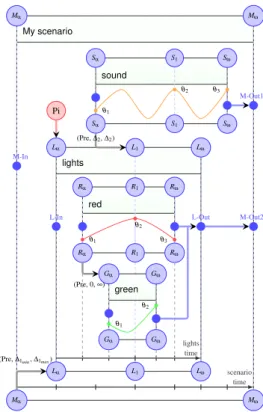
5http://figure53.com/qlab/ 6http://www.ableton.com/ My scenario Mα Mα Mω Mω M-In M-Out1 M-Out2 scenario time sound Sα Sα S1 S1 Sω Sω θ1 θ2 θ3 lights Lα Lα L1 L1 Lω Lω lights time L-Out L-In Pi red Rα Rα R1 R1 Rω Rω θ1 θ2 θ3 green Gα Gα Gω Gω θ1 θ2
(Pre,∆1min,∆1max)
(Pre,∆2,∆2)
(Pre, 0,∞)
Figure 1. An interactive scenario
specifies what can be changed during a performance. This way of writing the temporal organization is close to “con-straints programming”, since a performance constitutes an instance among possible scenarii that respect some given rules.
3.1. The writing model
We present here the graphical language used for writing the interactive scenarii. An example of such a scenario is given on the figure 1.
Since the system is though as a hub that can send ab-stract data to other applications, the writing formalism is based on processes able to compute and produce abstract values. The user can define how the processes will run dur-ing the performance. For this purpose, he defines the tempo-ral organization of his scenario by using tempotempo-ral objects.
The temporal objects are the basic element of the tem-poral model which is inspired from the hierarchical models proposed by Mira Balaban [3]. A temporal object with no children, called a texture, represents the execution in time of a given process. A temporal object with children, a struc-ture, represents the temporal organization of its children. Each structure has its own time line with scaled with its own time unit. A scenario is represented by a root struc-ture. Each object is associated with a set of control points which represent particluar moments of its execution.
On the figure 1, the objects “sound”, “red” and “green” are textures that represent the execution of processes, which
read tables in order to send values to specialized applications ; “lights” and “My scenario” are structures.
3.1.1. Temporal relations
The user can define the temporal proprieties of his scenario through temporal relations between the control points of the temporal objects. Thus these relations are taken from points algebra. There are 2 qualitative relations : precedence (Pre) and posteriority (Post). In addition, the user can specify quantitative constraints, by giving a range of possible values for the time interval between two points bound by a relation. The system will maintain the proprieties imposed by the temporal relations, during the writing process as well as dur-ing the performance. In the first case they can help the edit-ing operations, in the second case, they define the limits for the modifications introduced by the performer through the interaction points.
3.1.2. Interaction Points
During the writing process, the user can define some control points to be dynamically triggered by the performer during the execution. These control points are said dynamic (as the beginning of the “lights” structure on the figure 1), while the other control points, the static ones, will be triggered by the system. The written date of a dynamic control point is indicative.The possibilities are limited by the temporal re-lations. Then, on the figure 1, the system will refuse the dynamic triggering of the point Lαbefore the duration∆1min
has elapsed, in order to respect the relation between Mαand
Lα. In like manner, the system will automatically trigger
Lα if the performer did not before the duration ∆max has
elapsed.
3.2. The execution model
For the execution side of the system, we propose a generic abstract machine, called the ECO Machine, for running the scenarios written with the formalism.
Inside this machine, we represent the temporal organi-zation of the scenario with Petri nets structures (precisely hierchical time stream Petri nets [8]), which are runable place/transition representations of partialy ordered set of events ; they have been used several times in computer music appli-cations [6]. Other representation could be explorered such as concurrent constraints [2].
4. IMPLEMENTATION
In this section we present the IScore library, an implemen-tation of the formalism described in section 3. Thus, the library is the union of 2 parts which corresond to the sides of the model : an editor engine to write the temporal con-straints based scenarii, an execution engine to compile and to run the scenarii. This library, developed in C++ and cur-rently working on Mac OSX and Linux, is open source. 4.1. Architecture
The architecture of the implementation correpsonds to the theorical model.
4.1.1. Authoring
For the authoring part, we use a constraints solver solver li-brary (GeCode7. The dates of the control points and the
tem-poral relations are turned into a constraints problem. Each time a date is changed, the solver is called to find a new values for the other dates and tht scenario is updated. 4.1.2. Execution
For this side, we directly implemented the ECO machine as it is theorically described. Thus, we implemented a Petri nets runner. During the execution, the Petri nets is run ac-cording to its temporal caracteristics. Whenn triggering an event, the runner sends a message to a part of the software which lanches and stops the processes associated to the tem-poral objects.
4.1.3. Controller library
The Controller library is implemented to manage network communications. Indeed the Virage software has to control many different technologies by sending messages. This li-brary hides the protocols used to communicate with aother applications. When authoring a scenario, user only see some abstract devices that represent external environements. He can write the time evolution of the parameters of these envi-ronments without knowing how the values will travel trought the network during the execution.
4.2. Users involvement
Users have been implied in the research process all along the project, and at all its stages : from the initial definition of features through directed experimentations to the concep-tion stage by giving constant feedback and defining priori-ties of the development tasks. Then, once the first stable prototype had been produced, all successive steps of the de-velopment were the opportunity to confront the prototypes to a diversity of real-world situations generated by experi-mental workshops leaded by the 6 artistic partners of the re-search platform, ranging from the performing arts to digital interactive arts. These experimentations of the prototypes have been done within the existing creative environments of the field agents and developed around actual artistic ques-tions. These experiments have been done in actual produc-tion situaproduc-tions, but out of the producproduc-tion time, in order to avoid stressing the research process with production dead-lines and constraints.
4.3. Graphical interface
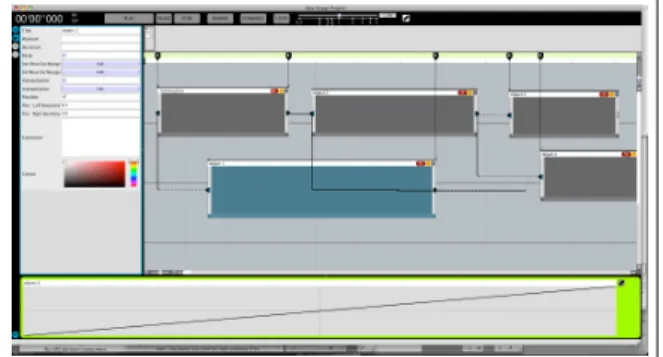
The main space of the graphical interface is dedicated to the edition of the temporal scenario, using the forthcoming elements : Temporal objects are represented by boxes on the time line, that can be connected at each end by Inter-vals, may they be fixed (bold lines), flexible (dashed lines) or semi-flexible with bounds (combination of bound and dashed lines representing the respective fixed and flexible durations). Trigger Points can be created and attached to
the temporal objects, allowing the user to interactively trig-ger them. They are currently placed on an upper rail for more straightforward ordering and triggering by the opera-tor, when executing the scenario. Though, it has been no-ticed that this representation was in some way restrictive to the creative temporal possibilities of the model. This place-ment of Trigger Points will be alternatively moved against the objects or on the time line rail depending on the editing mode (creation or execution) in a future version.
Apart from this main space, the user has access to a Namespace browser for exploring the remote environments.
Figure 2. A screenshot of the graphical interface.
5. PERSPECTIVES
Consolidation of the prototype as a usable cross-platform open source software by a further structuration of the project’s consortium and associated partners as a cooperative in order to keep the collaborative spirit developed throughout the re-search project
This consolidation phase will mostly focus on robust-ness (including porting the graphical interface to the Qt frame-work), ergonomy and usability
A few features that were not developed in the project will be added, including routing and conditioning of data flows or events from and to remote addresses, in order to allow to script continuous interaction and edition of hierar-chical scenarios (this feature is actually implemented in the engine)
Further research has been submitted to focus on the inte-gration of conditional objects, non-linearity, multi-user sce-narii.
6. CONCLUSION
We presented a research project that consisted in gather-ing researchers and field agents to propose solutions to real problems. Both groups came with a background, theoriti-cal models and results on one side, needs and experience on the other side. The all along communication allowed us to fuel the research process with new questions that leaded to adapt the theoretical background, but also to improve it for new developments. The scientific approach helped the field agents to clarify their point of view on their own practices, which evolve rapidly. It is clear that this parternship was
successful because both parts were enough mature, existing models for writing interaction on the one hand, real cases and newly established practices on the other hand.
A least, the software prototype gave an experimental tool and initiated the development of a really efficient soft-ware.
7. ACKNOWLEDGMENTS
This research project has been funded by French National Agency, in the ”Audiovisual and Multimedia program. The authors would also like to thank all of the partners of the Virage platform8 that have been contributing by feedback,
advising and workforce in order to achieve this project. 8. REFERENCES
[1] A. Allombert, “Aspects temporels d’un syst`eme de par-titions musicales interactives pour la composition et l’interpr´etation,” Ph.D. dissertation, Universit´e de Bor-deaux, 2009.
[2] A. Allombert, G. Assayag, M. Dessainte-Catherine, and C. Rueda, “Concurrent constraints models for interac-tive scores,” in Pr. of the 3rd Sound and Music Com-puting Conference (2006), GMEM, Marseille, France, May 2006.
[3] M. Balaban and N. Murray, “Interleaving time and structure,” Computers and Artificial Intelligence, vol. 17, no. 1, pp. 1–34, 1998.
[4] P. Baltazar and G. Gagner´e, “Outils et pratique du sonore dans le spectacle vivant,” in Actes des Journ´ees d’Informatiques Musicales (JIM07), Lyon, France, Avril 2007, pp. 153–162.
[5] A. Camurri, A. Catorcini, C. Innocenti, and A. Massari, “Music and multimedia knowledge and reasoning: the harp system,” Computer Music Journal, vol. 19, no. 2, pp. 34–58, 1995.
[6] A. Camurri, G. Haus, and R. Zaccaria, “Describing and performing musical processes by means of petri nets,” Interface, vol. 15, pp. 1–23, 1986.
[7] T. Coduys and G. Ferry, “Iannix - aesthetical/symbolic visualisations for hypermedia composition,” in Proc. of the 1st Sound and Music Computing Conference
(SMC04), Paris, France, 2004.
[8] R. W. P. S´enac, P. De Saqui Sannes, “Hierarchical time stream petri nets : A model for hypermedia systems,” in Proc. of the 16th International Conference on Appli-cations and Theory on Petri Nets, Turino, Italy, G. D. Michaelis and M. Diaz, Eds., 1995, pp. 451–470. [9] S. Pope, “Music notations and the representation of
musical structure and knowledge,” Perspectives of New Music, vol. 24, no. 2, 1986.