HAL Id: hal-00806019
https://hal.archives-ouvertes.fr/hal-00806019
Submitted on 29 Mar 2013
HAL is a multi-disciplinary open access
archive for the deposit and dissemination of
sci-entific research documents, whether they are
pub-lished or not. The documents may come from
teaching and research institutions in France or
abroad, or from public or private research centers.
L’archive ouverte pluridisciplinaire HAL, est
destinée au dépôt et à la diffusion de documents
scientifiques de niveau recherche, publiés ou non,
émanant des établissements d’enseignement et de
recherche français ou étrangers, des laboratoires
publics ou privés.
Structural and electronic properties of p-doped silicon
clathrates
Damien Connétable
To cite this version:
Damien Connétable. Structural and electronic properties of p-doped silicon clathrates. Physical
Review B: Condensed Matter and Materials Physics (1998-2015), American Physical Society, 2007,
vol. 75, pp.125202. �10.1103/PhysRevB.75.125202�. �hal-00806019�
O
pen
A
rchive
T
oulouse
A
rchive
O
uverte (
OATAO
)
OATAO is an open access repository that collects the work of Toulouse researchers and
makes it freely available over the web where possible.
This is an author-deposited version published in:
http://oatao.univ-toulouse.fr/
Eprints ID : 2415
To link to this article :
URL :
http://dx.doi.org/10.1103/PhysRevB.75.125202
To cite this version :
Connétable, Damien ( 2007)
Structural and electronic
properties of p-doped silicon clathrates.
Physical Review B (PRB), vol. 75 (n°
12). p. 125202. ISSN 1098-0121
Any correspondence concerning this service should be sent to the repository
administrator:
[email protected]
Structural and electronic properties of p-doped silicon clathrates
D. Connétable*
Laboratoire de Physique de la Matière Condensée et des Nanostructures, Bâtiment Brillouin, 43 Bd du 11 Novembre 1918, Université Claude Bernard Lyon I and CNRS, 69622 Villeurbanne, France
We present an ab initio study of the structural and electronic properties of type-I and type-II silicon clath-rates doped by elements chosen to be more electronegative than silicon. Depending on the intercalated element, we show that the electronic properties of doped silicon clathrates can exhibit metallic, semiconducting, or insulating behavior. It is found in particular that doping can lead to silicon-based materials with a band gap in the visible range and that, in type-II clathrates, the gap can be direct. However, the analysis of the selection rules show that the optical transitions are forbidden in type-I and type-II clathrates. Concerning the structural properties, the bonding between the dopant atom and silicon can significantly decrease the compressibility of the host network to values equivalent to the one of the much denser diamond phase. The present results are complemented and rationalized by the study of endohedrally doped SinHn共n=20,24,28兲 silicon clusters.
DOI:10.1103/PhysRevB.75.125202 PACS number共s兲: 81.05.Zx, 71.20.Tx, 82.75.⫺z, 62.20.⫺x
I. INTRODUCTION
Four decades after their first synthesis by Kasper et al.,1
clathrates have recently attracted new attention from both experimentalists and theoreticians due to their promising structural, electronic, dynamical, and superconducting prop-erties. This can be related, in particular, to the discovery of a BCS superconductivity at T⬃8 K in BaxNay@Si-46
clathrates.2–4Theoretical predictions5–15that the band gap in
empty silicon clathrates is ⬃0.7 eV larger than the one of the silicon diamond phase have been confirmed experimentally,16 thus providing novel perspectives in
opto-electronic applications. The low compressibility of such phases,17–19 the high stability under pressure,17 the prospect
of using clathrates as low work function materials,20the
pre-diction of more generally efficiently doped semiconducting phases,21 and the high thermoelectric power of doped
clathrates22–25are other subjects of current research. Further,
due to a rapid progress in the techniques of synthesis, new types of clathrates are constantly appearing. For example, systems containing such doping atoms as alkali metals, alka-line earth metals, or noble metals and frameworks made of combinations of Cu, Al, Ga, In in substitution of Si, Ge, or Sn have been synthesized.
Clathrates are cagelike open framework compounds, com-posed of three-dimensional networks of polyhedra which are sharing faces. Nearest neighbor distances and angles between the bonds are approximately the same as those we find in the diamond phase关in the silicon case d共Si−Si兲⬇2.35±0.05 Å, ⌰共Si−Si兲⬇109±5°兴, and all atoms are also linked together through sp3-type covalent bonds. The presence of 87% of pentagonal cycle共contrary to the diamond phase where there are only hexagonal cycles兲 is expected to be at the origin of the specific electronic and dynamical properties of clathrates.14
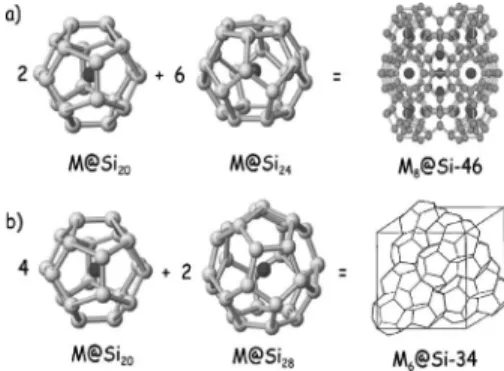
Clathrates are mainly classified into two types. The type-I clathrate, called Si-46, crystallizes in a simple cubic共sc兲 lat-tice with 46 atoms per unit cell and a Pm3¯n 共No. 223兲 sym-metry. We distinguish two sorts of cages in the network: 2 dodecahedral 共12-hedral with 12 pentagonal cycles兲 X20
cages共X=Si,Ge,Sn兲 of Ihpoint symmetry, and 6
tetrakaid-ecahedra X24共14-hedral with 12 pentagonal and 2 opposing
hexagonal cycles兲 cages of D6d symmetry, which are
con-nected together by sharing their faces 关see Fig. 1共a兲兴. The
type-II clathrate Si-34共often referred to as Si-136兲 is a face centered cubic共fcc兲 lattice with 34 atoms in the unit cell and a Fd3¯m 共No. 227兲 symmetry. This crystal can be seen as an aggregate of 2 hexadecahedral共16-hedral with 12 pentagonal and 4 hexagonal cycles兲 X28 cages 共Td兲 关Fig. 1共b兲兴 at each
site of the fcc unit cell. The space between the 16-hedral cages forms other cages of共4兲 12-hedral X20.
The originality of such structures is the possibility of a high endohedral doping, that is doping by inserting 共interca-lation兲 until there is one atom in each cage 共which corre-sponds to 20% of doping兲. From this point of view, doping of clathrates is much easier than doping of the diamond phase. As it will be shown later, intercalation can lead to dramatic changes of the electronic and structural properties. In a pre-vious work,26 we reported our theoretical results on the
un-usual structural and electronic properties of I8@Si-46
clath-rate synthesized recently by Reny et al.27 In the present
paper, we expand our study and report our ab initio results for Si-46 and Si-34 clathrates doped by seven elements共Xe,
FIG. 1. Symbolic ball-and-stick representation of the composi-tion of共a兲 M8@Si-46: six 14-hedral Si24cages and two 12-hedral
Si20cages and共b兲 M6@Si-34 clathrates: two 16-hedral Si28cages and four 12-hedral Si20cages.
I, Te, Sn, Kr, Br, and Ge兲 from the right side of the periodic table. We have not explored all the possibilities of intercala-tion, however we would like to give a general overview of this type of doping. The variety of doping elements will al-low us to perform a comparative analysis and to predict and to understand the evolution of the interaction of the doping element with the host network. As a result, the evolution of the properties of the material can be further analyzed.
The paper is organized as follows. In Sec. II, we briefly outline our computational framework. In Sec. III A, we present first-principle calculations on type-I clathrate doped by the elements mentioned above. To understand the origin of the modification of the electronic properties under doping, we study, in Sec. III B, the isolated clusters Si20H20, Si24H24,
and Si28H28 doped by the same elements. We focus in
par-ticular on the role of symmetries in driving the electronic properties. Such a symmetry共group theory兲 analysis is ex-tended to the clathrate phase in the Sec. III C. To confirm our results, we have also performed first-principles calculations of Kr8@Si-46 and Br8@Si-46 in Sec. III D, Xe6@Si-34 and
I6@Si-34 clathrates in Sec. III E. Finally, we conclude this
paper with the study in Sec. III F of the optical transitions in empty and Xe-doped Si-46 and Si-34 clathrates at high sym-metry points of the Brillouin zone.
II. COMPUTATIONAL DETAILS
Our calculations were done within the density functional theory28,29共DFT兲 in the local density approximation 共LDA兲.
The Perdew-Zunger parametrization30 of the Ceperley-Alder
homogeneous electron gas exchange-correlation potential31
was used. The valence electrons were treated explicitly while the influence of the core electrons and atomic nuclei was replaced by norm-conserving Trouiller-Martins pseudopotentials32 factorized in Kleinman-Bylander form.33
For the doping elements, pseudopotentials were generated including scalar relativistic effects and a nonlinear core correction34 was used to mimic some of the effects of the d
shell on the valence electrons.
We employed the SIESTA program package35 which is a
self-consistent pseudopotential code based on numerical pseudoatomic orbitals共PAOs兲 as the basis set for decompo-sition of the one-electron wave functions. A well-converged basis set, consisting of doubled 兵s,px, py, pz其 orbitals plus
polarization d-orbitals was adopted. The charge density was calculated on a real-space grid with a spacing equivalent to 80 Ryd cutoff. For structure optimization, the Brillouin Zone 共BZ兲 was sampled by a 2⫻2⫻2 Monkhorst and Pack grid36
which corresponds to 1 and 2 irreducible k points for
M8@Si-46共sc lattice兲 and M6@Si-34共fcc lattice兲 clathrates
respectively. For the calculation of the density of states, we have adopted a fine 8⫻8⫻8 grid 共20 and 60 irreducible k points, respectively兲.
All systems studied below were fully relaxed both with respect to the unit cell size and atomic positions. To evaluate the bulk modulus, several structural relaxations for different unit cell volumes were performed, and the results were fitted by a Murnaghan equation of state.37
III. RESULTS AND DISCUSSION A. The case of the„Xe\Sn…8@Si-46 clathrates
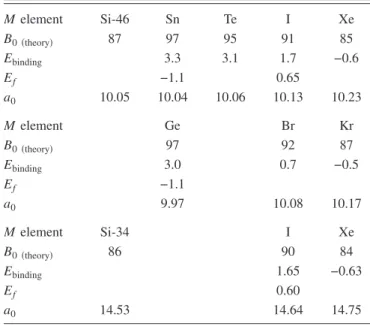
Calculated structural parameters and cohesive energies for type-I silicon clathrates are presented in TableI. Seven ele-ments of the periodic table共M =Xe, I, Te, Sn, Kr, Br, and Ge兲 were chosen as possible dopants. The stoichiometry of the calculated structures was M8@Si-46, i.e., both Si24and Si20
cages were filled with the doping elements M. We restrict our choice by placing the doping element at the center of the cages. In this section, we concentrate on the compounds where the doping elements belong to the fifth row of the periodic table 共Xe, I, Te, Sn兲. Such a work has been sug-gested by the recent synthesis of I- and Te-doped clathrates.27,38,39
We first discuss the structural and mechanical properties of the systems under study and in particular their binding energies Ebinding共M兲=
1
8关E共Si46兲+8E共M兲−E共M8@Si46兲兴. We
take as a reference the energy of the undoped Si-46 clathrate, and the isolated atom40 of the doping element. The results
共TableI兲 suggest that all elements, except for the noble gas
共Xe and Kr兲, are stabilized by being intercalated inside the Si-46 network. In particular, we find that I atom prefers to sit in the middle of the silicon cages rather than in I2dimers共by
0.65 eV atom兲, which is consistent with the experimental fact that I8@Si-46 has been already synthesized. On the
con-trary, in the case of Sn共or Ge兲 doped element, atom seems prefer to not form doped clathrates 共see note Ref. 41兲: the
formation energy共Ef in TableI兲, taking as references Si-46
and the standard states for Sn共and Ge兲, is found negative. We will show later, that the increase of the binding energy when going from I to Sn can nevertheless be correlated to the increase of the covalent character of the chemical bond be-tween the dopant and the network.
TABLE I. Calculated bulk modulus共GPa兲, binding energy 共eV兲, formation energy共in eV per M element兲 and lattice parameter a0共Å兲 for M8@Si-46 共M =Xe, I, Te, Sn, Kr, Br, and Ge兲 and for
M6@Si-34共where M =Xe and I兲 clathrates. A negative binding en-ergy means that the M element is not binding inside the cages共see text兲. The bulk modulus of Si-2 is calculated to be 97 GPa.
M element Si-46 Sn Te I Xe B0共theory兲 87 97 95 91 85 Ebinding 3.3 3.1 1.7 −0.6 Ef −1.1 0.65 a0 10.05 10.04 10.06 10.13 10.23 M element Ge Br Kr B0共theory兲 97 92 87 Ebinding 3.0 0.7 −0.5 Ef −1.1 a0 9.97 10.08 10.17 M element Si-34 I Xe B0共theory兲 86 90 84 Ebinding 1.65 −0.63 Ef 0.60 a0 14.53 14.64 14.75
Concerning the structural properties, it can be clearly seen 共TableI兲 that the lattice parameter is continuously decreasing
from Xe to Sn. The unit cell volume of Sn8@Si-46 system is
5% smaller than that of Xe8@Si-46, and is even smaller than
the unit cell volume of the empty Si-46 structure. On the contrary, standard atomic tables show that the size of the doping atom increases from Xe to Sn. This allows us to conclude that a simple analysis in term of steric共or volume excluded兲 effects is not appropriate for these systems. TableI
also indicates that the lattice contraction is accompanied by a constant increase of the bulk modulus. While being 85 GPa for the Xe8@Si-46 system, it reaches the value of 97 GPa for
Sn8@Si-46, a value comparable with the bulk modulus of the
silicon diamond phase.42 The high compressibility of Xe
doped clathrate rules out the simple idea that a big interca-lated atom should necessarily prevent the easy compression of the cages.
Two antagonist effects could explain these main results: the steric effects, due to the confinement of the doped ele-ment which expand cages, and the ionic/covalent effects, which contract cages, and characterize the interaction be-tween the network and the doping element. Later, we shall try to analyze the role of both of these effects, and will try to use this analysis to understand our structural data.
We now discuss the electronic structure of the
M8@Si-46共M =Xe,I,Te,Sn兲 clathrates. Figure2shows the LDA band structure of doped Si-46 clathrates along high symmetry directions of the Brillouin zone. The band struc-ture for undoped Si-46 clathrate is also presented as a refer-ence. As emphasized in the Introduction, the comparison of the band structures clearly indicates that a large variety of electronic properties can be obtained by changing the inter-calated atom.
We first focus on the Xe-doped system. Even though the negative binding energy, obtained for the intercalation of rare gas atom, questions the possibilities of synthesizing such a compound, Xe8@Si-46 will serve us as a useful reference
system to study the effect of doping. The most important result is the opening of the band gap共1.65 eV DFT value兲, which is 0.45 eV larger than that of the empty Si-46 clathrate and 1.1 eV larger than the one of Si-2 diamond共within the
same DFT formalism兲. Comparing the band structures of Si-46 and Xe8@Si-46 systems, we observe that the top of the
valence bands is hardly modified while the bottom of the conduction bands changes dramatically. Figure 3 presents calculated electronic density of states共eDOS兲 projected onto atomic orbitals for the Xe8@Si-46 system. The contribution
of Xe-5p orbitals is located in the middle of the valence band, while Xe-5s orbitals are located at much lower energy. Peaks A and B belong to 5s orbitals of Xe atoms located inside Si20 and Si24 cages, respectively. Peak A is always
lower in energy, due to the smaller size of the Si20cage. We
observe that, in spite of a small Xe weight both at the top of the valence band and at the bottom of the conduction band, the intercalation of Xe atoms modifies strongly the conduc-tion bands of the Si-46 system. Using the symmetry analysis of the character of Si-46 states, we shall show later that the coupling between Xe and Si-46 states takes place at the bot-tom of the conduction bands thus opening the band gap.
Now we analyze the electronic structure of I8@Si-46 and
Te8@Si-46 clathrates and compare it with that of the
Xe8@Si-46 system. Contrary to the Xe case, intercalation of
I or Te leads to a strong modification of the top valence bands of the silicon network共Fig.2兲, which now has a
sub-stantial contribution of the guest atoms 5p orbitals共Fig.3兲.
This is related to the ionic character of the I-Si and Te-Si bonds关using the Pauling scale, the electronegativities of Si, Te, and I are, respectively, 1.90, 2.10, and 2.66共Ref.43兲兴. As
a results, charge is transfered to the 5p levels of I and Te which are pushed up to the Fermi level. The integrated eDOS for the Iodine system shows that there are exactly four states between the Fermi level and the bottom of the gap, which corresponds exactly to eight I-5p electrons missing in the unit cell. The same integration for Te gives eight states, cor-responding to sixteen Te-5p electrons missing. As a result, I and Te systems become p-type degenerated doped semicon-ductors, with the Fermi level located, respectively, 0.26 and 0.68 eV below the “top of the valence band.” While the up-per valence bands are strongly modified as compared to Xe8@Si-46, we emphasize that the lower conduction bands
are on the contrary very similar. Further, the band gap of I8@Si-46 is found to be ⬇1.6 eV, which is relatively close
FIG. 2. DFT-LDA band structure of Si-46 and M8@Si-46 clathrates共M =Xe,I,Te,Sn,Kr,Br兲 along high symmetry directions of the Brillouin zone. Energies are in eV. The zero of energy has been set to the top of the valence bands for semiconductors and to the Fermi level for metallic systems. The arrows indicate the nature of the band gap.
to the one of Xe8@Si-46共⬃1.65 eV兲. This indicates that the
band gap opening is not related to charge transfer, ionic ef-fects are not indeed expected to occur when doping by Xe. We shall discuss the origin of such a large band gap in the Sec. III C.
We finally studied the evolution of the electronic structure of M@Si-46 clathrates going from M = I to M = Sn. Figure3
shows that Sn-5p states are now located in the band gap of the empty Si-46, and the doped clathrate becomes a pure metallic system. The reduction of the electronegativity while going from I to Sn共1.96 in Pauling units for Sn43兲 suggests
the increase of the covalent part of the chemical bonding between the intercalated atom and the silicon network. This could be a reason for the observed lattice contraction, and the increase of the bulk modulus as it was mentioned above.
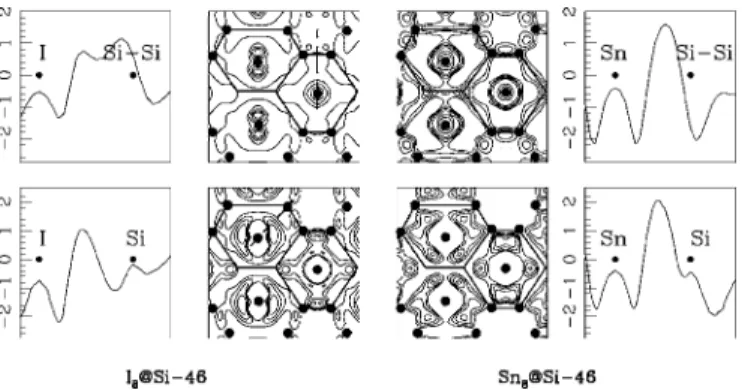
The nature of the chemical bond can be understood by analyzing the electron density distribution maps. Namely, we calculated the difference between the electronic density of the doped clathrate and a superposition of the electronic den-sity of empty Si-46共using the same volume兲 and correspond-ing “isolated” dopants. The results for the 共100兲 plane are presented in Fig.4. The positive共bottom兲 and negative 共top兲 parts of the electronic density are plotted separately for a convenient analysis. The radial electronic density has been plotted for further information along two different directions 共dotted lines on the map of the Fig.4兲: the first along one Si
and M atoms in a Si24cage 共bottom兲, and the second along
the middle of a Si-Si bond and M in a Si20 cage 共top兲. We notice a charge transfer from the cages to the interstitial space atom for the I- and Sn-doped clathrate. In the case of Sn doping we can clearly see a charge transfer from both the Si network and the doping atom to the space between Si and Sn, which proves our statement about the covalent nature of chemical bonding in this compound. In the case of the I doping there are two effects which we need to take to ac-count, to explain the electronic map: the electronic transfer due to the doping and the extension of the orbitals.
The formation of bonds between Si atoms and the dopant element means that the effective coordination number of Si becomes larger than four. As such, doped Si clathrates can be considered as high density phases of Si at ambient pressures. Their increased coordination numbers may explain why Sn8@Si-46 shows a large bulk modulus combined with a
strong metallic character.
At the end of this section we should mention that our results for the band gap opening have been confirmed by accurate many-body calculations within the GW
approxima-FIG. 3. Electronic density of states 共eDOS兲 for Si-46 and M8@Si-46 clathrates 共M =Xe,I,Te,Sn兲. Energies are in eV and
eDOS in states/eV. The zero of energy has been set to the Fermi level. The thick lines correspond to the total eDOS, the dotted lines correspond to the total eDOS projected on the guest atom orbitals, and the thin lines correspond to the silicon network total eDOS contribution. A 0.1 eV broadening has been used. Peaks A and B represent the s-orbital contribution of the guest atom, located in Si20, and Si24cages, respectively.
FIG. 4. Contour maps of the⌬ electron density distribution for I8@Si-46 and Sn8@Si-46 clathrates in the 共100兲 plane. ⌬
=共M8@ Si-46兲-共Si-46兲-8ⴱ共M兲 共see text兲. Each map has been delimited by five levels. The upper figures represents the negative part of the electron density contribution, while the bottom figures represent the positive part. The black circles show the positions of the atoms in the plane. There are five contours共positive or negative兲 for each map. The extrema correspond, respectively, to −4.5 to + 1.6 10−3electron/共a.u.兲3 and −2.2 to + 2.0 10−3electron/共a.u.兲3
for I- and Sn-doped clathrates. The black lines between the black circles symbolize the trace of the cages in the planes. We plot also the radial density distribution along two directions. Upper graphs represent it along a M atom and the middle of the bond Si-Si. Bottom figures represent it along a line between M and one atom of the Si24cage. The scale is in 10−3electron/共a.u.兲3.
tion, performed for the Xe8@Si-46 system.26,44The band gap
was also found to be 0.6 eV larger as compared to the empty Si-46 clathrate, and twice higher than the silicon diamond phase 共gapexp= 1.15 eV兲. However, as shown later, the
mechanisms responsible for this striking effect can be easily understood within usual DFT-LDA approach, taking into ac-count symmetry considerations.
B. Isolated clusters
For better understanding of the influence of cage-dopant interactions on the electronic properties of type-I and -II clathrates, we have studied the influence of intercalation on isolated hydrogenated clusters the elementary brick of clath-rates. The Si20, Si24, and Si28cages were “extracted⬙ from the
bulk and all dangling bonds on the cluster surfaces were passivate with hydrogen atoms共to mimic the fourfold coor-dination as in the clathrate phase兲. We used unit cells large enough to eliminate the interaction between clusters共the dis-tance between the clusters was more than 20 Å兲. The clusters were then relaxed with respect to atomic positions without imposing any symmetry limitations.
The case of isolated and intercalated Si cages 共H passi-vated or not兲 have been studied in the past in order to pro-pose new “building blocks” for designing cluster-made ma-terials 共see Refs. 45–47, for example兲. We study in the
following only the intercalated cages which are relevant for our study of the clathrates.
The results show that Si20H20 共symmetry Ih兲, Si24H24
共D6d兲, and Si28H28共Td兲 clusters remain stable under I doping
as in the clathrate bulk. The symmetry groups of the empty clusters were also well preserved after the relaxation process. This fact allowed us to perform a classification of molecular levels of the clusters according to irreducible representations of the corresponding point group. For the I-doped clusters a small distortion of the cage geometry due to a Jahn-Teller effect was observed. The corresponding splitting of the high-est occupied molecular orbital level was found to be about 0.15 eV in Si20H20. In the case of Xe doping, the binding energy is negative 共non bonding兲 for Si20H20, and positive
for Si24H24 and Si28H28 clusters共see TableII兲.
TableIIIpresents the energies of four molecular orbitals, including the highest occupied molecular orbital 共HOMO兲 and the lowest unoccupied molecular orbital 共LUMO兲, for each of the clusters. The corresponding irreducible represen-tations are also presented for each of the orbitals. The intro-duction of the guest atom leads to the shift of the LUMO level to higher energies, yielding an increase of the molecu-lar gap by 0.5 to 0.8 eV 共Table III兲. On the contrary, the
HOMO states seem to be hardly affected by the intercalation in the case of Xe@SinHn. This effect can be clearly seen on
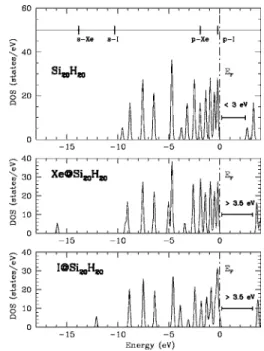
presented eDOS for Si20H20 clusters with Xe and I doping
共Fig.5兲. The results are comparable to those obtained for the
bulk clathrate phase.
This result is at first sight somewhat counterintuitive, as the 5p shell of Xe or I lies below the HOMO levels. The standard repulsion by hybridization mechanism between two levels 共see Fig. 6兲 would call for a closing of the gap by
repulsion of the HOMO level. However, as shown previously for Xe-doped systems, the top of the valence bands共and the HOMO states of the clusters兲 are hardly modified by the intercalation. To understand this fact we shall concentrate on
TABLE II. Binding energy共eV兲 for M@SixHx 共M =Xe,I, and
x = 20, 24, 28兲 cluster.
Cluster Si20H20 Si24H24 Si28H28
I 2.4 1.9 1.8
Xe −0.7 0.0 0.3
TABLE III. Energy levels of Si20H20, Si24H24, and Si28H28
clus-ters near the molecular gap. The symmetry groups of the clusclus-ters as well as corresponding IRs of the molecular levels are also presented 共see text兲. The bottom of the table shows the opening of the mo-lecular gap due to intercalation, and the IRs of the corresponding guest atom orbitals in the crystal field of the cluster. The reference energy has been set to the HOMO level.
Si20H20共Ih兲 Si24H24共D6d兲 Si28H28共Td兲
Mol. Lev. E共eV兲 E共eV兲 E共eV兲 HOMO− 1 −0.3共Gu兲 −0.2共E4兲 −0.1共E兲
HOMO 0.0共Hu兲 0.0共B1兲 0.0共T1兲 LUMO +2.9共Ag兲 +2.8共A1兲 +2.9共A1兲
LUMO+ 1 +3.6共T1u兲 +3.4共E1兲 +3.5共T2兲 Molecular gap opening due to intercalation共eV兲 IR 共T1u, Ag兲 共B2, E1, A1兲 共T2, A1兲
I 1.0 0.6 0.5
Xe 0.9 0.6 0.5
FIG. 5. Electronic density of states 共states/eV兲 for Si20H20,
Xe@Si20H20, and I@Si20H20clusters. The upper panel also shows the position of s and p orbitals of free Xe and I atoms.
the results presented in TableIIIand try to find out the rea-son for the increase of the molecular gap. The molecular field of the cluster causes the splitting of s and p orbitals of the guest atom into several irreducible representations, de-pending on the point symmetry group of the cluster. Let us consider as an example the Si20H20 cluster. The symmetry
group of the cluster is Ih, and the orbitals of the guest atom
split into the following irreducible representations共IRs兲: Ag
丣T1u. We see that these representations are present in the
IRs of two lowest unoccupied molecular orbitals, but can not be found among IRs of two highest occupied orbitals. This shows that only the lowest unoccupied orbitals can couple with the orbitals of the guest atom, while coupling with the highest occupied states is forbidden by symmetry. As a re-sult, only the LUMO states are “repelled” by the intercalated orbitals. This mechanism leads to the increasing of the mo-lecular gap value, as observed on eDOS plots共Fig.5兲.
Ex-actly the same effect is observed for Si24H24 and Si28H28
clusters共Table III兲. The described hybridization is stronger
for smaller cages, leading to a larger gap for the Si20H20
cluster.48
C. Symmetry analysis in the clathrate phase
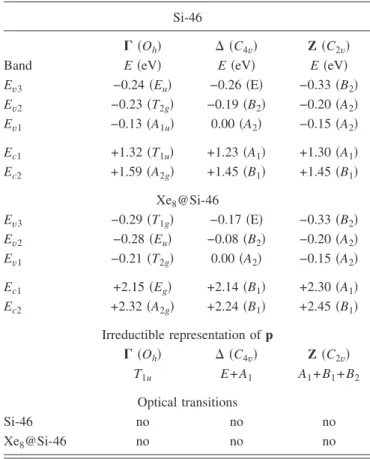
Now keeping in mind all our results obtained for the clus-ters, we turn back to clathrates and apply the same type of symmetry analysis for the bulk phase. We have analyzed the symmetries of five bands共three valence and two conduction兲 at three k points of the irreducible part of the BZ. We took the⌫ point, the middle between the ⌫ and X points, and the middle between X and M points 共see Fig. 2兲. For each k
point and each energy band, we determined the irreducible representation共IR兲 of the respective point group. The results for Si-46 and Xe8@Si-46 systems are summarized in Table
IV.
First, we consider the high-symmetry⌫ point. The doping atoms are located at positions with point group Oh, and the
crystal field causes the splitting of s and p orbitals of the doping atom into the following irreducible representations:
IRs=关A1g丣A2g兴丣关A1g丣Eg丣T2u兴 and
IRp=关T1u丣T2u兴丣关2T1u丣T2u丣Eg丣A2g丣T1g丣T2g兴,
where the IRs for the atom in the Si20共Si24兲 cages. are given on the left共right兲 of the 丣 direct product.
We observe that the top of the valence band and the bot-tom of the conduction band belong to A1uand T1u
represen-tation respectively. However, only T1u representation is
present among the IRs of the doping atom. This leads to the conclusion that only the bottom of the conduction bands can couple to the orbitals of the guest atom, leading to the band gap opening. This is similar to what was observed in the case of isolated clusters. As the T1u representation is present
among IRs of the p orbitals of the doping atoms located both in Si20and Si24cages, both intercalation sites should
contrib-ute to the change of the band structure.49 There exists of
course certain states in the valence band which are allowed to interact with the orbitals of the guest atom. As a result of interaction, these states are also pushed to higher energies 共TableIV兲, but this shift is not large enough to enter in the
band gap共Fig.2兲.
TABLE IV. Symmetry classification of the valence and conduc-tion bands near the fundamental gap for Si-46 and Xe8@Si-46 sys-tems共simple cubic lattice兲. The energies are calculated at three k points of the Brillouin zone. The k points along the⌫-X 共⌬兲 and X-M 共Z兲 directions are taken in the middle of the corresponding intervals. The bottom of the table shows the IRs of the momentum operator for the corresponding k-points, and the possibility of a direct dipole transition. The reference energy has been set to top of the valence bands.
Si-46
⌫ 共Oh兲 ⌬ 共C4v兲 Z共C2v兲
Band E共eV兲 E共eV兲 E共eV兲
Ev3 −0.24共Eu兲 −0.26共E兲 −0.33共B2兲 Ev2 −0.23共T2g兲 −0.19共B2兲 −0.20共A2兲
Ev1 −0.13共A1u兲 0.00共A2兲 −0.15共A2兲
Ec1 +1.32共T1u兲 +1.23共A1兲 +1.30共A1兲 Ec2 +1.59共A2g兲 +1.45共B1兲 +1.45共B1兲 Xe8@Si-46 Ev3 −0.29共T1g兲 −0.17共E兲 −0.33共B2兲 Ev2 −0.28共Eu兲 −0.08共B2兲 −0.20共A2兲 Ev1 −0.21共T2g兲 0.00共A2兲 −0.15共A2兲 Ec1 +2.15共Eg兲 +2.14共B1兲 +2.30共A1兲 Ec2 +2.32共A2g兲 +2.24共B1兲 +2.45共B1兲 Irreductible representation of p ⌫ 共Oh兲 ⌬ 共C4v兲 Z共C2v兲 T1u E + A1 A1+ B1+ B2 Optical transitions Si-46 no no no Xe8@Si-46 no no no
FIG. 6. Schematic representation of the expected coupling of the guest 5p orbitals with the HOMO level of the silicon clathrate or cluster. On the right, the position of the Xe, I, and Sn levels with respect to the top of the valence bands of clathrate is provided.
D. Electronic and structural properties of Si-46 clathrates doped by Kr, Br, and Ge
It is interesting to see if the results obtained above for doping elements in the Xe row, remain valid in the Kr serie. We have therefore performed calculations of type-I clathrates doped by three elements from the fourth row of the periodic table. We studied Kr8@Si-46, Br8@Si-46, and Ge8@Si-46
systems. The calculated lattice parameter, bulk modulus and binding energy for each of the systems are presented in Table
I. Comparing these results with the data obtained for the fifth row elements studied before 共Table I兲, we observe exactly
the same behavior. The bulk modulus continuously increases and reaches 97 GPa for the Ge-doped system, while the unit cell contracts to a volume smaller than the volume of the empty Si-46 structure.
The band structure共Fig.2兲 and the electronic density of
states 共Fig. 7兲 also shows a strong similarity between
Xe8@Si-46 and Kr8@Si-46 systems, as well as between
I8@Si-46 and Br8@Si-46 systems. Xe- and Kr-doped
clath-rates remain pure semiconductors, while I- and Br-doped systems become p-type doped semiconductors. The hybrid-ization of the conduction band states with the orbitals of the guest atom leads to the increasing of the band gap value, which becomes larger than 2 eV for Br8@Si-46 system
共DFT value兲. This is even larger than what was obtained for elements in the Xe line. Nothing prevents to believe that even larger gap values may be achieved.
E. Electronic and structural properties of Xe- and I-doped Si-34 clathrates
To make our research complete, we have explored the effect of Xe and I doping on atomic and electronic structure of type-II clathrates. This study will provide us with addi-tional information to check the trends observed in the previ-ous section. At the same time, the results obtained for the isolated clusters indicated that Si20cages have stronger
influ-ence on the electronic properties of the doped clathrates than Si28cages. The study of type-II clathrate will give us a
pos-sibility to check the validity of this statement.
Table I presents the calculated structural characteristics and binding energies for Xe6@Si-34 and I6@Si-34
clath-rates. The same characteristics for the empty Si-34 structure are also presented for sake of comparison. We see that the structural parameters exhibit the same tendency as in the Si-46 structure. Going from Xe to I, we observe an increase of the bulk modulus accompanied by a decrease of the lattice parameter.
The calculated binding energies for type-I clathrates show that the I atom prefers to sit inside the clathrate cages, while Xe atom does not. However, the calculation of Si-34 systems where Xe is located in Si28or in Si20only cages yields
bind-ing energies of⬃0 and ⬃−1.6 eV respectively. This demon-strates that Si28cages are the first candidates to be occupied
by the guest atoms even when this doping is energetically unfavorable. This correlates with the experimental results of Reny et al.,50 who observed that sodium atoms prefer to sit in Si28cages in the Nax@Si-34 compound.
We first focus on Xe-doped clathrate Xe6@Si-34. The
most important result 共Fig. 8兲 is again a large direct
共⬇1.95 eV DFT value兲 band gap, as compared to 1.30 eV for the empty Si-34 clathrate. As in the case of Xe8@Si-46,
we notice that the bottom of the conduction band is strongly modified under doping while the top of the valence band is only slightly modified. As we shall see later, the symmetry considerations can help us to understand this effect. For I6@Si-34, we also obtain a p-type semiconductor behavior,
with three states between the Fermi level and the top of the valence band. This corresponds, as in the I8@Si-46 case,
exactly to the number of states to fill the I shell. In the two doped type-II clathrates, we observe a direct band gap at the
L point, exactly as in the empty Si-34 system.
To clarify the influence of different cages on the elec-tronic properties of the compound, we performed additional calculations of Xe2@Si-34 and Xe4@Si-34 structures with
Xe atoms in Si28 and Si20 cages only, respectively. The
cal-culations were performed taking the atomic coordinates of Xe6@Si-34 system without structure relaxation and any
modifications of the unit cell共the difference between these unrelaxed systems and the corresponding relaxed one is small兲. Figure 8 shows the band structure of these systems. We observe a negligible modification of the band structure of Si-34 after intercalating a guest atom in the Si28 cages. On the contrary, the modifications are substantial after the Si20 cages are filled with the doping element. For both
Xe2@Si-34 and Xe4@Si-34 systems we calculated the
dif-ference between the electronic density of the doped system and a superposition of the electronic density of empty Si-34 and Xe atoms 共not represented here兲. For the Xe2@Si-34
structure, we hardly observe any influence of the doping atom, which is clearly not the case for the Xe4@Si-34
struc-ture. These results demonstrate the fundamental role of Si20
cages in the formation of the electronic structure of the doped clathrate systems.51
To check that the hybridization mechanisms between the guest atom and the host network are the same for type-I and type-II clathrates, we perform a symmetry analysis for doped Si-34 system at the ⌫ point. The s and p orbitals of the guest atom split to the following irreducible representations: IRs=关A2u丣A1g兴丣关A1g丣T2g兴 and IRp=关T2g丣T1u兴丣关A2u
FIG. 7. Electronic density of states共eDOS兲 for Kr8@Si-46 and
丣2T1u丣Eu丣T2u兴, where the IRs for the atom in the Si20
共Si28兲 cages. are given on the left 共right兲 of the 丣 direct
product.
Table V presents the energies of three valence and two conduction bands of Si-34 structure with their respective ir-reducible representations. We see that the top of the valence bands and the bottom of the conduction bands belong to T1g
and T1urepresentations, respectively. However, only the T1u representation can be found among IRs of the doping ele-ment. This shows that the coupling takes place mostly with the bottom of the conduction bands, leading to the band gap opening. We see that the hybridization mechanism is exactly the same as we observed while studying Si-46 structure and the cluster models.
F. Optical transitions
The present study demonstrates that contrary to the Si-46 clathrate, the Si-34 structure shows a direct band gap which can be as large as 2 eV共DFT value兲 under Xe or I doping 共Fig.8兲. This value is probably even larger 共⬃2.6 eV兲 if we
accept the assumption that the GW correction of 0.6 eV is the same for type-I and type-II clathrates.26The direct nature
of the band gap and its large value calls for possible use of doped clathrate in optoelectronic devices. This invited us to study the optical transitions in Si-34 and Si-46 systems.
This study can be performed using two different ap-proaches. First of all, the momentum matrix elements 具⌿nk兩P兩⌿n⬘k典 can be directly calculated numerically for all
band combinations and each k point. Another method is to find irreducible representations of the momentum operator P and one-electron wave functions⌿nk and ⌿n⬘k. The
selec-tion rules52can be further applied to determine if a transition
is possible or not. We used a symmetry-based approach, al-though the first method was also used in parallel in several cases to make sure that both approaches give exactly the same results.
TablesIVandVpresent the irreducible representations of the one-electron states near the band gap as well as the IRs for the momentum operator for兵Si-46, Xe8@Si-46其 and
兵Si-34, Xe6@Si-34其 structures, respectively. For Si-46 clathrates,
TABLE V. Symmetry classification of the valence and conduc-tion bands near the fundamental gap for Si-34 and Xe6@Si-34
sys-tems共fcc lattice兲. The energies are calculated at four k points of the BZ. The points in L-⌫ 共⌳兲 and ⌫-X 共⌬兲 directions are taken close to L and⌫ points, respectively. The bottom of the table shows the IRs of the momentum operator for corresponding k points, and the possibility of a direct dipole transition.
Si-34
L共D3d兲 ⌳ 共C3v兲 ⌫ 共Oh兲
Band E共eV兲 E共eV兲 E共eV兲
Ev3 −0.30共Eu兲 −0.31共E兲 −0.21共T2u兲 Ev2 −0.17共Eg兲 −0.16共E兲 −0.12共Eu兲
Ev1 0.00共A2g兲 −0.05共A2兲 −0.11共T1g兲
Ec1 1.30共A1g兲 +1.31共A1兲 +1.30共T1u兲 Ec2 1.79共A1g兲 +1.77共A1兲 +2.11共A2u兲
Xe6@Si-34
Ev3 −0.34共Eu兲 −0.39共E兲 −0.23共T1g兲
Ev2 −0.04共A2g兲 −0.09共A2兲 −0.21共T2u兲 Ev1 0.00共Eg兲 −0.02共E兲 −0.03共Eu兲
Ec1 +1.95共A1g兲 +2.02共A1兲 +2.33共A2u兲 Ec2 +2.46共A2u兲 +2.41共A1兲 +2.92共T2g兲 Irreductible representation of p L共D3d兲 ⌳ 共C3v兲 ⌫ 共Oh兲 A2u+ Eu E + A1 T1u Optic transition? Si-34 no no no Xe6@Si-34 no yes no
FIG. 8. DFT-LDA band structure of Si-34, Xe6@Si-34, and I6@Si-34 clathrates along high symmetry directions of the Brillouin zone. We add the band structure of Xe2@Si-34, and Xe4@Si-34 systems, obtained taking the unit cell size and atomic coordinates of
the study was performed at the high-symmetry⌫ point, as well as along⌫-X and X-M directions 共⌬ and Z directions, respectively兲. We see that the direct electric-dipole transi-tions are not allowed by symmetry in Si-46 system in the chosen k points and directions. The situation is not changed by intercalation, although, as it was pointed out before, the conduction bands change dramatically.
For Si-34 systems, the study was performed at all high symmetry points and directions of the Brillouin zone. Table
Vshows the results only for ⌫ and L points and along the
L-⌫ and ⌫-X directions 共respectively, ⌳ and ⌬ directions兲.
The band structure of Si-34 predicts a direct transition at the high-symmetry L point 共Fig. 2兲. However, the symmetry
analysis shows that the electric-dipole transition is not al-lowed at this point, neither for the undoped Si-34, nor for Xe-doped structure. The transition is also forbidden in all the other high-symmetry k points of the BZ for both systems. We found that for the undoped Si-34 case, the direct transi-tions are allowed only along the⌫-X direction. These tran-sitions are also allowed for the Xe-doped structure, but the change of the bands topology near the gap allows additional direct transitions along the L-⌫ direction 共TableV兲.
At first sight, such results does not play in favor of using doped clathrate in opto-electronic applications, even though the switching of the dipole matrix elements along the L-⌫ direction for Xe6@Si-34 means that at finite temperature a
few electrons would be allowed to relax by emitting a visible light photons. However, a more complete study of doping by other elements or of stress induced symmetry breaking would be interesting to see if the dipole matrix elements can be made non zero. Our results can be compared with those of the type-III clathrate 共hex-Si-40兲 presented by Galvani
et al.21They have shown that this latter clathrate
共hypotheti-cal phase兲 shows too a direct but nonactive opti共hypotheti-cal transition.
IV. CONCLUSION
We have reported an extensive ab initio study of structural and electronic properties of type-I and type-II silicon
clath-rates doped by the elements more electronegative than sili-con. We have released a general behavior of the doping by elements more electronegative than silicon. It was demon-strated that physical and mechanical properties of silicon clathrates can be tuned in a wide range by choosing an ap-propriate dopant from the right side of the periodic table. In particular, doping by the noble gas atoms increases signifi-cantly the band gaps of Si-46 and Si-34 systems 共up to 1.9 eV DFT value兲. Doping by I, Te, or Br atoms 共moving to the left in the periodic table兲 leads to the formation of a
p-type doped semiconductor with the gap up to 2 eV. And,
finally, doping by Sn or Ge atoms makes a pure metallic system out of type-I and type-II clathrates. Our results show that the hybridization mechanisms between the electronic states of the guest atom and the host network play a funda-mental role in increasing the bulk modulus and opening of the fundamental gap of silicon clathrates. Using a group the-oretical analysis, we have further demonstrated that in Si-46 and Si-34 clathrates the orbitals of the guest atom couple mostly with the bottom of the conduction band of the silicon network, while coupling with the top of the valence band is forbidden by symmetry. These mechanisms were verified by studying doped Si20, Si24, and Si28 clusters—the building
blocks of the clathrates. Finally, we have demonstrated that the symmetry of the system influences significantly the opti-cal properties of Si-46 and Si-34 clathrates. In particular, a direct optical transition, which was predicted by ab initio calculations for Si-34 clathrate, appears to be forbidden by symmetry in a dipole approximation.
ACKNOWLEDGMENTS
The author acknowledges use of the supercomputer facili-ties at the French CNRS IDRIS共Orsay兲 and CALMIP 共Tou-louse兲 France. He acknowledges X. Blase for help, V. Timo-shevskii for numerous discussions and comments about this manuscript, and E. Artacho for theSIESTApackage.
*Present address: CIRIMAT-ENSIACET, 118 route de Narbonne, 31077 Toulouse, France. Electronic address: [email protected]
1J. S. Kasper, P. Hagenmuller, M. Pouchard, and C. Cros, Science
150, 1713共1965兲; C. Cros, M. Pouchard, P. Hagenmuller, and J. S. Kasper, Bull. Soc. Chim. Fr. 7, 570 共1970兲; C. Cros, M. Pouchard, and P. Hagenmuller, J. Solid State Chem. 2, 570 共1970兲; C. Cros, M. Pouchard, and P. Hagenmuller, Bull. Soc. Chim. Fr. 2, 379共1971兲.
2H. Kawaji, H. O. Horie, S. Yamanaka, and M. Ishikawa, Phys.
Rev. Lett. 74, 1427共1995兲.
3K. Tanigaki, T. Shimizu, K. M. Itoh, J. Teraoka, Y. Moritomo, and
S. Yamanaka, Nat. Mater. 2, 653共2003兲.
4D. Connétable, V. Timoshevskii, B. Masenelli, J. Beille, J.
Mar-cus, B. Barbara, A. M. Saitta, G.-M. Rignanese, P. Mélinon, S. Yamanaka, and X. Blase, Phys. Rev. Lett. 91, 247001共2003兲.
5G. B. Adams, M. O’Keeffe, A. A. Demkov, O. F. Sankey, and
Y.-M. Huang, Phys. Rev. B 49, 8048共1994兲.
6A. Kitano, K. Moriguchi, M. Yonemura, S. Munetoh, A. Shintani,
H. Fukuoka, S. Yamanaka, E. Nishibori, M. Takata, and M. Sakata, Phys. Rev. B 64, 045206共2001兲.
7S. Yamanaka, E. Enishi, H. Fukuoka, and M. Yasukawa, Inorg.
Chem. 39, 56共2000兲.
8J. D. Bryan, V. I. Srdanov, G. D. Stucky, and D. Schmidt, Phys.
Rev. B 60, 3064共1999兲.
9K. Moriguchi, M. Yonemura, A. Shintani, and S. Yamanaka,
Phys. Rev. B 61, 9859共2000兲.
10A. A. Demkov, O. F. Sankey, K. E. Schmidt, G. B. Adams, and
M. O’Keeffe, Phys. Rev. B 50, 17001共1994兲.
11S. Saito and A. Oshiyama, Phys. Rev. B 51, R2628共1995兲. 12V. I. Smelyanski and J. S. Tse, Chem. Phys. Lett. 264, 459
共1997兲.
13P. Mélinon, P. Kéghélian, X. Blase, J. Le Brusq, A. Perez, E.
共1998兲.
14K. Moriguchi, S. Munetoh, and A. Shintani, Phys. Rev. B 62,
7138共2000兲.
15A. Moewes, E. Z. Kurmaev, J. S. Tse, M. Geshi, M. J. Ferguson,
V. A. Trofimova, and Y. M. Yarmoshenko, Phys. Rev. B 65, 153106共2002兲.
16J. Gryko, P. F. McMillan, R. F. Marzke, G. K. Ramachandran, D.
Patton, S. K. Deb, and O. F. Sankey, Phys. Rev. B 62, R7707 共2000兲.
17A. San-Miguel, P. Kéghélian, X. Blase, P. Mélinon, A. Perez, J. P.
Itié, A. Polian, E. Reny, C. Cros, and M. Pouchard, Phys. Rev. Lett. 83, 5290共1999兲.
18A. SanMiguel, P. Mélinon, D. Connétable, X. Blase, F. Tournus,
E. Reny, S. Yamanaka, and J. P. Itié, Phys. Rev. B 65, 054109 共2002兲.
19J. S. Tse, S. Desgreniers, Z.-Q. Li, M. R. Ferguson, and Y.
Kawa-zoe, Phys. Rev. Lett. 89, 195507共2002兲.
20V. Timoshevskii, D. Connétable, and X. Blase, Appl. Phys. Lett.
80, 1385共2002兲.
21E. Galvani, G. Onida, S. Serra, and G. Benedek, Phys. Rev. Lett.
77, 3573 共1996兲; M. Bernasconi, S. Gaito, and G. Benedek, Phys. Rev. B 61, 12689共2000兲.
22J. L. Cohn, G. S. Nolas, V. Fessatidis, T. H. Metcalf, and G. A.
Slack, Phys. Rev. Lett. 82, 779共1999兲.
23J. S. Tse, K. Uehara, R. Rousseau, A. Ker, C. I. Ratcliffe, M. A.
White, and G. MacKay, Phys. Rev. Lett. 85, 114共2000兲.
24G. S. Nolas, J.-M. Ward, J. Gryko, L. Qiu, and M. A. White,
Phys. Rev. B 64, 153201共2001兲.
25L. Qiu, M. A. White, Z. Li, J. S. Tse, C. T. Ratcliffe, C. A. Tulk,
J. Dong, and O. F. Sankey, Phys. Rev. B 64, 024303共2001兲.
26D. Connétable, V. Timoshevskii, E. Artacho, and X. Blase, Phys.
Rev. Lett. 87, 206405共2001兲.
27E. Reny, S. Yamanaka, C. Cros, and M. Pouchard, Chem.
Com-mun.共Cambridge兲 24, 2505 共2000兲.
28P. Hohenberg and W. Kohn, Phys. Rev. 136, B864共1964兲. 29W. Kohn and L. J. Sham, Phys. Rev. 140, A1133共1965兲. 30J. P. Perdew and A. Zunger, Phys. Rev. B 23, 5048共1981兲. 31D. M. Ceperley and B. J. Alder, Phys. Rev. Lett. 45, 566共1980兲. 32N. Troullier and J. L. Martins, Phys. Rev. B 43, 1993共1991兲. 33L. Kleinman and D. M. Bylander, Phys. Rev. Lett. 48, 1425
共1982兲.
34S. G. Louie, S. Froyen, and M. L. Cohen, Phys. Rev. B 26, 1738
共1982兲.
35P. Ordejón, E. Artacho, and J. M. Soler, Phys. Rev. B 53, R10441
共1996兲; D. Sánchez-Portal, P. Ordejón, E. Artacho, and J. M. Soler, Int. J. Quantum Chem. 85, 453共1997兲.
36H. J. Monkhorst and J. D. Pack, Phys. Rev. B 13, 5188共1976兲. 37F. D. Murnaghan, Proc. Natl. Acad. Sci. U.S.A. 30, 244共1944兲. 38N. Jaussaud, M. Pouchard, G. Goglio, C. Cros, A. Ammar, F.
Weill, and P. Gravereau, Solid State Sci. 5, 1193共2004兲.
39N. Jaussaud, P. Toulemonde, M. Pouchard, A. San Miguel, P.
Gravereau, S. Pechev, G. Goglio, and C. Cros, Solid State Sci. 6, 401共2004兲.
40See A. Dal Corso, A. Pasquarello, A. Baldereschi, and R. Car,
Phys. Rev. B 53, 1180共1996兲 concerning the spin correction to include in the calculation of the energy of isolated atom.
41We have computed the formation energies of the Sn and Ge
stan-dard states: -tin and diamond for Sn 共respectively, 4.37, 4.43 eV/atom兲, and diamond for Ge 共4.10 eV/atom兲. Our results reproduce correctly the lattice parameters and the formation en-ergies already published 关see B. H. Cheong and K. J. Chang, Phys. Rev. B 44, 4103共1991兲; N. E. Christensen and M. Meth-fessel, ibid. 48, 5797共1993兲; P. Pavone, S. Baroni, and S. de Gironcoli, ibid. 57, 10421共1998兲, for Sn, and M. T. Yin and M. L. Cohen, ibid. 24, 6121共1981兲 for Ge兴.
42We pay attention to use the same spacing data points to fit energy
in all materials studied. We notice a negligible difference be-tween the simple bulk-modulus directly calculated and including the correction introduced by Rignanese. G. M. Rignanese, P. Ghosez, J. C. Charlier, J. P. Michenaud, and X. Gonze, Phys. Rev. B 52, 8160共1995兲.
43www.webelements.com
44X. Blase, Phys. Rev. B 67, 035211共2003兲.
45V. Kumar and Y. Kawazoe, Phys. Rev. Lett. 90, 055502共2003兲. 46F. Pichierri, V. Kumar, and Y. Kawazoe, Chem. Phys. Lett. 383,
544共2004兲.
47F. Pichierri, V. Kumar, and Y. Kawazoe, Chem. Phys. Lett. 406,
341共2005兲.
48Q. Sun, Q. Wang, T. M. Briere, V. Kumar, Y. Kawazoe, and P.
Jena, Phys. Rev. B 65, 235417共2002兲, and the references.
49We can notice that, in the clusters, the s orbital of the doped
element is coupling with the LUMO, while, in the clathrates, it is the p shells which are coupling.
50E. Reny, P. Gravereau, C. Cros, and M. Pouchard, J. Mater.
Chem. 8, 2839共1998兲.
51In the case of type-I clathrates, Si
24 cages are not significantly
smaller than Si20cages共in particular in the hexagon to hexagon center direction兲 and the distinction between the role of different cages is not so clear.
52P. Y. Yu and M. Cardona, in Fundamentals of Semiconductors