Publisher’s version / Version de l'éditeur:
Journal of Applied Chemistry, 17, 7, pp. 185-189, 1967-10-01
READ THESE TERMS AND CONDITIONS CAREFULLY BEFORE USING THIS WEBSITE.
https://nrc-publications.canada.ca/eng/copyright
Vous avez des questions? Nous pouvons vous aider. Pour communiquer directement avec un auteur, consultez la première page de la revue dans laquelle son article a été publié afin de trouver ses coordonnées. Si vous n’arrivez pas à les repérer, communiquez avec nous à [email protected].
Questions? Contact the NRC Publications Archive team at
[email protected]. If you wish to email the authors directly, please see the first page of the publication for their contact information.
NRC Publications Archive
Archives des publications du CNRC
This publication could be one of several versions: author’s original, accepted manuscript or the publisher’s version. / La version de cette publication peut être l’une des suivantes : la version prépublication de l’auteur, la version acceptée du manuscrit ou la version de l’éditeur.
Access and use of this website and the material on it are subject to the Terms and Conditions set forth at
Carbonation of CA OH2 investigated by thermal and X-ray diffraction
methods of analysis
Gillott, J. E.
https://publications-cnrc.canada.ca/fra/droits
L’accès à ce site Web et l’utilisation de son contenu sont assujettis aux conditions présentées dans le site LISEZ CES CONDITIONS ATTENTIVEMENT AVANT D’UTILISER CE SITE WEB.
NRC Publications Record / Notice d'Archives des publications de CNRC:
https://nrc-publications.canada.ca/eng/view/object/?id=76c1439e-6e37-46b2-a348-900d70097a53 https://publications-cnrc.canada.ca/fra/voir/objet/?id=76c1439e-6e37-46b2-a348-900d70097a53
Gillott: Carbonntntion o f Cn(OH), ii~vestignted by Tl~ermnl nrzd X-ray clzflaction nzetl~ocls
185
CARBONATATION OF Ca(OH), INVESTIGATED
BY THERMAL AND X-RAY DIFFRACTION
METHODS OF ANALYSIS
By J. E. GILLOTT
The carbonatation of calciunl hydroxide has been re-investigated using thermal and X-ray diffraction methods of analysis. The crystal size and morphology of Ca(OH), vary with the method of preparation, which also affects the rate and mechanism of the carbonatation reaction. This is also dependent upon the relative hunlidity established prior to carbonatation. The form of the thermograms is described and thc nature of the changes responsible for the peaks discussed.
Introduction
Calcium hydroxide is of importance in industry, engineering and agriculture. It was used as a constituent of mortar by the Greeks and Romans and has been en~ployed from early times in agriculture to improve soil tilth. It is of increasing significance in civil engineering practice in the lime stabilisa- tion of soils, and is a n important hydration product of Portland cement.
Calciunl hydroxide reacts with carbon dioxide to form calcium carbonate. The reaction has been previously in- vestigated in detail.'v2 It is probably involved in the mecha- nism by which carbonatation leads t o shrinkage of cement3s4 and in the processes that lead t o gain in strength with time, following mixing of lime with soils.5
Sample preparation
The Ca(OH), used in this investigation was prepared by hydration of CaO. It has been known for a considerable time that the properties of CaO are affected by the method of preparation. Time and temperature of firing are of par- ticular importance, though of the two variables, temperature is reported t o have the greater e f f e ~ t . " ~ Lime made by firing at low temperatures is more reactive than lime made at higher temperatures. The high temperature product owes its re- duced reactivity to sintering, which gives the material a higher bulk density, reduced porosity, a n increased crystallite size and reduced surface area. Differences between samples of CaO may be reflected in differences in the reactivity of the corresponding Ca(OH), prepared by hydration. The Ca(OH)2 is also affected by the hydration procedure.
I n the present investigation two stoclcs of CaO were pre- pared. Analytical reagent grade Ca(OH), was fired for 16 h at temperatures of 500" and 1100".
Three methods were employed for the preparation of Ca(OH),. CaO was hydrated in distilled water, in vapour phase at 22", and in vapour phase at 100". Vapour-phase hydration was carried out at relative hunlidities of 25 and 97
%
obtained by use of saturated salt solutions o r mixtures of water and sulphuric acid.All samples of Ca(OH), were allowed t o come t o equili- brium at a relative humidity of either 25 or 9 7 % prior to carbonatation. This was carried out in a C 0 2 atmosphere, and samples were renloved after increasing time intervals and stored in a desiccator for analysis.
Analytical procedure
Samples were analysed by X-ray diffraction and thermal
methods. Some were examined ~l~icroscopically o n the petrographic and electron n~icroscopes. X-ray diffraction powder photographs were taken with a Nonius Guinier quadruple-focussing camera employing monochron~atic cop- per radiation. A Hilger diffractometer with furnace attach- ment was also employed. Differential thermal analysis (D.T.A.) was carried out in a nitrogen o r steam atmosphere o n a n R . L. Stone Co. apparatus using the dynamic gas system of sample atmosphere control. Reduced pressure was enlployed in certain of the differential thermal analyses. A silica spiral and Cahn thermal balance were used to observe weight changes 011 heating.
Results
X-ray diffraction and D.T.A. showed that samples of C a O made by firing for 16 h a t 500" contained a small amount of calcite, and weak broad lines o n the X-ray powder pattern showed that dehydroxylation of the was not com- plete. The samples of C a O made by firing at 1100" did not contain Ca(OH), and there were only weak indications of calcite.
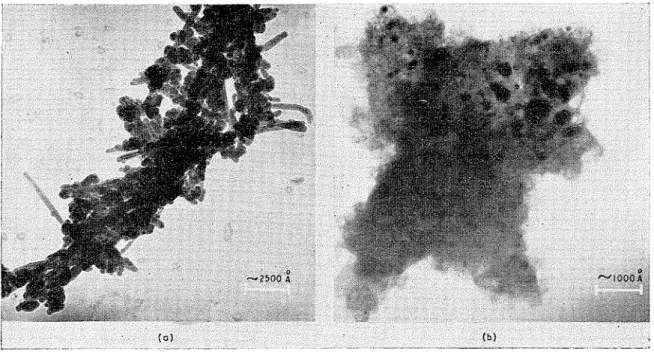
X-ray analysis was en~ployed to determine whether forma- tion of Ca(OH)2 by all three methods of hydration of the C a O had gone to completion. Samples of Ca(OH), pre- pared by vapour-phase hydration showed conspicuous broadening of X-ray diffraction powder lines. This may have resulted from small crystallite size, in~perfections in the crystals, o r both. The Ca(OH)2 made by water hydration gave sharper X-ray powder lines. These samples were dis- persed in trichloroethylene using an ultra-sonic bath and examined o n the electron microscope. The crystals prepared by water hydration display needle- or lath-like forms and have long dimensions of about 2500 A (0.25 p) (Fig. la). The Ca(OH), made by vapour hydration occurs as small plate-like crystals of about 250 A dia. This agrees with the dimension deduced from a n approximate analysis of the X-ray line broadening. The crystal platelets are surrounded by and enclosed within what appears to be amorphous material (Fig. Ib). The suggestion has been made that vapour-phase hydration involves a topochenlical reaction, whereas hydration in liquid water may involve a 'through solution and crystallisation' p r o c e ~ s . ~
Thermograms of samples which had been exposed t o C 0 2 (pre-carbonatated samples) showed three o r four major peaks, depending o n the conditions. Thermal analysis showed that in general, samples hydrated in vapour phase a t 22 and 100" behaved similarly o n carbonatation whereas water-hydrated samples behaved differently.
Gillott: Carbotzatatiotz of Ca(OH)2 investigated by TI7ern7al and X-rajj d~ffractiorz tnetI7ods
Fig. 1. Electroll 111icrograp11s of Ca(OH), (a) Water hydrated
(b) Vapour hydrated at 22'
A small endothermic peak at about 250" was detected on many of the thermograms. Samples made by vapour-phase hydration at either 22 or 100" and carbonatated after con- ditioning to 25% R.H. showed a sharp exotherm at 300" to 310". On samples prepared by water hydration and con- ditioned at 25
%
R.H. prior to carbonatation, this peak waspresent only on thermograms of samples treated in CO, for 1 h or less. Such material treated in CO, for longer periods did not display this peak on the therinogram (Fig. 2). The peak was absent on all but one of the samples carbonatated at 97
%
R.H.An endothermic peak was present between 400 and 500" on all samples except those in which carbonatation had gone to virtual completion. The peak was double on certain of the water-hydrated samples (e.g. 4 days CO,, 97% R.H., 1100" in Fig. 2), some of which were subjected to D.T.A. under a reduced pressure of about 8 mm Hg. Under these conditions a sharp peak at about 415" was recorded and an improved resolution of the subsidiary peaks obtained. A peak was registered at about 490" and a small inflection at about 425". Analyses were also carried out in a steam atmosphere. The peak system normally found in the 400" to 500" temperature range was shifted to a temperature of about 545", but the multiple peak system showed only as a slight inflection on the low temperature side of a single endo- thermic peak.
An endothermic peak, the size of which depended on the extent of carbonatation, was recorded at a temperature in excess of 600". It was occasionally double and a peak occurred at about 590°, followed by another at about 650". It was found in some cases that after the material had been stored under vacuum for several days the peak at 590" was not registered and only that at about 650" was recorded.
A weight-loss curve was recorded by means of the Cahn thermal balance from a sample of water-hydrated Ca(OH), carbonatated for four days at 97
%
R.H. Significant changesin weight were registered over several temperature ranges. A
sharp inflection occurred at about 246" and another at 380 to 414", followed by a decrease in rate of weight loss to about 460°, and again by a more rapid loss in weight from 460" to about 490". A large weight loss occurred at a tem- perature slightly above 500".
X-ray diffraction patterns of carbonatated Ca(OH), made by water hydration were compared with siinilar patterns of carbonatated Ca(OH), made by vapour-phase hydration. Fig. 3 gives the results for samples conditioned at 25
%
R.H.followed by carbonatation for 4 11. The C0,-treated samples were heated in N2 in the D.T.A. apparatus and rapidly cooled, and an X-ray diffraction photograph was taken with the Guinier camera. The '10.4' calcite line and the '10.0' Ca(OH), powder line were scanned on a microdensitometer. Strong calcite lines appeared on X-ray diffraction photo- graphs of the unheated water-hydrated material. Corres- ponding photographs of the vapour-hydrated Ca(OH), showed only faint X-ray powder lines attributable to calcite. After the vapour-hydrated C0,-treated material had been heated in a N, atmosphere to a temperature of about 330°, however, calcite X-ray reflections became quite strong. This indicates that calcium carbonate present as X-ray amorphous material crystallised as calcite when the sample was heated to 330". The Ca(OH), lines also showed some sharpening. This temperature of 330" is slightly higher than that of the sharp exothermic peak recorded on D.T.A. diagrams.
The relative intensity of the calcite X-ray reflections also confirms the conclusion based on the D.T.A. charts that Ca(OH), made by water hydration carbonatated more rapidly than did the vapour-hydrated material. A somewhat similar experiment was performed in which vapour-hydrated Ca(OH), carbonatated at 25% R.H. was soaked in water and then dried. The X-ray diffraction photograph of this material showed powder lines that could be matched with calcite. The Ca(OH), powder lines were also sharpened.
Pre-carbonatated water- and vapour-hydrated Ca(OH), was subjected to X-ray analysis in a N2 atmosphere by the
Gillott: Carbonatation of Ca(OH), itzvestigated by Thermal arzd X-ray dzffraction methods 187
Fig. 2. Tl~er~nogranu of lvater hydrated Ca(OH), after illcreasing tirnes itz C0,
Tirnr in
c 0 2
oscillating heating technique on the diffractometer. An in- crease in height and sharpness of the '10.4' calcite reflection with increase in temperature was recorded. This reflection continued to increase in intensity in the temperature range from 500" to 700°, following which it rapidly disappeared.
Discussion Zero so p v I sopv- I I I I SOP V S O ~ V 5 0 p V 1 I I I I I I I I I I I 2 0 0 5 0 0 8 0 0 2 0 0 5 0 0 8 0 0 2 0 0 5 0 0 8 0 0 2 0 0 5 0 0 8 0 0 Flrinq temperatllres
Consideration of the sets of D.T.A. curves showed that the rate and course of the carbonatation reaction are affected by the temperature at which the CaO was fired, the method of hydration by which the Ca(OH), was prepared, and the relative humidity established prior to carbonatation.
5 0 0 " c
The small endothermic inflection at about 250" on D.T.A. charts was matched on the thermal balance curve by a corres- ponding weight loss. The temperature is below that at which dehydroxylation takes place and it seems possible that it represents loss of sorbed water held by surface forces.
X-ray diffraction and thermal analysis data indicate that the sharp exothermic peak at about 310" (registered on the D.T.A. charts of the vapour-hydrated Ca(OH), carbonatated at 25
%
R.H. and on the water hydrated Ca(OH), carbonata- ted for less than 1 h) results from crystallisation of calcite from X-ray amorphous calcium carbonate and possibly from some crystallisation of Ca(OH),. There was no signi-l l O O " c
J. appl. Chem., 1967, Vol. 17, July
Precondilloned relatlve hurnldlties
2 5 % 97 %
Gillott: Carbonatation of Ca(OH)2 investig rated by Thermal and X-ray diffraction nzetlzorls
SOOOc CoO hydrated 5 0 0 ° c CaO hydrated
in vapour at 25 % R.H. in water
4 hours C O 2 a t 25'/0 R.H. unheated
Fig. 3 . Relative lzeight of 10.0 C O ( O H ) ~ vs 10.4 Calcite X-ray d(tfrc~ctior~ penk followit~g carbotmtatiotl and heat treatment
ficant weight loss registered at this temperature on curves recorded either by means of the Cahn thermal balance or with a silica spiral. The crystallisation reaction takes place at room temperature in the presence of water, so that the exothermic peak at about 310" was absent on D.T.A. charts of samples pre-conditioned at 97% R.H. It is harder to ac- count for the absence of this peak on thermograms of samples of Ca(OH), made by water hydration and pre-conditioned at 25% R.H. prior to C 0 2 treatment for periods of time ex- ceeding 1 h. Water is liberated during the carbonatation reaction. A comparison shows that the Ca(OH)2 made by water hydration carbonatated much more rapidly than did the Ca(OH), prepared by vapour hydration at either room temperature or 100". One possibility is that water was liberated sufficiently rapidly during the carbonatation of the water-hydrated samples to raise the relative humidity at the
site of the reacting particles to the point at which crystallisa- tion of calcite could occur; in the carbonatation reaction considerable heat is evolved, and some te~nperature rise may also have occurred. The slower reaction rate of vapour- hydrated Ca(OH), may not have liberated water rapidly enough to raise the relative humidity sufficiently for significant crystallisation to take place.
An alternative explanation may also be proposed. The electron micrographs and broadening of the X-ray powder lines suggest that the Ca(OH), made by vapour-phase hydra- tion is crystallographically less well organised than the Ca(OH), formed by water hydration. This diminished crystallographic order in the vapour-hydrated Ca(OH), may influence the regularity of the atomic configuration of the CaC03 that develops on carbonatation if the reaction pro- ceeds via a topotactic mechanism. Hence, relatively n~uch more of the CaCO, may be X-ray amorphous and the presence of the disorganised Ca(OH), may more effectively inhibit crystallisation of calcite.
For vapour-hydrated Ca(OH)Z conditioned at 25% R.H., prior to carbonatation and irrespective of the mechanism, the exothermic crystallisation reaction took place only after the temperature had been raised sufficiently to supply the necessary activation energy. The exothermic peak at about 300" is recorded on the thermograms of such samples.
The peak at about 450" on the D.T.A. charts corresponds
to breakdown of Ca(OH),, and the endotherm at about 700" results from breakdown of calcite, as is well known. CaO is the decomposition product in both cases. The relative sizes of these peaks indicate the extent of carbonatation.
The Ca(OH), made by water hydration showed a more rapid early rate of carbonatation than did the Ca(OH), made by vapour hydration. This effect is most marked in samples conditioned at 25
%
R.H. The difference in rate is the opposite of that anticipated; the particle size of the Ca(OH), made by vapour hydration is known to be less than that of the Ca(OH)2 made by water hydration. The reason for this apparent anomaly is unknown, but it is suggested that it is in some way connected with the amorphous-looking material by which the Ca(OH), crystal platelets are enclosed in the samples prepared by vapour-phase hydration. Vapour- hydrated Ca(OH), showed a very slow rate of carbonatation with time when conditioned at 25%
R.H.A consideration of peak heights shows that for all sanlples the rate of carbonatation decreased with time. In the samples pre-conditioned at 97% R.H. there is a tendency for the carbonatation reaction to go to completion more rapidly in the vapour-hydrated Ca(OH), than in similarly treated samples of water-hydrated Ca(OH)2. The 450" peak on D.T.A. charts of water-hydrated Ca(OH)2 becomes multiple after an increasing time in C 0 2 (Fig. 2). Inversion of ara- gonite to calcite occurs in approximately that temperature range, but no aragonite lines could be detected on X-ray diffraction photographs. It further appears very unlikely that this is the explanation, because the thermal balance curve indicated a multiple weight loss at temperatures approxi- mately the same as those detected by D.T.A. The peak system on the D.T.A. chart shifted to a higher temperature when the analysis was performed in a steam atmosphere, further suggesting that breakdown of Ca(OH), is responsible for the peaks. It appears possible that more than one type of Ca(OH)2 was present and that slight structural differences are reflected in differences in the temperature of thermal decomposition. An X-ray investigation failed to detect any J. appl. Chem., 1967, Vol. 17, July
Gray et al.: Etnissiotz of Corrosive Yolatiles fronz Wood. III. 189
significant shift in lattice spacings o n samples heated to a temperature corresponding to the multiple peak detected o n the thermograms.
Consideration of the series of thermograms also showed that the Ca(OH), made from C a O prepared by firing a t 1100" carbonatated at a slower rate than the corresponding samples of Ca(OH), made from C a O fired at 500'.
Decomposition of calcite occurred a t a temperature of 800" or less, which is lower than that at which calcite generally d e c o r n p o ~ e s . ~ ~ The doubling of this peak sometimes de- tected has been attributed to the presence of two types of calcite. The disappearance of the doublet a n d its replacement by a single peak on a thermogram of a sample stored under vacuum for three days suggests that ageing is a factor that deternlines whether a peak is double o r single.
Conclusions
(I) The Ca(OH), made by water hydration is of larger crystallite size than that made by vapour-phase hydration; in the latter, amorphous material appears t o be present. (2) At the same relative humidity, Ca(OH), made by vapour hydration carbonatates at a slower rate during early ages than does Ca(OH), made by water hydration.
(3) At the same relative humidity there is little difference in response to carbonatation between Ca(OH)2 made by vapour phase hydration at 22" and Ca(OH), made by vapour phase hydration a t 100".
(4) Calcite crystallises less readily from carbonatated vapour- phase-hydrated Ca(OH), than from Ca(OH), made by water hydration in samples pre-conditioned at 25
%
R.H.(5) Carbonatation may lead t o formation of amorphous calciu~n carbonate. This crystallises a t 310" on heating. If much moisture is present, crystallisation occurs at roo111
at 9 7 % R.H. This decomposes at slightly different tempera- tures in the 400 to 500" temperature range causing multiple peaks on D.T.A. a n d thermal balance charts.
(7) The reactivity of the Ca(OH), to CO, is affected by the firing temperature of the CaO; by the conditions of hydration; and by the relative humidity at the time of carbonatation. (8) Ageing seems to affect the form of the peak a t about 700".
Acknowledgment
This paper is a contribution from the Division of Building Research, National Research Council, Canada, and is pub- lished with the approval of the Director of the Division.
Inorganic Building Materials Section, Division of Building Research,
National Research Council, Ottawa 7. Canada
Rcceived 8 August, 1966; anlendcd manuscript 24 November, 1966
References
Glasson, D. R., J. cr~pl. Clretir., Lotrd., 1960, 10, 42
'
Mackenzie, R. C., The differential thermal investigation of clays', 1957, p. 456, (Mineralogical Society, London) (Aber- deen: Central Press)Powers, T. C., J. Portlntrd cetiretit Ass., 1962, 4, (2), 40
a Verbeck, G., A.S.T.M. spec. tech. Plrbl., 1958, No. 205, p. 17
"oldberg, I., & Klein, A., A.S.T.M. spec. tech. Pr~bl., 1953, No. 142, p. 53
Azbe, V. J., Symposium on Lime, A.S.T.M., Philadelphia, Pa., 1939, p. 88
'
Haslam, R. T., & Herman, E. C., Itrd. Etlgtlg Chetir., 1926, 18,960
Ray, K. W., & Mathers, F. C., hrd. Et~gtrg Clierir., 1928, 20,
temperalure.
"
415Ramachandran, V. S., Sereda, P. J., & Feldman, R. F., N(ttto.cl,
(6) More than one type of Ca(OH), may be present following Loird., 1964, 201, 288-289 carbonatation of water-hydrated Ca(OH)2 pre-conditioned l~ Sec ref. 2, p. 332
EMISSION OF CORROSIVE VOLATILES FROM WOOD
111." EFFECT OF TREATMENT WITH PROPYLENE OXIDE
By
5.
D. GRAY, G. C. COCHRANE and P. C. ARNIA study has been ~iiatle of the release of corrosive volatiles when wood shavings are sterilised by propylene oxide. Sterilisation of sweet chestnut (Castntrea sntiva), beech (Fngus s)dvatica), Norway spruce (Picea abies), Sitka spruce (Picen sitclieti.~is), Douglas fir (Pseudotsccga taxifolia) and Scots pine (Pitircs sylvestris) with propyl- ene oxide at varying relative l~un~idities and subsequent incubation at 48" and 100% R.H. gave a variable release of corrosive volatiles but usually tended to increase the amount of acid released.
Introduction
During the course of a current programme of v
.
on the e~llission by wood of corrosive vapours, mainly a . i acid, it was considered of interest to determine whetht r t h e r : ease of volatile acid from the wood was exclusive y a :hemica1 hydrolysis catalysed by small amounts of acid presel~t in the growing tree or whether the hydrolysis was of I ~icrobio-logical origin. I n order to study this aspect o f : cid release it
was necessary to prepare samples of sterilised wood for incubation studies. This was achieved by use of propylene oxide which avoids the use of the high temperature necessary for heat sterilisation.
Samples of freshly felled comminuted sweet chestnut (Cnstnnen sntivn) and oak (Quet.cus robzlr) were exposed to vapours of propylene oxide a t 21' in a closed container for 48 h. Thereafter, the wood samples were removed and 'Part L L .J. appl. Cl~ern.,