HAL Id: hal-00459466
https://hal.archives-ouvertes.fr/hal-00459466
Submitted on 24 Feb 2010
HAL is a multi-disciplinary open access
archive for the deposit and dissemination of
sci-entific research documents, whether they are
pub-lished or not. The documents may come from
teaching and research institutions in France or
abroad, or from public or private research centers.
L’archive ouverte pluridisciplinaire HAL, est
destinée au dépôt et à la diffusion de documents
scientifiques de niveau recherche, publiés ou non,
émanant des établissements d’enseignement et de
recherche français ou étrangers, des laboratoires
publics ou privés.
Thulium-doped silica-based optical fibers for cladding
pumped fiber amplifiers
Pavel Peterka, Václav Kubeček, Ivan Kašík, Vlastimil Matějec, Wilfried
Blanc, Basile Faure, Bernard Dussardier, Gérard Monnom
To cite this version:
Pavel Peterka, Václav Kubeček, Ivan Kašík, Vlastimil Matějec, Wilfried Blanc, et al.. Thulium-doped
silica-based optical fibers for cladding pumped fiber amplifiers. Optical Materials, Elsevier, 2007, 30
(1), pp.174-176. �10.1016/j.optmat.2006.11.039�. �hal-00459466�
Thulium-doped silica-based optical fibers for cladding pumped
fiber amplifiers
Pavel Peterka
a *, Václav Kubeček
b, Ivan Kašík
a, Vlastimil Matějec
a, Wilfried Blanc
c,
Basile Faure
c, Bernard Dussardier
cand Gérard Monnom
caInstitute of Radio Engineering and Electronics, Academy of Sciences of the Czech Republic, Chaberska 57, 18251 Prague, Czech Republic bCzech Technical University, Faculty of Nuclear Sciences and Physical Engineering, Břehová 7, 115 19 Prague 1, Czech Republic cLaboratoire de Physique de la Matièere Condensée, CNRS - Université de Nice - Sophia Antipolis, Parc Valrose, 06108, Nice, France
Elsevier use only: Received date here; revised date here; accepted date here
Abstract
We present preparation and spectroscopic characterization of the Tm-doped fibers with enhanced 3H4 fluorescence lifetime
thanks to codoping with alumina. With the alumina content of 10 mol %, the fluorescence lifetime of 58 s was achieved.
Using experimentally obtained fiber characteristics, we used numerical simulations to study and optimize for the first time the thulium-doped fiber amplifier (TDFA) with dual wavelength (800 + 1400 nm) pumping scheme where the pump at 800 nm propagates in the cladding and the other pump propagates in the core. The results are compared with numerical simulations of TDFA pumped at single-wavelength in the 1050 nm band.
© 2001 Elsevier Science. All rights reserved
Keywords: fiber lasers; fiber amplifiers; thulium PACS: 42.81 Fiber optics, 42.55.Wd Fiber lasers, 42.70.Hj Laser materials
*
Corresponding author. Tel.: +420 366 773 527; fax: +420 284 680 222; e-mail: [email protected].
1. Introduction
The thulium doped fibers are promising candidates for optical amplification in the optical telecommunication S-band (1460-1530 nm). Since the nonradiative decay of the lasing transition of thulium in conventional silica based fibers is high, the lower phonon energy, fluoride-based fiber host are often used. However, excellent environmental stability of silica fibers and their inherent compatibility with standard telecommunication fibers makes the preparation of an efficient silica based thulium doped fiber a technological challenge. Several codopants that locally modify the silica environment of Thulium ions were investigated in order to decrease the local phonon energy and thus minimize the nonradiative decay. The S-band
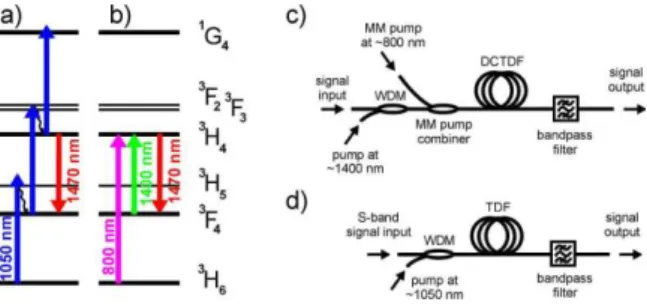
signal gain of 10 dB in bismuth codoped core [1] and 12 dB in gallium and yttrium codoped core [2, 3] was demonstrated. Gain of more than 20 dB was demonstrated in highly antimony codoped silicate fiber [4], but the complicated triple crucible method was used for fiber preparation and the fiber still was not compatible with standard telecommunication fibers. In our preliminary report [5] we have demonstrated that incorporation of alumina can increase the 1470 nm luminescence quantum efficiency. Another issue to be addressed in the TDFA design is the pumping scheme. Since the lifetime of the upper laser level is shorter than the lifetime of the lower level, population inversion can be hardly achieved with a direct pumping of the upper laser level. To overcome the problem, upconversion pumping at single wavelength of about 1050 nm, see Fig. 1a, or two pumps at different
Submitted to Elsevier Science
2
wavelengths can be used. The pumping methods are reviewed e.g. in [6].
Fig. 1. (a, b) TDFA upconversion pumping schemes. Dual-wavelength (c) and single-Dual-wavelength (d) TDFA setup.
In this paper we report preparation and spectroscopic
characterization of the Tm-doped fibers with enhanced 3H4
fluorescence lifetime thanks to codoping with alumina. With the experimentally obtained fiber characteristics, we present numerical modeling of Tm-doped fiber amplifier at telecommunication S-band. For the first time we study the dual wavelength scheme using combination of cladding
pumping at the wavelength p1 in the 800 nm band, and
pumping in the fiber core at p2 in the 1400 band, see Fig.
1b. The method was proposed in [3] but to our knowledge it was studied neither experimentally nor theoretically. Since the effective absorption cross section can be varied by proper ratio of the core and cladding cross section areas, this method offers one more degree of freedom in the TDF design. In addition, relatively inexpensive, multimode and high power pump diodes at 800 nm can be used. The TDF amplifier performance under this pumping scheme is compared with the upconversion pumping at single
wavelength p3 in the 1050 nm band.
2. Fiber preparation and characterization
The fiber preforms were fabricated by using the MCVD (Modified Chemical Vapor Deposition) method. Thulium and aluminum ions were incorporated by solution doping technique. Germanium was also added to increase the refractive index. It was incorporated during the core layer deposition and collapsing passes. Electron Microprobe
Analysis was made and GeO2 and Al2O3 typical
concentrations of 4 and up to 10 mol %, respectively.
Thulium ions concentration was estimated from the 3H4
absorption peak and it varied typically between 40-300 ppm.
The fluorescence lifetime of the 3H4 level in the fiber of
the highest (10 mol %) alumina content was measured to be
58 µs (under direct excitation at 786 nm). The 3H
4 lifetime
in high alumina codoped fiber represents an improvement compared to pure or weakly modified silica glass where the
respective lifetime is about 14 µs [7]. The fluorescence
lifetimes of the 3H4 and 1G4 levels were measured to be
about 430 µs (using direct excitation at 1586 nm) and
540 s (using upconversion excitation at 980 nm),
respectively. In the case of the 1G4 level lifetime
measurement, a fiber codoped with ytterbium was used. Luminescence decay waveforms were non exponential. Therefore the lifetime of the levels were taken as the time where the fluorescence intensity decreases to 1/e of its initial value. This non-exponential behavior has been observed in many other thulium-doped glasses. The luminescence detected is the sum of the emission from all the emitting centers. In a glass, such as silica, there are many sites with different environment for thulium. This site to site variation yields to distribution of crystal fields and then to various lifetimes for thulium which implies the non-exponential shape of the decay curves.
3. Modeling of Tm3+ doped fiber amplifier
The setup of the TDFA under investigation is shown in Fig. 1c. The S-band input signal is combined with the 1400 nm pump in the wavelength division multiplexer (WDM) and then coupled together with 810 nm multi-mode (MM) pump to the double-clad (DC) TDF. Several methods can be used to combine the pump and signal into the DCTDF, reviewed e.g. in [8]. The DCTDF is of a narrow core for single-mode propagation of the signal and 1400 nm pump; and of a wide inner cladding for propagation of the multi-mode pump. The inner cladding is surrounded by the lower index material. For predicting the amplifier performance and its optimization we developed a comprehensive, spectrally and spatially resolved numerical model described in detail elsewhere [6]. In the numerical simulations we use spectroscopic parameters listed in the previous section and in [6]. The optimized core refractive index profile of
numerical aperture NA=0.4 and core diameter of 2 m is
considered [5]. For the numerical simulation we set the thulium concentration to 1000 ppm. The pair induced quenching processes among neighbouring thulium ions can be still assumed negligible at this level of concentration [7]. Unless otherwise stated, the total pump power is set to 1 W. The peak gain and optimum TDF length dependence on the
pump wavelength p1 is shown in Fig. 2a for several ratios
of the core to cladding areasp1. The ratio p1 corresponds
approximately to the pump overlap with the thulium ions.
The second pump of power 700 mW and p2=1395 nm is
used. The gain characteristics are found rather flat with respect to the second pump in the 1390-1410 nm range and the pump power between 500-800 mW. For small overlap
p1 corresponding to a typical cladding pumping case the
maximum gain of about 26 dB is achieved for the
wavelength p1=790 nm. With increasing overlap, i.e. with
Submitted to Elsevier Science 3
pump shifts towards longer pump wavelength. For p1=805
nm and p1=0.2 the gain of 28 dB is achieved.
The single-wavelength upconversion scheme using the
pump wavelength p3 from the 1050 nm band, see Fig. 1a
and 1d, is also studied. The peak gain and optimum TDF length are shown Fig. 2b. Commonly used pump wavelengths of 1050 and 1064 provide gain of 17 and 14 dB, respectively, considerably lower than the optimized dual-wavelength scheme, at the same total pump power
level of 1 W. For higher pump power at p3, the optimal
pump wavelengths shifts towards 1020 nm, where the gain of 24 dB is achieved, only slightly lower than the optimized dual wavelength gain. However, it might be a problem to find suitable high power pump source at this wavelength as the highly efficient Yb-fiber laser source are more difficult to build at wavelength below 1030 nm [9].
Fig. 2. Maximum gain and optimum TDF length for (a) dual wavelength scheme using 800 nm + 1400 nm pump band and (b) upconversion pumping at single wavelength.
4. Conclusions
We presented preparation and spectroscopic
characterisation of the Tm-doped fibres with enhanced 3H4
fluorescence lifetime thanks to codoping with alumina using MCVD and solution doping methods. With the
alumina content of 10 mol %, the fluorescence of 58 s
was achieved. Using the experimentally obtained fibre characteristics, we studied and optimized for the first time TDFA with dual wavelength pumping scheme where one of
the pumps propagates in the cladding while the other pump propagates in the core. Although higher gain was predicted for the dual wavelength scheme, the optimized single wavelength scheme might be preferable thanks to its less complexity.
In this work we limited the study only to the pumping scheme at the wavelength of 800 nm band (cladding) and the 1400 nm. Next step would be modeling of the cladding pumped Tm/Yb fiber devices. The in-core pumping of Tm/Yb fiber S-band amplifiers has been already proposed [3] and also studied theoretically [10].
Acknowledgements
The authors would like to thank David Simpson from Victoria University in Melbourne, Australia, for the
measurements of the 3F4 and 1G4 fluorescence lifetimes.
This work was supported by the French-Czech Barrande program, French ministry of foreign affairs/EGIDE, project No. 07476ZM, by the Ministry of Education, Youth and Sports of the Czech Republic, contract No. 6840770022 and by the Academy of Sciences of the Czech republic, grant No. B200670502.
References
[1] S. Ohara, N. Sugimoto, Y. Kondo, K. Ochiai, Y. Kuroiwa, Y. Fukasawa, T. Hirose, H. Hayashi and S. Tanabe, Proc. SPIE
4645 (2002) p. 8.
[2] B. Cole and M. L. Dennis, In Proc. OFC'01, Anaheim, USA, paper TuQ3 (2001).
[3] M. L. Dennis and B. Cole, US patent, Appl. No. 261619, October 2, 2002.
[4] B. N. Samson, N. J. Traynor, D. T. Walton, A. J. G. Ellison, J. D. Minelly, J. P. Trentelman, J. E. Dickinson, In Proc. OAA'00, Quebec city, Canada, paper PD6 (2000).
[5] B. Faure, W. Blanc, B. Dussardier, G. Monnom and P. Peterka, In Proc. of OAA'04, San Francisco, USA, paper OWC2 (2004).
[6] P. Peterka, B. Faure, W. Blanc, M. Karasek and B. Dussardier, Opt. and Quantum Electron., 36 (2004) p. 201.
[7] S. D. Jackson and T. A. King, J. Lightwave Technol. 17 (1999) p. 948.
[8] P. Peterka, I. Kasik, V. Matejec, J. Kanka, M. Karasek, M. Hayer and J. Slanicka, In Proc. of ECOC'05, Glasgow, Scotland, paper We4.P.127, 3 (2005) p. 755.
[9] J. Nilsson, W.A. Clarkson, R. Selvas, J. K. Sahu, P. W. Turner, S.U. Alam, A.B. Grudinin, Opt. Fiber Technol. 10 (2004) p. 5. [10] J. Chang, Q.-P. Wang and G.-D. Peng, Opt. Mat. 28 (2006) p.
1088. 10000 1020 1040 1060 1080 5 10 15 20 25 30 0 5 10 15 200 mW 500 mW Pump power: Pea k G a in (sol id l in e ) [d B] Pump Wavelength, p3 [nm] 1000 mW b) O p ti mu m T D F L e n g th (d a she d l in e ) [m]