HAL Id: hal-00297240
https://hal.archives-ouvertes.fr/hal-00297240
Submitted on 15 Jul 2008
HAL is a multi-disciplinary open access
archive for the deposit and dissemination of
sci-entific research documents, whether they are
pub-lished or not. The documents may come from
teaching and research institutions in France or
abroad, or from public or private research centers.
L’archive ouverte pluridisciplinaire HAL, est
destinée au dépôt et à la diffusion de documents
scientifiques de niveau recherche, publiés ou non,
émanant des établissements d’enseignement et de
recherche français ou étrangers, des laboratoires
publics ou privés.
Fast computation of magnetostatic fields by
Non-uniform Fast Fourier Transforms
Evaggelos Kritsikis, Jean-Christophe Toussaint, Olivier Fruchart, Helga
Szambolics, L. D. Buda-Prejbeanu
To cite this version:
Evaggelos Kritsikis, Jean-Christophe Toussaint, Olivier Fruchart, Helga Szambolics, L. D.
Buda-Prejbeanu. Fast computation of magnetostatic fields by Non-uniform Fast Fourier Transforms.
Ap-plied Physics Letters, American Institute of Physics, 2008, 93 (13), pp.132508. �10.1063/1.2995850�.
�hal-00297240�
Fast computation of magnetostatic fields by Non-uniform Fast Fourier Transforms
Evaggelos Kritsikis,1, ∗ Jean-Christophe Toussaint,2, 3 and Olivier Fruchart21
Spintec, CNRS/CEA/UJF/INP Grenoble, 38054 Grenoble cedex 9, France
2
Institut N´eel, CNRS et Universit´e Joseph Fourier, BP 166, F-38042 Grenoble Cedex 9, France
3
INP Grenoble, 38031 Grenoble cedex 1, France (Dated: 15 juillet 2008)
The bottleneck of micromagnetic simulations is the computation of the long-ranged magnetostatic fields. This can be tackled on regular N-node grids with Fast Fourier Transforms in time N log N, whereas the geometrically more versatile finite element methods (FEM) are bounded to N4/3in the
best case. We report the implementation of a Non-uniform Fast Fourier Transform algorithm which brings a N log N convergence to FEM, with no loss of accuracy in the results.
The power of computers steadily increases over the years while the size of devices used in fundamental sci-ence or technology is shrinking. Today we have reached a cross-over where numerical simulations are capable of describing in detail the physics of nanodevices, for which they thus play a leading role in their understanding and designing. In numerical micromagnetics for spin electronics, a bottleneck is the computation of the mag-netostatic interactions which by nature are long-ranged. These interactions can be expressed in terms of either magnetostatic field H or scalar pseudo-potential φ such that H = −∇φ. The latter is convenient since it boils the problem down to a single scalar unknown. To deal with magnetostatic interactions, essentially two distinct approaches have been implemented, depending on the type of mesh used :
1. for Finite Difference (ie. translation invariant) meshes, a Green approach with Fast Fourier Transforms, called FD-FFT. Computation time is moderate (N log N with N the number of nodes), but the curved boundaries that occur often in experimental devices are not ideally described ;
2. for Finite Element (much more general) meshes, a Finite Element Method coupled to a Boundary Element Method, called FEM-BEM. This can faithfully describe curved boundaries but compu-tation time is higher, at least N3/2 in 2D (resp.
N4/3 in 3D).
In this Letter we report the implementation of a new magnetostatic code which combines the advantages of both cited approaches : it uses a FEM mesh thus de-scribing curved boundaries as well as FEM-BEM, albeit with computation time N log N . It is based on a algo-rithm reported recently for computing non-periodic Fast-Fourier Transforms (NFFT)1. Our code, called
FEM-NFFT, proves to be significantly faster than FEM-BEM
∗Electronic address: [email protected]
with no loss of precision. As a first step the implementa-tion was done for a 2D geometry (which pertains to 3D systems with one direction of translational invariance, i.e. cylinder-like) for the proof of concept. The gain is expected to be even greater in more realistic 3D calcu-lations. This demonstrates the potential of FEM-NFFT for micromagnetism and thus spin-electronic devices.
Let us recall the principle and features of FD-FFT and FEM-BEM before presenting our approach and results. We consider a system Ω with boundary ∂Ω, displaying a known magnetization distribution M(r).
Finite Difference micromagnetic codes use a transla-tion invariant grid. On such a grid, FFTs can be used to compute convolutions in time N log N . This motivates a Green approach for magnetostatics : φ is calculated as a convolution of the Green function G = −(1/2π) log r in 2D [resp. G = 1/(4πr) in 3D] with the magnetic charges, volumic ρ = −∇ · M and surfacic σ = M · n :
φ(r) = Z Ω ρ(r′)·G(r−r′)dr′+ Z ∂Ω σ(r′)·G(r−r′)dr′ (1)
The N log N speed explains the wide and lasting use of FD in micromagnetic simulations2. However, most
devices have curved boundaries, either by design or as a result of experimental imperfections. Simulating these cases with FD requires the use of saw-tooth boundaries to describe the magnetic material. This geometrical approximation may induce inadequate descriptions3.
Finite Element micromagnetic codes use, on the con-trary, complex-shaped meshes with triangles (resp. tetra-hedrons) as 2D (resp. 3D) unit cells. They consequently suffer much less from the above-mentioned limitations. However, without translational invariance of the mesh, FFTs are not available. Bearing in mind that direct sum-mation of Eq.(1) on a FEM mesh, called FEM-direct, would cost N2time, one understands why the Green
ap-proach is thought incompatible with FEM codes. To deal with magnetostatics, FEM codes thus go back to the Poisson equation −∆φ = ρ, with the usual reg-ularity condition that the field should decay at infinity. Applying FEM, the equations are translated into a linear system, which is solved by standard iterative methods4
2
in time N3/2 in 2D (resp. N4/3 in 3D) Not only is this
asymptotically slower than the N log N time required for FD-FFT, but N here takes higher values, because the mesh must extend well beyond Ω in order to tackle the regularity condition at infinity. This induces an ad-ditional slowdown, and also creates finite-size artifacts.
To avoid meshing outside Ω, the main approach consists in coupling FEM with a Boundary Element Method, resulting in the so-called FEM-BEM5. The
asymptotic complexity of the Poisson solver is unchanged but the BEM step introduces another time limitation N2
∂ where N∂ is the number of boundary nodes. In the
most favorable case consisting of compact systems N∂ ≈
N1/2 in 2D (resp. N
∂ ≈ N2/3 in 3D). However for flat
geometries, of particular relevance to applications, N∂ ≈
N , in which case the time limitation for FEM-BEM may be pretty severe.
Our innovation is to revert, within the FEM frame-work, to a Green approach. The convolution (1) is dis-cretized in a way typical for FEM, and computed using a fairly recent mathematical method called NFFT (Non-uniform Fast Fourier Transform). NFFTs allows one to compute discrete convolutions in time N log N without the equispaced data requirement of FFTs.
More in details, we seek φ at the nodes (ri),i=1...N
of the mesh. A linear interpolation inside each element, of known magnetization values M(ri), is used to
evalu-ate charges ρ and σ at points rj,j=1...M defined as the
quadrature points for the integrals in (1)6.
Consequently, (1) is rewritten the following way :
φ(ri) = M X j=1 ρjG(ri− rj) ωj det J(rj) + M X j=1 σjG(ri− rj) ωj det J(rj) (2) where
– ρj = ρ(rj) if rj is in the interior of Ω, 0 otherwise,
– σj= σ(rj) if rj is on ∂Ω, 0 otherwise,
– ωj is the weight of rj in the quadrature scheme,
– J(rj) is the Jacobian of the affine transformation
mapping the unit element on that containing rj.
We then use NFFTs to compute (2). Although the seminal paper7 dates back to 1993, the NFFT method
remains little-known even in the mathematical commu-nity. A presentation of the method can be found Ref.8.
Here we sketch the basic strategy and show that com-putation time does not exceed N log N , ie. that of the classical FFT.
Let us look at our non equispaced data as a sum of Dirac functions. The goal is to find the spectrum of this data function. The idea is to convey initial information
over a regular grid, so that an FFT can be used. We therefore choose a regular grid X and let the data dif-fuse to the X nodes through convolution with a Gaussian function (or more generally a smooth localized function). The Gaussian is localized in space, so we can consider that each piece of data diffuses only to a fixed number of the nearest X nodes. Computation time of this diffusion step is thus proportional to N .
The question arises how to choose the period of the X grid. In our case, the answer depends on how smooth the Green function G is. A necessary preliminary step before executing the NFFT is therefore to smooth G around the origin ; the price to pay is an afterwards correction in the smoothing zone. It can be shown that a grid of size p2N
in 2D (resp. p3N in 3D) is convenient, where p is the
degree of smoothness chosen for G.
We then perform, according to the initial idea, a FFT on the X grid, in time proportional to N log N . Based on the convolution theorem, what we get is the Fourier coefficients of the data function multiplied by those of the Gaussian. Therefore, we finally divide these numbers by the Fourier coefficients of the Gaussian to get the desired spectrum. The number of divisions is proportional to N . As a whole, the NFFT is expected to behave asymptotically like N log N , as all extra steps behave like N .
We implemented FEM-NFFT to 2D test cases where an analytical solution φa is available, so that errors can
be readily estimated. Interpolation and quadrature rou-tines are written in C++ and the NFFT package used9
is in C99. For G we have chosen a smoothness degree of 2. On each test case, we provide computation times and error estimates for FEM-direct, the classic FEM-BEM and our NFFT-based method. The computed error is the normalized root mean square (MsL)−1(PNi=1|φ(ri)−
φa(ri)|2/N )1/2, where Msis the saturation magnetization
and L the system diameter set at unity, . Computations are done on an Intel P4 2GHz with 1GB RAM running Fedora 5.
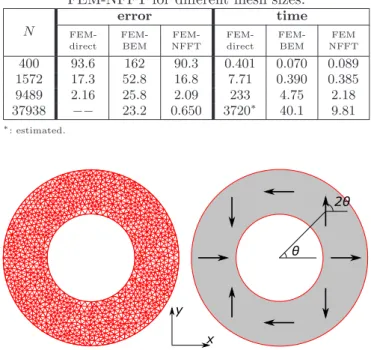
The first test case is a disk uniformly magnetized along the x-axis (a cylinder in 3D space). The analytical solu-tion is φ(x) = Msx/2. The second case is the so-called
magic cylinder, a circular annulus of radii R1, R2 where
the angle between magnetization and the x-axis equals twice the polar angle. The name stems from the uni-form magnetic field thus induced in the inner region. The analytical solution inside the annulus is φ(r, θ) = Msr cos θ log(r/R2) in polar coordinates.
Tables 1 and 2 display the numerical results for the two cases, respectively. It can be readily seen that FEM-NFFT provides results very similar to FEM-direct. The error induced by the NFFTs is thus negligible. Compared to FEM-BEM, errors are comparable for non-uniformly magnetized systems (see Table 2) whereas for uniform distributions, Green approaches, to which FEM-NFFT belong, are more accurate by one order of magnitude (see Table 1). This is because they can treate apart
volu-mic and surfacic charge contributions. Concerning com-putational time, FEM-direct is as expected the quickest, gaining a factor around 5 over FEM-BEM for the finer meshes. Nodes required in 3D cases of interest commonly count up to 105, around which number the time
advan-tage of NFFT over classical methods such as FEM-BEM is expected to reach one order of magnitude.
Fig.1 – Test case 1 : the uniformly magnetized disk. Mesh used for N = 400 (left) and magnetization
distribution (right).
Tab.I – Test case 1 : error (in ppm) and computation time (in seconds) of FEM-direct, FEM-BEM and
FEM-NFFT for different mesh sizes.
error time
N FEM- FEM- FEM- FEM- FEM- FEM
direct BEM NFFT direct BEM NFFT
400 93.6 162 90.3 0.401 0.070 0.089
1572 17.3 52.8 16.8 7.71 0.390 0.385
9489 2.16 25.8 2.09 233 4.75 2.18
37938 −− 23.2 0.650 3720∗ 40.1 9.81
∗: estimated.
Fig.2 – Test case 2 : the magic cylinder. Mesh used for N = 1192 (left) and magnetization distribution (right).
To conclude, we have successfully implemented a Non-uniform Fast Fourier Transform (NFFT) algorithm to compute magnetostatic fields for micromagnetic simula-tions based on Finite Element methods (FEM). The new approach, called FEM-NFFT, combines the advantages previously found separately in Finite Difference methods Tab.II – Test case 2 : error (in ppm) and computation
time (in seconds) of FEM-direct, FEM-BEM and FEM-NFFT for different mesh sizes.
error time
N FEM- FEM- FEM- FEM- FEM- FEM
direct BEM NFFT direct BEM NFFT
1192 174 172 174 3.58 0.290 0.331
2091 95.8 94.2 95.8 14.0 0.640 0.498
8214 24.7 32.1 24.8 211 4.59 2.02
22683 −− 21.5 9.05 1600∗ 34.0 6.62
∗: estimated.
(computation time scaling like N log N ) and FEM (faith-ful description of curved boundaries). Thus FEM-NFFT promises a leap in the attractiveness of micromagnetic simulations of spin electronic devices.
1
G. S. D. Potts and M. Tasche, Fast Fourier transforms for nonequispaced data : A tutorial (Birkh¨auser, Boston, 2001), pp. 247–270.
2
B. Kevorkian, Ph.D. thesis, Universit´e Joseph Fourier, Grenoble (1998).
3
4
Phys. 184 (2003).
4
D. Braess, Finite Elements (Cambridge University Press, Cambridge, 2001), 2nd ed.
5
D. Fredkin and T. Koehler, IEEE Transactions on Magnet-ics 26 (1990).
6
In singular zones where the quadrature scheme becomes not precise enough, it is possible to combine it with semi-analytical terms, the details of which will come in a forth-coming paper.
7
A. Dutt and V. Rokhlin, SIAM J. Sci. Stat. Comput. 14, 1368 (1993).
8
L. Greengard and J.-Y. Lee, SIAM Rev. 46, 443 (2004).
9
S. Kunis and D. Potts, NFFT, Softwarepackage, C subrou-tine library (2002-06).