A Bioengineering Roadmap for Negative Emissions Technologies
by
Sarah Mary Haiken Sclarsic B.A., Harvard University (2006)
Submitted to the Program in Media Arts and Sciences, School of Architecture and Planning, in partial fulfillment of the requirements for the degree of
Master of Science at the
Massachusetts Institute of Technology February 2021
© Massachusetts Institute of Technology, 2021. All rights reserved
Author
……… Program in Media Arts and Sciences
January 15, 2021 Certified by
……… Edward S. Boyden, Ph.D.
Professor MIT Media Laboratory and MIT McGovern Institute Accepted by
……… Tod Machover Academic Head, Program in Media Arts and Sciences
A Bioengineering Roadmap for Negative Emissions Technologies
by
Sarah Mary Haiken Sclarsic
Submitted to the Program in Media Arts and Sciences, School of Architecture and Planning, on January 15, 2021 in partial fulfillment of the requirements for the degree of
Master of Science
Abstract:
Negative emissions technologies that can remove carbon dioxide from the atmosphere are a critical tool to limit global temperature rise and ocean acidification. Bioengineering capabilities have not been
sufficiently assessed or utilized for the development of negative emissions technologies. Bioengineering holds the potential to improve the efficiency of some existing technologies and to create new methods of carbon removal. I review existing technologies to assess how bioengineering could improve them, focusing on technologies that could achieve at least 1 Gt of CO2 removal per year. I also investigate and describe potential new methods of carbon removal that leverage bioengineering. Key questions for additional research are identified, as are key engineering targets for the development of improved negative emissions technologies. This evaluation of potential high-impact R&D work is intended to provide an initial roadmap for the development of bioengineered negative emissions technologies that are scalable, sustainable, and can remove gigatons of CO2 from the atmosphere.
Thesis advisor:
Edward S. Boyden, Ph.D. Professor
A Bioengineering Roadmap for Negative Emissions Technologies by
Sarah Mary Haiken Sclarsic
This thesis has been reviewed and approved by the following committee members Edward S. Boyden, Ph.D. ……… Professor MIT Media Laboratory and MIT McGovern Institute
George M. Church, Ph.D. ……… Professor Harvard Medical School
Kevin Esvelt, Ph.D. ……… Associate Professor MIT Media Laboratory
Table of Contents
INTRODUCTION ... 5
INCREASING BIOMASS ... 9
IMPROVEMENTS IN PHOTOSYNTHESIS ... 11
SOIL CARBON SEQUESTRATION ... 13
INCREASING CARBON STORED UNDERGROUND VIA ENHANCED ROOTS ... 14
RECALCITRANT MOLECULES FOR LONGER TERM CARBON STORAGE ... 16
Suberin ... 16
Lignin ... 19
Sporopollenin ... 23
ANNUAL TO PERENNIAL CONVERSIONS ... 24
SLOWER DECOMPOSITION ... 26
ENGINEERING BIOMASS TO GROW ON MARGINAL LAND AND LAND DEGRADED DUE TO CLIMATE CHANGE ... 28
ALGAE FOR CDR ... 29
MACROALGAE (SEAWEED) ... 29
MICROALGAE (ALGAE) ... 32
BIO-ENHANCED ROCK WEATHERING ... 34
BIO-ENHANCED MINERALIZATION ... 43
BIO-ENHANCED ABIOLOGICAL CARBON REMOVAL SYSTEMS (HYBRID APPROACHES) ... 44
CONCLUSION ... 47
Introduction
Human activities are increasing the atmospheric concentration of CO2, which is changing the Earth’s climate in ways that will be — and in some cases already are — catastrophic to the thriving of many people and ecosystems. Human activity since the start of the Industrial age (~1850) has increased the amount of CO2, a powerful greenhouse gas that traps heat and warms the planet, in the atmosphere by about 50% (NASA, 2021). The atmospheric concentration of CO2 has risen from ~285 ppm to ~415 ppm during this timeframe, and continues to rise at an accelerating rate, adding around 2.7 ppm per year (NASA, 2021). To stop climate change, humans must stop emitting greenhouse gases such as CO2, a process known as mitigation. In addition to reducing CO2 emissions to near-zero, however, hundreds of billions of tons of CO2 must be removed from the atmosphere in order to have a reasonable chance of limiting global temperature rise to global targets of 1.5°C or 2°C. Removing CO2 is generally referred to as carbon dioxide removal or CDR, and technologies that can achieve such removal are called negative emissions technologies (NETs).
Image 1: Projected scenario of the significance of negative emissions relative to mitigation in reaching net zero emissions. Source: NASEM, 2019.
The Intergovernmental Panel on Climate Change (IPCC) estimates that we need to start removing large quantities of CO2 this decade, ramping up to at least 10 Gt CO2 or CO2e/year in about 30 years in order to have a reasonable chance of limiting global temperature rise to 1.5°C (CO2e means greenhouse gases with radiative forcing effect equivalent to that of CO2) (IPCC, 2014). The majority of pathways for limiting temperature rise to 2°C rely on NETs (Fuss et al., 2014). This is a tremendous amount of material to capture and move: 10 Gt is about the size of the global cement industry, and atmospheric CO2 is dilute: only 1 molecule in ~ 2500 of ambient air is CO2. This scale of this challenge has been described as
creating a new industry that can have the same effect as running the entire fossil fuel industry in reverse. It is important to note that CDR is the only option for both reducing global temperatures and reversing the destructive chemical changes to the world’s oceans, whose acidity has increased 30% since pre-Industrial times and continues to increase, threatening the survival of coral reefs and a broad array of marine life (NOAA, 2020) (Intergovernmental Panel on Climate Change, 2018). Other technologies for reducing global temperatures, such as Solar Radiation Management, are likely to be a less expensive and faster way to reduce global temperatures than CDR, but they cannot solve the underlying problem of an excess of CO2 in the atmosphere, or address ocean acidification. Thus, CDR is critical to any discussion of stabilizing the climate.
CDR is an area of increasing interest to climate change policymakers and researchers as the timeframe for acting to limit global temperature rise shortens. Much attention has been given to researching biological solutions for CDR, such as planting trees, and abiological technologies, such as direct air capture (DAC) machines. However, relatively little attention has been given to the field sitting at the intersection of these two concepts: bioengineering. Some exceptions of note are a recent series of reports from the Energy Futures Initiative highlights the potential for biotechnology-based contributions to CDR and an opinion piece from a group of researchers outlining broad strategies for synthetic biology led climate solutions including CDR and calling for more research into this topic (EFI, 2020) (DeLisi et al., 2020).
Purpose
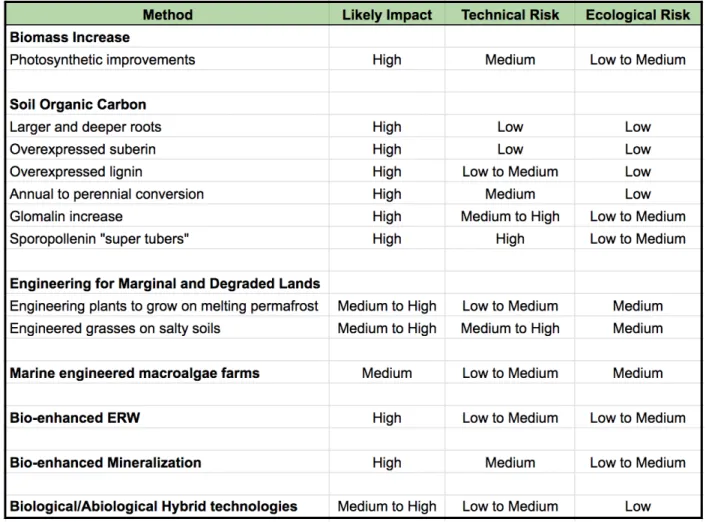
Bioengineering has the potential to enhance the effectiveness of both biological and abiological solutions by lowering costs and energy requirements and increasing the speed and effectiveness of some CDR methods. This paper aims to survey the possible ways that bioengineering could be employed to develop NETs that can operate at the 1 Gt CO2/yr scale or more, providing significant additional capabilities to efforts to stabilize the Earth’s climate. This paper will discuss the main categories of NETs that can be achieved or enhanced by biotechnology, focusing heavily but not exclusively on plant engineering and enhanced rock weathering (ERW) due to their low energetic requirements, high scalability, and in the case of rock weathering, permanence. Each section begins with an explanation of why the proposed NETs strategy is promising and key facts, then discusses possible bioengineering improvements that could be developed, and ends with an outline of key research questions to answer and key engineering targets to pursue. A table summarizing the carbon-capturing potential, technological risk, and environmental risk of each technology is included at the end in order to provide a snapshot comparison of potential benefits and risks of each strategy (Table 1). The overall goal of this paper is to provide a roadmap for how
bioengineering tools and techniques could be applied to help reduce atmospheric CO2 levels.
Scope and Methodology
The carbon cycle and existing proposals for enhanced carbon removal were used as a starting point to assess possible routes of carbon removal. Major global negative carbon fluxes, also known as carbon sinks, that involve biology were assessed to understand how carbon removal processes could be enhanced or newly introduced. For terrestrial approaches using plants, focus was placed on solutions that could be deployed on lands that are already highly managed or underproductive (e.g. farmland and marginal lands), and intervention was ruled out for biodiverse, ecologically sensitive, and native ecosystems such as protected areas, parks, old growth forests, and rainforests.
Image 2: The global carbon flux, illustrating major CO2 sources and sinks. Source: NASEM, 2019.
In addition to existing biological carbon cycling pathways, consideration was also given to new pathways that could be created, such as ERW systems utilizing microbes for faster CO2 uptake, or DAC machines that encompass biologically-derived components such as engineered enzymes. For each topic, I reviewed the literature to assess the state of knowledge in the field and the potential for improvements to CDR processes. I conducted a series of 1-on-1 discussions with researchers studying relevant aspects of the global carbon cycle, climate change, and biological processes that drive carbon removal. Finally, I held two workshops on new approaches to CDR, one in September 2019 at the MIT Media Lab and one held virtually in June 2020. Both workshops featured presentations by expert researchers and graduate students on new concepts for carbon removal, followed by discussion and ideation. The September workshop included both abiological and biological ideas, while the June workshop focused solely on biological approaches.
Historical context for biological change to atmospheric CO2 levels
In the big picture — encompassing geologic time going back several billion years — there is plenty of precedent for biologically-driven drawdown of CO2 so extensive that it dramatically altered Earth’s climate. Evidence for these shifts abounds in the geological record captured in sediments and ice cores,
among other types of evidence. These changes took place over tens or hundreds of thousands of years: slowly from the perspective of humans, but relatively quickly from the perspective of geologic time. They provide insight into how biologically fixed carbon can become locked away from the atmosphere for long enough periods of time to affect the climate, pathways that could potentially be exploited today.
One major drawdown event occurred during the Carboniferous era, when newly evolved trees absorbed tremendous quantities of CO2 and stored it in their biomass in the form of lignin over millions of years. The conventional explanation for the tremendous build-up of biomass is that fungi had not yet evolved the capability to break down lignin, however recent research challenge that notion and instead points to the highly productive ecosystem of warm tropics entombing dead trees in anoxic sediments, which were then buried during glacial periods (Nelsen et al., 2016). The immense deposits of Carboniferous biomass were eventually transformed by geological pressure into coal deposits. Today’s rapid digging-up and
combustion of coal, sending its stored carbon into the atmosphere, represents a rapid-fire undoing of millions of years of carbon fixation by photosynthesis. These two theories explain Carboniferous era CO2 drawdown as the result of either the formation of difficult-to-degrade carbon in the form of lignin, or as the result of environmental conditions that physically sequestered carbon in sediments where it could not be degraded.
Another instructive drawdown is the Azolla event, an extended period during the Eocene era when a fast-growing freshwater aquatic plant known as Azolla (duckweed) grew in copious amounts in the Arctic. A large freshwater lake, stratified over a saline layer, formed where azolla could grow continuously, refreshed by nutrients from continental runoff (Speelman et al., 2009). A symbiotic relationship with nitrogen-fixing cyanobacteria provided Azolla with unlimited nitrogen to feed its growth. As individual Azolla plants died, they sank into an anoxic zone at the bottom of the lake and was trapped in sediments (Speelman et al., 2009)Over hundreds of thousands of years, this process is thought to have drastically changed the amount of the CO2 in the atmosphere from about 3000ppm CO2 to under 1000ppm CO2 (Pearson & Palmer, 2000)Among other evidence for the Azolla event are the remains of 50M year old Azolla found in Arctic sediments (Speelman et al., 2009).
These prehistorical precedents illuminate how shifts in the balance of biomass fixation and degradation can result in large-scale carbon removal that can change the Earth’s climate. As dramatic as they were for the climate, however, the Azolla event and Carboniferous drawdown occurred over hundreds of
thousands and millions of years, respectively. IPCC targets for the amount of carbon removal needed to remove enough CO2 to remain under 1.5°C of global heating, roughly on the order of ~10 gigatons/year for the next century, do not require matching the net amount of carbon removal from these events, but they would require a much faster rate of carbon removal. Meeting this target requires interventions that can work on the order of one to several orders of magnitude faster than prehistoric carbon removal events.
Resource constraints
Carbon removal schemes must be designed with the limitations of the Earth’s resources in mind. Much of Earth’s land area is already in use for human habitation or agriculture, is difficult to access (Arctic land, mountain ranges), or is set aside for conservation. Fresh water and nutrients such as phosphorous
land, fertilizers, and water to grow plants for purposes of carbon removal will eventually conflict with the use of those resources to grow food for an ever-increasing global population.
In a recent review article highlighting resource constraints, researchers calculated that
implementing one of the most commonly pointed-to CDR strategies, Bioenergy Carbon Capture and Storage (BECCS), would conflict with the use of arable land for food or bioenergy production (P. Smith et al., 2016). BECCS is a process in which biomass is grown, harvests, and burned in a facility to generate energy and capture the resulting carbon emissions for storage off-site. To capture 10 Gt CO2/yr in 2100 with BECCS would require 380-700 Mha, which represents 7-25% of all agricultural land and 25-46% of arable plus permanent crop land (P. Smith et al., 2016). The researchers found that afforestation and reforestation would require a similar amount of land to sequester the same amount of carbon as BECCS. This land requirement is 2 - 4 times the amount of land considered marginal, making the limitations of land use inescapable when contemplating NETs at the multi-gigaton scale (P. Smith et al., 2016). CDR concepts that require minimal amounts of land, freshwater and nutrients are preferable. An awareness of these constraints is necessary but also helpful, as it may direct innovation towards solutions like nutrient recycling, thought to have fueled the perpetual blooms of the Azolla event.
Permanence
Not all carbon removal is created equal. Removing carbon from the atmosphere and storing it in living biomass creates a flight risk: in the right situations, that carbon can be released almost instantaneously back into the atmosphere, undoing years of carbon removal work. Fires are one such way that biomass can quickly make its way back to the atmosphere. Another risk of storage in living biomass is land use change. A forest that is planted can always be cut down, and a field can always be paved over. Biomass that is locked away for only a few years or decades could start to return to the atmosphere while society is in still throwing its (proposed) CDR program into high-gear, thus making CDR targets even harder to achieve. However, some forms of carbon removal can last for eons. For example, carbon locked away in carbonate form, such as magnesium carbonate (MgCO3) is highly stable and can sequester carbon effectively permanently, and so is being investigated for long-term carbon storage (Lackner et al., 1995). Permanence is an important consideration when valuing individual CDR solutions and when building an overall portfolio of solutions.
Increasing biomass
The growth of biomass represents an important pathway for carbon removal. Natural growing biomass — primarily in the form of forests, wetlands, grasslands, phytoplankton, and other photosynthetic things — is the primary driver of the carbon cycle on an annual basis. The amount of new biomass that is created is referred to as Net Primary Productivity and amounts to about 105 GtC/yr,roughly half of which is produced on land and half in the ocean (Field et al., 1998). Emissions from human activities amount to roughly 11 GtC/yr (equivalent to 40 Gt CO2/yr), which means that biology fixes nearly ten times as much carbon each year as humans emit (Intergovernmental Panel on Climate Change, 2018). Most of the biomass created each year is however not sequestered, but rather is released back into the carbon cycle over time frames ranging from hours to months. Only about 2.5% of carbon fixed by photosynthesis
becomes sequestered as soil carbon (ARPA-E, n.d.). As plants, microbes and other organisms respire, die and decompose, the carbon they removed from the atmosphere is returned.
This low sequestration rate is why increasing biomass production alone will not result in appreciable net amounts of carbon removal. A study by the United States Geological Survey of carbon fluxes in the US shows that forests have the largest annual negative carbon flux, yet they store only 0.28% of total forest biomass each year (Zhu et al., 2010). Annual net negative carbon flux is usually only a tiny proportion of an ecosystem’s total biomass.Given the very large amounts of additional carbon storage needed to slow global temperature rise to under 2°C, and the limited availability of arable land for planting more forests and grasslands, it is more helpful to focus on increasing the proportion of total biomass carbon that is sequestered rather than on producing more biomass.
Many biomes should be avoided for NETs implementation, in order to preserve natural ecosystems and biodiversity. The best target areas for increased carbon storage are those which are already managed, which contain mainly non-native plants, or which do not represent ecologically rich and biodiverse landscapes. On land, this means croplands, pasturelands, commercial forests, marginal and degraded lands, and other non-native ecosystems should be considered for additional carbon storage. In addition to considering the carbon removal potential of an area, we must also consider its wider climate and
ecological impact.
Increases in biomass can be effective at removing carbon if those increases are paired with strategies for sequestering this carbon for long periods of time. This can be accomplished through several strategies, including storing carbon in the form of molecules that are slow to degrade in environmental conditions (referred to as “recalcitrant” carbon), storing carbon in chemical environments where natural degradation processes are blocked, such as anoxic sediments, and storing carbon in physical locations where it is locked away from release back into the atmosphere, such as the deep ocean. We will examine the carbon removal potential of each of these strategies.
Growing new biomass is not always a clear win: sometimes it can even be counter-productive to climate stabilization goals. Land use change must consider the whole picture. For example, replacing a carbon-storing forest with crops might reduce the amount of carbon stored on that piece of land. Replacing desert with tree cover may increase carbon storage, but may also decrease the albedo of the surface. Albedo is an aspect of the Earth’s climate system that acts as an important dampener to global warming by reflecting radiation back into space. Planting trees where there is not enough groundwater or rain to sustain them may further deplete scarce groundwater resources and harm both the trees and the native vegetation. Additional impacts of land use change include the effect of vegetation on transpiration and evaporation, rainwater and nutrient runoff, and local weather. With these concerns in mind, there is room to make significant headway in CDR by increasing land-based biomass storage. It is estimated that since the Industrial Revolution, land use change and soil carbon losses have results in the release of 136 ± 55 petagrams of carbon to the atmosphere, equivalent to 266 to 628 Gt CO2(Zomer et al., 2017).
In addition to planting more area with productive plants, strategies could be employed to increase the plant nutrient uptake. This would be effective in areas where nutrients are limiting factors to growth.
Improvements in Photosynthesis
A strategy that could be highly impactful for increasing biomass is increasing photosynthetic efficiency. Terrestrial plants only use about 1% of incoming sunlight. Other organisms, such as algae, have
demonstrated the ability to capture ten times more energy from sunlight (Khan et al., 2018). Increasing photosynthetic efficiency would give plants more energy with which to fix carbon and build more biomass.
Historically, improvements in plant productivity have come from traditional techniques such as selective breeding, cross-breeding, irrigation and the addition of nutrients in the form of manure and synthetic fertilizer. Modern tools of genomics and synthetic biology offer the opportunity to not just fine-tune these traditional strategies, but to re-engineer photosynthesis itself. Multiple different strategies have been proposed and investigated for improving photosynthetic efficiency(Kubis & Bar-Even, 2019).These efforts are largely driven by a desire to increase the productivity of harvested crops such as food and biomass used for biofuels production, but they could also be used to increase carbon removal. The resulting biomass increases would need to be paired with strategies for producing carbon that is kept from returning to the atmosphere for decades or longer, such as recalcitrant carbon or carbon stored in deep soils. Several broad concepts for increasing photosynthetic efficiency are highlighted here. A recent review paper by Kubis & Bar-Even describes the photosynthetic changes most likely to result in increased carbon fixation (Kubis & Bar-Even, 2019).
At the heart of many approaches to improve photosynthesis is addressing the fundamental inefficiency of the key protein that fixes carbon dioxide from the atmosphere, Rubisco. Rubisco is a somewhat clumsy protein. Its job is to bind CO2, but it has trouble differentiating CO2 from O2 and “misfires” about 20 - 25% of the time (Sharkey, 1988) (RIPE, 2020). This causes plants to waste a large amount of energy, first in binding the wrong molecule, and second in cleaning up the resulting mess from unwanted reactive oxygen inside the cell, a process called photorespiration. Many plants have evolved strategies to work around Rubisco’s poor performance.
Convert plants from C3 to C4 metabolism
The type of photosynthesis used by most plants around the world is referred to as C3 photosynthesis, but in hot, dry climates, some plants have evolved a version of photosynthesis, called C4 photosynthesis, that reduces water loss involved in the uptake of CO2 and increases photosynthetic efficiency. C4 plants use a carboxylase enzyme, PEP, to fix carbon into a four-chain carbon molecule (C4) called malate, which is then shuttled into anatomical structures called bundle sheaths that allow carbon to be concentrated around Rubisco. Plant breeding efforts such as the RIPE project, a partnership between universities, government agencies and nonprofits, are attempting to improve productivity by introducing C4 traits into C3 crop plants (RIPE, 2020).
Although no successful C3 to C4 plant conversions have yet been announced, it has been pointed out that such as conversion is likely to be achievable given that C4 metabolism has evolved at least 66
independent times and that C3 plants already contain many key C4 traits, such as PEP carboxylases and carbon transport capabilities (Kubis & Bar-Even, 2019).
Redesign Rubisco
The structure of Rubisco could be modified to improve its functionality, or Rubisco could be replaced with a faster variant found in nature. Researchers have successfully expressed cyanobacterial Rubisco in tobacco plants, although they saw a decrease in growth rate, likely because additional components such as carbon concentrating mechanisms were needed as well (Hanson et al., 2016).
Faster regeneration and clearing of Rubisco
Faster clearing of Rubisco that has mistakenly bound O2 could increase the effective amount of Rubisco available for binding CO2. Increased expression of the chaperone molecule, Rca, that clear sugar-phosphates interfering with Rubisco carbon binding sites, has been shown to increase Rubsico activity (Yamori et al., 2012).
Reduce kinetic bottlenecks in Calvin cycle (see above)
Kubis and Bar-Even point to modeling experiments that indicate which rate-limiting steps could be increased to improve the overall rate for regenerating RuBP, which binds to and fixes CO2. They suggest that “higher levels of sedoheptulose-1,7- bisphosphatase and fructose-1,6-bisphosphate aldolase, as well as enzymes linked to sink capacity, could support higher productivity” (Kubis & Bar-Even, 2019).
Improving carbon concentrating mechanisms from algae
Importing carbon concentrating mechanisms from algae could allow plants to dramatically increase their photosynthetic efficiency. Researchers have investigated adding carbon transporters, to bring more carbon into the cell, and carboxysomes, to concentrate the carbon around Rubsico. An experiment to engineer algal carbon transporters and carbonic anhydrases in Arabidopsis plants showed stable expression, although not biomass increases (Atkinson et al., 2016). This result was expected, as it pointed to the anticipated need for additional components of the carbon concentrating system to be imported as well in order to achieve improved growth rates.
Improve photorespiration speed or bypass photorespiration
Increasing the photorespiration rate or bypassing some of its more inefficient steps are potential
strategies, supported by experimental evidence, for saving plants energy and increasing the availability of CO2 (Kubis & Bar-Even, 2019).
Many of these strategies could potentially be combined in the same plant to achieve efficiency gains, although components may need to be modified in order to create a whole system that works together with optimal efficiency. Researchers assessed a set of 6 specific photosynthetic improvements and estimated that they could be implemented within 10 - 15 years due to relative ease of genetic modification, and increase crop yields by 50% (Long et al., 2006). Recent work has identified specific genes that can be targeted to increase plant productivity (Nowicka, 2019).
Key research questions
• What is the theoretical maximum carbon-fixing efficiency increase for plants relevant to developing NETs?
• What are near-term and medium-term engineering targets of low to moderate difficulty that can achieve a large increase in carbon fixation?
• What additional fundamental research needs to be done to create useful models that can predict efficiency gains from stacking multiple different bioengineered improvements together?
Key engineering targets
• Successfully demonstrate each of the strategies described above in a model plant.
• Develop model that can successfully predict the relationship between expression level and maximum biomass increase for each of the photosynthetic improvements described above.
Soil Carbon Sequestration
In the past few years, increasing attention has been paid to the idea of storing additional carbon in soils. Due to modern agricultural practices that degrade soils, soils have lost a tremendous amount of carbon. One study estimates the total soil organic carbon (SOC) loss since the Industrial Revolution at 78 ± 12 GtC while another puts the total at 133 GtC lost from soil organic matter and erosion since the beginning of agriculture (Zomer et al., 2017) (UNEP, 2019). Soil can be degraded by agricultural practices such as tilling, which exposes dirt to erosion, and the replacement of native plants with modern crops such as wheat which have shorter roots that do not hold soils together as well as deeper-rooted plants.
Agricultural practices can also result in dirt being removed from land by increased runoff via rainwater into streams and sediment basins. Soil organic carbon also oxides and returns to the atmosphere as CO2. This all adds up. 24 billion tons of topsoil lost every year (UNEP, 2019).
Targeted interventions could increase the amount of carbon stored in soils. By one estimate, croplands worldwide could sequester 0.9 to 1.85PgC/yr, the equivalent of about 3 to 6Gt CO2/yr (Zomer et al., 2017) A United Nations Environment Programme survey of literature or soil carbon estimates the total amount of carbon that can be sequestered on agricultural lands through improved practices at 10 Gt/year, with a “practically archivable” amount much lower at 1.5 -2 .5 GtC/yr (UNEP, 2019). The same review puts the theoretical sequestration potential of non-agricultural soils at 0.8 - 8 GtC/yr.
Carbon is added to the soil through natural processes through which plants transport carbon, fixed from the atmosphere via photosynthesis, to their roots in the form of carbohydrates, waxy molecules like suberin, and other carbon-rich molecules. This carbon is then transported to the soil as root exudates and as organic carbon that accumulates after a plant has died and its roots decompose. Carbon is also added to soils in the form of breakdown products from above-ground plant matter, also known as plant litter, such as stems, bark and leaves.
The main strategy being investigated for returning carbon to soils is so-called “regenerative agriculture” practices. These practices aim to essentially reverse the land-degrading farming practices that came before, and include no-till agriculture, the use of cover crops that build SOC, crop rotations to reduce degradation of soils, and silvopasture, a practice of planting trees throughout crop fields to retain moisture and build stronger root networks. These practices are promising, if not thoroughly understood, due to the absence of long-term studies and the understanding of the variance these practices may have in different climates and amongst different crops and soil types. The accumulation and long-term maintenance of
SOC is made more challenging because measuring SOC is difficult. SOC content can differ from meter to meter and at different soil depths even in the same field.
Biotechnology strategies for enhancing soil carbon
In addition to the gains in SOC that could be achieved through regenerative agriculture practices, there is strong potential for even further gains to be achieved through biotechnology applications. The National Academies of Sciences estimates that 6 GtCO2/yr could be added to soils through the use of “frontier biotech” although this is the amount considered practical, not a theoretical maximum (NASEM, 2019). Improvements to photosynthetic efficiency, explored in this paper in an earlier section, would allow plants to grow more overall biomass. This biomass increase could be used to boost the production of plant components that add to soil carbon. Additional strategies for adding to soil carbon, discussed in more detail in the following sections, include engineering plants to:
Store more carbon underground via a higher root to shoot ratio Grow recalcitrant forms of carbon such as suberin and lignin
Shift from being annual to perennial so they develop deeper root structures Slow the decomposition of biomass
Thrive on marginal and degraded lands
In addition to altering plants themselves, changing the plant root-soil ecosystem may provide a path to sequester more carbon. Fungi and microbes play critical roles in soil ecosystems. Both can be
decomposers, breaking down carbon and respiring it back into the atmosphere or converting it into more or less stable forms of soil carbon. Some fungi also have a symbiotic relationship with plants, funneling nutrients to plants roots via long filamentous hyphae structures, and in return for this service plants transfer to fungi carbon-rich carbohydrates from their roots. Because these proposals are speculative and have not been studied thoroughly or deployed at scale, their potential impact on global carbon storage is not well understood, and the discussion of each of these solutions will be more qualitative than
quantitative.
Increasing carbon stored underground via enhanced roots
It has been proposed by multiple scientists that increasing plant biomass production underground could be a means of drawing down and storing additional CO2 from the atmosphere (Kell, 2012)(Salk, n.d.). Although it is known that roots are a major root by which carbon enters the soil, the relationship between global primary production and soil carbon accumulation from roots is not fully understood. Fewer than 10% of studies of terrestrial net primary production (NPP) look at below-ground production, although roots are thought to account for 30 - 40% of terrestrial NPP (Chapin & Eviner, 2013).
Despite this, there are multiple strategies that present appealing targets for increasing soil carbon from roots. For one, enhancing the overall below-ground biomass that plants produce should yield more soil carbon. Increasing attention is being paid to the development of plants with enhanced roots that are deeper, more branched, and express a greater proportion of forms of carbon that persist for a long time in soils, such as suberin. The ARPA-E Roots Program commissioned a study that modeled deeper roots with
up to 100% more carbon allocation and found that even modest gains in these properties, if deployed across US crops, would “significantly offset” US GHG emissions, up to about 1.1 Gt CO2 (ARPA-E, n.d.).
The Salk Institute’s Harnessing Plants Initiative has done much to promote the idea of engineered crop plants that have deeper, more branched roots which express more suberin, a difficult-to-breakdown carbon-rich substance that is already produced by plants (Salk, n.d.) Much more fundamental work that needs to be done in this area: one recent paper bemoans that “[o]ur knowledge of the physiological basis underlying root growth and development and the relevant variations in belowground biomass production is poor”(Ogden et al., 2020). However, there is substantial research literature to support the idea that root architecture is a feasible engineering target. It is thought that most crops have flexibility to alter their root architecture (S. Smith & de Smet, 2012). The same paper that pointed out the lack of overall
understanding of root growth was able to identify families of transcription factors that were expressed to different degrees during root growth stages in a model plant from the same temperate grass family as wheat and rice (Ogden et al., 2020). Traditional molecular biology techniques have been fruitful in identifying the function, expression, and localization of many gene products, and even in describing small genetic regulatory networks controlling root properties such as Casparian strip development (Wachsman et al., 2015). For further understanding of how small gene networks interact (a possible number of combinations too big to try out via plant engineering experiments), computer models can simulate interaction and compare scenarios to see what matches with experimental data, an approach that successfully predicted gene expression patterns that regulate root epidermal development. In addition to exploring enhanced carbon storage traits, roots could also be improved in ways that increase a plant’s ability to explore and exploit soil conditions, especially in poor quality soils. This would allow plants to grow deeper roots contributing to overall plant growth and carbon deposition. A 2014 review of the potential to create deeper rooted crops identified opportunities for regulating the genes that control plants’ adaptability to soil conditions that limit root growth, including metal toxicity
(particularly from Al and Mn), P and Ca deficiency, salinity, and suboptimal soil temperatures (Lynch & Wojciechowski, 2015). Many of these poor soil conditions will be exacerbated under climate change and will affect more agricultural lands. For example, as coastal areas flood, they will experience increased soil salinity. Adapting important agricultural plants now to these conditions can yield increased benefits for carbon storage and plant productivity, and may also help avoid decreases in agricultural yields and farmable land.
It is possible that modifying the root or soil microbiome could contribute to additional carbon transfer from roots to soil, or the slower breakdown of plant-derived carbon in soil. The effect of root-microbe interactions on soil carbon sequestration, while known to be important, are not fully understood. A minireview in 2009 of microbe-plant interactions and carbon sequestration concluded that “More long-term and standardized studies, under different environmental conditions, of belowground carbon fluxes, integrating models and measurements are needed.” (Wu et al., 2009) While many factors are known to be influential, including temperature, microbial activity, and soil water content, the specific influence of these factors needs to be better characterized across different plant species and environments.
Challenges going forward will be to develop models that can predict overall plant root enhancements and soil carbon accumulation via pathways which won’t harm other desirable plant traits, and models that can work with limited data. Researchers will also need to develop a better understanding of which genes influencing root development are shared among plants species of interest, and to what degree they interact with each other to control root development.
Key Research Questions:
● What are the key root-microbe-fungi interactions that drive the accumulation of stable SOC? ● What are the key genes governing plant partitioning of carbon to roots?
Key Engineering Opportunities:
● Better understanding of genes controlling root growth, branching, mass, depth, and carbon deposition over the lifetime of the plant, particularly with regard to recalcitrant forms of carbon like suberin and lignin.
● Development of models that can predict organism-wide modifications for optimization of root architecture and carbon storage
● Development and testing of engineered strains that greatly enhance SOC without sacrificing other desired traits such as crop productivity
● Embrace and integrate new tools such as synthetic plant gene promoters for fine-tuned control of gene expression and localization
● Create models of the gene regulatory networks governing plant adaptability to poor soil conditions
● Engineer roots with improved adaptability to poor soil conditions such as Al and Mn toxicity, suboptimal temperatures, and hypoxia
Recalcitrant molecules for longer term carbon storage
In addition to storing more carbon deeper underground in enhanced roots, researchers are focusing on increasing the proportion of carbon that organisms fix into long-lived forms of carbon. The Salk Institute Harnessing Plants Initiative is focused on increasing suberin production in crops and cover crops (Salk, n.d.). Lignin and glomalin should also be considered as targets for enhancement. Suberin, lignin and glomalin are all substances already produced in abundance by plants and fungi, and they are resistant to degradation, and can persist in the soil for many decades or even longer.
Suberin
Suberin is a tough, waxy substance that accumulates in the cell walls of plant roots and in some other plant features, such as the bark of cork trees. It is slow to degrade in the soil, and is a significant source of soil organic carbon. Suberin originating in roots is considered to be an important contributor to long-term soil organic carbon stores (Filley et al., 2008)
Suberin provides an important function in creating a barrier to moisture and to protect the plant from attack by pathogens. It is composed of long chains of hydrocarbons linked together: highly stable ring-forming aromatic molecules that are covalently linked in an alternating pattern to aliphatic molecules (Bernards, 2002). These molecules are cross-linked via ester bonds, increasing the stability of the overall
structure. Because they are composed primarily of hydrogen and carbon, they are mostly composed of carbon by weight. While suberin subunits can be found in many variants, a study of suberin in soybean roots found the aliphatic domain composed of chains ranging in length from 16 to 24 carbons, with C:18 being the most common chain length, demonstrating the high proportion of carbon (Thomas et al., 2007). Because it contains a high proportion of carbon and is not rich in nitrogen and phosphorous, suberin is an excellent option for storing more organic carbon without locking up key nutrients which would degrade soils and put increased stress on global phosphorous production.
Image 3: Source: (Graça, 2015)
Although the suberin biosynthesis pathway is not completely understood, experiments have shown that suberin production can be vastly increased. An enhanced suberin 1 mutant Arabidopsis plant showed a two-fold increase in root suberin content, along with increased drought tolerance (Franke et al., 2012). A 2002 review described 85 enzymes involved in the biosynthesis pathway of suberin precursors (Bernards, 2002). Modern genomics techniques are quickly adding to our knowledge of suberin biosynthesis. A more detailed understanding of suberin biosynthesis will reveal opportunities for increasing suberin
production. Beyond that, a more detailed understanding of how the structural properties of suberin (both subunits and macromolecular assembly) relate to its resistance to degradation may illuminate
opportunities to engineer novel suberin structures to be even more degradation-resistant, or to enhance the expression of existing suberin structural elements and arrangements that confer resistance. For example, several studies have pointed to the aliphatic layer as critical in providing resistance to attack from dry-rot fungus and root diseases caused by the microbe Phytophthora soja (Thomas et al., 2007)
Inducible suberin upregulation
Formation of suberin lamellae in plant roots has been demonstrated to be dynamic, forming and reforming in response to changing soil conditions, a flexibility that allows plant roots to reroute around barriers in soils and towards nutrient-rich deposits (Ursache et al, 2020). This dynamism suggests that excess suberin production might be inducible at a desirable point in the plant life cycle, dramatically increasing the amount of suberin in the plant prior to its death, without impacting the majority of its life cycle. Such a property could be desirable in crop plants, triggered after harvest, as it would provide a way to increase suberin content without diverting the plant’s energy needed to produce food crops. The trigger for ramping up suberin production could be an element timed to the harvest: for example, the age of the plant (many types of crops are engineered to be ready a set number of days after seed planting), the amount of daylight at the end of the planting season, colder weather, or perhaps even an exogenous chemical
stimulant. Research on temperature-induced lignin deposition in several species, including post-harvest in at least one, points to possible genetic pathways for creating a responsive control for suberin expression (Q. Liu et al., 2018).
This is likely to be a technically challenging approach and would need to yield a significant increase in suberin production to justify the development effort. However, given the tremendous amount of land area occupied by crops, even a moderate increase in suberin growth and hence stored carbon is worth
investigating. The development of new tools for inducing controllable plant behaviors may also yield other benefits in fighting crop disease, adapting crops to climate change, or increasing crop productivity.
Key research questions
● What are the key mechanisms by which suberin is broken down in soils, and what are the most promising points of intervention to slow degradation?
● How much, and in which locations inside a plant, can suberin content be increased before harming plant health?
● What are the key genetic controls in the biosynthesis and expression of suberin that could be exploited to increase production?
● Which genetic controls could be exploited to create inducible or time-dependent suberin overexpression?
Key engineering opportunities
● Preferentially express monomers that result in more stable suberin and SOC, and design and test new monomers with improved characteristics
● Enlarge existing suberin deposits in plants
● Increase recalcitrance: Better understanding of macromolecular assembly may provide clues as to how to further strengthen these bonds from microbial and fungal attack after plant death
● Overexpression at end stages of crop plant life (waxy entombment)
Lignin
Lignin, like suberin, is a major component of plant biomass that provides structural stability and protects the plant from degradation and attack. Lignin is one of the most common organic polymers in the biosphere, comprising 30% of organic carbon (Ralph et al., 2004). It is particularly resistant to degradation in nature, and has been described as “the most recalcitrant component in biopolymers for physically impeding the accessibility of enzymes to polysaccharides substrate.”(Zhang et al., 2019). Lignin’s structure provides insight into its durability. It is composed of lignin monomers, which come in a wide variety of forms, that are added to a growing polymer chain in a semi-random fashion, depending on the availability of reactants and the local intracellular environment during polymer synthesis (Ralph et al., 2004). Because of this variability, there are an “astronomical” number of possible lignin macrostructures and a low probability of two lignin macromolecules being identical (Ralph et al., 2004). Lignin
monomers are produced in the cytoplasm and transported to the cell wall, where they are assembled into macromolecules (Q. Liu et al., 2018).
The past few decades have brought a great increase in our understanding of lignin biosynthesis. A 2017 mini-review identified 17 genes involved in lignin biosynthesis that had been identified in the preceding 5 years, many of which may be targets for increasing lignin expression or recalcitrance (Q. Liu et al., 2018). A general biosynthesis pathway has been proposed that describes the three key steps of monomer synthesis, transport, and polymerization and the key enabling enzymes (Q. Liu et al., 2018). While there is doubtless much more to learn, studies so far have shown many pathways for achieving double-digit increases in lignin biosynthesis, and increased lignin content has been linked to cold
temperature exposure in some plants, such as in the leaves of Rhodedendron and the wood of the Norway spruce (Q. Liu et al., 2018). In roots, a positive feedback loop enhancing lignin biosynthesis was
identified (Wachsman et al., 2015). In addition to increasing lignin content in plant biomass, pathways for increasing lignin content that result in increased SOC have also been identified. Single-gene mutants were demonstrated to have increased lignin biosynthesis and to result in increased carbon stored in soils due to decreased degradation of plant matter (Whalen et al., 2014).
Somewhat ironically, much of the climate-related engineering work on lignin has aimed to make it easier to degrade lignin, not harder. This is because of the extreme interest in the past several decades in using harvested biomass as a starting material for making biofuels. Repurposing this biomass requires first expending a large amount of energy in processing it to break down the lignin and separate out
hydrocarbons that can be used as precursors for making fuels. Thus, a substantial amount of research has gone into furthering the breakdown of lignin. Much of this research could actually provide a starting point for strengthening lignin, by essentially doing the reverse of previous genetic engineering strategies. There are many potential approaches to engineering plants to express more, and more durable, lignin. First, the extreme structural variability of lignin means it can tolerate a lot of interference in its form without sacrificing function. In natural lignin, many subunits are arranged in a fantastic array of forms,
which “provides significant opportunities to engineer the structures of lignins beyond the limits explored to date.” (Ralph et al., 2004) It is known that the composition of monomers in the macromolecules of lignin greatly affects the degradation susceptibility (Ragauskas et al., 2006). Modification of the monomer composition to enhance degradation resistance represents a path forward to enhance the amount of
recalcitrant carbon in soils.
The location of lignin accumulation within plants could also be controlled, allowing for example more lignin accumulation in areas of the plant (such as deep roots) that are particularly shielded from environmental degradation. Ferulates have been shown to be nucleation sites for beginning the
lignification process in grasses (Ralph et al., 1995). Within cells, “[t]he binding of peroxidases to specific epitopes within the cell wall is potentially a means to control lignin deposition in space within the cell wall.” (Ralph et al., 2004)
Pathways linking lignin deposition to environmental stresses and triggers which could be exploited to create bioengineered, temporally-controlled means of lignin overexpression. In satsuma mandarin trees, high temperature post-harvest was found to correlate with increased lignin deposition in the tree pericarp (Yun et al., 2013). It is possible that this adaptation serves to protect the plant from heat stress (Q. Liu et al., 2018).
These and other engineering strategies describe credible ways to control the molecular structure, intra-cellular location, intraplant location, overall expression levels, and temporal expression of lignin synthesis in plants in ways that could substantially increase long-term carbon storage.
Deployment
There are multiple potential strategies for deploying lignin-enhanced plants to store more atmospheric carbon. As with suberin, lignin could be overexpressed in the roots of crops, grasses, and trees across many biomes. Lignin can also be enhanced in above-ground biomass, where it is already found in great abundance in plant stems, stalks, canes, and all types of woody biomass. The primary value of increased lignin concentrations would be for increasing the proportion that ends up in soils or other long-lived deposits. On its own, more lignin stored in a living plant does not necessarily mean more carbon drawn down from the atmosphere. Increased lignin content in wood has been correlated with decreased growth rates (Novaes et al., 2010). Attempts to engineer high-lignin containing trees may need to offset lower growth rates by introducing growth-enhancing traits such as improved photosynthesis, water retention or nutrient uptake in order to not see a decrease in overall biomass production. Lignin-enriched wood might increase the carbon flux in forests towards a higher SOC content, however this would need to be
confirmed experimentally.
With regard to crops, there are potential paths for both increased and decreased lignin to be useful in environmental carbon removal. Much above-ground biomass, for example the stalks of corn and wheat, is not high-value material and is often considered waste (this and other low-value leftover biomass post-harvest is referred to as “crop residue”). Crop residue is often burned to clear fields for the next post-harvest, which releases tremendous amounts of CO2 back into the atmosphere and contributes greatly to local air pollution. One proposal to store carbon from crop waste imagines harvesting it and throwing it in the ocean, weighed down by stone ballast to sink into the deep ocean (Strand & Benford, 2009). While likely
to work, this proposal would remove crucial nutrients from soils and degrade them over time, so it is not likely to be sustainable.
It might be possible to engineer crops for planned degradation that enhances SOC, to avoid the current practices of burning and tilling while reaping the same benefits of clearing fields for the new harvest and returning nutrients and organic matter to the soil. One can imagine a scenario where crop residues from specially engineered crops, after harvest, begin to degrade quickly into smaller pieces, perhaps
millimeters in size, that are more easily integrated into the soil as SOC. Lignin however could persist in small, stable aggregates in the soil, thus enhancing long-term SOC while facilitating biodegradation that clears the field for the next harvest. A different strategy envisions crop residues being harvested and burned in facilities that capture CO2. The residues would be combusted at high temperature to create carbon-rich biochar, which would be returned to the fields (BECCS with biochar). Biochar has beneficial qualities that make this strategy appealing: it can sequester carbon in the soil for hundreds of thousands of years (Spokas, 2010). It plays a role in stabilizing soil structure and increasing water retention, and it provides an avenue for the storage of carbon from crop residues that need to be cleared from their original fields quickly. To improve the efficiency of this strategy, crops could be engineered to overexpress lignin and other molecules that are highly retained as stable carbon in the process of forming biochar.
Key Research Questions:
● What are the genetic controls and environmental stimuli that could be exploited to cause controlled degradation of crop residue that clears fields quickly but allows lignin to persist in SOC?
● What is the relationship between enhanced lignin production and increases in SOC?
● What aspects of lignin structure and chemistry help it resist degradation, and how could these traits be enhanced?
● What new chemistry and structural arrangements, perhaps adapted from other degradation-resistant organic molecules, could be introduced to lignin to make it more degradation degradation-resistant?
Key Engineering Opportunity:
● Create a model of the genetic controls that could be exploited to create planned degradation for key crop species
● Design and test “super recalcitrant” forms of lignin
● Engineer a model plant to overexpress lignin at the end stages of its life cycle (woody entombment)
Enhancing soil carbon from fungi (Glomalin)
In addition to increasing recalcitrant soil carbon that is derived from plant biomass, we can consider increasing the amount of long-lived soil carbon that originates in fungi. Glomalin is a recently discovered (1996) and relatively understudied component of soils, associated with certain types of fungi, that is thought to store a significant percentage of long-term stable soil carbon (Wright & Upadhyaya, 1996) (Comis, 2002). By one estimate from a U.S. Department of Energy funded study, glomalin may account for as much as 27% of soil carbon (Comis, 2002). Glomalin was first identified by a harsh extraction process that exposed soils to high heat and acid, leaving a durable and carbon-rich substance remaining.
This substance is referred to as glomalin, although a specific molecular structure for glomalin has not been identified. More recent research has shown that glomalin is composed of a variety of different molecules, some of non-fungal origin (Holátko, 2020). Because glomalin is not identified by a specific structure, but rather is identified by its extraction process and reactivity to an assay, it is currently referred to as glomalin-related soil protein (GRSP).
Some aspects of GRSP are known: it is mainly a hydrophobic glycoprotein (composed of both sugar and protein) produced in association with the arbuscular mycorrhizal fungi (ARF) which live in symbiosis with plant roots on at least 70% of terrestrial plants worldwide (Brundrett & Tedersoo, 2018). ARF grow hyphae filaments that explore the soil for nutrients and trade them to plant roots in exchange for
carbohydrates. Through this relationship, plants redirect 4 - 15% of their photosynthetically fixed carbon to ARFs in the form of sugars and fatty acids (Holátko, 2020). It is assumed that ARFs produce GRSP, but this has not been definitely proven: only a correlation has been established between AMF presence and glomalin (Holátko, 2020). At least some amount of the GSRP is the result of the activity of bacteria (Gillespie et al., 2011). This GSRP is either produced by the bacteria on their own or through the conversion of ARF-products (González-Chávez et al., 2008). GSRP has been shown to stabilize soil aggregates, which are critical to storing carbon in soils and protecting it from chemical and physical degradation (Rillig et al., 2010). Aggregates also help hold soils together, preventing loss of carbon derived from other sources (Comis, 2002). Several studies have found GRSP contains 28-45% C, 0.9 - 7.3% N, and 0.03 - 0.1% P, a range that indicates GSRP is composed of a variety of molecules that can be found in different proportions (Holátko, 2020).
GRSP is clearly a significant store of SOC globally. However, the mechanism by which it is produced, and the degree to which its production is the result of ARF and/or the relationship between ARF, plant roots, and soil microbes, needs to be further defined and validated experimentally in different ecosystems. Given the large percentage of soil carbon contained in GSRP, the question of how GSRP is created and maintained is critical for efforts to increase carbon content in soils. Importantly, this relationship may function differently in different biomes and climates. Strategies for enhancing GSRP or its most stable fractions may need to be tailored to different local ecosystems.
If ARF turns out to be the main driver of GSRP creation and subsequent stable SOC accumulation, then efforts to increase soil carbon should focus on enhancing ARF production of GSRP. This could take the form of engineering the fungus itself to overproduce key carbon-rich compounds; to engineer ARFs that can block the activity of microbes that consume and degrade GSRP, or to modify plants in ways that may increase ARF growth by for example feeding them more carbohydrates via plant roots.
Key research questions:
● How is GSRP produced? What role do ARF, plant roots, and microbes play in the production of GSRP components that contribute to long-term SOC?
● How could this relationship be exploited to enhance GSRP production and permanence? ● How could strains of ARF be cultivated in desired areas? How can modified strains be
maintained on land without being outcompeted by native strains?
● Is there an ecological risk or negative soil health impact associated with soils that contain higher glomalin content?
● What is the risk of escape of this trait into natural strains of ARF or other types of fungi, and what might the consequences be?
Key Engineering directions:
● Overexpress in plant roots, ARF, or microbes the factors the contribute to GSRP creation and stability
● Experiment with strategies for making GSRP even more resistant to degradation
● Investigate expressing the stable carbon fraction of GSRP in faster-growing organisms that could be grown at scale, possible in above ground biomass
● Assess the structure of the most recalcitrant carbon-rich fraction of GSRP to learn how to engineer other plant or fungal derived proteins to be more resistant to degradation
Sporopollenin
Sporopollenin is the most durable known biopolymer, which can remain chemically intact for millions of years (Mackenzie et al., 2015). Sporopollenin is found in the outer walls of plant pollen of all plants, serving a protective function (Mackenzie et al., 2015). Despite its ubiquity, biological importance and impressive stability, relatively little is known about sporopollenin. Its structure was first published in 2019, and indeed the durability of the biopolymer made degrading it for analysis particularly difficult (Li et al., 2019). This work showed that pine sporopollenin is composed of aliphatic-polyketide-derived polyvinyl alcohol units cross-linked to 7-O-p-coumaroylated C16 aliphatic units via a dioxane moiety featuring an acetal(Li et al., 2019). Li et al suggest that the presence of two types of cross-linking, both ester and acetal, contributes to the polymer’s durability, allowing it withstand degradation under both acidic and alkaline conditions.
Studies in Arabidopsis and rice have begun to identify the genes responsible for sporopollenin
biosynthesis (Quilichini et al., 2015). The process of sporopollenin biosynthesis is highly conserved, and recent work has begun to identify genes responsible for synthesis, translocation, and regulation (Ariizumi & Toriyama, 2011)Further research should increase understanding of the controls of precursor
production, transport and assembly into a wall structure(Quilichini et al., 2015).
Extremely durable “Super-tubers”
The extreme stability and degradation-resistance of sporopollenin might be repurposed for enhanced biological carbon storage. One hypothetical concept is to create a thin sporopollenin-composed shell around the tuberous portion of the roots of highly productive plants, such as cassava or potatoes. Cassava is one of the most productive root vegetables and is one of the world’s major crops, with production capacity reaching 80 tons per hectare(FAO, 2013). Just as sporopollenin functions to protect the interior of seeds, the outer protective shell could protect a carbon-rich interior mass from attack by fungi, microbes, and environmental degradation. If such a shell could be expressed around tubers matching the productivity of cassava, and we assume tubers are 50% C by mass, then storing 1 GtC/yr, equivalent to 3.6 Gt CO2/yr, would require 250,000 km2, about twice the area taken up by lawns in the US (lawns occupy under 2% of the land area of the US). Improvements from photosynthetic efficiency, nutrient production and uptake (for example by co-cultivating w N fixing microbes), increase in root mass via engineering the genes controlling root/shoot partitioning, might substantially increase carbon storage capabilities per unit area. An experiment in increasing the carbon-fixing ability of potatoes by engineering just one enzyme to reduce photorespiration resulted in a 230% increase in tuber biomass (Nölke et al.,
2014). Super-tubers could also be engineered to grow on marginal lands like agricultural lands taken out of crop production due to salt-water incursions.
Existing genetic pathways could potentially be repurposed for creating tubers encased by sporopollenin. It’s been noted that sporopollenin is similar in structure and function to cutin, the material that makes up the aerial outer wall of plants, and there is evidence that biosynthesis s of both materials may share similar catalytic enzymes involved in the production of fatty acid derivatives (Ariizumi & Toriyama, 2011). This might provide a starting point for engineering by repurposing aspects of the cutin production pathway to make sporopollenin. Sporopollenin has been identified as a component of the outer cell wall in the microalgae Chlorella protothecoides (He et al., 2016). This observation provides a potential model organism for experiments in controlling sporopollenin production, localization and deposition.
One obvious downside to encasing roots in sporopollenin is that it would impede their ability to take up water and nutrients from the surrounding environment. This presents a significant challenge. A possible solution could be to engineer the sporopollenin layer to only surround the portion of roots storing carbon-rich molecules (starches, for example) and not express sporopollenin in the finer roots and roots hairs. Or, sporopollenin deposition could perhaps be temporally controlled, ramping up expression only when roots are at maturity.
Annual to Perennial Conversions
Perennial plants allocate more resources to below-ground biomass (root) growth than annuals, and invest in growing deeper roots (Vico et al., 2016). These larger, deeper roots enable more carbon to be stored deeper underground, where it can be more effectively locked away from being recycled back to the atmosphere. By switching croplands and other managed lands to grow perennials rather than annuals, tremendous additional amounts of carbon could be stored in soils. In particular, pairing an annual-to-perennial conversion with plant engineering that causes plant roots to express more recalcitrant forms of carbon, such as suberin, could have a double-whammy effect at increasing soil carbon. Perennial crops could also lead to less soil carbon loss from soil disturbance than annual plants, as the land doesn’t need to be tilled or resown every year. A 100-year study conducted in Missouri compared the effects of an annual cropping system vs a rotation of 4 years of cropping alternating with 2 years of perennial grasses, and found the perennial system maintained 30% more topsoil and was 54 times more effective in
controlling soil erosion (Glover, 2003).
There is good reason to believe that annual-to-perennial modifications could cause a large increase in underground biomass and resulting soil carbon. Perennial roots for grasses can contain orders of
magnitude more biomass and extend meters deeper into the soil than their perennial cousins, as illustrated in a photo (Image 4, below) comparing the root structures of annual and perennial wheatgrasses.
Converting pastureland to perennial C4 grasses has been shown to increase root biomass and soil carbon content (Bresciano et al., 2019). One study in Kansas compared land that had been used for annual production of wheat for 75 years to perennial grasslands, and found that the perennial grasslands had three to seven times greater root biomass and root lengths twice as long (DuPont et al., 2014). In the first meter of soil depth (the extent of the study), perennial grasslands were found to contain 33% more soil organic carbon (DuPont et al., 2014). A 10-year study in Kansas of perennial and annual biofuel crops
found similar results: the perennials showed 3.7 to 7.8 times greater root biomass and increases in soil organic carbon of 0.8 to 1.3 MgC per hectare per year (McGowan et al., 2019).
Image 4: Photo of the roots of perennial versus annual grasses. Source: Glover, 2008.
The Land Institute, a nonprofit organization dedicated to sustainable agriculture, is attempting to engineer new perennial crop plants to help restore the health of soils while continuing to feed a growing global population (The Land Institute, 2021). The Land Institute focuses on engineering perennial traits into annual crops, like corn and wheat, to restore the soil health and carbon content of the prairie lands that modern monoculture farms replaced. The organization’s engineering strategy revolves around selective breeding of domestic strains to find perennial traits, and cross-breeding of wild perennials with domestic strains (The Land Institute, 2021). These efforts, however, could be supercharged with the use of
synthetic biology and genetic engineering.
There is good reason to think that annual plants could be engineered to become perennials. Perennial plants have evolved naturally into annuals many times, and annuals have evolved into perennials as well (Heidel et al., 2016). This evolutionary history indicates that such annual-to-perennial switches can be introduced by a limited number of genetic changes, rather than requiring a full redesign of core metabolism and physiology. A 2008 study found that regulating just two genes related to flowering induces perennial-like traits in otherwise annual plants(Melzer et al., 2008). Another study compared perennial and annual varieties of four plants, and identified five gene families that may be responsible for
the evolutionary switch from perennial to annual, encoding a kinase, an oxidoreductase, a
lactoylglutathione lyase, a F-box protein and a zinc finger protein (Heidel et al., 2016). It is likely that modern genetic and molecular analysis techniques can identify the relevant genes and metabolic shifts needed to convert annuals to perennials. Such changes could be modeled in silico and optimized before being engineered into plants, speeding up the experimental cycle time.
Key research questions
● What are the key genetic controls governing the transformation from an annual to a perennial life cycle?
● Can crops be converted to perennials without harming productivity?
Key engineering targets
● Identify key genetic changes responsible for annual to perennial transitions
● Create models of annual-to-perennial conversion for species of interest to optimize and speed plant engineering efforts
● Create genetically modified perennial versions of plants that also include other carbon storage-enhancing traits (e.g. overexpressed suberin or lignin)
Slower decomposition
As plant matter decomposes, carbon is released back into the carbon cycle. Interventions that slow degradation could play a role in increasing the total amount of carbon stored in soils and the net annual carbon flux to soils. One potential source of organic carbon that could be preserved for longer is crop residues. Crop residues are the stalks, stems, and other low-value components of above-ground plant biomass that is leftover after the harvest of crops like corn and wheat.
Crop residues around the world are used for animal feed, building materials, or plowed back into the soil (a process that breaks up soil and can further erosion). Even plowing residues back into the soil will result in relatively rapid decomposition. One study of no-till wheat showed 66% of the carbon was respired within a year (Gale & Cambardella, 2002). However, in many areas crop residues are burned, releasing the contained carbon immediately back into the atmosphere as CO2 and contributes heavily to local air pollution. The annual burning of crop waste after Harvest in Northern India has been linked to a 60% increase in harmful PM 2.5 particulate matter, impacting the health of millions (Jethva et al., 2019). Globally, there is an estimated 5 Gt of crop residue every year from the major crops, which contains about 40% carbon (Strand & Benford, 2009). If this material was reengineered or repurposed, that could
translate to a substantial amount of additional carbon storage per year (functioning both as mitigation and as carbon removal). One proposal calls for dumping crop residues in the deep ocean as a means of long-term carbon storage. While technically this is likely feasible, removing even a third of global crop residues could “exacerbate soil erosion hazard, deplete the SOC pool, accentuate emission of CO2 and other GHGs from soil to the atmosphere, and exacerbate the risks of global climate change” (Lal, 2005). Thus, we should look for other solutions that allow crop residues to return organic carbon and nutrients to the soil.