Publisher’s version / Version de l'éditeur:
Vous avez des questions? Nous pouvons vous aider. Pour communiquer directement avec un auteur, consultez la première page de la revue dans laquelle son article a été publié afin de trouver ses coordonnées. Si vous n’arrivez pas à les repérer, communiquez avec nous à [email protected].
Questions? Contact the NRC Publications Archive team at
[email protected]. If you wish to email the authors directly, please see the first page of the publication for their contact information.
https://publications-cnrc.canada.ca/fra/droits
L’accès à ce site Web et l’utilisation de son contenu sont assujettis aux conditions présentées dans le site LISEZ CES CONDITIONS ATTENTIVEMENT AVANT D’UTILISER CE SITE WEB.
Student Report; no. SR-2010-07, 2010-04-26
READ THESE TERMS AND CONDITIONS CAREFULLY BEFORE USING THIS WEBSITE.
https://nrc-publications.canada.ca/eng/copyright
NRC Publications Archive Record / Notice des Archives des publications du CNRC :
https://nrc-publications.canada.ca/eng/view/object/?id=77001255-ed1d-4335-8d54-95eacd2e5443 https://publications-cnrc.canada.ca/fra/voir/objet/?id=77001255-ed1d-4335-8d54-95eacd2e5443
NRC Publications Archive
Archives des publications du CNRC
For the publisher’s version, please access the DOI link below./ Pour consulter la version de l’éditeur, utilisez le lien DOI ci-dessous.
https://doi.org/10.4224/17506226
Access and use of this website and the material on it are subject to the Terms and Conditions set forth at
Performance Evacuation of Marine Evacuation Slide System - Test Program Review and Analysis
DOCUMENTATION PAGE REPORT NUMBER
SR-2010-07
NRC REPORT NUMBER DATE
April 2010
REPORT SECURITY CLASSIFICATION
Unclassified
DISTRIBUTION
Unlimited
TITLE
PERFORMANCE EVALUATION OF MARINE EVACUATION SLIDE SYSTEM
Test Program Review and Analysis
AUTHOR (S)
April Smith
CORPORATE AUTHOR (S)/PERFORMING AGENCY (S)
Institute for Ocean Technology, National Research Council, St. John’s, NL
PUBLICATION
SPONSORING AGENCY(S)
IOT PROJECT NUMBER NRC FILE NUMBER
KEY WORDS
Marine evacuation, slide system, model tests
PAGES iv, 22, App. A-B FIGS. 8 TABLES SUMMARY
This report presents a set of tests that were done in the Offshore Engineering Basin at the Institute for Ocean Technology. These tests were conducted to examine the performance of a Marine Evacuation Slide System. Marine evacuation systems are often relied on for evacuation from offshore structures or vessels in emergency situations. The experimental program considered a variety of deployment scenarios and sea state conditions. This report includes a discussion of the test set-up, a review of the test results, and conclusions arising from the data analysis. The procedure for running these tests as well as the process of analyzing the data is also reviewed. The results from the test program can help ensure an appropriate performance level for slide systems, as well as identify any weak areas where improvement may be possible or necessary.
ADDRESS National Research Council
Institute for Ocean Technology Arctic Avenue, P. O. Box 12093 St. John's, NL A1B 3T5
National Research Council Conseil national de recherches Canada Canada Institute for Ocean Institut des technologies
Technology océaniques
PERFORMANCE EVALUATION OF MARINE EVACUATION
SLIDE SYSTEM
Test Program Review and Analysis
SR-2010-07
April Smith April 2010
TABLE OF CONTENTS
List of Figures... .iii
1.0 INTRODUCTION ... 1 2.0 PROJECT DETAILS ... 1 3.0 TEST PROCEDURE ... 1 4.0 TEST PROGRAM... 2 4.1 Weather Condition ... 2 4.2 Deployment Scenario... 3 4.2.1 Vessel Orientation ... 3 4.2.2 Vessel Condition ... 3
4.2.3 Slide Stiffness (Internal Pressure) ... 4
4.2.4 Boarding Platform ... 4
5.0 METHODOLOGY ... 4
6.0 INSTRUMENTATION... 5
7.0 ANALYSIS ... 7
7.1 Description of Quantitative Performance Analysis ... 7
7.2 Description of Qualitative Performance Analysis ... 7
7.3 Performance Criteria (Qualitative)... 8
7.4 Calculation of Decreased Performance Percentage: ... 14
8.0 RESULTS... 15 8.1 Quantitative... 15 8.2 Qualitative ... 19 9.0 CONCLUSIONS ... 21 10.0 RECOMMENDATIONS ... 22 11.0 REFERENCES... 22 APPENDICES
Appendix A: Observations from Slide Video Appendix B: Graphs from Slide Data
LIST OF FIGURES
Figure 1. Intact Vessel... 3
Figure 2. Damaged with Deployment on the Upper Side of the Vessel... 4
Figure 3. Raft Instrumented to Measure Wind... 6
Figure 4. Upper Dynomometer ... 6
Figure 5. Lower Dynomometer ... 7
Figure 6. Drag vs Weather for Intact Vessel... 17
Figure 7. Drag vs Weather for Damaged with Deployment on the Lower Side of the Vessel ... 17
Figure 8 Drag vs Weather for Damaged with Deployment on the Upper Side of the Vessel ... 18
1.0 INTRODUCTION
Marine Evacuation Slide Systems are commercially available and internationally regulated. The objective of this program was to test the performance of the slide system. Model tests were used to determine the behaviour of a slide system and liferaft. The slides were tested in varying weather conditions and varying deployment scenarios (i.e. intact, damaged).
These experiments were carried out in the Offshore Engineering Basin (OEB) at the Institute for Ocean Technology (IOT). This report presents the results from the test program both quantitatively and qualitatively. The quantitative data was collected through a number of sensors that fitted to the model evacuation equipment, which collected data related to the motions, weather condition and loading on the equipment. The qualitative data was collected through video, cameras set up to record the evacuation system during testing.
The overall intent of the project was to generate a performance analysis of the Marine Evacuation Slide System. In the report the assessment of the qualitative and quantitative data obtained from these experiments is presented.
2.0 PROJECT DETAILS
The test program is part of a much larger marine safety project and was designed to test the performance of both chutes and slides as Marine Evacuation Systems in a range of weather conditions. The research is important to, and has direct implications on, the safety of personnel during emergency evacuation from offshore structures or vessels, such as the ones used off Newfoundland’s Grand Banks, as well as all over the world. This portion of the research was funded by the Program of Energy Research and Development (PERD) Marine Transportation and Offshore Safety Program.
Originally, offshore activity in the East Coast of Canada was primarily comprised of fishing vessel activity, however, the discovery of hydrocarbons in the area coupled with the high demand for oil and gas resulted in an increase in the level of offshore activity for both the shipping and oil industries. The development of a safe means of evacuation at sea is a critical component to ensure the safety of all personnel working offshore. 3.0 TEST PROCEDURE
The test procedure for the experiment was as follows:
1) Data collection began approximately 20 seconds prior to wave maker activation. This allowed for a baseline to be established before the beginning of each run,
which included the wind fans being active. The wave maker was activated from a control booth, once a baseline had been established.
2) The target run length for each trial was three minutes. It was not always possible to reach this target, due to the fear of breaking equipment and therefore compromising further testing. There was an effort made during each run to ensure that at least 30 seconds of data was collected once the vessel reached a steady state for the weather condition required.
3) Once the three-minute window of data collection was reached, the data collection and wave maker were stopped and the collected data stored.
4) The final step was comprised of two components:
a. There was a 20-minute tank settling time between each test. This allowed for each test to begin in a tank that was completely settled.
b. After the completion of a number of tests the status of the model was assessed. During this assessment, any changes necessary for the next test was made, as well as often times it was necessary to empty any collected water in the raft or vessel.
4.0 TEST PROGRAM
The test criteria for the Marine Evacuation Slide performance analysis involved many key items, each of which are described below with the significance of each variable included.
4.1 Weather Condition
The weather element was crucial to the tests. It was considered necessary to test the Marine Evacuation Slide in weather conditions that closely mirrored those that the slide would be operated in. According to the IMO Life Saving Appliances’ code, the international code that governs these systems, the slide is required to operate in weather that was equivalent to Beaufort 6. The decision was made to test the slide in the following full-scale conditions:
Weather 1 – Calm – No wind or waves
Weather 2 – Beaufort 4 – Wind = 11 – 15 knots, Waves = 1 m Weather 3 – Beaufort 5 – Wind = 16 – 20 knots, Waves = 2 m Weather 4 – Beaufort 6 – Wind = 21 – 26 knots, Waves = 3 m Weather 5 – Beaufort 7 – Wind = 27 – 33 knots, Waves = 4 m
Testing was done beyond the IMO requirements to ensure completeness in testing. 4.2 Deployment Scenario
1.1.1 Vessel Orientation
The deployment scenario refers to how the Marine Evacuation Slide is deployed from the vessel. Rather than focusing on the device that deploys it, the deployment scenario is concerned with how the vessel is orientated in regard to the wind and waves. The two deployment scenarios used are listed below:
Windward Deployment Leeward Deployment 1.1.2 Vessel Condition
Vessel Condition was another critical component of the deployment scenario. The capability of deploying the Marine Evacuation Slide from an intact vessel and in the damaged condition was an important requirement of the IMO LSA regulations. LSA states that the slide must be deployable with a list angle of up to 20 degrees in either direction. The vessel conditions assessed in these tests are listed below:
Intact (Shown in figure below)
Damaged with Deployment on the Lower Side of the Vessel
Damaged with Deployment on the Upper Side of the Vessel (shown in figure below)
Figure 2. Damaged with Deployment on the Upper Side of the Vessel
1.1.3 Slide Stiffness (Internal Pressure)
Slide stiffness was a critical component being compared during these tests. The purpose of this variation was to determine the behaviour of the slide at different internal pressures. The slide stiffness’ considered are listed below:
Normal
50% Under Normal 50% Over Normal 1.1.4 Boarding Platform
The boarding platform was tested with different load scenarios. This was to demonstrate how different loads on the liferaft during an evacuation would affect the system operation. The boarding platform scenarios tested are listed below:
Load 0 (empty raft)
Load 75 (raft at 75% complement) 5.0 METHODOLOGY
A naming scheme was used to indicate the specifics of each test run directly in the file title, such as SL90_DLN_LD75_S15_W1. Below is a description of the naming scheme used to designate the test files.
D (U / I) Indicates the vessel condition (intact, damaged with slide on side down, or
damaged with slide on side up)
L (W ) Indicates the deployment (leeward or windward)
N (5 0 % U / 5 0 % O ) Indicates the slide stiffness (normal, 50% under, or 50% over) LD7 5 (LD0 ) Indicates the load of the boarding platform (75% of full capacity or 0)
S1 5 (S1 0 / S2 0 ) Indicates the wave steepness
W 1 (W 2 / W 3 / W 4 / W 5 ) Indicates the weather condition (the Beaufort equivalent
was previously stated) 6.0 INSTRUMENTATION
The system was instrumented during testing to enable different data to be collected throughout each individual test. There were four wave probes, one placed on each side of the vessel. These wave probes measured the amplitude of the passing waves. The wind speed was measured at the wind source, as well as at the hull, the slide and the raft (shown in Figure 3). Wind direction was also measured at the hull and raft. Both the vessel and the raft were instrumented to collect motion data, such as surge, sway, heave, pitch, roll and yaw. There were upper (Figure 4) and lower (Figure 5) force dynomometers instrumented to measure forces in the X, Y and Z directions (X1, Y1, Y2,
Z1, Z2 and Z3). The angle between the raft and the slide and the slide and the vessel
was also measured. Two load cells in line measured the force on the lines connecting the raft to the side of the vessel. Accelerations and rates were also measured.
Figure 3. Raft Instrumented to Measure Wind
Figure 5. Lower Dynomometer
7.0 ANALYSIS
7.1 Description of Quantitative Performance Analysis
Prior to my analysis the data had been calibrated. The quantitative data was loaded into Igor, and then multiplied by the model scaling factor, which was seven (7). This converted the values to full scale as opposed to the one-seventh-model scale. Once the data was loaded into Igor, it was run through an Igor Procedure developed at IOT. Once this procedure file had been initiated, its features were used to extract the data into .csv (Microsoft Excel Comma Separated Values) files. The data files included parameters such as pitch, roll, heading, the loads recorded by the dynomometers, etc. The data was then plotted and compared for the different test conditions.
7.2 Description of Qualitative Performance Analysis
The Qualitative Performance Analysis (QPA) was developed for systematically evaluating the performance of the Marine Evacuation Slide, using the video records captured throughout the trials. The QPA focused strictly on the performance of the evacuation system, completely ignoring any human factors of marine evacuation. It is important to note that the human aspects of marine evacuation cannot truly be ignored; therefore the QPA should merely be considered as an aid to future research. It should also be noted that the QPA does not indicate how well a system performs, but rather when the systems performance becomes impaired, causing it to be less efficient and
safe. Observations were also recorded for each test run from the program, shown in Appendix A.
7.3 Performance Criteria (Qualitative)
The QPA presented in this report consists of the analysis of three key factors that directly relate to the performance and survivability of the marine evacuation slide. These key factors were then divided into sub criteria. This was to ensure that all of the significant factors that would reduce the slide performance were evaluated, and thus included in the analysis.
Area of Observation: Description of Observation Severity Level: Assigned Performance Reduction Value: Performance Reduction Factor: Maximum Single Criterion Performance Reduction: Percentage of Total Performance Reduction: Raft Motion: 1 – No Roll 0 2 16 16 2 – Minor Roll 2 3 – Significant Roll 4
Raft’s Motion due to Environment
4 – Major roll, often
lifting out of the water 8
1 – No Twisting 0 1 2 2 2 – Minor Twisting of Raft 1 Twisting 3 – Major Twisting of Raft 2
Description and Justification: Raft’s Motion due to Environment:
Video Observation: Focuses on the movement of the raft, due to the wave motion. This is easily seen through the video captured.
Performance Reduction
Factor: 2 – Moderate Performance Reduction
Value: Range from 0 to 8
Justification: Significant because excessive movement of the raft would increase evacuation time and any risk of injury upon the evacuees.
Twisting:
Video Observation: Focuses on the movement of the raft about the mooring, which is evident from the video footage. Performance Reduction
Factor: 2 – Moderate Performance Reduction
Value: Range from 0 to 2
Justification: Significant because excessive movement of the raft would increase evacuation time as well as the risk of injury to evacuees.
Area of Observation: Description of Observation Severity Level: Assigned Performanc e Reduction Value: Performanc e Reduction Factor: Maximum Single Criterion Performanc e Reduction: Percentage of Total Performanc e Reduction: Raft Survivability: 1 – No Water 0 2 12 12 2 – Only Spray 2 3 – Partial Swamping 4 Water Accumulation in Raft 4 – Raft Swamped 6 1 – No waves break
into Collection Plate 0 3 12 12
2 – Some waves break
into Collection Plate 2
Wave Action WRT Raft
3 – Collection Plate is constantly having
waves slam into it 4
1 – No Jerking on Spring Lines 0 3 18 18 2 – Minor Jerking on Spring Lines 2 3 – Major Jerking on Spring Lines 4
Spring Lines Force Description
4 – Major Jerking by Spring Lines and the Collection Plate is suspended in air by
them 6
1 – Collection Plate does not become
inverted 0 4 12 12
Raft Inversion
2 – Collection Plate
does become inverted 3
1 – Collection Plate floats normally on the
surface 0 3 12 12
Raft Orientation
2 – Collection Plate tubes buckle under
wave loading 2
3 – Collection Plate is pushed against the side of the vessel and
Description and Justification: Water Accumulation in Liferaft:
Video Observation: The value of water accumulated in the raft was not measured, but is clearly visible from the captured video.
Performance Reduction
Factor: 2 – Moderate Performance Reduction
Value: Range from 0 to 6
Justification: Water accumulation in the raft can be hazardous to evacuees for two reasons. The collection of water can make it more challenging and therefore slow down movement into the raft, increasing evacuation time. As well, evacuees getting wet would likely make them cold and increase the likelihood of hypothermia. Wave Action with respect to Collection Plate:
Video Observation: The reaction of the raft to wave action. Performance Reduction
Factor: 3 – Significant Performance Reduction
Value: Range from 0 to 4
Justification: Water accumulation in the raft can be hazardous to evacuees for two reasons. The collection of water can make it more challenging and therefore slow down movement into the raft, increasing evacuation time. As well, evacuees getting soaked by the water would likely make them cold and increase the likelihood of hypothermia.
Spring Lines Force Description:
Video Observation: Examines the force applied to the raft by the spring lines attached to the vessel. For the purpose of this performance analysis this was only observed through video, though the value was measured quantitatively through testing.
Performance Reduction
Factor: 3 – Significant Performance Reduction
Value: Range from 0 to 6
Justification: Jerking of the spring lines causes high loads on the raft, which results in violent movement of the raft. In addition to this, should the spring lines fail under these loads, evacuation would fail because the raft would be free to move.
Collection Plate Inversion:
Video Observation: Observation of the raft and its orientation with respect to the surface of the water and the vessel.
Performance Reduction
Factor: 4 – High
Performance Reduction
Value: Range from 0 to 3
Justification: This portion of the criteria has a major impact on the evacuation performance. If the raft becomes inverted, evacuation will have to be halted and the evacuees would then be trapped on the vessel.
Collection Plate Orientation:
Video Observation: Observation of raft and its orientation with respect to the surface of the water and the vessel.
Performance Reduction
Factor: 3 – Significant Performance Reduction
Value: Range from 0 to 4
Justification: This is considered to be significant because of the possibility of increased evacuation time, along with the possibility of injury to evacuees due to the raft becoming pinned to the vessel.
Area of Observation: Description of Observation Severity Level: Assigned Performance Reduction Value: Performance Reduction Factor: Maximum Single Criterion Performance Reduction: Percentage of Total Performance Reduction: Slide Movements:
1 – Slide Keeps Shape 0 2 8 8
2 – Slide buckles slightly 2 Slide Stability
3 – Slide buckles and
stays buckled 4 1 – Slide experiences no pull 0 2 8 8 2 – Slide experiences slight pull 2 Slide Motion 3 – Slide experiences violent pull 4
Description and Justification: Slide Stability:
Video Observation: Examined the stability or stiffness of the slide, varying as a result of contrasting roll and heave of the vessel and raft in different weather conditions.
Performance Reduction
Factor: 2 – Moderate Performance Reduction
Value: Range from 0 to 4
Justification: The slide rapidly losing stiffness would be hazardous, increasing evacuation time as well as the risk of injury.
Slide Motion:
Video Observation: This criterion focuses on the movements of the slide, such as the jerking of it due to the opposing motions of the raft and vessel.
Performance Reduction
Factor: 2 – Moderate Performance Reduction
Value: Range from 0 to 4
Justification: This is important because excessive movement of the slide would increase evacuation time and any risk of injury for the evacuees.
7.4 Calculation of Decreased Performance Percentage:
The QPA aided in the computation of the Decreased Performance Percentage (DPP) and the Decreased Performance Level (DPL). These two numbers, the DPP and DPL, are significant in the analysis of the Marine Evacuation Slide performance. In the future, a DPP and DPL will be calculated for each run that was completed during these tests. The DPP describes the decreased performance that was observed for each particular run. A decrease in performance of 100 percent would not necessarily mean that the system failed; this merely indicates that based on the criteria described above, the
highest rate of performance decrease was achieved. The formula used to derive the DPP is shown below:
Where:
DDP = Decreased Performance Percentage
= The sum of the Single Criterion Performance Reduction Points Once the DPP has been calculated, it can be used to determine the Decreased Performance Level. The DPL is the simplest way to determine the result of the experiment once it is completed, determining a level of reduced performance. The DPL, was broken into four categories that correspond to different DPP ranges. The DPL categories are described in the table below:
DPL Category Corresponding DPP Range
Low 0 % to 20 %
Medium 20 % to 50 %
High 50 % to 75 %
Extreme 75 % to 100 %
8.0 RESULTS
This section of the report will discuss the results of the tests on Marine Evacuation Slides. The results were broken up into the quantitative and qualitative aspects of the testing, and therefore will be discussed as such. It should be noted that most of the physical testing was conducted at weather conditions 2 and 3.
8.1 Quantitative
When discussing the quantitative results from these tests, it should first be noted that the pitch results will not be reviewed because they were found to be insignificant due to the fact that the vessel was beam to the waves. To begin, the findings arising from comparison of the deployment scenarios are discussed. As was stated previously in this report, there were three different deployment scenarios used. These included an intact vessel, a damaged vessel with the slide system attached to the side that was down, and a damaged vessel with the slide system attached to the side that was facing up. It was
found that the roll was relatively small for both Weather 2 (W2) and Weather 3 (W3). However, the roll was greater for the damaged vessel than it was for the intact vessel. More so, the vessel with deployment on the side facing up (Damaged Up) had greater roll than the vessel with deployment on the side facing down (Damaged Down).
For the “Roll of the Raft” versus the “Roll of the Hull” comparison it was found that W2 for the intact vessel was mostly on the positive side, while W3 was mostly on the negative side. This relationship was found to be the opposite for both damaged up and damaged down, W2 was mostly negative, while W3 was mostly positive. It was also found that the W2 points were all closely clustered for the three deployment scenarios. The W3 points for both damaged deployments contained a large amount of variation, while for the intact deployment they were relatively closely clustered.
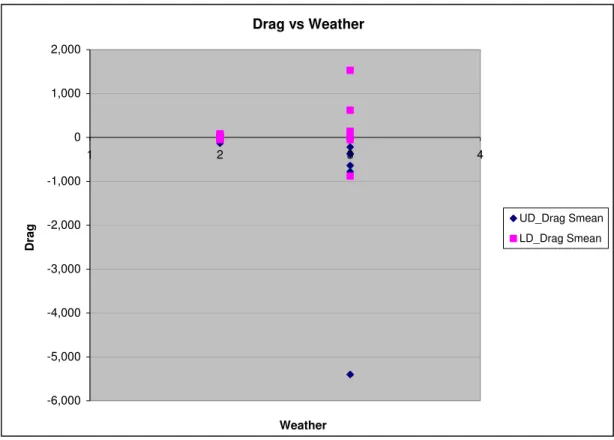
The two dynomometers, upper and lower, were broken into six load cell components. These included drag (x-component), side 1 (y-component 1), side 2 (y-component 2), vert 1 component 1, or vertical component 1), vert 2 component 2), and vert 3 (z-component 3). The resulting forces for drag were of a lower magnitude than those of the rest of the dyno components. The smallest force for the drag component recorded resulted from the intact vessel condition. The intact vessel also experienced slight to no difference of forces between the upper dyno and lower dyno at W3 in regards to drag. The drag components for both damaged deployment scenarios were found to be more scattered than those of the intact scenario. Also, there was a greater drag force for the damage up deployment scenario than the damaged down, which had a higher drag force than intact. These results are shown in the three figures below, while a collection of the complete set of graphs is shown in Appendix B.
Drag vs Weather -600 -500 -400 -300 -200 -100 0 100 200 300 1 2 3 4 Weather Drag UD_Drag Smean LD_Drag Smean
Figure 6. Drag vs Weather for Intact Vessel
Drag vs Weather -1000 -800 -600 -400 -200 0 200 400 600 800 1 2 3 4 Weather Drag UD_Drag Smean LD_Drag Smean
Drag vs Weather -6,000 -5,000 -4,000 -3,000 -2,000 -1,000 0 1,000 2,000 1 2 3 4 Weather Drag UD_Drag Smean LD_Drag Smean
Figure 8 Drag vs Weather for Damaged with Deployment on the Upper Side of the Vessel
When comparing the side 1 forces it was found that the upper dyno was most affected by the damaged deployment scenario. The greatest forces recorded for side 1 were with damaged up; the next greatest force was with damaged down, while the intact deployment scenario had the smallest recorded forces. When measuring the forces of side 2, it was found that the intact vessel experienced the same forces as it did for side 1 (y-component 1). For both damaged conditions it was seen that side 2 did not experience as much loading as side 1, but that the upper dyno did continue to experience the highest values while in the damaged condition.
The vert 1 component of the force seen little impact due to the change in vessel condition, though it was still evident that the recorded forces increased when going from intact, to damaged down, to damaged up. It was also found that the upper dynos were seeing higher forces than the lower dynos, while the upper dyno had negative values and the lower dyno was seeing positive. Vert 2 and vert 3 followed the same trend as vert 1, however opposite of vert 1, these both had positive values for the upper dynos and negative values for the lower dynos.
The next step in the data analysis process is to compare the results for a raft load of 75% to a raft load of 0. It was found when comparing the results from the tests that assessed raft loading variation, that there was no significant influence resulting from a
load change at the weak sea states. However, there were no high weather tests done for the 75% loads to use for comparison. Note that this assessment is based on tests conducted on the intact slide condition.
It would also be beneficial to compare the results of the leeward tests with the windward tests. The roll was not affected by the position of the system in regard to the wind source. However, all of the forces were much higher in the windward tests than the leeward tests, often two or three times the force.
8.2 Qualitative
The qualitative results include a detailed description of the reduction analysis process. Due to time constraints it was possible to complete only one test analysis. However, the analysis procedure presented here could be used as a guide to analyse the remaining tests in the future. A test was chosen in which the results seemed indicative of the entire set of results.
An example of a reduction analysis for one run from these tests is shown below:
Area of Observation: Description of Observation Severity Level: Assigned Performance Reduction Value: Performance Reduction Factor: Maximum Single Criterion Performance Reduction: Percentage of Total Performance Reduction: Raft Motion: 1 – No Roll 0 2 4 4 2 – Minor Roll 2 3 – Significant Roll 4
Raft’s Motion due to Environment
4 – Major roll, often
lifting out of the water 8
1 – No Twisting 0 1 1 1 2 – Minor Twisting of Raft 1 Twisting 3 – Major Twisting of Raft 2 Area of Observation: Description of Observation Severity Level: Assigned Performance Reduction Performance Reduction Factor: Maximum Single Criterion Percentage of Total Performance
Value: Performance Reduction: Reduction: Raft Survivability: 1 – No Water 0 4 8 8 2 – Only Spray 2 3 – Partial Swamping 4 Water Accumulation in Raft 4 – Raft Swamped 6
1 – No waves break into
Collection Plate 0 0 0 0
2 – Some waves break
into Collection Plate 2
Wave Action WRT Raft
3 – Collection Plate is constantly having waves
slam into it 4 1 – No Jerking on Spring Lines 0 2 6 6 2 – Minor Jerking on Spring Lines 2 3 – Major Jerking on Spring Lines 4
Spring Lines Force Description
4 – Major Jerking by Spring Lines and the Collection Plate is suspended in air by
them 6
1 – Collection Plate does not become
inverted 0 0 0 0
Raft Inversion
2 – Collection Plate
does become inverted 3
1 – Collection Plate floats normally on the
surface 0 0 0 0
Raft Orientation
2 – Collection Plate tubes buckle under
wave loading 2
3 – Collection Plate is pushed against the side of the vessel and
Area of Observation: Description of Observation Severity Level: Assigned Performance Reduction Value: Performance Reduction Factor: Maximum Single Criterion Performance Reduction: Percentage of Total Performance Reduction: Slide Movements:
1 – Slide Keeps Shape 0 2 4 4
2 – Slide buckles slightly 2
Slide Stability
3 – Slide buckles and
stays buckled 4 1 – Slide experiences no pull 0 2 4 4 2 – Slide experiences slight pull 2 Slide Motion 3 – Slide experiences violent pull 4 Total 27%
The results of this analysis indicated that the corresponding DPL category was a medium decreased performance level.
9.0 CONCLUSIONS
The results of the test program are varied. One main finding is the drastic effect that damaged deployment has upon the Marine Evacuation Slide System. The forces were found to be much higher than those of the intact vessel. Also, the deployment scenario in which the vessel was damaged and the system was attached to the side facing up was concluded to be much worse than that of the deployment side down. This means that an intact vessel is clearly more desirable than a damaged one for evacuation and also in the event of vessel damage it would be beneficial to evacuate on the side of the vessel facing down. This is due to less stress on the system by being attached to the down facing side. Also, the results indicated that it would be best to attach the system on the leeward side of the vessel. Often times the system could not withstand the increase in force that was due to positioning on the windward side of the vessel. The
load of the raft appeared to be insignificant to the evacuation system, however testing of harsher weather conditions could suggest otherwise.
10.0 RECOMMENDATIONS
Recommendations are made that can aid in future testing of offshore evacuation systems. These recommendations can help to ensure test completion and to gather an absolute data set. First, it is recommended that there be further testing to confirm the conclusions regarding the comparison between a load of 0 and a load of 75% on the raft. Due to the limited weather conditions tested, the loading conditions have not been fully assessed. It is also recommended that the qualitative analysis be completed, by conducting a performance reduction analysis for each of the tests in this test program. These results could then be combined so that a proper analysis of the entire test set can be done.
11.0 REFERENCES
1) IMO. (2003). IMO LSA. London Maritime Organization.
2) Gifford, P. (2008). Performance Analysis of Marine Evacuation Chutes. St. John’s: Institute for Ocean Technology.
APPENDIX A
Project Marine Evacuation Systems - Model Scale Slide Performance Evaluation
Project Manager Antonio Simoes Ré
Date 01-Nov-07
Test ID SL90_ULN_LD75_S15_W2_004
Slide Angle: 90; Vessel Condition: Up; Deployment: Leeward; Slide Stiffness: Normal; Load: 75; Wave Steepness: 15; Wind: 2 = Beaufort 3
Time 5:18 PM
Author April Smith
Observations
Slide Observations Relatively calm, the portion of the slide attached to the raft moved up and down due to the rafts movements.
Raft Observations The raft experienced roll.
Ship Observations The ship model underwent sway with a little heave.
Other Notes
Problems Encountered None
Test ID SL90_ULN_LD75_S15_W3_001
Slide Angle: 90; Vessel Condition: Up; Deployment: Leeward; Slide Stiffness: Normal; Load: 75; Wave Steepness: 15; Wind: 3 = Beaufort 4
Time 5:32 PM
Author April Smith
Observations
Slide Observations The slide experienced some tugging from the opposing movements of the raft and ship, this was a somewhat violent motion.
Raft Observations The raft underwent roll with yaw about the mooring, as well as being tugged on by the slide/ship. There was significant water ingress.
Ship Observations The ship model experienced significant pitch with heave, and slight sway.
Other Notes
Problems Encountered None
Test ID SL90_ULN_LD75_S20_W2_001
Slide Angle: 90; Vessel Condition: Up; Deployment: Leeward; Slide Stiffness: Normal; Load: 75; Wave Steepness: 20; Wind: 2 = Beaufort 3
Time 5:48 PM
Author April Smith
Observations
Slide Observations Calm, moved up and down slightly by the motion of the raft and ship model.
Raft Observations The raft experienced little roll.
Ship Observations The ship underwent heave.
Other Notes
Problems Encountered None
Test ID SL90_ULN_LD75_S20_W3_001
Slide Angle: 90; Vessel Condition: Up; Deployment: Leeward; Slide Stiffness: Normal; Load: 75; Wave Steepness: 20; Wind: 3 = Beaufort 4
Time 6:02 PM
Author April Smith
Observations
Slide Observations The slide buckled on the end near the ship, this was due to the opposing motions of the raft and ship.
Raft Observations The raft experienced roll, as well as being violently pulled on by the slide (caused by the ship's motion). Significant water ingress.
Other Notes
Problems Encountered None
Test ID SL90_ULN_LD75_S10_W2_001
Slide Angle: 90; Vessel Condition: Up; Deployment: Leeward; Slide Stiffness: Normal; Load: 75; Wave Steepness: 10; Wind: 2 = Beaufort 3
Time 6:27 PM
Author April Smith
Observations
Slide Observations Relatively calm, the bottom moved up and down remotely due to the movement of the raft.
Raft Observations he raft experienced roll.
Ship Observations The ship heaved and swayed slightly.
Other Notes
Problems Encountered None
Test ID SL90_ULN_LD75_S10_W3_001
Slide Angle: 90; Vessel Condition: Up; Deployment: Leeward; Slide Stiffness: Normal; Load: 75; Wave Steepness: 10; Wind: 3 = Beaufort 4
Time 6:43 PM
Author April Smith
Observations
Slide Observations The slide moved up and down with the movement of the ship model and raft.
Raft Observations The raft experienced roll.
Ship Observations The ship model heaved and swayed, with slight pitch.
Other Notes
Project Marine Evacuation Systems - Model Scale Slide Performance Evaluation
Project Manager Antonio Simoes Ré
Date 02-Nov-07
Test ID SL90_ULN_LD75_S10_W2_002
Slide Angle: 90; Vessel Condition: Up; Deployment: Leeward; Slide Stiffness: Normal; Load: 75; Wave Steepness: 10; Wind: 2 = Beaufort 3
Time 9:02 AM
Author April Smith
Observations
Slide Observations The slide was calm, though the bottom moved up and down slightly due to the movement of the raft.
Raft Observations The raft underwent roll.
Ship Observations The ship experienced heave and sway.
Other Notes
Problems Encountered None
Test ID SL90_ULN_LD75_S10_W3_002
Slide Angle: 90; Vessel Condition: Up; Deployment: Leeward; Slide Stiffness: Normal; Load: 75; Wave Steepness: 10; Wind: 3 = Beaufort 4
Time 9:17 AM
Author April Smith
Observations
Slide Observations The slide moved up and down, due to the movement of the raft and ship model.
Raft Observations The raft experienced roll, with slight yaw about the mooring.
Ship Observations The ship underwent heave and pitch.
Other Notes
Problems Encountered None
Test ID SL90_ULO50_LD75_S15_W2_001
Slide Angle: 90; Vessel Condition: Up; Deployment: Leeward; Slide Stiffness: Over 50%; Load: 75; Wave Steepness: 15; Wind: 2 = Beaufort 3
Time 9:51 AM
Author April Smith
Observations
Slide Observations Relatively calm, the bottom portion moved up and down slightly due to the movement of the raft.
Raft Observations The raft experienced roll.
Ship Observations The ship swayed, with a little heave.
Other Notes
Problems Encountered None
Test ID SL90_ULO50_LD75_S15_W3_001
Slide Angle: 90; Vessel Condition: Up; Deployment: Leeward; Slide Stiffness: Over 50%; Load: 75; Wave Steepness: 15; Wind: 3 = Beaufort 4
Time 10:09 AM
Author April Smith
Observations
Slide Observations The slide was tugged on by the somewhat violent movements of the raft.
Raft Observations The raft underwent roll. The mooring of the slide caused the opposite side of the raft to life out of the water at times. There was
Ship Observations The ship experienced significant pitch and heave.
Other Notes
Problems Encountered None
Test ID SL90_UO50_LD75_S20_W2_001
Slide Angle: 90; Vessel Condition: Up; Slide Stiffness: Over 50%; Load: 75; Wave Steepness: 15; Wind: 3 = Beaufort 4
Time 10:23 AM
Author April Smith
Observations
Slide Observations Calm, moved up and down slightly.
Raft Observations The raft was calm while experiencing roll.
Ship Observations The ship model underwent heave.
Other Notes
Problems Encountered None
Test ID SL90_UlO50_LD75_S20_W3_001
Slide Angle: 90; Vessel Condition: Up; Slide Stiffness: Over 50%; Load: 75; Wave Steepness: 20; Wind: 3 = Beaufort 4
Time 10:43 AM
Author April Smith
Observations
Slide Observations The raft maintained its shape, while experiencing somewhat violent tug due to the rafts movement.
Raft Observations The raft underwent roll, with the side opposite the mooring lifting out of the water. There was significant water ingress.
Ship Observations The ship experienced roll.
Other Notes
Problems Encountered None
Test ID SL90_ULO50_LD75_S10_W2_001
Slide Angle: 90; Vessel Condition: Up; Deployment: Leeward; Slide Stiffness: Over 50%; Load: 75; Wave Steepness: 10; Wind: 2 = Beaufort 3
Time 10:55 AM
Author April Smith
Observations
Slide Observations The slide was calm, with the bottom moving up and down slightly with the roll of the raft.
Raft Observations The raft experienced roll.
Ship Observations The ship model was relatively calm, experiencing slight heave and sway.
Other Notes
Problems Encountered None
Test ID SL90_ULO50_LD75_S10_W3_001
Slide Angle: 90; Vessel Condition: Up; Deployment: Leeward; Slide Stiffness: Over 50%; Load: 75; Wave Steepness: 10; Wind: 3 = Beaufort 4
Time 11:09 AM
Author April Smith
Observations
Slide Observations The opposing sides of the slide moved up and down with the movement of the raft and ship model.
Raft Observations The raft experienced roll, with slight yaw about the mooring.
Ship Observations The ship underwent heave with slight sway.
Problems Encountered None
Test ID SL90_DLN_LD75_S15_W2_002
Slide Angle: 90; Vessel Condition: Down; Deployment: Leeward; Slide Stiffness: Normal; Load: 75; Wave Steepness: 15; Wind: 2 = Beaufort 3
Time 1:20 PM
Author April Smith
Observations
Slide Observations Calm
Raft Observations The raft experienced little roll and yaw about the mooring.
Ship Observations The ship heaved slightly, with little pitch and sway.
Other Notes
Problems Encountered None
Test ID SL90_DLN_LD75_S15_W3_002
Slide Angle: 90; Vessel Condition: Down; Deployment: Leeward; Slide Stiffness: Normal; Load: 75; Wave Steepness: 15; Wind: 3 = Beaufort 4
Time 1:35 PM
Author April Smith
Observations
Slide Observations The slide moved up and down with the movement of the raft and ship model.
Raft Observations The raft underwent roll, with little sway about the mooring.
Ship Observations The ship experienced heave and pitch.
Other Notes
Problems Encountered None
Test ID SL90_DLN_LD75_S20_W2_002
Slide Angle: 90; Vessel Condition: Down; Deployment: Leeward; Slide Stiffness: Normal; Load: 75; Wave Steepness: 20; Wind: 2 = Beaufort 3
Time 1:50 PM
Author April Smith
Observations
Slide Observations Calm, the slide moved up and down slightly in reaction to the movement of the raft and ship model.
Raft Observations The raft experienced roll, though calm.
Ship Observations The ship underwent pitch and heave.
Other Notes
Problems Encountered None
Test ID SL90_DLN_LD75_S20_W3_002
Slide Angle: 90; Vessel Condition: Down; Deployment: Leeward; Slide Stiffness: Normal; Load: 75; Wave Steepness: 20; Wind: 3 = Beaufort 4
Time 2:06 PM
Author April Smith
Observations
Slide Observations The slide experienced violent pull from the opposing motions of the raft and slide model, this opposing motion also caused the slide to
buckle.
Raft Observations The raft underwent roll, with the mooring causing the outer side to lift out of the water. There was significant water ingress.
Ship Observations The ship experienced roll.
Other Notes
Test ID SL90_DLN_LD75_S10_W2_002
Slide Angle: 90; Vessel Condition: Down; Deployment: Leeward; Slide Stiffness: Normal; Load: 75; Wave Steepness: 10; Wind: 2 = Beaufort 3
Time 2:24 PM
Author April Smith
Observations
Slide Observations Calm.
Raft Observations The raft underwent very little roll.
Ship Observations The ship model experienced slight sway, with little pitch.
Other Notes
Problems Encountered None
Test ID SL90_DLN_LD75_S10_W3_002
Slide Angle: 90; Vessel Condition: Down; Deployment: Leeward; Slide Stiffness: Normal; Load: 75; Wave Steepness: 10; Wind: 3 = Beaufort 4
Time 2:40 PM
Author April Smith
Observations
Slide Observations The slide moved up and down slightly with the movement of the raft and ship model.
Raft Observations The raft experienced roll.
Ship Observations The ship heaved slightly, with a little pitch.
Other Notes
Problems Encountered None
Test ID SL90_ILN_LD75_S15_W2_002
Slide Angle: 90; Vessel Condition: Intact; Deployment: Leeward; Slide Stiffness: Normal; Load: 75; Wave Steepness: 15; Wind: 2 = Beaufort 3
Time 3:32 PM
Author April Smith
Observations
Slide Observations Relatively calm, the bottom portion of the slide moved up and down due to the roll of the raft.
Raft Observations The raft experienced roll.
Ship Observations The ship swayed, with little heave.
Other Notes
Problems Encountered None
Test ID SL90_ILN_LD75_S15_W3_002
Slide Angle: 90; Vessel Condition: Intact; Deployment: Leeward; Slide Stiffness: Normal; Load: 75; Wave Steepness: 15; Wind: 3 = Beaufort 4
Time 4:02 PM
Author April Smith
Observations
Slide Observations The opposing sides of the slide moved up and down with the opposing movements of the raft and ship model.
Raft Observations The raft experienced roll and yaw about the mooring.
Ship Observations The ship experienced pitch with heave.
Other Notes
Project Marine Evacuation Systems - Model Scale Slide Performance Evaluation
Project Manager Antonio Simoes Ré
Date 05-Nov-07
Test ID SL90_ILO50_LD75_S15_W2_002
Slide Angle: 90; Vessel Condition: Intact; Deployment: Leeward; Slide Stiffness: Over 50%; Load: 75; Wave Steepness: 15; Wind: 2 = Beaufort 3
Time 9:36 AM
Author April Smith
Observations
Slide Observations Calm, with the bottom portion moving up and down with the movement of the raft.
Raft Observations The raft underwent roll.
Ship Observations The ship experienced sway, with silght heave.
Other Notes
Problems Encountered None
Test ID SL90_ILO50_LD75_S15_W3_002
Slide Angle: 90; Vessel Condition: Intact; Deployment: Leeward; Slide Stiffness: Over 50%; Load: 75; Wave Steepness: 15; Wind: 3 = Beaufort 4
Time 9:52 AM
Author April Smith
Observations
Slide Observations The opposite ends of the slide moved up and down due to the opposing motion of the raft and ship model.
Raft Observations The raft experienced roll, with yaw about the mooring.
Ship Observations The ship experienced significant pitch and heave, with little sway.
Other Notes
Problems Encountered None
Test ID SL-90_IWN_LD75_S15_W2_001
Slide Angle: 90; Vessel Condition: Intact; Deployment: Windward; Slide Stiffness: Normal; Load: 75; Wave Steepness: 15; Wind: 2 = Beaufort 3
Time 5:07 PM
Author April Smith
Observations Slide Observations
Raft Observations Ship Observations
Other Notes
Problems Encountered Late recording the test, therefore did not catch much of the run.
Test ID SL-90_IWN_LD75_S15_W3_001
Slide Angle: 90; Vessel Condition: Intact; Deployment: Windward; Slide Stiffness: Normal; Load: 75; Wave Steepness: 15; Wind: 3 = Beaufort 4
Time 5:32 PM
Author April Smith
Observations Slide Observations
Raft Observations Ship Observations
Other Notes
Project Marine Evacuation Systems - Model Scale Slide Performance Evaluation
Project Manager Antonio Simoes Ré
Date 06-Nov-07
Test ID SL-90_IWO50_LD75_S15_W2_001
Slide Angle: 90; Vessel Condition: Intact; Deployment: Windward; Slide Stiffness: Over 50%; Load: 75; Wave Steepness: 15; Wind: 2 = Beaufort 3
Time 12:18 PM
Author April Smith
Observations
Slide Observations The slide bucked on the prtion near the ship, due to the opposing motion of the raft and ship model.
Raft Observations The raft rolled with significant water ingress.
Ship Observations The ship experienced little sway and heave.
Other Notes
Problems Encountered None
Test ID SL-90_IWO50_LD75_S15_W3_001
Slide Angle: 90; Vessel Condition: Intact; Deployment: Windward; Slide Stiffness: Over 50%; Load: 75; Wave Steepness: 15; Wind: 3 = Beaufort 4
Time 12:48 PM
Author April Smith
Observations
Slide Observations The slide buckled due to the movement of the raft and ship model. The slide moved all over the place, with violent movements.
Raft Observations The raft experienced somewhat violent roll, with significant water ingress.
Ship Observations The ship underwent pitch and heave, with little sway.
Other Notes
Project Marine Evacuation Systems - Model Scale Slide Performance Evaluation
Project Manager Antonio Simoes Ré
Date 26-Oct-07
Test ID SL90_ILN_LD0_S15_W2_001
Slide Angle: 90; Vessel Condition: Intact; Deployment: Leeward; Slide Stiffness: Normal; Load: 0; Wave Steepness: 15; Wind: 2 = Beaufort 3
Time 2:43 PM
Author April Smith
Observations
Slide Observations Bottom moved up and down slightly as the raft moved, the top of the slide did not move as much since the ship did not move as much as the raft.
Raft Observations The raft experienced some roll, as well as slight yaw about the mooring. There was limited water ingress.
Ship Observations The ship experienced sway, as well as very slight heave.
Other Notes
Problems Encountered None
Test ID SL90_ILN_LD0_S15_W3_001
Slide Angle: 90; Vessel Condition: Intact; Deployment: Leeward; Slide Stiffness: Normal; Load: 0; Wave Steepness: 15; Wind: 3 = Beaufort 4
Time 3:03 PM
Author April Smith
Observations
Slide Observations Continuously moving up and down, reacting to the motion of both the ship and raft.
Raft Observations The raft experienced roll, as well as yaw about the mooring. The bottom of the raft was completely covered with water moving back
and forth, though the raft was not full of water.
Ship Observations The ship experienced somewhat violent heave and pitch, as well as some sway.
Other Notes
Problems Encountered None
Test ID SL90_ILN_LD0_S15_W4_001
Slide Angle: 90; Vessel Condition: Intact; Deployment: Leeward; Slide Stiffness: Normal; Load: 0; Wave Steepness: 15; Wind: 4 = Beaufort 5
Time 3:16 PM
Author April Smith
Observations
Slide Observations Slide continued to violently bend and wip straight.
Raft Observations The raft experienced roll violently, to the point that the outside of the raft would lift into the air because of the mooring holding the other side down. Raft became almost completely immersed in water.
Ship Observations Ship experienced violent roll.
Other Notes
Test ID SL90_ILN_LD0_S15_W5_001
Slide Angle: 90; Vessel Condition: Intact; Deployment: Leeward; Slide Stiffness: Normal; Load: 0; Wave Steepness: 15; Wind: 5 = Beaufort 6
Time 3:47 PM
Author April Smith
Observations
Slide Observations Slide continued to violently bend and wip straight, when the motion stopped the slide continued to stay bent.
Raft Observations The raft experienced roll to the point that the side opposite the mooring was almost completely straight in the air. The raft became almost completely immersed in water.
Ship Observations The ship model experienced violent rolling motion.
Other Notes
Project Marine Evacuation Systems - Model Scale Slide Performance Evaluation
Project Manager Antonio Simoes Ré
Date 29-Oct-07
Test ID SL90_ILN_LD0_S20_W2_001
Slide Angle: 90; Vessel Condition: Intact; Deployment: Leeward; Slide Stiffness: Normal; Load: 0; Wave Steepness: 20; Wind: 2 = Beaufort 3
Time 12:15 PM
Author April Smith
Observations
Slide Observations Moved up and down slightly, opposing ends moving in opposite directions.
Raft Observations Slight roll, limited water ingress.
Ship Observations Experienced slight sway with a small amount of heave.
Other Notes
Problems Encountered None
Test ID SL90_ILN_LD0_S20_W2_002
Slide Angle: 90; Vessel Condition: Intact; Deployment: Leeward; Slide Stiffness: Normal; Load: 0; Wave Steepness: 20; Wind: 2 = Beaufort 3
Time 1:01 PM
Author April Smith
Observations
Slide Observations Continuously moved up and down, reacting to the motion of both the ship and raft.
Raft Observations Raft experiences roll, with slight yaw about the mooring, became more swamped with water as test continued.
Ship Observations Model ship experiences heave with slight pitch.
Other Notes
Problems Encountered None
Test ID SL90_ILN_LD0_S20_W3_001
Slide Angle: 90; Vessel Condition: Intact; Deployment: Leeward; Slide Stiffness: Normal; Load: 0; Wave Steepness: 20; Wind: 3 = Beaufort 4
Time 1:16 PM
Author April Smith
Observations
Slide Observations Slide moves up and down with the ship and raft, opposing ends moving in opposing directions for the most part, though the slide did
maintain straight.
Raft Observations Raft experienced roll, while with the restriction of the mooring caused the opposide side of the raft to lift above sea level, almost to 45
degrees at some points during the test. Water continued to splash into the raft throughout the test.
Ship Observations Experienced heave, with slight roll and pitch.
Other Notes
Test ID SL90_ILN_LD0_S10_W2_001
Slide Angle: 90; Vessel Condition: Intact; Deployment: Leeward; Slide Stiffness: Normal; Load: 0; Wave Steepness: 10; Wind: 2 = Beaufort 3
Time 1:37 PM
Author April Smith
Observations
Slide Observations The slide was barely disturbed during the test.
Raft Observations The raft experienced slight roll and limited water ingress.
Ship Observations The ship experienced little sway and heave.
Other Notes
Problems Encountered None
Test ID SL90_ILN_LD0_S10_W3_001
Slide Angle: 90; Vessel Condition: Intact; Deployment: Leeward; Slide Stiffness: Normal; Load: 0; Wave Steepness: 10; Wind: 3 = Beaufort 4
Time 1:55 PM
Author April Smith
Observations Slide Observations
Raft Observations Ship Observations
Other Notes
Problems Encountered Data could not be analyzed due to the breaking of a mooring line, the model moved out of the screen.
Test ID SL90_ILN_LD0_S10_W3_002
Slide Angle: 90; Vessel Condition: Intact; Deployment: Leeward; Slide Stiffness: Normal; Load: 0; Wave Steepness: 10; Wind: 3 = Beaufort 4
Time 3:07 PM
Author April Smith
Observations Slide Observations
Raft Observations Ship Observations
Other Notes
Project Marine Evacuation Systems - Model Scale Slide Performance Evaluation
Project Manager Antonio Simoes Ré
Date 30-Oct-07
Test ID SL90_ILN_LD0_S10_W3_003
Slide Angle: 90; Vessel Condition: Intact; Deployment: Leeward; Slide Stiffness: Normal; Load: 0; Wave Steepness: 10; Wind: 3 = Beaufort 4
Time 9:15 AM
Author April Smith
Observations
Slide Observations Slide stayed intact, ends moved with the ship and raft.
Raft Observations The raft experienced slight roll and yaw about the mooring, limited water ingress.
Ship Observations The ship model experienced slight heave, and somewhat violent pitch.
Other Notes
Problems Encountered Ship model took on a significant amount of water.
Test ID SL90_ILN_LD0_S10_W3_004
Slide Angle: 90; Vessel Condition: Intact; Deployment: Leeward; Slide Stiffness: Normal; Load: 0; Wave Steepness: 10; Wind: 3 = Beaufort 4
Time 12:30 PM
Author April Smith
Observations Slide Observations
Raft Observations Ship Observations
Other Notes
Problems Encountered Cameras did not record video.
Test ID SL90_ILO50_LD75_S15_W2_001
Slide Angle: 90; Vessel Condition: Intact; Deployment: Leeward; Slide Stiffness: Over 50%; Load: 75; Wave Steepness: 15; Wind: 2 = Beaufort 3
Time 2:13 PM
Author April Smith
Observations
Slide Observations Slide maintained it's integrity, bottom end moved slightly with the raft's motion.
Raft Observations Raft experienced roll.
Ship Observations Ship experienced slight sway and heave.
Other Notes
Problems Encountered None
Test ID SL90_ILO50_LD75_S15_W3_001
Slide Angle: 90; Vessel Condition: Intact; Deployment: Leeward; Slide Stiffness: Over 50%; Load: 75; Wave Steepness: 15; Wind: 3 = Beaufort 4
Time 2:28 PM
Author April Smith
Observations
Slide Observations The slide maintained itself, though did experience lots of movement due to the raft and sip model movement.
Raft Observations The raft experienced roll and slight yaw about the mooring.
Other Notes
Problems Encountered None
Test ID SL90_ILO50_LD75_S20_W2_001
Slide Angle: 90; Vessel Condition: Intact; Deployment: Leeward; Slide Stiffness: Over 50%; Load: 75; Wave Steepness: 20; Wind: 2 = Beaufort 3
Time 2:44 PM
Author April Smith
Observations
Slide Observations Calm
Raft Observations Raft experienced very little roll, with little yaw about the mooring.
Ship Observations The ship model experienced little heave, with very little pitch and sway.
Other Notes
Problems Encountered None
Test ID SL90_ILO50_LD75_S20_W3_001
Slide Angle: 90; Vessel Condition: Intact; Deployment: Leeward; Slide Stiffness: Over 50%; Load: 75; Wave Steepness: 20; Wind: 3 = Beaufort 4
Time 3:00 PM
Author April Smith
Observations
Slide Observations Slide stayed intact, though movements were somewhat violent.
Raft Observations Experienced roll, with silght water ingress.
Ship Observations The ship experienced heave and roll, with slight pitch.
Other Notes
Problems Encountered None
Test ID SL90_ILO50_LD75_S10_W2_001
Slide Angle: 90; Vessel Condition: Intact; Deployment: Leeward; Slide Stiffness: Over 50%; Load: 75; Wave Steepness: 10; Wind: 2 = Beaufort 3
Time 3:17 PM
Author April Smith
Observations
Slide Observations Calm
Raft Observations The raft experienced little roll.
Ship Observations The ship experienced slight sway.
Other Notes
Problems Encountered None
Test ID SL90_ILO50_LD75_S10_W3_001
Slide Angle: 90; Vessel Condition: Intact; Deployment: Leeward; Slide Stiffness: Over 50%; Load: 75; Wave Steepness: 10; Wind: 3 = Beaufort 4
Time 3:33 PM
Author April Smith
Observations
Slide Observations The slide moved slightly with the motion of the ship.
Raft Observations The raft experienced yaw about the mooring, and slight roll.
Ship Observations The ship model experienced heave and pitch, as well as slight sway.
Problems Encountered None
Test ID SL90_ILN_LD75_S15_W2_001
Slide Angle: 90; Vessel Condition: Intact; Deployment: Leeward; Slide Stiffness: Normal; Load: 75; Wave Steepness: 15; Wind: 2 = Beaufort 3
Time 4:17 PM
Author April Smith
Observations
Slide Observations The bottom portion of the slide moved up and down due to the motion of the raft.
Raft Observations The raft experienced roll.
Ship Observations The ship experienced slight heave and sway.
Other Notes
Problems Encountered None
Test ID SL90_ILN_LD75_S15_W3_001
Slide Angle: 90; Vessel Condition: Intact; Deployment: Leeward; Slide Stiffness: Normal; Load: 75; Wave Steepness: 15; Wind: 3 = Beaufort 4
Time 4:32 PM
Author April Smith
Observations
Slide Observations The silde experienced somewhat violent up an down motions, as well as hauling at both ends, in reaction to the opposing movements
of the raft and ship model.
Raft Observations The raft experienced yaw about the mooring and roll, with inconsiderable water ingress.
Ship Observations The ship experienced considerable pitch and heave.
Other Notes
Problems Encountered None
Test ID SL90_ILN_LD75_S20_W2_001
Slide Angle: 90; Vessel Condition: Intact; Deployment: Leeward; Slide Stiffness: Normal; Load: 75; Wave Steepness: 20; Wind: 2 = Beaufort 3
Time 4:45 PM
Author April Smith
Observations
Slide Observations Relatively calm and undisturbed.
Raft Observations The raft experienced little yaw about the mooring, and even less roll. There was very limited water ingress.
Ship Observations The ship underwent pitch, with inconsiderable heave.
Other Notes
Problems Encountered None
Test ID SL90_ILN_LD75_S20_W3_001
Slide Angle: 90; Vessel Condition: Intact; Deployment: Leeward; Slide Stiffness: Normal; Load: 75; Wave Steepness: 20; Wind: 3 = Beaufort 4
Time 5:00 PM
Author April Smith
Observations
Slide Observations The slide continued to be hauled tight by the movement of the raft throughout the test, this was a somewhat violent motion.
Raft Observations The raft underwent roll, with significant water ingress.
Ship Observations The ship experienced heave, with slight pitch and roll.
Problems Encountered None
Test ID SL90_ILN_LD75_S10_W2_001
Slide Angle: 90; Vessel Condition: Intact; Deployment: Leeward; Slide Stiffness: Normal; Load: 75; Wave Steepness: 10; Wind: 2 = Beaufort 3
Time 5:14 PM
Author April Smith
Observations
Slide Observations The slide was relatively undisturbed during the test.
Raft Observations The raft experienced roll.
Ship Observations The ship underwent a relatively small amount of sway.
Other Notes
Problems Encountered None
Test ID SL90_ILN_LD75_S10_W3_001
Slide Angle: 90; Vessel Condition: Intact; Deployment: Leeward; Slide Stiffness: Normal; Load: 75; Wave Steepness: 10; Wind: 3 = Beaufort 4
Time 5:30 PM
Author April Smith
Observations
Slide Observations The slide experienced some movement up and down due to movement of the raft and ship, but overall was not disturbed too much.
Raft Observations The raft experienced slight yaw about the mooring, and roll.
Ship Observations The ship underwent pitch, with minor heave.
Other Notes
Problems Encountered None
Test ID SL90_ILU50_LD75_S15_W2_001
Slide Angle: 90; Vessel Condition: Intact; Deployment: Leeward; Slide Stiffness: Under 50%; Load: 75; Wave Steepness: 15; Wind: 2 = Beaufort 3
Time 5:48 PM
Author April Smith
Observations
Slide Observations The bottom of the slide moved up and down with the movement of the raft.
Raft Observations The raft underwent roll, with limited water ingress.
Ship Observations The ship experienced sway, with very little pitch and heave.
Other Notes
Problems Encountered None
Test ID SL90_ILU50_LD75_S15_W3_001
Slide Angle: 90; Vessel Condition: Intact; Deployment: Leeward; Slide Stiffness: Under 50%; Load: 75; Wave Steepness: 15; Wind: 3 = Beaufort 4
Time 6:02 PM
Author April Smith
Observations
Slide Observations The slide experienced somewhat violent tugging from the motion of the ship, though it did maintain it's shape.
Raft Observations The raft underwent roll, pitch and yaw about the mooring, with significant water ingress.
Ship Observations The ship experienced heavy pitch and heave, with little sway.
Other Notes
Test ID SL90_ILU50_LD75_S20_W2_001
Slide Angle: 90; Vessel Condition: Intact; Deployment: Leeward; Slide Stiffness: Under 50%; Load: 75; Wave Steepness: 20; Wind: 2 = Beaufort 3
Time 6:16 PM
Author April Smith
Observations
Slide Observations Relatively calm, ends moved in opposing directions up and down.
Raft Observations The raft experienced slight roll and yaw about the mooring, with limited water ingress.
Ship Observations The ship heaved and swayed, with very little pitch.
Other Notes
Problems Encountered None
Test ID SL90_ILU50_LD75_S20_W3_001
Slide Angle: 90; Vessel Condition: Intact; Deployment: Leeward; Slide Stiffness: Under 50%; Load: 75; Wave Steepness: 20; Wind: 3 = Beaufort 4
Time 6:30 PM
Author April Smith
Observations
Slide Observations The slide experienced violent thrashing due to the movement of both the ship and the raft acting on it, this cause the slide to
continuesly collapse.
Raft Observations The raft underwent roll, with significant water ingress.
Ship Observations The ship experienced roll and heave.
Other Notes