HAL Id: hal-01878033
https://hal.archives-ouvertes.fr/hal-01878033
Submitted on 27 May 2020
HAL is a multi-disciplinary open access
archive for the deposit and dissemination of
sci-entific research documents, whether they are
pub-lished or not. The documents may come from
teaching and research institutions in France or
abroad, or from public or private research centers.
L’archive ouverte pluridisciplinaire HAL, est
destinée au dépôt et à la diffusion de documents
scientifiques de niveau recherche, publiés ou non,
émanant des établissements d’enseignement et de
recherche français ou étrangers, des laboratoires
publics ou privés.
core type III effector RipG7 from solanacearum: RipG7
evolution, structure/function
Keke Wang, Philippe Remigi, Maria Anisimova, Fabien Lonjon, Ilona Kars,
Andrey Kajava, Chien-Hui Li, Chiu-Ping Cheng, Fabienne Vailleau, Stéphane
Genin, et al.
To cite this version:
Keke Wang, Philippe Remigi, Maria Anisimova, Fabien Lonjon, Ilona Kars, et al..
Functional
assignment to positively selected sites in the core type III effector RipG7 from solanacearum:
RipG7 evolution, structure/function. Molecular Plant Pathology, Wiley, 2016, 17 (4), pp.553–564.
�10.1111/mpp.12302�. �hal-01878033�
Functional assignment to positively selected sites in the core type
III effector RipG7 from
Ralstonia solanacearum
KEKE WANG
1,2, PHILIPPE REMIGI
1,2,†, MARIA ANISIMOVA
3, FABIEN LONJON
1,2, ILONA KARS
1,2,‡,
ANDREY KAJAVA
4, CHIEN-HUI LI
5, CHIU-PING CHENG
5, FABIENNE VAILLEAU
1,2,6,
STÉPHANE GENIN
1,2AND NEMO PEETERS
1,2,*
1INRA, Laboratoire des Interactions Plantes Micro-organismes (LIPM), UMR441, CS52627 Chemin de Borde Rouge, 31326 Castanet-Tolosan, France 2CNRS, Laboratoire des Interactions Plantes Micro-organismes (LIPM), UMR2594, CS52627 Chemin de Borde Rouge, 31326 Castanet-Tolosan, France
3Institute of Applied Simulations, School of Life Sciences and Facility Management, Zürich University of Applied Sciences, Gruenalstrasse 14, 8820 Wädesnwil,
Switzerland
4Centre de Recherche de Biochimie Macromoléculaire, CNRS, UMR5237, 1919 Route de Mende, 34000 Montpellier, France 5Institute of Plant Biology, National Taiwan University, Taipei 11529, Taiwan, R.O.C
6Université de Toulouse, INP, ENSAT, 18 Chemin de Borde Rouge, Castanet-Tolosan 31326, France
SUMMARY
The soil-borne pathogenRalstonia solanacearum causes bacterial
wilt in a broad range of plants. The main virulence determinants of
R. solanacearum are the type III secretion system (T3SS) and its
associated type III effectors (T3Es), translocated into the host cells. Of the conserved T3Es amongR. solanacearum strains, the Fbox
protein RipG7 is required forR. solanacearum pathogenesis on Medicago truncatula. In this work, we describe the natural ripG7
variability existing in theR. solanacearum species complex. We
show that eight representativeripG7 orthologues have different
contributions to pathogenicity onM. truncatula: only ripG7 from
Asian or African strains can complement the absence ofripG7 in
GMI1000 (Asian reference strain). Nonetheless, RipG7 proteins from American and Indonesian strains can still interact with
M. truncatula SKP1-like/MSKa protein, essential for the function of
RipG7 in virulence. This indicates that the absence of complemen-tation is most likely a result of the variability in the leucine-rich repeat (LRR) domain of RipG7. We identified 11 sites under posi-tive selection in the LRR domains of RipG7. By studying the func-tional impact of these 11 sites, we show the contribution of five positively selected sites for the function of RipG7CMR15 in M. truncatula colonization.This work reveals the genetic and
func-tional variation of the essential core T3E RipG7 from
R. solanacearum.This analysis is the first of its kind on an essential
disease-controlling T3E, and sheds light on the co-evolutionary arms race between the bacterium and its hosts.
Keywords: LRR,Medicago truncatula, positive selection, Ralstonia solanacearum, type III effector, virulence function.
INTRODUCTION
During the co-evolution of host–pathogen interactions, plant hosts have evolved complex immune systems to prevent infections caused by pathogens.The latter have evolved infection strategies to suppress these host defence responses and colonize hosts (Dou and Zhou, 2012; Win et al., 2012). Among these strategies are the
bacterial type III effectors (T3Es). They represent one of the most effective means used by many Gram-negative pathogenic bacteria of both plants and animals (Galán and Collmer, 1999; Raymond
et al., 2013). Bacterial pathogens, such as the plant pathogens Pseudomonas syringae, Xanthomonas spp. and Ralstonia solanacearum, or the animal pathogens Salmonella spp., Shigella
spp. andYersinia spp., have repertoires of T3Es that they can inject
into host cells to manipulate cellular pathways (Galán, 2009; Win
et al., 2012).
Various isolates of these bacterial pathogens possess a set of T3Es consisting of a combination of conserved (or ‘core’) T3Es and specific T3Es. This has been described for the plant pathogens
P. syringae (Baltrus et al., 2011) and R. solanacearum (Peeters et al., 2013a). Each bacterial T3E repertoire is shaped during the
co-evolutionary arms race with the host plant immune system (Jones and Dangl, 2006). The persistence and further evolution of a given T3E is determined by a tradeoff between its capacity to participate in coaxing the host into accommodating the pathogen and its recognition by the plant specific (R gene-based) immunity. Ralstonia solanacearum is a large species complex, present
worldwide and divided into four phylotypes: Asian strains (phylotype I), American strains (phylotype II), African strains (phylotype III) and Indonesian strains (phylotype IV). Considering the sequence variability of some of the sequenced genomes, it has been debated whether this species complex should be classified into three subspecies (grouping together the Asian and African strains) (Peeters et al., 2013b; Safni et al., 2014). This species
complex is remarkable for having a particularly large host range (Peeterset al., 2013a), as well as a large set of T3Es, with, for
*Correspondence: Email: [email protected]
†Present address: New Zealand Institute for Advanced Study, Massey University, Auckland,
New Zealand.
‡Present address: Bejo Zaden, B.V. Trambaan 1, 1749CZ Warmenhuizen, The Netherlands.
MOLECULAR PLANT PATHOLOGY DOI: 10.1111/mpp.12302
instance, up to 75 T3Es in the strain Po82 (Peeterset al., 2013b; Xu et al., 2011). The analysis of sequenced genomes from this species
complex enabled us to define a large set of 32 conserved or ‘core’ T3Es (Peeterset al., 2013b).
So far, the relationship between host specificity and T3E reper-toire has not been clearly demonstrated (Baltrus et al., 2011;
Lindeberget al., 2009), probably owing to the fact that: (i) T3Es
can have overlapping functions; and (ii) T3Es are not the only virulence determinants. One notable exception is the T3E RipG7 which has been shown to be required for the compatible interac-tion between strain GMI1000 of R. solanacearum and the host
plantMedicago truncatula ecotype A17 (Angot et al., 2006).
Inter-estingly, RipG7 is conserved in all strains sequenced so far and, as such, is part of the core T3E of R. solanacearum (Peeters et al.,
2013b). These core T3Es are, by definition, conserved in the diverse strains of theR. solanacearum species complex, indicating a likely
benefit to bacterial fitness. This is indeed the case, as it has been shown that, in addition to the requirement of RipG7 on
M. truncatula (Angot et al., 2006), RipG7 is also necessary for the
full aggressiveness of the strain GMI1000 onArabidopsis thaliana
and tomato plants (Remigiet al., 2011).
We have also shown that the Fbox motif is essential for RipG7 virulence function on M. truncatula (Angot et al., 2006). In
eukaryotes, the Fbox-containing proteins have been shown to be essential for many cellular processes (Lechneret al., 2006). They
form an SCF (‘SKP1-CUL1-Fbox’) protein complex that has an E3 ubiquitin ligase activity, directing specific proteins for ubiquitination and proteasome degradation. The Fbox domain is crucial as it enables the direct interaction of the Fbox protein with the SKP1-like protein (Zhenget al., 2002).
Other bacterial pathogens have been reported to contain Fbox proteins among their virulence arsenal (Kuboriet al., 2010; Magori
and Citovsky, 2011; Zaltsmanet al., 2010). The C-terminal domain
of Fbox proteins typically contains protein–protein interaction domains, allowing for the recruitment of host proteins prior to their ubiquitination and further proteasome degradation. Notably, the latter domains are very different, defining several families, with probably different target recognition, in a given organism (Xu
et al., 2011). Among the Fbox proteins with a leucine-rich repeat
(LRR) as C-terminal domain, there is evidence of positive selection on the LRR, suggesting diversification of target recognition (Wang
et al., 2014). Other plant LRR-containing proteins, related to
immunity functions, are also subject to strong evolutionary con-straints. Positive selection has been detected in the LRR domains of the polygalacturonase-inhibiting proteins (PGIPs) (Casasoli
et al., 2009; Kalunke et al., 2015). Similarly, it has been shown that
the key amino acids of the resistance protein Cf-9 are hypervariable and solvent-exposed residues of the LRR (Wulff
et al., 2009). The plant surface receptors EF-Tu receptor (EFR) and
flagellin-sensing 2 (FLS2) are both mostly under purifying selection (Helftet al., 2011), consistent with the fact that they enable the
plant cell to detect conserved pathogen peptides (Zipfel, 2009). Mutagenesis was instrumental in all of these studies to show the essential contribution of specific LRR amino acids to their overall or specific functions (Benedetti et al., 2013; Cao et al., 2013;
Koller and Bent, 2014; Sunet al., 2012; Wulff et al., 2009).
In this work, a similar approach was carried out on the RipG7 core T3E of R. solanacearum. This enabled us to highlight the
contribution to the function of RipG7 of positively selected resi-dues situated in the LRR domain. Indeed, we took advantage of the fact that RipG7 is required for disease onM. truncatula to first
test the functionality of different ripG7 orthologues present in
phylogenetically diverse strains of R. solanacearum. We then
refined a previous analysis that indicated the presence of positive selection (Remigi et al., 2011), and identified several residues
under high probability of positive selection. We then showed that some of these residues are important for the function of RipG7 on
M. truncatula, demonstrating that the diversifying selection likely
to have been imposed during the co-evolutionary arms race has a direct impact on the function of this virulence determinant.
RESULTS
ripG7 is sufficient, among the seven paralogous ripG1
toripG7, for R. solanacearum strain GMI1000 to
colonize and cause wilting inM. truncatula
Previous virulence tests of single mutants generated in each of the seven paralogousripG1 to ripG7 genes have shown that only the
mutation inripG7 affects the pathogenicity of R. solanacearum on M. truncatula (Angot et al., 2006). In this work, we generated
GRS138 (ripG7 mutant, Table S1, see Supporting Information),
GRS460 (ripG2 ripG3 ripG6 ripG7 quadruple mutant, Table S1) and
GRS447 (septuple ripG1–ripG7 mutant, Table S1) expressing a
chimeric ripG7GMI1000 from an ectopic genomic integration, and tested the virulence of these strains on M. truncatula. Figure 1
represents the log10(hazard ratio), the hazard ratio being the
wilting rate for plants root inoculated with GMI1000 divided by the wilting rate of plants inoculated with mutant or comple-mented strains (see Experimental details). No or little wilting occurs for plants inoculated with the quadruple (ripG2 ripG3 ripG6 ripG7, GRS460) or septuple (ripG1–7, GRS447) mutant, whereas
the singleripG7 mutant (GRS138) displays some occasional
symp-tomatic plants (Fig. 1, strain GRS138 is significantly different from strains GRS460 or GRS447 with bothP< 0.001, unpaired t-test). The pathogenicity of the three mutants was fully restored by RipG7GMI1000(Fig. 1). We then performed a quantification of
bacte-rial growth in a gnotobioticM. truncatula in vitro infection system
(Fig. 1). The wilting phenotype is associated with a strong
in planta bacterial growth; indeed, GMI1000 and complemented
strains all show a median colonization higher than 109
mutants (GRS138, GRS460 and GRS447) systematically display a much lower colonization (median< 106cfu/gFW). This study aims
to test the functionality of different RipG7 natural orthologues and mutagenized RipG7 sequences. In order to maximize the observed disease symptoms and bacterial colonization, we decided to use the quadruple GRS460 mutant strain as the tester recipient strain.
Only ripG7 orthologues from phylotype I and phylotype III strains can complement the loss of
virulence of the GMI1000ripG7 mutant on
M. truncatula
In order to obtain a broader knowledge of the existing genetic diversity, we cloned 16ripG7 orthologues (Fig. S1, Table S1 and
Dataset S1, see Supporting Information) from a set of strains spanning the whole diversity of R. solanacearum. This dataset
contains seven RipG7 orthologues from phylotype I strains and three from each of phylotypes II, III and IV.
To investigate the genetic and functional variation ofripG7, we
selected eight ripG7 orthologues among the 16 cloned R. solanacearum strains to evenly represent the four phylotypes
(phylotype I: GMI1000, Pss190; phylotype II: Molk2, IPO1609; phylotype III: CMR15, CMR66; phylotype IV: Psi07, MAFF301558). Among these strains, only GMI1000, CMR15 and CMR66 are successful in causing wilting ofM. truncatula plants (Fig. S2, see
Supporting Information). We then tested whether the defective mutant GRS460 could be complemented for its virulence pheno-type onM. truncatula by the different ripG7 orthologues, fused to
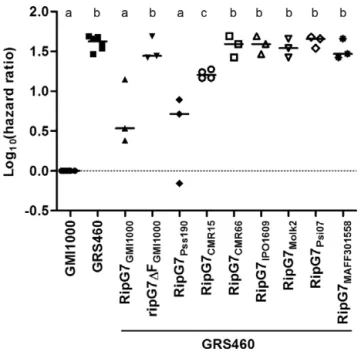
a triple haemagglutinin (HA) epitope tag, under the control of the GMI1000RipG7 promoter (see Experimental procedures). Figure 2
shows that the log10(hazard ratio) for plants inoculated with the
GRS460 mutant is significantly higher than zero (P< 0.001, one-samplet-test), indicating that the death rate of plants inoculated
with GRS460 is significantly lower than the death rate of those inoculated with the wild-type strain GMI1000 (as evidenced in Fig. 1). The log10(hazard ratio) of the GRS460 strain
expressing a mutant version with a deletion of the RipG7 Fbox domain (GRS460/ripG7ΔFGMI1000), known to be required for R. solanacearum virulence on M. truncatula (Angot et al., 2006),
is also significantly higher than zero (P = 0.003, one-sample t-test). The log10(hazard ratios) of plants inoculated with GRS460/
RipG7GMI1000 or GRS460/RipG7Pss190are not significantly different
from zero (P = 0.099 and P = 0.276, respectively, one-sample t-test), which shows that RipG7Pss190 and RipG7GMI1000 (see also
Figs 1 and 2) can complement the GRS460 mutant and restore its virulence onM. truncatula. The strain GRS460/RipG7CMR15shows
an intermediate phenotype, significantly different from both GMI1000 (P< 0.001, one-sample t-test) and GRS460 (P < 0.001, unpaired t-test). The complementation of GRS460 did not occur
with the other phylotype III variant RipG7CMR66 nor with
orthologues from phylotype II (RipG7Molk2 and RipG7IPO1609) or
Fig. 1 Pathogenicity andin planta growth of ripG7 mutants and
complemented strains vs. wild-type GMI1000 onMedicago truncatula. (A) The
data are represented as the hazard ratio between the tested strain and GMI1000. The death rates of plants inoculated with GRS138, GRS460 and GRS447 are significantly lower than the death rates of those inoculated with GMI1000. Moreover, GRS460 and GRS447 fall into the same group, according to unpairedt-test. GRS138/RipG7GMI1000, GRS460/RipG7GMI1000and GRS447/RipG7GMI1000have a similar level of pathogenicity to GMI1000. Letters are used to represent groups after pairwiset-test (P< 0.05). (B) High levels of bacterial growth (colony-forming units per gram fresh weight, cfu/gFW) inM. truncatula are observed after inoculation with wild-type
GMI1000 and complemented strains (GRS138/RipG7GMI1000, GRS460/RipG7GMI1000and GRS447/RipG7GMI1000). GRS138, GRS460 and GRS447 mutants all display significantly lower colonization than GMI1000. Letters are used to represent groups after pairwise Mann–Whitney tests (P< 0.05).
phylotype IV (RipG7MAFF301558 and RipG7Psi07); the log10(hazard
ratios) for the latter strains were significantly greater than zero (P = 0.003, P = 0.002, P = 0.002, P = 0.001 and P = 0.002,
respectively; one-samplet-test) and similar to that of the GRS460
mutant strain (P = 0.651, P = 0.398, P = 0.766, P = 0.265 and P = 0.735, respectively; unpaired t-test).
To characterize the partial complementation of GRS460 by RipG7CMR15, we quantified the in planta bacterial growth of
GRS138 and GRS460 expressing RipG7CMR15(Fig. S3, see
Support-ing Information). There seems to be a higher variability in the measured bacterial load of GRS138/RipG7CMR15 and GRS460/
RipG7CMR15, with instances of strong colonization, when compared
with the recipient GRS138 and GRS460 mutants. Nonetheless, the bacterial growth of neither GRS138/RipG7CMR15 nor GRS460/
RipG7CMR15can be distinguished from that of GRS138 or GRS460 (P
= 0.063 andP = 0.297, respectively; Mann–Whitney test; Fig. S3).
This suggests that the low bacterial colonization of GRS460/ RipG7CMR15could be the cause of the delayed symptoms observed
for theM. truncatula plants inoculated with GRS460/RipG7CMR15.
In order to verify that the ectopically expressed RipG7 orthologues are indeed substrates of the type III secretion system (T3SS), we performed in vitro secretion assays on the different
strains. We showed that the eight RipG7 allelic versions tested could all be produced and secreted by R. solanacearum. As a
control, a T3SS-defective mutant (hrcV mutant) failed to secrete
RipG7GMI1000(Fig. S4, see Supporting Information).
Among the eight ripG7 orthologues tested, only
RipG7IPO1609does not interact with MSKa, the
M. truncatula SKP1-like SCF core component
A functional Fbox is required for the complementation of GRS138 by RipG7GMI1000(Angotet al., 2006). This is most probably a result
of the fact that, for its function, RipG7 needs to interact with a plant SKP1-like protein (Angotet al., 2006), similar to a bona fide
Fbox protein (Zheng et al., 2002). Considering that five of the
eight diverseripG7 orthologues tested were not able to
comple-ment the GRS460 mutant strain for bacterial wilting (Fig. 2), we wanted to test whether the absence of complementation could be explained by an absence of interaction with MSKa, one of the main M. truncatula SKP1-like proteins (Angot et al., 2006).
Co-immunoprecipitation experiments showed that RipG7GMI1000
-green fluorescent protein (RipG7GMI1000-GFP), but not the
Fbox-deleted version RipG7ΔFGMI1000-GFP, interacts with MSKa-cMyc
(Fig. 3A). An interaction with MSKa could be detected for RipG7Pss190and RipG7CMR15,the two orthologues that complement
GRS460, as well as for several other orthologues that do not complement GRS460 (RipG7CMR66, RipG7Psi07, RipG7MAFF301558,
RipG7Molk2). Only phylotype II RipG7IPO1609could not interact with
MSKa-cMyc, neither in co-immunoprecipitation experiments (Fig. 3A), nor in yeast two-hybrid (Y2H) assays (Fig. 3B).
Selection study on RipG7 from 16 diverse strains identifies 11 sites under strong positive selection As published previously, there is evidence that RipG7 is among the T3Es that seem to be evolving under significant positive selection (Peeterset al., 2013b; Remigi et al., 2011). The selection analysis
was reiterated on the larger dataset of 16 orthologues (Dataset S1; Fig. S1) and allowed us to identify specific amino acids under positive selection. Significant across-site variation of selection on the protein was detected using the likelihood ratio test (LRT) of models M0 vs. M3 (P< 0.01) (see Experimental procedures). Accordingly, it was estimated that the majority of RipG7 sites were either strongly conserved withω = 0.06 (53.9% sites) or evolving almost free of selection pressure withω = 0.83 (39.3% sites). The remaining 6.8% of sites were estimated to be evolving under recurrent positive selection pressure with ω = 3.36. Furthermore, strong evidence of positive selection on the protein was obtained using the LRTs of nested models M1a vs. M2a and M8a vs. M8 (P< 0.01 for both tests). As a result, we identified 11 sites in RipG7 under positive selection with high posterior probability (P> 0.95, see Fig. 4A). One site is located in the Fbox domain and the 10 others are located within, or in loops between, predicted LRR domains (Fig. 4A) (Kajava et al., 2008).
Fig. 2 Pathogenicity of GRS460 complemented with naturalripG7 variants
vs. wild-type GMI1000 onMedicago truncatula. ripG7 orthologues can be
separated into three groups: (i) RipG7GMI1000and RipG7Pss190fully restore the pathogenicity of GRS460 onM. truncatula to the wild-type level; (ii)
RipG7CMR15partially restores the pathogenicity of GRS460; and (iii) RipG7CMR66, RipG7IPO1609, RipG7Molk2, RipG7Psi07and RipG7MAFF301558fail to restore the pathogenicity of GRS460, like the negative control RipG7ΔF. Letters are used to represent groups after pairwiset-tests (P< 0.05).
The amino acid variability at the selected sites is indicated for each of the natural variants of RipG7 in Fig. 4B.
Loss-of-function site-directed mutagenesis reveals positively selected sites L126, G322, E500, D511 and D522 as contributing to the virulence function of RipG7CMR15, but not of RipG7GMI1000
To assess the functional role of the 11 positively selected sites in RipG7, we conducted site-directed mutagenesis using RipG7GM1000
as template and generated mutations in each of the positively selected sites. We chose to replace the selected RipG7GMI1000sites
with the corresponding residue of RipG7MAFF301558(phylotype IV, see
Fig. 4), this orthologue being unable to complement the GRS460 mutant for disease establishment (Fig. 2), but still being capable of interacting with MSKa (Fig. 3A). The log10(hazard ratio) of the
RipG7GMI1000(11*) mutant cumulating the 11 positively selected
mutated sites was not significantly different from zero (P = 0.114,
one samplet-test; Fig. 5A), indicating that it could not be
distin-guished from its wild-type progenitor RipG7GMI1000.
The same approach was performed between the more closely related phylotype IIIripG7 orthologues ripG7CMR15and ripG7CMR66,
displaying 92% identical amino acids. Although both strains are compatible onM. truncatula, only RipG7CMR15can complement the
wilting defect of GRS460 (although partially, Fig. 2). Only five of the 11 positively selected sites are polymorphic between RipG7CMR15and RipG7CMR66(L126, G322, E500, D511 and D522, see
Fig. 4B). We generated RipG7CMR15(5*), cumulating changes in all
five sites, using RipG7CMR66as a template. The GRS460 strain
com-plemented with RipG7CMR15(5*) was clearly less aggressive on M. truncatula than the strain GRS460 complemented with the
wild-type version RipG7CMR15 (Fig. 5B; P = 0.009, one-sample t-test). This result indicates that one or several residues among
L126, G322, E500, D511 and D522 contribute significantly to the virulence function of RipG7CMR15.
Modification of the positively selected sites is not sufficient to provide a gain of function to
RipG7MAFF3010558or RipG7CMR66
In a reverse experiment, we modified the 11 positively selected sites of RipG7MAFF3010558so that each site would display the
corre-sponding RipG7GMI1000residue at each of the 11 sites. This mutated
RipG7 was not functional onM. truncatula (Fig. S5A, see
Support-ing Information), as the recipient strain GRS460 was not distin-guishable from the non-complementing RipG7MAFF3010558wild-type
orthologue (P = 0.939, unpaired t-test). The same approach was
performed between the more closely related phylotype IIIripG7
orthologues RipG7CMR15and RipG7CMR66. In RipG7CMR66, we replaced
the five positively selected and polymorphic sites using RipG7CMR15
residues, and these five point mutations were also insufficient to
Fig. 3 Interaction between RipG7 natural variants and MSKa. (A)
Co-immunoprecipitation of RipG7 with MSKa after transient expression in
Nicotiana benthamiana. Cell lysates were immunoprecipitated with anti-green
fluorescent protein (anti-GFP). The cell lysates (Input) and immunoprecipitates (IP) were analysed by immunoblotting with antibodies anti-c-Myc and anti-GFP. Black triangles point to the specific corresponding protein bands after immunoblotting (IB). A non-specific band shown with a black star confirms equal loading. Co-immunoprecipitation assay indicates that RipG7 natural variants can interact with MSKa in plants, except for RipG7IPO1609. (B) Yeast two-hybrid (Y2H) analysis testing the interaction between
BD-RipG7IPO1609and AD-MSKa in yeast cells. The two-hybrid interaction was tested with positive control BD-p53/AD-T-antigen and negative control BD-Lam/AD-T-antigen. No interaction between RipG7IPO1609and MSKa was indicated by the absence of growth on selective medium. The interaction between RipG7MAFF301558and MSKa was confirmed by growth on selective medium. SD-LW, medium without leucine (Leu) and tryptophan (Trp); SD-LWH10, medium without Leu, Trp and histidine (His) supplemented with 10 mMof 3-amino-1,2,4-triazole (3-AT); SD-LWHA, medium without Leu, Trp, His and adenine (Ade). AD, activation domain; BD, binding domain.
generate a gain-of-function RipG7 variant. Indeed, RipG7CMR66(5*)
cannot be distinguished from RipG7CMR66,and they are both unable
to complement GRS460 to cause wilting of M. truncatula
(Fig. S5B;P = 0.223, unpaired t-test).
DISCUSSION
The core T3E RipG7 is required for full virulence on the legume host plantM. truncatula. In contrast with that which has been
published previously (Angot et al., 2006), in our current and
updated controlled inoculation procedures, the single ripG7
mutant (strain GRS138) is not completely abolished in its virulence capacity (Fig. 1), as is the case for the quadruple mutant (ripG2 ripG3 ripG6 ripG7 mutant, strain GRS460) or the septuple ripG
mutant GRS447. This indicates that there seems to be a small contribution to virulence of any or several of RipG2, RipG3 and RipG6. Interestingly, this was not apparent whenin planta
bacte-rial colonization was assessed for these mutant strains (Fig. 1). The
Fig. 4 The 11 sites under strong positive selection in RipG7. (A) Posterior probability of positive (red), negative (blue) or relaxed (grey) selection is plotted along
the coding sequence of RipG7. Thex-axis coordinates correspond to the codons along the multiple alignments of all 16 RipG7 orthologues. On the bottom part of
the graph are indicated the positions of the Fbox domain (RipG7GMI1000amino acid coordinates, 121–182), and the leucine-rich repeat (LRR) domains LRR1–5 (RipG7GMI1000amino acid coordinates, 236–355), LRR6–8 (RipG7GMI1000amino acid coordinates 421–492) and LRR9–11 (RipG7GMI1000amino acid coordinates, 515–586). On the top part of the graph are indicated the 11 sites (with the corresponding residues from RipG7GMI1000) with the highest probability (P> 0.95) of positive selection: M126 (P = 0.957), G322 (P = 0.999), E370 (P = 0.969), S374 (P = 0.973), E381 (P = 0.967), A399 (P = 0.984), D472 (P = 0.97), Q500 (P =
0.994), E511 (P = 0.963), N522 (P = 0.962) and A596 (P = 0.976). (B) Table highlighting the polymorphism at the 11 positively selected sites for each of the 16
natural variants studied. An amino acid in a blue background is hydrophobic, in green is hydrophilic, in pink is negatively charged and in red is positively charged. The star symbols indicate the sites polymorphic between CMR15 and CMR66.
marginal contribution of RipG2, RipG3 or RipG6 was ignored further in this work as the GRS460 quadruple mutant could be fully restored when complemented with the cognate GMI1000
ripG7-expressing construct.
None of the strains studied in detail in this work were sampled from legume plants, but rather from tomato (GMI1000, Pss190, CMR15, Psi07), potato (CMR66, MAFF301558, IPO1609) or banana crop (MolK2). Nonetheless, the legume plantM. truncatula is a host
plant forR. solanacearum (Vailleau et al., 2007).When each of the
eight above-mentioned strains were inoculated onM. truncatula,
they fell into two categories: those able (GMI1000, CMR15 and CMR66) and those unable (Pss190, IPO1609, MolK2, MAFF301558 and Psi07) to produce wilting symptoms on the host.We know that: (i) RipG7 is an essentialT3E of GMI1000 for its virulence on this host (Angotet al., 2006); and (ii) numerous other virulence
determi-nants are needed for appropriate infection, colonization and wilting
(Genin and Denny, 2012). The straightforward explanation would be that the first group (GMI1000, CMR15 and CMR66) has both a functional RipG7 and other required virulence determinants (e.g. RipAA, Turneret al., 2009; other virulence functions, Valls et al.,
2006), whereas the second group could be deficient in either or both. In this study, we investigated further the sequence variability in relation to the function of these diverse RipG7 proteins. Only RipG7GMI1000, RipG7Pss190and RipG7CMR15were able to complement
the absence of wilting symptoms of the GRS460 strain, a GMI1000-based mutant. The first conclusion would be that GMI1000 and CMR15 have both functional RipG7s and the other required viru-lence determinants to cause wilting ofM. truncatula. Pss190 has a
functional RipG7, but not the other required virulence determi-nants. As the Pss190 T3E repertoire is very similar (presence/ absence polymorphism and allelic diversity) to that of GMI1000 (C.-P. Cheng, personal observation, unpublished data), we can hypothesize that allelic differences, rather than presence/absence polymorphism in either the other T3Es or non-T3E virulence deter-minants, account for the inability of the Pss190 strain to cause wilting in M. truncatula. CMR66 does not have a
GMI1000-compatible functional RipG7, but is capable of causing wilting in this host. For this latter puzzling case, we cannot be sure that the virulence of CMR66 is indeed associated with endogenous RipG7, nor do we know the exact virulence gene repertoire, as this strain has not yet been sequenced.
The case of CMR15 is compelling. On the one hand, the CMR15 strain is very aggressive onM. truncatula (Fig. S2, although the
difference from GMI1000 is not significant, we recorded a nega-tive hazard ratio for CMR15). On the other, the RipG7CMR15
orthologue only weakly restores the wilting capacity of GRS460. We ruled out the possibility that this could be because of a dependence on any of RipG2, RipG3 or RipG6 for the colonization of gnotobioticM. truncatula plantlets as the single ripG7 mutant
strain GRS138 expressing RipG7CMR15cannot be distinguished from
strain GRS460/RipG7CMR15 (see Fig. S3). We can speculate that
CMR15 has evolved other virulence determinants (T3Es or others) required for full virulence on this host. It is interesting to note that CMR15 is the onlyR. solanacearum strain to have a ripG8 gene
(Remenant et al., 2010; Remigi et al., 2011). This paralogue is
quite distant from RipG7 (Peeterset al., 2013b), but only a
muta-tion analysis could inform us about its involvement in the viru-lence on this host.
RipG7 is a peculiar T3E, interacting directly with plant proteins (SKP1-like proteins) to create a bacterium–plant composite SCF E3-ubiquitin ligase in plant cells (Angot et al., 2006, 2007).
Co-immunoprecipitation experiments allowed us to rule out the possibility that the absence of complementation is a result of the absence of interaction with SKP1-like (MSKa) for all but the phylotype II strain IPO1609. This result is in agreement with the fact that the LRR domains of Fbox proteins are key for the interaction with substrate proteins (Gagne et al., 2002; Wang
Fig. 5 Pathogenicity of GRS460/RipG7GMI1000and GRS460/RipG7CMR15vs. cumulated mutant strains onMedicago truncatula. (A) The death rate of
plants inoculated with GRS460 containing RipG7GMI1000(11*) could not be distinguished from their wild-type progenitor RipG7GMI1000. (B) GRS460 containing RipG7CMR15(5*) showed reduced pathogenicity compared with RipG7CMR15. Letters are used to represent groups after pairwiset-test (P< 0.05).
et al., 2014). Our selection study on a global diversity set of 16 ripG7 orthologues further emphasizes the importance of this
domain, as 10 of the 11 strongest candidate sites for positive selection were located in, or in between, LRR repeats. This sup-ports the hypothesis of an evolutionary arms race between
R. solanacearum and its hosts, occurring at the interaction
inter-face between RipG7 and its putative plant targets. Figure 6 pre-sents the predicted structure of the LRR domain of RipG7GMI1000; all
sites but E511 are located in theα-helices of the LRR. As a result, 10 of the 11 selected sites are exposed (Fig. 6A) on the surface of the convex side of the predicted LRR of RipG7. For RipG7CMR15,
collectively or individually, the sites 126, 322, 500, 511 and 522 are required for full virulence contribution of this orthologue. At this stage, it is hard to speculate whether the concave part of the LRR of RipG7CMR15(with site 511), or the convex site (with sites
322, 500 and 522), is directly involved in target recognition. It should be noted that, for the plant Fbox LRR phytohormone recep-tor proteins TIR1 and COI1, the surface of interaction with IAA7 and JAZ1 proteins, respectively, has been mapped on the concave side of the LRR structure (Sheardet al., 2010; Tan et al., 2007).
Site 126 is the only non-LRR-located site and is surprisingly located in the Fbox domain for which the overall selection is, rather, purifying (Wanget al., 2014) (Fig. 4A). It is unexpected that
there should be a positively selected site in the Fbox domain, as it interacts with a conserved SKP1-like plant protein (Kurodaet al.,
2012). It should be noted that, although clearly under positive selection, this site is a methionine, leucine or isoleucine, all very similar in their chemical nature, and thus should not affect the interaction with MSKa, but could contribute to modulate this interaction, possibly in a host-dependent fashion.
Our analysis uncovered sites under significant positive selection in the overall dataset of 16 orthologues. We also showed that there is a different contribution to RipG7-mediated virulence of some of these amino acids, depending on the allelic background in which they are tested (GMI1000 or CMR15). This is evidence indicating that the T3Es (and RipG7) of specificR. solanacearum
strains co-evolve with their specific host targets, for a constant best fit (RipG7 LRR domain interacting with putative plant targets), for a full virulence function. Although GMI1000, a phylotype I strain, and CMR15, a phylotype III strain, were both isolated from tomato (in French Guyana and Cameroon, respec-tively), they may have co-evolved on additional host plants. Recent work has shown that one single amino acid substitution in a virulence effector of Phytophthora infestans was sufficient to
mediate a host shift in this species (Donget al., 2014).
Further-more, a single amino acid modification in the Fusarium verticilloides endo-polygalacturonase enables it to avoid
recogni-tion by the LRR domain of PGIP2 inPhaseolus vulgaris (Benedetti et al., 2013). The recognition of polygalacturonases has also been
shown to occur at the concave part of the PGIP2 LRR (Casasoli
et al., 2009).
Gain-of-function mutagenesis has been successfully achieved by random modification of ATR1, an effector from the oomycete
Hyaloperonospora arabidopsidis, for it to gain recognition by the
plant LRR-immune receptor protein RPP1 (Steinbrenner et al.,
2015). In our case, as we are testing for the contribution to aggressiveness, we could not embark on a systematic random mutagenesis, and so we tested the contribution of the 11 posi-tively selected sites. The RipG7MAFF301558(11*) cumulative ripG7
mutant was unable to cause wilting inM. truncatula (Fig. S5). We
Fig. 6 Mapping of positively selected sites on
a structural model of the RipG7GMI1000 leucine-rich repeat (LRR) domain. (A) Alignment of the LRRs of RipG7GMI1000. Conserved motifs corresponding toβ-structural regions are underlined. Residues of LRR that are located inside the structure are indicated in bold. The positively selected sites are indicated in red. (B) A typical structural unit of GALA LRR observed in the crystal structure of GALA protein LegL1 fromLegionella pneumophila (pdb code 4XA9).
Positively selected sites are located in positions 4, 8, 11, 15 and 21 of the LRR, exposed on the surface of the structure. (C) A structural model of the LRR domain of RipG7 with the positively selected sites shown in red. A long loop of one of the LRRs is shown in dark blue.
believed that a gain of function would be more likely to be achieved by modification of RipG7CMR66 into a functional
orthologue using the positive sites of the closely related RipG7CMR15as a template. Although there were only five positively
selected sites among the 50 existing polymorphic amino acids, this gain of function was unsuccessful. It should be remembered here that the CMR66 strain is virulent on M. truncatula, despite
RipG7CMR66being unable to complement the absence of virulence
of GRS460. If the strain CMR66 evolved other virulence determi-nants, RipG7CMR66could have been under less stringent selection
and could have accumulated deleterious mutations. A counter-argument to this is the fact that RipG7CMR66 has maintained its
ability to interact with MSKa.
Ralstonia solanacearum core T3Es are conserved across
phylotypes which are spread over all continents and infect diverse host plants (Peeterset al., 2013b). These core T3Es must thus be
essential for bacterial virulence and fitness. Nonetheless, each specific strain is adapted to a given set of hosts (or restricted to a specific host for some strains; Remenantet al., 2011). We can thus
expect that the overall T3E repertoire, including the core T3Es, constantly co-evolves with the host plant genes whose products are targeted by these T3Es. This leads to the apparent contradic-tion in which a T3E can be ubiquitously represented and required in allR. solanacearum species complex strains and, at the same
time, possess specific and minute changes enabling an adaptation to the specific and different host targets of the different strains.
EXPERIMENTAL PROCEDURES
NewripG7 orthologues
Based on the conservation of RipG7 in each phylotype, we designed primers on the known RipG7 from reference strains GMI1000 (phylotype I), CMR15 (phylotype III) and Psi07 (phylotype IV) (Table S2, see Support-ing Information). We then amplified, BP cloned (Gateway® cloning
system, Life Technologies, Carlsbad, CA, USA) and sequenced theripG7
orthologues from the other phylotype I strains: Pss79, Pss81, Pss166, Pss190, Pw12 and ss1-3, all originating from Taiwan. Similarly, we cloned RipG7 from phylotype III strains CMR66 and NCPPB332 and phylotype IV strains MAFF301558 and ACH732. All the strain metadata and ripG7
sequences are available (Table S2, Dataset S1). All accession numbers are given at the end of the article. All the variantripG7 sequences can
unequivocally be assigned as beingripG7 orthologues, as both the number
and specific sequences of the LRR are strictly conserved (Peeterset al.,
2013b; Remigiet al., 2011).
Plasmid constructs andR. solanacearum mutant
strains generated
ForR. solanacearum virulence tests, ripG7 orthologues were cloned in a
complementation vector pNP329 (Lohou et al., 2014; Monteiro et al.,
2012) by the Gateway® cloning system (Life Technologies). These
con-structs allow for the expression of the diverse RipG7 clones under the control of the promoter from RipG7GMI1000and fused to a terminal triple HA
epitope tag (Table S2). GRS138, GRS460 and GRS447, expressing RipG7 proteins, were generated by natural transformation ofR. solanacearum
(Bertollaet al., 1997). The strains used in this study are given in Table S2.
All RipG7 constructs for Y2H assays and for the agroinfiltration of Nico-tiana benthamiana leaves were also cloned using the Gateway® system;
details are given in Table S2.
Virulence tests, bacterial internal growth curves (IGCs) and statistical analysis
Ralstonia solanacearum strains were grown overnight in B liquid medium
(Pleneret al., 2012) with appropriate antibiotics. Each soil inoculation
consisted of 16 2-week-oldM. truncatula (ecotype A17) plants grown in
Jiffy pots that were inoculated by soil drenching with a 108cfu/mL
bacte-rial suspension after root cutting. Visual scoring of plant symptoms accord-ing to a scale rangaccord-ing from ‘0’ (no symptoms) to ‘4’ (complete wiltaccord-ing) was performed as described by Vailleau et al. (2007). This procedure was
repeated at least three times for each tested strain. The disease scoring was then transformed into binary data, with a disease index below ‘2’ corresponding to ‘0’ and a disease index equal to or higher than ‘2’ corresponding to ‘1’. This transformation allowed us to apply the survival analysis statistical protocols particularly suited for distinguishing between two different strains (Machinet al., 2006; Remigi et al., 2011). The hazard
is defined as the slope of the survival curve and is a measure of how rapidly plants are dying; the hazard ratio compares two survival curves. The hazard ratios were calculated by Graphpad Prism 5.0 software. The log10(hazard ratio) transformation was used to analyse the data, as it is
assumed to follow a normal distribution (Machinet al., 2006). One-sample t-test was used to test the null hypothesis of the log10(hazard ratio) as
being equal to the specified value of ‘0’. IfP< 0.05, the null hypothesis that the tested strain behaves like the reference strain will be rejected. For IGCs, 2-week-old,in vitro-grown M. truncatula plantlets were inoculated
with the bacterial suspension (108cfu/mL). IGCs were performed by
grind-ing six plantlets (surface sterilized) with a mortar and pestle. Bacterial concentrations were determined by plating, with a dedicated easySpiral® (Interscience 78860, Saint Nom, France), different bacterial dilutions on solid B medium with appropriate antibiotics. This gnotobiotic inoculation procedure was repeated at least three times for each tested bacterial strain. The log10(cfu/gFW) transformation was used to analyse the data. As
the IGC data are known not to follow a normal distribution, a non-parametric Mann–Whitney test was used to determine whether or not a series of biological repetitions of two bacterial strainin planta IGCs can be
considered as different.
Selection study
RipG7 sequences were aligned using the ProGraphMSA + TR program (Szalkowski and Anisimova, 2013), which implements the evolution-aware alignment algorithm performing well with indel-rich data and particularly with tandem repeats, as is our case. The phylogenies of all RipG7s and of individual RipG7 genes were reconstructed by maximum likelihood under model LG (Le and Gascuel, 2008) withΓ-rate variation among sites (Yang, 1994), as implemented in PhyMLv3.0 (Guindon et al., 2010). Branch
supports were estimated using the aBayes method (Anisimovaet al.,
2011). Using these phylogenies, selective pressures on RipG7 were ana-lysed with codon substitution models (Yanget al., 2000) (as implemented
in PAML), which describe selection on the protein by a distribution of the
ω ratio—the ratio of non-synonymous to synonymous substitution rates.
Heterogeneity of selective pressures across codon sites was tested using an LRT of codon models M0 (equal selection pressure over sites) vs. M3 (with three categories of sites). Tests for positive selection on the protein were also performed using LRT of pairs of nested models: M1a vs. M2a, and M8a vs. M8 (Anisimova and Kosiol, 2009). In these LRTs, for each pair of models, the null hypothesis (no positive selection) was represented by a model that constrains ω ≤ 1 (models M1a and M8a), whereas the
alternative hypothesis (positive selection is allowed) allowed forω > 1
(models M2a and M8). Bayesian empirical Bayesian prediction (Yang
et al., 2005) was then used to detect sites under positive selection
employ-ing the best-fittemploy-ing model M8 (accordemploy-ing to the Akaike Information Cri-terion). Dataset S2 presents the overall selection analysis on the RipG7 dataset.
Molecular modelling
The initial template for the RipG7GMI1000LRR was taken from a 24-residue
LRR of the known crystal structure of GALA protein LegL1 fromLegionella pneumophila (pdb code 4XA9; M. L. Urbanus et al., unpublished data,
Department of Molecular Genetics, University of Toronto, Toronto, ON M5S 1A8, Canada). Based on this template, the LRR domain was built using the Insight II program (Dayringeret al., 1986). The amino acid sequence of the
template was edited in accordance with the RipG7GMI1000sequences using
the homology modelling option of the Insight II program. The structure was further refined as described in Kajavaet al. (2008).
Site-directed mutagenesis
Site mutations were introduced by polymerase chain reaction (PCR) using a QuickChange II XL Site-Directed Mutagenesis Kit (Agilent Technologies, Santa Clara, CA, USA) following the manufacturer’s protocol. The muta-genic primers are shown in Table S2. PCRs for point mutations were run for 18 cycles of 50 s at 95 °C and 50 s at 60 °C, followed by 5 min at 68 °C. The resulting mutant plasmids were verified by sequencing.
Y2H analysis
RipG7 protein was fused to the GAL-binding domain (BD) and MSKa was fused to the GAL4-activation domain (AD) by the Gateway® cloning system. AH109 yeast cells were co-transformed with a BD-RipG7 fusion construct and AD-MSKa construct, and grown on SD-LW [medium without leucine (Leu) and tryptophan (Trp)]. Three co-transformants per interaction were spotted onto SD-LWH-10 [medium without Leu, Trp and histidine (His) supplemented with 10 mMof 3-amino-1,2,4-triazole] and SD-LWHA [medium without Leu, Trp, His and adenine (Ade)] selective medium and grown at 28 °C for 2–3 days.
Co-immunoprecipitation and immunoblot analyses
RipG7 orthologues and MSKa were fused to a GFP tag in pB7FWG2
and c-Myc tag in pGWB17 by Gateway® cloning, respectively.
First, N. benthamiana leaves were co-infiltrated with two GV3101 Agrobacterium tumefaciens strains harbouring a RipG7-GFP and
MSKa-cMyc-expressing plasmid. Then, ground leaf samples were resuspended in 400μL of protein extraction buffer [GTEN buffer: 10% glycerol, 25 mM
Tris-HCl, pH 7.5, 1 mMethylenediaminetetraacetic acid (EDTA), 150 mM
NaCl, 10 mM dithiothreitol (DTT), protease inhibitor cocktail, 1 mM
phenylmethylsulfonylfluoride (PMSF), 0.15% Nonidet P40]. The superna-tant of this lysate and 20μL of equilibrated GFP-Trap®_M beads (Chromotek, Planegg, Germany) were incubated for 1 h, followed by three washes with 500μL of buffer (GTEN buffer, protease inhibitor cocktail, 1 mMPMSF). Proteins were eluted from the GFP-trap beads with 50μL of 2 × SDS-sample buffer [100 mMTris-HCl, pH 6.8, 4% sodium dodecylsulfate (SDS), 0.2% bromophenol blue, 20% glycerol) for 10 min at 95 °C. The eluted proteins were subjected to immunoblot analyses with anti-c-Myc and anti-GFP antibody.
Secretion assay
The secretion assay was performed as described previously (Guéneron
et al., 2000; Poueymiro et al., 2009). The pAM5 plasmid (Guéneron et al.,
2000) was introduced into GRS138/RipG7s mutant strains in order to overexpress the T3SS and T3Es. RipG7GMI1000-expressing plasmid was
intro-duced into the GMI1694 strain (hrcV mutant). All strains were grown
overnight in B medium with appropriate antibiotics. B medium culture was washed by centrifugation (2300g, 10 min), and bacterial pellets were
resuspended in minimal medium (Pleneret al., 2010) supplemented with
10 mMglutamate, 10 mMsucrose and 100μg/mL of Congo Red at an optical density (OD) of 0.2. The minimal medium cultures were harvested after 8 h of growth at 28 °C and normalized to the same bacterial con-centration. After centrifugation (2300g, 10 min), bacterial cell pellets and
culture supernatants were treated as described by Poueymiroet al. (2009).
The cell pellets and culture supernatants were then subjected to immunoblot analysis with anti-HA antibody (diluted at 1:5000).
Phylogenetic analysis
All 16 RipG7 orthologues and the outgroup RipG6 from GMI1000 were aligned by thePRANKprogram (Löytynoja and Goldman, 2008) and sub-jected to phylogenetic tree reconstruction using PhyML (Guindonet al.,
2010). Tree rendering was performed with iTOL (Letunic and Bork, 2011).
Accession numbers
TheripG7 accession numbers are as follows. Phylotype I strains: GMI1000
(CAD15059), Pss79 (KR349453), Pss81 (KR349454), Pss166 (KR349452), Pss190 (KR349445), Pw12 (KR349455) and ss1-3 (KR349456); phylotype II strains: IPO1609 (GCA_001050995.1), MolK2 (GCA_000212635.2), CFBP2957 (CBJ43267); phylotype III strains: CMR15 (CBJ38611), CMR66 (KR349448) and NCPPB332 (KR349451); phylotype IV strains: Psi07 (CBJ51373), MAFF301558 (KR349450) and ACH732 (KR349449).
ACKNOWLEDGEMENTS
This work was supported by ANR-07-JCJC-0133 to NP, and was carried out at the Laboratoire des Interactions Plantes Micro-organismes (LIPM)
funded by LABEX ‘TULIP’ (ANR-10-LABX-41). This work benefited from an Short-term Scientific Mission grant promoted by the COST Action SUSTAIN FA1208. KW was supported by a grant from the China Scholarship Council. We thank Dr Miles Armstrong and Professor Paul Birch, from the James Hutton Institute, Dundee, UK, for technical advice. The authors declare the absence of any conflicts of interest.
REFERENCES
Angot, A., Peeters, N., Lechner, E., Vailleau, F., Baud, C., Gentzbittel, L., Sartorel, E., Genschik, P., Boucher, C. and Genin, S. (2006)Ralstonia solanacearum requires
F-box-like domain-containing type III effectors to promote disease on several host plants.Proc. Natl. Acad. Sci. USA, 103, 14 620–14 625.
Angot, A., Vergunst, A., Genin, S. and Peeters, N. (2007) Exploitation of eukaryotic
ubiquitin signaling pathways by effectors translocated by bacterial type III and type IV secretion systems.PLoS Pathog. 3, e3.
Anisimova, M. and Kosiol, C. (2009) Investigating protein-coding sequence evolution
with probabilistic codon substitution models.Mol. Biol. Evol. 26, 255–271.
Anisimova, M., Gil, M., Dufayard, J.-F., Dessimoz, C. and Gascuel, O. (2011) Survey
of branch support methods demonstrates accuracy, power, and robustness of fast likelihood-based approximation schemes.Syst. Biol. 60, 685–699.
Baltrus, D.A., Nishimura, M.T., Romanchuk, A., Chang, J.H., Mukhtar, M.S., Cherkis, K., Roach, J., Grant, S.R., Jones, C.D. and Dang, J.L. (2011) Dynamic
evolution of pathogenicity revealed by sequencing and comparative genomics of 19
Pseudomonas syringae isolates. PLoS Pathog. 7, e1002132.
Benedetti, M., Andreani, F., Leggio, C., Galantini, L., Di Matteo, A., Pavel, N.V., De Lorenzo, G., Cervone, F., Federici, L. and Sicilia, F. (2013) A single amino-acid
substitution allows endo-polygalacturonase ofFusarium verticillioides to acquire
recognition by PGIP2 fromPhaseolus vulgaris. PLoS ONE, 8, e80610.
Bertolla, F., Van Gijsegem, F., Nesme, X. and Simonet, P. (1997) Conditions for
natural transformation ofRalstonia solanacearum. Appl. Environ. Microbiol. 63,
4965–4968.
Cao, Y., Aceti, D.J., Sabat, G., Song, J., Makino, S.-I., Fox, B.G. and Bent, A.F. (2013)
Mutations in FLS2 Ser-938 dissect signaling activation in FLS2-mediated Arabidopsis immunity.PLoS Pathog. 9, e1003313.
Casasoli, M., Federici, L., Spinelli, F., Di Matteo, A., Vella, N., Scaloni, F., Fernández-Recio, J., Cervone, F. and De Lorenzo, G. (2009) Integration of
evo-lutionary and desolvation energy analysis identifies functional sites in a plant immun-ity protein.Proc. Natl. Acad. Sci. USA, 106, 7666–7671.
Dayringer, H.E., Tramontano, A., Sprang, S.R. and Fletterick, R.J. (1986) Interactive
program for visualization and modelling of proteins, nucleic acids and small mol-ecules.J. Mol. Graph. 4, 82–87.
Dong, S., Stam, R., Cano, L.M., Bozkurt, T.O., Oliva, R., Liu, Z., Tian, M., Win, J., Banfield, M.J., Jones, A.M.E., Van der Hoorn, R.A.L. and Kamoun, S. (2014)
Effector specialization in a lineage of the Irish potato famine pathogen.Science, 343,
552–555.
Dou, D. and Zhou, J.-M. (2012) Phytopathogen effectors subverting host immunity:
different foes, similar battleground.Cell Host Microbe, 12, 484–495.
Gagne, J.M., Downes, B.P., Shiu, S.-H., Durski, A.M. and Vierstra, R.D. (2002) The
F-box subunit of the SCF E3 complex is encoded by a diverse superfamily of genes in Arabidopsis.Proc. Natl. Acad. Sci. USA, 99, 11 519–11 524.
Galán, J.E. (2009) Common themes in the design and function of bacterial effectors.
Cell Host Microbe, 5, 571–579.
Galán, J.E. and Collmer, A. (1999) Type III secretion machines: bacterial devices for
protein delivery into host cells.Science, 284, 1322–1328.
Genin, S. and Denny, T.P. (2012) Pathogenomics of theRalstonia solanacearum
species complex.Annu. Rev. Phytopathol. 50, 67–89.
Guéneron, M., Timmers, A.C., Boucher, C. and Arlat, M. (2000) Two novel proteins,
PopB, which has functional nuclear localization signals, and PopC, which has a large leucine-rich repeat domain, are secreted through the hrp-secretion apparatus of
Ralstonia solanacearum. Mol. Microbiol. 36, 261–277.
Guindon, S., Dufayard, J.-F., Lefort, V., Anisimova, M., Hordijk, W. and Gascuel, O.
(2010) New algorithms and methods to estimate maximum-likelihood phylogenies: assessing the performance of PhyML 3.0.Syst. Biol. 59, 307–321.
Helft, L., Reddy, V., Chen, X., Koller, T., Federici, L., Fernández-Recio, J., Gupta, R. and Bent, A. (2011) LRR conservation mapping to predict functional sites within
protein leucine-rich repeat domains.PLoS ONE, 6, e21614.
Jones, J.D.G. and Dangl, J.L. (2006) The plant immune system.Nature, 444, 323–
329.
Kajava, A.V., Anisimova, M. and Peeters, N. (2008) Origin and evolution of
GALA-LRR, a new member of the CC-LRR subfamily: from plants to bacteria?PLoS ONE,
3, e1694.
Kalunke, R.M., Tundo, S., Benedetti, M., Cervone, F., De Lorenzo, G. and D’Ovidio, R. (2015) An update on polygalacturonase-inhibiting protein (PGIP), a leucine-rich
repeat protein that protects crop plants against pathogens.Front. Plant Sci. 6, 146.
Koller, T. and Bent, A.F. (2014) FLS2-BAK1 extracellular domain interaction sites
required for defense signaling activation.PLoS ONE, 9, e111185.
Kubori, T., Shinzawa, N., Kanuka, H. and Nagai, H. (2010) Legionella metaeffector
exploits host proteasome to temporally regulate cognate effector.PLoS Pathog. 6,
e1001216.
Kuroda, H., Yanagawa, Y., Takahashi, N., Horii, Y. and Matsui, M. (2012) A
com-prehensive analysis of interaction and localization of Arabidopsis SKP1-like (ASK) and F-box (FBX) proteins.PLoS ONE, 7, e50009.
Le, S.Q. and Gascuel, O. (2008) An improved general amino acid replacement matrix.
Mol. Biol. Evol. 25, 1307–1320.
Lechner, E., Achard, P., Vansiri, A., Potuschak, T. and Genschik, P. (2006) F-box
proteins everywhere.Curr. Opin. Plant Biol. 9, 631–638.
Letunic, I. and Bork, P. (2011) Interactive Tree Of Life v2: online annotation and display
of phylogenetic trees made easy.Nucleic Acids Res. 39, W475–W478.
Lindeberg, M., Cunnac, S. and Collmer, A. (2009) The evolution ofPseudomonas syringae host specificity and type III effector repertoires. Mol. Plant Pathol. 10,
767–775.
Lohou, D., Turner, M., Lonjon, F., Cazalé, A.C., Peeters, N., Genin, S. and Vailleau, F. (2014) HpaP modulates type III effector secretion inRalstonia solanacearum and
harbours a substrate specificity switch domain essential for virulence.Mol. Plant Pathol. 15, 601–614.
Löytynoja, A. and Goldman, N. (2008) Phylogeny-aware gap placement prevents
errors in sequence alignment and evolutionary analysis.Science, 320, 1632–1635.
Machin, D., Cheung, Y.B. and Parmar, M. (2006)Survival Analysis. Chichester: John
Wiley & Sons.
Magori, S. and Citovsky, V. (2011) Hijacking of the host SCF ubiquitin ligase
machin-ery by plant pathogens.Front. Plant Sci. 2, 87.
Monteiro, F., Solé, M., van Dijk, I. and Valls, M. (2012) A chromosomal insertion
toolbox for promoter probing, mutant complementation, and pathogenicity studies in
Ralstonia solanacearum. Mol. Plant–Microbe Interact. 25, 557–568.
Peeters, N., Guidot, A., Vailleau, F. and Valls, M. (2013a)Ralstonia solanacearum, a
widespread bacterial plant pathogen in the post-genomic era.Mol. Plant Pathol. 14,
651–662.
Peeters, N., Carrere, S., Anisimova, M., Plener, L., Cazalé, A.C. and Genin, S.
(2013b) Repertoire, unified nomenclature and evolution of the Type III effector gene set in theRalstonia solanacearum species complex. BMC Genomics, 14, 859.
Plener, L., Manfredi, P., Valls, M. and Genin, S. (2010) PrhG, a transcriptional
regulator responding to growth conditions, is involved in the control of the type III secretion system regulon inRalstonia solanacearum. J. Bacteriol. 192, 1011–1019.
Plener, L., Boistard, P., González, A., Boucher, C. and Genin, S. (2012) Metabolic
adaptation of Ralstonia solanacearum during plant infection: a methionine
biosynthesis case study.PLoS ONE, 7, e36877.
Poueymiro, M., Cunnac, S., Barberis, P., Deslandes, L., Peeters, N., Cazale-Noel, A.-C., Boucher, C. and Genin, S. (2009) Two type III secretion system effectors from
Ralstonia solanacearum GMI1000 determine host-range specificity on tobacco. Mol. Plant–Microbe Interact. 22, 538–550.
Raymond, B., Young, J.C., Pallett, M., Endres, R.G., Clements, A. and Frankel, G.
(2013) Subversion of trafficking, apoptosis, and innate immunity by type III secretion system effectors.Trends Microbiol. 21, 430–439.
Remenant, B., Coupat-Goutaland, B., Guidot, A., Cellier, G., Wicker, E., Allen, C., Fegan, M., Pruvost, O., Elbaz, M., Calteau, A., Salvignol, G., Mornico, D., Mangenot, S., Barbe, V., Médigue, C. and Prior, P. (2010) Genomes of three
tomato pathogens within theRalstonia solanacearum species complex reveal
sig-nificant evolutionary divergence.BMC Genomics, 11, 379.
Remenant, B., de Cambiaire, J.-C., Cellier, G., Jacobs, J.M., Mangenot, S., Barbe, V., Lajus, A., Vallenet, D., Medigue, C., Fegan, M., Allen, C. and Prior, P. (2011)
Ralstonia syzygii, the blood disease bacterium and some Asian R. solanacearum
strains form a single genomic species despite divergent lifestyles.PLoS ONE, 6,
e24356.
Remigi, P., Anisimova, M., Guidot, A., Genin, S. and Peeters, N. (2011) Functional
diversification of the GALA type III effector family contributes to Ralstonia solanacearum adaptation on different plant hosts. New Phytol. 192, 976–987.
Safni, I., Cleenwerck, I., De Vos, P., Fegan, M., Sly, L. and Kappler, U. (2014)
proposal to emend the descriptions ofRalstonia solanacearum and Ralstonia syzygii
and reclassify currentR. syzygii strains as Ralstonia syzygii subsp. syzygii subsp. nov., R. solanacearum phylotype IV strains as Ralstonia syzygii subsp. indonesiensis subsp.
nov., banana blood disease bacterium strains asRalstonia syzygii subsp. celebesensis
subsp. nov. and R. solanacearum phylotype I and III strains as Ralstonia pseudosolanacearum sp. nov. Int. J. Syst. Evol. Microbiol. 64, 3087–3103.
Sheard, L.B., Tan, X., Mao, H., Withers, J., Ben-Nissan, G., Hinds, T.R., Kobayashi, Y., Hsu, F.F., Sharon, M., Browse, J., He, S.Y., Rizo, J., Howe, G.A. and Zheng, N.
(2010) Jasmonate perception by inositol-phosphate-potentiated COI1-JAZ co-receptor.Nature, 468, 400–405.
Steinbrenner, A.D., Goritschnig, S. and Staskawicz, B.J. (2015) Recognition and
activation domains contribute to allele-specific responses of an Arabidopsis NLR receptor to an oomycete effector protein.PLoS Pathog. 11, e1004665.
Sun, W., Cao, Y., Jansen Labby, K., Bittel, P., Boller, T. and Bent, A.F. (2012) Probing
the Arabidopsis flagellin receptor: FLS2–FLS2 association and the contributions of specific domains to signaling function.Plant Cell, 24, 1096–1113.
Szalkowski, A.M. and Anisimova, M. (2013) Graph-based modeling of tandem
repeats improves global multiple sequence alignment.Nucleic Acids Res. 41, 1–
11.
Tan, X., Calderon-Villalobos, L.I.A., Sharon, M., Zheng, C., Robinson, C.V., Estelle, M. and Zheng, N. (2007) Mechanism of auxin perception by the TIR1 ubiquitin
ligase.Nature, 446, 640–645.
Turner, M., Jauneau, A., Genin, S., Tavella, M.-J., Vailleau, F., Gentzbittel, L. and Jardinaud, M.-F. (2009) Dissection of bacterial wilt onMedicago truncatula revealed
two type III secretion system effectors acting on root infection process and disease development.Plant Physiol. 150, 1713–1722.
Vailleau, F., Sartorel, E., Jardinaud, M.-F., Chardon, F., Genin, S., Huguet, T., Gentzbittel, L. and Petitprez, M. (2007) Characterization of the interaction
between the bacterial wilt pathogen Ralstonia solanacearum and the model
legume plantMedicago truncatula. Mol. Plant–Microbe Interact. 20, 159–167.
Valls, M., Genin, S. and Boucher, C. (2006) Integrated regulation of the type III
secretion system and other virulence determinants inRalstonia solanacearum. PLoS Pathog. 2, e82.
Wang, A., Fu, M., Jiang, X., Mao, Y., Li, X. and Tao, S. (2014) Evolution of the F-box
gene family in Euarchontoglires: gene number variation and selection patterns.PLoS ONE, 9, e94899.
Win, J., Chaparro-Garcia, A., Belhaj, K., Saunders, D.G., Yoshida, K., Dong, S., Schornack, S., Zipfel, C., Robatzek, S., Hogenhout, S.A. and Kamoun, S. (2012)
Effector biology of plant-associated organisms: concepts and perspectives.Cold Spring Harb. Symp. Quant. Biol. 77, 235–247.
Wulff, B.B.H., Heese, A., Tomlinson-Buhot, L., Jones, D.A., la de Peña, M. and Jones, J.D.G. (2009) The major specificity-determining amino acids of the tomato
Cf-9 disease resistance protein are at hypervariable solvent-exposed positions in the central leucine-rich repeats. Mol. Plant–Microbe Interact. 22, 1203–
1213.
Xu, J., Zheng, H.-J., Liu, L., Pan, Z.C., Prior, P., Tang, B., Xu, J.S., Zhang, H., Tian, Q., Zhang, L.Q. and Feng, J. (2011) Complete genome sequence of the plant pathogen
Ralstonia solanacearum strain Po82. J. Bacteriol. 193, 4261–4262.
Yang, Z. (1994) Maximum likelihood phylogenetic estimation from DNA sequences
with variable rates over sites: approximate methods. J. Mol. Evol. 39, 306–
314.
Yang, Z., Nielsen, R., Goldman, N. and Pedersen, A.M. (2000) Codon-substitution
models for heterogeneous selection pressure at amino acid sites.Genetics, 155,
431–449.
Yang, Z., Wong, W.S.W. and Nielsen, R. (2005) Bayes empirical bayes inference of
amino acid sites under positive selection.Mol. Biol. Evol. 22, 1107–1118.
Zaltsman, A., Krichevsky, A., Loyter, A. and Citovsky, V. (2010) Agrobacterium
induces expression of a host F-box protein required for tumorigenicity.Cell Host Microbe, 7, 197–209.
Zheng, N., Schulman, B.A., Song, L.Z., Miller, J.J., Jeffrey, P.D., Wang, P., Chu, C., Koepp, D.M., Elledge, S.J., Pagano, M., Conaway, R.C., Conaway, J.W., Harper, J.W. and Pavletich, N.P. (2002) Structure of the Cul1-Rbx1-Skp1-F box(Skp2) SCF
ubiquitin ligase complex.Nature, 416, 703–709.
Zipfel, C. (2009) Early molecular events in PAMP-triggered immunity.Curr. Opin. Plant Biol. 12, 414–420.
SUPPORTING INFORMATION
Additional Supporting Information may be found in the online version of this article at the publisher’s website:
Fig. S1 Maximum-likelihood phylogenetic tree of ripG7. The
branches with bootstrap support greater than 0.80 are shown in red; the clades are collapsed when the average distance to leaves is smaller than 0.01. This is the case for the two subclades of phylotype IripG7 sequences.
Fig. S2 Pathogenicity of Ralstonia solanacearum strains vs.
GMI1000 onMedicago truncatula. Hazard ratios are used to
rep-resent the pathogenicity of various strains ofR. solanacearum in
comparison with GMI1000. Only CMR15 and CMR66 show a similar level of pathogenicity to GMI1000. Letters are used to represent the groups of strains with similar behaviour after pairwiset-test (P< 0.05).
Fig. S3 In planta growth of ripG7 mutants complemented with
RipG7GMI1000 or RipG7CMR15. GRS138/RipG7GMI1000 and GRS460/
RipG7GMI1000show indistinguishable levels of bacterial growth in Medicago truncatula compared with wild-type GMI1000. Neither
GRS138/RipG7CMR15nor GRS460/RipG7CMR15is significantly
differ-ent from GRS138 or GRS460 in the level of bacterial colonization inM. truncatula.
Fig. S4 In vitro secretion assay of RipG7. GRS138 expressing ripG7 orthologues and R. solanacearum hrcV mutant expressing
RipG7GMI1000were grown in secretion medium; cell pellets (CP) and
culture supernatants (SN) were harvested after 8 h of culture and analysed by immunoblotting with anti-haemagglutinin (anti-HA). EightripG7 orthologues were visualized in both SN and CP,
indi-cating that they are produced and secreted. The type III secretion system-defective mutant (hrcV mutant) failed to secrete
RipG7GMI1000.
Fig. S5 Pathogenicity of RipG7MAFF301558and RipG7CMR66cumulated
mutants vs. the corresponding wild-type RipG7. The data are rep-resented as hazard ratios. Neither the 11 cumulated mutations in RipG7MAFF301558(11*) nor the five cumulated mutations in
RipG7CMR66(5*) produce an increase in aggressiveness onMedicago truncatula relative to their wild-type versions RipG7MAFF301558and
RipG7CMR15. Letters are used to represent groups of strains with
similar behaviour after pairwiset-test (P< 0.05).
Table S1 Metadata of the 16 Ralstonia solanacearum strains
used in this study.
Table S2 List ofRalstonia solanacearum strains, oligonucleotides
and plasmids used in this study.
Dataset S1 Nucleotide sequences of the 16 RipG7 natural
variants.