Advances in Electric Power Systems:
Robustness, Adaptability, and Fairness
MASSACHUSES INSTITUTEOF TECHNOLOGY
by
Xu Andy Sun
SEP 2 8 2011
Submitted to the Sloan School of Management
LIBRARIES
in partial fulfillment of the requirements for the degree of
ARCHIVES
Doctor of Philosophy in Operations Research
at the
MASSACHUSETTS INSTITUTE OF TECHNOLOGY
September 2011
@
Massachusetts Institute of Technology 2011. All rights reserved.
A uthor ...
... .
...
Sloan School of Management
July 8, 2011
Certified by..
Dimitris Bertsimas
Boeing Leaders for Global Operations Professor
Thesis Supervisor
Accepted by ...
Patrick Jaillet
Co-director, Operations Research Center
Advances in Electric Power Systems:
Robustness, Adaptability, and Fairness
by
Xu Andy Sun
Submitted to the Sloan School of Management on July 8, 2011, in partial fulfillment of the
requirements for the degree of
Doctor of Philosophy in Operations Research
Abstract
The electricity industry has been experiencing fundamental changes over the past decade. Two of the arguably most significant driving forces are the integration of renewable energy resources into the electric power system and the creation of the deregulated electricity markets. Many new challenges arise. In this thesis, we focus on two important ones: How to reliably operate the power system under high penetration of intermittent and uncertain renewable resources and uncertain demand: and how to design an electricity market that considers both efficiency and fairness. We present some new advances in these directions.
In the first part of the thesis, we focus on the first issue in the context of the unit commitment (UC) problem, one of the most critical daily operations of an electric power system. Unit commitment in large scale power systems faces new challenges of increasing uncertainty from both generation and load. We propose an adaptive
robust model for the security constrained unit commitment problem in the presence
of nodal net load uncertainty. We develop a practical solution methodology based on a combination of Benders decomposition type algorithm and outer approximation techniques. We present an extensive numerical study on the real-world large scale power system operated by the ISO New England (ISO-NE). Computational results demonstrate the advantages of the robust model over the traditional reserve adjust-ment approach in terms of economic efficiency, operational reliability, and robustness to uncertain distributions.
In the second part of the thesis, we are concerned with a geometric character-ization of the performance of adaptive robust solutions in a multi-stage stochastic optimization problem. We study the notion of finite adaptability in a general setting of multi-stage stochastic and adaptive optimization. We show a significant role that geometric properties of uncertainty sets, such as symmetry, play in determining the power of robust and finitely adaptable solutions. Ve show that a class of finitely adaptable solutions is a good approximation for both the multi-stage stochastic as well as the adaptive optimization problem. To the best of our knowledge, these are the first approximation results for multi-stage problems in such generality. Moreover,
the results and the proof techniques are quite general and extend to include important constraints such as integrality and linear conic constraints.
In the third part of the thesis, we focus on how to design an auction and pricing scheme for the day-ahead electricity market that achieves both economic efficiency and fairness. The work is motivated by two outstanding problems in the current practice - the uplift problem and equitable selection problem. The uplift problem is that the electricity payment determined by the electricity price cannot fully recover the production cost (especially the fixed cost) of some committed generators, and therefore the ISOs make side payments to such generators to make up the loss. The equitable selection problem is how to achieve fairness and integrity of the day-ahead auction in choosing from multiple (near) optimal solutions. We offer a new perspective and propose a family of fairness based auction and pricing schemes that resolve these two problems. We present numerical test result using ISO-NE's day-ahead market data. The proposed auction- pricing schemes produce a frontier plot of efficiency versus fairness, which can be used as a vaulable decision tool for the system operation. Thesis Supervisor: Dimitris Bertsimas
Acknowledgments
I am very grateful to my thesis supervisor Professor Dimitris Bertsimas for his mo-tivation, guidance, encouragement, and high research and ethical standards. It is a great fortune that I have the privilege to work with him, and know him not only as an advisor but also as a friend. He is such an extraordinary man in so many aspects that he has been a constant source of inspiration to me. This experience has forever changed my perspective on research, and will have a long-lasting influence on my career.
I would also like to thank my committee members Professor Robert Freund, Pro-fessor Georgia Perakis, and ProPro-fessor Vivek F. Farias for their support through the years. I am deeply indebted to Professor Robert Freund for introducing me to the field of operations research, his mentoring during my initial years at the ORC, and his unconditional support throughout my Ph.D. program. One of the key ideas of Chapter 3 in this thesis came out of my understanding of the concept of symmetry, which I learned primarily from Rob and Alex Belloni's earlier work.
The direction of my research was also greatly influenced by my interaction with ISO New England Inc., especially the Department of Business Architecture & Tech-nology led by Eugene Litvinov. I am greatly indebted to Eugene's warm welcome of an 'outsider' into the field of electric power systems, his opennese and vision for research collaboration, and his generous support. The two summers that I spent in his group, first as a visitor, then as an intern, were pleasant and formative for my understanding of the field. It has been very enjoyable and productive to work with Tongxin Zheng and Jinye Zhao from the group. And, none of these would be possible without the generous financial support from the ISO for the past year.
I would like to thank Professor Ignacio Pdrez Arriaga for teaching the course on engineering, economics., and regulation of the electric power sector, and for organizing a wonderful field trip to the ISO New England, from which I first met Eugene's group. I would also like to thank Professor Marija D. Ilit for the insightful discussion and financial support for me to attend the Seventh Annual Carnegie Mellon Conference
on the Electricity Industry.
The ORC has been such a warm, congenial, and cozy place that I am sure I will miss. I would like to thank Professors Dimitris Bertsimas, Cindy Barnhart, and Patrick Jaillet for serving as co-directors during my time at the center. I would also like to thank the ORC staff, Paulette Mosley, Laura Rose, and Andrew Carvalho, and
Margaret Lo from the Sloan School Dean's Office. The greatest about the ORC is the people. Countless late night discussions, chats, complaints, encouragement, and laughs made up the unforgettable memory.
Above all, no words can fully express my thankfulness to my parents. I am ex-tremely grateful for their love, care, and faith in me. To them this thesis is dedicated. Finally, I would like to acknowledge that this research was supported in part by a grant from ISO New England Inc..
Contents
1 Introduction 15
1.1 Reliable Operation of the Electric Power Systems Under Supply and
Demand Uncertainty... . . . . ... 15
1.2 Fairness and Efficiency in Electric Market Design... . . . ... 16
1.3 Exciting Development in Operations Research: Robust and Adaptive Optimization... . . . . ... 18
1.4 The Structure and Contributions of the Thesis... . . . . ... 19
2 Adaptive Robust Optimization for Security Constrained Unit Com-mitment Problems 25 2.1 Introduction... . . . . ... 25
2.2 The Deterministic SCUC Problem... . . . ... 29
2.3 The Two-stage Fully Adaptive Robust SCUC Formulation . . . . 34
2.3.1 The Uncertainty Set of Net Load... . . . ... 34
2.3.2 The Adaptive Robust SCUC Formulation... . . . . . ... 35
2.4 Solution Method to Solve the Adaptive Robust Model . . . . 37
2.4.1 The Outer Level: Benders Decomposition Algorithm . . . . . 37
2.4.2 The Inner Level: Solve R(x) . . . . 38
2.5 Computational Experiments... . . . ... 40
2.5.1 Cost Efficiency and the Choice of the Budget Level . . . . 43
2.5.2 Reliability of Dispatch Operation... . . . ... 44
2.5.3 Robustness Against Load Distributions... . . . . ... 46
3 A Geometric Characterization of the Power of Finite Adaptability in Multistage Stochastic and Adaptive Optimization
3.1 Introduction... . . . . ... 3.2 Models and Preliminaries . . . ....
3.2.1 Two-stage Optimization Models 3.2.2 Multi-stage Optimization Models 3.2.3 Examples . . . . 3.2.4 Finitely Adaptable Solutions . .... 3.2.5 The Symmetry of a Convex Set . . .
3.2.6 The Translation Factor p(u,) .
3.3 Our Contributions ...
3.4 Two-stage Stochastic Optimization Problem 3.4.1 Tightness of the Bound . ...
3.4.2 An Alternative Bound
3.4.3 Examples: Stochasticity Gap for Specific Uncertainty 3.5 Multi-stage Stochastic Problem under RHS Uncertainty . . .
3.5.1 Algorithm . ...
3.5.2 Proof of Theorem 3 . . . . 3.6 Multi-stage Adaptive Problem . ...
3.6.1 Right-hand Side Uncertainty: Yf"apt.
3.6.2 RHS and Cost Uncertainty . ... 3.6.3 An Alternative Bound ...
3.7 Extension to General Convex Cones . . . . 3.7.1 Stochastic Problem with Linear Conic Constraints . . 3.8 Extensions to Integer Variables ...
3.8.1 Multi-stage Stochastic Problem ...
3.8.2 Multi-stage Adaptive Optimization Problem . . ... 3.9 Conclusion... . . . . . . . . ... 3.10 Appendix... . . . . ...
3.10.1 Examples: Symmetry of Specific Sets . . . .
98 99 99 . . . .51 . . . . . 55 . . . . . 56 . . . . . 58 . . . . . 62 . . . . . 64 . . 66 . . 69 . . . . . 71 . . . . . 75 . . . . . 77 . . . . . 78 Sets . . 80 . . . . . 83 . 84 . . . . . 86 . . .. 89 . . . . . 89 . 90 . . .. 92 . . . . . 95 . . . . . 95 . 96 . . 97 . 97
3.10.2 Proof of Theorem 6. . . . . 109
4 A Fairness-based Proposal for Electricity Market Design 113 4.1 Introduction. . ... . . .. 113
4.2 The current day-ahead market auction and pricing scheme . . . . 116
4.3 Max-Min Fairness Based Electricity Market Design . . . . 120
4.3.1 Fairness Concepts... . . . . .. 120
4.3.2 M ax-M in Fairness . . . . 121
4.3.3 Max-min Fairness Auction and Pricing Scheme . . . . 123
4.3.4 Properties of the MMF Scheme... . . . .. 125
4.4
#-Fairness.
. ... . . . .. 1314.5 Efficient Fairness Pricing Scheme . . . . 137
4.6 The Efficiency-Fairness Tradeoff Curve: An Example Using Real-World Data... . . . .. 140
4.7 Conclusion. . ... . . . . .. 143
4.8 Appendix: Max-Min Fairness... . . . .. 144
List of Figures
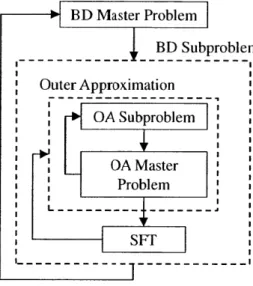
2-1 Flow chart of the proposed two-level algorithm. . . . . 40
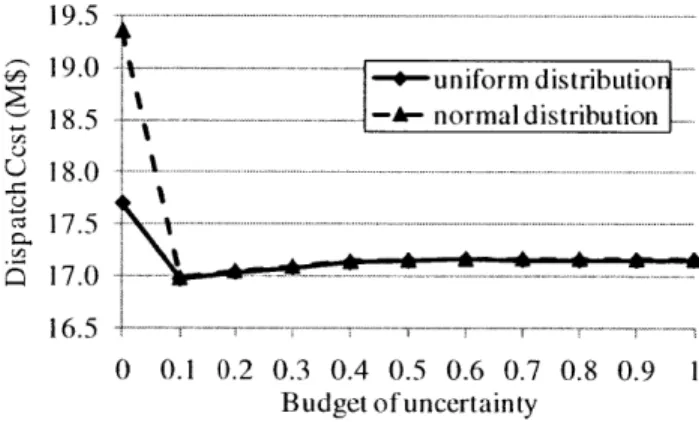
2-2 The average dispatch costs of the AdptRob approach for normally and uniformly distributed load... . . . . .. . 47
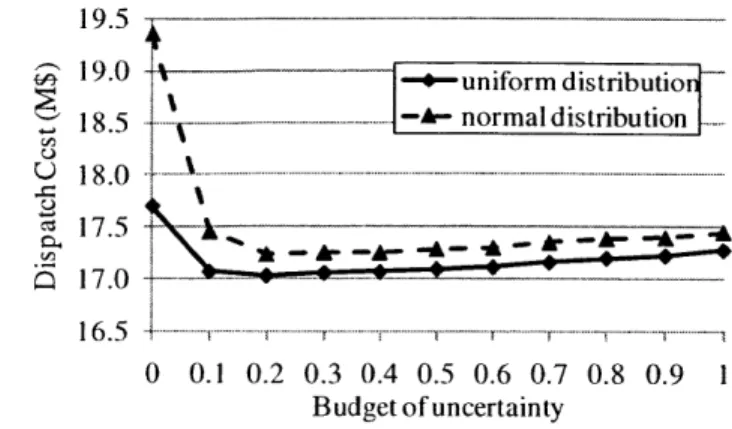
2-3 The average dispatch costs of the ResAdj approach for normally and uniformly distributed load... . .. . 48
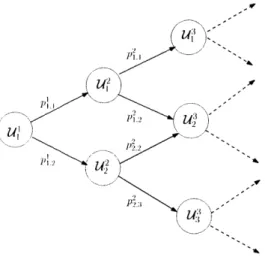
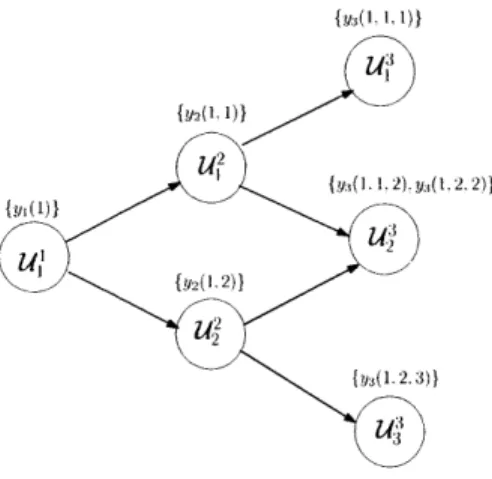
3-1 Illustration of the evolution of uncertainty in a multi-stage problem. . 59 3-2 A finitely adaptable solution for a 4-stage problem. For each uncer-tainty set, we specify the set of corresponding solutions in the finitely adaptable solution policy... . . . ... 66
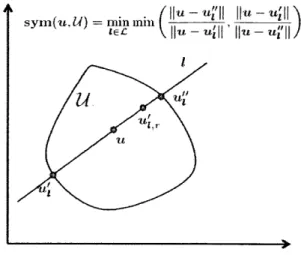
3-3 Geometric illustration of sym(u,U)... . . 68
3-4 The figure on the left is a symmetric polytope with symmetry 1. The middle figure illustrates a standard simplex in R" with symmetry 1/M. The right figure shows the intersection of a Euclidean ball with R, which has symmetry 1/ i... . 69
3-5 Geometry of the translation factor... .. . 70
3-6 A geometric perspective on the stochasticity gap... . . . ... 79
3-7 A geometric perspective on the adaptability gap... . . . 94
4-1 Efficiency-fairness tradeoff curve. Let
u
be the utility vector of a solu-tion and ii be its mean. Four inequity measures are defined as variance:E
(ui - u)2; sum of absolute deviations:E
1 E1ui
- ua1; reversed Jain's index: n~ii2 Gini index: 2n2ui . In each plot, from the highest efficiency are the solutions of the MaxSW-MP scheme, the lim-iting pricing scheme, and the tradeoff scheme with 3 0.3, 0.5, 0.7,0.9. 142List of Tables
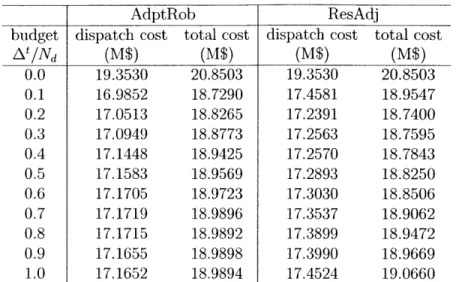
2.1 The average dispatch costs and total costs of the AdptRob and ResAdj
for normally distributed load for At/Nd = 0, 0.1, ... , 1... . ... 44
2.2 The average dispatch costs and total costs of the AdptR.ob and ResAdj for normally distributed load A'/v = - 0.5, 1 . . . , 3... . . . ... 45 2.3 Standard deviation of the dispatch costs of the two approaches and
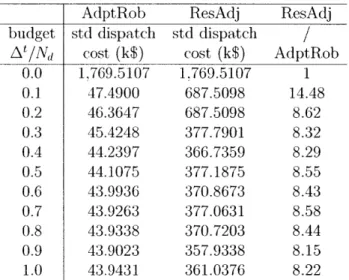
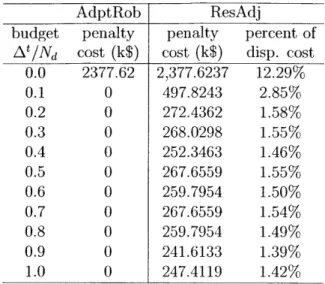
their ratio for normally distributed load. . . . . 45 2.4 Penalty costs of AdptRob and ResAdj approaches for normally
dis-tributed load. . . . . 46 2.5 Standard deviation of dispatch costs for uniformly distributed load and
the relative difference with those of the normally distributed load. . . 48
3.1 Symmetry and corresponding stochasticity gap for various uncertainty sets. Note that footnote (a) or (b) means the tight bound is from the symmetry bound (3.13) or the scaling bound (3.17)... . . ... 111
4.1 3-fairness tradeoff schemes for the simple example. For each 13, the first four utilities are the utilities of generators; the last one is the consumer utility (since both consumers have the same utility, only one is shown). 135
Chapter 1
Introduction
1.1
Reliable Operation of the Electric Power
Sys-tems Under Supply and Demand Uncertainty
Over the past decade, significant new development has taken place in the electricity industry around the world. One of the most important driving forces is the move to-ward alternative energy resources. Indeed, over the past decade, tremendous amount of effort and resources have been invested in developing renewable energy technologies and installing renewable energy generating plants. Many countries in the world have established alternative energy mandate. For instance, 24 states in the US have renew-able portfolio standards, and the European Union has a mandate of 20% electricity generated from renewable energy resources by the year 2020. To keel) the development of renewable energy sustainable and to realize its full potential, new challenges to the operations of electric power systems have to be solved. In particular, the following issue becomes critical:
* How to reliably operate the power system under high penetration of intermittent and uncertain renewable resources as well as uncertain demand.
To take full advantage of the renewable energy resources, the bulk power system needs to be operated in a reliable, resilient, and robust way. This need is particularly felt in the day-ahead power system scheduling problem, i.e., the so-called security
constrained unit commitment (SCUC) problem. The SCUC is a key daily operation of any large scale electric power systerm in both vertically integrated industry and deregulated electricity markets. It has been one of the most challenging problems in the power system operation, due to its large scale, discrete nature, and complex constraints. Since the unit commitment decisions have to be made a day before the real-time operation, the uncertainty in the generation and demand forecast is a significant factor that complicates the planning, especially with the fast growing renewable energy penetration and demand-side price sensitive response.
The current operational practice heavily relies on deterministic decision models and heuristic, inflexible reserve requirement [45, 85], which makes it difficult and economically inefficient to adjust to the emerging system of growing uncertainty in both supply and demand. Most of the existing proposals that explicitly deal with uncertainty use the stochastic optimization approach, which requires a probability distribution of the uncertainty, and often relies on sampling discrete scenarios of the uncertainty realizations [27, 82, 68, 87, 86]. This approach has practical limitations in the application to large scale power systenis. In particular, it may be difficult to identify an accurate probability distribution of the uncertainty. Also, stochastic UC solutions only provide probabilistic guarantees to the system reliability. It often requires large number of scenario samples to obtain a reasonable reliability guarantee, which results in intensive computation. The limitations of the current deterministic approach and the stochastic optimization model calls for a new methodology for unit commitment operations.
1.2
Fairness and Efficiency in Electric Market
De-sign
Another important driving force of the significant development in the electricity in-dustry is the creation of deregulated electricity markets. Since the 1990's, the elec-tricity industry has undergone deregulation and restructuring in several countries
such as UK, Spain, Chile, Brazil, among others, and several regions of the United States. Vertically integrated utility companies are restructured; electricity produc-tion and transmission are separated into different enterprises; Independent System Operators (ISOs) and Regional Transmission Organizations (RTOs) are established to manage the regional transmission grids and wholesale electricity markets. Today, ten ISOs and RTOs serve two-thirds of the electricity consumers in the United States and more than half of Canada's population. Although more than two decades have passed, some fundamental issues in electricity market design still remain in active debate, attracting considerable attention from both academia and industry [79].
The day-ahead (DA) market design is one of the most difficult among electricity market design problems. In the current reality of deregulated electricity markets, the Independent System Operators (ISOs) adopt the social welfare maximization principle in solving a unit commitment problem and a marginal cost pricing scheme to determine the electricity price as the incremental cost of producing one more unit of electricity. A long noticed shortcoming of this approach is the so-called uplift problen, i.e., the electricity payment determined by the electricity price cannot fully recover the production cost (especially the fixed cost) of some committed generators, and therefore the ISOs make side payments to such generators to make up the loss.
Recent proposals have focused on augmenting the current social welfare niaxi-mization auction and marginal cost pricing scheme by imposing prices for integer decisions [67, 88], or directly using the Lagrangian multipliers of the mixed integer unit commitment problem to form the electricity price [50, 44). One drawback of the first approach is that the introduced energy prices are sometimes hard to interpret and implement in practice, in a sense, they are similar to the uplift payment in na-ture. The second approach minimizes the total uplift payment, however, its definition of uplift is different from the one used in current practice, also it does not fully re-solve the problem - uplift payment can still be positive. Computationally, it requires solving a Lagrangian relaxation of the mixed-integer unit commitment problem, and potentially a primal version of the unit connitmnent as well.
clearing solution from multiple optimal or near-optimal solutions [53, 48]. We call this equitable selection problem. Although all solution candidates have the same level of system welfare, selecting one solution against others can have significant financial implications on individual generators and consumers. Current practice lacks clear-cut criteria in choosing from potentially numerous solution candidates. In fact, even computing all the solution candidates is a highly nontrivial task.
This thesis aims to provide new perspective and proposals to these issues. In our consideration, both problems are symptoms of a deeper unfairness issue: for the uplift problem, some generators that produce electricity make no profit, while other market participants, especially on the consumer side, collect considerable utility surpluses; for the second problem, choosing one solution from others can clearly cause fairness and inequity concerns among market participants. Thus, the following question seems to bear significant implication on the electricity market design problem:
How to design an auction and pricing scheme for the day-ahead market that achieves both economic efficiency and fairness.
1.3
Exciting Development in Operations Research:
Robust and Adaptive Optimization
As the electricity industry is witnessing exciting development, the operations research community has also been making significant progress, especially in the area of mul-tistage decision making under uncertainty. Mulmul-tistage optimization problems under uncertainty are prevalent in numerous scientific and engineering disciplines (includ-ing electric power systems) and have attracted researchers from diverse backgrounds. Several solution approaches have been proposed including exact and approximate dynamic programming, stochastic programming, and simulation-based methods. As early as 1970s, Soyster [80] and Falk [36] considered static linear programming prob-lems with uncertain matrix coefficients, right-hand side, and cost coefficients. The goal was to find a solution that is feasible for all realizations of uncertainty to
mini-mize the worst case cost. This new solution concept remained almost unnoticed until the late 1990's, when a series of papers by tal and Nemirovski [11, 12, 13], Ben-tal et. al. [1], El Ghaoui and Lebret [40], El Ghaoui et. al. [41], Bertsimas and Sim [21, 22], and Bertsimas et. al. [30] considerably extended the previous work in linear programs to much more general convex optimization problems. Robust Optimization has since become an active research field. Later, the framework is further extended by a sequence of papers by Ben-tal et. al. [10, 7, 8], in which the decision is allowed to be made after the uncertainty was revealed, thus introducing adaptable policies and Adaptive Optimization. It was shown that an arbitrary adaptable policy typi-cally results in intractable problems, and proposed a special class of affine decision rules. In the work by Bertsimas and Caramanis [16], a hierarchy of finitely adaptable policies with increasing adaptability was proposed.
As is shown, it is an exciting time to conduct interdisciplinary research on the boundary of electric power systems and operations research. Indeed, this thesis presents some advances in the above two important directions for power systems operation and electricity market design, using the recent development in Robust and Adaptive Optimization. In particular,. we develop a new methodology for the secu-rity constrained unit commitment operation that is both robust and adaptable to the uncertain supply and demand. We propose a new design for the day-ahead electricity market that explicitly considers both efficiency and fairness. We also present a con-tribution to the theory of multi-stage stochastic and adaptive optimization, where we found a tight geometric characterization of the power of finitely adaptable solutions for mutli-stage stochastic optimization problems.
1.4
The Structure and Contributions of the Thesis
The structure and the main contributions of the thesis are summarized below.
* In Chapter 2 of the thesis, we focus our attention on the security constrained unit commitment problem.
1. We formulate a two-stage adaptive robust optimization model for the se-curity constrained unit commitment (SCUC) problem with nodal net load uncertainty. It is a first such SCUC model using adaptive robust optimiza-tion and incorporating all types of constraints considered in the real world, such as network, contingency, reserve, ramp-rate, and all other physical, inter-temporal constraints. The first-stage commitment decision is robust and the second-stage dispatch solution is fully adaptive to all variations of uncertainty. This endorses the solution with both robustness and high adaptability. Special techniques are taken to further reduce the conser-vativeness of the solution by controlling the size of the uncertainty region and choosing proper budget of uncertainty levels using the probability law. 2. Due to the complexity and novelty of the adaptive robust model, efficient
algorithms are in great need. We develop a practical two-level solution algorithm. The algorithm combines a cutting plane type method with heurstic speed-up in the outer level with an efficient approximate algo-rithm in the inner level. This algoalgo-rithm can be viewed as a further gener-alization to the traditional Generalized Benders Decomposition framework, where in our case the objective function is given implicitly by a nontriv-ial bilinear optimization problem. Our algorithm can be useful to many other problems, where the two-stage adaptive robust optimization model is applicable, such as capacity expansion, resource planning, and airline management.
3. We conduct extensive numerical tests on the large scale power system op-erated by ISO New England with all detailed constraints used in reality (reserve, transmission, ramping rate, constraint violation penalty, etc). Based on the numerical results, we compare the performance of the adap-tive robust UC model to the current practice in three aspects, namely economic efficiency, real-time operation reliability, and robustness to prob-ability distributions of the uncertainty. The numerical test demonstrates the clear advantages of the adaptive robust models in all three aspects.
* Chapter 3 of the thesis is of a theoretical nature, but was originally motivated by the above adaptive robust SCUC model.
1. We discover a significant role that geometric quantities, such as the sym-metry of the uncertainty set, play in characterizing the performance of the finite adaptability solutions in multistage stochastic optimization and adaptive optimization. In particular, in both two-stage and multi-stage models, the optimal objective value of a finitely adaptive solution is upper bounded by (1
+
p/s) times the optimal value of a multistagestochas-tic optimization solution, where s is the symmetry of the uncertainty set and p E [0, 1] relates how far the set is removed from the origin. The significance of the result is that it shows the finitely adaptive solution is a good approximation of a multistage stochastic solution, e.g., when the uncertainty set is symmetric (s = 1, we have a 2-approximation). While multistage stochastic optimization is essentially intractable, finitely adapt-able optimization is computationally tractadapt-able.
2. The above geometric result opens the way to characterize performance for many structured uncertainty set. We investigate and give many examples, such as budgeted uncertainty set, symmetric sets, uncertainty set moti-vated by Central Limit Theorem, etc. This provides a useful guideline to the modelers in choosing and designing proper uncertainty sets.
3. We extend our results to general linear conic inequalities, thus include the important case of multistage optimization with positive semidefinite (SDP) constraints. We also extend our results to problems with integral decisions in the first-stage, which include capacity planning type problems.
* The above two parts correspond to the robustness and adaptability in the thesis title. Chapter 4 of the thesis deals with the design of an efficient and fair day-ahead (DA) electricity market.
full spectrum of fairness proposals. The case 3 = 0 corresponds to cur-rent practice of maximizing social welfare, whereas
#
= 1 corresponds to a solution that maximizes the minimum utility among market participants, the so-called max-min fairness. Under the max-min fairness scheme, every market participant is guaranteed a nonnegative surplus, so no side pay-ments are needed, and thus the uplift problem is naturally solved. We broadly investigate various properties, computational methods, and eco-nomic implications of the max-min fairness scheme.2. By varying
#,
we investigate the tradeoff between efficiency and fairness of the#-fairness
auction and pricing scheme. We formulate a family of mixed integer optimization models that explicitly parametrizes this tradeoff. The solutions for different parameter values are used to generate an efficiency-fairness curve. Such a frontier plot illustrates a flexible tradeoff between efficiency and fairness achieved by our proposal, and thus, it can be used to facilitate the ISO's decision-making in choosing an appropriate operating point of its market. A particular revealing observation from the efficiency-fairness curve is that the current operational practice (0 = 0) is not Pareto efficient, and significant improvement can be achieved by our proposed schemes.3. We demonstrate that there is a 1o E (0, 1), at which the social welfare is as high as current practice, while the fairness property is strictly better and the side payments are strictly lower than current practice. This shows that, in accordance with well formulated fairness principle, the -fairness tradeoff scheme with
/
= 30o automatically selects the most fair solution from potentially numerous maximum social welfare solution candidates. This provides a solution to the second issue of the current practice to achieving fairness and integrity in choosing from multiple optimal social welfare solutions.fur-ther propose a new pricing scheme called efficient fairness (EF) scheme, which decouples from the MaxSW auction and simultaneously achieves the maximum social welfare and max-min fairness. It also enjoys easier com-putation (only solves one simple linear program). We also formally show that among all pricing schemes, the EF pricing scheme is the most likely to eliminate uplift payment. When uplift is unavoidable under any pricing scheme, the EF scheme minimizes the largest uplift payment.
Chapter 2
Adaptive Robust Optimization for
Security Constrained Unit
Commitment Problems
2.1
Introduction
Unit commitment (UC) is one of the most critical decision processes performed by system operators in deregulated electricity markets as well as in vertically integrated utilities. The objective of the UC problem is to find a unit commitment schedule that minimizes the commitment and dispatch costs of meeting the forecasted system load, taking into account various physical, inter-temporal constraints for generating resources, transmission, and system reliability requirements.
During the normal real-time operation, system operator dispatches the committed generation resources to satisfy the actual demand and reliability requirements. In the event that the actual system condition significantly deviates from the expected con-dition, system operator needs to take corrective actions such as committing expensive fast-start generators, voltage reduction, or load shedding in emergency situation to maintain system security. The main causes of the unexpected events come from the uncertainties associated with the load forecast error, changes of system interchange
schedules, generator's failure to follow dispatch signals, and unexpected transmission and generation outages.
In recent years, higher penetration of variable generation resources (such as wind power, solar power, and distributed generators) and more price-responsive demand participation have posed new challenges to the unit commitment process, especially in the independent system operator (ISO) managed electricity markets. It becomes important for the ISOs to have an effective methodology that produces robust unit commitment decisions and ensures the system reliability in the presence of increasing real-time uncertainty.
Previous studies of uncertainty management in the UC problem can be divided into two groups. The first group commits and dispatches generating resources to meet a deterministic forecasted load, and handles uncertainty by imposing conservative re-serve requirements. The second group relies on stochastic optimization techniques. The first group, so-called the reserve adjustment method, is widely used in today's power industry. Much of research along this vein, including [2, 24, 23, 43), has fo-cused on analyzing the levels of reserve requirements based on deterministic criteria, such as a loss of the largest generator or system import change. Such an approach is easy to implement in practice. However, committing extra generation resources as reserves could be an economically inefficient way to handle uncertainty, especially when the reserve requirement is determined largely by some ad-hoc rules, rather than a systematic analysis. Also, since the UC decision only considers the expected oper-ating condition, even with enough reserve available, the power system may still suffer capacity inadequacy when the real-time condition, such as load, deviates significantly from the expected value.
The stochastic optimization approach explicitly incorporates a probability distri-bution of the uncertainty, and often relies on presampling discrete scenarios of the uncertainty realizations [27, 82, 68, 87, 86]. This approach has some practical limi-tations in the application to large scale power systems. First, it may be difficult to identify an accurate probability distribution of the uncertainty. Second, stochastic UC solutions only provide probabilistic guarantees to the system reliability. To obtain
a reasonably high guarantee requires large number of scenario samples, which results in a problem that is computationally intensive. To improve the robustness of stochas-tic UC solutions, Ruiz et al.
[74
proposed a hybrid approach combining the reserve requirement and stochastic optimization methods. A recent work[35]
proposed an interesting framework that combines uncertainty quantification with stochastic op-timization. This framework could also be integrated with the robust optimization formulation proposed in this chapter.Robust optimization has recently gained substantial popularity as a modeling framework for optimization under parameter uncertainty, led by the work [11, 12, 13, 1, 40, 41, 21, 22, 30]. The approach is attractive in several aspects. First, it only requires moderate information of the underlying uncertainty, such as the mean and the range of the uncertain data; and the framework is flexible enough that the modeler can always incorporate more probabilistic information such as covariance to the uncertainty model, when such information is available. Second, the robust model constructs an optimal solution that immunizes against all realizations of the uncertain data within a deterministic uncertainty set. Such a robustness is a desirable feature, especially when the penalty associated with infeasible solutions is very high, as the case in the power system operations. Hence, the concept of robust optimization is consistent with the risk-averse fashion in which the power systems are operated. There has been a broad variety of applications of robust optimization in engineering and management sciences (such as structural design, integrated circuit design, statistics, inventory management, to name a few. See [9] and references therein).
In this chapter, we propose a two-stage adaptive robust optimization model for the security constrained unit commitment (SCUC) problem, where the first-stage UC decision and the second-stage dispatch decision are robust against all uncertain nodal net load realizations. Furthermore, the second-stage dispatch solution has full adaptability to the uncertainty. The critical constrains such as network constraints, ramp rate constraints and transmission security constraints are incorporated into the proposed model as well. It is key to design a proper uncertainty set to control the conservatism of the robust solution. We use a special technique proposed in
[21, 22] for this purpose. We develop a practical solution method, and extensively test the method on a real-world power system. Papers [70, 89] proposed similar robust optimization UC models. However, their proposals ignored reserve constraints and did not study critical issues such as the impact of robust solutions on system efficiency, operational stability, and robustness of the UC solutions against different probability distributions of uncertainty, neither did they compare the robust UC model with the current practice in a real world power system. Our research was conducted and written independently of the works in [70, 89]. The main contributions of our work are summarized below.
1. We formulate a two-stage adaptive robust optimization model for the SCUC problem. Given a pre-specified nodal net load uncertainty set, the two-stage adaptive robust UC model obtains an "immunized against uncertainty" first-stage commitment decision and a second-first-stage adaptive dispatch actions by minimizing the sum of the unit commitment cost and the dispatch cost under the worst-case realization of uncertain nodal net load. The nodal net load uncer-tainty set models variable resources such as non-dispatchable wind generation, real-time demand variation, and interchange uncertainty. The parameters in the uncertainty set provide control over the conservatism of the robust solution. 2. We develop a practical solution methodology to solve the adaptive robust model. In particular, we design a two-level decomposition approach. A Benders decom-position type algorithm is employed to decompose the overall problem into a master problem involving the first-stage commitment decisions at the outer level and a bilinear subproblem associated with the second-stage dispatch ac-tions at the inner level, which is solved by the outer approximation approach [32, 37]. The proposed solution method applies to general polyhedral uncer-tainty sets. We present a computational study that shows the efficiency of the method. Besides the unit commitment studied in this chapter, the proposed mixed-integer adaptive robust model is applicable to many two-stage decision making problems, such as robust inventory management problems, robust
loca-tion transportaloca-tion problems, etc. The efficient soluloca-tion methodology developed here, therefore, may be of interest to a much wider community.
3. We conduct extensive numerical experiments on the real-world large scale power system operated by the ISO New England. We study the performance of the adaptive robust model and provide detailed comparison with the current prac-tice, the reserve adjustment approach. Specifically, we analyze the merit of the adaptive robust model from three aspects: economic efficiency, contribution to real-time operation reliability, and robustness to probability distributions of the uncertainty. The extensive computational results show that the adaptive robust UC model outperforms the current practice in all three aspects. This clearly demonstrates the advantages of the adaptive robust UC model.
This chapter is organized as follows. Section 2.2 describes the deterministic SCUC formulation. Section 2.3 introduces the two-stage adaptive robust SCUC formulation. Section 2.4 discusses the solution methodology. Section 2.5 presents computational results, including a discussion on the proper way to choose the level of conservatism in the robust model. Section 2.6 concludes with discussion.
2.2
The Deterministic SCUC Problem
For the unit commitment decision making, the system operator usually has access to a wide range of detailed data listed below, including economic data of generator's production costs or supply curve in a market setting, physical characteristics of each generator, expected load forecast, system reserve requirement, network parameters and transmission line ratings.
" N,, Nd, Nb. NI. T: The number of generators, loads, nodes, transmission lines,
and time periods (in hours).
.
Nl?
9, , !N A,. T: The corresponding sets of generators, loads, nodes, transmis-sion lines, and time periods (in hours)." C(-): Variable cost of generator i at time t as a function of production levels.
max min
" pa I pn Maximum and minimum production levels of generator i (usually
called Ecomax and Ecomin, respectively).
" RUj, RD': Ramp-up, ramp-down rates of generator i at time t.
" MinUpi, MinDowni: Minimum-up and minimum-down times of generator i.
" f"ax: Flow limit on transmission line 1 in base case.
e f,"nax: Flow limit on transmission line 1 in contingency i (i.e. line i is dropped).
" BP, Bd: Network incidence matrices for generators and load.
* a,: Network shift factor vector for line 1 for the base case. " a11: Network shift factor vector for line I in contingency i.
" d': Expected demand at node
j,
time t."
Nr:
The set of system reserve requirementsMr
={TMSR,
T10, T30}." A: The set of reserve products A = {TMSR, TMNSR, TMOR}.
" Ak: The set of reserve products needed to satisfy reserve requirement k E V,:
ATmIs =- {TMSR}, AT1o = {TMSR,TMNSR}, AT30 = {TMSR,TMNSR,TMOR}. i : Reserve capacity of generator i, requirement k E AN, time t.
t
qik: System reserve requirement of k E
N,,
timet.
The system operator in the current practice commits extra generation resource, called reserve, in the day-ahead scheduling. The reserve capacity will be available to the sys-tem operator in the real-time operation to prepare for unexpected loss of generators or other system disruptions. According to how fast the reserve capacity can respond to the emergency, there are three important types of reserves: ten-minute spinning reserve (TMSR), ten-minute nonspinning reserve (TMNSR), and thirty-minute op-erating reserve (TMOR). Other types of reserves exist, such as regulation service
(automatic generation control) which responds to frequency changes in the system second by second, and supplement reserve.
The decision variables of the unit commitment problem are:
* xi C
{0,
1}: If generator i is on at time t, xt = 1; otherwise x' = 0.t
u
E{0,
1}: Ifgenerator
i is turned on at time t, n = 1; otherwiseu
= 0.* vo C
{0,
1}: If generator i is turned down at time t, v = 1; otherwise = 0.* pi [0, oo): Production of generator i at time t.
* q a C [0, oo): Reserve of generator i, type a E A, time t.
A standard deterministic UC model is formulated below [45, 85].
T Ng
min
x
q Yuv x Fit + ut S + vtG' + C (p|) x -x +'U > 0, xx+ vu,
2
0,
x1 xt - xT, VT C [t + 1, min{t + MinUpi - 1, T}], t E [2, T], x3 - x <1- X. VT E [t + 1. min{t + MinDwi - 1, T}j t E [2, T], Ng Nd p= 1 ,' =1 j=1 Vt E T,- RD < pt pt RU|, ViE A,,t E T, - f"[ < a'(Bpt - B(d') < j.ax Vt E Tl E A, (2.1) (2.2) (2.3) (2.4) (2.5) (2.6) (2.7) (2.8)
fPi
< a'(Bppt - Bad') < ftj.." Vt E T, E CT,i C N,pnu " p + q+ , <Pax Vi E Ng, t E T, qqk a tC ke,. aE A
q 2
W,
Vt E, kE.N,
N~g
a c-Akq
i
a(E Ak V E g, t E T. k c r. (2.9) (2.10) (2.11) (2.12)V1 (E
No,,t 1, T,
Vi E Nr, t (E T,Eq. (2.2) and (2.3) are logic constraints between on and off status and the turn-on and turn-off actiturn-ons. In particular, a generator i is turned turn-on at time t ut = 1 if and only if x 1 = 0, Xz = 1. Similarly, a generator i is turned off at time t if and only if X'-1 = 1,
IX
= 0. Eq. (2.4) and (2.5) are constraints of minimum up and minimum down times for each generator, i.e. if a generator is turned on at time t, then it must remain on at least for the next (MinUpi - 1) periods, and similar for the shutdown constraint. There are multiple ways to model these constraints. The specific form that we use here follow the formulation proposed in [83]. The convex hull of the binary variable x defined by Eq. (2.4)-(2.5) is explicitly characterized in [58]. Furthermore, the convex hull of the binary variables (x, u) defined by Eq. (2.2)-(2.3) and Eq. (2.4)-(2.5) is characterized in [71]. In the software implementation of our robust unit commitment model, we use the strong formulation proposed in [71].Eq. (2.6) is the energy balance equation that matches the system level supply and load at each time period. Eq. (2.7) is the ramp rate constraint, i.e. the speed at which a generator can increase or decrease its production level is bounded in a range. Notice that the ramping constraint is a complicating constraint that couples many consecutive time periods.
Eq. (2.8) is the transmission flow constraint for the base case, where all trans-mission lines are functioning. Eq. (2.9) is the transtrans-mission line constraint for the i-th contingency where transmission line i is tripped. In this situation. the network topology is changed, so are the shift factor asi and flow limits
fj'a.
Eq. (2.8) and (2.9) are the DC approximation of the nonlinear AC power flow equations. In Ap-pendix, we review the physical laws that govern the power flows and give a derivation of the DC approximation from the the AC model. Incorporating the nonlinear AC flow equations into the unit commitment problem would result in a nonlinear mixed-integer optimization problem, which is significantly more difficult to solve than a linear imixed-integer problem. In the literature, it has been standard to use the DC model in the unit commitment problem. It remains a challenging problem to incorpo-rate AC power flow model into the economic dispatch problem where the commitment variables are fixed.Eq. (2.10) is the constraint that the sum of the production output and the reserve should be within the upper and lower bounds for each generator. Eq. (2.11) describes the requirement on how much reserve the system should have reserve category k E Ar
at time t. Eq. (2.12) says generator i can provide at most qi,k,t for reserve requirement k at time t. Since reserve also takes up the generation capacity,
The variable production cost, or the supply curve in a market setting, C(pi) is an increasing convex piece-wise linear function of the production output pt. In the ISO-NE's day-ahead energy market, each generator is allowed to submit a supply curve of up to 20 pieces.
To simplify the notation, we present a compact matrix formulation for the rest of the chapter. min cTx + bT y Xly s.t. Fx
f,
(2.13) Hy < h, (2.14) Ax + By < g, (2.15) Iy = d, (2.16) x binary.The binary variable x is a vector of commitment related decision including the on/off
and start-up/shut-down status of each generation unit for each time interval of the commitment period, usually 24 hours in an ISO setting. The continuous variable y is a vector of dispatch related decision including the generation output, load consumption levels, resource reserve levels, and power flows in the transmission network for each time interval.
The objective function is to mininmize the sum of commitment cost cTx (including start-up, no-load, and shut-down costs) and dispatch cost bTy over the planning hori-zon. Constraint (2.13), involving only commitment variables, contains minimum up and down, and start-up/shut-down constraints. Constraint (2.14) includes dispatch
related constraints such as energy balance (equality can always be written as two opposite inequalities), reserve requirement, reserve capacity, transmission limit, and ramping constraints. Constraint (2.15) couples the commitment and dispatch deci-sions, including minimum and maximum generation capacity constraints. Constraint (2.16) emphasizes the fact that the uncertain nodal net loads are fixed at expected values in the deterministic model
(J,
selects the components from y that correspond to uncertain resources).2.3
The Two-stage Fully Adaptive Robust SCUC
Formulation
In this section, we first discuss the uncertainty set, which is a key building block of the robust model. Then, we introduce the two-stage adaptive robust SCUC formulation and provide a detailed explanation.
2.3.1
The Uncertainty Set of Net Load
The first step to build a robust model is to construct an uncertainty set. Unlike the stochastic optimization approach, the uncertainty model in a robust optimization formulation is not a probability distribution, but rather a deterministic set. In our model, the uncertain parameter is the nodal net load. We consider the following uncertainty set of nodal net load at each time period
t
in the planning horizon T,Dt(d',
d
t,
A)
{dtE R
S;dN,
(2.17)
it
{dt d d + ] V 11 E A rd}
where dt = (di, i E
.Md)
is the vector of uncertain net loads at time , dt is the deviation of the uncertain load from the nominal value Pi, and the interval[J
-dt,
| + dJ]
is the range of the uncertain d', and the inequality in (2.17) controls the total deviation of all load from their nominal values at time t. The parameter At is the "budgetof uncertainty", taking values between 0 and Nd. When At = 0, the uncertainty set is a singleton, i.e. D' =
{d},
corresponding to the deterministic case. As At increases, the size of the uncertainty set Dt enlarges, which implies that larger total deviation from the expected net load is considered. Therefore, the resulting robust UC solutions are more conservative and the system is protected against a higher degree of uncertainty. In particular, when A = Nd, D' equals to the entire hypercube defined by the intervals for each d' for i ENd.
More compactly, the uncertainty set can be written as the intersection of a 11 ball and a l ball.
DA(dt,
A)
={d
t E RNd:b
-'(d' -d)1
AA l
t t t}
where D = diag(di, ... d)
2.3.2
The Adaptive Robust SCUC Formulation
The two-stage adaptive robust SCUC problem is formulated as follows,
min C Tx + max bTy (d) (2.18)
XY(.)dED)
s.t. Fx <
f,
x is binary, Hy(d) < h(d). Vd C D, Ax + By(d) < g, Vd E D,J,, y (d) -, d, Vd E D.
where d = (dt, t C T) and D = RT D. The objective function has two parts, reflecting the two-stage nature of the decision. The first part is the commitment cost. The second part is the worst case second-stage dispatch cost.
In the adaptive robust model, the commitment decision x takes into account all possible realization of future net load in the uncertainty set. Such a UC solution remains feasible, thus robust, for any realization of the uncertain net load. In
com-parison, the traditional UC solution only guarantees feasibility for a single nominal net load, whereas the stochastic optimization UC solution only considers a finite set of preselected scenarios of the uncertain net load. Furthermore, in our formulation the optimal second-stage decision y(d) is a function of the uncertain net load d, therefore,
fully adaptive to any realization of the uncertainty. The functional form of y(.) is
de-termined implicitly by the optimization problem, rather than being presumed. This full adaptability models the economic dispatch procedure in the real-time operation. The above formulation can be recast in the following equivalent form, which is easier to see the structure of the two-stage robust model.
min (cTx +max min bTy (2.19)
dED yEQ(x,d)
s.t. Fx <
f,
x binary,where Q(x, d) {y : Hy < h, Ax+ By < g, Iuy = d} is the set of feasible dispatch solutions for a fixed commitment decision x and nodal net load realization d. The first stage decision is the unit commitment decision x. For a fixed commitment decision, the second stage implicitly finds the economic dispatch solution for each realization of the load, and identifies the worst case load that results in the maximum dispatch cost.
It is useful to write out the dual of the dispatch problem minyeQ(xd) bTy. Denote its cost by S(x, d).
S(x, d) = max AT (Ax - g) - OTh + lT d (2.20)
- AT B - PTH + I = bT, p 0, A > 0, 7 free
where p, A and q are the multipliers of the constraints (2.14), (2.15) and (2.16),
respectively.
optimization problem given below
R(x) = max AT(Ax - g) - pTh + T d (2.21)
d,cp.A,r
- ATB - OTH + ITI, = bT,
d E- E)
p > 0, A > 0, q free.
The uncertainty set D is assumed to be polyhedral. Computing R(x) is non-trivial. To see this, notice that the objective function of (2.21) contains a non-concave bilinear term rTd, and bilinear programs are in general NP-hard to solve. Also notice that the objective function optimized over (p, A,
y)
results in a convex piece-wise linear function in d (the pieces are not given explicitly), and maximization over such a convex function is NP-hard. Throughout this chapter, we assume R(x) <+00
for all feasible x. This can be ensured by adding penalty terms in the dispatch constraints. We omit the penalty terms here for a clearer presentation.2.4
Solution Method to Solve the Adaptive
Ro-bust Model
As analyzed in the previous section, the adaptive robust formulation (2.19) is a two-stage problem. The first-two-stage is to find an optimal commitment decision x. The second-stage is to find the worst-case dispatch cost under a fixed commitment solution. Therefore, we naturally have a two-level algorithm. The outer level employs a Benders decomposition (BD) type cutting plane algorithm to obtain x using the information (i.e. cuts) generated from the inner level, which solves the bilinear optimization problem (2.21).
2.4.1
The Outer Level: Benders Decomposition Algorithm
Initialization: Let x0 be a feasible first-stage solution. Solve R(xo) defined by
(2.21) to get an initial solution (di,
pi,
A1, r1). Set the outer level lower boundLBD = -oo, upper bound UD = +oo and the number of iteration k = 1. Choose an outer level convergence tolerance level
E(>
0).Iteration k > 1:
Step 1: Solve BD master problem.
The master problem of BD is the following mixed integer program (MIP):
min cT X+0 a(2.22)
s.t. Of > AT(Ax - g) - pfh + TIdi, Vl < k, Fx < f,x binary.
Let (Xk, ak) be the optimum. Set LBD - CTXk +
ak-Step 2: Solve BD subproblem R(Xk).
We will discuss the methodology to solve R(xk) in the next subsection. Let
(dk+l, Wk+l, Ak+1l I1k+1) be the optimal solution. Set UBD _ CTXk + R(xk)-Step 3: Check the outer level convergence.
If UBD - L BD < E, stop and return Xk- Otherwise, let k = k + 1, and go to step 1.
To speed up the convergence of the above BD algorithm, we find it helpful to add dispatch constraints Q(Xk, dk) to the BD master problem (2.22) at certain iteration k when UBD or LBD has improved slowly.
2.4.2
The Inner Level: Solve R(x)
An outer approximation (OA) algorithm [32, 37] is used to solve the bilinear program (2.21). Since the problem (2.21) is nonconcave, only a local optimum is guaranteed by the OA algorithm. To verify the quality of the solution, we test on different initial
conditions and observe fast convergence and consistent results. The OA algorithm is described below.
Initialization: Fix the unit conmitment decision zk passed from the kth iteration of the outer level BD algorithm. Find an initial net load di E D. Set the inner level lower bound L^ = -oc, upper bound UA = +oc and number of iteration
j
= 1.Choose an inner level convergence tolerance level 6(> 0). Iteration
j
> 1:Step 1: Solve OA subproblem S(xk, dj).
Solve S(xk, dj), the dual of the dispatch problem defined by (2.20). Let (pW, Aj, 77)
be the optimal solution. Set LOA = S(xk, dj). Define Lj(dj, ?)), the lineariza-tion of the bilinear term q'd with respect to (dj, vi), as follows
Lj(dj,
mj)
= n'dj + (y - rjj )'d + (d - d j)inr.Step 2: Solve OA master problem.
Solve the linearized version of R(xk), defined below:
U (djr) = 'max AT(Ax - g) - pTh+#
< Li(di, rij), Vi 1.j
- ATB - 'pTH + -I = bT,
d E D,
'p > 0, A > 0, ri free.
Since the uncertainty set D is assumed to be polyhedral, U(dj, rm) is a linear program. Denote (dj±1,
P
, 17Agi ,#j±1)
as the optimal solution. Set theinner level upper bound as UQA = U(dj, rj).
Step 3: Check the inner level convergence. If UOA - LOA < 6, then stop and output the current solution. Otherwise, set