Designing New Electrode Materials for Energy Devices by
Integrating
Ab Initio Computations with Experiments
Kisuk Kang
B
.
S
.
Materials Science and Engineering
Seoul National University, 200
1
Submitted to the Department of Materials Science and Engineering
in partial fulfillment of the requirements for the degree of
Doctor of Philosophy
in Materials Science
and
Engineering
at the
MASSACHUSETTS INSTITUTE OF TECHNOLOGY
June 2006
O
Massachusetts Institute of Technology, 2006. All rights resewed.
OF TECHNOLOGY
72 I
I
... ... ...
...
Signature of author:
...;
.<.
r..I...~~..~...~.
Depa
f Materials Science and Engineering
ARCHIVES
April, 28,2006
I
Certified by:.
...
:.
...
.- ...
7 --
. m . m . . m m m . m . . m ~ ~ . ~ ~ ~ m ~ ~ m m ~ i m ~Gerbrand Ceder
R
P. Simmons Professor of Materials Science and Engineering
/ 3
nThesis Supervisor
Aecepted by:.
...
ru
.,.
....
.
,
... ;...
t -
-Samuel
M. Allen
POSCO Professor of Physical Metallurgy
Chair, Department Committee on Graduate Students
Designing Novel Electrode Materials for Energy Devices by Direct Integration of Ab
Initio Computations with Experiments
Kisuk Kang
Submitted to the Department of Materials Science and Engineering in partial fulfillment of the requirements for the degree of
Doctor of Philosophy
in Emerging, Fundamental, and Computational Materials Science
Abstract
Utilization of Ni2+/Ni4+ double redox couple in electrochemical reactions has been tested as a way to gauge u s e l l properties such as high capacity in electrode materials. The feasibility of a Ni2+/Ni"+ active redox couple is confirmed in a new layered electmde material, L&.9Ni0.45T&.5502. First principles calculations combined with experiments show that the degree of cation disordering in the material arising fiom both synthesis conditions and the electrochemical reaction is critical in performance of this material as the electrode. In an attempt to l l l y utilize Ni2+/Ni4+ double redox couple, Li2Ni02 in the Immm structure was successfully synthesized and its electrochemical behavior upon delithiation was evaluated. The material shows a high specific charge capacity of about 320 r n M g and discharge capacity of about 240 mAh/g at the first cycle. The stability of Li2NiOz in the Immm structure is attributed to the more favorable Li m g e m e n t possible as compared to a Li2Ni02 structure with octahedral Ni. The electrochemical data, first principles calculation and EXAFS analysis all indicate that the orthorhombic Immm structure is rather prone to phase transformation to a close-packed layered structure during the electrochemical cycling. The possibility of stabilizing the orthorhombic Immm structure during the electrochemical cycling by partial substitution of Ni is also evaluated. First principles computations of some chemically substituted materials identified Pt substitution as a way of stabilizing the Li2(Ni,M)02 composition in the Irnmm structure but found no elements that would likely stabilize the material upon Li removal.
The second part of the thesis is focused on designing high rate capable electrode materials. We systematically investigated several of the factors that influence the migration barrier for Li motion in layered oxides with the 0 3 structure using fir& principles methods, and found that the two dominant effects are the Li slab spacing which determines the compressive stress on Li when it is in the tetrahedral site, and the electrostatic repulsion Li experiences there from the transition metal ion. The other factors investigated (non-transition metal doping, Li-metal site exchange) can be reduced to the effect they have on the electrostatic and Li-slab factor. We have used these first principles results as key strategies for increasing the rate capability of layered cathode materials and applied them to L i ( N i o . 5 ~ . s ) 0 2 , a safe, inexpensive
, , . .
.
. material that has been thought to have poor intrinsic rate capability. Structural modification of. J L '
Li(Nio.S&.5)02 according to first prknciples'guideline leads this novel material to retain its capacity at high rates in agreement with the theoretical predictions. The rate capability tests show that even at a 6C d i s c k g e rate (1C= 280mAtg) it can deliver over 1 8 O W g . The best electrochemical data published for this material shows that it can deliver about 130mAWg at a 2C rate, and there is no data available for a rate as high as 6C. The electron microscopy shows that the particle size of this material is about two times bigger than- the conventional Li(&.sMn,,s)02. This implies that with proper engineering optimization in processing (i.e. synthesis temperature, time etc.) this material can show even better rate capability.
~ h k s i s Supervisor: Gerbrand Ceder
Title: R. P. Simmons Professor of Materials Science and Engineering
Acknowledgements
I would foremost like to thank my advisor, Prof. Gerbrand Ceder, whose support and passion have made the completion of this work possible. Prof. Ceder, through his leadership and modesty, has motivated and encouraged me through my thesis work. I am truly grateful for his generosity in sharing his knowledge and insights with me.
I am also grateful to CEDER group people, Dr. Anton Van der Ven, Dr. Matteo Cococcinoni, Dr. Dany Carlier, Dr. Eric Wu, Dr. Elena Arroyo, Dr. Kristin Persson, Dr. Shirley Meng, Dr. John Reed, Dr. Chris Marianetti, Dr. Stefano Curtarolo, Dr. Thomas Maxisch, Dr. Caetano Miranda, Ashley Predith, Byungchan Han, Chris Fischer, Fei Zhou, Tim Mueller, Byoungwoo Kang, Kevin Tibbetts, Maria Chan, Hinurna Yoyo, Lei Wang, Osman Burak Okan and Xiaohua Ma for their sharing their knowledge and making my stay in MIT very fruitful and enjoyable. I am especially thankful to Dr. Dane Morgan, whose advice always cheered me up whenever I struggled. I will never forget it.
I am thankful to people who visited our lab, shared their expertise and inspired me- Prof. Bing Joe Hwang, Prof. Masanobu Nakayama, Dr. Chil-Hoon Doh, Tanghong Yi and Wang Cui Yang.
I would like to thank our collaborators, Prof. Clare Grey, Prof. Yang Shao-Horn, Prof. Donald Sadoway, Prof. Nicola Marzari, Prof. Claude Delmas, Dr. Laurence Croguennec, Julien Breger.
I cannot thank enough to my parents, my sisters and brothers. Their endless support and great love made me strong and confident.
Most of all, I thank my wife, Jiyoung Park, whose deepest understanding, patience, motivation and love made this possible.
Contents
...
List of Figures and Tables 8
1
.
Motivation & Outline...
182
.
Electrochemical Li Cells, Li Intercalation compound...
232.1 Electrochemical Li cells
...
242.2 Li Intercalation compound ... -28
3 . First Principles Calculations
...
333.1 First Principles Calculations; Introduction to DFT (Density Functional Theory) .... 33
3.2 Application of first principles calculations to batteries ... 37
3.2.1 Li intercalation Voltage ... 37
... 3.2.2 Structural Stability 39 3.2.3 Li diffusivity
...
-404 . Design high capacity electrode ... 44
2+ 4+ 4.1 Advantage of Ni Ni redox couple ... 46
4.2 Lio.~(Nio.45Tio.55)0z ... -48
4.2.1 Motivation ... 49
...
4.2.2.1 Preparation of material 50
...
4.2.2.1.1 Nao.9(Nio.45Tio.55)02 - Synthesis and Structure 50...
4.2.2.1.2 Ion-exchange 52...
4.2.2.2 Structure 53 ... 4.2.2.3 Electrochemical properties -57 ...4.2.3 First Principles observations 61
...
4.2.3.1 Oxidation state and Voltage 61
...
4.2.3.2 Electronic structure 63 ... 4.2.3.3 Ti migration -65...
4.2.3.4 Li mobility 66...
4.2.4 Conclusion -67 ... 4.3 Li2Ni02 -68 4.3.1 Motivation...
68...
4.3.2 Experimental observations 70...
4.3.2.1 Preparation of material 70 ... 4.3.2.2 Structure 71...
4.3.2.3 Electrochemical properties 724.3.2.4 XAS and EXAFS
...
74 ...4.3.3 First Principles observations -79
...
4.3.3.1 Phase Stability and Voltage 79
...
4.3.3.2 Doping -88 ... 4.3.3.3 Li mobility -90 ... 4.3.4 Conclusion -95Part
111.
High Power electrode
...
...
5 . Design high rate capable electrode 97
5.1 Theoretical study of Factors affecting Li mobility in Layered lithium transition metal
oxides ... -98
5.1.1 Background ... -99
5.1.2 Lattice parameter
...
1005.1.2.1 c-lattice parameter (Li slab space) ... 101
5.1.2.2 a (or b)-lattice parameter ... 104
5.1.3 Doping of non-transition metal
...
1065.1.4 Effect of transition metal species ... 111
... 5.1.5 Cation mixing (Liltransition metal site exchange) 114 5.1.6 Anion Effect ... 115
5.1.7 Discussion and Summary ... 118
5.2 Application of theory to Li(Nio.5Mno.5)02 ... -120
5.2.1 Strategy on Li(Nio.5Mno.5)02 ... 120
5.2.2 Preparation of material ... 123
... 5.2.2.1 Na(Nio.5Mno.5)02-Synthesis and Structure 123 5.2.2.2 Ion exchange mechanism
...
1265.2.3 Structure
...
1315.2.4 Electrochemical Properties
...
1365.2.4.1 Comparison of chargeldischarge behavior with conventional Li(Ni0.5Mno.5)02. ... 137
5.2.4.2 Rate Capability
...
-139 ...... 5.2.4.4 Safety -145
...
5.2.5 Conclusion -146...
. 6 Conclusions 148 ... References 1 52List of Figures and Tables
...
Figure 1-1 (a) various portable devices. (b) Prius. HEV by Toyota 18
Figure 1-2 Ragone plot of Li battery using various electrodes . Burden of the cell. module. and
battery externals are not included ... 21
Figure 2-1 Schematic description of Li secondary battery ... 25
Figure 2-2 (a). (b). (c) . Examples of 1. 2 and 3 dimensional Li hosts. respectively ... 29
Figure 2-3 0 3 type oxygen stacking sequences in LiCoOz
...
30Figure 2-4 Charge and discharge curves of a Li/LiNil12Mnl. z 0 2 cell operated in voltages of 2.5- -2 4.5 V at a rate of 0.17 rnA cm for 30 cycles
...
32Figure 4-1 The schematic pictures of cell at open circuit (on the left) and energy vs . density of states for LixTiS2 and Lil-yCo02 (on the right) ... 45
Table 4-1 Equilibrium potential (vs . Lithium metal) of each transition metal redox couple at olivine or layered structures ... 46
Figure 4-2.Schematic picture of the electronic configuration of Ni at different valence states in the octahedral coordination ... 48
Figure 4-3 XRD pattern and Rietveld refinement of N~.9Nio.4sTio.ss02 (a and c are the lattice parameters and z the atomic position of oxygen along the c axis.)
...
52Figure 4-4 Full pattern matching of Lio.gNio .45Ti o.ss02
...
54Figure 4-5 Lattice parameter comparison with literature values (rocksalt structure . shaded area)
...
at different Ti composition.
The square dot indicates the observed value of our material 55Figure 4-6 XRD of Li0.9Ni0.45Ti0.5502 obtained from different synthesis conditions
...
56Figure 4-7 (a) Li0.9Ni0.45Ti0.5502 synthesized in boiling hexanol for 12 hours (b) after heating in
...
oven at 160°C for 2 days 57
Figure 4-8 Galvanostatic cycling of Li0.9Ni0.45Ti0.5J02 samples
...
59Figure 4-9 Galvanostatic cycling of Li0.9Ni0.45Ti0.5502 sample (boiling hexanol, 12 hours) at
different C rate
...
60Figure 4-10 The integrated spin as a function of integration radius
(A)
around Ni and Ti in (a)LiNi0.5Tio.502 and (b) Lio.5Nio.sTio.502
...
62Figure 4-1 1 The spin density of state of the 3d orbitals of Ni and Ti in LiNi0.5Ti0.502 (above) and
. .
Li0.5Nio.5Ti0.502 (below)
...
-64Figure 4-12 The activation barrier of Li motion as a fimction of Li slab space for various
transition metal layered oxides
.
Refer section 5.1.4 for detailed description...
67 10Figure 4-13 Crystal structure of (a) IT-Li2Ni02 (Ni occupies the center of the octahedron (dark shaded) and Li occupies the center of a tetrahedron (light shaded)); (b) I-LizNiOz (Ni occupies the center of the rectangle (dark shaded) and Li occupies the center of a tetrahedron (light shaded) .) ... -69
Figure 4-14 XRD pattern and hetveld refinement of Li2Ni02 (a, b and c are the lattice
parameters and z the atomic position of oxygen or Li along the c axis.) ... 72
Figure 4-15 Chargeldischarge curves for Li2Ni02 cycled in the voltage range 1.5-4.6V at the
...
current density of 12.5mAig ..73
Figure 4-16 XRD pattern of Li2Ni02 before and after the cycling ... 74
Figure 4-17 (a) k3-weighted EXAFS spectra and (b) FT magnitudes of k3-weighted at Ni K-edge
... as a function x in Liz-,NiOz taken by Prof. Bing Joe Hwang' group 77
Figure 4-18 The coordination number of the Ni-0 shell and Ni-Ni shell as well as their ratio
versus x in Liz-,NiOz analyzed by Prof. Bing Joe Hwang's group
...
79Figure 4-19 The relative energy of two structures (layered R3-m and orthorhombic Irnrnrn) at
different Li contents
...
8 1Table 4-2 Calculated voltage for delithiation reactions between the possible structures. All ... potentials are corrected by adding 0.7V to the value obtained from DFTIGGA 82
Figure 4-20 (a) d-orbital splitting in square planar coordination (b) the case of ~ i " (c) the case of
...
~ i + ~ . -8 5
Figure 4-21 Density of States of 1T-Li2Ni02
...
87Table 4-3 The energy difference between the layered structure and Irnrnm structure with
...
doping.. -89
Figure 4-22 The orthorhombic Li2Ni02 with Immrn space group. Ni occupies the center of
oxygen rectangle and Li occupies the tetrahedral sites. (darker big circle: oxygen)
...
9 1Figure 4-23 Relative energy along the different migration paths (B, C and D) determined with the
...
nudged elastic band method.. -92
Figure 4-24 The tetrahedral Li is shifted away from the Ni due to the electrostatic repulsion.
Along path A, the Li should go through the oxygen triangle which faces toward Ni, while along B, the oxygen triangle which faces away from Ni ... 94
Figure 5-1 In layered lithium transition metal oxides Li hops between octahedral sites through an
intermediate tetrahedral site. The activated tetrahedral site shares an oxygen face with a transition metal octahedron below (left figure)
...
98Figure 5-2 (a) The lithium migration paths as seen looking down on the layered crystal structure
along the c axis. The triangular grid corresponds to the lithium sites, the filled circles are lithium ions, the large empty circles are oxygen ions in the plane directly above the lithium plane and the small empty circles are oxygen ions directly below the lithium plane. Empty squares refer to
lithium vacancies. The arrow indicates lithium migration between octahedral sites through the tetrahedral site. (b) The energy diagram along the path shows that Li in the tetrahedral site is very close to the maximum of the energy surface. Calculations are done for the LiCo02 system .... ... . .... .
...
...
...
. . . . . ..
. . ..
. . . . ... . . . . . ,, . . . . , . ..
. . ..
..
. . . 1 0 0Figure 5-3 Response of each slab distance with the variation of the c lattice parameter of the
cell ... ...
.
.. . .. . .. ... . ... ... .. . .... . . . . . . . . . . . . . . . . . . . ... . ... .. .. .. .. . .. . .. ... . . 1 0 2Figure 5-4 Activation barriers (squares) for Li migration in LiCoOz as a function of Li slab
distance. The dashed line shows the calculated equilibrium Li slab distance ...
...
103Figure 5-5 Energy for Li in the octahedral (squares) and tetrahedral (circles) site as a function of
c-lattice parameter.. .. ... . .. .. ... . ... .. ... ... . .. . .. . .. .. . .. . ... . ... .. ... .... .... .... .. ... .... . .. ... ... . .... .. . .. . .. .. 104
Figure 5-6 Activation barrier for Li migration in LiCoOz as a function of a (or 6)-lattice
parameter.. . .
.
. . ..
. . ..
. . . , . . . , . . , . ..
. . . 1 0 5Figure 5-7 (a) Activation barriers (stars) obtained for Al-doped LiCoO,. (b) Activation barriers
(triangles) obtained for Mg-doped LiCoO? ... 108
Figure 5-8 Electron charge density integrated around oxygen atoms near Li in the tetrahedral site
for (a) Al-doped LiCoO? (b) Mg-doped LiCoOz. The dashed lines give electron charge density integrated in undoped LiCo02 for comparison. ... ... .... .. .. . .. . ... .. . .. .. . .. . ... . ., . .... ... . .. . ... . ... .. .. .
..
. .. 109Figure 5-9 Activation barriers (hexagon) obtained for Cu doped LiCo02 compared to Mg doped
case (triangles). ... ... ... 1 1 1 13
Figure 5-10 Calculated activation barrier as a h c t i o n of Li slab distance for various layered lithium transition metal oxides..
...
1 12Figure 5-11 Activation barriers for Li motion for various transition metal. The values were
calculated at a fixed Li slab distance for various chemistries and Li contents
...
1 13Figure 5-12 The calculated activation barrier for Li migration in LiNi02 with cation mixing
(stars) and without cation mixing (squares). The Li slab distances with and without cation mixing
...
are indicated with thick and thin dashes, respectively 1 15
Figure 5-13 Activation barriers of Li migration for sulfides as a function of normalized Li slab
distance with the previous results for oxides. LiTiS2 /LiTi02 (above) and LiCoS2/LiCo02 (below)
...
1 17Figure 5-14 Calculated activation barrier for Li migration in Li(Ni0.5Mn0.5)02 as function of the
Li slab space. The triangles (circles) give the activated state that face-shares with Ni (Mn). The activation barriers have been calculated for a hypothetically perfect layered system, for a system with 8.3% excess Ni present in the Li layer without a change in the transition metal layer and for
a system with 8.3% Li-Ni exchange
...
12 1Figure 5-15 Structural refinement of NaNio.5M~.502. Observed pattern, calculated peak positions
and the difference between two are plotted
...
125Figure 5-17 Schematic pictures of the ion-exchange processes of different batch sizes ... 127
Figure 5-18 X-ray diffraction patterns for structures appearing during ion.exchange ... 130
Figure 5-19 Enlargement of profiles between 15 and 20" of Figure 5- 18
...
131Figure 5-20 Refinement of XRD patterns of IE-Li(Nio.5Mno.5)Oz and SS-Li(Nio.5Mno.5)02 ... 133
Figure 5-21 'Li MAS NMR spectra of (a) IE-Li(Nio.sMno.s)02, and (b) SS- Li(Nio.sMno,5)02 taken ... . . by Mr Julien Breger in Prof Grey's group in S U N Y at Stony Brook 135 Figure 5-22 TEM image of IE-Li(Nio.5Mno.5)02 particle and SS-Li(Nio,5Mno.5)02 particle taken by Dr . Meng Y ing Shirley ... -136
Figure 5-23 First charge and discharge profiles of IE-Li(Nio.5Mno.5)02 and SS-Li(Nio.5Mno.5)02 at Cl20 rate ... 138
Figure 5-24 The discharge curve at various C-rates for IE-Li(Nio.5Mno.5)02 (above) and SS- Li(Ni0.5Mn0.5)02 (below) ... 1 4 0 Figure 5-25 The Ragone plot for the two samples (only active electrode is included in the weight) ... 141
Figure 5-26 dQ1dV graphs of discharge curves at various C-rates for IE-LiNio.5Mno.502. ... 142
Figure 5-27 (a) Cycling chargeldischarge curves of I E - L i ( N i o . S ~ . 5 ) 0 2 electrode at 1C (280mAlg) rate within the voltage window of 4.4-2.5V verses L?. (b) Specific discharge capacity as a hnction of cycle number at 1C rate in a CCCV mode. The electrode loading is 0. 15cm2/mg. The fade for the IE-Li(Nio.5Mno.5)02 cell is 0.58% between cycle 5 and 30
...
144Figure 5-28 TGA measurements of IE-Li(Nio.5&.5)02 and SS-Li(Nio.5Mno.s)Oz at highly
Chapter 1
Motivation &
Outline
Lithium rechargeable batteries have enjoyed widespread use over the past two decades as a convenient power source for portable devices (Figure 1-1). Their high energy density and power make it possible for cellular phones and laptop computers to be used for a reasonable amount of
time [6]. However, as technology creates more complex portable devices with many functions, there are more demands for higher power, energy density, and longer cycle life with reduced cost.
For portable electric gadgets (Figure 1
-
1 (a)) that require only a small amount of current during operation, battery research is focused on developing high energy density batteries with reduced cost to extend the runtime of the device. The energy density of a battery is mainly determined by the product of the voltage and the specific capacity of the cell, and these properties are primarily a h c t i o n of the electrode materials in the cell. Intensive research has been carried out to improve the currently used cathode material, LiCo02 [7-111. However, due to the high cost of Co, and structural deterioration of LiCoO? when large amounts of Li are removed from LiCoO? (a natural part of the chargeldischarge cycle), more recent research has focused on finding entirely new electrode materials [7- 121.Among the candidate electrode materials, LiNio.5Mno.s02 has been highlighted as a next generation electrode material [7, 131. Its high energy density, safety, and low cost make it an exciting option as electrode. Most importantly, the science behind LiNi0.5Mi0.502 is unique in that two transition metal components (Ni and Mn) contribute to important properties in two different ways. In LiNiQ.SMno.s02, ~ nis electrochemically inactive throughout the deiintercalation of Li, ' ~ playing the role of a structure stabilizer, and Ni" is the only redox element to contribute to the specific capacity [7, 13, 141. As will be discussed in the following chapters, ~ i " is oxidized to Ni" and ~ i during the deintercalation, and ~' ~ i is reduced back to ~ i ' ~ ' ~ and Ni" in the intercalation. In addition, the observed voltages for the two different redox reaction i .e. ~ i " l N i ' ~ and ~ i ' ~ / N i + ~ are similar due to the electronic structure of Ni in the octahedral site (its equilibrium position in the LiNi0.5Mno.502 structure).
This double redox couple of ~ i " / N i ' ~ occurring at similar voltages opens up a new way to find a high capacity electrode material. While conventional LiM02 (M=Co, Ni, Mn etc.) intercalation compounds derive their electrochemical activity from a single ~ ' ~ i h i l " redox couple, contributing only one electron per transition metal, the double redox couple can deliver two electrons per transition metal. Therefore, the specific capacity can, in theory, be doubled by using
~ i + ' / N i + ~ . The first part of this thesis describes attempts to develop a high capacity electrode material using the ~ i " / N i " ~ redox couple.
We approached this project by combining first principles calculations directly with experimental synthesis and analysis. First principles calculations have been a useful tool in studying key properties in electrode materials such as electronic structure, voltage, and phase stability [ 15- 181. Having proven predictive power, first principles calculations have even made it possible to extract important electrochemical information about materials prior to synthesis. Combined with experimental investigations, first principles calculations can help in understanding properties of electrode materials more rapidly. Also, a combined approach can help guide the discovery of new electrode materials efficiently. The exploration of new high energy density materials utilizing Nif2/Nit4 will be performed through the direct integration of experimental work and first principles calculations.
For some larger scale battery applications (Figure 1-l(b)), such as in hybrid electric vehicles (HEV), or power tools, the rate capability of the battery becomes crucial in addition to the high energy density. In HEV, the materials in the rechargeable battery must be able to charge sufficiently fast to take advantage of regenerative braking, otherwise much of the fuel savings are lost. In power tools, the current available from the battery should be high enough to give the desirable power. Due to the successful launch of the HEV by several major automobile manufacturers, (e.g. the Toyota Prius (Figure 1-l(b)), demand for high rate capable batteries with higher energy density and reduced cost is expected.
However, thus far only batteries with other chemistries (e.g. low energy density Ni-MH, Ni- Cd batteries) have been used for high power applications, and available Li rechargeable batteries have not been able to meet the requirements for those applications (power, safety, calendar life, cost and so on). In particular, Li battery technologies seriously lose their advantage on high
energy density when a high current is drawn, making them less attractive in high rate applications (Figure 1-2). 1000
-
I I I II II 6: 4-
100 h-
-
6 a2
* 2 - , . 10 h-
09
1 0 52
2 = I h 0.1 h , :-
1 *' 1 1 1 1 11 1 1 1 . I 1 1 1 1 1 1 1 1 ' r I I r r r r ~ 1o0
1 0' 1 02 1 0' 1o4
?..cc
elerationSpecdic Power
(Wkg)
Figure 1-2 Ragone plot of Li ion battery using various current electrodes [l] . Burden of the cell, module, and battery externals are not included.
The rate capability of the Li rechargeable battery is critically dependent on how fast Li ions and electrons can move in the battery. As will be described in more detail in the next chapter, the
lithium rechargeable battery is composed of three main components - negative electrode, electrolyte and positive electrode. In charging, the ~ i ' in the positive electrode diffuses out of the host and moves toward the negative electrode through the electrolyte, while the electrons moves through the external circuit to the negative electrode. In discharging, the flows of electrons and Li ions are reversed. High power applications require the Li diffusion to take place fast enough to supply the electrical current. Li difisivity in the electrode is usually orders of magnitude lower than that in the electrolyte [19-221, and as such, Li diffusion in the electrode is considered to be critical in supporting the rate capability.
Understanding Li diffusion in the battery, especially in the electrode material is crucial to developing higher rate capable materials. Unfortunately, studies of intrinsic Li diffusion in materials experimentally is often quite complicated due to many external factors involved such as grain size distribution, morphology, and the presence of defects in the structure [6,2 1, 23-3 11. To study intrinsic Li diffusion, these external parameters have to be carefully controlled. Due to these factors, systematic studies of Li diffusion are complex.
In investigating the intrinsic Li diffusion, first principles calculations have proven to be quite successful. Having complete control over the system of interest makes it possible to study Li diffusion phenomena much more closely. By providing accurate and reliable energy surfaces one can identi@ and characterize possible Li motion pathways and their kinetics [32-351. In the second part of this thesis, I will attempt to understand the factors affecting Li mobility in electrode materials and apply knowledge obtained from the theoretical work to develop a new class of electrode materials with both high power and energy density.
The objective of the first part of my thesis is to discover new high energy density electrode materials that use the ~ i ' ' ~ i ' ~ double redox couple, and understand their electrochemical properties by combining first principles calculations and experimental techniques. The objective of the second part of my thesis is to experimentally develop a high power density electrode material based on the knowledge obtained from a systematic first principles study. Chapter 2
gives a brief description of an electrochemical Li cell and intercalation compounds. In Chapter 3,
I introduce density functional theory and show how first principles calculations can be used to study various important electrochemical properties. In Chapter 4, details on the development of a high capacity electrode will be presented. Chapter 5 describes the efforts to develop high power electrodes, and finally, Chapter 6 summarizes with conclusions.
Chapter 2
Electrochemical Cells and Li Intercalation
compounds
A battery is a device that converts chemical energy into electrical energy and vice versa. Li secondary (rechargeable) batteries consist of several electrochemical cells that are connected in parallel andor in series to provide the required capacity and voltage, respectively. Each cell usually has two intercalation compounds separated by an electrolyte. One intercalation solid acts as the positive electrode, and the other as the negative electrode. Upon charge, ~ i + ions diffuse out of the positive electrode, pass through the electrolyte and are intercalated into the negative electrode host, whereas e- pass through an external circuit performing work. The performance of a battery depends intimately on the solid state chemistry of the electrodes [36, 371. In this chapter, we will see how a lithium electrochemical cell works (2.1) and discuss the role of intercalation compounds in electrochemical cells (2.2).
2.1 Electrochemical Li cells
An electrochemical cell is constructed so as to convert stored chemical energy into useful electrical energy. Rechargeable cells (or secondary cells) are capable of reversibly converting electrical energy back into chemical energy so that they can be used more than once. Among many electrochemical cells, lithium secondary cells are technologically very important for several state-of-the-art applications due to their very high energy density. The high energy density of lithium secondary cells is made possible by lithium which is the very electro-positive and the third lightest element in the periodic table. When intercalated into intercalation compounds, lithium often exhibits remarkably low chemical potential vs. lithium metal, ensuring high potential of an electrochemical cell.
Important components of an electrochemical cell are the positive electrode, negative electrode, and the electrolyte (Figure 2-1). The positive electrode is a thin mixture layer of a powdered cathode material, binder and conductive additives mounted on a current collector. The negative electrode is a thin layer of powdered graphite, or other type of carbons mounted on a current collector. Conductive additives such as super carbon are added to the positive electrode to enhance the electrical contact between cathode particles. A binder is used for cohesion among the electrode components. Finally, the two electrodes are separated by a porous plastic film (separator) soaked in non-aqueous electrolyte. The electrolyte contains dissociated Li salts, which enhance ion transport between the two electrodes. The electrolyte, in good contact with the electrodes, acts as the electrical insulator so that all the electrons flow through the external circuit. The voltage of a lithium cell is established by the difference in chemical potential of lithium between the electrode materials (Figure 2-1). Hence, the combination of positive and negative electrode determines the observed potential of a cell. The material where Li resides at high
chemical potential such as graphite, Li metal or Li alloy, is the negative electrode material. In most commercial batteries, graphite is used due to its safety and good cyclibility. A low chemical potential is established on the positive electrode side by selecting a transition metal oxide or sulfide that can intercalate Li ions. Most research on positive electrodes is currently focused on transition metal oxides, as they deliver a higher cell voltage than sulfides.
Figure 2-1 Schematic description of Li secondary battery
Charge and discharge of a cell occur through the intercalation ideintercalation process at the electrode driven by the reduction of the electrochemical potential of Li. During the discharge of a lithium cell, at the negative electrode, Li dissociates into Li ions and electrons;
The ions move to the positive electrode through the electrolyte, and electrons move through the external circuit performing work. At the positive electrode, the Li ions intercalate into the host structure of the transition metal oxide (MO,) and the oxide is reduced;
Upon charge, an external power supply is used to increase the electrochemical potential of Li at the positive electrode side, extracting electrons and Li ions from the host structure and depositing both at the negative electrode, while the positive electrode is oxidized.
The choice of electrode materials is of importance in the performance of a cell, since the electrochemical reaction in a cell is intimately tied to the electrode materials. The key parameters for electrode materials are
9 Gravimetric/ Volumetric energy density 9 Rate capability (power density)
P Cycle life (Stability) 9 Cost
P Toxicity (environmentally benign) 9 Safety
The gravimetric (or volumetric) energy density is defined as the energy per unit weight (or unit volume), which is equal to the product of the lithium cell voltage and specific capacity (in Wh/kg or Whll). The cell voltage is determined by the difference in the electrochemical potential of Li between two electrodes as shown in the equation in Figure 2.1. Most transition metal oxides
exhibit a voltage of
-
4 V when the negative electrode is lithium metal. The specific capacity of an electrode can be calculated using the following equation:- - - - -
Specific Capacity
=x-
[IIL&/~]A 1
3600
where A x is the number of moles of Li that can participate in the electrochemical reaction (most
cases delintercalation) reversibly and M is the molar mass of the electrode compound. Ax in the intercalation electrode indicates how much of Li ions can be reversibly (i.e. without structural instability) charged in the structure without significant change in the chemical potential of Li (i.e. in the useful voltage window). AX depends on the crystal structure of the electrode material, such
as the number and the size of empty interstitial sites suitable for lithium intercalation.
The power density of a lithium cell is defined as the battery power per unit weight (Wlkg). It is the product of the current in the lithium cell and the cell voltage. Also it can be simply thought as the energy density divided by the time of cell discharging. The power density is determined by the cell impedance arising from various factors such as the Li diffusion (in the electrodes, electrolyte and at the interface), electric resistance fiom cell geometry, solvation/desolvation kinetics of Li salts, and others. Among them, Li diffusion in the solid electrode material is considered to be critical in the rate capability of a cell.
Cycle life is defined as the number of charge/discharge cycles that can be performed before the cell specific capacity falls below a certain cut-off limit. The cycle life is dependent on many factors such as formation of a stable SEI (Solid Electrolyte Interphase) layer, stability of electrolyte, and structural stability of electrodes. Most of all, the cycle life is believed to depend primarily on the stability of the electrode material during operation.
2.2
Li Intercalation compounds
As active electrode materials in Li rechargeable batteries, intercalation compounds are appropriate and have been most widely used due to their peculiar ability to accommodate foreign species such as Li over large concentration intervals. Good intercalation compounds have open one, two, or three dimensional channels through which guest ions can migrate moderately quickly. The transition metal tri-chalcogenides like TiS3 and NbSe3 which possess unlinked channels are examples of one-dimensional hosts (Figure 2-2(a)) [38]. Two dimensional hosts include layered dichalcogenides whose structure have empty spaces between layers of MX2 (M: transition metal, X: chalcogenide such as 0 and S) that can accommodate Li (Figure 2-2(b)) [6, 391. Examples of three dimensional hosts are transition metal oxide spinels, vanadium oxides and NASICONs, all of which possess a three dimensional mesh of cross linked channels (Figure 2-2(c)) [40-421. Li moves in and out of the compound through these different channels. The rate at which lithium ions can be removed and inserted into the intercalation compounds is largely dependent on the mobility of the Li ions within the host which in turn is determined by factors such as the crystal structure and electronic structure of the host. Jn addition, the electrical conductivity is critical as electron flow needs to compensate for Li ion flow.
Intercalation compounds can readily accommodate Li because the transition metal in the host can easily change its valence state. Lithium intercalation into the host leads to a change in the electronic properties of the transition metal and its anion fiamework. As lithium is added, its valence electron is generally donated to the host where it can either shift the valence state of the transition metal ion and/or alter the nature of the bonds between the transition metal and the chalcogenide ions.
Figure 2-2 (a), (b), (c). Examples of 1 , 2 and 3 dimensional Li hosts, respectively
Most technologically important examples of intercalation compounds are transition metal
oxides with a layered structure ( 0 3 type). The layered lithium transition metal oxide consists of
close-packed oxygen planes, which are stacked in a sequential way of ABCABC.. . (Figure 2-3).
Between the oxygen planes layers of transition metal ions alternate with layers of lithium ions.
This type of layered structure is so called 0 3 according to the nomenclature proposed by Delmas and Hagenmuller [43]. The first letter ( 0 ) refers to the sites of alkali ion (in this case Li in
octahedral sites), and the following number (3) represents the number of transition metal slabs
along the c
- axis in the hexagonal unit
cell. Most usefkl layered transition metal oxides at theirl l l y lithiated states adopt 0 3 type structure, and typically exhibit rhombohedral ~3 m symmetry.
Among 0 3 type layered transition metal oxides, LiCoOz and LiNi02 were the first to be
investigated as electrode materials. LiCoO? is the positive electrode material that was used in the one of the first commercially successful rechargeable Li batteries, and has been used most widely
until now. It is a nearly ideal layered intercalation compound with rhombohedral R ? m space group [44, 451. LiCoOz can be easily synthesized and enables a fast and reversible lithium
intercalation. However, in practice, only half of the Li available for operation are reversibly
0 octahedra surrounding CQ
Edge sharing 0 octahedra in Li plane
Face sharing 0 octahedra i n Li plane
03 host structure
Figure 2-3 0 3 type oxygen stacking sequences in LiCo02 [ 5 ]
LiNi02 is isostructural with LiCo02. Since Ni is more readily available than Co and its theoretical specific capacity is comparable with LiCo02, the use of layered LiNi02 was pursued as a battery cathode. However, obtaining stoichiometric LiNiOz is extremely difficult and excess Ni in the form of Lil-yNil+y02 is always present in the compound due to similar ionic size of ~ i ' + and ~ i ' [51-581. The electrochemical properties of LiNiOz dramatically deteriorate with excess Ni [52, 531. People have suspected that excess Ni in the Li layer reduces the Li diffusion coefficient [52, 531. However, a more severe problem is that LiNiOz at the highly delithiated state is unstable due to its high effective equilibrium oxygen partial pressure causing a serious safety problem [5 9-62].
More recently, multi-transition-metal layered oxides such as Li(Ni,Co)OZ, Li(Ni,Co,Mn)02 and Li(Li,Ni,Mn)02 have been investigated as cathode materials research 13, 8, 10, 63, 641. The synergetic effects of each transition metal in this class of materials in terms of specific capacity, safety and rate capability are great enough to draw substantial attention from researchers [3, 8, 10, 50, 63, 65-69]. Among them, LiNio.5Mno.502 has gained a vast amount of attention [3, 101. While most layered oxides containing a significant amount of Mn have suffered from phase
transformation [70-721, this material has been demonstrated to be very stable over cycles [3, 101. Even though there are some uncertainties still remaining on the structure of this material especially with different Li compositions, several interesting features have been observed. In LiNio.sMno.sOz, Ni and Mn are respectively in the +2 and +4 state [73, 741. Only Ni exchanges two electrons between ~ i ' ~ and Ni4', while Mn remains at a 4+ oxidation state during the chargeldischarge cycle. Since is very stable in the octahedral site (due to its half filled tz, band), it functions as a structure stabilizer. Also, the structural distortion that is ofien observed with Jahn-Teller active ~ n ~ ' , or Mn ion migration due to charge disproportion of ~ n ) ' to Mn4+ and mobile Mn", are avoided.
Detailed experimental studies show that LiNio.5Mno.sOz has a substantial amount of Li/Ni site exchange (around 9% ) [lo]. 6 ~ i MAS NMR confirms the presence of ~ i ' in the transition metal layer [75, 761. This is likely due to the similar ionic size of ~ i ' and ~ i ~ ' which reduces the driving force for layering [54].
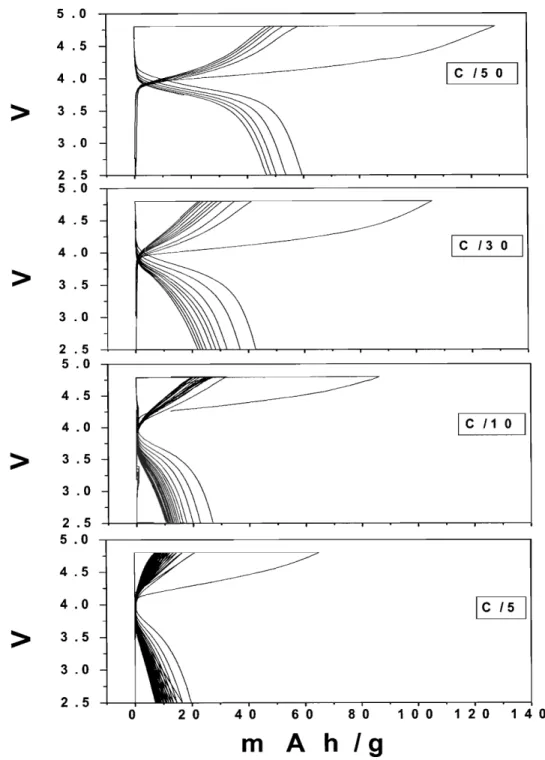
Makimura et al. obtained a reversible capacity of 200rnAhIg in the potential window 2.5- 4.5V at a slow rate (0. 17mAlcm2) and a good cycling efficiency up to 30 cycles (Figure 2-4) [3]. Lu et al. reported a stable capacity of 140mAh/g at a 10mA/g rate between 3 to 4.4V and 200mAhlg at a SrnAlg rate between 2.OV to 4.8V [lo]. It is remarkable that LiNio.5Mno.502 shows high reversible specific capacity even with 9% of excess Ni in the Li layer, while a similar degree of Ni in the Li layer in LiNiOz makes the material almost completely inactive electrochemically
Figure 2-4 Charge and discharge curves of a Li/LiNil:2Mn1/202 cell operated in voltages of 2.5-4.5 V at a rate of 0.17 mA ~ r n - ~ for 30 cycles [3].
Chapter 3
First Principles Calculations
3.1 First Principles Calculations;
Introduction to DFT (Density Functional Theory)
First principles calculations or ab initio calculations, as implied in its name, are distinguished from empirical methods in requiring only rudimentary information such as nuclear charges, and number of electrons as inputs. Energy, structure, and other properties of a material are calculated from these inputs through the application of an approximation to quantum mechanics, without any fitting parameters.
The objective of a first principles calculation is to obtain the wave function containing all the information of a given system, by solving the time-dependent Schrodinger equation. However, since our investigation targets mainly the energy of the material, only the time independent Schrodinger equation obtained by separation of variables is considered.
In (3. I), H is the Harniltonian operator, y/ is the wave function and E is the total energy of the
system. For systems with many particles (i. e. electrons and nuclei) such as a compound, equation 3.1 is intractable. Hence it is necessary to introduce a number of approximations in reaching a solution. Within the Born-Oppenheimer approximation, the electrons are assumed to move so much faster than nuclei that they instantly adjust their state to any change in the positions of the nuclei. The coordinates of the nuclei
x,
act simply as parameters in the Hamiltonian that can be written aswhere T is kinetic energy operator of electron ,Vee is the Coulomb interactions between the electrons and the third term describes the Coulomb interactions between the electrons and the nuclei. The last term which is referred to as the Ewald or Madelung energy arises from the Coulomb interaction between nuclei having charge Z,, and can be dropped in solving the electronic wave fbnction since it is simply an additive term.
This still formidable equation can be solved with further techniques, for example, using the Rayleigh Ritz variational theorem. The variational method [77] is based on the fact that given an arbitrary square integrable function g,
,
an upper bound for the ground state energy E, of the system governed by the Hamiltonian H is provided byBy optimizing p and hence minimizing the upper bound iteratively, the h c t i o n a l E [ q ] is minimized to the ground state energy E,. Incorporating a Slater determinant of single electron orbitals as a trial function p into variational method leads to the canonical Hartree-Fock equations and their solutions, which is called the Hartree-Fock approximation [78-811.
A different approach to solving 3.1 is with density functional theory (DFT) [82, 831. It is noteworthy that DFT can be less complicated due to its use of the three coordinate electron density compared to the 4N (N: total number of electrons) coordinate electron wave function in Hartree-Fock. The fundamental principle of DFT is the Hohenberg-Kohn theorem that the ground state properties of a substance are uniquely determined by the electron density and the ground state energy is a functional of the electron density [82]. The ground state energy is represented as
with
-
where F[p] is a universal functional and
v(r)
is the Coulomb potential due to the nuclei of the system. According to DFT, if the universal functional F b ] were known, the ground state energy of the system with external potential v(;) is obtained by variationally minimizing the functional E b ] with respect to p using the electron density as the variational quantity.However, F[p] is not known and approximations to it are necessary. Kohn and Sham [84] introduced a different separation of &I] by writing it as
where
Ts
[p] is the kinetic energy of non-interacting electrons and Jlp], which is referred to as the Hartree term, is a classical Coulomb energy. The last term Ex&], called the exchange-correlation energy, includes the difference in kinetic energies between non-interacting electrons introduced in (3.6) and real electrons in (3.5) as well as a correction to Jlp] arising from the correlations between electrons. The non-interacting electron kinetic energy functional T, [ p ] can be calculated exactly with a Slater determinant of independent electron orbitals. The minimization of E[p] ultimately leads to N one-electron equations of the form-
-
6J[pl+ 6E,[pl V , (r) = v(r)+
-
6~ 6~
These equations are called the Kohn-Sham equations and need to be solved self-consistently due to the dependence of vef on p(r).
However, they are not still exact because Ex&] is not known. One of the most common approximations to ExcCp] is the local density approximation (LDA) suggested by Kohn and Sham 1841. Within LDA, Exc[p] is written as
where E, is the exchange-correlation energy per electron for a uniform electron gas. LDA, therefore, assumes E, is local. Purdue and Yue developed the generalized gradient approximation (GGA) to address problem of the LDA by incorporating polynomial terms with the modulus of the electron density gradient [85, 861.
No strict guidelines exist as to when GGA is better than LDA, or vice-versa. In this work GGA is chosen as it typically does better reproducing spin polarization on transition metal ions in oxides. Among many numerical programs for solving the Kohn-Sham equations, we have chosen VASP (Vienna Ab intio Simulation Package) that solves the Kohn-Sham equations iteratively for valence orbitals using Projector Augmented Wave (PAW) potentials [87].
3.2 Application of first principles calculations to determine battery
properties
By solving the Kohn-Sham equation, we can obtain properties that are crucial to materials for electrochemical applications [32, 34, 88, 891. In this chapter we briefly provide the basic ideas on how properties, such as intercalation voltage (3.2. l), structural stability of a material (3.2.2) and Li diffusivity (3.2.3), can be obtained from first principles calculations.
3.2.1
Li intercalation Voltage
As mentioned before, the equilibrium intercalation voltage depends on the chemical potential difference of lithium in the anode and cathode. The lithium chemical potential is the partial
derivative of the free energy of the material with lithium composition. The open-circuit voltage at the intercalation level of LixMX is obtained by
where z is the charge on the lithium ion in the electrolyte (z = 1) and e is the electron charge. If the anode is composed of pure metallic lithium,
p y d "
is constant, and the voltage change withcathode
the depth of intercalation (x) is only dependent on the change in pLi ( x ) . In most cases, the average voltage is of main interest, though it is possible to compute the voltage as a function of lithium composition at the expense of computing cost [15, 901. The average voltage between x =
xl and x = XI is easily obtained by integrating (3.10) in that range.
where AG is the Gibbs free energy for the reaction
L i,, MX(cathode)
+
( x , -x,
) L i(anode) -t L i,t, (3.1 2)The reaction free energy, AG, can be broken into three parts by AG
-
AE
+
P A V - TAS . The internal energy change, AE, can be obtained from first principles calculations on each material at zero K. P A V can be neglected for a solid state reaction where volume change are usually small. In fact P A V is of the order of eV, whereas AE is of the order of 3 to 4 eV per molecule. TAS can also be neglected since its value is only the order of the thermal energy, which is about 0.025eV.Therefore, AG can be approximated by the
AE
with very small error, enabling the fairly correct voltage prediction from first principles [ 1 8, 88,9 11.3.2.2
Structural stability
During the intercalation/deintercalation reaction, some candidate electrode materials
experience phase transformations. Irreversible phase transformations cause capacity loss if the transformed structure is not electrochemically active in the desired voltage or rate range. Also, some reversible phase transformations can affect the integrity of structures when the volume change involved is significant. First principles calculations can predict the phase transformation during the Li delintercalation, since the energetically favorable phase can be easily determined to a first approximation by total energy calculations. However, predicting phase transformations is often not a simple task if competitive structures are not known. All possible candidates for a stable structure at each Li composition should be considered and the total energy of all the structures should be calculated for comparison. In practice, it is nearly impossible to find all possible structures, and the computational cost of total energy calculations of these structures is often extremely high. Nevertheless, some experimental information available about the structure at certain Li composition can be a great help to reduce the efforts and make determining a stable phase much more efficient. For example, a spinel structure (LiA&O4, where M is a transition metal) is often observed to be a competing structure when half of Li is removed from a layered structure in most lithium transition metal oxides (LiMO?). One can easily calculate and compare the energies of those two structures and get an idea about driving force andlor the mechanism for the possible phase transformation [92].
Also, some techniques which deal with partial disorder efficiently such as the cluster expansion can be useful [93-951. The cluster expansion technique is particularly helpful in
handling candidate structures with partial Li occupancies in Li sites that arise from Li delintercalation reaction. The dependence of the energy on the site disorder can be parameterized with a cluster expansion if there is no major structural modification. Only the total energy of a manageable number of configurations is required to parameterize the cluster expansion correctly. Once the function between energy and Li composition for candidates structures is constructed, the stable phase(s) at the composition of interest are determined, therefore, the phase transformation can be predicted [ 1 51.
3.2.3 Li diffusivity
Li diffusivity in electrode materials can be estimated from first principles calculations. Diffusion is a non-equilibrium phenomenon that refers to the transport of atoms over a chemical potential gradient. However, when kinetic phenomena proceed not too far from equilibrium but rather evolve between states that are in local equilibrium [96], the kinetic parameters such as the difhsivity can be determined by considering the decay of fluctuations at equilibrium [96-1061.
Consideration of relevant fluctuations at thermodynamic equilibrium leads to Kubo-Green type of equations [S];
where N is the number of Li ions, 6N is the fluctuation of the number of Li ions within a reference volume, v is the particle velocity, x is the fraction of occupied Li sites, d is the dimension of the host and r is the position of the particle.
Li ions spend most of their time at crystallographically well defined equilibrium sites and only a very small fi-action of time is spent occupying paths connecting adjacent sites. Therefore, Li motion can be viewed as a succession of discrete hops and be modeled stochastieally. A good approximation for the frequency with which Li ions hop between adjacent sites is transition state theory [107]. The transition theory converts the complexity of the many dynamic trajectories a typical atom follows before it actually hops, into a probabilistic frequency that, on average, gives the rate with which an atom performs a hop. In transition state theory, the hop frequency is written by
where v* is a vibrational prefactor and AEb is an energy difference between the initial state and
the activated state, that is, an activation barrier.
Several methods exist for finding the activated state and the activation barriers with first principles methods. The elastic band method enables the determination of the minimum energy path between two energetically stable end-points [log]. In this scheme, intermediate states are interpolated between initial and final states, and allowed to relax according to the energy landscape. Intermediate states are bound to one another with so called 'rubber band' or 'elastic band' so that they do not entirely relax back to their stable end points. The relaxed intermediate states along the energy landscape (first principles energies) follow the minimum energy path and give the activation barrier.
All the possible diffusion paths are tested as above yielding activation barriers for each path. Considering all the paths tested, numerical simulations such as kinetic Monte Carlo enable an explicit simulation of the migration of Li ions using the jump frequency obtained by (3.15) with the aid of cluster expansions to parameterize the first principles activation barrier if it depends on the environment. The parameters in (3.14) can be identified through the multiple Monte Carlo and
Chapter
4
Designing a high capacity electrode
With ever increasing demands for high capacity batteries and rapidly advancing mobile technologies, the importance of developing high capacity electrode materials has never been higher. The battery capacity, the amount of charge the battery can provide with one charge, is directly related to the specific capacity of the electrode material in the battery. As briefly mentioned in Part I, the number of moles of Li that can reversibly participate in the electrochemical reaction determines the specific capacity of an electrode. In most cases, the electrochemical reaction involves the delintercalation of Li into the host structure.
In designing high capacity electrodes, it is crucial to understand the essential factors that determine the amount of Li that can be reversibly delintercalated frodinto an electrode material. For example, the host structure should have an abundance of sites for Li. While Li usually occupies either tetrahedral or octahedral sites in most transition metal oxides, the number of these sites is determined by how oxygen atoms are arranged and where the transition metals are situated in the oxygen framework. For example, in the 03-type layered materials, oxygen is
stacked in a close-packed
ABCABC..
. fashion and transition metals occupy octahedral sites. Li ions at the voltage range of interest occupy nearly all of available octahedral sites remaining while tetrahedral site are only accessible at practically too low voltage. Often, the number of available Li octahedral sites excluding those occupied by transition metals is typically one per two oxygen atoms.The host material should also be able to easily adapt to electronic structure changes. The reversible dehntercalation requires the material to adapt electron charge alteration in the host due to the change in the electron count upon dellithiation. The transition metal in the host structure plays an important role in distributing charge added or lost during delintercalation. This is because in most cases, the transition metal redox couple is located near the Fermi level as shown for typical electrode materials in Figure 4-1. As a result, the transition metal species and its oxidation state significantly affect Li capacity of cell even for a fixed host structure.
Figure 4-1 The schematic pictures of energy vs. density of states for Li,TiS2 (left) and
4.1 Advantage of the Ni2+/Ni4+
redox couple
In order to increase the capacity of an electrode material, more Li should be able to reversibly intercalate into the host. However, the intercalation of more than one Li per formula unit of Li,M02 (M=transition metal) at a reasonable voltage range requires not only more available Li sites but also active transition metal redox couples (Table 4-1). Active redox couples are necessary since Li donates electrons to the host upon lithiation. Conventional layered materials are electrochemically active by the reversible M ~ + / M ~ + redox couple contributing one electron per transition metal with lithiation or delithiation. Therefore, the number of redox couples in Li,M02 is just right for one Li intercalation per one formula unit, and the host cannot accommodate further dellithiation. Additional reduction or oxidation of this redox couple usually results in either a very unstable oxidation state or voltage that is too low.
Oht-ine (h12+ R13+) 1 3 5 4 S \ ' 5 1 1 -
Layered (h13+ h14+) 4 3.9\-
Table 4-1 Equilibrium potential (vs. Lithium metal) of each transition metal redox
couple at olivine or layered structures [4].
However, recently it has been demonstrated theoretically [14] and experimentally [7, 131
that a ~i'+/'Ni'+ double redox couple is accessed in Li(Nio.jMnoj)Oz. While has given up its role as an electrochemically active center and is present only as filler, Ni is the only transition metal that is reversibly reduced or oxidized contributing two electrons in these materials. More
importantly, unlike other transition metal species, the voltages exhibited by two different redox couples i.e. Ni2+/Ni3+ and Ni3+/Ni4+, are reasonably similar and in a range of practical interest.
This can lead to a new way to develop a high capacity electrode material. By doubling the electron capacity using Ni'+/Ni4+, the electronic limitation with dellithiation becomes less critical. It implies that if the material contains only electrochemically active Nit2 without structural fillers like h4n4+, the host has enough electron capability to cycle 2 Li per transition metal. The theoretical capacity of 280mAWg of Li(Nio,sMno.s)Oz can increase up to 549 mAWg of a material with a composition such as LizNiOZ. As long as half of the transition metals are ~ i " in the layered structure, electrochemical properties can be optimally tuned, for example, by replacing Mn with other elements without sacrificing specific capacity.
The interesting double Ni2+/~i4' redox couple is probably due to Ni's unique electronic structure in the octahedral site (Figure 4-2). While Ni4+ has a relatively stable configuration of filled tzg orbitals in the octahedral site, Ni3+ becomes energetically unstable due to its unpaired electron in an e, orbital. The unpaired e, electron can be easily stabilized either by removing it (Nit4) or making it paired (Nii2), therefore, making the transition between ~ i " and Ni4+ more feasible.
In the following section 4.2, 1 have tried to confirm the feasibility of a Ni"/Ni4+ active redox couple in a new composition of material. In section 4.3, the fully utilizing the Ni"/Ni4+ redox couple without any structural filler is attempted.
Figure 4-2.Schematic picture of the electronic configuration of Ni at different valence states in the octahedral coordination
In this chapter, it is shown that a new layered structure with a composition of Lio.9~io.45,Tio.ss)02 where Ni is in +2 state can be synthesized. The structure of this new material is investigated using X-ray diffraction, its electrochemical properties as an electrode are explored using experimental and first principles tools.
4.2.1 Motivation
Since Mn in LiNio.sMno.502 acts only as structural filler without participating in the electrochemical reaction [7, 13, 73, 92, 1091, it is possible to think of a way to enhance the electrochemical property of this material by replacing Mn with another element. Since the element that replaces Mn does not need to be electrochemically active, it can be chosen to optimize certain other properties. Replacing Mu with lighter elements can increase the specific
capacity. Also, cost, non-toxicity and safety issues may be optimized by finding species to replace Mn. The restrictions on a M n modifier are: They should be stable in +4 state ensuring Ni is in the +2 state as prepared, and they should be able to fit into the octahedral sites keeping the layered host structure. Si may be stable in the +4 state when mixed with Ni in the transition metal layer, but it favors a tetrahedral coordination of oxygen. Another example, Co, can be very stable in the octahedral site and mixes with Ni very well, but becomes "+3" oxidizing ~ i ' ' to ~ i ~ + .
As a potential analogue to ~ i ( ~ i + ~ ~ . ~ M n ~ + ~ . ~ ) 0 ~ , we have investigated ~ i ( N i + ~ ~ . ~ ~ i ~ + ~ . 3 0 ~ . Among the advantages in using Ti; its compounds can be readily obtained from very cheap
precursors such as TiOz, possibly reducing the cost of material. In addition, Ti02 is non-toxic, and Ti is lighter than Mn.
~i(Ni+*,~i~+)o~ is expected to be more difficult to synthesize in the layered ~3 m structure as both ~ i(0.83 + ~
![Figure 2-4 Charge and discharge curves of a Li/LiNil:2Mn1/202 cell operated in voltages of 2.5-4.5 V at a rate of 0.17 mA ~ r n - ~ for 30 cycles [3]](https://thumb-eu.123doks.com/thumbv2/123doknet/14723341.571052/32.918.272.722.148.512/figure-charge-discharge-curves-linil-operated-voltages-cycles.webp)


![Figure 4-5 Lattice parameter comparison with literature values (rocksalt structure - shaded area) at different Ti composition [15]](https://thumb-eu.123doks.com/thumbv2/123doknet/14723341.571052/55.918.188.800.616.874/lattice-parameter-comparison-literature-rocksalt-structure-different-composition.webp)