HAL Id: hal-03108836
https://hal.archives-ouvertes.fr/hal-03108836v3
Submitted on 5 Mar 2021
HAL is a multi-disciplinary open access
archive for the deposit and dissemination of
sci-entific research documents, whether they are
pub-lished or not. The documents may come from
teaching and research institutions in France or
abroad, or from public or private research centers.
L’archive ouverte pluridisciplinaire HAL, est
destinée au dépôt et à la diffusion de documents
scientifiques de niveau recherche, publiés ou non,
émanant des établissements d’enseignement et de
recherche français ou étrangers, des laboratoires
publics ou privés.
Distributed under a Creative Commons Attribution - NonCommercial| 4.0 International
License
VP Float: First Class Treatment for Variable Precision
Floating Point Arithmetic
Tiago Trevisan Jost, Yves Durand, Christian Fabre, Albert Cohen, Frédéric
Pétrot
To cite this version:
Tiago Trevisan Jost, Yves Durand, Christian Fabre, Albert Cohen, Frédéric Pétrot. VP Float: First
Class Treatment for Variable Precision Floating Point Arithmetic. International Conference on Parallel
Architectures and Compilation Techniques (PACT 2020), Oct 2020, Atlanta, United States.
pp.355-356, �10.1145/3410463.3414660�. �hal-03108836v3�
VP Float: First Class Treatment for Variable Precision Floating
Point Arithmetic
Tiago Jost
Yves Durand
Christian Fabre
[email protected] Univ. Grenoble Alpes CEA, LIST, Grenoble, FranceAlbert Cohen
[email protected] Google, Paris, France
Frédéric Pétrot
[email protected] Univ. Grenoble Alpes, CNRS, Grenoble INP†, TIMA, Grenoble, France
ABSTRACT
Optimizing compilers for high performance computing only sup-port IEEE 754 floating-point (FP) types and applications needing higher precision involve cumbersome memory management and calls to external libraries. We introduce an extension of the C type system to represent variable-precision FP arithmetic, supporting both static and dynamically variable precision. We design and im-plement a compilation flow bridging the abstraction gap between this type system and hardware FP instructions or software libraries. We demonstrate the effectiveness of our solution by enabling the full range of LLVM optimizations and leveraging two backend code generators: one for the ISA of a variable precision FP arithmetic coprocessor, and one for the MPFR multi-precision FP library. Both targets support the static and dynamically adaptable precision of our type system. On the PolyBench suite, our optimizing com-pilation flow targeting MPFR is shown to outperform the Boost programming interface for the MPFR library.
CCS CONCEPTS
• Software and its engineering → Source code generation; Im-perative languages; Data types and structures; Dynamic compilers.
KEYWORDS
Floating point arithmetic, compiler optimization, LLVM, MPFR
ACM Reference Format:
Tiago Jost, Yves Durand, Christian Fabre, Albert Cohen, and Frédéric Pétrot. 2020. VP Float: First Class Treatment for Variable Precision Floating Point Arithmetic. In Proceedings of the 2020 International Conference on Parallel Architectures and Compilation Techniques (PACT ’20), October 3–7, 2020, Virtual Event, GA, USA. ACM, New York, NY, USA, 2 pages.https://doi. org/10.1145/3410463.3414660
1
INTRODUCTION
Floating-point (FP) computation has been around long before its standardization, but the adoption of the IEEE 754 standard in 1985 [10] along with the progress of integration technology made
†
Institute of Engineering Univ. Grenoble Alpes.
Permission to make digital or hard copies of part or all of this work for personal or classroom use is granted without fee provided that copies are not made or distributed for profit or commercial advantage and that copies bear this notice and the full citation on the first page. Copyrights for third-party components of this work must be honored. For all other uses, contact the owner/author(s).
PACT ’20, October 3–7, 2020, Virtual Event, GA, USA © 2020 Copyright held by the owner/author(s). ACM ISBN 978-1-4503-8075-1/20/10.
https://doi.org/10.1145/3410463.3414660
1 void a x p y 1 0 0(int N, vpfloat<mpfr, 16 , 100 > alpha,
2 vpfloat<mpfr, 16 , 100 > *X, 3 vpfloat<mpfr, 16 , 100 > *Y) { 4 for (u n s i g n e d i = 0; i < N; ++i) 5 Y[i] = a lph a * X[i] + Y[i]; 6 } 7
8 void va xpy(u n s i g n e d prec, int N,
9 vpfloat<mpfr, 16 , prec> alpha,
10 vpfloat<mpfr, 16 , prec> *X,
11 vpfloat<mpfr, 16 , prec> *Y) {
12 for (u n s i g n e d i = 0; i < N; ++i)
13 Y[i] = a lph a * X[i] + Y[i];
14 }
Listing 1: axpy kernel with mpfr type
hardware FP units ubiquitous. While hardware support is para-mount to the performance of numerical applications, compilers play a major role in leveraging these units efficiently. Compiler optimizations handle FP representations supported by common hardware, at best the 16, 32, 64, 80 and 128 bits IEEE formats as well as bf16. However, a growing number of applications [2, 6] are better suited to operate on different formats.
Finer control of exponent and precision sizes allows the nu-merical analyst to explore suitable trade-offs between accuracy and execution time (and/or energy consumption). This goal can be achieved through the use of external libraries, yet multi-precision code is difficult to write and maintain. More than the performance gap, the productivity gap of variable precision FP arithmetic makes it unaccessible to its main potential users.
We address this challenge through a variable precision FP type system and language extension of standard C through the intro-duction of a template type namedvpfloat. The syntax for this type system captures most of the expressiveness needed by nu-merical analysts while enabling highly efficient in-place execution, stack allocation and the full range of compiler optimizations ex-pected for the C language. This is made possible by extending the LLVM intermediate representation [7], allowing classical compiler optimizations to operate on multi-precision FP types with few mod-ifications. In particular, we enable multiple FP formats to coexist in a single numerical kernel with full procedural abstraction. For each format that supports it, we also enable computations over multiple variables of different precision and memory footprints, including dynamically-varying precision and footprints. This al-lows to explore multiple numerical configurations within a single program source or even across successive iterations of a tuning or convergence loop.
2
GENERIC VP TYPES
Every VP variable declaration must provide a type attribute which defines if subsequent attributes are needed and which information they carry. Attributes are specified in the following order: type, exponent, precision, and size. With the exception of type,vpfloat
attributes can all be defined with integral constant literals or iden-tifiers. This generic type supports not only constant-size but also dynamically-sized types, which is always a technical hurdle in languages with unmanaged memory like C, and its associated in-termediate representations and ABIs.
We designed and implemented a full compilation flow in LLVM supporting (1)mpfrtypes, which hold the number of bits of expo-nent and mantissa in the second and third fields, respectively; and (2)unum[5] types with second and third fields, ess and fss, respec-tively, with an optional size field that holds the maximum number of bytes used to represent the number. Listing 1 shows the imple-mentation of the axpy kernel, a level-1 BLAS [8] routine operating on vectors, for constant and dynamically-sized mpfr types.
3
EXPERIMENTAL RESULTS
We demonstrate the effectiveness of our type system and compiler implementation by comparing the variable-precision MPFR type
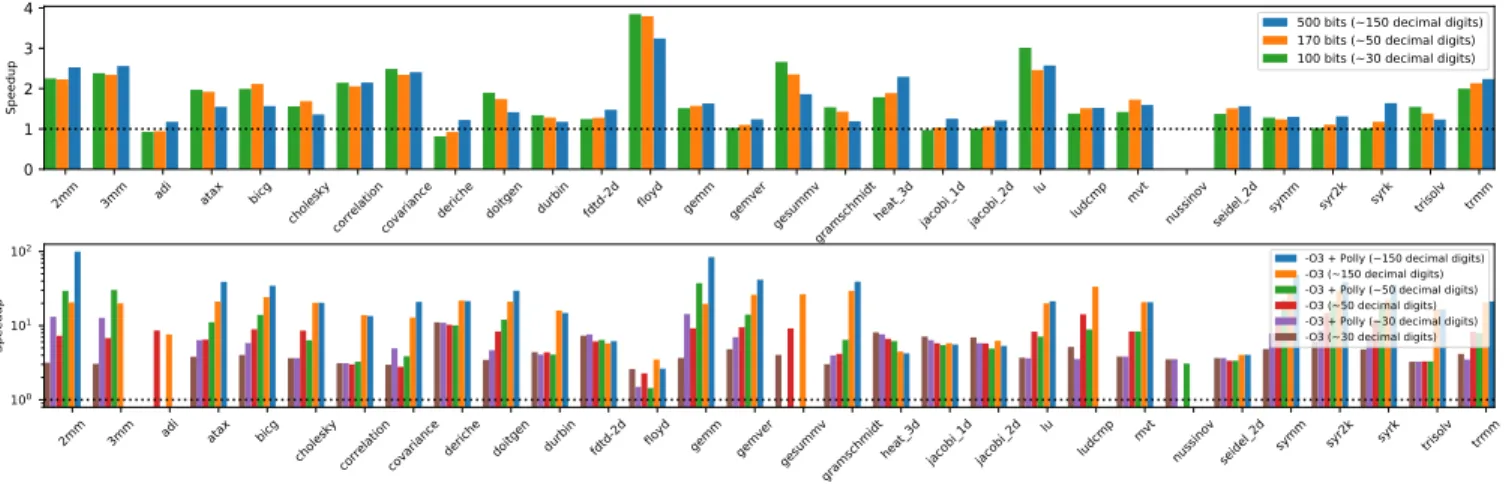
vpfloat<mpfr, ...>with the Boost library for multi-precision. Both approaches rely on the MPFR library and execute code with identi-cal precision [3]. We compiled the PolyBench suite version 4.1 [9] at optimization level -O3, and enabling or disabling Polly’s polyhedral loop nest optimizations [4]. The nussinov benchmark results are missing due to erroneous computations (NaN) in the Boost baseline, we are investigating the issue. Overall, results show an average speedup of 1.70× for the Intel Xeon E5-2637 with 128GB of RAM. To evaluate the portability of our approach, we also demonstrate our LLVM implementation targeting a coprocessor for a RISC-V Rocket core accelerating FP arithmetic in the UNUM format [1]. Unfortunately we hit hardware bugs when executing some bench-marks: gesummv and adi failed to run when compiled with Polly and 3 more benchmarks failed at the highest precision with Polly (3mm, ludcmp, nussinov). This is due to an issue in the co-processor
memory subsystem that we were not able to address at this time. Nevertheless, we were able to achieve at the highest precision (150 digits), speedups of 18.03× and 27.58× for -O3, and -O3 + Polly, respectively, when using ourvpfloat<mpfr, ...>as baseline.
4
CONCLUSION
We propose an extension to the C type system to operate on vari-able precision FP formats. Our extension supports FP arithmetic of arbitrary representation whose precision and exponent size can be configured at compilation time or runtime. We demonstrate the productivity benefits of our programming model and its ability to leverage the full range of optimizations of LLVM. Experiments on the PolyBench suite yield strong speedups at all optimization levels in comparison to the Boost Multi-precision library for MPFR.
REFERENCES
[1] Andrea Bocco, Yves Durand, and Florent De Dinechin. 2019. SMURF: Scalar Multiple-precision Unum Risc-V Floating-point Accelerator for Scientific Com-puting. In Proceedings of the Conference for Next Generation Arithmetic. 1–8. [2] Erin Carson and Nicholas Higham. 2018. Accelerating the Solution of Linear
Systems by Iterative Refinement in Three Precisions. SIAM Journal on Scientific Computing 40 (Jan. 2018), A817–A847. https://doi.org/10.1137/17M1140819 [3] Laurent Fousse, Guillaume Hanrot, Vincent Lefèvre, Patrick Pélissier, and Paul
Zimmermann. 2007. MPFR: A Multiple-precision Binary Floating-point Library with Correct Rounding. ACM Trans. Math. Softw. 33, 2, Article 13 (June 2007). [4] Tobias Grosser, Hongbin Zheng, Raghesh Aloor, Andreas Simbürger, Armin
Größlinger, and Louis-Noël Pouchet. 2011. Polly – Polyhedral optimization in LLVM. In Proceedings of the First International Workshop on Polyhedral Compilation Techniques (IMPACT). 1–6.
[5] John L. Gustafson. 2017. The end of error: UNUM computing. 416 pages. [6] Nicholas J. Higham. 1996. Accuracy and Stability of Numerical Algorithms. Society
for Industrial and Applied Mathematics, Philadelphia, PA, USA.
[7] Chris Lattner and Vikram Adve. 2004. LLVM: A Compilation Framework for Lifelong Program Analysis & Transformation. In Proceedings of the International Symposium on Code Generation and Optimization. 75–86.
[8] Chuck L Lawson, Richard J. Hanson, David R Kincaid, and Fred T. Krogh. 1979. Basic linear algebra subprograms for Fortran usage. ACM Transactions on Mathe-matical Software (TOMS) 5, 3 (1979), 308–323.
[9] Louis-Noël Pouchet et al. 2012. PolyBench: The polyhedral benchmark suite. http://www.cs.ucla.edu/pouchet/software/polybench.
[10] Dan Zuras et al. 2008. IEEE standard for floating-point arithmetic. 70 pages.
This work was partially funded by the French Agence nationale de la recherche (ANR) for project IMPRENUM under grant n° ANR-18-CE46-0011.
2mm 3mm adi atax bicg
cholesky correlationcovariance deriche doitgen durbin fdtd-2d floyd gemm gemver gesummv
gramschmidtheat_3d jacobi_1d jacobi_2d lu
ludcmp mvt nussinov seidel_2d symm syr2k syrk trisolv trmm 0 1 2 3 4 Speedup
500 bits (~150 decimal digits) 170 bits (~50 decimal digits) 100 bits (~30 decimal digits)
2mm 3mm adi atax bicg
cholesky correlationcovariance deriche doitgen durbin fdtd-2d floyd gemm gemvergesummv
gramschmidtheat_3d jacobi_1d jacobi_2d lu
ludcmp mvt nussinov seidel_2d symm syr2k syrk trisolv trmm
100
101
102
Speedup
-O3 + Polly (~150 decimal digits) -O3 (~150 decimal digits) -O3 + Polly (~50 decimal digits) -O3 (~50 decimal digits) -O3 + Polly (~30 decimal digits) -O3 (~30 decimal digits)
Figure 1: Speedup of (1)vpfloat<mpfr, ...>over the Boost library for multi-precision on x86, and (2) ofvpfloat<unum, ...>over