COMPACT NEUTRON SOURCES FOR ZERO KNOWLEDGE WARHEAD VERIFICATION USING EPITHERMAL NEUTRON TRANSMISSION ANALYSIS
By
Ezra Max Engel
B.S., Physics, United States Military Academy, 2017
SUBMITTED TO THE
DEPARTMENT OF NUCLEAR SCIENCE AND ENGINEERING
IN PARTIAL FULFILLMENT OF THE REQUIREMENTS FOR THE DEGREE OF MASTER OF SCIENCE IN NUCLEAR SCIENCE AND ENGINEERING
AT THE
MASSACHUSETTS INSTITUTE OF TECHNOLOGY JUNE 2019
© 2019 Massachusetts Institute of Technology All rights reserved.
Signature of Author: ______________________________________ Ezra Max Engel Department of Nuclear Science and Engineering
15 May 2019 Certified by: ____________________________________________ Areg Danagoulian Norman C. Rasmussen Assistant Professor of Nuclear Science and Engineering
Thesis Supervisor Certified by: ____________________________________________ Richard Lanza Senior Researcher, Laboratory for Nuclear Security and Policy Thesis Reader Accepted by: ___________________________________________
Ju Li Battelle Energy Alliance Professor of Nuclear Science and Engineering and Professor of Materials Science and Engineering Chair, Department Committee on Graduate Students
Compact Neutron Sources for Zero Knowledge Warhead
Verification via Epithermal Neutron Transmission Analysis
by
Ezra Max Engel
Submitted to the Department of Nuclear Science and Engineering On 15 May, 2019 in Partial Fulfillment of the Requirements For the Degree of Masters of Science in Nuclear Science and
Engineering
ABSTRACT
In anarchic international environments, verification methods improve the viability of arms control agreements and disarmament measures by allowing party states to escape the security dilemma. However, warhead verification requires confident assurance of warhead authenticity while protecting design information about the interrogated object. Zero-knowledge physical cryptography provides a solution to the verification paradox by introducing system designs that do not require electronic information barriers and protect sensitive information during measurement. Compact epithermal neutron sources enable the verification process to occur on-site and minimize the security risk of transporting special nuclear material to dedicated verification facilities. Experimental results demonstrate the feasibility of a tomographic approach to zero-knowledge physical
cryptography, and MC simulations offer promising results for compact epithermal neutron sources.
Thesis Supervisor: Areg Danagoulian
Contents
1 Introduction 7
2 Complex Organizations and Normal Accidents 9
2.1 The American Nuclear Establishment and Normal Accidents . . . 9
2.2 Institutional Risks . . . 11
3 Nuclear Arms Control and Disarmament 12 3.1 Historical Disarmament Movements . . . 12
3.2 Previous Treaty Designs . . . 13
4 Obstacles to Disarmament 14 4.1 Realism . . . 14
4.2 Liberalism . . . 15
4.3 Constructivism . . . 16
5 Warhead Verification and Enforcement 17 5.1 Roles of Verification in Arms Control . . . 17
5.2 Historical Verification Regimes . . . 18
5.3 Verification Approaches and Technologies . . . 19
5.4 Information Barriers . . . 21
6 Zero-Knowledge Physical Cryptography 22 7 Zero-Knowledge NRTA Tomography 26 7.1 Configuration and Process . . . 26
7.2 Methods . . . 29
7.2.1 Targets . . . 29
7.2.2 Measurements . . . 32
7.2.3 Detector . . . 33
7.2.4 Time of Flight Reconstruction . . . 33
7.3 Results . . . 34
7.4 Discussion . . . 37
7.4.1 Narrow Beam Construction . . . 40
8 Compact Neutron Sources 41
8.1 Monte Carlo Simulations . . . 42
8.1.1 Simulations . . . 42
8.1.2 Moderator Optimization . . . 44
8.1.3 System Geometry . . . 46
8.1.4 Target . . . 47
8.2 Results . . . 48
8.2.1 TOF Energy Reconstruction . . . 49
8.2.2 Isotopic Sensitivity . . . 51
8.3 Effects of Neutron Generation Pulse Width . . . 54
8.4 Polycone Detector Shielding . . . 55
8.4.1 Polycone TOF Reconstruction . . . 56
8.4.2 Polycone Spectra Differentiation . . . 59
8.4.3 Polycone Pulse Width Smearing . . . 61
8.4.4 Analytical Spectra Reconstruction . . . 62
8.5 Summary of DT-Source Designs . . . 65
9 Conclusions 66
1 Introduction
Over the past two decades, the North Korean and Iranian nuclear programs have renewed interest in arms control, disarmament, and counter-proliferation. This interest has lead both to new bilateral treaties between the U.S. and Russia such as the New Strategic Arms Reduction Treaty (START) and collaborative efforts to curb weapon development in non-nuclear states through sanctions and negotiations. These efforts culminated in the Joint Comprehensive Plan of Action which greatly restricted Iran’s capability to weaponize its nascent nuclear program. Whether these same efforts will succeed in North Korea remains to be seen.
Over the past fifty years, arms control agreements have been highly successful at reducing the global nuclear weapon inventory (mostly through bilateral agreements between the U.S. and Russia). Figure 1 shows the estimated global nuclear warhead inventory over the past 70 years. Researchers in disarmament give special attention to the U.S. and Russia (then the Soviet Union) as these two countries have possessed over 90% of the global stockpile at every point in the nuclear age.
The growing concern over nuclear proliferation has generated renewed interest in warhead verification research. Historically, nuclear arms control verification has focused on delivery vehicles, since they constitute a good proxy for strike capability and are easy to verify by national technical means. No arms control agreement has ever attempted to verify the authenticity of the warheads themselves. This has created a large global surfeit of non-deployed nuclear warheads (in stockpiles, long-term storage, and/or awaiting dismantlement).
A warhead verification regime must simultaneously accomplish two seemingly contradictory objectives. (1) The host country must be completely confident that the inspecting country will not obtain any sensitive design information about her weapons. (2) The inspector must authenticate the host’s weapons to verify compliance to the pertinent agreement. Historically, verification systems incorporated either a template-based or attribute-based approach combined with an electronic information barrier (IB) to protect the host’s design information. In a template-based approach, measurements are to be compared against a “fingerprint” for a known warhead, often selected at random from a host country’s ICBM or cruise missile arsenal. In an attribute-based approach, the verification body selects a universal set of criteria for weapon designs that are compared against the host’s interrogated warheads. In both cases, the monitoring country takes direct measurements of the weapon, but the information is encrypted electronically before read-out. This electronic encryption process, the IB, remains one of the most contentious design element in these verification systems [1].
Figure 1: Estimated global nuclear warhead inventories over time. A large fraction of the overall decrease can be explained by a bilateral shift to more accurate weapons in the 1970s, and the collapse of the Soviet Union in the late 1980s. However, arms control agreements and their respective verification systems, in particular the Intermediate Nuclear Forces Treaty (1987), are also a major factor in the success of historical disarmament efforts. [2]
New approaches to verification have reduced reliance on IBs by offering viable alternatives. Instead, these systems—pioneered at Princeton University [3], and MIT [4]—use physical processes to encrypt sensitive design information before measurement. Physical cryptography simplifies the design of these systems and has the potential to increase international confidence in the viability of warhead verification for international arms control agreements.
In this thesis, we attempt to contextualize the importance of these new approaches and introduce novel techniques in physical cryptography and neutron time-of-flight (TOF) instrumentation. We begin with a justification of disarmament efforts generally, which some critiques have denounced as destabilizing [5][6]. We then provide a brief history of previous arms control efforts and challenges. Finally, we introduce a new set of techniques that offer promising results for physically encrypted warhead verification.
This thesis contains nine sections. Section II examines the implications of normal accident theory for stochastic risk involving nuclear weapons. Section III explores the historical priorities of arms control and non-proliferation agreements. Section IV examines the general-ized international problem of disarmament using the lens of game theory and international relations paradigms. Section V examines verification strategies for enforcement and arms control. Section VI gives an introduction to new research in physical cryptography and novel weapons verification techniques. Section VII examines results for an experimental validation of zero knowledge physical cryptography for warhead verification. Section VIII examines the design and use of compact epithermal sources for on-site verification. Section IX offers some
conclusions on the future landscape of verification technology and systems. Ultimately, we conclude that zero-knowledge technologies offer a valuable enforcement mechanism for future disarmament agreements by increasing both detection fidelity and confidence in information security, and that developments in compact sources and measurement techniques make a warhead disarmament effort increasingly feasible.
2 Complex Organizations and Normal Accidents
The U.S. Department of Defense and international equivalents have a long history of nuclear near misses. In the thirty-four years of the U.S. nuclear weapons program the DoD experienced thirty-two broken arrow incidents (nuclear accidents grave enough to endanger the American public) [7]. Any one of these incidents could have potentially resulted in a catastrophic loss of American life. While no similar concrete numbers exist for the Soviet nuclear program during the same time, it is likely that the USSR experience a comparable number of accidents. A growing body of literature in organizational psychology and systems engineering suggests that these types of accidents are guaranteed consequences of complex organizations.
2.1 The American Nuclear Establishment and Normal Accidents
Given the tremendous size and complexity of the U.S. government, the alarming frequency of nuclear accidents is unsurprising. Many organizational theorists promote a normal accident approach to complex systems and hazardous material. Normal accident theory was proposed in 1984 by Charles Perrow and requires that (1) the system is complex, (2) the system is tightly coupled, and (3) that the system has catastrophic potential. Normal accident theorists also frequently frame organizational failures as the result of friction between disparate interests within large organizations [8]. Subsequent developments in normal accident theory have also introduced the concept of human reliability into the framework. So, in addition to Perrow’s initial requirements for systematic failure, we can add a fourth risk-multiplying factor: (4) human error [9].
1. Three primary organizations are responsible for overseeing nuclear safety and weapons management in the United States—the Air Force, the Navy, and the Department of Energy. These organizations have their own command structures with limited communication between them. They each contain multiple layers of commands, research groups, and authority structures. The U.S. nuclear apparatus is highly complex. 2. Nuclear weapons maintenance, storage, and security are generally handled by either
The DOD uses a highly centralized system of checklists and maintenance priorities to manage its weapons systems, and this approach is rigidly standardized across the arsenal. The U.S. nuclear apparatus is tightly coupled [10, 11].
3. The U.S. stockpile consists of weapons with yields in the hundreds of kilotons. While these modern warheads are much smaller than the megaton warheads of the cold-war, an accident involving any one of them could still easily cause thousands of deaths. In the same vein, theft of nuclear weapons material (or a fully intact weapon) would constitute a massive national security threat. The U.S. nuclear apparatus has catastrophic potential. 4. The U.S. stockpile is staffed and maintained by 18, 19, and 20-year-old airmen and
sailors. These junior enlisted personnel are frequently commanded by officers with a similar dearth of experience. During the 1980s, propellant transfer systems teams would routinely fill maintenance buckets with hydrazine and shoot at them with oxidizer-filled ping pong balls to entertain themselves during 14 hour shifts. While liquid-fuel rockets have been phased out of the stockpile, inexperienced young men still play pivotal roles in the maintenance and deployment of our nuclear weapons. The U.S. nuclear apparatus is vulnerable to human error [11][12].
The interactive complexity of these American organizations is mirrored in other national nuclear weapon programs. According to normal accident theory, this level of complexity guarantees failure pathways that are virtually unpredictable. These unforeseeable pathways can lead to catastrophe. The 1980 Damascus Titan missile explosion constituted one of the worst nuclear accidents in U.S. history. Describing the event, one of the airmen summarized the incredulity of the failure.
One dropped socket that A, should have let’s just say not dropped; but B, should have never got past a platform; C, shouldn’t have hit the thrust mount; D, shouldn’t have hit the missile. If it hit, it shouldn’t have punctured a hole in it. I mean there are so many things that shouldn’t have happened, but one dropped socket wiped out an entire nuclear missile system. One dropped socket, nine-pound socket, took it all out. There’s no one that thought that scenario out. [11]
These types of system accidents are nearly impossible to forecast, and thus nearly impossible to prevent. The risk of failure inevitably grows with the size and complexity of the system, so in a super-large, hyper-complex system like the U.S. national security apparatus catastrophic failures are not just possible, but inevitable [12].
2.2 Institutional Risks
Normal accident theory has implications beyond the prediction of Broken Arrow incidents. The same dynamics that motivate disasters like the Damascus missile explosion can also confound attempts to make rational, informed decisions about the deployment of these weapons in conflict. During the height of the Cold War, the possibility of a Soviet decapitation strike directed at senior civilian and military leadership posed a grave command and control threat. This possibility was troublesome in the U.S. but considerably worse in Western Europe, which lacked an early warning system to detect an incoming Soviet attack on NATO command bunkers. The potential chaos resulting from a decapitation attack sensitized military leaders to the potential first-strike scenario, and kept them on a hair-trigger alert. It also meant that strategists only had minutes to plan a response upon the detection of an incoming attack. Over-sensitivity in both the U.S. and Soviet early warning systems further increased the likelihood of a false alarm—and subsequent response [12, 13].
The development of a national nuclear program can also substantially alter the politi-cal landscape in which decisions are made, further complicating a nation’s organizational structure and increasing the risk of a nuclear strike. An underappreciated impact of national nuclear infrastructure are the substantial political and bureaucratic influences that the nuclear establishment can have on national decision making. The caché afforded to nuclear estab-lishments in many countries affords them significant power to expand beyond their original mandates. This influence was apparent in the development of both India’s and Pakistan’s nuclear weapon programs, and remains a concern for potential nuclear proliferators such as Iran [14].
Even without the influence of nuclear establishments, nuclear weapons substantially increase the consequences of organizational miscalculations. This was most obvious in tense, high-stakes standoffs such as the Berlin Airlift (1948) and the Cuban Missile Crisis (1962). Nuclear weapons and first strike scenarios also posed serious challenges to conventional command and control structures within the armed forces—increasing the risk of a false-alarm, accidental nuclear conflict. Normal accident theory suggests that these scenarios are enabled by the same factors which facilitate broken arrow incidents: complex, tightly-coupled organizations with catastrophic potential. In tense international standoffs, these risks were further exacerbated by the potential for human error.
3 Nuclear Arms Control and Disarmament
Over the past 60 years, nuclear powers and the international community seem to have grown increasingly intolerant of nuclear risk. Despite consistent improvements in international safeguards and the end of the Cold War, the world has continued pursuing nuclear arms control, negotiating over a dozen agreements since 1970. The growing willingness of global powers to restrict delivery vehicles and nuclear testing reflects a rising global awareness and disapproval of the deployment and possession of nuclear weapons. This political and popular opposition is not a recent development. These movements have been around for almost as long as the nuclear weapons themselves.
3.1 Historical Disarmament Movements
The efforts of the Manhattan Project reached a climax on July 16th, 1945 with the Trinity nuclear test at Alamogordo, New Mexico. When the Gadget device detonated with a yield of 20 kT, Robert J. Oppenheimer, the project director, is alleged to have quoted the Bhagavad Gita, “I am become death, destroyer of worlds.” Less than 1 month later, on August 6th, the United States dropped Little Boy on Hiroshima. Three days later, the U.S. dropped Fat Man—a weaponized iteration of Gadget—on Nagasaki. The bombs killed over 120,000 people, and on August 15th, Imperial Japan surrendered to Allied forces on the USS Missouri [15].
The bombings of Hiroshima and Nagasaki were indisputable demonstrations of the destruc-tive potential of nuclear technology. Survivors of the explosion recount the indiscriminate carnage and unanimously express support for international disarmament efforts [16][17]. These horrors loomed over the global geopolitical landscape as nuclear technology proliferated to the Soviet Union, the United Kingdom, France, and China over the next two decades.
These technologies spread in spite of growing popular protest against the use and devel-opment of nuclear weapons. In Japan, these movements were spearheaded by the hibakusha (people affected by the bombings) who effectively used Hiroshima and Nagasaki as
inter-national symbols of protest and opposition. In the United States and U.K., disarmament movements gained traction in the 50s among pacifists, scientists, and world federalists. The latter two groups were particularly sensitive to the security dilemma (see Section IV) and strongly advocated for the creation of a strong world government as a solution. The French public, deeply concerned about the prospect of yet another global war, reportedly harbored a “repugnance for the use of these weapons except in the direst circumstances” [6]. In the Soviet Union, party leaders led efforts to stigmatize nuclear weapons in order to delegitimize U.S. military advantages in Europe. While these movements were originally agitated by scientists, pacifists, and world government enthusiasts, the ideas and motifs slowly percolated
into broader society throughout the fifties and sixties [6].
3.2 Previous Treaty Designs
Growing public opposition eventually culminated in the signings of the Partial Test Ban Treaty in 1963 and the Treaty on the Non-Proliferation of Nuclear Weapons in 1968. The NPT ushered in an age of multilateral arms control agreements that included the SALT I (1972) and SALT II (1979) talks, the INF Treaty (1988), START (1991), the Comprehensive Test Ban Treaty (arbitrated in 1996 but never ratified), and New START (2010) [6][18]. Most theorists and strategists agree that these arms control agreements have strengthened the international order and decreased the likelihood of nuclear mishaps [19].
Arms control agreements and test-ban treaties also played a crucial role in military de-escalation and confidence building during the Cold War. The Partial Test Ban Treaty (1963) was the first major multilateral effort at nuclear arms control. Negotiated between President Kennedy and Secretary Khrushchev, the agreement effectively ended atmospheric testing. Outside of Chinese and French resistance, the PTBT was received with almost universal adulation [6].
The mounting popular will to curb the testing and potential use of nuclear weapons also facilitated the Treaty on the Non-Proliferation of Nuclear Weapons in 1968. By this time, France and China had both developed their own versions of the A-bomb, and were enthusiastic signatories. Worries over potential nuclear catastrophe and populist sentiment compelled all but three countries to sign the agreement. The nonsignatories—India, Pakistan, and Israel—would all develop their own nuclear weapon programs over the next few decades in response to particularly acute security dilemmas [20].
The seventies and eighties saw a procession of bilateral agreements between the United States and the USSR targeted at weapon delivery vehicles. SALT I (1972) resulted in the Anti-Ballistic Missile Treaty which restricted the development and deployment of anti-ballistic missile systems. SALT II (1979) substantially curtailed development of new missile systems and also restricted the number of deployed MIRVs (multiple independently targeted reentry vehicles) for both countries. The INF (1988) eliminated all intermediate-range nuclear delivery systems deployed by the U.S. or USSR [21].
These agreements targeted delivery vehicles in lieu of actual warheads. Both countries were able to use their national technical means to verify the dismantlement of the delivery vehicles. Verification of the warheads constituted a significantly more difficult technical problem that policy makers declined to address [22]. These international agreements were instrumental in decreasing the number of deployed nuclear warheads by changing the incentives of countries
facing a security dilemma. Despite initial skepticism these agreements ultimately proved to be highly effective international motivators for disarmament efforts.
4 Obstacles to Disarmament
The disarmament problem can best be understood in the context of the three major schools of thought in international relations: realism, liberalism, and constructivism. In realist approaches such as balance of threat, nation-states execute policies as rational actors in an anarchic international order [23]. States respond rationally to threats by increasing defenses, and they use their militaries to gain strategic advantages if they believe that the benefit of doing so outweighs the cost. Liberalism promotes international cooperation and organizations as a means by which individual states can solve the security dilemma and avoid an arms race. Constructivism emphasizes the importance of cultural factors and ideology in steering the decision-making of states. Together, the three schools outline a set of obstacles to disarmament but also suggest a set of solutions.
This section uses game theory to examine the implications of realism, liberalism, and constructivism for arms control and disarmament. For a note on interpreting game tables, see Fudenberg [24].
4.1 Realism
The realist school of thought has a history that extends as far back as Thucydides, who used realist theories in his History of the Peloponnesian War in 431 BC [25]. The school boasts an impressive stable of thinkers and writers that includes Niccoló Machiavelli (1532), Thomas Hobbes (1651) [26], and Carl von Clausewitz (1832) [27]. It has influenced statesmen and diplomats like Otto von Bismarck, Henry Kissinger, and George Kennan.
At its core, realism has four primary axioms. 1. The international system is anarchic.
2. The actors in this anarchic system are states. 3. States are rational actors.
4. States are concerned primarily with survival [23].
In response to anarchy, states build defenses in order to bolster their own security. This build-up, in turn, forces other states to build their defenses. This cycle of escalation is defined
State 2 Arm Disarm State 1 Disarm (-30, +10)Arm (-20, -20) (+10, -30)(0, 0)
Table 1: A game table depicting payoffs from a two state game in which both actors have the option to arm or disarm. Though both actors would prefer to remain in a disarmed state, the dominant strategy for both states is to arm.
as the security dilemma and has manifested itself in arms races throughout history, perhaps most vividly during the Cold War.
The security dilemma is an international extension of the prisoner’s dilemma, introduced by mathematician, John Nash, in 1951 [28]. In the international version of the prisoner’s dilemma, we have two states, each with an option to arm or disarm. In this game, players derive utility from increasing their relative position of strength, so the benefit of mutual armament or disarmament is zero. However, because building and maintaining a large military is expensive (whereas not having a military is free), mutual armament is a suboptimal outcome for both states. Large standing armies also increase the risk of the nuclear accidents and accidental false-alarm conflicts outlined in Sections I and II. For the sake of building a concrete game table, we can define the payoff from an increase in relative strength as (+30,-30) and the cost of arming as (-20). The resultant game table is shown in Table 1.
In the the security dilemma, because states cannot be confident about the covert actions of the opposing player, they are forced to arm themselves to avoid being cheated. In this way, even though both states would prefer to mutually disarm, they are forced to arm anyway. In purely realist scenarios, the disarm/disarm box is an unstable equilibrium, and states will fail to cooperate.
4.2 Liberalism
Liberalism critiques realism by emphasizing the power of international organizations and NGOs to shape international collaboration. The theory also claims that variations in the structure of national governments have significant affects on the decision-making processes of states. (A frequently cited piece of evidence in support of this is the apparent unwillingness of democracies to fight wars with each other—conflicts disproportionately involve autocratic states). Liberal orders have the potential to significantly affect the payoff structure of the security dilemma by introducing international organizations and verification regimes. By creating systems of international enforcement and compliance, states can be significantly
State 2 Arm Disarm State 1 Disarm (-30, -10)Arm (-40, -40) (-10, -30)(0, 0)
Table 2: When the punishment for defections is added, it substantially changes the incentive to cheat on disarmament agreements by increasing the cost of arming, and the disarm/disarm strategy becomes a stable equilibrium.
State 2 Arm Disarm State 1 Disarm (-35, -5)Arm (-20, -20) (-5, -35)(0, 0)
Table 3: When the benefit to cheating is reduced, we stabilize the disarm/disarm equilibrium for the game. Both states are able to disarm without fear that the other will cheat.
more confident in the viability of arms control agreement. [29]
International enforcement and inspection regimes impact the payoff structure in two important ways. First, international organizations can impose sanctions, or other punishments, on states found to be in violation of disarmament agreements. These punishments are highly costly for the violating country, especially in a tightly coupled international economic system. These punishments can change the payoffs by substantially increasing the cost of arming (-20). The resultant game table is shown in Table 2.
Regular inspections also substantially decrease the potential gains from cheating. In-spection regimes limit the amount of undetected progress that a country can make towards affecting the balance of power. They provide early warning, and the other players can respond appropriately, sharply decreasing the expected value of arming. We can represent this in the game table by shrinking the payoff from cheating to (+15,-15). This result is show in Table 3.
Combining these two effects can result in a substantial increase to the expected viability of an arms control agreement. Liberal international orders generally represent effective solutions to the collective action problem but they require verification to work effectively.
4.3 Constructivism
Constructivism recognizes the importance of popular will and ideological symbols in shaping national decision making. There are many examples in the literature of ideology playing large roles in national decision making in the United States [6], Germany [30], the Soviet Union [31], and the Middle East [32]. These ideological forces have the potential to significantly
State 2 Arm Disarm State 1 Disarm (-50, +10) (+20, +20)Arm (-20, -20) (+10, -50)
Table 4: A populist pacifist movement has the potential to overcome the security dilemma by increasing the benefits of disarmament. In this case, the equilibrium is stabilized by significantly increasing the benefit of disarming.
impact the incentives to arm or disarm in the security dilemma.
Ideologies of nationalism and militarism can substantially increase the cost of disarming, especially if national nuclear programs become symbols of modernity and technological progress as happened in Pakistan and India [14]. Likewise, populist pacifist and disarmament movements could substantially increase the benefit to disarming. These effects drive incentives and decision making in opposite directions. The effect of a pacifist movement (+20 for disarmament) is shown if Table 4.
Combinations of ideological strategies and strong international organizations are both potential means to escape the security dilemma. Though populist movements can be powerful, they are also, by nature, uncontrollable. In systems design, we should focus on the development of strong international enforcement regimes to ensure agreement viability. However, in order for these regimes to effectively discharge their responsibilities, they need verification technologies and systems to monitor compliance.
5 Warhead Verification and Enforcement
5.1 Roles of Verification in Arms Control
Warhead verification is an important aspect of arms control and has an essential role in future disarmament strategies. It facilitates viable agreements and treaties in two primary ways. (1) Verification systems provide a deterrent against cheating on the agreement by increasing the probability of discovery and subsequent punishment. Through consistent and frequent inspections, they also decrease the potential benefits of violations by restricting timelines for undetected illicit development (e.g. US-Soviet verification organizations, and facility inspections in Iran). (2) Verification systems represent an important confidence building measure for treaty viability. Consistent and impartial verification regimes increase transparency and confirm that all parties are adhering to the agreement conditions. We have already seen the impact that international verification regimes have on treaty viability
through the historical success of arms control agreements. By promoting trust and punishing violators, verification regimes increase the viability and longevity of these agreements [33][34].
Tolerance-level for undetected violations is an essential element of verification design. As many authors have noted, a verification regime that guarantees a 100% detection rate would be highly invasive, and potential signatories would almost certainly reject it [33]. As such, practical verification regimes need to be appropriate for an agreement’s objectives. A verification regime may miss small violations, but as long as these violations do not substantially alter the balance of military power, the regime remains valid. In many cases, strong verification regimes may, nonetheless, be necessary for treaty viability. Strong regimes are particularly important in situations that involve technically capable and aggressive states, lack of a unified international security effort, or possible technical breakthroughs and political breakdowns [22].
5.2 Historical Verification Regimes
Verification has been an integral element in previous arms control designs. Most agreements over the past sixty years have established independent verification institutions to inspect for agreement compliance. These institutions have generally been bilateral (mostly between the U.S. and USSR), but are often regional or even global.
The United States and the Soviet Union have included stipulations for independent verification institutions in almost every one of their treaties between 1960 and the present day. The Threshold Test Ban Treaty (1974) created the Bilateral Consultative Commission to inspect and monitor further nuclear tests. SALT II (1979) created a standing consultative commission to enforce compliance for arms reduction. The Intermediate-Range Nuclear Forces Treaty (1987), START I (1991), and START II (1993) all provided for independent verification organizations—called the Special Verification Committee, the Joint Compliance and Inspection Committee, and the Bilateral Implementation Coalition, respectively [33, 6].
Regional verification bodies have also played an important role in arms control. These include EURATOM and the Agency for Control of Armaments for Western Europe, OPANAL in Latin America, the Argentine-Brazilian Agency for Accounting and Control of Nuclear Materials, the Joint Nuclear Control Commission for Korea, and the African Commission on Nuclear Energy. Since the 1960s, the IAEA has served as the primary global verification body [33, 6].
None of these regimes have successfully targeted actual warheads. We have enjoyed relative success in monitoring fissile material and restricting delivery vehicles, but warheads have escaped the scrutiny of verification institutions for over 50 years. Until present, arms
control agreements have ignored the nuclear components of weapons because verification is intensely difficult. The nuclear components are generally quite small, usually on the order of a few kilograms of fissile material, and are thus more difficult to verify without exposing sensitive design information [22]. Delivery vehicles can be counted using national technical means such as spy satellites, but the warheads themselves generally require more direct interrogation. The unique challenges inherent to warhead verification have led to a range of technological and systems-based approaches.
5.3 Verification Approaches and Technologies
The sensitivity of warhead design information exacerbates the verification paradox. The monitoring country must be confident that the warhead is authentic, but the host country must be certain that the monitoring country does not acquire any classified design information [35]. To solve this problem, most traditional designs conceal direct warhead measurements behind electronic information barriers (IBs).
Verification systems must also satisfy a number of other requirements. These criteria are more fully explored in the literature [36], but generally include:
• preventing unauthorized operation and use, • protecting classified data,
• preventing unauthorized and undetected modification of the system, especially in ways that allow a party to extract classified data,
• not producing false negatives
• being transparent (to facilitate inspection),
• including diagnostics that verify correct operation without disclosing classified data, • and detecting errors during operation.
In short, the system needs to perform all the functions of a standard radiographic measurement without disclosing any classified data to the inspectors operating it.
There are two major approaches to verification design: template based and attribute based. A template-based approach compares signals from interrogated warheads against the known “fingerprint” of an authenticated weapon. The template is selected to guarantee its authenticity—potentially at random from a launch-ready ICBM. Template based approaches are effective for efficiently verifying large numbers of identical weapons configurations [1].
The attribute based approach uses a mutually agreed upon set of attributes to test interrogated weapons against. These systems are more susceptible to clever cheating strategies, but they have two advantages. First, they can be used to verify nearly any potential warhead, universalizing a single mode of operation. Second, they do not require storage of sensitive weapon design information in the “fingerprint” like template based designs. Potential attributes in these systems include: presence of plutonium or uranium-235, isotopics, mass of fissile material, symmetry, and the presence of high explosives [1]. These criteria describe a large majority of deployed warheads, but may be vulnerable to clever hoaxing scenarios that use asymmetric pits, exotic fissile material (potentially neptunium), or innovative radiation shielding. Due to these vulnerabilities, template-based approaches are generally considered to be more secure [1].
The measurements used to verify the warhead can use either passive or active interrogation. Passive interrogation utilizes detectable signals intrinsic to the fissile material. These can include gamma ray emissions from radioactive decay, as well as neutron and gamma ray detection from spontaneous fissions in plutonium and uranium. While gamma rays are more readily detectable, they are also significantly attenuated by the weapons material, especially if the tamper is constructed from tungsten instead of depleted uranium [37, 38]. Because passive interrogation methods can be implemented using only a single detector, they are highly agile and have been used successfully to detect and characterize attributes of Soviet warheads on SLCMs [39].
Brookhaven and Sandia National Labs have developed high fidelity, template based, passive systems for use in warhead verification. In 1988, Brookhaven introduced CIVET—a Controlled Intrusiveness Verification Technology—as a potential verification system. CIVET uses passive gamma and x-ray radiography with systems of detectors to measure elements of pit geometry [40] and was successfully used to verify weapons in field trials in the late 1990s [41]. Sandia developed TRIS—Trusted Radiation Identification System—in 2000. TRIS utilizes a high purity germanium detector to measure gamma emissions from plutonium using a model of the scattering continuum in the intravenous materials [42]. Both systems utilized a series of computational information barriers with dedicated trusted processors to maintain information security [40, 42].
Oak Ridge National Labs uses active instead of passive interrogation in their verification designs. The NMIS—Nuclear Materials Identification System—uses a californium-252 neutron source to interrogate potential fissile material. The system uses plastic scintillators and pulse shape discrimination to detect gammas and neutrons from induced fissions [43]. NMIS did not contain specifications for a devoted information security system, instead suggesting that information security could be achieved through the use of IBs developed by Brookhaven
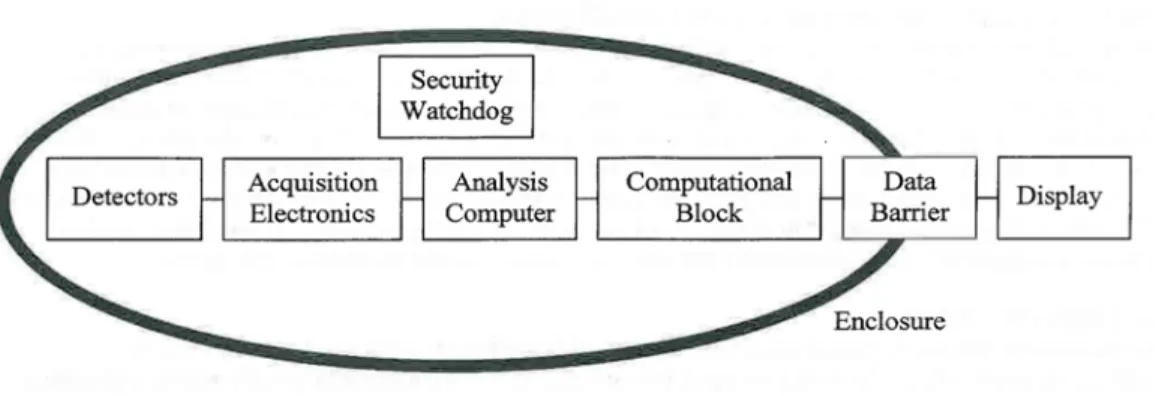
Figure 2: A model for information barrier design. Direct measurements, acquisition, electronics (multi-channel analyzers), and data analysis are performed before a final data barrier. The
inspector receives a Boolean output (TRUE for weapon, FALSE for counterfeit). [44] and Sandia. In general, active interrogation systems allow the monitoring party to verify the authenticity of warheads with higher fidelity, but require an external radiation source which introduces additional logistic and technological burdens. Others have proposed gamma radiography for active interrogation, but the rapid attenuation of photons in high-Z materials have generally made neutrons the preferred option [38].
5.4 Information Barriers
The national lab proposals (with the exception of NMIS) use computational information barriers to protect the host country’s design information. Traditional information barriers (IBs) use system, hardware, and software design to prevent the disclosure of classified measurement information while providing diagnostic confidence to the monitoring country. A basic layout for information barriers is shown in Figure 2.
Computational information barriers are designed to promote transparency for the host and monitor. They employ dedicated CPUs with highly restricted functionality to analyze the data and encrypt it before display. They attempt to minimize electromagnetic emanations. They utilize simple detectors and multi-channel analyzers to acquire the measurement information. Despite these attempts to maximize transparency, inspection of these systems can remain difficult and opaque. Host countries generally insist on supplying the integrated system to minimize the potential for information leakage, but this invites opportunities of subterfuge and hoaxing [45].
Some of these systems become so complex that their own design can become classified, further obfuscating the ostensible transparency of the information barrier [35]. Additionally, for template-based designs, storage of highly sensitive “fingerprint” information remains
an unsolved problem for IB designers. The host fears that the monitor will use it to obtain the design information while the monitor fears that the host will tamper with it, so custody becomes a major point of contention. The inherent complexity and opaqueness of computational IBs undermines the political feasibility of their implementation.
6 Zero-Knowledge Physical Cryptography
To solve many of the problems posed by IBs, researchers at Princeton and MIT have proposed an entirely new approach to verification. These new methods use the template-design with active interrogation, but use physical processes combined with zero-knowledge proof protocols to ensure that no direct measurement of the object is ever taken. This physical cryptography obviates the need for information barriers, simplifying design and improving transparency.
These new verification approaches rely on zero-knowledge (ZK) protocols developed by Goldwasser in 1988. Zero-knowledge protocols verify a claim without informing the verifier about why the claim is valid. [46]
An effective example is posed on Wikipedia using marbles. A regime needs to verify that the number of marbles (x) in two cups is identical without knowledge of the number of marbles in either cup. To accomplish this, the host prepares two buckets with 100-x marbles in each bucket. The verifier then chooses which cup to empty into which bucket. If either bucket does not contain 100 marbles, the verifier knows that the host was lying. As this measurement is repeated, the verifier gains confidence that the number of marbles in each cup is identical without ever learning the value of x. The confidence associated with a verification process using N number of trials can be described by P (N) = 1 0.5N.
It is important to note that the marble example and many recent developments in verification are not, strictly, zero-knowledge. In the marble example, for instance, the verifier learns that there are fewer than 100 marbles in the original cups. While there are ways to perform the marble example that satisfy a strict zero-knowledge protocol, in practice, verification approaches do not need to meet strict ZK standards in order to be useful. Because we can be fairly certain that every warhead contains weapons-grade uranium or plutonium, a system that potentially reveals the presence of a fissile isotope in a warhead does not violate reasonable standards of information security.
The Princeton group successfully implemented this approach for a zero-knowledge system with fast-neutron radiography. In their system, two arrays of identical preloaded detectors are configured by the host country. These detectors are preloaded with the negative of the radiograph from the warhead template. The monitoring country then selects which array will measure the template and which array will measure the submitted item. If the host country
has attempted to defraud the inspectors by changing the preloads in one of their arrays there is a high probability of being caught when the monitor performs multiple measurements [3].
This system improves on IB designs because by eliminating the reliance on electronic encryption and simplifying overall system design. However, it faces two major disadvantages.
First, the system is isotopically insensitive, and may be vulnerable to hoaxing scenarios. Because it relies primarily on fast neutron interactions, there are multiple combinations of isotopes that can result in similar overall neutron cross sections and thus similar overall measurements. Specifically, the system may be insensitive to substitutions of weapons grade plutonium for reactor grade plutonium in potential hoaxes. Research to solve this problem through additional measurements (particularly of spontaneous fissions in Pu-240) is ongoing [47].
Second, the detector preload restricts potential detector technology to superheated emul-sion detectors and neutron activation detectors. Superheated emulemul-sion detectors only operate at about 1% efficiency, and are highly temperature sensitive which results in long measure-ment times and a necessity for precise temperature controls. Neutron activation detectors (often Zirconium or Indium based) operate at an even lower efficiency (0.25%). Additionally, the preloads for both detectors decay over time, so the preload and measurement must be precisely timed to ensure information security. [3]
To solve many of these problems, researchers at MIT have combined isotopically sensitive approaches with new zero-knowledge protocol design. These new systems use epithermal neutron radiography in lieu of the fast neutron radiography used by Princeton and NMIS. Neutron resonance transmission analysis (NRTA) is highly sensitive to isotopic variations in interrogated materials due to isotopically unique resonance absorption spectrums. These cross sections are nearly impossible to hoax and can be used to precisely determine isotopic abundances in interrogated material. Using time-of-flight techniques, the energy spectrum for incident neutrons on a detector can be reconstructed with high precision (around 1 eV), and analyzed for verification purposes. Absorption resonance regions for plutonium isotopes are shown in Figure 3 [48].
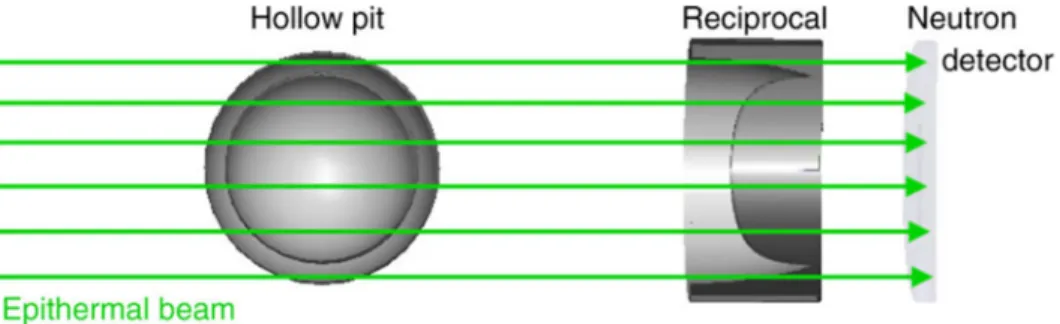
Early iterations of NRTA did not implement a zero knowledge protocol to protect the classified measurement information. New research at the MIT Laboratory for Nuclear Security and Policy has incorporated these zero-knowledge design protocols into new system designs. These designs call for the measurement of an aligned pit and reciprocal object to physically encrypt both isotopic and geometric design information about the interrogated warhead. The reciprocal is a physical object designed by the host country with the same isotopic characteristics as the warhead. When appropriately aligned with an interrogated pit, the areal density across the pit-reciprocal object is uniform, shown in Figure 4. Functionally the
Figure 3: Neutron absorption resonances are plotted for a variety of plutonium isotopes. The unique shapes of these spectra allow precise reconstructions of isotopic abundances in interrogated material. [48]
reciprocal preloads neutron attenuation across each linear path through the material. Monte Carlo simulations have shown that the reciprocal can be designed such that measurements through the pit-reciprocal object reveal no useful geometric information about the warhead [48].
Isotopic information can also be physically encrypted by adding homogeneous material to the reciprocal of an unknown isotopic constitution. Ultimately, the measurements will only determine the isotopic abundance across line integrals through the pit-reciprocal object. If appropriately designed, it is impossible for inspectors to reconstruct the isotopic characteristics of the isolated pit object [48].
The reciprocal-based epithermal design offers two distinct advantages over the Princeton proposal. First, due to its isotopic sensitivity, it is sensitive to a broader range of possible hoaxing scenarios. Second, because it does not rely on preloaded detectors, detector selection is less constrained by the design criteria. This aspect of the design could substantially simplify the verification system by eliminating the need for precise timing of preload decays and also eliminate the issues of detector temperature sensitivity. The MIT design could also improve the counting accuracy of the system by utilizing modern solid-state detectors with efficiencies approaching 80% [49].
Figure 4: The pit-reciprocal object is designed to ensure that areal isotopic densities are constant across the object. This ensures a constant rate of neutron attenuation, and provides geometric information security for the host. Simulations have shown that neutron in-scattering does not appreciably impact this geometric security. [48]
of detector and reciprocal objects is essential for geometric and isotopic information security. Small deviations in alignment could result in significant information leakage. One potential solution to this alignment sensitivity is to decrease the resolution of the detector array. Another possible solution utilizes single-pixel comparative tomography [50] which is further discussed in Section 7. Second, collimated beams of epithermal neutrons are somewhat more difficult to produce than collimated beams of fast or thermal neutrons. Recent work has demonstrated the feasibility of thermalized neutron spallation as a viable source for epithermal neutrons for neutron powder diffraction [51]. Moderated Cf-252 sources are another potential epithermal source for NRTA. LinAc and DT neutron sources are also viable for verification applications. Due to the diversity of options and techniques, access to adequate neutron sources should not pose a serious obstacle for verification, especially in countries with robust nuclear infrastructure.
This epithermal approach also requires that the warhead be fully dismantled before the verification process. Otherwise, the hydrogenous high-explosive surrounding the pit will significantly attenuate the epithermal beam. Verification approaches employing passive gamma spectroscopy and fast neutron detection do not require prior disassembly. For different applications, such a requirement might present a major obstacle for implementation; however, because verification is focused on the support of disarmament efforts, verified pits would have been marked for disassembly anyway. The requirement that warheads be disassembled prior to measurement becomes significantly more modest and feasible with the understanding that the warheads would have needed to have been disassembled eventually regardless of the physical limitations of the measurement. For an more in-depth discussion of the non-technical verification procedures, see Kemp [4] and Hecla [48].
7 Zero-Knowledge NRTA Tomography
While the verification system proposed by Hecla et al. provided promising results for the feasibility of zero-knowledge system and physical cryptography, it introduces new security and technical challenges to the verification process. [48]
While the geometric reciprocal mask does ensure geometric and isotopic information security when properly aligned with the interrogated pit, small misalignments between the two objects could result in a substantial leak of both geometric and isotopic information. Depending on the resolution of the neutron detector, alignment errors as small as 50 microm-eters could reveal the radius, thickness, and enrichment of an interrogated warhead. This concern was emphasized during multiple conversations with specialists at the National Labs. These vulnerabilities could be mitigated through precise alignment, coarser imagers, and the introduction of films to “smear" the image. However, the alignment issue remains an important failure point for the system, and concerns about information security cannot be easily dismissed when the system involves the use of images.
Another difficulty in the reciprocal mask approach is the construction of a complex reciprocal—and possibly multiple reciprocals depending on machining tolerances—for each warhead design in a host’s stockpile. The manufacture of these reciprocals would require relatively large amounts of enriched fissile material and precise machining in each design case. Additionally, the large amount of fissile material involved in the construction of these masks would require designers to consider criticality as a potential failure point. Though the reciprocal might be sliced into sections to mitigate these criticality concerns, such a demand would further complicate the alignment issues discussed previously, and amplify concerns about information security.
Finally, the work completed by Hecla et al., relies only on Monte Carlo simulations for a proof of concept. Though MC simulations have proven to be a highly useful tool for feasibility studies and design optimization, an experimental verification of such a design would be essential before widespread adoption. These concerns combined with the need for an experimental validation of a physical cryptography system lead us to explore single-pixel tomography as a potential solution to both the security and technical concerns with previous work.
7.1 Configuration and Process
To avoid the use of a geometrically complex reciprocal mask and mitigate possible alignment issues, single-pixel tomography was considered as an alternative. Not only does tomography resolve the alignment concerns discussed previously, it also requires a far simpler experimental
set up. Such a design would require only a collimated neutron source, a test object, a simple encrypting filter, and a lithium glass neutron detector.
Geometrical uniqueness is determined by performing a series of random rotations between on axis measurements of a pit object. It can be shown that geometrical uniqueness only requires 3 to 4 measurements for single pixel tomography [4]. While it is possible to manufacture geometrically dissimilar objects that produce similar spectra, as the number of rotations increases, these hoax geometries rapidly become impractically complex. For each measurement the detector would measure the total flux of all neutrons transmitted through the source and provide geometrically and isotopically sensitive data that, when combined across different rotations, uniquely identify the fingerprints for genuine warheads.
To maintain information security with the single pixel system, an encrypting foil is placed into the beam line. The encrypting foil can be a simple plate with an isotopic composition similar to that of the pit object. With the inclusion of the foil, the detector measures only the combined attenuation spectrum of the pit plus the encrypting foil. With such a system, it becomes impossible to isolate and determine the enrichment of the pit as distinct from the encrypting foil.
The high-level approach to template-based warhead verification is discussed Hecla et al [48]. The inspecting country announces an inspection of a host country. A short time later, some random deployed warhead is removed from an ICBM or SLBM. If the inspector is concerned about hoaxing, it might remove multiple deployed warheads. The deployed warheads are measured to establish a unique fingerprint of authenticity. Measurements of candidate warheads are then compared to this authentic fingerprint to establish genuineness. Using the tomographic process described above, each measurement would consist of 5 steps. 1. The genuine reference warhead, the encrypting foil, and the neutron detector are aligned
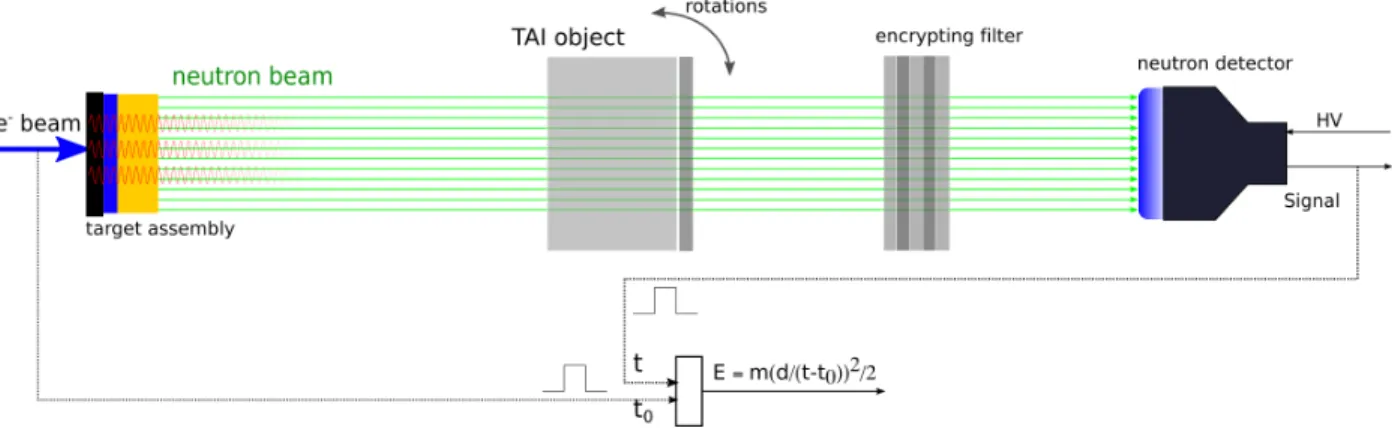
along the axis of an epithermal neutron beam. A full schematic for the measurement is show in Figure 5. The encrypting filter is manufactured by the host, and its precise geometric and isotopic composition is unknown to the inspectors; however, a treaty might enumerate a list of isotopes that such a filter was allowed to consist of. The encrypting filter would be composed of the same isotopes as the test object, and could be constrained to achieve some minimum flux at the detector surface. The host takes a spectroscopic measurements of the genuine warhead and observes the data. If the host approves the data, the inspectors may record the measurement for use as a fingerprint. If the host rejects the data, it is deleted and the measurement retaken.
2. The encrypting filter is left in place while the genuine reference warhead is replaced with a candidate warhead. A measurements is taken under the conditions described in
Figure 5: A schematic for the tomographic pit measurement. Measurements are taken of the pit and encrypting foil which provides isotopic and geometric information security. Geometrical uniqueness is achieved via rotations.
step 1. This step can then be repeated for as many candidate warheads as desired. 3. The spectrum from the genuine reference warhead is compared with the spectrum of
each candidate warhead. If a statistical 2 test produces a test statistic above a certain threshold (as determined by treaty partners) the interrogated object is declared a hoax, and appropriate punitive action as determined by the treaty is initiated against the host. If the result of the 2 test does not exceed the established threshold, the measurement proceeds to step 4.
4. The genuine reference warhead is now placed back into the beam line, now with some specified random rotation. The rotation is generated by the inspector using a random number generator. At this time, the hosts replace the encrypting foil with a new filter to prevent differential analysis. The encrypting foil should always be replaced in between rotational measurements to maintain information security. Steps 1 to 3 are repeated for the new rotation and encrypting foil. The genuine warhead is measured and then replaced with a rotated candidate. The spectra are compared and if the 2 test exceeds an established threshold, the candidate is labeled a hoax.
5. Step 4 can be repeated any number of times to increase the geometrical sensitivity of the verification system. Based on previous work performed by [4], three rotations should be sufficient for a viable verification system, but this would ultimately be determined by treaty partners during negotiations.
Experimental work focused on determining the feasibility of this design for use in a verification regime. Measurements were performed at the Rensselaer Polytechnic Institute Gaerttner LINAC center, a facility optimized for neutron TOF cross section measurements.
The experimental set-up is discussed in-detail in the methods section. Ultimately the system was able to clear all genuine warhead candidates, and identify both geometric and isotopic hoaxes demonstrating a proof of concept for the zero-knowledge tomographic design. These results are discussed in-detail in the results section.
7.2 Methods
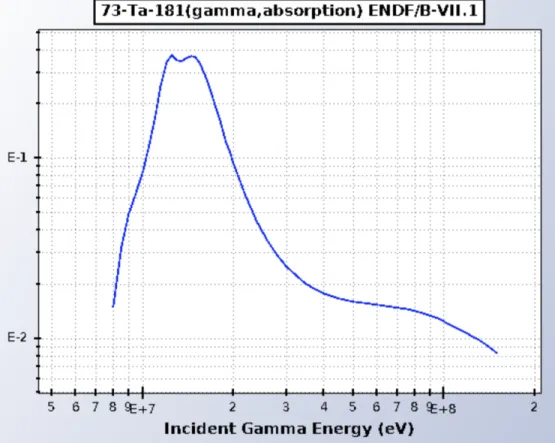
The Gaerttner LINAC center uses a 60 MeV electron beam to generate pulsed, moderated neutrons for TOF cross section measurements, and was constructed to support the U.S. Navy’s reactor research in the 1960s. To generate neutrons, electrons are accelerated along the LINAC into a tantalum target where they create bremsstrahlung radiation as they slow down in the target. The bremsstrahlung radiation then impinges on the same tantalum target, where the high energy photons cause ( ,n) reactions in 181Ta. 181Ta is a weakly confined nucleus which can disintegrate above a threshold of approximately 8 MeV. The cross section for this reaction is shown in Figure 6.
The neutrons from photodisintegration are emitted isotropically from the tantalum target. They are then collimated and moderated into a low energy pulsed beam. After moderation, the neutron energies ranged from thermal to MeV, but a cadmium filter after the HDPE moderator eliminated the thermal flux before the start of the beam line. A small fission chamber within the beam line provided data to normalize for the small fluctuations in the beam flux. The beam path was kept at vacuum for all measurements, and used a lithium glass neutron detector for data acquisition with a beam path of 15.12 meters. The beam was collimated to a 4.7625 cm diameter before transmitting through the target and encrypting foil.
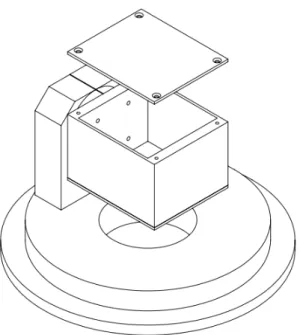
The target was contained within an aluminum box machined at MIT’s central machine shop. The box was designed to rotate through a variety of angles without the need to unmount the sample from the beam line. The encrypting plates were mounted directly to sample holder in the beam line. The plates were manually swapped between different rotations. Figure 7 shows a schematic of the holder for the measurements. Due to relatively low interaction cross sections, the 1 mm of aluminum within the beam line did not significantly affect measurements.
7.2.1 Targets
Due to the lack of availability of plutonium and uranium for experiments, the targets consisted of proxies that were available in an academic setting. Such proxies needed to have epithermal resonance structures in the energy range between 1 eV and 200 eV. We used
Figure 6: Cross section for photodisintegration of 181Ta. Photodisintegration likelihood increases with increasing photon energy with a threshold at approximately 8 MeV. Photo-disintegration allows even relatively low energy bremsstrahlung radiation to produce large numbers of neutrons. Cross section from ENDF data.
Figure 7: Schematic of the object holder. The interrogated object is contained within an aluminum box and suspended in the beam line. The box is able to freely rotate through any rotations of interest. The encrypting foil is mounted directly to the mounting plate during measurements.
natural molybdenum and tungsten for this purpose. In this experiment molybdenum was used as a proxy for 239Pu (and235U) while tungsten was used as a proxy for 240Pu (and238U).
We used simple cylindrical and box geometries instead of hollow pits—which are more typical in actual weapon designs—to simplify the manufacturing process. In our measurements, cylindrical configurations were a proxy for genuine warheads while a box configuration represented a geometric hoaxing attempt. All objects had a depth of 30 mm with a diameter (or side length for the hoax) of 50.8 mm.
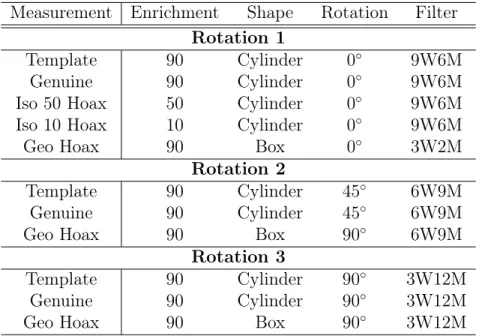
The experiment took measurements of five proxy pit objects designed to evaluate possible failure points for the system. The geometric hoax was deliberately designed to be cleared by the first, on-axis measurement. This necessitated the use of rotations to identify the hoaxing attempt.
1. A genuine reference object consisted of 50.8 mm diameter cylinder with 27 mm of molybdenum and 3 mm of tungsten. This corresponded to a 90% pit enrichment. 2. A genuine candidate with identical geometry to the template. This was used to
determine whether the system was able to clear honest objects.
3. An isotopic hoax at 50% enrichment with the same diameter as the template but with 15 mm of molybdenum and tungsten each.
Measurement Enrichment Shape Rotation Filter Rotation 1
Template 90 Cylinder 0 9W6M Genuine 90 Cylinder 0 9W6M Iso 50 Hoax 50 Cylinder 0 9W6M Iso 10 Hoax 10 Cylinder 0 9W6M Geo Hoax 90 Box 0 3W2M
Rotation 2
Template 90 Cylinder 45 6W9M Genuine 90 Cylinder 45 6W9M Geo Hoax 90 Box 90 6W9M
Rotation 3
Template 90 Cylinder 90 3W12M Genuine 90 Cylinder 90 3W12M Geo Hoax 90 Box 90 3W12M
Table 5: List of experimental measurements. Measurements were chosen to identify potential failure points for the assembly. These included clearing genuine candidates, discriminating against isotopic hoaxes, and employing rotations to identify geometric hoaxes.Filter notation XWYM refers to X mm of tungsten and Y mm of molybdenum.
4. An isotopic hoax at 10% enrichment using 3 mm of molybdenum and 15 mm of tungsten. 5. A geometric hoax consisting of a 50.8x50.8x30 mm box at 90% enrichment (27 mm of
molybdenum with 3 mm of tungsten).
The template was compared to the genuine pit and the isotopic hoaxes via a single on-axis measurement. It was compared to the geometric hoax using three different rotations at 0 , 45 , and 90 . The geometric hoax was only differentiated at the 45 and 90 rotations. 7.2.2 Measurements
The experiment consisted of 11 primary measurements taken over approximately 3 hours at the Gaerttner LINAC. A full list of primary measurements is shown in Table 5. Various encrypting foils were constructed from combinations of tungsten and molybdenum plates (each one 3mm thick). Filter notation XW6M refers to X mm of tungsten and Y mm of
molybdenum.
The fission chamber was used to normalize any beam fluctuations that occurred over the 3 hour measurement time—such fluctuations proved to be minimal. The background was also measured and determined to be low relative to the flux of the beam line. Additional
measurements using a smaller collimator were not ultimately included in the analysis of the results.
7.2.3 Detector
The experiment used a simple lithium glass detector for neutron detection. Lithium glass detectors detect neutrons via 6Li(n, t)↵ reaction. When a neutron interacts with 6Li, the lithium breaks into an alpha particle and triton. Both of these charged particles scintillate in the glass which in turn is amplified by a photo-multiplier tube, and ultimately registered as an event by the detector.
Because the energy of the resulting alpha and triton are only loosely connected to the energy of the incident neutron, the original energy of the neutron is lost to the detector. The energy of neutrons cannot be easily measured directly as with other forms of radiation. The energy spectrum of transmitted neutrons needs to be reconstructed using other methods. 7.2.4 Time of Flight Reconstruction
The incident neutron energy spectrum was reconstructed using time of flight analysis. To improve the empirical accuracy of the reconstruction, an energy spectrum for 3 mm of tungsten was compared to cross section data from ENDF. The expected locations of the tungsten resonances were compared with the locations of those resonances in the data, and significant discrepancies began to appear at energies above 50 eV.
Using a two parameter fit for the flight path and t0 somewhat improved the reconstruction, but nonlinearities in the time-to-energy transformation continued to introduce discrepancies into the reconstructed spectrum. Further analysis demonstrated that these nonlinearities were a result of variations in neutron moderation times. On average, lower energy neutrons exited the moderator more slowly than higher energy neutrons, since they had to spend additional time within the moderator to reach those lower energies.
Ultimately, we determined a relationship between neutron energy and moderation time (and thus t0) using a specialized Monte Carlo simulation. The relationship between mean
moderation time and detected neutron energy was well defined by a power law,
Tmod(E) = 2040· e 0.500·E+ 42.1 ns. (1) When this power law was implemented to adjust the t0 of incident neutrons, the TOF reconstruction became highly accurate, correctly predicting resonances at over 100 eV.
Ultimately, the accuracy of the TOF reconstructions had a minimal impact on direct chi-squared comparisons between various spectra. However, the accuracy of the reconstructions provided confidence that the measurements were physically accurate.
7.3 Results
Pure molybdenum and tungsten plates were measured to assess calibration and TOF recon-struction accuracy during analysis. The shapes of the molybdenum and tungsten spectra were referenced against the expected resonance locations and intensities for natural tungsten and molybdenum. The Joint Evaluated Fission and Fusion Nuclear Data Library (JEFF 3.2) was used for cross section data. After TOF modifications described in Section 7.2.4, the spectral and cross section data were in strong agreement with each other.
The comparisons between the genuine warhead and isotopic hoaxes are shown in Figure 8. The differences in the measured spectra are highly apparent even upon visual inspection, and the reduced chi-squared values for the each comparison reflect this high degree of separation. Because the resonant attenuation is highly nonlinear, it remains possible to differentiate the isotopic hoaxes even when the spectra are normalized for total integrated counts. This indicates that this method is sensitive to both total counts and spectral shape and is robust to a broader range of possible hoaxing scenarios that might employ HDPE to decrease absolute neutron flux homogeneously across the epithermal energy range.
A measurement along the z-axis for a specific geometry is sensitive only to the projection of that geometry (and its isotopics) on the axis of measurement. The transmission T for a an energy bin E and a spherically symmetric geometry can be approximated as
ln T ' X i i(E)NAv⇢i Ai 2⇡ Z cos ✓0 cos 1 Z X 0 fi(r, cos ✓)drd cos ✓, (2) where i(E), ⇢i, X, ✓0 and Ai are the cross section, density, total thickness, solid angle, and atomic number for isotope layer i of the object, respectively. fi(r, cos ✓) is the fractional abundance of isotope i at a particular radial coordinate, and NAv is Avogadro’s number. The summation is performed across every isotope within the object, and the radial and polar integration occur over the range of the object’s dimensions. The neutron detector effectively reduces this spacial integral to a single spectral measurement, and geometrical information is lost during this compression. However, further geometrical sensitivity can be gained back by performing multiple measurements at different rotations. Previous work has shown that if these rotations are random, only one or two of these rotations is necessary to guarantee the
Figure 8: Histograms of neutron count energies, as reconstructed via the TOF technique, for two isotopic hoaxes. a The template data from an authentic reference of 90/10 Mo/W composition (blue) is compared to the data from a 50/50 Mo/W isotopic hoax (red). b The data from the authentic reference is compared to that from a 10/90 Mo/W isotopic hoax (red). The legend lists the 2 value, the number of degrees of freedom, and the corresponding probability (p-value) for the 2 test. Both hoaxes are rejected. The solid and dashed vertical lines denote the locations of some of the known tungsten and molybdenum resonances, respectively. Data collection lasted approximately five minutes per object.
Figure 9: Histograms of neutron count energies, as reconstructed via the TOF technique, for a geometric hoax. The geometric hoax has been constructed as to have the same areal density along z-axis as the genuine reference. The template data from an genuine reference (blue) is compared to the data from the geometric hoax (red) at ✓ = 0 (top), ✓ = 45 (middle), and ✓ = 90 (bottom). As expected per design the ✓ = 0 yields a perfect agreement, as shown by the p-value. The rotations readily expose the hoax.
geometrical uniqueness of a given object.
In order to prevent differential analysis on the multiple measurements, it is essential that the host country have the opporunity to change the encrypting foil between rotational measurements. By swapping encrypting foil, the host country ensures that the degrees of freedom for the measurements exceeds the estimated parameters, and information security is preserved.
Figure 9 shows the comparison between the template and geometric hoax across three rotations of 0, 45, and 90 degrees. Due to a deliberate choice of hoax pit geometry, the geometric hoax initially clears the inspection when measured on axis at 0 degrees. However, additional rotations reveal the hoaxing attempt. Reduced chi-squared values for the geometric rotations are lower than those for the isotopic hoaxes but remain significantly large to confidently differentiate the geometric hoaxes with a p-value less than 10 5.