HAL Id: hal-03160056
https://hal.laas.fr/hal-03160056
Submitted on 4 Mar 2021
HAL is a multi-disciplinary open access
archive for the deposit and dissemination of
sci-entific research documents, whether they are
pub-lished or not. The documents may come from
teaching and research institutions in France or
abroad, or from public or private research centers.
L’archive ouverte pluridisciplinaire HAL, est
destinée au dépôt et à la diffusion de documents
scientifiques de niveau recherche, publiés ou non,
émanant des établissements d’enseignement et de
recherche français ou étrangers, des laboratoires
publics ou privés.
Multi-Mode RCPSP with Safety Margin Maximization:
Models and Algorithms
Christian Artigues, Emmanuel Hébrard, Alain Quilliot, Hélène Toussaint
To cite this version:
Christian Artigues, Emmanuel Hébrard, Alain Quilliot, Hélène Toussaint.
Multi-Mode RCPSP
with Safety Margin Maximization: Models and Algorithms.
10th International Conference on
Operations Research and Enterprise Systems, Feb 2021, Online Streaming, Austria. pp.129-136,
�10.5220/0010190101290136�. �hal-03160056�
Multi-Mode RCPSP with Safety Margin Maximization: Models and
Algorithms
Christian Artigues
1, Emmanuel Hebrard
1Alain Quilliot
2and Helene Toussaint
21LAAS Laboratory, CNRS, Toulouse, France 2LIMOS Laboratory, CNRS, Clermont-Ferrand, France
{artigues, hebrard}@laas.fr, {alain.quilliot, helene.toussaint}@isima.fr
Keywords: Scheduling, Resource Constrained Project Scheduling Problem, Evacuation Process, Network Flow, Branch and Bound, Linear Programming.
Abstract: We study here a variant of the multimode Resource Constrained Project Scheduling problem (RCPSP), which involves continuous modes, and a notion of Safety Margin maximization. Our interest was motivated by a work package inside the GEOSAFE H2020 project, devoted to the design of evacuation plans in face of natural disasters, and more specifically wildfire.
1 INTRODUCTION
RCPSP: Resource Constrained Project Scheduling Problem (see (Hartmann, 2010), Herroelen, 2005), (Orji, 2013)) involves jobs subject to both temporal constraints and cumulative
resource constraints. In multimode RCPSP (see
(Bilseka, 2015), (Weglarz, 2011), resource requirements are flexible and the scheduler may cut
a trade-off between speed and resource
consumption. The MSM-RCPSP (Multimode with
Safety Maximization RCPSP) model introduced is a
variant of multi-mode RCPSP: for any job j, we must choose its evacuation rate vj, which determines, for any resource e in the set (j) of resources required by j, the amount of e consumed by j. Release dates Rj and deadlines j are imposed, and performance is about safety maximization, that means the minimal difference (safety margin), between job deadlines and ending times.
MSM-RCPSP was motivated by the H2020
GEOSAFE European project (GeoSafe, 2018), related to the management of wildfires. At some time during this project, we dealt with evacuation schedules. While in practice evacuation is managed in an empirical way, 2-step optimization approaches have been recently tried (see (Artigues, 2018), and (Bayram, 2016)): the first step (pre-process) identifies the routes that evacuees are going to follow; the second step schedules the evacuation of
estimated late evacuees along those routes. This last step implies priority rules and evacuation rates imposed to evacuees and resulting models may be cast into the MSM-RCPSP framework.
The paper is structured as follows: Section II describes the MSM-RCPSP model. Section III solves the fixed topology case. In Section IV we prove that MSM-RCPSP preemptive relaxation can be solved in polynomial time. We design in Section V and VI both fast heuristic network flow techniques, well-fitted to real-time management, and an exact branch and bound algorithm. Section VII is devoted to numerical tests.
2 MULTI-MODE RCPSP WITH
SAFETY MAXIMIZATION
MSM-RCPSP is related to a set J of jobs,
subject to release dates Rj and deadlines j, j J, which have to be scheduled while maximizing what we call the Safety Margin. That means that we want to compute starting times Tj and ending times T*j in such a way that, for any job: Rj ≤ Tj < T*j ≤ j, and that resulting Safety Margin, defined as equal to the quantity Inf j J (j - T*j), is the largest possible. But we do not know the durations of those jobs: as a matter of fact, duration of j is determined as a quantity P(j)/vj, where P(j) is some fixed coefficient
and vj is the speed of j, which is part of the problem
and which we also call evacuation rate in reference to the Late Evacuation problem set in the context of H2020 GEOSAFE project. The choice of those
evacuation rates is constrained in a cumulative way
by the existence of a resource set E: any job j involves a subset J(e) E of resources and at any time between Tj and T*j its consumption level of any resource e E is equal to the evacuation rate vj, while the amount of available resource e is bounded by a fixed number CAP(e). Let us first link
MSM-RCPSP with evacuation problems and the
GEOSAFE H2020 Program.
2.1 Tree Late Evacuation (Tree-LEP)
We consider here a transit (evacuation) networkH = (V, E), supposed to be an oriented tree:
Leaf subset J V, called evacuation node set, identifies groups of P(j) j-evacuees who must reach the anti-root safe node SAFE while following the arcs of related path (j). The last
j-evacuee must reach SAFE before deadline j. Only one arc e(j) has origin j and only one arc has destination SAFE.
Every arc e E is provided with time value
L(e), required for any evacuee to move along e; L-length of(j) is denoted by Length(j). Every
arc e E is also provided with some capacity
CAP(e): no more than CAP(e) evacuees per
time unit may enter e at a given time t.
Practitioners impose that all j-evacuees move along
(j) according to the same evacuation rate vj. This
Non Preemption Hypothesis, makes the j-evacuation
process to be determined by its starting time TD j (when a first j-evacuee leaves j), its ending time TAj, (when the last j-evacuee arrives to SAFE) and its
evacuation rate vj, subject to (Evacuation Rate
Formula): TAj = TDj + Length(j) + P(j)/vj.
Then the Late Evacuation Problem (LEP) consists in the search TDj, TAj, vj, j J, consistent with deadlines and capacities, and maximizing the global safety margin Inf j (j - TAj).
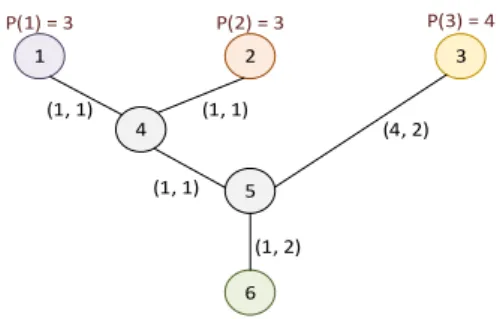
Example 1: For any arc e in Fig. 1, the first
number means the length L(e) and the second one its capacity CAP(e). In case 3 = 7; 2 = 1 = 13, we make (optimal schedule) group 3 start at time zero according to full rate v3 = 2, and both groups 1 and 2 start at time 4, according to rates v1 = v2 = ½.
1 2 4 5 6 3 P(1) = 3 P(2) = 3 P(3) = 4 (1, 1) (1, 1) (1, 1) (1, 2) (4, 2)
Figure 1: An Instance of Tree-LEP.
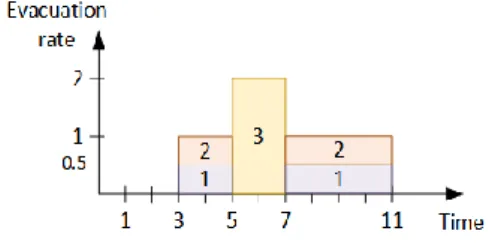
Figure 2 represents related optimal schedule according to a Gantt diagram: The height of rectangle j is the evacuation rate; its width is delimited by the time when population j starts entering node 6 and the time when it has finished.
Evacuation rate Time 1 1 5 7 13 3 2 0.5 1 2 T(3) T*(3)
Figure 2: TREE-LEP Schedule in RCPSP format.
In order to turn a Tree-LEP solution into
RCPSP format, we set, for any j in J: Rj = Length(j) and vminj = P(j)/((j) –Rj)). Seadline constraint implies vj ≥ vminj ; vmaxj = CAP(e(j)). Then we
consider the process defined by the j-evacuees when they enter into the SAFE node, and call it evacuation
job j. Its starting time is Tj = TDj + Length(j), its ending time is T*j = TAj and we want to maximize
Safe-Margin = Min j J (j – T*j ). If vj denotes
related evacuation rate, we get the following
temporal constraints: Rj ≤ Tj ≤ T*j ≤ j and T*j = Tj + P(j)/vj. As for resource constraints, we say that 2 jobs j1, j2, overlap iff interval [Tj1, T*j1] [Tj2, T*j2] is neither empty nor reduced to one point. Then
resource constraints tells that for any arc e in A and
for any Overlap clique J0 J(e) ={j such that e (j)}, we should have: j J0 J(e) vj ≤ CAP(e). In case J0 = e(j), this yields vj ≤ vmaxj.
2.2 The MSM-RCPSP Model
According to 2.1, MSM-RCPSP Inputs are: The job set J and the resource set E; for any j J,
Population coefficient P(j), Release date Rj,
Deadline j, maximal evacuation rate vmaxj and set subset (j) E of resources used by j; for any e E, the Capacity CAP(e) = and the subset J(e) E of
jobs j which use e. Then MSM-RCPSP model,
MSM-RCPSP Model: Compute Rational Vectors
T = (Tj, j = 1..N), T* = (T*j, j = 1..N), v = (vj, j = 1..N) ≥ 0, and {0, 1, -1}-valued
vector = (j1,j2, j1, j2 = 1..N) with
Semantics : j1,j2 = 1 ~ j1 << j2; j1,j2= -1 ~
j2 << j1; j1,j2= 0 ~ j1 Overlap j2, such that: Structural Constraints: For any j1, j2,
j1,j2= - j2,j1. Temporal Constraints:
o For any j: Rj ≤ Tj ≤ T*j ≤ j and
T*j = Tj + P(j)/vj; (E1)
o For any pair j1, j2, the following implication holds: j1,j2 = 1 -> Tj2 ≥ T*j; (E1*) Resource Constraints:
o For any j : vminj = P(j)/((j) –Rj)) ≤ vj ≤ vmaxj ;
o For any arc e, (E2) implication holds: (E2) (J0 J is such that for any pair j1, j2 inJ0,
j1,j2 = 0) -> j J0 J(e) vj ≤ CAP(e);
Maximize : Safe-Margin = Inf j ((j) – T*j)} This model fits with industrial contexts, where jobs j involving continuous flows of items are applied a sequence (j) = {ej
1, ej2, .., ejn(j)} of operations, and pipe-lined through some set of machines.
3 FIXING THE TOPOLOGY
It will happen in next sections that we are provided with some topological vector . So we denote by RCPSP() resulting
MSM-RCPSP model. MSM-MSM-RCPSP() model is convex.
In order to linearize MSM-RCPSP(), we replace, for any j, T*j by Tj+ P(j)/vj, and reformulate (E1) as:
o For any j, and any w [vminj, vmaxj]: (j -
RMin - Tj) ≥ (- vj + w).P(j)/w2 + P(j)/w. This constraints tells us that for any w the 2D-point (vj, (j - Tj - RMin)) must be located above the tangent line in (w, P(j)/w) to the hyperbolic curve whose equation is x -> P(j)/x. We proceed the same way with E1* and get the following linear formulation LINEAR-MSM-RCPSP():
LINEAR-MSM-RCPSP(): {Compute T = (Tj, j = 1..N), v = (vj, j = 1..N) ≥ 0 and RMin ≥ 0, s.t:
Temporal constraints: o For any j : Rj ≤ Tj ;
o For any j and any w [vminj, vmaxj]: (E1) (j – Rmin - Tj ) ≥ (- vj + w).P(j)/w2 + P(j)/w; o For any j1, j2 s.t j1,j2 = 1, any w [vminj1,
vmaxj1]: (E1*) Tj2 - Tj1 ≥ (- vj1 + w).P(j1)/w2 + P(j1)/w;
Capacity Constraints : o For any j : vminj ≤ vj ≤ vmaxj ;
o For any e, any subset J0 J s.t for any j1, j2 in
J0, j1,j2 = 0: j J0 J(e) vj ≤ CAP(e); (E2) Maximize : Safe-Margin = RMin}.
We apply a cutting plane process to (E1, E1*):
Linear-MSM-RCPSP-Cut(:
Initialize a set W of constraints (E1, E1*) and condider related restriction
LINEAR-MSM-RCPSP(, W); Not Stop ; While Not Stop do
Solve LINEAR-MSM-RCPSP(, W);
Search for j0 (j1, j2) and w0 such that (E1, E1*) do not hold;
If Fail(Search) then Stop
Else Insert (E1, E1*) related to j0, w0 into W.
4 PREEMPTIVE MSM-RCPSP
Preemptive MSM-RCPSP means that jobs may
stop at some time and start again a little later.
Preemption allows any job j to be split into k(j)
sub-processes j1,.., jk(j), each with starting time tj,k, ending time t*j,k, and evacuation rate vj,k. We denote by
P-MSM-RCPSP the resulting problem. Figure 3
below shows an example of preemptive schedule related to example 1.
Figure 3: P-MSM-RCPSP Schedule.
Let us now suppose that we are provided with some safety margin ≥ 0 which we want to ensure. Then we set S = {Rj, (j – ), j J} and label its elements {t1,.., t2N}, in such a way that t1 ≤ t2 ≤… ≤
t2N. For any k = 1,…,2N-1, we set k = tk+1 – tk. This leads to the following rational PL Preemptive():
Preemptive() Linear Program : Compute
rational vector w = (wj,k , j J, k = 1..2N-1) ≥ 0, whose semantics is that wj,k is the evacuation rate for
j between tk and tk+1, and which satisfies the For any j, k, wj,k ≤vmaxj;
For any arc e, any k: j J(e) wj,k ≤ CAP(e); For any j and any k such that tk+1 ≤ Rj, wj,k = 0 ; For any j, k such that tk ≥ (j – )wj,k = 0}.
Lemma 1: Preemptive() identifies a preemptive
schedule which is consistent with safety margin , in case such a schedule exists.
Proof: If a preemptive schedule exists, consistent
with safety margin , release dates Rj, deadlines j, j J, and capacities CAP(e), e A, then it can be chosen in such a way that for any job j and any k, related evacuation rate of j is constant between tk and tk+1. Then we get above linear program.
We solve P-MSM-RCPSP by applying the following binary process Optimal-P-MSM-RCPSP, which computes optimal safety margin -Val by making iteratively evolve between a non feasible value and a feasible one :
Optimal-P-MSM-RCPSP(Threshold):
<- 0 ; 1 <- Inf j [(j) – (Rj + P(j)/vmaxj)]; w-Sol <- Nil ; Val <- - ; Solve Preemptive();
If Success(Solve) then Val <- 1; w-Sol <- related vector w
Else
Solve Preemptive();
If Success(Solve) then
Val <- 0; w-Sol <- related vector w ;
Counter <- 0;
While Counter ≤ Threshold do
<- (1+0)/2 ; Solve Preemptive();
If Success(Solve) then 0 <- ; Val <- 0; w-Sol <- related w Else 1 <- ;
Optimal-P-MSM-RCPSP <- (Val, w-Sol);
Else Optimal-P-MSM-RCPSP <- Fail;
Theorem 1: Optimal-MSM-RCPSP solves the
P-MSM-RCPSP Problem in Polynomial Time.
Proof: Optimality comes in straightforward way
from the very meaning of linear program
Preemptive(). As for complexity, we set Threshold
= Log2(Sup j Maximal binary encoding size of j and Rj + 1) and derive Time-Polynomiality from time polynomiality of LP.
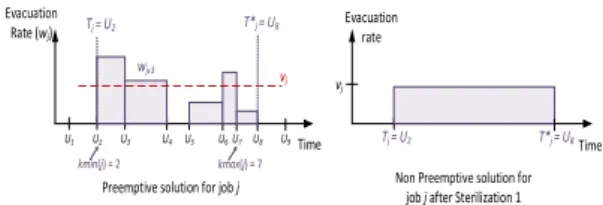
Sterilization: We may try to turn w into a non
preemptive schedule through 2 approaches:
Sterilization1: Smoothing w while keeping safety
margin as in Figure 4 below:
Evacuation Rate (wj) Time U1 U3 U4 U5 U6 U9 vj kmin(j) = 2 kmax(j) = 7 U2 U8 Tj = U2 T*j = U8 U7 wj,3 Evacuation rate Time Tj = U2 T*j = U8 vj
Preemptive solution for job j Non Preemptive solution for job j after Sterilization 1
Figure 4: Sterilization1 Scheme.
Sterilization2: Deriving from w a topological vector , and solving MSM-RCPSP().
5 A FLOW BASED HEURISTIC
This section is devoted to the description of a network flow based heuristic, which implements insertion mechanisms as in (Quilliot, 2012), and computes an efficient feasible MSM-RCPSP solution. We consider resources e as flow units, that
jobs j share or transmit: If we represent every job as
a rectangle whose length is the duration T*j – Tj and height is the evacuation rate vj, then, if j1 precedes
j2, and if not jobs j is located between j1 and j2 on the
e-diagram, then we see (fig. 2 and 6) that part of evacuation rate vj1 related to resource e is transmitted to j2. In order to formalize this, we build an auxiliary network G in which the vertex set is J {s, p}, where s and p are two fictitious jobs source and sink, whose arcs are all arcs (i, j), i, j J, augmented with all arcs (s, j) and all arcs (j, p). Then we consider that the backbone of a schedule is a flow vector w = (wej1,j2, j
1, j2 J(e) {s, p}) ≥ 0, which represents, for all resources e, the way jobs share resource e. Clearly, this vector w must satisfy standard flow conservation laws:
For any e: j J wes,j = j J wej,p = wep,s = CAP(e); For any resource e of E and any job j0 J(e),
j J {p} wej0,j = j J {s} wej,j0 = vj0.
Besides, if we introduce starting times Tj and ending times T*j as in II, then, for any j1, j2, the following implication is true: e we
j1,j2 ≠ 0 -> Tj2 ≥ T*j1. This logical constraint means that if job j1 provides j2 with some part of resource e, then j1 should be achieved before j2 starts. Clearly, we must keep on with the other standard constraints: For any j: Rj ≤ Tj ≤ T*j ≤ j ; vj ≤ vmaxj; T*j = Tj
+ P(j)/vj; Ts = T*s = 0. Maximize Min j (j – T*j).
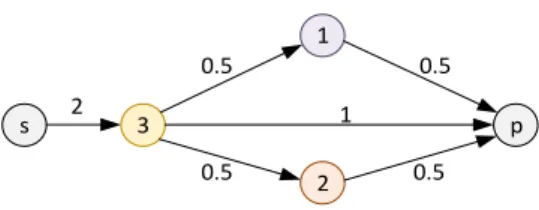
s 1 2 3 p 2 0.5 1 0.5 0.5 0.5
Figure 5: Example 2, with 3 = 7, 1 = 2 = 13.
5.1 An Adaptative Insertion Heuristic
We deal with MSM-RCPSP-Flow through an insertion algorithm which manages two antagonistic trends: when handling job j and trying to insert it into a current partial schedule (T, T*, v), we first compute Tj and next assign vj a value. But if we choose a high value vj in order to make j finish fast, then we may block the access to the most critical resources of (j). In order to find a compromise we control an adaptative safety margin through binary search and a related adaptative priority list , which drives the insertion process for a given . For a given value of , and a current list , the procedureInsert-MSM-RCPSP () scans the jobs j0 in , and try to compute Tj0 and vj0 in such a way that
MSM-RCPSP-Flow constraints are satisfied for all
jobs j before or equal to j0 according to , and that
vj0 is minimal. In case of success, then is
increased, else Insert- MSM-RCPSP() yields a set of pairs j1, j2, asked to become such that j2 j1 (Instruction Update() below).
MSM-RCPSP-Flow(Precision:Number)
Algorithmic Scheme:
Step 1: Start from a non feasible margin -max,
a feasible one -min, a related Current-Schedule;
Initialize priority list : priority given to jobs j
with small P(j) and expected safety;
While (-max --min) ≥ Precision do
<- (-min -max; Insert-MSM ()
If Success then set -min to and Update
Current-Schedule
Else Update(Retrieve topology from
Current-Schedule;
Step2: Solve resulting P-MSM-RCPSP().
5.2 Insert-MSM Procedure
This procedure works while scanning current priority list and assigning Tj and vj values as far as
jobs j come. That means that at any time during the
process, we are considering some job j0, while all
jobs j such that j j0 have been scheduled: for any j J {s} such that j j0, we are provided with values Tj, T*j,vj, as well as with values (e, j) which
represents the amount (evacuation rate) of e-resource that j is able to transmit to j0, according to flow vector we of the MSM-RCPSP-Flow model. Then we proceed in 3 steps:
- 1st step : Scan (j0) according to decreasing (e, j0) values, and for any e in (j0), provide j0 with an amount of resource e in such a way resulting T*j0 does not exceed j0 - .
- 2nd Step : In case of success of previous first
step, we become provided with an evacuation
rate vj0 and, for any resource e ≠ e0 in (i0) with an evacuation rate value v-auxe which may be less than vi0; So the second stepmakes increase the values we
j,i0 for any e e0, j J(e), inorder to make j0 run according to the same
evacuation rate for all arcs e of (j0).
- 3rd step: In case of success of previous second
step, last step is a clustering step, which aims at making decrease the number of resources provided with non null we
j,i0 values, and works by shifting, as far as possible, values we
j,i0 which involve, for a given j, only one resource
e, to another job j’ such that j’ J(e), we j’,i0 ≠ 0 and ( e, j’) ≥ wej,i0 + we
j’,i0.
Example 2: Suppose that we face here the
following situation: = s,…, j1, …, j2, ….j3, …., j0;
(x0) = {e1, e2}; CAP(e1) = 20, CAP(e2) = 25; j0 = 21; P(j0) = 5; Rj0 = 10; j1 J(e1) J(e2); j1 J(e1);
j3 J(e2); P(j1)/v1 = 6; P(j2)/v2 = 3; P(j3)/v3 = 4. Then we get: Step1 -> we1s,j0,= 2; w e2 s,j0 = 3; we1j1,j0 = 8; vj0 = 10; Success; Step2 -> we2 j2,j0 = 7; Success; Step3 -> we1j1,j0 = 0; w e1 j2,j0 = 8; Tj0 = 21.
6 AN EXACT ALGORITHM
This Branch&Bound algorithm relies on sections IV and V: Optimistic estimation (upper bound) derives from IV, and an initial feasible solution is computed according to V. We must specify:
- The nodes of related search tree and the way
optimistic estimation is adapted to those nodes;
- The Branching Strategy and the global Tree
Search process.
The nodes of the Search Tree: Such a node s
will be defined by a Release vector A = (Aj, j J) ≥
R = (Rj = j J), a Deadline vector B = (Bj, j J) ≤ and 2 partially defined Medium vectors U = (Uj, j
o J(s) denotes the set of jobs j such that Uj and
U*j are defined;
o If j J(s), then Aj ≤ Uj < U*j ≤ Bj ;
For a given job j, the meaning of Uj and U*j, j J(s) is that wj = wj(t) must be constant on [Uj, U*j] and such that, for any t’ outside [Uj, U*j], t inside [Uj,
U*j], wj(t) ≥ vj(t’). Then Branching from s. Given a
job j and 2 values and such that Aj < < , node
s gives rise to 3 sons:
First son: Aj is replaced by Second son: Bj is replaced by
Third son: Uj is replaced by and U*j by : we must have: < Uj <U*j < .
The 3-uple (j, ) defines the Branching
Signature. Once created, node s is applied an optimistic estimation procedure, and next, in case Sterilization does not work, stored into a Breadth-First Search list together with resulting value -Val
and related Branching Signature Sign = (j0, ).
Optimistic Estimation and Sterilization Procedures: They derive from Section IV: we solve
P-MSM-RCPSP augmented with additional constraints related to node s. More precisely: For any j, we set B*j = Inf (Bj, j – ) and S =
{Aj, B*j, j J} {Uj, U*j, j J(s)}. We order S = {t1,…, tk,…tK} through increasing values t1 <t2 < … < tK and set, for any k = 1.. K-1: k = tk+1 - tk We build 4 vectors k1, k2, k3, k4, with
indexation on J, and whose meaning is: - k1j means the value k such that Aj = tk ; - k2j means the value k such that B*j = tk ; - k3j means the value k such that Uj = tk; (* If
Uj is undefined, then k3j = 0*)
- k4j means the value k such that U*j = tk ; (*If
Uj is undefined, then k4j = 0*)
According to this, we adapt the program
Preemptive() to node s by setting:
Preemptives(): {Compute w = wj,k , j J, k = 1..K-1} such that;
For any e and any k, j J(e) wj,k ≤ CAP(e)
For any j, k k . wj,k = P(j)
For any j, any k ≤ k1(j) – 1, w,k = 0 ; For any j, any k ≥ k2(j), wj,k = 0 ; For any j, any k ≥ k3(j), w,k+1 ≤ w,k ; For any j, any k ≤ k4(j)-2, wj,k+1 ≥ wj,k .
We try to turn a solution of Preemptives() into a MSM-RCPSP Solution through procedures
Sterilizationx , x = 1, 2 of IV, and adapt Optimal-P-MSM-RCPSP into a procedure UB in order to make
it compute, for a given node s = (A, B, U, U*), related optimistic estimation -Val = UB(s).
Branching Strategy: Let us suppose that we just
computed -Val = UB(s), got a preemptive solution
w, which we could not turn into a non preemptive
solution with better Safety Margin than our current best feasible value. Then, for any job j, we scan the index set 1..K, and compute a word j = {j
1,.., jK} representative of the resource profile induced by j: o If = 1 then wj,k > wj,k-1;
o If = -1 then wj,k < wj,k-1;
o If = 0 then wj,k-1 = wj,k and h =0. This word j enables us to identify:
- 1st Configuration: A hole (see Fig. 6) with some
depth and width and a weight = depth.width;
- 2sd Configuration: No hole but a left stair or a
right stair with once again a depth, a width and a weight.
Evacuation Rate (wj)
Time
α β
Figure 6: Hole (1st Configuration) Branching.
So our Branching Strategy comes as follows: In case Configuration 1, then we compute branching
signature Sign as some related Sg with largest weight = depth.width. In case it does not exist, then
we look for Sg related to configuration 2 with the highest weight value.
Resulting Branch and Bound Algorithm B&B- MSM-RCPSP: B&B- MSM-RCPSP is implemented
as follows, according to a BFS (Breadth First
Search) strategy. In case of interruption, we get a
lower bound BInf and an upper bound BSup.
7 NUMERICAL EXPERIMENTS
Technical Context: Algorithms are implemented in C++, gcc 7.3. Linear models are solved with Cplex 12.8. Hardware involves Processors Intel(R) Xeon(R) CPU E7-8890 v3 @ 2.50 GHz, run by Linux.
Instance Generation: Instances come from the
clustered into 10 instance groups dense_x,
medium_x, sparse_x, where x is the number of jobs,
and dense, medium and sparse are related to the mean degree of the nodes in related tree.
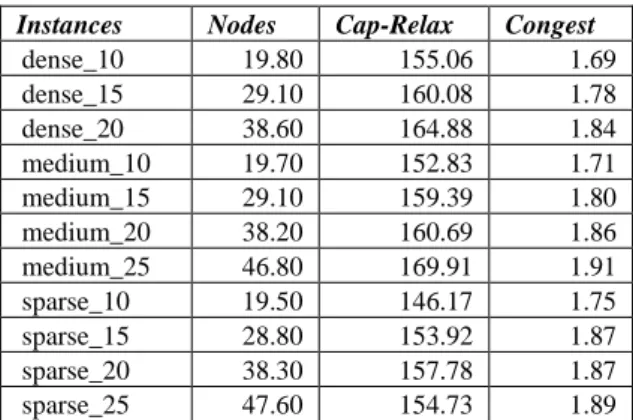
Table 1: Characteristics of the Instances.
Instances Nodes Cap-Relax Congest
dense_10 19.80 155.06 1.69 dense_15 29.10 160.08 1.78 dense_20 38.60 164.88 1.84 medium_10 19.70 152.83 1.71 medium_15 29.10 159.39 1.80 medium_20 38.20 160.69 1.86 medium_25 46.80 169.91 1.91 sparse_10 19.50 146.17 1.75 sparse_15 28.80 153.92 1.87 sparse_20 38.30 157.78 1.87 sparse_25 47.60 154.73 1.89
For any 10 instances group, above Table 1 provides us with: the mean number Nodes of nodes, the minimal duration Cap-Relax of the evacuation process in case capacity constraints are relaxed and the mean (for all nodes x) ratio Congest, between the sum of capacities of the in-arcs and the capacity of the out-arc related to x.
7.1 Evaluating
Optimal-P-MSM-RCPSP and MSM-Optimal-P-MSM-RCPSP-Flow
We focus here on the ability of Optimal-P-MSM-RCPSP and MSM-RCPSP-Flow to provide
us with a good MSM-RCPSP Lower/Upper approximation window. Table 2 provides, for every instance group:
Opt-P-MSM: Optimal safety margin
(Optimal-P-MSM-RCPSP); Opt-P-CPU: Related CPU time;
# fails : the number of instances for which
MSM-RCPSP-Flow yields a fail result;
Flow: Safety margin computed by
MSM-RCPSP-Flow; Flow-CPU: Related CPU Time;
Preempt-Gap: the gap between MSM-Flow and the Opt-P-MSM.
Table 2: Behavior of MSM-RCPSP-Flow.
Instances Opt-P-MSM Opt-P-CPU
dense_10 106.25 0.05 dense_15 68.3 0.08 dense_20 39.29 0.11 medium_10 92.59 0.04 medium_15 65.35 0.08 medium_20 54.85 0.11 medium_25 49.55 0.32 sparse_10 113.78 0.04 sparse_15 78.33 0.06 sparse_20 64.45 0.11 sparse_25 21.69 0.45
Table 2-Bis: Behavior of MSM-RCPSP-Flow.
Instances MSM- Flow Preempt-Gap Flow-CPU # fails dense_10 97.09 9.23 2.01 0 dense_15 58.02 20.96 2.31 0 dense_20 34.75 20.03 2.97 2 medium_10 88.76 4.21 2.06 0 medium_15 52.87 18.24 2.82 0 medium_20 43.75 20.85 3.53 2 medium_25 36.78 26.87 1.96 1 sparse_10 110.38 3.65 1.88 0 sparse_15 75.77 3.24 2.75 0 sparse_20 48.70 28.50 3.94 0 sparse_25 32.67 * 1.18 4
Comment: Optimal-P-RCPSP and
MSM-RCPSP-Flow provide us with respectively efficient
optimistic and realistic approximations.
7.2 Evaluating B&B-MSM-RCPSP
We focus here on the filtering process and the number of nodes of the search tree which are visited during the process. We compute (Table 3):
The value Opt-P-MSM as in Table 2;
The lower (feasible) bound B&B- MSM-Inf provided by B&B-MSM-RCPSP; The lower bound B&B-MSM-Sup provided by B&B-
MSM-RCPSP; Related CPU time B&B- CPU;
The number Nodes of nodes of the search tree which were visited during the process.
Table 3: Behavior of B&B- MSM-RCPSP.
Instances Opt-P-MSM B&B-MSM- Inf B&B-MSM-Sup dense_10 106.25 105.75 105.76 dense_15 68.30 66.65 67.49 dense_20 39.29 38.86 39.29 medium_10 92.58 91.87 91.87 medium_15 65.35 63.42 64.48 medium_20 54.85 49.82 54.57 medium_25 51.60 49.19 51.60 sparse_10 113.78 113.75 113.78 sparse_15 78.33 78.33 78.33 sparse_20 64.45 59.21 64.38 sparse_25 34.34 32.49 34.34
Table 3-Bis: Behavior of B&B-MSM-RCPSP.
Instances Nodes B&B-CPU
dense_10 12077.80 361.14 dense_15 27148.80 1090.40 dense_20 11338.90 720.85 medium_10 4253.30 105.51 medium_15 28850.20 1440.62 medium_20 27254.90 1800.03 medium_25 10839.00 1081.33 sparse_10 57425.50 604.36 sparse_15 10668.30 360.32 sparse_20 15164.50 1440.08 sparse_25 17054.10 1800.28
Comment: B&B-MSM-Inf is always very close to
optimistic estimation Opt-P-MSM, and
Optimal-P-MSM-RCPSP provides us with a very good
approximation of optimality. Still, it is difficult to make this optimistic estimation decrease.
8 CONCLUSIONS
We introduced here a Multi-Mode RCPSP model with both discrete and continuous features, solved its preemptive version, proposed a network flow based heuristic as well as an exact Branch&Bound algorithm. Further work will aim at extending the model and exploring potential industrial applications.
ACKNOWLEDGEMENTS
We thanks E.U Community for funding H2020 GeoSafe Project.
REFERENCES
Artigues.C, Hebrard.E, Pencolé.Y, Schutt.A, Stuckey.P, 2018. A study of evacuation planning for wildfires;
ModRef 2018 Workshop, Lille, France.
V.Bayram.V, 2016. Optimization models for large scale network evacuation planning and management;
Surveys in O.R and Management Sciences.
Bilseka.U, Bilgea.Ü, Ulusoy.G, 2015. Multi-mode resource constrained multi-project scheduling and resource portfolio problem; EJOR, 240, 1, p 22-33. Geo-Safe- geospatial based environment for optimization
systems addressing fire emergencies; MSCA-RISE 2015 H2020, http://fseg.gre.ac.uk/fire/geo-safe.html. Accessed Jue 12, (2018).
Hartmann, S., Briskorn, D., 2010. A survey of variants and extensions of the resource-constrained project scheduling problem. EJOR, 207: 1-14.
Herroelen, W., 2005. Project scheduling - theory and practice. Production and Operations Management, 14(4): 413-432.
Orji.M.J, Wei.S, 2013. Project Scheduling Under Resource Constraints: A Recent Survey. IJERT Vol. 2 Issue 2.
Quilliot.A, Toussaint.H, 2012. Flow Polyedra and
RCPSP, RAIRO-RO, 46-04, p 379-409.
Weglarz. J, Jozefowska. J, Mika.M, Waligora.G, 2011. Project scheduling finite/infinite processing modes - A survey. EJOR, 208(10): 177-205.