Title
:
advanced supply chain planning systems: A systematic literature
review.
Auteurs:
Authors
:
Luis Antonio Santa-Eulalia, Georgina Halladjian, Sophie D'Amours
et Jean-Marc Frayret
Date: 2011
Type:
Article de revue / Journal articleRéférence:
Citation
:
Santa-Eulalia, L. A., Halladjian, G., D'Amours, S. & Frayret, J.-M. (2011). Integrated methodological frameworks for modelling agent-based advanced supply chain planning systems: A systematic literature review. Journal of
Industrial Engineering and Management, 4(4), p. 624-668. doi:10.3926/jiem.326
Document en libre accès dans PolyPublie
Open Access document in PolyPublie URL de PolyPublie:
PolyPublie URL: https://publications.polymtl.ca/3650/
Version: Version officielle de l'éditeur / Published versionRévisé par les pairs / Refereed Conditions d’utilisation:
Terms of Use: CC BY
Document publié chez l’éditeur officiel
Document issued by the official publisher Titre de la revue:
Journal Title: Journal of Industrial Engineering and Management (vol. 4, no 4) Maison d’édition:
Publisher: Omnia Science URL officiel:
Official URL: https://doi.org/10.3926/jiem.326 Mention légale:
Legal notice:
Ce fichier a été téléchargé à partir de PolyPublie, le dépôt institutionnel de Polytechnique Montréal
This file has been downloaded from PolyPublie, the institutional repository of Polytechnique Montréal
http://dx.doi.org/10.3926/jiem.326
- 624 -
Integrated methodological frameworks for modeling
agent-based advanced supply chain planning systems: A systematic
literature review
Luis Antonio Santa-Eulalia
1, Georgina Halladjian
1, Sophie D’Amours
2, Jean-Marc Frayret
31
Téluq - Université du Québec à Montréal,
2Université Laval,
3École Polytechnique de Montréal
(CANADA)
[email protected]
;
[email protected]; [email protected];
[email protected]
Received January 2011 Accepted September 2011
Abstract:
Purpose: The objective of this paper is to provide a systematic literature review of
recent developments in methodological frameworks for the modelling and
simulation of agent-based advanced supply chain planning systems.
Design/methodology/approach: A systematic literature review is provided to
identify, select and make an analysis and a critical summary of all suitable studies in
the area. It is organized into two blocks: the first one covers agent-based supply
chain planning systems in general terms, while the second one specializes the
previous search to identify those works explicitly containing methodological
aspects.
Findings: Among sixty suitable manuscripts identified in the primary literature
search, only seven explicitly considered the methodological aspects. In addition, we
noted that, in general, the notion of advanced supply chain planning is not
considered unambiguously, that the social and individual aspects of the agent
society are not taken into account in a clear manner in several studies and that a
significant part of the works are of a theoretical nature, with few real-scale
625
-industrial applications. An integrated framework covering all phases of the
modelling and simulation process is still lacking in the literature visited.
Research limitations/implications: The main research limitations are related to
the period covered (last four years), the selected scientific databases, the selected
language (i.e. English) and the use of only one assessment framework for the
descriptive evaluation part.
Practical implications: The identification of recent works in the domain and
discussion concerning their limitations can help pave the way for new and
innovative researches towards a complete methodological framework for
agent-based advanced supply chain planning systems.
Originality/value: As there are no recent state-of-the-art reviews in the domain
of methodological frameworks for agent-based supply chain planning, this paper
contributes to systematizing and consolidating what has been done in recent years
and uncovers interesting research gaps for future studies in this emerging field.
Keywords: supply chain management, advanced supply chain planning systems,
agent-based modelling and simulation, methodological frameworks
1 Introduction
The Supply Chain Management (SCM) paradigm is widely discussed today in virtually all industry sectors. A supply chain (SC) is a network of autonomous or semi-autonomous companies responsible for raw materials extraction, transformation into intermediary and finished products, as well as distribution and delivery to final consumers (Lee & Billington, 1993). These systems encompass several characteristics that render them quite intricate, according to the complexity’s theory.
In order to cope with this complexity, modelling and simulation techniques are frequently used to understand these systems and to propose the best way to exploit them. For example, scientists and practitioners model and simulate supply chains to deal with problems related to: dynamic scheduling and shop floor job assignment, planning and scheduling integration problems, supply chain coordination problems, supply chain dynamics problems (Lee & Kim, 2008),
- 626 -
information sharing, supply chain control structures, intelligent behaviour of supply chain members, evaluation of supply chain push and pull strategies, autonomy of supply chain partners and problem-solving algorithms and methods, among several other possibilities described in the literature.
In an attempt to model and simulate these problems, many techniques have emerged since the 1950’s. Santa-Eulalia, D’Amours, Frayret and Azevedo (2009a) reviewed the state of the art of modelling and simulation techniques for capturing the complexity of supply chain systems. In this work, fourteen different modelling and simulation approaches were identified and organized into a novel taxonomy. One of the most pre-eminent categories identified is called multi-agent systems. Derived from Artificial Intelligence, this technique provides an innovative way to model and treat supply chain management problems.
To extend this previous study, the objective of this paper is to review the literature related to agent-based systems for SCM. To do so, a new taxonomy classifying different methodological frameworks for modelling SCM problems was created. This taxonomy identifies that several dissimilar methods have been employed to represent agents in an SC since the 1990’s, as will be explained in the next subsection. The present work focuses on a specific category of this taxonomy which models “based systems” to perform “advanced SC planning”. These agent-based systems are defined here as d-APS (distributed Advanced Planning and Scheduling systems), as proposed by Santa-Eulalia, Frayret and D’Amours (2008). These systems represent an emergent domain, arising from the convergence of two fields of research. The first field deals with APS systems, proposing a centralized and hierarchical perspective of supply chain planning, generally treating a single company’s supply chain operations planning system. The second field concerns agent-based manufacturing technology, which entails the development of distributed software systems to support the management of production and distribution systems. APS systems employing agent technology (hereafter d-APS) propose mechanisms that overcome some of the limitations of traditional APS systems mainly related to: i) the inability to create sophisticated simulation scenarios (i.e. APS only proposes what-if analysis of part of the SC); and ii) the limitation in modelling distributed contexts to capture important business phenomena like negotiation and cooperation (Santa-Eulalia et al., 2008).
In the domain of d-APS systems there is an important research gap (Govindu & Chinnam, 2010; Santa-Eulalia, Aït-Kadi, D’Amours, Frayret & Lemieux, 2011; Santa-Eulalia, 2009), which limits researchers in fully taking advantage of
- 627 -
simulations: in this area, simulations are normally developed and implemented directly from pre-stated requirements with little explicit focus on system analysis, specification, design and implementation in an integrated manner. Several works exist to specify and design agent-based simulation for SCM, but few approaches exist that integrate the entire development process. Moreover, the methodological aspects are not usually exploited explicitly. This results in a typical problem in agent-based systems, i.e. the engineering divergence phenomenon (Michel, Gouaïch & Ferber, 2003), where the conceptual model is incomplete or inadequate in different ways, consequently yielding outputs that are different from the stakeholder’s real requirements for simulation.
In this sense, this paper aims to organize and identify the main recent advances in the domain of methodological frameworks. This will contribute to systematize and consolidate what has been done in recent years and also uncover possible interesting research gaps for future studies in this emerging field. In order to do so, a systematic approach is employed so as to guarantee a rigorous, transparent and reproducible procedure aiming to identify, select and make an analysis and a critical summary of all suitable studies dealing with this promising research area.
This paper is organized as follows. First, Section 2 presents two taxonomies organizing the modelling and simulation techniques for SC, with special attention given to agent-based methodologies. Section 3 puts forward the research methodology employed. Section 4 presents the main results of this study and finally, Section 5 outlines some discussions and final remarks.
2 Supply Chain Modelling and Simulation
“Modelling and simulation is the use of models, including emulators, prototypes, simulators, and stimulators, either statically or over time, to develop data as a basis for making managerial or technical decisions. The terms “modelling” and “simulation” are often used interchangeably” (DoD, 1998).
Many efforts for modelling and simulating SC systems have been made since the 1950’s. Santa-Eulalia et al. (2009a) proposed a taxonomy to organize the literature review on modelling and simulation techniques for supply chains. It represents how we understand the domain and it is divided as follows:
SC Simulation: represents essentially descriptive modelling techniques, in which the main objective is to create models for describing the system itself. Modellers develop these kinds of models to understand the modelled
- 628 -
system and/or to compare the performance of different systems. Several techniques were surveyed, including System Dynamics (Kim & Oh, 2005), Monte Carlo Simulation (Biwer, Griffith & Cooney, 2005), Discrete-Event Simulation (Van Der Vorst, Tromp, & Van der Zee, 2005), Combined Discrete-Continuous techniques (Lee & Liu, 2002) and Supply Chain Games (Van Horne & Marier, 2005).
SC Optimization: refers to normative models, i.e. models that suggest how the system should or ought to be. Modellers develop these kinds of models mainly to discover the ideal situation concerning the modelled system (optimal behaviours). Examples of the studied techniques include Multi-Echelon Inventory Systems (Ng & Piplani, 2003), Classic SC Optimization (Ouhimmou, D’Amours, Beauregard, Aït-Kadi & Chauhand, 2008), and Statistical Analysis-Based and Non-Parametric Optimization (Chen, Yang & Yen, 2007). There is also a set of Statistical Analysis-Based techniques, which are divided into Combined Optimization – Monte Carlo (Beaudoin, Lebel & Frayret, 2007), Business Games (Moyaux, Chaib-draa, & D’Amours, 2007), Stochastic Programming-based (Kazemi, Aït-Kadi & Nourelfath, 2010) and Fuzzy Logic-Based techniques (Ganga, 2010).
Basic Hybrid Approaches: it is interesting to note that in between Simulation techniques and Optimization approaches, there is a basic hybrid approach called Simulation Optimization. This technique combines characteristics of both SC Simulation (i.e. descriptive models) and SC Optimization (i.e. normative models), and it is being widely discussed in the literature.
Artificial Intelligence: descriptive and/or normative models, used to create models that try to mimic systems including human behaviour for supply chain management. Modellers employ these models to describe the system (most of the applications available in the literature), or for optimizing it, or both (like the system proposed by Frayret, D’Amours, Rousseau, Harvey & Gaudreault, 2007). This approach is explained in detail in the next sub-section.
In addition, it is important to mention that there are other techniques in the literature, but they are not very common in the surveyed works. Some examples are spreadsheet simulations (Kleijnen, 2005; Chwif, Barretto & Saliby, 2002), mental simulations (Escalas, 2004; Penker & Wytrzens, 2005), case base reasoning (Kwon, Im & Lee, 2005), and traditional Queuing models (Amouzegar &
- 629 -
Moshirvaziri, 2006). For more details about these techniques, the reader is referred to Santa-Eulalia et al. (2009a).
2.1 Multi-Agent Systems for Supply Chain Planning
From the artificial intelligence field a set of techniques fall under the umbrella of multi-agent-based systems. They model systems that are composed of distributed interacting intelligent entities, called agents, which solve problems that are difficult or simply impractical for a monolithic model to solve. In this context, diverse agents work together and interact with one another to accomplish some tasks. All of the agents use their abilities and knowledge to strengthen the problem-solving capacity of the whole planning system. Due to this distinctiveness, such a system is of great utility in helping solve problems based on multiple methods and that have multiple perspectives (Jarras & Chaib-draa, 2002).
Multi-agent systems employ mechanisms from distributed artificial intelligence, distributed computing, social network theory, cognitive science, and operational research (Tweedale, 2007; Samuelson, 2005). Examples of these mechanisms include autonomy, pro-activeness and social ability, for example. The social capability is quite interesting in this domain; examples of these abilities include cooperation, coordination and negotiation.
In this context, software agents in SCM generally embed one or more techniques from SC Optimization and SC Simulation to support operations planning or simulation. However, agents usually go further by also embedding negotiation protocols (Forget, D'Amours, Frayret & Gaudreault, 2008; Dudek & Stadtler, 2005) or learning algorithms (Carvalho & Custodio, 2005; Emerson & Piramuthu, 2004) to address other issues, such as coordination in distributed and complex contexts. Agent-based approaches for SCM are not new. Since the early 1990’s, several developments have targeted the context of distributed decision-making across the supply chain using agent technology. For example, the pioneering work of Fox, Barbuceanu, Gani and Beck (1993), followed by others like Parunak (1998), Swaminathan, Smith and Sadeh (1998), Strader, Lin Tan and Shaw (1998) and Montreuil, Frayret and D’Amours (2000), just to mention a few, have led to significant advances in the area. Nevertheless, the notion of APS systems is generally not treated explicitly. In other words, these works do not clearly address the integration of advanced planning functions with the notion of agents. Basically, APS systems address various functions of supply chain management, including procurement, production, distribution and sales, at the strategic, tactical and
- 630 -
operational planning levels (Frayret et al., 2007; Stadtler, 2005). These systems stand for a quantitative model-driven perspective on the use of IT in supporting SCM to exploit advanced analysis and supply chain optimization methods.
More recently, agents embedding APS tools and procedures appear to consider these issues more explicitly (Santa-Eulalia et al., 2008). Defined here as d-APS, these systems model the supply chain as a set of semi-autonomous and collaborative entities acting together to coordinate their decentralized plans. The use of agent technology extends traditional APS in order to tackle negotiation and complex coordination issues. In this sense, d-APS systems may provide more modelling functionalities, hence permitting capture of a higher level of complexity in comparison with classic APS systems.
Another interesting advantage of d-APS systems is related to simulation. Agents are largely used for simulation since they naturally model the simultaneous operations of multiple agents in an attempt to re-create and predict the actions of complex phenomena. Thus, simulating actions and interactions of autonomous individuals in a supply chain and with the possibility of assessing their effects on the system as a whole is one interesting property of this system.
To conceive, implement and use d-APS systems, a set of modelling frameworks has been proposed in the literature, as discussed in the next sub-section.
2.2 Modelling Frameworks for Agent-Based Advanced Supply Chain Planning
A set of frameworks or methodological approaches can be employed for modelling a simulation environment, varying from traditional development approaches to specific agent-oriented supply chain planning approaches. Figure 1 organizes our literature review of the main approaches that could be useful for modelling a d-APS system. This tree-classification schema adapts and extends the categorization of Bussmann, Jennings and Wooldridge (2004).
- 631 -
l
Figure 1. Modelling approaches for agent-based advanced supply chain planning The following categories are proposed:
Non Agent-oriented Approaches: refers to modelling paradigms that can be used to model diverse systems, including agent-based systems, without explicitly considering agents’ societies. Examples of this category include Generic Approaches such as Data-oriented Approaches (e.g. Jackson, 1975 apud Bussmann et al., 2004), Structural Approaches (e.g. DeMarco, 1978 apud Bussmann et al., 2004) and Object-oriented Approach (e.g. Chatfield, Harrison & Hayya, 2006). A set of Manufacturing-oriented approaches also exists, with modelling frameworks that vary from modelling formalisms (e.g. SADT/IDEF – Structured Analysis and Design Technique/Integrated Computer Aided Manufacturing Definition – or Petri-Nets approaches) to complete modelling architectures (Vernadat, 1996) (e.g., CIMOSA – Computer Integrated Manufacturing Open System Architecture) derived from the field of Enterprise Integration.
Agent-oriented Approaches: Conventional methodologies have proven unsuitable for engineering agent-based systems (Karageorgos & Mehandjiev, 2004; Monostori, Vancza & Kumara, 2006). In this sense, Agent-oriented Approaches (Brugali & Sycara, 2000) explicitly take into consideration the notion of agent. At this level, two generic classes exist: General Purpose for Agents [e.g. Tropos (Giorgini, Kolp, Mylopoulos & Pistore, 2003), Prometheus (Padgham & Winikoff, 2002), MaSE (Wood &
- 632 -
DeLoach, 2000), Gaia (Wooldridge, Jennings & Kinny, 2000), MAS-CoMoMAS (Iglesias, González & Velasco, 1998)], which were developed for creating agent-based systems by explicitly incorporating concepts such as autonomy, reactivity, proactivity, and sociability; and Agent-oriented Manufacturing, which provides more explicit guidelines for the identification of agents in production control, but not necessarily dedicated to supply chain problems (e.g. Nishioka, 2004; Bussmann et al., 2004; Parunak, Baker & Clark, 2001). Although these kinds of approaches are interesting for creating simulation models for our proposed domain, they are not dedicated to the SCM context.
Derived from the Agent-oriented Approaches, a set of techniques appears to explicitly create agents for SCM activities. Named Agent-oriented SCM approaches, this category can be divided into:
Agents for SCM: Agents are dedicated to supply chain management but are not specialized in the advanced planning domain. Examples of relevant projects in this domain are Labarthe, Espinasse, Ferrarini and Montreuil (2007), Chatfield, Hayya and Harrison (2007), Van der Zee and Van der Vorst (2005), Cavalieri, Cesarotti and Introna (2003), MaMA-S (Galland, Grimaud, Beaune & Campagne, 2003; Galland, 2001), NetMAN (Montreuil et al., 2000), ISCM (Fox, Barbuceanu & Teigen, 2000; Fox et al., 1993), MCRA (Ulieru, Norrie, Kremer & Shen, 2000; Wu, Cobzaru, Ulieru & Norrie, 2000), CASA/ICAS (Shen & Norrie, 1999), DASCh (Parunak, 1998; Parunak & VanderBok, 1998), Strader et al. (1998) and MAIS-Swarm (Lin, Tan & Shaw, 1998). A detailed and recent comparative discussion about agent-based systems for supply chain management can be found in Monteiro et al. (2008).
Agents for Advanced SC Planning: derived from Agent-oriented SCM approaches, they explicitly mention the use of optimization procedures or finite capacity planning models when performing supply chain planning. The following projects can be classified as being examples of this category: Santa-Eulalia, D’Amours and Frayret (2010), Egri and Vancza (2005), SNS (Baumgaertel & John, 2003), Lendermann, Gan and McGinnis (2001), Gjerdrum, Shah and Papageorgiou (2001), MASCOT (Sadeh, Hildum, Kjenstad & Tseng, 1999), ANTS (Sauter, Parunak & Goic, 1999) and Swaminathan et al. (1998).
- 633 -
This work focuses on the last category of the proposed taxonomy. Special attention is given to the methodological aspects of these frameworks, as explained in the next subsection.
2.3 Methodological Aspects of the Modelling Frameworks
One important element of these modelling frameworks refers to the methodological aspect. In the software engineering domain, it is known that methodological aspects are quite important, but they are rarely taken into consideration in a clear way in the studied area.
These methodological aspects include procedures and steps for developing a system. For example, a traditional way of developing a system from a software engineering point of view is called the waterfall approach (Pfleeger & Atlee, 2006), where a set of stages are depicted as cascading from one to another. These stages are analysis, specification, design, implementation, integration and maintenance. Derived from software engineering, specific approaches for agent-based software engineering have appeared more recently (Dam & Winikoff, 2004). For example, MaSE (Wood & DeLoach, 2000) which was originally inspired from object-oriented approaches now proposes a complete lifecycle methodology, consisting of seven iterative steps, divided into the initial system analysis and the design. An example of a recent work employing an “Agents for SCM” approach with methodological concern is Govindu and Chinnam (2010). It proposes a method for the analysis and design of multi-agent supply chain systems by integrating the Gaia methodology and the Supply Chain Operations Reference (SCOR) model. Specific works dealing with the methodological aspects will be discussed in Section 4.
Now it is possible to position the present work in relation to the concerned literature. This paper focuses on new developments in the “Agents for Advanced SC Planning” area, with major attention to methodological aspects. As will be discussed later, this area is emerging fast and several interesting research gaps still exist. Before presenting the main results in Section 4, the next subsection summarizes the research methodology employed in this work.
3 Methodology
This section presents the general organization of a systematic review of the domain of “methodological frameworks for modelling d-APS systems”. A systematic review is a review following a rigorous, transparent and reproducible procedure aiming to
- 634 -
identify, select and make an analysis and a critical summary of all suitable studies that deal with a clearly defined question (Becheikh, 2005). Its origin was in medical science, but it can be adapted to different domains. For example, it has recently been used in software engineering and management science.
Based on Becheikh (2005) and Kitchenham et al. (2009), the following phases were defined for the present work:
Problem formulation: this study consists of a systematic literature review concerning scientific papers and technical reports published between 2007 and 2010 on the selected topic, i.e. on methodological frameworks for agent-based advanced supply chain systems. The last four years were covered to identify only recent advances in the field, as a previous literature review on the domain was provided by Santa-Eulalia (2009) covering the period from 1993 to 2007. The main research questions addressed by the present study are:
Q1: How many works related to Agent-based Supply Chain Planning systems and their methodological aspects have there been in the past four years?
Q2: What research topics do they address (e.g. planning, scheduling, control, supply, distribution, etc.)?
Q3: How many papers explicitly employ methodological aspects (see subsection 2.3) in their work?
Q4: Do the frameworks explicitly address the APS functions and modules? Q5: Are social and individual aspects of their agents explicitly considered? Q6: What are identified as the main limitations of these studies?
Q7: What are the required research advances in the domain?
Q8: Which methodological aspects are covered and which are not in the literature?
Search strategy: the search was performed in digital works only and in the English-speaking literature. The inclusion criteria comprised i) scientific peer-reviewed articles, published in a peer-reviewed journal or conference or ii) technical reports, from well-established research groups, companies or
- 635 -
professional societies. The databases employed were Academic Search Premier, Business Source Premier, Google Scholar, ABI-Inform, Proquest and SCOPUS. The final result of this stage was a list of potential articles that had to be analyzed.
Selection and evaluation of the articles: Figure 2 schematizes this process. The primary literature search (step 1) yielded 60 papers. Of these, 26 were excluded since they did not focus on agent-based systems for advanced SC planning (d-APS, as defined previously), and one was eliminated because the reference was found, but not the full paper. A search from the reference lists of relevant studies led to eight additional studies, which were included in the review process in step 2. In addition, two references already known by the authors. But not spotted by the primary search, were included manually. From the 34 publications that reached step 2, 27 were eliminated because they did not present specific methodologies for modelling d-APS systems, and seven were further evaluated in step 3. Step 2 produced a comparative table of all agent-based systems for SC planning and step 3 produced a specialized table on modelling frameworks for d-APS systems.
Finalization: information extraction and organization, as well as findings statement, implications, and recommendations (also for steps 2 and 3).
Figure 2. Papers search process
It is important to explain the difference between step 2 and step 3. First, papers are compared in step 2 (d-APS systems) using a general description of each work. On the other hand, a specific descriptive evaluation is performed at step 3 (Frameworks for d-APS Systems) as this work is primarily concerned with the methodological aspects of the papers.
- 636 -
Diverse approaches from different disciplines exist for evaluating frameworks of software engineering methodologies. Together with the evaluation of general aspects, the Karageorgos and Mehandjiev (2004) approach was employed, inducing a descriptive evaluation method for the specific aspects of agent-based methodologies. This method includes arguing for or against certain characteristics of the evaluated framework without actually applying it, which is useful for discovering some weaknesses in the method, e.g. when desirable features are not supported. It comprises four different conceptually linked views: concepts, models, processes and pragmatics. The framework is summarized in Table 1.
View Aspect Concepts: concentrates on which modelling concepts are used.
Concept definition: refers to the restrictive premise concerning the agent-based
architecture and type/class of agents that can be produced using the methodology. Methodologies can be classified as being open (no consideration for a particular agent architecture), bounded (consideration for specific architectures, such as BDI – beliefs, desires and intentions) or limited (highly bounded). It is preferable for a method to be open.
Design in scope: considers whether a methodology includes steps and guidelines
for the engineering lifecycle. It can be true or false.
Heuristics support: considers whether the methodology provides a formal
support for applying heuristics guidelines and tips for engineering a system. This formal support can be, in extreme cases, used to provide automation of the engineering process. It can be true or false.
Models: denotes the models used to represent different parts of the system.
Organization settings: concerns whether organization settings (e.g. agents’
roles) are explicitly considered as design constructs. Can be true or false.
Collective behaviour: considers whether the approach includes first-class
modelling constructs to explicitly represent collective agent behaviour or not. Can be true or false.
Non-functional aspect: regards whether non-functional aspects are explicitly
considered or not. Can be true or false.
Processes: concentrates on steps that are executed to construct the model.
Design perspective: refers to the perspective from which the methodology is
used. Can be top-down, bottom-up, or both.
Support for reuse: considers whether the methodology supports the use of
previous knowledge. It can be, for example, guidelines for creating, storing and reusing knowledge. Can be true or false.
Design automation: concerns whether there are formal underpinnings enabling
automation to a certain extent, and which steps could be carried out by a software tool. Can be true or false.
Pragmatics: evaluates how practical the method is for engineering real-world agent systems.
Generality: evaluates whether the methodology is based on restrictive premises
concerning the environment and the application domain. Can be characterized as high (a generic method), medium (there are considerable restrictions, but the methodology is still wide) or low (applied for specific domains). High generality results in lower design complexity since it is easier to apply it to diverse domains.
Abstractability: considers whether there is support to enable work at different
levels of abstraction, which is considered by the authors as one of the main factors affecting design complexity. Can be true or false.
Tool support: concerns whether the approach provides tools supporting the realization of the method, e.g. agent-based toolkits, or CASE tools. Can be true or false.
Table 1. Summarizing the Karageorgos and Mehandjiev’s (2004) framework The next section presents the main results of the systematic research.
- 637 -
4 Results
According to the research objectives stated in Section 1 and the research strategy defined in the last section, the research results are organized in two blocks. First, a general search (step 2) was performed covering works dealing with supply chain planning using agent-based approaches, i.e. the last category of the taxonomy described in subsection 2.2. Afterwards, in the second block the previous search was specialized in order to identify those works explicitly containing methodological aspects for modelling agent-based systems (step 3). These two research blocks are explained in the next two subsections.
4.1 Agent-Based Supply Chain Planning
34 papers dealing with d-APS systems were selected for a general comparative study. In order to evaluate these manuscripts, some criteria were defined, according to the research questions listed in Section 3.
First of all, the papers studied were classified depending on the supply chain problem treated. Diverse problems were studied, ranging from SC planning, scheduling, collaboration to lot-sizing.
The second criterion indicated whether the work was applied or not. Papers can be theoretical (T), applied (A), or both (TA). Applied papers employ theoretical developments in real cases by providing proof-of-concepts cases, for example. To complement this discussion, the industry sector mentioned in each applied work was also surveyed. For our concerns, it is important to know whether these new advances are reaching the industry or if they are mostly of a laboratorial nature. Next, it was identified whether specific implementation toolkits that enable individuals to develop agent-based applications, such as NetLogo, Swarm, Repast, AnyLogic, Maillorca, JADE and others, were employed. This helped to identify if modelling toolkits were associated to any methodological development.
Another important criterion employed refers to the methodological aspects of the frameworks. As the main objective of this work is to treat this aspect, it was verified whether they were explicitly considered. Papers are identified as “Yes” when they put forward the methodological aspects (in this case, the kind of contribution they provide is indicated), as “Some” when only a few elements are considered, or “NI” (i.e. not identified) when it was not possible to detect this criterion for the studied work.
- 638 -
The notion of APS being clearly treated in the paper was also verified, such as when the authors noticeably identify a set of modules/applications/functionalities/agents for planning and scheduling supply chains. These elements can be at different decision levels (strategic, tactical, operational, control), for different parts of the supply chain (procurement, production, distribution, sales), from the source of raw material to final consumption and return (Stadtler, 2005). Again, the notation “Yes”, “Some” and “NI” was employed. This allowed us to identify whether a complete analysis of APS systems was conducted, or if the planning and scheduling approaches were treated partially for specific/dedicated problems.
Finally, two additional criteria related to agents’ society were surveyed. The first one refers to social aspects, which are associated with how the society is organized (for example, using autonomous, federated, or hierarchical societies – Shen, Norrie & Barthès, 2001) and what the agent’s relationships are. Also, social aspects can be related to social protocols, i.e. a set of rules governing connections between agents, defining syntactic, semantics and approaches for synchronizing interactions. The second agent-based criterion refers to individual aspects of the society. They stand for different individual roles that agents can play within the society, such as planning and scheduling, controlling, learning, knowledge management, interfacing, and so forth. Sometimes individual aspects comprise internal agent architectures. The objective in analyzing social and individual aspects is to identify if the agent paradigm is really employed, or if it is employed arbitrarily or partially. Again, the notation “Yes”, “Some” and “NI” was used.
The next four tables (Table 2, Table 3, Table 4, and Table 5) summarize the main findings of this first research bloc according to a chronological sequence.
Authors Andreev et al. (2007)
Approach/Project Adaptive Planning Toolset
Contribution An architecture for performing an adaptive SC planning SC Problem SC Planning
Theoretical or Applied TA
Application Sector Airport logistics, factory planning, laundry scheduling and pharmaceutical logistics Specific Implementation Toolkit NI
Methodological approach NI APS Modules NI Social Agent Organization NI Individual Agent Organization NI
Authors Andrews, Benisch, Sardinha & Sadeh (2007)
Approach/Project NI
Contribution Inspection of games from one bracket of the 2006 TAC (Trade Agent Competition) semi-finals in order to isolate behavioural features that distinguished top performing agents in this bracket
SC Problem SC Planning (requests to suppliers, offersto customers, and a production plan) Theoretical or Applied T
Application Sector NI Specific Implementation Toolkit NI Methodological approach NI APS Modules NI Social Agent Organization NI
- 639 - Individual Agent Organization NI
Authors Chen & Wei (2007)
Approach/Project SCMAS (Supply Chain Multi-agent Systems)
Contribution A multi-agent architecture dedicated to negotiation and to production planning and dynamic scheduling SC Problem SC Scheduling; Negotiation
Theoretical or Applied T
Application Sector Computers industry Specific Implementation Toolkit Yes (JADE) Methodological approach NI APS Modules NI
Social Agent Organization Some (a negotiation approach is proposed) Individual Agent Organization Some (agents have defined individual roles)
Authors Feng, Helaakoski, Jurrens & Kipinä (2007)
Approach/Project SteelNet Contribution
A coalition framework for business and manufacturing networks comprising an ontological engineering environment and a multi-agent architecture. The d-APS is just part of a larger architecture, including other elements such as CAPP and CAM, for example
SC Problem Manufacturing and SC Integration Theoretical or Applied T
Application Sector Steel products Specific Implementation Toolkit Yes (JADE) Methodological approach NI APS Modules NI
Social Agent Organization Some (some interaction mechanisms are studied) Individual Agent Organization Some (an internal agent architecture is proposed)
Authors Frayret et al. (2007)
Approach/Project The experimentation planning platform
Contribution A generic software architecture for development of an experimentation environment to design and test distributed advanced planning and scheduling systems
SC Problem SC planning Theoretical or Applied TA
Application Sector Forest products industry
Specific Implementation Toolkit No (C# - Microsoft.NET - and with ILOG CPLEX and ILOG SOLVER) Methodological approach NI
APS Modules Yes (agents are specialized in different APS planning areas) Social Agent Organization Some (some agents interactions protocols are identified) Individual Agent Organization Some (agents planning capabilities)
Authors Ivanov, Kaeschel & Sokolov (2007a)
Approach/Project Decentralised Integrated Modelling Approach (DIMA)
Contribution Multi-disciplinary approach to model flexible application of various modelling frameworks (analytical, simulation and heuristics) as well as their combinations in the context of agile production networks SC Problem SC Integration - named collaborative and agile networks Theoretical or Applied T
Application Sector NI Specific Implementation Toolkit NI
Methodological approach Some (some methodological aspects are considered, as the definition of conceptual models, mathematical models and simulation tools) APS Modules NI
Social Agent Organization Yes (some general schema of agents interactions)
Individual Agent Organization Yes (some functional agent models for describing active elements)
Authors Ivanov, Arkhipov & Sokolov (2007b)
Approach/Project NI
Contribution It elaborates principles for creating complex quantitative models for SC and Virtual Enterprises using concepts from control theory, system theory, operations research and distributed artificial intelligence SC Problem SC Planning and Control
Theoretical or Applied T Application Sector NI
Specific Implementation Toolkit No (partially implemented using C++)
Methodological approach Some (some methodological aspects are considered, as the definition of conceptual models, mathematical models and simulation tools) APS Modules NI
Social Agent Organization NI
Individual Agent Organization Some (meta-models for SC planning and control)
Authors Jankowska, Kurbel & Schreber (2007)
Approach/Project Mobile Agent-based SCEM System (MASS) SCEM stands for Supply Chain Event Management Contribution An architecture for a mobile SC event management system based on mobile agents, Auto-ID technologies and mobile computing for linking
SC planning and SC execution
SC Problem SC Planning and Execution (SC Event Management) Theoretical or Applied TA
Application Sector Bicycle Industry, but no details are provided Specific Implementation Toolkit Yes (JADE)
- 640 - Methodological approach NI
APS Modules NI Social Agent Organization NI Individual Agent Organization NI
Authors Labarthe et al. (2007)
Approach/Project NI
Contribution An agent-based methodological framework for modelling and simulation of SC SC Problem General problems related to SCM
Theoretical or Applied TA
Application Sector Golf club industry
Specific Implementation Toolkit Yes (AnyLogic and Majorca)
Methodological approach Yes (the proposed framework is of methodological nature) APS Modules NI
Social Agent Organization Yes (a specific interaction schema is proposed - structural and dynamic model) Individual Agent Organization Yes (agent roles - cognitive and reactive - are explicitly defined)
Authors Lee & Kumara (2007)
Approach/Project NI
Contribution A decentralized coordination approach for dynamic lot-sizing in distribution networks SC Problem Coordination, information sharing and lot-sizing in distribution networks Theoretical or Applied T
Application Sector NI
Specific Implementation Toolkit No (they used a Discrete-Event Simulator - not identified - and LINDO) Methodological approach NI
APS Modules NI
Social Agent Organization Some (coordination mechanisms based on auctions/bidding strategies) Individual Agent Organization Some (a lot sizing approach)
Authors Monteiro, Roy & Anciaux (2007)
Approach/Project NI
Contribution An heterarchical architecture for coordinating decisions in a multi-site environment SC Problem Coordination, SC planning, Negotiation
Theoretical or Applied TA
Application Sector Bronze tap production system Specific Implementation Toolkit NI
Methodological approach NI APS Modules NI
Social Agent Organization Some (cooperative negotiation models) Individual Agent Organization Some (a Planner Agent and a Negotiator Agent)
Authors Orcun et al. (2007)
Approach/Project SCOPE (Supply chain optimization and protocol environment) Contribution A rapid-prototyping environment for simulating SC planning scenarios employing APS technology SC Problem SC planning, collaboration
Theoretical or Applied TA
Application Sector Consumer packaged goods industry
Specific Implementation Toolkit No (they employed Excel with Visual Basic and Crystal Ball and they also employed ILOG CPLEX) Methodological approach NI
APS Modules Yes (Agents are specialized in different APS planning areas) Social Agent Organization NI
Individual Agent Organization Some (different planning approaches for each agent)
Authors Shin (2007)
Approach/Project Collaborative coordination of distributed production planning (DPP) Contribution Collaborative coordination mechanism/heuristics based on information sharing and on a coordinator/mediator for a distributed system SC Problem Coordination, production planning
Theoretical or Applied T Application Sector NI Specific Implementation Toolkit NI Methodological approach NI APS Modules NI
Social Agent Organization Some (for coordination and collaboration only) Individual Agent Organization Some (production planning model)
Authors Venkatadri & Kiralp (2007)
Approach/Project DSOPP (Distributed Simulation Order Promising Platform)
Contribution An agent-based architecture for order promising in a distributed network employing optimization technology SC Problem Order promising, SC planning
Theoretical or Applied T Application Sector NI
Specific Implementation Toolkit No (OPL Studio 3.7 and Visual Studio 6.0) Methodological approach NI
APS Modules NI
Social Agent Organization Some (order promising interaction schema) Individual Agent Organization NI
- 641 -
Authors Yain-Whar, Edmond, Dumas & Chong (2007)
Approach/Project UMTac-04
Contribution Comparison of two different strategies in SCM, namely buy-to-build and build-to-order using an agent-based SC Problem SC Planning
Theoretical or Applied T
Application Sector Computer industry Specific Implementation Toolkit NI
Methodological approach NI APS Modules NI Social Agent Organization NI
Individual Agent Organization Some (different planning strategies)
Table 2. Studied works for the year 2007
Authors Forget et al. (2008)
Approach/Project Multi-Behaviour Agents for SC Planning
Contribution An agent-based model employing multi-behaviour strategies for SC planning, which are able to react differently according to stimuli from the business environment
SC Problem SC planning; Coordination Theoretical or Applied TA
Application Sector Lumber industry
Specific Implementation Toolkit No (generic programming tools and optimization used ILOG SOLVER and ILOG CPLEX) Methodological approach NI
APS Modules NI
Social Agent Organization Some (two different coordination schemas were studied) Individual Agent Organization Yes (different agent behaviours for SC planning)
Authors Jung, Chen & Jeong (2008)
Approach/Project NI
Contribution A decentralized supply chain planning framework based on minimal-information sharing between the manufacturer and the third party logistics provider
SC Problem Planning, Collaboration, Information Sharing Theoretical or Applied T
Application Sector NI
Specific Implementation Toolkit No (only ILOG-OPL Studio) Methodological approach NI
APS Modules NI
Social Agent Organization Some (a simple information sharing schema)
Individual Agent Organization Some (some decision models for distribution and production planning)
Authors Lau, Li, Song & Kwok (2008)
Approach/Project NI Contribution
A multi-agent system where agents are subject to an adjustable autonomy, which is changed during runtime as a response to
uncertainties from the environment. Also, a coalition formation approach is employed to establish global coherence through negotiation
SC Problem SC adaptability for entities' autonomy Theoretical or Applied TA
Application Sector Defence industry Specific Implementation Toolkit NI
Methodological approach NI APS Modules NI
Social Agent Organization Some (a coalition formation approach) Individual Agent Organization Some (individuals’ autonomy)
Authors Lin, Kuo & Lin (2008)
Approach/Project NegoGA (Negotiation and Genetic Algorithm)
Contribution A distributed coordination mechanism that integrates negotiation techniques with genetic algorithm to plan quasi-optimal order fulfilment SC Problem Coordination
Theoretical or Applied T
Application Sector Modul manufacturing Specific Implementation Toolkit Yes (JADE)
Methodological approach NI APS Modules NI
Social Agent Organization Some (a negotiation approach) Individual Agent Organization NI
Authors Paolucci et al. (2008)
Approach/Project Supply Chain Operations Planning (SCOP) System Contribution A d-APS framework for Small and Medium Enterprises SC Problem SC Planning (Sales & Operations Planning)
Theoretical or Applied T Application Sector NI Specific Implementation Toolkit NI Methodological approach NI
- 642 - APS Modules NI
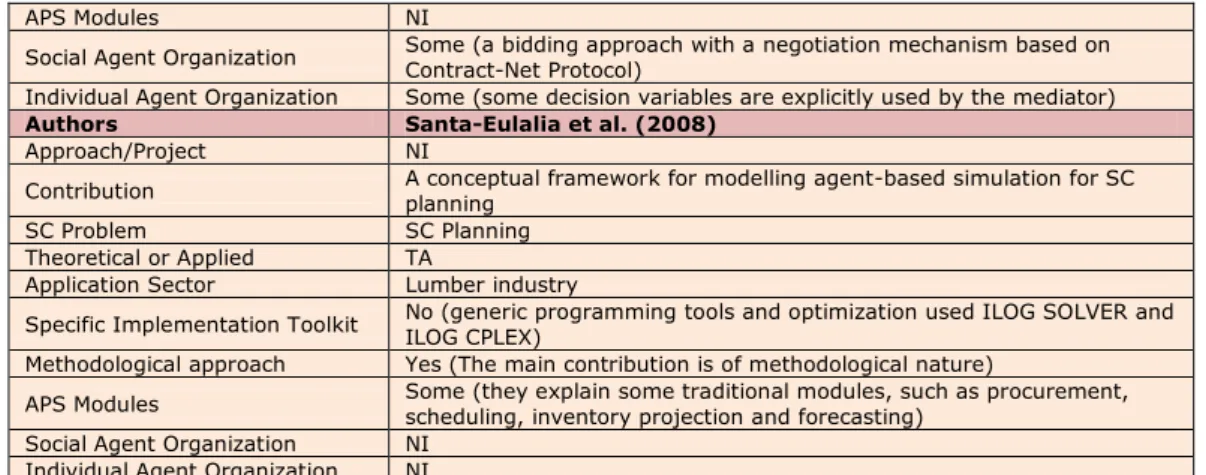
Social Agent Organization Some (a bidding approach with a negotiation mechanism based on Contract-Net Protocol) Individual Agent Organization Some (some decision variables are explicitly used by the mediator)
Authors Santa-Eulalia et al. (2008)
Approach/Project NI
Contribution A conceptual framework for modelling agent-based simulation for SC planning SC Problem SC Planning
Theoretical or Applied TA
Application Sector Lumber industry
Specific Implementation Toolkit No (generic programming tools and optimization used ILOG SOLVER and ILOG CPLEX) Methodological approach Yes (The main contribution is of methodological nature)
APS Modules Some (they explain some traditional modules, such as procurement, scheduling, inventory projection and forecasting) Social Agent Organization NI
Individual Agent Organization NI
Table 3. Studied works for the year 2008
Authors Benisch, Sardinha, Andrews, Ravichandran & Sadeh (2009)
Approach/Project CMieux Contribution
An agent approach called CMieux in the context of the TAC SCM (Trading Agent Competition). It implements adaptive strategies to support the integration of procurement, bidding and planning functionality. They performed experiments to demonstrate empirically the performance of their approach
SC Problem SC planning; Coordination Theoretical or Applied T
Application Sector Computer industry Specific Implementation Toolkit NI
Methodological approach NI
APS Modules Yes (the notion of d-APS is identified) Social Agent Organization NI
Individual Agent Organization Some (agents mechanism for SC planning)
Authors Cid-Yanez, Frayret & Léger (2009)
Approach/Project (FEPP) FORAC Experimental Planning Platform
Contribution Analysis of some demand-driven planning approaches that propagate demand information upstream the supply chain SC Problem SC Planning
Theoretical or Applied TA
Application Sector Lumber industry
Specific Implementation Toolkit No (C# - Microsoft.NET - and with ILOG CPLEX and ILOG SOLVER) Methodological approach NI
APS Modules Yes (Agents are specialized in different APS planning areas) Social Agent Organization NI
Individual Agent Organization Some (different planning approaches for each agent)
Authors Gaudreault, Forget, Frayret, Rousseau & D’Amours (2009)
Approach/Project NI Contribution
Three agent-specific mathematical models to plan and schedule a softwood SC composed of sawing, drying and finishing activities. Specific coordination mechanisms are also proposed to assure that the resulting plans are coherent with each other
SC Problem SC Planning; coordination Theoretical or Applied TA
Application Sector Softwood lumber
Specific Implementation Toolkit No (C# - Microsoft.NET - and with ILOG CPLEX and ILOG SOLVER) Methodological approach NI
APS Modules Some (specific modules for three SC entities at the operational level) Social Agent Organization Some (a coordination mechanism)
Individual Agent Organization Some (specific modules for the three SC units)
Authors Ivanov (2009)
Approach/Project DIMA (decentralized integrated modelling approach)
Contribution A novel approach for comprehensive multi-disciplinary modelling of distributed large-scale business systems with decentralized decision-making and control
SC Problem SC planning and control Theoretical or Applied T
Application Sector NI Specific Implementation Toolkit NI
Methodological approach Yes (a macro approach covering conceptual modelling, mathematical modelling, and software development) APS Modules NI
Social Agent Organization NI Individual Agent Organization NI
- 643 -
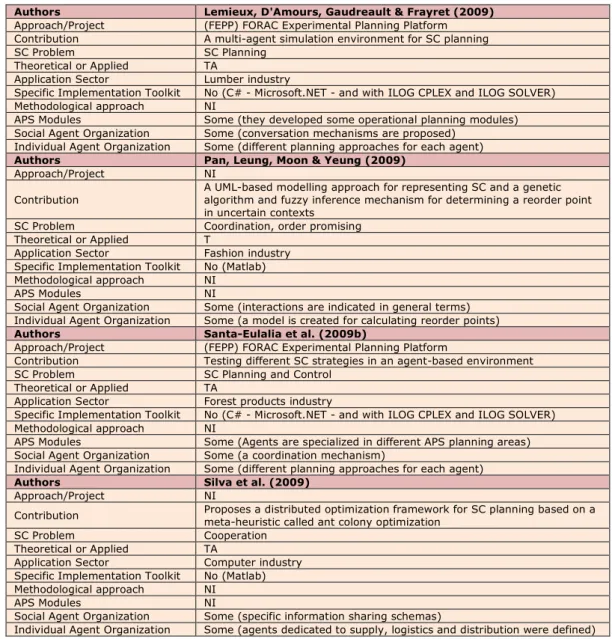
Authors Lemieux, D'Amours, Gaudreault & Frayret (2009)
Approach/Project (FEPP) FORAC Experimental Planning Platform Contribution A multi-agent simulation environment for SC planning SC Problem SC Planning
Theoretical or Applied TA
Application Sector Lumber industry
Specific Implementation Toolkit No (C# - Microsoft.NET - and with ILOG CPLEX and ILOG SOLVER) Methodological approach NI
APS Modules Some (they developed some operational planning modules) Social Agent Organization Some (conversation mechanisms are proposed)
Individual Agent Organization Some (different planning approaches for each agent)
Authors Pan, Leung, Moon & Yeung (2009)
Approach/Project NI
Contribution A UML-based modelling approach for representing SC and a genetic algorithm and fuzzy inference mechanism for determining a reorder point in uncertain contexts
SC Problem Coordination, order promising Theoretical or Applied T
Application Sector Fashion industry Specific Implementation Toolkit No (Matlab) Methodological approach NI APS Modules NI
Social Agent Organization Some (interactions are indicated in general terms) Individual Agent Organization Some (a model is created for calculating reorder points)
Authors Santa-Eulalia et al. (2009b)
Approach/Project (FEPP) FORAC Experimental Planning Platform
Contribution Testing different SC strategies in an agent-based environment SC Problem SC Planning and Control
Theoretical or Applied TA
Application Sector Forest products industry
Specific Implementation Toolkit No (C# - Microsoft.NET - and with ILOG CPLEX and ILOG SOLVER) Methodological approach NI
APS Modules Some (Agents are specialized in different APS planning areas) Social Agent Organization Some (a coordination mechanism)
Individual Agent Organization Some (different planning approaches for each agent)
Authors Silva et al. (2009)
Approach/Project NI
Contribution Proposes a distributed optimization framework for SC planning based on a meta-heuristic called ant colony optimization SC Problem Cooperation
Theoretical or Applied TA
Application Sector Computer industry Specific Implementation Toolkit No (Matlab) Methodological approach NI APS Modules NI
Social Agent Organization Some (specific information sharing schemas)
Individual Agent Organization Some (agents dedicated to supply, logistics and distribution were defined)
Table 4. Studied works for the year 2009
Authors Chan & Chan (2010)
Approach/Project NI
Contribution An adaptive coordination strategy for improving fill rate while reducing costs without using information sharing SC Problem Coordination
Theoretical or Applied T Application Sector NI Specific Implementation Toolkit No (Java) Methodological approach NI APS Modules NI
Social Agent Organization Some (coordination mechanisms)
Individual Agent Organization Some (decision models for two-echelon SC)
Authors Ivanov et al. (2010)
Approach/Project A-SCM (Adaptive SCM)
Contribution A multi-structural framework (models and tools) for the planning and control of adaptive SC using principles from control theory, operations research and agent-based modelling
SC Problem SC planning, coordination Theoretical or Applied T
Application Sector They mention that it was applied to special machinery building and textile branches, but these cases are not discussed in the paper Specific Implementation Toolkit Yes (Anylogic)
Methodological approach NI APS Modules NI
Social Agent Organization Yes (a multi-structural process)
- 644 -
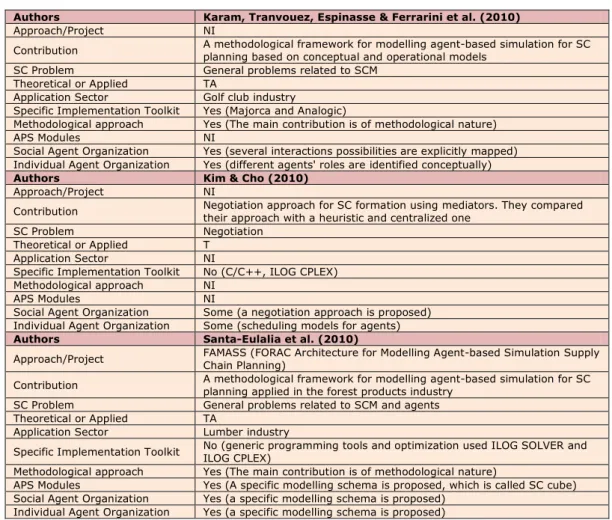
Authors Karam, Tranvouez, Espinasse & Ferrarini et al. (2010)
Approach/Project NI
Contribution A methodological framework for modelling agent-based simulation for SC planning based on conceptual and operational models SC Problem General problems related to SCM
Theoretical or Applied TA
Application Sector Golf club industry
Specific Implementation Toolkit Yes (Majorca and Analogic)
Methodological approach Yes (The main contribution is of methodological nature) APS Modules NI
Social Agent Organization Yes (several interactions possibilities are explicitly mapped) Individual Agent Organization Yes (different agents' roles are identified conceptually)
Authors Kim & Cho (2010)
Approach/Project NI
Contribution Negotiation approach for SC formation using mediators. They compared their approach with a heuristic and centralized one SC Problem Negotiation
Theoretical or Applied T Application Sector NI
Specific Implementation Toolkit No (C/C++, ILOG CPLEX) Methodological approach NI
APS Modules NI
Social Agent Organization Some (a negotiation approach is proposed) Individual Agent Organization Some (scheduling models for agents)
Authors Santa-Eulalia et al. (2010)
Approach/Project FAMASS (FORAC Architecture for Modelling Agent-based Simulation Supply Chain Planning) Contribution A methodological framework for modelling agent-based simulation for SC planning applied in the forest products industry SC Problem General problems related to SCM and agents
Theoretical or Applied TA
Application Sector Lumber industry
Specific Implementation Toolkit No (generic programming tools and optimization used ILOG SOLVER and ILOG CPLEX) Methodological approach Yes (The main contribution is of methodological nature)
APS Modules Yes (A specific modelling schema is proposed, which is called SC cube) Social Agent Organization Yes (a specific modelling schema is proposed)
Individual Agent Organization Yes (a specific modelling schema is proposed)
Table 5. Studied works for the year 2010 The following sub-sections discuss the main criteria surveyed. 4.2 Main Contributions
Contributions in the domain cover dissimilar topics. For example, several papers propose agent-based architectures (Frayret et al., 2007; Andreev et al., 2007; Feng et al., 2007; Monteiro et al., 2007; Venkatadri & Kiralp, 2007), some deal with the famous TAC – Trade Agent Competition (Andrews et al., 2007; Si, Edmond, Dumas & Chong, 2007; Benisch et al., 2009), certain approaches propose coordination and information-sharing mechanisms (Lee & Kumara, 2007), others focus on mathematical models for agents (Gaudreault et al., 2009), a number use an agent-based environment only as a testbed to test SC strategies (Cid-Yanez et al., 2009; Santa-Eulalia et al., 2009b), and finally some propose agent-based methodological frameworks (e.g. Karam et al., 2010; Santa-Eulalia et al., 2010; Labarthe et al., 2007).
It was observed that the terms framework, architecture, approaches and methodology were very frequently employed in many studies to define the
- 645 -
contribution of the papers, but no definition was provided for them. For example, in the modelling area (particularly in the Enterprise Modelling; Vernadat, 1996), these terms can have different meanings, but the surveyed works mostly neglect to specify the nature of their contribution. This is probably an indication that the surveyed area is still an emerging domain requiring some organization.
SC Problems
Several SC problems were identified: general problems related to SCM, manufacturing and SC integration, SC planning, scheduling, control and execution, cooperation, coordination, negotiation, information sharing, SC adaptability, order promising, and multi-level lot-sizing.
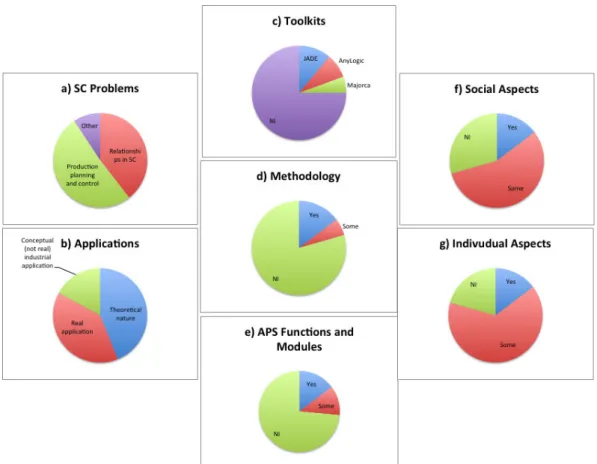
It is possible to affirm that three macro categories exist in this area, covering most of the papers: 1) Relationships in SC, including the following categories: coordination, cooperation, information sharing, negotiation and integration; 2) Production Planning and Control, comprising the following sub-categories: SC planning, scheduling, control and execution; 3) Others, including papers related to general problems in SCM and agents, as well as one about SC adaptability.
When considering possible repetition (i.e. when a paper can be classified in more than one macro category), it is possible to see that: 17 papers (50%) are in the macro category Relationships in SC (including Chan & Chan, 2010; Lin et al., 2008; Lee & Kumara, 2007); 22 papers (65%) are related to Production Planning and Control (Lemieux et al., 2009; Jankowska et al., 2007; Orcun et al., 2007); and finally, there are only four papers (12%) in the third macro category (i.e., three papers related to general problems: Karam et al., 2010; Santa-Eulalia et al., 2010; Labarthe et al., 2007 – and one paper about SC adaptability, i.e. Lau et al., 2008). Figure 3 summarizes these findings.
This led us to believe that d-APS researchers are focusing mostly on two mainstream subjects (Relationships in SC and PPC), and that there is some interesting room for other domains. For example, problems related to SC governance, sustainability, adaptability, network design and other domains are lacking in the recent literature.
Applications
Among the selected 34 papers, 18 (53%) are of a theoretical nature (Ivanov, 2009) and 16 (47%) provide real applications (Cid-Yanez et al., 2009). Seven of the
- 646 -
theoretical papers (21%) also illustrate their approach through conceptual (not real) industrial applications (Si et al., 2007).
Despite the fact that applications are usually considered relevant for having papers published in prestigious journals and conferences, more than half of them (18) do not provide real applications and 12 (35%) do not provide any at all. Among those manuscripts presenting some kind of application, most of them (28) are demonstrations (e.g. proofs of concept) that are not linked with an industrial-scale situation. None of the papers present mature applications being commercialized or close to the market. This indicates that, so far. d-APS systems are mostly at laboratorial stages and that many efforts need to be made in order to gain more practical insights.
The last four tables also surveyed the application sector of the 16 studies concerned, which are: airport logistics, laundry, pharmaceuticals, forest products, bicycles, golf clubs, defence, bronze taps, packing, computers and toys. In the case of theoretical papers employing conceptual industrial cases, the following sectors were found: computers, steel, mould and fashion. It is interesting to note that eight manuscripts are about the forest products industry. This indicates that the application is quite diversified, hence enriching the domain, although many applications are of an academic nature.
Toolkits and Methodologies
Modelling toolkits are not employed massively, since only seven manuscripts (20%) out of 34 utilize a known toolkit: four use JADE, one works with AnyLogic and two employ together Majorca and Anylogic.
Among those works not mentioning any specialized agent toolkit, it was observed that generic languages are usually employed (mainly C#, C/C++, and visual basic) connected to some optimization system (e.g. ILOG SOLVER and CPLEX). Other technologies used for implementation are ILOG-OPL Studio, LINDO, Excel, Crystal Ball, some discrete-event simulation tool, and Visual Studio. No correlation was identified between the methodological aspects and the agent toolkits.
In terms of methodological aspects, 27 papers (79%) out of 34 do not explicitly mention the use of them. On the other hand, a small quantity of two (6%) papers (Ivanov et al., 2007a; Ivanov et al., 2007b) present some indications that they were inspired by methodological aspects, such as the definition of conceptual models, mathematical models and simulation tools. Only five (15%) papers
- 647 -
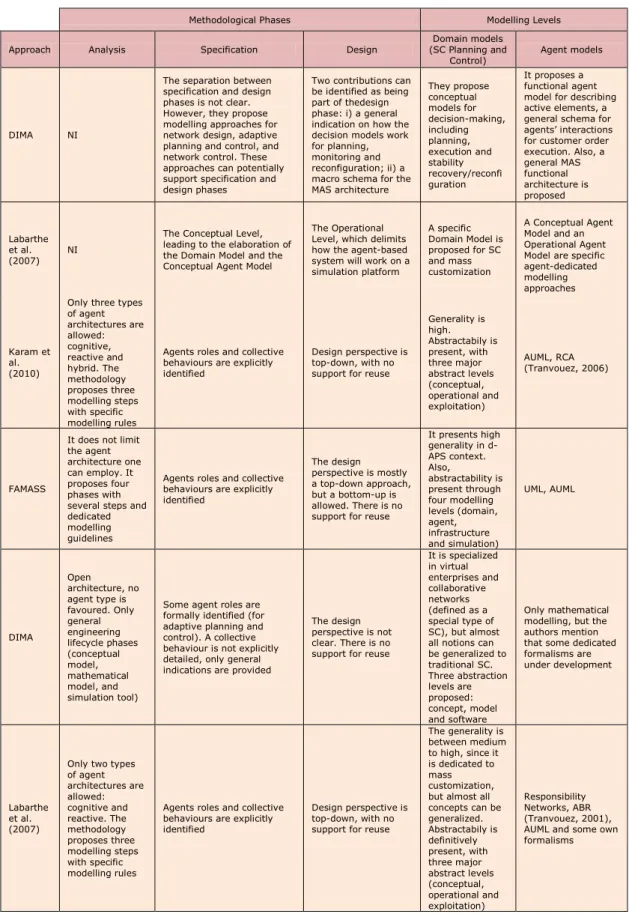
explicitly present methodological elements and four contributions are of a methodological nature (Karam et al., 2010; Santa-Eulalia et al., 2010; Ivanov, 2009; Labarthe et al., 2007). The methodological aspects of these five works will be detailed in subsection 4.3.
APS Functions and Modules
Despite the fact that the studied works being reviewed can be classified as dealing with d-APS systems according to our definition, few articles (i.e. 9 out of 34, representing 26%) detail (i.e. Yes and Some) APS modules. Some of them present agents specialized in traditional APS modules, such as procurement, scheduling, inventory and forecasting (Benisch et al., 2009); others present agents specialized in specific industrial domains (e.g. operational planning for sawing, drying and finishing operations, such as Cid-Yanez et al., 2009, Lemieux et al., 2009, and Gaudreault et al., 2009); and in one specific case a specialized modelling schema is proposed to explicitly represent a d-APS system (Santa-Eulalia et al., 2010).
The evaluation of this criterion allows us to believe that a complete and integrated view of d-APS is still not properly covered in the reviewed literature. Most of the works do not intend to propose a generic architecture for d-APS systems, specialized in specific domains. At the present time, almost all of the papers deal with agent-based SC planning and scheduling using optimization approaches without explicitly declaring that APS (or d-APS) technology is being used. This indicated that d-APS is still a new research domain which is not uniformly defined. Social and Individual Agents Issues
When dealing with d-APS, two facets of these systems have to be considered: social and individual abilities of the multi-agent system.
In terms of the social aspects, it was not possible to clearly identify them in 10 manuscripts (29%). Despite the fact that in some cases terms such as communication and conversation are mentioned, they do not provide any approach for modelling social aspects of the agent society. For example, Jankowska et al. (2007) is much more dedicated to the layered technical architecture and the main computing technologies it integrates.
On the other hand, 20 works (59%) are classified as proposing “some” discussion about social aspects. They do not provide any complete modelling approach to identify and simulate several different types of social structures or social protocols, but they address these aspects somehow; sometimes one paper just mentions or