Publisher’s version / Version de l'éditeur:
Journal of the Highway Division, ASCE, 92, 2, pp. 21-33, 1967-07-01
READ THESE TERMS AND CONDITIONS CAREFULLY BEFORE USING THIS WEBSITE. https://nrc-publications.canada.ca/eng/copyright
Vous avez des questions? Nous pouvons vous aider. Pour communiquer directement avec un auteur, consultez la première page de la revue dans laquelle son article a été publié afin de trouver ses coordonnées. Si vous n’arrivez pas à les repérer, communiquez avec nous à [email protected].
Questions? Contact the NRC Publications Archive team at
[email protected]. If you wish to email the authors directly, please see the first page of the publication for their contact information.
NRC Publications Archive
Archives des publications du CNRC
This publication could be one of several versions: author’s original, accepted manuscript or the publisher’s version. / La version de cette publication peut être l’une des suivantes : la version prépublication de l’auteur, la version acceptée du manuscrit ou la version de l’éditeur.
Access and use of this website and the material on it are subject to the Terms and Conditions set forth at
Snowshed location and design
Schaerer, P. A.
https://publications-cnrc.canada.ca/fra/droits
L’accès à ce site Web et l’utilisation de son contenu sont assujettis aux conditions présentées dans le site
LISEZ CES CONDITIONS ATTENTIVEMENT AVANT D’UTILISER CE SITE WEB.
NRC Publications Record / Notice d'Archives des publications de CNRC:
https://nrc-publications.canada.ca/eng/view/object/?id=07b7c01f-2de1-4fad-a300-703f4cedf047
https://publications-cnrc.canada.ca/fra/voir/objet/?id=07b7c01f-2de1-4fad-a300-703f4cedf047
Ser
THl
N21t2
no. 2J2
c . 2
]
B U I L D , ] J G i ] . : 1 . , I J i ; r l 5 : - - ^ \ - / - L i - . . 1-I"iAfl
3 i370
I I A T I O N A L R E S E A R C H C C U F I C I LNlrroxnu
REseancx Courucru oF CANADA
Consrt Nlrtonel oe Recrencxes DU CANADA
SNOWSHED
LOCATIONA N D D E S I G N
BY
P . A . S C H A E R E R
A N A L Y Z E D
J O U R N A L O F T H E H I G H W A Y D I V I S I O N ASCE VOL. 92. NO. H\,vz, OGTOBER 1966
P . 2 t - 3 3 T E C H N I C A L P A P E R N O . 2 5 2 O F ? H E D I V I S I O N O F B U I L D I N G R E S E A R C H OTTAWA J U L Y 1 9 6 7 N R C 9 6 ? 6 PRICE 25 CENTS
o7
L
EMPLACEMENT ET CONCEPTION DES GALERIES
PARE-AVALANCHES
SOMMAIRE
La choi:< de ltemplacement et du type de galerie n6cessaire ) Ia protection des voies de communication contre les ava-lanches doit se fonder sur Ir6tude soigneuse du terrain, la fr6quence des avalanches et leur importance. Lrauteur d6-c r i t b g r a n d s t r a i t s l e s m 6 t h o d e s p r 6 l i m i n a i r e s d r o b s e r v a -tion des emplacements choisis pour Ies travaux de d6fense contre les avalanches. Les facteurs que lting6nieur doit prendre en consid6ration pour la conception structurale de lrouvrage sont les suivants: charges impos6es par la coul6e de neige et par le manteau nival, longueur de la galerie, 6clairage, 6coulement des eaux et entretien. 11 estpossible de r6duire la longueur des galeries par Itutilisation de lev6es ou de murs 6rig6s parallblement b Ia directiondes avalanches. Lrauteur dGcrit ltinfluence de ces facteurs sur la conception et le fonctiorrnement des galeries pare-avalanches de la Route transcanadienne au Col Rogers, en Colombie-Britannique. On a d6couvert quril est pr6f6rable de construire de longues galerie s ininte rro mpue s tr ave rs ant plusieur s couloir s d I ava -lanches plut6t que dt€tablir un certain nombre de galeries s6par6es par de courts intervalles d6couverts.
iltil
October. 1966
Journal of the
HIGHWAY DIVISION
Proceedings of the American Society of Civil Engineers
sNowsHED LocATIoN AND DESIGNa
By Peter A. Schaererl
INTRODUCTION
Snowsheds are one of the methods used to protect communication lines from snow avalanches. The showshed is a roof which is designed to guide the sliding snow across a highway or a railway to protect tralfic and prevent deep snow deposits on the roadway. Because snow deposited by an avalanche can be very heavy, snowsheds should be designed like bridges rather than roofs. They are, therefore, an important and expensive part of a road.
Snowsheds have been used at mountain passes for a long time in Europe. At the beginning of the 19th Century, when roads began to replace the ancient pack trails at alpine passes, snowsheds were already an integral part of the road. These old sheds were built of wood or stone. The stone-arched snow-sheds at the Simplon Pass between Switzerland and Italy were built under the direction of Napoleon between 1801 and 1805 and were still in use until a few years ago when they were replaced by wider structures made necessary by the modern highway. There are few snowsheds over highways on the North American continent, but many miles of themprotectthe railways in the Sierra Nevada, Cascade, and Selkirk Mountains.
The sheds of the ancient narrow roads and single track railways were designed on a trial-and-error basis. Estimates of loadings, if made at all, were only guesses. The stone arch shedsweresufficienfly strong to withstand unknown great forces, and the timber sheds, if they failed, could be replaced easily by stronger beams. The narrow old sheds were relatively inexpensive structures. Modern wide highways require large and cosily structures and their location and design should be based on careful studies.
N o t e . - D i s c u s s i o n o p e n u n t i l M a r c h 1 , 1 9 6 7 . T o e x t e n a @
a written request must be filed with the Executive Secretary, ASCE. This paper is
22 October. 1966 H W 2
Between 195? and 1962 the Rogers Pass section of the Trans-Canada Highwaywas built through the rugged selkirk Mountains. The selkirk Moun-tains of British Columbia are famous for numerous avalanches. An extensive study of the avalanches along the proposed route was made prior to the con-struction of the highway and the- most suitable and economical defense was chosen for each avalan;he site.Z,3 Nine snowsheds were built as part of the avalanche defense system. Much experience was gained during the location studies for the sheds, during.their_design and construction, and from obser-vations of their performance.+' c'o"
This experience, together with that accumulated in the united states, Switzerland, Austria, and other countries, permits conclusions to be drawn concerning the factors that should be taken into consideration in the design of snowsheds. and the on-site observations required to obtain the necessary background information. It is the purpose of this paper to present these factors, and to describe them with particular reference to the construction and performance of the sheds in the Rogers Pass area.
AVALANCHE CHARACTERISTICS
The character of an avalanche varies with the circumstances under which it is formed antl with the nature of the terrain on which it occurs. Dry snow avalanches usually result when a layer of dry, new snow slides on top of an older, stable snow base. These avalanches are accompanied by a cloud of snow dust and a windblast. They may reach speeds as high as 100 mph. If an avalanche becomes air-borne whenfallingover cliffsor on steep terrain, it can attain a speed of 200 mph. snow or snow mixed with air moving at this high speed can be extremely destructive.
Wet snow avalanches occur when snowfalls are immediately followed by warm weather or rain, or when the snow cover loses cohesion as it melts in spring, wet snow avalanches are slower than dry ones and may attain speeds to ?o mpn. The surface area where avalanches originate and the depth of the unstable snow that slides, govern the size of an avalanche. Avalanches have been observed whichcontained up to 5,000,000 cu yd of snow; a large single
2 schaerer, Peter A., .,Planning Avalanche Defense for the Trans-canada Highway at Rogers Pass, B. C.," T!9 l4gUqg4!g-q994g1, Montreal, Quebec, Canada, Vol' 45, No. 3I March, 7s62, ppler-SE-;iEo=tallab-ie as@Natl'
Research Council" Div. of Bldg' Research, Ottawa' Canada' May' 19tt2.
3 Schaerer. Peter A.. ',Avalanche Defenses fortheTrans-CanadaHighway at Rogers Pass,' NRC 7020, Natl. Research Council, Div. of Bldg. Research' Ottawa, Canada' November, 1962.
4 Mi[ar, Hugh M., nAvalanche Control, Trans-Canada Highway, Glacier National park,o proceedlngs, 42ttd Cottn"ntion of the Canadian Good Rds. Assn., Banff, Canada' 1 9 6 1 .
H W 2 SNOWSHEDS
avalanche which occurred in 1962 in Switzerland covered almost two miles of highway.
APPLICATION OF SNOWSHEDS
Snowsheds are an efficient and safe avalanche defense, but in view of their high cost (particularly when used for modern highways) they can be built only at sites where other defense methods are impracticable or do not offer sufficient protection.
The decision as to whether a shed shouldbe build at a given site should be made only after the following factors are considered: (a) frequency of ava-lanche occurrence; (b) size ofthe avaava-lanches, the volume and type of snow that could be deposited on theroad; (c) lengthof time required to remove the snow; (d) density of traffic; (e) length of time that can be allowed for interruption of traffic; and (f) degree of safety required. To arrive at a conclusion based on these factors, several years of observations on the size and frequency of occurrence of avalanches at the site are necessary. The time required to remove snow deposits can be estimated from these observations. It must then be decided whether the interruption of traJfic caused by the occurrence of an avalanche is serious enough to warrant the cost of a defense structure. Some difficulties are encountered while attempting to assess the sa.fety offered by a snowshed, U it is assumed that the average speed of traffic on a mountain road in winter is 40 mphand the average avalanche is b00 ft wide, then a vehicle would be exposed tothe avalanche for 8.5 sec. Ifthe average daily traffic in winter is 1,000 vehicles, the average interval between vehicles would be 86 sec. For one avalanche perwinter and a total of 150,000 vehicles during the five winter months, there is a chance that one vehicle out of 1,500,000 would be hit by an avalanche, and this might occur once in 10 yr. This hazard is comparable with the accident rate on highways, one accident per 100,000 vehicle miles and one death per 12,000,000 vehicle miles. It is clear that the frequency of accidents increases with the number of avalanches per winter and with the density of traffic. practice in different countries indicates that when other defense methods are impractical or too costly, snowsheds are usually built on main highways at sites where ava-lanches that are at least 150 ft wide and deposit more than 3 ft of snow reach the highway once every year, or at sites where avalanches occur once every 3 yr to 5 yr and could deposit deep snowon the highway which would require more than 12 hrtobe removed. Thereare many sites on highways where these conditions are fulfilled and no protection is provided. With an increase in traffic, however, highway departments are forced to consider adequate ava-lanche defense.
Studies of avalanche accidents in Western Canada suggest that railway trains are more frequently hit by avalanches than vehicles on highways. Be-cause of their length and slow speed, trains are exposed to the avalanche for a longer period of time and, despite low traJfic density, the probability of a train being hit by an avalanche is equal to or higher than that of a vehicle on a highway. The vibration of the moving train probably triggers the ava-lanche and, therefore, greatly increases the hazard. This would lead to the conclusion that snowsheds or other avalanche defenses are more important for railways than for highways.
2 4 October, 1966 H W 2 Snowsheds are the most suitable defense atlocationswhere the descending avalanches are confined in a narrow track, suchas a deep gully. A short shed would be required at such locations. Sites where avalanches run over a wide mountainside and threaten a long section of road are usually not favorable locations for snowsheds. If sheds are built atsuch locations, tley will be long and costly, and therefore, detailed studies would have to be made to deter-mine whether other defense methods would be more economical8,9 The only alternate defense method that offers the same or even a greater safety is a retaining barrier in the starting zone of the avalanches. Many retaining barriers protect towns, railways, and highways in Switzerland, Austria, and France, and design specifications are available.l0 If the starting zone is small, retaining barriers might be the better solution. They also have the advantage of protecting the terrain above and below the road and create no need for structures near the road which obstruct visibility and make later improvements diff icult.
LOCATION AND DESIGN
To determine the location of a snowshed and to obtain the information required for design, the following information must be recorded concerning the avalanches which occur:
1. Character of the avalanche;
2. loeation of the starting zone and the nature of the avalanche fracture; 3. location and nature of the track followed by the avalanche;
4. approximate depth of the sliding snow;
5. location of the avalanche runout zone (particularly its width on the road), the average and maximum depth of the snow deposited, and the char-acter of the avalanche snow;
6. weather conditions associated with the development and occurrence of the avalanche;
The observations for otrtaining this information should be made over as many' years as possible before building a snowshed. Most important is the survey of the width of the avalanches near the road. Reference points necessary for an accurate survey must be established at the side of the avalanche track.S
Because observations are usually available for onlyafew winters and may be made during a time when there was little avalanche activity, the infor-mation must be supplemented by observations of the tenain and vegetation, e.g., the extent of tree damage along the edges of the avalanche path.
I Frutiger, H., "Stiitzverbau im Anbruchgebiet (Retaining Barriers in the Starting Zone'1,' Lawinensicherung von Alpenstrassen, StrasseundVerkehr,Z.Drich, Switzerland' V o I . 5 0 , N o . 1 , J a n u a r y L 7 , 7 9 6 4 , p p . 6 - 8 .
9 Frutiger, H., and de Quervain, M., "Stfitzverbau oder Galerie? (Retaining Barrier or Snowshed?),' Lawinensicherung von Alpenstrassen, StrgeEg_gnq_yert<9hr,Zfilich, Switzerland, Vol. 50, No. 1, January 17, t964, pp. 17-19.
l0 "Avalanche Control in the Starting zone," Station Paper No. ?1, Rocky Mountain Forest and Range Experiment Sta., Forest Service, U. S. Dept. of Agric., Fort Collins' C o I o , , S e p t e m b e r , 1 9 6 2 .
H W 2 SNOWSHEDS
The snowshed should cover tJre full width of the avalanche site and should control arl the avalanches that could possibly occur. In view of the cost, the engineer responsible for the location and the design of the snowsheds usually tries to reduce the length to a minimum. Experience at Rogers pass and in switzerland has indicated that for economic reasons sheds are frequenily built too short. with such sheds, large avalanches easily flood the portars and
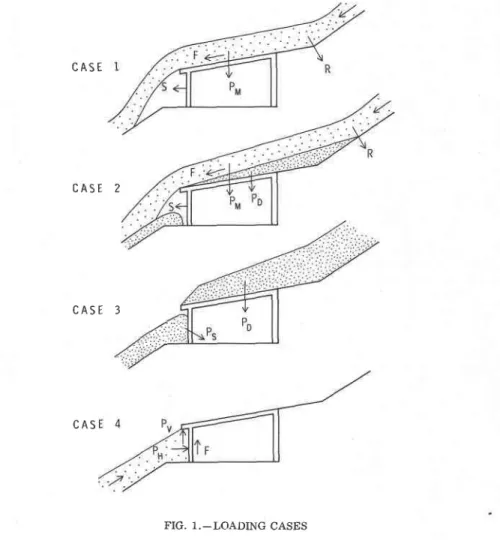
C A S E C A S E Z C A S E 3 4:t't; ;t.'i C A S
FIG. I._LOADING CASES
enter the interior making it difficult and errpensive to remove this snow. careful attention, therefore, should be given to determine the probable ex-tent of the avalanches.
The loads that act on a snowshed have been described bv the writer3 and by B. Salm and E. Sommerhalder.ll The loading cases that must be
11 Salm, B., and Sommerhalder, E,, ,,Beanspruchung von Lawinenschutzgalerien durch schnee (snow Pressure on Avalanche protection stieds),' Lawinensichsreng ven 4p+gt gggq, Strasse und Verkehr, zfilich, Switzerland, vol. 501ffi. r'piuafrrz,-1 9 6 4 , p p . r'piuafrrz,-1 0 - r'piuafrrz,-1 6 .
26 October, 1966 H W 2
Considered in the shed design and some remarks with reference to experienCes
larities of terrain.
Loaiti.ng case 2.-A major avalanche slides over previouslydepositedava-lanche snow. The following loads would occur simultaneously: maximum moving load, Pp1, deposit load, Pp, from snow previously deposited by ava-lanchei, frictioiil F, suction, S, and dynamic force, R, which probably would be smaller than in Case 1.
Loading Case g.-A maximum possible number of avalanches have de-posited snow on a shed. The following loads would occur simultaneously: deposit load, Pp, andpressures, PSrfromsnowdeposited on the side.
Forces may also occur as a result of the gliding and creeping of the de-posited snow. Usually they need not be considered for the design of the ih"d beca.tse they are within the limits of the forces considered in Case 2. Loading Case 4.-An avalanche from the opposite side of the valley pro-duces an impact pressure, P11. and friction, F, on the side of the shed and a pressure, Py, on protruding paits of the roof.
The vertical moving load is difficult to estimate and in most cases an educated guess must be made, based on obserVations of the size of past ava-lanches and e:<perience. Wet snow avaava-lanches produce the highest loads. such avalanches would have depths between 10 ft and 25 ft and the snow would have a unit weight between 25 pcf and 35 pcf. Dry snow avalanches could have greater depths, but the weight of the moving snow would be much lighter. The assumed moving loads on the Rogers Pass sheds were between 300 psf and 700 psf.
iitl" hrs been published concerning the friction coefficient between the moving avalanche and the roof of thedepositedsnow. However, measurements have been made by the Swiss Institute ofsnow and Avalanche Research during the past few years.1l Previous results and e:rperience suggest that the friction coefficient is between 0.4 and 0.5.Thevalue0.5 was used for the Rogers Pass snowsheds and for sheds built recently in Switzerland.
There is as yet little data from direct observation which can be used as a basis for predicting the dynamic force caused by irregularities of terrain. Because such forces can be quite high, it would be advisable to maintain the backslope behind each shed at the same incline as the shed roof for at least 50 ft. Most of the dynamic load would be taken by this section and not by the roof.
Avalanches could be deflected into the air by a bench above the snowshed and land on the shed, producing forces that exceed many times the vertical moving load. This must be prevented by removing benches and rock knobs from the path above the shed.
vertical deposit loads are particularly high on sheds built in the runout zone of the avalanches. The maximum load should be estimated from ob-servations of snow depth before the shed is built, taking into account the modifications of the avalanche site caused by the constrrrction of the shed, dams, removal of benches, and highway grading.
H W 2 SNOWSHEDS
The depth of snow deposited on the shed does not usually exceed 8 ft at sites where small avalanches occur. Depths to 30 ft should be considered for the design of highway snowsheds at sites with frequent and large ava-lanches. The unit weight of the avalanche snow must be assumed to be 40 pcf.
snow is usually deposited in trapezoid form over the width of the sheds, causing higher loads on tre uphill than on the downhill side. The highest loads used for the design of the Rogers Pass snowsheds were b00 psf on the downhill and 1,100 psf on the uphill side. sheds at sites wiilr small ava-lanches were designed for a uniform load 300 psf. These loads occurred during the 1964-1965 winter, a winter with frequent and large avalanches.
The vertical moving load, friction force, deposit load, and dynamic force also act on the bacldill behind tlre shed, and should be considered in the de-sign of the retaining wall.
Loading Case 4 should be considered at sites where avalanches could occur from the other side of the valley. Avalanches may become air-borne or, when reaching the valley bottom, may still have enough velocity to climb the other side. In January, 1965, an avalanche at Rogers pass climbed a 38' slope and deposited snow 6 ft deep on the highway located 160 ft above the valley floor. The Lanark avalanches at Rogers pass sometimes hits the railway snowsheds on the opposite side of the narrow valley. A section of the timber shed was destroyed by such an avalanche in lgbl. In December, 1964, another major avalanche hit the snowshed. From the compaction of the snow and the size of the planks that were broken, the avalanche was computed to have produced an impact force of approximately 1,200 psf. An avalanche passing over the shed causes a suction on the inside of the shed. observations on sheds and buildings have indicated that this suction force is small and the only countermeasures required are that roof members and planks on the side of the shed be secured against small lifting forces. The pressure wave that precedes a falling avalanche and the resulting suction acts in an unpleasant way by blowing loose snow into the shed, producing in the interior conditions similar to a hearry blizzard. Details concerning structural design of the snowsheds^ 1t Rogers pass have been described by G. H. Foures5 andW. C. McKenzie.6,?
USE OF DAMS
The width of avalanches can be restricted by dams built parallel to the direction of the avalanches (Fig. 2). Dams should be located in such a way that the direct path of the avalancheisaltered as little as possible and enough cross-sectional area is available to allorv the free flow of avalanche snow. The dams should restrict the spreading of each side but should not reduce the width of the natural path. Dams which converge like a funnel and direct the avalanches from a wide area into a narrov channel are not advisable. channels formed bI/ such dams might easily be filled by snow deposited from small avalanches and allow larger avalanches to spill over the dams. The height of the dams depends on the number and size of the avalanches that might occur during a winter. A height of 20 ft would appear to be the minimum. A vertical wall made of concrete, metal, or log cribs at the side of the avalanche path would be most effective, Lrut in view of its lower cost, an earth dam wittr a nafural slope may be considered.
28 October, 1966 H W 2 e T r a c k Da m L i m i t o f A v a l a n c h e s W i t h o u t D a m s \ H i g h w a Y P a r a p e t W a l l FIG. 2._PLAN OF SHED WITH DAMS
The use of dams at Rogers Pass allow the length of snowshed to be re-duced to approximately lOVo of the length that would have been required without the dams. The money saved with the shorter shed more than com-pensated for the cost of the dams. Failures of dams were observed at two iites. et one site the size of the largest avalanche had been underestimated and avalanches overran the dam. At the second site, large dry snow ava-lanches became air-borne in the gUlly above the alluvial fan and continued to fall 0n the outside of the dam. At both sites the sheds had to be extended. At a third site, the snow that fell on the steep outer slope of the dam was observed to fracture and slide onto the highway just in front of the snowshed. in a severe winter.
A v a l a n
2 9
H W 2 SNOWSHEDS
The avalanche snow, however, covered only part of the highway and could be removed in a short time.
Dams that reduce the spread of the avalanches should be extended over the snowshed in the i""r"
"r parapet
walls above the portals. when the sheds were designed io" noga", pass in 1959, it was decided ttrat parapet walls should not ue puilt b"""i"" it might be necessary to lengthen the sheds l a t e r . E : r p e r i e n c e s i n c e t h e s h e d s w e " " b . ' i l t h a s i n d i c a t e d t h a t p a r a p e t w a l l s
are required at most of the sites' particularly those where more than one
avalanche occurs eacn year. This netessity was demonstrated when a major
avalanche of wet snow, split by deep avalanche snow' deposited in the center
of the Lanark snowshed.'was diverted toward the two portals and fell over
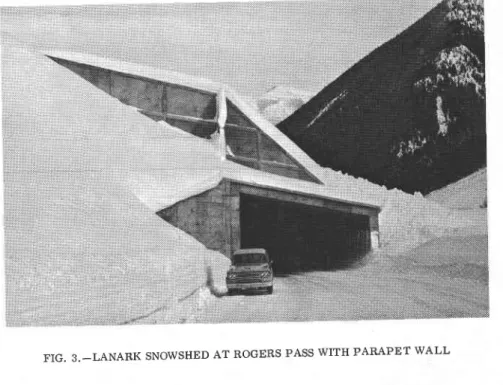
FIG. 3.-LANARK SNOWSHED AT ROGERS PASS WITH PARAPET WALL
t h e e n d s o n t o t h e h i g h w a y . B o t h e n t r a n c e s o f t h e l , 0 2 5 - f t - I o n g s h e d w e r e completely covered. e farapet wall, 25 ft high, was constructed later at this site (Fig. 3),
A t s - i t e s w h e r e h i g h d a m s a r e u s e d , i t w o u l d b e d i f f i c u l t t o b u i l d p a r a p e t walls having tne sa*e nJght as the dam above- The wall could be set back i"l-rn"*" i-" Fig. 2) to a iocation where the wall would only control the odd a v a l a n c h e t h a t b r e a k s a v f a y t o t h e s i d e . A h e i g h t b e t w e e n l 0 f t a n d 2 0 f t would then be sufficient.
The highway, tne snowshed, and the dams alter the profile and width of the avalanche path
"rrJ infl.r"o."
the speed, the depth' and the place where avalanches come to resi. E:rperierrcu rtrd imagination are ne.cessary to deter-m i n e t h e b e h a v i o r o f t h e . a v a l a n c h e s , u s i n g t h e o b s e r v a t i o n s deter-m a d e b e f o r e
3 0 October. 1966 H W 2
the shed was built. Time and effort spent on the necessary field observations and a sfudy of the advantages to be gained through the use of dams are well compensated by reduced construction cost and winter maintenance.
DRAINAGE
Drainage is important for snowsheds and many factors must be considered. slope of Roof.-The roof slab must have sufficient slope toward the down-hill side so that meltwater can run off under the avalanche deposits. A slope of at least 1 on 12 is required. This slope must be maintained even when the roof slab is covered with earth.
waterproofing of Roof.-High quality concrete slabs usually do notrequire special treatment. At sites where avalanches carry debris, or where rock slides may occur, it is advantageous to have the roof covered with a layer of earth. A bituminous coat should be applied before the eartr is placed. Joints should be sealed with the best material and according to the best practice because water leaking from joints may form ice on the road at places where it would be least er'<pected. The joints are exposed to frequent freeze-thaw cycles and must be designed to withstand this.
Dtrainage of Retaining wall.-The soil behind the retaining wall should be properly drained, taking into consideration the deep frost penetration that might occur. Great quantities of seepage water are to be e:<pected from melting snow and, therefore, drain pipes must be large.
surface water.-small water courses may be intercepted with a ditch and diverted to the side or carried in culverts under the snowshed. The culverts, however, should be placed deep enough to prevent freezing. Larger water courses, the size of a small creek and running continuously during the whole year, are better carried over the snowshed in speciat channels. such chan-nels would also carry rocks and other debris which might fill a culvert.
LIGHTING
visibility inside a highway snowshed can be a serious problem. sufficient light is provided when the downhill side is open, but this is only possible at sites where the snowshed is built on a steep hillside with a narrow shoulder on which no avalanche snow is deposited. Manysnowsheds, however, are built in the flat runout zone ofavalancheswherethe deposited snow may completely bury the shed. The side of the snowshed should be closed with light planks or wire mesh to prevent the snow from falling back onto the road, and it should be closed with a solid wall at seetions where large avalanches could occur from the opposite side of the valley.
The conditions in completely closed sheds and sheds buried in the snow are similar to those in a tunnel. Motorists are blinded for a few seconds
H W 2 SNOWSHEDS
tlit,*l*
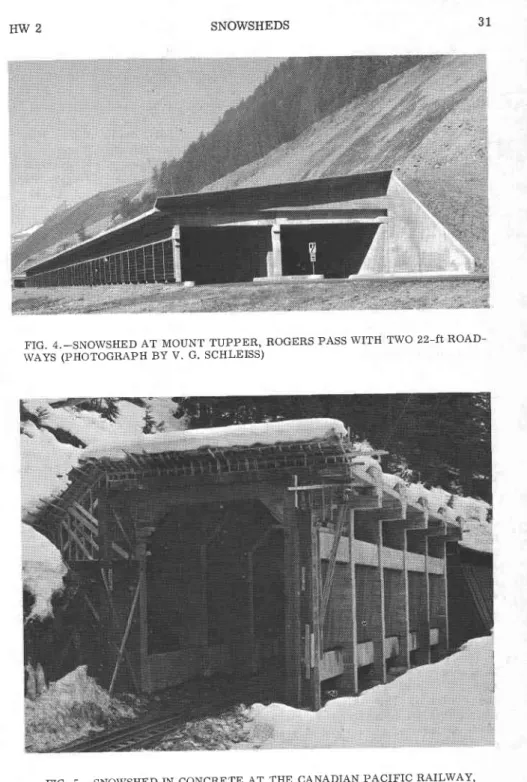
F I G . 4 . _ S N O W S H E D A T M O U N T T U P P E R , R O G E R S P A S S W I T H T W O 2 2 _ f t R O A D _ WAYS (PHOTOGRAPH BY V. G. SCHLEISS)
::l.ll;i
:&,
: . 1 ,
. .
. : li:
FIG. 5.-SNOWSHED IN CONCRETE AT THE CANADIAN PACIFIC RAILWAY' B U I L T I N 1 9 6 0
3 2 October, 1966 H W 2
with wood planks and, by removing the planks during the summer, visibility is improved.
MATERIALS
Snowsheds may be built of concrete, steel, wood, or a combination of these materials. Economic considerations must determine ttre type of material to be used in each ease. concreteisusedmost frequen[y for highway snowsheds and was found to be the most economical building material at Rogers pass (Fig. a). Because the same type of strucfural member appears many times in a long snowshed, precast roof beams, columns, and planks can be used (Fis. 5). Timber appears tobethemosteconomical material for narrow sheds for railways or access roads to mines or construction sites.
Snowsheds need not be the conventional type with a flat roof zupported by the blackwall and columns, bnrt could be built like a tunnel. A rather unusual type of shed was built in 1940 on tlre oberalp pass in switzerland. The railway line, usually closed during the winter, had to be kept open for national defense purposes. It was decided to build a temporary arched snow-shed made of snow blocks like an igloo. This snowsnow-shed proved to be a suitable protection against the numerous small avalanches at this site. A permanent snowshed was built later.
OTIIER EXPERIENCES
The snowsheds in the Mount Tupper area at Rogers pass are exposed to strong winds blowing in the direction of the highway. The wind removed approximately one-half the loose snow from the top of the sheds, formed cornices at the edge above the portals, and deposited snow on ttre highway below. cornices had to be cut away twice each month because they were a hazard when falling on the highway. The formation of cornices is now pre-vented by cantilever roofs extending b ft over the snowshed portals. The blowing snow reduces visibility on the highway and adds to the snow that must be removed. snow removal operation is more difficult in front of the shed because of reduced space beside the wing wa-ll. Snow plows are respon-sible for another nuisance near snowshed entrances because they carry snow into the shed during ordinary plowing operations. Itis difficult to remove this snow which forms ice on the pavement later. Vertical parapet walls, of course, would reduce drifting and the problems related to the drifting snow. Because of the high cost and the scant e:qrerience with the construction of snowsheds in North America, snowsheds at Rogers pass were built short, with the possibility of having them extended later. This policy resulted in a number of short sheds with open spaces of100ft and,27i ftbetween them. It was also thought that the openings between the sheds would improve the visibility. The difficulties with snow removal near the portals and the necessity of avoiding frequent, dangerous changesfromlightto dark, however, made it advisable to have one continuous snowshed rather than a number of short ones with. short open sections. A continuous shed arso has the
ad-H W 2 SNOWSHEDS
vantage of controlling slides from back slopes between sheds and avalanches that might follow une:<pected tracks.
SUMMARY AND CONCLUSIONS
The steps that should be taken to locate a snowshed and to determine the design loads may be summarized as follows:
1. Survey over aperiodofyearsallavalanchesat the proposed site'
2. Consider modifications of the terrain to obtain a smooth profile above the snowshed and to maintain the avalanches in a predetermined path.
3. Estimate spread of avalanches on snowsheds and establish the design of the parapet walls at the snowshed portals.
4. If sheds are separated by short distances, consider connecting them. 5. Estimate maximum avalanche depth and moving load.
6. Estimate characteristics of snow deposit and maximum deposit load. ?. Sfudy the avalanche hazard from other side oJ valley.
8. Define loading cases and loads.
9. Consider possible erratic avalanche paths that wouldallowan avalanche to spill snow onto the highway and make adjustments necessary later.
In conclusion, the importance of adequate preliminary observation cannot be oVeremphasized at sites where avalanche defense works are required. The information obtained from these observations is necessary for design purposes and will provide savings that will more than compensate for the inveStment of money and time required to conduct them. EngineerS reSpon-sible for the design of avalanche defense works should always bear in mind that avalanches are often erratic, surprising in their size, forms and un-expected courses. The planning and design of avalanche defenses should, therefore. make allowances for the unknown.
ACKNOWLEDGMENTS
The location work and the design of the snowsheds at Rogers Pass was a project of the Development Engineering Branch of the Department of pubtic works of canada under G. T. Clarke, chief Engineer. The stajf of the Department provided close cooperation while making field observations and deiign recommendations. Thanks areduetothemand to J. B. R. Coleman, Director of the National Parks Branch, Department of Northern Affairs and National Resources, for making possible a study of the avalanche defense after the construction. The assistance of M. R. de Quervain, Director of Federal Institute for Snow and Avalanche Research, Switzerland, in locating and designing the Rogers Pass snowsheds, was particularly valuable. This paper iJ a contribution from the Division of Building Research, National Reiearch Council, Canada, and is published with the approval of the Director of the Division.
4923 SNOWSHED LOCATION AND DESIGN
KEY WORDS: avalanches; design; highways; Ioads (forces); site surveys; snow: snowsheds
ABSTRACT: The location and design of snowsheds for avalanche defense must be based on careful studies of terrain, the frequency of avalanche occurrence, and the size of the avalanche. Preliminary observatlon at sites of plamed avalanche defense work is outlined. Factors that must be taken into consideration in the structural design of snowsheds are: Loads by moving avalanches and by deposited snow, length of the shed' lighttng, drainage, and maintenance. The length of sheds car be reduced by darns and wilts fuitt parallel to the direction of the avalanches. These factors are described vrit' reference to the design and performance of the gnowsheds for the Trans-Canada High-way at Rogers Pass, British Columbia. Long, continuous snowsheds covering more than one avalahche track were found to be more advantageous than a number of short sheds with short, open spaces between.
REFERENCE: Schaerer, Peter A., "Snowshed Location ard Design,' Journal of the Highway Division, ASCE, VoI. 92, No. HW2, Proc. Paper 4923, October, 1966' p p . 2 1 - 3 3 .