HAL Id: hal-01959766
https://hal.archives-ouvertes.fr/hal-01959766v2
Submitted on 30 Sep 2019
HAL is a multi-disciplinary open access
archive for the deposit and dissemination of
sci-entific research documents, whether they are
pub-lished or not. The documents may come from
teaching and research institutions in France or
L’archive ouverte pluridisciplinaire HAL, est
destinée au dépôt et à la diffusion de documents
scientifiques de niveau recherche, publiés ou non,
émanant des établissements d’enseignement et de
recherche français ou étrangers, des laboratoires
Formally and Practically Verifying Flow Integrity
Properties in Industrial Systems
Jannik Dreier, Maxime Puys, Marie-Laure Potet, Pascal Lafourcade,
Jean-Louis Roch
To cite this version:
Jannik Dreier, Maxime Puys, Marie-Laure Potet, Pascal Lafourcade, Jean-Louis Roch. Formally
and Practically Verifying Flow Integrity Properties in Industrial Systems. Computers and Security,
Elsevier, 2018, 86, pp.453-470. �10.1016/j.cose.2018.09.018�. �hal-01959766v2�
Formally and Practically Verifying Flow Integrity
Properties in Industrial Systems
I
Jannik Dreiera,∗, Maxime Puysb,∗∗, Marie-Laure Potetc, Pascal Lafourcaded, Jean-Louis Rochc
aUniversité de Lorraine, CNRS, Inria, LORIA, F-54000 Nancy, France. bUniversité Grenoble Alpes, CEA, LETI, DSYS, F-38000 Grenoble, France.
cUniversité Grenoble Alpes, CNRS, Verimag, UMR 5104, 700 av. centrale, IMAG/CS-40700, 38058 Grenoble Cedex 9, France
dUniversité Clermont Auvergne, LIMOS, UMR 6158, Campus Universitaire des Cézeaux, BP 86, 63172 Aubière Cedex, France.
Abstract
Industrial systems are nowadays regularly the target of cyberattacks, the most famous being Stuxnet. At the same time such systems are increasingly interconnected with other systems and insecure media such as Internet. In contrast to other IT systems, industrial systems often do not only require classical properties like data confidentiality or authentication of the communication, but have special needs due to their interaction with physical world. For example, the reordering or deletion of some commands sent to a machine can cause the system to enter an unsafe state with potentially catastrophic effects. To prevent such attacks, the integrity of the message flow is necessary. We provide a formal definition of Flow Integrity. We apply our definitions to two well-known industrial protocols: OPC-UA and MODBUS. Using TAMARIN, a cryptographic protocol verification tool, we confirm that most of the secure modes of these protocols ensure Flow Integrity given a resilient network. However, we also identify weaknesses in a supposedly secure version of MODBUS, as well as subtleties in the handling of sequence numbers in OPC-UA. We also practically examine an OPC-UA stack named
python-opcua, where some of the subtleties are not handled correctly. Keywords: Security protocols, industrial systems, SCADA, symbolic model, automated verification, flow integrity
IThis work has been partially funded by the CNRS PEPS SISC ASSI 2016, the French National Research Agency in the framework of the Investissements d’Avenir program (ANR-15-IDEX-02), and received the support of the “Digital Trust” Chair from the University of Auvergne Foundation, the Indo-French Centre for the Promotion of Advanced Research (IFCPAR) and the Center Franco-Indien Pour La Promotion De La Recherche Avancée (CEFIPRA) through the project DST/CNRS 2015-03 under DST-INRIA-CNRS Targeted Programme.
∗Corresponding author. Address: LORIA, Campus Scientifique, BP 239, 54606 Vandœuvre-lès-Nancy Cedex, France
∗∗This work was realized while author was affiliated to the Verimag laboratory.
Email addresses: [email protected](Jannik Dreier), [email protected] (Maxime Puys), [email protected](Marie-Laure Potet), [email protected] (Pascal Lafourcade), [email protected] (Jean-Louis Roch)
1. Introduction
Industrial systems are often used to monitor and control a physical process such as energy production and distribution, water cleaning or transport systems. They are often simply called Supervisory Control And Data Acquisition (SCADA) systems. Due to their interaction with the real world, the safety of these systems is critical and any incident can potentially harm humans and the environment. Since the Stuxnet worm in 2010 [22], such systems increasingly face cyberattacks caused by various intruders, including terrorists or enemy governments. As the frequency of such attacks is increasing, the security of SCADA systems becomes a priority for governmental agencies, e.g. [32] for the NIST or [1] for the ANSSI.
While security objectives for IT systems are usually confidentiality, integrity and availability (CIA), industrial systems put a particular emphasis on integrity and availabil-ity. One property required by such systems is that all sent commands are received in the same order by the industrial machine, which is part of what we call Flow Integrity. This property is crucial in industrial systems since most of commands require the system to be in a specific state when they are launched. For instance, if an electric device requires to be unpowered to be manipulated, the shutdown command must arrive before any manipulation command. Inverting them could cause the device, along with its environment, to be damaged.
Automated protocol verification has been performed during the past twenty years and multiple efficient tools such as ProVerif [5], AVISPA [2], Scyther [9] or TAMARIN[24] have been developed. However, they focused on cryptographic protocols for Internet such as TLS [10] or special applications such as electronic voting [20] or auctions [12]. The Flow Integrity property differs from the properties usually verified in these classical protocols. For example, we want to ensure that messages are delivered (a liveness property), which requires a resilient channel. As Internet is not resilient, resilient chan-nels are difficult to model in most tools that were designed to verify Internet protocols. Moreover, the order of messages is ensured in most Internet protocols as the messages have different formats, so reordering the messages simply aborts the protocol. In the context of industrial systems most of the protocols are used to transport commands, meaning that the messages always have the same format, rendering the ordering cru-cial. In order to ensure the correct ordering of the messages, most of the transport protocols including industrial ones use timestamps, counters and sequence numbers. These solutions are notoriously difficult to model and verify using actual tools due to some theoretical limitations of the tools that often lead to non-termination. In order to face these limitations, we use the verification tool TAMARIN[24], that allows us to model counters and resilient channels that can build on previous work concerning the verification of liveness properties [3].
Contributions. To the best of our knowledge, the Flow Integrity property has not yet been formalized in the context of industrial protocols. Hence, we have two main contributions:
• We provide a formal definition of Flow Integrity in industrial control systems; a property that ensures that all messages are received without alteration, and in the same order as they were sent. We also define weaker properties, including Non-injective and Injective Message Authenticity, which ignore the ordering of messages but ensure that all received messages are unmodified (and cannot be duplicated in the injective case). We also define the corresponding Non-injective and Injective Message Delivery properties, making sure that all messages are delivered (and in the injective case the correct number of times).
• We study Flow Integrity for two real industrial protocols: MODBUS and OPC-UA. Using TAMARIN, we apply our definitions to multiple versions of these protocols and discover a weakness in a version of MODBUS. We also identify problems in OPC-UA if sequence number overflows appear.
• We also perform practical experiments to validate our results on a real OPC-UA implementation. We were able to show that we can reproduce the traces found by TAMARINand achieve an insecure state of an example industrial process using sequence number overflows.
Outline. In Section 2, we discuss related work. Then in Section 3, we explain our definitions of the different properties, and in Section 4 how we modeled these properties with the TAMARINprover. In Section 5, we apply the verification of our property to the MODBUS and OPC-UA industrial protocols. Then, in Section 6, we show that our verification results can be experimentally confirmed. Finally, we conclude in Section 7.
2. Related Work
The notion of integrity can vary a lot depending on the context. A generic defini-tion could state that integrity is the maintenance and assurance of the accuracy and consistency of some data over its life-cycle. For instance, this notion has been applied in 1987, by Clark and Wilson in [7]. They proposed an access control model able to specify and analyze integrity policies. In such model, data alteration is restricted to those authorized. In 1998 in a different field, Heintze et al. [18] analyzed the consistency of the values of variables during a program execution. Within their framework, they are able to ensure properties relying on integrity such as non-interference (i.e. the modification of a variable should not affect another). Again in a different field, in 2005, Umezawa et al. [33] proposed a methodology to ensure that the description of hardware components (such as VHDL code) respects some temporal logic properties such as invalid states for state machines or invalid values for counters. Their approach relies both on model-checking and simulation.
In this paper, we studied the integrity of messages exchanged over a potentially insecure network. Traditionally, message integrity is used to detect accidental changes using error detection codes such as Cyclic Redundancy Checks (CRC). However, such detection codes do not protect against a malicious intruder since he can easily recalculate CRCs of the messages he changes. Similarly the TCP protocol protects against an accidental reordering of messages, but not against a malicious intruder that also modifies the sequence numbers used for this purpose. To guarantee message integrity in presence
of malicious intruders, cryptographic primitives are needed, such as digital signatures or Message Authentication Codes (MAC).
Early works concerning the security of industrial protocols focused on discussing the security properties supported or not by protocols. In 2004, Clarke et al. [8] studied the security of DNP3 (Distributed Network Protocol) and ICCP (Inter-Control Center Communications Protocol). In 2005, Dzung et al. [15] surveyed the security in SCADA systems including informal analysis on the security properties offered by various indus-trial protocols: OPC (Open Platform Communications), MMS (Manufacturing Message Specification), IEC 61850, ICCP and EtherNet/IP. In 2006, authors of the technical docu-mentation of OPC-UA (OPC Unified Architecture) detailed the security measures of the protocol. In 2015, Wanying et al. [34] summarized the security offered by MODBUS, DNP3 and OPC-UA. None of these works give any formal proof of security properties on the protocols.
In more recent works, formal analyses started to appear for industrial protocols. In [27] the authors proposed a formal verification of DNP3 using OFMC [4, Open-Source Fixed-Point Model-Checker] and SPEAR II [30, Security Protocol Engineering and Analysis Resource]. In [14], they detailed formal specifications of MODBUS developed using PVS, a generic theorem prover in order to help proving the consistency of an implementation with the standards. In [16], the authors proposed a secure version of MODBUS relying on well-known cryptographic primitives such as RSA and SHA2. In [17], they designed another secure version of the MODBUS protocol using hash-based message authentication codes and built on SCTP (Stream Transmission Control Protocol). In [6], authors provided a Deep-Packet Inspection tool to verify syntactic correctness of DNP3 packets using the Hammer tool [28]. In [29], the authors formally verified secrecy and authentication properties of OPC-UA handshake protocols using the ProVerif tool [5]. However, none of these works formally define or verify Flow Integrity.
In general – outside industrial systems – formal verification of authentication prop-erties [23] is common. As shown by [21], this property is supported by many tools such as AVISPA [2], ProVerif [5], Scyther [9] and TAMARIN[31]. However, our definition of integrity goes beyond the usual authentication properties, as we also consider the or-dering of the messages and ensure their delivery (a liveness property), which is difficult to express and verify in most of these tools. We chose TAMARINto build on previous work [3] concerning the modeling of resilient channels and the verification of liveness properties.
This paper is an extended version of a paper initially presented at SECRYPT’17 [13]. The previous version does not contain the practical experiments to validate our theoreti-cal results.
3. Defining Authenticity, Delivery and Integrity 3.1. Notations
In our definitions, we talk about sequences of messages. Let S∗ denote the set of sequences over a set S. For a sequence s, we write si for its i-th element, |s| for its length, and idx(s) = {1, . . . , |s|} for the set of its indices. We use [] to denote the
empty sequence, [s1, . . . , sk] to denote the sequence s of length k, and s · s0to denote the concatenation of the sequences s and s0. We say that the sequence [s1. . . sn] is a subchain of the sequence[r1. . . rm] if there exist sequences1z0, . . . , znsuch that:
z0· [s1] · z1· [s2] · . . . · [sk−1] · zn−1· [sn] · zn= [r1. . . rm]
We denote by set(S) the unordered set that contains only once each element of the sequence S, and by multiset(S) the unordered multiset that contains the elements of S. To distinguish operations on multisets from operations on sets we use the superscript]: for example ∪ denotes set union, whereas ∪]denotes multiset union. We use regular set notation {·} for sets and multisets whenever it is clear from the context whether it is a set or a multiset.
In our model, the messages consist of terms. Let ΣFunbe a finite signature of functions of the set Fun and V be a set of variables, TΣFun(V ) denotes the set of terms built using functions from ΣFunand variables from V . Unlike classical cryptographic protocols, which are a finite sequences of messages, we study transport protocols that aim at transporting commands or data from a party to another, resulting in potentially infinite sequences of messages. We call the transported commands the payload of the message, in contrast to, e.g., protocol headers and other additional values added by the protocol. To be able to identify the payload inside a larger protocol message, we use types. We assume that this part of the message is of type D for data, and the rest of the message has other types (e.g. H for hash or S for signatures).
3.2. Definitions & Intruder Model
We suppose a set of agents that exchange messages over a network which can be (partly2) controlled by a Dolev-Yao intruder [11]. A classical Dolev-Yao intruder has access to all messages on the public network and can modify, inject, delete or delay them. He is however limited by the cryptographic primitives used: he can only decrypt a ciphertext or forge a signature if he knows the corresponding keys. This is known as the perfect cryptography assumption.
We define Flow Integrity for the flow of messages between two agents A and B. More precisely, we define the integrity of message payload, i.e., we only aim at protecting the contents of the message, as this is what is required by the applications in industrial systems. This is modeled by syntactic subterms of type D (for data) in the messages. We restrict our integrity definitions to the payload only as we can have false attacks otherwise. For example, consider a protocol that sends each message together with a signature on the message, and a random value. The message cannot be modified due to the signature, but the random value is unprotected. If we considered the random value in our definitions the protocol would not ensure any kind of integrity, although the payload actually cannot be modified.
Definition 1. Let SA,B,Dbe the sequence that contains the subterms of type D of all messages sent by agent A to agent B, and the sequence RA,B,Dcontains the subterms of type D of all messages received by agent B from A.
1Note that z
ican be the empty sequence.
For example, given a protocol that sends the message m of type D together with its hash h(m) of type H, SA,B,Donly contains the messages, and not the hashes. Since A might not only send messages to B but also to another agent C, and B might receive messages from A and E, we define the ordered sequence of messages that A sends to B, and the ordered sequence of messages that B received from A.
Note that we understand the notions of origin and destination from the agents perspective, i.e., a message m is in RA,B,Dif B believes that it came from A. Similarly, a message m that A wanted to send to B, but was received by C, is still in SA,B,D.
We now define several notions of integrity, authenticity and delivery. We have three levels of integrity, authenticity and delivery, where at each level integrity is defined as the conjunction of the corresponding authenticity and delivery properties. Intuitively, the authenticity properties ensure that messages have not been altered during transmission between sender and receiver, and the delivery properties ensure that messages are not lost.
The first notion of authenticity requires that all received messages were sent by the sender to the receiver, but messages can be lost or duplicated.
Property 1. A protocol ensures Non-Injective Message Authenticity (NIMA) between sender A and receiver B for data D ifset(RA,B,D) ⊆ set(SA,B,D).
Note that this also ensures that all received messages are unmodified as each received message equals a sent message, but not that they are actually delivered as we only have a subset. For this, we define the corresponding delivery property.
Property 2. A protocol ensures Non-Injective Message Delivery (NIMD) between sender A and receiver B for data D ifset(RA,B,D) ⊇ set(SA,B,D).
Note that message delivery is difficult to achieve using an insecure asynchronous network such as Internet, but industrial systems often use special (real-time) networks with stronger channel guarantees such as Parallel Redundancy Protocol (PRP) and High-availability Seamless Redundancy (HSR)[19]. Taking the above properties together, we obtain Non-Injective Message Integrity.
Property 3. A protocol ensures Non-Injective Message Integrity (NIMI) between sender A and receiver B for data D ifset(RA,B,D) = set(SA,B,D).
To ensure that messages cannot be duplicated, we have Injective Message Authen-ticity and Injective Message Delivery.
Property 4. A protocol ensures Injective Message Authenticity (IMA) between sender A and receiver B for data D ifmultiset(RA,B,D) ⊆ multiset(SA,B,D).
Property 5. A protocol ensures Injective Message Delivery (IMD) between sender A and receiver B for data D ifmultiset(RA,B,D) ⊇ multiset(SA,B,D).
Both properties can be verified at the same time by checking Injective Message Integrity.
Property 6. A protocol ensures Injective Message Integrity (IMI) between sender A and receiver B for data D ifmultiset(RA,B,D) = multiset(SA,B,D).
Again it is easy to see that a protocol ensuring Injective Message Integrity also ensures Injective Message Delivery and Injective Message Authenticity, and that vice versa a protocol ensuring Injective Message Delivery and Injective Message Authenticity also ensures Injective Message Integrity.
Injective Message Integrity ensures that all messages are delivered, and not dupli-cated, but they can still be reordered. This is prevented by Flow Authenticity and Flow Delivery.
Property 7. A protocol ensures Flow Authenticity (FA) between sender A and receiver B for data D if RA,B,Dis a subchain of SA,B,D.
Property 8. A protocol ensures Flow Delivery (FD) between sender A and receiver B for data D if SA,B,Dis a subchain of RA,B,D.
Both properties can be verified at the same time by checking Flow Integrity, which corresponds to the property one would like to achieve in real systems.
Property 9. A protocol ensures Flow Integrity (FI) between sender A and receiver B for data D if SA,B,D= RA,B,D.
Again it is easy to see that a protocol ensuring Flow Integrity also ensures Flow Delivery and Flow Authenticity, and that vice versa a protocol ensuring Flow Delivery and Flow Authenticity also ensures Flow Integrity.
Note that a protocol ensuring Flow Integrity also ensures Injective Message Integrity, and that a protocol ensuring Injective Message Integrity also ensures Non-Injective Message Integrity (and analogously for the authenticity and delivery properties). This is summed up in Figure 1. FA) (FD ∧ FI ∧ ∧ IMA) (IMD IMI NIMA) (NIMD NIMI
Figure 1: Relationship of our notions: A ⇒ B if a protocol ensuring A also ensures B.
Moreover, if a protocol ensures either Flow Authenticity and Injective Message Delivery, or Flow Delivery and Injective Message Authenticity, this is sufficient to ensure Flow Integrity, as the following Theorem 1 shows.
Theorem 1. A protocol that ensures Flow Delivery and Injective Message Authenticity also ensures Flow Integrity (FD∧ IMA ⇒ FI). Similarly, a protocol that ensures Flow Authenticity and Injective Message Delivery, also ensures Flow Integrity (FA∧ IMD ⇒ FI).
Proof. Let [s1, . . . , sn] = SA,B,Dand [r1, . . . , rm] = RA,B,D. Suppose that a protocol en-sures Flow Delivery and Injective Message Authenticity, i.e. we have that SA,B,D is a subchain of RA,B,D, and multiset(RA,B,D) ⊆ multiset(SA,B,D). Moreover, as any
protocol ensuring Flow Delivery also ensures Injective Message Delivery, we have multiset(RA,B,D) ⊇ multiset(SA,B,D), and thus multiset(RA,B,D) = multiset(SA,B,D).
This means that n = m, i.e. both sequences have the same length. By the definition of subchains we have that there exist sequences z0, . . . , znsuch that z0· [s1] · z1· . . . · zn−1· [sn] · zn= [r1. . . rm]. As n = m, we have that [s1, . . . , sn] = [r1, . . . , rn], which is what we wanted to show.
The second proof is similar.
4. The TAMARINprover
We now recall the syntax and semantics of labeled multiset rewriting rules, which constitute the input language of the TAMARINprover [31]. We use the TAMARINprover since it allows us to model resilient channels and verify delivery properties.
4.1. Introducing theTAMARINprover
In TAMARIN, equations are used to specify properties of functions, where an equation over the signature ΣFunis an unordered pair of terms s,t ∈ TΣFun(V ), written s' t. An equational presentation is a pair
E
= (ΣFun; E) of a signature ΣFunand a set of equations E. The corresponding equational theory =Eis the smallest ΣFun-congruence containing all instances of the equations in E. We often leave the signature ΣFunimplicit and identify the equations E with the equational presentationE
. Similarly, we use =E for the equational theory =E. We say that two terms s and t are equal modulo E iff s=Et. We use the subscript E to denote the usual operations on sets, sequences, and multisets where equality is modulo E instead of syntactic equality. For example, we write ∈Efor set membership modulo E.Example 1. To model MACs, let ΣFun be the signature consisting of the functions mac(·, ·) and veri f y(·, ·, ·) together with the equation
veri f y(mac(x, k), x, k) ' true.
In TAMARINany system is modeled with multiset rewrite rules. These rules ma-nipulate multisets of facts which model the current state of the system, with terms as arguments. Formally, given a signature ΣFunand a (disjoint) set of fact symbols ΣFact, we define Σ = ΣFun∪ ΣFact, and we define the set of facts as
F
= {F(t1, . . . ,tn)|ti∈ TΣFun, F ∈ ΣFactof arity n}. We assume that ΣFactis partitioned into linear and persis-tentfact symbols; a fact F(t1, . . . ,tn) is called linear if its function symbol F is linear, and persistent if F is persistent. Linear facts can only be consumed once, whereas persistent facts can be consumed as often as needed. In practice, messages and protocol state facts are usually modeled as linear facts, whereas the intruder knowledge or, e.g. long term keys are stored using persistent facts. Facts are said to be ground if they only contain ground terms. We denote byF
]the set of finite multisets built using facts fromF
, and byG
]the set of multisets of ground facts.The system’s possible state transitions are modeled by labeled multiset rewrite rules. A labeled multiset rewrite rule is a tuple (id, l, a, r), written id : l−−[ a ]→r, where l, a, r ∈
F
]and id ∈I
is a unique identifier. Given a rule ri = id : l−−[ a ]→r,name(ri) = id denotes its name, prems(ri) = l its premises, acts(ri) = a its actions, and concs(ri) = r its conclusions. Finally, rules are said to be ground if they only contain ground facts, and ginsts(R) denotes the ground instances of a set R of multiset rewrite rules, lfacts(l) is the multiset of all linear facts in l, and pfacts(l) is the set of all persistent facts in l. We use mset(s) to highlight that s is a multiset, and we use set(s) for the interpretation of s as a set, even if it is a multiset.
The semantics of a set of multiset rewrite rules P are given by a labeled transition relation→P⊆
G
]×G
]×G
], defined by the transition rule:ri= id : l−−[ a ]→r ∈Eginsts(P) lfacts(l) ⊆]S pfacts(l) ⊆ S S−−−→set(a) P((S \]lfacts(l)) ∪]mset(r))
Note that the initial state of a labeled transition system derived from multiset rewrite rules is the empty set of facts /0. Each transition transforms a multiset of facts S into a new multiset of facts, according to the rewrite rule used. Moreover each transition is labeled by the actions a of the rule. These labels are used to specify security properties as explained below. Since we perform multiset rewriting modulo E, we use ∈Efor the rule instance. As linear facts are consumed upon rewriting, we use multiset inclusion, written ⊆], to check that all facts in lfacts(l) occur sufficiently often in S. For persistent facts, we only check that each fact in pfacts(l) occurs in S. To obtain the successor state, we remove the consumed linear facts and add the generated facts. The actions associated to the transition contain the set of actions of the rule instance, the identifier of the rule, and the newly introduced variables.
Example 2. The following multiset rewrite rules describe a simple protocol that sends messages together with a hash of the message. The first rule describes the agent A: he uses the key shared with B to send a fresh message m to B. The second rule describes B: he receives a message together with its hash. Note that the second rule can only be triggered if the input matches the premise, i.e., if the hash is correctly computed.
Send_Message_A:
[Fr(m)]−−[Sent(m) ]→[Out((m, h(m)))], Receive_Message_B:
[In((m, h(m)))]−−[Received(m)]→[]
TAMARINimplements a Dolev-Yao intruder given by the message deduction rules MDbelow. The intruder can receive any message sent on the network, send out any term he knows, create fresh values or public values, and apply functions from the function signature. This message deduction is considered modulo the equational theory.
MD= {Out(x)−−[]→K(x),K(x)−−[K(x) ]→In(x),
Fr(x : fr)−−[]→K(x : fr), []−−[]→K(x : pub) } ∪ {K(x1), . . . ,K(xn)−−[]→K( f (x1, . . . , xn))
| f ∈ ΣFunwith arity n }
Note that all messages on the public network transit via the intruder, whose rules make the connection between the Out and In facts in the protocol rules.
Moreover, in TAMARINthe Fr facts have a special semantics. These facts can only be generated using a special rule FRESH: []−−[ Fr(x) ]→[Fr(x)], and each instance of the rule generates a new fresh value, as ensured by the following definition of the possible executions.
Definition 2 (Executions). Given a multiset rewriting system R we define its set of executions as execmsr(R) =n0/−→A1 R. . . An −→RSn| ∀i, j ∈ Nn, a. (Si+1\#Si) = Fr(a)]∧ (Sj+1\#Sj) = Fr(a)]⇒ i = j o
Our security properties will be expressed as properties on the traces associated to the executions. We define the set of traces as follows.
Definition 3 (Traces). The set of traces is defined as tracesmsr(R) =n(A1, . . . , An) | ∀ 0 ≤ i ≤ n. / 0=⇒A1 R. . . An =⇒RSn∈ execmsr(R) o where=⇒A Ris defined as / 0 −→∗ R A −→R / 0 −→∗ Rfor A6= /0.
In TAMARIN, security properties are specified in an expressive two-sorted first-order logic over the actions on the traces. In this logic, the sort time is used for time points, and
Vtime
are the temporal variables. The other type msg for message is used for messages and cryptographic terms.Definition 4 (Trace formulas). A trace atom is either false ⊥, a term equality t1≈ t2, a timepoint ordering i l j, a timepoint equality i= j, or an action F@i for a fact F ∈.
F
and a timepoint i. A trace formula is a first-order formula over trace atoms.These trace formulas are used to specify the desired security properties, and TAMARINcan then be used to check whether all traces respect a property, or whether there is an execution that violates a property.
Example 3. Consider the multiset rewrite rules given in Example 2. The following property specifies that any message received by B was previously sent by A:
∀i : time, m : msg.
Received(m)@i ⇒ (∃ j.Sent(m)@ j ∧ j l i) For the formal definition of the semantics, see [31].
4.2. Defining our Security Properties
Using trace formulas we can specify all our properties in TAMARINas follows. To make messages visible on the trace, we instrument the protocol rules in TAMARINwith two actions,Sent(A, B, m) andReceived(A, B, m), where the first one denotes that the message m was sent by A to B, andReceived(A, B, m) denotes that B received message mfrom A. Note that here we only use the message payload, i.e. m is the part of the protocol message that is of type D. Using these actions, we can define Non-Injective Message Authenticity in TAMARINas follows.
Property 10. A TAMARINprotocol model ensuresNon-Injective Message Authenticity (NIMA) between sender A and receiver B for data D if the following formula is satisfied on all traces:
∀i : time, A, B, m : msg.Received(A, B, m)@i ⇒ (∃ j.Sent(A, B, m)@ j ∧ j l i)
This definition captures precisely the definition from Section 3: we require that any message m received by B from A, i.e. m ∈ set(RA,B,D), is included in set(SA,B,D), i.e. was sent by A to B. We can define Non-Injective Message Delivery analogously by interchanging theSentandReceivedactions.
Property 11. A TAMARINprotocol model ensuresNon-Injective Message Delivery (NIMD) between sender A and receiver B for data D if the following formula is satisfied on all traces:
∀i : time, A, B, m : msg.Sent(A, B, m)@i
⇒ (∃ j.Received(A, B, m)@ j ∧ i l j)
To verify Injective Message Integrity we can simply check whether both Non-Injective Message Authenticity and Non-Non-Injective Message Delivery hold.
To ensure injectivity, we have to ensure that a message cannot be duplicated, which we express as follows.
Property 12. A TAMARIN protocol model ensures Injective Message Authenticity (IMA) between sender A and receiver B for data D if the following formula is satisfied on all traces:
∀i :time, A, B, m : msg.Received(A, B, m)@i ⇒(∃ j.Sent(A, B, m)@ j ∧ j l i ∧ ¬(∃i2 : time,
A2, B2 : msg.Received(A2, B2, m)@i2 ∧ ¬(i2= i))).
This ensures that any received message was previously sent, and that there is not other time point where the same message is received, thus capturing the injectivity requirement3. The corresponding delivery property definition is obtained easily by interchanging theSentandReceivedactions, as above.
3We use unique fresh messages on the sender side to prevent false attacks that would result from the same message being sent twice and received twice.
Property 13. A TAMARINprotocol model ensuresInjective Message Delivery (IMD) between sender A and receiver B for data D if the following formula is satisfied on all traces:
∀i :time, A, B, m : msg.Sent(A, B, m)@i ⇒(∃ j.Received(A, B, m)@ j ∧ i l j
∧ ¬(∃i2 : time, A2, B2 : msg.
Sent(A2, B2, m)@i2 ∧ ¬(i2= i))).
To verify Injective Message Integrity, we simply check both properties at the same time.
Flow Authenticity and Flow Delivery are expressed in TAMARINas follows: we first verify that Injective Message Authenticity or Injective Message Delivery hold, respectively, and then check whether the order of messages is preserved.
Property 14. A TAMARINprotocol model ensuresFlow Authenticity (FA) between sender A and receiver B for data D if it ensures Injective Message Authenticity and if the following formula is satisfied on all traces:
∀i, j : time, A, B, m, m2: msg.
(Received(A, B, m)@i ∧ Received(A, B, m2)@ j ∧ i l j) ⇒ (∃k, l.Sent(A, B, m)@k ∧ Sent(A, B, m2)@l ∧ k l l)
Property 15. A TAMARINprotocol model ensuresFlow Delivery (FD) between sender A and receiver B for data D if it ensures Injective Message Delivery and if the following formula is satisfied on all traces:
∀i, j : time, A, B, m, m2: msg.
(Sent(A, B, m)@i ∧ Sent(A, B, m2)@ j ∧ i l j) ⇒ (∃k, l.Received(A, B, m)@k
∧ Received(A, B, m2)@l ∧ k l l)
Again, to verify Flow Integrity, we simply check both properties at the same time. 4.3. Resilient Channels, Counters and Timestamps
As noted above, delivery properties typically require a resilient channel as an unrestricted Dolev-Yao intruder can simply delete all messages and thus prevent any message from arriving. We can model a resilient channel in TAMARIN by adding a restrictionthat enforces that all messages are eventually delivered. A restriction is a trace formula that TAMARINwill assume true, i.e., it will discard all traces violating the restriction when trying to prove a property.
To model a resilient channel, we add a new actionCh_Sent(m) to all rules that send out messages on the resilient channel, and an actionCh_Received(m) to all rules that receive messages from the resilient channel. Note that here m is not only the payload of type D, but the entire protocol message, and that we do not include senders or recipients.
Using these actions, we can express the fact that the channel is resilient using the following formula:
∀i :time, m : msg.Ch_Sent(m)@i ⇒ (∃ j.Ch_Received(m)@ j ∧ i l j)
Note that this restriction on the intruder’s capabilities does not prevent him from delaying messages for a certain time, reordering or duplicating them, or injecting new messages. This means that even when assuming a resilient channel our security properties do not hold vacuously.
We also use restrictions to model sequence numbers and timestamps. An intuitive way of modeling sequence number in TAMARINwould be to use state facts to implement a counter using a constant (e.g. zero) and a function (e.g. inc(·)). Consider a protocol that simply sends out a message together with its counter:
Counter_Init : []−−[]→[Counter(zero)], Send_Message : [Counter(n), Fr(m)]−−[]→
[Counter(inc(n)), Out((m, n))]
Such a model usually results in non-termination. When TAMARIN tries to prove a property, it tries to find a counterexample using a backwards-search approach. More precisely, it starts from the negation of the formula, and tries to construct a valid execution by resolving the premises of all rule instances mentioned in the formula until it either has found a counterexample or a contradiction.
When analyzing the above counter model, resolving the first premise of the Send_Message rule results in two cases: either the premise is the conclusion of a Counter_Init rule, or it results from a Send_Message rule itself. In that case we need to resolve the same premise again, and enter a loop.
Our solution to avoid this problem is to not model the counter explicitly, but to let the intruder choose the sequence number, while limiting his choice using a restriction. Consider the rule
Send_Message :
[In(n), Fr(m)]−−[ Seq_Sent(A, B, n) ]→[Out((m, n))] and the following restriction
∀i, j : time, A, B, seq1, seq2: msg.
(Seq_Sent(A, B, seq1)@i ∧ Seq_Sent(A, B, seq2)@ j ∧ i l j) ⇒ (∃di f .seq2≈ seq1+ di f )
where “+” is an associative and commutative infix operator provided by TAMARIN. Note that “+” does not have any other associated equations and thus does not exactly correspond to an addition of numbers. In particular we do not have a neutral element 0, so that seq1+ 0 6= seq1. The restriction ensures that the term representing the sequence number in any two subsequent messages increases by including a new term dif, but without fixing dif precisely. Although this abstraction allows jumps (for example
increments by 2 or more) in the sequence number which would not occur in reality, it fixes an order on the sequence numbers which is sufficient to prove the properties we are interested in, as we will see in the case studies. Finally timestamps can be modeled in the same way, which means that the intruder controls the timing, but cannot go back in time.
5. Applications to SCADA Protocols
We verify the security of multiple variants of two industrial communication protocols (namely MODBUS and OPC-UA) to check if they guarantee the properties we defined in Section 3. The TAMARINcode is available online4, all verifications where completed on a standard laptop within a few minutes. As mentioned earlier, all protocols presented in this Section are transport protocols which carry a request from a client to a server (the responses from the server to the client can be considered as another instance of the same protocol) over a potentially asynchronous and insecure network. We consider an unbounded number of sessions of the protocol, where each session is an arbitrary long sequence of messages.
5.1. MODBUS
Description. MODBUS [25] is an industrial communication protocol designed by Modicon (now Schneider Electric) in 1979. It has become one of the most popular protocols in the domain and can be used either on serial bus or on TCP communication. We focus on the TCP version of the protocol, which is nowadays more popular than the serial version. In all MODBUS protocols, only the client is able to send requests to which the server answers (meaning that the server does never send a message on its own). In the TCP version, the message includes a sequence number in addition to the TCP sequence number. This number is called a transaction identifier and only increased by one at each client request. Some other terms are also part of the message, i.e. (i) a protocol identifieronly used for compatibility with non-TCP versions, (ii) the length of the message and (iii) the unit identifier which is used to dispatch the command to actuators and sensors. Those three terms are public values that do not impact the security of the protocol. We choose to model them as single public header ph. A generic session of the protocol is displayed in Figure 2, where n is the transaction identifier, reqiis a request from the client and respiis the corresponding response from the server.
The protocol relies on TCP to provide counter-measures against network errors (e.g. checksums such as CRC or LRC), and does not implement any protection against malicious adversaries. Thus anyone is able to forge a fake message or modify an existing one, allowing an adversary to run arbitrary commands on servers. To avoid such attacks, two secure versions were proposed. In [16], the authors proposed a version of MODBUS based on well-known cryptographic primitives such as RSA and SHA2. Figure 3 presents the same session than in Figure 2 plus the counter-measures proposed in [16] where tsiis the timestamp of the i-th message.
Cli Srv
n, ph, req1
n, ph, resp1
n+ 1, ph, req2
n+ 1, ph, resp2
Figure 2: Two requests and responses in textbook MODBUS [25].
Cli Srv
ts1, n, ph, req1, sign(h(ts1, n, ph, req1), skCli)
ts2, n, ph, resp1, sign(h(ts2, n, ph, resp1), skSrv)
ts3, n+ 1, ph, req2, sign(h(ts3, n+ 1, ph, req2), skCli)
ts4, n+ 1, ph, resp2, sign(h(ts4, n+ 1, ph, resp2), skSrv)
Figure 3: Two requests and responses in secure MODBUS [16].
In [17], they designed another secure MODBUS protocol based on SCTP (Stream Control Transmission Protocol). SCTP is a transmission layer protocol as TCP and UDP which provides protection against Denial-of-Service attacks. However, like TCP it provides counter-measures against network errors but none against malicious intruders. To avoid an adversary forging fake messages or modifying existing ones, Hayes et al. added message authentication codes (MACs). Moreover, to avoid replay attacks a nonce (called verification tag) provided by SCTP is included in the MACs of the messages. Figure 4 details the session in Figure 2 plus the counter-measures proposed in [17] with vtthe verification tag of the SCTP session.
Security Analysis. We modeled the three versions of MODBUS described above and analyzed them with TAMARIN to check if they satisfy the properties we defined in Section 3. We performed a first analysis assuming an insecure network, and the results are presented in Table 1.
TAMARINfinds attacks for all properties against the standard version. This is not surprising since this version of the protocol was not intended to provide any security. However, the version with digital public key signatures from [16] is subject to attacks since the identity of the receiver of the message is not specified in the signature. Thus an intruder is able to reroute a message to different recipient which accepts the message, violating all of our properties. This attack could be prevented by adding the receiver
Cli Srv
vt, n, ph, req1, mac((vt, n, ph, req1), K)
vt, n, ph, resp1, mac((vt, n, ph, resp1), K)
vt, n+ 1, ph, req2, mac((vt, n + 1, ph, req2), K)
vt, n+ 1, ph, resp2, mac((vt, n + 1, ph, resp2), K)
Figure 4: Two requests and responses in secure MODBUS [17].
Protocol NIMA IMA FA NIMD IMD FD
Standard MODBUS
[25] UNSAFE UNSAFE UNSAFE UNSAFE UNSAFE UNSAFE MODBUS Sign
[16] UNSAFE UNSAFE UNSAFE UNSAFE UNSAFE UNSAFE MODBUS MAC
[17] SAFE SAFE SAFE UNSAFE UNSAFE UNSAFE
Table 1: Results for MODBUS assuming an insecure network.
inside the signature, or using a different public and private key pair for each connection, which however would be equivalent to using a symmetric authentication technique such as MACs, which is done in version with MACs from [17]. In this version the attack is prevented since the symmetric authentication keys are restricted to a specific session between a specific client and a specific server. Thus if an intruder changed the destination of a message, the new recipient would not be able to verify the MAC. This version of the protocol ensures all authenticity properties, however it still fails on all delivery properties as the intruder can simply delete all message. When assuming a resilient channel, it also ensures all delivery properties (see Table 2). Note that even when assuming a resilient channel the first two variants do still not ensure any property as messages are still not guaranteed to be delivered at the right recipient, as in the above attack.
5.2. OPC-UA
Description. OPC-UA is one of the most recent industrial communication protocols, being released in 2006 [26]. It is developed by the OPC Foundation (a consortium of
Protocol NIMA IMA FA NIMD IMD FD
Standard MODBUS
[25] UNSAFE UNSAFE UNSAFE UNSAFE UNSAFE UNSAFE MODBUS Sign
[16] UNSAFE UNSAFE UNSAFE UNSAFE UNSAFE UNSAFE MODBUS MAC
[17] SAFE SAFE SAFE SAFE SAFE SAFE
the main stakeholders of the domain), and is often referred to as the next industrial communication standard. It is a multi-level protocol, including transport and session layers. The security layer implements key agreement through a handshake. Then the client is invited to provide an authentication method such as a password or a certificate using the generated key. The transport layer consists in sending messages from the client to the server using the security keys negotiated.
Cli Srv
mh, sh,{n, rID1, req1, pad, mac((mh, sh, n, rID1, req1, pad), KSigCS)}KCS
mh, sh,{n + 1, rID1, resp1, pad, mac((mh, sh, n + 1, rID1, resp1, pad), KSigSC)}KSC
mh, sh,{n + 2, rID2, req2, pad, mac((mh, sh, n + 2, rID2, req2, pad), KSigCS)}K
CS
mh, sh,{n + 3, rID2, resp2, pad, mac((mh, sh, n + 3, rID2, resp2, pad), KSigSC)}KSC
Figure 5: Two requests and responses in OPC-UA. A generic session of the protocol is displayed in Figure 5 where: • mh is a message header containing public values.
• sh is a security header consisting of a fresh nonce called security token. • n is a sequence number incremented for each request and response. • rIDiis the ID of the request to correctly associate responses. • reqi(resp. respi) is the content of the request (resp. response). • pad is a padding if needed.
• mac(...) is a signature of everything above.
Only the sequence number, message body and signatures are sent encrypted. Finally, three security modes exist in OPC-UA:
• SignAndEncrypt (Figure 5): messages are signed mac(m, KSigXY) and encrypted {m}KXY, where mac(·, ·) is a message authentication code function, KXY the symmetric encryption key shared by X and Y , KSigXY the symmetric signature key shared by X and Y .
• Sign: it is the same as SignAndEncrypt but messages are only signed using mac(m, KSigXY), and not encrypted. Thus message 1 (respectively 2, 3, and 4) of Figure 5 becomes:
mh, sh, n, rID1, req1, pad, mac((mh, sh, n, rID1, req1, pad), KSigCS) • None: messages are neither signed nor encrypted (mainly used for compatibility).
Thus message 1 (respectively 2, 3, and 4) of Figure 5 becomes: mh, sh, n, rID1, req1, pad
Security Analysis. We model the transport layer of OPC-UA presented in Figure 5 for the three security modes (None, Sign and SignAndEncrypt). Results for the case of an insecure network are presented in Table 3.
Protocol NIMA IMA FA NIMD IMD FD OPC-UA None UNSAFE UNSAFE UNSAFE UNSAFE UNSAFE UNSAFE
OPC-UA Sign SAFE SAFE SAFE UNSAFE UNSAFE UNSAFE
OPC-UA SignAndEncrypt SAFE SAFE SAFE UNSAFE UNSAFE UNSAFE
Table 3: Results for OPC-UA [26], assuming an insecure network.
TAMARIN finds attacks on the version with security mode None. This is not surprising since this version was not intended to not provide any security. However both the Sign and SignAndEncrypt versions are safe for all authenticity properties. This means that having only the MACs added in the Sign version is enough to guarantee Flow Authenticity. To also have the corresponding delivery properties, we again need to assume a resilient channel (see Table 4).
Protocol NIMA IMA FA NIMD IMD FD
OPC-UA None UNSAFE UNSAFE UNSAFE UNSAFE UNSAFE UNSAFE
OPC-UA Sign SAFE SAFE SAFE SAFE SAFE SAFE
OPC-UA SignAndEncrypt SAFE SAFE SAFE SAFE SAFE SAFE
Table 4: Results for OPC-UA [26], assuming a resilient channel.
Out of curiosity, we also checked a variant of the protocol with only symmetric encryption and no MAC (thus not an official version). It appears that we obtain the same results as for signatures. This is due to the fact that the symmetric keys are only shared by two participants and any message with its destination changed would not be readable by its new recipient.
OPC-UA in case of bounded sequence numbers. Until now we assumed sequence numbers to be unbounded integers from N. However, in reality machine integers are obviously bounded and this can have an impact on properties such as Flow Integrity. To evaluate this impact, we tested a modeling of OPC-UA SignAndEncrypt (described in Figure 5) with explicitly bounded sequence numbers (in our example we bound it to four). This means that if a client sends four messages, then the fourth message has the same sequence number as the first one.
Protocol NIMA IMA FA NIMD IMD FD
OPC-UA SignAndEncrypt with bounded numbers
Insecure Channel
SAFE SAFE UNSAFE UNSAFE UNSAFE UNSAFE OPC-UA SignAndEncrypt
with bounded numbers Resilient Channel
SAFE SAFE SAFE SAFE SAFE SAFE
Table 5: Results for OPC-UA with bounded counters.
We checked the properties described in Section 3 on this version with TAMARIN and obtained the results presented in Table 5: it turns out that Flow Integrity is no longer verified. The attack works as follows: the client sends out four messages, thus the fourth message has the same sequence number as the first one. The intruder delays the first
three messages so that the first message received by the server is the forth with sequence number zero. He then transmits the second message which has a sequence number of one, and is thus accepted by the server although it was actually sent earlier than the message he accepted previously.
Interestingly the described attack disappears if we assume a resilient channel. The server will accept each sequence number only once5, and if we have two messages with the same sequence number this leads to a contradiction since both of them have to be received. This however implies that each sequence number can be used only once also on the client side, thus there can be only a finite number of messages, bounded by the range of the sequence numbers.
This analysis illustrates the need for a big range of sequence numbers. If more messages than the range of sequence numbers allows need to be exchanged, one has to reinitialize the session (i.e., exchange new keys) before running out of sequence numbers. This is the solution adopted by OPC-UA: in [26, p. 36] it is stated that “A SequenceNumber may not be reused for any TokenId. The SecurityToken lifetime should be short enough to ensure that this never happens [...]”. Our analysis underlines the importance of this requirement.
6. Experimental Validation
In this section, we illustrate the feasibility of some of the attacks we found using TAMARINin the case of bounded sequence numbers on a real world implementation of the OPC-UA stack.
6.1. Scenario
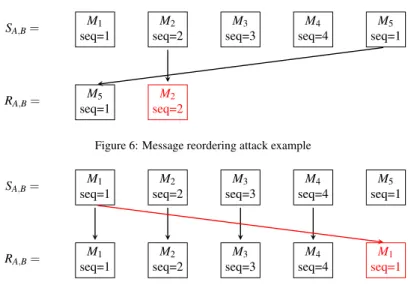
We first recall the idea of the attacks we aim to find. They rely on the fact that sequence numbers used by protocols to keep an order on messages are bounded. For instance, if the client sends five messages M1, ..., M5, and that counters are wrapping at four, then M5and M1will share the same sequence number. The attack on property Flow Authenticity given by TAMARINon OPC-UA with bounded sequence numbers is presented in Figure 6. The clients sends five messages M1, ..., M5with messages M5 and M1sharing the same sequence number. The intruder delays or block messages M1 to M4, lets go message M5and then either let go or replay M2. From the point of view of the server, sequence numbers are correct and follow each other, but messages have been reordered.
However, to the best of our knowledge, most implementations of OPC-UA rely on TCP and the client will not send message M2before having received an answer of message M1. One can thus either spoof the acknowledgment, or use a variant of the attack as presented in Figure 7. The client and the server will communicate normally with messages M1, ..., M4. Then, when the client sends message M5, the attacker will replace it with message M1(previously sent by the client). We want to experimentally check if the server would accept such a replayed message.
5Note that allowing a sequence number to be reused leads to attacks on Injective Message Authenticity as the same message can be accepted multiple times.
SA,B= M1 seq=1 M2 seq=2 M3 seq=3 M4 seq=4 M5 seq=1 RA,B= M5 seq=1 M2 seq=2
Figure 6: Message reordering attack example
SA,B= M1 seq=1 M2 seq=2 M3 seq=3 M4 seq=4 M5 seq=1 RA,B= M1 seq=1 M2 seq=2 M3 seq=3 M4 seq=4 M1 seq=1
Figure 7: Message replaying attack example
6.2. Example Industrial Process
To motivate these experimentations, we propose a toy industrial scenario to instanti-ate our attacks. In our example, a server controls a boiler with two pressure valves. The client can control the pressure of these two valves by writing on two variables P1and P2. The process must always guarantee that P2> P1. To interact with the server, while ensuring this property, the client sends messages as presented in Table 6.
Packet Command Sent by Client Comment
1 OpenSecureChannel OPC-UA Handshake 2 CreateSession 3 ActivateSession 4 Browse, P1 5 Browse, P2 6 Read, P1 P1= 40, P2=? 7 Read, P2 P1= 40, P2= 50 8 Write, P2, 60 P1= 40, P2= 60 9 Write, P1, 50 P1= 50, P2= 60 10 Write, P2, 80 P1= 50, P2= 80 11 Write, P1, 70 P1= 70, P2= 80 12 Write, P2, 110 P1= 70, P2= 110 13 Write, P1, 100 P1= 100, P2= 110 14 Write, P2, 150 P1= 100, P2= 150
Table 6: Requests sent by the client
First, the client and the server perform the handshake in order to generate crypto-graphic keys and authenticate each other. More information on this part of the protocol
can be found in [29]. Then the client performs twoBrowserequests, aiming to find the location of variables P1and P2. After this, the client sends twoReadrequests to find out the current values of variables. Finally, the client sends a sequence ofWriterequests in order to gradually increment the values of the variables while preserving the property. 6.3. Tools
We test our attacks on a freePythonimplementation of the OPC-UA stack called
python-opcua6. Moreover, we rely onDockerto help virtualizing clients and servers andWiresharkto check the network packets exchanged. We first detail in Section 6.3.1 some modifications we made to the stack under test. Then, in Section 6.3.2, we explain the network and hosts configurations.
6.3.1. Modifications of the OPC-UA Stack
In the standard, as well as in implementations, the sequence number limit is fixed to 232− 1024 which is rather difficult to reach. In order to easily demonstrate our attack, we modify parts of the implementation to reduce this limit to 8. Such value is obviously very low but presents the advantage to display easily understandable attack traces. Moreover, when considering languages where the size of integer variables depend on their type such asC,C++orJava, a developer could choose a wrong type by mistake and thus reduce the maximal value (e.g.,charwould be limited to 28− 1). To bound this limit to 8, we modified parts of thepython-opcuastack. In particular we modified at lines 212, 216, 254 and 263 of fileopcua/common/connection.py(see Listing 1) and line 61 of fileopcua/client/ua_binary.py(see Listing 2). We emphasize that these modifications only aim to change the value of the bound (i.e., to replace 232− 1024 by 8) but do not alter the behavior of the server regarding replayed messages.
198 def message_to_binary (self, message , \
message_type = ua . MessageType . SecureMessage , \ request_id =0 , algohdr = None ):
[...]
208 chunks = MessageChunk . message_to_chunks (
209 self. security_policy , message , self. _max_chunk_size , 210 message_type = message_type ,
211 channel_id =self. channel . SecurityToken . ChannelId , 212 request_id=request_id%8 if request_id%8>0 else 1, 213 token_id = token_id )
214 for chunk in chunks :
215 self. _sequence_number += 1 216 if self._sequence_number >= 8:
217 logger . debug (" Wrapping sequence number :
self. _sequence_number )
218 self. _sequence_number = 1
[...]
223 def _check_incoming_chunk (self, chunk ): [...]
250 # sequence number must be incremented or wrapped 251 num = chunk . SequenceHeader . SequenceNumber 252 if self. _peer_sequence_number is not None : 253 if num != self. _peer_sequence_number + 1:
254 wrap = 8-1
255 if num < 1024 and self. _peer_sequence_number >= wrap :
256 # specs Part 6, 6.7.2
257 logger . debug (" Sequence number wrapped : 258
self. _peer_sequence_number , num )
259 else:
260 raise ua . UaError (
" Wrong sequence {0} −> {1} ( server bug or replay attack )"
262 .format(self. _peer_sequence_number , num ))
263 self._peer_sequence_number = num%8
Listing 1: opcua/common/connection.py
44 def _send_request (self, request , callback = None , timeout =1000 , \ message_type = ua . MessageType . SecureMessage ):
[...]
60 self. _request_id += 1
61 if self._request_id == 8: self._request_id = 1 62 future = Future ()
Listing 2: opcua/client/ua_binary.py
6.3.2. Network and Hosts Configuration
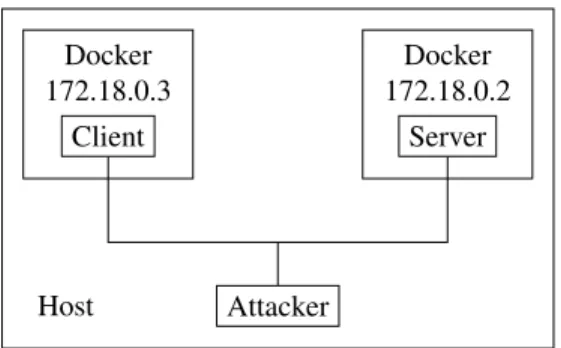
Classical network configurations considered for attacks such as those introduced in Section 6.1 place the intruder in a Man-in-the-Middle position. Such an intruder bears a resemblance with the Dolev-Yao intruder used in TAMARINin the sense that the intruder has a total control on messages exchanged between the client and the server (and can for instance block messages). During experimentations, we noticed that depending on the client behavior, such attack power is not needed for the kind of attacks we study. We consider an attacker able to both sniff communications between the client and the server, and able to send packets on the network. Such an intruder could denote for instance a corrupted router, someone performing MAC flooding or, as we implemented it, the host system of several virtualized machines. Our experimental network configuration is described in Figure 8. For convenience, the client and the server are virtualized applications in the form ofDockercontainers and the attacker is located on the host system. The client and the server communicate on a dedicated network where the client is identified as172.18.0.3and the server as172.18.0.2. The attacker is an application located on the host system that can wiretap this network and inject packets on it.
Docker 172.18.0.3 Client Docker 172.18.0.2 Server Host Attacker
Figure 8: Experimental network configuration
6.4. Results
We propose two experimental attacks on OPC-UA. Against security mode None, we propose in Section 6.4.1 an injection attack where the attacker forges a new packet and inserts it into an ongoing session. Against security mode Sign and SignAndEncrypt, we propose in Section 6.4.2 a replay attack (similar as the one displayed in Figure 7). All scripts used for attacks are made available7.
6.4.1. Security Mode “None”
Given the hypothesis that sequences numbers will wrap at 8, we propose the attack detailed in Table 7. Messages 1 to 14 are sent normally by the client. Then, in message 15, the attacker forges aWRITErequest in order to set variable P2to 42, leading to violating the property P2> P1ensured by the system.
Technical challenges that must be taken into account for this attack are mainly dealing with the headers being accepted by the server. At Ethernet and IP levels, the attacker must spoof MAC and IP addresses of both the client and the server (which can be learned from observed traffic). Similarly at TCP level, the attacker must spoof the source port used by the client. More complicated, the attacker must provide the right TCP sequence and acknowledgment numbers. Those can be deduced from the last packet sent by the server and its length. Multiple fields of the OPC-UA header must also match the session initiated by the client (namely the channel ID, the security token and the request ID). Finally, the OPC-UA sequence number must follow the one in the previous request. We provided two scripts in order to demonstrate a communication without and with the attack. An execution trace of both scripts is displayed in Listing 3. $ ./ runWithoutAttackNone . sh
[+] Launching server None .
[+] Checking attack success in server logs . $ ./ runWithAttackNone . sh
[+] Launching server None .
[+] Checking attack success in server logs .
Packet Sequence Command Sent by Client Comment Number 1 1 OpenSecureChannel OPC-UA Handshake 2 2 CreateSession 3 3 ActivateSession 4 4 Browse, P1 5 5 Browse, P2 6 6 Read, P1 P1= 40, P2=? 7 7 Read, P2 P1= 40, P2= 50 8 1 Write, P2, 60 P1= 40, P2= 60 9 2 Write, P1, 50 P1= 50, P2= 60 10 3 Write, P2, 80 P1= 50, P2= 80 11 4 Write, P1, 70 P1= 70, P2= 80 12 5 Write, P2, 110 P1= 70, P2= 110 13 6 Write, P1, 100 P1= 100, P2= 110 14 7 Write, P2, 150 P1= 100, P2= 150 15 1 (Forged) Write, P2, 42 P1= 100, P2= 42 Table 7: Forge attack trace
ERROR : root :[ ALERT ] Property failure : Pressure1 (100) >= Pressure2 (42)! Listing 3: Execution traces for forge attack
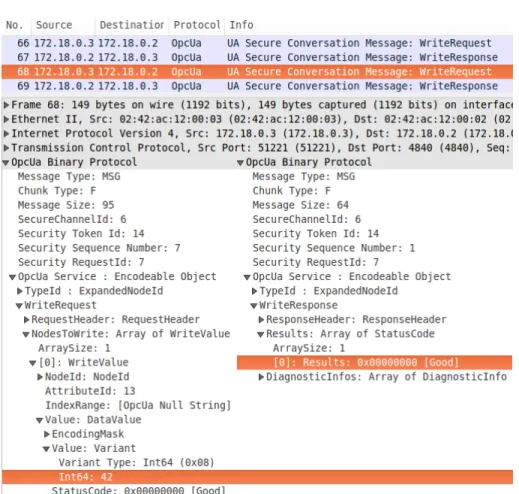
Under attack, the server pushes a syslog to alert the safety property has been violated (such log is accessed throughDocker’s interface). Moreover, when looking at a network analyzer such asWireshark, we can clearly see highlighted in orange, the crafted packet with our chosen value (here 42), and the server sending a response confirming the modification of the variable (“Good”). Both packets are showed in Figure 9.
6.4.2. Security Modes “Sign” and “SignAndEncrypt”
In security mode Sign and SignAndEncrypt a cryptographic signature prevents the attacker to forge a new packet (since the secret symmetric keys are required in order to sign it, and these are renewed for each session). However, the attacker can still replay an older packet from the same session, with the same sequence number, as shown in Figure 7. Thus we can implement the attack presented in Table 7. Messages 1 to 14 are sent normally by the client. Then, in message 15, the attacker replays theWRITErequest sent by the client in message 8 in order to set variable P2to 60, leading to violating the property P2> P1ensured by the system.
The technical challenges that must be taken into account for this attack are similar to those in Section 6.4.1 at Ethernet, IP and TCP levels. Then, the OPC-UA level is a simple replay of a previous packet (packet 8 in our case) and cannot be modified due to the cryptographic signature. Thus all fields of the OPC-UA header obviously match the session initiated by the client, including the OPC-UA sequence number that must follow the one in the previous request. We provided two scripts in order to demonstrate a communication without and with the attack. An execution trace of both scripts is displayed in Listing 4. Again, under attack, the server pushes a syslog to alert the safety
Figure 9: Wireshark capture of forge attack
property has been violated (such log is accessed throughDocker’s interface). $ ./ runWithoutAttackSign . sh
[+] Launching server in mode Sign .
[+] Checking attack success in server logs . $ ./ runWithAttackSign . sh
[+] Launching server in mode Sign .
[+] Checking attack success in server logs .
ERROR : root :[ ALERT ] Property failure : Pressure1 (100) >= Pressure2 (60)! Listing 4: Execution traces for replay attack
When looking at a network analyzer such asWireshark, we can clearly see high-lighted in orange, the replayed packet with value 60, and the server sending a response confirming the modification of the variable (“Good”). One can also notice random looking bytes (starting at f 1 38 e2 and ending at bc f 2 30 at the very bottom of the figure) denoting the cryptographic signature of the message. Both packets are showed
Packet Sequence Command Sent by Client Comment Number 1 1 OpenSecureChannel OPC-UA Handshake 2 2 CreateSession 3 3 ActivateSession 4 4 Browse, P1 5 5 Browse, P2 6 6 Read, P1 P1= 40, P2=? 7 7 Read, P2 P1= 40, P2= 50 8 1 Write, P2, 60 P1= 40, P2= 60 9 2 Write, P1, 50 P1= 50, P2= 60 10 3 Write, P2, 80 P1= 50, P2= 80 11 4 Write, P1, 70 P1= 70, P2= 80 12 5 Write, P2, 110 P1= 70, P2= 110 13 6 Write, P1, 100 P1= 100, P2= 110 14 7 Write, P2, 150 P1= 100, P2= 150 15 1 (Replayed) Write, P2, 60 P1= 100, P2= 60
Table 8: Replay attack trace
in Figure 10. We can go further and demonstrate the exact same replay attack with the server configured in security mode SignAndEncrypt as shown in Listing 5.
$ ./ runWithoutAttackSignEnc . sh
[+] Launching server in mode SignEncrypt . [+] Checking attack success in server logs . $ ./ runWithAttackSignEnc . sh
[+] Launching server .
[+] Checking attack success in server logs .
ERROR : root :[ ALERT ] Property failure : Pressure1 (100) >= Pressure2 (60)! Listing 5: Execution traces for replay attack (with encryption)
Looking at aWiresharkcapture of this transmission, one only sees that packets are encrypted. The OPC-UA header is in plaintext (yet signed), allowingWiresharkto recognize the packet as OPC-UA, but the applicative contents cannot be observed. 6.5. Limitations
Our experiments show some limitations of these attacks. First, assuming the “wiretap and spoof” attacker introduced in Section 6.3.2, the attacker can only inject new packets in the protocol flow but has no control over legitimate ones. As a consequence, injected packets will decorrelate TCP and OPC-UA sequence numbers shared by the client and the server, leading to the attack being easily detected (all packets later sent by the client will be refused by the server). Yet, we argue that depending on the physical consequences of the attack on the industrial process (including potential destruction
Figure 10: Wireshark capture of replay attack
of the facility), detection might become obvious anyway. Moreover, a real Man-in-the-Middleattacker could tamper sequence numbers of packets later sent by the client and keep the attack secret. In addition, in security mode SignAndEncrypt, the attacker cannot read packets and is bound to replay unknown packets leading to the attack being a lot less practical. However, there is a one-to-one correspondence between packets in Sign andSignEncryptmodes. Thus, in our experimental setup, we knew exactly which packet to replay in SignAndEncrypt mode based on the attack in Sign mode.
Finally, as mentioned at the end of Section 5.2, it is stated in the OPC-UA standard that “A SequenceNumber may not be reused for any TokenId. The SecurityToken lifetime should be short enough to ensure that this never happens [...]”. Our experiment showed that this counter-measure is not implemented inpython-opcua, thus other imple-mentations should be checked. Yet, even if this counter-measure is not implemented,
the limit of 232− 1024 appears difficult to reach: for a client that sends a hundred messages per second, it would take roughly sixteen months to reach the limit without the session being renewed. Such running times can however be attained in the case of some industrial systems that stay in place for several decades. Therefore, while this attack might be hard to realize on many real systems, our experiment showed that it is still technically possible, at least on one stack implementation.
7. Conclusion
We provided a formal definition of Flow Integrity and other related properties in industrial systems. Flow Integrity ensures that all messages are received without alteration, and in the same order as they were sent. We checked Flow Integrity on multiple variants of two real industrial protocols: MODBUS and OPC-UA. Our analysis confirms that most of the secure modes of these protocol ensure Flow Integrity given a resilient network. However, we also identified a weakness in a supposedly secure version of MODBUS, due to an insufficient use of cryptography. Moreover, our analysis of bounded sequence numbers highlighted the importance of the renewal of session keys to avoid the reuse of sequence numbers. Unsurprisingly, the insecure modes of these protocols did not ensure any of our security properties. Moreover it turns out that to ensure delivery one has to assume a resilient channel, as the intruder can otherwise always block messages. At the same time, our results show that a resilient channel alone is not sufficient to ensure Flow Integrity: one still needs to use cryptography to prevent the intruder from rerouting or injecting messages.
We also performed practical experiments to validate our results on a real OPC-UA implementation. We were able to show that we can reproduce the traces found by TAMARINand achieve an insecure state of an industrial process example.
In the future, we would also like to study other industrial protocols such as DNP3 or IEC 61850. Finally we are interested in formalizing properties similar to Flow Integrity for protocols with encapsulation. Such protocols permit for example to transfer MODBUS packets through OPC-UA as if they were OPC-UA data so that MODBUS security is performed by OPC-UA. They are a real challenge for formal verification as there is few work on protocol composition, and it has turned out that verifying the composition is more complicated than verify the protocols independently.
References
[1] ANSSI. Managing cybersecurity for ICS, June 2012.
[2] A. Armando, D. Basin, Y. Boichut, Y. Chevalier, L. Compagna, J. Cuellar, P. H. Drielsma, P.-C. Heám, O. Kouchnarenko, J. Mantovani, S. Mödersheim, D. von Oheimb, M. R., J. Santiago, M. Turuani, L. Viganò, and L. Vigneron. The AVISPA tool for the automated validation of internet security protocols and applications. In CAV’05. 2005.
[3] M. Backes, J. Dreier, S. Kremer, and R. Künnemann. A novel approach for reasoning about liveness in cryptographic protocols and its application to fair exchange. In EuroS&P 2017, pages 76–91. IEEE, 2017.
[4] D. Basin, S. Mödersheim, and L. Viganò. An on-the-fly model-checker for security protocol analysis. In ESORICS’03, 2003.
[5] B. Blanchet. An efficient cryptographic protocol verifier based on Prolog rules. In CSFW’01, 2001.
[6] S. Bratus, A. J. Crain, S. M. Hallberg, D. P. Hirsch, M. L. Patterson, M. Koo, and S. W. Smith. Implementing a vertically hardened dnp3 control stack for power applications. In ICSS’16, pages 45–53, 2016.
[7] D. D. Clark and D. R. Wilson. A comparison of commercial and military computer security policies. In Security and Privacy, 1987 IEEE Symposium on, pages 184–184. IEEE, 1987.
[8] G. R. Clarke, D. Reynders, and E. Wright. Practical modern SCADA protocols: DNP3, 60870.5 and related systems. Newnes, 2004.
[9] C. Cremers. The Scyther Tool: Verification, falsification, and analysis of security protocols. In CAV’08, 2008.
[10] C. Cremers, M. Horvat, S. Scott, and T. van der Merwe. Automated analysis and verification of TLS 1.3: 0-rtt, resumption and delayed authentication. In SP’16, 2016.
[11] D. Dolev and A. C. Yao. On the security of public key protocols. Information Theory, IEEE Transactions on, 29(2):198–208, Mar. 1981.
[12] J. Dreier, P. Lafourcade, and Y. Lakhnech. Formal verification of e-auction protocols. In POST’13, 2013.
[13] J. Dreier, M. Puys, M. Potet, P. Lafourcade, and J. Roch. Formally verifying flow integrity properties in industrial systems. In SECRYPT’17, Madrid, Spain, 2017. [14] B. Dutertre. Formal modeling and analysis of the MODBUS protocol. In Critical
Infrastructure Protection, pages 189–204. Springer, 2007.
[15] D. Dzung, M. Naedele, T. von Hoff, and M. Crevatin. Security for industrial communication systems. Proceedings of the IEEE, 93(6):1152–1177, June 2005. [16] I. Fovino, A. Carcano, M. Masera, and A. Trombetta. Design and implementation
of a secure MODBUS protocol. In IFIP AICT’09. 2009.
[17] G. Hayes and K. El-Khatib. Securing MODBUS transactions using hash-based message authentication codes and stream transmission control protocol. In IC-CIT’13, 2013.
[18] N. Heintze and J. G. Riecke. The slam calculus: programming with secrecy and integrity. In POPL’98, 1998.
[19] IEC-62439. Industrial communication networks - High availability automation networks - Part 3: Parallel Redundancy Protocol (PRP) and High-availability Seamless Redundancy (HSR). International Electrotechnical Commission, 2016.

![Figure 2: Two requests and responses in textbook MODBUS [25].](https://thumb-eu.123doks.com/thumbv2/123doknet/14567791.539230/16.918.330.587.177.371/figure-two-requests-and-responses-in-textbook-modbus.webp)
![Figure 4: Two requests and responses in secure MODBUS [17].](https://thumb-eu.123doks.com/thumbv2/123doknet/14567791.539230/17.918.262.663.176.342/figure-two-requests-and-responses-in-secure-modbus.webp)