HAL Id: hal-02624937
https://hal.archives-ouvertes.fr/hal-02624937
Submitted on 26 May 2020
HAL is a multi-disciplinary open access
archive for the deposit and dissemination of
sci-entific research documents, whether they are
pub-lished or not. The documents may come from
teaching and research institutions in France or
abroad, or from public or private research centers.
L’archive ouverte pluridisciplinaire HAL, est
destinée au dépôt et à la diffusion de documents
scientifiques de niveau recherche, publiés ou non,
émanant des établissements d’enseignement et de
recherche français ou étrangers, des laboratoires
publics ou privés.
Overview of PSF determination techniques for
adaptive-optics assisted ELT instruments
Roland Wagner, Olivier Beltramo-Martin, Carlos Correia, Romain Fétick,
Ronny Ramlau, Thierry Fusco, Benoit Neichel
To cite this version:
Roland Wagner, Olivier Beltramo-Martin, Carlos Correia, Romain Fétick, Ronny Ramlau, et al..
Overview of PSF determination techniques for adaptive-optics assisted ELT instruments. 6th
Inter-national Conference on Adaptive Optics for Extremely Large Telescopes, AO4ELT 2019, Jun 2019,
Quebec City, Canada. �hal-02624937�
Overview of PSF determination techniques for
adaptive-optics assisted ELT instruments
Roland Wagner
a, Olivier Beltramo-Martin
b,c, Carlos M. Correia
d,c, Romain J. F´
etick
b,c, Ronny
Ramlau
a,e, Thierry Fusco
b,c, and Benoit Neichel
c aJohannes Kepler University, Altenberger Strasse 69, 4040 Linz, Austriab
ONERA, The French Aerospace Laboratory, Marseille, France
cAix Marseille Univ., CNRS, CNES LAM, Marseille, France d
W. M. Keck Observatory, 65-1120 Mamalahoa Hwy, Kamuela, HI 96743
eJohann Radon Institute of Computational and Applied Mathematics, Austrian Academy of Sciences, Linz, Austria
ABSTRACT
The determination of the optical point spread function (PSF) or a model thereof is one key step in the estimation of key astronomical quantities for most science cases. Yet it has proven quite challenging due to crowding or the total absence of point-sources in the field or variability (time, angle and wavelength). For Adaptive-optics (AO) assisted observations, alternative techniques exist such as PSF reconstruction (PSF-R) which relies on the AO control loop data. Our goal is to provide a standardized nomenclature and categorization of the techniques that use focal-plane data (numerical extraction, parametric model-fitting), recovery from telemetry (reconstruction, analytic or Monte Carlo modeling) or both jointly combined (hybrid, deconvolution) in an attempt to gain insight into the advantages and shortcomings of such techniques. Applicability to AO systems on Giant Segmented Mirror Telescopes (GSMT) is our main motivation.
Keywords: Adaptive Optics, Extremely Large Telescopes, Instrumentation, Point Spread Function, Post pro-cessing
1. INTRODUCTION
Knowledge of the Point spread function (PSF) is crucial in astronomy in order to optimize observations scheduling and post-process data delivered by instruments that equip telescopes. For instance, observations of extended objects, such as asteroids or galaxies, necessitate to deconvolve1–3 the focal-plane image from the PSF to restore high-spatial frequencies of the object morphology. However, a good representation of the PSF is not necessarily retrievable from the image itself; the absence of a point source, the detector noise or the source crowding prevent estimating the PSF straightforwardly, calling for specific PSF estimation strategy, like offsetting the telescope to observe the closest bright star. Besides, the PSF delivered by ground-based telescopes is naturally variable owing to atmospheric turbulence statistics that evolve across time, optical elements that introduce field and wavelength-dependent aberrations. The use of AO increases this variability as we illustrate it along three types of PSF variability:
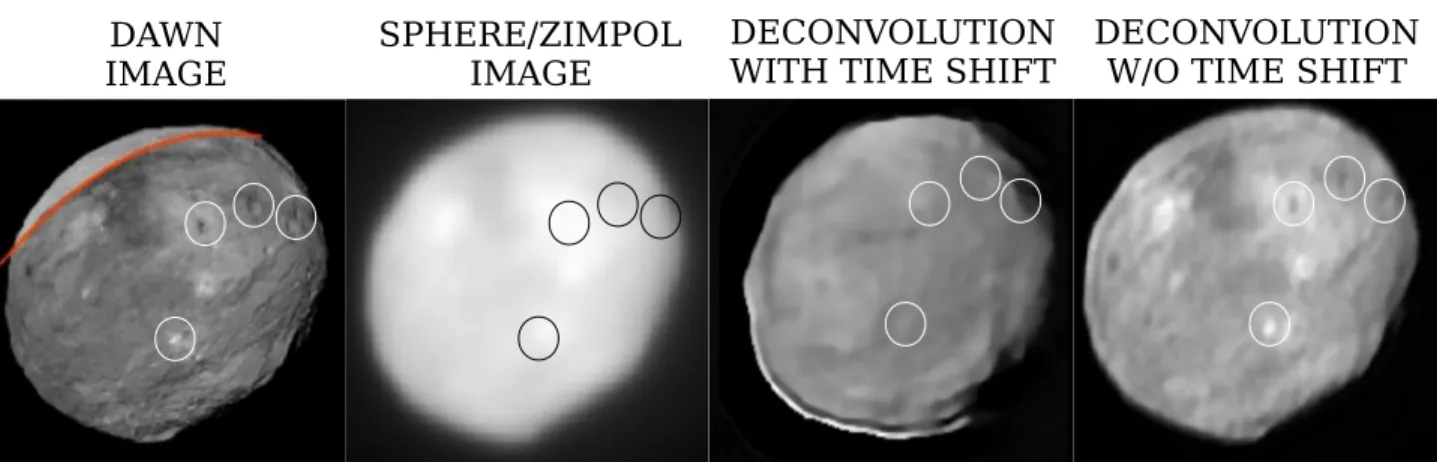
• temporal: Deconvolution of extended objects relies on PSF recovery to estimate the high spatial fre-quencies that are filtered by the AO system. We present in Fig. 1 a SPHERE/ZIMPOL visible image of VESTA4 compared to a in situ image obtained with the probe DAWN. The result of the deconvolution is very sensitive to the PSF provided to the algorithm. When relying on an unsynchronous PSF obtained 10 mn before the asteroid observation, the deconvolution introduces strong artifacts at the object edges and fails in restoring the surface topology. On the contrary, the use of a synchronous PSF allows to recover the presence of craters at the asteroid surface.
Further author information: (Send correspondence to R.W) R.W.: E-mail: [email protected]
• spatial: For modern instruments providing AO corrected images covering up to 1’ of the sky, anisopla-natism5 and field-dependent static aberrations6 introduce a spatial variability of the PSF as illustrated in Fig. 2. Therefore, assuming that we are capable of extracting a PSF somewhere in the field, with a sufficient S/N, we will introduce a strong bias and degrade precision by at least a factor three on photome-try/astrometry estimates (see O. Beltramo-Martin, G. Witzel et al. in this conference) if we do not model these spatial variations in the PSF-fitting process.
• spectral: Extrapolating a PSF from one wavelength to another may not be straightforward. We present in Fig. 2the core of the cluster HD125935 imaged with MUSE in Narrow Field Mode (NFM).7We also present the azimuthal average of the PSF for the corresponding wavelengths, that illustrates the spectral variation of the PSF. Part of this variation can be anticipated regarding that the residual phase φ = 2πδ/λ, with δ the achromatic residual optical path difference. However, the instrument and atmosphere bring chromatic effects as well whose impact on the PSF must be calibrated.
All three sources of variability limit the use of observed PSFs into the post-processing stage: a model of spatial and spectral variations is necessary, as well as synchronous measurements of the PSF with the astrophysical image. The current prospect to tackle the PSF recovery issue consists in utilizing AO contextual data, such Wavefront Sensor (WFS) measurements and Deformable Mirror (DM) commands, known as PSF reconstruction (PSF-R).8–14 This technique is now well established but necessitates a deep understanding of the AO system through multiple calibration and on-sky observations. In parallel, there is an effort from the community to propose analytic AO PSF models15–19and image processing pipelines.20–24 We aim in this proceedings to review the different existing techniques to determine the PSF presented in Sect.2, In Sect.3, we discuss current and future work related to PSF estimation for preparing the venue of the next generation of instruments for large and extremely large ground-based telescopes. We conclude in Sect.4.
DECONVOLUTION
WITH TIME SHIFT
SPHERE/ZIMPOL
IMAGE
DAWN
IMAGE
DECONVOLUTION
W/O TIME SHIFT
Figure 1. From left to right: (i) Image of the asteroid VESTA obtained with the DAWN probe, (ii) Image of VESTA obtained in R-band with the SPHERE/ZIMPOL instrument, (iii) Result of the deconvolution using a PSF measured 10 mn after the observation, (iv) Result of the deconvolution using a synchronous PSF. The figure highlights that the temporal variability of the PSF strongly affects the deconvolution process if neglected.4,25
2. METHODS FOR DETERMINING THE PSF
We distinguish four different species of PSF recovery techniques:
1. PSF fitting that adjusts a parametric model over one or several PSF extracted from the astronomical image.
2. PSF reconstruction that builds a simplified model of the PSF that involves AO control loop telemetry (wavefront measurements, DM commands, ...) and calibration of instrumental static aberrations.
Figure 2. Top: Images of HD 125935 with the narrow field mode of MUSE at four different spectral bands. Bottom-left: Simulation of a stellar population from the catalog given by26 observed with the K-filter of the 10”×10” NIRC2 imager that equips the Keck II telescope through the AO system. The simulation relies on median atmosphere conditions at Mauna Kea with 45◦of zenith angle. The figure unveils the spatial variability of the PSF due to angular anisoplanatism5 and field-dependent static aberrations.6 Bottom right: Azimuthal average of the MUSE on-sky PSFs with respect to the angular separation. Number indicated in the legend correspond to the estimated Strehl-ratio.
3. PSF simulation that consists in running a end-to-end physical-optics propagation simulation to obtain a PSF from geometrical and atmospheric parameters identified from on-sky data.
4. Hybrid PSF determination as methods that combines the three previous to optimize the PSF deter-mination.
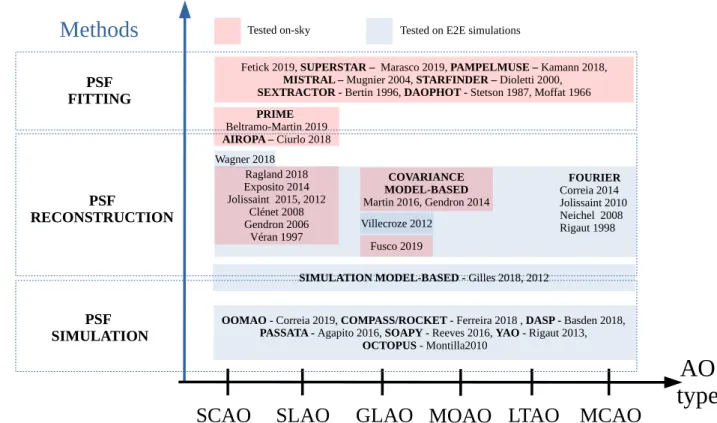
In the following Sections, we discuss benefits and drawbacks of those four categories. Fig.3 summarizes this discussion and Fig.4 shows a comparison between the true PSF and the PSF estimates obtained using different techniques for different AO systems.
2.1 PSF fitting
PSF fitting is the most common technique as it does not require AO expertise and rely on the sole astronom-ical image. Several pipelines have been developed in this purpose, such as STARFINDER,22 DAOPHOT24 or SEXTRACTOR,23 or more recent work with PAMPELMUSE20and SUPERSTAR. They usually organize over a three-folded process that consists in (i) correcting frames from dark, backgrounds, flat field and distortions,27 (ii) extracting PSFs from the entire field or sub-fields to account for PSF spatial variations, (iii) adjusting a parametric model over extracted images or stack them to determine the PSF. However, these methods are sen-sitive to the image noise that propagates through the model fitting, require the presence of a point-like source within the scientific field and are limited by the crowding effect.26,28–30 On top of that, the AO PSF complex
structure, with a core dominated by the AO residual and seeing-limited wings, is not accurately modeled by classical functions (Moffat, Gaussian). A recent analytical description has been proposed15 to derive the PSF from physical-based parameters and describes jointly both corrected and non-corrected parts of the PSF, with successful applications to MUSE Narrow Field Mode7and SPHERE/ZIMPOL.31,32Myopic deconvolution1,2can also be deployed for PSF determination. Similarly to PSF-fitting algorithms, the deconvolution process solve for a criterion, with an explicit regularization term, whose minimization enable the PSF 2D shape retrieval as long as we have priors on both the object intensity distribution and the PSF. The morphology of this latter can be constrained thanks to an analytical model, as sucessfully showed in.25
2.2 PSF simulation
A first mean to determine the PSF relies on end-to-end simulations based on physical-optics model of the wave-front propagation from atmosphere layers to science instruments detector. Powerful tools have been developed such as OOMAO (C. Correia et al. in this conference), COMPASS,16,33 DASP,34 PASSATA,35 SOAPY,36 YAO,37 OCTOPUS38 and many others. A forward use of those tools would be to asses both integrated param-eters (C2
n profile, seeing, outer scale, turbulence coherence time,...) from on-sky AO telemetry and instrumental
configuration (static aberrations, pupil shape, DM influence functions, detectors pixel scales, WFS sensitivity, pupil mis-registrations, ...) to feed an end-to-end simulations. This strategy is meaningful to account for the real AO system behavior (such as the control algorithm implemented into the RTC), but requires an advanced understanding and modeling of the full optical path including telescope, AO system and scientific instruments to achieve an accurate PSF determination that reproduces sky observations. On top of that, some information may be missing, such as measurements of low wind effects, optical gains variations for instance; consequently, it may exist a deviation of the simulated PSF from the observation that impact significantly the estimation of the interest astrophysical signal.
2.3 PSF reconstruction
PSF reconstruction relies on a simplified model of the AO system that assumes that the WFS measurements are linear with respect to the residual phase, that is considered as a stationary and Gaussian process. In this assumption, the PSF h(α) can be derived analytically as follows
h(α) = Fh˜hT(ρ/λ) exp (Bφ(ρ) − Bφ(0))
i
, (1)
where ˜hTis the telescope + instrument Optical Transfer Function (OTF) and Bφis the covariance function of the
AO residual phase. The static OTF is obtained by the autocorrelation of the static phase within the telescope pupil that is measured thanks to phase diversity1or focal plane sharpening39techniques. The covariance function Bφ may be calculated using different strategies:
• Fourier model-based approach: this consists in modelling how spatial frequencies of atmospheric phase disturbances propagate from the layer which they are generated from to the detector focal plane. This demands to model each component of the AO system to understand how a spatial frequency is measured and reconstructed through the wavefront-sensing process:19,40–43
Bφ(ρ) = F [Wφ(k)] , (2)
where WAO is the AO residual phase Power Spectrum Density (PSD). This latter is split into multiple
terms that account for different physical limitations, such as the DM cut-off frequency that creates the seeing-limited PSF halo, or the servo-lag the PSD that models how the system latency combined with the atmosphere temporal characteristics create a PSF elongation. The Fourier calculation is very fast (less than a second to get a PSF) and well documented with algorithms available to the community. It is also ideal at the system design stage to assess the relative performance sensitivity with respect to AO configuration (number of lasers, number of DM,...) and observing conditions. For instance, recent works have delivered statistics on the atmospheric vertical distribution at Paranal;44,45 thanks to the rapidity of the analytical derivation, AO designers are capable of defining the most performing and robust system regarding these
measurements instead of median and quartiles only. However, the main drawback is that they usually call approximations (e.g., infinite exposure, a priori on the atmosphere statistics) that limit the final absolute accuracy. A recent work (T. Fusco in prep.) has illustrated however that a Fourier-based reconstruction can reach better than 20% of accuracy on the PSF metrics (Strehl ratio, FWHM, Ensquared energy) from only three integrated parameters (seeing, ground seeing and outer scale).
• Covariance model-based approach: this is a similar method that involves the same hypothesis on the atmosphere statistics. Similarly to the Fourier method, the AO residual is split into error terms (actually the same physical processes) but focuses on modelling the auto and cross correlation of those12,18,46 in a modal basis. This enables to calculate more easily cross-terms, separate properly tip-tilt modes to the rest, include the DM spatial filtering and account correctly for the LGS cone effect.
• Reconstruction approach: Other techniques presented above degrade the information contained in the telemetry down to few integrated parameters only. With the reconstruction approach, Bφ is derived from
the empirical covariance of wavefront measurements,8,9,14,47which contains more information than the sole integrated parameters. This strategy generally allows to improve the PSF reconstruction accuracy despite the mathematical formalism remains quite the same. On-sky tests have been achieved through the two past decades, especially on on PUEO,8NACO,48Keck11,13or CANARY,49that showed that reconstructing the PSF at 1%-5% level is doable.
2.4 Hybrid PSF determination
Hybrid PSF determination techniques gather at least two of the approaches presented above, in order to mitigate weaknesses and benefit from strengths of each of them. For instance, a way to enable accurate PSF reconstruction for MCAO systems is carried by the so-called simulation-model based approach,10,50 developed in the context of TMT. It consists in (i) reconstructing the PSF in laser guide stars direction from the AO telemetry (ii) determine using end-to-end simulation the correct spatial filter to obtain the PSF across the field and accounting for the MCAO optimization fitting. By combining efficiently the AO telemetry generated by the real system and its simulated gemini, one may obtain the spectacular results presented in Fig. 4 on simulated data of NFRIAOS/IRIS.
The same pragmatic idea goes along PSF fitting techniques that can be enhanced thanks to PSF reconstruc-tion. The so-called AIROPA package,21,51 inherits from the original Starfinder code but includes off-axis PSF reconstruction to account for PSF spatial variations. Those latter are modeled from (i) the anisoplanatism effect5 that introduces a phase spatial decorrelation (ii) the field-dependent static aberrations that can be calibrated and have a significant impact on the PSF inhomogeneity.6 In the same spirit, the algorithm called PRIME52,53 combines PSF fitting and PSF reconstruction techniques to achieve jointly the stellar parameters (photome-try/astrometry) and PSF determination. The covariance function Bφ is reconstructed from AO telemetry and
additional degrees of freedom are introduced to obtain Bφ=PigiBi, where gi is a scaling factor to retrieve and
Bi the covariance of a specific AO error (DM fitting, servo-lag, aliasing, ...). Gains gican be calibrated at a cost
of possibly large amount of technical time; PRIME aims to retrieve them directly from PSF in the image.
3. ON-GOING AND UPCOMING WORK
Several projects for PSF reconstruction on GSMT first light instruments are on-going. We present in the following some of them as well as necessary developments to make these projects a success in serving the observational community. A common point for all systems is that the data volumes will increase for the upcoming GSMTs and therefore a proper data flow pipeline has to be envisioned already during the design phase of an instrument. All algorithms need also to account for the particular pupil geometry (e.g., spiders, actuator positions), which will demand also to upgrade existing propagation models of spatial frequencies. In order to coordinate the efforts dedicated to PSF estimation for instruments at ESO’s Extremely Large Telescope (ELT), a working group at ESO led by Jo¨el Vernet has been established recently. This group aims to define a top-down level roadmap, starting from defining the scientific requirements and how they do translate in terms of PSF characterization accuracy, to implement accurate estimation tools and manage operation and dissemination aspects. In order to trigger upcoming discussions, we present in the next sections the current investigations on PSF reconstruction.
Methods
AO
type
SCAO
SLAO
GLAO MOAO LTAO MCAO
PRIME Beltramo-Martin 2019 AIROPA – Ciurlo 2018 COVARIANCE MODEL-BASED Martin 2016, Gendron 2014 Ragland 2018 Exposito 2014 Jolissaint 2015, 2012 Clénet 2008 Gendron 2006 Véran 1997 Wagner 2018
Tested on-sky Tested on E2E simulations
Fetick 2019, SUPERSTAR – Marasco 2019, PAMPELMUSE – Kamann 2018,
MISTRAL – Mugnier 2004, STARFINDER – Dioletti 2000, SEXTRACTOR - Bertin 1996, DAOPHOT - Stetson 1987, Moffat 1966
PSF FITTING FOURIER Correia 2014 Jolissaint 2010 Neichel 2008 Rigaut 1998 Villecroze 2012 Fusco 2019
OOMAO - Correia 2019, COMPASS/ROCKET - Ferreira 2018 , DASP - Basden 2018, PASSATA - Agapito 2016, SOAPY - Reeves 2016, YAO - Rigaut 2013,
OCTOPUS - Montilla2010
SIMULATION MODEL-BASED - Gilles 2018, 2012
PSF SIMULATION
PSF
RECONSTRUCTION
Figure 3. Overview of different PSF estimation techniques comparing AO type, data need and expected on-sky error.
Figure 4. Comparison of PSF estimation techniques for different AO systems. Top row: true PSF, middle row: esti-mated PSF, bottom row: residual PSF. The results are from left to right for the systems: Keck/NIRC2 (SLAO,53), Canary/CAMICAZ (GLAO,54), Canary/CAMICAZ (MOAO,54), GALACSI/MUSE (LTAO,15) and NFIRAOS/IRIS (MCAO,50).
3.1 SCAO systems using Pyramid WFS: MICADO, HARMONI and METIS
For SCAO systems, PSF reconstruction is possible using the historic V´eran technique,8which was demonstrated on sky several times (NACO,9SPHERE,52CANARY,12Keck11,55). However, a generalization to Pyramid WFS-based systems must be investigated, especially, due to the potential non-linear behavior of the Pyramid WFS. Currently the working group in Linz is updating the reconstruction algorithms to Pyramid WFS and the needs of MICADO. Demonstration on end-to-end simulations have been achieved, but must be pursued to explore the parameter space and test the algorithm in a non-linear regime. The LOOPS bench (see P. Janin-Potiron in this conference) has been recently upgraded with a new Spatial Light Modulator (SLM) placed into a pupil-plane to simulate turbulent phase screens. Thanks to OOMAO (see C. Correia et al. in this conference), we aim to simulate residual phase screens to be seen by the pyramid, in order to acquire bench pyramid measurements and perform the PSF reconstruction with variable observing and modulation conditions. The utmost validation will come from on-sky facilities equipped with pyramid-based AO systems, such at Keck (see C. Bond at al. in this conference) or at the LBT for instance. Moreover, experience on PSF reconstruction from quad-cell WFS is also meaningful to address the problem a optical gain variations encountered with Pyramid WFS (see. V. Chambouleyron et al., V. Deo et al. in this conference) as this problem occurs on quad-cell sensors as well.55
3.2 GLAO and MOAO systems: MOSAIC ELT
These systems are dedicated to improve the PSF FWHM and encircled energy from the seeing-limited scenario, but in a very wide field. For instance, MUSE WFM (GLAO) achieves a factor two in decreasing the PSF FWHM. Such systems are ideal for multiplex observations and probing very large field of view depleted in known source, such as the MUSE Hubble ultra deep field survey,56 for which there is potentially no PSF in the field, calling for a dedicated PSF estimator. The level of correction is nominally limited by the atmospheric residual, which signifies that modelling the PSF does not require necessarily to have a very precise knowledge of the instrument static aberrations. For GLAO systems, an analytical approach,18based on integrated values (seeing, outer scale, ground layer fraction) plus few PSFs for calibration purpose, is sufficient to reach 20% of accuracy on MUSE WFM images (T. Fusco et al., in prep.). For MOAO systems, a work has been led on the CANARY experiment12 and achieved reconstruction results at a few percent level. However, in order to fulfill the needs of an ELT instrument, both methods have to be updated: for GLAO the MUSE WFM algorithm has to be adapted, while for MOAO the CANARY algorithm has to be enhanced to handle the combination of open and closed loop DMs.
3.3 LTAO systems: HARMONI ELT, KAPA Keck, MUSE NFM VLT
LTAO systems are now coloring the AO landscape with MUSE at VLT and soon KAPA at Keck and HARMONI at ELT. As the emergence of LTAO systems on-sky is quite recent, there is no experience in performing PSF reconstruction on such systems. The theoretical framework presented in Sect. 2.3 is still valid, although the tomographic process complexifies the reconstruction for two reasons (i) we need more calibration data, such as the exact tomographic reconstructor that has been used during AO operations, and (ii) the PSF spatial variability is not a function of the atmosphere characteristics only but depends on the tomographic strategy as well. There is an effort led at LAM to enable PSF reconstruction for LTAO systems by combining classical on-axis PSF reconstruction and modeling of spatial variations.
3.4 MCAO systems: MAORY ELT, NFIRAOS TMT, MAVIS VLT
The theoretical PSF reconstruction framework does not apply to MCAO systems owing to the MCAO fitting process that optimizes the image quality in the science detector plane. Consequently, the PSF reconstructed from LGS measurements would be broader than the one really observed on the science focal-plane; we can not play the game of applying convolutive filters (bounded between 0 and 1) to the on-axis OTF any longer as it would enlarge the PSF instead of sharpen it. A new type of non-convolutive filter is needed as presented Gilles10,50 who computes from end-to-end simulation the proper spatial filter to get from reconstructed LGS PSF to science focal-plane PSF. An effort for demonstrating the simulation-model based technique on-sky on near infra-red GeMS/GSAOI data is led by TMT. In parallel, there are investigations at the mathematical department of JKU Linz to propose a new PSF reconstruction framework for MCAO systems. There is also work on-going at
LAM to extend and test the PRIME algorithm on GeMS images of young massive clusters by parametrizing the field-dependent spatial filter to reconstruct the PSF at any position of the field from AO telemetry and PSF in the field.
4. CONCLUSIONS
The problem of PSF determination has been particularly stressed with the emerging 30-40 m class telescopes, which lead to an on-going effort by the community to organize working groups, such as the ESO PSF recon-struction group and the TMT PSF reconrecon-struction workpackage, and workshops with the AO data processing workshop, theOpticon workshop week and AO4ASTRO. Regarding the increasing of activities related to PSF determination, workshops dedicated to post-AO data processing will be held more frequently, with the second edition of theOpticon workshop weekat Porto in 2020 and AO4ASTRO2 at Oxford in 2021. Past meetings and discussions have raised several questions to be addressed and we propose below a non-exhaustive list:
• What is the status of on-going and up-coming work dedicated to PSF determination ? We tried to summarize the different PSF determination techniques and work related to in previous sections, but a step back is probably needed to overview, not only work led by AO experts and users, but also a global activities that concentrate on PSF estimation problem, with a vision of AO experts, astronomers and image processing experts working with ground but also space-based instruments. Workshops and conferences are ideal moments to create this synergy and we emphasis the need of pursuing this effort of communication and dissemination.
• What is the accuracy needed on the PSF determination ? The answer is driven by science and user needs in terms of accuracy of course, but also regarding the accessibility, flexibility and robustness of the PSF delivery pipeline. For instance, for analyzing galaxy kinematics, a 10-20% accuracy on the PSF FWHM estimation must be achieved,57 which does not necessarily require to store all the AO telemetry to reconstruct the PSF at this level, as demonstrated on MUSE FWM (T. Fusco et al., in prep). Stellar populations analysis are more accuracy demanding, and a more efficient PSF determination tools are needed, such hybrid PSF determination techniques. Generally, there is an on-going effort to translate science needs in terms of PSF determination accuracy, especially in the context of GSMTs.58 Extending this effort to all AO-assisted instruments on future 30-40 m class telescopes is probably a must to propose a coherent and efficient PSF determination strategy.
• What is the PSF estimation precision ? For some cases, as deconvolution of extended objects, it may be preferable to achieve a precise determination of a smooth PSF profile instead of relying on a unprecised structured PSF that could compromise the deconvolution process. Few works have attempted to figure out the precision of a reconstructed PSF47 and the way how this precision would impact the image-processing downstream must be clarified.
• What should be the nature of the PSF delivery pipeline ? Several studies have addressed technical questions related to how determining the PSF; however the way we make it accessible to users is not clear so far, although it remains a critical question. In the case of the ELT for instance, do we want to design a common pipeline to all instruments and should we keep PSF generator separated ? It is one of goal of the ESO working group to figure out what is the best strategy to make the estimated PSF accessible to users. • How can we technically and practically enable PSF reconstruction for AO-assisted instruments that will
equip giant segmented mirrors telescopes ? The problem of data flow and storage oftenly raises up (see M. Rosensteiner at al. in this conference) and a common strategy shared between instruments is highly desirable. As PSF reconstruction did not come up to a regular and astronomical routine, we must anticipate all issues that may compromise deployment of PSF reconstruction on-sky. Such an effort is led at W.M. Keck Observatory since years now to deliver a PSF reconstruction pipeline to the users community,13,55 with a particular scope on the AO telemetry management and archiving, which must inspire the definition of equivalent tools on future and existing telescopes.
ACKNOWLEDGMENTS
This work was funded by OEAD, Project FR 08/2018 and by Hochschulraumstrukturmittel provided by the Austrian Ministry of Research (bmbwf). Authors acknowledge the French National Research Agency (ANR) to support this work through the ANR Apply coordinated by B. Neichel. This project has received funding from the European Union’s Horizon 2020 research and innovation programme under grant agreement No 730890. This material reflects only the authors views and the Commission is not liable for any use that may be made of the information contained therein. We acknowledge funding from Partnership Herbert Curien #39442QA.
REFERENCES
[1] Mugnier, L. M., Fusco, T., and Conan, J.-M., “MISTRAL: a myopic edge-preserving image restoration method, with application to astronomical adaptive-optics-corrected long-exposure images,” Journal of the Optical Society of America A 21, 1841–1854 (Oct. 2004).
[2] Fusco, T., V´eran, J. P., Conan, J. M., and Mugnier, L. M., “Myopic deconvolution method for adaptive optics images of stellar fields,” A&A 134, 193–200 (Jan 1999).
[3] Conan, J.-M., Mugnier, L. M., Fusco, T., Michau, V., and Rousset, G., “Myopic deconvolution of adaptive optics images by use of object and point-spread function power spectra,” Applied Optics 37, 4614–4622 (Jul 1998).
[4] Vernazza, P., Brozv, M., Drouard, A., Hanusv, J., Viikinkoski, M., Marsset, M., Jorda, L., Fetick, R., Carry, B., and Marchis, F., “VizieR Online Data Catalog: SPHERE/ZIMPOL (89) Julia images (Vernazza+, 2018),” VizieR Online Data Catalog , J/A+A/618/A154 (Jul 2018).
[5] Fried, D. L., “Anisoplanatism in adaptive optics,” Journal of the Optical Society of America (1917-1983) 72, 52 (Jan. 1982).
[6] Sitarski, B. N., Witzel, G., Fitzgerald, M., Meyer, L., Ghez, A. M., Campbell, R. D., Lu, J. R, M. K., Wizinowich, P., and Lyke, J., “Modeling instrumental field-dependent aberrations in the nirc2 instrument on the keck ii telescope,” in [Adaptive Optics Systems IV ], Proc. SPIE 9148 (August 2014).
[7] Bacon, R., Accardo, M., Adjali, L., Anwand, H., Bauer, S., Biswas, I., Blaizot, J., Boudon, D., Brau-Nogue, S., and Brinchmann, J., “The MUSE second-generation VLT instrument,” in [Proc. SPIE ], Society of Photo-Optical Instrumentation Engineers (SPIE) Conference Series 7735, 773508 (Jul 2010).
[8] Veran, J.-P., Rigaut, F., Maitre, H., and Rouan, D., “Estimation of the adaptive optics long-exposure point-spread function using control loop data.,” Journal of the Optical Society of America A 14, 3057–3069 (Nov. 1997).
[9] Gendron, E., Cl´enet, Y., Fusco, T., and Rousset, G., “New algorithms for adaptive optics point-spread function reconstruction,” Astrophysical Journal 457, 359–363 (Oct. 2006).
[10] Gilles, L., Correia, C., V´eran, J.-P., Wang, L., and Ellerbroek, B., “Simulation model based approach for long exposure atmospheric point spread function reconstruction for laser guide star multiconjugate adaptive optics,” Appl. Opt. 51, 7443–7458 (Nov 2012).
[11] Jolissaint, L., Ragland, S., and Wizinowich, P., “Adaptive Optics Point Spread Function Reconstruction at W. M. Keck Observatory in Laser Natural Guide Star Modes : Final Developments,” in [Adaptive Optics for Extremely Large Telescopes IV (AO4ELT4) ], E93 (Oct. 2015).
[12] Martin, O. A., Correia, C. M., Gendron, E., Rousset, G., Gratadour, D., Vidal, F., Morris, T. J., Basden, A. G., Myers, R. M., Neichel, B., and Fusco, T., “Point spread function reconstruction validated using on-sky CANARY data in multiobject adaptive optics mode,” Journal of Astronomical Telescopes, Instruments, and Systems 2, 048001 (Oct. 2016).
[13] Ragland, S., Dupuy, T. J., Jolissaint, L., Wizinowich, P. L., Lu, J. R., van Dam, M. A., Berriman, G. B., Best, W., Gelino, C. R., Ghez, A. M., Liu, M. C., Mader, J. A., Vayner, A., Witzel, G., and Wright, S. A., “Status of point spread function determination for Keck adaptive optics,” in [Adaptive Optics Systems VI ], Proc. SPIE 10703, 107031J (July 2018).
[14] Wagner, R., Hofer, C., and Ramlau, R., “Point spread function reconstruction for single-conjugate adaptive optics on extremely large telescopes,” J. of Astronomical Telescopes, Instruments, ans Systems 4(4), 049003 (2018).
[15] F´etick, R. J. L., Fusco, T., Neichel, B., Mugnier, L. M., Beltramo-Martin, O., Bonnefois, A., Petit, C., Milli, J., Vernet, J., Oberti, S., and Bacon, R., “Physics-based model of the adaptive-optics-corrected point spread function. Applications to the SPHERE/ZIMPOL and MUSE instruments,” Astrophysical Journal 628, A99 (Aug 2019).
[16] Ferreira, F., Gendron, E., Rousset, G., and Gratadour, D., “Numerical estimation of wavefront error break-down in adaptive optics,” Astrophysical Journal 616, A102 (Aug. 2018).
[17] Gendron, ´E., Charara, A., Abdelfattah, A., Gratadour, D., Keyes, D., Ltaief, H., Morel, C., Vidal, F., Sevin, A., and Rousset, G., [A novel fast and accurate pseudo-analytical simulation approach for MOAO ], vol. 9148 of Proc. SPIE , 6 (Aug. 2014).
[18] Villecroze, R., Fusco, T., Bacon, R., and Madec, P.-Y., “PSF reconstruction for MUSE in wide field mode,” in [Adaptive Optics Systems III ], Proc. SPIE 8447, 84475W (July 2012).
[19] Neichel, B., Fusco, T., and Conan, J.-M., “Tomographic reconstruction for wide-field adaptive optics sys-tems: Fourier domain analysis and fundamental limitations,” Journal of the Optical Society of America A 26, 219 (Dec. 2008).
[20] Kamann, S., “PampelMuse: Crowded-field 3D spectroscopy,” (May 2018).
[21] Ciurlo, A., Do, T., Witzel, G., Lu, J., Lyke, J., Fitzgerald, M. P., Ghez, A., Campbell, R., and Turri, P., “Off-axis PSF reconstruction for integral field spectrograph: instrumental aberrations and application to Keck/OSIRIS data,” in [Adaptive optics systems VI ], Proc. SPIE 10703, 107031O (July 2018).
[22] Diolaiti, E., Bendinelli, O., Bonaccini, D., Close, L. M., Currie, D. G., and Parmeggiani, G., “StarFinder: A code for stellar field analysis.” Astrophysics Source Code Library (Nov. 2000).
[23] Bertin, E. and Arnouts, S., “SExtractor: Software for source extraction.,” Astrophysical Journal 117, 393–404 (June 1996).
[24] Stetson, P. B., “DAOPHOT - A computer program for crowded-field stellar photometry,” Publications of the Astronomical Society of the Pacific 99, 191–222 (Mar. 1987).
[25] F´etick, R. J., Jorda, L., Vernazza, P., Marsset, M., Drouard, A., Fusco, T., Carry, B., Marchis, F., Hanuˇs, J., Viikinkoski, M., Birlan, M., Bartczak, P., Berthier, J., Castillo-Rogez, J., Cipriani, F., Colas, F., Dudzi´nski, G., Dumas, C., Ferrais, M., Jehin, E., Kaasalainen, M., Kryszczynska, A., Lamy, P., Le Coroller, H., Marciniak, A., Michalowski, T., Michel, P., Mugnier, L. M., Neichel, B., Pajuelo, M., Podlewska-Gaca, E., Santana-Ros, T., Tanga, P., Vachier, F., Vigan, A., Witasse, O., and Yang, B., “Closing the gap between Earth-based and interplanetary mission observations: Vesta seen by VLT/SPHERE,” Astrophysical Journal 623, A6 (Mar 2019).
[26] Fritz, T., Gillessen, S., Trippe, S., Ott, T., Bartko, H., Pfuhl, O., Dodds-Eden, K., Davies, R., Eisenhauer, F., and Genzel, R., “What is limiting near-infrared astrometry in the Galactic Centre?,” M.N.R.A.S 401, 1177–1188 (Jan. 2010).
[27] Bernard, A., Neichel, B., Mugnier, L. M., and Fusco, T., “Optimal correction of distortion for high-angular-resolution images: Application to GeMS data,” M.N.R.A.S 473, 2590–2607 (Jan. 2018).
[28] Massari, D., Fiorentino, G., McConnachie, A., Bono, G., Dall’Ora, M., Ferraro, I., Iannicola, G., Stetson, P. B., Turri, P., and Tolstoy, E., “GeMS MCAO observations of the Galactic globular cluster NGC 2808: the absolute age,” Astrophysical Journal 586, A51 (Feb 2016).
[29] Massari, D., Fiorentino, G., McConnachie, A., Bellini, A., Tolstoy, E., Turri, P., Andersen, D., Bono, G., Stetson, P. B., and Veran, J. P., “Astrometry with MCAO: HST-GeMS proper motions in the globular cluster NGC 6681,” Astrophysical Journal 595, L2 (Oct 2016).
[30] Yelda, S., Lu, J. R., Ghez, A. M., Clarkson, W., Anderson, J., Do, T., and Matthews, K., “Improving Galactic Center Astrometry by Reducing the Effects of Geometric Distortion,” Astron. & Astrophys. 725, 331–352 (Dec. 2010).
[31] Beuzit, J. L., Vigan, A., Mouillet, D., Dohlen, K., Gratton, R., Boccaletti, A., Sauvage, J. F., Schmid, H. M., Langlois, M., and Petit, C., “SPHERE: the exoplanet imager for the Very Large Telescope,” arXiv e-prints , arXiv:1902.04080 (Feb 2019).
[32] Schmid, H. M., Bazzon, A., Roelfsema, R., Mouillet, D., Milli, J., Menard, F., Gisler, D., Hunziker, S., Pragt, J., and Dominik, C., “SPHERE/ZIMPOL high resolution polarimetric imager. I. System overview, PSF parameters, coronagraphy, and polarimetry,” Astrophysical Journal 619, A9 (Nov 2018).
[33] Ferreira, F., Gratadour, D., Sevin, A., Doucet, N., Vidal, F., Deo, V., and Gendron, E., “Real-time end-to-end AO simulations at ELT scale on multiple GPUs with the COMPASS platform,” in [Proc. SPIE ], Society of Photo-Optical Instrumentation Engineers (SPIE) Conference Series 10703, 1070347 (Jul 2018). [34] Basden, A. G., Bharmal, N. A., Jenkins, D., Morris, T. J., Osborn, J., Peng, J., and Staykov, L., “The Durham Adaptive Optics Simulation Platform (DASP): Current status,” SoftwareX 7, 63–69 (Jan 2018). [35] Agapito, G., Puglisi, A., and Esposito, S., “PASSATA: object oriented numerical simulation software for
adaptive optics,” in [Proc. SPIE ], Society of Photo-Optical Instrumentation Engineers (SPIE) Conference Series 9909, 99097E (Jul 2016).
[36] Reeves, A., “Soapy: an adaptive optics simulation written purely in Python for rapid concept development,” in [Proc. SPIE ], Society of Photo-Optical Instrumentation Engineers (SPIE) Conference Series 9909, 99097F (Jul 2016).
[37] Rigaut, F. and Van Dam, M., “Simulating Astronomical Adaptive Optics Systems Using Yao,” in [Proceed-ings of the Third AO4ELT Conference ], Esposito, S. and Fini, L., eds., 18 (Dec 2013).
[38] Montilla, I., B´echet, C., Lelouarn, M., Correia, C., Tallon, M., Reyes, M., and Thi´ebaut, ´E., “Comparison of Reconstruction and Control algorithms on the ESO end-to-end simulator OCTOPUS,” in [Adaptative Optics for Extremely Large Telescopes ], 03002 (Jan 2010).
[39] Lamb, M., Correia, C., Sauvage, J.-F., Andersen, D., and V´eran, J.-P., “Exploring the operational effects of phase diversity for the calibration of non-common path errors on NFIRAOS,” in [Adaptive Optics Systems V ], Proc. SPIE 9909, 99096E (July 2016).
[40] Rigaut, F. J., V´eran, J.-P., and Lai, O., “Analytical model for Shack-Hartmann-based adaptive optics systems,” in [Adaptive Optical System Technologies ], D. Bonaccini & R. K. Tyson, ed., Proc. SPIE 3353, 1038–1048 (Sept. 1998).
[41] Jolissaint, L., “Synthetic modeling of astronomical closed loop adaptive optics,” Journal of the European Optical Society - Rapid publications, 5, 10055 5 (Nov. 2010).
[42] Correia, C. M. and Teixeira, J., “Anti-aliasing Wiener filtering for wave-front reconstruction in the spatial-frequency domain for high-order astronomical adaptive-optics systems,” Journal of the Optical Society of America A 31, 2763 (Dec. 2014).
[43] Bond, C. Z., Correia, C. M., Sauvage, J.-F., El Hadi, K., Neichel, B., and Fusco, T., “Fourier wavefront reconstruction with a pyramid wavefront sensor,” in [Proc. SPIE ], Society of Photo-Optical Instrumentation Engineers (SPIE) Conference Series 10703, 107034M (Jul 2018).
[44] Farley, O. J. D., Osborn, J., Morris, T., Sarazin, M., Butterley, T., Townson, M. J., Jia, P., and Wilson, R. W., “Representative optical turbulence profiles for ESO Paranal by hierarchical clustering,” M.N.R.A.S 481, 4030–4037 (Dec. 2018).
[45] Osborn, J., Wilson, R. W., Sarazin, M., Butterley, T., Chac´on, A., Derie, F., Farley, O. J. D., Haubois, X., Laidlaw, D., LeLouarn, M., Masciadri, E., Milli, J., Navarrete, J., and Townson, M. J., “Optical turbulence profiling with Stereo-SCIDAR for VLT and ELT,” M.N.R.A.S 478, 825–834 (July 2018).
[46] Gendron, E., Charara, A., Abdelfattah, A., Gratadour, D., Keyes, D., Ltaief, H., Morel, C., Vidal, F., Sevin, A., and Rousset, G., “A novel fast and accurate pseudo-analytical simulation approach for MOAO,” in [Adaptive Optics Systems IV ], Proc. SPIE 9148 (June 2014).
[47] Exposito, J., Am´elioration de la qualit´e des images obtenues par optique adaptative et application `a l’´etude des noyaux actifs de galaxie, PhD thesis, Universit´e Paris DIderot (2014).
[48] Cl´enet, Y., Lidman, C., Gendron, E., Rousset, G., Fusco, T., Kornweibel, N., Kasper, M., and Ageorges, N., “Tests of the PSF reconstruction algorithm for NACO/VLT,” in [Proc. SPIE ], Society of Photo-Optical Instrumentation Engineers (SPIE) Conference Series 7015, 701529 (Jul 2008).
[49] Martin, O. A., Gendron, ´E., Rousset, G., Gratadour, D., Vidal, F., Morris, T. J., Basden, A. G., Myers, R. M., Correia, C. M., and Henry, D., “Wave-front error breakdown in laser guide star multi-object adaptive optics validated on-sky by Canary,” Astrophysical Journal 598, A37 (Feb. 2017).
[50] Gilles, L., Wang, L., and Boyer, C., “Point spread function reconstruction simulations for laser guide star multi-conjugate adaptive optics on extremely large telescopes,” in [Proc. SPIE ], Society of Photo-Optical Instrumentation Engineers (SPIE) Conference Series 10703, 1070349 (Jul 2018).
[51] Witzel, G., Lu, J. R., Ghez, A. M., Martinez, G. D., Fitzgerald, M. P., Britton, M., Sitarski, B. N., Do, T., Campbell, R. D., Service, M., Matthews, K., Morris, M. R., Becklin, E. E., Wizinowich, P. L., Ragland, S., Doppmann, G., Neyman, C., Lyke, J., Kassis, M., Rizzi, L., Lilley, S., and Rampy, R., “The AIROPA software package: milestones for testing general relativity in the strong gravity regime with AO,” in [Adaptive Optics Systems V ], Proc. SPIE 9909, 99091O (July 2016).
[52] Beltramo-Martin, O., Fusco, T., Neichel, B., Marasco, A., Massari, D., and J., M., “Pushing Point spread function reconstruction to the next level. Application to SPHERE/ZIMPOL.,” M.N.R.A.S , 1256 (Dec 2019).
[53] Beltramo-Martin, O., Correia, C. M., Ragland, S., Jolissaint, L., Neichel, B., Fusco, T., and Wizinowich, P. L., “PRIME: PSF Reconstruction and Identification for Multiplesource characterization Enhancement -application to Keck NIRC2 imager,” M.N.R.A.S 487, 5450–5462 (Aug 2019).
[54] Martin, O. A., Correia, C. M., Gendron, E., Rousset, G., Gratadour, D., Vidal, F., Morris, T. J., Basden, A. G., Myers, R. M., and Neichel, B.and Fusco, T., “PSF reconstruction validated using on-sky CANARY data in MOAO mode,” in [Adaptive Optics V for proc. SPIE ], (2016).
[55] Ragland, S., Jolissaint, L., Wizinowich, P., van Dam, M. A., Mugnier, L., Bouxin, A., Chock, J., Kwok, S., Mader, J., Witzel, G., Do, T., Fitzgerald, M., Ghez, A., Lu, J., Martinez, G., Morris, M. R., and Sitarski, B., “Point spread function determination for Keck adaptive optics,” in [Adaptive Optics Systems V ], Proc. SPIE 9909, 99091P (July 2016).
[56] Bacon, R., Conseil, S., Mary, D., Brinchmann, J., Shepherd, M., Akhlaghi, M., Weilbacher, P. M., Piqueras, L., Wisotzki, L., Lagattuta, D., Epinat, B., Guerou, A., Inami, H., Cantalupo, S., Courbot, J. B., Contini, T., Richard, J., Maseda, M., Bouwens, R., Bouch´e, N., Kollatschny, W., Schaye, J., Marino, R. A., Pello, R., Herenz, C., Guiderdoni, B., and Carollo, M., “The MUSE Hubble Ultra Deep Field Survey. I. Survey description, data reduction, and source detection,” Astrophysical Journal 608, A1 (Nov 2017).
[57] Bouch´e, N., Carfantan, H., Schroetter, I., Michel-Dansac, L., and Contini, T., “GalPak3D: A Bayesian
Parametric Tool for Extracting Morphokinematics of Galaxies from 3D Data,” The Astrophysical Journal 150, 92 (Sept. 2015).
[58] Davies, R., Engel, H., Hicks, E., F¨orster Schreiber, N. M., Genzel, R., Tacconi, L. J., Eisenhauer, F., and Rabien, S., “Dissecting galaxies with adaptive optics,” in [Proc. SPIE ], Society of Photo-Optical Instrumentation Engineers (SPIE) Conference Series 7736, 77361G (Jul 2010).