HAL Id: hal-02466188
https://hal.archives-ouvertes.fr/hal-02466188
Submitted on 4 Feb 2020
HAL is a multi-disciplinary open access archive for the deposit and dissemination of sci-entific research documents, whether they are pub-lished or not. The documents may come from teaching and research institutions in France or abroad, or from public or private research centers.
L’archive ouverte pluridisciplinaire HAL, est destinée au dépôt et à la diffusion de documents scientifiques de niveau recherche, publiés ou non, émanant des établissements d’enseignement et de recherche français ou étrangers, des laboratoires publics ou privés.
photosynthetic carbon uptake and ecosystem respiration
Martin Küttim, Maaike Hofsommer, Bjorn Robroek, Vincent Jassey, Anna
Laine, Mariusz Lamentowicz, Alexandre Buttler, Mati Ilomets, Robert Mills
To cite this version:
Martin Küttim, Maaike Hofsommer, Bjorn Robroek, Vincent Jassey, Anna Laine, et al.. Freeze-thaw cycles simultaneously decrease peatland photosynthetic carbon uptake and ecosystem respiration. Boreal Environment Research, Finnish Environment Institute, 2017. �hal-02466188�
BOREAL ENVIRONMENT RESEARCH 22: 267–276 © 2017
ISSN 1797-2469 (online) Helsinki 29 May 2017
Editor in charge of this article: Sari Juutinen
Freeze-thaw cycles simultaneously decrease peatland
photosynthetic carbon uptake and ecosystem respiration
Martin Küttim
1,*, Maaike L. Hofsommer
2,3, Bjorn J.M. Robroek
2,4,
Constant Signarbieux
2,3, Vincent E.J. Jassey
2,3, Anna M. Laine
5,
Mariusz Lamentowicz
6, Alexandre Buttler
2,3, Mati Ilomets
1and
Robert T.E. Mills
3,71) Institute of Ecology, School of Natural Sciences and Health, Tallinn University, Uus-Sadama 5,
EE-10120 Tallinn, Estonia (*correspoinding author’s e-mail: [email protected])
2) Ecological Systems Laboratory (ECOS), École Polytechnique Fédérale de Lausanne, Station 2,
CH-1015 Lausanne, Switzerland
3) WSL — Swiss Federal Institute for Forest, Snow and Landscape Research, Site Lausanne, Station 2,
CH-1015 Lausanne, Switzerland
4) University of Southampton, Biological Sciences, Southampton, SO17 1BJ, UK 5) Department of Forest Sciences, P.O. Box 27, FI-00014 University of Helsinki, Finland
6) Laboratory of Wetland Ecology and Monitoring, Department of Biogeography and Paleoecology,
Adam Mickiewicz University in Poznań, Dzięgielowa 27, PL-61-680 Poznań, Poland
7) Lancaster Environment Centre, Lancaster University, Lancaster, Lancs, LA1 4YQ, United Kingdom
Received 5 Dec. 2016, final version received 16 May 2017, accepted 16 May 2017
Küttim M., Hofsommer M.L., Robroek B.J.M., Signarbieux C., Jassey V.E.J., Laine A.M., Lamentowicz M., Buttler A., Ilomets M. & Mills R.T.E. 2017: Freeze-thaw cycles simultaneously decrease peatland photosynthetic carbon uptake and ecosystem respiration. Boreal Env. Res. 22: 267–276.
Decreasing snow cover in winter resulting from climate warming increases the incidence of freeze–thaw cycles (FTCs) in many ecosystems, including peatlands. As peatland eco-systems form a globally significant long-term carbon storage, understanding the effects of changing conditions in winter on carbon dynamics is essential. We studied how FTCs affect peatland carbon cycling by conducting mesocosm experiments with Sphagnum. Our results indicate an overall impeding effect of FTCs on Sphagnum photosynthesis, chlorophyll content, ecosystem respiration and enzymatic processes. A threefold reduction in photosynthesis in the FTC treatment was related to a decrease in chlorophyll content, showing that Sphagnum physiologically suffers from repeated FTCs. In the FTC treatment
β-glucosidase and phosphatase enzymatic activities decreased by 50% and 30%,
respec-tively, whilst alanine remained unaffected, indicating that in peat soils short-term FTCs affect the carbon and phosphorus cycles, but not the nitrogen cycle. Long-term effects of FTCs deserve further studies.
Introduction
The presence of snow cover in winter is impor-tant in many ecosystems, as its insulating
proper-ties regulate thermal conditions by disconnecting air and soil temperatures (Henry 2008, Wright
et al. 2009, Robroek et al. 2013). Decreasing
warm-ing have been predicted to result in shallower, sometimes even periodically absent snow cover, especially in the temperate zone of the north-ern hemisphere (Jylhä et al. 2004, Moss et al. 2010). This will result in increased frequency of soil freeze-thaw cycles (FTCs) (Bombonato
and Gerdol 2012), a phenomenon often referred to as ‘colder soils in a warmer world’ (Groff-man et al. 2001). Freeze–thaw cycles have been shown to affect nutrient availability and the community structure of vegetation and below-ground microbes in many ecosystems (Henry 2008, Kreyling et al. 2010, Kreyling and Henry 2011, Templer 2011), including peatlands (Bok-horst et al. 2008, Robroek et al. 2013, Jassey et
al. 2016). Although the effect of climate
warm-ing and concurrent FTCs on peatlands were studied before (e.g. Wright et al. 2009, Wang
et al. 2014), the simultaneous effect of FTCs
on above-ground (e.g. Sphagnum photosynthe-sis) and below-ground (e.g. microbial respira-tion) processes, to our best knowledge, remains overlooked. In particular, as above- and below-ground processes are interlinked in peatlands and both contribute to the carbon cycle and to net carbon uptake, the simultaneous effect of FTCs on both compartments of the ecosystem needs further attention.
Peatlands store vast quantities of carbon as partially degraded organic matter (i.e. peat) due to the imbalance between decomposition and productivity. The carbon sink function of peat-lands is particularly sensitive to changes in cli-matological conditions (Coulson and Butterfield 1978, Turunen et al. 2002, Laiho 2006). There-fore, more frequent FTCs as an indirect effect of climate change may have an important role in the potential shift of peatland ecosystems from carbon sink to carbon source (Bombonato and Gerdol 2012). Sphagnum mosses are crucial in the process of carbon accumulation in peatlands.
Their productivity is known to be dependent on a range of biotic and abiotic conditions (e.g. Gunnarsson 2005), yet the role of FTCs is gener-ally overlooked. Parallel to the impeding effect of freeze–thaw cycles on vascular plants (e.g. Min et al. 2014), FTCs are likely to damage
Sphagnum due to freezing and subsequent quick
thaw, as the tolerance of lipid bilayers form-ing cell membranes to compression and
stretch-ing is very limited (Schmitt et al. 1985). This could strongly reduce carbon assimilation in the system and thus impact peatland carbon bal-ance. Moreover, Sphagnum mosses are associ-ated with diverse microbial communities that govern decomposition processes (Bragina et al. 2014). Hence, if Sphagnum is damaged by FTCs, microbes living in Sphagnum mosses are also likely to be affected by FTCs and their func-tions altered (Jassey et al. 2016). Robroek et al. (2013) showed that snow removal affects micro-bial community structure, potentially causing changes in microbial processes like enzymatic activity. Indeed, most enzymes are proteins and can therefore be affected by changes in chemical environment (e.g. pH) and temperature (Puis-sant et al. 2015). Although changes in enzymatic activity can cascade to important functions like the carbon cycle, data on the effect of winter cli-mate change on peatland microbes is very scarce (but see Tsyganov et al. 2012 and Jassey et al. 2016).
Here we postulate that freeze–thaw cycles force Sphagnum and microbial communities to repeatedly acclimatise to the rapid change in temperature. As such, freeze–thaw cycles are an environmental stress that could impact the pho-tosynthetic capacity of the peat mosses and the functioning of the microbial community. FTCs have been shown to decrease chlorophyll con-centrations in plants (Deltoro et al. 1999, Zhang
et al. 2014); we therefore hypothesize (i) that Sphagnum chlorophyll content decreases with
repeated FTCs, further decreasing Sphagnum photosynthetic capacity and carbon uptake of the system. Microorganisms are usually highly sen-sitive to deep soil freezing and many taxa have no tolerance to freezing (Schimel and Mikan 2005, Walker et al. 2006, Yergeau and Kowal-chuk 2008); we thus hypothesize (ii) that FTCs reduce respiration and enzymatic activity in ombrotrophic peatlands.
Materials and methods
Bryophyte material
In mid-February 2015, we collected 16 meso-cosms (diameter 7.5 cm, depth 15 cm) from
BOREAL ENV. RES. Vol. 22 • Effects of freeze-thaw cycles on peatland carbon processes 269
the ridge-hollow ecotope (Küttim et al. 2016) in Männikjärve raised bog (Estonia), where the mean long-term (1962–2012) annual tempera-ture and precipitation are 5.1 °C and 710 mm, respectively (Estonian Weather Service). The average daily maximum of solar radiation at the Männikjärve bog (58°52´N, 26°14´E), during midwinter is 55 W m–2 (but on some days only
8 W m–2), and about 500 W m–2 in early spring,
when the snowpack is decreasing and thereby FTCs occur (Estonian Weather Service). Meso-cosms were taken in pairs from eight patches whose diameter was ≥ 40 cm, and coverage of
Sphagnum magellanicum ≥ 95%. The bottom of
each mesocosm was covered with nylon mesh (100 µm) so as to prevent any loss of peat mate-rial, but allowing excess water to drain. After collection, the mesocosms were kept at 5 °C until the start of the experiments.
Experimental set-up
One mesocosm from each pair was assigned to a control (CON), and the other to experimental freeze-thaw cycles (FTC), resulting in eight con-trol and eight FTC mesocosms. All mesocosms were placed in PVC boxes (32 ¥ 37 ¥ 56 cm). To mimic natural conditions where only the sur-face is exposed to frost, the sides and the bottom of each mesocosm were insulated with styro-foam (the bottom plate was perforated to allow water to drain). Air temperature (10 cm above the capitula) and peat temperature (2 cm below the capitula) were measured at 30-minute inter-vals using Decagon ECT temperature probes connected to an Em50 data logger (Decagon Devices Inc., Pullman, WA, USA).
Our experimental design consisted of two parallel experiments. In the first experiment, the FTC mesocosms (n = 4) were subjected to seven cycles of above- and sub-zero air tem-peratures for one week in a dark incubator. Specifically, during daytime (thawing phase: 08:00–20:00 hrs) the air temperature was set to +5 °C, whilst during the night (frost phase: 20:00–08:00 hrs) it was set to –5 °C. In the second experiment, the FTC mesocosms (n = 4) were kept outside at the ambient temperature and light (~500 W m–2) during daytime (thawing
phase: 08:00–18:00 hrs) and then transferred to an incubator where the temperature was kept at –5 °C (frost phase: 18:00–08:00 hrs. Both experiments were carried out at the École Poly-technique Fédérale de Lausanne, Switzerland (46°31´N, 06°38´E).
Control mesocosms (n = 4, for each experi-ment) were kept in a dark incubator at +5 °C, as this has been reported to be the threshold for active Sphagnum photosynthesis (Gerdol et al. 1996, Haraguchi and Yamada 2011). All meso-cosms were watered with 100 ml of distilled water before, during and after the treatments to keep mesocosm water content above 90% (Thi-monier et al. 2005).
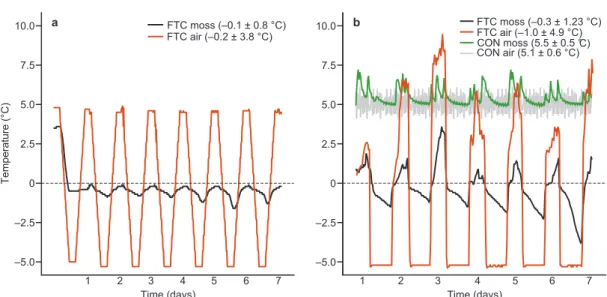
The FTC mesocosms in the first experiment did not experience any freeze–thaw cycles: instead they remained frozen throughout the experimental period (Fig. 1a). This was prob-ably due to the absence of solar energy. As a result, they were excluded from the analysis and only the mesocosms form the second experiment where clear FTCs were recorded (Fig. 1b) were considered.
Measurements and analyses
Sphagnum photosynthesis
Photosynthetic capacity (Amax) of S.
magellani-cum, defined as the maximum CO2 assimila-tion rate under optimum light condiassimila-tions, was measured at the capitulum level (reducing the possible measure of CO2 loss from non-photo-synthetic tissue) at the end of the experimental treatment. Capitula (n = 2–3) were harvested together, 30 minutes after rewetting. Measure-ments were performed using an open infrared gas analyser (IRGA) system connected to a 2.5 cm2 PLC-6 chamber (CIRAS-2, PP-Systems,
Amesbury, USA). Initial pilot measurements (data not presented) indicated an optimum light level for S. magellanicum photosynthesis at a PPFD of 600 µmol photons m–2 s–1 at 20 °C.
The environmental conditions inside the cuvette were controlled and kept constant during the measurements with the leaf temperature and CO2 concentration being 20 ± 1 °C and 380 ± 2 ppm, respectively; the relative humidity was always
close to ambient conditions. Capitula were weighed directly after gas measurements and subsequently dried at 65 °C for 48 h to constant weight (DW). Amax is expressed as mg of CO2 per gram of DW per hour (mg g–1 h–1). All moss
water contents were above 90%. Chlorophyll concentration
Chlorophyll-a and -b concentrations were determined after the experimental treatments, by extracting the green tissue pigments from
S. magellanicum capitula in 96% ethanol
(Lichtenthaler 1987). Freeze-dried samples were cut into small pieces using scissors and homog-enised. Next, 5 mg of dry tissue was hydrated with 100 µl of distilled water. After 10 minutes, chlorophyll was extracted in 8.0 ml of 96% etha-nol at room temperature over night. The follow-ing day, samples were vortexed and centrifuged, after which absorbance of the supernatant was measured on a spectrophotometer at 470 nm, 648.6 nm, 664.2 nm and 750 nm (Shimadzu, UV-120-01, Japan).
Respiration
Measurements of the CO2 flux in the FTC and
CON treatments were made using a LI-COR LI-8100 automated soil CO2 flux system (LI-COR Inc., Lincoln, Nebraska, USA). Through-out the seven-day experimental period, we per-formed dark-chamber (1140 cm3) measurements
three times per day (i.e. 9:00, 12:00 and 17:00). Note that all the measurements were made during the day (the thawing period in the FTC treatment) and, hence, under similar conditions for both FTC and CON cores. Further, respi-ration included respirespi-ration from mosses, moss endophytic microbes and soil microbes. Cham-ber measurements were started after the first frost period, and were comprised of a 2-minute closure time during which headspace CO2 con-centrations were recorded 120 times. Fluxes were then calculated from the changes in the chamber headspace CO2 concentrations in time, using linear regression.
Potential enzyme activity measurements Potential enzyme activity assays were conducted as described in Jassey et al. (2011, 2016). We used substrates labelled with the fluorophores 7-amino-4-methylcoumarin (MUC) or methylumbellifer-one (MUB) to quantify the relative activity (i.e. enzyme activity under saturating substrate condi-tions) of enzymes responsible for the
hydroly-Temperature (°C) 10.0 7.5 5.0 2.5 0 –2.5 –5.0 10.0 7.5 5.0 2.5 0 –2.5 –5.0 Time (days)3 4 7 3 4 7 2 2 a Time (days) 1 b CON moss (5.5 ± 0.5 ° CON air (5.1 ± 0.6 °C) FTC air (–1.0 ± 4.9 °C)FTC moss (–0.3 ± 1.23 °C) FTC moss (–0.1 ± 0.8 °C) FTC air (–0.2 ± 3.8 °C) C) 1 5 6 5 6
Fig. 1. FTC and CON air temperatures and moss temperatures at 2 cm depth below the capitula in (a) the first and
BOREAL ENV. RES. Vol. 22 • Effects of freeze-thaw cycles on peatland carbon processes 271
sis of one peptide [L-alanine-7-amido-MUC, Alanine-aminopeptidase (ALA)], one carbohy-drate [4-MUB-β-glucopyranoside, β-glucosidase (BGA)] and one phosphate ester [4-MUB-phos-phate, acid phosphatase (AP); all substrates sup-plied by Sigma-Aldrich Switzerland]. Enzymes were analysed in microplates using slurries cre-ated by homogenizing 3 g fresh weight of soil. Briefly, 3 g fresh weight S. magellanicum shoots (0–5 cm depth) per mesocosm were ground with 50 ml of a 0.1 M CaCl2 solution with 0.05% Tween 80 and 20 g of polyvinylpoly-pyrrolidone, and shaken at room temperature for 1.5 h on a reciprocal shaker (150 rpm). The resulting sus-pension was filtered to remove the largest float-ing particles, and then centrifuged at 5000 rpm for 5 min at 4 °C. After successive filtration of the supernatant through 1.2 µm Whatman GF/C filters, the extracts were concentrated in cellu-lose dialysis tubes (Medicell International Ltd., London, UK) with a 10 kDa molecular mass cut-off, covered with polyethylene glycol (PEG) until approximately 1/10 of the initial volume. The extract was re-suspended to 10 ml with phosphate buffer (pH 5.6) and separated in two equal frac-tions. To correct enzymatic activities, one fraction was stored at 4 °C, the other was boiled for 3 h at 90 °C and used as a control.
For each sample, we used four methodologi-cal-replicate assay wells receiving 38 µl of enzy-matic extract and 250 µl of substrate. Four other methodological-replicate assay wells were filled with 38 µl of boiled enzymatic extract and 250 µl substrate as control. Incubations were performed at 25 °C for 3 h after which the reactions were stopped with 1 µl NaOH (0.5 M). Fluorescence was monitored spectrophotometrically with an excitation wavelength of 365 nm and emission detection at 450 nm (Biotek, SynergyMX). All measurements were converted to nanomoles per gram dry weight per min (nmol g–1 min–1).
Data analysis
Prior to statistical analyses, data were tested for normality by Kolmogorov-Smirnov test, and for equality of variance by Levene’s test. All data were normally distributed and had equal variances. Respiration rates were averaged per
mesocosms which were then used for testing the effect of FTCs on respiration rates. The effects of FTCs on Amax, chlorophyll concentration, res-piration rate and enzymatic activity were tested using paired t-test. Linear regressions were com-puted to analyse the relationships between Amax and chlorophyll-a concentration, respiration and temperature, and respiration and enzyme activi-ties. Throughout the paper, treatment means with their standard errors are presented. All analyses were performed by IBM SPSS 20 Statistics soft-ware.
Results
Photosynthetic capacity (Amax) of mosses in the FTC experiment was approximately three times lower than that of the control (t3 = –1.7, p ≤ 0.001), and there was a decline in Sphagnum chlorophyll-a concentration (t3 = –2.7, p ≤ 0.001; Fig. 2). Amax and chlorophyll-a concentration correlated across treatments and in both treat-ment groups (FTC: R2 = 0.85, n = 4, p = 0.043;
CON: R2 = 0.79, n = 4, p = 0.014).
Respiration rates in the mesocosms in FTC experiment were considerably lower (t3 = 9.6, p ≤ 0.001) than those in the control (on average, FTC = 0.09 ± 0.07; CON = 0.60 ± 0.21 µmol m–2 s–1;
Fig. 3). Although respiration rate tend to decrease throughout the experiment in both treatments, no daily pattern occurred, and the respiration in FTCs was always lower than in controls. Additionally, the rate of respiration was significantly affected by temperature within the mesocosms (R2 = 0.38,
n = 4, p ≤ 0.001).
The responses of potential enzyme activities to FTCs were enzyme-specific (Fig. 4). BGA (–50%; t3 = –2.7, p = 0.033) and AP (–30%;
t3 = –8.9, p ≤ 0.001) were markedly lower in FTCs than in the controls, while ALA remained unaffected (t3 = 0.05, p = 0.264). Decreases in enzymatic activities most likely underlay the decrease in respiration rates under freeze–thaw conditions as mean respiration rates correlated with BGA (R2 = 0.56, n = 4, p ≤ 0.001) and AP
activities (R2 = 0.81, n = 4, p ≤ 0.001). There
was no correlation between ALA and respiration (p = 0.271).
FTC CON Rate of photosynthesis (mg CO 2 g –1 DW hr –1) 2.0 1.5 1.0 0.5 0 FTC CON Chlorophyll-a concentrChlorophyll-ation (mg g –1 DW ) 1.25 0.75 0.50 0.25 0 1.00 FTC CON Time (days)4 7 3 2 1 5 6 Respiration (mg CO 2 m –2 DW hr –1) 140 120 100 80 60 40 20 0 BGA AP ALA
Potential enzymatic activity (nmol mi
n –1 g –1 DW) 8000 6000 4000 2000 0 CON FTC
Fig. 2. Photosynthetic capacity (Amax) and chlorophyll-a
concentration of control (CON, kept at +5 °C) and FTC-treated Sphagnum magellanicum (FTC, kept at ambient outdoor temperature and –5 °C during day and night, respectively) at the end of the experimental treat-ments. Error bars represent standard errors.
Fig. 3. Mean respiration rates for CON and FTC moss
mesocosms (FTC) measured at 09:00, 12:00 and 17:00, and throughout the experiment. The first meas-urements of each day at 09:00 is indicated by a black dot.
Fig. 4. Potential enzymatic activity of
alanine-amin-opeptidase (ALA), β-glucosidase (BGA) and acid phos-phatase (AP) of control (CON, +5 °C) and FTC-treated mosses (FTC, ambient and –5 °C) at the end of the experimental treatments. Error bars represent standard errors.
Discussion
Projected climate change is expected to increase
the frequency of soil freeze-thaw cycles (FTCs) (Bombonato and Gerdol 2012). Our experiments revealed that merely positive daytime tempera-ture is not enough to thaw the frozen peat, but that energy form solar radiation is instrumental. These seem obvious, but in many laboratory studies of the effects of FTCs on plant perfor-mance dark incubators are used (e.g. Min et
al. 2014). Our results highlight the necessity
of additional energy (either solar, or artificial IR lamps) to induce cyclic (24 h) freeze–thaw events, at least in peat soil.
As hypothesized, photosynthetic capacity in
S. magellanicum was substantially lower when
it was subjected to freeze–thaw cycles. These results underpin that peat moss carbon uptake through photosynthesis is impeded by repeated freezing. While mosses tolerate freezing much better than do most vascular plants (Glime 2007), FTCs are considered one of the most severe environmental stressors on moss per-formance (Kennedy 1993, Deltoro et al. 1999). The decrease in photosynthetic capacity caused by FTCs may be the result of (1) a direct effect on the moss physiology, e.g. through changes in pigment concentrations, (2) mechanical stress due to formation of ice crystals (Schmitt et al.
BOREAL ENV. RES. Vol. 22 • Effects of freeze-thaw cycles on peatland carbon processes 273
1985, Kennedy 1993), or (3) an increase in the concentrations of cellular solutes due to cell dehydration (Schmitt et al. 1985). Our results show that the lower photosynthetic capacity under freeze–thaw conditions may be due to a decrease in chlorophyll-a concentration. Gerdol
et al. (1994) showed that chilling can trigger a
rapid degradation of chlorophyll. In addition, interaction between solar radiation and frost can amplify the effect on chlorophyll a (Glime 2007) resulting in a smaller absorbance of light energy (Huner et al. 1993).
Snow, because of its insulating properties, keeps below-ground temperatures rather con-stant, and allows for microbial metabolism during winter (Brooks et al. 1997, Bombonato and Gerdol 2012). Therefore, winter CO2 fluxes in peatlands should not be ignored, as they can form 8%–14% of annual CO2 release (e.g. Leppälä et al. 2011). Soil respiration rates in our control mesocosms were comparable to those measured in the earlier studies (Alm et
al. 1999, Kim et al. 2007, Leppälä et al. 2011).
Reduced snow cover and concurrent FTCs could however result in microbial biomass reduc-tions, ultimately lowering ecosystem respiration rates (Larsen et al. 2002, 2007). Supporting our hypothesis, a threefold reduction of mean res-piration rate was observed after the mesocosms experienced FTCs. Larger decline in respiration in the FTC than in CON mesosoms in the course of the experiment suggest that this reduction was not caused by a mere change in temperature, but that respiration rates were hampered by freeze-thaw cycles.
Although Robroek et al. (2013) obtained similar results from a Swiss mountain bog, we currently lack consensus on the effect of FTCs on microbial respiration. While we found a decrease, some studies report only minor effects of FTCs on microbial respiration in sub-arctic (Larsen et al. 2007), alpine (Bombonato and Gerdol 2012) and boreal (Johansson 2010) peat-lands. Possibly, prevailing environmental condi-tions and adaptation of the microbial communi-ties to those conditions play an important role in their response to soil frost. Nevertheless, the effects of freeze–thaw cycles on soil microor-ganisms are still not well understood (Kreyling and Henry 2011). We found an overall temporal
reduction in respiration rates in both FTC and CON treatments, which could be due to experi-mental conditions. There is evidence that freeze– thaw cycles strongly reduce the activity and population dynamics of microorganisms in soils because repeated fluctuations in temperature can damage or even destroy microbial cells (Schimel and Mikan 2005, Walker et al. 2006), and hence decrease microbial activity. Also Schimel and Clein (1996) recorded a decreasing respiration rate after every FTC, and related it to a parallel decline in living microbial biomass, as a sig-nificant amount of microbes were killed by each cycle.
We found that lower respiration rates in response to FTCs were related to lower enzyme activity, except ALA that remained unaffected by FTCs. The latter finding supports those by Weedon et al. (2012, 2014), who demonstrated that all potential peptidase activities were unaf-fected by temperature. ALA, and probably other peptidases as well, appear to be less sensitive to FTCs than AP and BGA, and in addition, peptidase activity in peatlands is rather minimal (Weedon et al. 2014). This points to a minor effect of FTCs on N cycle in peatlands, as pepti-dases are responsible for the cycling of organic N forms. Peptidases are more active in the begin-ning of the summer (Weedon et al. 2014) and therefore have to be somewhat less dependent on FTCs that rarely occur after May in boreal peatlands. AP participates in the mineralization of phosphate (Dodd et al. 1987, Rodriguez and Fraga 1999) and decreased about 30% in FTC relative to CON. If FTCs are long-lasting and severe, a significant part of the soil microbial component could be exacerbated and therefore produce less extracellular enzymes, which in case of AP leads to a reduced amount of avail-able phosphate. Such scenario may imbalance the stoichiometry of available nitrogen and phos-phorus.
Among the tested enzymes, BGA showed the strongest response to FTCs. Further, poten-tial enzymatic activity of BGA decreases along with ecosystem respiration rate, which support previous findings on BGA activity as a proxy for carbon respiration (Sinsabaugh et al. 2008). Taken together, our results highlight that FTCs reduce carbon release from peatlands at least
in the short term. When microbes are exposed to cold temperatures, the microbial commu-nity most likely shifts into a cold-adapted state, where microbes synthesize enzymes that work in low temperatures. It is therefore possible that a functional isozyme replacement occurs, resulting in an adaption of decomposition process to low temperatures (Blagodatskaya et al. 2016).
Reductions in AP and BGA potential activi-ties after soil FTCs are related to reduction in microbial biomass or activity. Although microbes can survive and grow with tempera-tures below zero (Gilchinsky and Wagener 1995, Alm et al. 1999), repeated crossing the 0 °C threshold leads to direct shifts in microbial activ-ity. This is due to lower availability of liquid water (Mikan et al. 2002, Kreyling and Henry 2011) that hinders the diffusion of extracellular enzymes (Elberling and Brandt 2003). Micro-organisms that accumulate osmolites to survive the cold temperatures could possibly die during thawing of the soil because of an osmotic shock caused by the sudden availability of melt water from snow (Jefferies et al. 2010). This can be coupled to changes in microbial community structure and affect the overall functioning of the ecosystem (Larsen et al. 2002). Although we did not test the recovery speed of photosynthetic and microbial activity after FTCs, it has to be noted that microbial organisms react more rap-idly to changing environmental conditions than macroorganisms (Hajek et al. 2011). However, the effects of FTCs on annual ecosystem carbon accumulation remain subject to further study.
Conclusions
Our experiment confirmed that diurnal FTCs impede photosynthesis and microbial enzymatic activity and concurrent ecosystem respiration. The increase in frequency and severity of FTCs may also affect vegetation and microbial struc-ture, nutrient content and stoichiometry, and the phenology of many species. Thus the function-ing of peatland ecosystems in the winter may be slowed down due to decreasing snow cover and concurrent FTCs. Although in the short term the changes in carbon uptake processes are roughly balanced by carbon release reductions, the
long-term effects remain unknown. However, in the severe and long-lasting FTC cases these effects might cascade to the growing season and lower biomass production.
Acknowledgements: This study was supported by the
Esto-nian Science Foundation (grant 9070), the Centre of Excel-lence at Tallinn University “Natural Sciences and Sustainable Development”, Institutional Grant “Enchanted” (IUT 18-9), and through the Swiss Contribution to the enlarged European Union (PSPB-013/2010). The Dora Program of the Archime-des Foundation, and the Estonian Doctoral School of Earth Sciences and Ecology supported MK. MH was supported by the Dutch Foundation for the Conservation of Irish Peat-lands. Kone Foundation supported AML. The authors thank Liisa Küttim for field assistance, Kadri Umbleja for the help on formatting the figures, and Marju Merila (Tooma Mire Station of Estonian Weather Service) for providing hydrome-teorological data.
References
Alm J., Saarnio S., Nykänen H., Silvola J. & Martikainen P.J. 1999. Winter CO2, CH4 and N2O fluxes on some
natural and drained boreal peatlands. Biogeochemistry 44: 163–186.
Blagodatskaya Е., Blagodatsky S., Khomyakov N., Myachina O. & Kuzyakov Y. 2016. Temperature sensi-tivity and enzymatic mechanisms of soil organic matter decomposition along an altitudinal gradient on Mount Kilimanjaro. Scientific Reports 6: 22240, doi:10.1038/ srep22240.
Bokhorst S., Bjerkew J.W., Bowlesz F.W., Melilloz J., Cal-laghan T.V. & Phoenix G.K. 2008. Impacts of extreme winter warming in the sub-Arctic: growing season responses of dwarf shrub heathland. Global Change
Biology 14: 2603–2612.
Bombonato L. & Gerdol R. 2012. Manipulating snow cover in an alpine bog: effects on ecosystem respiration and nutrient content in soil and microbes. Climatic Change 114: 261–272.
Bragina A., Oberauner-Wappis L., Zachow C., Halwachs B., Thallinger G.G., Müller H. & Berg G. 2014. The
Sphagnum microbiome supports bog ecosystem
func-tioning under extreme conditions. Molecular Ecology 23: 4498–4510.
Brooks P.D., Schmidt S.K. & Williams M.W. 1997. Winter production of CO2 and N2O from alpine tundra: environ-mental controls and relationship to inter-system C and N fluxes. Oecologia 110: 403–413.
Coulson A.J.C. & Butterfield J. 1978. An investigation of the biotic factors determining the rates of plant decomposi-tion on blanket bog. Journal of Ecology 66: 631–650. Deltoro V.I., Calatayud A., Morales F., Abadia A. & Barreno
E. 1999. Changes in net photosynthesis, chlorophyll flu-orescence and xanthophyll cycle interconversions during
BOREAL ENV. RES. Vol. 22 • Effects of freeze-thaw cycles on peatland carbon processes 275 freeze-thaw cycles in the Mediterranean moss Leucodon
sciuroides. Oecologia 120: 499–505.
Dodd J.C., Burton C.C., Burns R.G. & Jefferies P. 1987. Phosphatase activity associated with the roots and the rhizosphere of plants infected with vesicular-arbuscular mycorrhizal fungi. New Phytologist 107: 163–172. Elberling B. & Brandt K.K. 2003 Uncoupling of microbial
CO2 production and release in frozen soil and its
impli-cations for field studies of arctic C cycling. Soil Biology
& Biochemistry 35: 263–272.
Gerdol R., Bonora A. & Poli F. 1994. The vertical pattern of pigment concentrations in chloroplasts of Sphagnum
capillifolium. The Bryologist 97: 158–161.
Gerdol R., Bonora A., Gualandri R. & Pancaldi S. 1996. CO2 exchange, photosynthetic pigment composition, and
cell ultrastructure of Sphagnum mosses during dehydra-tion and subsequent rehydradehydra-tion. Canadian Journal of
Botany 74: 726–734.
Gilchinsky D. & Wagener S. 1995. Microbial life in per-mafrost: a historical review. Permafrost & Periglacial
Processes 6: 243–250.
Glime J.M. 2007. Temperature: Cold. In: Glime J.M. (ed.),
Bryophyte ecology, vol. 1: Physiological Ecology.
Ebook sponsored by Michigan Technological University and the International Association of Bryologists. [Avail-able at http://digitalcommons.mtu.edu/cgi/viewcontent. cgi?article=1060&context=bryo-ecol-subchapters]. Groffman P.M., Driscoll C.T., Fahey T.J., Hardy J.P.,
Fitzhugh R.D. & Tierney G.L. 2001. Colder soils in a warmer world: a snow manipulation study in a north-ern hardwood forest ecosystem. Biogeochemistry 56: 135–150.
Gunnarsson U. 2005. Global patterns of Sphagnum produc-tivity. Journal of Bryology 27: 269–279.
Hájek M., Roleček J., Cottenie K., Kintrová K., Horsák M., Poulíčková A., Hájková P., Fránková M. & Dítě D. 2011. Environmental and spatial controls of biotic assem-blages in a discrete semi-terrestrial habitat: comparison of organisms with different dispersal abilities sampled in the same plots. Journal of Biogeography 38: 1683–1693. Haraguchi A. & Yamada N. 2011. Temperature dependency
of photosynthesis of Sphagnum spp. distributed in the warm-temperate and the cool-temperate mires of Japan.
American Journal of Plant Sciences 2: 716–725.
Henry H. 2008. Climate change and soil freezing dynam-ics: historical trends and projected changes. Climatic
Change 87: 421–434.
Huner N.P.A., Öquist G., Hurry V.M., Krol M., Falk S. & Griffith M. 1993. Photosynthesis, photoinhibition and low temperature acclimation in cold tolerant plants.
Pho-tosynthesis Research 37: 19–39.
Jassey V.E.J., Chiapusio G., Gilbert D., Buttler A., Tous-saint M.-L. & Binet P. 2011. Experimental climate effect on seasonal variability of polyphenol/phenoloxi-dase interplay along a narrow fen-bog ecological gradi-ent in Sphagnum fallax. Global Change Biology 17: 2945–2957.
Jassey V.E.J., Lamentowicz M., Bragazza L., Hofsom-mer M.L., Mills R.T.E., Buttler A., Signarbieux C. & Robroek B.J.M. 2016. Loss of testate amoeba functional
diversity with increasing frost intensity across a conti-nental gradient reduces microbial activity in peatlands.
European Journal of Protistology 55: 190–202.
Jefferies R.L., Walker N.A., Edwards K.A. & Dainty J. 2010. Is the decline of soil microbial biomass in late winter coupled to changes in the physical state of cold soils?
Soil Biology & Biochemistry 42: 129–135.
Johansson L. 2010. Temperature sensitivity of decomposition
in a boreal mixed mire in northern Sweden. M.Sc. thesis,
Water and Environmental Studies, Linköping University. Jylhä K., Tuomenvirta H. & Ruosteenoja K. 2004. Climate
change projections for Finland during the 21st century.
Boreal Environment Research 9: 127–152.
Kennedy A.D. 1993. Photosynthetic response of the Antarc-tic moss Polytrichum alpestre Hoppe to low tempera-tures and freeze-thaw stress. Polar Biology 13: 271–279. Kim Y., Ueyama M., Nakagawa F., Tsunogai U., Harazono
Y. & Tanaka N. 2007. Assessment of winter fluxes of CO2 and CH4 in boreal forest soils of central Alaska
esti-mated by the profile method and the chamber method: a diagnosis of methane emission and implications for the regional carbon budget. Tellus 59B: 223–233.
Kreyling J., Beierkuhnlein C. & Jentsch A. 2010. Effects of soil freeze–thaw cycles differ between experimen-tal plant communities. Basic and Applied Ecology 11: 65–75.
Kreyling J. & Henry H. 2011. Vanishing winters in Germany: soil frost dynamics and snow cover trends, and ecologi-cal implications. Climate Research 46: 269–276. Küttim L., Küttim M., Puusepp L. & Sugita S. 2016. The
effects of ecotope, microtopography and environmental variables on diatom assemblages in hemiboreal bogs in Northern Europe. Hydrobiologia 792: 137−149. Laiho R. 2006. Decomposition in peatlands: Reconciling
seemingly contrasting results on the impacts of low-ered water levels. Soil Biology & Biochemistry 38: 2011–2024.
Larsen K.S., Jonasson S. & Michelsen A. 2002. Repeated freeze-thaw cycles and their effects on biological pro-cesses in two arctic ecosystem types. Applied Soil
Ecol-ogy 21: 187–195.
Larsen K., Ibrom A., Jonasson S., Michelsen A. & Beier C. 2007. Significance of cold-season respiration and pho-tosynthesis in a subarctic heath ecosystem in Northern Sweden. Global Change Biology 13: 1498–1508. Leppälä M., Laine A.M. & Tuittila E.-S. 2011. Winter carbon
losses from a boreal mire succession sequence follow summertime patterns in carbon dynamics. Suo 62: 1–11. Lichtenthaler H.K. 1987. Chlorophylls and carotenoids:
Pigments of photosynthetic biomembranes. Methods in
Enzymology 148: 350–382.
Mikan C.J., Schimel J.P. & Doyle A.P. 2002. Temperature controls of microbial respiration in arctic tundra soils above and below freezing. Soil Biology & Biochemistry 34: 1785–1795.
Min K., Chen K. & Arora R. 2014. Effect of short-term versus prolonged freezing on freeze–thaw injury and post-thaw recovery in spinach: importance in laboratory freeze–thaw protocols. Environmental & Experimental
Moss R.H., Edmonds J.A., Hibbard K.A., Manning M.R., Rose S.K., van Vuuren D.P., Carter T.R., Emori S., Kainuma M., Kram T., Meehl G.A., Mitchell J.F.B., Nakicenovic N., Riahi K., Smith S.J., Stouffer R.J., Thomson A.M., Weyant J.P. & Wilbanks T.J. 2010. The next generation of scenarios for climate change research and assessment. Nature 463: 747–756.
Puissant J., Cécillon L., Mills R.T.E., Robroek B.J.M., Gava-zov K., De Danieli S., Spiegelberger T., Buttler A. & Brun J.J. 2015. Seasonal influence of climate manipu-lation on microbial community structure and function in mountain soils. Soil Biology & Biochemistry 80: 296–305.
Robroek B.J.M., Heijboer A., Jassey V.E.J., Hefting M.M., Rouwenhorst T.G., Buttler A. & Bragazza L. 2013. Snow cover manipulation effects on microbial com-munity structure and soil chemistry in a mountain bog.
Plant & Soil 369: 151–164.
Rodríguez H. & Fraga R. 1999. Phosphate solubilizing bacte-ria and their role in plant growth promotion.
Biotechnol-ogy Advances 17: 319–339.
Schimel J.P. & Clein J.S. 1996. Microbial response to freeze-thaw cycles in tundra and taiga soils. Soil Biology &
Biochemistry 28: 1061–1066.
Schimel J.P. & Mikan C. 2005. Changing microbial substrate use in Arctic tundra soils through a freeze–thaw cycle.
Soil Biology & Biochemistry 37: 1411–1418.
Schmitt J.M., Schramm M.J., Pfanz H., Coughlan S. & Heber U. 1985. Damage to chloroplast membranes during dehydration and freezing. Cryobiology 22: 93–104. Sinsabaugh R.L., Lauber C.L., Weintraub M.N., Ahmed B.,
Allison S.D., Crenshaw C., Contosta A.R., Cusack D., Frey S., Gallo M.E., Gartner T.B., Hobbie S.E., Holland K., Keeler B.L., Powers J.S., Stursova M., Takacs-Vesbach C., Waldrop M., Wallenstein M., Zak D.R. & Zeglin L.H. 2008. Stoichiometry of soil enzyme activity at global scale. Ecology Letters 11: 1252–1264. Templer P.H. 2011. Changes in winter climate: soil frost,
root injury, and fungal communities. Plant & Soil 353: 15–17.
Thimonier A., Schmitt M., Waldner P. & Rihm B. 2005. Atmospheric deposition on Swiss long-term forest eco-system research (LWF) plots. Environmental Monitoring
and Assessment 104: 81–118.
Tsyganov A.N., Temmerman S., Ledeganck P. & Beyens L. 2012. The distribution of soil testate Amoebae under winter snow cover at the plot-scale level in arctic tundra (Qeqertarsuaq/Disko Island, West Greenland). Acta
Pro-tozoologica 51: 155–167.
Turunen J., Tomppo E., Tolonen K. & Reinikainen A. 2002. Estimating carbon accumulation rates of undrained mires in Finland — application to boreal and subarctic regions. Holocene 12: 69–80.
Walker V.K., Palmer G.P. & Voordouw G. 2006. Freeze– thaw tolerance and clues to the winter survival of a soil community. Applied Environmental Microbiology 72: 1784–1792.
Wang J., Song C., Hou A. & Wang L. 2014. CO2 emissions from soils of different depths of a permafrost peatland, Northeast China: response to simulated freezing–thaw-ing cycles. Journal of Plant Nutrition and Soil Science 177: 524–531.
Weedon J.T., Kowalchuk G.A., Aerts R., van Hal J., van Logtestijn R., Taş N., Röling W.F.M. & van Bode-gom P.M. 2012. Summer warming accelerates sub-arctic peatland nitrogen cycling without changing enzyme pools or microbial community structure. Global Change
Biology 18: 138–150.
Weedon J.T., Aerts R., Kowalchuk G.A. & von Bodegom P.M. 2014. No effects of experimental warming but con-trasting seasonal patterns for soil peptidase and glycosi-dase enzymes in a subarctic peat bog. Biogeochemistry 117: 55–66.
Wright N., Hayashi M. & Quinton W.L. 2009. Spatial and temporal variations in active layer thawing and their implication on runoff generation in peat-covered per-mafrost terrain. Water Resources Research 45: W05414, doi:10.1029/2008WR006880.
Yergeau E. & Kowalchuk A.G. 2008. Responses of Antarctic soil microbial communities and associated functions to temperature and freeze–thaw cycle frequency.
Environ-mental Microbiology 10: 2223–2235.
Zhang Y., Guanter L., Berry J.A., Joiner J., van der Tol C., Huete A., Gitelson A., Voigt M. & Köhler P. 2014. Estimation of vegetation photosynthetic capacity from space-based measurements of chlorophyll fluorescence for terrestrial biosphere models. Global Change Biology 20: 3727–3742.