Bachelor Thesis
Green Meetings - a factor of success for a conference and
event management company?
The case of JPdL
HES-SO Valais/Wallis, School of Management and Tourism
Degree Program:
Tourism
Student:
Sibylle Frey
Professor:
Daniel Amrein
Submitted on:
July 4
th2016
HES-SO Valais-Wallis • Route du Rawyl 47 • CP • 1950 Sion 2 +41 27 606 85 11 • [email protected] • www.hevs.ch
Sources of visual on the title page:
Abstract
In the 21st century, climate change and environmental catastrophes are a worldwide acknowl-edged problem, which requires international cooperation and effort from every individual. Therefore more and more businesses realized the urge of taking action and implemented a sus-tainability strategy into their business operations, so also the meeting and event industry.
This thesis deals with the subject of environmental sustainability implemented into the meet-ing and event sector. So called “Green Meetmeet-ings” are meetmeet-ings, which are planned and executed in a way that causes the least negative impact on the environment. The goal of this thesis is to examine, the impact of a “Green Meeting Strategy” on the competitiveness and profitability of JPdL, a Canadian Conference and Event management company. The analysis provides the base-line for a concept developed for JPdL if they decide to implement a green meeting strategy.
The first part of the thesis provides an insight into the topic sustainable development within the event industry, and explains the different actions which can be taken in this field. The ex-amination of different best practice examples by means of semi-directed interviews and an e-mail questionnaire, helps to understand how other businesses incorporate sustainable strategies. It confirms that a sustainable strategy can not only bring advantages for the environment but also for the business itself. Amongst actual and prospective clients of JPdL, a quantitative survey was performed. This survey discloses that a big part of the clients are aware and informed about environmental considerations which can be taken whilst planning and operating an event or meeting. Most of them would consider to organize a green meeting in the future. It also discloses barriers, like for example the unwillingness of the clients to pay more for green services.
Based on the examination of the best practice examples and the survey, the last part provides suggestions on how JPdL could implement an environmentally sustainable strategy and offer green meeting services to its customers.
Keywords:
Foreword and acknowledgement
During my last semester of my tourism studies at HES-SO Valais/Wallis I had the opportunity to conduct an internship at JPdL Toronto & Niagara Inc., a Destination Management Company based in Toronto, Canada. At the stage of finding a topic for my thesis, I was encouraged by JPdL to investigate a topic of personal interest. Due to my interest in sustainable development and the questions what we can do, to reduce negative effects on the environment, I choose to ex-amine this topic in relation to my internship company. That is when I came across the topic “Green Meetings”.
Conducting my internship at the JPdL office in Toronto, which mainly offers destination man-agement services, I did not see a huge commitment towards environmental sustainability. Nei-ther did I see any services offered to the clients, which especially include an environmental friendly component. When I then reached out to the other offices, I realized that environmental sustainability is indeed something that JPdL considered in the past, and in some cases still is considering nowadays. The problem I was facing was the different perception and knowledge of environmental issues across the company. It is one of the challenges, which also effects the stage of offering green services. I also started to realize how complex and linked the topic of sustain-ability is. Therefore I decided to limit the scope of the thesis to environmental aspects only. The goal of this thesis is to examine if a green meeting strategy would not contribute to minimize negative effects on the environment, but also could generate profit for the company.
While preparing this thesis I had the opportunity to talk and reach out to different profession-als within and outside the meeting and event industry. They taught me the importance and op-portunity for businesses nowadays to take action and being responsible towards the environment. I learned that sustainability in all aspects is more than just a concept, it is a way of thinking, acting and taking responsibilities.
At this point I would like to thank everyone which supported the writing of this thesis. I would like to acknowledge my thesis advisor Daniel Amrein, Professor at HES-SO Wallis/Valais and founder and consultant of PME-Durable, for the directions to write this thesis. A special thank goes to my interview partners, Vikram Sumer, Geoff Mak, Amy Howells and especially Pranav Sethaputra, who took the time to skype with me despite to the 12 hours of difference between Singapore and Toronto. Furthermore I would like to thank Anne-Marie de Lavison for her support and Alain Carbonneau for his valuable input.
Table of contents
List of tables ... viii
List of figures ... ix
List of abbreviations ... x
Introduction ...1
1Theoretical basis ...3
1.1 MICE industry Canada ...3
2 Sustainability and sustainable development ...4
2.1 Sustainable business development ...5
2.1.1 Corporate Social Responsibility ...7
2.1.2 The Natural Step ...7
3 Green Meetings ...9
3.1 Action areas ... 11
3.1.1 Greenhouse gas emission ... 11
3.1.2 Destination, accommodation and venue ... 12
3.1.3 Energy ... 13
3.1.4 Transportation ... 13
3.1.5 Waste and water management ... 14
3.2Implementation and management... 15
3.3 Industry councils and associations ... 16
3.4 Green meeting certifications and standards ... 17
4 Analysis and research ... 18
5 Company structure JPdL ... 18
5.1 Current environmentally sustainable approach and CSR Strategies ... 19
5.2 Industry membership and affiliates ... 24
5.3 Communication ... 24
5.4 Conclusion and key issues discovered ... 25
6 Best practice ... 26
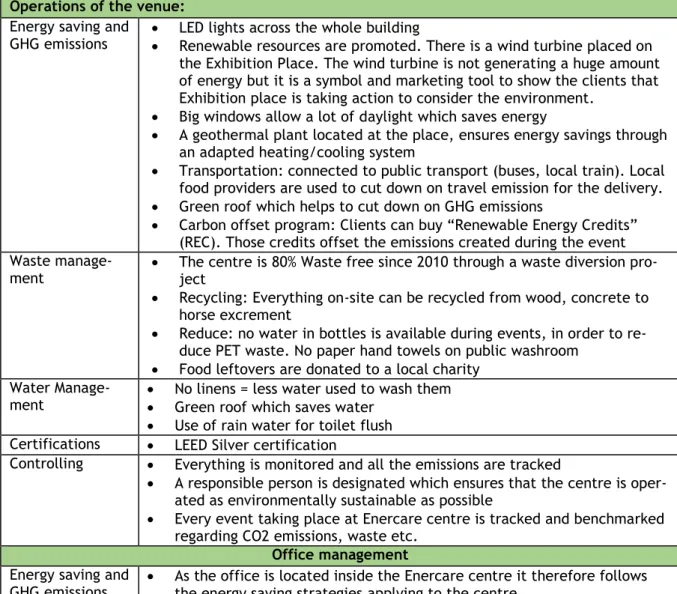
6.1 Enercare Centre ... 27
6.3 Whistler ... 32
6.4 MCI ... 36
6.5 Conclusion of best practice examples ... 38
7 Market analysis ... 38
7.1 Research design ... 39
7.1.1 Limits of the survey ... 39
7.2 Results ... 39
7.2.1 Profile of the respondent ... 39
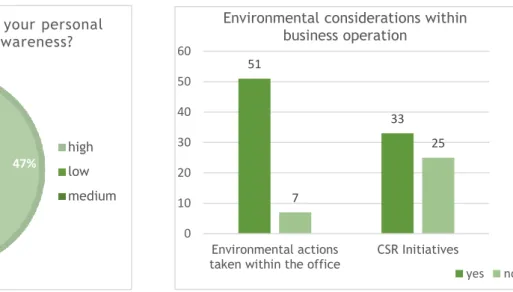
7.2.2 Environmental awareness... 40
7.2.3 Perception and value of green services ... 42
8 Concept... ... 47
8.1 Stakeholder analysis ... 47
8.2 Policies and objectives ... 49
8.3 Mission statement ... 51
8.4 Implementation ... 52
8.4.1 Environmental sustainability manager:... 52
8.4.2 Education ... 52
8.4.3 CSR Strategies ... 53
8.4.4 Network and industry partnerships ... 54
8.4.5 Actions to be taken within business operation ... 54
8.4.6 Offering green services ... 56
8.4.7 Supplier management ... 57
8.4.8 Carbon offset programme ... 60
8.5 Marketing and communication ... 60
8.5.1 Website ... 60 8.5.2 Newsletter ... 62 8.5.3 Social media ... 63 8.5.4 Industry events ... 63 8.5.5 PR and media ... 63 8.5.6 E-mail signature ... 64
8.6 Measuring, monitoring and return on investment ... 64
9 SWOT Analysis ... 67
Conclusion... 69
Bibliography... 70
Appendix I Research material JPdL International ... 77
Appendix II Research material JPdL Ottawa/Intertask ... 84
Appendix III Research material JPdL Tremblant ... 95
Appendix IV Research material JPdL Quebec ... 97
Appendix V Research material JPdL Toronto ... 100
Appendix VI JPdL website ... 104
Appendix VII JPdL Newsletter earth day ... 106
Appendix VIII Online survey and results ... 112
Appendix IX Interview Vikram Sumér, Bell Canada ... 133
Appendix X Interview Geoff Mak Enercare centre ... 135
Appendix XI Interview Pranav Sethaputra, MCI Singapore ... 138
Appendix XII Government Canada ... 144
List of tables
Table 1 Environmental business operation ...6
Table 2 Facts to consider when choosing event venue or destination ... 12
Table 3 Energy saving strategies ... 13
Table 4 Travel green ... 14
Table 5 Waste saving strategies ... 15
Table 6 APEX/ASTM Standards ... 17
Table 7 Actions to be taken within the different JPdL offices ... 20
Table 8 Communication channels of JPdL ... 24
Table 9 Smart Green strategy Enercare centre ... 27
Table 10 Stakeholder Analysis ... 47
Table 11 Short – and long term goals ... 50
Table 12 Carbon Footprint of different means of transportation (Montreal - Toronto return) .. 56
List of figures
Figure 1 The Natural Step funnel metaphor ...8
Figure 2 Environmental impact of different means of transport ... 13
Figure 3 Clearly visible recycling bin placed in the exhibition area. ... 29
Figure 4 Simple action to remind visitors to recycle their show guide ... 29
Figure 5 Whistler 2020 funnel metaphor ... 34
Figure 6 Whistler 2020 framework ... 35
Figure 7 Considerations to be taken during event planning ... 42
Figure 8 Organization of green meetings ... 44
Figure 9 Customers value of a green option on a proposal ... 46
Figure 10 Suggestions how to improve the communication through the website ... 61
Figure 11 Suggestions for home page ... 62
List of abbreviations
ADMEI Association of Destination Management Executives International CIC Convention Industry Council
CMP Certified Meeting Professional CSR Corporate Social Responsibility DMC Destination Management Company
e.g. For example
F&B Food and Beverage GHG Green House Gas
GMIC Green Meeting Industry Council GRI Global Reporting Initiative
ICAO International Civil Aviation Organization
ICCA International Congress and Convention Association IISD International Institute for Sustainable Development IoT Internet of Things
ISO International Standard Organisation
MICE Meeting, Incentives, Conventions and Exhibitions MPI Meeting Professionals International
PCMA Professional Convention Management Association PCO Professional Congress Organizer
RFP Request for proposal
UN United Nations
UNEP United Nations Environment Programme
WBSCD World Business Council for Sustainable Development WCED World Commission on Environment and Development
Introduction
Initial proposition
Being sustainable is a current trend - more and more businesses tend to implement sustainable practices, are concerned about the environment and turn green. Companies do not only help to preserve the environment by considering their ecological, economic and social impact, they also hope to gain strategic advantage within an industry, as the demand in green and sustainable products and services is rising. (Estes, 2009, pp. 6 - 9) This trend also influences the Meetings, Incentive, Conventions and Event (MICE) industry. The meeting and event industry is widely known to have a negative environmental impact due to the high number of people gathering in one place, the necessary movement for gathering and the high consumption of resources during the event. Environmental sustainable policies such as the concept of “Green Meetings” are there-fore essential and important in order to minimize the negative effect on the environment. (Philips & Philips, 2011, ch. 1, loc. 444)
Research question
JPdL inc. is offering event- and conference managing as well as destination management ser-vices across Canada. A basic environmental policy is operating within the offices, which includes amongst others keeping printing to a minimum, saving energy whenever possible as well as obey-ing recyclobey-ing guidelines. However, in regards to the services the company is offerobey-ing to their clients, there is no clear strategy existing to make those services environmentally sustainable. This thesis should reveal the impact of the implementation of a green meeting strategy on the competitiveness and profitability of the company.
Objective
This thesis aims to analyse the market opportunity for green meetings in the case of JPdL. It should evaluate how a green meeting strategy not only contributes to conserve the environment but also influences the company‘s economic competitiveness. It gives answers to questions like: How much does it matter to the clients if their event or conference is organized on an environ-mentally friendly basis? Would they be willing to pay more? Or is it even one of the main decision making factors when deciding on a company to work with? Furthermore this paper will provide a concept for JPdL to implement, if they decide to become a sustainable meeting and event or-ganization in future. The strategy will stage which measurements JPdL needs to take and which chances and risks are assigned to those steps.
Structure and methodology
In the first part of the thesis theoretical approaches to relevant issues are gathered in order to provide an overview of the topic. It is explained how sustainability objectives can be imple-mented in the MICE industry and what exactly the concept of green meetings includes. Further-more the importance of this industry in Canada is determined and industry councils and associa-tions are presented. In addition to that, a company profile of JPdL is provided. This part also examines the approach which has been made within the different offices of JPdL in the past in regards to a sustainable meeting strategy and company operations.
This theoretical part is followed by best practice examples, which provide an insight to the way other companies are implementing sustainable practices, and how those practices create value for them. Semi-directed expert-interviews, as well as an online questionnaire determine the importance green initiatives have for existing and prospective customers of JPdL, and exam-ine their perception. The last part consists of a strategy which JPdL can follow in order to im-plement a green meeting strategy. It shows the steps which should be taken, but also evaluates the opportunities and risks attached to the strategy.
1 Theoretical basis
This first part provides a theoretical overview of the relevant subject areas for this thesis and explains the most important terms and concepts. Within the scope of this thesis, the main focus shall be on ecological considerations. Nevertheless the concept of sustainability as a whole shall be explained, as the ecological part is highly connected with social and economic considerations, which shows the complexity of this topic.
1.1 MICE Industry Canada
MICE is an acronym standing for Meetings, Incentives, Conventions and Exhibitions. The term meeting describes a gathering of people in a particular place, for the reason to discuss a partic-ular topic or to realize a certain activity. This can happen either on occasion for a special reason, or on a regularly basis. Incentives are defined as reward programs, offered from businesses to their employees in order to honour a special performance. A Conference can be seen as special meeting, with the aim to find a solution for a problem, to discuss a topic or to research in a special field. In comparison with a Congress, a conference is normally smaller and has clearly defined objective of fact-finding and problem solving. Exhibitions are defined as events with the purpose to display products and services. The term “The Meeting Industry” is often used as a synonym for the MICE industry, including the components mentioned above. (International Congress and Convention Association [ICCA], 2013) Another frequently and common used syno-nym is simply the “Event industry” which focuses on the Event, which is defined by the Conven-tion Industry Council [CIC] as an “organized occasion such as a meeting, convenConven-tion, exhibiConven-tion, special event, gala dinner” (CIC, n.d.).
According to the Canadian Economic Impact Study of the year 2012, 585’000 business events took place in Canada during that year, which generated an overall direct spending of 29.1 billion Canadian Dollars. 62 % of the meetings were corporate or business meetings, followed by con-ference, conventions and congresses (almost 20 %). Only a small amount were trade shows, ex-hibitions or incentives. The MICE industry created in total around $ 27.5 billion1 contribution to the GDP of Canada. (MPI Foundation Canada, 2014, pp. 1-2) Unfortunately there is no up-to date data available, therefore a direct comparison with the current tourism gross domestic product is not accurate. However, the numbers can be used to give an idea about the economic contribution the MICE industry has within Canada. In 2015 the GDP contribution of the tourism industry was per average $ 88.86 billion dollars (Governement of Canada, 2015). Hence it can be concluded that the MICE segment is an important part of the Canadian Tourism industry.
Business tourists generally not only attend their meeting or congress but also generate further spending within the region. Nowadays convention planners often offer further program points for
their delegates such as city tours, sightseeing aspects or other package aspects. (International Trade Centre, 2001)
2 Sustainability and sustainable development
In order to understand the concept of sustainability and sustainable development it is im-portant to consider the movement which has been made over the past decades. One of the milestones in the history of sustainable development was the United Nations Conference on the Human Environment, which was held in Stockholm in 1972. This was the first of its kind and led to the creation of the United Nations Environment Programme (UNEP). During this conference, the right of the humanity to have a healthy and productive environment was officially acknowl-edged and the importance of environmental considerations in order to provide and maintain this environment was realized. The Stockholm declaration stated that actions, such as safeguarding natural resources, minimizing pollution of air and water and also supporting environmental re-search and education have to be implemented. This happened for the first time in an official framework. The development led into the creation of the World Commission on Environment and Development (WCED) in 1983 and its recognition as an autonomous part of the United Nations General Assembly one year later. (United Nations, 2016a) At the same time, the Club of Rom, an international non-governmental organization, published a report called “Limits to Growth”. This scientific report, based on forecasting calculations, was the first research document which stated the ecological limits of the untamed economic growth and its consumption of natural resources. The term “Sustainable Development” was then for the first time defined in the report “Our Common Future” which is also known as Brundtland Report. (Sachs, 2015) This report was pub-lished by the WCED in 1987. The paper discloses the connection between economic development, environmental and social issues such as poverty, hunger and inequality. (WCED, 1987)
The Bruntland report defines Sustainable Development as the following: “Sustainable devel-opment is develdevel-opment that meets the needs of the present without compromising the ability of future generations to meet their own needs.” Furthermore the report defines: “Sustainable development requires meeting the basic needs of all and extending to all the opportunity to satisfy their aspirations for a better life.” (WCED, 1987, p. 41) In addition to that, the report outlines that economic, social as well as environmental aspects are clearly connected and should be considered together. It defines those three elements as the basic pillars of the concept of sustainability. (WCED, 1987)
Based on the growing understanding of sustainable development and its role in fighting envi-ronmental and social issues like climate change, world poverty and hunger, the first UN Confer-ence on Environment and Development was held in Rio de Janeiro in 1992. The conferConfer-ence led to the adoption of the Agenda 21, an action programme which includes all dimensions of sustain-ability. The agenda also determines the global goals to fight poverty and inequality, conserve
the natural resources and biological diversity and increase the living standards for everyone on the planet. The 2002 Rio +20 Congress on sustainable development then defined a strategy to continue with the goals made 20 years ago. (United Nations, 2016a)
Sustainable development is a continuous process and of big importance in today’s world. Solely looking at the environmental aspect, actions have to be taken as the climate change the world is facing can no longer be overseen. Therefore effort has been made by the United Nations to guide development in the right direction. On the Sustainable Development Summit in Septem-ber 2015, the United Nations launched a new action plan which should lead sustainable develop-ment for the upcoming 15 years: the so called 2030 Agenda for sustainable developdevelop-ment. 17 Goals shall ensure a worth living future for everyone. The new goals address issues like poverty, hunger, poor health and insufficient education. Moreover responsible consumption and produc-tion shall be promoted. The focus of the new agenda is also lying on individual business as well as multi-stakeholder partnerships, in order to ensure the ability to implement those goals within different industries. (United Nations, 2016b). To encourage and support businesses to adopt sus-tainable practices and contribute to the sussus-tainable development goals, the UN Global Compact was founded in 2000. Businesses dedicated to make a contribution to sustainable development are able to join the UN Global Compact, which is an initiative of the United Nations. (UN Global Compact, n.d.a)
Speaking about environmentally sustainable development, goal number 13 is dedicated to implement the decisions taken during the Climate Change Conference held in December 2015 in Paris. During this Conference 195 nations acknowledged the importance of taking immediate action against the climate change and signed the new agreement. The agreement does not only focus on keeping the rise in global temperature as low as possible but also supports a framework for countries to manage the consequences of global warming. (United Nations Framework Convention on Climate Change, 2016)
2.1 Sustainable business development
The rising awareness of environmental and social issues in a highly globalised world, has led into different government mandates, environmental laws and regulations since the mid-1970s. This change in the business environment and the world market combined with the technological revolution has forced businesses into generating and incorporating sustainable business strate-gies. Back at the time where no such laws and regulations existed, firms tended only to focus on economic growth without considering their impact on the environment. Changes within business operations were then primarily made involuntarily and driven by stricter environmental regula-tions and laws, which dictated for example reducregula-tions in hazardous emissions and wasteful prac-tices. Growing stakeholder awareness and interest in sustainable practices in the 1990ies finally reinforced the trend of sustainable development within businesses. (Rainey, 2006, pp. 13 - 18)
6 Nowadays sustainable business development is no longer seen as a necessary evil, but more and more as a strategic tool to enforce stakeholder’s satisfaction and benefit profitability. Taking environmental, social and economic issues into account when leading a business is considered as a factor of success as it creates value for clients, stake – and shareholders alike. (International Institute for Sustainable Development (IISD), 2013 a). A study conducted by the Massachusetts Institute of Technology [MIT] in 2009 determined the following drivers as the most important ones for companies to incorporate sustainable practices: enhancing the image of the company and/or brand, saving costs, competitive advantage, employee and shareholder relationship, in-novation and risk management. (Phillips & Phillips, 2011 loc. 232) For any kind of business to develop and integrate a sustainable strategy into business operations, requires those to be in-cluded into the management level as well as into controlling. The ISSD recommends the following steps in order to implement a sustainable strategy within a company. (IISD , 2013b)
1) Perform a stakeholder analysis
2) Set sustainable development policies and objectives 3) Design and execute an implementation plan
4) Develop a supportive corporate culture
5) Develop measures and standards of performance 6) Prepare reports
7) Enhance internal monitoring processes (IISD , 2013b)
Being a sustainable company, no matter if only focussing on social or environmental practices or both, does not only concern the products or services a firm is producing but also includes how the business is operated (deBlanc Goldblatt, 2012, p. 19). Focussing on environmental sustaina-bility, different actions can be taken within the business operations as summarized in Table 1.
Table 1 Environmental business operation
Paper use Minimize paper use through the use of e-correspondence methods/mailing systems Print only when necessary and on both sides
Efficient paper use, no paper waste trough “mistakes”
Reuse one-sided paper for notes or printing on the other side Use recycled paper
Prefer black and white printing rather than color for documents Waste
and recy-cling
Buy reusable products wherever possible
Exchange unwanted office supplies between co-workers Provide and encourage recycling programs and composting Personal
items
Void the use of disposable dishes and provide reusable supply wherever possible Kitchen supply (like coffee, cream sugar) should be purchased in bulk
Tabs should be turned off by the employees, any dripping or leaking tab should be reported
Lights and
equip-ment
Turn off lights and equipment if not in use Enable energy saving features on electronic tools
Prefer energy saving certified machines and consider to buy multi-use machines Travel Keep business travel to a minimum by using videoconferencing
Employees shall be encouraged to use public transportation, to walk or bicycle or use carpooling
The implementation of environmental and social initiatives into a company’s strategy is of gaining interest and importance, which is also reflected in the number of guidebooks published since the 21st century. Most of those books are providing guidelines or a toolbox for companies to facilitate the process of becoming a more sustainable organisation (e.g. Philips & Philips, 2011; Rainey, 2006; Estes, 2009). Furthermore there are different networks, non governement organisations and councils founded which goal it is to enforce sustainable practices within different industries trough workshops, exchange of information and discussions (e.g. GreenBiz, IISD, Network for Business Sustainability [NBS], The Natural Step). Those relating to the meeting industry will be presented in the course of this thesis.
2.1.1 Corporate Social Responsibility
Corporate Social Responsibility (CSR) is a concept which incorporates ethics into business management. It can therefore be seen as a subarea of Business Ethics. (Bassen, Jastram, & Meyer, 2005, p. 231) There are several definitions existing. One of the common ones was made by the World Business Council for Sustainable Development (WBSCD) „Corporate social responsibility is the commitment of business to contribute to sustainable economic development, working with employees, their families, the local community and society at large to improve their quality of life“ (Holme, R. & Watts P. 2000, p. 10). CSR is a part of sustainability and sustainable businesses development. Whilst the concept of CSR is focused on the responsibility of a business to their Stakeholders, sustainability is a much more holistic approach which includes the responsibility to the whole humanity and future generations. (Bassen, Jastram, & Meyer, 2005, p. 234) Many firms have developed a CSR strategy over the past years in order to promote their charitable objectives and behaviour. Awareness for CSR initiatives has also been raised within the MICE industry especially in Europe and Canada. (deBlanc Goldblatt, 2012, pp. 7-8)
2.1.2 The Natural Step
Depending on the industry a business is operating in, there are different considerations which can be taken into account in order to operate a sustainable firm. At the same time there are many approaches and concepts developed to provide guidance for businesses which wish to be-come more sustainable. One of the most known is The Natural Step (TNS). The Natural Step can also be applied within the MICE industry (see Whistler, chapter 6.3). Therefore it is useful to take a closer look at the concept in order to provide a greater understanding of sustainable business development and its important role in today’s world. The concept was developed by the Swedish scientist and cancer researcher Karl-Henrik Robert in 1989. The non-profit organisation which he founded is still in operation. (Cook, 2004, ch.1., loc.134 - 175) TNS assisted several businesses but also municipalities worldwide with implementing sustainability in their strategic planning and business operations. Carillion UK, Starbucks USA or the destination Whistler are just a few examples. (Cook, 2004, ch. 7, loc. 863 -1095)
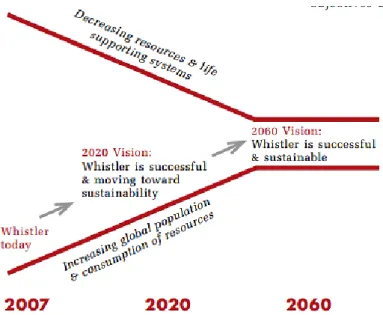
In order to understand the problem of unsustainability and the importance of sustainability, TNS uses the metaphor of a funnel. Due to human interaction over decades the amount of natural resources is decreasing. Population is constantly growing and demand for those resources is in-creasing which causes pressure on ecological system and also social systems. In order not to end in a crisis, where the two sides of the funnel are clashing, actions need to be taken. (Green Meeting Industry Council (GMIC) & The Natural Step (TNS), 2012, pp. 14 - 17)
Source: (GMIC, TNS, 2012, p. 15) The Natural Step concept is based on four main strategies: Concerning the environment:
1. Eliminate the extraction of substances from the earth’s crust such as heavy metals or fossil fuels
2. Decrease the concentration of substances like dioxins, fossil fuels or heavy metals pro-duced by the community
3. Eliminate the physical cutback of nature and natural processes (for example destroying forests, displacing wildlife, overfishing etc.)
Concerning social issues:
4. Eliminate all conditions which diminish the capacity of individuals to meet their basic needs for example: unsafe working conditions, not enough salary to live etc. (The Natural Step, n.d.)
TNS follows the concept of back-casting. This can be seen as the opposite of forecasting which means to define a vision of what should be accomplished in the future and then think backwards from the vision to the present and discover what needs to be done in order to achieve this vision. (Cook, 2004, p. 486).
To apply and implement those strategies within, TNS recommends the ABC Method:
1. Awareness: First of all, the team has to become aware of the problem and ensure a common understanding and definition of sustainability.
2. Baseline: The second step consists of assessing the current situation, define stakeholders, describe challenges and evaluate the areas where action has to be taken.
3. Compelling vision: This third step consists of finding possible solutions for the challenges defined in step two.
4. Deciding on priorities: In the last step priorities are defined and decision is made on which solutions should be implemented first. (The Natural Step, n.d.)
Even though TNS is not entirely scientifically approved which is a main critic point of the concept, it provides easy – to follow guidelines and principals for businesses to become more sustainable. (Upham, 2000, p. 453)
3 Green Meetings
Considering the trend of sustainable and environmental friendly practices within different industries, the term “Green Meetings” defines the approach which has been made within the MICE industry in order to diminish the negative environmental impact. Events such as meetings, conventions or congresses are an opportunity for people to come together for the purpose to discuss research or celebrate. This gathering of people does always include negative environ-mental effects, as resources are consumed and waste is created. Not to neglect is furthermore the travel-component which creates a huge amount of greenhouse gas emission. Due to the size and importance of the meeting industry, incorporating sustainable and environmentally friendly practices is necessary. As events in general are also known to have an educational factor, it is furthermore a chance to showcase excellence in sustainable behaviour. (Jones, 2014, pp. 46-48) In order to provide an equal understanding of the topic “Green Meetings” it is important to first determine the term “green” which has to be distinguished from “sustainable”. Estes differ-entiates the two terms in his book as follows:” ‘Green’ implies specific activities related to environmental impact whereas ‘sustainable’ implies the inclusion of three activities that impact people, planet and profits” (2009, p. 7). Since the fundamental aim of every commercial busi-nesses is to make profit, the economic aspect needs to be taken into account as well. There are several definitions of the term “Green Meeting” existing. A common one is provided by the Con-vention Industry Council:
“A meeting or event [that] incorporates environmental considerations to minimize its negative impact on the environment (2004).”
Those “environmental considerations” can for example include the following action areas Minimized greenhouse gases and compensation through offsetting
Minimized consumption of natural resources Less production of waste, reuse and recycle
Detailed action areas will be disclosed in the following chapters. Other definitions of green meetings do also include social considerations, for instance the inclusion of the local community (e.g. deBlanc Goldblatt, 2012, p.5). This shows the complexity and interconnection between the different components of sustainability. Within the framework of this thesis, the social aspect is consciously neglected. DeBlanc Goldblatt also mentions the term “Ecotourism” in his guidebook for greener meetings and events (2012, p.5). Ecotourism can be defined as “a sustainable, non-invasive form of nature based tourism that focuses primarily on learning about nature first-hand, and which is ethically managed to be low-impact, non-consumptive and locally oriented” (Fennell, 2007, p. 30). This approach is important and should be considered when talking about incentive travel, which is also a part of the MICE industry. However within the scope and goals determined in this thesis, the main focus is led on sustainable meetings, conferences and events.
The importance of taking environmental aspects into account when planning and executing events is acknowledged and supported by the Government of Canada. In 2007 the Environmental division of the Canadian Government published the second version of the “Green Meeting Guide” (Environment Canada, 2007). The first version was already published in 1995 and shows the pio-neering position of Canada in regards to environmental considerations within this industry. Due to a change in mandates within the Canadian Government institutions, there is no institution directly responsible for sustainable development within the MICE industry. However sustainable development and CSR initiatives in every industry are supported by a government institution called Innovation, Science and Economic Development. (Appendix XIII) The green meeting guide, which still can be consulted on the government website, provides information and tools not only on how to create and produce green meetings but also on how to communicate the effort. The guide is intended for meeting planners working at any kind of business. Government departments in different countries2 (e.g. Germany, Switzerland, Canada) as well as also international envi-ronmental unions like for example the UNEP have developed individual guides, providing sugges-tions and tools on how to make a meeting more sustainable (2009). Moreover different authors provided a comprehensive overview on how sustainability can be implemented within the meet-ing industry and shared results on the advantages this implementation can brmeet-ing. (e.g deBlanc Goldblatt, 2012; Jones, 2014; Bowman, 2014). Specific and limited research about the perception and value of green meetings to selected stakeholder groups has been conducted and published in scientific industry journals (e.g. Mykletun, Bertkeviciute & Puchkova, 2014; Rittichainuwat & Mair, 2012).
Organizing green meetings does not only minimize the negative envrionmental aspect, action taken to be more envrionemtnally friendly does have further positive impacts. By using resources and material more responsible and minimize the amount of waste, there is a saving in cost and
consequently an increase in profit. Furthermore the image and reputation of a organization can clearly be enhanced by its commitment to the environement. Moreover promoting the actions taken during a green meeting, raises awareness amongst the attendees and help them to understand the importance of environmentally sustainable practices. It also promotes innovtion and technologies to reduce negative environmental impact. (Environment Canada, 2007)
In addition, as it is predictable that authorities will tighten environmental specifications in all branches of business, corporations that are prepared to act environmentally sustainable will in the future have a clear competititve advantage on the market as compared to those without. Preparednes also will avoid enterprises to get away with fraudulent actions such as the recently uncovered affair on tricked software for CO2 emissions monitoring in the automobile branch (the cae of VW). (Russell, 2015)
3.1 Action areas
Before focussing on how green meetings can be implemented and managed, the different action areas, where environmentally practices can be employed shall be described.
3.1.1 Greenhouse gas emission
Greenhouse Gas Emissions (GHG), such as CO2, methane or ozone are mainly responsible for today’s climate change. Those gases are important to keep the earths’ temperature at a certain level. Greenhouse gases do occur naturally and are at a certain level necessary that life on earth can exist. However, since the industrial age their emission raised so much that global warming and climate change occurred. (Jones, 2014, pp. 159-172)
GHG emissions are therefore one major point to be minimized in order to organize a greener meeting and to make it as climate neutral as possible. GHG emissions at an event are mainly caused due to the travel of the attendees and by the energy consumed (lights, equipment etc.) during the event. Therefore it is important to minimize those emissions within the different action areas. However, GHG emissions can not be fully eliminated. Offsetting them, what means investing in climate neutral or development projects, can be a solution. (UNEP 2009) Pranav Sethaputra, Group Sustainability Consultant at MCI3 Singapore, confirms that the GHG emissions are playing an important role in measuring the sustainability of an event. They are easy to com-pare and benchmark. The trend of measuring GHG emissions of events is reflected in the current demand of the clients to have those emissions measured. Within MCI those are one of the most demanded sustainable services. (Appendix XI)
An example of a planning tool which measures GHG emissions of events, is the ICAO Green Meetings Calculator, a smartphone application which was launched by the International Civil
Aviation Organization in 2013. This easy to use planning tool calculates the CO2 emissions created by the estimated air travel of the attendees to reach a destination. Based on the home town of the attendees, the application ranks different meeting locations based on the estimated emis-sion. (International Civil Aviation Organiztion (ICAO), n.d.)
3.1.2 Destination, accommodation and venue
The question where an event, congress or meeting does take place is an important factor in the green meeting strategy. Within different destinations (cities, regions or even countries) there has been diverse effort made, when it comes to the support of environmental initiatives. Differ-ent destinations have differDiffer-ent environmDiffer-ental policies and commitmDiffer-ents made by the govern-ment, thus influence the destinations resource managegovern-ment, environmental stewardship, waste management policy, agricultural production and many aspects more. (Jones, 2014, pp. 79-84) Considering the scope of this thesis and the fact that the destination is often already given, when working in an event and conference planning company, a focus shall be made on the venue and accommodation selection. The selection of the venue – no matter if it is a convention centre for a congress or a restaurant space for a large gala dinner - plays an important part in greening an event. Fundamental facts to consider when choosing a venue or hotel are summarized in Table 2.(Jones, 2014, pp. 86 - 87)
Source: Table by the author, based on (Jones, 2014, pp. 86 - 87) Table 2 Facts to consider when choosing event venue or destination
Diverse certifications like for example the LEED certification, which identifies buildings which have an environmental friendly design and which are following an energy saving practice, are a big help for meeting planners in order to choose a “green venue” for an event. (U.S. Green Building Council, 2016) A best practices example of the Enercare Centre, as a green venue, as well as the conference centre in Whistler, which incorporates a sustainable policy will be pro-vided in chapter 6.1 and 6.3. Also an important eco-rating program, which is used for hotels and resorts is the “green key”. Since over 15 years, the Green key program assesses different opera-tional areas of a hotel facility. Those areas include the environmental management of the busi-ness, housekeeping, F&B Management, engineering and also the conference and meeting facili-ties. Analysed are amongst other practices energy and water conservation, waste management, infrastructure and air quality. (Green Key Global, 2016)
3.1.3 Energy
Energy efficiency and energy saving actions taken in all the areas of planning and implement-ing an event or meetimplement-ing, is another important part in order to make an event more environmen-tally sustainable. This leads to a reduction in the emission of harmful carbon gas. For indoor events and meetings, where the power is mostly provided by the venue, Jones suggests the fol-lowing steps to ensure energy efficiency (2016 p. 91 -105):
Source: Table by the author, based on (Jones, 2014, pp. 91-105)
3.1.4 Transportation
One of the main points why an event or meeting has a negative environmental balance and is due to the GHG emissions linked to the travel of the attendees. Therefore minimizing travel distance and making transportation more efficient and less depending on non-renewable resources is a huge
Figure 2 Environmental impact of different means of transport
Source: (deBlanc Goldblatt, 2012 p.85) Table 3 Energy saving strategies
opportunity in order to create a more environmentally friendly event. (deBlanc Goldblatt, 2012, pp. 83 - 99)
Source: Table by the author, based on (Jones, 2014, p. 136)
3.1.5 Waste and water management
Green meetings do incorporate sustainable waste and water-management strategies. When-ever possible, waste should be prevented, minimized or reused. If that is not possible, a com-posting and recycling strategy is encouraged instead of sending waste to the landfill. (deBlanc Goldblatt, 2012, p. 102)
Source: Table by the author, based on (deBlanc Goldblatt, 2012, pp. 101-121)
In order to create a sustainable event, water conservation is another important consideration. Saving water and using this resource more efficiently is therefore fundamental. As corporate events do normally take place at selected venues, there is little control with regards to water management from the side of the organizer. Hence choosing a venue, which manages this re-source in a sustainable way is one of the most important points. Another powerful way to safe water is simply to make attendees aware to conserve water for example whilst using washroom facilities.
3.2 Implementation and management
Planning and implementing environmentally friendly events does require sustainability man-agement principles within the company which organizes the event. Those manman-agement principles include the creation and definition of a vision and mission statement, values, policies, goals, objectives and targets as well as the development of a strategy and framework. (Jones, 2014, p. 6) Environmental considerations have to be prioritized within the organization, in order to plan green meetings and sufficient time and resources need to be allocated (Environment Canada, 2007). The commitment to environmental sustainability also has to be communicated. It is im-portant to communicate and promote the idea of sustainability inside and outside the organisa-tion. This means that staff, employees but also the suppliers have to be aware of sustainable initiatives. Furthermore also the attendees need to be a focus of the communication. A careful and good communication should ensure, that all stakeholders are aware of the environmental commitment. It is an opportunity to incite them to take green actions themselves. (Jones, 2014, pp. 34-57) Another important part when organizing green meetings is measuring and monitoring the actual environmental impact of the meeting in order to evaluate if the actions taken were effective. Measurements can be made for example on the resources and energy consumed during the event, on waste generated and disposed and also on the travel methods selected by the
participants. To collect those data is important as it not only helps to understand what could be improved but also for benchmarking purposes. (Sustainable United Nations, 2009)
3.3 Industry councils and associations
Industry councils and associations are playing an important part in supporting the sustainable development within the industry, as they are a platform to exchange, research and network. In the following, the councils and associations which are important for the meeting industry are presented and their effort in regards to green meetings described.
Meeting Professionals International (MPI)
MPI is an international association for professionals, working in the meeting industry. Founded in 1972, the non-profit organization MPI is with 18’500 members the largest industry association. The association provides educational tools, encourages innovation, offers a networking platform and supports the growth of the meeting industry. MPI continuously researches in the area of sustainable development with a special focus on CSR. In addition to that, MPI has developed a sustainable meeting professional certificate (SMPC). In a three hour training programme, the participants learn about sustainable meeting planning, tools and standards. The course is built around an online tool, which facilitates the planning of sustainable meetings by providing easy-to follow procedures. Upon the successful completion of the training programme, the attendees achieve a certification. (Meeting Professionals International, 2016)
Professional Convention Management Association (PCMA)
PCMA is an organisation for event and meeting professionals with the goal to enhance innova-tion and educainnova-tion, enable business networking and promote the industry. PCMA members are given access to research studies and different online tools. Furthermore PCMA is the publisher of the monthly Convene magazine, which provides educational content and discloses the latest trends and innovations within the industry. Sustainability in the event industry herein plays an important role. PCMA regularly publishes the latest trends and research results in this area. (PCMA, 2015)
International Congress and Convention Association (ICCA)
The ICCA is an industry association for congress and convention organizers. With over 1000 members, the ICCA acts as a knowledge exchange platform for industrial members. Moreover they offer several reports, publications and educational content to their members as well as the access to industry news and trends. In this context, ICCA publishes news and content about green meetings and events and sustainable development within the MICE industry. (ICCA, 2016)
Green Meeting Industry Council (GMIC)
The most powerful voice with regards to sustainable development within the meeting industry is the Green Meeting Industry Council (GMIC). The GMIC, which was founded in 2003 is now a council of the convention industry, an organisation which encourages the exchange of infor-mation within the industry. The GMIC is a non-profit organisation which goal it is to improve and implement sustainable practices across the industry. The mission of GMIC is to “transform the global meeting industry trough sustainability” (Green Meeting Industry Council (GMIC), 2016) Members of GMIC are meeting planners as well as event industry suppliers. Trough educational resources (training, workshops and online-resources), acknowledging industry leadership as well as the promotion of equal industry standards, GMIC helps to improve sustainability within the meeting industry. Businesses, which comply with the GMIC business partner’s sustainability code of conduct, can apply for GMIC membership. Members of GMIC have access to the resources, case studies and statistics conducted by the organisation. Furthermore a membership with GMIC brings the advantage, that businesses will be listed in the green supplier directory. This is a database for suppliers, which are actively implementing environmentally sustainable initiatives. The part-nership therefore provides the possibility to connect with other sustainable businesses, like for example green suppliers. GMIC members can use the logo of the industry council for promotional purposes. It identifies them as a business which takes the environment into account. (GMIC, 2016)
3.4 Green meeting certifications and standards
The two main standards with regard to green meetings and sustainability within the event industry are the APEX/ASTM Green Meetings and Events Standards and the ISO20121:2012 Event Sustainability Management System Standards. Both are providing a collaborative approach in re-gards to sustainable and environmentally practices within the MICE industry.
The APEX/ASTM Green Meetings and Events Standards were developed by the GMIC in part-nership with APEX (the Convention Industry Council’s Accepted Practices Exchange) and ASTM (an international standard development organization). The reason for developing those interna-tional standards was to build a measurable tool which helps to enhance the sustainability of events or meetings. The standards do apply in the following areas of meeting management (Table 6) by including different categories, where action has to be taken.
Table 6 APEX/ASTM Standards
Area of meeting management Categories - AV/Production
- Accommodation - Communication - Destination Selection - Exhibits
- Food and Beverage - Meeting Venue
- Staff Management and Environmental Policy - Communication - Waste Management - Energy - Air quality - Water - Procurement
- Onsite Office - Transportation
- Community Partners
This standard can only be achieved by event supplying businesses such as venues, audio-vis-ual companies or destinations. They do offer a useful tool for sustainable event planning com-panies if they would like to choose appropriate suppliers. (GMIC, 2016)
On the other hand there are the ISO 20121:2012 Event Sustainability Management System Standards. Those standards which were developed by the international organisation for stand-ardisation in 2012 provide guidelines to enhance all three components of sustainability by imple-menting an event sustainability management system. The ISO 20121:2012 standards can be im-plemented within an event organisation but can also be applied for a single event and even provides guidelines for suppliers. The ISO 20121:2012 provides guiding principles through the whole process of event planning. At the planning state the standards help to determine the risks and opportunities and assists with formulating sustainability goals, identify resources and com-petence needed. Furthermore the guidelines also include the operations side as for example the supply chain management as well as the evaluation of the performance and advice how to im-prove the whole process. (ISO, 2012)
4 Analysis and research
The practical part of the thesis consists of four main chapters: the analysis of JPdL’s current strategy towards environmental sustainability, the examination of four best practice examples, the analysis of the online-survey conducted as well as the strategy developed for JPdL. The practical part shall determine the value a green meeting strategy would bring to JPdL. In advance to the practical research, the following hypothesis were made
Generally the value of the different environmental sustainable actions when planning an event, congress or meeting are acknowledged and represent an important consideration for the target group of JPdL. Especially bigger and international businesses, which themselves follow environmentally friendly practices within their business operations see value in envi-ronmentally sustainable services and are interested in organizing green meetings.
Due to customer demand in green services as well as the creation of intangible benefits (e.g. image and customer’s retention) the implementation of a green meeting strategy would in-fluence the competitiveness and profitability of JPdL in a positive way.
5 Company structure JPdL
JPdL inc. was founded over 30 years ago by Jean-Paul de Lavison and is offering congress, conference and event planning as well as destination management services all over Canada to national and international clients. Clients are enterprises, various associations, universities or
government boards. JPdL is operating all across Canada with offices located in the Canadian cities Montreal, Toronto, Ottawa and Quebec. There are over 60 full time employees working for JPdL countrywide. JPdL International, which is the main Professional Congress Organizer (PCO) is located in the head office in Montreal. The other offices are mainly offering event planning and acting as local destination management companies.
In order to fully understand the services JPdL is providing, a brief definition of a “Destination Management Company” (DMC) is necessary. Destination Management Company is a relatively new term for a business, which organizes the logistics for all the services necessary or desired around a conference, special event or convention. Destination Management professionals are known to possess a superior knowledge about the region which allows them to successfully plan or design customized tours and activities, transfer services, decoration or entertainment. (Association of Destination Management Executives International [ADMEI], 2016)
Two further subsidiaries of JPdL are Intertask Conferences, as well as JPdL Vitamine. Intertask conference planning is managed from the JPdL office in Ottawa and is specialised in conference planning. JPdL Vitamine, located in the Montreal office, is focussing only in incentive trips. Even though all offices and divisions are working individually, there is an active cooperation between the different offices for bigger projects.
5.1 Current environmentally sustainable approach and CSR strategies
In order to define what has been done within the different offices in regards to environmental sustainability the event professionals working at the different offices were interviewed.
Montreal Tremblant Toronto (& Niagara) Ottawa Quebec Services offered • PCO (JPdL International) • DMC • Event planning • Incentives (JPdL Vitamine) • DMC • Event planning • Only a virtual office, operated from Montreal
• DMC for Toronto, Ni-agara and since 2016 Vancouver/Whistler area • Event planning • DMC • Event planning • Conferences (Intertask) • DMC • Event planning Employees As per April 2016 30 incl. Vitamine 2 7 2 + 15 Intertask 3 Environ-mentally sustainable practices within the office
• Electronic communication and archiving (all documents are centralized on a server) • JPdL does not encourage unnecessary print-ing. All documents are printed two-sided. • Energy saving bulbs are in operation, as well as a timer which shuts down all lights when not used (between 6PM and 8AM)
• Recycling and compost
• JPdL possesses a Bixi bike (bikeshare) mem-bership (Jean-Paul de Lavison)
• The use of public transportation is common and encouraged
• Other offices are sent to side inspections if it is nearer their location
• As the employ-ees work from distance, every-thing is online and there is barely something printed out • home office for one employee: no travel necessary
• A basic approach has been made: recycling, online-filing
• Printing used to be by default double-sided in the past (no longer in use)
• Medium environmen-tal awareness amongst employees. Computers are often not shut down their computer at the end of the day and, many things are printed even though they could be con-sulted on the screen
• Communication via e-mail
• Two-sided printing by default
• The entire building was updated with T12 bulbs (energy-saving)
• All interior lights are turned off at night
• Basic environmental practices such as recy-cling and printing on recycled paper. •Donating old com-puter equipment to a certified recycling or-ganisation Environ-mentally friendly approach regarding the ser-vices of-fered to clients
• A major effort has been made 10 years ago, when the topic came up
•Nowadays it is not a main selling argument. The demand for environmental friendly services is estimated as not high enough.
• Being sustainable is seen as “main-stream” • Jean-Paul de Lavison as the founder of JPdL as considered as leader in regards to green meet-ings many years ago (2007), when the term was not that common yet (Douloff, 2012).
JPdL was an active member of the advisory board which worked on a formal certification in
• Not a big effort has been made • Demand is esti-mated as low, as they never had a request for envi-ronmentally sus-tainable services so far •Effort is made when possible, but it is not a • no effort made so
far • Effort has been made for specific request from a government authority (in 2013): An appendix which describes the measurements Intertask considers in regards to green meetings is very outlined and developed for this proposal • Already in 1984 Inter-task printed a corporate
• None. Clients are considered as not in-terested in environ-mentally friendly ser-vices
“environmental responsibility in meeting man-agement” (with the Quebec Standards Organi-zation). Furthermore JPdL was also member of the APEX Green Meetings and Event Practices Panel (voluntary standards development organi-zation)
• No green option sent out with proposals, but the membership at the Advisory board as well as the participation at the APEX Green Meet-ings and Events Practices” Panel is usually men-tioned in proposals of JPdL International • JPdL organized green events before, e.g. in 2007 the 4th world environmental education
congress.
• There is no mission statement and no policies existing, which include environmental consider-ations
• The following green services for conferences have been offered services in the past:
o Recycling (e.g. of name badges) and waste management
o carbon-offsetting program (on occasion) o Re-usable water bottles
o Eliminating delegate bags
o Encouraging the use of public transit • If requested by clients, green options can be developed but it is not offered by default.
main selling point. It is rather defined at a later stage of the pro-gram (e.g. cater-ers which donate leftovers etc.) •Locally sourced products for ca-tering or gifts are preferred. •Group transfers for airport arri-vals are preferred than individual ones.
marketing brochure pro-moting environmentally sensitive meeting man-agement practices, for example:
o Paper and badge-holder recycling o Re-usable lanyards o Avoiding disposables
and single-use con-tainers
o Adjusting meeting-room lighting and heating, travel econ-omies and use of re-cycled paper.
This leaflet was sent out to potential clients and the statement included in various proposals in the past.
•Nowadays there is no green statement sent out to prospective clients within a proposal any-more
CSR Strate-gies
• Different projects were supported, for exam-ple a women’s shelter in Montreal, building a children’s park etc.
• Not much done. The main effort is to encourage cli-ents to do so: e.g. projects to build a commu-nity park or pro-ject for kids in need
• TO office was in-volved in Christmas basket project some years ago (initiative coming from Montreal office)
• no clearly defined CSR strategy
• Charity drives from time to time
• Support of a book club to share books
• supporting the MPI Charity Auction
• Efforts made to adjust the employees environ-ment (workplace)
• If CSR activities are a topic, JPdL Quebec cooperates with a lo-cal charity in order to offer CSR initiatives for incentives. Exam-ples are putting to-gether hygiene kits for homeless shelters, building bikes etc. Source: Table by the author based on data collected by the author (Appendix I - V)
Montreal:
Montreal is the biggest of the JPdL offices. Different divisions are operated out of the Montreal office: PCO, DMC and Incentives (Vitamine). About 10 years ago there has been a major effort made to become a more environmental friendly company and to develop and implement green ideas, also regarding the services provided to the clients. In 2012 Jean-Paul de Lavison, the founder of JPdL was awarded by the Industry Innovator Award by Meetings+Incentive Travel, a business event community (Douloff, 2012). His pioneering in green meetings before it was be-coming main stream was seen as exceptional. JPdL has been an active member of the advisory board which worked on a formal certification in “environmental responsibility in meeting man-agement” (with Quebec Standards Organization). Furthermore JPdL was a member of the APEX Green Meetings and Event Practices Panel (a voluntary standards development organization) Jean-Paul de Lavison, who’s environmental awareness can be estimated as above average is one of the main driver in regards to green strategies. Due to the fact, that JPdL International orga-nized environmentally friendly meetings in the past (e.g. the world environmental congress in 2007), the industry leadership in the past (APEX/Quebec) and the fact that leading personalities at JPdL International have knowledge in organizing green meetings, leads to the conclusion that there is expertise available to plan and implement green meetings. On the opposite not every employee at the JPdL Montréal offices has the same understanding, perception and also aware-ness of the green initiatives which are taken. (Appendix I)
Within the organization, the team in Montreal took different actions to save energy trough different initiatives (see Table 7 Actions to be taken within the different JPdL offices). There has even been a one-sheet developed by a former employee (in 2007) in order to inform clients about the actions taken in regards to ensure environmental sustainability within JPdL. This was meant to be sent out with proposals4. Today the JPdL team in Montreal is not that particularly focussed in promoting green initiatives anymore. One of the main reasons for that is, that the value for the clients, and demand from them, as well as the return on investment is estimated as low. An example, given by Jean-Paul de Lavison is a lost bid from a Canadian Association many years ago. The Association requested green options which demanded a high planning effort from JPdL’s side. At the end the proposal including the “green” services was slightly more expensive than the competitor and drove to JPdL losing the bid against a competitor which was cheaper. This created doubt in the value of providing environmentally sustainable services. Furthermore many of the people who were actively involved in this development left the company. Concluding that actively promoting green options does not bring the expected value for the company, JPdL international does not set a special focus on promoting green conference options nowadays and
re-it’s only done occasionally (e.g. for the international earth day, Appendix VII). There is no inter-nal statement existing, which includes a focus on environmentally friendly services nor are there “green options” send out in proposals. Individual requests will be handled on a case by case approach. However the past memberships at the Advisory board for sustainable meeting man-agement as well as the participation at the APEX Green Meetings and Events Practices is normally mentioned at the end of proposals for JPdL International. Within the office environmentally sus-tainable practices such as recycling and double-sided printing are still in use. In regards to CSR initiatives, JPdL Montreal supports different projects like a women’s’ shelter in Montreal or the building of a kids park. The focus is more on social initiatives right now than on environmental ones, confirms founder Jean-Paul de Lavison. (Appendix I)
Tremblant
Due to the small office size, the Tremblant office currently only exists as a virtual office, managed out of Montreal. No big effort has been made in order to be environmentally friendly or offer services which are “green”. The demand is estimated as low, since not having any re-quest for environmental friendly services within the last four years. In regards to CSR programs, there is not much done except from encouraging clients to take part in social programs. (Appen-dix III)
Toronto
Within the Toronto office the environmental awareness can be estimated as average and very diverse amongst different employees. Basic effort has been made within the office to save re-sources and recycle. However computers tend to stay on during night and there are many docu-ments printed which could be consulted on the screen. Regarding the services offered, there is no effort made to keep them “green”. Actions like recycling of the name badges are considered if the client asks for a cheaper option. A CSR strategy does not exist and currently there are no projects directly supported. (Appendix V)
Ottawa
The JPdL Ottawa office, which includes Intertask conferences, has done some effort to operate a green strategy within the office. For a request for proposal from a government division in 2013, all environmental practices JPdL Ottawa /Intertask has been taking in the past were outlined. This document testifies the effort which has been made within JPdL Ottawa to operate a sustainable business. Already in 1984 Intertask discovered the promotional value of these prac-tices and printed a corporate marketing brochure which stated environmentally sensitive meet-ing management practices. This leaflet was sent out to potential clients and the statement was included in various proposals. Nowadays this leaflet is not part of proposals anymore, neither
there is a green option in proposals sent out. JPdL Ottawa is supporting some CSR projects like for example the MPI book auction. (Appendix II)
Quebec
There has been a basic approach made at the Quebec office to implement environmental friendly practices within business operation. This includes amongst other things general recycling and printing on recycled paper. There is no special approach made in order to provide environ-mental friendly services to clients as the demand is estimated to be low. CSR initiatives are sporadically considered for incentive programs and usually in cooperation with an organization or a local charity. They do for example include charity activities for a local homeless shelter. (Appendix IV)
5.2 Industry membership and affiliates
JPdL is affiliate with different institutions and partners. An important affiliate for the DMC side is Host Global Alliance. Hosts Global Alliance is a worldwide consortium of selected Desti-nation Management Companies which is referring business to JPdL (Hosts Global Alliance , 2016). JPdL is their only DMC partner in Canada and therefore an important source for business oppor-tunities. From the Congress organisation side, JPdL is member of IAPCO (International Association of Professional Congress Organisers), which affiliates the services of JPdL. Furthermore the dif-ferent offices have a partnership with the tourism organizations in the according city (Tourism Quebec, Toronto, Ottawa, Montreal and Greater Niagara). Those partnerships are not only im-portant to be informed about what is going on in the cities, the different tourism institutions also refer leads to JPdL. JPdL is also member of industry associations like MPI, PCMA or ICCA and has access to their online resources as well as networking events or annual meetings.
5.3 Communication
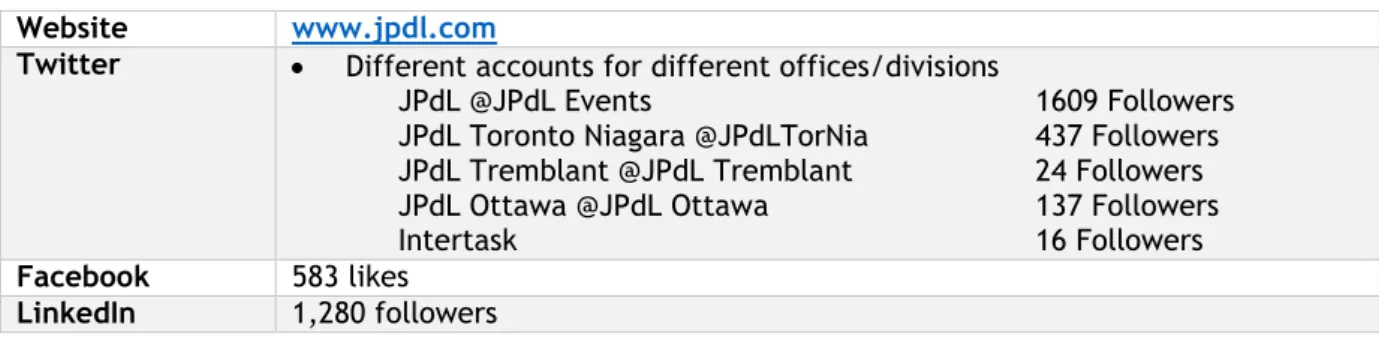
As discussed, communication is an important factor in order to inform stakeholders about the company’s sustainable commitment. Therefore it is necessary to disclose the communication channels JPdL is using in order to promote the business
JPdL is using the following communication channels (as per 21st April 2016): Table 8 Communication channels of JPdL
Website www.jpdl.com
Twitter Different accounts for different offices/divisions
JPdL @JPdL Events 1609 Followers
JPdL Toronto Niagara @JPdLTorNia 437 Followers JPdL Tremblant @JPdL Tremblant 24 Followers JPdL Ottawa @JPdL Ottawa 137 Followers
Intertask 16 Followers
Facebook 583 likes LinkedIn 1,280 followers