Publisher’s version / Version de l'éditeur:
Vous avez des questions? Nous pouvons vous aider. Pour communiquer directement avec un auteur, consultez la première page de la revue dans laquelle son article a été publié afin de trouver ses coordonnées. Si vous n’arrivez pas à les repérer, communiquez avec nous à [email protected].
Questions? Contact the NRC Publications Archive team at
[email protected]. If you wish to email the authors directly, please see the first page of the publication for their contact information.
https://publications-cnrc.canada.ca/fra/droits
L’accès à ce site Web et l’utilisation de son contenu sont assujettis aux conditions présentées dans le site
LISEZ CES CONDITIONS ATTENTIVEMENT AVANT D’UTILISER CE SITE WEB.
Paper (National Research Council of Canada. Division of Building Research); no.
DBR-P-1315, 1985-03
READ THESE TERMS AND CONDITIONS CAREFULLY BEFORE USING THIS WEBSITE. https://nrc-publications.canada.ca/eng/copyright
NRC Publications Archive Record / Notice des Archives des publications du CNRC :
https://nrc-publications.canada.ca/eng/view/object/?id=b242940d-4128-4c3b-a0e9-c25a0bccc97e https://publications-cnrc.canada.ca/fra/voir/objet/?id=b242940d-4128-4c3b-a0e9-c25a0bccc97e
NRC Publications Archive
Archives des publications du CNRC
This publication could be one of several versions: author’s original, accepted manuscript or the publisher’s version. / La version de cette publication peut être l’une des suivantes : la version prépublication de l’auteur, la version acceptée du manuscrit ou la version de l’éditeur.
For the publisher’s version, please access the DOI link below./ Pour consulter la version de l’éditeur, utilisez le lien DOI ci-dessous.
https://doi.org/10.4224/40001792
Access and use of this website and the material on it are subject to the Terms and Conditions set forth at
Solid temperature prediction in downward flame propagation
Ser
TKjl
PI21 d --
National Research Conseil national
no.
125
($
CC 0
ouncll Canada de recherches Canada
BLDG
Division of Division des-- - Building Research recherches en batiment
Solid Temperature Prediction
in Downward Flame
Propagation
by M.A. SultanANALYZED
Reprinted from
Journal of Fire Sciences Vol. 3, No. 2, March/April 1985 p. 83
-
98(DBR Paper No. 1315)
Price $3.00 NRCC 24915
On a Glabore un modele simple qui permet de prevoir la repartition bidimensionnelle des temperatures B l'avant et B l'arrisre d'un front de flammes se propageant verticalement et vers le bas au-dessus d'un matgriau combustible solide et spais. Selon ce modsle, la transmission de la chaleur par conduction de la region en combustion vers le materiau combustible imbr016 B l'avant du front de flammes est consid6r6 comme le principal mode de transfert de l'energie. Les previsions sont conformes aux resultats des experiences rapportees dans les documents techniques.
SOLID TEMPERATURE
*
PREDICTION IN DOWNWARD
FLAME PROPAGATION
M.
A.
Sultan
Fire Research Section
Division of Building Research National Research Council o f Canada Ottawa K I A OR6
Canada
(Received April 23. 198.5)
ABSTRACT
A simple model is developed for predicting the two-dimensional temperature
distribution ahead of and behind a flame front in vertical downward flame prop-
agation over a thick combu.stible solid. In the model. heat conduction in the solid
from the burning region to the unburnt fuel ahead of the flame front is con-
sidered to be the major mode of energy transfer. Predjctions are in agreement
with experimental results reported in the literature.
INTRODUCTION
IN RECENT YEARS, THE SPREAD OF FLAME OVER COMBUSTIBLE materials has received world-wide attention, as it plays a crucial role in fire propagation.
When a material bums, thermal energy is generated and transferred to the surrounding regions. For a flame to spread over the surface, suffi- cient heat must be transferred from the burning region of the fuel to the unburnt region. The three heat transfer mechanisms whlch occur in the vicinity of the flame front are: conduction through the solid, flame rada-
tion, and conduction-convection through the gas phase. Often all these mechanism? are in~rolved, and i t is hfficult to determine which one is
,
dominant.The heat transfer from the flame to the unbumt region depends on the orientation of the fuel surface. In vertical upward flame propagation the flame impinges on the fuel surface ahead of the pyrolysis front: the heat
transfer
t
o
the fuel surface is predominantly by flame radiation. In vertical-lateral and horizontal flame propagation flame radiation is not as significant. In vertical downward flame propagation, the contribu-tion of the flame radiation to the unburnt fuel surface is also insignifi- +
cant [l-41.
Studies of vertical dawnward flame spread aver the surface of PMMA sheets of various thicknesses by Femandez-Pel10 and Hirano 121 and
Hirano et a1 [5] showed that the flame spread rate, V , is inversely pro-
-
portiond to the solid fuel thickness, L. A quantitative analysis of the energy balance of the reDon ahead of the flame front has indicated that if L is less than 0.2 cm, as in the thermally thin case, only 20% of the energy required for frame spread is conducted through the solid phase
(31, thus the energy transfer from the burning to unburnt region is ex- pected by heat conduction through the gas phase or by name radiation
16-121. When the combustible fuel is sufficiently thick, e.g. L is greater than 2 cm, the depth of heat penetration in the solid reaches a maximum value which is independent of the thickness of the fuel, and heat conduc-
tion through the solid is the dominant mechanism l3.5.91. Only ther-
mally thick materid will be considered in the present study.
Measurements of the temperature distribution ahead of the flame front in vertical downward flame propagation over the surface of PMMA material have been reported [13,14].
Fernandez-Pel10 [13] has developed an empirical formda to predict the temperature distribution ahead of the flame front in downward
flame spread. Assuming quasi-steady conditions, the energy equation was rearranged to be similar to the Wiener-Hopf Equation 1151. The kernel was split for the two limiting wses, R = 0 and R = m, for the
unburnt region. as follows:
+,(a) = en for R = 0 (1)
I
+,(o,d) = erfc [[(%)( d m
- o ) ] ~ ' ~ ] for R = (2)where +,, a, d, R are dimensionless
I
From Equations ( I ) and (2), the solution for the intermediate values of
R was approximated by Fernandez-Pello [13] as
Solid Temperature Prediction in - Downward Flame - Propagation
To achieve agreement between measured [13,14] and calculated tem- peratures, Fernandez-Pello 11 3
1
set the empirical constant P equal to 4.Equation (31 may not he applicable to materials other than PMMA. L
The model presented in this paper is the exact. solution of the t w e
dimensional energy equation used by Fernandez-Pello 1131, subject to the same boundary conditions, except a t the surface of the burning
.
region where constant heat flux is considered. Thus the model can be applied to any material provided that the physical properties of the materials involved and the flame spread velocity are known.THEORETICAL ANALYSIS AND DISCUSSION
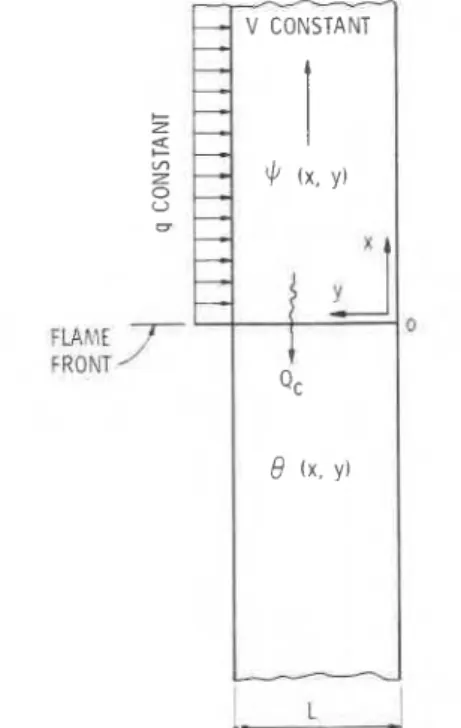
The mathematical model presented here describes the two-dimen- sional temperature distribution in the solid ahead and behind the flame front in vertical downward flame propagation. The physical situation which the mathematical model attempts to describe is shown in Figure 1. The fuel is of a thickness L; t h e y coordinate is attached to the insulated back surface. The flame front is a t x = 0, where the sur- face temperature is the ignition temperature, T,,, and the coordinate x is considered positive in the burning region and negative in the region ahead of the flame front. In the burning region, heat is constantly fed back from the flame to the solid.
V CONSTANT
m
1.
LFernandez-Pello and Santoro [3] studied the dominant mode of heat transfer in downward flame spread, and showed that for thick fuels heat conduction through the solid is the dominant mechanism of heat transfer. In the present study, therefore, it is assumed that heat con- duction from the burning to the unburnt region is the sole heat trans- fer mechanism.
The flame front is considered infinite in extent, perpendicular to the plane xy, and the heat conduction is assumed to occur in two dimen- sions in the xy plane.
The following assumptions are made: (1) The flame spreads a t a constant velocity.
(2) The rate of heat transfer over the surface of the burning region, x
>
0, is constant.(3) To avoid coupling the energy equations of the solid and the gas in the region ahead of the flame, an insulated surface is considered. (4) The thermophysical properties of the material are independent of
temperature.
(5) The effect of mass transfer is ignored.
In the following theoretical analysis, 8 (x,y) has been used for the temperature distribution in the unburnt region x
<
0, 4) (x,y) has beenused for that in the burning region, x
>
0, and the coordinate system moves with the flame front. The steady governing energy Equations [16] for the two regions are:a
-- - 2 S - - - + 7 = 0a e
a2e
for x<
0 a x 2 a x a ya
24) - - 2 S ----a w a24)
+
7 = 0 for x>
0 a x 2 a x a y eve where 2 S =- K(for isotropic and homogeneous material K , = K, = K )
The boundary conditions for x
<
0, where no heat is transferred through the slab surfaces, are:a e
-- (SO) = 0 (back surface of the slab)
a y (6)
a e
--- (x, L) = 0 (front surface of the slab)
Solid Temperature Prediction in Downward Flume Propagation
The use of the insulated wall condition, x
<
0, is equivalent to assum-!
ing that heat transfer to the gas phase does not significantly alter the temperature distribution in the solid [13]. The boundary conditions for
I
x
>
0, where there is no heat transfer a t the back surface of the slab and a constant rate of heat flux a t the front surface, are:I
v(
a , y ) = m (because mass transfer is not considered) (1 1)Equation (11) will be discussed later.
At the interface between the burning and the unburnt regions, where
x = 0, the conditions are
I This formulation comprises two homogeneous partial differential
Equations (4) and (5), four homogeneous boundary conditions, ( 6 ) , (7),
(8) and (9). and four non-homogeneous boundary conditions -
(lo),
( l l ) ,(12) and (13).
The s u ~ e r ~ o s i t i o n solution for x
>
0 is used to eliminate the dif-ficulty oflha;ing the non-homogeneous boundary condition, Equation (lo), [17]. The solution of Equation (5) may be assumed to be of the form
Substitution of Equation (14) into Equation (5) yields
Hence the problem may be divided into three simpler problems y,(x,y),
y 2 ( x ) and y~,(y) each solution satisfying the required homogeneity con-
ditions and all adding up to define the complete solution for x
>
0.with the conditions
For y 2 ( x ) and y , ( y ) the coupled equation is
with the conditions
The solutions of y 2 ( x ) and y 3 ( y ) may be attempted first. Since y 2 ( x ) and y 3 ( y ) can vary independently of one another, Equation ( 2 0 ) holds when the right-hand side and left-hand side are equal to the same con- stant C. Then the solution may be assumed [18] to be
From Equation ( 2 1 ) and Equation (24), C 2 = 0 .
Noting that the solution of y l ( x , y ) depends on y 2 ( x ) and ~ p , ( y ) , the two constants C,, C3 may be arbitrarily set equal to zero [17] and the constant Cmay be determined from Equations ( 2 2 ) and (241, C = q/KL. Therefore, Equations ( 2 3 ) and ( 2 4 ) become
Solid Temperature Prediction in Downward Flame Propagation .- 89
To obtain the solution y(x,y), first a solution for y , ( x , y ) must be found. Equation (16) with the boundary conditions (17), (18) and (19) can be 1 solved using the separation of variables technique [17]. Assuming that
the solution can be written as a product
and introducing Equation (27) into Equation (16) and dividing each term by XY to give
Equation (28), separately expressed in the x- and y-directions is as follows:
where
and
where
/
The general solution of Equations (29) and (31), [16], become
X , ( X ) =Ane'S - "s' + A,,'I 2
(34)
Thus, the solution of y,(x,y) may be written as
where a , = A , B , (the Fourier series coefficients); c o s l , is the Fourier
series characteristic function; A . is the Fourier series characteristic
value nnlL; and n = 0, 1, 2,.
.
.
.
By adding Equations (25), (26) and (36),one obtains the solution for ~ ( x , y ) as
Now, for the region ahead of the flame front where x < 0, the solution
of Equations (4), (6) and (7) is similar to the solution of Equations (16),
(17) and (18), [17], and may be written as
03
~ ( x , Y ) = 2 bne(S + '/" + C O S ~ , y (38)
n = O
The two Fourier series coefficients a , , b , may be calculated from the
conditions a t x = 0, by substituting Equations (37) and (38) into Equa-
tion (12), yielding I 03 03 1 9 b o + 2 b , c o s A , y = a o + - - y 2 + 2 a,cosA,y (39) I n = l 2 K L , = I I
This equation may be rearranged t o
I
I
Differentiating Equations (37) and (38), and substituting them into Equation (13) yields
Solid Temperature Prediction in Downward Flame Propagation 9 1
when n = 0 ,
A,,
= 0 , Equation ( 4 1 ) becomes*
d therefore
and for n
>
1, Equation (41) becomesa . ( S )-- = b n ( S I-+
consequently
Substituting Equations ( 4 2 ) and ( 4 4 ) into Equation ( 4 0 ) yields
Multiplying both sides of Equation (45) by c o s l , y and integrating the
results from 0 to L [17] then gives
I"
[A
y 2 cos(0)dy a. = 0 4 sK L - ~ E
1
( 4 6 )f'
cos ' ( 0 ) d y 0 Therefore andr[l(-~g-
y 1 cosi.ydy 0 4S1KL
2K L -
C" = - --I
( 4 8 ) cos2A.y dy 0 Thus4
and a , and b , can be determined from Equations (44) and (49):
Substituting Equations (47) and (50) into Equation (37) gives the tem- perature distribution for the region x
>
0 asBecause the mass transfer is ignored and the boundary condition presented by Equation (11) is considered in the model, the temperature
distribution in the burning region (Equation (52)) indicates that the , solid temperature increases without limit as the coordinate x in-
creases. I
No measurements of the temperature distribution in the burning region for downward flame propagation are available in literature. The only temperature measurements available are for horizontal flame spread over PMMA material [5].
In the burning region, the results in Reference [5] show that the
i
PMMA surface tends to drop with the increase in x as a result of mass transfer and thereby is no longer horizontal.
To determine how much the temperature distribution yielded by the present model for the region x
>
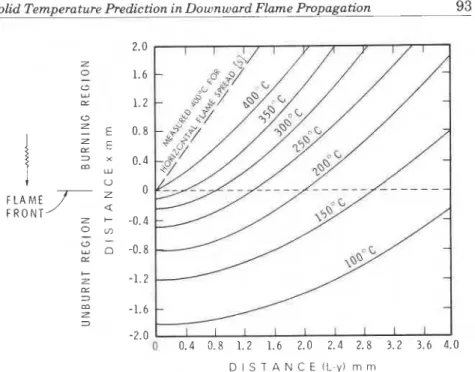
0 differs from the real-life tem- perature distribution, the isotherm 400 "C representing the solid sur-face temperature in the burning region for horizontal flame propaga- Y
tion [5] is pIotkd in Figure 2 together with the isotherms predicted by the present model. The thermophysical properties of PMMA 119) used
in the m d e l will he mentioned later. Figure 2 shows that where x
>
0 4a t an isotherm 400°C, the difference between the measured tem- perature in horizontal flame spread and the predicted temperature for downward flame propagation Equation (52), is almost 0 a t x = 0 and
80 "C a t x = 1.6 mrn. Mass transfer for vertical downward flame spread is expected to be higher than in the horizontal flame spread, thus the
Solid Temperature Prediction i n Downward Flame Propagation 93
FLAME^
F R O N T + 0 (0 - 0 - u D LT D I S T A N C E ( L - y l r n mFigure 2. Temperature distribution in the vicinity of flame front spreading vertically downward presented by isotherms, L = 12.7 mm
difference between the measured and the predicted temperatures a t the isotherm 400°C may become small. In the near future, the measurements of the temperature distribution in the burning region for flame spread vertically downward will be performed a t NRCC.
For the region where x
<
0, the temperature distribution 8(x,y) can be obtained by substituting Equation (42) and (51) into Equation (38). The result isc The surface temperature distribution ahead of the flame front can be
determined by the substitution of y = L in Equation (53)
To obtain the temperature distribution ahead of the flame front as discussed earlier, the heat flux q must be known. The heat flux q can
be determined from the condition, a t x = 0 and y = L, where the sur- face temperature is equal t o the ignition temperature, T,,. By sub- stituting x = 0 in Equation (54), an expression is obtained for the heat
flux, q. >
The temperature distribution in the region ahead of the flame front can be calculated from Equations (53) and (55). Also, the surface temperature distribution x
<
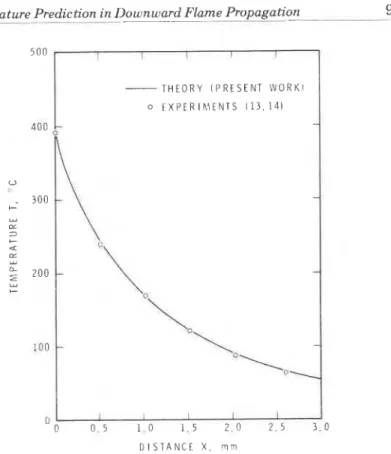
0 can be determined from Equations (54) and (55).From the proposed model discussed here, Equations (53) and (54) are verified by use of measurements available in the literature for PMMA [13,14]. The thermophysical properties of PMMA are given by Orloff et a1 [19]: density (o = 1.19 x 10³kglm3), specific heat
(C
= - 0.247+
5.69 x 10³TI(JKg K ) , and thermal conductivity ( K = - 1.0+
6.32 x 10³T-
1.03 x 1 0 5 P+
5.57 x 10⁹TJ W/mK). These physical properties are considered a t temperature T,,/2, TI, = 395°C [13]. The downward flame spread velocity v is taken from References [5] and [13] (v = 5 xcmls). Agreement between the predicted surface temperature distribution ahead of the flame front and the literature measurements for PMMA 113,141 is shown in Figure 3.
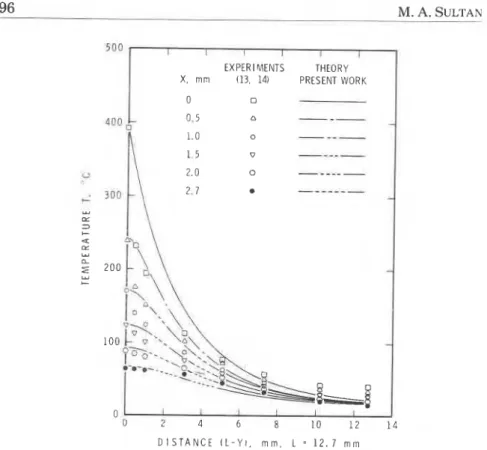
In the solid ahead of the flame front qualitative agreement between the proposed model and measurements [13,14J, as shown in Figure 4, is evident. Quantitative disagreement is apparent near the surface and close to the flame front. where the measurements [13,14] lie below the predicted curves.
This
discrepancy, as indicated by Fernandez-Pello and Williams 1141, is traceable in large part to migration of the thermo- couple junctions. As the flame approaches, the PMMA polymer becomes soft and thermocouples near the surface tend to sink deeper into the polymer under the influence of surface tension [14].CONCLUSION
A simple mathematical model has been derived for predicting the in- ternal and the surface temperature profiles ahead of a flame front. This
model is applicable to vertical downward flame propagation over thick i
solid combustible materials.
Inside the solid, particularly in the region very close to the flame front, qualitative agreement between the proposed model and the literature measurements is evident. Also, excellent agreement is found
Solid Temperature-Prediction in --- Downward Flame Propagation - . 95 .. 5 0 0 I I I - T H E O R Y ( P R E S E N T W O R K 1 o E X P E R I P v ! E N T S 113, 1 4 ) - - - I o n \c
Lz
-l
G
,
0 I I I I I 0 0 . 5 1 0 1 . 5 2 0 2 . 5 3.0 D I S T A N C E X , rnrnFigure 3. Surface temperature distribution ahead o f the flame front in vertical down ward flame spread.
between predicted and measured values a t the surface ahead of the flame front.
The proposed model is simple, sufficiently accurate for practical pur- poses and easier to use than the complicated formulas derived from coupling the energy equations for the solid and gas phases.
ACKNOWLEDGEMENT
This paper is a contribution from the Division of Building Research, National Research Council of Canada, and is published with the ap- proval of the Director of the Division.
NOMENCLATURE
C specific heat
I
EXPERl hlENTS THEORYX, mm (13, 14) PRESENT WORK
I
D ? 4 6 8 1 0 1 2 1 4
D I S T A N C E ( L - Y I . m m . L = 12. 7 m m
Figure 4. Internal temperature distribution ahead of the flame front downward flame spread.
vertical
slab thickness
constant in Equation (3)
forward heat transfer from burning to unburning region constant heat flux from the flame to burning region temperature
flame spreading velocity
coordinate parallel to the fuel surface coordinate normal to the fuel surface density
dimensionless temperature ( T
-
T , )I(T,,
-T,
fuel temperature in t h e unburning region (
T
- T, )fuel temperature in the burning region ( T - T, 1
non-bensional distance normal to the surface. into the solid. d = - y e c ~ i m
non-dimensional distance point of flame attachment, o = xecvlK,
Solid Temperature Prediction in Downward Flame Propagation - -S u b s c r i p t s i initial c conduction x x direction y y direction ig ignition
REFERENCES
1. Ray, S. R., Fernandez-Pello, A. C. and Glassman, I. A., "A Study of the
Heat Transfer Mechanisms in Horizontal Flame Propagation," ASME,
Journal of Heat Transfer, 102, (2), pp. 357-363 (1980).
2. Fernandez-Pello, A. C. and Hirano, T., "Controlling Mechanisms of Flame
Spread," Com.bustion Science and Technology, 32, pp. 1-3 1 (1983).
3. Fernandez-Pello, A. C. and Santoro, R. J., "On the Dominant Mode of
Heat Transfer in Downward Flame Spread," Seventeenth Symposium (Int.) on Combustion, The Combustion Institute, Pittsburgh, pp. 1201- 1209 (1978).
4. Fernandez-Pello, A. C. and William, F. A,, "Laminar Flame Spread over PMMA Surfaces," Fifteenth Symposium (Int.) on Combustion, The Com- bustion Institute, Pittsburgh, pp. 217-231 (1975).
5. Hirano, T., Koshida, T. and Akita, K., "Flame Spread Mechanisms over
PMMA Surfaces," Bulletin of Japanese Association of Fire Science and
Engineering, (in Japanese), 27, (2), pp. 37-39 (1977).
6. Magee, R. S. and McAlevy, R. F., "The Mechanism of Flame Spread,"
Journal of Fire and Flammability, 2, p. 271 (1971).
7. Campbell, A. S., "Some Burning Characteristics of Filter Paper," Com- bustion Science and Technology, 3, p. 103 (1971).
8. Parker, W. J., "Flame Spread Model for Cellulosic Materials," Journal of
Fire and Flammability, 3, p. 254 (1972).
9. Sibulkin, M. and Lee, C. K., "Flame Propagation Measurements and
Energy Feedback Analysis for Burning Cylinders," Combustion Science and Technology, 9, p. 137 (1974).
10. Hirano, T. and Tazawa, K., "Effect of Thickness on Downward Flame Spread over Paper," Bulletin of Japanese Association of Fire Science and Engineering, 26, p. 7 (1976).
11. Hirano, T., Noreikis, S. and Waterman, T., "Measured Velocity and Temperature Profiles of Flames Spreading over a Thin Combustible Solid," Combustion and Flame, 23, p. 83 (1974).
12. DeRis, J. N., "Spread of a Laminar Diffusion Flame," Twelfth Sym-
posium (Int.) on Combustion, The Combustion Institute, Pittsburgh, p. 241 (1969).
13. Fernandez-Pello, A. C., "Laminar Flame Spread over Flat Solid Surfaces," Ph.D. Thesis, University of California, San Diego, pp. 64-69, 200 (1975). 14. Fernandez-Pello, A. C. and Williams, F. A., "Experimental Techniques in
the Study of Laminar Flame over Solid Combustible," Combustion
Science and Technology, 14, pp. 155-167 (1976).
15. Carrier, G. F., Krook, M. and Pearson, G. E., "Functions of a Complex Variable, Theory and Technique," McGraw-Hill, New York (1966).
98 M. A. SULTAN
16. Bird, R. B., Stewart, W. E. and Lightfoot, E. N., "Transport Phenomena,"
John Wiley & Sons Inc., p. 319 (1960).
17. Arpaci, V. S., "Conduction Heat Transfer," Addison-Wesley Publishing
Company, pp. 210-212, 217, 277-279 (1966). b
18. Rahman, N., Professor of Mathematics, Carleton University, Ottawa,
Canada, Private Communication.
19. Orloff, L., DeRis, J. and Tewarson, A., "Thermal Properties of PMMA at
Elevated Temperatures," Factory Mutual Research Corporation, Tech. Rep., 22355-2 (1974).
4
T h i s p a p e r , w h i l e being d i s t r i b u t e d i n r e p r i n t form by t h e D i v i s i o n of B u i l d i n g R e s e a r c h , remains t h e c o p y r i g h t of t h e o r i g i n a l p u b l i s h e r . It s h o u l d n o t be r e p r o d u c e d i n whole o r i n p a r t w i t h o u t t h e p e r m i s s i o n of t h e p u b l i s h e r . A l i s t of a l l p u b l i c a t i o n s a v a i l a b l e from t h e D i v i s i o n may be o b t a i n e d by w r i t i n g t o t h e P u b l i c a t i o n s S e c t i o n , D i v i s i o n of B u i l d i n g R e s e a r c h . N a t i o n a l R e s e a r c h C o u n c i l of C a n a d a . O t t a w a . O n t a r i o . K1A OR6. Ce document e s t d i s t r i b u 6 s o u s forme d e t i r e - a - p a r t par l a D i v i s i o n d e s r e c h e r c h e s e n b l t i m e n t . Les d r o i t s d e r e p r o d u c t i o n s o n t t o u t e f o i s l a p r o p r i Q t 6 d e 1 1 6 d i t e u r o r i g i n a l . Ce d o c u m e n t n e p e u t S t r e r e p r o d u i t en t o t a l i t € ou en p a r t i e s a n s l e consentement de 1 ' 8 d i t e u r . Une l i s t e d e s p u b l i c a t i o n s d e l a D i v i s i o n p e u t O t r e o b t e n u e en Q c r i v a n t a l a S e c t i o n d e s p u b l i c a t i o n s . D i v i s i o n d e s r e c h e r c h e s en b l t i m e n t , C o n s e i l n a t i o n a l d e r e c h e r c h e s Canada. Ottawa, O n t a r i o , K I A OR6.