HAL Id: hal-01403191
https://hal.archives-ouvertes.fr/hal-01403191
Submitted on 25 Nov 2016HAL is a multi-disciplinary open access archive for the deposit and dissemination of sci-entific research documents, whether they are pub-lished or not. The documents may come from teaching and research institutions in France or abroad, or from public or private research centers.
L’archive ouverte pluridisciplinaire HAL, est destinée au dépôt et à la diffusion de documents scientifiques de niveau recherche, publiés ou non, émanant des établissements d’enseignement et de recherche français ou étrangers, des laboratoires publics ou privés.
Public Domain
Topological shape optimization using level-set method
Damien Lachouette, Grégoire Allaire, François Jouve, Marc Albertelli, Vasili
Srithammavanh
To cite this version:
Damien Lachouette, Grégoire Allaire, François Jouve, Marc Albertelli, Vasili Srithammavanh. Topo-logical shape optimization using level-set method. 12e Colloque national en calcul des structures, CSMA, May 2015, Giens, France. �hal-01403191�
1
CSMA 2015
12 Colloque National en Calcul des Structures 18-22 Mai 2015, Presqu'île de Giens (Var)Topological shape optimization using level-set method
D Lachouette 1, G. Allaire2, F. Jouve3, M. Albertelli4, V. Srithammavanh5
1 ESI-Group,SYSTUS Developpement, [email protected]
2 Ecole polytechnique, CMAP 3 Univ. Paris Diderot, LJLL 4 Renault, technocentre 5 Airbus group innovation
Summary — Software edition company ESI-Group in collaboration with industrial and academic
partners (part of the RODIN consortium) has started to industrialize a recent method for optimizing the shape of structures. This method relies on the use of shape derivative based on mechanical computation. An ESI Software has been modified to solve the shape derivatives. The shape is described using the level-set method to precisely represent the shape evolution on a fixed mesh.
Keyword — Topological optimization, level-set, shape derivative
1 Introduction
Topology optimization consists in finding the optimal material distribution within a design space (i.e. the available volume). Up to the early 2000’s, one main technology, homogenization and its variants (power-law, SIMP method) have been proposed. The SIMP approach (Solid Isotropic Material with Penalization) has been implemented into many commercials tools. Topology optimization has deeply changed the way to design. The standard methodology has long relied on the experience of designers and on their ability to guess the optimal load path. They usually distribute the material in a way to maximize the stiffness regarding given excitations. It must be noticed that even for a simple component, the experience will greatly make the difference between several competitors. Each of them will differently understand and interpret the mechanical system and finally set a “personal” design. Among all the feasible designs that individual designers may create, one of them is yet the best regarding for example mass savings subject to stiffness constraints. Whatever the component, it will then be produced in large quantities, in particular in the car industry, hence the utmost importance of systematically reaching the best design regardless of the designer. In this context, topology optimization has brought a very promising and unexpected response.
Topological shape optimization is an important and now very popular study field [1]. A new method, using the level-set representation [3] of the shape, has been developed by G. Allaire and F. Jouve [2] which are partners in the RODIN consortium sponsored by the FUI.
The level-set method is used to represent very precisely the shape. Many geometrical properties are naturally taken into account within the level-set method, and could be used to manage some casting constraints.
2
2.1 The minimization problem
Let be the minimization problem: Let 𝐷 be a closed domain of ℝ𝑑 representing the design
space containing all admissible shapes Ω. Let be 𝑐0(Ω) the objective function to minimize and
𝑐𝑖(Ω), 𝑖 > 0 the optimization constraints of the problem.
Let be 𝒰 = {Ω ⊂ 𝐷 / ∀𝑖 > 0, 𝑐𝑖 ≤ 𝑐𝑖0} the set of admissible shapes. Find Ω𝑜𝑝𝑡 as:
𝑐0(Ω𝑜𝑝𝑡) = minΩ∈𝒰(𝑐0(Ω)) (1)
Note: the constraints could also be expressed as inferior bounds (𝑐𝑖 ≥ 𝑐𝑖0).
The resolution of this problem needs to calculate the shape derivative of each function 𝑐𝑖.
In the general case, this function is expressed as a function of the displacement (𝑢) coming from the mechanical problem:
𝑐𝑖(Ω) = ∫ 𝑗𝑖(𝑢)𝑑𝑥
Ω (2)
The computation of the shape derivatives (3) could be written as a function of the solution of mechanical problem and the solution of the adjoint problem. The core of the finites
elements solver SYSTUS [5] has been modified to allow the computation of both the adjoint solution and the shape derivatives. Some objective functions such as compliance or Eigen frequencies do not require the calculation of an adjoint solution (see [2]).
𝑐𝑖′(Ω)(𝜃) = ∫ 𝜃𝑖(𝑠). 𝑛(𝑠)𝑗𝑖′(𝑢)𝑑𝑠
∂Ω (3)
2.2 The shape representation
In order to avoid unnecessary computation it has been decided to find a shape
representation that does not need remeshing. The shape Ω is then represented with a level-set function 𝜓 with these properties.
𝜓(𝑥) = {
𝜓(𝑥) < 0 ⟺ 𝑥 ∈ Ω 𝜓(𝑥) = 0 ⟺ 𝑥 ∈ 𝜕Ω
𝜓(𝑥) > 0 ⟺ 𝑥 ∈ 𝐷 ∖ Ω̅ (4)
This function is used inside the mechanical solver to determine if the element is in the material or not. For numerical stability an ersatz material is applied in the void (see [4]).
In order to evolve the shape, all that is necessary is to solve a problem of Hamilton-Jacobi (5).
3 𝜕𝜓
𝜕𝑡 − 𝑣|∇𝜓| = 0 (5)
Where 𝑣 is a ‘’velocity’’ normal to the level-set and 𝑡 a fictitious time. Both 𝜓 and 𝑣 must be defined in the whole domain 𝐷
2.3 Shape evolution
The evolution problem needs a pseudo-velocity for the Hamilton-Jacobi problem. This could be obtained by an intelligent combination of each shape derivatives coming from each constraints and the objective.
The shape derivatives are only defined on the boundaries of the shape. The descent direction defined on the boundaries of the shape, obtained with the shape derivatives. This descent direction is then regularized and extended to the whole domain to obtain the pseudo-velocity.
The descent direction for one objective is defined as: 𝜃𝑖 = −𝑗𝑖′𝑛, where 𝑛 is the normal to
𝜕Ω.
The main goal is to solve the problem (1), so an innovative minimization algorithm has been designed to find the global descent direction (𝑣) that could take into account all the constraints (using all the 𝜃𝑖). This algorithm will not be developed in this presentation due to industrial secret.
3 Results
3.1 Optimization of a bike pedal
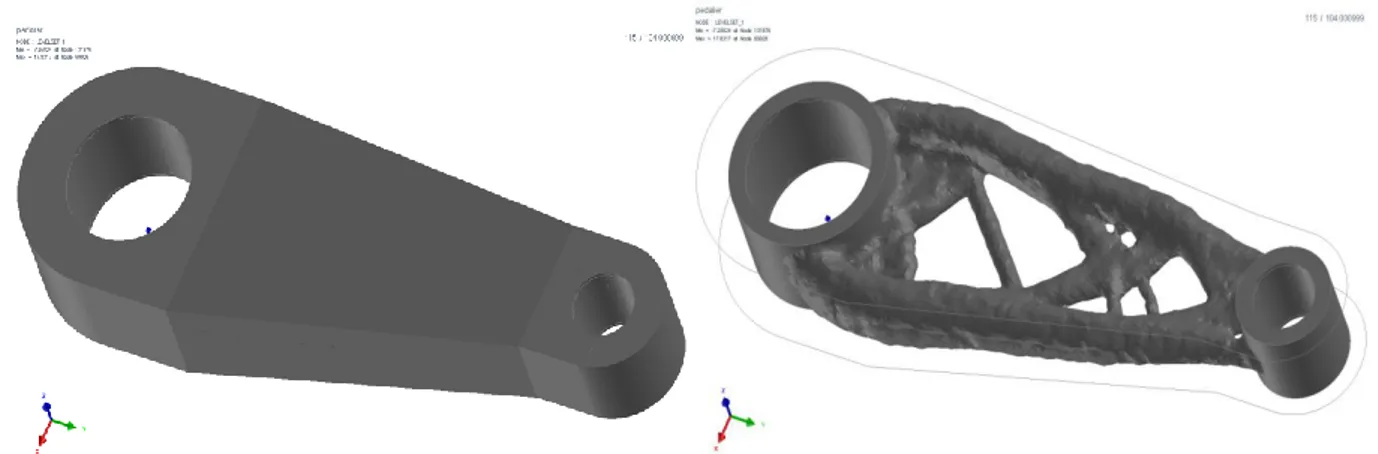
In this simple test case we apply two loads on a bike pedal, one in traction the second in bending. We try to optimize the mass of the pedal with respect to the compliance for each load case and the maximum Von Mises stress.
4
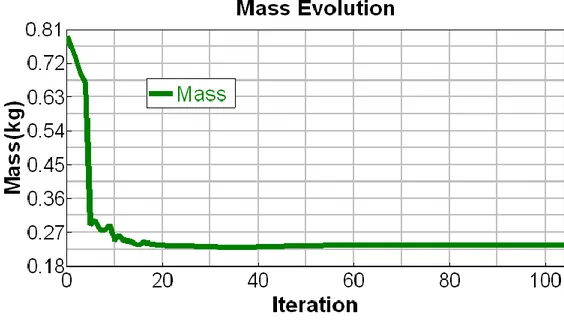
The two cylinder corresponding to the hub and the crank are set in non-optimizable zones. This leads to a mass reduction of 70%. On the final shape all the optimization constraints are satisfied.
Figure 2 Mass reduction among iteration
It could also be interesting to plot the evolution of optimization constraints.
Figure 3 Optimization Constraints Evolution
This is a very simple case that demonstrates the ability of the software to manage a few constraints.
3.2 Optimization of Renault’s Engine Support
5
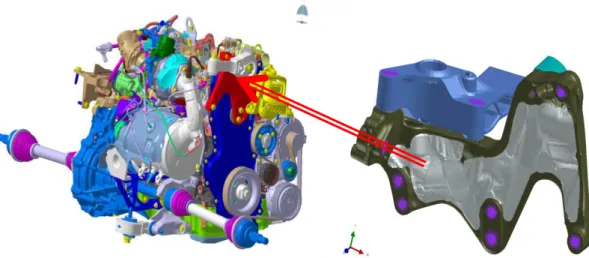
Figure 4 Part to optimize into the powertrain
On the right of Figure 4, the part to optimize is drawn. Only the white part is set as optimisable.
Figure 5 Actual CAD geometry
There are 4 load cases, for each load case we would control the displacement of two significant points (one on each blue part) and the maximum value of Von Mises stress. In addition we would control the first Eigen Frequency to be above 630Hz. Finally we would that part to be moldable in the Z direction.
6
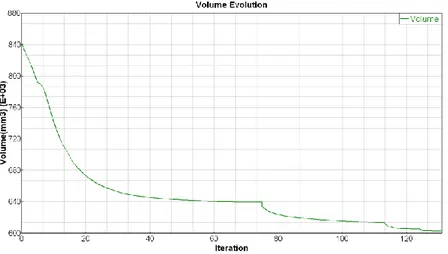
Figure 7 Volume reduction
Constraints are respected, the final shape is moldable (this is a geometrical constraint: the scalar product of the normal and the molding direction must be positive).
Figure 8 Evolution of some constraints
As it can be seen on figure 8, all constraints are verified, but some of them are far from the limit.
4 Conclusion
We have developed a robust algorithm to optimize mechanical part for industrial application. Many features are available today such as linear mechanical criterions (Displacement in norm or in particular direction, stress norm or Von Mises stress, compliance) all these criterions are available as integral form or localized form. Also Modal analysis criterions are available such as Eigen frequencies. And finally, geometrical criterions such as volume, surface, mass, maximum thickness or moldability could also be defined.
Integration of new functionality keeps going:
- About manufacturing constraints: the integration of the minimum thickness is ongoing. This is the last core feature that industrial partners need. The theoretical background has already been completed and proof of feasibility has been achieved, although a fine tuning of the optimization algorithm process would be probably necessary
- Mechanical criterions based on linear analysis: the implementation of new criterions is naturally continuing in the area of linear analysis, modal analysis and frequency response
7
- Mechanical criterions based on non-linear analysis: for the time being, the work remains exclusively theoretical although some encouraging results have already been produced.
- Mesh export require further care in order to deliver a robust and powerful embedded workflow. However the theoretical work is essentially complete for this topic and some tools are already available.
A few years after the beginning of the RODIN project, the consortium has demonstrated that the level-set approach method is perfectly capable to manage “real world
application”. The consortium hopes that a first commercial tool will be delivered in the course of 2015.
5 Acknowledgment
This project is included into the RODIN consortium (Renault, Airbus Group Innovation, Safran, ESI group, Eurodecision, Alneos, DPS, Ecole Polytechnique, INRIA Bordeaux, Paris VI and VII University) which is supported by the FUI.
The RODIN project is a tremendously inspiring experience backed by highly qualified partners. The authors sincerely acknowledge the contribution of all of them and their great and unfailing motivation.
The RODIN project has been accepted within the framework of the 13th FUI call to project in early 2012. Support from CRIF (Conseil Régional d’Ile de France), CGY78 (Conseil Général des Yvelines), and BPI France is gratefully acknowledged. The project has been labelled by Astech and System@tic.
6 References
[1] G. Allaire. Shape Optimization by the homogenization method. Springer Verlag, New York, 2001
[2] G. Allaire, F. Jouve, A.-M. Toader, Structural optimization using sensitivity analysis and level-set method, Journal of Computational Physics 194, Elsevier, 363-393, 2004
[3] S. Osher, F. Santosa. Level-set method for optimization problems involving geometry and constraints:
frequencies of a two-density inhomogeneous drum. J. of Comp. Phys. 171, 272-288, 2001
[4] J. Sethian, A. Wiegmann, Structural boundary design via level-set and immersed interface method, J. of Comp. Phys. 163, 489-528, 2000