HAL Id: tel-03223089
https://tel.archives-ouvertes.fr/tel-03223089
Submitted on 10 May 2021HAL is a multi-disciplinary open access archive for the deposit and dissemination of sci-entific research documents, whether they are pub-lished or not. The documents may come from teaching and research institutions in France or abroad, or from public or private research centers.
L’archive ouverte pluridisciplinaire HAL, est destinée au dépôt et à la diffusion de documents scientifiques de niveau recherche, publiés ou non, émanant des établissements d’enseignement et de recherche français ou étrangers, des laboratoires publics ou privés.
Alternative finance : what are the advantages?
Rosette Khalil
To cite this version:
Rosette Khalil. Alternative finance : what are the advantages?. Economics and Finance. Université de Pau et des Pays de l’Adour, 2021. English. �NNT : 2021PAUU2090�. �tel-03223089�
1
Thesis submitted for assessment with a view to obtaining the Doctoral degree in
Economics
By
Ms. Rosette Khalil
JURY MEMBERS:
Mr. Jamal Bouoiyour, Associate Professor at University of Pau Thesis director Mr. Alain Alcouffe, Professor at University of Toulouse 1-Capitole Referee
Mr. Jean-Michel Uhaledeborde, Professor at University of Pau Examinator Mr. Olivier Hueber, Associate Professor at Université Côte d'Azur Examinator Ms. Rosella Nicolini, Professor at Autonomous University of Barcelona Referee
Alternative Finance:
What are the
2
Table of Contents
General introduction ... 8
First Chapter: Development of Islamic Banks: Evolution and Characteristics ... 19
1.
The appearance of Islamic Finance and its spread in the world ... 20
1.1.
Birth and evolution of Islamic banks
... 20
1.1.1. Islamic Finance in Muslim countries ... 23
1.1.2. Islamic Banks in the GCC Countries ... 25
1.1.3. The evolution of Islamic finance in the non-Muslim world ... 27
2.
Islamic financial instruments ... 32
2.1.
Participatory financing tools: “Mucharakah”
... 32
2.2.
Working capital financing and liquidity management: “Murabahah”,
“Istisna'a” and ”Bai' Al Salam”
... 33
2.3.
Asset financing tool: “Ijara”
... 36
2.4.
“Mudaraba”
... 38
2.5.
Fixed income investment: “Sukuks”
... 38
2.6.
The Takaful
... 41
3. The basics of Islamic finance ... 41
4. Conclusion ... 43
Second Chapter: Measuring the Productive Efficiency of Islamic Banks operating
in the GCC Region………...45
1.
Introduction ... 46
2.
A Brief Literature review ... 48
3.
The Methods of Measuring Productive Efficiency... 51
3.1.
The parametric frontier
... 51
3.1.1. The stochastic cost frontier ... 51
3.1.2. The Model of Battese and Coelli (1992, 1995) ... 53
3
4.
Empirical results ... 59
4.1.
Descriptive Statistics ... 59
4.2.
Calculation of efficiency scores
... 61
4.3.
The effects of explanatory financial performance variables on the
efficiency of Islamic banks operating in the GCC region
... 66
4.4. Robustness Test
... 70
4.4.1. The output-oriented DEA model ... 70
4.4.2. Amendment to the distribution of inefficiency ... 70
5.
Conclusion ... 76
Third Chapter: Bitcoin and Islamic Global Stock Markets: Complements or
Substitutes?...78
1.
Introduction ... 79
2.
Some stylized facts and Literature review ... 83
2.1.
Money in Islam
... 83
2.2.
Bitcoin from Shariah angle
... 85
3.
Methodology, data and descriptive statistics ... 88
3.1.
Methodology
... 88
3.1.1. Component GARCH model ... 89
3.1.2. The Markov Switching regime model ... 91
3.2.
Data and descriptive statistics
... 93
4.
Empirical results ... 100
4.1.
Component GARCH (1,1) model results
... 100
4.2.
Markov Switching regime results
... 106
4.3.
Robustness checks.
... 113
4.3.1. Volatility ... 114
4.3.2. Relationship between Bitcoin and Islamic stock market indices for a restricted period ... 117
4
Chapter four: Islamic and Sustainable Finance: Complements or Substitutes?122
1.
Introduction ... 123
2.
Some insights about the SRI ... 128
2.1.
A brief history of Socially Responsible Investment and its global
expansion
………..128
2.2
.
Social Responsibility and Maqasid Al Shariah
... 132
3.
Methodology, data and descriptive statistics ... 134
3.1.
The autoregressive distributed lag (ARDL) model
... 134
3.2. Unconditional Causality Tests ... 136
3.3. Conditional causality: Breitung and Candelon spectral Granger
causality…….
... ……….140
4.
Data and descriptive statistics ... 142
4.1.
Preliminary results
... 142
4.2.
ARDL Analysis Results
... 149
4.3.
Unconditional Causality Analysis
... 157
4.4.
Robustness checks: Conditional Causality Analysis
... 162
5.
Conclusion ... 167
General Conclusions……….……….170
References………194
List of Figures
Figure 1. The main standards of AAOIF ... 21Figure 2. Emergence of Islamic Finance in Muslim and non-Muslim countries ... 23
Figure 3. The three types of capital in the "Mucharakah" contract ... 33
Figure 4. Description of "Ijara"transaction ... 37
5
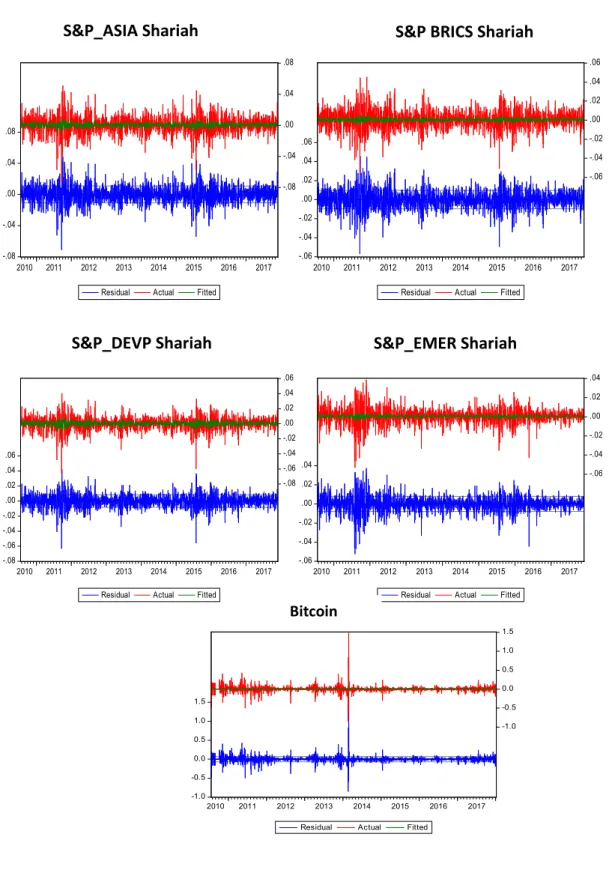
Figure 6. Normality Test of Shariah indices and Bitcoin……….………..………98
Figure 7. Q-Q plots of Index returns normally distributed………..99
Figure 8. Conditional variance of Component GARCH (1, 1)………..… 105
Figure 9. Smoothed Regimes Probabilities for Islamic indices ... ………..113
Figure 10. Smoothed Regime Probabilities for a restricted period ... 118
Figure 11. Evolution of Dow Jones sustainable and Islamic Indices returns from 2011 until 2018……..…146
Figure 12. Normality Test of Sustainable and Islamic indices……….147
Figure 13. Plots of sustainable and Islamic Indices returns………..148
Figure 14. Plot of cumulative sum of Recursive residuals……….155
Figure 15. Breintung and Candelon (2006):Frequency Domain Causality between Islamic and Sustainable indices...161
Figure 16. Frequency domain among VIX and Dow Jones variables (Breitung and Candelon, 2006)…....166
List of Graphs
Graph 1. Asset Growth of Islamic versus Conventional Banks. ... 26Graph 2. Who Invests in “Sukuks” ... 40
List of Tables
Table 1. France has the highest percentage of Muslim population amongst European countries ... 30Table 2. Descriptive statistics of the variables used to estimate the cost efficiency of Islamic banks in 2004 and 2017 ... ………60
Table 3. Average Productive Efficiency of Islamic Banks ... .61
Table 4. Evolution of average cost efficiency over the period 2004-2017 ... …...63
Table 5. Annual evolution of cost efficiency of Islamic banks operating in the GCC region……….…65
Table 6. Relationship between Efficiency Scores and the Internal and External Variables ... ……69
Table 7. Average Productive Efficiency of Islamic Banks ... …...72
Table 8. Spearman Correlation Order……….74
Table 9. Relationship between Efficiency Scores and Internal and External Variables………...75
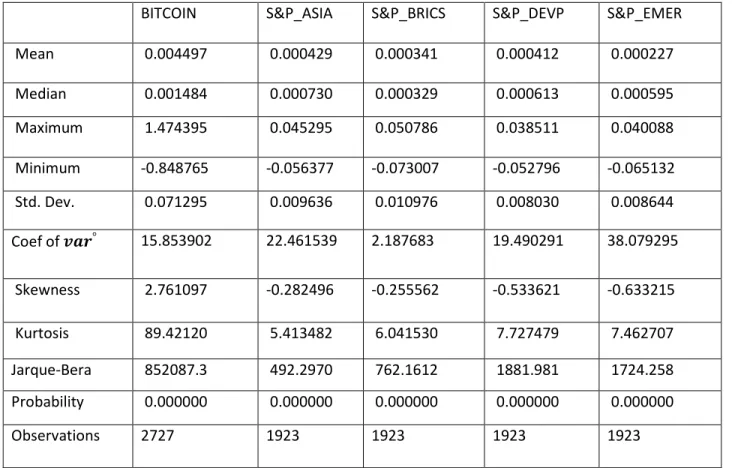
Table 10. Descriptive statistics of the returns of Bitcoin and Shariah indices………..………….95
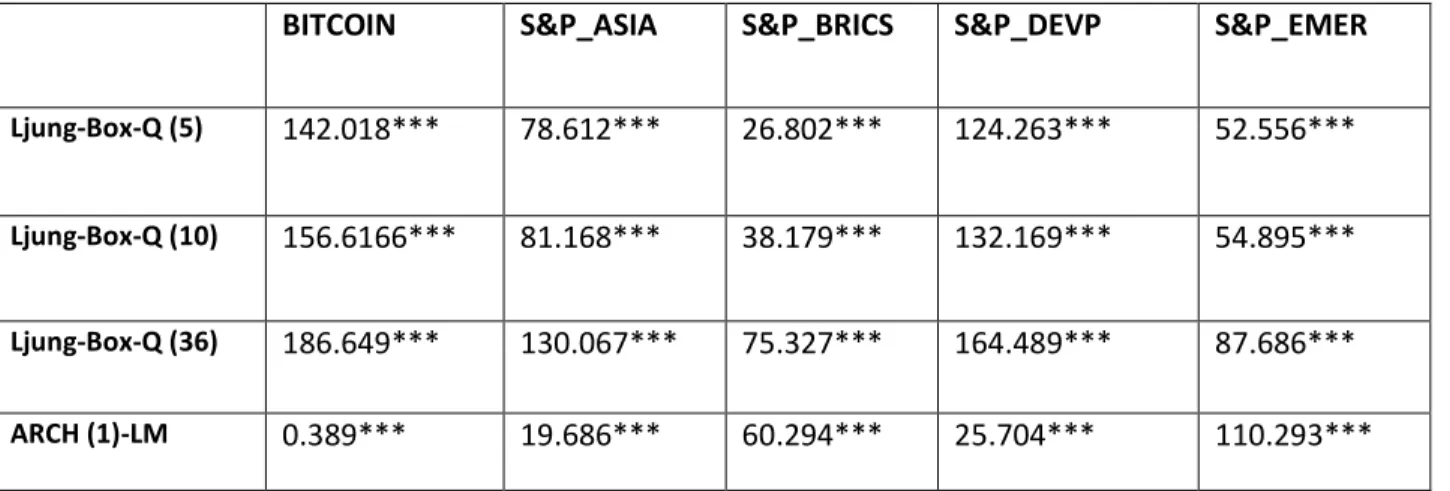
Table 11. Ljung-Box and ARCH-LM of Bitcoin and Shariah indices……….96
Table 12. The outputs of Component GARCH Model (1,1)……….…102
Table 13. Estimated parameters for each time series Shariah indices and Bitcoin……….…107
Table 14. The outputs of Garch (1,1) model………116
Table 15. The outputs of TGarch (1,1) model……….……116
Table 16. Descriptive statistics of the returns of Sustainable and Shariah indices……….….144
Table 17. Lag Length Selection……….……..….149
6
Table 19. Wald Test: Unrestricted intercept and no trend………..………157
Table 20. Frequency domain among Dow Jones variables (Breitung and Candelon, 2006)………..160
Table 21. Conditional causality among Dow Jones variables……….……..….165
Appendix
Appendix 1. Investment Policy Risks……….……..178Appendix 2. The Difference between Efficiency and Productivity………....179
Appendix 3. The Parametric Deterministic Approach………..……….……….181
Appendix 4. The Method of Maximum Likelihood and the Method of Correction by Moments…………..185
Appendix of Figures Figure 1. “Shariah” in Islam………..…….………174
Figure 2. The benefits of the PLS Principle on the economy………..175
Figure 3. Typology of Market Risks………...178
Figure 4. A Production Plan on the Entire Production……….180
Figure 5. Distinction between Productivity and Efficiency………...181
Figure 6. Data-Driven Algorithms………187
Figure 7. Pyramid representing investors needs during an investment………..………190
Figure 8. Four main principles about "Biblical stewardship"………..………..…….190
Figure 9. Four main principles in Christian Business Ethics……….….….………….191
Appendix of Graphs Graph 1. Islamic Finance Assets growth……….176
Graph 2. Money manager assets main distribution channels in Billions of Dollars……….………188
Graph 3. U.S. ESG Growth (at the start of year)………..188
Graph 4. Sustainable, Responsible and Impact Investing in the U.S (1995-2016)……….………..189
Graph 5. Pioneer Fund Class A Shares: 1928 – 6/30/17………..………..189
Appendix of tables Table 1. Balance sheet Growth in selected GCC Islamic Bank Markets………..177
Table 2. Muslim Population by Regions……….177
7
Acknowledgement
First of all, I would like to thank Allah Subhana w Ta’ala for giving me
the power, persistence, and motivation to work on my Phd for four
continuous years.
I would like to thank with all of my heart, my supervisor Professor Jamal
Bouoiyour for giving me the opportunity to attend the University of Pau
and be under the supervision of an expert such as himself. I thank him
for believing in my abilities and sharing his experience and
recommendations with me which have allowed me to improve and to
develop stronger research and academic skills. I would like also to thank
Dr. Refk Selmi for her continuous support and guidance while also
sharing her personal experiences with me which have helped me
through my Phd.
I would also like to thank the members of the Jury; professors: Alain
Alcouffe, Jean-Michel, Olivier Hueber, and Rosella Nicolini, for taking
the time to review my thesis and for their participation in my thesis
defense.
Finally, I’d like to thank my father and my mother and two sisters who
believed in me and never stopped supporting me and for making
sacrifices for me to attend the University of Pau and achieve my dream
of obtaining a Phd. I’d also like to thank my fiancé for being supportive
and for giving me the motivation to achieve my goals.
8
General introduction
Many financial crises show the opposite faces of the conventional financial system. In this context, in the 18th century, Bernard Mandeville (1714) highlights the evils of the capitalist-liberalism system that can hinder economic growth. In his book "The Fable of the Bees, private, public benefits", he focuses on the importance of the collective goods system.
In the past four decades, several consecutive crises known as the October crashes (The Black Tuesday (October 29), the Great Crash, October 1987 and October 2008) have attacked the conventional financial system. From the mentioned crashes, the 2008-2009 international financial crisis was the most severe. There was a severe collapse in the stock markets that were attacked by a "speculative bulimia". During 2007, the subprime crisis was transformed into a liquidity crisis which was reflected by the negative effects on the credit rate. This effect was known as the "credit crunch". Under those circumstances, many firms mainly small and medium ones started decreasing their investment which resulted in the shrinking of the international trade. Moreover, the general price level of primary materials increased which led to a decrease in the purchasing power of lower-middle classes from Haiti to Philippines. According to Murphy (2008), the total transactions in the swaps market reached around USD 55 trillion. Knowing that the supposed credit default swaps (CDS) in the United States was 4 times less than the amount reached. Simon (2008) argues that there was a lack of regulation and documentation concerning the pricing of these CDS as a big portion was dealt online or through the phone.
During the period between 2008 and 2009, the Euronext, Tokyo and New York Stock Exchanges were severely affected as there was a decrease from Euros 3,794 billion to 1,676 billion, from USD 4,158 billion to 2,563 billion and from USD 14,574 billion to 8,700 billion respectively. In addition to that, commercial banks were the most affected by the negative consequences. For instance, from December 2007 to March 2010, Natixis bank and Citi Bank
9
were affected due to the strong engagement in loan securitization as net inventories had decreased from Euros 29.8 billion to Euros 4.9 billion and from Euros 150 billion to Euros 13 billion respectively.
According to Monica and Tridico (2014), the negative impacts of the financial crisis show that when capital markets become inefficient, economic fluctuations can lead to an increase in public debt and can become an obstacle to economic growth. Many huge companies and States were attacked by the negative consequences of the crisis. For instance, Iceland was not able to manage its public debt and was menaced by a sovereign default.
The position of classical finance during and after the last international financial crisis has demonstrated the importance of values and ethical standards in the efficiency of the financial system. Accordingly, many global market participants and policy makers who considered the conventional system as dishonest and avaricious were increasingly paying attention to the potential of the alternative-complementary financing system including the ethical Islamic financing system. Equally important, the vulnerability, the information asymmetries and the volatility in the traditional financial markets can disrupt the financial system which can support the position of alternative investments. For instance, many German investors who took vulnerability into consideration; especially during the last international crisis, started diversifying portfolios by adding alternative products. According to Dymski and Kaltenbrunner (2014), European investors started searching for lending and payment systems which were less volatile than the traditional one that is characterized by consecutive crises. Nowadays, Western economies are impressed by the emergence of alternative channels away from the conventional markets. For instance, in 2016, more than USD 8.1 trillion was invested in socially responsible investment portfolios.
Concerning the importance of financial lending for small businesses, it has been proven that the financial funding for start-up enterprises can have positive effects on economic growth. At first glance, Joseph Schumpeter (1912) gives high importance to the financial system and especially the banking system in his research. Miguel De Cervantes said "Urgent necessity
10
prompts many to do things". During the international financial crisis, small and medium enterprises (SMEs) started suffering from global credit shortage. The vulnerability of the SMEs pressed conventional banks to adopt strict prudential rules in which they started losing their position as first external financiers. During the crisis, small enterprises were snowballing leverage which led to a contraction in banks' balance sheets. Accordingly, these severe constraints discourage the persistence and resilience of new projects which could not have enough tangible assets as guarantees. Moreover, as firms are indispensable to increase the level of employment, diversified funding options should be put to maintain its durable investments and to minimize as possible their market position. Thus, after many SMEs have battled to assure loans from traditional banks and credit unions, the financial landscape started changing for the benefit of alternative lenders. In 2015, alternative financing started expanding significantly to be one of the most supporting financing for SMEs by 2016. According to the Advocacy teams, these firms started suffering from global credit shortage. As an illustration, 80 percent of loan applications serving small businesses were dropped. This post-recession pressed small businesses to strive for funding support through new financing windows which benefit in return by filling the financial void. In the same context, it is important to note that over the past two decades, the global financial market has seen the emergence of new alternative financial industries such as the Islamic investment, the socially responsible investment and cryptocuurencies.
Nowadays, Islamic finance in general and Islamic banking in specific are considered as one of the fastest-growing industries of the international financial system especially after the 2008-2009 financial crisis. Recently, the Islamic financial market became a vital and flourishing market. Hence, many inter-governmental organizations such as the International Monetary Fund and the World Bank have been expanding efforts to reconstruct market performance by enhancing ethical basics. Moreover, in 2015, a Memorandum of Understanding (MoU) was signed by and between the World Bank and the General Council for Islamic Banks and Financial institutions to improve the level of awareness of Islamic products and to set up a solid and resilient system. As for the position of Islamic finance in the global financial system, two points of view exist. The first point of view considers Islamic finance as a substitute for conventional
11
finance. However, the second one classifies it as a complementary to the conventional finance system.
Nevertheless, according to Mohieldin et al. (2011), Islamic finance and mainly the Islamic banking system is essential to meet Muslim clients' demand who refuse illegal services such as interest. This means that the simple existence of Islamic finance can help increase the saving rate which can guide economic growth. In this context, Miller and Modigliani (1958) assert that ethical alternative banking could be less risky and thus it is preferable in terms of economic growth. This crisis of confidence in conventional banks is a devastating crisis. By contrast, according to Chapra (2008), Islamic financial institutions are less affected by financial crises than conventional institutions. The case of Islamic banks is pretty different. In general, Islamic banks are more protected by their Islamic standards mainly by the prohibition of leverage and speculative transactions. To begin, being based on Profit Sharing Principle (PLS) has many benefits in the financial strategies. First, the partnership principle can build an efficient risk management strategy and can lead to the selection of strong project. According to Chapra (2008:12-16), the Profit Sharing Principle (PLS) is related to the real economy which can limit the speculative behavior and thus lead to efficient resource management. Second, the partnership principle permits the funding of small and medium enterprises (SMEs) and to reduce exceptional expenses and poverty. (See Appendix Figure 2) In this context, Iqbal and Molyneux (2005) present the innovative role of Islamic banks in SMEs financing, in risk management and diversification between creditor and entrepreneur. The effective regulation and supervision in Islamic banks can have positive effects on economic stability by reducing the problem of "moral hazard". Third, there is a limitation to the real sector. According to Islamic business law, asset-backed financing has to be certified. Conventional securitization (akin to sales of debts) is forbidden in Islam. Accordingly, debt markets, accused of failing, are excluded from Islamic services. Thus, Islamic transactions depend on the real economy thereby savings will be invested in well-productive sectors. Fourth, the prohibition of speculation under Islamic standards is a fundamental stone to reduce the negative effects. The requirement of an asset possession prevents "short-selling". For instance, many believed that the Islamic contract "Murabaha” (see section 2, chapter one) is similar to the conventional mortgage contract.
12
However, there is a difference between the two contracts. The conventional mortgage contract has high speculative and leverage effects compared to the Islamic mortgage. In addition, in the case of conventional mortgage, the client will purchase the asset and will be the only one responsible for the price fluctuations. Nevertheless, in the case of "Murabaha", there is risk-sharing between the bank and the creditor. Another important criterion of Islamic banks that can hold subprime effects down is the restricted debt ratio as it is not allowed to finance heavily indebted projects. In Islamic banks, household debt ratio is approximately 33 percent compared to 120 percent in American Conventional banks. To conclude, Islamic banks were relatively more resilient to the last international financial crisis than conventional banks which can reflect their solidity.
Therefore, many Western countries especially in North Africa, USA and UK were incented to develop their Islamic financial services. In October 2008, Pope Benedict XVI argued: "Only the
Word of God is the foundation of all reality". The Vatican, in 2009, put in evidence on how the
impacts of the crisis led to a crisis of confidence in the financial system. The liquidity problems were a direct cause to extend Islamic financial services. As an alternative to the conventional financial system, an ethical Islamic system can support and reconstruct the reputation of the conventional system during crises. To put it differently, under the Islamic system, there is a maximal trust level and tendency to maintain a climate of confidence within their households. Thus, Islamic fundamentals will not only stimulate clients but also bring clients closer to their bank. In this sense, the Observatory Romano assumed: “Western banks could use tools such as
the Islamic bonds, known as Sukuks, as collateral1”.
The existence of strong and adaptive legal laws coordinated to a developed financial sector is essential. In this sense Imam et al. (2015) discovers that, since the principles of financial institutions are based on an old legal structure, they can have a positive effect on the economy. One of these radical principles is social justice (Al ‛Adâla Al Ijtimâ‛iyya). Likewise, the "Hadith" of the Prophet represent another source of legislation. The "Hadith" include the
1Collateral: it can be assets, securities or liquidities used as guaranties to reduce credit risk resulting
13
words, actions, practices, and approvals of Prophet “Mohammed” (SAW). The "Hadith" are divided into several types according to the mode of transmission, the number of rapporteurs and the authenticity of the "Hadith". These sources highlight the conditions that transactions in Islamic finance must undergo. These transactions must be of the same purpose, and of the same kind with the backing of any transaction to a tangible asset.
In addition, the foundations of Islamic finance such as the prohibition of usury and the sale of debt have proven that the mere existence of these banks has made it possible to relatively protect this finance from the effects of the last financial crisis. However, Islamic finance is not immune to crises. For example, the "Dubai World" crisis is the result of a remarkable crisis in the “Sukuk” market. But in general, we can say, from an Islamic point of view, that the main cause of this crisis is the lack of a social environment capable of dealing with the economic ills that Islam tends to combat. Overall, Islamic finance helps reduce poverty and unemployment rate. Theoretically, the principle on which the Islamic banking system is based is the minimization of the evils which oppose not only economic but also social Islamic norms within a community such as poverty, socioeconomic injustice, distribution fairness of wealth.
As Islamic Finance is generally based on the principle of ethics, we can say that it also supports sustainable economic activity and seeks economic prosperity. Socially Responsible Investing (SRI) which is described as “ethical”, “green” or “sustainable” investing is established on a similar principal which is based on the principle of ESG investments. Sustainable development is defined as the development of human objectives through natural means and is considered as a common factor between SRI and Islamic investment. According to Hirigoyen (1993), Islamic finance is considered as a popular form of SRI and was founded on religious principles that are based on considering ethical and responsible investment decisions.
The Muslim community shares widespread belief on the role of humanity to act responsibly and sustainable and thus express it through their faith-based values in their investments. The Islamic finance industry has been able to expand at a rate of 17 percent since
14
the last financial crisis. Generally, the Islamic finance sector started as a faith-based initiative which is self-regulated and enforced. However, most recently, governments and monetary authorities have begun to regulate the Islamic finance sector. Even though there is a mutual concern for responsible business.
In general, investors are interested in only profits. However, some investors favor other criteria such as ethical, social, or environmental factors for their investments. Those who choose this route follow the social responsible investment (SRI) path which plays a key role in “the stability of the economy”. Those who favor SRI usually oppose the views of Milton Friedman who states that “the social responsibility of companies is to generate profits and that modern companies have no responsibility towards the public and its only responsibility is to provide income to the owner”2. He mentions that “the role of the company leader is to earn money and to meet or beat the benchmark.”
Thus, Islamic finance, through the sector filtering it imposes, represents an interesting socially responsible investment option. Sustainable investments are considered a derivative of SRI investments and can serve as a platform for Islamic finance to grow on. It is considered that through sustainable development, the objectives of SRI and Islamic finance are converged. However Islamic finance has access to large amounts of SRI funding from global markets. The connectivity between Islamic finance and SRI is being realized in certain markets with momentum. It is thus deemed crucial that “practitioners of Islamic finance” realize the opportunities available in the SRI market. In addition to meeting the requirements of SRI, ethics can serve as a pre-requisite for efficient performance of financial markets. This would result in higher yields in ethical funds. (De Serres, 2007, Burlacu et al, 2004). Thus, for so many policymakers, this diversity in the investors’ portfolio can be a chance to invest responsibly or simply seeking financial performance. (Beal et al., 2005).
The common values between SRI and Islamic finance can be grouped together to allow Islamic finance to garner access to the large availability of SRI funds globally. For instance,
2
15
Malaysia’s SRI Sukuk framework can be commissioned through the stronger interconnection between SRI and Islamic finance. An estimated amount of USD 3.4 trillion is expected to be invested in this ESG index from around the world.
As a part of the alternative financial tools, the digital world and virtual currencies start to conquer the world in the last decade. Created in January 2009, by an enigmatic computer programmer, “Satoshi Nakamoto”, many virtual currencies like Bitcoin are strongly interested to be a part of the services portfolio of the Islamic Financial system. Following the 2008-2009 financial crisis, regulatory framework was enhanced by the implementation of stricter capital requirements which led consumers to seek alternatives to conventional banks. Despite the increased popularity of Bitcoin and Islamic finance, the literature about this topic is still very scarce. After the emergence of Bitcoin in the recent years, many questions were revolved by researchers to understand the nature and characteristics of this digital currency. Many economists like Reboredo (2013b) evaluate the importance of digital currency for the minimization of risks in investors’ portfolios. Knowing that, the diversification is crucial by allowing traders and investors to benefit from desirable returns by reducing the maximum risks in a portfolio. Many other researchers like Bouoiyour and Selmi (2015), Briere et al. (2015) pose a dilemma if the Bitcoin is a speculative currency, a safe haven or can be considered as a future currency. Bouoiyour and Selmi (2015), by using daily data from 2010 until 2014, do a research on "the complex phenomenon of Bitcoin". By using an "ARDL Bounds Testing method", they reveal that Bitcoin is a very volatile currency with long-term uncertainty. In addition to that, they conclude that Bitcoin cannot be considered as a safe haven. This analysis can be concluded after studying the relationship existing between Bitcoin and Shanghai stock market which is the biggest simulator of the Bitcoin price. The results show that on the short term, there is an existence of a positive and significant relationship between the Shanghai market index and the bitcoin price. However, due to the limitless of the ARDL test, it was not possible by the researchers to detect the relation on the long-term. Bouri et al. (2016) analyze the potential of Bitcoin as a diversifier. The results of this study through the use of "dynamic conditional correlations method" show that Bitcoin may be classified as a diversifier for many stock indices such as bonds, oil and USD.
16
Bariviera et al. (2017) specify the informational efficiency of the Bitcoin market and to determine the main characteristics of Bitcoin and indicate that the volatility clustering is a key feature of the Bitcoin market. Selmi et al. (2018) performed a nonlinear data analysis technique called the multifractal detrended fluctuation analysis to investigate the time-varying efficiency of this market. They showed that Bitcoin is characterized by a persistent long memory process in its short- term components, which could be attributed by its excessive volatility and speculation. Understanding the Bitcoin from Islamic angle was so interesting not only for Muslim investors but also for policymakers.
The thesis is divided into four chapters. In the first chapter, we illustrate the history and the expansion of Islamic finance worldwide. We show the growth in terms of Islamic finance in Muslim countries and non-Muslim countries as well. We also mention the main transactions applied by Islamic financial institutions and which are based on the Islamic law “Shariah”. We mention accordingly in a simplified manner the prohibited items in Islam.
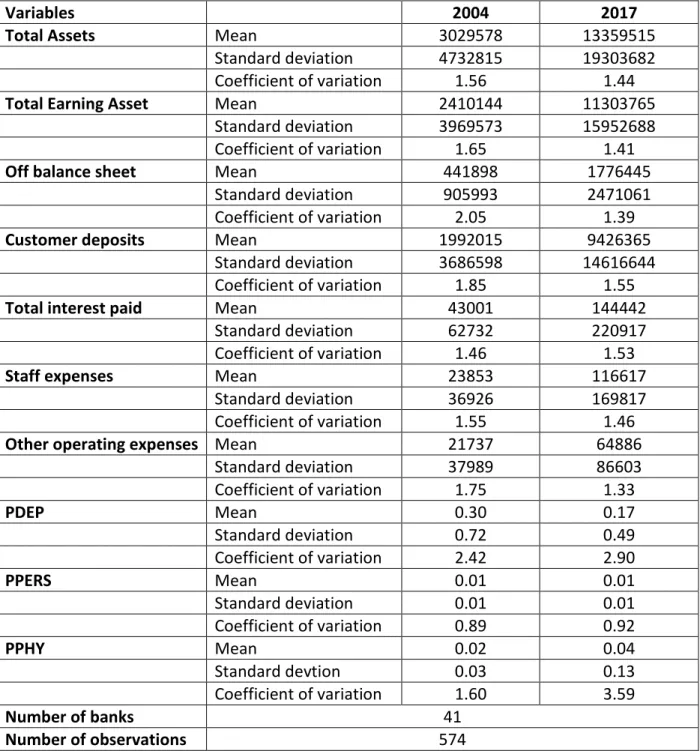
In the second chapter, we study the efficiency of 41 pure Islamic banks operating in in 5 GCC countries for the period 2004 and 2017. We cover the period before and after the international financial crisis. We estimate the cost efficiency of our banks by considering three inputs and three outputs. We rely on two orientations which differentiate in terms of constraints: input orientation and output orientation in order to study the production efficiency which is calculated by the production function based only on the quantities of used input factors and the profits of the outputs provided. This approach is explained by the ability to avoid wasting resources by producing as much outputs as the use of input allows, or vice versa (using as much little inputs as the level of output requires). In order to do this, we rely on the cost stochastic frontier and data envelopment method. Battese and Coelli (1995) proposed a stochastic production frontier which can calculate the efficiency scores of production units by integrating directly in the estimating function and specific macro variables that may influence the efficiency. The second method is the data envelopment method which uses linear programming techniques. Data envelopment analysis was introduced by Charnes, Cooper and Rhodes (1978) in order to generalize the traditional measure of productivity of an input and an
17
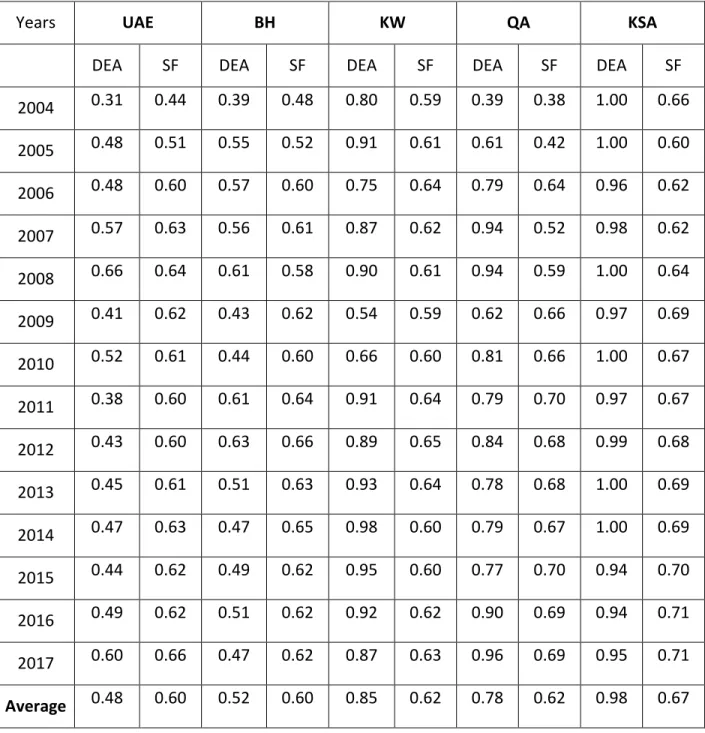
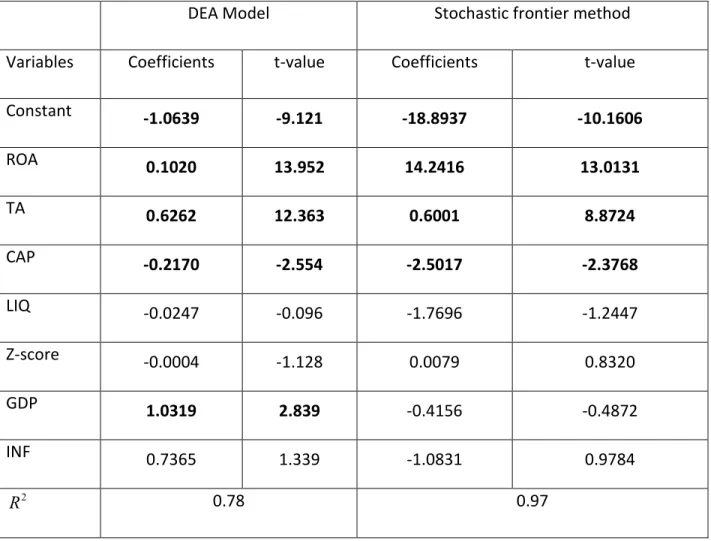
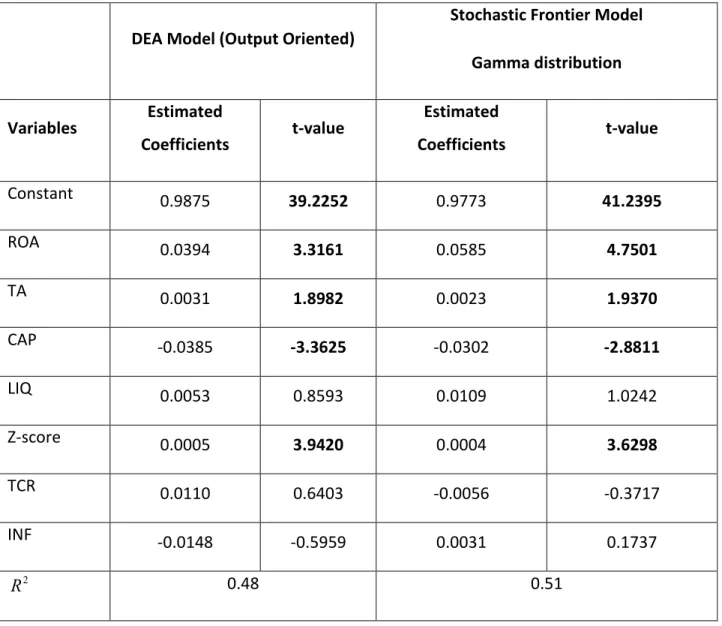
output as a measure of technical efficiency. From our results, we see that the Islamic banks operating in the GCC region do not operate on the efficient cost frontier maybe due to managerial inefficiency and misuse of production factors. The dispersion of cost efficiency although is important. Our results are therefore in the low range of average efficiency scores observed by the empirical studies (e.g. Zuhroh et al., 2015, Tahir and Haron, 2010). Regarding the historical evolution of cost efficiency, we observe an increase over the period 2004-2017: 38.5 percent according to stochastic frontier and 24.7 percent according to DEA method. To test the stability of our results, we propose to modify the distribution of the inefficiency by assuming that the error component representing the inefficiency follows a gamma distribution. Greene (1980, 2005) and Stevenson (1980). While the distribution of efficiency scores varies according to the definition of the adopted measure, the ranking of banks remains relatively stable. The use of the output-oriented DEA model and the Gamma distribution do not change the obtained results significantly. In this context, the results showed that the efficiency scores could not be explained solely by financial ratios, as they are related to external factors corresponding to the X-inefficiency and economic environment.
In the third chapter, we study the characteristics of Bitcoin as a virtual currency versus four Islamic indices. We rely on Garch family models to detect the level and the persistence of volatility during the period 2010 until 2018. We also rely on the Markov switching model to study the duration of persistence of the indices during low risk regime and high risk regime. The rises of virtual currencies have also significantly touched the Islamic world. This study circles around exploring how and to what extent Islamic fund investors can benefit from diversifying their investments in virtual currencies such as Bitcoin. Some studies indicated that regardless of the volatile and speculative behaviors of Bitcoin, the latter possesses hedging and safe haven properties and can be incorporated in a portfolio to curtail the adverse consequences of rising uncertainty surrounding unforeseen shocks/events. From our results, we notice that Islamic indices and Bitcoin are not immune to financial shocks. However, the volatility persistence of Bitcoin is more important than the case of Islamic stock market. We can say that the duration of persistence for Bitcoin is on the short and long terms. In addition, we confirm the role of Bitcoin as a hedge during normal moments and as a safe haven during moment of anxiety. We
18
also conclude the existence of an asymmetric distribution of returns for all the indices under study. However, it is important to take their respective market characteristics (in particular, their volatile behaviors) into account. It must be stressed the measurement of volatility is widely viewed as a “tool” to determine the level of risk in the financial market.
In the fourth chapter, we study the interaction between three Islamic indices versus their sustainable counterparts. We apply the autoregressive distributed lag model to see the existence of the short-run and long-run relationship between the indices. In the second step, we use the Domain frequency causality which was refined by Geweke (1982) and implemented by Breitung and Candelon (2006) to study the dynamic causality and its directness between each Islamic index and its counterpart. Our study is beneficial mainly for investors who are concerned with many non-financial factors such as religious belief, sustainability, the well-being of society, which consider environmental issues, corporate governance and ethical factors. Our results show the existence of a long-run equilibrium and the position of the stock markets as complements mainly on the short term and substitutes on the long-term. The “frequency-by-frequency” causality outputs show the existence of a causal relationship on the Short-term between the three sustainable stock market and their Islamic counterparts. These findings show the ability to diversify is an additional opportunity without losing in profits.
19
First Chapter: Development of Islamic Banks:
Evolution and Characteristics
20
1.
The appearance of Islamic Finance and its spread in the world
1.1. Birth and evolution of Islamic banks
The principles of Islamic finance are historically more than 1,400 years old but began to be noticed in the 1940s; thanks to "Sayyid Abu Al Ala Maududi" in Pakistan.
In 1963, Islamic finance began to be exported to the Arab countries with the birth of the first Islamic bank "Mit Ghamr" which was sponsored by Dr. Ahmed Al Najjar in Egypt. It was the first of its kind in the MENA region. In order to revive industrialization in rural areas of Egypt, the social savings bank "Nasser Social Bank" was introduced in 1971. It appeared to respond to the need to reduce the level of poverty and unemployment in the country. To achieve the bank`s goals, the Egyptian government has donated USD 2 million to the bank.
After that, the 1973 oil boom and the decolonization of the Arab countries were important cyclical reasons for the expansion of the Islamic banks. Indeed, in 1975, several Islamic banks emerged such as the "Dubai Islamic Bank", "Kuwait Finance House", "Bahrain Islamic Bank" and the "Faisal Islamic Bank" in Khartoum.
In the 1980`s, the market witnessed strong growth due to continued demand for Islamic financial products. The market for Islamic financial products has attracted the attention of several Western commercial banks, which have begun to offer financial services through its Islamic windows for high net worth clients.
Since the 1990s, efforts have intensified to control and regulate the operation of Islamic banks according to the “Shariah” law. Therefore the following have emerged; the Accounting and Auditing Organization for Islamic Financial Institutions (AAOIF), the General Council for Islamic Banks and Financial Institutions (CIBAFI), the Islamic International Rating Agency (IIRA), the International Islamic Center for Reconciliation and Arbitration (IICRA), the Islamic Financial Standards Board (IFSB); and the Malaysia Accounting Standards Board (MASB).
At the micro level, "Shariah" products must be submitted to the “Shariah” Supervisory Board (SSB). The main missions of the" “Shariah” Board" are:
21
- Putrefying and analyzing “Shariah” products of financial institutions including legal documentation and characteristics
- Advising Islamic financial institutions while drawing up contracts in order to be submitted to Islamic commercial law
- Detecting the existence of illicit returns on investment (ROI). Islamic banks must structure specific accounts to mask illicit activities. Hence, these returns are considered charitable donations and must be allocated to help people in need
- Auditing of Islamic financial operations
- Issuing an annual report on Islamic banks operations and performance.
At the macroeconomic level, the main regulatory institutions are in Bahrain and Malaysia. Accounting and Auditing Organization for Islamic Financial Institutions (AAOIF) AAOIF is an Islamic international independent "non-for-profit" organization. In 1990, AAOIF was created in Bahrain. This Islamic financial institution has standards which are particularly applied in the Gulf region. The issued standards of AAOIF are as follow:
Figure 1. The main standards of AAOIF
22
In the last two decades, the Islamic finance sector has grown by 7.59 percent in “Shariah” asset growth globally in 2018. Total global assets growth in 2017 was significantly less at around 4.74 percent. This expansion in assets was not only in Islamic countries such as in countries such as countries in the GCC, Iran but also in non-Islamic western countries such as USA, Australia and others in which growth reached 20.2 percent in 2018 and in Asia by 16.3 percent while in Africa it was around 12.6 percent. Even though strong growth was witnessed in 2018. An increase in small financial Islamic financial institutions was also witnessed. According to the Global Finance report in 2017, it can be analyzed from the report that an increase in the rate of Islamic financial assets from 2007 until 2016 occurred especially after the latest recession. It is shown that in 2008, an increase occurred which is equivalent to USD 822 billion and grew to a total of USD 1139 billion in 2010. It continued to increase to USD 1631 billion in 2012, then, it reached USD 1981 billion in 2014. In 2015, it reached USD 2143 billion and in 2016 it rose to USD 2293 billion.By 2023, the Islamic finance market is projected to reach USD 3.8 trillion as reported by the Thomson Reuters Islamic Finance Development Report 2018 through the “Shariah-compliant” organizations which are estimated to be 1400 institutions worldwide. It is projected that this trend will continue to increase to about USD 5 trillion in the coming years.3 As of March 2020, the issuance of “Sukuks” amounted to approximately USD 180 billion. This amount was mainly contributed to from the GCC and Malaysia. Saudi Arabia was the country that had the largest market share in the Islamic banking market. According to the IFSI stability report in 2018 on the distribution of Islamic financial assets by sector in 2017, it is shown that the highest increase is led by Islamic banking which accounts for 76 percent followed by “Sukuks” at 19.5 percent, Islamic funds at 3.3 percent, and “Takaful” at 1.3 percent. The level of systematic importance of Islamic Banking is led by Iran then Sudan in Africa. Then, they are followed by the GCC which is led by Saudi Arabia followed by Kuwait and Qatar respectively. In Asia, Malaysia is in first place followed by Indonesia. In the MENA region, Jordan and Turkey are ranked at the top. The share percentages for each country is led by Iran at 34.4
3
The sources which the data was retrieved from differ and is based on specific standards to measure the rate of growth on assets and to measure the size of Islamic assets worldwide.
23
percent, followed by Saudi Arabia at 20.4 percent, then the UAE at 9.3 percent, and Malaysia at 9.1 percent.
1.1.1. Islamic Finance in Muslim countries
Most Islamic banking assets have recently been centralized in the Gulf region as well as in Southeast Asia. Iran, Saudi Arabia and Malaysia have the largest number of Islamic financial assets.
Iran is the country that was leading the sector in terms of shares with a share of 28.6 percent of the global Islamic assets. The total “Shariah” assets reached in 2018 around USD 575 billion. This country has the largest Islamic financial institution. Iran abided to “Shiite” Islamic law in 1983 which had two convergent phases. The first phase in which the Islamic banking system had remarkable success and the second phase in which growth began to slow down. This slowdown is due in principle to the disruption of the political situation in the country and economic sanctions such as the Iran-Iraq war, etc.).
Source: IFSB Financial Stability Report 2015, KFHR, IMF
24
Saudi Arabia comes in second place with 25 percent of the total Islamic assets. It has the most prominent bank being: The National Commercial Bank (NCB), which is considered the largest bank in the Arab world and the second largest in the world. It exercises not only the principles of "Shariah" (two-thirds of the total assets) but also other conventional transactions. This bank issued shares equivalent to euros 4.7 trillion in 2014 and made more than USD 2 trillion in profits in the same year. In this context, the Islamic Development Bank (IDB), founded in 1975 in Saudi Arabia, is also considered an intergovernmental Islamic bank. The main objective of the "IDB" is to increase social welfare and to reduce poverty in a society. Moreover, the intention of the country to open with an amount of USD 590 billion to the global stock market in the coming years which can stimulate investment in the Islamic financial sector.
In third place comes Malaysia with of 23 percent of the share of Islamic financial products. Although Malaysia is a Muslim country, half of the clients in Islamic banks in the country are non-Muslims. Malaysia has experienced significant growth and began to develop gradually since 2000s in terms of expertise and financial innovation at the national and global levels and in particular at the level of the Islamic financial system, In terms of Islamic finance assets, Malaysia is the second market with an amount of USD 491 billion.
Indonesia comes in fourth place. In the Islamic financial sector since it started in 1991 in Jakarta. In the same year, the first Islamic bank was founded and is known today by the name of "Muamalat Indonesia". Later, in the 2000s and in response to the appetite of the Muslim clientele, large Islamic banks such as the "Representative House of Indonesia" were established. Consequently, a massive transfer from conventional banks to Islamic banks followed; as a result the number of rural Islamic banks increased from 105 in 2006 to 146 in July 2010. Recently, there are more than 1,640 Islamic banking branches in the country.
25
1.1.2. Islamic Banks in the GCC4 Countries
According to the rating agency Standard & Poor's (S&P), projections show that the share of the Islamic banking sector in the Gulf countries and that of the conventional banking sector within five years have a percentage of 30 percent and 25 percent respectively. This means that the share of Islamic banks exceeds that of traditional banks in this region. Note that by the end of 2015, assets in these countries reached round USD 2 trillion compared to USD 1.7 trillion in 2013.
The Islamic transactions expanded by about 5 percent in 2017 compared with about 2 percent the previous year, according to estimations (see Graph 1 below), with strong support from the “Sukuks" market. Between 2018 and 2019, it was expected that growth will converge with that of conventional banks, but that Islamic banks will continue to expand at a marginally faster rate. The volume of "Sukuks" issuance increased in 2017 thanks to jumbo issuances by some GCC countries. It is also important to note that "Sukuks" can play a significant role in economic growth. Echachabi et al. (2016) showed that between 2005 and 2012, "Sukuks" issuance had a positive effect on economic growth in certain Muslim countries and non-Muslim countries as well. That can be explained by the invasion of Islamic finance the main Tiger Cub5 Economies which do not highly rely on petroleum products. Knowing that, the covered period was characterized by consecutive bubbles and perturbations. After the oil shock in 2014, there was a mild economic recovery in the GCC. The growth in customer deposits recovered slightly in 2017. This was the result of stabilized oil prices and the channeling of higher public-sector deposits to the banking systems. Islamic banks tend to attract retail depositors due to their “Shariah-compliant” nature.
4 The GCC is composed of Saudi Arabia, Bahrain, Oman, Qatar, the United Arab Emirates and Kuwait.
Yemen is considered as an observer rather than a member.
5
“Tiger Cub Economies collectively refer to the economies of the developing countries of Indonesia, Malaysia, the Philippines, Thailand and Vietnam, the five dominant countries in Southeast Asia”. Wikipedia (2020).
26
There is an expectation that the Islamic banks' financing growth will reach 4 percent-5 percent, supported by strategic initiatives such as:
- The Dubai Expo 2020 - Saudi Vision 2030
- The World Cup 2020 in Qatar
- Higher government spending in Kuwait led by Kuwait 2035 Vision, the country's national development plan.
Graph 1. Asset Growth of Islamic versus Conventional Banks.
Source: S&P Global Ratings (2018), banks’ financial statements. GCC-Gulf Cooperation Council.
27
A surge in geopolitical risk and ensuing delays of some of these initiatives could negatively affect the base-case scenario. According to an analysis made by the research team of "S&P", the GCC economies are heavily dependent on oil prices. The other challenge is falling oil prices which negatively affect the income and wealth of a population and therefore create a liquidity risk. To remedy this, a balance should be struck between the exposure of conventional and Islamic banks to less politically sensitive infrastructure projects.
Moreover, the three key risks that we foresee for GCC Islamic banks are regional geopolitical tensions, higher cost of risk, and lower profitability. The end of the triple-digit-oil-price era has significantly slowed GCC economies and reduced growth opportunities for their banking systems.
1.1.3. The evolution of Islamic finance in the non-Muslim world
In the early 1980s, Islamic finance began to be exported to non-Muslim countries in Africa such as Senegal and Niger as well as to European countries such as Luxembourg and the United Kingdom. In 1978, the first Islamic bank in Europe appeared in Luxembourg. The Islamic banking system (later replaced by "Islamic Finance House Universal Holdings") was mainly concerned with buying transactions and in particular the exchange of shares with European and global companies. At the beginning of the twenty-first century, several Islamic banks began to spread more and more in the Western world. GIDE which is considered as French association of international lawyers has experimented in 2015 Islamic financing whereby it researched in cooperation the BEMO to issue the first “Ijara Sukuks” (see section 2) which is based on the renting of vehicles owned by Saudi Arabia. Starting from 2003, GIDE also increased its efforts in other sectors such as real estate where a growth of 6 billion euros resulted. These efforts were for the benefit of several banks such as Morgan Stanley, Citi Group, Société General, etc.
1.1.3.1. The United Kingdom
According to the "Lane Clark & Peacock" (LCP) company which is concerned with the immobilization and the granting of the credits the United Kingdom has approximately 10,000 millionaires. The Muslim population, which accounts for 50,000 customers for its “Shariah”
28
products, is considered as the pioneer not only in European countries but also the Western world. Its Islamic financial sector was worth around £ 2.3 billion in 2014. In 2017, the total assets of UK-based institutions that offer Islamic finance services amounted to USD 6 billion and composed of 6 Islamic banks6 and 20 commercial banks offering Islamic financial instruments7 withan amount of USD 700 million accounts for the total net assets of Islamic funds in the UK.
The Islamic financial market of the UK is very advanced and is considered a key market for foreign “Shariah-compliant” institutions. Islamic Financing was first started in the 1980`s whereby the London Metal Exchange offered overnight deposit facilities that were established on the "Murabahah" principle. Shortly afterwards mortgage finance based on the "Ijarah" principle was offered (see section 2). London is considered a major financial center offering Islamic products through large traditional Middle Eastern banks. In the UK, the Financial Services Authority has turned to implementing standards that are in compliance with Islamic financial products. In addition to this, the UK legislation also considered the subject of taxation on Islamic transactions.
The first corporate ‘Sukuks” was launched in 2005 through the launching of the Sanctuary Building “Sukuks” which was the first in the UK and in Europe.
The British government introduced measures on the legislative framework for investment bonds or “Sukuks” that are similarly structured to conventional debt instruments. The UK has implemented an extensive range of regulations and policy that support the Islamic finance sector and that are intended to expand the market of Islamic finance services. This led
6The Islamic Bank of Britain (IBB) in 2004
European Islamic Investment Bank (EIIB) 2005
The Bank of London and the Middle East (BLME) in 2007
Qatar Islamic Bank UK (QIBUK) (European Finance Hose) in 2008 Gatehouse Bank in 2008
Abu Dhabi Islamic Bank UK (ADIB-UK) in 2013
7
In addition to pure Islamic banks in the UK, there are also Islamic windows in a number of commercial banks that aim to meet the requirements of the clients that comply with the principles of Islamic law. This includes Citi Bank, HSBC, UBS, and PNB Paribas.
29
to the reduction of legal costs and removed obstacles that would affect their issuance. The UK Government also established an Islamic Finance Task Force in 2013 to further regulate the sector. In addition to that it has strong legal expertise for the sector with around 25 law firms specialized in Islamic Finance in matters related to transactions, regulations, compliance, tax, management, and operations. The UK banking sector is regulated by the Bank of England and the Financial Services Authority (FSA). Due to the growing demand for Islamic Finance by ethnic minorities, they have enabled fiscal and regulatory framework to allow Islamic Finance to compete with conventional financial products. The regulatory framework included abolishing the double taxation regime which was associated with a double stamp duty which was applicable when the bank purchased the house and second once the house is bought by the client from the bank. This strengthened demand for Islamic Financing in the UK. They also abolished capital gains tax and stamp duties on land, reformed arrangements for bonds so that returns and income and considered in a matter similar to interest. The FSA also ensures that Islamic Finance is consistent with its objective and principles.
1.1.3.2. France
Through a study that was conducted by the Pure Research Center about the demographic evolution of Muslims in France, in 2020 the number of Muslim inhabitants reached a percentage of 8.3 percent from the total population. It is projected that this number will grow in the next three decades to reach to approximately 7.5 million inhabitants by 2050 which would be equivalent to about 11 percent of the total population. Most of the Muslims which are present in France are from North African origin (Algerian, Tunisian, and Moroccan). They are spread across three generations; the immigrants, the first generation, and the second generation8.The Islamic religion is distinguished by its demographic growth which has grown at a more rapid pace than other religions. This is attributed to several reasons which include marriage to relatives, high fertility rates, and continuous immigration. It should also be noted that most Muslims prefer to live within proximity of each other which allows them to migrate
8
The term second generation refers to the first generation person who was born in France who have evolved after the year 1980. The term second generation is used to prevent the classification of the person as a new immigrant amongst the general society.
30
easily. France is considered behind in comparison to its neighbors in terms of Islamic finance. Currently, the activity of this market is limited to the real estate sector.
Years Number Percentage of the population
2010 4,710,000 7.5 percent 2020 5,430,000 8.3 percent Projection 2030 6,100,000 9.1 percent 2040 6,750,000 9.9 percent 2050 7,540,000 10.9 percent
But following a recent survey by the World Bank, in 2016, 55 percent of the Muslim population was interested in taking loans that respect the ethics of Islam. The good development of this sector pushed the Minister of Economy and Finance "Christine Lagarde" to declare in July 2, 2008 the need to make Paris a major center of Islamic finance. According to her "Islamic finance can in principle become a factor of financial stability because risk-sharing
reduces the debt ratio and trade is backed by tangible assets that are fully guaranteed." After
this declaration, there were several essential tax instructions to facilitate the entry of the capital coming from the Gulf countries to enter later in competition in particular with London. This has been proven by the General Directorate of Public Finance which began in July 2010 to step up efforts to increase the role of Islamic financial transactions within the French economy.
The French authorities have played an important role the development of Islamic Finance who has established an environment to all for growth of the sector. The Paris Euro
Source: Author's structure, Pew Research Center
Table 1. France has the highest percentage of Muslim population amongst European countries
31
place established the Islamic Finance Commission in December 2007 to promote the market and since then the French financial market regulator, the "Autorité des marchés financiers" (AMF), began to allow ‘Sukuks” listings and “Shariah-compliant” investment funds. In addition to that, the Paris Stock Exchange has allowed parity of tax treatment with conventional financial instruments for “Murabaha”, “Sukuks”, “Ijarah”, and” Istisna'a” in July 2008. In this manner, “Sukuks” was officially listed and regulated on the French market and compensation which was paid by “Sukuks” was treated in the same manner as interest on conventional bonds. Non-residents investing in “Sukuks” were also exempt from withholding taxes in France regardless of whether it was governed by French law or another country. In July 2010, amendments were made by the French government for the facilitation of “Sukuks” issuances. The amendments were mainly related to the abolishment of double stamp duties and capital gain taxes on property. In June 2011, the first Islamic deposit scheme was introduced in France through existing conventional banks. Further on, a home financing product and 10-year “Murabahah” contracts were introduced. The demand for “Shariah-compliant” home financing was in high demand for retail clients and it is envisioned that similar tools will be launched for small and medium-sized enterprises. Other financial instruments such as "Mucharakah" and "Mudarabah" are expected to be issued in the near future by the French tax authorities. Presently there are a total of six “Shariah-compliant” funds with a total of USD 147.2 million in total assets under management. These are split between money markets and equity assets at percentages of 47 percent and 53 percent respectively.
Further growth of Islamic finance in the French market is expected to develop further as trade between neighboring Muslim countries such as Morocco, Algeria, and Tunisia. It should be noted that a large proportion of the French population originates from the above-mentioned countries which has led to the strengthening of demand for Islamic Finance in France.
1.1.3.3. United States
As its Muslim population gradually grows to reach around 3.5 million Muslims by the end of 2017, the United States is experiencing significant growth in Islamic finance services. Among the most famous banks in the country, the "Riba Bank of the American Finance House"
32
which had been authorized to spread in 13 states. This bank has experienced diversity in its financial services and financing in the real estate sector, the medical sector, the automotive sector, as well as in the financing of SMEs. However, the Islamic financial assets in USA are still limited to around USD 4 billion9 in 2019. The reasons for growth of Islamic finance in non-Muslim countries and particularly in North America and Europe, is to meet the demand of Muslim clients who respect the principles of “Shariah” law. This is accomplished by setting up "Islamic windows" in some banks such as "Citibank, HSBC, UBS, and BNP Paribas". Similarly, many other Western countries are interested in such banks because they have good transparency and financial regulations in comparison to conventional banks.The market size of Islamic finance grew in the US with relation to the growth of Muslim population in the late 1990`s, whereby it rose to 66 percent in the 2000s compared to 50 percent in the 1990s.”The University Bank, Harvard Islamic Finance Program, and the American Islamic Finance House” are considered as the three largest banks in terms of asset size in the US that offer Islamic banking services. In 2013, JP Morgan began offering Islamic banking services as well.
2. Islamic financial instruments
There are various types of Islamic financial instruments. The main forms are represented as follows: Participatory financing tools: “Mucharakah”, Working capital financing and liquidity management: “Murabaha”, “Istisna'a'a” and “Bai' Al Salam”, Asset financing tool:” Ijara”, “Mudaraba”, fixed income investment: "Sukuks" and “Takaful”.
2.1. Participatory financing tools: “Mucharakah”
The contract "Mucharakah" means "participation". It is a transaction whereby the partners distribute the losses and profits according to a predetermined percentage. The bank creates a company and it will be responsible for its management and in which it will involve its depositors in a specific project (joint venture). Indeed, the management of the project is done with the "Mucharikun" according to the law of participation of profit and loss. Since it is a principle of participation and a positive sum without which no one could profit independently
33
of the others. Similarly, participation here is not limited to physical capital but also to the contribution in the project management. Consequently, any "passive investor" will be stripped of his rights and therefore of remuneration. To guarantee the rights of all partners, the distribution will take place only after the closing of the transaction and the losses will be assumed on the basis of its shareholding. There are three types of invested capital that must be defined when signing the contract. These assets are:
Therefore, no Islamic bank is limited to a single "Mucharakah" because of the high degree of risk. For this, there will always be a diversified portfolio of "Mucharakah" with a feasibility study of the client proposal. Indeed, thanks to expertise and diversification, this risk can be reduced. There is, however, no way to completely eliminate the risk and therefore whoever wants to make a profit, must accept a minimum risk.
2.2. Working capital financing and liquidity management: “Murabahah”,
“Istisna'a” and ”Bai' Al Salam”
The contract "Murabahah" is better known as "flat profit" or "Ribh" which is a form of loan without risk. According to this contract, when a customer wants to buy a property, the bank does it in its place. The importance of this contract appears in particular in the financing operations for consumption needs. Formally, within the framework of an Islamic financial
Financial capital Human capital Technical capital
Source: Ruimy Michel, Islamic Finance, 2008