
Moving and staying together without a leader
Texte intégral
Figure
Documents relatifs
Second, we have shown how the finite-size scaling of first-order dynamical phase tran- sitions can be understood qualitatively by mapping them to classical phase transitions
Une correction de biais est alors nécessaire : elle est obtenue, pour chaque secteur d'activité (en NES16 et NES36), par un étalonnage de l'indicateur sur les estimations
Optical coherence tomography revealed marked thrombus material within the scaffold (Panels E – H; Supplementary material online, Video S1), potentially caused by incomplete
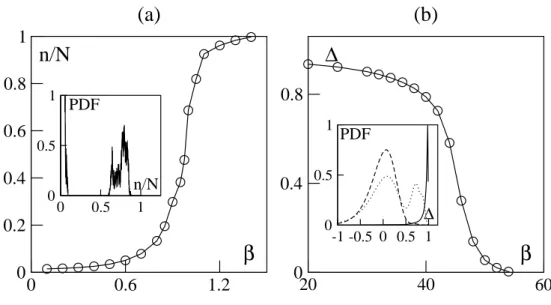
Right side: average size of the largest cluster, normalized to the total particle number, as a function of the temperature in the canonical ensemble at fixed volume for different
Gaussian curvature (focal conic domains of the usual type) close to the phase boundary with the L~ sponge phase, and defects with positive Gaussian curvature (focal conic domains
other hexatic B phases have been identified on the basis of qualitative features associated with the X-ray powder pattern [14], as we are doing here, 650BC and 460BC
It then follows that if one studies, for a given magnetization M, the external field h, this field approaches exponentially with A its bulk limit, but the coefficient
Trie paper is organized as follows: in Section 2 we introduce trie Bogolyubov rotation and derive the effective Hamiltonian within trie new basis. In Section 3 we take as example
