CO-releasing molecules (CO-RMs) are an emerging class of pharmaceutical compounds that are intended to specifically deliver CO to diseased or inflamed tissues in order to initi-ate and promote therapeutic effects at the site of disease. The potent beneficial action of CO-RMs is directly attributed to the biochemistry of the released CO. Healthy humans constantly produce CO. Available data indicate production of CO as approximately 10 cm3/d, but elevated levels are measured in patients suffering from various pathological conditions [1].
Endog-enously, the formation of CO is due to a family of enzymes known as heme oxygenases (HOs) of which three isoforms have been identified: HO-1, -2 and -3 [2–4]. In our body HO-1 and -2
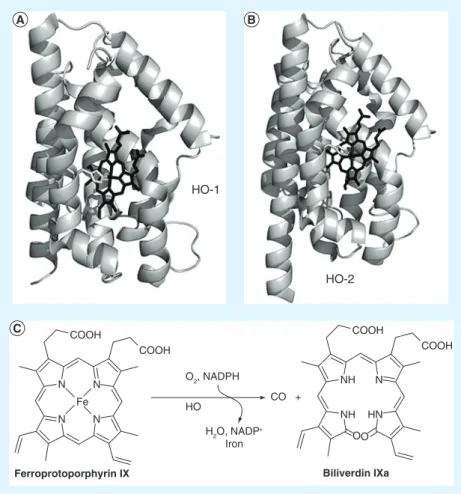
carry out the formation of CO via the oxidative metabolism of heme (Figure 1), while the func-tion of HO-3 is still unknown. HO-1, mainly found in the spleen and the liver, is the only inducible isoform of this enzymatic family. It is ubiquitously expressed in all mammalian tis-sues. Mounting evidence indicates that increased cellular stress will result in a cascade of stimuli ultimately leading to the up-regulation of tran-scription of the enzyme [2–5]. HO-2 and -3 are
constitutively expressed and they are mainly found in the brain and testes. Abnormality in the function of HO’s and in metabolism of their action-derived CO have been linked to different diseases [2].
Despite the fact these enzymes have been known for over half a century, their action-derived CO was considered for decades as only a ‘byproduct’ of their metabolic reactions. Today
we know that the diatomic molecule plays a cru-cial role as a gasotransmitter, and when exog-enously applied it mediates a therapeutic effect in different pathologies including cancer, neuro-degenerations, hypertension, heart diseases, liver disfunctions, inflammation and infections. In medicine, CO applications have also advanced in the field of organ transplantation and preser-vation. Initially, the potential therapeutic effects of CO were demonstrated in a model of acute lung injury and subsequently, in a seminal paper by Otterbein and his group, it was demonstrated that CO is able to suppress the development of post-transplant arteriosclerotic lesions in rat recepients of allogenic aorta transplants [6].
Cur-rently CO is evaluated in several clinical trials (Phase I–III). These include: improvement of cardiac injury after myocardial infarction (in conjunction with heme arginate, Phase I/II); anti-inflammatory effects in chronic obstruc-tive pulmonary disease (Phase II completed); treatment of patients with intestinal paralysis after colon surgery (Phase II); prevention of lung inflammation (Phase I completed) [1]. The
pro-tective effects of CO as vasodilator (and prob-ably biliverdin and bilirubin derived from the heme metabolic pathway) have also been success-fully evaluated in several cardiovascular diseases including pulmonary arterial hypertension, for which there is no treatment.
Although the technology is now in place to bring CO to clinical applications [7], the use of
the gaseous molecule poses several problems. First, the dose control of the gas is demand-ing. Inhaled gaseous CO causes direct cell
CO and CO-releasing molecules in medicinal
chemistry
Since the discovery that CO acts as a cytoprotective and homeostatic molecule, increasing research efforts have been devoted to the exploitation of its therapeutic effects. Both endogenous and exogenous CO improves experimental lung, vascular and cardiac injuries and protects against several inflammatory states. The technology is now in place to bring CO to clinical applications, but the use of the gaseous molecule poses several problems. The challenges associated with the clinical implementation of the gas have in part been answered by the development of CO-releasing molecules (CO-RMs). As stable solid forms of CO, these molecules represent an alternative to the administration of carbon monoxide (orally or by injection). In this article, we present insights into the biochemical action of CO and discuss the efficacy of CO and CO-RMs in preclinical disease models. Recent advances in the CO-RMs field are critically addressed.
Fabio Zobi University of Zürich, Winterthurerstrasse 190, 8057 Zürich, Switzerland Tel.: +41 44 635 4623 Fax: +41 44 635 6802 E-mail: [email protected]
toxicity and rapidly reacts with hemoglobin (Hb) owing to its much higher affinity to the protein (approximately 230-fold) over molecular oxygen [8]. This event leads to the formation of
carbonmonoxy hemoglobin (HbCO), inhibi-tion of oxygen transport by red blood cells and subsequent tissue hypoxia. There is virtually no possibility of controlling tissue specificity in the administration of the gas. Consequently, CO loads tend to be high. The COVOX delivery system has now been developed by Ikaria for the administration of the gas and medical person-nel will require specific training [7]. Moreover,
due to safety considerations, administration of CO can at present only be carried out in hos-pital settings. The challenges associated with clinical application of the gas by inhalation have sparked the design of CO-RMs as an alternative approach to the administration of CO. Indeed,
CO-releasing molecules offer the possibility, through flexible chemical design, to overcome all of the problems above. Since, ideally, CO-RMs can be administered orally or via injection, the right dose of administered CO can be con-veniently calculated from the known structure of the compounds. This reduces drug (and CO) loads for the patients. Tissue specificity can be controlled by chemical variation of the drugs by, for example, appending CO-RMs to receptor targeting biomolecules. If administered orally or via injection, no equipment is needed to deliver the drug and the operation may be carried out in an ambulatory setting, thus greatly reducing overall costs.
To date, the vast majority of CO-RMs are molecules tailored around a transition metal ion (Figure 2). In general the central metal ion is not considered to play a role in the therapeu-tic action of CO-RMs and it may be viewed as the scaffold for the delivery of CO. However, potentially toxic elements such as chromium, whose metabolites after CO release, would make molecules unsuitable for further advancement to become a drug should be avoided. Factors regarding the toxicity of the central metal ion are taken in great consideration, and the field has lately seen a shift in the synthesis of CO-RMs modified with bio compatible elements such as iron. CO-RMs based on purely organic molecules are also known. The only examples are the boranocarbonate species introduced by Alberto [9–11]. These molecules, along with
metal-based CO-RMs, have advanced to pre-clinical trials showing promising effects as, for example, cerebroprotective agents for the treat-ment of epileptic seizures [12]. In this perspective
article, knowledge associated with the biochemi-cal action of CO is evaluated and the efficacy of the diatomic molecule as a therapeutic agent is discussed. Recent advances in the CO-RMs field are critically addressed and a conceptual model for the future development of the mol-ecules is offered. The fundamental electronic and molecular orbital theory descriptions of CO-RMs are not addressed here. The reader may refer to a recent review for an in-depth discussion of these topics [13]. In this article a
strong and perhaps provocative case is argued in favor of the development of targeting CO-RMs. This opinion should not be considered exclusive and certainly other approaches are valid as well. Indeed, the reader should bear in mind that in other fields of medicinal inorganic chemistry, major metal-based drugs, for example, platinum Key Terms
CO-releasing molecules:
Any compound capable of liberating CO under physiological conditions. The loss of CO may be either spontaneous (e.g., thermal activation) or triggered by an external stimulus (e.g., light).
Ligands: Ions or molecules that binds to a central metal atom and which, in concert with CO, form the fundamental structure of the vast majority of CO-releasing molecules.
HO-1
HO-2
Ferroprotoporphyrin IX Biliverdin IXa
O2, NADPH CO + H2O, NADP+ Iron HO N N N N Fe COOH COOH NH NH HN N COOH COOH OO
Figure 1. x-ray structures of human heme oxygenases 1 and 2 and their catalyzed heme degradation. (A) Structure of human HO-1 (PDB access code 1N45) and (B) human HO-2 (PDB access code 2QPP) in complex with their ferroprotoporphyrin IX substrate (shown in black). (C) Endogenous regioselective HO-catalyzed degradation of heme resulting into ferric iron, biliverdin IXa and a molecule of CO.
and ruthenium anticancer agents, do not pos-sess targeting ligands but are very successful pharmaceuticals.
CO in biochemistry & medicine
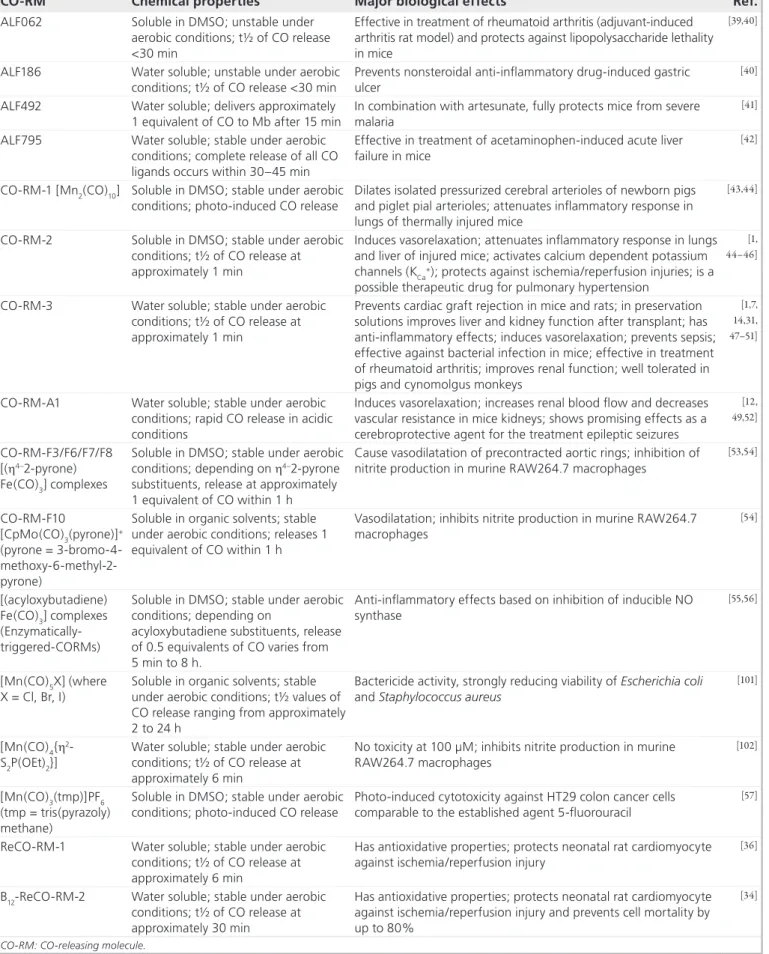
The therapeutic effects of CO-RMs and of CO have been demonstrated in a large number of preclinical disease models. Motterlini and Otter-bein have recently reviewed the medical appli-cations of the molecules [7]. tables 1 & 2 offer a brief extract of the preclinical efficacy of CO and selected CO-RMs on different disease models. A similar register may be found in the review article by Mann [1]. It should be mentioned that selected
CO-RMs show similar effectiveness in the mod-els listed in table 1 and in some cases offer a superior therapeutic action over CO inhalation alone. For instance, the bactericidial effects of a ruthenium-based CO-RM (CO-RM-3 in Figure 2) have been shown to improve survival in immunocompetent and immunosuppressed mice, while CO gas does not seem to have a direct effect on bacteria survival [14]. The way
by which CO-RMs and specifically CO real-ize their therapeutic action is largely unknown. Indeed the biochemistry of CO is probably best understood by its toxicity [8]. Inhaled CO will
cause HbCO levels to rapidly increase in the blood with consequent impairment of oxygen carrying ability and hypoxia. This event is mis-takenly held responsible for the toxicity of the gas, a conviction deeply rooted in the general public and the scientific community at large. In agreement with this model, serum HbCO levels are used diagnostically in hospitals to establish the severity of CO intoxication. However, the toxicity of CO is not a simple function of serum HbCO levels and such a relationship may be applied only in cases where CO is delivered to patients in its gaseous form [13].
The issue of whether HbCO is a reliable marker of CO poisoning is of particular impor-tance for the medical applications of CO-RMs. The answer to the problem above has actually been available in the literature for over 30 years but it was only recently brought back into sight by Foresti and Motterlini [15]. In a recent
con-tribution, these authors have published an old comment written by Poulton in response to the work of Aronow who affirmed that blood with elevated HbCO levels should not be given to patients suffering from cardiac or pulmonary dysfunctions. Via this commentary, the 1975 work of Goldbaum on the mechanism of CO toxicity was discussed. By using groups of dogs
that were either allowed to breathe CO or that were bled to a severe state of anemia and then transfused with red blood cells saturated with 80% HbCO, Goldbaum showed that it is not the CO bound to hemoglobin that is toxic [16].
Hb operates in a detoxifying mechanism and it is rather the fraction of CO that escapes it that becomes detrimental.
Relevant to the medicinal application of CO-RMs, the question of what is responsible for the toxicity of CO remains unanswered. But, more significantly, the therapeutic sites of action of CO are still unknown. At present, reports on the bio-logical targets and the sites of action of CO are very limited. Cytochromes and other intracellu-lar hemoproteins are often indicated as the most likely candidates [1–3,5,7,15,17]. Direct evidence of
the interaction of CO with cytochromes is avail-able [18] but several other proteins containing
var-ious transition metals, such as manganese, cop-per, cobalt, nickel, vanadium or molybdenum, may potentially be targeted by CO [19]. Little is
known about the functional significance of such
Key Term
Hemoproteins: Believed to be the major intracellular targets of CO, they are conjugated proteins containing a metal-porphyrin compound as the prosthetic group.
Cl Cl CO Ru Cl OC OC CO CO Cl Ru CO CO-RM-2
ALF062 ALF186 ALF795
Fe-based type CO-RMs B12-ReCO-RM-2
CO-RM-A1
Examples of PhotoCO-RMs ET-CO-RMs CO-RM-3 ReCO-RM-1 N H2 O O H2 N Na Na 3Na HN O Fe COL R OC Fe COCO OC O O R H B OH O H H R R R O R O N N N R CO Ru Cl OC OC Br Br Br Re Br 2[Et4N] OC OC Br OH2 CO Re N C CO OC Br CO CO Br Mo CO OC OC O Mo CO OC OC CN CN R R N C Mo R CO OC OC Fe COCO OC N N N Mn CO OC OC CO CO P W CO OC OC [Et4N]
Figure 2. Structures of selected well-known CO-releasing molecules. In these examples ‘R’ indicates an organic substituent and ‘L’ a monodentate ligand. For details and references see table 2.
interactions. The physical targets responsible for mediating the protective effects of CO appear to be diverse. Often the effects of CO are found to parallel those of NO and in some cases CO action is dependent on nitric oxide production. Guanylyl cyclase is one of the rare enzymes for which direct evidence of CO modulation is avail-able [20]. The polypeptide is activated by both
CO and NO to convert guanylyl triphosphate to cGMP that then acts as an important signal-ing molecule. Other reports have shown that CO promotes its effects on mitogen-activated protein kinases, proliferator-activated receptors, signal transducers and activators of transcription, and hypoxia-inducible factors [21,22]. Recently,
Na+ and calcium dependent potassium channels (KCa+) have been identified as potential targets of CO, owing to the HO-2 function as an oxygen sensor in these systems [23,24]. It is interesting to
note here that Guanylyl cyclase is also involved in the signaling cascade that is activated by low Ca2+ levels and inhibited by high intracellular Ca2+ concentration [25].
It is now established that among the earli-est cellular responses to low concentration of
exogenously applied CO is an increase in reac-tive oxygen species (ROS) formation. This event, called ‘oxidative conditioning’ [5], is
particularly pertinent to the application of CO-RMs in the treatment of cardiac dysfunc-tions. There are several studies that support the idea that small amounts of applied gaseous CO will first affect cellular respiration resulting in local high concentration of ROS [26–29]. The
downstream targets of ROS are unclear, but in response to ROS formation, cells reply with enhanced induction of antioxidant enzymes. The up-regulation of ‘conditioning enzymes’ eventually results in cellular adaptation. CO is then ascribed a (pre)conditioning role by stimulating mitochondrial ROS production and activating mitochondrial biogenesis [30–32].
Recent evidence also indicates that CO-RM-3 derived CO is capable of modulating activity of the most abundant and potent antioxidant enzymes, SOD1 and SOD2, found in all cells and tissues [27]. This mechanism, however, may
not always be relevant when different CO-RMs are used for treatment instead of the gas. The promising class of rhenium-based CO-RMs Table 1. Effects of inhaled CO in preclinical disease models.
Disease model Effect of CO gas
Acute inflammation and lung injury in mice Prevents hyperoxia-induced lung inflammation and injury
Acute liver failure in mice Prevents liver failure and injury Aortic allograft rejection in mice and rats Prevents transplant vascular stenosis Asthma and airway hyperresponsiveness in
mice
Prevents bronchoconstriction and airway inflammation Autoimmune disease in mice Reverses paralysis
Bacterial infection in mice Improves survival and prevents multiple-organ failure Cardiac graft rejection in mice and rats Prolongs survival and prevents rejection
Cardiopulmonary bypass in pigs Reduces lung inflammation Cerebral malaria in mice Prevents cerebral injury
Chronic colitis in mice Prevents colitis and inflammation
Hemorrhagic shock in mice Prevents organ failure and improves tissue availability Islet cell transplantation Improves islet cell survival
Kidney and liver preservation in rats Improves renal and liver function after treatment Lung allograft rejection and
ischemia-reperfusion injury in mice and rats
Prevents chronic rejection, ischemia-reperfusion injury and apoptosis
Myocardial infarction in mice Prevents infarct mass
Postoperative ileus in mice, rats and pigs Prevents ileus and improves motility Pulmonary and renal fibrosis in mice Prevents lung and renal fibrosis
Pulmonary hypertension in rats and mice Reverses pulmonary artery pressure and prevents pulmonary hypertension on prolonged treatment Sepsis and endotoxemia in mice, rats and
pigs
Has anti-inflammatory effects, ameliorates lung derangement, improves survival and lung and liver injury Sickle cell disease in mice Prevents leukocyte infiltration and vaso-occlusion Small bowel transplant Prevents rejection and transplant-induced paralytic ileus Data taken from [7] and references therein.
Key Term
Oxidative conditioning:
The ability of nondetrimental doses of carbon monoxide-induced reactive oxygen species generation to make cells more resistant to a subsequent insult, thus resulting in adaptation.
Table 2. Chemical properties and major biological effects of selected CO-releasing molecules.
CO-RM Chemical properties Major biological effects Ref.
ALF062 Soluble in DMSO; unstable under aerobic conditions; t½ of CO release <30 min
Effective in treatment of rheumatoid arthritis (adjuvant-induced arthritis rat model) and protects against lipopolysaccharide lethality in mice
[39,40]
ALF186 Water soluble; unstable under aerobic conditions; t½ of CO release <30 min
Prevents nonsteroidal anti-inflammatory drug-induced gastric ulcer
[40]
ALF492 Water soluble; delivers approximately 1 equivalent of CO to Mb after 15 min
In combination with artesunate, fully protects mice from severe malaria
[41]
ALF795 Water soluble; stable under aerobic conditions; complete release of all CO ligands occurs within 30–45 min
Effective in treatment of acetaminophen-induced acute liver failure in mice
[42]
CO-RM-1 [Mn2(CO)10] Soluble in DMSO; stable under aerobic conditions; photo-induced CO release
Dilates isolated pressurized cerebral arterioles of newborn pigs and piglet pial arterioles; attenuates inflammatory response in lungs of thermally injured mice
[43,44]
CO-RM-2 Soluble in DMSO; stable under aerobic conditions; t½ of CO release at approximately 1 min
Induces vasorelaxation; attenuates inflammatory response in lungs and liver of injured mice; activates calcium dependent potassium channels (KCa+); protects against ischemia/reperfusion injuries; is a possible therapeutic drug for pulmonary hypertension
[1, 44–46]
CO-RM-3 Water soluble; stable under aerobic conditions; t½ of CO release at approximately 1 min
Prevents cardiac graft rejection in mice and rats; in preservation solutions improves liver and kidney function after transplant; has anti-inflammatory effects; induces vasorelaxation; prevents sepsis; effective against bacterial infection in mice; effective in treatment of rheumatoid arthritis; improves renal function; well tolerated in pigs and cynomolgus monkeys
[1,7, 14,31, 47–51]
CO-RM-A1 Water soluble; stable under aerobic conditions; rapid CO release in acidic conditions
Induces vasorelaxation; increases renal blood flow and decreases vascular resistance in mice kidneys; shows promising effects as a cerebroprotective agent for the treatment epileptic seizures
[12, 49,52]
CO-RM-F3/F6/F7/F8 [(h4–2-pyrone) Fe(CO)3] complexes
Soluble in DMSO; stable under aerobic conditions; depending on h4–2-pyrone substituents, release at approximately 1 equivalent of CO within 1 h
Cause vasodilatation of precontracted aortic rings; inhibition of nitrite production in murine RAW264.7 macrophages
[53,54] CO-RM-F10 [CpMo(CO)3(pyrone)]+ (pyrone = 3-bromo-4- methoxy-6-methyl-2-pyrone)
Soluble in organic solvents; stable under aerobic conditions; releases 1 equivalent of CO within 1 h
Vasodilatation; inhibits nitrite production in murine RAW264.7 macrophages [54] [(acyloxybutadiene) Fe(CO)3] complexes (Enzymatically-triggered-CORMs)
Soluble in DMSO; stable under aerobic conditions; depending on
acyloxybutadiene substituents, release of 0.5 equivalents of CO varies from 5 min to 8 h.
Anti-inflammatory effects based on inhibition of inducible NO synthase
[55,56]
[Mn(CO)5X] (where X = Cl, Br, I)
Soluble in organic solvents; stable under aerobic conditions; t½ values of CO release ranging from approximately 2 to 24 h
Bactericide activity, strongly reducing viability of Escherichia coli and Staphylococcus aureus
[101]
[Mn(CO)4{h2 -S2P(OEt)2}]
Water soluble; stable under aerobic conditions; t½ of CO release at approximately 6 min
No toxicity at 100 µM; inhibits nitrite production in murine RAW264.7 macrophages
[102]
[Mn(CO)3(tmp)]PF6 (tmp = tris(pyrazoly) methane)
Soluble in DMSO; stable under aerobic conditions; photo-induced CO release
Photo-induced cytotoxicity against HT29 colon cancer cells comparable to the established agent 5-fluorouracil
[57]
ReCO-RM-1 Water soluble; stable under aerobic conditions; t½ of CO release at approximately 6 min
Has antioxidative properties; protects neonatal rat cardiomyocyte against ischemia/reperfusion injury
[36]
B12-ReCO-RM-2 Water soluble; stable under aerobic conditions; t½ of CO release at approximately 30 min
Has antioxidative properties; protects neonatal rat cardiomyocyte against ischemia/reperfusion injury and prevents cell mortality by up to 80%
[34]
(ReCORM-1 and B12-ReCORM-2 in Figure 2) [33–36], for example, is able to prevent
cardio-myocyte death in an ischemia-reperfusion stress model, but mitochondrial respiration is found unaffected by treatment [34]. This observation
underlines the distinct possibility that differ-ent mechanisms of protection are at play in CO-RMs-based treatments when compared with gaseous CO [37]. In this specific example,
the ability of the rhenium compounds to act as antioxidants might explain the lack of ROS production.
State of the art CO-RMs
The discovery, identification and design of novel CO-RMs belongs to the general disci-pline dubbed ‘medicinal inorganic chemistry’. The field is strongly interdisciplinary, encom-passing traditional inorganic, organic and (bio) physical chemistry together with biology and medicine. The synthesis of CO-RMs, however, is currently a prerogative of inorganic chemists who are inevitably biased by their training. Con-sequently, at least in the early developments of the field, the literature has witnessed an explo-sion of molecules which, in the words of Whitty, “would be considered by a pharmaceutical com-pany researcher to have little or no value” and “whose main claim to fame is that they show activity in a biochemical or cellular assay” [38].
The scientific value of the early synthetic studies should not be underestimated.
The vast majority of CO-RMs identified to date are molecules comprising elements of the metal transition series. Examples of selected metal-based CO-RMs that have been tested
in vitro and/or in preclinical animal disease
models are shown in Figure 2 and listed in table 2 [1,7,12,14,31,34,36,39–57,101,102]. The examples
provided are far from comprehensive. There are hundreds of papers describing the chemistry, the biological effects or the medical applications of CO-releasing molecules. Technically, it is not trivial to realize a metal carbonyl complex that meets all properties required for a CO-releas-ing agent intended as a medical drug. Beyond properties of absorption, distribution, metabo-lism, excretion or toxicity, inorganic medicinal chemists are faced with problems that include:
n Water solubility; n Biocompatibility;
n Aerobic stability or stability in aqueous aerobic
media;
n Rapid decay of the M(CO)x fragment in the
blood;
n Fast reactions of the metal scaffold after CO
release;
n Analysis of the resulting metabolites.
To further complicate matters, inorganic chemists cannot rely on organic molecules as conceptual templates for their CO-RM design. Apart from boranocarbonate species [9–11],
compounds of main group elements capable of releasing CO are rare. Some aldehydes have been used to release CO and to treat arthritis [1], but
other typical examples include formic acid in concentrated sulphuric acid, dichloromethane, dimethyl formamide or other similar compounds that are beyond any possible medical applicabil-ity. Also, considering also the general mistrust surrounding the use of transition metal-based drugs in medicine, chemists involved in this field are challenged with a seemingly daunting task.
Nevertheless, several CO-RMs have been tested in preclinical disease models with remark-able success. Figure 3 shows the general struc-ture of a metal-based CO-RM. For our discus-sion the structure of CO-RM-3 (Figure 2) is taken as an example. The compound, of for-mula [Ru(CO)3Cl(glycinate)], is undoubtedly the best known and most widely investigated CO-RM to date. Approximately 150 research articles have been published on this species. A single ruthenium atom (oxidation state 2+, d6 low spin system) is at the core of the molecule. Three CO ligands are arranged facially around the metal ion. A deprotonated glycine, which occupies two of the remaining coordination sites, and a single chloride ion complete the coordination sphere of the molecule. Virtually almost all known CO-RMs show this type of octahedral geometry. Variations are given by the nature and the electronic structure of the central metal ion, the number and the spatial arrangement of the CO groups, and the type, number and coordination mode of the ancillary ligands [58,59]. Beyond structural considerations,
for the purpose of this article, state-of-the-art metal-based CO-RMs will be broadly divided in two classes. The first class of molecules com-prises CO-RMs in which CO release is either spontaneous or initiated by hydrolysis or redox reactions at the metal core [33–36,42,54,60–66]. The
second class encompasses molecules for which external stimuli (e.g., light) are required in order to promote CO dissociation [55,56,57,67–76]. Key Term
Photo-CO-releasing molecule: Any compound capable of liberating CO upon exposure to light.
Mechanisms of CO release
In the simplest conceptual case, CO-RM reac-tions leading to CO loss may be ascribed to CO dissociation from the metal ion. Both theoretical and experimental studies have shown that CO dissociation is a facile step in several Mn- and Fe-based CO-RMs bearing dithio carbamate ligands. In buffer solutions, an equilibrium involving release and re-coordination of CO is rapidly established in this family of compounds
[64,77–79]. A second possible mechanism of CO
release is generally referred to as a hydrolytic or thermal process. In this class of molecules, aqua-tion or ligand substituaqua-tion at the metal centre triggers CO release. The steps leading to CO loss are not entirely understood, but it is reason-able to assume that CO is liberated via an acid/ base-catalyzed, an associative, or a dissociative substitution mechanism. The latter may also be pH dependent. Possible mechanisms leading to CO loss are outlined in Figure 3. Often, how-ever, the detailed description of CO release is more complicated than the simple scheme por-trayed in Figure 3. Redox processes at the metal centre also play a role in the liberation of CO. The recently described Fe complexes with poly-pyridyl ligands might exemplify this issue [75].
For these compounds it has been reported that the CO-releasing behavior is critically dependent on the presence of dioxygen. The molecules are thus stable under anaerobic conditions and their CO loss has been attributed to the formation of a highly stable µ-oxo diiron species (i.e., a molecule with a Fe-O-Fe bond).
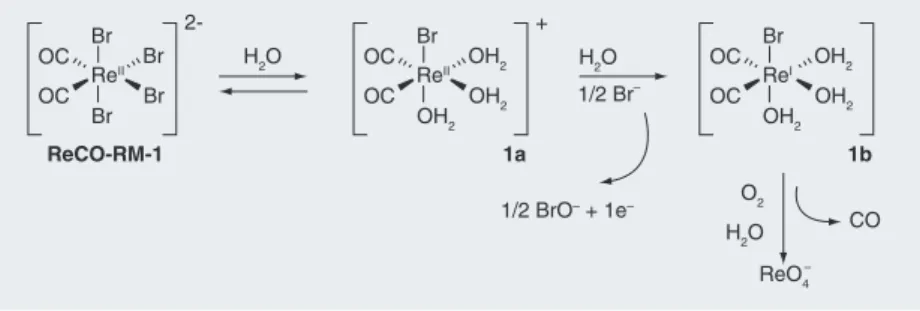
The hydrolytic and redox processes are not mutually exclusive. A class of CO-RMs based on electronically unsaturated Re com-plexes (ReCO-RM-1 and B12-ReCO-RM-2 in Figure 2), appears to release CO via a combined path of mechanisms (Figure 4) [34]. When
dis-solved in aqueous media, three bromides in ReCORM-1 are rapidly exchanged for solvent molecules. The substitution of three Br- by three water molecules is postulated to increase the ReI → ReII redox couple of 1a (Figure 4) to a value sufficient to drive the oxidation of Br -to BrO-. Following reduction of the solvated ReII complex the corresponding ReI species is formed (1b; Figure 4). This complex is then pro-posed as the CO-releasing entity liberating one equivalent of CO within 30 min under physi-ological conditions. In aqueous solutions under aerobic conditions, the monocarbonyl ReI com-plex is finally oxidized to the non-toxic ReO4- anion. Complexes of electronically unsaturated
Re-based CO-RMs are a rare example for which both a tentative mechanism of CO loss and the final metabolite have been elucidated.
Within this first set of molecules, borano-carbonate compounds of formula Na[H3BCO2H] (CORM-A1 in Figure 2) and Na[H3BCONR2] (where R = organic functionality) deserve to be mentioned briefly [9–11,79]. These represent the
only group of nontransition-metal compounds that release CO. At physiological pH these molecules lose CO via an acid/base-catalyzed mechanism. CORM-A1 shows potential as a cerebroprotective agent for the treatment of epileptic seizures [12], it is active in the
cardio-vascular system [52] and reduces inflammation [80,81]. More than 30 papers have been published
on biological applications of this compound. The second broad class of CO-RMs are mol-ecules for which external stimuli (e.g., light or enzymatic activation) are required in order to promote CO dissociation. Complexes compris-ing the [Mn(CO)3]+ core are the best-known examples of light-activated CO-RMs (Figure 2) [57,70–72,74]. These compounds, now called
‘photo-CO-RMs’ [69], are being developed in
order to address some of the fundamental prob-lems associated with the delivery and the tissue specificity of the drugs. Once the biodistribution of the drug is elucidated, photochemical cleavage of CO allows in principle to control the tim-ing, dosage and the location of the released CO. At present, the limitation of photo-CO-RMs
L4 M L1 L3 L2 OC OC CO CO Decomposition Dissociative mechanism Thermolysis CO CO + L4 or solvent CO Enzymati c triggerin g CO [MxOy]n Electromagneti c radiation Oxidation CO pH change Acid/base catalyzed Associative mechanism CO CO M L1 L3 L2 OC OC M L1 L3 L2 OC OC M L1 L3 L2 OC OC
Figure 3. Possible reactions resulting in the CO loss from a CO-releasing molecule of general formula [(CO)3ML1L2L3]. The loss of CO may be either spontaneous (e.g., thermolysis, pH change) or triggered by an external stimulus (e.g., electromagnetic radiation or enzymatic activation).
is in the radiation wavelength at which they are activated. Generally photo-CO-RMs are activated with high-frequency light in the UV range (hn < approximately 400nm) but examples are known of complexes where higher wavelengths can be used to promote CO loss. The [Fe(SCH2CH2NH2)2(CO)2] complex, for example, can be activated with a wavelength of 470 nm [82]. Thus, in general, photochemical
triggering is a technique currently limited to
in vivo applications to sites directly exposed to
the body’s surface. This represents perhaps the most pressing problem for the photo-CO-RMs community. In the words of Schatzschneider: “The main challenge in the further develop-ment of photo-CO-RMs will be to prepare com-pounds in which the photolytic release of CO can be triggered by light in the phototherapeutic window, that is at wavelengths above 600 nm”
[71]. Three solutions have been proposed to meet
the challenge above: the bathochromic shift of absorption maximum of the photo-CO-RMs via ancillary ligands with extended aromatic p-sys-tems; the use of photo-CO-RMs with appended photosensitizers to aid in the liberation of CO; the simultaneous absorption of two photons of identical or different frequencies to promote the CO releasing process via the two-photon absorption technique [71].
Enzymatically triggered CO-releasing molecules (ET-CO-RMs) are a new and inter-esting class of CO-RMs that have recently appeared in the literature [55,56]. The
com-pounds, based on acyloxybutadiene tricarbonyl iron species (Figure 2), are activated by intracel-lular esterases, which, upon cleavage of the ester functionality on the acyloxybutadiene precur-sors, generate a highly unstable hydroxybutadi-ene ligand on the iron center. This reaction trig-gers decomposition of the molecule via oxidation of the [Fe(CO)3] core ultimately leading to CO
release. This strategy represents a new concept in the development of CO-RMs [55,56].
ET-CO-RMs show strong inhibition of inducible nitric oxide synthase, but their activation is currently limited to a restricted number of enzymes. Some toxicity issues still need to be addressed in this class of CO-RMs.
Systemic or targeted drugs?
CO-RMs are unlike most drugs whose phar-macological action is dependent on their interaction with a macromolecular target and whose potency is dictated by the duration of the drug–target complex persistence. In most cases, modulation of such drug–target interac-tions are archived by chemical variation on the periphery of the compound. Apparently small changes (as it might be the substitution of a methyl for an ethyl group) have profound con-sequences on the effectiveness of the drug due to conformational and structural changes around the pharma ceutical binding pocket of the mac-romolecule that in turn controls the dynam-ics of drug dissociation. CO-RMs, however, are believed to exert their therapeutic action via a completely different mechanism. Pres-ently, they are not designed to target a specific receptor and their potential utility is generally ascribed to their fundamental ability to liberate CO. CO-RMs are systemic prodrugs; CO is their ‘active ingredient’. Thus, CO-RMs must survive long enough under physiological condi-tions and be activated only at the disease site. The half-life of the drug (e.g., in the circulatory system) is considered of great importance for the therapeutic effectiveness of the molecule. Significant research efforts continue to be dedi-cated to the design of CO-RMs with suitable ligands capable of modulating the half-life of CO-loss. Very recently, Atkin pointed out that “due to the diverse nature of the applications (i.e., of CO-RMs), the optimum release rate for CO release is not known; thus, the develop-ment of a variety of CO-RMs with different activities is desirable” [83]. This is a valid
argu-ment, but other factors will play a decisive role for the advancement of CO-RMs as acceptable pharmaceuticals.
It is now established that for any given transi-tion metal-based CO-RM, the rate of CO release is influenced by the electronic structure of the metal and by the atoms directly bound to it. This selection of ligands forms what is defined in inorganic chemistry as the first coordination sphere of the metal ion. The development of Key Terms
Enzymatically triggered CO-releasing molecules:
Molecules capable of liberating CO as a result of an enzymatic reaction. In general considered to be recognized as a substrate of the selected enzyme.
Systemic prodrugs:
CO-releasing molecules with no targeting functionalities, which, once administered orally or intravenously, are expected to act (i.e., release CO) on the whole body. ReCO-RM-1 Br Br H2O H2O ReO4 – 2-Br ReII Br OC OC OH2 OH2 + Br ReII OH2 O2 OC CO OC OH2 OH2 Br ReI OH2 OC OC H2O 1/2 Br– 1a 1b 1/2 BrO– + 1e–
Figure 4. The proposed mechanism underlying the CO loss from an electronically unsaturated Re-based CO-releasing molecule, and its subsequent oxidation to the ReO4- anion.
clinically useful transition metal-based CO-RMs, however, must move beyond the simple inorganic chemistry approach. In parallel to the identification and design of, for example, octahedral, tetrahedral or square planar car-bonyl complexes, the new frontier of CO-RMs research needs to address issues relevant to basic physicochemical properties required for an acceptable pharmaceutical behavior. These issues were also addressed by Romão and his team in a recent tutorial review on the devel-opment of therapeutic CO-RMs [13]. In their
contribution, the authors have described a con-ceptual CO-RM model that takes into account both the first coordination sphere of the central metal and a second expanded sphere that they named the ‘dug sphere’ of the molecule. There it was argued that, within the constraints of metal carbonyl chemistry, modifications of the drug sphere should be considered to modulate drug-like features of CO-RMs, and in turn address absorption, distribution, metabolism and excre-tion properties. Targeting funcexcre-tionalities could also be introduced within this second sphere.
We believe this is a valid model. Indeed, amino acids, purine and pyrimidine bases have been used since the beginning in the design of CO-RMs as the presence of such molecules removes toxicity issues of released ligands. We have also prepared biocompatible site-specific metal based-CO-RMs conjugated to biomolecules. Spe-cifically, we have introduced cyanocobalamin (vitamin B12) within the drug sphere of labile Re(II)-based CO-RMs [34]. The idea behind the
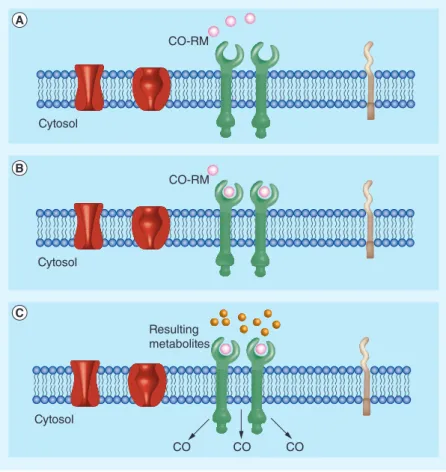
development of such bio-conjugates is to target the metallo prodrug to a specific location within the organism and thus elicit a compartmentalized homeostatic response as opposed to a systemic one that is chaotic and disordered. This goal may only be achieved by functionalizing CO-RMs with receptor targeting biomolecules in order to ensure, at least theoretically, the exclusive accumulation of the drug in the diseased organ or tissues that are intended to be treated. It is this approach that is now driving our CO-RM research program. The strategy is shown in Figure 5 – a bio-conjugated CO-RM designed for a specific target (and/or receptor) is anticipated to accumulate preferentially at the site of interest. CO-RM decomposition (i.e., CO release) follows the bio-carrier mediated target binding, thereby promoting CO passive diffusion and accumula-tion at the target locaaccumula-tion. It should be noted, however, that it is currently possible to admin-ister CO-RMs locally for many of the potential
applications. It is known that ALF062, CORM-3 and [{HC(C3H3N2)3}Mn(CO)3]+, for example, enter cells and as a result are likely to remain close to the site of administration [18,39,84].
Nevertheless, the careful selection of target-ing functionalities within the drug sphere of CO-RMs will not only allow a compartmentalized therapeutic effect, but will aid in overcoming the general poor water solubility of the metal com-plexes. Furthermore, the modulation of the drug sphere should bring CO-RMs to behave more like standard organic drugs in vivo. Thus, depend-ing on the strength and persistence of the CO-RM-target (and/or receptor) complex, it would be possible to select CO-RMs with different CO-releasing profiles to promote either a rapid (i.e. with CO-RMs with short half-lives) or a con-tinual therapeutic action. These effects could also be achieved with appended CO-RMs capable of releasing two or more equivalents of CO at differ-ent rates. Overall, this strategy should ultimately result in a reduced drug load for patients.
CO-RM Cytosol CO-RM Cytosol Resulting metabolites Cytosol CO CO CO
Figure 5. Development of biocompatible-site specific metal-based CO-releasing molecules. (A) Bio-conjugate CO-RM approach to target site. (B) Bio-carrier mediated receptor binding. (C) CO-RM decomposition, CO release and CO penetration at target site.
Future perspective
The field of CO-releasing molecules is certainly gaining momentum. An increasing number of scientists are entering the CO-RM arena and in the near future we are likely to face a growing number of molecules identified for this pur-pose. Certainly the field will still require the invaluable input of synthetic chemists, but a shift must also occur towards more application-oriented studies. Only a small fraction of the published compounds has advanced beyond the initial biological tests. A number of pri-vate companies (e.g., ALFAMA) are currently
exploring the possible commercial value of CO-RMs. Due to patenting issues, it is likely that within the next 5 to 10 years compounds of significant medicinal value will appear in literature. Their structures will provide a new synthetic platform for the advancement of the field. At present, however, there are several problems to be solved [85]. The need to address
issues relevant to basic physicochemical proper-ties required for an acceptable pharmaceutical behavior was discussed above. In addition to that, from a chemical standpoint, more efforts should be directed towards the elucidation of Executive summary
Background
n CO-releasing molecules (CO-RMs ) and their action-derived CO mediate therapeutic effects in different pathological conditions.
n CO and CO-RMs have advanced in a wide range of medical applications. These include organ transplantation and preservation,
reduction of reperfusion injury, inflammation, sepsis and killing drug-resistant bacteria.
CO in biochemistry & medicine
n CO-RMs and CO realize their therapeutic action via largely undetermined mechanisms.
n The biological targets of CO are unknown, but cytochromes and other hemoproteins are indicated as the most likely candidates.
n CO is ascribed a (pre)conditioning role by stimulating mitochondrial reactive oxygen species production and activating mitochondrial
biogenesis.
State of the art CO-RMs
n The vast majority of CO-RMs are molecules tailored around a transition metal ion.
n Virtually almost all known metal-based CO-RMs show an octahedral geometry.
n CO-RM design should take into account absorption, distribution, metabolism and excretion properties, toxicity, water solubility and
biocompatibility.
Mechanisms of CO release
n CO-RMs may be broadly divided in to two types of classes: molecules in which CO release is either spontaneous or initiated by hydrolysis
or redox reactions at the metal core, and molecules for which external stimuli are required in order to promote CO dissociation.
n In the simplest conceptual case, CO-RM reactions leading to CO loss may be ascribed to CO dissociation from the metal ion.
n A second possible mechanism of CO release is generally referred to as a hydrolytic or thermal process.
n CO-RMs for which external stimuli are required to promote CO dissociation are known as photo-CO-RMs (for light-activated molecules)
or enzymatically-triggered CO-RMs.
n Boranocarbonate compounds are the only group of non-transition-metal CO-RMs.
Systemic or targeted drugs?
n CO-RMs are currently not designed to target specific receptors or macromolecules. They can be defined as systemic prodrugs.
n The new frontier of CO-RMs research needs to consider issues relevant to basic physicochemical properties required for an acceptable
pharmaceutical behavior.
n A possible solution to address absorption, distribution, metabolism and excretion properties is via the formation of
CO-RM-bio-conjugate systems capable of targeting a specific location within the organism and thus elicit a compartmentalized homeostatic response as opposed to a systemic one that is chaotic and disordered.
Future perspective
n In the near future the field will likely see a shift towards more application-oriented studies.
n Due to the involvement of private companies exploring the commercial value of CO-RMs, is it is likely that within the next 5 to 10 years,
compounds of significant medicinal value will appear in literature.
n The main focus of medicinal chemists should also be directed towards the generation of CO-RMs that are tissue specific, so as allow a
controlled delivery of CO.
n Targeted delivery is, however, one of the other valid approaches.
the mechanistic details underlying CO release. Several authors have already made important contributions and, in this respect, the work of Fairlamb, Lynam and Mann is exemplary. The identification of metabolites resulting after CO release or decomposition of CO-RMs also requires more rigorous scientific investiga-tion. Unlike the simple gas, CO is delivered by CO-RMs on a metal scaffold. The fate of the metal backbone must be elucidated from a metabolical and toxicological point of view. Existing techniques for the measurements of the CO release need to be perfected. Cur-rently, CO detection is achieved spectroscopi-cally either by trapping CO with myoglobin or hemoglobin, or with gas chromatography, CO electrodes or in situ infra-red techniques. It would be advantageous for the community to develop a common reliable method that could be used as the standard for all. The widely spread myoglobin assay has shortcomings. This was clearly demonstrated in recent stud-ies [86–88]. The main focus of medicinal
chem-ists should be directed towards the generation of CO-RMs that are tissue specific, so as to allow a controlled delivery of CO. Targeted delivery is, however, one of the other valid approaches. Thus, for example, it is acknowl-edged that for treatment of infections such as infected wounds, the local administration of creams containing CO-RMs is advantageous
over molecules designed to target CO-RMs to tissues or organs, just as the use of aerosols is superior for the treatment of lung infections. All the issues above are openly discussed in the community and concrete steps forward have already been made. Initiatives to estab-lish a solid network among research groups are being promoted. These include the creation of a publicly accessible CO-RM library where synthetic procedures, CO-releasing profiles, the biodistribution and the therapeutic effects of different molecules are collected. Steps are being taken to foster more intensive collabora-tions between chemists, biologists and medical doctors in order to fully realize the potential of CO-RMs. This is probably the only possible solution to meet the ultimate challenge in the field: bringing CO-RMs into clinical use. Financial & competing interests disclosure F Zobi is an employee of the Institute of Inorganic Chemistry of the University of Zürich. This work was supported by Swiss National Science Foundation (grants PZ00P2_121989 and PZ00P2_139424) and by the Institute of Inorganic Chemistry. The author has no other relevant affiliations or financial involvement with any organization or entity with a financial interest in or financial conflict with the subject matter or materials discussed in the manuscript apart from those disclosed.
No writing assistance was utilized in the production of this manuscript.
References
Papers of special note have been highlighted as:
n of interest
nn of considerable interest
1 Mann BE. Carbon monoxide: an essential signalling molecule. Top. Organomet. Chem. 32, 247–285 (2010).
n Review of major CO-releasing molecules
(CO-RMs) drawn from the chemical literature and patents with a focus on the medical and biological applications of CO-RM-2 and CO-RM-3.
2 Wu LY, Wang R. Carbon monoxide: endogenous production, physiological functions, and pharmacological applications. Pharmacol. Rev. 57(4), 585–630 (2005).
nn Exhaustive review of the physiological
functions of CO.
3 Abraham NG, Kappas A. Pharmacological and clinical aspects of heme oxygenase. Pharmacol. Rev. 60(1), 79–127 (2008).
4 Ryter SW, Alam J, Choi AMK. Heme oxygenase-1/carbon monoxide: from basic
science to therapeutic applications. Physiol. Rev. 86(2), 583–650 (2006).
5 Bilban M, Haschemi A, Wegiel B, Chin BY, Wagner O, Otterbein LE. Heme oxygenase and carbon monoxide initiate homeostatic signaling. J. Mol. Med. 86(3), 267–279 (2008).
6 Otterbein LE, Zuckerbraun BS, Haga M et al. Carbon monoxide suppresses arteriosclerotic lesions associated with chronic graft rejection and with balloon injury. Nat. Med. 9(2), 183–190 (2003).
7 Motterlini R, Otterbein LE. The therapeutic potential of carbon monoxide. Nat. Rev. Drug Discov. 9(9), 728–742 (2010).
nn Reviews the physiology of CO, summarizes
the effects of CO gas and CO-RM in preclinical animal models of cardiovascular disease, inflammatory disorders and organ transplantation, and discusses the
development and therapeutic options for the exploitation of the molecules.
8 Kao LW, Nanagas KA. Toxicity associated with carbon monoxide. Clin. Lab. Med. 26(1), 99–125 (2006).
9 Pitchumony TS, Spingler B, Motterlini R, Alberto R. Derivatives of sodium boranocarbonate as novel CO-releasing molecules (CO-RMs). Chimia 62(4), 277–279 (2008).
10 Pitchumony TS, Spingler B, Motterlini R, Alberto R. Syntheses, structural
characterization and CO releasing properties of boranocarbonate [H3BCO2H]- derivatives. Org. Biomol. Chem. 8(21), 4849–4854 (2010).
11 Alberto R, Motterlini R. Chemistry and biological activities of CO-releasing molecules (CORMs) and transition metal complexes. Dalton Trans. (17), 1651–1660 (2007).
12 Zimmermann A, Leffler CW, Tcheranova D, Fedinec AL, Parfenova H. Cerebroprotective effects of the CO-releasing molecule CORM-A1 against seizure-induced neonatal vascular injury. Am. J. Physiol. Heart Circ. Physiol. 293(4), H2501–H2507 (2007).
13 Romão CC, Blättler WA, Seixas JD, Bernardes GJL. Developing drug molecules for therapy with carbon monoxide. Chem. Soc. Rev. 41(9), 3571–3583 (2012).
n Tutorial review that summarises the
biological and chemical behavior of CO, the current status of CO-RM development with a focus on the fundamental electronic and molecular orbital theory descriptions of CO-RMs.
14 Desmard M, Davidge KS, Bouvet O et al. A carbon monoxide-releasing molecule (CORM-3) exerts bactericidal activity against Pseudomonas aeruginosa and improves survival in an animal model of bacteraemia. FASEB J. 23(4), 1023–1031 (2009).
15 Foresti R, Motterlini R. Interaction of carbon monoxide with transition metals: evolutionary insights into drug target discovery. Curr. Drug Targets 11(12), 1595–1604 (2010).
16 Goldbaum LR, Ramirez RG, Absalon KB. What is the mechanism of carbon-monoxide toxicity? Aviat. Space Environ. Med. 46(10), 1289–1291 (1975).
17 Zuckerbraun BS, Chin BY, Bilban M et al. Carbon monoxide signals via inhibition of cytochrome c oxidase and generation of mitochondrial reactive oxygen species. FASEB J. 21(4), 1099–1106 (2007).
18 Davidge KS, Sanguinetti G, Yee CH et al. Carbon monoxide-releasing antibacterial molecules target respiration and global transcriptional regulators. J. Biol. Chem. 284(7), 4516–4524 (2009).
19 Boczkowski J, Poderoso JJ, Motterlini R. CO-metal interaction: vital signaling from a lethal gas. Trends in Biochem. Sci. 31(11), 614–621 (2006).
20 Ma XL, Sayed N, Beuve A, van den Akker F. NO and CO differentially activate soluble guanylyl cyclase via a heme pivot-bend mechanism. EMBO J. 26(2), 578–588 (2007).
21 Bilban M, Bach FH, Otterbein SL et al. Carbon monoxide orchestrates a protective response through PPAR gamma. Immunity 24(5), 601–610 (2006).
22 Chin BY, Jiang G, Wegiel B et al. Hypoxia-inducible factor 1 alpha stabilization by carbon monoxide results in cytoprotective preconditioning. Proc. Natl Acad. Sci. USA 104(12), 5109–5114 (2007).
23 Kemp PJ. Hemeoxygenase-2 as an O-2 sensor in K+ channel-dependent
chemotransduction. Biochem. Biophys. Res. Commun. 338(1), 648–652 (2005).
24 Roth M, Rupp M, Hofmann S et al. Heme oxygenase-2 and large-conductance Ca(2+)-activated K(+) channels lung vascular
effects of hypoxia. Am. J. Respir. Crit. Care Med. 180(4), 353–364 (2009).
25 Liu YC, Wu SN. BAY 41–2272, a potent activator of soluble guanylyl cyclase, stimulates calcium elevation and calcium-activated potassium current in pituitary GH(3) cells. Clin. Exp. Pharmacol. Physiol. 32(12), 1078–1087 (2005).
26 Tavares AFN, Teixeira M, Romao CC, Seixas JD, Nobre LS, Saraiva LM. Reactive oxygen species mediate bactericidal killing elicited by carbon monoxide-releasing molecules. J. Biol. Chem. 286(30), 26708–26717 (2011).
27 Mizuguchi S, Capretta A, Suehiro S et al. Carbon monoxide-releasing molecule CORM-3 suppresses vascular endothelial cell SOD-1/SOD-2 activity while up-regulating the cell surface levels of SOD-3 in a heparin-dependent manner. Free Radic. Biol. Med. 49(10), 1534–1541 (2010).
28 Sun BW, Zou XQ, Chen YL, Zhang P, Shi GS. Preconditioning of Carbon monoxide releasing molecule-derived CO attenuates LPS-induced activation of HUVEC. Int. J. Biol. Sci. 4(5), 270–278 (2008).
29 Cepinskas G, Katada K, Bihari A, Potter RF. Carbon monoxide liberated from carbon monoxide-releasing molecule CORM-2 attenuates inflammation in the liver of septic mice. Am. J. Physiol.-Gastr. Liver Physiol. 294(1), G184–G191 (2008).
30 Almeida AS, Queiroga CSF, Sousa MFQ, Alves PM, Vieira HLA. Carbon monoxide modulates apoptosis by reinforcing oxidative metabolism in astrocytes role of Bcl-2. J. Biol. Chem. 287(14), 10761–10770 (2012).
31 Lancel S, Hassoun SM, Favory R, Decoster B, Motterlini R, Neviere R. Carbon monoxide rescues mice from lethal sepsis by supporting mitochondrial energetic metabolism and activating mitochondrial biogenesis. J. Pharmacol. Exp. Ther. 329(2), 641–648 (2009).
32 Piantadosi CA, Carraway MS, Babiker A, Suliman HB. Heme oxygenase-1 regulates cardiac mitochondrial biogenesis via Nrf2-mediated transcriptional control of nuclear respiratory factor-1. Circ. Res. 103(11), U1232–U1260 (2008).
33 Zobi F, Blacque O. Reactivity of 17 e- complex [ReII(Br)4(CO)(2)](2-) with
bridging aromatic ligands. Characterization and CO-releasing properties. Dalton Trans. 40(18), 4994–5001 (2011).
34 Zobi F, Blacque O, Jacobs RA, Schaub MC, Bogdanova AY. 17 e- rhenium dicarbonyl CO-releasing molecules on a cobalamin scaffold for biological application. Dalton Trans. 41(2), 370–378 (2012).
35 Zobi F, Degonda A. CO-releasing properties of cis-trans-[Re-II(CO)(2)Br2L2](n) complexes.
Nucl. Med. Biol. 37(6), 712–712 (2010).
36 Zobi F, Degonda A, Schaub MC, Bogdanova AY. CO releasing properties and
cytoprotective effect of cis-trans- [Re-II(CO) (2)Br2L2](n) complexes. Inorg. Chem. 49(16), 7313–7322 (2010).
37 Decaluwe K, Pauwels B, Verpoest S, Van de Voorde J. Divergent mechanisms involved in CO and CORM-2 induced vasorelaxation. Eur. J. Pharmacol. 674(2–3), 370–377 (2012).
38 Whitty A. Growing PAINS in academic drug discovery. Future Med. Chem. 3(7), 797–801 (2011).
39 Nobre LS, Seixas JD, Romao CC, Saraiva LM. Antimicrobial action of carbon monoxide-releasing compounds. Antimicrob. Agents Chemother. 51(12), 4303–4307 (2007).
40 Bannenberg GL, Vieira HLA. Therapeutic applications of the gaseous mediators carbon monoxide and hydrogen sulfide. Expert. Opin. Ther. Pat. 19(5), 663–682 (2009).
41 Pena AC, Penacho N, Mancio-Silva L et al. A novel carbon monoxide-releasing molecule fully protects mice from severe malaria. Antimicrob. Agents Chemother. 56(3), 1281–1290 (2012).
42 Marques AR, Kromer L, Gallo DJ et al. Generation of carbon monoxide releasing molecules (CO-RMs) as drug candidates for the treatment of acute liver injury: targeting of CO-RMs to the liver. Organometallics 31(16), 5810–5822 (2012).
43 Fiumana E, Parfenova H, Jaggar JH, Leffler CW. Carbon monoxide mediates vasodilator effects of glutamate in isolated pressurized cerebral arterioles of newborn pigs. Am. J. Physiol. Heart Circul. Physiol. 284(4), H1073–H1079 (2003).
44 Sun BW, Bihari A, Chen X et al. Carbon monoxide (CO)-releasing molecule (CORM)-liberated CO attenuates inflammatory response in the liver of thermally injured mice. FASEB J. 21(6), A768–A768 (2007).
45 Kooli A, Kermorvant-Duchemin E, Sennlaub F et al. trans-Arachidonic acids induce a heme oxygenase-dependent vasorelaxation of cerebral microvasculature. Free Rad. Biol. Med. 44(5), 815–825 (2008).
46 Sun BW, Sun H, Liu C, Shen J, Chen ZY, Chen X. Role of CO-releasing molecules liberated CO in attenuating leukocytes sequestration and inflammatory responses in the lung of thermally injured mice. J. Surg. Res. 139(1), 128–135 (2007).
47 Pizarro MD, Rodriguez JV, Mamprin ME et al. Protective effects of a carbon monoxide-releasing molecule (CORM-3) during hepatic cold preservation. Cryobiology 58(3), 248–255 (2009).
48 Ferrandiz ML, Maicas N, Garcia-Amandis I et al. Treatment with a CO-releasing molecule (CORM-3) reduces joint inflammation and erosion in murine collagen-induced arthritis. Ann. Rheum. Dis. 67(9), 1211–1217 (2008).
49 Ryan MJ, Jernigan NL, Drummond HA et al. Renal vascular responses to CORM-A1 in the mouse. Pharmacol. Res. 54(1), 24–29 (2006).
50 Seveso M, Vadori M, Besenzon F et al. Anti-inflammatory responses and tolerability following the in vivo administration of a carbon monoxide-releasing molecule in primates. Xenotransplantation 12(5), 393–393 (2005).
51 Seveso M, Vadori M, Bosio E et al. Pharmacological effects and tolerability profile of a carbon monoxide-releasing molecule (CORM-3) in primates. Am. J. Transplant. 5, 306–307 (2005).
52 Kramkowski K, Leszczynska A, Mogielnicki A, Motterlini R, Chlopicki S, Buczko W. The comparison of antithrombotic properties of CORM-3 and CORM-A1 in arterial thrombosis in rats. Vasc. Pharmacol. 56(5–6), 382–382 (2012).
53 Sawle P, Hammad J, Fairlamb IJS et al. Bioactive properties of iron-containing carbon monoxide-releasing molecules. J. Pharm. Exp. Ther. 318(1), 403–410 (2006).
54 Fairlamb IJS, Lynam JM, Moulton BE et al. Eta(1)-2-pyrone metal carbonyl complexes as CO-releasing molecules (CO-RMs): a delicate balance between stability and CO liberation. Dalton Trans. (33), 3603–3605 (2007).
55 Romanski S, Kraus B, Guttentag M et al. Acyloxybutadiene tricarbonyl iron complexes as enzyme-triggered CO-releasing molecules (ET-CORMs): a structure-activity relationship study. Dalton Trans. 41(45), 13862–13875 (2012).
56 Romanski S, Kraus B, Schatzschneider U, Neudorfl JM, Amslinger S, Schmalz HG. Acyloxybutadiene-iron tricarbonyl complexes as enzyme-triggered CO-releasing molecules (ET-CORMs). Angew. Chem. Int. Ed. 50(18), 2392–2396 (2011).
57 Niesel J, Pinto A, N’Dongo HWP et al. Photoinduced CO release, cellular uptake and cytotoxicity of a tris(pyrazolyl) methane (tpm) manganese tricarbonyl complex. Chem. Commun. (15), 1798–1800 (2008).
58 Santos-Silva T, Mukhopadhyay A, Seixas JD, Bernardes GJL, Romao CC, Romao MJ. Towards improved therapeutic CORMs: understanding the reactivity of CORM-3 with proteins. Curr. Med. Chem. 18(22), 3361–3366 (2011).
59 Motterlini R. Carbon monoxide-releasing molecules (CO-RMs): vasodilatory,
anti-ischaemic and anti-inflammatory activities. Biochem. Soc. Trans. 35, 1142–1146 (2007).
60 Hewison L, Crook SH, Johnson TR et al. Iron indenyl carbonyl compounds: CO-releasing molecules. Dalton Trans. 39(38), 8967–8975 (2010).
61 Zhang WQ, Whitwood AC, Fairlamb IJS, Lynam JM. Group 6 carbon monoxide-releasing metal complexes with biologically-compatible leaving groups. Inorg. Chem. 49(19), 8941–8952 (2010).
62 Atkin AJ, Williams S, Sawle P, Motterlini R, Lynam JM, Fairlamb IJS. Mu(2)-Alkyne dicobalt(0)hexacarbonyl complexes as carbon monoxide-releasing molecules (CO-RMs): probing the release mechanism. Dalton Trans. (19), 3653–3656 (2009).
63 Scapens D, Adams H, Johnson TR et al. [(eta-C5H4R)Fe(CO)(2)X], X = Cl, Br, I, NO3,CO2Me and [(eta-C5H4R)Fe(CO)(3)] (+), R = (CH2)(n)CO2Me (n = 0–2), and CO2CH2CH2OH: a new group of CO-releasing molecules. Dalton Trans. (43), 4962–4973 (2007).
64 Crook SH, Mann BE, Meijer AJHM et al. [Mn(CO)(4){S2CNMe(CH2CO2H)}], a new water-soluble CO-releasing molecule. Dalton Trans. 40(16), 4230–4235 (2011).
65 Johnson TR, Mann BE, Teasdale IP et al. Metal carbonyls as pharmaceuticals? [Ru(CO)(3)Cl(glycinate)], a CO-releasing molecule with an extensive aqueous solution chemistry. Dalton Trans. (15), 1500–1508 (2007).
66 Bikiel DE, Solveyra EG, Di Salvo F et al. Tetrachlorocarbonyliridates: water-soluble carbon monoxide releasing molecules rate-modulated by the sixth ligand. Inorg. Chem. 50(6), 2334–2345 (2011).
67 Rimmer RD, Pierri AE, Ford PC. Photochemically activated carbon monoxide release for biological targets. Toward developing air-stable photoCORMs labilized by visible light. Coord. Chem. Rev. 256(15–16), 1509–1519 (2012).
n Overview of recent efforts regarding
photo-activated CO releasing moieties based on manganese, iron and group 6 metals.
68 Zhang WQ, Atkin AJ, Fairlamb IJS, Whitwood AC, Lynam JM. Synthesis and reactivity of molybdenum complexes containing functionalized alkynyl ligands: a photochemically activated CO-releasing molecule (PhotoCO-RM). Organometallics 30(17), 4643–4654 (2011).
69 Rimmer RD, Richter H, Ford PC. A photochemical precursor for carbon monoxide release in aerated aqueous
media. Inorg. Chem. 49(3), 1180–1185 (2010).
70 Mohr F, Niesel J, Schatzschneider U, Lehmann CW. Synthesis, structures, and CO releasing properties of two tricarbonyl manganese(I) complexes. Z. Anorg. Allg. Chem. 638(3–4), 543–546 (2012).
71 Schatzschneider U. PhotoCORMs: Light-triggered release of carbon monoxide from the coordination sphere of transition metal complexes for biological applications. Inorg. Chim. Acta 374(1), 19–23 (2011).
72 Dordelmann G, Pfeiffer H, Birkner A, Schatzschneider U. Silicium dioxide nanoparticles as carriers for photoactivatable CO-releasing molecules (PhotoCORMs). Inorg. Chem. 50(10), 4362–4367 (2011).
73 Schatzschneider U. Photoactivated biological activity of transition-metal complexes. Eur. J. Inorg. Chem. 2010(10), 1451–1467 (2010).
74 Kunz PC, Huber W, Rojas A, Schatzschneider U, Spingler B. Tricarbonylmanganese(I) and -rhenium(I) complexes of imidazol-based phosphane ligands: influence of the substitution pattern on the CO release properties. Eur. J. Inorg. Chem. 2009(35), 5358–5366 (2009).
75 Gonzalez MA, Fry NL, Burt R, Davda R, Hobbs A, Mascharak PK. Designed iron carbonyls as carbon monoxide (CO) releasing molecules: rapid CO release and delivery to myoglobin in aqueous buffer, and vasorelaxation of mouse aorta. Inorg. Chem. 50(7), 3127–3134 (2011).
76 Jackson CS, Schmitt S, Dou QP, Kodanko JJ. Synthesis, characterization, and reactivity of the stable iron carbonyl complex [Fe(CO) (N4Py)](ClO4)(2): photoactivated carbon monoxide release, growth inhibitory activity, and peptide ligation. Inorg. Chem. 50(12), 5336–5338 (2011).
77 Vummaleti SVC, Branduardi D, Masetti M, De Vivo M, Motterlini R, Cavalli A. Theoretical insights into the mechanism of carbon monoxide (CO) release from CO-releasing molecules. Chem. Eur. J. 18(30), 9267–9275 (2012).
78 Hewison L, Crook SH, Mann BE et al. New types of CO-releasing molecules (CO-RMs), based on iron dithiocarbamate complexes and [Fe(CO)(3)I(S2COEt)]. Organometallics, 31(16), 5823–5834 (2012).
79 Motterlini R, Sawle P, Bains S et al. CORM-A1: a new pharmacologically active carbon monoxide-releasing molecule. FASEB J. 18(14), 284–268 (2004).
80 Fagone P, Mangano K, Quattrocchi C et al. Prevention of clinical and histological signs of proteolipid protein (PLP)-induced
experimental allergic encephalomyelitis (EAE) in mice by the water-soluble carbon monoxide-releasing molecule (CORM)-A1. Clin. Exp. Immunol. 163(3), 368–374 (2011).
81 Halilovic A, Patil KA, Bellner L et al. Knockdown of heme oxygenase-2 impairs corneal epithelial cell wound healing. J. Cell. Physiol. 226(7), 1732–1740 (2011).
82 Kretschmer R, Gessner G, Gorls H, Heinemann SH, Westerhausen M. Dicarbonyl-bis(cysteamine)iron(II) a light induced carbon monoxide releasing molecule based on iron (CORM-S1). J. Inorg. Biochem. 105(1), 6–9 (2011).
83 Atkin AJ, Fairlamb IJS, Ward JS, Lynam JM. CO Release from norbornadiene iron(0) tricarbonyl complexes: importance of ligand dissociation. Organometallics 31(16),
5894–5902 (2012).
84 Meister K, Niesel J, Schatzschneider U, Metzler-Nolte N, Schmidt DA, Havenith M. Label-free imaging of metal-carbonyl complexes in live cells by raman microspectroscopy. Angew. Chem. Int. Ed. 49(19), 3310–3312 (2010).
85 Mann BE. CO-Releasing molecules: a personal view. Organometallics 31(16), 5728–5735 (2012).
86 Huber W, Linder R, Niesel J, Schatzschneider U, Spingler B, Kunz PC. A comparative study of tricarbonylmanganese photoactivatable CO releasing molecules (PhotoCORMs) by using the myoglobin assay and time-resolved IR spectroscopy. Eur. J. Inorg. Chem. 2012(19), 3140–3146 (2012).
87 McLean S, Mann BE, Poole RK. Sulfite species enhance carbon monoxide release from CO-releasing molecules: implications for the deoxymyoglobin assay of activity. Anal. Biochem. 427(1), 36–40 (2012).
88 Atkin AJ, Lynam JM, Moulton BE et al. Modification of the deoxy-myoglobin/ carbonmonoxy-myoglobin UV-vis assay for reliable determination of CO-release rates from organometallic carbonyl complexes. Dalton Trans. 40(21), 5755–5761 (2011).
n Patents
101 Romao CC, Rodrigues SS, Seixas JD et al.: WO2007/35105 (2007).
102 Hemocorm Ltd, University of Sheffield: WO003953 (2008).

![Figure 3. Possible reactions resulting in the CO loss from a CO-releasing molecule of general formula [(CO) 3 ML 1 L 2 L 3 ]](https://thumb-eu.123doks.com/thumbv2/123doknet/14275757.490955/7.884.373.833.111.429/figure-possible-reactions-resulting-releasing-molecule-general-formula.webp)