HAL Id: tel-00947624
https://tel.archives-ouvertes.fr/tel-00947624 Submitted on 17 Feb 2014
HAL is a multi-disciplinary open access archive for the deposit and dissemination of sci-entific research documents, whether they are pub-lished or not. The documents may come from teaching and research institutions in France or abroad, or from public or private research centers.
L’archive ouverte pluridisciplinaire HAL, est destinée au dépôt et à la diffusion de documents scientifiques de niveau recherche, publiés ou non, émanant des établissements d’enseignement et de recherche français ou étrangers, des laboratoires publics ou privés.
properties
Ragab AbouzeidTo cite this version:
Ragab Abouzeid. Advanced cellulose composites; preparation and properties. Other. Université de Grenoble; HELWAN UNIVERSITY, 2012. English. �NNT : 2012GRENI085�. �tel-00947624�
Université Joseph Fourier / Université Pierre Mendès France / Université Stendhal / Université de Savoie / Grenoble INP
THÈSE
Pour obtenir le grade de
DOCTEUR DE L’UNIVERSITÉ DE GRENOBLE
Spécialité : Mécanique des fluides, Energétique, ProcédésArrêté ministériel : le 6 janvier 2005 -7 août 2006 Et de
DOCTEUR DE LA Faculte Des Sciences de
L’
Université de HelwanSpécialité : Chimie Présentée par
« Ragab ABOUZEID»
Thèse dirigée par « Alain DUFRESNE » codirigée par « Mohamed YOUSEF »
préparée au sein des Laboratoire de Génie des Procédés Papetiers
dans l'École Doctorale Ingénierie-Matériaux, Mécanique, Environnement, Energétique, Procédés, Production. Et du Laboratoire des Chimie Organique
dans la Faculté des Sciences de Helwan Université.
Composites haute perfermance
à base de cellulose: Préparation
et Propriétés.
Thèse soutenue publiquement le « date de soutenance », devant le jury composé de :
Monsieur, Aid, KHALIL
Professeur, Faculté des Sciences de Helwan Université, Président.
Monsieur, Magdi, NAOUM
Professeur, Faculté des Sciences de Cairo Université, Rapporteur.
Monsieur, Etienne FLEURY
Professeur, INSA, Lyon, France. Rapporteur.
Monsieur, Alain Dufresne
Professeur, Institut Polytechnique de Grenoble, Membre.
Monsieur, Mohamed Adel YOUSEF
Professeur, Faculté des Sciences de Helwan Université, Membre.
Mme, Nahla El-Wakil
Professeur, Centre national de recherche, Egypte, Membre
Monsieur, Ali Ali Sarhan
Université Joseph Fourier / Université Pierre Mendès France / Université Stendhal / Université de Savoie / Grenoble INP
First and foremost, I kneel meekly to ALLAH, thanking him for paving the way for me.
This work was carried out under joint supervision of collaboration between the International School of Paper and Print Media and Biomaterials (INP-Pagora), Grenoble, France and Helwan University, Faculty of Sciences, Egypt. I take this opportunity to thank the financial support for French government “Campus France” and Centre Français de Culture et de Coopération in Egypt.
I deeply thank my supervisor, Prof. Dr. Alain Dufresne, Grenoble Institute of Technology, Grenoble, France for his guidance, comments and constructive advices.
The author wishes to express his thanks and appreciation to Prof. Dr. Mohamed Adel Yousef Professor of Chemistry, Faculty of Science, Helwan University and Dr. Samya El-Sherbeny, Assistant Professor of Chemistry, Faculty of Science, Helwan University, for their encouragement and guidance during the course of this study.
Special and sincere thanks are due to Prof. Dr. Yehia Fahmy, Cellulose and Paper Department, National Research Center, for his supervision, suggestions, discussions, and support.
El-Wakil for her continuous encouragement, endless help, favors and support.
I would like to offer my deep thanks to. Dr/ Ahmed Ali El-Gendy for his support and assistance.
I deeply express my gratitude to Professor Waleed El-Zawawy, Professor Naceur Belgacem, Professor Evelyne Mauret, Professor Mohamed Hassan, Professor Mohamed Elsakawy, Professor Samir Kamel, Dr/Ramzi Khiari and Dr/ Mohammed Krouit for their kind cooperation.
Special and sincere thanks are devoted to my colleagues and
technical staff from the NRC and PAGORA for their
friendship assistance and help during the course of this work.
I thank to all the persons that directly or indirectly
contributed to the accomplishment of this work.
Thank you all of you!
Merci beaucoup à vous tous!
ﻼﻳﺰﺟ اﺮﻜﺷ
Contents
List of Figures ………...vi
List of Tables………...xii List of abbreviations………..xiv Aim of Work………..………xvi Abstract………...xviii Chapter 1. Introduction 1.1. Cellulose………... 1 1.1.1. Hydrogen bonding………...….. 1 1.1.2. Polymorphism of cellulose………...………….... 3
1.2. Natural sources of cellulose………... 5
1.2.1. Wood………... 5 1.2.1.1. Softwood………... 6 1.2.1.2. Hardwood………... 6 1.2. 2. Non-wood fibers……….... 7 1.2.2.1 Sugarcane bagasse……….... 11 1.3. Papermaking………... 13
1.3.1. Factors affecting paper properties………... 14
1.4. Chemical modification of cellulose………... 25
Chapter 2. Experimental
2.1. Materials and methods………..………... 45
2.1.1. Analysis of pulp………...………... 46
2.1.1.1. α-Cellulose content……….... 46
2.1.1.2. Pentosan content……….…………... 46
2.1.1.3. Lignin content………... 47
2.1.1.4. Ash Content……….…………... 49
2.1.1.5. Morphological analysis by Morfi………….…………... 49
2.1.1.6. Water Retention Values (WRV) of pulp………... 50
2.1.2. Preparation of soy protein Isolate (SPI)………....…. 51
2.1.2.1. Preparation of SPI binders………..……... 51
2.1.3. Preparation and characterization of the paper sheets…... 52
2.1.3.1. Preparation of handsheets………... 52
2.1.3.2. Scanning Electron Microscopy……….…... 53
2.1.3.3. Thickness and Grammage of handsheets………...….. 53
2.1.3.4. Breaking length………... 53
2.1.3.5. Tear Strength………...…... 54
2.1.3.6. Burst Strength………..…....….. 54
2.1.3.7. Brightness………...……. 55
2.1.3.8. Opacity………...……. 55
2.1.4. Synthesis of alkoxybenzoyloxypropyl cellulose (ABPC-n) from HPC of DS 3 and 4-alkoxybenzoic acid
derivatives.……….…...
56
2.1.5. Preparation of dissolving bagasse pulp………....……….. 56
2.1.5.1. Synthesis of alkoxybenzoyloxypropyl cellulose (ABPC-m) from partially substituted HPCB and 4-alkoxybenzoic acids derivatives.………….…..……...… 57
2.1.5.2. Synthesis of alkoxybenzoyloxypropyl cellulose (ABPC-m) from partially substituted HPCB and 4-alkoxybenzoic acids………...…. 58
2.1.6. Characterizations of HPC and its derivatives…...…….. 59
2.1.6.1. FT-IR spectroscopic analysis………..…...….. 59
2.1.6.2. 1H NMR Spectra………...…… 59
2.1.6.3 Differential Scanning Calorimetry…………...……… 61
2.1.6.4 Polarized light Microscope………...………….. 62
2.1.6.5. Refractive indices………...…………. 63
Chapter 3. Results and Discussions 3.1. Modification of soy protein………...……….. 66
3.1.1. Influence of soy protein isolate denatured by urea and NaOH………...……... 67
3.1.2. Influence of soy protein isolate denatured by urea, NaOH
and acrylamide………...………. 70
3.1.3. Effect of pH of SPI on the strength of paper sheets....….. 76
3.2. Influence of addition of kaolin to paper sheets loaded with SPI………...….. 79
3.3. Liquid crystalline behavior of hydroxypropyl cellulose with esterfied with 4-alkoxybenzoic acids...…. 82
3.3.1. Investigation of ABPC-n structure……….... 82
3.3.1.1. FT-IR spectroscopic analysis………....……. 82
3.3.1.2. 1H NMR spectra and determination of degree of substitution………....…………. 86
3.3.2. Phase behavior of ABPC-n………...………… 91
3.3.3. Thermotropic liquid crystalline behavior…………...… 95
3.3.4. Lyotropic liquid crystalline properties of ABPC-n...…. 101
3.4. Hydroxypropylation of dissolving bagasse pulp…...… 106
3.4.1. FT-IR spectroscopic analysis... 107
3.4.2. 1H NMR analysis………...….. 108
3.4.3. Thermal characterization of HPCB…………...……….. 109
3.4.4. The lyotropic liquid crystal phase of HPCB...……….. 110
3.5. Characterization of n-alkoxybenzoyloxypropyl cellulose (ABPC-m)………...…….. 112
3.5.1. Thermotropic phase behavior of
n-alkoxybenzoyloxypropyl ABPC-m………..………. 114
3.5.2. Lyotropic liquid crystalline properties of ABPC-m....….. 119
Chapter 4. Summary ………..……… 124
Chapter 5. French Summary………..… 128
Chapter 6. References……… 132
List of Figures
FIGURES PAGE
Figure (1) Structure of cellulose……...……... 1 Figure (2) Cellulose I and cellulose II……....…... 3 Figure (3) Schematic representation of cellulose
transformation into its several olymorphs.... 4 Figure (4) Consumption of non-wood pulp in paper
production………...……. 8
Figure (5) Potential uses of bagasse……...…….. 13 Figure (6) Chemical structure of starch: repeated
glucose Units………...…….... 20
Figure (7) The molecular structures of synthetic
polymers…………...…………...…… 25
Figure (8) Schematic representation of the main types of cellulose chemical modification
and some of the typical ensuing products... 26 Figure (9) The schematics of (a) crystal, (b) liquid
crystal and (c) liquid.……..………... 35 Figure (10) Thermotropic liquid crystalline transition.... 36 Figure (11) Schematic representation of molecular
Figure (12) Schematic representations of molecular arrangements of the smectic-A and
smectic-C phase………...…………... 38
Figure (13) Schematic representation of cholesteric
liquid crystalline phase…………... 39 Figure (14) Chiral nematic phase; p refers to the chiral
pitch……….. 40
Figure (15) Lyotropic liquid crystalline transition…... 41 Figure (16) Structure of lyotropic liquid crystal. The
red heads of surfactant molecules are in contact with water, whereas the tails are immersed in oil (blue): bilayer (left) and
micelle (right)………... 42
Figure (17) SEM images (a, c) cross section and surface morphology of paper sheet without SPI and (b, d) cross section and surface morphology
of paper sheet with 2.5% SPI, respectively.. 70 Figure (18) The effect of pH of SPI on the physical
Figure (19,A)
Figure (19,B)
FTIR of a) HPC, b) ABPC-1, c) ABPC-2, d) ABPC-3, e) ABPC-4 and , f) ABPC-7...
FTIR of a) HPC, b) ABPC-8, c) ABPC-10, d) ABPC-12 and e) ABPC 14...
84
85
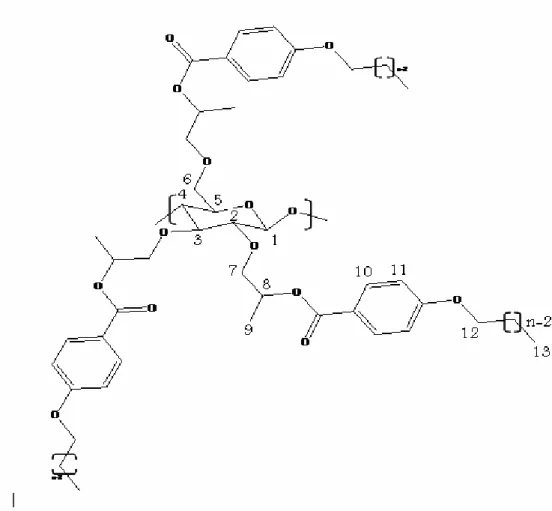
Figure (20) Chemical structure of ABPC-n………. 86
Figure
(21,A) 1H NMR spectra of HPC, 1,
ABPC-2 ABPC-3, ABPC-4 and ABPC-7……... 89
Figure
(21,B) 1H NMR spectra of HPC, 8,
ABPC-10, ABPC-12, and ABPC-14……… 90
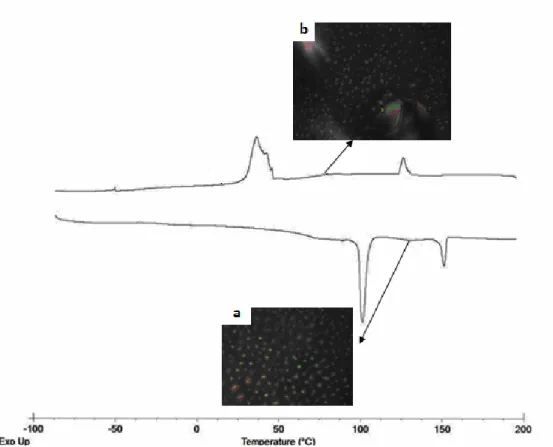
Figure (22) DSC heating curves of ABPC-n……... 92 Figure (23) DSC thermograms of ABPC-1, 2, 3 and 4
upon heating and cooling... 94 Figure (24) DSC thermograms and the observed PLM
images for ABPC-7 on heating; a) 120 ºC and b) 140 ºC and on cooling c) 90.0 ºC and
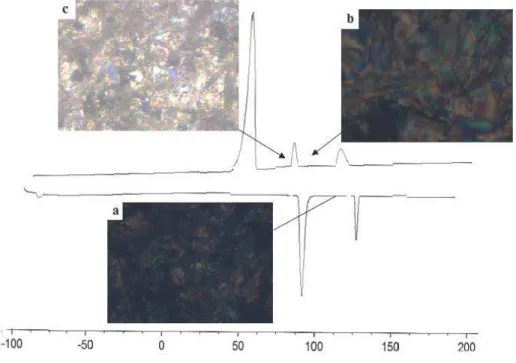
Figure (25) DSC thermograms and the observed PLM images for ABPC-8 on heating; a) 120 ºC
and on cooling b) 90.0 ºC and c) 30.0 ºC.... 97 Figure(26) DSC thermograms and the observed PLM
images for ABPC-10 on heating; a) 120.0 ºC, and on cooling b) 110.0 ºC, c) 80.0 ºC
and d) 50 ºC………... 98
Figure(27) DSC thermograms and the observed PLM images for ABPC-12 on heating; a) 85.0 ºC, and on cooling b) 85.0 ºC and c) 65.0 ºC...
99
Figure (28) DSC thermograms and the observed PLM images for ABPC-14 on heating; a) 70.0 ºC, and on cooling b) 90.0 ºC and c) 60.0 ºC…...
100
Figure (29) Plot of the mean refractive index vs. concentration for a) ABPC-2, b) ABPC-4, c) ABPC-8, d) ABPC-10, e) ABPC-12 and
f) ABPC-14………... 102
Figure (30) PLM images of a) ABPC-2, b) ABPC-4, c) ABPC-8, d) ABPC-12, e) ABPC-10 and f) ABPC-14 in 60 wt % DMA at room
Figure (31) Dependence of the birefringence on the number of the methylene groups of
ABPC-n... 106
Figure (32) FTIR spectra of (A) bagasse pulp
(cellulose) and (B) its Hydroxypropyl
derivatives (HPCB)... 108
Figure (33) 1H NMR spectra of HPCB... 109
Figure (34) DSC heating/cooling curves of HPCB, and
PLM image (a) of HPC at 180°C……... 110 Figure (35) PLM image of HPC solution in DMSO
(60 wt %) at room temperature... 111 Figure (36) FTIR spectra of HPC, ABPC-2, ABPC-10
and ABPC-12………... 113
Figure (37) 1H NMR spectra of HPC, ABPC-2,
ABPC-10 and ABPC-12…... 114 Figure (38) DSC heating curves of ABPC-2, ABPC-10
and ABPC-12………... 115 Figure (39) DSC thermograms and the observed PLM
images for ABPC-10 on heating; a) 125.0 ºC, and on cooling b) 120.0 ºC and
Figure (40) DSC heating curves of ABPC-m
DSC thermograms and the observed PLM images for ABPC-12 on heating; a) 100.0 ºC, and on cooling b) 95.0 ºC and c) 70
°C... 119 Figure (41) Plot of the mean refractive index vs.
concentration for a) HPCB, b) ABPC-2, c)
ABPC-10 and d) ABPC-12……...….. 121
Figure (42) PLM images of a) ABPC-2, b) ABPC-10 and c) ABPC-12 in 60 wt % DMA at room temperature………. .
List of Tables
TABLES PAGE
Table(1) Unit cell dimensions of the four main types of cellulose polymorphs, as published by Krässig……...……... 4 Table(2) Typical composition for hardwoods and
softwoods………...….... 7
Table(3) Physical and chemical properties of some non-woods used for papermaking…...…… 10 Table(4) Composition of Commercial Soy
Proteins………. 22
Table(5) Effect of beating on fibre morphology and WRV of bagasse pulp………... 66
Table(6) Influence of soy protein isolate
denatured by urea and NaOH... 69 Table(7) Influence of soy protein isolate
denatured by urea, NaOH and 1.5% Acrylamide (SPI2)…………...…. 73 Table(8) Influence of soy protein isolate
denatured by urea, NaOH and 2.5% Acrylamide (SPI3)…………... …... 74
Table(9) Influence of soy protein isolate denatured by urea, NaOH and 5%
Acrylamide (SPI4)……… 75
Table(10) The effect of pH of SPI on the physical
properties of paper sheets……… 78
Table(11) Influence of addition of kaolin together with the soy protein isolate on the paper
properties……….. 80
Table(12) Retention value of kaolin by bagasse pulp in absence of binder and with 2.5%
SPI4... 81
Table(13) 1H NMR data for ABPC-n…………... 88
Table(14) Thermal Properties ABPC-n……… 93
Table(15) Optical Properties of ABPC-n………….. 107
Table(17) Thermal properties of ABPC-m……….. 116
List of Abbreviations
CNCs MCC SCB WRV GCC PCC SPI SPC SF UF MF PAE C-PAM PVAm DMSO DMF DMA LC HPC CEC EC MC HEC Nanocrystals Microcrystalline cellulose Sugarcane bagasseWater retention value Ground calcium carbonate
Precipitated calcium carbonate
Soy protein isolate Soy protein concentrate Soy flour Ureaformaldehyde Melamine-formaldehyde
Poly(amideamine) epichlorohydrin resins Cationic poly (acrylamides)
Polyvinylamine Dimethyl sulfoxide Dimethylformamide N,N-Dimethylacetamide Liquid crystals Hydroxypropyl cellulose Cyanoethylcellulose Ethylcellulose Methylcellulose Hydroxyethylcellulose
HPMC CMHEC DS MS °SR TsCL THF DSC Tg Tc Tm PLM Hydroxypropylmethylcellulose Carboxymethylhydroxyethylcellulose Degree of substitution Moles of substitution Schopper riegler degree Para-toluenesulfonylchloride Tetrahydrofuran Differential scanning calorimetry Glass transition temperature Clearing temperature Melting temperature Polarized light microscope
Aim of work
The general aim of the present work is to utilize local Egyptian bagasse pulp in both conventional and non-conventional applications. The conventional application is devoted to papermaking, and the second is dedicated to the preparation of advanced cellulosic derivatives having liquid crystalline properties.
Many problems in traditional paper industry, such as environmental pollution, low production efficiency and high energy consumption exist. Nowadays, energy and environment become two main bottlenecks in the development of paper industry. The excessive use of petroleum-based binders will accelerate the deterioration of environment. So, there is a need to develop eco-friendly polymeric materials using renewable resources such as soy protein isolate (SPI) in paper industry as petroleum resources are finite and are becoming limited. The process of modification of SPI comprises three types; the first is denaturation using urea/NaOH, the second is addition of Acrylamide to denatured SPI and the third is studying the effect of pH of SPI on protein adsorption. Finally addition of kaolin with denatured SPI and studying the role of SPI as a retention aid of Kaolin will be studied. For all the previously mentioned
modifications, evaluation of the mechanical and physical properties of the paper sheet loaded with SPI will be investigated.
Cellulose derivatives prepared by substituting part or all of the hydroxyl groups showed a wide variation of their characteristics from industrial point of view. The variation of the properties is expectedly dependant, to large extent, on the degree of substitution (DS). Literature survey, concerning 4- alkyoxybenzoyloxypropyl cellulose, showed that no studies have been conducted regarding its preparation and characterization. A series of 4- alkyoxybenzoyloxypropyl cellulose samples will be synthesized via the esterification of hydroxypropyl cellulose (HPC) of DS 3 with 4-alkoxybenzoic acid bearing 1, 2, 3, 4, 7, 8, 10, 12 and 14 carbon atoms in the side chain. On the other hand, partially substituted HPC prepared from dissolving bagasse pulp through hydroxypropylation will be performed. Further, esterification of the partially substituted HPC and 4-alkyloxybenzoic acids, bearing 2, 10 and 12 carbon atoms in the side chain will be carried out. The liquid crystalline (LC) phases and transitions behaviors of the HPC and its derivatives will be investigated using polarized light microscopy (PLM) and differential scanning calorimetry (DSC), respectively.
Abstract
The present study deals with utilization of Egyptian bagasse in both conventional and non-conventional fields. The conventional application is devoted to papermaking, where bagasse pulp is the most appropriate pulp for this purpose due to the suitability of fiber length and high cellulose and hemicellulose contents. The non-conventional application is dedicated to the preparation of cellulosic derivatives having liquid crystalline properties.
The first approach deals with using modified soy protein isolate (SPI) as binder for cellulosic fibers in paper composites. Modification of SPI was carried out through i) denaturation with urea and NaOH. ii) addition of acrylamide to the denatured SPI. iii) changing pH of SPI. These types of modification were used to improve the adhesion properties of SPI. Pronounced mechanical and physical properties of paper sheets filled with 0.5, 2.5 or 5% denatured SPI was obtained upon using 2.5%. The optimum condition of SPI addition was used in ii and iii modifications. The additional effect of acrylamide on SPI was pronounced where the mechanical and physical properties were enhanced. Correlation between the mechanical and physical properties of paper sheets with the pH of SPI was studied. The used pHs were 3, 5, 7 and 10.The results showed that the maximum breaking length was obtained
at the isoelectric point of SPI at pH 5 (at the isoelectric point (IEP) the number of positive and negative charges on the polyion is the same, giving a net charge of zero) and it began to decrease when the pH is increased to pH 10. Both the burst index and the tear index showed parallel trends.
In the second approach, a series of 4- alkyoxybenzoyloxypropyl cellulose (ABPC-n) samples were synthesized via the esterification of hydroxypropyl cellulose (HPC) with 4-alkoxybenzoic acid bearing alkoxy chain with different lengths. On the other hand, cellulose was isolated in pure form from Egyptian bagasse pulp. Hydroxypropylation was then conducted on the isolated cellulose. 4-alkyoxybenzoyloxypropyl cellulose (ABPC-m) samples were synthesized via the esterification of the latter product with the same acid, bearing 2, 10 and 12 carbon atoms in the side chain and characterized.
The molecular structure of both esters (ABPC-n and ABPC-m) was confirmed by Fourier transform infrared (FT-IR) and 1H NMR spectroscopy. The liquid crystalline (LC) phases and transition behaviors were investigated using polarized light microscopy (PLM), and differential scanning calorimetry (DSC), respectively. The lyotropic behavior of the derivatives was investigated in DMA solutions using PLM and
the critical concentration was firstly determined via refractive index measurements.
Key Words: Bagasse, cellulose, soy protein, paper composite, mechanical properties, physical properties, 4-alkyloxybenzoic acids, hydroxypropyl cellulose, thermotropic and lyotropic phase behavior.
Chapter 1. Introduction 1.1. Cellulose
Cellulose is a polysaccharide common in all plant materials. It was first discovered and isolated by Anselme Payen and since then has been studied for over 150 years (Atalla 1999, French et al. 2004, O'Sullivan 1997, Salmon and Hudson 1997). Cellulose is also present in some fungi, bacteria, algae, and tunicates. It consists of repeating monomer units of β-D-anhydroglucopyranose rings linked by β-1, 4-linkages forming a linear chain. Each monomer unit contains three hydroxyl functions which are of interest for chemical modification. Each cellulose chain has a reducing end and non-reducing one, which gives it directionality. The reducing end ring can be opened to an aldehyde group at the C-1 position (see Figure 1) (Kontturi et al. 2006).
Figure (1): Cellulo
se structure (Kontturi et al. 2006).
1.1.1. Hydrogen bonding
There are intramolecular hydrogen bonds within an individual chain between the ring oxygen and C-3 hydroxyl
group, and between the C-2 and C-6 hydroxyl groups. This hydrogen bonding also contributes to the chain’s linearity. Individual cellulose chains are usually tightly packed together forming microfibrillar units making up a fiber by this strong intra- and intermolecular hydrogen bonds making up the crystalline or ordered domains. There can also be more loosely packed domains of microfibrils which form the amorphous or disordered regions. In the case of intermolecular hydrogen bonds between cellulose molecules in crystalline regions, it is of a very complex nature.
Depending on the native source and treatment of cellulose, the hydrogen bonding network and molecular orientation can be completely different. These differences give rise to the polymorphism of cellulose. So far, cellulose has been identified to exist in four different forms depending on native origin and treatment, cellulose I (α and β), II, III, and IV. Differences in crystal structure of these polymorphs are usually determined by X-ray diffraction and each gives a different diffraction pattern.
Cellulose I (α and β) is the native form and depending on its origin, exists in different ratios. For example, tunicates, wood, cotton and ramie fibers have primarily Iβ form, while some algae and bacterial cellulose have primarily Iα (Frenchet al. 2004). The
differences between these two polymorphs lie within the crystal structure and hydrogen bonding pattern, although both have cellulose chains aligned in parallel. Iα has a triclinic unit cell with
one cellulose chain per unit cell, whereas Iβ has a monoclinic unit cell with two chains per unit cell and actually it is the more stable form between the two. Iα can be annealed to produce Iβ, but it cannot be reversed.
1.1.2. Polymorphism of cellulose
When native cellulose I (α and β) is treated with alkali or dissolved in a suitable solvent and regenerated, the polymorph is converted to cellulose II (Atalla 1999, French et al. 2004, O'Sullivan 1997, Salmon and Hudson 1997). The structure of cellulose II differs from I in that the chains in II are in an anti-parallel arrangement where reducing and non-reducing end groups alternate in a microfibril, yielding a more stable structural arrangement. Thus, it has been found that cellulose II cannot be converted back to cellulose I. It is also important to note that the crystal densities of cellulose II and cellulose Iβ are almost identical. Shown in Figure 2 is the major supramolecular distinction between cellulose I and cellulose II (Kontturi et al. 2006).
If cellulose I (α and β) or cellulose II is treated with amines or liquid ammonia and then removed, cellulose III (either IIII or
IIIII) is formed (Atalla 1999, French et al. 2004, O'Sullivan 1997,
Salmon and Hudson 1997). Polymorph IV can be obtained by heating cellulose III up to 260 ºC in glycerol. A summary of possible cellulose polymorph transformations is shown in Figure 3 and their unit cell dimensions are given in Table 1.
Table (1): Unit cell dimensions of the four main types of cellulose polymorphs, as published by Krässig 1993.
Figure (3): Schematic representation of cellulose transformation into its several polymorphs (Klemm et al. 2002).
In order to separate and obtain all of the highly crystalline domains of cellulose from the amorphous regions, workers have employed different types of acid hydrolysis (French et al. 2004, Sturcova et al. 2004, De Souza et al. 2004, Hamad 2006).
Some variables in this process are the type of acid used, time, and temperature. For example, if one employs sulfuric acid hydrolysis, a more stable aqueous suspension of crystalline cellulose will be obtained because of anionic sulfate groups present on the surface. There are a few types of products made of mainly of crystalline cellulose, namely cellulose nanocrystals (CNCs) or whiskers and microcrystalline cellulose (MCC). CNCs are usually produced by either sulfuric acid or hydrochloric acid hydrolysis which hydrolyzes cellulose chains in amorphous regions, leaving rod or whisker-like crystals that the acid has not penetrated. MCC is usually derived from pulverized wood pulp hydrolyzed with hydrochloric acid to produce a colloidal cellulose powder. Some current uses for MCC are for fillers in foods and for tableting in pharmaceuticals (French et al. 2004).
1.2. Natural sources of cellulose
Cellulose can be derived from a variety of sources such as woods, annual plants, microbes, and animals. These include seed fiber (cotton), wood fibers (hardwoods and softwoods), bast fibers (flax, hemp, jute, ramie), grasses (bagasse, bamboo), algae (Valonica ventricosa), and bacteria (Acetobacter xylinum) (Nevell and Zeronian 1985).
1.2.1. Wood
Wood is one of the world’s most important resources, as raw material for industries, for construction and as fuel. Forests
cover an estimated 3,952 million hectares or 30 percent of the total land area (Rowell 2004). There is a very wide selection of species of trees, each having its own characteristics. Two basic groups of fibers are those from softwood (gymnosperms) species, such as pines, firs, and cedars, and hardwood (angiosperms) species, such as maples, oaks, poplars, and elms.
1.2.1.1. Softwoods
Softwoods consist of tracheids (90-95%) with approximate dimensions of 1.4-6.0 mm × 20-50 µm, running in the axial direction of the stem. The tracheids’ function is to support the tree and transport liquid within the tree. The other significant species of cells in softwoods are the ray parenchyma cells (5-10%) which are much smaller (0.01-0.16 mm × 2-50 µm) and arranged radially, taking care of storage of reserve food supplies. The most important morphological characteristics of softwood fibers are fiber length (3-7mm), which contributes to their tendency to flocculate when suspended in water, fiber width or diameter (20-50 µm), and fiber wall thickness (3-7 µm) (Fengel and Wegener 1983).
1.2.1.2. Hardwoods
Hardwoods have a greater variety of cell types in contrast to the tracheid as the main cell in softwoods. The hardwood consists of 36-70 % fibers (fibers form the basic tissue of the support system), 20-55 % vessel elements (handle the liquid
transport), and storage functions by longitudinal and ray parenchyma cells. In addition, hardwoods, compared to softwoods, have fibers that are shorter (1-2 mm) and narrower (10-40 µm) and rays that are more variable in width (Scott 1996).
Wood fibers are composed of three major components, cellulose, hemicelluloses and lignin. These compositions change with different wood species, wood age, location, and wood morphology. The typical compositions of softwood and hardwood are shown in Table 2 (Fengel and Wegener 1979).
Table (2): Typical composition for hardwoods and softwoods.
Parameters Hardwoods Softwoods
Cellulose 45±2 % 42±2 %
Hemicellulose 30±5 % 27±2 %
Lignin 20±4 % 28±3 %
Extractives 5±3 % 3±2 %
1.2.2. Non-wood fibers
There is a growing interest in the use of non-wood fibers, such as annual plants and agricultural residues, as a raw material for pulp and paper and cellulose derivatives applications. According to their origin, non-wood fibers are divided into three main types: (1) agricultural by-products; (2) industrial crops; and (3) naturally growing plants (Rowell and Cook, 1998; Svenningsen et al., 1999). Agricultural by-products are the
secondary products of the principal crops (usually cereals and grains) and are characterized by low raw material price and moderate quality, such as rice straw and wheat straw (Navaee-Ardeh et al. 2004; Deniz et al. 2004). Industrial crops, such as hemp, sugarcane and kenaf, can produce high quality pulps with high expense cost of raw materials. However, the source of the pulp is limited and these materials come from crops planted specifically to yield fiber (Kaldor et al. 1990; Zomers et al. 1995). Naturally growing plants are also used for the production of high quality pulps, such as bamboo and some grass fibers e.g. reed and sabai grass (Walsh, 1998; Poudyal, 1999; Shatalov and Pereira, 2002; Salmela et al. 2008).
Non-wood fibers account for less than 10% of the total pulp and paper production worldwide (Waranyou 2010). This is made up of 44% straw, 18% bagasse, 14% reeds, 13% bamboo and 11% others (Figure 4). The production of non-wood pulp mainly takes place in countries with shortage of wood, such as China, India and Egypt (Oinonen and Koskivirta, 1999).
The chemical compositions of non-wood materials have tremendous variations in chemical and physical properties compared to wood fibers (Gümuüşkaya and Usta, 2002; Rezayati-Charani et al. 2006). They vary according to the non-wood species and the local conditions, such as soil and climate (Bicho
et al. 1999; Jacobs et al. 1999). The non-wood materials generally
have higher silicon, nutrient and hemicellulose contents than wood (Hurter, 1988). Some parts of the non-fibrous materials may be removed by the treatment of the raw material that has a positive influence on the ash content and consequently on the pulp and paper properties. Table 3 shows average results of the chemical and physical analyses of some non-wood fibers (Hurter, 1988; Chen et al. 1987; Rodrίguez et al. 2008).
The utilization of non-wood fibers is an ethically sound way to produce pulp and paper compared to the clear-cutting of rain forests or primeval forests. The benefits of non-wood plants as a fiber resource are their fast annual growth and the smaller amount of lignin that binds their fibers together. Another advantage is that non-wood pulp can be produced at low temperatures with lower chemical charges. In addition, smaller mill sizes can be economically possible, giving a simplified process. Non-wood pulps are also more easily refined. Moreover, non-food applications can give additional income to the farmer
from food crops or cattle production (Rousu et al. 2002; Kissinger
et al. 2007; Rodríguez et al. 2008).
Table (3): Physical and chemical properties of some non-woods used for papermaking.
Non-wood fibers are used for all kinds of paper. Writing and printing grades produced from bleached non-wood fibers are quite common. Some non-wood fibers are also used for packaging. This reflects the substantially increased use of non-wood raw materials, from 12,000 tons in 2003 to 850,000 tons in 2006 (FAO, 2009; López et al. 2010).
1.2.2.1. Sugarcane bagasse (SCB)
The most important non-wood raw material in Egypt, Brazil, China etc. is sugarcane bagasse (SCB) as a secondary by-product of sugarcane extraction factories. It is used in the manufacture of pressed fibrous woods, paper pulp and as fuel. Bagasse represents 30-32 % of the sugar cane plant (Barnes, 1980). In Egypt, more than 33 million tons of crop residues are produced annually; sugarcane bagasse represents 3 million tons of these residues (Agriculture Economic and Statistics Institute, 2009). SCB has proved to be the easiest non-wood raw materials to collect transport and process. Processes with efficient systems for recovery of chemicals and heat are available to make various types of pulp and several grades of paper from bagasse. In general, 5.4 x10⁸ dry tons of sugarcane is processed annually throughout the world and 1 ton of sugarcane generates 280 kg of bagasse. Structurally, the sugarcane stalk consists of two parts, an inner pith containing most of the sucrose and an outer rind with lignocellulosic fibers. During sugar processing, the sugarcane stalk is crushed to extract sucrose (Boopathy 2004). This procedure produces a large volume of residue, the bagasse, which contains both crushed rind and pith fibers. Bagasse is a fibrous residue that remains after crushing the stalks, and contains short fibers. Basically, it is a waste product that causes mills to acquire additional disposal costs. It consists of water, fibers, and small
amounts of soluble solids. Percent contribution of each of these components varies according to the variety, maturity, method of harvesting, and the efficiency of the crushing plant.
The potential uses of bagasse: In sugarcane factory, bagasse is normally burnt as a fuel to produce steam and renewable electricity. Despite its 50% moisture content, bagasse has a high calorific value, 9.9 MJ/kg and has properties suitable for a range of highly value-added renewable products such as pulp and paper products, polymers, building materials and renewable fuels (Figure 5). Researchers have investigated bagasse lignin and cellulose as resources for renewable polymeric materials (Doherty, et al. 2007; Park, et al. 2008). Income from bagasse based polymers may grow substantially in the medium-term because consumer demand for plastics produced from renewable and sustainable resources is likely to increase.
Currently, there is much research on the uses of bagasse in synthesis of celluloseic derivatives. Cellulose acetate (Rodrigues Filho et al. 2000), methylcellulose (Viera et al. 2004) and carboxymethylcellulose (Morais and Campana 1999) were successfully prepared from cellulose extracted from bagasse. The relatively high cellulose content in bagasse, about 40 to 55%, makes it possible to use this residue in the production of cellulosic derivatives (Goldemberg et al. 2008; Aguiar, 2010).
Bagasse
Pulp and Paper
Fiberboard and building materials
Animal feed
Polymers Steam and electricity
Hydrothermal liquefaction
biofuels
Cellulosic ethanol Dietary fiber Waxes and Resins
Figure (5): Potential uses of bagasse.
1.3. Papermaking
Paper manufacture spans a very wide range of science and technology (Roberts 1996). The formation of paper is a continuous filtration process in which cellulosic fibers are formed into a network, which is then pressed and dried. The important chemistry involved in this process is, firstly, the retention of colloidal material during the filtration and, secondly, the modifications of fiber and sheet properties so as to widen the scope for the use of paper and board products. The chemistry of paper manufacture can be considered to fall into two distinct areas, namely paper formation and finishing.
The total global consumption from papermaking was projected to increase from 316 million tons in 1999 and 351 million tons in 2005 to about 425 million tons by 2010 (Waranyou 2010). Progress in pulp and paper technology has overcome most of the related environmental problems. The environmental problems have brought forth the cleaner technology now involved in papermaking. Non-wood materials have replaced traditional wood raw materials with less polluting cooking.
1.3.1. Factors affecting paper properties
- Fiber length
The properties of paper are dependent on the structural characteristics of the fibers that compose the sheet. Fiber length is one of the most important characteristics of papermaking fibers. Long fibers are more strongly held in the network than short fibers.
- Beating and water retention value
The term beating refers to the mechanical treatment of chemical pulp to make it suitable for papermaking. Chemical pulp practically is never converted to paper without first being subjected to beating. Beating is an important process step since this type of pulp can be said to have no papermaking properties until modified by the mechanical action of a beater.
Beating increases the bonding ability of fibers so that most paper strength properties improve. However, certain paper properties, e.g. optical parameters, decrease during beating. Tear strength typically first increases, reaching a maximum and then decrease (Seth and Page 1975). Beating has several structural effects on fibers: fines production, external fibrillation, internal fibrillation (swelling), fiber straightening (or curling) and fiber cutting (Page, 1989; Ebeling, 1980). Among the effects, the internal fibrillation of fibers plays a major role in the development of paper strength, because it improves the flexibility and collapsibility of fibers, which are essential for inter-fiber bonding and aspect which seems to be gaining more attention.
The Water Retention Value, (WRV) (g water/g pulp), primarily quantifies the inner fibrillation of the fibers and thus the swelling of the fibers. The amount of water it is able to hold gives a measure of the degree of swelling. The WRV increases with increased beating. It gives a hint of the paper webs performance in the press section. The higher the WRV the more difficult it is to press out water from the paper web.
- Effect of fines
Fines contribute to consolidation of sheet, interfiber bonding and to wet web strength. Interfiber bonds can be strengthened by adding strength chemicals and fines (Joseph 1982). As they have large specific area and their capacity
to adsorb polymers is therefore higher than that for whole fibers (Patricia 2006). Presence of fines has a positive effect on tensile strength and light scattering. On the other hand they have a negative effect on density, where low density is better (Minna 2007).
- Effect of additives
Additives play an important role in papermaking. In fact, almost all types of paper contain one or more added non-fibrous substance. These additives modify sheet properties in order that paper meets the specific requirements for its intended use (Fardous et al. 1997; Lenorad and Coughlin, 1984; Maher, 1985; Halpern, 1975). In general, the use of these additives is determined by economic considerations, i.e., whether it is more economical to use expensive raw materials or even more expensive binders, which, however, need only to be used in small amounts to produce the desired strengths. An optimum level of retention can reduce the costs of the chemicals.
The most common additives are classified into three main types: sizing agents, binders and filling materials. The objective of sizing is to retard the penetration of water or ink into the pores of paper and their spreading on the paper surfaces (Casey, 1961; Mobarak, 1968; Reichel, 1990). The binders represent the second main class of additives used in papermaking. Their main function
as can be anticipated from their name is promotion of fiber bonding, i.e. to increase the number of interfiber bonding and hence paper strength. These substances are usually hydrophilic compounds such as starches, vegetable gums, synthetic hydrophilic or water-soluble materials and resin emulsions or lattices. The third main class of additives is represented by the filling or loading the web to increase the opacity and brightness of the paper, and to some extent the smoothness and finishing of the paper which are important properties especially in printing papers.
-Fillers
Fillers can generally be divided into two groups, inorganic fillers and organic ones. The dominant fillers used in papermaking are inorganic fillers. Organic fillers are two main types, hollow micro-spheres and porous fillers, and they are suitable only for special applications because of high price (Mollaahmad 2008). In addition to the traditional fillers in micrometers, the use of nanofillers in papermaking has become very hot topic (Koivunen et al. 2009). The most common inorganic fillers used in papermaking are ground calcium carbonate (GCC), kaolin, and precipitated calcium carbonate (PCC). Talc and TiO2 are commonly used as well.
Kaolin is a pigment that is commonly used in papermaking. The popularity of kaolin can be explained by its low price, good availability and its relatively white color. Kaolin meets most of the filling requirements (except high refractive index) and hence is admirably suited for filling. This accounts for the large quantities consumed in the manufacture of magazine paper, book paper and other printing papers. Kaolin is found in natural deposits and can be processed in various ways to give a variety of different qualities. The cheaper grades are fractionated by air after drying and milling and these clays are commonly used as fillers. The better grades are water washed in order to obtain a better color and finer particle size (Casey 1982).
- Strength additives
Binders or adhesives are classified according to their effect on paper sheets. It is possible to distinguish between three basic types of paper strength. The initial wet strength is the strength of the paper in the wet state before drying. It greatly influences the operational characteristics of the paper machine. The dry strength which the paper possesses in the finished state is responsible for a trouble- free running in further processing steps, e. g. in a printing press or packaging machine. Finally the wet strength describes the strength of the paper after it has been wet (Franz and Sheldon 1991).
Dry strength additives are usually water soluble, hydrophilic natural and synthetic polymers. The commercially most important are cationic starch, natural vegetable gums, and acrylamide polymers. There are also others which are used in specialized applications, these are unmodified and anionically modified starches, proteins, soluble cellulose derivatives such as carboxymethyl cellulose, dual-purpose wet end dry- strength resins and polyvinyl alcohol’s, latexes and other polymers. The strength additives can be divided into two types: natural and synthetic polymers.
- Natural polymers
Starch is a biodegradable, renewable and inexpensive polymer. Additionally, it is one of the most abundant polymers in the world (Tiefenbacher 1997). Starch is found in a wide variety of naturally grown products, including rice, maize (corn), potato, tapioca and beans. Starch is made up of a repeated glucose chain, which can be found in Figure 6. The gelatinization of starch occurs when the starch granules swell and cross-link (Chen, et al. 1999). In the presence of excess water, a three dimensional matrix of swollen gelatinized starch granules forms, increasing the stiffness of the starch (Nagano et al. 2008). This thickening activity allows starch to be used as a resin.
Figure (6): Chemical Structure of Starch: Repeated Glucose Units (http://pslc.ws/macrogcss/starch.html).
- Soy proteins
The studies on soy proteins and their applications in industrial products, such as adhesives for wood and paper, binders in coatings and paints and as emulsifiers in colloidal rubber products were carried out extensively during early part of the twentieth century and are well documented (Endres 2001; Moure
et al., 2006; Park et al., 2002). However, the availability of oil at
a lower cost and biochemical inertness of petroleum-based products proved disastrous for the industrial use of soy protein. It is only after a lapse of almost 50 years that the significance of eco-friendly materials has been realized and once again, the polymer scientists are looking at biopolymers. There is a need to develop eco-friendly polymeric materials using renewable resources. Paper industry needs environment-friendly adhesives
from renewable resources because petroleum resources are finite and are becoming limited, whereas the demand for adhesives is increasing (Qiang et al. 2011). Soy protein is extracted from soy beans and is available worldwide. Although in the United States soy beans have mainly been used to feed animals, soy protein has good film-forming ability and has been used for sustainable films (Yamamoto, 2006).
Soy protein is commercially available in three forms: soy protein isolate (SPI), soy protein concentrate (SPC) and soy flour (SF). The compositions of these forms can be found in Table 4. SPI has the highest percentage of protein, and therefore has the best mechanical properties. For this reason, SPI was used as the soy protein binder in this work.
Soy proteins have different functional properties, which result from its amino acid composition, its structure, and its interaction with other proteins and substances present such as water, lipids and cellulose (Ghorpade et al. 1995). Due to the high availability and excellent mechanical properties of soy protein isolate, it has become a popular choice for resins in paper composites. Various studies have been performed using SPI as the resin of choice (Ghorpade, et al. 1995).
Table (4): Composition of Commercial Soy Proteins (Yamamoto, 2006).
Soy proteins Compositions
SPI SPC SF
Protein, % 90 68-72 46-53
Fat (acid hydrolysis), % 4-5 3-4 3-19
Ash, % 5-6 5-6 -
Dietary Fiber, % - 19-20 16-18
Carbohydrates, % - - 26-30
Moisture, % 6 6-9 8-9
In a native protein, the majority of polar and non polar groups are unavailable due to the internal bonds resulting from Van der Waals forces, hydrogen bonds and hydrophobic interactions. As a result of these bonds, a simple paste of protein is a poor adhesive and a chemical change is required to break the internal bonds and uncoil or disperse the polar protein molecules. Dispersion and unfolding of protein are enhanced by hydrolysis or by increasing the pH to about 11 or higher (Lambuth 1977).
Modifications of soy protein have introduced new cross-links in the protein structure, in addition to the naturally occurring ones (Singh, 1991). Improvements in cross-linking have been shown to improve the mechanical properties in SPI because of the increased linkage between the molecules of SPI (Ghorpade, et al. 1995). Modification of soy protein for functionality
improvements has been carried out via physical means such as heat treatment (Renkema and van Vliet, 2004) and application of pressure (Torrezan et al. 2007) or via chemical means such as acidification (Tay et al. 2005), addition of salts (Puppo and Añón, 1999) and by the Maillard reaction inducing cross-linking (Md Yasir et al. 2007b). SPI might be chemically modified by reaction with acrylamide or methylolacrylamide group to provide sites for crosslinking. These groups are hydrophobic and help prevent swelling of container film in water.
There are three types of modification used in this work to improve the adhesion properties of SPI i) denaturation with urea and NaOH ii) addition of acrylamide to the denatured SPI iii) changing pH of SPI. Urea is one of the chemical denaturation agents that unfold the secondary helical structure of protein. Urea has oxygen and hydrogen atoms that interact effectively with the hydroxyl groups of the soy protein, a reaction that may break down the hydrogen bonding in the protein body and, consequently, unfold the protein complex. The major effect of urea on soy protein globulins is dissociation of high molecular weight protein into sub units. Alkali denaturation by NaOH, is the most commonly used process to increase the adhesive strength and water resistance of soy protein. NaOH hydrolyzes the protein molecules which cause decrease in the molecular weight of the protein, increase in the free amino and carboxylic free end groups
and consequently increases its solubility and destroys the globulin structure of the protein (Huang and Sun 2000; Mo et al. 2001).
- Synthetic polymers
Synthetic polymers as strength additives that are used in papermaking include polyacrylamide (PAM), polyvinylamine (PVAm), and different wet strength resins: urea-formaldehyde (UF), melamine-formaldehyde (MF), and polyamideamine epichlorohydrin (PAE) resins (Petri 2009). Cationic polyacrylamides (C-PAM) are prepared by radical co-polymerization of an acrylamide monomer with a cationic charge carrying co-monomer (Figure 7). The polymers can be prepared with different molecular weights and charge densities depending on the use (strength, retention). Synthetic polyampholytes and polyelectrolyte complexes of polyacrylamides and other polyelectrolytes have also been shown as potential strength additives. Polyvinylamine is a linear amine functional polymer (Figure 7) known to improve both the wet and dry strength of paper. Wet strength resins are chemically reactive condensation products of urea-formaldehyde, melamine-formaldehyde, and polyamideamine epichlorohydrin (Figure 7), that gives wet strength to paper after drying and curing (Petri 2009).
Figure (7): The molecular structures of synthetic polymers (Petri 2009).
1.4. Chemical modification of cellulose
Cellulose derivatives constitute a very important and promising domain, representing value-added products derived from the chemical modification of a low-cost naturally available raw material. The chemical modification of cellulose is a common approach whose actors are its hydroxyl groups. Accordingly, it is typically carried out under the well-known classical reactions of these moieties, specifically esterification, etherification and oxidation reactions, as depicted in Figure 8.
Figure (8): Schematic representation of the main types of cellulose chemical modification and some of the typical ensuing products (Klemm et al. 1998).
Esterification is usually accomplished by reacting cellulose with an appropriate acid anhydride or acid chloride (Klemm, et al. 2005; Klemm, et al. 1998). Cellulose etherification can be carried
out by three main routes, namely i) by the Williamson ether synthesis with alkyl halides in the presence of a strong base, ii) with alkylene oxides in a weakly basic medium, or iii) by Michael addition of acrylic or related unsaturated compounds, such as acrylonitrile (Klemm, et al. 1998).
The esterification and etherification reactions can also serve as starting point for other more elaborated strategies, such as crosslinking and grafting polymerization; the former one is usually carried out by employing bifunctional modification reagents (Klemm, et al. 1998) The latter can consist, on the one hand, of the grafting of short side chains onto the cellulose backbone performed, for example, during etherification with alkylene oxides via addition of more than one alkylene oxide unit or, on the other hand, of a grafting-from process, for instance, by radical polymerization of vinyl compounds after the creation of a radical site at the cellulose chain (Klemm, et al. 2005; Klemm, et al. 1998).
The oxidation of the cellulose hydroxyl groups can occur at the C-6 position first to give an aldehyde group and then the corresponding carboxylic counterpart (Figure 8 , A and B). If this reaction takes place at C-2 and/or C-3 positions, it generates ketones (Figure 8, C to E) or, in the case of bond scission between C-2 and C-3, the corresponding dialdehyde (Figure 8, F) may be oxidized in turn to the diacid moieties
(Figure 8, G) (Klemm, et al. 1998). The preference towards a certain type of oxidation depends substantially on the nature of the oxidant, but usually both carbonyl and carboxylic functions are produced in varying proportions (Klemm, et al. 1998).
The supramolecular arrangement of cellulose, in terms of crystallinity or fibrillar architecture, strongly influences its properties. In addition to the solubility, this structural aspect plays an important role in determining the rate and often also the course of a chemical reaction, especially in the case of heterogeneous systems, thus influencing the extent and distribution of substituents and the product solubility.
For instance, a high supramolecular order of the cellulose chains, synonymous of lower accessibility of the hydroxyl groups due to the large amount of interfibrillar hydrogen-bonding, generally hinders the progress of chemical reactions (Klemm, et
al. 1998). This problem can be easily overcome however, and
thus the reaction rate is enhanced, by changing the nature of the medium, i.e., from heterogeneous to homogeneous (Klemm, et al. 1998).
The heterogeneous modification of cellulose is usually carried out in a medium where the polysaccharide is insoluble, where the reaction products could dissolve gradually into it (Klemm, et al. 2005). Contrary to the homogeneous modifications, with these types of conditions, the
supramolecular order and fibrillar architecture of the cellulose substrate largely determine the extent and rate of the chemical transformation. Thus, depending on the type of reaction, the medium, the degree of steric hindrance with the reagent, the sample morphology and reaction parameters, heterogeneous cellulose modifications can proceed within a wide spectrum of situations, from a surface-limited transformation to an in-depth or quasi-homogeneous bulk reaction (Klemm, et al. 1998).
The non-uniform character of the macromolecular ordering in native cellulose, due to the presence of the crystalline and amorphous regions, frequently leads to reactions that, depending on the conditions, can be limited to the latter regions or at least can proceed much faster in these disordered domains as compared with those of high order, as already mentioned. As a result, frequently the modification extent of cellulose in heterogeneous conditions can be significantly increased by lowering the supramolecular order and/or by loosening the interfibrillar bonding via an appropriate pretreatment. This pretreatment can either results in the complete destruction of the supramolecular order by dissolution and subsequent reprecipitation of the sample in a more amorphous form (only suitable for laboratory-scale studies), or in cellulose activation using liquids of high swelling power, such as water, aqueous alkali or dimethyl sulfoxide (DMSO),
which may also be employed as the reaction medium (Klemm,
et al. 1998). These liquids promote a loosening of the cellulose
supramolecular structure, while usually preserving the original solid state of the sample (Klemm, et al. 1998).
In homogeneous reaction conditions, cellulose is dissolved in an appropriate medium and consequently all the OH moieties are equally available for reaction, thus leading to a bulk modification (Klemm, et al. 1998 and Liebert, 2010).
This kind of modification implies the destruction of the microfibrillar integrity of the cellulose fibers, i.e., the hydrogen-bonding between the cellulose microfibrils, which deeply affects their supramolecular structure. As a consequence, the products obtained generally possess properties totally different from those of the perfect cellulose fibers, including physical and mechanical properties, constituting materials with thoroughly novel features. Homogeneous modifications have represented an important aspect of cellulose research for many years, because more uniform products can be obtained, compared to reactions conducted in heterogeneous conditions.
Cellulose dissolution can be attained by (i) physical interactions with the solvent or (ii) chemical reaction with the solvent leading to covalent bond formation (Heinze, and Petzold, 2008). Accordingly cellulose solvents can be subdivided
into derivatizing and non-derivatizing, and both categories include aqueous and non-aqueous media (Heinze, and Liebert, 2001; Liebert, 2010; Heinze, and Koschella, 2005). The term “derivatizing solvents” refers to all solvents and solvent systems in which the dissolution of cellulose occurs together with the formation of a labile ether, ester, or acetal derivative, called intermediate. This means that the intermediates should be easily decompose to regenerate cellulose by changing the medium (e.g. non-aqueous to aqueous) or its pH.
N,N-dimethylformamide DMF/N2O4 is an example of a
derivatizing system, whose intermediate is cellulose nitrite (Klemm, et al. 1998).
On the other hand, the non-derivatizing category comprises solvents or solvent systems, such as cadoxen (common denomination for cadmium ethylenediamine) and N,N-dimethylacetamide (DMA/LiCl system), which are able to dissolve cellulose only by intermolecular interactions (Edgar et
al. 2001). Additionally, more recently, much attention has been
focused on a new class of solvents, the ionic liquids, also known as “green solvents” due to their essential features, such as negligible volatility, i.e. the absence of one of the main problems associated with the use of common organic solvents (Pinkert et al. 2009).
- Applications of cellulose derivatives
Cellulose derivatives, being of natural origin, have diverse physicochemical properties and are revered for their large scale use mainly as additives of fine/special chemicals in textile, pharmaceutical, cosmetic, food, and packaging industries (Balser
et al. 1986; Barndt 1986). Cellulose and some derivatives form
liquid crystals (LC) and represent excellent materials for basic studies on this subject. A variety of different structures are forming thermotropic and lyotropic LC phases, which exhibit unusual behavior (Bhadani et al 1983; Tseng et al. 1982).
Despite the large variety of cellulose derivatives that have been made, there is a continuous expansion in the worldwide market of cellulose ethers because of their availability, economic efficiency, easy handling, low toxicity, and great variety of types. Combined effects of flow control, stabilization, water retention, film formation, etc. provided by cellulose ethers are not generally obtainable by the use of fully synthetic polymers. Cellulose ethers such as carboxymethyl cellulose (CMC), hydroxypropyl cellulose (HPC), ethylcellulose (EC), methylcellulose (MC), hydroxyethylcellulose (HEC), hydroxypropylmethylcellulose (HPMC), carboxymethylhydroxyethylcellulose (CMHEC), etc. have gained their position in the market due to their multifunctional properties.
1.5. Liquid crystal
As we know, there are three basic states of matter, solid, liquid, and gaseous states. These states of matter can be transformed into each other at appropriate conditions. In the solid state (generally meaning the crystalline state), the building blocks, such as atoms, or molecules, or clusters of molecules are packed closely and regularly, forming a crystal lattice. The physical properties of crystals are basically anisotropic. The crystals have a constant melting temperature (except for amorphous solids). As the temperature of matter increases the thermal movement of atoms or molecules becomes so severe that the crystal lattice is dissolved and fluidity appears. At this temperature, matter does not have a regular shape and anisotropic properties any more. It becomes a liquid. In the liquid state, the atoms or molecules are no longer arranged in a regular order, but they are still bonded to each other tightly, though not in the tightest packing. Increasing the temperature further up beyond the melting point, matter is transformed to the gaseous state. In the gaseous state, no short-range order exists. The interaction between the constituent molecules is extremely weak. Due to thermal excitation the molecules fill the container uniformly and hence the gas no longer has a flat surface. Generally, as the temperature increases progressively, matter at first appears in the form of a crystal solid, and then a liquid and finally the gaseous state.
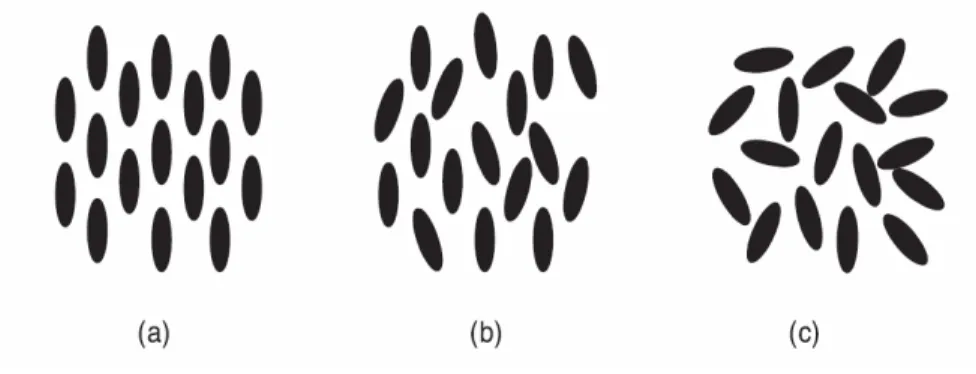
As the understanding about the states of matter became deeper, people had found that in addition to the above mentioned well-known three states, there exists other state of matter in nature such as liquid crystal state. The liquid crystal state is a kind of state whose order is between the crystal solid and isotropic liquid states. In the crystal state, there is a long range order in position and orientation, while in the liquid state there is no long range ordering in either of them. Figure 9 is a comparison of the crystal (a), the liquid crystal (b) and the liquid (c) states.
Liquid crystals are also called mesogens and various intermediate phases in which they could exist are termed mesophases or mesomorphic phases. LCs are anisotropic materials whose flow properties strongly depend on their structures and molecular orientation. The mesomorphic phases appear as a more or less viscous fluid which can be identified visually by their characteristic turbidity or by optical birefringence. Whereas LCs exhibit a degree of macroscopic orientational order that is found between the boundaries of crystalline solid state and isotropic, ordinary liquid state, the properties of LCs are intermediate between those of an isotropic liquid and those of a crystalline solid.
Many organic compounds, including macromolecules, would possibly form liquid crystals when they are heated above their melting temperatures. The well-known and widely studied liquid crystals are thermotropic and lyotropic (Priestley 1974; Meier, et al. 1975; Hans and Rolf 1980). Thermoropic liquid crystals are of interest both from the standpoint of basic research and also for applications in electro-optic displays, temperature and pressure sensors (Meier, et al. 1975). Lyotropic liquid crystals, on the other hand, are of great interest biologically and appear to play an important role in living systems (Meier, et al. 1975). Depending on temperature, pressure, constitutes, concentration, substitutes, and so on, mesogens can exhibit rich mesophases, including nematic (N), smectic (S) and cholesteric (Ch), Priestley 1974; Meier, Sackmann et al. 1975; Hans and Rolf 1980; Finkelmann 1987; Leadbetter 1987).
- Thermotropic Liquid Crystals
A mesogen is thermotropic if the order of its components is determined or changed by temperature (Priestley 1974; Hans and Rolf 1980; Pavel, et al. 2002). If temperature is too high, the rise in energy and therefore in motion of the components will induce a phase change: the LC will become an isotropic liquid. If, on the contrary, temperature is too low to support a thermotropic LC phase, the LC will become a crystal. The liquid crystallinity of thermotropic LC appears only in a particular temperature range, as schematically shown in Figure 10. Smectic, nematic and cholesteric are the three main types of thermotropic LC phases (Pavel, et al. 2002).
Figure (10): Thermotropic liquid crystalline transition (Pavel, et al. 2002).
I- Nematic Liquid Crystals
One of the most common LC phases is the nematic phase, where the molecules have no positional order, but they have long-range orientational order. Thus, the molecules flow and their center of mass positions are randomly distributed as in a liquid,
but they all point in the same direction (within each domain). Most nematics are uniaxial: they have one axis that is longer and preferred. Some liquid crystals are biaxial nematics, meaning that in addition to orienting their long axis, they also orient along a secondary axis (Cladis and Kleman 1972; Cladis 1974; Priestley 1974) as seen in Figure 11.
Figure (11): Schematic representation of molecular arrangements in nematic phase.
II- Smectic Liquid Crystals
The smectic phases are found at lower temperatures than the nematic. The smectics are thus positionally ordered along one direction. There are many different smectic phases, all characterized by different types and degrees of positional and orientational order. In the smectic A phase, the molecules are oriented along the layer normal, while in the smectic C phase they are tilted away from the layer normal. These phases are
liquid-like within the layers. Schematic of alignment in the smectic phases is shown in Figure 12.
Figure (12): Schematic structure of the molecular arrangement of the smectic-A and smectic-C phase.
III- Chiral phases
The chiral nematic phase or called cholesteric phase exhibits chirality (handedness). This phase is often called the cholesteric phase because it was first observed for cholesterol derivatives. Only chiral molecules (i.e. those that lack inversion symmetry) can give rise to such a phase. This phase exhibits a twisting of the molecules perpendicular to the director, with the molecular axis parallel to the director. The finite twist angle between adjacent molecules is due to their asymmetric packing, which results in longer-range chiral order. In the smectic C* phase (an asterisk denotes a chiral phase), the molecules have positional ordering in a layered structure (as in the other smectic phases), with the molecules tilted by a finite angle with respect to
the layer normal. The cholesteric phase is characterized by layers of nematic molecules where each layer is twisted with respect to the ones above and below it. As a succession of layers is passed through, the director turns through 360o (as shown in Figure 13) and the thickness of such a period represents a pitch length of the helix.
Figure (13): Schematic representation of cholesteric liquid crystalline phase. An important characteristic of the cholesteric mesophase is the pitch. The chiral pitch, p, refers to the distance over which the LC molecules undergo a full 360° twist (but note that the structure of the chiral nematic phase repeats itself every half-pitch, since in this phase directors at 0° and ±180° are equivalent). The pitch, p, typically changes when the temperature is altered or when other molecules are added to the LC host (an achiral LC host material will form a chiral phase if doped with a chiral material), allowing the pitch of a given material to be tuned accordingly (Hou et al. 2000).