1
Electronic Supplementary Information
High Capacity Anode Materials for Li-Ion Batteries Based
on Spinel Metal Oxides AMn
2O
4(A= Co, Ni, and Zn)
Fabrice M. Courtela, Hugues Duncana, Yaser Abu-Lebdeh*, Isobel J. Davidson
National Research Council Canada, 1200 Montreal Road, Ottawa, Ontario K1A 0R6, Canada * Tel: 1 613 949-4184, Fax: 1 613 991-2384, E-mail: [email protected]
2 Electronic Supplementary Information S1
X-ray patterns of the commercial CoO powder and the NiO powder sintered at 400 °C are shown in Figure 1. They both show a Fm-3m crystalline structure. The Rietveld refinement provided cell parameters of a = 4.1792(6) Å for CoO and a = 4.2633(2) Å for NiO. In addition, crystallite sizes of 298(34) nm and 16(24) nm were obtained for CoO and NiO, respectively.
Figure 1. XRD patterns of the commercial CoO powder and the NiO powder sintered at 400 °C. Supplementary Material (ESI) for Journal of Materials Chemistry
3 Figure 2. Cyclic voltammograms of half cells recorded between 0.01 V and 3V at 0.1 mV s-1 of a) commercial CoO and b) NiO sintered at 400 °C. Lithium metal was used as both counter and reference electrode.
4 Electronic Supplementary Information S3
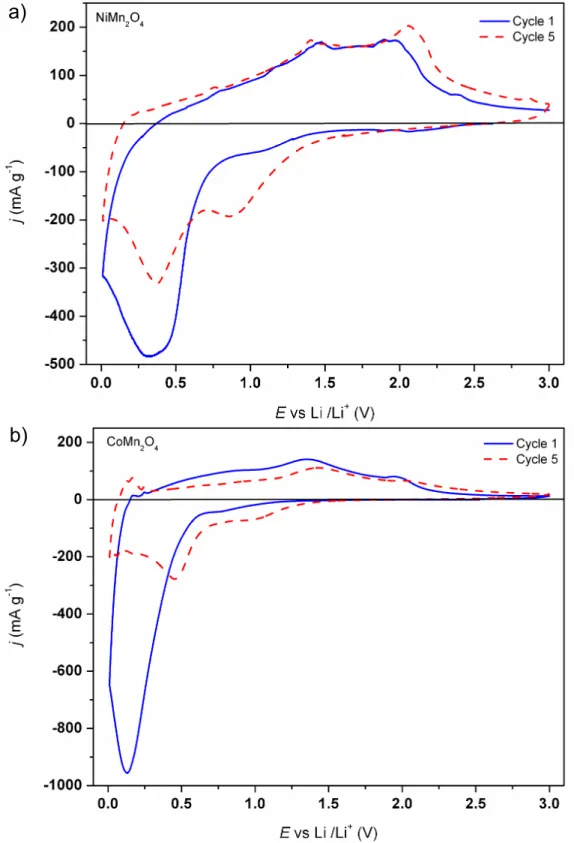
Figure 3. Cyclic voltammograms of half cells recorded between 0.01 V and 3V at 0.1 mV s-1 of a) CoMn2O4 sintered at 800 °C and b) NiMn2O4 sintered at 400 °C. Lithium metal was used as both
counter and reference electrode.
a)
b)
Supplementary Material (ESI) for Journal of Materials Chemistry This journal is © The Royal Society of Chemistry 2011
5 Figure 4. Charge/discharge profile of ZnO, Mn2O3, and ZnMn2O4 electrodes prepared from powders
6 Electronic Supplementary Information S5
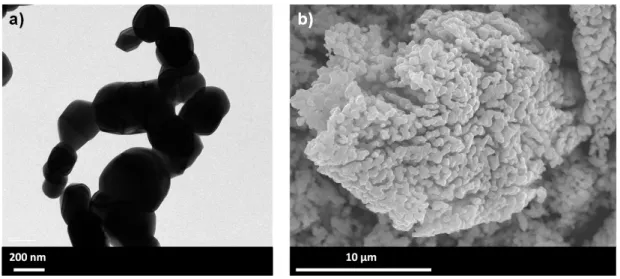
After filtration, the precipitate of zinc and manganese oxalate was dried and calcined at 800 °C for 16h instead of 2h. The Rietveld refinement of the X-ray pattern showed a crystallite size of 210(3) nm, which is larger than the value obtained for the powder annealed for 2h. SEM and TEM micrograph are shown in Figure 5. In agreement with the crystallite size value, by increasing the calcination time at 800 °C, the TEM micrograph (see Figure 5a) showed an augmentation of the particle size, now ranging from 200 nm to 300 nm. In addition, on a microscopic scale (see Figure 5b), one can see the aggregates appearance is very different when compared with the powder calcined for 2h only; fused, more rounded and bigger particles are observed within the aggregate.
Figure 5. a) TEM and b) SEM micrographs of a ZnMn2O4 powder sintered 800 °C for 16h.
Figure 6 shows a comparison of the cycling performance of half cells made of ZnMn2O4 heated for 2h
and 16h. The material sintered for 16h showed a 1st discharge capacity of 990 mAh g-1, which is about
200 mAh g-1 lower than the capacity obtained for the material sintered for 2h. In addition, a larger irreversible capacity (between the 1st and the 2nd cycle) of 465 mAh g-1 was measured and a lower stable reversible capacity of 310 mAh g-1 was obtained after 70 cycles. This lower performance is most
probably due to the larger particle size, as already demonstrated by Poizot et al. in the case of Cu2O.1
Supplementary Material (ESI) for Journal of Materials Chemistry This journal is © The Royal Society of Chemistry 2011
7 Figure 6. Discharge capacities of ZnMn2O4 electrodes prepared from powders sintered at 800 °C for 2h
and 16h. References
8 Electronic Supplementary Information S6
The conversion reaction equations of CoMn2O4 and NiMn2O4 are shown by the four following
equations. The capacity of the reversible reaction was calculated using CoMn2O4 or NiMn2O4 as
starting materials.
CoMn2O4 + 8Li+ + 8e-→ Co + 2Mn + 4Li2O 921 mAh g-1 (1st discharge) (1)
Co + 2Mn + 3Li2O ↔ CoO + 2MnO + 6Li+ + 6e- 691 mAh g-1 (reversible reaction) (2)
NiMn2O4 + 8Li+ + 8e-→ Ni + 2Mn + 4Li2O 922 mAh g-1 (1st discharge) (3)
Ni + 2Mn + 3Li2O ↔ NiO + 2MnO + 6Li+ + 6e- 692 mAh g-1 (reversible reaction) (4)
Supplementary Material (ESI) for Journal of Materials Chemistry This journal is © The Royal Society of Chemistry 2011