Publisher’s version / Version de l'éditeur:
Vous avez des questions? Nous pouvons vous aider. Pour communiquer directement avec un auteur, consultez la première page de la revue dans laquelle son article a été publié afin de trouver ses coordonnées. Si vous n’arrivez Questions? Contact the NRC Publications Archive team at
[email protected]. If you wish to email the authors directly, please see the first page of the publication for their contact information.
https://publications-cnrc.canada.ca/fra/droits
L’accès à ce site Web et l’utilisation de son contenu sont assujettis aux conditions présentées dans le site
LISEZ CES CONDITIONS ATTENTIVEMENT AVANT D’UTILISER CE SITE WEB.
Technical Memorandum (National Research Council of Canada); no. DBR-TM-93,
1967-11-01
READ THESE TERMS AND CONDITIONS CAREFULLY BEFORE USING THIS WEBSITE.
https://nrc-publications.canada.ca/eng/copyright
NRC Publications Archive Record / Notice des Archives des publications du CNRC : https://nrc-publications.canada.ca/eng/view/object/?id=96d0acdb-d761-48ae-824b-ea1c54905f7f https://publications-cnrc.canada.ca/fra/voir/objet/?id=96d0acdb-d761-48ae-824b-ea1c54905f7f
NRC Publications Archive
Archives des publications du CNRC
For the publisher’s version, please access the DOI link below./ Pour consulter la version de l’éditeur, utilisez le lien DOI ci-dessous.
https://doi.org/10.4224/20374832
Access and use of this website and the material on it are subject to the Terms and Conditions set forth at
Manual on snow removal and ice control in urban areas
Working Group on Urban Snow Removal, Snow and Ice Subcommittee,
Associate Committee on Geotechnical Research
MANUAL
on
SNOW REMOVAL
and
ICE CONTROL
•
In
URBAN AREAS
ANALYZEDPrepared by
Working Group on Urban Snow Removal
SNOW AND ICE SUBCOMMITTEE
ASSOCIATE COMMITTEE ON
GEOTECHNICAL RESEARCH
NATIONAL RESEARCH COUNCIL
Ottawa, Canada
PREFACE
The direct cost for the removal of snow and ice from roads, railways and air-ports in Canada now exceeds about 100 million dollars annually. It is not un-natural, therefore, that a problem that is such a financial burden to the people of this country should receive the attention of the National Research Council through its Associate Committee on Geotechnical Research.
The interest of the Associate Committee on this problem extends back to the very earliest days of the Committee. In 1947 the Committee sponsored a confer-ence at which snow and ice problems were discussed. It was recognized at that time that greater attention should be given to snow removal and ice control. Since then considerable attention has been given to this problem, primarily by those responsible for winter maintenance operations. The experience accumulated has been such that in 1964 the Snow and Ice Subcommittee of the Associate Com-mittee was able to sponsor a two-day conference on the problem. The Pro-ceedings
*
of this conference is a useful record of experience, as well as a source of information on the cost of winter maintenance and the factors that influence it. The conference indicated a real need for further study of snow removal and ice control in urban areas. The Snow and Ice Subcommittee of the Associate Com-mittee, therefore, set up a Working Group under the Chairmanship of W. D. Hurst, City Engineer of Winnipeg, to consider this problem. After careful consideration, the Working Group decided that the most urgent need at this time was for a manual of good practise that would record some of the extensive experience now available in Canada.The membership of the Committee was eminently suitable for the undertaking of such a project. Itcomprised men who have contributed significantly to Canadian experience in winter maintenance: J. V. Arpin, Director, Roads Department, City of Montreal; F. E. Ayers, Director, Department of Planning and Works, City of Ottawa; R. H. Burton, Traffic Consultant, H. G. Acres Co.; K. T. McLeod, Super-intendent, Weather and Ice Services, Meteorological Branch, Department of Trans-port; and L. W. Gold (Secretary), Head, Snow and Ice Section, Division of Building Research, National Research Council.
Winter maintenance is a continuing tax on the Canadian transportation industry. Itis important that we learn to conduct it in the most effective and efficient manner possible. It is indeed a pleasure to see the part that the NRC Associate Committee on Geotechnical Research has been able to play in increasing our capability in dealing with this problem, particularly through its co-ordination of the unselfish contribution of men with practical experience in the field, of which this manual
• Snow Removal and Ice Control, Tech. Memo. No. 83, Associate Committee on Geotechnical Research. National Research Council, Ottawa, 1964.
is an excellent example. On behalf of the Associate Committee, I wish to express its gratitude to the members of the Working Group for the notable contribution they have made through the recommendations and record of good practise that are contained in this Manual on Snow Removal and Ice Control in Urban Areas.
Robert F. Legget, Chairman,
Associate Committee on Geotechnical Research, 1945-1966.
MANUAL ON URBAN SNOW REMOVAL FOREWORD
In February 1964, the Snow and Ice Subcommittee of the Associate Committee on Geotechnical Research of the National Research Council sponsored a conference in Ottawa on Snow Removal and Ice Control. The Conference was greeted with widespread enthusiasm by those engaged in this field of operations, and the attend-ance was much larger than anticipated. At the end of the Conference, an ad hoc committee recommended that further studies and research be undertaken on this problem. As a result of the recommendations advanced, the Associate Committee on Geotechnical Research established a Working Group to give consideration to snow removal and ice control in urban areas.
The Manual on Urban Snow Removal is a direct result of this action. The Work-ing Group trust that the Manual will be of assistance to those who have the re-sponsibility of keeping our cities' streets both open and safe during the winter season and will, at the same time, encourage further development work on this most im-portant subject.
That the subject is one of great importance will be seen when it is realized that the direct annual cost for winter maintenance in Canadian urban areas is about $32 million. This amounts to about 15 per cent of the total money spent on municipal streets and roads. It is not unnatural that, when such a significant amount of public money is spent on a service, considerable knowledge and experience should have accumulated concerning it. Although urban areas have developed a very respectable capability for snow removal and ice control, this development has tended to occur in an independent fashion because of the lack of opportunities for the exchange of knowledge and experience.
The increasing extent and cost of winter maintenance has resulted in the need for more elaborate management procedures and methods of continually evaluating the adequacy and effectiveness of the service being provided. This, in turn, has created a need for an increase in the exchange of knowledge and experience between urban centres, and for the development of a record of practise. It was considered by the Working Group that the writing of a manual would be a most useful contribution towards satisfying this need at the present time.
The Manual is based on the experience accumulated over the years by a number of Canadian urban centres. It was not intended to be all inclusive in its coverage, nor indeed to be the last word on the subjects with which it deals. Winter mainte-nance is not a static activity, but one which is in an active stage of development. Only now is there developing a general appreciation of the factors that have a
significant influence upon it. As this appreciation grows, practices will be modified, and research and development will make available new concepts and methods. With this in mind, it was decided that the Manual should emphasize three im-portant aspects of winter maintenance, namely: preparation and conduct of opera-tions; budgeting and records; and bylaws and regulations. It was also considered that it should cover the equally important subjects of use of chemicals for ice con-trol, melting systems, and weather.
Preparation and conduct of operations is dealt with in Part I of the Manual. This Part reflects the broad experience accumulated over the years by the Roads Depart-ment of the City of Montreal, suppleDepart-mented by experiences of other Canadian cities. Budgeting and Records are discussed in Part II. The information contained in this Part is based largely on the experience of the Department of Planning and Works of the City of Ottawa, again supplemented by experiences of other Canadian cities.
Bylaws and Regulations are considered in Part III. Information on this subject was received from several cities, the Canadian Good Roads Association, and the American Public Works Association.
Ice Control has become a major problem of winter maintenance in urban areas. The Division of Building Research of the National Research Council has reviewed available knowledge and current practice on the use of chemicals and melting sys-tems for ice control. The results of this review are presented in Parts IV and V respectively. Weather is the factor that makes the whole winter maintenance oper-ation necessary. A review of weather and its influence on winter maintenance acti-vities, as well as a summary of the assistance available from the Meteorological Branch of the Department of Transport, is presented in Part VI.
It was recognized by the Group preparing the Manual that this first attempt is bound to be inadequate on many subjects. Comments and suggestions concerning the contents of the Manual, and recommendations as to information that shouldbe considered for future editions, would be welcomed by the Associate Committee on Geotechnical Research. Itis only through a critical appraisal of this first attempt that the standardization and record of practice required for winter maintenance will develop. Comments, suggestions and recommendations should be addressed to the Secretary, Associate Committee on Geotechnical Research, National Research Council, Ottawa, Ontario.
Mention must be made of the following individuals who have assisted the Work-ing Group in no small way in the development of the Manual:
P. A. Schaerer, Research Officer, Snow and Ice Section, Division of Building Research, National Research Council.
F. J. Mahaffy, Weather and Ice Services, Meteorological Branch,
Depart-ment of Transport. .
A. Johns, Engineer in charge of Roads, Department of Planning and Works, Ottawa, Ontario.
E. G. Hamlyn, Executive Assistant, Department of Planning and Works, Ottawa, Ontario.
In addition, useful comments concerning the Manual were received from several urban centres, the Canadian Good Roads Association and the American Public Works Association, and these are gratefully acknowledged.
The Manual represents the accumulation of many years of experience.Itis hoped that this record of experience will be useful to those who find it necessary to modify, develop or expand their winter maintenance program. It is also hoped that the Manual will not only encourage that uniformity of practice necessary for purposes of management, but also lead to the orderly accumulation of records required to establish where further research and development should be encouraged.
W. D. Hurst, Chairman,
Working Group on Urban Snow Removal.
PART I
WINTER MAINTENANCE OPERATIONS
Page
1.1 INTRODUCTION 17
1.2 PREPARING FOR WINTER MAINTENANCE OPERATIONS 18
1.2.1 Standards of Maintenance 18
(1) What Are Standards of Maintenance? 18
(2) Who Establishes Standards? 18
(3) What Standards Are Necessary? 18
(4) How Standards Are Changed 18
1.2.2 Classification of Streets 19 1.2.3 Organization 21 (1) Subdivisions 21 (2) Personnel 21 1.2.4 Responsibilities 23 (1) Central Control 23 (2) Districts 24 (3) Foremen 24 1.2.5 Training 25 1.2.6 Equipment 26 (1) Types 26 (2) Allocation of Equipment 26 (3) Winter Maintenance 26 (4) Summer Maintenance 27
1.2.7 Renting Equipment and Contracting 27
1.2.8 Ice Control Materials 28
1.2.9 Routes 29
1.2.10 Snow Disposal 33
(1) Dumps 33
(2) Sewers 33
Page
1.2.11 Communications 33
1.2.12 Topography and Exposure 34
1.2.13 Inspection 35
1.2.14 Weather and Climate 35
(1) Weather 35
(2) Climate 35
(3) Weather Forecast 35
1.2.15 Alert 36
1.2.16 Information to the Public 36
1.2.17 Control of Traffic and Parking 37
1.2.18 Public Transportation - Utilities 38
1.2.19 Street Planning 38
1.2.20 Budget and Record 38
1.3 CONDUCT OF WINTER MAINTENANCE OPERATIONS 39
1.3.1 Responsibilities During Operations 39
(1) Central Control 39
(2) Districts 39
(3) Sections 39
1.3.2 Instructions for Operations 39
1.3.3 Decision to Act 40 1.3.4 Plowing 40 1.3.5 Ice Control 41 1.3.6 Snow Removal 41 1.3.7 Snow Disposal 42 1.3.8 Clean-up 42 1.3.9 Railway Crossings 43
APPENDIX 1 - Suggested Standards for the Principal Snow Removal
and Ice Control Activities 43
APPENDIX 2 - Street Classification System Recommended by the Canadian
PART
n -
RECORDS
Page
2.1 INTRODUCTION 49
2.2 BUDGETING AND CLASSIFICATION OF ACCOUNTS 51
2.2.1 Budgeting 51
2.2.2 Chart of Accounts 51
2.2.3 Assigning Costs 52
(1) Overhead 52
(2) Indirect Labour and Materials 53
(3) Fringe Benefits 53
(4) Wage and Salary Rates 53
(5) Municipal Equipment 53
2.2.4 Who Develops the System 54
2.2.5 Control Reports 54
2.3. MEASURING AND RECORDING PERFORMANCE 55
(1) Plowing 55 2.3.3 Methods of Measurement 55 2.3.2 Recording Performance 56 2.3.1 Introduction 57 (2) Snow Removal 57 (3) Snow Disposal 57 (4) Snow Casting 58
(5) Ice Control on Roadways 58
2.3.4 Work Studies 59
APPENDIX 1 - Chart of Accounts 73
PART III -
BYLAWS AND REGULATIONS
Page
3.1 INTRODUCTION 83
3.2 SNOW EMERGENCY ROUTES 83
3.2.1 Emergency Routes - Designation 83
3.2.2 Emergency Routes - Declaration 83
3.2.3 Emergency Routes - Regulations 83
(1) Snow Tires and Chains 84
(2) Penalties, Fees, Liens 84
3.2.4 Emergency Routes - Signing 84
3.3 SECONDARY STREETS 84
3.3.1 Secondary Streets - Snow Clearing Signs 84
3.3.2 Secondary Streets - Snow Removal Regulations 84
3.4 OTHER REGULATIONS 8S
3.4.1 Other Regulations .,. Responsibility for Snow Operations 8S
3.4.2 Other Regulations - Sidewalks 8S
3.4.3 Other Regulations - Penalties 8S
PART IV -
CHEMICALS
4.1 OBJECTIVES 89
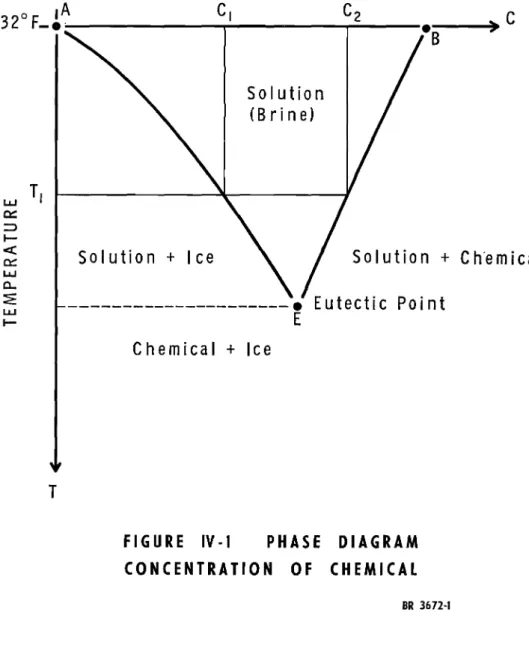
4.2 BASIC PRINCIPLES OF ICE MELTING BY CHEMICALS 89
4.3 FACTORS THAT INFLUENCE MELTING ACTION 90
4.3.1 Type of Chemical 90
4.3.2 Grading 90
4.3.3 Weather Conditions 91
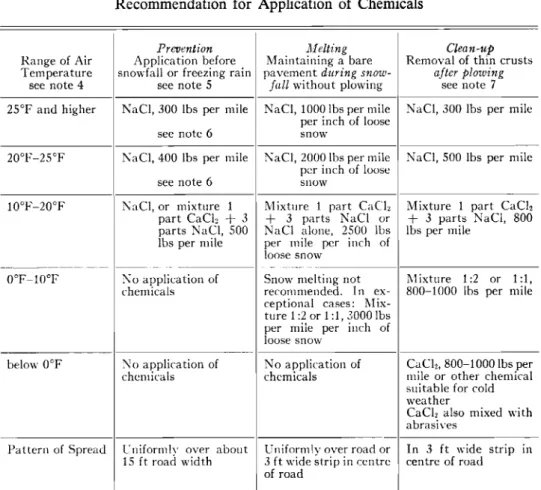
Page 4.3.5 Time of Application 91 4.3.6 Action of Traffic 91 4.4 MATERIALS 92 4.4.1 Requirements 92 4.4.2 Sodium Chloride 92 4.4.3 Calcium Chloride 93 4.4.4 Mixtures 93 4.4.5 Other Chemicals 94 4.5 APPLICATION OF CHEMICALS 95 4.5.1 Time of Application 95 4.5.2 Amount of Chemical 95 4.5.3 Cold Weather 95 4.5.4 Chemicals in Solution 96 4.5.5 Additive to Abrasives 96 4.5.6 Chemicals as Abrasives 96
4.6 SIDE EFFECTS OF CHEMICALS 97
4.6.1 Corrosion of Metals 97
4.6.2 Protection against Corrosion 97
4.6.3 Deterioration of Concrete 98
4.6.4 Effects on Asphalt Pavements 99
4.6.5 Damage to Vegetation 99 4.6.6 Other Effects 100 4.7 STORAGE OF CHEMICALS 100 4.7.1 Location 100 4.7.2 Elevated Bins 100 4.7.3 Sheds 101
4.7.4 Outdoor Stockpiles and Cribs 101
4.7.5 Bags 101
APPENDIX 1 - Standard Specifications for Sodium Chloride 108 APPENDIX 2 - Standard Specifications for Calcium Chloride 110
PART V -
MELTING SYSTEMS
Page
5.1 mERMAL SYSTEMS FOR SNOW REMOVAL
AND ICE CONTROL 115
5.2 IN SITU MELTING SYSTEMS 115
5.2.1 Heat Requirements for Melting Systems 115
(1) Sensible Heat 115
(2) Heat to Melt Ice 115
(3) Heat Loss by Evaporation 115
(4) Heat Loss by Convection and Radiation 116
(5) Heat Loss by Evaporation, Convection and
Radiation from Snow Surfaces 116
(6) Heat Loss to the Ground 116
(7) Total Heat Reqnirement 117
5.2.2 Standards of Removal 117
5.2.3 Systems Characteristics 118
5.2.4 Costs 119
5.2.5 Infrared Systems 119
5.2.6 Summary 120
5.3 MOBILE AND PIT-MELTING SYSTEMS 120
5.3.1 General Characteristics 120
5.3.2 Factors Influencing Design 121
5.3.3 Cost Considerations 121
PART VI -
WEATHER AND CLIMATE
6.1 WEATHER
6.1.1 Weather and Weather Forecasts 6.1.2 Weather Services in Canada
127 127 128
Page
6.1.3 Arrangements for Weather Service 128
6.1.4 Making Use of Weather Services 129
6.2 CLIMATOLOGY AND CANADIAN SNOWFALL 130
6.2.1 Climatology and Climatological Records 130
6.2.2 Canadian Snowfall Features 131
6.2.3 The Usefulness of Snowfall Data 132
6.3 PUBLICATIONS ON WEATHER AND CLIMATE 133
6.3.1 Basic Data and Climatological Maps 133
6.3.2 Current Data Periodicals 134
6.3.3 Meteorology and Weather Forecasts 134
PART I
1.1 INTRODUCTION
Snow removal and ice control is a service made necessary by a condition of the environment that makes it imperative that action be taken to safeguard man and property. For the small urban areas, a very adequate service can generally be developed based on accumulated experience and the common sense of those responsible for maintenance. In larger areas, however, particularly in cities of population of 50,000 or more, snow removal and ice control operations become much more complex and the demands for this service more extensive. Operational departments must be organized and equipped so that they can cope with the greater volume of work and with the emergencies that become more serious as the size of the area to be serviced increases.
Emergencies that must be handled by the Police, Fire and Waterwork Depart-ments are usually quite local. Snow and ice storms, however, can cause emergency situations that affect a large area similar to those due to floods or severe wind storms. Winter maintenance organizations must be prepared at all times to cope with these situations and to re-establish as rapidly as possible the road conditions required by modern traffic. If these storms are not dealt with rapidly and effectively, the life and economy of the community may be seriously affected.
Experience has demonstrated that the requirements of a successful winter main-tenance operation are:
(a) well-defined standards of maintenance;
(b) careful planning and equipping so as to be able to attain these standards; (c) effective control of the conduct of operations.
It cannot be overemphasized, however, that an effective and efficient snow re-moval and ice control service requires more than good planning and adequate equipment; it also requires good men. Men who conduct the operations must have a thorough knowledge of all matters related to their areas of responsibility. They must be capable of fighting snow and ice storms under the worst possible conditions, and in dealing effectively with one of Nature's most unpredictable forces "the weather". This is particularly true for men in supervisory positions. These men must understand the environment in which we live, be able to anticipate a change in conditions, and be ready to combat these conditions in the most effective manner. They must have developed to a high degree the techniques of planning and organi-zation of men, equipment and materials. Most of all, they must know how to co-ordinate these elements in such a way that, even after the worst storm, normal traffic conditions are attained in a matter of a day or two instead of a week. With such men, a sound, well-equipped organization and careful planning, it will always be possible to state when a storm strikes "Nous sommes prets" - "We are ready".
1.2 PREPARING FOR WINTER MAINTENANCE OPERATiONS 1.2.1 Standards of Maintenance
(1) What Are Standards of Maintenance?
Standards are the objectives that snow removal and ice control operations strive to achieve. They state the condition that is required for a given street under normal traffic use, and will vary in accordance with the role of the street in the transpor-tation network. People would like to have the snow removed as it falls on the road. Theoretically this is possible, but the cost would be prohibitive. Standards of maintenance must be realistic and chosen so as to provide a suitable road surface at a reasonable and acceptable cost. The cost should be in balance with the need and the benefit derived. Larger urban centres, therefore, will usually require and can afford higher standards of winter maintenance than smaller centres. The same general considerations apply to business districts vs. residential areas.
(2) Who Establishes Standards?
Standards of maintenance are ultimately set by the legislative body of a given urban area. They are a matter of policy and take into account the demand of citizens, traffic density, economic feasibility, topographical and climatological factors and the capability of equipment, men and materials. In practice they are evolved through experience, and influenced greatly by recommendations of the Maintenance De-partment, Police, Traffic Engineer and others concerned with traffic movement and control.
(3) What Standards Are Necessary?
Standards of maintenance must define for each type of street and sidewalk: (a) the service to be provided, e.g., maintenance of bare pavement, plowing
only, complete snow removal, casting to adjacent land, etc.;
(b) the maximum acceptable time for which a street may remain in an unsatis-factory condition following a storm.
Suggested standards for the principal snow removal and ice control activities are given in Appendix 1-1.
(4) How Standards are Changed
Once a policy is established, changes can be brought about in various ways. Public demands can be made known through elected representatives at council meetings. Decisions concerning these wishes are then transmitted to the Maintenance Depart-ment.
Changes in methods are often suggested by foremen to their superiors. These suggestions should be given careful consideration because they are based on
oper-ating experience and are often initiated by changed conditions such as new traffic patterns or parking restrictions.
The Head of Maintenance Operations will often introduce or recommend perma-nent or temporary changes in policy in response to changing traffic and conditions of work. Such recommendations may be necessary, for example, when it becomes advisable to have complete snow removal in certain sectors, or when introduction of the use of chemicals or changes in hours of operations are deemed necessary.
Major temporary changes in policy may be required to meet emergencies, such as might develop when two major storms occur in close succession. In such cases, it is particularly important to notify the elected officials of changes made and reasons for them so that these officials will be prepared for any public reaction. One need only observe the movement of traffic during a snowstorm to appreciate the influence snow removal and ice control practice can have on traffic flow. In-adequate service for one reason or another can result in a serious disruption in traffic, loss of life and property damage. It must always be kept in mind that the purpose of snow removal and ice control is to provide street and sidewalk con-ditions that will allow the traffic and pedestrian to keep moving freely and safely. The standards of maintenance evolved must define this condition for the traffic conditions that occur.
1.2.2 Classification of Streets
Attention must be given to street types and associated standard of maintenance required when organizing snow removal and ice control operations. At some stage, the action to be taken for each type of street should be tabulated. Table 1-1 is an example of such a tabulation.
The classification used in Table 1-1 is that recommended by the Canadian Good Roads Association. This classification is presented in Appendix 1-2.
For purposes of snow removal and ice control, streets may be further sub-divided, e.g.;
snow emergency routes;
streets upon which cars are allowed to park on both sides or on only one side;
one-way or two-way streets; - hilly sections.
Parking and width of streets may in some cases limit the type of work that can be done and equipment that can be used.
Locals Collectors
Arterials Freeways
TABLE I-I DEPENDENCE OF SNOW REMOVAL AND ICE CONTROL ACTIVITIES ON TYPE OF STREET
1 1 1 1 1 -N o Spreading Salt and/or mixtures Rate of application Mechanical at speed of 20/30 MPH. 600-1500Ibs/mile Continuous Mechanical at speed of 15/20 MPH. 600-1200Ibs/mile Continuous Mechanical at speed of 10/15 MPH. 300-600lbs/mile
Stops, lights, hills.
Mechanical or by hand at speed of 5/10 MPH. 300--600 lbs/mile
Stops, lights, hills.
a) divided - Move snow from L. to R. To clear full pavement-Same on other side on return trip.
b) undivided - Move snow from L. to R. from centre line-Same on other half of pavement on return trip.
Plowing (pavement)
Tandem plowing at 20/30 MPH.
300 ft between plows. -More plows, depending
on width, or no. of lanes
Tandem plowing at 8/20 MPH.
150 ft between plows. -More plows, depending
on width, or no. of lanes
Tandem plowing at 5/10 MPH.
30 ft between plows.
1) Parking permitted, sin-gle plow at 4/6 :\lPH. 2) No parking, two plows
5/8 MPH.
a) One-way streets-(i) parking one side
-clear of pave-ment from L. to R. curb
(ii) parking two sides -Plow centre lane L. to R. repeat and complete plowing after cars moved.
b) Two-way traffic-Plow half from L. to R.-same on other half L. to R. on re-turn trip. Plowing (sidewalks) Cross-walks clearing Loading and hauling Nil Nil
Rotary snow loader (high speed, if slush) 1 truckload/min.
1st pass to open, at 3/5 l\lPH.-more passes as necessary if snow con-tinues.
Last pass to widen. \Vheel tractor loader
172-2.11c.y. Rotary snow loader
(high speed, if slush)
72-%;truckload/min.
1st pass to open, at 3/5 MPH.-more passes as necessary if snow con-tinues.
Last pass to widen. Wheel tractor loader
1Yz-2)/2c.y.
Rotary snow loader and/or wheel tractor loader 20-30 loads/hr. depending on snow, distance and traffic
1st pass to open, at 3/5 MPH.-more passes as
necessary if snow con-tinues.
Last pass to widen. Wheel tractor loader
1-2C.y.
Rotary snow loader and/or wheel tractor loader 20-30 loads/hr. depending on snow, distance and traffic
1.2.3 Organization
The organization of winter maintenance activities will depend on the size of area to be serviced and amount of work to be done. It will vary from a one- or two-man operation satisfactory for small centres, to the very complex organization involving several hundred men required for large cities.
( 1) Subdivisions
The area to be serviced may be divided into districts, the number and size de-pending on the work load and local conditions. It may be convenient for adminis-trative and work assignment purposes to divide the districts into sections. Sections are usually the smallest unit into which an area is divided. Certain activities may also be grouped for administrative and supervisory purposes; for example, vehicle maintenance, maintaining accounts and records, etc.
(2) Personnel
No matter what type of organization is established, the creation of a Central
Control is essential. This is particularly true when several departments contribute
to the operation. One man should be designated as the "Head" of the winter main-tenance operations. The choice of this man must be made with great care so as to obtain the fullest co-operation from all the departments and to foster a team effort. He must be a senior official, such as the Director of Public Works, or the Head of the Roads or Sanitation Departments.
Each subdivision of the organization should be under the direct command of one individual. For example, a section, or the equivalent subdivision, would usually be under the direction of a foreman. Individuals in supervisory positions are the key men of a winter maintenance organization and must be chosen and instructed carefully. The Head of the winter maintenance operations must ensure that these individuals have the necessary experience and management ability and that they are fully aware of their responsibilities and position within the organization. Their assignments should be in writing so that there is no misunderstanding.
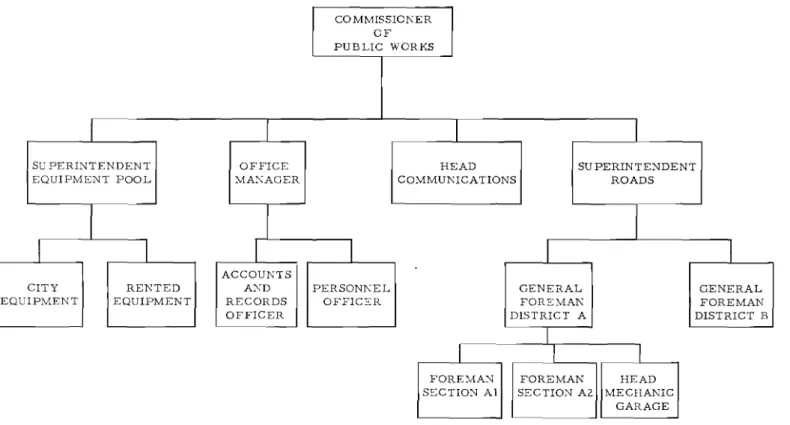
Personnel (permanent and auxiliary) should be assigned to, and be under the direct control of, the Supervisor of each District or equivalent grouping. Organi-zation of personnel at the District level must take into account winter maintenance activities to be conducted under contract arrangements within the District area. Well-prepared organization charts will assist in showing the men the make-up of the organization and where they fit into it. A master chart should show the skeleton structure of the whole departmental organization and the names of key personnel at each level of supervision. A second chart should show in detail the subordinate posts, particularly at the district level, and the tie-in with the master
tv tv COMMISSIONER OF PUBLIC WORKS
I
I
I
I
SUPERINTENDENT OFFICE HEAD SUPERINTENDENT
EQUIPMENT POOL MAKAGER COMMUKICATIONS ROADS
I
I
I
I
I
I
I
I
1
ACCOUNTS
CITY REKTED AND PERSONNEL GENERAL GENERAL
EQUIPMENT EQUIPMENT RECORDS OFFICER FOREMAN FOREMAN
OFFICER DISTRICT A DISTRICT B
I
I
l
I
FOREMAN FOREMAN HEAD
SECTION AI SECTION A2 MECHANIC
GARAGE
chart. These charts should be displayed so that everyone will have the opportunity to know his position and responsibility in the organization. Examples of organi-zation charts are given in Figure I-I.
The organization chart should show clearly the line of command to be followed. If, during operations, lines of command are crossed, any action taken should be corroborated with the least possible delay with the proper authority. Pre-season briefings are essential to inform men of their responsibilities, and to eliminate possible confusion due to lack of knowledge of the organization and its operating procedures.
1.2.4 Responsibilities
A successful winter maintenance program requires that the three essential elements, personnel, equipment and materials, be integrated into an effective fighting force. This is not easy! No one pattern of organization is followed by communities. Each assigns tasks to those officials or departments considered best capable of providing an effective operation. It is necessary, therefore, that the responsibilities of each group or supervisory level of the organization be clearly defined. Suggestions concerning the responsibilities that should be assigned to each level of supervision are presented in the following paragraphs.
( 1) Central Control
Central Control is usually located in the offices of the individual responsible for the entire winter maintenance operation. This office should have responsibility for the following tasks:
a) organization and control of the over-all operation; b) establishing and assigning standards of maintenance;
c) determining what work is to be done by municipal crews and what is to be let out for tender;
d) acquisition of rented equipment; e) allocation of equipment to Districts;
f ) organizing the equipment maintenance service;
g) organizing and controlling the communications network; h) arranging for and issuing weather reports;
i) arranging for control of traffic, parking and removing of illegally parked vehicles;
j ) providing information to the public;
k) arrangements with public transportation and other utilities; I ) maintaining accounts and reports.
The Head of the winter maintenance organization should be fully responsible to the elected officials for the organization and conduct of snow removal and ice control operations. He must be a planner by nature. Long before the first snowflakes come down, he must have established the whole plan for the winter's operations. By August or September he will have seen that there are adequate stocks of tools, salts and abrasives. He will have made several trips to the garages to ensure that changes and repairs to equipment will be completed on time. He will also have lined up his suppliers of rented equipment and completed arrange-ments of snow removal and ice control contracts. Finally, he will have made certain that each District and crew are fully prepared and that the communications system is in good working order.
(2) Districts
For medium to small municipalities, all planning wiII probably be done by Central Control, and details worked out in co-operation with the supervisory personnel. For large areas subdivided into Districts, Central Control usually plans only within the framework of general policies and, in particular, only those activities that apply in a general way to all Districts or the whole urban area.
Each district is usually autonomous and detailed planning within it concerning personnel, equipment, materials, and the work, is the responsibility of the District Supervisor. The District office should be responsible for the following tasks:
a) determining the number of men and amount of equipment required; b) assignment of men and equipment;
c) determining the amount of materials required and establishing stock piles; d) recommending what sections should be maintained by contractors; e) preparing route plans for their District;
f ) training men;
g) arranging for night and week-end work and standby crews.
The individual in charge of a district must be a man of thought and action. He must ensure that each unit under his charge has sufficient men, equipment, and materials; that the men are properly trained and informed about their work and prepared to act effectively at all times. If preparations are not as they should be, he should be prepared to take immediate, effective action. His foremen depend on him and he must not let them down. He must be ready at all times to answer for his group to the Head of the winter maintenance organization.
(3) Foremen
The foreman of a section should receive all necessary instructions concerning his territory from the District Supervisor. He must participate in the planning activity,
and sit frequently at District planning meetings so that he will know what is expected of him and his section. This mental exercise is good for him, for it helps him to become thoroughly familiar with his responsibilities.
The foreman should ensure that:
a) the organization chart for his section is complete;
b) the names, addresses and telephone numbers of all his personnel are proper-ly recorded and available;
c) each shift is planned well in advance, including holidays and week-ends; d) adequate equipment is on hand and each piece is manned by competent
operators;
e) personnel know their work routes and have received all necessary in-structions.
The foreman is the main pinion of the human machinery sent out to battle the snowstorm and the supervisor closest to the operation. He must be chosen with care, properly trained, and given the tools and men required for the job. It is his responsibility to see that men and equipment perform their tasks properly. He must anticipate the problems that may arise during operations and be prepared ahead of time to take the proper action. He must be organized so that he will have control over his men, equipment, and materials at all times.
1.2.5 Training
Equipment and materials can only be effective in snow removal and ice control operations if men know how to use them properly. It is important, therefore, to institute a training program that will be carried out before the winter season begins. The training of the lower echelons should be emphasized because these men are the important cogs in the snow clearing operations. By the end of the training program each man should know exactly what he is to do and be thoroughly fa-miliar with the area in which he is to work.
It is good practice to have "dry runs" with equipment before the snow season so that any faults in the operations can be rectified and any maladjustment of equipment corrected. Each equipment operator should have a map of his route, indicating stopping and starting points. He should know exactly what procedures he is to follow; for example, when and where he is to work alone or with others. Itis recommended that men be kept on the same work so that they will become thoroughly familiar with it and, therefore, perform more efficiently. Contractors and owners of rented equipment should also be urged to follow the same practice.
1.2.6 Equipment
(1) Types
Winter maintenance equipment can be divided into two general groups. One group is the special purpose equipment that is used exclusively on snow or ice. This group includes salt spreaders, plows and attachments, sidewalk tractors and blowers. The second is the multi-purpose machines, such as trucks, loaders, flushers, certain types of tractors, etc.
Equipment may be owned by a municipality, by a contractor, or rented. The relative distribution between these three sources of equipment will depend on the work load, amount of equipment available and policy. Arrangements for equip-ment must be settled well in advance of the winter season.
(2) Allocation of Equipment
In small- and medium-sized areas, allocation of equipment is usually not a major problem. Serious problems, however, are often encountered in large urban centres. There is often a lack of equipment in one area, and this must be remedied by transfer of municipal-owned equipment from other districts, or by renting equip-ment. The allocation of equipment must be decided early and, if possible, the equipment should be distributed and ready for action before the winter begins. Consideration should also be given to the possible need to relocate equipment temporarily in times of emergencies.
(3) Winter Maintenance
Equipment is the lifeline of a modern snow and ice fighting force and must always be in the best possible working condition. It should be handled with care and only competent operators allowed to use it. Equipment is put through a gruelling test during each snowstorm, however, and breakdowns can be expected. Experience indicates that after the first 24 hours of operations, as much as one-quarter of the equipment may be out of action. Adequate repair facilities must be available as the efficiency of winter maintenance is very much dependent on the speed at which equipment can be put back into operation.
It is necessary to ensure at the planning stage that garages will be well equipped and capable of making good and rapid repairs of both a minor and major nature. Garages should be well staffed and always open. For large urban areas, there should be a garage in each district for minor repairs and large central facilities for major repairs. Plans should include a good road service with a sufficient number of radio-equipped trucks always ready or, better still, on patrol during storms to answer calls and be on the spot when needed. The additional expense of such a service will more than pay for itself. It is useful to have radio-equipped tank
trucks on the road with predetermined routes for refuelling equipment, preferably during lunch hour.
Arrangements should be made to ensure that equipment is periodically checked and adequate preventive maintenance applied on a routine basis. Minor defects, if not looked after, can develop into major breakdowns. Equipment that is abused can give trouble when it is most urgently required.
(4) Summer Maintenance
Both the special and general purpose equipment require special care so that they will be ready for use as soon as winter arrives. Each Spring the equipment must be thoroughly checked, overhauled and painted. The special purpose equipment must be properly stored and its condition occasionally checked during the sum-mer. It is dangerous practice to leave this equipment unattended after the com-pletion of winter, assuming that early Fall will be soon enough to get it back into working condition. General purpose equipment must be altered in the Fall and Spring to prepare it for the work to be done. These activities should be planned in advance and established as normal routine.
1.2.7 Renting Equipment and Contracting
Public demand for rapid snow removal and ice control has resulted in a need for a large array of equipment. Small- and medium-size communities may be able to satisfy this demand with their own equipment, perhaps supplemented by rented equipment for the heavier storms. Ownership of all the equipment required for winter maintenance is impractical for large cities. The investment required is uneconomical because much of the machinery required would only be used during the winter for a total of from 40 to 60 days. Consideration must often be given to renting a considerable number of plows, graders, wheel or crawler loaders, tractors, trucks, etc., and to having some areas maintained under contract.
The requirements for rented equipment and the areas to be maintained by con-tract must be determined during the planning stage. Areas to be maintained by municipal crews and those by contractors should be laid out on large-scale maps. These maps should show the street classification by appropriate colours, traffic lights, stops and location of snow dumps. If properly prepared, they can be useful when planning routes for the different operations, and can also serve as a model for the smaller route plans that should be provided to each machine operator.
Rented equipment should be integrated with the municipal crews, and its oper-ators receive their instructions along with them. If the amount of rented equipment becomes too great, difficulties may be experienced in controlling it. Difficulties may also be experienced in obtaining the equipment required because of an
in-adequate supply due to demands of surrounding communities. This demand can result in inflated rental rates, particularly in large urban areas, and make the cost of winter maintenance with rented equipment relatively high.
Snow removal and ice control by contract has provided one means of over-coming the difficulties that may be encountered when relying on rented equipment to provide necessary additional capability. Experience has indicated that this method can keep supervision to a reasonable level and reduce the amount of money expended on non-productive time. Many contractors are interested in ob-taining such contracts because it provides them with an opportunity to keep key personnel on the payroll through the winter and to obtain fuller use of equipment. If tenders are called for rented equipment or snow removal by contract, it is usually necessary to guarantee a minimum number of hours of work.
Notices concerning equipment requirements and areas to be let out to contract should be placed in all local and rural papers well before the snow season begins. Because the response to these notices is usually poor, they may have to be repeated regularly and follow-up action will probably be necessary. Lists of equipment owners employed in earlier winters should be maintained and brought up to date each fall.Itis useful to send circular letters to these owners urging them to commit their equipment as soon as possible. Considerable time and effort may be required to reach these people and obtain from them a definite answer. It must be kept in mind that, when the first major storm strikes, usually only half of the equip-ment committed will be available, the remainder still being on summer work. This potentially serious letdown should not be overlooked when planning the winter operations.
In some areas it may not be possible to obtain the equipment or men and ma-terials required for winter maintenance. If this is the case, it may be possible to make arrangements with provincial road authorities for help in the event of a severe storm. These arrangements are vital and should be made well in advance of the snow season.
1.2.8 Ice Control Materials
The more important materials, such as chlorides and abrasives, should be ordered well in advance of the winter season. The amount of materials required must be estimated from experience, miles of street to be treated, and established policy. It may happen that tenders for materials are rejected and new tenders must be called. If the time schedule is too short, it may result in materials not being available on time, resulting in serious consequences. Storage must also be planned. Stockpiles should be adequately protected from the weather and well distributed
throughout the city to minimize hauling and handling. Information on the storage of chlorides is given in Part IV.
1.2.9 Routes
When a snowstorm or other form of precipitation creates a hazard on city streets, it is unwise to try to cope with this situation without having developed a plan of attack. There is bound to be confusion unless proper planning has been carried out well in advance. Equipment operators must know exactly what to do. They should have definite instructions, preferably in simple graphical form, that show the route to be followed and the sequence of their tasks.
Street priorities must be established during the planning stage. These priorities must be taken into consideration in the planning of routes, and should be clearly shown on route maps. The route maps should also indicate special instructions, such as where and when single and tandem plowing is required. It should be kept in mind that heavy snowstorms usually call for single plowing to keep open as many streets as possible. When the rate of snowfall subsides, tandem plowing is then used to widen roads. Special attention must be given to the way in which route instructions are to be handled in areas being maintained by a contractor. Figures 1-2, 1-3 and 1-4 are examples of route plans.
.... .... hi .... .... .... ... .... ....
....
w w w w w ww w w w wD:: w w w w w ww w w W a: D:: D:: D:: a:D:: D:: a: .... a: ... a:'"
....'" ....'" ....'" '" '" .... ...."'''' .... ....'" '" ....'" I....
e e I I I I I I I .... '" Z a: ... ... .... .... .... a N..,
"'"'"
"'
... CD 0> 0 N '" '"'"
"'''' "'''' '"N..,
:::c < (!l..,
セ]
;:=::====;1 :=1
]セ
, - - - 1 ;:::1]セゥ
,--, :===-::!JJ, _ .
z-Schedule for Plowing Main Streets
Crew "A" - 3 plows: A, B, C
Crew "A-1" - 2 plows: A, B
Street From To Sides Street From To Sides
12th Ayenue 30th Street 28th Street W 28th Street 12th Ayenue 3rd Ayenue N 28th Street 3rd Ayenue 14th Ayenue S 28th Street 14th Ayenue 12th Street N 12th Ayenue 28th Street 30th Street E
9th Ayenue 10th Ayenue 9th Ayenue 10th Ayenue 4th Ayenue 29th Street 6th Ayenue 30th Street 20th Street 30th Street 20th Street 30th Street 3rd Ayenue 30th Street 20th Street W 30th Street E 20th Street E 30th Street W 21st Street 2 4th Ayenue 2 22nd Street 2
LEGEND
Plowing done with 3 plows - -
セ- -
セPlowing done with 2 plows
---+-FIGURE 1-2
EXAMPLE ROUTE PLAN FOR SNOW PLOWING MAIN STREETS
...
...
...
...
...
...
...
...
... ...
UJ UJ UJ UJ UJ UJ UJ UJ
UJ UJUJ UJ UJ
<>:: UJ UJ UJ UJ UJ UJUJ UJ UJ W UJ
...
<>:: <>:: <>:: <>::<>:: ex:<>:: <>:: ex: ex: ex:o»
...
u»...
u»...
v> v> v>...
...
...
v>V>...
v> v>... o»... <n...:>::
...
z Cl :>:: :>:: :>:::>:: :>:: :>:: :>::...
... v> Cl <>:: ... ......
......
v> 0 N N ,..., "'on "' .... CO en 0 ;;:; N N N N N NN N N ,..., ;;0 < CD..,
I
=:/
I
-.-z-ll[56:
II II I I IST AVE II " I I " " "t
c::::=::::J
I 1c::=:::J1 Iセi
d IJ
I:::
A:VEEセ
II
I
I I 15TH AVE ' II
16TH AVEI
51
I
I
7TH AVEセ
.I I I BTH AVE II IIII
I
19 TH AVEj
==:Jc:=::,
110TH AYE/JIGセ =:::J L-., I I==r
cjNャャjセ III
H
IIiTH AVE/fl/==rLJ"
ーセ I IIl@!iYi//l
S
t
a
sセセ
エjLセGW
V';3THAセc[
II---.
114
TH AVE , I II IIII
I
0115 TH AVE D I rI
II
II
101
r----, , II i i j I ,,....,Schedule for Plowing Main Streets
Crew "A-2" - 1 plow: C
Street
From
To
Sides
30th Street
26th Street
24th Street
22nd Street
8th Avenue
21st Street
13th Avenue
10th Avenue
14th Avenue
14th Avenue
22nd Street
8th Avenue
3rd Avenue
3rd Avenue
3rd Avenue
3rd Avenue
21st Street
3rd Avenue
22
2
2
22
FIGURE 1-3
EXAMPLE ROUTE PLAN FOR SNOW PLOWING MAIN STREETS
l- I- l- I-
1-1-..,
..,
..,
..,
..,..,
..,
..,
..,
..,
..,..,
a: a: a: a: a: a: l- I- l- I- 1-1-(J) (J) (J) (J) (J)(J) :J: l- e e :J::J: I- (J) Z a: 1-1-0 N N'"
...
'"
N N N N N1
'---' l-J
1 Ic:=JC]
I IAi
c:;:::JI
:=J
tart
[]L
t
/
--7(
]ZZjセ =::J r I =:JCJI':JCJ'I
=:JCJb
c::::=JI
=::::J =:JU
c i'i...-...:J I I=:Jqr:
I
II
I
DI
,...----, iII
I
i i i 1-1-..,..,
l-.., ..,
I- I-..,
w..,.., ..,
..,
a: a: a: a: a: 1-1- l- I- I-(J)(J) (J) (J) til :J:::<: :J: :J:I-...
l- I- (J)..,!'-
GO'"
;;; NN N'"
I I I J 1ST AVE I i ;;0 < (l)..,
Schedule for Sidewalk Plowing (one plow)
Street From To Sides
BR3952-3
2
2
2
2
2
2
2
2
31st Street 30th Street 4th Avenue 4th Avenue 4th Avenue 4th Avenue 30th Street 30th Street 21st Street 21st Street 3rd Avenue 3rd Avenue 3rd Avenue 3rd Avenue 22nd Street 22nd Street 4th Avenue 3rd Avenue 23rd Street 25th Street 27th Street 29th Street 5th Avenue 6th Avenue Note:All other sidewalks shown on this map, which are not included in this schedule, are cleared
by
other plows.FIGURE 1-4
1.2.10 Snow Disposal
(1) Dumps
In some areas it is necessary to remove the snow completely from the streets. At-tention must be given to the disposal of this snow. Some municipalities are fortunate in having conveniently located areas for dumping snow including accessible rivers with suitable embarkments, or even bridges that may be closed at night and snow blown from them. Difficulties in disposing of snow may be accentuated by a bare pavement policy and an unwillingness of citizens to tolerate snow accumulation at the back of sidewalks. A continuing search for suitable dump areas may be necessary to find replacements for areas taken over for development purposes. When haul distances become too great, consideration should be given to other methods of disposing of snow, some of which are discussed in the following sections.
(2) Sewers
Disposal of snow into sewers is an alternative method, but if this is done, the following factors must be appreciated:
a) the flow of water to carry the snow away. In some situations it may be practical to obtain sufficient flow by adding water;
b) adequate flow may only occur in the day but, if the work is done at that time, it may interfere with traffic;
c) the sewer must be large enough to carry the additional load;
d) the snow will contain grit and refuse. It may be expensive to remove this debris from the sewers.
(3) Snow Melters
In some areas the cost of disposing of snow by hauling and dumping has increased to the extent that it has become practical to invest in snow-melting facilities. Mobile melters may provide the best solution for snow disposal problems in small congested urban areas. The slowness of this method, however, makes it unsuitable for widespread urban areas, and for this situation the large stationary pit-type melter may provide an economical solution. Ifserious consideration is to be given to snow-melting systems, information concerning the real cost of loading, hauling and dumping snow required for cost comparison studies should be accumulated well in advance. Snow-melting systems, including the embedded type, are discussed in Part V.
1.2.11 Communications
Communications are as vital to snow removal and ice control operations as are nerves to the human body. They are the lifeline which makes it possible for a winter maintenance organization to respond rapidly and effectively to varying
con-ditions during a storm. To achieve the high degree of mobility that is required during operations, attention must be given to developing a good communications system and to ensuring that it always functions properly.
Control of communications should be in the office of Central Control. Each District may have its own subcentre of communications which is directly con-nected with the communications control centre. The control centre and subcentres must be staffed with competent operators and with replacement operators when necessary. A list of all the key personnel, with their addresses and telephone num-bers, should be posted at each of the communications centres.
Central Control, District offices, yards, equipment dispatch centres, dump sites and other departments that are involved in operations must be inter-connected by telephone and, ifpossible, by teletype. Teletype has the advantage that all stations can receive messages at the same time and that instructions are in writing. "Punch Card"-type telephones which eliminate errors in dialing should be considered, if available.
One of the most effective means of communication is the radio with fixed and mobile stations. Foremen at work and vital pieces of equipment, such as salt spreaders, should be on a two-way radio network. During storms, the Control Centre should regulate the transmission of all radio calls to eliminate any con-fusion that can arise through congested air waves. All personnel who use radio should be trained in its use. Stress should be placed on the importance of brief and to-the-point messages und the use of codes.
1.2.12 Topography and Exposure
Topographical features that affect winter maintenance operations, such as hills, open areas exposed to wind, etc., must be given careful consideration to ensure proper action is taken to avoid difficult and hazardous conditions. Ice may form at exposed sites during thaw periods, and extra spreading of chemicals or abrasives may be required. Grades, if not attended to promptly, can quickly result in snarled traffic.It is sometimes effective to place abrasives in boxes at difficult sites and assign personnel to spread them manually.
Areas subject to drifting require more plowing, and additional equipment may be necessary because of this.
Snow fences are sometimes useful in areas where drift conditions are well de-fined and there is sufficient space for the fence to be effective. Fences should be placed prior to the freezing of the ground.
Maps of plow and spreader routes must show trouble spots clearly and indicate that prompt action is necessary. Keep the traffic moving at these spots and half the battle is won.
1.2.13 Inspection
Snow removal and ice control operations can deteriorate rapidly if there is not a good system of inspection. All supervisory personnel, including the Head of the winter maintenance operations, must act as inspectors to a certain extent. The foremen, however, should be primarily responsible for seeing that the work is carried out properly. They should give attention, in particular, to the condition of streets and sidewalks during storms and weather conditions that may result in icy surfaces.
Large organizations should have a number of special inspectors who constantly report through the foremen on the progress and quality of the work. These in-spectors should also have the responsibility of inspecting work done by contract. Unacceptable work or delays should be brought to the attention of the contractor's representative. When reporting, care must be taken to follow the line of command in order not to weaken authority at the different levels of supervision. Very serious faults, however, should be corrected on the spot with later confirmation and ex-planation of the action taken.
1.2.14 Weather and Climate
(1) Weather
The need for snow removal and ice control is a consequence of weather. "Weather" is the day-to-day pattern of the temperature, wind, cloud, precipitation and other elements. An appreciation of the weather, the factors upon which it depends, and the major influence that weather has on operations, is required when planning winter maintenance operations.
(2) Climate
"Climate" is a statistical synthesis of weather for a given site or region, and has a major influence on the development and organization of the over-all winter maintenance capability. A study of past records will give information on the greatest and the least amounts of snow in a winter, a month, and a day; the fre-quency of snow and ice storms; the pattern followed by major storms, etc. From such a study, the characteristics of the winter in an area can be determined and one will thereby be in a better position to estimate the equipment and other re-sources required when planning winter maintenance operations.
(3) Weather Forecast
Without weather forecasts, snow fighting would be an almost hopeless task or, at best, a losing battle. Arranging for good forecasts is absolutely vital for an effective winter maintenance operation. A courtesy call on the Chief Forecaster of the Weather Service, if there is one nearby, will foster good relations and will
usually result in a useful discussion of needs. It will be found that the Weather Service is willing to help, and often a direct line of communication can be installed. Any official forecast that is issued can then be commented on by the forecaster on duty, and additional valuable information obtained.
Weather bulletins are issued at specific times by the Weather Office of the Meteorological Branch, Federal Department of Transport. Arrangements to receive these forecasts should be made well in advance of the winter season. A minimum of one forecast per day is required and, for large urban areas, four per day are indispensable. The times when these will be received must be arranged with the local weather office. These times will depend on when new forecasts are issued and the hours best suited to permit mobilization of the work forces to meet the traffic rush hours. Information on the weather should be sent out over the radio to all the Districts and subdivisions and confirmed by telephone or teletype. A particularly close watch should be made of the weather just prior to and during weekends, for it is at this time that men are most difficult to reach, and a slight
delay in the beginning of operations can have serious consequences.
Information on weather, climate, and weather forecasting, as well as services available in Canada and how communications with the Weather Office can be established, are given in Part VI.
1.2.15 Alert
One individual, usually the man in charge of the communications centre, should be designated to be the first informed as to the possible occurrence of troublesome weather. He should immediately inform the Head of the winter maintenance oper-ation who, in turn, will decide whether and when to alert the snow forces.
To guard against any possible failure of the Head of communications to receive the message, it is of the utmost importance to have some sort of cross-check. A second person, usually among the key personnel, should also be called by the Weather Office. He, in turn, would also call the Head of the winter maintenance operation.
1.2.16 Information to the Public
Providing information to the public concerning snow removal and ice control oper-ations is an activity that should be planned well in advance. This task is too often forgotten when the main preoccupation is managing the forces fighting the snow or ice condition. Neglecting to promote the public's co-operation is serious, for without the citizen's help the work is much more difficult and certainly more costly. In planning a public relations program, two main objectives should be kept in mind: adequate pre-storm education and promotion of co-operation; and adequate communications during the storm.
It is imperative to promote sound winter driving practice and to educate the public in how to prepare themselves and their automobiles for winter driving con-ditions. Regulations concerning snow removal and ice control and the driver's responsibilities should be publicized and explained in clear simple language. Regu-lations and recommendations presented in a well-prepared folder are certain to gain public acceptance. Articles prepared for the local press, radio and television can, when properly done, help put the message across. The help of service clubs should not be forgotten for their activities can reach thousands of drivers.
Snow emergency route signs and other signs used in winter maintenance oper-ations should be easily recognized and read. Whenever possible, symbols painted in bright colors so as to attract attention should be used. The public should be made thoroughly familiar with the signs and their purpose through the press and tele-vision.
It is most difficult to inform the public of the exact moment that a storm will strike. A false alarm can seriously damage previous publicity. When there is no doubt that a serious storm is approaching, radio stations shoud be asked according to a parranged routine to broadcast pstorm traffic warnings and general re-commendations at opportune times. These messages can be put on tape at the beginning of the winter season. The best effect will be obtained if all radio stations broadcast simultaneously. It is recommended that, in all cases, messages should be prepared and announced by people expert in this activity.
1.2.17 Control of Traffic and Parking
Traffic creates a serious interference to winter maintenance in urban areas. Atten-tion should be given to ways of reducing this interference and a plan of acAtten-tion developed. The assistance and co-operation of the Police Department in controlling traffic and parking is absolutely necessary. An unattended busy intersection during a storm can result in serious traffic congestion. Adequate bylaws concerning traffic and parking should be passed and rigidly enforced during the winter season. (See Part III.)
The cost of snow removal is considerably decreased if the work is not hampered by parked automobiles. On streets for which the snow must be completely removed, therefore, there should be adequate arrangements for prohibiting parking during snow removal operations. This work can be carried out at night, and prohibition of parking on these streets from 7:00 p.m. to 7:00 a.m. is highly recommended. Arrangements should be made for the Police to remove illegally parked or stalled automobiles. In areas that are particularly congested, this arrangement may not be practical and, in such cases, it may be necessary to have tow trucks at the disposal of the loading crew foreman. If it is not possible to prohibit parking,
careful thought must be given to find ways of doing the work under this serious handicap.
1.2.18 Public Transportation - Utilities
Arrangements between maintenance departments and transit companies may vary. The former may be called upon to clear all the embarkation zones or the latter may look after its own plowing and ice control. In some areas it is a dual responsi-bility where one will do the plowing and the other the salt or abrasive spreading. Whatever the arrangements may be, keeping these areas clear and safe is very important and, in planning winter operations, this urgent work must be specifically indicated in the instructions to crews. The clearing of snow around fire hydrants is a work of similar urgent nature and a satisfactory mutual understanding with the Fire Department must be worked out.
Storms of wet snow or freezing rain can cause emergency situations due to overloading of trees and wires. Close co-operation between municipal crews and utilities personnel should be automatic, particularly if the ice or snow has brought down high tension wires or trees. Here again, action must be planned and instruc-tions prepared to indicate the action to be taken.
1.2.19 Street Planning
Winter maintenance can be made easier by proper planning and design of streets. Those responsible for maintenance should have the opportunity to advise on the layout of new streets or the redevelopment of old areas.
Snow removal and ice control at interchanges is often a difficult task. Consider-ation of winter maintenance problems at such sites should be given high priority at the planning stage. Winter maintenance of interchanges is being studied in the Cooperative Highway Research Program of the Association of American State Highway Officials.
1.2.20 Budget and Record
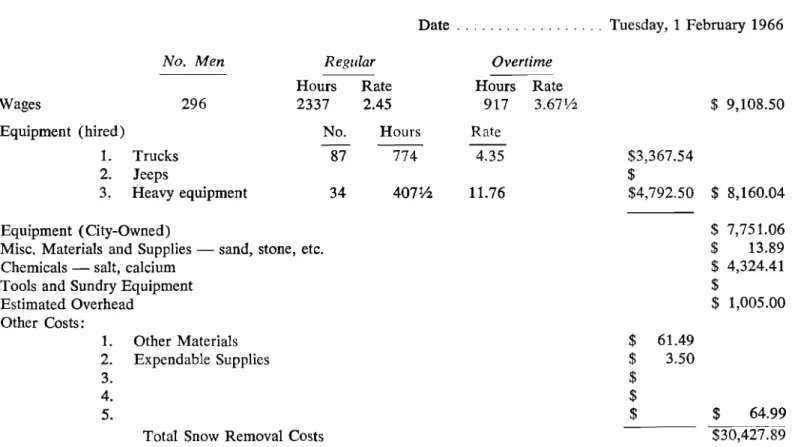
No municipality has an unlimited budget for winter maintenance. On the contrary, the work must usually be done within monetary limitations which make it very difficult to set up a budget. Attention should be given during planning to the ways in which additional money can be obtained if required. Attention should also be given to the records necessary for both financial control and management of oper-ations. Budgets and records for winter maintenance are discussed in Part II.
1.3 CONDUCT OF WINTER MAINTENANCE OPERATIONS 1.3.1 Responsibilities During Operations
By the onset of winter, all details concerning organization should have been looked after; men, equipment and materials should be ready for the first snowfall. All those associated with winter maintenance activities should be "snow conscious" through pre-season preparations and repeated briefings. Everyone should be well prepared and know exactly what is expected of him. The men in supervisory positions should now only have to be concerned with their responsibilities during actual operations. These responsibilities are reviewed in the following paragraphs.
( 1) Central Control
The main task of the staff of Central Control is to ensure that communications work properly, instructions and programs are followed, and schedules maintained. Reports giving progress of both municipal crews and contractors must be submitted regularly to the office. Breakdowns or delays that are reported should be investi-gated immediately, and appropriate action taken.
(2) Districts
The tasks of the staff of District offices are similar to those of Central Control, except that they are confined to the District. Continuous inspection must be main-tained of the progress of snow removal and ice control, and reports on this progress submitted to Central Control. They must also ensure that there is adequate field supervision for all activities, particularly for night work.
(3) Sections
At the subdistrict level, foremen must assign personnel and equipment for each operation. They must ensure that the work under their supervision is done properly and on schedule. Brief progress reports should be submitted to the District office ifpossible by radio, and in greater detail by telephone, Each foreman should ensure that he has sufficient assistance for maintaining a continuous inspection of the work, particularly that being conducted by contractors in his area.
1.3.2 Instructions for Operations
All instructions concerning operations should be easy to read and concise. For example, route sheets when properly prepared provide an orderly procedure for accomplishing objectives without confusion and unnecessary work. General in-structions should have been prepared by the Head of the winter maintenance oper-ations and distributed to all key personnel by letter or teletype. Special instructions may be warranted by unpredictable circumstances and are released when a change in plan is required. When instructions are not carried out, the written record shows who is required to provide an explanation or to justify a change in action.