• Aucun résultat trouvé

Automatic Estimation of Transcription Accuracy and Difficulty

N/A
N/A
Protected

Academic year: 2021

Partager "Automatic Estimation of Transcription Accuracy and Difficulty"

Copied!
5
0
0

Texte intégral

(1)

Automatic Estimation of Transcription Accuracy and Difficulty

The MIT Faculty has made this article openly available.

Please share

how this access benefits you. Your story matters.

Citation

Roy, Brandon C. / Vosoughi, Soroush / Roy, Deb (2010):

"Automatic estimation of transcription accuracy and difficulty", In

INTERSPEECH-2010, 1902-1905.

As Published

http://www.isca-speech.org/archive/interspeech_2010/

i10_1902.html

Publisher

International Speech Communication Association

Version

Author's final manuscript

Citable link

http://hdl.handle.net/1721.1/69094

Terms of Use

Creative Commons Attribution-Noncommercial-Share Alike 3.0

(2)

Automatic Estimation of Transcription Accuracy and Difficulty

Brandon C. Roy

, Soroush Vosoughi

, Deb Roy

The Media Laboratory, Massachusetts Institute of Technology

Cambridge, Massachusetts, USA

[email protected], [email protected], [email protected]

Abstract

Managing a large-scale speech transcription task with a team of

human transcribers requires effective quality control and

work-load distribution. As it becomes easier and cheaper to collect

massive audio corpora the problem is magnified. Relying on

expert review or transcribing all speech multiple times is

im-practical. Furthermore, speech that is difficult to transcribe may

be better handled by a more experienced transcriber or skipped

entirely.

We present a fully automatic system to address these issues.

First, we use the system to estimate transcription accuracy from

a a single transcript and show that it correlates well with

inter-transcriber agreement. Second, we use the system to estimate

the transcription “difficulty” of a speech segment and show that

it is strongly correlated with transcriber effort. This system

can help a transcription manager determine when speech

seg-ments may require review, track transcriber performance, and

efficiently manage the transcription process.

Index Terms: speech transcription, inter-transcriber

agree-ment, human-machine collaboration

1. Introduction

Annotating audio recordings with speech transcripts is an

im-portant task for many enterprises. However, as the size of audio

corpora increase thanks to advances in recording and storage

technology, efficient speech transcription methodologies will

become increasingly important. While automatic speech

recog-nition technologies continue to improve, they are inadequate for

many tasks and human transcribers are needed.

Speech transcription approaches can be considered along

several dimensions. One aspect is the level of annotation

de-tail, and it is common to annotate speech at the phonetic, word

and discourse level. The focus here is on word-level

(ortho-graphic) transcription of short speech segments. Purely

man-ual approaches are often used for orthographic transcription

and tools such as CLAN [1] and Transcriber [2] are popular,

but these tools do not perform well for large-scale transcription

tasks. In particular, transcription times are usually an order of

magnitude longer than the actual audio being annotated [2, 3].

An active area of research focuses on how services such

as Amazon’s Mechanical Turk

1

can be leveraged to reduce the

cost of annotation. Speech transcription using Mechanical Turk

can attain quality competitive with conventional methods, but

at a fraction of the cost [4]. Furthermore, different transcription

goals may permit different levels of transcription quality. For

example, if the goal is to train a speech recognizer, then more

transcription errors may be tolerated if the yield is higher [5].

*The first two authors contributed equally to this work.

1

http://www.mturk.com

Mechanical Turk is a promising approach for many

applica-tions, but in our work there are certain privacy requirements that

must be met. Specifically, we are studying early child language

acquisition as part of the Human Speechome Project [6]. For

the Human Speechome Project (HSP), the home of one of the

authors (DR) was outfitted with a custom audio-video

record-ing system with the goal of recordrecord-ing the first three years of his

child’s life. This naturalistic, ultra-dense, longitudinal corpus

is helping to shed new light on early language learning [7, 8].

But given the privacy concerns with this corpus and the special

training required to adequately transcribe a young child’s early

speech, Mechanical Turk is not a viable solution. Instead, the

size of this corpus (roughly 120,000 hours of audio), the nature

of the data and the privacy requirements have led us to develop a

new semi-automatic transcription system called BlitzScribe [9].

2. Semi-automatic speech transcription

with BlitzScribe

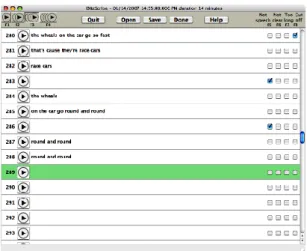
BlitzScribe is a human-machine collaborative system that

en-ables human transcribers to transcribe significantly faster than

purely manual approaches. BlitzScribe works by first

automati-cally identifying and segmenting speech in audio, and then

pre-senting it to the human transcriber in a streamlined user

in-terface. The human transcriber plays a segment, transcribes

and advances to the next segment using only the keyboard,

en-abling them to proceed quickly and efficiently and eliminating

the need to spend time browsing for and selecting speech using

the mouse. Since the speech is automatically detected, the

anno-tator may encounter speech while transcribing. Such

non-speech segments are marked naturally in the course of

transcrip-tion by simply leaving them blank and advancing to the next

segment. Both the transcribed speech and non-speech segments

are then fed back into the system to retrain the speech

detec-tion component, thereby adapting and improving the system as

a whole. Using BlitzScribe yields up to a six-fold speedup over

other purely manual approaches [9]. This corresponds to

tran-scriber time of roughly twice the audio duration. BlitzScribe

is particularly effective on unstructured audio, where a

signifi-cant portion of the audio consists of non-speech. While a purely

manual tool usually requires scanning all the audio to identify

speech, transcriber time in BlitzScribe depends primarily on the

amount of speech. The BlitzScribe user interface is shown in

figure 1.

3. Estimating transcription accuracy

Speech transcription can be challenging, and spontaneous

speech captured in a naturalistic environment can be

particu-larly difficult to transcribe. Such speech is often mixed with

background noise and other non-speech sources, can include

Figure

Figure 2: Pipeline for calculating the expected accuracy of a speech transcription. ●●●●●●●●●●●●● ● ●● ● ● ●●●●●●●● ●●●●●●●●●●●●●●●● ● ●●●●●●●●●●● ●●●●●●●●●●●●●●●●●●●●●●●●●●●●● ● ●●●●● ●●●●●●●●●●●●●●●●●●●●●●●●●●●●●●●●●●●●●●●●●●●●●●●●●●●●●●●●●●●●●●●●●●● ● ●
Figure 8: Pipeline for calculating the predicted transcription difficulty for an audio segment.
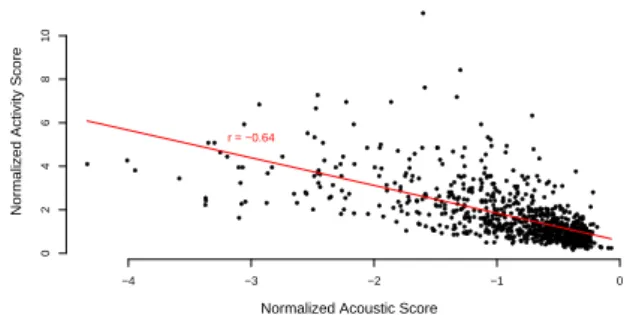
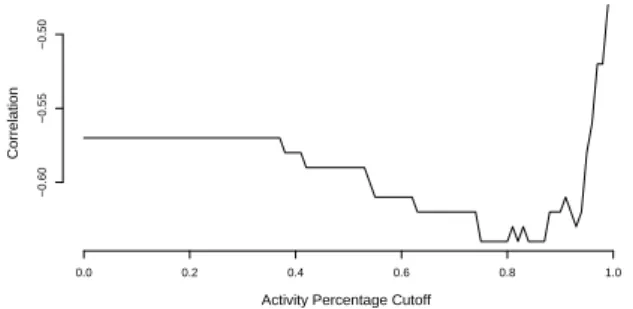
Figure 10: Acoustic difficulty score vs. actual transcriber diffi- diffi-culty r-values at different activity percentage cutoff thresholds.

Références

Documents relatifs

Experimental results on the TED-LIUM corpus show that the proposed adaptation technique can be effectively integrated into DNN and TDNN setups at different levels and provide

L’archive ouverte pluridisciplinaire HAL, est destinée au dépôt et à la diffusion de documents scientifiques de niveau recherche, publiés ou non, émanant des

These results show that acoustic and labial features contain comp]ementary information and that the performance of an acoustic speaker recognition system can be

This new method is specifically designed to lower the complexity of the modeling phase, compared to classical techniques, as well as to decrease the required amount of learning

Copyright and moral rights for the publications made accessible in the public portal are retained by the authors and/or other copyright owners and it is a condition of

Acoustic Model Merging Using Acoustic Models from Multilingual Speakers for Automatic Speech Recognition.. Tien Ping Tan, Laurent Besacier,

d(Ψ src , Ψ tgt ) = hΨ src , Ψ tgt i (8) In the context of voice casting, the advantage of the multi-label scoring is double : first, the multi-label scoring can be used to

The article presents a method for adapting a GMM-based acoustic-articulatory inversion model trained on a reference speaker to another speaker. The goal is to