HAL Id: hal-02350374
https://hal.archives-ouvertes.fr/hal-02350374
Submitted on 25 Nov 2020HAL is a multi-disciplinary open access
archive for the deposit and dissemination of sci-entific research documents, whether they are pub-lished or not. The documents may come from teaching and research institutions in France or abroad, or from public or private research centers.
L’archive ouverte pluridisciplinaire HAL, est destinée au dépôt et à la diffusion de documents scientifiques de niveau recherche, publiés ou non, émanant des établissements d’enseignement et de recherche français ou étrangers, des laboratoires publics ou privés.
Intercomparison measurements of two 33 S-enriched
sulfur isotope standards
L. Geng, J. Savarino, N. Caillon, E. Gautier, J. Farquhar, J. Dottin Iii, N.
Magalhães, S. Hattori, S. Ishino, N. Yoshida, et al.
To cite this version:
L. Geng, J. Savarino, N. Caillon, E. Gautier, J. Farquhar, et al.. Intercomparison measurements of two 33 S-enriched sulfur isotope standards. Journal of Analytical Atomic Spectrometry, Royal Society of Chemistry, 2019, 34 (6), pp.1263-1271. �10.1039/C8JA00451J�. �hal-02350374�
Title: Intercomparison measurements of home-made sulfur isotope standards enriched in 33S
Authors: Geng L.1, 2, Savarino J.2, Caillon N.2, Gautier E.2, Farquhar J.3, Dottin J.3, Magalhães
N.3, Hattori S.4, Ishino S.4, Yoshida N.4, Albarède F.5, Abalat E.5, Cartigny P.6, Ono S.7,
Thiemens, M. H.8
Affiliations:
1. Anhui Province Key Laboratory of Polar Environment and Global Change,School of Earth and Space Sciences, University of Science and Technology of China, Hefei, Anhui, China;
2. Univ. Grenoble Alpes, CNRS, IRD, G-INP, Institut des Géosciences de l’Environnement, F-38000 Grenoble, France;
3. Department of Geology and ESSIC, University of Maryland College Park, College Park, MD 20742, USA;
4. Department of Chemical Science and Engineering, School of Materials and Chemical Technology, Tokyo Institute of Technology, Kanagawa, Japan;
5. ENS de Lyon, CNRS, Université Lyon 1, Université de Lyon, Lyon, France;
6. Laboratoire de Géochimie des Isotopes Stables, Institut de Physique du Globe de Paris, Sorbonne Paris Cité, Univ. Paris Diderot, UMR 7154 CNRS, 75005 Paris, France;
7. Department of Earth, Atmospheric and Planetary Sciences, Massachusetts Institute of Technology, Cambridge, MA 02139, USA;
8. Department of Chemistry and Biochemistry, University of California, San Diego, La Jolla, CA 92093, USA.
Abstract:
Despite widespread applications of sulfur isotope mass-independent fractionation (MIF)
signals for probing terrestrial and extra-terrestrial environments, there has been no international
sulfur isotope reference material available for normalization of Δ33S and Δ36S data. International
reference material to anchor isotope values is useful for interlaboratory data comparisons and
needed to evaluate, e.g., whether issues exist associated with blanks and mass spectrometry when
using different analytical approaches. We synthesized two sodium sulfate samples enriched in
33
S with different magnitudes, and termed them as S-MIF-1 and S-MIF-2, respectively. The
sulfur isotopic compositions of these two samples were measured in five different laboratories
using two distinct techniques to place them on the V-CDT scale for δ34S and a provisional
V-CDT scale for Δ33S and Δ36S. We obtained an average δ34S of MIF-1 = 10.26 ± 0.22 ‰ and
S-MIF-2 = 21.53 ± 0.26 ‰ (1 σ, versus V-CDT). The average Δ33S and Δ36S values of S-MIF-1
were determined to be 9.54 ± 0.09 ‰ and -0.11 ± 0.25 ‰, respectively, while the average Δ33S
and Δ36S of S-MIF-2 are 11.39 ± 0.08 ‰ and -0.33 ± 0.13 ‰ (1 σ, versus V-CDT). The lack of
variation among the interlaboratory isotopic values suggests sufficient homogeneity of S-MIF-1
and S-MIF-2, especially for Δ33S. Although additional measurements may be needed to ensure
the accuracy of the isotopic compositions of S-MIF-1 and S-MIF-2, they can serve as working
standards for routine Δ33S analysis to improve data consistency, and have the potential to serve
as secondary sulfur isotope reference materials to address issues such as scale
contraction/expansion and for normalization and reporting of Δ33S and Δ36S between
laboratories. For the same reasons as exposed for sulfur isotopes, the same standards were also
artificially enriched in O-17. The calibration is still in progress but first estimations gave Δ17O =
1. INTRODUCTION
Sulfur has four stable isotopes 32S, 33S, 34S and 36S with approximate abundances of
94.99 %, 0.75 %, 4.25 % and 0.01 %, respectively. The relative abundances of these isotopes in
geologic materials (e.g., rocks, atmospheric aerosols, water, ice, meteorites, etc.) are affected by
different geologic, atmospheric, biologic, and hydrologic processes. Therefore, variations in the
relative abundances of sulfur isotopes in a variety of terrestrial and extra-terrestrial materials
have the potential to serve as useful tracers of the source and transformation of sulfur in different
environments, as well as provide information about their physical and/or chemical conditions.
The relative abundances of sulfur isotopes are typically measured as the ratios of the rare
isotopes (33S, 34S and 36S) to the most abundant isotope, 32S, and expressed as the delta notation
which describes a deviation from a primary isotope reference material:
(1)
where R represents xS/32S, and x = 33, 34 or 36. The first principal reference material was troilite
from the Canyon Diablo meteorite (Canyon Diablo Troilite - CDT). However, CDT was found to
be variable in a prior study1, and thus a V-CDT scale was established later by assigning a δ34S
value of -0.3 ‰ relative to V-CDT to an internationally distributed silver sulfide reference
material IAEA-S-12. The assigned value of -0.3 ‰ was based on intercomparison measurements
from fifteen individual laboratories.
A second historic aspect of sulfur isotope analyses has been a focus on δ34S. This occurred
because of the difficulty of measuring 33S and 36S using standard combustion techniques, and a
strong mass-dependent correlation between δ33S, δ33S and δ36S that led to the belief that
independent information would not be obtained by measuring the two rarest sulfur isotopes. The
atmospheric and ice-core samples10-15, as well as the development of new techniques such as the
MC-ICP-MS techniques for 33S measurement16, 17 have made it of interest to have better
calibrations over the full range of stable sulfur isotopes. In addition, mass-dependent
fractionation processes in the biogeochemical sulfur cycle have also been measured and are
known to produce small abundance deviations for 33S and 36S from mass-dependent
relationships18-20, and these variations have been shown to be useful in terms of obtaining
additional information on the biogeochemical sulfur cycles in, for example, marine
environments21-23. The deviation from dependent trends was commonly termed as
mass-independent fractionation (MIF), although some was strictly related to mass-dependent
processes, and expressed as the capital delta notation as follows:
(2)
(3)
These sulfur isotope anomalous signals, Δ33S and Δ36S, serve as unique proxies to track
both mass dependent and mass independent fractionation processes.
Prior community efforts have established a consensual value for the V-CDT scale on the
basis of the δ34S for IAEA-S-1 in order to normalize δ34S measurements of different samples in
different laboratories, for data comparability and consistency. Other sulfur reference materials,
such as IAEA-S-2 and IAEA-S-3, are also routinely used with the same purpose. Provisional
assignments of values for Δ33S and Δ36S have been assigned to V-CDT in various studies24, 25,
but a full assignment has yet to be made. Other studies have resorted to normalizations to
IAEA-S-119 or CDT for Δ33S and Δ36S26-28. The number of studies reporting Δ33S and Δ36S of terrestrial
and extra-terrestrial samples29 has increased tremendously in the past two decades due to interest
increase has brought forth a need for the establishment of working materials and interlaboratory
comparisons that will lay the groundwork for establishing a consensus for the normalization of
Δ33
S and Δ36S of V-CDT.
Appropriate data normalization, aside from precise and accurate measurements, is
necessary to ensure proper interlaboratory data comparison and to reach consensual conclusions
according to Δ33S and Δ36S values measured from same or similar types of samples30.
Appropriate data normalization is also important for interpretation of small Δ33S and/or Δ36S
values (e.g., 0.03 ‰). The Δ33S and Δ36S values are not directly measured, but calculated from
the measured δ34S, δ33S and δ36S values as shown in the above equations. The δ34S, δ33S and δ36S
values are typically measured with respect to a laboratory working reference gas (i.e., SF6), and
then need to be anchored to the V-CDT scale in order to ensure consistent comparison of data
among different laboratories. Although consensual δ34SV-CDT values of international sulfur
isotope reference materials have been established, currently there are no consensual δ33SV-CDT
and δ36SV-CDT values. Here we use the provisional Wing and Farquhar 24 V-CDT calibration of
IAEA-S-1 which assigns Δ33S = 0.094 ‰ and Δ36S = -0.7 ‰ as the values for IAEA-S-1 on the
V-CDT scale. These values correspond to δ33S and δ36S of -0.061 ‰ and -1.27 ‰, respectively.
These values along with the community-defined δ34S value of IAEA-S-1 (-0.3 ‰) are used to
normalize multiple sulfur isotope compositions of particular samples to the V-CDT scale, once
the working reference gas is calibrated versus S-1, or concurrent measurements of
IAEA-S-1 are performed.
Given the small Δ33S and Δ36S values measured in, e.g., stratospheric and tropospheric
sulfate aerosols, marine S-bearing materials, meteorites and Proterozoic geological samples,
differences in the derived Δ33S and Δ36S values for such samples. In addition, the mechanism
behind the origin of S-MIF in atmospheric sulfate is still a subject of debate31-34, and
observations of small negative ∆36S in atmospheric sulfate possibly associated with combustion
processes14, 15 raise further questions on the photo-chemical origin of S-MIF. Accurate and
precise measurements as well as consistent data normalization are also critical in distinguishing
the difference between small non-zero Δ33S and Δ36S values produced by mass-dependent
fractionation processes in biogeochemical sulfur cycles and non-zero Δ33S and Δ36S values
produced by MIF processes, and in further discerning the contributions of different MIF
processes. In principle, data normalization can be considerably improved by using two or more
points to provide a normalization spanning a wide delta range. To enable proper data
normalization and compatible data reporting from different laboratories, secondary reference
materials of Δ33S and Δ36S are necessary in addition to IAEA-S-1. The IAEA-S-1 material is
used as a primary reference material to scale or anchor the measured data to the V-CDT scale,
rather than a physically-real calibration standard.
To date, there is no international sulfur isotope reference material enriched in 33S and/or
36
S available for the purpose of a global calibration. Individual laboratories generally report Δ33S
and Δ36S values normalized using concurrent IAEA-S-1 measurements, but consensus values of
Δ33
S and Δ36S for IAEA-S-1 in the V-CDT scale have not been assigned. In this study, we report
the sulfur isotopic compositions of two synthesized sodium sulfate samples artificially enriched
in 33S with different magnitudes. The data we report are from separate analyses by five different
laboratories. We evaluate the interlaboratory variations in the reported values and use the data to
assess the potential for further use of these samples as secondary reference materials for Δ33S
as exposed for sulfur. The calibration is still in progress and the preliminary result of Δ17O = 3.3
± 0.3 ‰ (1 σ) is reported only for information purposes. In the following we will not elaborate
more on Δ17O.
2. EXPERIMENTAL
2.1. Synthetization of samples enriched in 33S
Two sodium sulfate (Na2SO4) samples, namely, S-MIF-1 and S-MIF-2, with an enrichment
in 33S were prepared in the stable isotope laboratory at the University of California-San Diego.
We chose Na2SO4 as it is chemically stable, nontoxic, does not hydrate, and is widely available
and easy to manufacture. The samples were prepared from chemical conversions of a mixture of
sulfur powder and sulfur-33 powder. Reagents used included sulfur powder (99.5%, Fisher ACS,
Lot: 897542), sulfur-33 powder (99.8%, Isoflex, Lot: 07111L35969), H2O2 solution (30%, extra
pure, Fisher Scientific, Lot: 110251), H2SO4 (95%, extra pure, Fisher Scientific, Lot: 49020),
NaOH (99+%, extra pure, Fisher Scientific), and O2 (99.999%, Matheson USA).
For S-MIF-1, 20 g of sulfur powder and 0.00445 g of sulfur-33 powder were weighed
and mixed in an agate mortar. For S-MIF-2, 20 g of sulfur powder and 0.0015 g of sulfur-33
powder were weighted and mixed. The composition of the initial mixtures corresponded to
Δ33
SV-CDT values of ~30 ‰ and 10 ‰, respectively. The powder mixture was transferred into a
crucible, and ignited with a flame. The crucible was then placed in a 4 L air-tight glass vessel
followed by a flow of O2 at a rate of 50 mL/min in order to purge the glass vessel. As a result,
SO2 was produced and carried by O2 into a NaOH solution (made of 33 ml 17O-enriched water
(Δ17O = 47 ‰), 33 ml NaOH (50 % w/w) and 133 ml of pure water (18.2 MΩ)), where SO2 was
trapped as Na2SO3. The S(IV)-containing NaOH solution was placed in an ice-water bath during
slowly added 80 mL 30% H2O2 (due to the exothermicity of the reaction) to the NaOH solution
in order to oxidize the trapped SO32- to SO42-. For S-MIF-1, 33 mL H2SO4 was added to dilute
Δ33
S to ~ 10 ‰, and then a few drops of NaOH were added to adjust to neutral pH. For S-MIF-2,
no dilution was made and only a few drops of H2SO4 were added to adjust neutral pH. The
different treatments of S-MIF-1 and S-MIF-2 in this last step were intended to produce Na2SO4
with circa identical Δ33S but different Δ17O. Both S-MIF-1 and S-MIF-2 were then dried and
grounded, and the powder was collected and stored. In the end, we recovered ~136 g and ~ 55.6
g Na2SO4 for S-MIF-1 and S-MIF-2, respectively.
2.2. Isotopic analysis
After preparation, S-MIF-1 and S-MIF-2 were circulated to five laboratories, including the
stable isotope laboratory at Ecole Normale Superieure (ENS) de Lyon, the stable isotope
laboratory at the Institut de Physique du Globe de Paris (IPGP), the stable isotope laboratory at
the University of Maryland, College Park (UMD), the stable isotope Geo-biology laboratory of
the Massachusetts Institute of Technology (MIT) and the stable isotope laboratory at Tokyo
Institute of Technology (TIT). In these laboratories, the isotopic of composition of S-MIF-1 and
S-MIF-2 were characterized individually.
In the laboratories of IPGP, UMD, MIT and ITI, S-MIF-1 and S-MIF-2 were analyzed
following the conventional SF6 methods. In each laboratory, the Na2SO4 samples were first
reduced to silver sulfide (Ag2S), using the STrongly Reducing
hydrIodic-hypoPhosphorous-hydrochloric acid (STRIP) method 35 or the Kiba reagent 36 following the standard procedure
described in Forrest and Newman 37. We note that in practice each laboratory uses slightly
different reduction techniques for operational convenience. Briefly, the collected sulfide after
weighed (1- 3 mg) and transferred into a small aluminum boat. The aluminum boats were folded
and loaded into externally heated nickel reaction tubes. The reaction tubes were evacuated for
0.5-1 hours at ~ 100 ˚C until desired vacuum achieved. F2 (in excess) was then introduced into
the reaction tubes to produce SF6. The reaction tubes were heated to ~250 ˚C and held at this
temperature overnight. The produced SF6 gas was first purified using a series of cryogenic
techniques and then by gas chromatography carried by a helium flow. The purified SF6 was lastly
trapped with liquid nitrogen and then expanded under vacuum to a gas-source isotope ratio mass
spectrometer (Thermo Fisher MAT 253) where its sulfur isotopic composition was analyzed in
dual-inlet mode.
In the ENS laboratory, S-MIF-1 and S-MIF-2 were analyzed for sulfur isotopic
compositions using multi-collector inductively coupled plasma mass spectrometry
(MC-ICP-MS)16. This method allows the measurements of 32S, 33S and 34S at very low sulfur content (180
nmol, but can be as low as 10 nmole sulfur), with a typical reproducibility of ± 0.1‰ for δ34S
and ± 0.15 ‰ for δ33S (2 σ) based on replicate measurements of the in-house Alfa Aesar (AA)
standard solution. However, due to the interference of Ar-36 isotope, S-36 cannot be measured
by this method. The chemistry procedure requires a first step of isolation and purification of
sulfur (sulfate) from the sample matrix. In the ENS lab, after sulfate was isolated with anion
exchange resin (200-400 mesh AG1-X8, in chloride form) and eluted in diluted HNO3 media,
sulfur isotopic compositions were measured on a Neptune Plus MC-ICP-MS with a Cetac Aridus
II desolvator in the high-resolution mode. The isotopic values of δ33S and δ34S were measured
with respect to the AA standard solution using standard-sample-standard bracketing technique.
The δ34SV-CDT value of the AA standard solution, 4.86 ± 0.14 ‰, was pre-calibrated using
value of the AA standard solution was calculated using the mass-dependent fractionation law7.
These values were then used to anchor the measured δ33S and δ34S values of MIF-1 and
S-MIF-2 (with respect to AA) to the V-CDT scale.
In Table 1, we list important technical information of sample preparation and analysis in
each laboratory. For the IR-MS method in laboratories other than ENS, IAEA-S-1 was measured
repeatedly with S-MIF-1 and S-MIF-2. The measurement uncertainties of δ34S, Δ33S and Δ36S in
each laboratory as indicated by repeat measurements of IAEA-S-1 are listed in Table 2. The
results of IAEA-1 in Table 2 were also used to anchor the sulfur isotopic composition of
S-MIF-1 and S-MIF-2 into the V-CDT scale, given its known V-CDT values of δ34S, Δ33S and
Δ36
S.
For information only, Δ17O of these two samples was established based on the Ag2SO4
method38-40, and preliminary results indicate the two samples have an identical mean of Δ17O =
3.3 ± 0.3 ‰ (1 σ), despite the efforts in sample preparation aiming to produce Na2SO4 with
different Δ17O.
3. RESULTS AND DISCUSSION
3.1. Data reduction
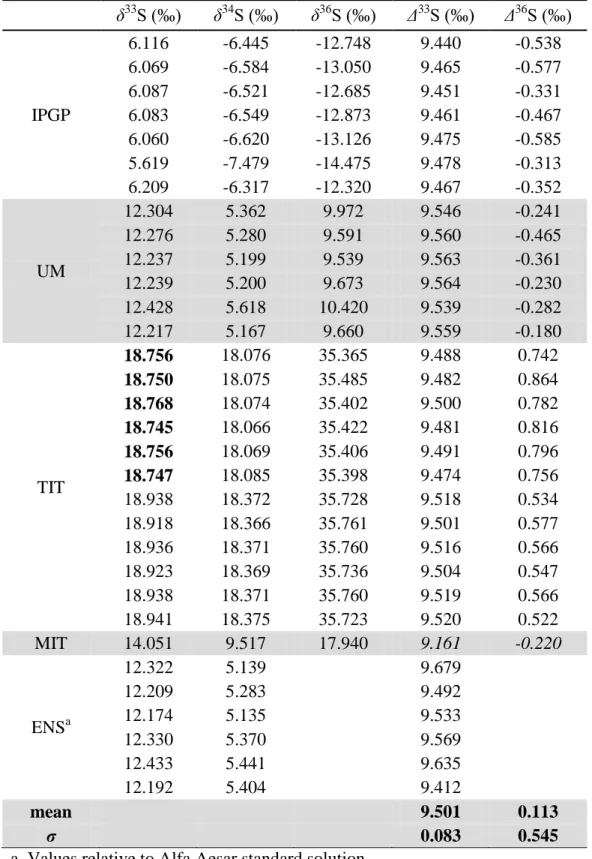
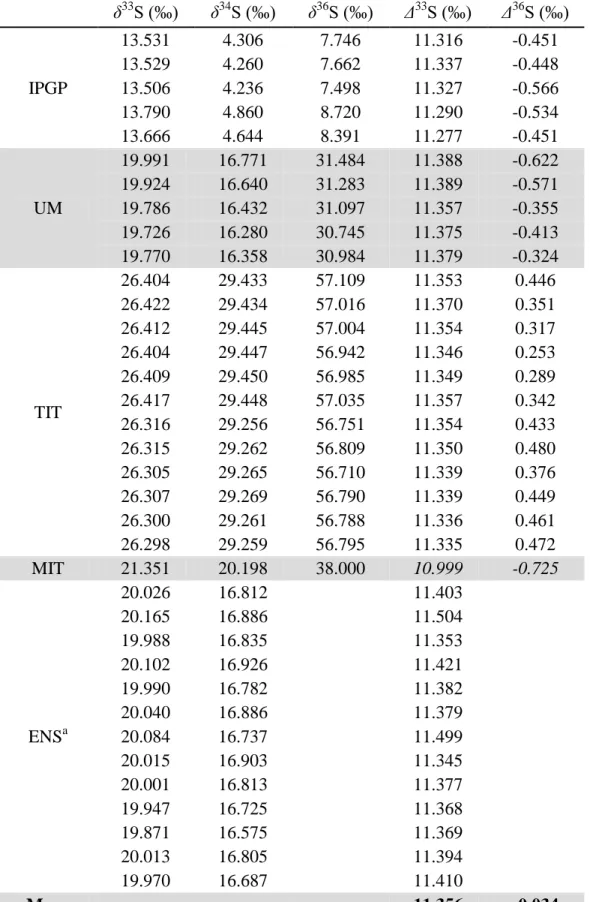
The measured δ34S, δ33S and δ36S values of S-MIF-1 and S-MIF-2 with respect to individual
laboratory working reference gas or standard solution are listed in Table 3 and Table 4,
respectively. In these tables, the calculated Δ33S and Δ36S values according to equations (2) and
(3) are also listed. The means of Δ33S and Δ36S for S-MIF-1 are 9.50 ± 0.08 ‰ (1 σ, N = 33) and
0.11 ± 0.55 ‰ (N = 26), respectively, and that for SMIF2 are 11.36 ± 0.08 ‰ (N = 37) and
to evaluate the isotopic variability of S-MIF-1 and S-MIF-2, these values need to be anchored in
the same scale (i.e., the V-CDT scale).
For measurements done at IPGP, UMD, MIT and ITI, international reference material
IAEA-S-1 was also measured at the same time with S-MIF-1 and S-MIF-2, and the results are
reported with respect to laboratory working reference gases and listed in Table 2. IAEA-S-1 has
a consensual δ34SV-CDT value of -0.3 ‰, but its δ33Sand δ36S values on the V-CDT scale have not
been assigned. Wing and Farquhar24 have complied Δ33SV-CDT and Δ36SV-CDT data of IAEA-S-1
from the literature, and obtained provisional Δ33SV-CDT and Δ36SV-CDT values as 0.094 ± 0.004 ‰,
and -0.7 ± 0.1 ‰, respectively. From there the δ33SV-CDT and δ36SV-CDT values of IAES-S-1 were
also derived as -0.061‰ and -1.270‰, respectively. Hereafter, we refer to this scale as the
V-CDT scale, but alert the reader to its provisional nature for the rarest isotopes. From the V-V-CDT
values of IAEA-S-1 and its measured mean values with respect to the working gases, we
obtained the isotopic values of the working reference gas in each laboratory with respect to
V-CDT. Finally, the raw δ34S, δ33S and δ36S values of S-MIF-1 and S-MIF-2 with respect to
working reference gases were converted into the V-CDT scale.
For measurements done in ENS, the δ34SV-CDT value of the working standard solution AA
was 4.86 ± 0.14 ‰ as calibrated by international reference materials. According to the
mass-dependent fractionation law, its δ33SV-CDT value was calculated as -2.52 ‰. These values were
then used to convert the raw δ34S and δ33S data of S-MIF-1 and S-MIF-2 to the V-CDT scale.
3.2. Characterization of isotopic variability
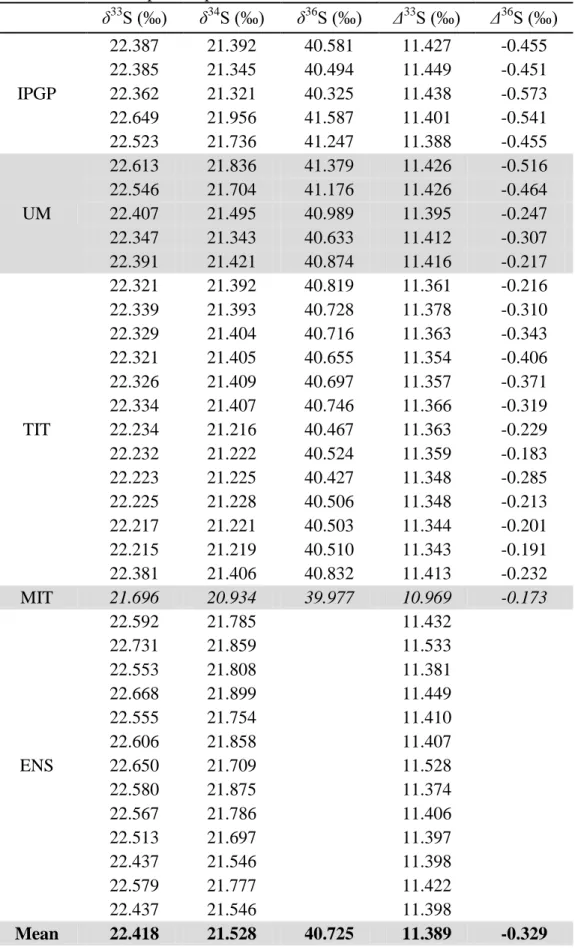
The isotopic compositions of S-MIF-1 and S-MIF-2 in the V-CDT scale are listed in Table 5
and 6, respectively. The Δ33S and Δ36S values were calculated using Equations (2) and (3),
S-MIF-1 and S-MIF-2 is ± 0.22 and ± 0.26 ‰ (1 σ), respectively, comparable to or better than
that of international sulfur reference materials (e.g., ± 0.2 ‰ for IAEA-SO-6 and ± 0.4 ‰ for
NBS-127). The uncertainty of Δ33SV-CDT for S-MIF-1 and S-MIF-2 is ± 0.09 and ± 0.08 ‰,
respectively. For Δ36SV-CDT, the uncertainties are ± 0.25 and ± 0.13‰ for S-MIF-1 and S-MIF-2,
respectively. The relatively large uncertainties in Δ36SV-CDT are in part due to the extremely low
abundance of 36S, which leads to its accurate measurement more difficult, but maybe more likely
come from an isobaric interference on the 131 peak during IRMS measurements (James
Farquhar, personal communications). In addition, the uncertainties of the small delta values are
larger than that of the capital delta values as always observed, and the best precision is for Δ33S
V-CDT. This is because the uncertainties of the small delta values are in part from sample
preparation and conversion processes, but these processes would only induce mass-dependent
fractionation and thus won’t significantly affect the capital delta values.
It is noted that the V-CDT values of S-MIF-1 and S-MIF-2 derived from the measurement
(one analysis available) done in MIT are slightly different from other labs, e.g., are at the low
end for Δ33SV-CDT but the high end for Δ36SV-CDT among all data derived. However, this is only
one measurement and its involvement in the global means did not affect the results (the means
and standard deviations) much.
In all, S-MIF-1 was characterized with δ34SV-CDT = 10.26 ± 0.22 ‰ (1 σ, N = 32), Δ33SV-CDT
= 9.54 ± 0.09 ‰ (N = 33) and Δ36SV-CDT = -0.14 ± 0.25 ‰ (N = 36), and for S-MIF-2, its isotopic
compositions were established as δ34SV-CDT = 21.52 ± 0.26 ‰ (N = 37), Δ33SV-CDT = 11.39 ± 0.08
‰ (N = 37) and Δ36
SV-CDT = -0.33 ± 0.13 ‰ (N = 24).
The mean δ34SV-CDT, Δ33SV-CDT and Δ36SV-CDT values among all data and that of data from
derived δ34SV-CDT, Δ33SV-CDT and Δ36SV-CDT values of S-MIF-1 and S-MIF-2 from the
laboratories except for MIT are in good agreement, especially for the Δ33SV-CDT values, which are
9.56 ± 0.01 ‰ (N = 7), 9.59 ± 0.01 ‰ (N = 6), 9.52 ± 0.02 ‰ (N = 12) and 9.58 ± 0.09 ‰ (N =
6) for S-MIF-1, and 11.42 ± 0.03 ‰ (N = 5), 11.42 ± 0.01 ‰ (N = 5), 11.36 ± 0.02 ‰ (N = 12),
and 11.43 ± 0.05 ‰ (N = 13) for S-MIF-2 from IPGP, UM, TIT and ENS, respectively. In
comparison, the Δ33SV-CDT values of S-MIF-1 and S-MIF-2 derived from MIT are 9.13 and 10.97
‰, respectively.
4. SUMMARY
There is a compelling need to have international sulfur and oxygen isotope reference
materials enriched in 33S, 36S and 17O, respectively, to calibrate the Δ33S, Δ36S and Δ17O values
measured from a variety of atmospheric and geological samples. This is important not only in
terms of data comparisons within a laboratory and/or among different laboratories, but also
regarding the differentiations of small Δ33S and Δ36S values from mass-dependent and mass
independent fractionation processes. Currently there is only one international sulfur reference
material, IAEA-S-1, with established Δ33S and Δ36S values (0.094 ± 0.004 ‰, and -0.7 ± 0.1 ‰,
respectively) reported on the V-CDT scale24, but IAEA-S-1 can be regarded more as a primary
reference material. There are no reference materials with apparently large anomalies in Δ33S and
Δ36
S.
In this report, we synthesized two sodium sulfate samples, S-MIF-1 and S-MIF-2,
artificially enriched in S-33 and O-17. The preliminary assessments of their oxygen isotopic
compositions yielded Δ17O = 3.3 ± 0.3 ‰. The sulfur isotopic compositions of these two samples
were characterized by five different laboratories using two distinct methods, the conventional
MIT laboratory, results from other fours laboratories are in good consistence. The good
precisions of these isotopic values indicate isotopic homogeneity of S-MIF-1 and S-MIF-2.
Although further calibration efforts may need to improve the accuracy of Δ33SV-CDT assessments
of S-MIF-1 and S-MIF-2, their current values can be adopted to calibrate Δ33S measurements. In
particular, mixing of them with other sulfur reference materials with zero Δ33S such as
IAEA-SO-5 and IAEA-SO-6 should generate working standards with different Δ33S values, and which
can be used to establish a calibration curve spanning a large Δ33S range (e.g., 0 to 11 ‰) for
better data normalization. These standards are available for the community and can be requested
on demand to Joel Savarino.
Acknowledgments
Agence Nationale de la Recherche (ANR) via contract NT09-431976- VOLSOL is acknowledged for the financial support of J.S. This project has received funding from the European Union’s Horizon 2020 research and innovative programme under the Marie
Sklodowska Curie grant agreement No 700853). Travel visit support for J. S. was provided by the CNRS/PICS program. JF acknowledges support from NNX16AG39G and the Agouron Foundation. LG acknowledges Marie Curie Individual Fellowship, and support from the University of Science and Technology of China. NM acknowledges Science Without Borders fellowship (Brazil) at UMD.
References:
1. G. Beaudoin, B. E. Taylor, D. Rumble and M. Thiemens, Geochim Cosmochim Ac, 1994, 58, 4253-4255.
2. T. B. Coplen and H. R. Krouse, Nature, 1998, 392, 32-32.
3. G. W. Cooper, M. H. Thiemens, T. L. Jackson and S. Chang, Science, 1997, 277, 1072-1074.
4. H. B. Franz, S. T. Kim, J. Farquhar, J. M. D. Day, R. C. Economos, K. D. McKeegan, A. K. Schmitt, A. J. Irving, J. Hoek and J. Dottin, Nature, 2014, 508, 364-+.
5. J. Farquhar, J. Savarino, T. L. Jackson and M. H. Thiemens, Nature, 2000b, 404, 50-52. 6. S. Ono, J. L. Eigenbrode, A. A. Pavlov, P. Kharecha, D. Rumble, J. F. Kasting and K. H.
Freeman, Earth Planet. Sc. Lett., 2003, 213, 15-30.
8. H. Ohmoto, Y. Watanabe, H. Ikemi, S. R. Poulson and B. E. Taylor, Nature, 2006, 442, 908-911.
9. J. Farquhar, M. Peters, D. T. Johnston, H. Strauss, A. Masterson, U. Wiechert and A. J. Kaufman, Nature, 2007, 449, 706-U705.
10. M. Baroni, J. Savarino, J. H. Cole-Dai, V. K. Rai and M. H. Thiemens, J. Geophys. Res., 2008, 113.
11. J. Cole-Dai, D. Ferris, A. Lanciki, J. Savarino, M. Baroni and M. H. Thiemens, Geophys.
Res. Lett., 2009, 36.
12. J. Savarino, A. Romero, J. Cole-Dai, S. Bekki and M. H. Thiemens, Geophys. Res. Lett., 2003, 30.
13. A. B. Romero and M. H. Thiemens, J. Geophys. Res., 2003, 108.
14. M. Lin, X. L. Zhang, M. H. Li, Y. L. Xu, Z. S. Zhang, J. Tao, B. B. Su, L. Z. Liu, Y. A. Shen and M. H. Thiemens, P Natl Acad Sci USA, 2018, 115, 8541-8546.
15. R. Shaheen, M. M. Abaunza, T. L. Jackson, J. McCabe, J. Savarino and M. H. Thiemens,
P Natl Acad Sci USA, 2014, 111, 11979-11983.
16. E. Albalat, P. Telouk, V. Balter, T. Fujii, V. P. Bondanese, M. L. Plissonnier, V. Vlaeminck-Guillem, J. Baccheta, N. Thiam, P. Miossec, F. Zoulim, A. Puisieux and F. Albarede, J Anal Atom Spectrom, 2016, 31, 1002-1011.
17. G. Paris, A. L. Sessions, A. V. Subhas and J. F. Adkins, Chem Geol, 2013, 345, 50-61. 18. S. Ono, Space Sci Rev, 2008, 135, 203-220.
19. S. Ono, B. Wing, D. Johnston, J. Farquhar and D. Rumble, Geochim Cosmochim Ac, 2006, 70, 2238-2252.
20. D. T. Johnston, J. Farquhar, B. A. Wing, A. Kaufman, D. E. Canfield and K. S. Habicht,
Am J Sci, 2005, 305, 645-660.
21. G. M. Luo, S. Richoz, B. van de Schootbrugge, T. J. Algeo, S. C. Xie, S. Ono and R. E. Summons, Geochim Cosmochim Ac, 2018, 231, 73-87.
22. D. T. Johnston, S. W. Poulton, P. W. Fralick, B. A. Wing, D. E. Canfield and J. Farquhar,
Geochim Cosmochim Ac, 2006, 70, 5723-5739.
23. Y. A. Shen, J. Farquhar, H. Zhang, A. Masterson, T. G. Zhang and B. A. Wing, Nat
Commun, 2011, 2.
24. B. A. Wing and J. Farquhar, Geochim Cosmochim Ac, 2015, 170, 266-280.
25. S. Ono, W. C. Shanks, O. J. Rouxel and D. Rumble, Geochim Cosmochim Ac, 2007, 71, 1170-1182.
26. M. A. Antonelli, S. T. Kim, M. Peters, J. Labidi, P. Cartigny, R. J. Walker, J. R. Lyons, J. Hoek and J. Farquhar, P Natl Acad Sci USA, 2014, 111, 17749-17754.
27. J. W. Dottin, J. Farquhar and J. Labidi, Geochim Cosmochim Ac, 2018, 224, 276-281. 28. J. Labidi, P. Cartigny and M. G. Jackson, Earth Planet. Sc. Lett., 2015, 417, 28-39. 29. J. M. Eiler, B. Bergquist, I. Bourg, P. Cartigny, J. Farquhar, A. Gagnon, W. F. Guo, I.
Halevy, A. Hofmann, T. E. Larson, N. Levin, E. A. Schauble and D. Stolper, Chem Geol, 2014, 372, 119-143.
30. J. Kaiser and T. Röckmann, Rapid Commun. Mass Spectrom., 2008, 22, 3997-4008. 31. S. Hattori, J. A. Schmidt, M. S. Johnson, S. O. Danielache, A. Yamada, Y. Ueno and N.
Yoshida, P Natl Acad Sci USA, 2013, 110, 17656-17661. 32. J. R. Lyons, Geophys. Res. Lett., 2007, 34, L22811.
34. A. R. Whitehill, C. J. Xie, X. X. Hu, D. Q. Xie, H. Guo and S. H. Ono, P Natl Acad Sci
USA, 2013, 110, 17697-17702.
35. H. G. Thode, J. Monster and H. B. Dunford, Geochim Cosmochim Ac, 1961, 25, 159-174. 36. T. Kiba, T. Tagaki, Y. Yoshimura and I. Kisha, Bull Chem Soc Jpn, 1955, 28, 641-644. 37. J. Forrest and L. Newman, Anal. Chem., 1977, 49, 1579-1584.
38. L. Geng, A. J. Schauer, S. A. Kunasek, E. D. Sofen, J. Erbland, J. Savarino, D. J. Allman, R. S. Sletten and B. Alexander, Rapid Commun. Mass Spectrom., 2013, 27, 2411-2419. 39. J. Savarino, B. Alexander, V. Darmohusodo and M. H. Thiemens, Anal. Chem., 2001, 73,
4457-4462.
40. A. J. Schauer, S. A. Kunasek, E. D. Sofen, J. Erbland, J. Savarino, B. W. Johnson, H. M. Amos, R. Shaheen, M. Abaunza, T. L. Jackson, M. H. Thiemens and B. Alexander, Rapid
Table 1. Sample preparation and analysis methods in each lab.
Lab IPGP UMP TIT MIT ENS
Preparation STRIP/SF6 STRIP/SF6 Kiba/SF6 STRIP/SF6 Solution/SO4
2-Purification GC GC GC GC Resin Mass Spectrometry MAT-253 DI-IRMS VISC/O MAT-253 DI-IRMS VISC/O MAT-253 DI-IRMS VISC/O MAT-253 DI-IRMS VISC/O MC-ICP-MS
VISC/O: Variable Ion Source Conductance (sulfur window) open.
Table 2. Sulfur isotopic composition of IAEA-S-1. Values are reported relative to individual laboratory working SF6 gas.
δ33S (‰) δ34S (‰) δ36S (‰) Δ33S (‰) Δ36S (‰) IPGP -8.734 -17.042 -32.506 0.079 -0.375 -8.727 -17.004 -32.079 0.066 -0.019 -8.764 -17.096 -32.643 0.077 -0.411 mean -8.742 -17.047 -32.409 0.074 -0.268 σ 0.020 0.046 0.294 0.007 0.217 UM -2.581 -5.177 -10.701 0.088 -0.888 -2.668 -5.333 -10.818 0.083 -0.709 mean -2.624 -5.255 -10.760 0.086 -0.799 σ 0.061 0.111 0.083 0.004 0.126 TIT 3.888 7.510 14.23 0.028 -0.083 3.907 7.514 14.29 0.045 -0.036 3.896 7.514 14.30 0.033 -0.025 3.893 7.510 14.26 0.032 -0.062 3.906 7.510 14.29 0.045 -0.024 3.907 7.506 14.27 0.048 -0.035 3.968 7.638 14.479 0.041 -0.083 3.972 7.626 14.482 0.051 -0.058 3.964 7.631 14.415 0.042 -0.133 3.963 7.629 14.434 0.042 -0.111 3.964 7.629 14.487 0.042 -0.058 3.967 7.630 14.389 0.044 -0.158 mean 3.933 7.571 14.361 0.041 -0.072 σ 0.035 0.063 0.096 0.007 0.043 MIT -0.492 -1.021 -2.47 0.034 -0.531
Table 3. Sulfur isotopic composition of S-MIF-1. Values are reported relative to individual laboratory working SF6 gas.
δ33S (‰) δ34S (‰) δ36S (‰) Δ33S (‰) Δ36S (‰) IPGP 6.116 -6.445 -12.748 9.440 -0.538 6.069 -6.584 -13.050 9.465 -0.577 6.087 -6.521 -12.685 9.451 -0.331 6.083 -6.549 -12.873 9.461 -0.467 6.060 -6.620 -13.126 9.475 -0.585 5.619 -7.479 -14.475 9.478 -0.313 6.209 -6.317 -12.320 9.467 -0.352 UM 12.304 5.362 9.972 9.546 -0.241 12.276 5.280 9.591 9.560 -0.465 12.237 5.199 9.539 9.563 -0.361 12.239 5.200 9.673 9.564 -0.230 12.428 5.618 10.420 9.539 -0.282 12.217 5.167 9.660 9.559 -0.180 TIT 18.756 18.076 35.365 9.488 0.742 18.750 18.075 35.485 9.482 0.864 18.768 18.074 35.402 9.500 0.782 18.745 18.066 35.422 9.481 0.816 18.756 18.069 35.406 9.491 0.796 18.747 18.085 35.398 9.474 0.756 18.938 18.372 35.728 9.518 0.534 18.918 18.366 35.761 9.501 0.577 18.936 18.371 35.760 9.516 0.566 18.923 18.369 35.736 9.504 0.547 18.938 18.371 35.760 9.519 0.566 18.941 18.375 35.723 9.520 0.522 MIT 14.051 9.517 17.940 9.161 -0.220 ENSa 12.322 5.139 9.679 12.209 5.283 9.492 12.174 5.135 9.533 12.330 5.370 9.569 12.433 5.441 9.635 12.192 5.404 9.412 mean 9.501 0.113 σ 0.083 0.545
Table 4. Sulfur isotopic composition of S-MIF-2. Values are reported relative to individual laboratory working SF6 gas.
δ33S (‰) δ34S (‰) δ36S (‰) Δ33S (‰) Δ36S (‰) IPGP 13.531 4.306 7.746 11.316 -0.451 13.529 4.260 7.662 11.337 -0.448 13.506 4.236 7.498 11.327 -0.566 13.790 4.860 8.720 11.290 -0.534 13.666 4.644 8.391 11.277 -0.451 UM 19.991 16.771 31.484 11.388 -0.622 19.924 16.640 31.283 11.389 -0.571 19.786 16.432 31.097 11.357 -0.355 19.726 16.280 30.745 11.375 -0.413 19.770 16.358 30.984 11.379 -0.324 TIT 26.404 29.433 57.109 11.353 0.446 26.422 29.434 57.016 11.370 0.351 26.412 29.445 57.004 11.354 0.317 26.404 29.447 56.942 11.346 0.253 26.409 29.450 56.985 11.349 0.289 26.417 29.448 57.035 11.357 0.342 26.316 29.256 56.751 11.354 0.433 26.315 29.262 56.809 11.350 0.480 26.305 29.265 56.710 11.339 0.376 26.307 29.269 56.790 11.339 0.449 26.300 29.261 56.788 11.336 0.461 26.298 29.259 56.795 11.335 0.472 MIT 21.351 20.198 38.000 10.999 -0.725 ENSa 20.026 16.812 11.403 20.165 16.886 11.504 19.988 16.835 11.353 20.102 16.926 11.421 19.990 16.782 11.382 20.040 16.886 11.379 20.084 16.737 11.499 20.015 16.903 11.345 20.001 16.813 11.377 19.947 16.725 11.368 19.871 16.575 11.369 20.013 16.805 11.394 19.970 16.687 11.410 Mean 11.356 -0.034
σ 0.076 0.463 a. Values relative to Alfa Aesar standard solution.
Table 5. Sulfur isotopic composition of S-MIF-1 in the V-CDT scale.
δ33S (‰) δ34S (‰) δ36S (‰) Δ33S (‰) Δ36S (‰) IPGP 14.907 10.458 19.419 9.535 -0.545 14.860 10.317 19.107 9.560 -0.586 14.878 10.381 19.484 9.545 -0.332 14.874 10.352 19.290 9.556 -0.471 14.851 10.280 19.029 9.570 -0.594 14.406 9.407 17.636 9.573 -0.312 15.001 10.588 19.861 9.562 -0.353 UM 14.906 10.370 19.661 9.579 -0.134 14.878 10.288 19.276 9.593 -0.361 14.839 10.206 19.224 9.596 -0.257 14.841 10.207 19.359 9.597 -0.124 15.031 10.627 20.113 9.571 -0.175 14.819 10.174 19.346 9.592 -0.073 TIT 14.704 10.123 19.410 9.503 0.089 14.698 10.122 19.529 9.498 0.210 14.715 10.122 19.447 9.515 0.128 14.693 10.114 19.466 9.497 0.162 14.703 10.116 19.450 9.506 0.142 14.695 10.133 19.443 9.489 0.103 14.884 10.417 19.768 9.533 -0.116 14.865 10.411 19.801 9.517 -0.073 14.883 10.416 19.800 9.532 -0.084 14.870 10.414 19.776 9.520 -0.103 14.885 10.416 19.799 9.534 -0.084 14.888 10.420 19.763 9.535 -0.127 MIT 14.393 10.246 19.879 9.130 0.323 ENS 14.869 10.054 9.703 14.755 10.199 9.516 14.720 10.050 9.557 14.877 10.286 9.593 14.980 10.357 9.659 14.738 10.320 9.436 Mean 14.810 10.262 19.467 9.538 -0.144 σ 0.141 0.215 0.457 0.090 0.250
Table 6. Sulfur isotopic composition of S-MIF-2 in the V-CDT scale. δ33S (‰) δ34S (‰) δ36S (‰) Δ33S (‰) Δ36S (‰) IPGP 22.387 21.392 40.581 11.427 -0.455 22.385 21.345 40.494 11.449 -0.451 22.362 21.321 40.325 11.438 -0.573 22.649 21.956 41.587 11.401 -0.541 22.523 21.736 41.247 11.388 -0.455 UM 22.613 21.836 41.379 11.426 -0.516 22.546 21.704 41.176 11.426 -0.464 22.407 21.495 40.989 11.395 -0.247 22.347 21.343 40.633 11.412 -0.307 22.391 21.421 40.874 11.416 -0.217 TIT 22.321 21.392 40.819 11.361 -0.216 22.339 21.393 40.728 11.378 -0.310 22.329 21.404 40.716 11.363 -0.343 22.321 21.405 40.655 11.354 -0.406 22.326 21.409 40.697 11.357 -0.371 22.334 21.407 40.746 11.366 -0.319 22.234 21.216 40.467 11.363 -0.229 22.232 21.222 40.524 11.359 -0.183 22.223 21.225 40.427 11.348 -0.285 22.225 21.228 40.506 11.348 -0.213 22.217 21.221 40.503 11.344 -0.201 22.215 21.219 40.510 11.343 -0.191 22.381 21.406 40.832 11.413 -0.232 MIT 21.696 20.934 39.977 10.969 -0.173 ENS 22.592 21.785 11.432 22.731 21.859 11.533 22.553 21.808 11.381 22.668 21.899 11.449 22.555 21.754 11.410 22.606 21.858 11.407 22.650 21.709 11.528 22.580 21.875 11.374 22.567 21.786 11.406 22.513 21.697 11.397 22.437 21.546 11.398 22.579 21.777 11.422 22.437 21.546 11.398 Mean 22.418 21.528 40.725 11.389 -0.329
Figure 1. The individual laboratory results of S-MIF-1 and S-MIF-2. The error bars for the individual laboratory results are 1 σ; The Solid and dashed lines represent the interlaboratory averages and ± 1 σ, respectively.