Publisher’s version / Version de l'éditeur:
Journal of Membrane Science, 229, 2004
READ THESE TERMS AND CONDITIONS CAREFULLY BEFORE USING THIS WEBSITE. https://nrc-publications.canada.ca/eng/copyright
Vous avez des questions? Nous pouvons vous aider. Pour communiquer directement avec un auteur, consultez la première page de la revue dans laquelle son article a été publié afin de trouver ses coordonnées. Si vous n’arrivez pas à les repérer, communiquez avec nous à [email protected].
Questions? Contact the NRC Publications Archive team at
[email protected]. If you wish to email the authors directly, please see the first page of the publication for their contact information.
NRC Publications Archive
Archives des publications du CNRC
This publication could be one of several versions: author’s original, accepted manuscript or the publisher’s version. / La version de cette publication peut être l’une des suivantes : la version prépublication de l’auteur, la version acceptée du manuscrit ou la version de l’éditeur.
For the publisher’s version, please access the DOI link below./ Pour consulter la version de l’éditeur, utilisez le lien DOI ci-dessous.
https://doi.org/10.1016/j.memsci.2003.09.019
Access and use of this website and the material on it are subject to the Terms and Conditions set forth at
Synthesis and characterization of sulfonated poly(ether ether ketone)
for proton exchange membranes
Xing, P.; Robertson, Gilles; Guiver, Michael; Mikhailenko, S.; Wang, K.;
Kaliaguine, S.
https://publications-cnrc.canada.ca/fra/droits
L’accès à ce site Web et l’utilisation de son contenu sont assujettis aux conditions présentées dans le site LISEZ CES CONDITIONS ATTENTIVEMENT AVANT D’UTILISER CE SITE WEB.
NRC Publications Record / Notice d'Archives des publications de CNRC:
https://nrc-publications.canada.ca/eng/view/object/?id=2171b074-084c-432f-b1a5-c68e0c220ad4 https://publications-cnrc.canada.ca/fra/voir/objet/?id=2171b074-084c-432f-b1a5-c68e0c220ad4Synthesis and characterization of sulfonated
poly(ether ether ketone) for proton exchange membranes
夽
Peixiang Xing
a,b, Gilles P. Robertson
a, Michael D. Guiver
a,∗,
Serguei D. Mikhailenko
b, Keping Wang
b, Serge Kaliaguine
baInstitute for Chemical Process and Environmental Technology, National Research Council, 1200 Montreal Road, Ottawa, Ont., Canada K1A 0R6 bChemical Engineering Department, Laval University, Ste-Foy, Que., Canada G1K 7P4
Received 10 January 2003; received in revised form 11 September 2003; accepted 15 September 2003
Abstract
Series of sulfonated poly(ether ether ketone)s (SPEEKs) were prepared by sulfonation of commercial Victrex®and Gatone®PEEK for a comparative study of proton exchange membranes (PEM) intended for fuel cell applications. The degree of sulfonation (DS) of the sulfonated PEEK was determined from deuterated dimethyl sulfoxide (DMSO-d6) solution of the purified polymers using1H NMR methods. The second method using a solvent suppression technique, in which DS results were obtained directly from1H NMR spectra of SPEEK dissolved in sulfuric acid (non-deuterated) reaction medium was evaluated. The variation between the two methods was determined. The room temperature sulfonation of PEEK, monitored directly by second1H NMR method, proceeded rapidly initially, reaching DS ∼ 0.8 within 1 week, but progressed slowly thereafter. A maximum DS of 1.0 was determined after 1 month at ambient temperature (∼22◦
C). The thermal properties of SPEEK were characterized by means of DSC and TGA. The mass averaged molecular weights Mwof both Victrex®and Gatone®PEEK were estimated from intrinsic viscosities measured in sulfuric acid solutions. It was verified that higher temperature (55◦C) did not induce any apparent chain degradation of Victrex®(or Gatone®) PEEK by M
wtests. The water uptake and swelling properties of prepared films were studied and the proton conductivities at different temperatures were measured. The conductivities of the SPEEKs were found to increase with increasing DS and temperatures. The effect of film casting solvents on the conductivities is also discussed.
© 2003 Elsevier B.V. All rights reserved.
Keywords:Poly(ether ether ketone); Sulfonation; Fuel cell; Proton exchange membrane; Ion-exchange membranes
1. Introduction
Proton exchange membrane fuel cells (PEMFC) are among the most promising electrochemical devices for con-venient and efficient power generation. The proton exchange membrane (PEM) is a key component in the system, which functions as an electrolyte for transferring protons from the anode to the cathode as well as providing a barrier to the pas-sage of electrons and gas cross-leaks between the electrodes. Currently, the most commonly used PEM for both hydro-gen (H2-PEMFC) and direct methanol fuel cells (DMFC)
are perfluorinated copolymers such as Nafion®, which have
夽NRCC No. 46455.
∗Corresponding author. Tel.: +1-613-993-9753;
fax: +1-613-991-2384.
E-mail address:[email protected] (M.D. Guiver).
high hydrolytic and oxidative stability and excellent proton conductivity. However, the perfluorinated polymers have three major drawbacks: very high cost; loss of conductivity at high temperature (>80◦C); and high methanol
perme-ability, which hinder their further application[1,2]. In view of this, there is widespread effort being spent to develop alternative more economical non-perfluorinated polymer PEMs for high temperature use. Many promising polymers are based on aromatic thermoplastics[1,3–6], such as poly(aryl ether ketone)s (PAEKs) (e.g. PEEK), poly(ether sulfone) (PES), polybenzimidazole (PBI), etc., which have excellent chemical resistance, high thermo-oxidative sta-bility, good mechanical properties and low cost. By at-tachment of sulfonic groups to the polymers’ chains, these sulfonated PEEK [1,3–8], PES [9,10], polyimides [11,12] and PBI [13,14]were applied as PEM materials. Sulfona-tion of polymers is typically conducted by either directly
0376-7388/$ – see front matter © 2003 Elsevier B.V. All rights reserved. doi:10.1016/j.memsci.2003.09.019
introducing the sulfonic acid group onto the polymer back-bone by modification[15–17]or by polymerizing sulfonated monomers [9,18]. Many polymers have been sulfonated to improve their membrane properties in terms of better wettability, higher water flux, higher antifouling capacity, better permselectivity, and increased solubility in solvents for processing. In particular, the solubility of certain sul-fonated aromatic polymers such as PEEK allows casting from organic solution and offers a more convenient and less expensive process than fabricating perfluorosulfonic acid membranes. Hydrophilic SPEEKs have been used as membrane materials for the separation [19,20]of liquids. However, in a number of studies, SPEEK was reported to be used as a PEM material[1–10,21–25]. In Ref. [24]for instance it was found that a SPEEK-based PEM could have a lifetime of more than 3000 h [24], which indicates that SPEEK may be durable enough under fuel cell operation conditions.
Recently, proton-conducting blend membranes[3,26–29], in which SPEEK was used as a major component, have been explored with the goal to obtain good mechanical properties, high proton conductivity, and optimized membrane proper-ties. SPEEKs were used to prepare blend membranes with PES [3,25,26], and with polyetherimide [27] for PEMFC application and with polysulfone for direct methanol fuel cell (DMFC)[28].
Although several studies on SPEEK were previously conducted, the present paper is a comparative study of the sulfonation of commercial Victrex® and Gatone® PEEK and their membrane properties related to PEM. Although the sulfonation of Victrex PEEK has been studied and Victrex currently has a license agreement with a fuel cell company, there have apparently been no comparative stud-ies of the sulfonation of Gatone PEEK, which is produced by a different polymerization method. In addition, a new technique for directly monitoring the sulfonation reaction of PEEK by NMR was evaluated.
2. Experimental
2.1. Chemicals and materials
Victrex®PEEK grade 450G extruded pellets were kindly provided by Victrex PLC (England). Gatone® PEEK grade 5300P extruded pellets were kindly provided by Gharda Chemicals Ltd. (India). Sulfuric acid (95–98 wt.%), dimethylacetamide (DMAc), dimethylformamide (DMF) and methanol were obtained from Aldrich Chemical Corp. MEMBRA-CEL dialysis tubing was obtained from Helixx Technologies Inc. (Canada).
2.2. Sulfonation of PEEK
PEEK pellets (40 g) were gradually added during 20 min into vigorously mechanically stirred 1.4 l sulfuric acid
(95–98 wt.%) in a three-neck flask under argon atmosphere. Usually (unless otherwise specified) the reaction was car-ried out at room temperature. After a prescribed time, the sulfonated polymer was recovered by precipitating the acid polymer solution into a large excess of ice water. The poly-mers were washed repeatedly with deionized water until the rinse water was at pH 6–7. For SPEEK with high DS (>0.8), residual acid was difficult to remove from the polymers due to swelling in water. Accordingly, the high DS SPEEKs were washed by placing the polymers in dialysis tubing and dialysing the acid out of the polymers. Typically, several days of dialysis were required to obtain pH values of 6–7. The recovered SPEEKs were dried at room temperature for 2 days, then dried in a vacuum oven at 80◦C for 24 h. The
yields for all samples were ∼90–95%.
2.3. Characterization of SPEEK 2.3.1. NMR
Nuclear magnetic resonance (NMR) spectra were recorded on a Varian Unity Inova 400 NMR spectrometer operating at a resonance frequency of 399.95 MHz for 1H
and 100.579 MHz for 13C. Carbon spectra were acquired
using a 10 mm tunable broadband probe. For each analy-sis, ∼3 wt.% polymer solution was prepared in deuterated dimethyl sulfoxide (DMSO-d6) for1H NMR and ∼15 wt.%
for 13C NMR. The chemical shift of tetramethylsilane was used as the internal standard reference. Most NMR tests were conducted at room temperature (∼22◦C).
The DS was determined by1H NMR using the following two methods. The first method normally used was to mea-sure the intensity of the appropriate signal[8] from recov-ered and washed SPEEK samples dissolved in deuterated DMSO (DMSO-d6) solvent. The limitation of this method
is that PEEK and SPEEK with low DS (≤0.4) do not dis-solve in common organic dis-solvents. However, SPEEK with DS ≥ 0.5 can be dissolved in common solvents such as DMSO, DMAc, DMF, and 1-methyl-2-pyrrolidinone (NMP) [5]. Hence, a secondary method was developed for measur-ing the DS value of SPEEK directly from the sulfuric acid reaction mixture solution. This technique requires that the proton spectrum of H2SO4 solvent does not overlap with
the polymer signals. In this experiment, presaturation of the intense sulfuric acid peak was performed, resulting in a reasonably good hydrogen spectrum of the aromatic re-gion. Using this solvent suppression technique, the DS of SPEEK could be determined directly from the sulfonation re-action mixture from the relative integration intensities of the signals.
2.3.2. FTIR
FTIR spectra were recorded on a Nicolet 520 Fourier transform spectrometer either with powder samples in-side a diamond cell or by using KBr pellets composed of 50 mg of IR spectroscopic grade KBr and 1 mg polymer sample.
2.3.3. Thermal properties of SPEEK
A TA DSC 2920 differential scanning calorimetry (DSC) was employed to study the thermal transition behavior of SPEEK samples. The samples (∼10 mg) were preheated un-der nitrogen from room temperature to 160◦C at 10◦C/min
to remove moisture, then cooled to 90◦C, and reheated from that temperature to 250◦C at 10◦C/min.
A DuPont Instruments 951 and a TA Hi-Res TGA 2950 thermogravimetric analyzer (TGA) were employed to study the thermal stability behavior of SPEEK samples. The sam-ples (∼10 mg) were preheated under air from room tem-perature to 150◦C at 10◦C/min to remove moisture, cooled
to 90◦C, then reheated from that temperature to 800◦C at
10◦C/min in air.
2.3.4. Viscosity measurements
The solution viscosities were measured in sulfuric acid (95–98 wt.%) at 25◦C using an Ubbelohde viscometer. The
intrinsic viscosity was taken as the arithmetical mean of re-duced and inherent viscosities extrapolated to zero concen-tration.
2.4. Membrane preparation
Dried SPEEK powder was dissolved either in DMAc or DMF (15 wt.%), then the solution was filtered using a fine glass frit filter funnel. Solutions were cast onto glass plates, then dried at ambient condition for 1 day in an oven under argon gas flow for reducing humidity, at 60◦C for 2 days
and at 120◦C under vacuum for 24 h. The thickness of the
resulting membranes was in the range of ∼70–120 m.
2.5. Water uptake and swelling
Before measurement, the membranes were dried in a vacuum oven at 120◦C for 24 h. Weighed films with area
10 mm × 50 mm were immersed in deionized water at room temperature for 24 h. The membranes were saturated with water until no further weight gain was observed. The liquid
Table 1
DS and Tgof Victrex®and Gatone®PEEK sulfonated at 22◦C
Polymer designation Reaction time (h) Color of polymer DS (from1H NMR in DMSO-d
6) Tg (◦C)
Victrex PEEK – Gray – 150
V-SPEEK48 60 Yellow 0.48 – V-SPEEK64 110 Yellow 0.64 217.8 V-SPEEK66 140 Yellow 0.66 221.0 V-SPEEK67 160 Yellow 0.67 214.6 V-SPEEK79 190 Yellow 0.79 223.9 V-SPEEK78 240 Yellow 0.78 – V-SPEEK99(55) 10 (55◦C) Yellow 0.99 –
Gatone PEEK – Brown – 156.0
G-SPEEK59 140 Brown 0.59 217
G-SPEEK77 190 Brown 0.77 220.2
G-SPEEK79 240 Brown 0.79 –
G-SPEEK97(55) 10 (55◦C) Brown 0.97 –
water on the surface of wetted membranes was removed using tissue paper before weighing. The weight and the dimensional length gain of films were recorded. The per-centage weight gain with respect to the original membrane weight was taken as water uptake. The percentage of length gain to original length was taken as the swelling ratio. Each sample was tested with three specimens, and the results were the average of three test results.
2.6. Proton conductivity measurements
Transverse proton conductivities of the SPEEK mem-branes were measured by AC impedance spectroscopy over a frequency range of 1–107Hz with 50–500 mV oscillating voltage, using a Solatron 1260 gain phase analyzer. Films having 13 mm diameter, sandwiched between two stainless steel block electrodes with ∼3 kg/cm2pressure, were placed in an open, temperature-controlled cell. The films were pre-viously hydrated by immersion for 24 h at room temperature. The conductivity σ of samples in the transverse direction was calculated from the impedance data, using the relation-ship σ = d/RS, where d and S are the thickness and face area of the membrane sample, respectively, and where R was derived from the low intersection of the high frequency semi-circle on a complex impedance plane with the Re(Z) axis. The impedance data were corrected for the contribu-tion from empty and short-circuited cell.
3. Results and discussion 3.1. Sulfonation and NMR study
Sulfonation of PEEK in sulfuric acid is an electrophilic substitution reaction, in which the sulfonic groups are intro-duced into the hydroquinone segment of the polymer chain activated for electrophilic substitution by the ether linkage. Table 1 shows the comparison of the DS of both Victrex®
O C O 1 2 3 4 5 6 7 11 12 13 14 15 16 17 18 19 9' 10' 12' 13' SO3H O O C O O x y 1 2 3 4 5 6 7 8 9 10 14 15 16 17 18 19 11' 8'
Fig. 1. Structure and atom numbering of SPEEK, x + y = n, y/(x + y) = DS.
190 180 170 160 150 140 130 120 110 ppm 1 5, 14 8, 11 11' 8' 9' 2, 3, 7, 16-18 13' 12' 9, 10, 12, 13 10' 4, 6, 15, 19 110 120 130 140 150 160 170 180 190 200 ppm
Fig. 2.13C NMR spectrum of sulfonated Victrex PEEK in DMSO-d 6.
studies on the sulfonation reaction kinetics and character-ization of SPEEK were reported [7,8,14–17,29–35]. Jin et al.[15]investigated the sulfonation of PEEK using con-centrated sulfuric acid at room temperature and reported that sulfonation is limited to DS 1.0 and occurs only on the four chemically equivalent positions of hydroquinone segment[29](Fig. 1). In the present study, the 13C NMR spectra of Victrex® and Gatone® SPEEK sulfonated at room temperature were assigned. They confirmed (Figs. 1 and 2, Table 2) that sulfonation occurred exclusively on the hydroquinone segment, which is consistent with the results of Jin et al. [15]. Further, sulfonation on this ring does not exceed DS 1.0 under the ambient condi-tion, due to the electron-withdrawing deactivating effect
Table 2
13C NMR data for V-SPEEK79 in DMSO-d 6 δ(ppm) Carbona δ(ppm) Carbona 116.50–117.70 4, 6, 15, 19 148.05 8′ 119.98 10′ 150.90 11′ 121.93 9, 10, 12, 13 151.53 8, 11 122.39 12′ 160.71 5 or 14 123.87 13′ 161.97 14 or 5 130.90–132.30 2, 3, 7, 16–18 193.11 1 141.49 9′
aRefer toFig. 1for carbon designation.
of the –SO3H group once it is introduced in that ring.
The other two phenyl rings connected through the ether linkages are therefore deactivated for electrophilic sulfona-tion by the electron-withdrawing effect of the carbonyl group. In related PAEKs, oxy-phenylene-carbonyl units of poly(ether ketone) (PEK) and poly(ether ketone ether ketone ketone) (PEKEKK) were substituted by sulfonic groups [7] when strong sulfonation conditions were em-ployed. The substitution position in hydroxyquinone for model compounds of PEEK was evaluated by 13C NMR
[32,33]. It is noted in the present study that the structures of the two commercial PEEK products are identical by13C and 1H NMR spectral analysis of Victrex® and Gatone® SPEEK.
The chemical shift assignments of13C NMR (Fig. 2) and
1H NMR spectra (Fig. 3) are listed inTables 2 and 3,
re-spectively. The DS of SPEEK can be calculated from the
Table 3
1H NMR of G-SPEEK77 in DMSO-d 6
δ(ppm) Proton designation δ(ppm) Proton designation
7.01, 7.17 4, 6, 15, 19 7.25 9, 10, 12, 13
7.10 13′ 7.51 10′
7.9 7.8 7.7 7.6 7.5 7.4 7.3 7.2 7.1 7.0 6.9 ppm 3, 7, 16, 18 10' 12' 9, 10, 12, 13 4, 6, 15, 19 13'
Fig. 3.1H NMR spectra of G-SPEEK77 in DMSO-d6.
relative integration of the H10′peak from 1H NMR[8,36]
(seeFigs. 1 and 3).
Due to the insolubility of SPEEK with low DS (≤ 0.4) in common deuterated organic solvents, it is difficult to ob-tain their1H or13C NMR spectra in organic solvent. In the present study, a new technique to acquire NMR spectra di-rectly from the sulfuric acid reaction solution was evaluated. Although well-resolved spectra are normally difficult to obtain in non-deuterated solvents, a solvent suppression technique for1H NMR enabled us to extract usable DS data
for SPEEK solution directly in sulfuric acid. A typical 1H
NMR spectrum is shown inFig. 4. To evaluate the accuracy of this method, a comparative analysis of purified SPEEK dissolved in DMSO-d6 and SPEEK dissolved in sulfuric
acid reaction mixture was performed. A portion of sulfuric acid reaction mixture was withdrawn from reaction flask
7.0 6.5 6.0
13', 4, 6, 15, 19
3, 7, 16, 18 10'
12'
Fig. 4.1H NMR spectrum of V-SPEEK in H
2SO4 (non-deuterated).
and used to measure the DS directly by NMR using solvent (H2SO4) suppression method. Another portion was poured
into water, and the resulting precipitated SPEEK was puri-fied using dialysis tubing. The dried puripuri-fied SPEEK sample was dissolved in DMSO-d6and its1H NMR spectrum was
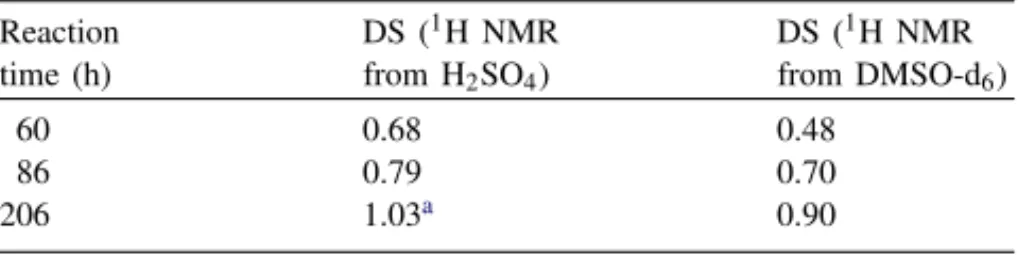
recorded. Three pairs of results obtained from the above two methods are listed inTable 4. The DS obtained from H2SO4 solutions are greater by ∼0.1–0.2 than those
ob-tained from DMSO-d6. This may be explained by factors
inherent in this technique such as incomplete suppression of the intense sulfuric acid peak, lower resolution and lower signal to noise ratio. Another possible reason is that the
1H NMR test in H
2SO4reaction mixture was run at 30◦C,
which may induce some further sulfonation. The samples were run at 30◦C to reduce the reaction solution viscosity
Table 4
DS of V-SPEEK in DMSO-d6 and in H2SO4 obtained from1H NMR
Reaction time (h) DS (1H NMR from H2SO4) DS (1H NMR from DMSO-d6) 60 0.68 0.48 86 0.79 0.70 206 1.03a 0.90
aThis value cannot be larger than 1.00.
the relative integrations of signals are not precise, leading to a small DS overestimation (average ∼ 0.15). Therefore, the DS derived by this method must be adjusted by deducting this variation. However, DS obtained directly from sulfuric acid is a convenient method to follow the real-time sulfona-tion reacsulfona-tion and readily monitor the sulfonasulfona-tion of PEEK to achieve the desired DS. The direct method is also espe-cially valuable in the case of SPEEK with low DS (≤0.4), since there is no common deuterated organic solvent to dissolve this SPEEK for running the1H NMR test. In our previous studies, lower DS SPEEKs were used in the prepa-ration of mixed-matrix PEMs containing inorganic proton conductors.
This technique can also be used to study kinetics of sul-fonation. The sulfonation was conducted at room tempera-ture (20◦C). The start-time for the sulfonation reaction in
previous studies was ∼90 and 60 min, respectively[17,32], since it was inferred that PEEK was almost completely dis-solved in concentrated H2SO4 at that time. In the present
paper, the reaction start-time was not set at the exact time of complete dissolution, since complete dissolution of SPEEK in concentrated sulfuric acid (95–98%) took several hours due to the nature of the commercial extruded pellets. The starting time was set at 1 h after adding the PEEK to the sulfuric acid, since the sulfonation reaction and dissolution of PEEK occur simultaneously. It is noted in the present study that Gatone PEEK dissolves much more rapidly than Victrex PEEK in concentrated H2SO4.
The DS as a function of reaction time has been studied previously by different methods[8,17,29–35]. In the present study, the DS values acquired for Victrex®PEEK (V-PEEK) at ambient temperature directly in sulfuric acid solution, af-ter deducting a variation of 0.15, are plotted versus sulfona-tion reacsulfona-tion time (Fig. 5). The values inFig. 5 represent a single reaction whereas the values inTable 1are derived from individual batch reaction. The results show that the sul-fonation of PEEK proceeded rapidly initially, reaching DS ∼ 0.8 within 1 week, but progressed slowly thereafter, which is consistent with other reported work[8,23,32,34,35].
3.2. FTIR study
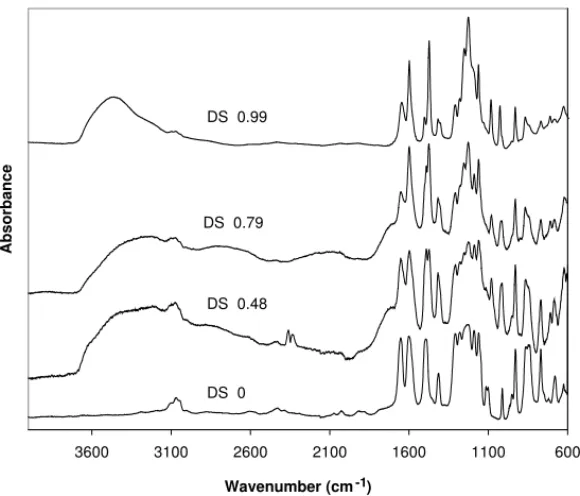
The comparative FTIR spectra of V-PEEK and V-SPEEK samples with different DS are shown inFig. 6. The broad-band in SPEEK samples appearing at 3460 cm−1 was assigned to O–H vibration from sulfonic acid groups
in-0 0.2 0.4 0.6 0.8 1 0 100 200 300 Reaction Time (h) DS
Fig. 5. DS measured by 1H NMR in H2SO4 reaction mixture, after
deducting a DS value of 0.15.
teracting with molecular water. The aromatic C–C band at 1489 cm−1 for PEEK was observed to split due to new substitution upon sulfonation. A new absorption band at 1080 cm−1in SPEEK was assigned to sulfur–oxygen sym-metric vibration O=S=O. The new absorptions at 1255, 1080, and 1020 cm−1 which appeared upon sulfonation
were assigned to the sulfonic acid group in SPEEK [31], as their intensities with respect to the backbone carbonyl band at 1651 cm−1increased with DS. There is no change in the carbonyl band at 1651 cm−1 for SPEEK compared with PEEK.
During the course of this study, efforts were made to thermally crosslink SPEEK for PEMs. A patent[21]reported that two sulfonic acid groups of SPEEK form a sulfone group upon treatment at 120◦C under vacuum. FTIR spectra
were recorded for SPEEK samples after annealing at 160◦C
in vacuum for 24 h, however no apparent new absorptions for the sulfone group were observed in the spectra. The thermally treated SPEEKs (initially with high DS) could still be dissolved in hot water, indicating contrary to what was claimed in[21], that an insignificant amount of crosslinking, if any, occurred through this mechanism at temperatures up to at least 160◦C.
3.3. Molecular weight (Mw) of PEEK
Due to the poor solubility of PEEK, it was difficult to measure its molecular weight directly. GPC has been successfully applied to measure Mw of pure PEEK using
phenol/1,2,4-trichlorobenzene 50/50 mixture at 115◦C[31].
Other successful methods to determine the Mw of PEEK
have been based on the study of SPEEK properties, such as dynamic light scattering[16,31]viscosity (using H2SO4
as solvent) and ultracentrifugation (using DMF/LiCl as solvent) [7]. Devaux et al. [31] measured Mw of PEEK,
fully sulfonated with sulfonic acid, by both dynamic light scattering and intrinsic viscosity. Using the experimental
600 1100 1600 2100 2600 3100 3600 Wavenumber (cm ) Absorbance DS 0.99 DS 0.79 DS 0.48 DS 0 -1
Fig. 6. Comparative FTIR spectra of V-PEEK and sulfonated V-SPEEK.
data for fully substituted SPEEK (DS 1.00) obtained by both methods, Devaux et al. [31] established an empirical Mark–Houwink equation (Eqs. (1) and (2)) relating viscos-ity and molecular weight was obtained:
[ηs]25◦C=3.849 × 10⁻⁵( ¯Mw)0.94
s (dl/g) (1)
where ( ¯Mw)s is the molecular weight of the sulfonated
PEEK. The molecular weight of unsulfonated PEEK could be estimated from the intrinsic viscosity of SPEEK by re-moving the contribution of SO3H group in Eq. (1). The
following empirical Mark–Houwink equation was obtained: [ηa]25◦C=6.195 × 10⁻⁵( ¯Mw)0.94
u (dl/g) (2)
where ( ¯Mw)u is the molecular weight of the unsulfonated
PEEK.
Two series of three different SPEEK samples obtained from both Victrex® and Gatone® SPEEK and having DS ∼1.0 and ∼0.8, were tested and the results are presented inTable 5. The samples include the Victrex®and Gatone® SPEEK with DS ∼ 1 (as determined by 1H NMR in DMSO-d6). They were obtained by sulfonating PEEK either
at room temperature for 1 month or at 55◦C for 10 h.
It has been previously reported[15,16,29]that no chem-ical degradation and no sulfone crosslinking were observed when concentrated sulfuric acid (concentration below 100%) was used for sulfonation at ambient temperature. There-fore the Mw values of both Victrex® and Gatone® PEEK
extrapolated from SPEEK with DS 1.0 sulfonated at room temperature should be regarded as a credible approximation of the Mwof initial PEEK samples. FromTable 5it can be
seen that the Mw values for Victrex®and Gatone®PEEKs
are similar. Following this, the (Mw)s of both Victrex®
and Gatone® PEEK sulfonated at 55◦C (V-SPEEK99(55),
G-SPEEK97(55)) were measured. The obtained (Mw)s for
Victrex® and Gatone® PEEKs sulfonated at 22◦C room
temperature (V-SPEEK99, G-SPEEK100) and at 55◦C are almost the same (Table 5). Hence, it is deduced that no chemical degradation of either Victrex®or Gatone®PEEK
occurs when they are sulfonated at 55◦C, confirming
an-other report [15]. This suggests that sulfonation of PEEK can be conducted for short times at elevated temperature (55◦C) without degradation.
ForEq. (1)to be valid, the DS value should be close to 1.0. To verify this, SPEEK with DS 0.8 was dissolved in con-centrated sulfuric acid and the Mw was measured. It should
be noted that the process of sulfonation of PEEK in concen-trated sulfuric acid is very slow after the DS reaches 0.8. The
Mw found for these samples (V-SPEEK79, G-SPEEK77) are overestimated by 30% (Table 5), compared with SPEEK DS ∼ 1.0. Thus, it is necessary to use SPEEK with DS ∼ 1.0 to determine a realistic Mw value from viscosity
tests.
Table 5
Intrinsic viscosity and molecular weights for Victrex® and Gatone®
SPEEK
Sample DS ηs (Mw)sa Mwb
Victrex SPEEK V-SPEEK99(55) 0.99 0.673 32600 25500
V-SPEEK99 0.99 0.663 32100 25100
V-SPEEK79c 0.79 0.883 43600 34100
Gatone SPEEK G-SPEEK97(55) 0.97 0.647 31300 24500
G-SPEEK100 1.00 0.631 30500 23800
G-SPEEK77c 0.77 0.796 39000 30500
aMolecular weight of SPEEK.
bMolecular weight for unsulfonated PEEK, M
w=(Mw)s/1.278. cM
100 150 200 250 300 350 400 Temperatue (°C) Endo V--SPEEK79 V--SPEEK64 V-PEEK
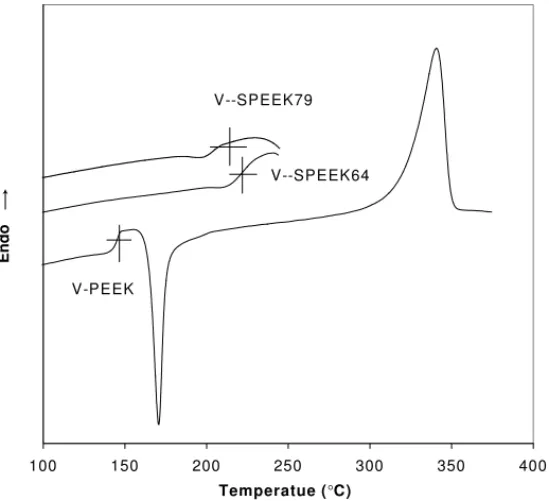
Fig. 7. Typical DSC curves of PEEK and SPEEKs.
3.4. Thermal properties
PEEK is a highly thermostable polymer with a Tg of
∼150◦C. TGA tests were run under air flow, in
similar-ity with real fuel cell conditions. TGA results showed there was no oxidation of SPEEK in the presence of air during pre-treatment of the samples under air (running to 160◦C).
DSC results show the Tgs of SPEEK occur in the range of
200–220◦C depending on the DS (Table 1,Fig. 7), in
sim-ilarity with results previously reported[8,15]. This increase of Tg values is typically observed in ionomeric polymers,
due to strong interaction between sulfonic groups.
The narrow dispersion of Tgvalues (20◦C range,Table 1)
may however be due to the effective ionic interaction (phys-ical crosslinking) which could become saturated at a certain DS. Tgis a parameter reflecting the polymer chain mobility
in a ∼100 nm segment. The effective physical crosslinking may not increase with increasing DS above a certain DS value, which would make the chain mobility and therefore
Tg invariant under these conditions. For example, the
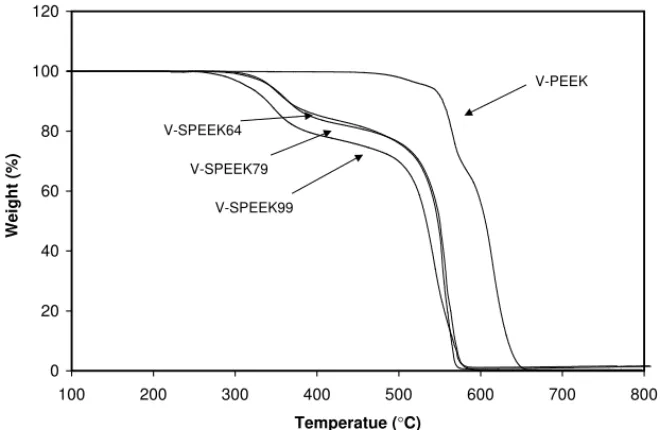
ef-fective ionic interaction (physical crosslinking) may attain almost the same level in both SPEEK with DS 0.6 and 1.0. Victrex® PEEK has a starting temperature of thermal degradation (Td1) at 550◦C. However, Gatone® PEEK
shows a considerably lower Td1of 467◦C. This is possibly
due to different residual reaction reagents present in the extruded pellets of Victrex® and Gatone®PEEK. The sul-fonated PEEKs show a progressive deterioration of thermal stability with increasing DS (Fig. 8). In comparison with pure PEEK, which exhibits a single step thermal degrada-tion, SPEEK has two distinct steps[8,36]. The first thermal degradation temperature Td1 of SPEEK decreased and the
signal broadened with DS. The first weight loss step is mainly associated with loss of the sulfonic groups in the range of 250–280◦C. The second weight loss step (at Td2) is
related to the decomposition of the main chain of PEEK in the range of 400–580◦C. The main chain degradation
tem-perature of SPEEK is lower than that of PEEK because of the catalytic degradation of the polymer chain caused by SO3H.
TGA analysis has been used to estimate the DS of SPEEK [8]. The method is based on the assumption that the first weight loss step at temperatures ranging between Td1 and Td2(the starting point of second step) is entirely caused by SO3release. The results inTable 6show that the DS values
obtained from TGA are comparable with those from NMR spectroscopy. The DS values obtained from TGA are slightly overestimated (about 0.05 higher)[8], probably because the TGA test is carried out under non-equilibrium conditions (10◦C/min) and small amounts of chain scission at the sul-fonated ether and carbonyl linkages may be involved in the first step degradation[36].
3.5. Water uptake and proton conductivity
It has been reported that the proton conductivity of SPEEK depends on the DS, pre-treatment of the membrane, hy-dration state, ambient relative humidity and temperature [21,22]. In general, for ionomeric membranes, the proton conductivity depends on the number of available acid groups and their dissociation capability in water, which is accom-panied by generation of protons. Water molecules dissoci-ate acid functionality and facilitdissoci-ate proton transport, so the water uptake is an important parameter in studying PEMs. Swelling is also a key factor for the mechanical integrity of
0 20 40 60 80 100 120 100 200 300 400 500 600 700 800 Temperatue (°C) Weight (%) V-PEEK V-SPEEK64 V-SPEEK79 V-SPEEK99
Fig. 8. Typical TGA curves of PEEK and SPEEKs.
membranes. Excessively high levels of water uptake can re-sult in membrane fragility and dimensional change leading to failures in mechanical properties, and in extreme cases, solubility in water at elevated temperatures. Therefore, it is important to know the relationship between the DS and wa-ter uptake for SPEEK PEMs.
In a fuel cell, PEMs are typically exposed to an operating environment of humidified gases at elevated temperatures. In the present work, membranes were submersed in water for treatment, which can be considered to be a harsher con-dition than the PEM operating environment. From Table 7 it follows that the equilibrium water contents of SPEEK in-creased with DS, as expected. SPEEK film with DS 1.0 could be dissolved over time in water when immersed at room temperature. The room temperature water uptake of SPEEK films with DSs of 0.66 and 0.79 corresponded to 4.5 and 8 water molecules per sulfonic acid group of SPEEK, re-spectively. Accordingly, the dimensions of the film changed when the film absorbed water. The swelling of both Victrex® and Gatone® SPEEK films are shown in Table 7.
Gener-Table 6
DS obtained from TGA and NMR data Polymer
designation
DS (from1H NMR) DS (from weight loss) First weight loss (%) Decomposition temperature, Td1 (◦C) Decomposition temperature, Td2(◦C) V-SPEEK48 0.48 0.62 14.7 262 407 V-SPEEK69 0.69 0.74 17.1 249 429 V-SPEEK66 0.66 0.73 16.8 263 426 V-SPEEK67 0.67 0.72 16.7 260 434 V-SPEEK78 0.78 0.80 18.1 262 433 V-SPEEK79 0.79 0.83 18.7 258 435 V-SPEEK99(55) 0.99 0.95 20.9 251 420 G-SPEEK59 0.59 0.72 16.7 259 431 G-SPEEK77 0.77 0.88 19.7 243 434 G-SPEEK79 0.79 0.90 20.0 246 432 G-SPEEK97(55) 0.97 0.96 21.0 239 422
ally, the swelling of films should not be excessive in order to maintain adequate mechanical properties.
In the present study, membranes were initially hydrated by immersion in water for 24 h at room temperature, then the conductivity was measured. As shown in Fig. 9a, the conductivity increased as a function of DS. In similarity with conductivity, the water uptake also increased with DS as shown inTable 7.
It was also found that the conductivity increases with tem-perature. The conductivity of SPEEK with DS 0.8 reaches ∼10−1S/cm at 90◦C, which is considered to be high. It was also reported that the conductivity of SPEEK is close to that of Nafion 117 at high temperature[13]. However, the wa-ter uptake for Nafion 117 has the same value of about 20% at room temperature and at 50◦C, while SPEEK with high
DS (0.8) shows a ∼23% uptake at room temperature and a higher uptake of 58% at 50◦C.
Recently, it was also observed that the proton conductiv-ity of membranes cast from DMF and DMAc is significantly different[38]. Films of identical SPEEK cast from DMF and
Table 7
Water uptake and conductivity of SPEEK Polymer
designation
DS (from1H NMR) Transverse proton
conductivity at 25◦C (S/cm) Water uptake (wt.%) Swelling in water (%)a H2O/SO3H V-SPEEK48 0.48 2.0 × 10⁻³b 5 2 1.9 V-SPEEK64 0.64 5.6 × 10⁻³c 12 6 3.3 V-SPEEK66 0.66 0.9 × 10⁻²c 19 6 4.6 2.2 × 10⁻³b 16 7 V-SPEEK67 0.67 2.2 × 10⁻²c 19 6 4.5 2.7 × 10⁻³b 16 4.4 V-SPEEK79 0.79 3.9 × 10⁻²c 23 6.6 4.9 0.79 4.5 × 10⁻³b 20 6
V-SPEEK99 0.99 Soluble or gel
G-SPEEK59 0.59 1.8 × 10⁻²c 10 4.4 3.16
G-SPEEK77 0.77 1.7 × 10⁻²c 30 8 7.57
G-SPEEK79 0.79 1.6 × 10⁻²c 32 9.2 7.90
G-SPEEK97 0.97 Soluble or gel
aDimension length change. bFilm cast from DMF. cFilm cast from DMAc.
0.001 0.01 0.1 1 0 20 40 60 80 100 120 140 Temperature (°C) Conductivity (S/cm) V-SPEEK79 DS 0.79 V-SPEEK67 DS 0.67 V-SPEEK64 DS 0.64 V-SPEEK48 DS 0.48 0.001 0.01 0.1 1 0 50 100 150 Temperature (°C) Conductivity (S/cm) V-SPEEK79 DMAc V-SPEEK79 DMF (a) (b)
Fig. 9. (a) Proton conductivities of V-SPEEK films cast from DMAc at different temperatures, (b) proton conductivities of V-SPEEK79 (DS 0.79) films cast from DMAc and DMF.
DMAc were first dried at 60◦C, then dried at 120◦C under
vacuum for 24 h. The room temperature conductivity of the films cast from DMAc is much higher (approximately half an order of magnitude) than those cast from DMF (Fig. 9b). A combination of factors has been found to be responsible for this behavior. Detailed NMR studies[37,38]explain the possible processes occurring during PEM fabrication that leads to differences in proton conductivity. The room tem-perature water uptakes of the two SPEEK samples cast from DMAc and DMF shown inFig. 9b were almost the same. This discounts water uptake as a sole or primary reason for the difference in proton conductivity. It is reported that the proton conductivity mechanism of hydrated materials is due to the transportation of H3O+ or H5O2+. Therefore,
the lower conductivity of the hydrated film cast from DMF compared with DMAc may be due to its lesser number of available acid groups.
TGA data showed that both Tdof V-SPEEK79 film cast
from DMF and DMAc are about 184◦C, which is 70◦C
lower than the Td (258◦C) of virgin V-SPEEK79 directly
recovered from water. This indicates that some residues (or solvent-derived compounds) still exist in the film, and that they form complexes with SPEEK even when the films were dried in vacuum at 120◦C. It appears clear that
cast-ing solvents represent an important factor leadcast-ing to sig-nificant differences in proton conductivity. As indicated in Refs. [37,38], one of the most important reasons for such behavior is that during PEM fabrication, DMF undergoes acid-catalyzed decomposition at relatively low temperatures (much more easily than DMAc) to produce dimethylamine and the volatile compounds: formic acid for DMF or acetic acid for DMAc[37,38]. The acid-catalyzed decomposition takes place in the presence of sulfonic acid groups of SPEEK or residual sulfuric acid in SPEEK from the sulfonation pro-cess (particularly at high DS, because of the greater diffi-culty in washing acid out of the swellable samples). The decomposed product dimethylamine of DMF forms a strong
complex with sulfonic group, which reduces the amount of available free sulfonic group as compared with DMAc. This leads to less protonated water and results in lower proton conductivity. It is clear from NMR that the resulting degrada-tion byproduct dimethylamine can form a strong acid–base complex with sulfonic acid groups. Hence, although DMF may appear to be a better choice of solvent for PEM fabri-cation due to its lower boiling point compared with DMAc, a combination of factors result in DMF giving lower proton conductivity than DMAc and other solvents.
4. Conclusion
A comparative study of sulfonation and product char-acterization of both commercial Victrex® and Gatone® PEEK was conducted. Both PEEKs show identical chain structure according to NMR spectroscopy and have similar molecular weights. It is verified that higher temperature sulfonation (55◦C) did not induce any apparent chain
degradation of PEEK as shown by Mw tests. A new method
for determining the DS of SPEEK directly in the sulfuric acid (non-deuterated) reaction solution was accomplished by 1H NMR using a solvent suppression technique. A 1H NMR method, using a solvent suppression technique, gives DS values higher than those obtained by what might be considered the more accurate method of1H NMR analysis of a recovered samples in DMSO-d6 solution. The new
method is useful to evaluate the sulfonation kinetics and to obtain a desired target DS for SPEEK. From TGA tests, both Victrex® and Gatone® derived SPEEKs show a high first thermal degradation temperature (∼250◦C). As fol-lows from comparison with NMR results, TGA is also be a practical method to determine the DS of SPEEKs. The conductivities of the SPEEKs were found to increase with increasing DS. Films cast from DMAc show higher proton conductivity than those of SPEEK membranes cast from DMF. The effect of casting solvents on the proton conduc-tivity of SPEEK was recently explained by the formation of strong complexes between the decomposed product of the solvent and sulfonic acid groups[38].
Acknowledgements
Partial financial support was provided by National Science and Engineering Research Council (NSERC), Canada. The authors gratefully acknowledge the generous gift of PEEK pellets grade 450G from Victrex PLC and PEEK pellets grade 5300P from Gharda Chemicals Ltd.
References
[1] O. Savadogo, Emerging membranes for electrochemical system. I. Solid polymer membranes for fuel cell systems, J. New Mater. Electr. Syst. 1 (1998) 47.
[2] G. Inzelt, M. Pineri, J.W. Schultze, M.A. Vorotyntsev, Electron and proton conducting polymers: recent developments and prospects, Electrochim. Acta 45 (2000) 2403.
[3] J. Kerres, Development of ionomer membranes for fuel cells, J. Membr. Sci. 185 (2001) 3.
[4] K.D. Kreuer, On the development of proton conducting polymer membranes for hydrogen and methanol fuel cell, J. Membr. Sci. 185 (2001) 29.
[5] M. Rikukawa, K. Sanui, Proton-conducting polymer electrolyte mem-branes based on hydrocarbon polymers, Prog. Polym. Sci. 25 (2000) 1463.
[6] G. Alberti, M. Casciola, L. Massinelli, B. Bauer, Polymeric pro-ton conducting membranes for medium temperature fuel cell (110– 160◦C), J. Membr. Sci. 185 (2001) 73.
[7] H.H. Ulrich, G. Rafler, Sulfonated poly(aryl ether ketone)s, Die Angew. Makromol. Chem. 263 (1998) 71.
[8] S.M.J. Zaidi, S.D. Mikhailenko, G.P. Robertson, M.D. Guiver, S. Kaliaguine, Proton conducting composite membranes from poly(ether ether ketone) and heteropolyacids for fuel cell application, J. Membr. Sci. 173 (2000) 17.
[9] F. Wang, M. Hickner, Y.S. Kim, T.A. Zawodzinski, J.E. McGrath, Direct polymerization of sulfonated poly(arylene ether sulfone) ran-dom (statistical) copolymers: candidates for new proton exchange membranes, J. Membr. Sci. 197 (2002) 231.
[10] J. Kerres, A. Ullrich, F. Meier, Th. Haring, Synthesis and charac-terization of novel acid–base polymer blends for the application in membrane fuel cells, Solid State Ionics 125 (1999) 243.
[11] C. Genies, R. Mercier, B. Sillion, N. Cornet, G. Gebel, M. Pineri, Soluble sulfonated naphthalenic polyimides as materials for proton exchange membranes, Polymer 42 (2001) 359.
[12] X. Guo, J. Fang, T. Watari, K. Tanaka, H. Kita, K. Okamoto, Novel sulfonated polyimides as polyelectrolytes for fuel cell ap-plication. 2. Synthesis and proton conductivity of polyimides from 9,9-bis(4-aminophenyl)fluorene-2,7-disulfonic acid, Macromolecules 35 (2002) 6707.
[13] D.J. Jones, J. Roziere, Recent advances in the functionalisation of polybenzimidazole and polyetherketone for fuel cell applications, J. Membr. Sci. 185 (2001) 41.
[14] J.A. Asensio, S. Borros, P. Gomz-Remero, Proton-conducting poly-mers based on benzimidazoles and sulfonated benzimidazoles, J. Polym. Sci. A 40 (2002) 3703.
[15] X. Jin, M.T. Bishop, T.S. Ellis, F.E. Karasz, A sulphonated poly(aryl ether ether ketone), Br. Polym. J. 17 (1985) 4.
[16] M.T. Bishop, F.E. Karasz, P.S. Russo, K.H. Langle, Solubility prop-erties of a poly(aryl ether ether ketone) in strong acids, Macro-molecules 18 (1985) 86.
[17] C. Bailly, D.J. Williams, F.E. Karasz, W.J. MacKnight, The sodium salts of sulphonated poly(aryl-ether-ether-ketone) (PEEK): prepara-tion characterizaprepara-tion, Polymer 28 (1987) 1009.
[18] F. Wang, J. Li, T. Chen, J. Xu, Synthesis of poly(ether ether ketone) with high content of sodium sulfonate groups and its membrane characteristics, Polymer 40 (1999) 795.
[19] M.C. Wijers, M. Jin, M. Wessling, H. Strathmann, Support liquid membranes modification with sulphonated poly(ether ether ketone): permeability, selectivity and stability, J. Membr. Sci. 147 (1998) 117. [20] F.G. Wilhelm, I.G.M. Punt, N.F. van der Vegt, H. Strathmann, M. Wessling, Cation permeable membranes from blends of sulfonated poly(ether ether ketone) and poly(ether sulfone), J. Membr. Sci. 199 (2002) 167.
[21] F. Helmer-Metamann, F. Osan, A. Schneller, H. Ritter, K. Ledjeff, R. Nolte, R. Thorwirth, US Patent 5 438 082 (1995).
[22] B. Bauer, D.J. Jones, J. Roziere, L. Tchicaya, G. Alberti, M. Casciola, L. Massinelli, A. Peraio, S. Besse, E. Ramunni, Electrochemical characterization of sulfonated polyetherketone membranes, J. New Mater. Electr. Syst. 3 (2000) 93.
[23] T. Kobayashi, M. Rikukawa, K. Sanuui, N. Ogata, Proton-conducting polymers derived from poly(ether-etherketone) and
poly(4-phenoxybenzoyl-1,4-phenylene), Solid State Ionics 106 (1998) 219.
[24] T. Soczka-Guth, J. Baurmeister, G. Frank, R. Knauf, Method for producing a membrane used to operate fuel cells and electrolysers, International Patent WO99/29763 (1999).
[25] K.D. Kreuer, T. Dippel, J. Maier, Membrane materials for PEM fuel cells: a microstructural approach, Proc. Electrochem. Soc. 95 (23) (1995) 241.
[26] S.P.S. Yen, S.R. Narayanan, G. Halpert, E. Graham, A. Yavrouian, Polymer material for electrolytic membranes in fuel cells, US 5 795 496 (1998).
[27] S.D. Mikhailenko, S.M.J. Zaidi, S. Kaliaguine, Electrical properties of sulfonated polyether ether ketone/polyetherimide blend membranes doped with inorganic acids, J. Polym. Sci. B 38 (2000) 1386. [28] C. Manea, M. Mulder, Characterization of polymer blends of
polyethersulfone/sulfonated polysulfone and polyethersulfone/sulfo-nated polyetheretherketone for direct methanol fuel cell applications, J. Membr. Sci. 206 (2002) 443.
[29] D. Daoust, J. Devaux, P. Godard, A. Jonas, R. Legras, in: H. Kausch (Ed.), Advanced Thermoplastic Composites—Characterization and Processing, Carl Hanser, Munich, 1992, Chapter 1.
[30] T. Ogawa, C.S. Marvel, Polyaromatic ether-ketones ether-ketone-sulfones having various hydrophilic groups, J. Polym. Sci. A 23 (1985) 1231.
[31] J. Devaux, D. Delimoy, D. Daoust, R. Legras, J.P. Mercier, C. Strazielle, E. Nield, On the molecular weight determination of a poly(aryl ether ether ketone) (PEEK), Polymer 26 (1985).
[32] D. Daoust, J. Devaux, P. Godard, Mechanism kinetics of poly(ether ether ketone) (PEEK) sulfonation in concentrated sulfuric acid at room temperature. Part 1. Qualitative comparison between polymer and monomer model compound sulfonation, Polym. Int. 50 (2001) 917.
[33] D. Daoust, J. Devaux, P. Godard, Mechanism kinetics of poly(ether ether ketone) (PEEK) sulfonation in concentrated sulfuric acid at room temperature. Part 2. Qualitative interpretation of model com-pound sulfonation, Polym. Int. 50 (2001) 925.
[34] N. Shibuya, R.S. Porter, A kinetic study of PEEK sulfonation in con-centrated sulfuric acid by ultraviolet-visible spectroscopy, Polymer 35 (1994) 3237.
[35] R.Y.M. Huang, P. Shao, C.M. Burns, X. Feng, Sulfonation of poly(ether ether ketone) (PEEK): kinetic study characterization, J. Appl. Polym. Sci. 82 (2001) 2651.
[36] Y. Luo, R. Huo, X. Jin, F.E. Karasz, Thermal degradation of sul-fonated poly(aryl ether ether ketone), J. Anal. Appl. Pyrol. 34 (1995) 229.
[37] S. Kaliaguine, S.D. Mikhailenko, K. Wang, P. Xing, G.P. Robert-son, M.D. Guiver, Properties of SPEEK based PEMs for fuel cell application, Catal. Today 82 (2003) 213.
[38] G.P. Robertson, S.D. Mikhailenko, K. Wang, P. Xing, M.D. Guiver, S. Kaliaguine, Casting solvent interactions with sulfonated poly(ether ether ketone) during proton exchange membrane fabrication, J. Membr. Sci. 219 (2003) 113.