HAL Id: inria-00526782
https://hal.inria.fr/inria-00526782
Submitted on 15 Oct 2010
HAL is a multi-disciplinary open access
archive for the deposit and dissemination of
sci-entific research documents, whether they are
pub-lished or not. The documents may come from
teaching and research institutions in France or
abroad, or from public or private research centers.
L’archive ouverte pluridisciplinaire HAL, est
destinée au dépôt et à la diffusion de documents
scientifiques de niveau recherche, publiés ou non,
émanant des établissements d’enseignement et de
recherche français ou étrangers, des laboratoires
publics ou privés.
Towards a True Acoustic-Visual Speech Synthesis
Asterios Toutios, Utpala Musti, Slim Ouni, Vincent Colotte, Brigitte
Wrobel-Dautcourt, Marie-Odile Berger
To cite this version:
Asterios Toutios, Utpala Musti, Slim Ouni, Vincent Colotte, Brigitte Wrobel-Dautcourt, et al..
To-wards a True Acoustic-Visual Speech Synthesis. 9th International Conference on Auditory-Visual
Speech Processing - AVSP2010, Sep 2010, Hakone, Kanagawa, Japan. pp.POS1-8. �inria-00526782�
Towards a True Acoustic-Visual Speech Synthesis
Asterios Toutios, Utpala Musti, Slim Ouni, Vincent Colotte,
Brigitte Wrobel-Dautcourt, Marie-Odile Berger
LORIA, UMR 7503, BP 239, 54506 Vandœuvre-l`es-Nancy, France
{toutiosa,musti,slim,colotte,wrobel,berger}@loria.frAbstract
This paper presents an initial bimodal acoustic-visual synthesis system able to generate concurrently the speech signal and a 3D animation of the speaker’s face. This is done by concatenating bimodal diphone units that consist of both acoustic and visual information. The latter is acquired using a stereovision tech-nique. The proposed method addresses the problems of asyn-chrony and incoherence inherent in classic approaches to au-diovisual synthesis. Unit selection is based on classic target and join costs from acoustic-only synthesis, which are augmented with a visual join cost. Preliminary results indicate the benefits of this approach, since both the synthesized speech signal and the face animation are of good quality.
Index Terms: audiovisual speech synthesis, talking head, bi-modal unit concatenation, diphones
1. Introduction
During the last decade, interest in audiovisual speech increased and more studies exist in both perception and synthesis. Speech is no longer considered as purely acoustic but it is considered as a bimodal means of communication. The first modality is audio, provided by the acoustic speech signal, and the second is visual, provided by the face of the speaker. Actually, the speech signal is the acoustic consequence of the deformation of the vo-cal tract under the effect of the movements of articulators such as the jaw, lips, and tongue. Moreover, there is more and more research showing the existence of a clear correlation between the face and the vocal tract. Thus, it is quite natural to find out that acoustics and face movements are correlated [1, 2].
Research in audiovisual speech intelligibility showed the importance of the information provided by the face especially when the audio is degraded [3, 4, 5]. Moreover, in [4] the au-thors showed that when the acoustic is degraded or missing, the natural face provides two thirds of the missing auditory intelli-gibility, the face without the inner mouth (without the tongue) provides half of the missing intelligibility and the lips restores third of it. This indicates that audiovisual synthesis should pay careful attention to model the part of the face that participates actively during speech, i.e., mainly the lips and lower part of the face.
In the vast majority of recent works, data-driven audiovi-sual speech synthesis, i.e., the generation of face animation to-gether with the corresponding acoustic speech, is still consid-ered as the synchronization of two independent sources: syn-thesized acoustic speech (or natural speech aligned with text) and the face animation [6]. However, achieving perfect syn-chronization between these two streams is not straightforward and presents several challenges related to audio-visual intelligi-bility. Furthermore, it can be the case that the auditory and the
visual information originate from different parts of the corpus, which may cause perceptual incoherence [7].
To avoid such problems, we propose, within the ViSAC project, to achieve synthesis with its acoustic and visible com-ponents simultaneously. Therefore, we consider a bimodal sig-nal as one sigsig-nal with two channels: acoustic and visual. This bimodality is kept during the whole synthesis process. The setup is similar to a typical concatenative (acoustic-only) speech synthesis setup, with the difference that here, the units to be concatenated consist of visual information alongside acoustic information. The concatenation unit adopted in our work is the diphone. The advantage of choosing diphones is that the ma-jor part of coarticulation phenomena is captured locally in the middle of the unit and the concatenation is made at the bound-aries, which are acoustically and visually steadier. Actually, this choice is in accordance with current practices in concatenative speech synthesis.
The idea of concatenating bimodal units is not entirely new. First studies appeared in [8] and [9]. More recently, two ad-vanced systems based on 2D images were presented in [10] and [7]. These works share several common characteristics with ours. Nevertheless, the combination of features of our system, as presented in this paper, is unique. In fact, our particular ability to acquire and process large amount of parallel audio-visual data will be very important to keep improving the quality of our results. In addition, a good coverage of the lower face by 3D markers is an important characteristic of our acquisition technique (see Fig. 1). In fact, the visual information is 3D data, pertaining to the movements of a large number of mark-ers painted on the face of the speaker. The number of markmark-ers is large enough to allow accurate reconstruction of the lips and all the area around them, which is important mainly because of their importance in audiovisual intelligibility. As a matter of fact, one of our goals is to be able to accurately animate the lips and thus the articulation and the coarticulation reproduce similar behavior as that of the real speaker.
Figure 1: A pair of stereovision images, showing the markers
painted on the speaker’s face.
We expect a two-fold benefit from our approach. On the one hand, taking into account visual information in
text-to-acoustic-speech synthesis can improve the quality of text-to-acoustic-speech synthesis by offering a more relevant distance measure for unit selection and concatenation. On the other hand, audiovisual synthesis can be improved due to the intrinsic consistency of combined acoustic-visual information.
In this paper, we first present our acquisition system and the data modeling. We used Principal Component Analysis (PCA) to reduce the dimensionality of the data. Second, the main idea of the bimodal selection and concatenation is presented. Then some preliminary results are presented to illustrate the potential benefits of our proposed method of combining acoustic and vi-sual constraints in a concatenative system. Finally, we provide some comments and concluding remarks.
2. Data acquisition and modeling
2.1. Acquisition
Visual data acquisition was performed simultaneously with acoustic data recording, using an improved version of a low-cost 3D facial data acquisition infrastructure we developed in the past [11]. The system uses two fast monochrome cameras, a PC, and painted markers, and provides a sufficiently fast acqui-sition rate to enable an efficient temporal tracking of 3D points. The large majority of markers are detected by low-level pro-cessing of the stereo image pairs. However, there are also cases when markers cannot be directly detected, for example markers on the temples which may disappear when the speaker moves his/her head, or markers on the lips that are occluded during protrusion or closing of the mouth. In such cases the positions of the markers are estimated using an interpolation scheme that involves an initial 3D mesh of the face. Processing the data is still a lengthy work though (several weeks for 25 minutes of data).
The recorded corpus consisted of the 3D positions of 252 markers covering the whole face. However, the lower face was covered by 70% of all the markers (178 markers), where 52 markers were covering only the lips. We made this choice, to be able to capture the lip movement accurately and to be able to model finely the lips. The sampling rate was 188.27 Hz. The corpus was made of 319 medium-sized French sentences, covering about 25 minutes of speech, uttered by a native male speaker. A few extra sentences were recorded for testing pur-poses. These data were sub-sampled to 100 Hz, for easier la-beling and alignment with acoustic parameters. In combination with the sub-sampling, the data were filtered using a low-pass filter with a cutoff frequency of 25 Hz. Such a processing re-moves additive noise from the visual trajectories without sup-pressing important position information. The speech signal was recorded at 16 kHz with 16-bit precision.
2.2. Principal Components
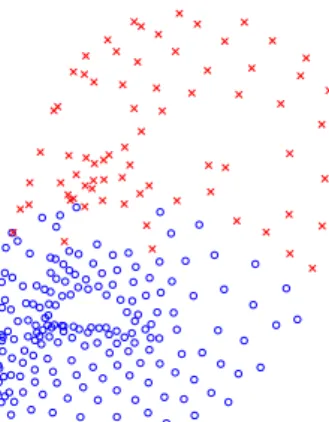
We applied principal component analysis on a subset of markers at the lower part of the face (jaw, lips, and cheeks–see Fig. 2). The reason for this choice was that the movements of markers on the lower part of the face are tightly connected to speech ges-tures, while markers on the upper part of the face either do not move, or their movements are of no direct relevance to speech. We retained the 12 first principal components, which explain about 94% of the variance of the lower part of the face.
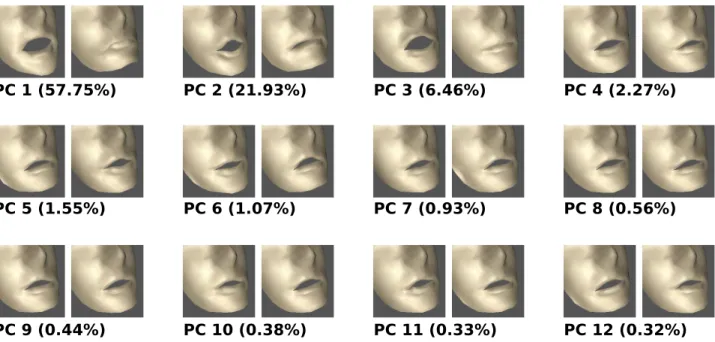
These 12 components are shown in Fig. 3. The first two components, which explain 79.6% of the lower face variance, both account for combined jaw opening and lip protrusion ges-tures. For the first component, as the jaw closes, lips protrude.
Figure 2: PCA is applied on the information of 178 out of 252
painted markers (plotted in blue circles). The remaining of the markers (plotted in red crosses) are modeled only by their mean value, since they do not reflect explicit speech gestures.
The effect is reversed for the second component: as the jaw
opens, lips protrude. That is, the two basic gestures of jaw
open-ing and protrusion appear not in isolation but intertwined. The third component accounts for lip opening, after removal of the jaw contribution. It is in good agreement with the lip opening factor typically described in articulatory models, as in Maeda’s model [12], for instance. Some of the components are related to speech but augmented by some gestures are specific to speaker facial expression. For instance, components 4 and 5 capture lip spreading, however due to some asymmetry of our speaker’s ar-ticulation, lip spreading is divided in two modes: one account-ing for spreadaccount-ing toward the left side of the lips and one for spreading toward the right side. Component 6 is a smiling ges-ture, however it is not clear whether it is related to speech or pure facial expression. Components 7 to 12 seem to account for very subtle lip deformations, which we believe are idiosyncratic characteristics of our speaker.
Several experiments indicated that retaining as less as three components could lead to an animation which would be accept-able, in the sense that it would capture the basic speech tures and would filter out almost all the speaker specific ges-tures. However, such an animation would lack some natural-ness, which is mostly captured by secondary components. We are also in favor of keeping the specificity of the speaker ges-tures. Retaining 12 components leads to animations that are natural enough for all purposes.
One of the goals of our proposed system is to synthesize trajectories corresponding to the PCA-reduced visual informa-tion, for these 12 components, alongside the synthesized speech signal. The visual information of the lower face can be recon-structed using these 12 trajectories. The mean values of the positions of the markers at the upper part of the face may then be added to complete the face visualization.
3. Bimodal selection and concatenation
As in typical concatenative speech synthesis, a corpus was phonetized, analyzed linguistically, and partitioned into di-phones. This corpus included information on position, duration, acoustic, visual (that is, the PCA-reduced representation) and linguistic parameters for each diphone. This corpus consisted of the 319 sentences. The size of this corpus is large enough compared to other works on audiovisual synthesis, but small
Figure 3: The 12 first principal components of the facial data and the percentage of variance each of them explains. Each pair of images
shows the deformation of the face when the corresponding component assumes a value of -3 (left) or +3 (right) standard deviations.
compared to works on text-to-speech synthesis. The main goal of using this corpus is to study the feasibility of our technique. During this project, we are designing a larger corpus of acous-tic and visual data, composed of about 2000 sentences (more than 2 hours of speech). The new corpus will cover at least all diphones of the French language and will contain several repre-sentations of these diphones in different contexts. Special care will be taken to account for visual variability alongside acoustic variability.
The input to the synthesizer system is a text that is auto-matically phonetized and partitioned into diphones. For each diphone, all possible candidates from the corpus must have the same phonemic label. A special algorithm is available to han-dle cases when there are no instance of the same diphone. The selection among these candidates is performed using the Viterbi algorithm. The result of the selection is the path in the lattice of candidates which minimizes a weighted linear combination of three costs: the target cost (T C), the acoustic join cost (JC), and the visual join cost (V C), that is
C = wtcT C + wjcJC + wvcV C (1) where wtc, wjcand wvcare weights to be chosen empirically by the experimenter.
The target cost is calculated on the basis of the linguistic analysis of the target utterance and is a weighted summation of the difference between the features of the candidate diphone and the features of the target diphone. Some of the features used are: syllable number and position in word, rhythmic group, and sentence; word number and position in rhythmic group and sen-tence; proximity of pauses; phoneme voicing, place and manner of articulation. The acoustic join cost is defined as the acoustic distance between the units to be concatenated, and is calculated using acoustic features at the boundaries of the units to be con-catenated: fundamental frequency, spectrum, energy, and dura-tion. For more details on the calculation of these costs see [13]. Similarly, the visual join cost is defined as the visual dis-tance between the units to be concatenated. This is calculated
Figure 4: Illustration of the visual cost calculation. The purpose
is to minimize the distance d between the points Pi,1and Pi,2
at the boundary of the two concatenated diphones.
using the PCA transformed visual information at the boundaries of the units to be concatenated. That is:
V C = 12 X
i=1
wi(Pi,1− Pi,2)2 (2) where Pi,1and Pi,2are the values of the projection on princi-pal component i at the boundary between the two diphones (see Fig. 4). The choice of weights wiis generally up to the experi-menter, however it should reflect the relative importance of the components. In accordance with [14], we chose these weights to be proportional to the eigenvalues of PCA analysis.
The selected diphone sequence is concatenated acoustically using a traditional technique, where pitch values are used to im-prove the join of diphones. At the moment, we do not apply any processing at all to the concatenated visual trajectories. Such a processing would be helpful in imposing continuity upon vi-sual trajectories, at boundaries between diphones, especially for less important principal components. For the most important components, the trajectories are already acceptably continuous
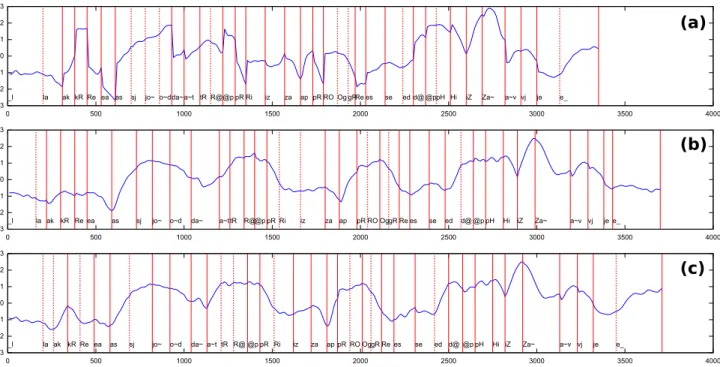
Figure 5: Concatenated first visual principal component (in z-scored units) for the test sentence ‘La cr´eation de l’entreprise a progress´e
depuis Janvier” when: (a) only target and acoustic join costs are minimized; (b) only visual join cost is minimized; (c) a weighted sum of all three costs is minimized. Horizontal axes denote time in milliseconds. The boundaries between diphones are marked. Dashed lines indicate that the combination of the two diphones exists consecutively in the corpus and is extracted “as is” from it, solid lines otherwise. SAMPA labels for diphones are shown.
(given our choice of relative weights for the calculation of the visual cost), and we expect that the quality will be improved further with a larger corpus as more candidates will be present.
4. Results
Some examples of acoustic-visual synthesis are available at (http : //visac.loria.fr/demos). To provide a preliminary evaluation of our system, we studied three cases for the weights of Eq. (1). First, we selected wvc = 0, i.e., we did not ap-ply a visual cost, and the system was driven only by linguistic and acoustic constraints, via target and acoustic join cost, re-spectively (acoustic-only case). The weights wtcand wjcwere set to optimal values according to our experience with acoustic-only synthesis.
For the second case, target and acoustic join cost weights were set to zero. The system was driven only by visual infor-mation (visual-only case).
The third case was truly bimodal. The target and acoustic join cost weights were selected as in the first case. The visual weight was given such a value so that the contribution of the third (visual) term of Eq. (1) was roughly equal to the contribu-tion of the first two terms.
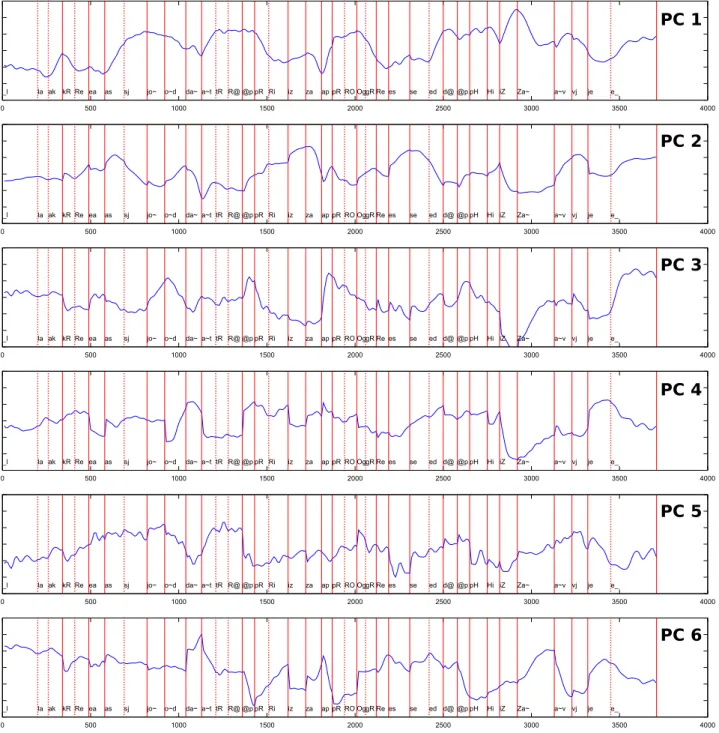
In Fig. 5 we show the trajectory of the first principal component for the synthesis of the sentence: “La cr´eation de l’entreprise a progress´e depuis Janvier”. In the acoustic-only case (a) there are some obvious discontinuities in the visual tra-jectory, that results in visible jerks during the animation of the face. On the contrary, in the visual-only (b) and bimodal (c) cases the resulting visual trajectories are smoother. This is true for the first three components, however, as we move to less im-portant components discontinuities start to appear gradually, as can be seen in Fig. 6. This is because the weights we chose
in Eq. (2) (i.e. the eigenvalues) put a lot of emphasis on the first few components. Nevertheless, more important a principal component, more sensitive the animation is to discontinuities in the corresponding projection.
Regarding speech acoustics, the bimodal case results to a waveform that is much closer to the waveform resulting from the acoustic-only case, than to the one resulting from the visual-only case. Listening showed that the visual-visual-only result, while intelligible, has several problems regarding phoneme duration, intonation and some audible discontinuities at boundaries be-tween diphones.
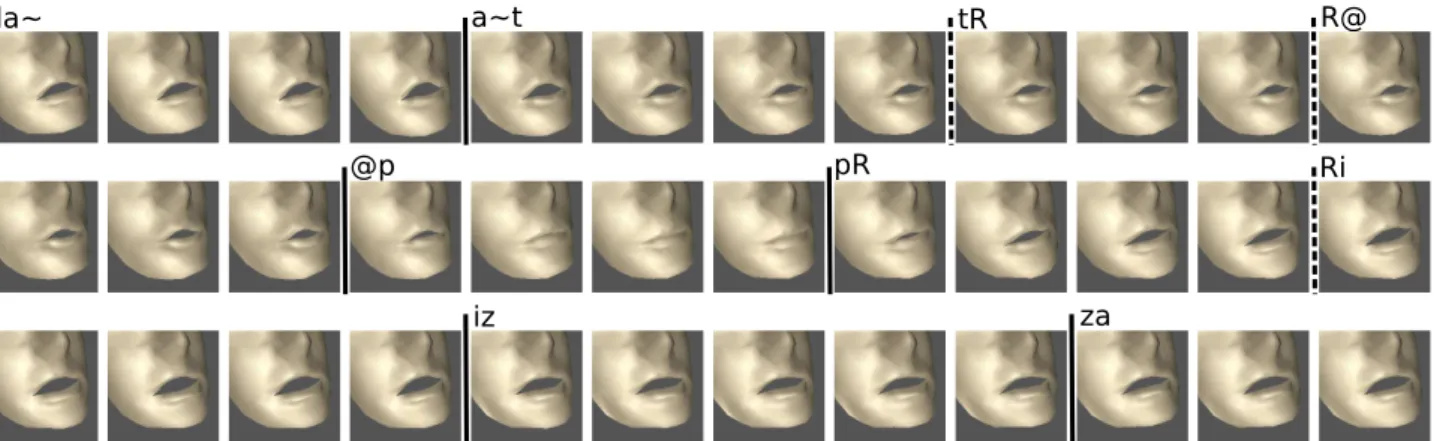
Broadly, using in conjunction acoustic/linguistic and vi-sual constraints combines benefits from using in isolation either acoustic/linguistic or visual constraints. Fig. 7 shows an ani-mated sequence using all constraints for a part of the sentence shown in Figs. 5. The faces (shown only in part, to emphasize the mouth area) are represented here by sparse meshes. These will be mapped to meshes of much higher resolution later on which should add more realism to our final result [15].
5. Conclusion
We presented a bimodal acoustic-visual synthesis where syn-thesis is achieved simultaneously for both acoustic and visual channels by concatenating bimodal diphones. The system com-bines costs from acoustic-only speech synthesis with a visual cost. This approach has the potential of overcoming inherent problems of the usual approach to audiovisual synthesis, such as asynchrony and incoherence. We also expect the extra ben-efit of improving the quality of the synthesized acoustic signal, since visual information provides additional relevant distance measures for selection and concatenation.
promis-
Figure 6: Concatenated six first visual principal component (in z-scored units) for the test sentence “La cr´eation de l’entreprise a
progress´e depuis Janvier” using a bimodal weighting. Horizontal axes denote time in milliseconds. The boundaries between diphones are marked. Dashed lines indicate that the combination of the two diphones exists consecutively in the corpus and is extracted “as is” from it, solid lines otherwise. SAMPA labels for diphones are shown.
Figure 7: Sequence of images, derived from synthesized 3D facial information, corresponding to milliseconds 1040 to 1750 of Fig. 5(c).
The word depicted in this example is “d’entreprise”, and synthesis is done by minimizing the weighted sum of all three costs involved. For the sake of clarity, one image for every 20 ms is shown. Bars mark the boundaries between concatenated diphones (dashed when diphones are consecutive in the corpus).
ing. In addition, we expect that using a larger corpus (about six times larger than the one used in this study) should improve the quality of the synthesis. We are optimistic that this in itself should increase drastically the quality of the bimodal synthe-sis, since we have observed such improvement in acoustic-only synthesis experiments with the same up-scaling of corpus size.
In the near future, we will explore and refine the choice of weights in Eqs. 1 and 2. Both of these sets of weights are un-der questioning, and we have only used preliminary heuristics for setting their values to get the results presented in this paper. It is very likely that a different relative weighting of the three costs (target, acoustic join, and visual join), or a different rela-tive weighting of the contribution of each principal component on the visual cost will improve results.
We also intend to apply appropriate processing of the vi-sual trajectories in the cases where we have some unavoidable mismatch at the boundaries between selected diphones. With the current weights used in the visual cost calculation, it seems that such processing is more relevant for less important princi-pal components.
For the longer term, we are planning a perceptual evaluation of our system, which could also be extended to the evaluation of the integration of the two signals (acoustic and visual). Our results and evaluation can be confronted with other audiovisual speech perception models [16, 17].
6. Acknowledgement
This work was supported by the French National Research Agency (ANR - ViSAC - Project N. ANR-08-JCJC-0080-01).
7. References
[1] J. Barker and F. Berthommier, “Evidence of correlation between acoustic and visual features of speech,” in ICPhS, San Francisco, USA, 1999.
[2] H. Yehia, P. Rubin, and E. Vatikiotis-Bateson, “Quantitative as-sociation of vocal-tract and facial behavior,” Speech
Communica-tion, vol. 26, no. 1-2, pp. 23–43, 1998.
[3] W. H. Sumby and I. Pollack, “Visual contribution to speech intel-ligibility in noise,” Journal of the Acoustical Society of America, vol. 26, no. 2, pp. 212–215, 1954.
[4] B. Le Goff, T. Guiard-Marigny, M. Cohen, and C. Benoit, “Real-time analysis-synthesis and intelligibility of talking faces,” in
2nd International Conference on Speech Synthesis, Newark, NY,
USA, 1994.
[5] S. Ouni, M. Cohen, H. Ishak, and D. Massaro, “Visual contri-bution to speech perception: measuring the intelligibility of ani-mated talking heads,” EURASIP Journal on Audio, Speech, and
Music Processing, vol. 2007, p. ID 47891, 2007.
[6] G. Bailly, M. B´erar, F. Elisei, and M. Odisio, “Audiovisual speech synthesis,” International Journal of Speech Technology, vol. 6, no. 4, pp. 331–346, 2003.
[7] W. Mattheyses, L. Latacz, and W. Verhelst, “On the importance of audiovisual coherence for the perceived quality of synthesized visual speech,” EURASIP Journal on Audio, Speech, and Music
Processing, p. ID 169819, 2009.
[8] A. Hallgren and B. Lyberg, “Visual speech synthesis with con-catenative speech,” in AVSP, Terrigal-Sydney, Australia, 1998. [9] S. Minnis and A. Breen, “Modeling visual coarticulation in
syn-thetic talking heads using a lip motion unit inventory with con-catenative synthesis,” in Interspeech, Bejing, China, 2000. [10] S. Fagel, “Joint audio-visual units selection the JAVUS speech
synthesizer,” in International Conference on Speech and
Com-puter, St. Petersburg, Russia, 2006.
[11] B. Wrobel-Dautcourt, M. Berger, B. Potard, Y. Laprie, and S. Ouni, “A low-cost stereovision based system for acquisition of visible articulatory data,” in AVSP, British Columbia, Canada, 2005.
[12] S. Maeda, “Compensatory articulation during speech: Evidence from the analysis and synthesis of vocal-tract shapes using an ar-ticulatory model,” in Speech production and speech modelling, W. Hardcastle and A. Marchal, Eds. Amsterdam: Kluwer Aca-demic Publisher, 1990, pp. 131–149.
[13] V. Colotte and R. Beaufort, “Linguistic features weighting for a Text-To-Speech system without prosody model,” in Interspeech, Lisbon, Portugal, 2005.
[14] K. Liu and J. Ostermann, “Optimization of an Image-Based Talk-ing Head System,” EURASIP Journal on Audio, Speech, and
Mu-sic Processing, p. ID 174192, 2009.
[15] M. Berger, “Realistic face animation from sparse stereo meshes,” in AVSP, Hilvarenbeek, The Netherlands, 2007.
[16] J. Kim and C. Davis, “Visible speech cues and auditory detection of spoken sentences: an effect of degree of correlation between acoustic and visual properties,” in AVSP, Scheelsminde, Denmark, 2001.
[17] J. Schwartz, F. Berthommier, and C. Savariaux, “Audio-visual scene analysis: evidence for a “very-early” integration process in audio-visual speech perception,” in Interspeech, Denver, Col-orado, 2002.