ANISOTROPIC SUPERELASTICITY OF
TEXTURED Ti-Ni SHEET
P. THAMBURAJA, S. GAO, S. YI and L. ANAND
Abstract— A recently developed crystal-mechanics-based constitutive model for polycrystalline shape-memory alloys (Thamburaja and Anand [1]) is shown to quantitatively pre-dict the in-plane anisotropy of superelastic sheet Ti-Ni to reasonable accord.
Keywords— Phase transformations, Constitutive equa-tions, Finite-elements, Mechanical testing.
I. Introduction
P
OLYCRYSTALLINE Ti-Ni is the most widely usedshape-memory material in industry. It is typically pro-cessed in the form of wires, bars and sheets. Superelastic Ti-Ni in sheet and ribbon form is used in actuation devices. For a given Ti-Ni sheet, experimental evidence has shown the superelastic behavior along different directions in the plane of the rolled sheets to be measurably anisotropic (eg. Saburi [2], Zhao et al. [3]). We have conducted our own superelastic experiments on Ti-Ni sheets, and the experi-mental results also show the in-plane anisotropic supere-lastic response. The purpose of this brief paper is to show that the recently developed crystal-mechanics-based con-stitutive model of Thamburaja and Anand [1] adequately captures the in-plane anisotropy.
II. EXPERIMENTAL PROGRAM
Superelastic Ti-Ni sheets were obtained from a commer-cial source. Tensile specimens were cut along different
di-rections and tested, ranging from 0o (rolling direction) to
90o (transverse direction) at 10o intervals. Superelastic
tension experiments were conducted at room temperature (θ = 298 K) under displacement control at very low strain rates to ensure isothermal testing conditions.
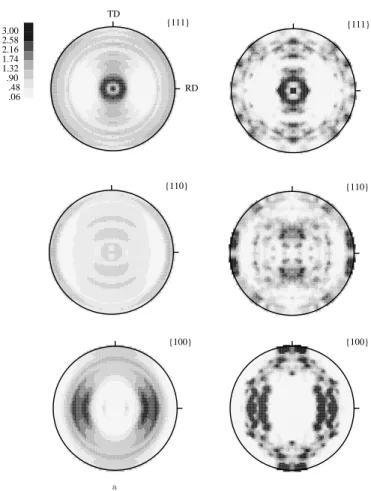
Experimental pole figure measurements of the initially-textured sheet were obtained using a Rigaku 200 X-ray diffraction machine. The {111}, {110} and {100} exper-imental pole figure is shown in figure 1(a). A numerical representation of the experimental pole figures using 420 discrete unweighted crystal orientations was obtained by using the computer program PoPLa [4]. The numerical representation of the experimental pole figures is shown in figure 1(b).
P. Thamburaja and L. Anand are with the Department of Mechan-ical Engineering, Massachusetts Institute of Technology, Cambridge, MA 02139. E-mail:[email protected]
S. Gao and Y. Sung are with the School of Mechanical & Production Engineering, Nanyang Technological University, Singapore 639798, Republic of Singapore. {111} 3.00 2.58 2.16 1.74 1.32 .90 .48 .06 TD RD {111} {110} {110} {100} {100} (a) (b)
Fig. 1. (a) Experimentally-measured texture in the as-received Ti-Ni sheet, and (b) its numerical representation using 420 discrete unweighted crystal orientations.
III. FINITE-ELEMENT SIMULATIONS AND RESULTS
Thamburaja and Anand [1] have implemented their con-stitutive model in the ABAQUS/Explicit [5] finite-element program. The initial finite-element mesh used to model a representative volume element (RVE) of the polycrystalline material is shown in figure 2(a).
In our finite-element model of a polycrystal, each element represents a single crystal, and it is assigned a crystal ori-entation from the set of crystal oriori-entations which approx-imate the initial crystallographic texture of the material shown in figure 1(b).
The material parameters in the constitutive model were calibrated to the tension experiment conducted along the rolling direction. The procedure to determine the material
0 0.01 0.02 0.03 0.04 0.05 0.06 0.07 0 100 200 300 400 500 600 700 STRAIN S T R E S S [ M P a ] EXPERIMENT:ROLLING FIT (a) (b)
Fig. 2. (a) Undeformed mesh of 420 ABAQUS C3D8R elements used to represent a textured polycrystal aggregate. (b) Superelastic stress-strain curve in tension along the rolling direction. The experimental data from this test were used to estimate the con-stitutive parameters. The curve fit using the full finite-element model of the polycrystal is also shown.
parameters is outlined in Thamburaja and Anand [1]. The fit of the constitutive model to the tension experiment con-ducted along the rolling direction is shown in figure 2(b). The single-crystal material parameters used to obtain this fit are:
Elastic moduli for austenitic : Ca
11 = 130 GPa, C12a =
98 GPa, Ca
44= 22 GPa.
Elastic moduli for martensitic: Cm
11 = 65 GPa, C12m =
49 GPa, Cm
44= 11 GPa.
Transformation strain: γT = 0.1308.
Temperature dependence of driving force : C(θ −
θT) = 102 MPa at θ = 298 K.
Critical driving force: fc= 6.9 MJ/m
3
.
With the constitutive model calibrated to the rolling di-rection, the superelastic tensile response along other direc-tions can be predicted. For brevity we show only the
re-sults of the finite-element predictions along the 50oand 90o
(transverse direction) orientations to the rolling direction, in figures 3 and 4, respectively.
The superelastic response in these orientations is well-approximated by the predictions from the constitutive model. Of particular note, the anisotropic response be-tween the rolling and transverse directions, as shown in figure 4, is captured by the model. To the best of our knowledge, this is the first time such calculations have been reported in the literature.
0 0.01 0.02 0.03 0.04 0.05 0.06 0.07 0 100 200 300 400 500 600 700 STRAIN S T R E S S [ M P a ] EXPERIMENT: 50o PREDICTION : 50 EXPERIMENT:ROLLING o
Fig. 3. Superelastic experiment along 50o
direction. The prediction from the full finite-element model for the polycrystal are also shown. For comparison purposes the tension experiment along the rolling direction is also shown.
0 0.01 0.02 0.03 0.04 0.05 0.06 0.07 0 100 200 300 400 500 600 700 STRAIN S T R E S S [ M P a ] EXPERIMENT:TRANSVERSE PREDICTION : TRANSVERSE EXPERIMENT:ROLLING
Fig. 4. Superelastic experiment along the transverse direction. The predictions from the full finite-element model for the polycrystal are also shown. For comparison purposes the tension experiment along the rolling direction is also shown.
IV. CONCLUSION
The crystal-mechanics-based constitutive model for phase transformations developed by Thamburaja and Anand [1] is shown to reasonably accurately predict the superelastic response of Ti-Ni sheet in tension along differ-ent in-plane directions. In particular, the rolling-transverse anisotropy of textured Ti-Ni sheet is captured by the con-stitutive model.
Acknowledgments
The financial support for this work was provided by the National Science Foundation under Grant CMS-0002930, and the Singapore-MIT Alliance. The ABAQUS finite-element software was made available under an academic license from HKS, Inc. Pawtucket, R.I.
References
[1] P. Thamburaja and L. Anand, J. Mech. Phys. Solids, 2001, 49, 709.
[2] T. Saburi, Proc. MRS Int. Mtg. on Adv. Mats., Tokyo (Shape Memory Mater.), 1989, 9, 77.
[3] L. Zhao, P. Willemse, J. Mulder, J. Beyer, and W. Wei, Scr. Mater., 1998, 39, 1317.
[4] J. Kallend, U. Kocks, S. Rollet, and R. Wenk, The Preferred Orientation Program of Los Alamos, (PoPLa), 1989.