Accelerators, Startup Performance, and Crises.
ByKonstantin Peter Oliver Von Bueren
B.S. Business Administration, WHU - Otto Beisheim School of Management, 2013
M.S. Management, London Business School, 2015
SUBMITTED TO THE MIT SLOAN SCHOOL OF MANAGEMENT IN PARTIAL FULFILLMENT OF THE REQUIREMENTS FOR THE DEGREE OF
MASTER OF SCIENCE IN MANAGEMENT STUDIES
AT THE
MASSACHUSETTS INSTITUTE OF TECHNOLOGY JUNE 2016
2016 KONSTANTIN PETER OLIVER VON BUEREN. All rights reserved.
The author hereby grants to MIT permission to reproduce
and to distribute publicly paper and electronic MAS OF 1 copies of this thesis document in whole or in part
in any medium now known of hereafter created.
JUN
g ar
aLIB
Signature redacted
USS INSTITUTE ECHNOLOGY08 2016
RARIES
RCMHVES
Signature of Author:MIT Sloan School of Management May 6, 2016
Signature redacted
Certified by:
Accepted by: _
Mercedes Delgado Visiting Associate Professor MIT Sloan School of Management
red acted
Thesis SupervisorRodrigo S. Verdi Associate Professor of Accounting Program Director, M.S. in Management Studies Program MIT Sloan School of Management
Accelerators, Startup Performance, and Crises.
ByKonstantin Peter Oliver Von Bueren
Submitted to MIT Sloan School of Management
on May 6, 2016 in Partial Fulfillment of the requirements of the Degree of Master of Science in
Management Studies.
Abstract
New accelerator programs have developed globally over the last decade. The accelerator concept is widely discussed in the media and receives increasing interest from researchers. However, the performance and impact of accelerators is often
debated.
This paper's objective is to offer a qualitative overview of different accelerator types and empirical analysis of the performance of two popular accelerators: Y Combinator and Techstars. Based on characteristics of the accelerators and the economic environment, this paper presents a first attempt to understand the influence of economic shocks on accelerated startups in the context of the recent Great Recession (2007-2009).
Three core findings were identified in this research. First, the death rate of startups accelerated during the recession is significantly greater than of startups accelerated before or after the recession. This finding questions the added value of attending an accelerator program during a recession and calls for crisis-specific initiatives to increase the resilience of the accelerated startups. Second, the scarce VC funding in a location during the crisis is associated with the increased death rates. Third, the two accelerators seem to have changed their business model, increasing the number of later stage startups (i.e., those with prior funding) accepted in their programs. Thesis Supervisor: Mercedes Delgado
Title: Visiting Associate Professor, MIT Sloan School of Management
Acknowledgements
This thesis is dedicated to my parents, Ursula von Bueren and Hendrik von Bueren, my siblings, Johannes von Bueren and Moritz von Bueren, and my grandparents, Anneliese Praendl and Hermann Praendl. My family's support always helped me to take the next step on a professional and personal level throughout my entire life. Their support enabled me to get into MIT and to always strive for the maximum. Additionally, I would like to thank my girlfriend, Diane Cagni, for her constant support and valuable advice during this entire year. Last but not least, I thank Professor Mercedes Delgado, who supervised my thesis. Mercedes and I met frequently and discussed my progress and she has always provided me with great, but challenging feedback. Her drive for perfection is inspiring and motivating to go the extra mile.
Table of Contents
Abstract ... iii
Acknow ledgem ents... v
Table of Contents ... vii
List of Figures... ix
List of Tables ... ix
List of Abbreviations... x
1. Introduction ... 1
2. A n Introduction to Accelerators ... 3
2.1 The History of Accelerators... 3
2.1.1 W hat Do Accelerators Do? ... ... ... ... .... ... .... . . 4
2.1.2 Rise of Accelerators... 5
2.2 Accelerator versus Incubator versus Business Angel ... 6
2.2.1 Accelerator versus Incubator ... 7
2.2.2 Accelerator versus Business Angel ... 9
2.3 Accelerator Types ... 10
2.3.1 Ecosystem Builders ... 10
2.3.2 M atchm akers... 11
2.3.3 Investors... 12
2.4 Deep Dive: Investor Accelerator ... 15
2.4.1 Business Model... 16
2.4.2 The Econom ics of Accelerators ... 17
2.4.3 Qualitative Analysis: Interview to Innovation Warehouse ... 18
3. Accelerators, Venture Capital, and Crises... 23
4. Q uantitative Findings... 24
4.1 Q uantitative Findings for Y Com binator... 25
4.1.1 Profile ... 25
4.1.2 Descriptive Analysis... 27
4.1.2.1 Startup Status: Dead, Acquired or Operating... 27
4.1.2.2 Rounds of Investm ent ... 29
4.1.2.3 Total Funding ... 31
4.1.2.4 Accelerator Acts as First Investor... 35
4.2 Quantitative Findings for Techstars ... 37
4.2.1 Profile ... 37
4.2.2 Descriptive Analysis ... 39
4.2.2.1 Startup Status: Dead, Acquired or Operating ... 39
4.2.2.2 Rounds of Investm ent ... 42
4.2.2.3 Total Funding ... 45
4.2.2.4 Accelerator Acts as First Investor... 50
4.3 Links between Techstars and the Regional Clusters ... 53
5. Regression M odel: Startup Survival... 55
5.1 Regression Findings: Y Com binator ... 57
5.2 Regression Findings: Techstars... 61
5.3 Reliability and M odel Robustness ... 64
6. Conclusion... 64
7. Bibliography ... 69
List of Figures
Figure 1: Innovation Warehouse's Selection Process...21
Figure 2: Y Combinator, Cohort Analysis by Startup Status as of 2016...29
Figure 3: Y Combinator, Cohort Analysis by Rounds of Investment as of 2016 ... . . 31
Figure 4: Y Combinator, Cohort Analysis by Startup with Maximum Funding as of 2016 ... 34
Figure 5: Y Combinator, Cohort Analysis by Total Funding as of 2016...34
Figure 6: Y Combinator, Cohort Analysis by Accelerator acted as First Investor ... 36
Figure 7: Y Combinator, Cohort Analysis by Accelerator acted as First Investor and Status ... 37
Figure 8: Techstars, Cohort Analysis by Startup Status as of 2016 ... 41
Figure 9: Techstars, Selected City Analysis by Operating Rate of the Com panies as of 2016... 42
Figure 10: Techstars, Cohort Analysis by Rounds of Investment as of 2016 45 Figure 11: Techstars, Startups with Maximum Funding per City as of 2016..47
Figure 12: Techstars, Startups with Maximum Funding per Year as of 2016.49 Figure 13: Techstars, Cohort Analysis by Total Funding as of 2016 ... 49
Figure 14: Techstars, Cohort Analysis by Accelerator did act as a First Investor ... 52
Figure 15: Techstars, Cohort Analysis by Accelerator did act as First Investor and Status as of 2016... 52
List of Tables
Table 1: Differences among Accelerators, Incubators and Business Angels.. 8Table 2: Accelerator Types and Their Key Attributes ... 15
Table 3: Definition of Regression Variables ... 56
Table 4: Y Combinator, Variable Correlation Matrix (N = 743) ... 58
Table 5a: Techstars, Variable Correlation Matrix (N = 507)... 62
List of Abbreviations
AIC Akaike Information Criterion
AUC Area Under the Curve
CAGR Compound Annual Growth Rate
IPO Initial Public Offering
ICT Information and Communications Technology
KPI Key Performance Indicator
LQ Location Quotient
MSA Metropolitan Statistical Area
MVP Minimum Viable Product
SaaS Software as a Service
USA United States of America
US United States
USD United States Dollar
1. Introduction
The phenomenon of the accelerator is rising with an increasing number of active accelerator programs in the United States and around the globe. Startup accelerators have been around for over a decade, starting with Y Combinator's creation in 2005. Since then hundreds of accelerators have been set up trying to help startups to grow.
According to Crunchbase and seed-db.com over 5600 companies have been accelerated in more than 230 accelerator programs worldwide up to this date. The accelerated companies raised total funding of $13 billion and achieved almost 700 exits amounting to a value of $3.6 billion. Observing the development of the accelerator industry, one also recognizes a steep growth in the number of accelerator across the United States - from 1 program in 2005 to 170 in 2014 (See Exhibit I in the Appendix). In 2015, the number of accelerator programs stayed constant and suggests that a somehow market saturation was reached.
Due to the fast growth of their startups, the accelerator model has received increasing attention by media and researchers. For example, Cohen, Hochberg, and Fehder (2015) created a seed accelerator ranking to encourage a larger conversation and research about accelerators, their effects, and their future. There is much confusion and discussion around how performance should be measured for an accelerator. Entrepreneurs cannot properly assess which accelerators fit best their needs because it is difficult to measure the performance of accelerators. This is caused by the private nature of the institution and scarcity of publicly available data. The ranking by Cohen et al. (2015) provides some information on the relative success of the programs and ranks the different accelerator programs in three
buckets - Silver, Gold, and Platinum.
As an aspiring entrepreneur I find it difficult to compare the value-added and performance of accelerator programs, not to mention which accelerator to choose for my potential startup. It is my motivation to better understand the performance of accelerator programs and to examine the relationship between accelerators, the
performance of accelerated startups, and economic shocks. My research question is how the survival of startups accelerated by Y Combinator and Techstars varies during a crisis period relative to the non-crises periods. In order to study this relationship, this paper outlines different accelerator types, analyzes the performance of two of the most popular startup accelerators (Y Combinator and Techstars), and study accelerator performance during the business cycle.
The findings suggest that the Great Recession (especially in 2008) had a severe negative impact on the survival, number of investment rounds, and total funding of accelerated startups. For example, the death rate as of 2016 of firms accelerated during 2008 by Y Combinator was on average 50% (versus an average death rate of 27% in 2006 and 2007 years). The analysis suggests that a scarce funding environment had a significant negative impact on the survival of accelerated startups. Furthermore, I observe that there is a shift in the profile of accelerated startups. At first, accelerators accepted startups with no prior funding, but in the last four years an increasing number of startups with prior funding were accelerated. This indicates either a change of the investor accelerator business model as accelerators start cherry picking the best startups or startups (in particular industries) are able to raise money earlier during their life cycle. Finally, I find some preliminary evidence that startups tend to participate in accelerator programs in locations with high concentration of similar and related firms (i.e., locations with strong industrial clusters).
The rest of the thesis is organized as follows: Section 2 describes different types of accelerators and provides a deep dive on investor accelerators. Section 3 explains the relationship between accelerators, the venture capital market, and the recent economic crisis (2007-2009). In Section 4, I use descriptive statistics to analyze the performance of startups accelerated by Y Combinator and Techstars. Section 5 focuses on how startups are impacted by the recent economic crisis. Afterwards I set up logistic regression models for both accelerators, Y Combinator and Techstars, with startup survival as the dependent variable. In Section 6, I discuss the implications and limitations as well as opportunities for future research.
2. An Introduction to Accelerators
2.1 The History of Accelerators
Cohen and Hochberg's (2014) concise definition of the term accelerator, "A fixed-term, cohort-based program, including mentorship and educational components, that culminates in a public pitch event or demo-day" (p. 4), includes all key features of an accelerator and will be used throughout this thesis.
The concept of technology accelerators is derived from the known concept of incubators. A more detailed differentiation between incubators and accelerator is provided later on in this research. Both concepts try to leverage entrepreneurial talent and speed up the company's development as well as the technological development by creating synergies between know-how, experience, capital, and network. The concept of technology accelerators is implemented by offering assistance and support services to young startups in order to develop their business (Grimaldi & Grandi, 2005). Accelerators are funded privately, backed by governments, corporations or universities (Hallen, Bingham, & Cohen, 2016). Cohen and Hochberg (2014) estimate the number of acceleration programs somewhere in between 300 and over 2,000 across all six continents. Jed Christiansen records 235 accelerators programs worldwide in his database on seed-db.com. The number of accelerator programs grew during the period from 2005 to 2014 with an annual compounded growth rate (CAGR) of 76.9% to a total of 170 accelerator programs in the United States (see Exhibit 1 in the Appendix). Globally,
5,693 companies were accelerated, 694 exits of accelerated companies for $ 3.6
billion, and combined all accelerated companies raised a total of $ 13 billion in funding (Christiansen, 2016; Crunchbase, 2016). A similar growth curve can be observed in the European technology scene, but yet it does not reach similar heights.
A growing number of startups goes through accelerator programs (see Exhibit 7 in
the Appendix for Y Combinator and Exhibit 14 in the Appendix for Techstars). For example, Y Combinator started its first cohort with eight startups in 2005 and has accelerated more than 750 startups until today. Also, these two pioneer accelerators,
Y Combinator and Techstars, started business in the United States in 2005 and 2007 respectively, whereas the main wave of programs in Europe started only in 2008.
2.1.1 What Do Accelerators Do?
The above named key features, defined by Cohen and Hochberg (2014), are common in each accelerator program. A more differentiated and detailed analysis of different types of accelerators follows in the section 2.3 Types of Accelerators. Accelerators usually accept annually or semi-annually a certain number' of startups to their acceleration program upon the startups' applications. The acceleration program lasts for short time period of around three months. This time period is an intense working period during which the accelerator offers a selected number of services to the startup in order to accelerate the startups' growth and therefore making them more attractive for outside investors such as business angels and venture capitalists (VCs). To give a short overview (Cohen & Hochberg, 2014; Miller
& Bound, 2011) of the variety of services of an accelerator, the following services
are provided upon acceptance to a program:
- Pre-seed funding
" Time-limited support including events, workshops and mentoring on several topics
o Legal advice
o Business development
o Product development
- Startups are supported in cohorts or classes
- Networking with potential investors, talent and alumni
e Demo day
2.1.2 Rise of Accelerators
Analyzing the development of the two most prestigious and oldest accelerators, Y Combinator and Techstars, one gains a good understanding of potential benefits of accelerators. These two organizations have taken very different paths in the last decade and both have been successful.
In 2005, Paul Graham in Cambridge, Massachusetts, founded Y Combinator before it was moved to the prestigious Silicon Valley. In 2007, David Cohen and Brad Feld created Techstars in Boulder, Colorado, after failing to convince Graham to set up a second Y Combinator in Boulder (Cohen & Hochberg, 2014). Y Combinator chose to stay exclusively in the Silicon Valley and to increase its cohort size from approximately 13 startups per cohort on average between 2005 and 2008 to around
65 startups per cohort between 2012 and 2015 (see Exhibit 7 in the Appendix).
Whereas Techstars expanded geographically and has programs in 14 cities and with the Global Accelerator Network even more accelerators that follow their model -approximately 50 programs in 63 cities on six continents (Cohen & Hochberg, 2014). With this approach Techstars grew the number of accelerated startups per year from
13 startups on average between 2007 and 2009 to 98 startups on average between 2013 and 2015 (see Exhibit 14 in the Appendix). Y Combinator considers all kinds
of technology startups for acceptance into their program. Techstars takes a similar approach, but also created programs that were more focused on a specific industry, e.g., Barclays Fintech Accelerator by Techstars. Since then most other accelerators are somehow oriented towards Y Combinator and Techstars accelerator model. Some chose to focus on only one industry, e.g. Fintech Innovation Lab, and others consider more industries and build a broader network, e.g., Startupbootcamp. The development of European accelerators lags a bit behind the US' development. The first European accelerator, Seedcamp, was founded in 2007 in London. According to Crunchbase more than 180 startups went through the Seedcamp accelerator program, hosting 20 startups per cohort semiannually, over the last eight years. Seedcamp has forward integrated within the investment process. This means that it started off being a pure accelerator, but has developed into seed-stage venture
capitalist fund with an accelerator covering pre-seed investments. This is a development that cannot only be observed in Europe, but also in the US. For example, Y Combinator has opened a fund that considers follow on investments in Y Combinator accelerated startups. This approach is debatable, as it can send mixed signals to investors regarding startups that do not receive a follow on investment by Y Combinator itself. In 2010, another important European accelerator, Startupbootcamp, opened its doors in Copenhagen. It has hosted more than 200 startups across Europe and the United States. Its model is comparable to the Techstars' one, as both set up industry focused accelerator programs across Europe and the US. By now Startupbootcamp has run accelerator programs in 14 different cities on three different continents.
Overall one can observe a fast growth of accelerators in the United States and Europe. After successfully running several smaller cohorts with startups from one particular industry, many accelerators choose between two different expansion strategies. First, the accelerator decides to increase its cohort size as well as to consider startups from other industries and then forward integrates into a hybrid model of an accelerator and an early stage venture capitalist. Or second, the accelerator chooses to keep the cohort size constant, but expanding geographically and creating accelerator programs for different industries depending on the location's cluster specialization. For example, Techstars set up a mobility accelerator in Detroit to accelerate startups in the logistics and transportation industry and connect them to potential customers and investors within the industry (Techstars,
2016).
2.2 Accelerator versus Incubator versus Business Angel
Cohen and Hochberg (2014) explain that there is a lack of a consistent definition of accelerator programs, since accelerators have similarities to both, incubators and business angels. This leads sometimes to confusion among individuals and media, but also gives a hard time to researchers, since they need to state their personal decision/definition and select appropriate programs accordingly. In this section the
differences between accelerators and the two other models are carved out. See Table 1 below for a summary of all three models. The differentiation is based on an approach by Cohen (2013), she compares the three models based on the variables duration, cohorts, business model, selection, and education, mentorship and networking. As mentioned above Cohen and Hochberg (2014) came up with a comprehensive definition for the term accelerator, which is also based on the Cohen's research (2013) and also reveal differences between all three models.
2.2.1 Accelerator versus Incubator
The accelerator can be seen as a modification of a traditional incubator. The main differentiators of accelerators are limited program length, defined startup cohorts entering the program, and accelerators profit orientation (Caley & Kula, 2013;
Isabelle, 2013; Miller & Bound, 2011).
At an incubator the time spend within the incubator's facilities varies and can amount several years (Rothaermel & Thursby, 2005). Accelerator programs, on the other hand, normally last only for several months (Hallen, Bingham, & Cohen, 2016)2.
The formation of cohorts within accelerators leads to a strong professional and personal network among the founders within a cohort. At incubators founders also build new connections, but the ties built within a cohort are much stronger according to Cohen (2013). Furthermore, incubators select companies to join them on a rolling basis, whereas accelerators have between one and four cohorts a year and therefore follow strict admission deadlines. Thus, accelerators' marketing efforts are focused around these deadlines in order to attract as many good applicants as possible. Top accelerators attract companies from all over the world and founders are willing to relocate once being accepted to an accelerator (Cohen, 2013).
2 Most accelerator programs last three months for no particular reason; it can be assumed that the
acceleration period was "simply" copied from existing accelerator programs (e.g. Y Combinator and Techstars started with offering three-month-programs).
One can observe all three business models - i.e. investment for equity stake, rent
based, and non-profit3 - at incubators and accelerators. However, accelerators tend
to be more profit and investment driven than incubators. The incubator model was originally created to support and build regional ecosystem and was non-profit based. Many founders of accelerators are former entrepreneurs and current business angels that want to support young startups to take off the ground (Cohen, 2013). There are some key differences, but also similarities regarding the offered services at accelerators and incubators. Accelerators focus on short and intensive learning opportunities in the form of events and workshops. Whereas incubators facilitate simpler and cheaper access to professional services such as legal or accounting services (Cohen, 2013). Mentorship is a key part for both institutions, but due to the short acceleration period there is an intense focus on mentorship and some startups meet up to 75 different potential mentors for different topics. At incubators the mentorship is by far not as intensive and normally mentors receive some sort of compensation from the startup directly.
Table 1: Differences among Accelerators, Incubators and Business Angels
Accelerators Incubators Business Angels
Duration 3 months 1-5 years Ongoing
Cohorts Yes No No
Business model Investment; non-profit Rent; non-profit Investment
Selection frequency Competitive; cyclical Non competitive Competitive; ongoing
Venture stage Early Early; late Early
Education Seminars; workshops On request, None
H R/legal/accounting
Venture location Usually on-site On-site Off-site
Mentorship Intense, by self and Minimal, and for a On request, by investor
others remuneration
Source: Cohen (2013).
3 Non-profit accelerators and incubators attract public and private institutions as supporters to finance
their operations. Private institutions are incentivized to support the non-profit accelerator or incubator
by receiving the opportunity to build connections with startups and potentially invest for an equity
stake in the startup. Public institutions are incentivized to support the non-profit accelerator or incubator by fostering the regional ecosystem and support regional entrepreneurs.
2.2.2 Accelerator versus Business Angel
Whereas the comparison to an incubator is obvious, it does not seem that obvious that accelerators share common attributes with business angels. First, they both invest in pre-seed and seed stage ventures and both can act as investors and therefore have aligned incentives with founders, who want to expand their company and grow (Cohen, 2013). Second, many founders of accelerators used to be or still are active as business angels, but they rarely have experience in running an incubator. Third, startups that are going through accelerator programs have tried or plan on raising funds from business angels, but they do not consider applying to incubators after being accelerated (Cohen, 2013). Thus, business angels seem to be more complementary to accelerators, as accelerators help them to identify rising stars for potential investments.
Besides the similarities, the duration of both institutions differ quite a bit. Accelerators run for three months, whereas angels invest on a two- to four-year time horizon. And according to interviews conducted by Cohen (2013) many former business angels formed accelerators, since they wanted to put more structure around their investment activities and have closer contact to founders and startups. Thus, accelerators increase their influence through an intense acceleration period filled with mentoring, workshops, pitches, and more.
Angels' major challenge is identifying the best investment opportunities among a large group of startups searching for capital. This can be seen as placing risky "bets" on the three to five most promising investment opportunities. Accelerators spread this risk by accepting/investing in more companies at the same time (Cohen, 2013). The economies of an accelerator are covered in detail in the section 2.5 The Economics of Accelerators.
Lastly, there is a gap between angels and accelerators regarding mentorship, networking, and indirect learnings provided by them. Accelerators focus on these three services full-time during the acceleration period, whereas angels usually act as angels only part-time and have to spread their resources across all of their investments. Thus, accelerators have more resources, i.e. capital and human resources, providing those services. The angel might have a board seat and can
directly influence the founders in their meetings, 'but the influence limited (Cohen,
2013).
In conclusion, all three approaches share similarities. Specifically, they want to have positive influence on the startup and help it to achieve further growth. Also, they are to some extent focused on early stage ventures. Although their motivation is aligned, the execution is not and accelerators stand out by providing intensive mentorship, education, and networking. This can only be done by limiting the time of engagement to a couple of months and focusing all resources available on the current cohort. The common demo-day at the end of an acceleration further differentiates the accelerator from incubators and business angels. Interestingly, accelerators seem to have more in common with angels than with incubators based on Cohen's analysis (2013). From here onwards the paper will solely focus on accelerators.
2.3 Accelerator Types
2.3.1 Ecosystem Builders
An Ecosystem builder is a tool used by government agencies to reduce early stage failures of startups. Agencies have an interest in supporting local, regional, or national startups activity in order to foster the regions competitiveness in terms of technology and jobs. For this reason, ecosystem builders focus often on potential
job creations of the startup, when selecting. Compared to investor accelerators and
corporate accelerators they are less risk averse and prefer investing in very early stage companies. At this point startups have rarely developed a complete value proposition and a team might only be in the ideation stage. The strength of ecosystem builders is their well-developed curriculum comprising mentorship and
educational services. The latter are normally organized as workshops and training sessions to help on ideation and finding the best value proposition. Mentorship is provided by consultants or business developers to support commercialization by helping with defining the right product-market fit and designing a go-to-market strategy (Clarysse, Wright, & Hove, 2015).
EforAll, for example, is an ecosystem builder that is dedicated to revitalize mid-sized
US inner cities that are suffering of poverty and unemployment by supporting local
entrepreneurs. EforAll is based in Lowell, where they support 15 to 20 entrepreneurs through mentorships and workshops. Also, they have access to a $ 30,000 funding pool at the end of the three-month acceleration period. EforAll is funded by different private institutions, foundations, and the City of Lowell (EForAll, 2016). Inner cities (economically distressed parts of a city) are a prevalent problem in the US, and ecosystem builder accelerators could help integrate the inner city with the rest of the city (Delgado & Zeuli, 2016).
The ecosystem builder's funding comes from local, regional, or national government agencies, e.g. formations of accelerators are financially supported under the umbrella of the technological support programs of the European commission. The economics of this model are rather unclear and operations are designed to satisfy the needs of the main stakeholders. This leads to an inefficient and fuzzy business model that is unsustainable. However, it remains to be answered how profit oriented ecosystem builders need to be (Clarysse et al., 2015).
2.3.2 Matchmakers
Corporate accelerators are used by large corporates to connect customers with early stage startups in order to create a triple win situation. For example, Accenture runs the Fintech Innovation Lab in order to provide a platform where Fintech startups and the financial industry can collaborate on current innovations, which strengthen the client relationships of Accenture. Thus, startups can connect to potential customers or partners and corporates see the newest industry trends, might become a strategic investor or partner with a startup. Corporate accelerators are looking for startups that have a certain track record, e.g. a working prototype or an experienced team. Corporate executives within the parent company and executives run the selection process from the industry the accelerator is focusing on. Mentorship is provided by the corporation, mainly helping startups to understand the right decision making unit within the potential partner companies (Clarysse et al., 2015).
The funding comes from the corporation on a year-to-year basis and only soft key performance indicators (KPI) are adopted such as showcase events and newsletters (Zott, 2007). Corporate accelerates rarely take an equity stake in the selected startups, but add value by helping startups to connect to potential partners and customers. Thus, a lot of the effort during the acceleration period is put on networking and connecting the right corporate customers to the best fitting startups.
2.3.3 Investors
Investor accelerators are often founded by former entrepreneurs and business angels, such as Paul Graham from Y Combinator (Cohen & Hochberg, 2014). They focus on bridging the financing gap many startups are facing between pre-seed, seed and series A funding. Selection is therefore focused on finding startups that will take on follow on capital and are interesting for venture capitalist after graduating from the accelerator program. This is more often the case with later stage startups that have raised some pre-seed funding, achieved already a small prove of concept or have a working prototype. Also, the rise of accelerators has led to high competitiveness among applicants and more mature startups are applying as well, thus, investor accelerators can pick more developed companies that are more likely to raise follow on capital.
As described in Section 2.1, investor-led accelerators tend to focus on industry vertical, e.g. technology, rather than broadening their focus. This allows accelerators to build up in-depth knowledge, expertise and experience (i.e. often the accelerator's founders had a professional career in that vertical) on a certain vertical to maximize the potential of the chosen startups. Due to the lasting hype of accelerators, investor accelerators now focus even more specifically on a subcategory of the chosen industry, e.g. Fintech or Software as a Service (SaaS) companies. The funding and business model is structured after a classic venture capitalist fund and attracts mainly private investors, business angels, and larger corporations. Active angel investors being part of the management team's network often provide mentorship and might play a future investment role for the startup (Clarysse et al., 2015).
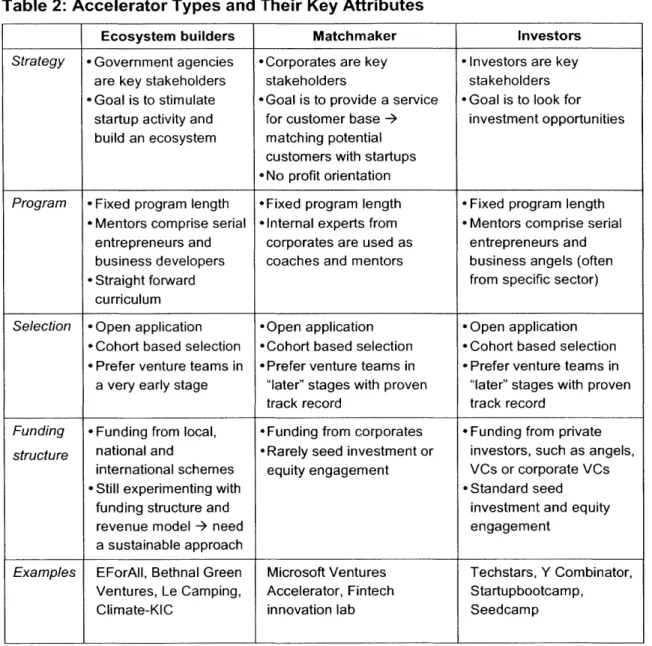
Having described key similarities and differences between the three archetypes of accelerators, one quickly realizes that the different motivations of the accelerator's key stakeholders are the major difference between them. Ecosystem builders support the regional economy and aim to create jobs. Corporate accelerators are built upon a triple win situation that strengthens their client relationship. And, investor accelerators follow a similar motivation as venture capitalist, meaning they are profit oriented and create a return for their investors.
This raises a question of how to measure performance in each of these three different accelerator types. First, ecosystem builders aim to support and improve the local entrepreneurial ecosystem. Thus, the number of created jobs and sustainable ventures, for example, might be a good KPI to measure the success of the ecosystem builder. However, this would not capture all impact aspects. As the motivation is to strengthen the ecosystem, one might want to consider also the total number of startups created in the region or the number of venture capital investment in the region and so on. This also means that one should not measure their performance on a profit basis (Clarysse et al., 2015). Second, looking at corporate accelerators it is already much more difficult to define KPIs that measure success, since the goal is to strengthen customer relationships. Also, they need to fulfill expectations on both sides of the platform, for startups and clients, in order to attract high potential startups and clients that are interested in cooperating with innovative ventures. One approach could be to measure the number successfully built partnerships between clients and startups. Here it is important to monitor the partnerships in order to manage expectations on both sides. Compared to the other types it is easier to measure the performance of investor accelerators, because they are profit oriented and need to create return for their investors (Clarysse et al., 2015). This can be measured with several KPIs:
Number of firms funded - Number of jobs created
- Total funding of portfolio companies - Total revenue of portfolio companies
- Survival rate (percentage of portfolio companies that are still operating) * Average number of follow-on rounds raised by portfolio companies - Number of exits
- Return on investment etc.
However, there is not much research conducted on how the different accelerator types perform and how their performance should be assessed. Although it is a rising topic in research and more researchers are focusing on related topics, most of them mention that the low amount of public data and its poor quality constrains their research efforts. Thus, research aiming to measure the performance or relative performance of accelerators directly collaborates with selected accelerator programs in order to receive better quality data (Fehder & Hochberg, 2015). Also, the topic gains more importance and attention among researchers in the US, European researchers lack behind. This leads to a discrepancy between the performance analysis conducted on American versus European accelerators.
Table 2: Accelerator Types and Their Key Attributes
Ecosystem builders Matchmaker Investors
Strategy -Government agencies -Corporates are key -Investors are key
are key stakeholders stakeholders stakeholders
-Goal is to stimulate *Goal is to provide a service -Goal is to look for
startup activity and for customer base + investment opportunities
build an ecosystem matching potential
customers with startups No profit orientation
Program -Fixed program length -Fixed program length -Fixed program length
-Mentors comprise serial -Internal experts from -Mentors comprise serial
entrepreneurs and corporates are used as entrepreneurs and
business developers coaches and mentors business angels (often
-Straight forward from specific sector)
curriculum
Selection -Open application -Open application -Open application
-Cohort based selection -Cohort based selection -Cohort based selection
-Prefer venture teams in *Prefer venture teams in -Prefer venture teams in
a very early stage "later" stages with proven "later" stages with proven
track record track record
Funding 'Funding from local, -Funding from corporates -Funding from private
structure national and -Rarely seed investment or investors, such as angels,
international schemes equity engagement VCs or corporate VCs
-Still experimenting with -Standard seed
funding structure and investment and equity
revenue model + need engagement
a sustainable approach
Examples EForAll, Bethnal Green Microsoft Ventures Techstars, Y Combinator,
Ventures, Le Camping, Accelerator, Fintech Startupbootcamp,
Climate-KIC innovation lab Seedcamp
Source: Clarysse et al., 2015.
2.4 Deep Dive: Investor Accelerator
After having differentiated the accelerator model from other institutions and having defined the different types of accelerators this section focuses solely on investor accelerators. First, the business model of investor accelerators is outlined. Second, the revenue and costs of an investor accelerator are explained. Lastly, I explain my
qualitative findings from interviewing the investor accelerator Innovation Warehouse, which underpins the literature review on this topic.
2.4.1 Business Model
The business model of an investor accelerator can be simply described as investors (limited partners) investing in the accelerator program which functions as a small fund. This fund acts very similar to a venture capitalist. The major stake of the fund is invested in equity stakes of the accepted cohort and the rest is used to cover running costs of the accelerator such as employee salaries or event organization. In return to the seed investment the accelerator receives an equity stake in the startup. These investments can be structured in different ways and it depends on each accelerator how they prefer structuring their investment. For example, the accelerator might prefer common stock or prefer to invest with a convertible note. A convertible note is short-term debt that converts in to equity or more specifically into preferred shares, upon closing a follow-on round of financing. It basically means that investors are giving the startup a loan, but instead of asking for their money back with interest, they receive preferred stock when further financing is secured (Clarysse et al., 2015; Financial Times, 2016). For example, Techstars offers automatically a $ 100,000 convertible note to each startup upon acceptance in exchange for 6% common stock.
As mentioned ab'ove, the investor accelerator business model is very similar to the typical venture capital (VC) business model. Since there is very limited amount of research completed on the economics of accelerators, one relies on research conducted on venture capital funds. The findings from the venture capital research will be adapted to the accelerator business model. The business model is structured in so-called venture cycles, which means one cycle includes raising funds from investors, investing the raised funds into the accepted startups, supporting them throughout the program, helping them to raise follow-on rounds, exiting successful deals, returning capital to investors and then accelerators raise additional funding to start a new fund and this when a new venture cycle starts (Gompers & Lerner, 2001).
After the accelerator's managing directors have raised sufficient funding from investors the accelerator cycle starts by selecting startups for the first cohort. Investors usually act as limited partners (LP) and do not have any operational role within the accelerator. Limited partners can be different kind of institutions such as endowments, insurance companies, pension funds, venture capitalist, and business angels (Preqin, 2012, 2014; Rao, 2014). These investors do not actively engage in the day-to-day operations of the accelerator, but profit from the returns made from the investments based on how much they invested into the accelerator's fund. However, invested venture capitalists or business angels might act as mentors or be interested in investing into accelerated startups after the completion of the program or the demo day (Samila & Sorenson, 2010, 2011). In order to make profit on its investments the accelerator needs to convert its illiquid shares in the private companies into a realized return (Gompers & Lerner, 2001). This can be an acquisition or an initial public offering (IPO) of the accelerated startup. An investment is written of, if a startup falls into insolvency. Different to venture capitalists, accelerators do not take board seats and do not actively influence the startups after they left the accelerator, but they might help them to raise follow on rounds thereafter
(Gompers & Lerner, 2001).
2.4.2 The Economics of Accelerators
Not only the business model of an investor accelerator is similar to that of an early stage VC fund, but also their economics. For venture capital funds a standard rule implies that the fund itself (General Partners of the fund) invests 1 % of the total fund size and limited partners add the remaining 99% (Mulcahy, 2014). Proceeds are therefore distributed respectively, after the initial investment is paid out. Then managing partners of the VC receive a carried interest and limited partners receive the remaining profits (Kaplan & Schoar, 2005). On top of that, funds request an annual management fee. This money is used to cover operating costs of the fund, such as employee salaries and rent (Feld & Mendelson, 2013). The following example illustrates this process more precisely.
Limited partners invest $500 million in a venture capital fund; general partners of the venture capitalist contribute another $5 million which is 1 % of the LPs' amount. The management fee amounts $10 million, 2%, of the LPs' money invested. The money is not invested, but used to cover operation expenses. Let say that the fund invests over a time horizon of 10 years and at disbursement the fund's capital amounts
$1000 million, $500 million go directly to the investors, $5 million to the venture
capitalist's general partners and one is left with $495 million of profit. These profits are now paid out based on the original agreement, e.g. 20% of carried interest, which leaves the investors with 80%, $396 million, and the fund's partners with 20%, $99 million.
This works similarly for accelerators, but there are some major differences. Accelerators usually do not take an annual management fee, as the 1-3% fee would not cover the operating expenses of coaching one or two cohorts a year. Entrepreneurs and venture capitalist on Quora.com mention that is rather a 50% management fee plus 20% carried interest in order to cover all operating costs (Quora, 2016a). Other accelerators, such as Techstars, apparently do not take a management fee, but also do not separate operational costs and the amount invested in startups. 500 Startups, for example, takes a seed investment, but for the coaching in the acceleration period startups are charged fees(Quora, 2016b). Thus,
500 Startups covers partly its operating costs with the charged fees. Y Combinator
tries to run a lean cost structure by not offering office space in order to save the rent. However, they started off investing capital from VCs and business angels, but nowadays as Sam Altman, president of Y Combinator, mentioned they invest their own capital and therefore keep all proceeds. As one can see different accelerators take different approaches. However, the 1-3% management fee typically charged by venture capitalist would not be sufficient to cover operating costs for an accelerator.
2.4.3 Qualitative Analysis: Interview to Innovation Warehouse
I conducted an interview with the startup accelerator Innovation Warehouse based
Business Development Manager at Innovation Warehouse and the son of Innovation Warehouse's founder and CEO Ami Shpiro. The interview was structured into four different parts - accelerator profile, business model, selection process, and performance metrics - in order to build a sound understanding of the accelerator's operations and how the economics in an accelerator function. The first part, accelerator profile, aims to collect simple information on the accelerator's background that I could not find in an online research. The business model part of the interview aims to gather information on the accelerator's vision and motivation, its revenue model and investors as well as the importance of partnerships. Understanding the key factors within the selection process of an accelerator is important as the selection process is closely linked to the business model. Lastly, most of the research in this work aims to understand how well different accelerators are performing, thus, it is critical to gather information on how accelerators measure their performance internally (See Exhibit 5 in the Appendix for the interview
instrument used).
Innovation Warehouse was founded by Ami Shpiro, CEO, in London in 2010. It employs 10 individuals in four different functions: investment, acceleration programs, community, and business development. On top of that the accelerator engages an advisory board and a number of mentors to support support startups or help with investment decisions.
The original motivation behind Innovation Warehouse is to create an environment that supports high growth startups with expertise, but also investment. A quite unique aspect about Innovation Warehouse is that once a startup was accepted to the accelerator program the investment team of the accelerator still needs to make a decision if an investment is taken or not. Thus, there is no investment upon acceptance and, if an investment is taken there is no standard term sheet, but it is discussed and decided together with the entrepreneurs how to structure the terms of the investment.
Differentiating its value proposition from competitors, Adam mentioned that they see themselves as an innovative and entrepreneurial ecosystem for growth startups that
provides certain services, such as co-working space, acceleration, investments, and mentorship. Thus, acceleration is one part, but not the only one of this ecosystem. Also, they focus on creating a serious, but at the same time collaborative environment in which startups can focus on growing their business.
As explained in Section 1, accelerators tend to expand in two different ways, either they increase the cohort size or they expand geographically meaning that they set up new acceleration programs in different city. Innovation Warehouse chooses the latter option and is currently looking to expand on a geographical level, but they have decided which location shall be next. They are considering starting an accelerator in either Asia, Israel or other parts of Europe in order to build a collaborative co-investing network that sits across key urban locations. Innovation Warehouse already has strong ties and partnerships with several institutions in Israel to have access to the strong Israeli entrepreneurial ecosystem. They see a high value for startups joining their program in getting access to the broad international network of Innovation Warehouse in the future.
Innovation Warehouse offers three major service to startups - co-working, acceleration (including mentorship programs), and investments. Based on these services they have three key revenue streams: co-working, acceleration programs, and investments. The entrepreneur can decide whether she wants to pay a fee for these services, give up equity in exchange or a flexible combination. The latter two services are often converted into equity. Innovation Warehouse aims to create a balance between running a sustainable business that creates profits and investing in startups.
Going back to Cohen's and Hochberg's definition of an accelerator program, Innovation Warehouse's accelerator program and its selection process are aligned with it. It is straight forward and similar from what I have seen in my research of other accelerator programs. Upon acceptance Innovation Warehouse offers intense mentorship during the acceleration period, educational workshops, and weekly pitch events as well as demo days for startups. Nonetheless, there are two main differences between the formal definition of an accelerator. Namely, Innovation
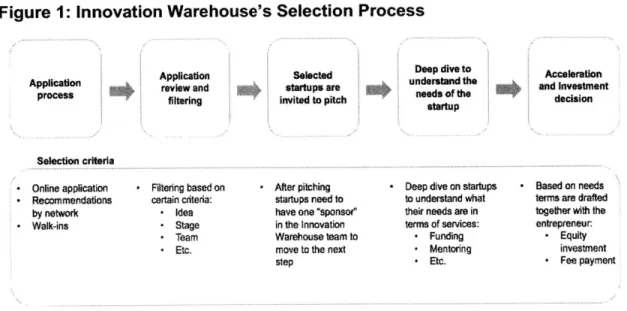
Warehouse does not accept startups on a cohort basis to their acceleration program, but on a rolling basis and there is no fixed period during which startups stay within the program, but it is decided on a case-to-case basis how long the startups stay. The selection to the accelerator and a potential investment is a five-staged process illustrated in Figure 1 below. After receiving an application, it is reviewed and based on its idea, team, and life-cycle stage the company is invited to pitch in front of the Innovation Warehouse team (e.g. during the weekly pitch event). Innovation Warehouse does accept single founders, but like many accelerators they prefer founding teams. Also, they prefer to see some work experience, which does not mean they have to be a serial entrepreneur. Also, they focus on companies that have already some kind of minimum viable product (MVP) or some product traction in order to further support them on the commercialization of their business. This implies that the startup has attracted some kind of prior pre-seed funding, for example by family and friends or business angels. The two most important decision making criteria to accept a startup are a winning team in an interesting and evolving market. In order to attract the right startups to apply Innovation Warehouse hosts a variety of events and workshops in the London technology community and by today their brand also plays an important role in attracting interesting candidates for the accelerator.
Figure 1: Innovation Warehouse's Selection Process
SelectedDeep dive to
Application Selected Depdv oAcceleration
Application understand the Aclrto
Application review and startups are undstof the and Investment
process filtering invited to pitch decision
Selection criteria
* Online application Filtering based on After pitching - Deep dive on startups Based on needs
- Recommendations certain criteria: startups need to to understand what terms are drafted
by network - Idea have one "sponsor" their needs are in together with the
- Walk-ins - Stage in the Innovation terms of services: entrepreneur:
- Team Warehouse team to - Funding - Equity
- Etc. move to the next - Mentoring investment
Innovation Warehouse has raised a fund from investors, mainly from business angels and high-net-worth individuals, to invest into the accelerated startups, if decided to do so after the selection process. The fund's structure is aligned with industry standards meaning that they take a 2-3% annual management fee and have a 20% carried interest in the profits of the investments. The terms of the investments are entrepreneur friendly and discussed with the entrepreneur on a case-to-case basis.
Innovation Warehouse tracts its performance based on five different KPIs - jobs created, total funding raised by startups, return on investment (ROI), revenues created by Innovation Warehouse, and survival rates of startups. The performance measurement is split into two parts, first the performance of startups and then performance of Innovation Warehouse. Of course these two are linked, but are reviewed separately. On the startup performance side, Innovation Warehouse measures how many jobs were created by the startups, how much funding they raised, and if the companies still existed or not. On the accelerator performance side, they keep track of the revenues by services and the ROI of their investments. This
seems to be a quite standard approach among accelerators.
Overall, Innovation Warehouse has a quite unique model of accelerating startups and includes aspects of two accelerator types mentioned in Section 2.3 - investor and ecosystem building accelerators. They are very focused on supporting the entrepreneurial ecosystem and also connecting startups to potential clients or partners within the community. As Innovation Warehouse invests in most of the accelerated startups and they run a profit oriented business, I still consider them as an investor accelerator.
3. Accelerators, Venture Capital, and Crises
This section aims on explaining the relationship between venture capital investments, impact of crisis, startup performance, and the implications for investor accelerators.
The venture capital industry is known for its high volatility, which spreads across the funds flowing to venture capitalist, the venture capitalists' investments in portfolio companies, and the performance of venture firms and its portfolio companies (Gompers, Kovner, Lerner, & Scharfstein, 2008). According to Gompers and Lerner
(1998) and Jeng and Wells (2000) the volatility in the venture capital market is linked
to valuation in public equity markets. Meaning that there is a connection between increases in IPO valuations and a growing amount of venture capital funds. Also, there is a positive relationship between venture capital returns and market returns (Cochrane, 2005; Kaplan & Schoar, 2005; Ljungqvist & Richardson, 2003). Thus,
overreactions to public market signals drive venture capital investments. During the time of crisis venture capitalists raise less funds and less money is available to invest in startups (Kaplan & Schoar, 2005) Both observations, VC market following public markets and less VC money is invested during crisis periods can be effortlessly observed in Exhibit 3 and 4 in the Appendix.
A scarce funding environment has a negative impact on startup performance, as it
is more difficult for startups to raise funds and consequently survival is put in jeopardy. Delgado, Porter, and Stern (2010) find that startups in a strong industrial cluster, such as information and communications technology (ICT) in Silicon Valley or Biopharmaceuticals and Medical Devices in Boston, are more likely to survive. Strong clusters can also be more resilient to economic crisis because they exploit economies of agglomerations (Delgado, Porter, & Stern, 2016a). Looking at Exhibit 4 and 5 in the Appendix, one can see that venture capital investments decreased during the recession in Silicon Valley, but to a lesser extent than other regions. Putting these three things together, one can see that crisis has a negative impact on public markets, whose development is followed by venture capital market in terms
of funds raised and capital invested. Thus, there is less capital available for startups and it is more difficult for startups to attract investors, consequently the risk of closure
increases.
One of investor accelerators key goal is to accelerate growth of the accepted startups and facilitate fund raising through connecting the startups to the accelerator's network of investors. During crisis years this is more difficult, because less investor money is available to be invested in startups. This raises the hypothesis, if accelerators are able to protect the accelerated startups in terms of survival from a scarce funding environment or does the economic crisis affect accelerated startups?
4. Quantitative Findings
In order to assess the performance of accelerators I gathered data from the Crunchbase database and filtered by all investments of two accelerators - Y Combinator and Techstars. I chose Y Combinator and Techstars for the analysis, since a part of my research focuses on the impact of the economic crisis on accelerated startups and these are the only two accelerators that have been active before the economic crisis in 2008.
Y Combinator is solely active in the United States, whereas Techstars is active internationally, but runs most of its accelerator programs in the US. This does not mean that they only accept startups from their respective continent, but that the acceleration program takes place there. For example, Y Combinator requires all accepted startups, local or international, to incorporate their business in the United States and relocate to the Silicon Valley during the acceleration period. Crunchbase provides good information related to the startups that were accepted to accelerators, but as mentioned above these counts only for startups that received an equity investment by the accelerator. The database provides information on startups including funding and founding dates, amount of funding, country of origin, number of funding rounds, current status, and category they are operating in. In Exhibit 6 in
the Appendix all variables are defined. Due to the private nature of the startup industry, the accuracy and correctness of information is strictly based on what is recorded and published by Crunchbase. In order to be able to build a sounder analysis I crossed the data from Crunchbase with data I collected from different websites, mainly the accelerators' websites. With this approach I was able to allocate the different startups to their corresponding cohort and if applicable to their corresponding program location (e.g. Techstars has several programs based out of different locations).
The quantitative findings first focus on the descriptive data analysis of Y Combinator and then of Techstars. Both parts of the analysis are two folded outlining the profile of the respective accelerator and deep diving into the quantitative performance analysis based on four KPIs: startup status, number of funding rounds, total funding raised, and if the accelerator acted as a first investor into the respective startups. As Techstars has 14 different locations, I provide an additional analysis describing, if startups from a certain industry choose accelerators in clusters that are strongly specialized in the startup's industry.
4.1 Quantitative Findings for Y Combinator
4.1.1 Profile
As mentioned above, Y Combinator was founded in 2005 in Mountain View, California. Y Combinator has accepted 21 cohorts since then, one during the summer and one during winter of each year. The winter cohorts generally start in January of the year, whereas the summer cohorts start in June and runs during the summer. The last cohort recorded in the analysis is the Summer 2015 cohort. Unfortunately, Crunchbase has only 22 startups from the Summer 2015 cohort recorded. The size of the cohorts increased over the last ten years, it started with eight startups per cohort and increased to around 100 startups nowadays. During this time period Crunchbase recorded 753 equity investments by Y Combinator of which 10 cannot be allocated to a specific cohort. Y Combinator has an original focus
on web and mobile applications, but nowadays funds all types of startups. The most famous alumni of the program are AirBnB, Reddit, Dropbox, and Sribd (NESTA, 2014). Over the past ten years Y Combinator has become an institution in the Silicon Valley due to its success of accelerating some of the fastest growing startups in the world. Y Combinator offers a number of important services to the accepted startups, such as dinners, events, office hours, and its famous alumni network (Miller & Bound,
2011).
The weekly dinners are not only co-working session from 6pm to midnight, but also meet-ups at which famous entrepreneurs present and talk about their success and failures and different teams from the current cohort present their most recent progress. Ian Hogarth, a British Y Combinator alumnus, describes it as a co-working time when teams help each other and solve problems together, but which is also competitive, as every time reports its weekly progress (Miller & Bound, 2011). Events are a core of the Y Combinator program, especially the so-called Angel day and Demo day. The Angel day is scheduled six weeks into the program to pair each startup with two angel investors that shall help preparing for the final pitch at the Demo day. The Demo day is the final day of the program where all startups pitch to around 400 potential investors. However, approximately one third of Y Combinator's cohort already raised angel money by then (Miller & Bound, 2011).
The office hours with Y Combinator's founders and partners is an essential part of the program, as it is the time when founders receive personal advice from experienced founders that have seen hundreds of startups fail as well as succeed. According to Miller and Bound (2011) is the success of the startups from Y Combinator and the success of Y Combinator itself closely connected to the skills and experience of the its partners.
The alumni network of Y Combinator is valuable to the startups, as alumni are proactively giving advice at the Alumni Demo day prior to the Demo day. Also, every Y Combinator startup can reach out to alumni who are highly responsive and happy to help solving problems. It can be understood as an university alumni network and