HAL Id: hal-00317019
https://hal.archives-ouvertes.fr/hal-00317019
Submitted on 1 Jan 2003
HAL is a multi-disciplinary open access
archive for the deposit and dissemination of
sci-entific research documents, whether they are
pub-lished or not. The documents may come from
teaching and research institutions in France or
abroad, or from public or private research centers.
L’archive ouverte pluridisciplinaire HAL, est
destinée au dépôt et à la diffusion de documents
scientifiques de niveau recherche, publiés ou non,
émanant des établissements d’enseignement et de
recherche français ou étrangers, des laboratoires
publics ou privés.
Post midnight spread-F occurrence over Waltair (17.7°
N, 83.3° E) during low and ascending phases of solar
activity
K. Niranjan, P. S. Brahmanandam, P. Ramakrishna Rao, G. Uma, D. S. V. V.
D. Prasad, P. V. S. Rama Rao
To cite this version:
K. Niranjan, P. S. Brahmanandam, P. Ramakrishna Rao, G. Uma, D. S. V. V. D. Prasad, et al.. Post
midnight spread-F occurrence over Waltair (17.7° N, 83.3° E) during low and ascending phases of solar
activity. Annales Geophysicae, European Geosciences Union, 2003, 21 (3), pp.745-750. �hal-00317019�
Annales Geophysicae (2003) 21: 745–750 c European Geosciences Union 2003
Annales
Geophysicae
Post midnight spread-F occurrence over Waltair (17.7
◦
N, 83.3
◦
E)
during low and ascending phases of solar activity
K. Niranjan, P. S. Brahmanandam, P. Ramakrishna Rao, G. Uma, D. S. V. V. D. Prasad, and P. V. S. Rama Rao
Department of Physics, Andhra University, Visakhapatnam 530 003, India
Received: 6 May 2002 – Revised: 5 September 2002 – Accepted: 20 September 2002
Abstract. A study carried out on the occurrence of post
midnight spread-F events at a low-latitude station, Waltair (17.7◦N, 83.3◦E), India revealed that its occurrence is max-imum in the summer solstice months of the low solar activity period and decreases with an increase in the sunspot activ-ity. The F-region virtual height variations show that 80% of these spread-F cases are associated with an increase in the F-region altitude. It is suggested with the support of the night airglow 6300 A zenith intensity data obtained with co-located ground-based night airglow photometer and electron temper-ature data from the Indian SROSS C2 satellite that the sea-sonal variation of the occurrence and probable onset times of the post midnight spread-F depend on the characteristics of the highly variable semipermanent equatorial Midnight Tem-perature Maximum (MTM).
Key words. Ionosphere (ionospheric irregularities;
iono-sphere atmoiono-sphere interactions) Atmospheric composition and structure (airglow and Aurora)
1 Introduction
It is established from various diagnostic techniques that Equatorial Spread-F (ESF) irregularities occur over a wide range of scale sizes and that no single instability mecha-nism could account for such a variety of scale sizes. Also, it is known that the causative mechanism for the inci-dence/suppression of the otherwise susceptible plasma for the occurrence of the spread-F are different for the pre- and post midnight periods, in view of the ambient conditions that prevail in the respective parts of the night. There are many reports on the morphology of ionogram ESF which include the solar cycle, season, and geomagnetic activity related vari-ations at specific locvari-ations around the globe. A distinctive feature of the incidence of spread-F on ionograms in the In-dian sector is the solar activity dependent seasonal behaviour. Correspondence to: K. Niranjan
Subba Rao and Krishna Murthy (1994) investigated the oc-currence of spread-F at Trivandrum, India on a seasonal basis during both the solar epochs and interpreted the seasonal be-haviour in terms of the Rayleigh Taylor instability growth mechanism. During the high solar activity epochs, the oc-currence of spread-F is maximum in the post sunset periods and is more probable during the equinox season than during the solstice. During summer solstice of low solar activity pe-riod, the peak occurrence is seen in the post midnight hours preceded by an abnormal increase in the F-region height. A pre-sunrise peak in the occurrence of spread-F is reported in the Brazilian sector at solar minimum (MacDougall et al., 1998).
It is generally accepted that the generalized Rayleigh Tay-lor (RT) instability mechanism is responsible for the gen-eration and growth of spread-F irregularities. Spread-F oc-currence at equatorial stations is associated with post sunset height rise in the F-region (Chandra and Rastogi, 1972). The high altitude of the F-region, where collision frequencies are low, is favourable for the growth of the irregularities by the RT instability mechanism. The pre-midnight growth rates are higher during the sunspot maximum compared to those dur-ing post midnight periods, leaddur-ing to a positive correlation of equatorial spread-F with solar activity. Abdu et al. (1992) pointed out that the height gradient of vertical drift also plays an important role in the occurrence of spread-F. Maruyama and Matuura (1984) in an attempt to account for seasonal lon-gitude ESF occurrence rates, suggested the ability of trans-equatorial neutral winds to inhibit the ESF activity. Mendillo et al. (1992) suggested that a neutral wind driven mechanism should act with equivalent efficiency on a night-by-night ba-sis and even within a given evening. They suggested that the nightly requirements for the RT instability growth lead-ing to the incidence of ESF are: post sunset rise of F-region, availability of seed perturbation to launch the RT mechanism and an absence of a strong trans-equatorial thermospheric wind. Maruyama (1988) with a diagnostic model for ESF, reported that a trans-equatorial wind and the E × B drift are equally important in controlling the generation of ESF.
746 K. Niranjan et al.: Post midnight spread-F occurrence over Waltair Fe b 9 7 Ap r 97 J un 9 7 Au g 97 Oc t 9 7 De c 9 7 Fe b 9 8 Ap r 98 J un 9 8 Au g 98 Oc t 9 8 De c 9 8 Fe b 9 9 Ap r 99 J un 9 9 Au g 99 Oc t 9 9 De c 9 9 Fe b 0 0 Ap r 00 J un 0 0 Au g 00 Oc t 0 0 De c 0 0 0 20 40 60 80 100 Pe rcent Occu rre n ce Month
Post Sunset Spread F
Fe b 9 7 Ap r 97 J un 9 7 Au g 97 Oc t 9 7 De c 97 Fe b 9 8 Ap r 98 J un 9 8 Au g 98 Oc t 9 8 De c 98 Fe b 9 9 Ap r 99 J un 9 9 Au g 99 Oc t 9 9 De c 99 Fe b 0 0 Ap r 00 J un 0 0 Au g 00 Oc t 0 0 De c 00 0 20 40 60 80 100 Fig. 1
Post Midnight Spread F
Month
Pe
rcent Occu
rren
ce
Fig. 1. Histogram showing the monthly percent occurrence of post midnight spread-F (top panel) and post sunset spread-F (bottom panel) at Waltair during 1997–2000.
Raghava Rao et al. (1992) with nonlinear numerical model-ing, suggested that vertical downward winds in the ambient gas have the potential to cause the ESF bubble phenomenon, while an upward wind could inhibit the same. Mendillo et al. (2001) from a multi-technique approach reported that the best available pre-cursor for pre-midnight ESF appears to be the strength of the electrodynamically driven Appleton anomaly pattern at sunset and that the correlative studies of the ESF activity and magnitude of meridional winds afford no convincing evidence of the wind suppression mechanism. In the Indian sector, spread-F conditions during the low sunspot period are known to develop during the post mid-night periods of the summer solstice months. The occurrence is associated with a distinct height rise in the F-layer. Sec-ondly, the post midnight occurrence of the spread-F over a location may not be entirely due to the instabilities in the lo-cal plasma, but could be due to the passage of fossil plumes generated elsewhere along the terminator and could move in the direction of the observing station. Sastri (1999) from an investigation of the ionograms data from a dip equatorial sta-tion in Kodaikanal (India) reported that the F-layer height does not play a pivotal role in the midnight onset of spread-F during the summer solstice months of solar minimum.
Even after such extensive investigations on the ambient
conditions during the onset and growth of the spread-F ir-regularities, there still remain some uncertainties about the conditions that favour the incidence of spread-F, demand-ing more efforts in the understanddemand-ing of the spread-F phe-nomenon at different locations. In view of this, an attempt is made to identify the ambient conditions that favour the appearance of localized post midnight irregularities causing spread-F in ionograms.
2 Data and methodology
Waltair (17.7◦N, 83.3◦E) is a low-latitude station in India lo-cated in the transition zone between the equator and the Ap-pleton anomaly crest region. The station is equipped with an IPS 42 Digital ionosonde system and a tilting filter night air-glow photometer. The ionograms data pertaining to the low and ascending solar activity period 1997–2000 has been used for identifying the post midnight spread-F events without any spread-F occurrence during the pre-midnight periods and the associated variations of the F-region virtual height. The night airglow 6300 A zenith intensity data is used to evaluate the mean characteristics of the midnight temperature maximum (as seen by the brightness wave properties) that could effect the incidence of spread-F in otherwise susceptible F-region plasma. The support of in situ electron temperature measure-ments of the RPA on board the Indian SROSS C2 satellite is taken in evaluating the probable time of occurrence of the semipermanent midnight temperature maximum.
3 Occurrence of post midnight spread-F
From an examination of the ionograms for the period from February 1997 to December 2000, it is observed that the post midnight spread-F occurrence is maximum during the sum-mer solstice months (May, June, July and August) of the low solar activity period. The post midnight occurrence shown in light gray in the top panel of Fig. 1 decreased as the solar ac-tivity increased from 1997 to 2000 and was minimum in the year 2000. The post sunset spread-F occurrence, however, in-creased with solar activity (bottom panel of Fig 1). This is in conformity with the results reported by Abdu et al. (1992) in the Brazilian sector and by Subba Rao and Krishna Murthy (1994) for the Indian equatorial station Thumba. However, during 1997 and 1998, the post midnight occurrence was al-most equally probable, with marginally higher probability during 1998. It has been observed that the most probable time for the occurrence of post midnight spread-F at Wal-tair during the summer solstice months is between 01:00 to 03:00 IST and not before 01:00 IST.
The nocturnal variation of the F-region virtual height h0F (solid line) on two typical days in summer solstice when the post midnight spread-F was observed at Waltair is shown in Fig. 2. The points with vertical bars show the mean magneti-cally quiet non-spread-F day (neither pre- nor post midnight) nocturnal variation of h0F during that month, along with the standard deviation. The horizontal solid line represents the
K. Niranjan et al.: Post midnight spread-F occurrence over Waltair 747 200 250 300 350 400 450 1 Jul 1998 h'F k m 200 250 300 350 400 450 Fig.2 06:00 04:00 02:00 00:00 22:00 20:00 18:00 IST h'F k m 23 June 1998
Fig. 2. Nocturnal variation of the F-layer virtual height (h0F) on two typical post midnight spread-F days during the summer solstice months. The points show the mean F-layer height of magnetically quiet non spread-F days and the vertical line shows the standard deviation. The horizontal solid line indicates the presence of spread-F on ionograms.
presence and duration for which spread-F is present on the ionograms. It is evident that before the onset of spread-F, the F-layer is lifted to higher altitudes making the condi-tions favourable for the incidence of spread-F. In majority of the cases, the condition of the high altitude F-region iono-sphere is satisfied before the onset of spread-F. However, in some cases, post midnight spread-F is seen even without any rise in the F-region altitude. In such cases, the spread-F is seen many times with a few sequences of ionograms show-ing spread-F and intermediate sequences without spread-F. The spread-F seen in such cases with no F-region altitude rise resemble the drifting fossil plumes generated at the sun-set terminator to the west of the present location and are seen drifting eastward.
One point of interest in Fig. 2 is the descent of the F-layer from 22 h showing a minimum height around local midnight. This feature is seen in both the cases presented in Fig. 2 and is a more general observation during summer solstice. Thereafter, the F-region is lifted to higher altitudes, making the conditions favourable for the growth of the RT instability mechanism leading to the onset of spread-F. However, dur-ing the winter solstice months, the midnight descent of the F-layer is delayed, starts around or after local midnight (Fig. 3)
150 200 250 300 350 06:00 04:00 02:00 00:00 22:00 20:00 18:00 25 Nov 1997 h' F km IST 150 200 250 300 350 Fig. 3 h'F km 16 Jan 1998
Fig. 3. Same as in Fig. 2 for two typical post midnight spread-F days in winter solstice.
and continues up to 02:00–03:00. Later, the F-region altitude rises before the onset of spread-F. Thus, the onset of post midnight spread-F during this season is seen at a later time compared to the summer solstice months.
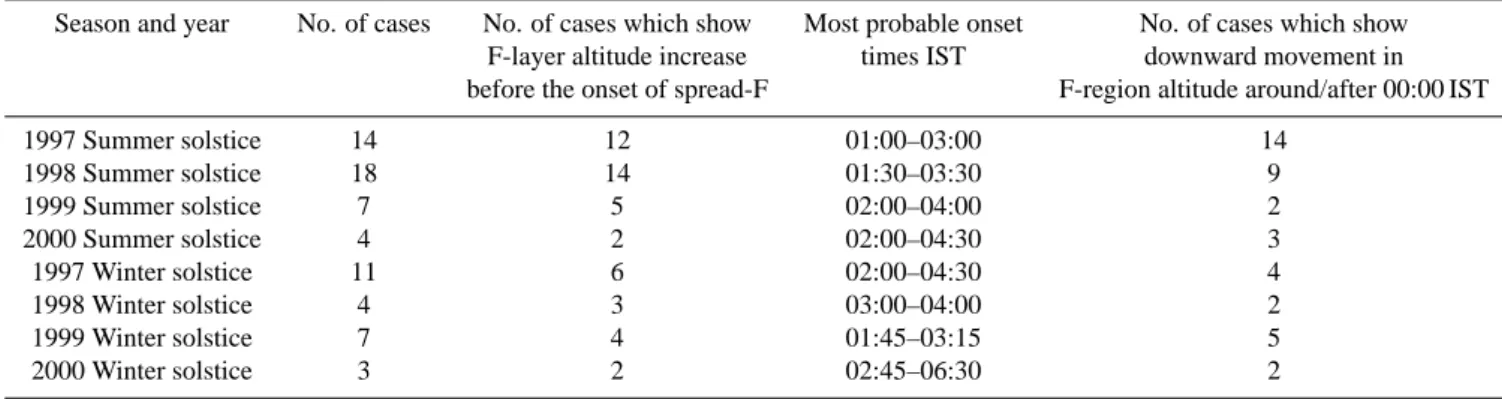
Table 1 gives the statistical details of all the post midnight spread-F events over Waltair considered in the present study. It may be noticed that in most of the cases the onset of post midnight spread-F is associated with an increase in the F-region altitude. The most probable time of onset of spread-F is between 01:00 to 03:00 during the summer solstice months with low sunspot activity period, while it is delayed by an hour or two during the winter solstice months. For the cases which were not associated with an altitude increase of the F-region, the probable times of occurrence were found to be around midnight.
4 Features of MTM observed over the location
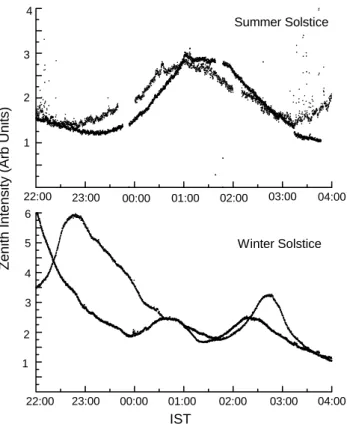
The variation of 630 nm night airglow zenith intensity over Waltair on two typical nights during the summer solstice months of 1997–1998 (top panel) when the brightness wave representing the semipermanent midnight temperature max-imum is present is shown in Fig. 4. The maxmax-imum intensity representing the MTM (on days when it is present), which is strongest during this season, is observed around 00:00 to 01:00 IST, where as during the winter solstice months,
748 K. Niranjan et al.: Post midnight spread-F occurrence over Waltair
Table 1. Statistical details of post midnight spread-F events
Season and year No. of cases No. of cases which show Most probable onset No. of cases which show F-layer altitude increase times IST downward movement in before the onset of spread-F F-region altitude around/after 00:00 IST
1997 Summer solstice 14 12 01:00–03:00 14 1998 Summer solstice 18 14 01:30–03:30 9 1999 Summer solstice 7 5 02:00–04:00 2 2000 Summer solstice 4 2 02:00–04:30 3 1997 Winter solstice 11 6 02:00–04:30 4 1998 Winter solstice 4 3 03:00–04:00 2 1999 Winter solstice 7 4 01:45–03:15 5 2000 Winter solstice 3 2 02:45–06:30 2
it is seen with less prominence and at a later time (01:00– 03:00 IST), as seen in the bottom panel.
The contour maps of F-region electron temperature de-rived from RPA data on board the Indian SROSS C2 satel-lite for the years 1997–1998 are shown in Fig. 5. The bot-tom panel corresponds to the summer solstice months and the top panel to the winter solstice months. The satellite alti-tude for these measurements was between 450–550 km when these measurements were made. However, the conditions at these altitudes, by and large, depend on the ambient iono-spheric conditions. It may be seen from Fig. 5 that during the summer solstice months, there is a significant tempera-ture gradient from about 1050◦K at the equatorial and lower latitudes, to about 900◦K around the latitudes of Waltair (14– 18◦N) from 22:00 to 24:00 IST. As the time progresses, in the early hours there is practically no temperature gradient as a function of latitudes from 01:00 IST onwards. In contrast, during the winter solstice months, while there is no defined temperature gradient during the 22:00 to 24:00 IST, the diur-nal decrease of temperature is seen at all latitudes. But, be-tween 01:00 to 03:00 IST latitude, a gradient in temperature is seen from equatorial (1050◦K) to lower latitudes (900◦K), although not as significant as the one seen in the June solstice around local midnight. Though there is a definite tempera-ture difference between the equatorial and low-latitudes, the temperature gradients seen are not very well defined. Thus, the brightness features observed in the night airglow zenith intensities resemble the brightness wave characteristics asso-ciated with MTM, as reported by Colerico et al. (1996) and coincide with the temperature enhancements that reflect the semipermanent midnight temperature maximum (MTM) in the in situ data of the SROSS C2 satellite.
5 Discussion
After sunset, the regular E-region ionosphere begins to re-combine and there is effectively no E-region to short out any irregularities in the F-region. Owing to the recombination and possible E × B drifts due to the polarization electric fields, the bottom side F-region begins to steepen. When the
altitude of the F-region is high enough to overcome the re-combination effects, as in the post sunset cases during mod-erate to high sunspot activity periods, plasma density fluctu-ations begin to grow on the bottom side via the RT instability mechanism. These irregularities, in turn, form plasma den-sity depletions (bubbles) on the bottomside, which, in turn, rise nonlinearly to topside. These steepening bubbles can bi-furcate to form small-scale structures by a cascade or two step mechanism (Ossakow, 1981). Subba Rao and Krishna Murthy (1994) reported that in the generalized RT instability mechanism, the growth rate could be due to the combined effects of the gravitational and cross field instability, and that these terms closely follow the layer height and become higher when the layer height is around 300 km and above. It is generally accepted that the primary mechanism for the growth of instability is a high altitude F-region where colli-sion frequencies are low. The growth rates follow h0F varia-tions and the pre-midnight growth rates are high in sunspot maximum compared to sunspot minimum years. Once de-veloped, the irregularities move depending on the prevailing neutral wind and thus, an eastward wind can cause the bub-bles to move westward with respect to the bulk plasma mo-tion.
Thus, the absence of spread-F on a given night, with the preconditions of higher altitude F-region and steep plasma gradients satisfied, could be due to the suppression of the instability growth rates by various factors. Thus, the peri-ods of no ESF development must be associated with factors that inhibit the otherwise susceptible ionosphere to instability growth. It is reported that the trans-equatorial wind plays a pivotal role in the suppression of the RT growth rate and that the wind effect is more prominent if the E × B drift reversal time is late (Maruyama, 1988) during the post sunset periods. Abdu et al. (1992) reported that small angles between sun-set terminator and magnetic meridian favour the post sunsun-set ESF development. Perfect alignment of the terminator with magnetic meridian tends to decrease the efficiency of ESF development. Normally in a given longitude sector, ESF oc-curs when the sunset terminator is approximately aligned to the geomagnetic flux tube. Under such conditions,
thermo-K. Niranjan et al.: Post midnight spread-F occurrence over Waltair 749 04:00 03:00 02:00 01:00 00:00 23:00 22:00 Fig. 4 6 5 4 3 2 1 04:00 03:00 02:00 01:00 00:00 23:00 22:00 Z enit h I n tens it y ( A rb Unit s ) IST Winter Solstice 4 3 2 1 Summer Solstice
Fig. 4. Nocturnal variation of airglow zenith intensity on two typical days showing the brightness wave feature during summer solstice (top panel) and winter solstice (bottom panel).
spheric winds typically have a small component along the meridian and thus suppression of the RT instability on the average is unlikely. Since the trans-equatorial component of the thermospheric wind in the magnetic plane is determined by the magnetic declination angle, the magnetic declination effect of ESF may also be well explained by the wind effect. Thus, a nightly requirement for the development of ESF is the absence of the trans-equatorial wind, in addition to the increase in the height of the F-layer and the electron density gradient.
In addition, vertical winds also control the RT growth rates (Raghava Rao et al., 1992). A downward wind pushing the F-region into lower altitudes of higher recombination rates does favours the RT growth rate, while an upward wind acts otherwise. It is also well known that thermospheric neutral wind speed is determined not only by the global circulation due to solar forcing, but also by the semipermanent equa-torial Midnight Temperature Maximum (MTM) (Herraro et al., 1993), particularly with reference to the mechanisms op-erative around and after local midnight. MTM is strongest in summer solstice of solar minimum and its characteristics like the amplitude and time of maximum occurrence are vari-able from day to day. Therefore, day-to-day variability in the neutral wind could impose a corresponding variability in the development of ESF.
The data presented here pertains to the post midnight onset of spread-F. It is to be noted that the onset of post midnight
0 2 4 6 8 10 12 14 16 18 20 IS T 700 750 800 850 900 950 1000 1050 1100 1150 1200 0 2 4 6 8 10 12 14 16 18 20 Latitude (Deg) Winter Solstice Summer Solstice 1000 1050 1000 1050 22 23 00 01 02 03 04 22 23 00 01 02 03 04
Fig. 5. Isothermal contours of electron temperature derived from the SROSS C2 RPA data for summer solstice months (bottom panel) and winter solstice months (top panel) during 1997–1998.
spread-F in 80% of the cases is preceded by a sharp increase in the F-region altitude, satisfying the base level condition of the high F-region altitude that favours the growth of the RT instability mechanism. However, on some days, spread-F was observed even without a height rise, either prior to the onset or after the onset of spread-F. During these nights, the spread-F activity was mostly of a recurrent short duration type and could possibly be of a non-local origin. This ESF activity is believed to be due to the irregularities generated at the terminator, moving westward and seen during post mid-night periods over Waltair. Such spread-F is observed to be very intense and patchy in character.
The post midnight spread-F, when viewed as a function of the onset times, appears earlier during the summer sol-stice months, while during winter solsol-stice the occurrence is delayed. The characteristics reflected in the night airglow ob-servations and the RPA electron temperature data presented above indicate that the semipermanent equatorial midnight temperature maximum is strongest and occurs around local midnight during the summer solstice of low and ascending solar activity period. In winter solstice months it is de-layed in time. Colerico et al. (1996) have also observed frequent enhancements in 6300 A Airglow emissions, which
750 K. Niranjan et al.: Post midnight spread-F occurrence over Waltair they referred to as the Midnight Brightness Wave (MBW)
and concluded that this enhancement is a signature of the thermospheric Midnight Temperature Maximum, a large-scale, highly variable neutral temperature anomaly. During the nighttime, the electron temperature is equal to the ion temperature and hence, can be considered to represent the neutral temperature. The SROSS C2 data, pertaining to the topside F-region, indicates the presence of a strong temper-ature enhancement at the equatorial latitudes in summer sol-stice. Though highly variable in nature, the MTM has a sta-tistical consistency in the time of occurrence and hence, is seen clearly in the isothermal contours presented in Fig. 5 as a function of latitude and time. The MTM is accompanied by a pressure bulge which significantly modifies the meridional neutral winds (Herraro and Meriwether, 1980). This pres-sure variation could lead to a reversal/abatement in the neu-tral wind from the equator to poleward, which, in turn, could lower the F-region at lower latitudes (as shown in h0F varia-tions in Figs. 2 and 3) to produce an increase in the 6300 A airglow intensities.
In summer solstice months, as the MTM occurs around midnight, the effect of the temperature variations cease by around 01:00 IST and hence, the poleward wind set in by the MTM ceases by 01:00 IST as seen in the SROSS C2 tem-perature data and the airglow intensities. Thus, the F-region altitude rise is not effected after 01:00 IST in the summer solstice months at lower latitudes. Therefore, an increase in the F-region altitude makes the conditions favourable for the growth of RT instability mechanism (Subba Rao and Kr-ishna Murthy, 1994) leading to the onset of spread-F even by 01:00 IST in summer solstice.
However, during winter solstice months of low sunspot activity period, the MTM is delayed in time and continues to effect the meridional neutral winds until about 02:00 IST. Therefore, the lowering of the F-region altitude as a conse-quence of the pressure bulge due to MTM continues well beyond 02:00 LT (Fig. 3). Hence, the F-region altitude in-crease is inhibited, making the conditions unfavourable for the growth of the RT instability and hence, the onset of the post midnight spread-F is delayed in the December solstice months. Secondly, due to the highly variable nature of MTM, on some occasions it may continue up to even later hours and by the time the MTM induced neutral wind perturba-tion diminishes, the ionizaperturba-tion level may come well below the threshold level for any instability growth mechanism to operate. Thus, the seasonal variation in the time and per-centage occurrence of post midnight spread-F could partly be attributed to the MTM induced neutral wind perturbation and subsequent lowering of the F-region altitude at lower
lat-itudes.
Acknowledgements. The financial support from the Department of
Science and Technology, Government of India and the Indian Space Research Organization is acknowledged. The SROSS C2data is provided by Dr. S. C. Garg and Mr. P. Subrahmanyam of NPL, New Delhi.
Topical Editor M. Lester thanks a referee for his help in evalu-ating this paper.
References
Abdu, M. A., Batista, I. S., and Sobral, J. H. A.: A new aspect of magnetic declination control of equatorial spread-F and F-region dynamo, J. Geophys. Res., 97, 14 897–14 904, 1992.
Chandra, H. and Rastogi, R. G.: Equatorial spread-F over a solar cycle, Ann. Geophysicae, 28, 37–44, 1972.
Colerico, M., Mendillo, M., Nottingham, D., Baumgardner, J., Meriwether, J., Mirick, J., Reinish, B., Sacli, J., Fesen, C., and Biondi, M. A.: Coordinated measurements of F-region dynamics related to the thermospheric midnight temperature maximum, J. Geophys. Res., 101, 26 783–26 793, 1996.
Herraro, F. A. and Meriwether, J. W.: 6300 A airglow meridional intensity gradients, J. Geophys. Res., 85, 4191–4204, 1980. Herraro, F. A., Spencer, N. W., and Mayr, H. G.: Thermopspheric
and F-region plasma dynamics in the equatorial region, Adv. Space Res., 13, 201–220, 1993.
MacDougall, J. W., Abdu, M. A., Jayachnadran, P. T., Cecile, J. F., and Batista, I. S.: Pre sunrise spread-F at Fortaleza, J. Geophys. Res., 97, 13 865–13 876, 1998.
Maruyama, T. and Matuura, N.: Longitudinal variability of annual changes in activity of equatorial spread-F and plasma bubbles, J. Geophys. Res., 89, 10 903–10 912, 1984.
Maruyama, T.: A diagnostic model for equatorial spread-F 1. Model description and application to electric field and neutral wind ef-fects, J. Geophys. Res., 93, 14 611–14 622, 1988.
Mendillo, M., Baumgardner, J., Pi, Xiaoqing, Sultan, P. J. and, Tsunoda, R.: Onset conditions for equatorial spread-F, J. Geo-phys. Res., 97, 13 865–13 876, 1992.
Mendillo, M., Meriwether, J., and Biondi, M.: Testing the thermo-spheric neutral wind suppression mechanism for day to day vari-ability of equatorial spread-F, J. Geophys. Res., 106, 3655–3663, 2001.
Ossakow, S. L.: Spread-F Theories – A review, J. Atmos. Sol. Terr. Phys., 43, 437–452, 1981.
Raghava Rao, R., Sekar, R., and Suhasini, R.: Nonlinear numerical simulation of equatorial spread-F – Effects of winds and electric fields, Adv. Space Res., 12, 227–230, 1992.
Sastri, J. H.: Post-midnght onset of spread-F at Kodaikanal dur-ing the June solstice of solar minimum, Ann. Geophysicae, 17, 1111–1115, 1999.
Subba Rao, K. S. V. and Krishna Murthy, B. V.: Seasonal Variations of Equatorial spread-F, Ann. Geophysicae, 12, 33–39, 1994.