by
Richard Y. Horowitz
Submitted in Partial Fulfill-ment of the Recuirements for the Degree of Master in Architecture on August 30, 1954
Massachusetts Institute of Technology
/4
I-Author
Laurence B. Anderson
Head of the Department of Architecture, Massachusetts Institute of Technology.
A DEVEOP1=-NT STUDY FOR NORTH PHILADELPHIA AIRPORT
A DEVELOPMNT STUDY FOR NORTH PHILADELPHIA AIRPORT
by
Richard M. Horowitz.
Submitted to the Department of Architecture on August 30 1954, in partial fulfillment of the requirements for the degree of Master in Architecture.
Although the commercial aviation needs of the City of Philadelphia are presently served by a fine new installation, Philadelphia International Airport, the location of this
field places it from 15 to 25 road miles from the area north of Lehigh Avenue, which is known as North Philadelphia. The existing Northeast Airport has few facilities to handle the rapidly expanding aviation need of this area.
A new installation is planned to include longer runways; more commercial, private, and business aircraft storage and maintenance; air passenger termainal; helicopter facilities;
and air cargo facilities.
This paper will sketch the present general problems which beset the airport as well as the situation as concerns the development of anticipated air freight operations. In
addition, the important question of proposed helicopter
activities will be taken up since it is felt they will great-ly affect this airport as well as the entire field of air transportation.
Thesis Supervisor: Laurence B. Anderson Title: Head of Department
187 Beacon St.,
Boston 16, August 30,
Mass. 1954. Dean Pietro Belluschi,
School of Architecture and Plannin-g, Massachusetts Institute of Technology.
Dear Sir:
In partial fulfillment of the requirements for the degree of Master in Architecture, I submit herewith my thesis report entitled, "A Development
Study for North Philadelphia Airport".
Respectfully submitted,
1
TABLE OF COITEITS
Page Introduction
Part I - General Problems of Airort Use and
Location
Part II - Statement of Purpose
Part III - Freight General_ Surniary)
Concentration of Volume Analysis by CAA
Other Forecasts
Volume and Types of Cargo Carried Airport Based Industry
Factors Affecting Growth of Air Cargo Effect on Airports
hew Developments in Loading Facilities and Terilinal Design
Part IV - Helicopters and 7Leliports
The Helicopter Aerocab Service
Intercity and FeeDer Markets Heliports I 4 20 21 24
36
37
4647
57
57
62 64 64Part V - Specific Existing Problem of North
Philadel-phia Airport 70
Description of Area and Existing Conditions 70 Existing North Philadelphia Airport 71 Professional Development Program for N.orth
Philadelphia Airport 72
Helicopter Facilities
78
Other Elements
78
Further Factors and Discussion 80
Part VI - Recomm;-ended Plan of Development 84
Outline of Passenger Service 84
Outline of Air Freight Service 86 Services Within the Scope of this Study 88
Design Program 89
(A) Air Passenger Terminal 89
(B) Air Cargo Terminal
97
ACKNOXGIEMENTS
The Philadelphia Department of Commerce, The Civil Aeronautics Administration,
Mr Wilhelm Von loltke and members of the Philadelphia Planning Commission,
The Port of New York Authority, The U.S. Department of Commerce,
Messrs. Brough and Pace of the Philadelphia International
Airport,
Mr. Arthur Ives and the Flying Tiger Lines, Mr. Louis P. Farina and United Air Lines,
Mr. Carl W. Wild of the Ducks County Planning Commission,
Trans World Airlines,
Lockheed Aircraft Corporation, Leigh Fisher and Associates,
Professor Alexander J. Bone of the Massachusetts Inst-itute of Technology,
The Staff of Logan International Airport.
To these persons and organizations and to all others who contributed advice or offered material and criticism
during the preparation of this thesis, the author wishes to express his gratitude, and especially to Professor
* Located in heavily populated and industrialized areas where such freight potential exists.
IEITRODUCTION.
The difficulty involved in attempting to isolate one particular portion of the over-all airport design dilemma for study is that the remainder of the plaaing, engineer-ing, economic, aeronauticand architectural problems tend to force themselves once more into the foreground. While this paper will concern itself with one particular airport, many of the points to be discussed will remain valid in relation to the general airport situation as well. Although this thesis is partially concerned with the development of North Philadelphia Airport into an air freight terminal to serve tie iiustrial air cargo potential of the Delaware Valley manufacturing and comivmercial area, it may serve as an indic-ation of the validity of the general idea of separate airports* with their principal facilities devoted to the handling of
air freight, as well as being an indication of the potential effectiveness of helicopter service in short shuttle and inter-city operLtions. Both of these problems, basic to the future of ground facilities for air transportation, deserve further consideration.
No general attempt will be made to solve all of the plan-ning aLn arch.-itctural probleniis involved in the redevelopment
of such a large scale airport. Rather, an indication of the newest thinking upon some of these points would allow for a fuller and more complete understanding of the basic architectural problems with which this thesis should concern itself. It is important to note at this point that, when-ever possible, when-every effort has been made to obtain the new-est available information on this subject. With the attend-ant development of new types of aircraft (haviig greater speecs, larger payloads, variations in the economics of
their operations, increased capacities and differing perform-ance characteristi-cs), and with new and improved engineering technicues, has come a rapid evolution in thinking on tne subject; so rapid in fact, that one might even say that if it appears in print, it is obsolete. An engineering example of this is the fact that runwa; lighting installations under-go a complete change about every three years. This is no
less true about those factors which govern the design of ground facilities for air transportation. Many of the basic problems have not yet been solved. One of the most glaring
deficiencies in passenger terminal design, has been (and still is) the failure to provide adecate bridging of the gap between the aircraft and the terminal building, so as to give passengers (and freight) protection from the ele-ments, and a direct, uncomplicated method of boarding the aircraft.
3
This obsolescence of early ideas even pertains to the helicopter, whose widespread operation has not even become accomplished fact. The early idea of roof-top heliports has become greatly modified, if not obviated, as a result
of the observation of perfonnance characteristics of the aircraft (and of the Eewark-Elizabeth airplane disasters), which have been developed to date, and which can only serve
as the precursors of the larger machines of tomorrow.
It must be noted that final solutions to these problems cannot be extrapolated from this accumulation of current dcata. The importance of the newest available information concerning progress in the aviation industry and its ground facilities, is that of affirming or denying the continuing validity of past concepts and the possibility of developing new ones.
PART I - G1EIEAL PROBLES OF AIRPORT USE AND LOCATION
In order to betier understand the specific situation concernirc the development of North Philadelphia Airport, it is necessary to set down some introductory material per-tainirg to the present-day dilemxima which surrounds airport design and planning. The statement made in the Introduction to the efrect that "if it is published it is obsolete" is literal. One has only to read the published material con-cerning this subject, and talk to people connected with the aeronautics industry and related fields, to realise that the entire matter is in a terrific state of flux. Thus it would greatly benefit the discussion to list the most troublesome problems and their anticipated solutions as presented by
authoritative sources in the field. This section will, of necessity, draw heavily from the deport* of the iPresident's Airport Comission** which is perhaps the best single trea-tise to date on the subject. It may be said that for a more complete understandir of the problems besetting the
air-* The Airport and Its Neighbors. Bibliography No. 43.
** This Connission was appointed by President Truman in 1952 to study the nation's policy on airport location and
ports of the United States, it is essential that this re-port be read in its entirity. Without incorporating the complete text into this paper, it would be indicative of the problems involved if the twenty-five specific recom-mendations of the Airport Commission were listed.
Recommendations.
1. Support recuired airport development. New Airports will be needed and present airportsmust be improved.
State, County and Lunicipal Governments should be prepared to assume their proper share of this expense.
2. Expand Federal-Aid Airport Program. Authorization of natching funds for Federal aid to airports, should be impli-me:nted b; adequate appropriations. Highest priority in the
application of Federal aids should be given to runways and their protective extensions incorporated into the airport, to bring major municipal airports up to standards recommended in this report.
3. Integrate municipal and airport planni:. Airports should be made a part of community master plans completely integrated with transportation requirements for passenger, express,
freight and postal services. Particular attention should be paid to limited access highways and their transportation
transport business.
4. Incorporate cleared runways extension areas into air-p The dominant runways of new airport projects should be protected by cleared extensions at each end at least one-half mile in length and 1,000 feet wide. This area should be completely free from housing or any other form of obstruction. Such extensions should be considered an integral part of the airport.
5.
Establish effcctive zoning laws. A fan-shaped zone, beyond the half-mile cleared extension described in Riecom-mendation 4, at least 2 miles long and 6,000 feet wide atits outer limits should be established at new airports by zoning law, air easement or land purchase at each end of doriminant runways. In ths area, the height of buildings and also the use of the land should be controlled to elim-inate the erection of places of public assembly, churches, hospitals, schools, etc., and to restrict residences to the more distant locations within the zone.
b. Improve existinaiorts. Existing airports must continue to serve their community. However, cities should go as far as practical toward developing the cleared areas and zoned runway approaches recommended for new airports. No further building should be permitted on runway extensions and, wherever possible, objectionable structures should be
removed. Operating procedures should be modified in line with Commission recommendations for minimizing hazard and nuisance to persons livirg in the vicinity of such airports.
7.
Clariyls and regulations governing use of airspace. Authority of the Federal State or municipal governmeitswith respect to the regulation of the use of airspace should be clarified to avoid conflicting regulations and laws.
8. Define navigable airspace in approach zones. The limits of the navigable airspace for the glide path or take-off patterns at airports should be defined,
9.
Extend Civil Aeronautics Act to certificate airports. The Civil Aeronautics Act should be amended to recuire cert-ification of airports necessary for interstate commxerce and to specify the terms and conditions under which airports so certified shall be operated. Certificates should be revoked if minimium standards for safety are not maintained. Closing or abandonmuent of an airport should be ordered or allowed only if clearly in the public interest.10. Maintairrpositive air traffic control. Certain air traffic control zones in areas of high air traffic density
should be made the subject of special regulations to insure that all aircraft within the zone are under positive air traffic control at all times regardless of weather.
11. Raise circling and maneuvering minimums. Present straight-in straight-instrument approach mstraight-inimums are considered satisfactory
but the minimum ceilings and visibilities under which aircraft are permitted to circle or maneuver under the overcast 'in congested terminal areas should be raised.
12. Accelerate installation of aids to airnavigation. Re-search and development programs and installation projects designed to i-proVe aids to navigation and traffic control in the vicinity of airports, especially in congested areas, should be accelerated. Installation and adequate manning of radar traffic control systems should be given high pri-ority.
13. Revise present cross-wind component limits. Existing cross-wind component limitations should be reviewed to estab-lish more liberal cross-wind landing: and take-off specifi-cations for each transport type aircraft.
14. Develop and use cross-wind equipment. Although modern transport aircraft can operate successfully in any but very strong cross-winds, the further development and use of spec-ial cross-wind landing gears should be accelerated.
15. Extend use of Single runway system. New airports
should adopt a single or parallel runway design. This should be adequate except under strong wind conditions, in which
II
case a shorter runway at 900, to the main one may be re-quired. Present airports should plan to develop the dom-inant runway at the expense of those less used. Airport expansion should be achieved through additional parallel runways.
16. Meet standard recuirments for runway lergth. For each catagory of airport a standard runway length has been established consistent with its future planned use. Air-ports should bring their runwoays up to the standard. For intercontinental or transcontinental airports, the length of the dominant runways should be 6,400 feet with possibility of expansion to 10,000 feet if later reouired and with clear approaches as per hecormendations 4 and 5.
17. Accelerate ground noise reduction rograms. Engine run-up schedules and run-up locations should be adjusted to minimize noise near airports. Adequate acoustical treat-ment in run-up areas and at test stands should be provided.
18. Instruct flight personnel concerning nuisance factors. A tight discipline with respect to airport approach and
departure procedures to minimize noise nuisance to people on the ground (within the limits of safe operating proced-ures) should be maintained at all times.
19. Arrange flight patterns to reduce ground noise. Airwlays
A
and flight patterns near airports should be arranged to avoid unnecessary flight over thickly settled areas to minimize noise, but only within the limits of safe flight practice.
20. Minimize training flights at congested airports. Flight crew training should be conducted, as far as prac-ticable, away from thickly-settled areas and with a mini-rum number of flights into and out of busy airports.
.21. Minimize test flights near metropolitan areas. Production flyaway from aircraft factories under proper conditions is acceptable but all flights of experimental aircraft and test flying of production models near built-up areas should be reduced as far as possible.
22. Avoid military training over congested areas. Al-though the basing of reserve. air units at airports near cities has been considered generally desirable, and a loca-tion of certain combat units there is sometimes necessary training maneuvers,- particularly with armed military
air-craft, should be conducted only over open spaces. Rapid
shuttle service to an outlying military training field offers minimum interference with civil air operations, and maximum
safety and freedom from nuisance to people on the ground.
23. Separate military and civil flying at congested airports Military aircraft should not be based on congested civil
11
airports except when it is not economically or otherwise feasible to provide separate facilities for them nor should commercial aircraft operate regularly from busy military airports.
24. Provide more flight crew trainin. Every flight crew should be required to have frequent drills in instrument and emergency procedures. This can be accomplished in part in flight simulators. These flight simulators should be located at convenient points and should be available to all operators on a fair basis.
25. Develop helicopters for civil use. Concurrent with military helicopter development, interested Government agencies should encourage civil helicopter development for inter-airport shuttle services, and for short-haul use, emphasizing safety, reliability and public toleration fac-tors.
Certain of these points deserve further comment, as they pertain particularly to the problem at hand, especially Nos. 2, 3, 4,
5,
15, 17, and 25 (2, 15). It should be noted that the present Federal policy concerning aid to airports in constructing runways, is based upon the development and perfection of the castered (cross-wind) landing fear (Recom-mendation No. 14). The U.S. Government will usuallythe instrument runway and/or any extension thereof, and/or any runway addition or extension to any runway parallel to the instrument runway. At the present time, those planes
now operating with the castered gear, do so with the gear in locked position since a potentially dangerous "shimmy" occurs in the rear wheels. Eventually, it is claimed, this equipment will enable large aircraft to land with perpendic-ular cross-wind components of as much as 50 m.p.h. The planning advantages of the one-directional airport are
ob-vious.
(3) This point deserves mention in conjunction with the discussion of the Philadelphia Planning Commission's prog-ram for the development of the Far Northwest area, and for a new system of expressways and truck routes. It will be
seen that this is being done.
(4 and
5)
It would be best to refer to these matters co-incidentally with a general review of the report concerning North Philadelphia airport prepared in 1953 for the Depart-ment of Commerce of the City of Phiadelphia by a firm ofTransportation consultants.
(17) This problem is, unfortunately, .on the increase with the continuing development of new and more powerful aircraft.
13
The noise nuisance associated with the ground and flight operations is caused by the piston engine, the propellor, the
j
et engine, thej
et engine with the after-burner, therocket engine, and the supersonic propellor, in ascending order.* Considerable progress has been made in quieting piston-engined (propellor-driven) light planes, but in the high-powered jet engines, the possible problem of gener-ating noise from the same mechanism that produces the pro-pulsion power presents a most paradoxical situation,
dif-ficult of solution. Turbo-jets with afterburners, ram jets and rockets, also fall into this catagory.
Even greater problems are posed once an aircraft is airborn, and flight patterns should be arranged to minimize the noise nuisance.
(25) This problem will be dealt with at length in a later portion of this thesis (Part IV) together with a discussion of the latest available professional publications, bearing on the projected use and development of the helicopter and the facilities necessary to serve it.
"At practically every major airport, the investment in building construction will exceed the investments in the
construction of the landing facilities. The operational aspects of a building poorly planned often result in fin-ancial penalties that are economically unbearable to the airport owner and the user.
The prime requisites of an airport building are that it should be flexible and expansible. This report will include designs for two types of buildings; an air freight
station, (which type has not received much consideration save from a few specific interested organizations until a short time ago) and an aerocab (airport to airport heli-copter shuttle), intercity heliport, and short haul fixed-wing passenger terminal complex.
Comments on hangar design would have more specific meaning if applied directly to the projected master plan of North Philadelphia Airport.
Generally speaking, the problems of providing adequate terminal buildings, hangars, shops, etc., are serious and
difficult ones. In many areas, the temptation exists to erect large and grandiose schemes which become financial liabilities because of the insufficient amount of air
traf-fic into the terminal. Such an example is the airport at
* Bibliography, No. 17, p.l.
15
Baltimore. On the other hand, terminal buildings that are too inadequate to handle the enormous volume of traffic now pouring into them, and which had no provision for expansion or flexibility have had to be replaced by new large and cost-ly structures. This has happened at Newark airport and will
eventually take place at North Philadelphia. Cities, such as Boston, which have large and heavily used airports with little more than basic ground facilities, now face the prob-lem of having to expand their passenger terminals in order to cope with the growing demand imposed upon them by the rapid growth in air transportation, must build in a time of flux; that is, without having any positive assurance that any projected forecast of anticipated operations (no matter how authoritative the source - and this should be kept in mind while reading any projection figures - some of which have been considerably at variance with the actual develop-ments in the past decade), will be fulfilled in actuality or not be modified by exterior circumstances not extant or apparent at the time of the forecast. Such a hidden factor may well be the future wide-spread use of helicopter opera-tions in aerocab, intercity, and suburban routes, with its
PART II - STATEM]T OF PURPOSE
Since this thesis is submitted in partial fulfillment of the recuirements to be met for a degree in architecture, the purpose of this report is to serve as a general back-ground to the design of the two relatively new specialized
buildirg types which form a part of this thesis. The pre-sent situation concerning North Philadelphia Airport (the proposed site for these buildings) in all its aspects is a fascinating one, and a great number of these factors bear directly upon the design of the ground facilities. It is for this reason that, placing the cart before the horse, the two large general sections which follow are taken into consideration before the specific problem of Northeast
(Philadelphia) airport has been discussed. By so doing,
the actual conditions and problems of development can be pur-sued in the light of the follo.wing simplified sections with-out having to interrupt the continuity for a long digression on one of the general phases of the evolution of air trans-portation facilities.
As much as the seeming postponement of pressing matters to later sections of this report may tend to become irksome and tedious, it is considered necessary in the interest of clarity and the avoidance of redundancy to attempt a clear-cut division and classification of the various components
l'7
of this complex series of interrelated questions. To further complicate matters, a complete report has been compiled upon the specific airport under consideration which covers a wide range of subjects pertaining to this problem. In this case, a separate section will be devoted to this professional re-port so as not to present it piecemeal or in fragmentary form,
and thus preserve its coherency within the body of this paper. This method is better suited to the purpose of making crit-ical comment within the limited province of the written and design portions of this thesis.
The great length of Part III of this paper was due to two factors: (1) An effort to discern the type and extent of air freight industry growth, and (2) An attempt to ascer-tain the feasibility of various types of airport-based indus-try. Much of the material in this section is taken from the CAA's Domestic Air Cargo Forecast, 1955 and l6O,*but an equally large amount has never seen publication before.
A general survey of forecasts for the air freight ind-ustry reveals that most sources indicate a steady increase in volume and extent of air cargo operations. However, a great number of economic and technological unknowns are in-volved in long term forecasts, which have in the past missed their mark with monotonous regularity. This had been due in great part to the relative newness of the industry and to factors not easily seen until air freight had been in op-eration for some time. There is a much better chance for the latest forecast, based upon a larger and more complete understanding of the factors affecting air cargo growth, potential, and development, to give a truer picture of an-ticipated operations and potential.
To give an indication of past air cargo volume, e extent and type of operations, and growth to date before going on with discussion of present problems and future growth, would serve the interests of clarity.
* For differences between projections and actual develop-
4
ments, compare pages 16, Table V (Forecasts of DomesticAir Cargo-Ton-Milep) with Table I, Page (Domestic Air Cargo Ton-Miles Flown and Tons Carried, by Types of Carrier 1946-1951), Bibliography No. 26, p.10.
19
TABLE I
DISTRIBUTION OF COMMERCIAL INIER-CITY FREIGHT TRAFFIC IN U. S. - 1951
(millions of ton-miles)
TYPE
Steam railroads
(including mail and express) Oil Pipelines
Motor Trucks
Great Lakes Shipping
(U.S. domestic traffic only) River and Canal Shipping Electric Railroads Air Carriers NUMBER
654,000
150,000137,000
108,000
55,000
1,000
246 1,105,24659.*1
1306
12.49.8
.0 0.1 Total = 100%4
CONCELTRA.TION OF VOLUM:
It may be seen by the above table that all air carriers hauled only about 1/50 of 1% of the total freight moved in
1951. However, the percentage will probably grow consider-ably due to the special nature of the cargo carried and the particular factors affecting the growth of the air freight industry. It is interesting to note that in 1951, the fifty largest cargo centers generated 93% of the total cargo vol-ume; ten communities alone generated 64%.
56%
of the total tonnage originated in the Middle Atlantic and the East North Central States; 14% on the Pacific Coast, largely in Calif-ornia.New York alone accounted for 17.6%, Chicago for 13.6%. The State of Pennsylvania shipped
5.1%
(14,473.7 tons) of which Philadelphia (the eighth largest air freight trafficgenerator) originated 2.8% (8,104 tons) of the United States total.
This concentration is higher than that for air passen-ger traffic but is due to the relative newness of the indus-try. It must also be realized that the carriers have expen-ded their selling effort largely in big cities where most of the air cargo potential is located and also that sched-ules have been geared primarily to the needs of the major traffic points. As volume increases, and potential is
21
realized, however, the percentages of total tonnage gen-erated by the large traffic hubs will decrease, although their general volumes will steadily rise, barring any gen-eral economic or world catastrophe.
While it is not the purpose of this report to treat the financial anC aeronautical aspects of this situation at length, it is felt that a general summary of the present position of the air freight industry is necessary in order
to completely comprehend the manifold factors which go into the designaterminal facilities (as regards both size of
function as well as the operational inter-relationships with the other airport activities which exist in
conjunct-ion with these facilities). The operational and economic aspects of ground facilities for air transportation are almost impossible to separate for reasons outlined in the introduction to this paper, and any large loss of revenue due to poor, inadequate, or over ambitious planning would be a serious matter to an infant industry such as this. The same reasons will be seen to apply to the discussion of heliports in the next chapter.
ANALYSIS: BY CAA
The latest available CAA publication concerning dom-estic air cargo contains a section which includes a
summary and list of conclusions which will be inserted at this point in a condensed and paraphrased form.
(1) It is predicted that domestic air cargo will rise to 400 million ton-miles (450,000 tons) in 1955 and to a level between 600 to 800 million ton-miles (750-950,000 tons) by 1960. This last mean figure would be 2.8 times the actual volume carried in 1951.
(2) Cargo traffic in 1960 will require approximately 160 all-cargo aircraft which is about
50
over the number now in service.(3) C-46 and DC-4 aircraft (not originally designed for
economical commercial freight operation, but the only air-craft generally available after the war for this purpose), will be gradually supplanted by DC-6A and L-1049 B types which are specifically designed for air cargo operations.
The passenger airlines will continue to carry appreci-able quantities of cargo in combination passerger-cargo
air-craft because of cost considerations and the availability of capacity, but the proportion will decline as volume in-creases.
(4) There will be a small additional load on the Federal airways system and the nation's airport network due to the anticipated increase in the cargo fleet. This will also
23
necessitate a gradual increase in the CAA's airport build-ing program.
(5)
Air cargo has expanded, though not as rapidly as fore-casted. Volume rose from 63 million ton-miles in 1946 to 246 million ton-miles in 1951, (307,000 tons). During 1951 and 1952, the industry's growth was hampered by a shortage of equipipent.(6) The growth of the industry has been due primarily to: (a) Substantial savings in transit time.
(b) Increasing competitiveness of the air freight rate structure with respect to rail express and the other surface carriers.
(c) Gradual realization of advantages and economies possible by air shipment.
(d) Improvement in ground handling pick-up and delivery service, packaging and crating techniques, and dependability of operations.
(e) Increased selling effort on the part of the carriers.
(f) Certification of the all-cargo carriers by the CAB. (g) Expansion of all-cargo service to additional routes and communities.
(h) CAB authorization of below-minimum specific com-modity rates on eastbound and northbound shipments (to help
ease the backhaul problem).
new business.
()
The high level of national prosperity.(7) Although new industry has created traffic, the bulk of air cargo volume has been diverted from railway express. Commodities carried have been largely high value items
fall-ing in the manufactured goods catagory. No significant change in type or characteristics of air freight traffic is anticipated during the forecast period except for the
poss-ibility of an increase in penetration of the potential in agricultural perishables.
(8) Average length of haul rose steadily. Air freight will primarily continue to consist of long-haul traffic.
(9) Any real reduction of freight rates is largely depend-ent upon:
(a) Improvement of ground handling techniques leading to lower costs.
(b) The development of an efficient low-cost aircraft specifically designed for all-cargo operations.
OTIER FORECASTS:
It is interesting to compare the CAA forecast contained in Conclusion No. (1) with a survey published by the Lockheed Aircraft Corporation. Here is their general summary:
TRENDS
All
carriers
&
PROJECTIONS
source BASIC TON MILE DATA TO 1951
FROM C.A.B REPORTS
IRREGULAR AIR CARRIERS NOT
INCLUDED AFTER OCTOBER 1949
notes
DOMESTIC AIR CARGO
30 20 ..--. .. 10 1943 1944 1945 1946 1947 1948 1949 1950 1951 1952 1953 1954 1955 1956 197 95 159 96 REVISED SEPT.1953 15 15 99 16 1,000 900 800 700 600 500 400 300 4 cL. w 0. 0n zu-0 (n 0 200 100 90 80 70 60 50 40
700
0
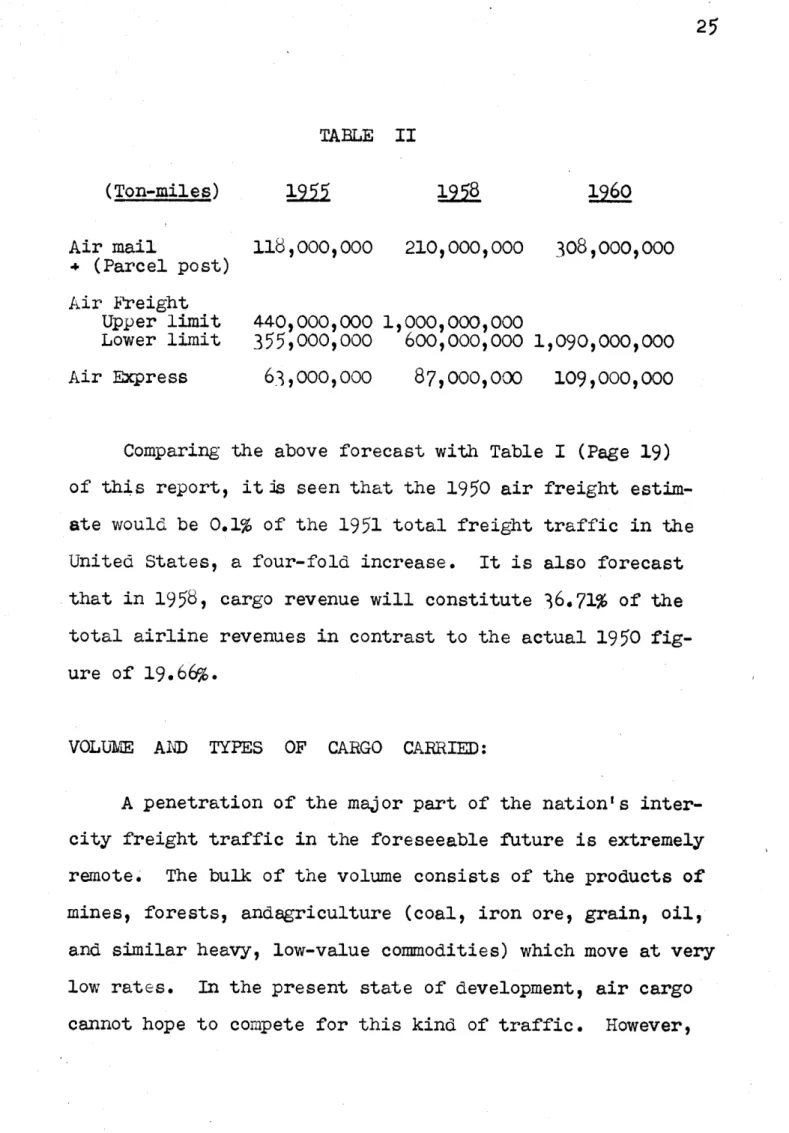
PASSENGERS 600 -MAIL -500 EXPRESS FREIGHT 400 0 300 z w S200, 100 0 8 9452st5 1958 1950 1944 1946 1948(Ton-mi Air mail + (Parcel post) Air Freight Upper limit Lower limit Air Express 118,000,000 440,000,000 355,000,000 63,000,000 210,000,000 1,000,000,000 600,000,000 87,000,000
308,000,000
1,090,000,000
109,000,000Comparing the above forecast with Table I (Page 19) of this report, itis seen that the 1950 air freight estim-ate would be 0.1% of the 1951 total freight traffic in the United States, a four-fold increase. It is also forecast that in 1958, cargo revenue will constitute
36.71%
of the total airline revenues in contrast to the actual 1950 fig-ure of 19.66%.VOLUM AID TYPES OF CARGO CARRIED:
A penetration of the major part of the nation's inter-city freight traffic in the foreseeable future is extremely remote. The bulk of the volume consists of the products of mines, forests, andegriculture (coal, iron ore, grain, oil, and similar heavy, low-value commodities) which move at very low rates. In the present state of development, air cargo cannot hope to compete for this kind of traffic. However,
TABLE II
les)
1960
a portion of the vast freight movement, falling primarily in the manufactured and miscellaneous goods catagories, can be considered air cargo potential, especially in the light of recent rises in some surface transportation rates.
Based on the experience of the past six years, the air freight rate structure is expected to remain fairly stable in the immediate future except insofar as it is affected by increase in the general price level. While the average re-turn of the carriers is not expected to show much change, the industry will undoubtedly continue to experiment with specific commodity or class rates in order to attract as much of the potential traffic as possible. There appears little doubt that lower rates will sharply stimulate vol-ume in many commodities which have the characteristics needed to be air freight candidates, but cannot move in
cuantity at current general rate levels. On the other hand, it may be possible to raise rates on certain items without appreciably affecting volume.
In regard to volume, CAA studies show that (in the case of passenger traffic) once service becomes widely est-ablished, most cities maintain relatively the same position in the air passenger traffic pattern. This method must be used with considerable caution because of the relative im-maturity of the air cargo industry. Air cargo's flow, traf-fic, and commodity patterns are not yet as well established
27
as that of air passenger operations. As service is expanded and improved and the potential in additional communities de-veloped, the proportion emplaned at some of the larger cities, which were among the first to receive cargo service, may well
decline. On the other hand, some cities whcih are not now receiving adequate service or which may in the future obtain the benefit of particularly low rates may substantially im-prove their position.
In 1960 combination (passenger-cargo) flights are ex-pected to carry 235,000,000 ton-miles of freight. No direct
flight costs are involved in this, and the cargo merely uti-lizes space which would otherwise be empty. However, much of the anticipated increase in air freight cannot be handled in combination equipment because of the size or special
characteristics of the shipments.* Similarly, the concen-tration of freight shipments after the close of the business day will require additional cargo schedules during the night hours. Thus, much of the capacity in combination equipment
cannot be effectively utilized because it will not be avail-able at the time or place needed. In addition, it may be difficult to load large quantities of freight on passenger equipment because of the need for reducing station time and maintaining schedules on passenger flights. A study of
aircraft ramp time made by the CAA at selected airports disclosed that the loading and unloading of cargo from combination aircraft required more than twice as much time as did the embarking or deplaning of passengers. Whereas almost all flights discharged or took on their passergers in two minutes or less, cargo was unloaded at the rate of about 200 lbs/minute and loaded at 150 lbs/minute. The handling of a greatly increased cargo volume on passenger equipment would therefore result in serious delays unless cargo handling procedures were greatly improved. Thus it is seen that as volume epands, the proportion carried in all-cargo equipment will rise; by 1960, approximately two-thirds of the total of 700 million ton-miles (or an estimated 465 million ton-miles) should be carried. The latter figure includes the entire traffic of the all-freight air carriers and about 50 percent of the freight ton-miles of the passenger airlines. The remaining 50 percent of the passenger air carriers' air freight and all of their air
express should be carried on combination flights. (The matter of differences between combination and all-cargo
op-erations is of great importance as regards Northeast Phil-adelphia airport as will be noted later.)
An extremely important situation (which directly re-lates to the question of airport-based industry to be dis-cussed later concerns the relative tendencies of various
29
industries either to ship/ or not to ship, by air freight. Different air cargo companies, covering widely separated localities, tend to ship certain commoditiesiin varyirg
per-centages. However, a general concensus of these percetage distributions may give some indication of which industries or commodity groups ship by air freight.
TABLE III Source:CAA
PERCE4TAGE DISTRIBUTION OF COMMODITIES CARRIED BY AIR FREIGHT
Commodity Groups All Carriers Slick IaJior AiraS
Airlines
Weeks of' 9/7/47 & 10/19/47 Wearing apparel
Dry Goods & Textiles Auto parts & accessories Machinery & parts
Cut flowers
Advertising
& printed matterElectric and electronic ecuip-ment and parts
Aircraft parts & accessories LMetal products, hardware. Footwear
Radios and parts
Processed food farm products Drugs and biologicals
Paper and paper products Phonograph records
Vegetables
Plants and nursery
Hides, leather, fur, skins Luggage and personal effects Livestock, chicks, fish
Cameras, films, photo equipment Fresh food, rubber goods
Professional and scientific Instruments, engines and parts Furniture All other 30.6 7.1
5.3
13.5 4.35.8
2.5 3.0 1.10 0.3 1.1---6
Sept.
194816.7
7.9
12*4 10.0 7.46.4
4.5 2.3 2.1 1.2 1.2 1.0 0.0 0.4 1.2 1950 1951 16,9 18.3 5.1 7.03.6
7.2 2.8 70 6.2 1.8 2.118.o
23,6 21.0& 12.16.8
11.6 7.17.7
14*35.7
4.7 4.9 1.5 2.23.5
3.4 2.9 3.1 2.46.1
100.0 100.0 100.0 100.0 * foods only** increased 1.4% to permit table to add to 100% Total
*
31
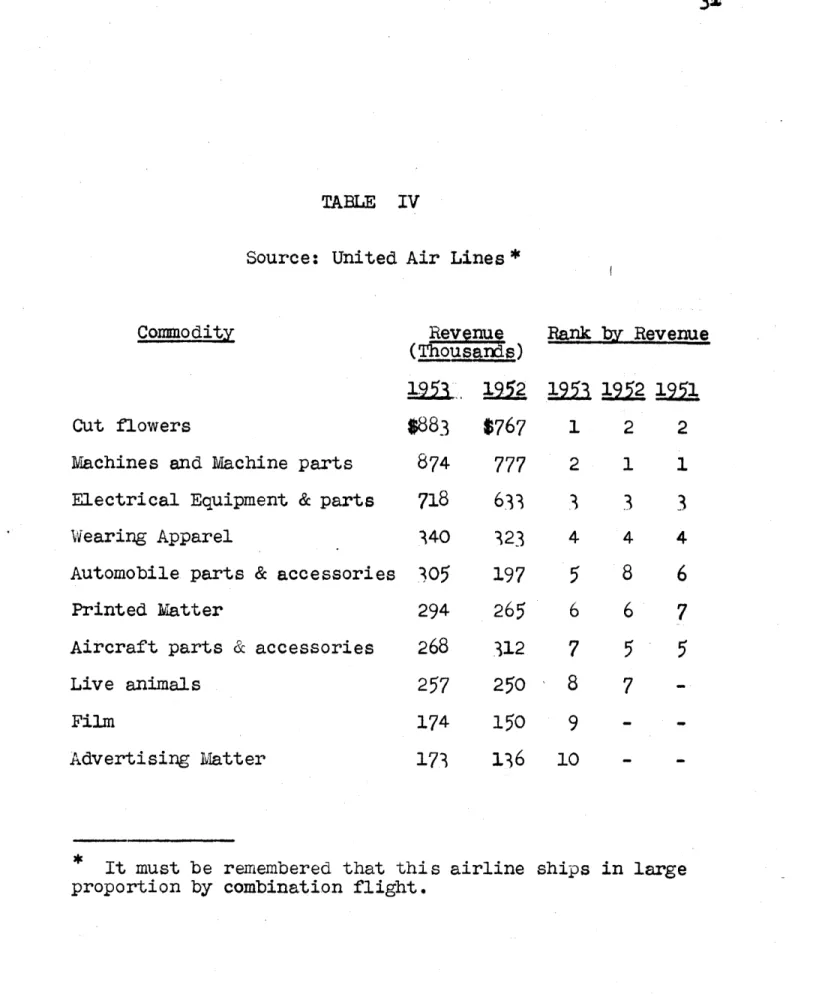
TABLE IV
Source: United Air Lines *
Commodity Revenueh
(Thousands)
$883
$767
Machines and Machine parts Electrical Equipment & parts Wearing Apparel
Automobile parts & accessories Printed Matter
Aircraft parts & accessories Live animals Film Advertising Matter
874
718
340 305 294268
257
174173
777
633
323197
265 312 250 150 1 2 2 2 1 13
3
3
4 4 45
8
6
6
6
7
7
5'
8
7
-9
--136
10It must be remembered that this airline ships in large proportion by combination flight.
Cut flowers
Rank by Revenue
TABLE V
Source: Flying Tig6r Lines
42±2 Commodity Rankirg l. Automobile Parts 1 2. Clothing
6.
3.
Industrial Machinery 2. 4. Aircraft Parts 4. ~. Flowers9.
6.
Radio-Television-7.
Electrical Products 3.8. Miscellaneous Metal Products
9. Nursery Stock
10. Office Machines 7.
Machine Parts Weighing more 8.
than 1,000 Pounds.
Photographic Film 10.
The largest gains were in industrial machinery which had more than doubled; electrical products, the volume of which was five times as large as the 1949 traffic; metal products, and office machines, each up four times, and aircraft parts, which had nearly doubled. Clothing traffic had moved up slightly and flowers were about even with the 1949 volume. Automobile traffic had increased about one-third.
33
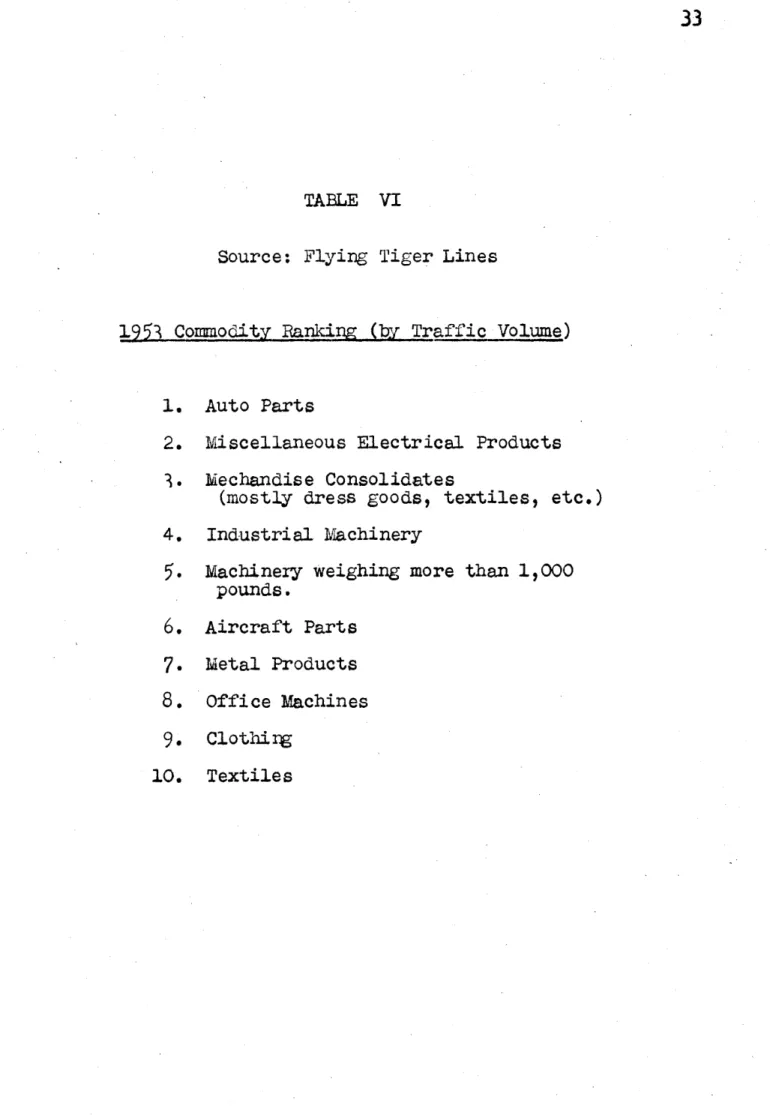
TABLE VI
Source: Flying Tiger Lines
1953
Commodity Ranking (bY Traffic Volume)1. Auto Parts
2. Miscellaneous Electrical Products 3. Mechandise Consolidates
(mostly dress goods, textiles, etc.) 4. Industrial Machinery
5. Machinery weighing more than 1,000 pounds. 6. Aircraft Parts 7. Metal Products 8. Office Machines
9.
Clothirg
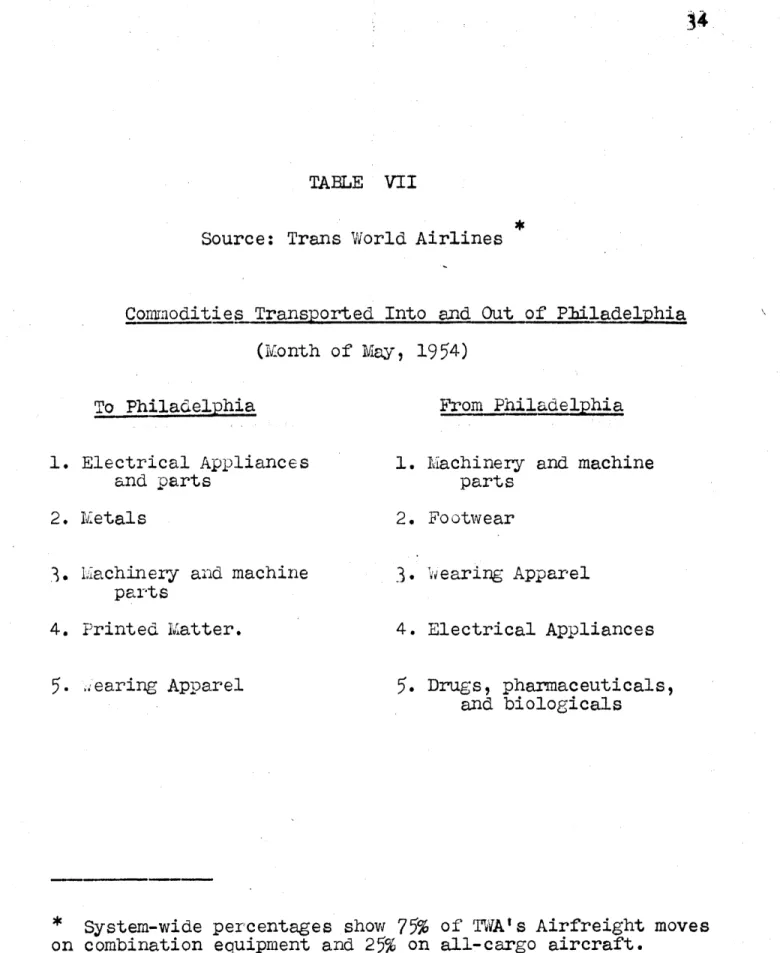
10. TextilesTABLE VII
Source: Trans World Airlines *
Commodities Transported Into and Out of Philadelphia (Month of May, 1954)
To Philadelphia From Philadelphia
1. Electrical Appliances and parts
2. Metals
1. Machinery and machine parts
2. Footwear
3. Lachinery and machine parts 4. Printed Matter. 5. .earing Apparel
3.
earing Apparel 4. Electrical Appliances 5. Drugs, pharmaceuticals, and biologicals* System-wide percentages show
75%
of TWA's Airfreight moves on combination equipment and 25% on all-cargo aircraft.TABLE VIII
Source: Trans World Airlines
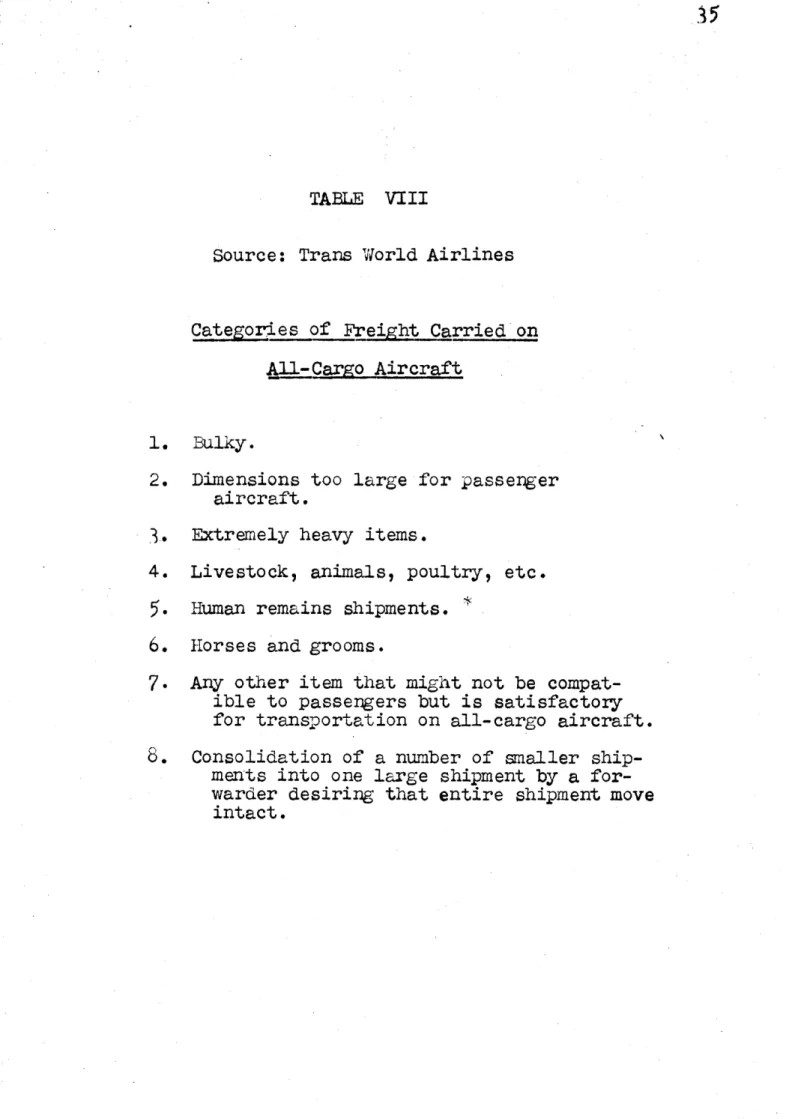
Categories of Freigt Carried on All-Cargo Aircraft
1. Bulky.
2. Dimensions too large for passeilger aircraft.
. Extremely heavy items.
4. Livestock, animals, poultry, etc. 6. Human remains shipments.
6. Horses and grooms.
7.
Any other item that might not be compat-ible to passengers but is satisfactory for transportation on all-cargo aircraft. 8. Consolidation of a number of smallership-ments into one large shipment by a for-warder desiring that entire shipment move intact.
AIRPORT BASED Ih]USTRY:
It can thus be seen that the bulk of air freight is shipped by a comparatively few industries. In the follow-ing section, devoted to the discussion of factors affectfollow-ing the growth of air cargo, the matter of possible penetration of existing potential by the air carriers will be analysed. However, the determination of which industries could assume
advantageous physical relationships with airports possess-ing adecuate freight terminal facilities would be a matter for intensive study devoted to the particular problem in-volved. It will be seen that the proposed master plan** for Northeast airport calls for the establishment of air-port based industry.
* Bibliography N1o. 25.
** Bibliography No. 44.
The CAA publication Domestic Air Cargo (December 1948) supplies an attempted distribution of air cargo by rating groups, (p.4b) but it must be remembered that this document is now over five years old and much of the data is at
37
FACTORS AFFECTING GROWTH OF AIR CARGO
A. Speed of Service.
Speed is the primary advantage which air cargo offers the shipper and all other advantages stem more or less directly from it.
Examples:
(1) Wearing apparel, shoes and other style good_.
Air freight pernits low inventories, "feeler" sales, meeting of peak seasonal demaiads, and protection against counter or inventory losses.
(2) Phonogaphecords.
By using air freight, retailers can meet unexpected demands while carrying a low stock of records which do not sell.
(3) Television and Auto Parts.
Air freight permits a low stock so distributors would not be caught with obsolete merchandise.
(4) Flowers and Other Perishables.
Because of the factor of speed, there is little de-terioration, plus the advantage of two or three extra days of sales that are lost in slower mail movement. Baby Chicks
Shipment by air freight means a virtual elimination
of chick mortality and a shipment weight saving due to the elimination of the necessity of feedirg.
(6) Newspapers, Maazines, and Printed Matter.
The greater market area thus provided has meant larger circulations and higher advertising rates.
(7) iscellaneous Eriergency Shipments.
Shipping needed repair parts by air permits produc-tion line bottlenecks to be broken with a minimum of delay. Drugs anci pharmaceuticals are also often
need-ed in a hurry, as are many other products. (o) Economies from Speed.
Some of these include: (a) less capital needed for smaller inventories; (b) less warehousiig; (c) cut in crating costs; (d) lighter shipping weights; (e) lower insurance rates; (f) less pilferage; (g) less paper-work; and (h) elimination of commodity deterioration.
B. Average Length of Haul.
As distances decrease, the time differential between air shipment aid surface transportation narrows to a point when no real time saving is achieved. SuArface haulers can reach points 300-500 miles distant overnight. Slow ground handling of air cargo has often wiped out gains by speed, particularly if it constitutes such a large portion of
door-to-door time as tends to occur in short-haul operations.
Thus, air freight is largely a long haul operation. The average haul in 1951 was 628 miles for trunk lines, and
39
1462 miles for the all-cargo carriers. This must be re-membered in regard to possible operations between
Phila-delphia and such near-by large centers as New York.
C. Rate Structures.
The level of air freight rates is still too high to make the industry a competative threat to railcarload, motor, truckload, and inland waterways traffic, which move
at extremely low rates. However, freight forwarder, rail less-than-carload, motor-less-than-truckload traffic move at somewhat higher rates, and air cargo may be able to com-pete for a portion of this market. Special commodity and
directional rates have stimulated volume when applied with respect to existing non-realized potential. The major im-pact of the air freight industry has thus far been on rail-way express.
D. Availability of a Specially Designed All-Cargo Aircraft.
The lack of an adequate basic airplane is one of the chief factors hampering further expansion of air freight traffic. Freight carrier planes in operation today are largely C-46's, DC-4's and new DC-6A's*; these will carry the bulk of the traffic until 1955 when DC-6A's and L-1049B's
* The DC-6A is the only all-cargo aircraft now in service which permits overnight delivery on coast-to-coast shipment.
will probably become the standard freight carrier aircraft. The year 1958 may see the development of a good plane, but such an aircraft will probably not make its appearance until after 1960. The impact of such a "standard plane" upon the design of ground facilities will be great, but to date, there is little way of knowing what the specific characteristics of such an airplane would be insofar as they would affect the planning of freight terminals, especially in the light of the various systems (to be discussed) being developed to facilitate the loading of cargo aircraft.
E. Commodities which are potential Air Cargo Candidates.
There has been a rather full discussion of this par-ticular factor in the preceding section entitled Volume and Types of Cargo Carried. There remain a few items which deserve to be mentioned here.
(1) As volume increased and rates were reduced, the number and types of commodities carried broadened considerably. This should result in greater stability for the air freight industry with seasonal fluctuations and price changes in particular industries having less impact on volume and
operations.
(2) Even so, a relatively small number of industries still make up the bulk of air freight shipments.
(3)
Commodities which have been attracted to air freight are largely those with a relatively high value per pound, a fairly low density per cubic foot, or a particular need for speed in transportation. They fall primarily in the general catagory of manufactured goods.(4) The relative volume of these commodities has also been affected by the urgency of general customer demand for the specific products. Many shippers who were originally attract-ed to air freight during periods of abnormal demand for their products, have continued to ship by air because they found
it an advantageous means of transport.
(5)
The most notable omission from the air freight commodity distribution has been fresh fruits and vegetables. The post-war boom in the frozen-food field has undoubtedly cut backair cargo development in this field.' At least one major air carrier*firmly believes, however, that perishables
(
as well as clothing and phonograph records) would move in greater volume if rates were lowered. (Which of course depends onsuch factors as are now under consideration.)
(6) Low rates on eastbound and northbound shipments have
been extremely successful in building up air freight volume in such commidities as nursery stock, business machines,
film, drugs and biologicals, cosmetics and toilet prepara-tions, electronic equipment and parts. They have also been able to tap the fresh fruit and vegetable market for the first time. However, they have succeeded in attracting
only a very small volume in such items as vending and amuse-ment machines, oil field equipamuse-ment, abrasives and adhesives, building material and tools, chemicals, furniture, hides and pelts, shoes, rubber goods, sporting goods, glass, rugs, leather goods, and candy.
The carriers themselves expect little change in the character and type of air freight traffic during the next few years. Thus, an inspection of any large hailway Express terminal should provide a fairly good preview of what kinds of air cargo will be carried duriig the forecast period.
F. Packaging and Refrigeration.
The development of advantageous special packaging tech-niques for products to be transportated by air has not kept pace with the growth of air freight service. Thus, research
in this field has just begun.
Lack of adequate refrigeration and precooling facili-ties at air terminals has hampered tie development of the air freight potential in perishables. Surveys show that perishable products have often b en cooked into insalability
43
when on the ground; similarly, temperature control on air-craft has not been all that it should be. Installation of mechanical refrigeration not only is expensive but also re-duces payload. On return hauls or other flights ol which no perishables are carried, there is no offset to these
costs.
G. The Back-Haul Problem.
This problem has been briefly touched on in the fore-going discussion. In the interests of completeness a few more points should be mentioned. The problem has been
characterized by a heavy flow of traffic from east to west and from north to south, and a relatively light traffic in the opposite directions. However, it seems that the back-haul problem has been substantially alleviated and that an appreciable volume of traffic generated by special low rates in the off-direction.
H. Air Carrier Interest in Air Cargo.
Since this need not be of primary concern in relation to the problem at hand, the fact that, in the case of the major airlines, over 80 percent of their revenues was from passenger service while cargo amounted to only 5.4 percent, need only be compared with the charts included in the pre-ceding section entitled Other Forecasts, to see how the matter stands.
I. Freight Forwarders.
Classified as indirect carriers, the freight forwarders collect and consdlidate shipments at point of origin, and break bulk at point of destination. Acting in a sense as the shipper's traffic department and expert adviser, the air freight forwarder is able to choose the most efficient and cheapest routings. Basically, the forwarders are sales and service organizations and, as such, they have been sell-ing air freight as a normal part of their everyday business.
J. Ground Handling and Terminal Facilities.
Much of the advantage gained by speed in the air has been wiped out by slow and relatively inefficient ground handling which threatens to retard the further development of air freight. Ground delays have had a particularly de-terring effect on short-haul shipments of less than
500
miles.
Results of a study* showed, that in a typical air
freight operation, 85% of the iiitransit time for goods ship-ped from New York to Detroit represented ground handling and only 155 time in the air. For flights between New York and Chicago, ground handling took 81% of the elapsed time, while on flights from New York and Los Angeles, 67% of total transit
* R. Dixon Speas - American Aviation Daily; Nov. 30, 1949; p.140.
4
time was spent on the ground if the goods were delivered the second morning, and 42% if first morning delivery was achieved.
An estimated 80% of total in-transit time of air
freight is consumed by slow and inefficient ground handling, due to a lack of adequate centralized freight terminal
facil-*
ities at most airports. Only 11 airfreight terminals were in operation at
80
major airports and little planning was under way to provide modern freight-handling facilities at these or other fields. The so-called air freight terminal of today is either in the passenger terminal or adjacent to it in prefabricated sheds and obsolete hagars.One of the principal problems in handling air cargo is found in the transfer of shipments from the floor of the terminal to the aircraft. An acute need exists for an efficient and economical bridging device which will allow this transfer with the least amount of handling. Some of the suggested devices will be described shortly.
The loading of the present airplane is inherently slow and cumbersome; it is essential that the load be so distrib-uted that the center of gravity be maintained, and shipments must be secured against vertical and lateral movement as well
* University of Tennessee Survey, American Aviation;
as fore and aft. Similarly, the doors of a plane limit the dimensions of a shipment and cylindrical fuselages often make utilization of space difficult. Ground time
attribut-able to pick-up and delivery is relatively small compared with the time consumed in pick-ups in terminals and on the
loading apron.
EFFECT ON AIRPORTS:
The effect of the concentration of air cargo at a rel-atively few communities of our airport system is somewhat mitigated by the fact that cargo moves in greatest quantities
during the middle of the week and only small amounts more on Saturdays and Sundays, when passenger traffic is heaviest. Moreover, all-cargo flights tend to be heaviest during the night hours, between 9p.m. and 6a.m. On the other hand, the peak of passenger traffic occurs during the daylight and early evening hours. Thus, as the peak operations of the two types of traffic do not coincide, it is anticipated that landing facilities will be able to handle the increased
op-erations generated by all-cargo flights.
The fact that a substantial volume of air freight will continue to move on combination passenger-cargo flights byg the scheduledairlines seems to be a major consideration in the forecast of the CAA that separate air cargo airports will probably not come into existance by 1960.
47
NEW DEVELOPMENTS IN LOADING FACILITIES AND TERMINAL DESIGN:
At the present time, the bulk of air freight is loaded and unloaded from aircraft by means of fork-lift trucks, tractor-trains, makeshift conveyor belts and other over-numerous pieces of ecuipment that tend to clutter up the loading apron, cause frustrating delay in operations, and sometimes collide with, and damage, the aircraft itself. Loreover, these operations must be carried out under all-weather conditions, which greatly intensify the hazards in-volved. This is the obvious result of the design of the
air-craft. Unlike a boxcar which can be brought directly to a level loading platform where the cargo can be transferred with ease, the airplane possesses an unfunctional (for these
operations) aerodynamic shapewhich causes a large physical gap to open up between the vessel being loaded and its
term-inal facilities. It is with the closing of this gap, the major source of delay and complication, that certain new
loading systems are concerned.
The airplane is principally designed for motion aloft, but, on the ground it becores a fairly cumbersome beast. It does not offer the ability of the automobile to park between two adjacent vehicles. Yet, in a sense, that is what it must do in order to get into ramp position to load or discharge
for such movements, thereby increasing the distance traveled by passenger or cargo. To this must be added the obvious hazard and drawback introduced by forcing passengers or cargo to traverse the gap between aircraft and terminal in any and all weather conditions. And the aircraft, existing or anticipated, cannot, of itself, surmount these difficulties
singly because it is built to fly and its necessarily aero-dynamic features stand in the way.
The Loadair System, attempts to circumvent these dif-ficulties by means of a highly ingenious system of motor-driven dollies set into the ramp. The incoming plane taxies onto the three cars (dollies) and stops. By means of cable winches, control-ed by a series of safety switches, the plane
is then drawn perpendicularly into a fixed landing dock. It is claimed for this system that mechanical positioning of aircraft and automatic controls eliminate collision hazards, 20-25% more aircraft can be parked in front of a given term-inal, and these aircraft spend 50% less time at the terminal; in other words, airport terminal utilization is better than doubled. The system has its basis in the fact that there is a surprising uniformity of cabin door heights and fore and aft location of present transport aircraft as well as in their wheel arrangements. To what extent new developments
routing.
(6) Protects passergers and cargo from unfavorabl weather or temperature.
(7) Fragile merchandise is loaded and unloaded wi treater care.
(8) Large savirgs are made in paving expenditures
e
th
due to smaller overall area of pavement. Such savings, .hiting says, will often -more than pay for the Loadair. (9) Paving is eliminated or of considerably less, thickness around the track area.
49
in aircraft design will hold to these established factors, and the capacity of the system for flexibility to adapt to ary charges, are both difficult to predict. On paper, and
seemingly in the freight installation at Barrarlgiulla, Col-umbia, the system boasts impressive advantages. As claimed by the manufacturers, Loadair;
(1) Reduces ground time for planes and thus increases utilization.
(2) Eliminates expensive mobile equipment and the op-erators of such equipment.
(A) Reduces snow and ice removal costs.
(4) Fueling, servicing, and maintenance (line service) operations are speeded because facilities may be in fixed position.
Upon consideration, this system seems to offer many advantages but it seems to contain several drawbacks as well. One, already mentioned, is its possible difficulty
in a&apting .itself to new and difficult types of aircraft, but this objection must be tempered by the fact there seems to be little possibility of a radical new type of design for cargo aircraft for quite a number of years and that a iumber of aircraft (or their types) now in service will continue to serve the iiustry. However, it must be noted that the DC-bA (no information seems to be available on the L-1049B at present), one of the anticipated workhorses of the cominjg cargo fleet, possesses two cargo doors (fore
and aft of the winigs), and that some modification of the design may be necessary to accomodate this type of loading. Also it might prove difficult to service different types
of existirf, aircraft on this same installation. Another possible disadvantage is that limited terminal activities may not require such a high factor of utilization,
espec-ially in the face of an initial capital investment (per system) of between $25 to#45,000. However, it must be pointed out thattcertain extremely busy terminals which originate many cargo flights daily, this last point tends to lose force..