Publisher’s version / Version de l'éditeur:
IAHR 7th International Symposium on Ice, Proceedings, 1, pp. 39-47, 1984
READ THESE TERMS AND CONDITIONS CAREFULLY BEFORE USING THIS WEBSITE.
https://nrc-publications.canada.ca/eng/copyright
Vous avez des questions? Nous pouvons vous aider. Pour communiquer directement avec un auteur, consultez la
première page de la revue dans laquelle son article a été publié afin de trouver ses coordonnées. Si vous n’arrivez
pas à les repérer, communiquez avec nous à [email protected].
Questions? Contact the NRC Publications Archive team at
[email protected]. If you wish to email the authors directly, please see the
first page of the publication for their contact information.
NRC Publications Archive
Archives des publications du CNRC
This publication could be one of several versions: author’s original, accepted manuscript or the publisher’s version. /
La version de cette publication peut être l’une des suivantes : la version prépublication de l’auteur, la version
acceptée du manuscrit ou la version de l’éditeur.
Access and use of this website and the material on it are subject to the Terms and Conditions set forth at
A Procedure to account for machine stiffness in uni-axial compression
tests
Timco, G. W.; Frederking, R. M. W.
https://publications-cnrc.canada.ca/fra/droits
L’accès à ce site Web et l’utilisation de son contenu sont assujettis aux conditions présentées dans le site
LISEZ CES CONDITIONS ATTENTIVEMENT AVANT D’UTILISER CE SITE WEB.
NRC Publications Record / Notice d'Archives des publications de CNRC:
https://nrc-publications.canada.ca/eng/view/object/?id=d8b7148a-0a29-41ef-8bc9-b37bcb113a44
https://publications-cnrc.canada.ca/fra/voir/objet/?id=d8b7148a-0a29-41ef-8bc9-b37bcb113a44
Ser
/
3
q&J-
N21d
National Resea&
Conseil
national
0.
1294
Division of
Division des
Building Research
recherches en batiment
A Procedure to Account for
Machine Stiffness in Uni-Axial
Compression Tests
by
G.W. Timco and R.M.W. Frederking
ANALYZED
Reprinted from
IAHR
7th
International Symposium on Ice
Hamburg, W. Germany, August 27 -31,1984
Proceedings. Vol. I. p. 39-47
(DBR Paper No. 1294)
Price $1.00
NRCC 24681
I1 est bien connu que la rigidit6 des machines d'essai peut
fausser les resultats des essais de compression uniaxiale de la
glace.
Cela provient du fait que les machines d'essai de
compression conventionnelles ne sont pas suffisanment plus
rigides que 116chantillon de glace soumis aux essais.
I1 en
resulte donc un processus complexe d'interaction entre la
machine et la glace.
Cette communication presente un modele
simple de ce processus et les equations deterninantes.
On
obtient ainsi une formule correctrice qui pernet de tenir
compte de la rigidite de la machine.
Le nodele est verifie
avec des echantillons de glace columnaire d'eau douce et de
glace granulaire d'eau de mer en conparant les valeurs des
resistances corrigees pour trois machines d'essai different&
avec celles obtenues en utilisant une machine d'essai
circuit
ferm6 de forte capacite.
LIHR
Ice Symposium
1984
Hamburg
A PROCEDURE TO ACCOUNT FOR MACHINE STIFFNESS
I N UNI-AXIRL CaMPRESSION TESTS
G. W. Timco and R. F r e d e r k i n g N a t i o n a l Research C o u n c i l Canada Research O f f i c e r s
ABSTRACT
I t
is
w e l l e s t a b l i s h e d t h a t t e s t machine s t i f f n e s s c a n i n f l u - e n c e t h e r e s u l t s i n u n i - a x i a l compression t e s t s on i c e . T h i s comes about because t h e c o n v e n t i o n a l compression machines a r e n o t s u b s t a n t i a l - l y s t i f f e r t h a n t h e p i e c e of i c e under t e s t ; hence t h e t e s t becomes a c o m p l i c a t e d i c e - s t r u c t u r e i n t e r a c t i o n p r o c e s s . I n t h i s n o t e , a s i m p l e model o f t h i s p r o c e s s is o u t l i n e d and t h e d e f i n i n g e q u a t i o n s a r e e s t a b - l i s h e d . T h i s y i e l d s a c o r r e c t i o n formula which a c c o u n t s f o r t h e s t i f f - n e s s o f t h e t e s t machine. The model is checked f o r both columnar f r e s h - water i c e and g r a n u l a r s e a i c e by comparing t h e c o r r e c t e d s t r e n g t h v a l u e s f o r t h r e e d i f f e r e n t t e s t machines w i t h t h o s e measured using a h i g h - c a p a c i t y c l o s e d - l o o p t e s t machine.INTRODUCTION
I n r e c e n t g l a c i o l o g i c a l l i t e r a t u r e , t h e r e has been d i s c u s s i o n on t h e i n f l u e n c e of t h e t e s t machine s t i f f n e s s on t h e u n i - a x i a l compres- s i v e s t r e n g t h of i c e which has been measured using c o n s t a n t cross-head r a t e t e s t machines (Aaynes, 1979; Sinha and F r e d e r k i n g , 1979; S i n h a 1981a, 1981b. 1982; Frederking and Timco, 1983, 1984). B a s i c a l l y this problem a r i s e s because t h e s e c o n v e n t i o n a l t e s t machines a r e not c o n s i - d e r a b l y more r i g i d t h a n t h e i c e specimen being t e s t e d . Because o f t h i s , t h e t e s t machine i t s e l f can deform e l a s t i c a l l y a s i g n i f i c a n t amount d u r i n g t h e t e s t . T h i s deformation of t h e t e s t machine r e s u l t s i n a lower a p p l i e d s t r a i n r a t e on t h e sample t h a n t h e nominal s t r a i n r a t e . S i n c e t h e t e s t r e s u l t s a r e u s u a l l y i n t e r p r e t e d i n terms of t h e s t r a i n r a t e , and t h e compressive s t r e n g t h o f i c e is s t r a i n - r a t e dependent, t h i s l e a d s t o an i n a c c u r a t e i n t e r p r e t a t i o n of t h e t e s t . Thus, a t e s t o f i c e s t r e n g t h made on a machine which is not s i g n i f i c a n t l y more r i g i d t h a n t h e i c e sample w i l l r e s u l t i n a lower s t r e n g t h t h a n w u l d occur f o r a t r u e s t r a i n r a t e e q u a l t o t h e nominal r a t e . It has been shown, i n f a c t , t h a t f o r t h e same nominal s t r a i n r a t e , t h e a p p a r e n t s t r e n g t h of i c e i n c r e a s e s with i n c r e a s i n g t e s t system s t i f f n e s s ( S i n h a , 1981a).
To overcome t h i s problem, r e c e n t t e s t s of i c e s t r e n g t h have been performed on "closed-loop" t e s t machines. I n t h e s e t e s t s , t h e r a t e o f d e f o r m a t i o n o f t h e sample is measured and i n s t a n t a n e o u s l y fed back t o t h e c o n t r o l system. T h i s , i n t u r n , a d j u s t s t h e cross-head r a t e so a s t o m a i n t a i n a t r u e c o n s t a n t s t r a i n r a t e of t h e sample d u r i n g t h e t e s t . Using a t e s t machine of t h i s t y p e , it i s p o s s i b l e t o i n v e s t i g a t e t h e s t r e n g t h of i c e a s a f u n c t i o n of t r u e c o n s t a n t s t r a i n r a t e ; i.e. t h e i n f l u e n c e of t h e t e s t machine s t i f f n e s s
is
e l i m i n a t e d . In any s t u d y i n v e s t i g a t i n g t h e p h y s i c s o r mechanisms o f i c e f a i l u r e , a machine of t h i s type should be used, i f a t a l l p o s s i b l e . Closed-loop machines, however, have s e v e r a l drawbacks s i n c e t h e y a r e q u i t e expensive, w r y l a r g e and not e a s i l y d e p l o y a b l e for use i n t h e f i e l d . For many e n g i - n e e r i n g a p p l i c a t i o n s , t h e r e f o r e , a c o n v e n t i o n a l t e s t machine is used. Most of t h e i n f o r m a t i o n i n t h e l i t e r a t u r e An t h e s t r e n g t h o f i c e h a s been o b t a i n e d using such t e s t machines. I t w u l d be h i g h l y d e s i r a b l e , t h e r e f o r e , t o f i n d a t e c h n i q u e which would a l l o w a l l t h i s i n f o r m a t i o n t o be compared by e l i m i n a t i n g t h e i n f l u e n c e o f t h e machine s t i f f n e s s . T h i s t e c h n i q u e would a l s o f a c i l i t a t e f i e l d t e s t i n g s i n c e l i g h t e r and moree a s i l y d e p l o y a b l e t e s t machines w u l d s t i l l g i v e r e s u l t s which c o u l d be i n t e r p r e t e d i n terms o f s t r a i n r a t e .
I n t h i s note, a simple model is p r e s e n t e d f o r t h e s t i f f n e s s o f a c o n v e n t i o n a l test machine. T h i s y i e l d s a c o r r e c t i o n formula which a c c o u n t s f o r t h e machine s t i f f n e s s . The model is checked by comparing s t r e n g t h v a l u e s which were o b t a i n e d f o r both columnar f r e s h w a t e r i c e and g r a n u l a r s e a i c e using t h r e e d i f f e r e n t t e s t machines and c o r r e c t e d using t h i s formula, with t h o s e measured using a high c a p a c i t y c l o s e d - l o o p machine.
DEFINING EQUATIONS
The model f o r t h e system o f an i c e sample i n a t e s t machine
is
shown i n F i g u r e 1. It c o n s i s t s o f a s e r i e s combination o f two i n d i v i d u - a l e l e m e n t s which r e p r e s e n t t h e machine s t i f f n e s s and t h e i c e s t i f f n e s s .L a n n CELL- C O M P L I A N T c D E F L E C T I O N P L A T E N S L O A D I N G S Y S T E M E5
?
K,3 S P E C I M E N a1 L O A D I N G M A C H I N E b l T E S T S Y S T E MFIGURE 1 SCHEMATIC OF ( a ) COMPRESSION W I N G MACHINE AND (b) EQUI VALENP STIFFNESS ELEMENTS
I t has p r e v i o u s l y been d i s c u s s e d by Frederking and Timco (1983). I n b r i e f , t h e l o a d i n g system s t i f f n e s s K i s is d e f i n e d a s
where AP is a load increment, 6j is t h e c o r r e s p o n d i n g d i s p l a c e m e n t increment o f t h e screw jack, and 6s is t h e r e s u l t i n g d e f o r m a t i o n increment o f t h e sample. 6, is d e f i n e d a s
where E is t h e e l a s t i c modulus of t h e specimen, 1 i s t h e l e n g t h and A its c r o s s - s e c t i o n a l a r e a . Combining t h e s e e q u a t i o n s and s e t t i n g t h e sample s t i f f n e s s Ks = EA/1, y i e l d s (per u n i t t i m e )
T h i s e x p r e s s i o n r e l a t e s t h e d i s p l a c e m e n t r a t e o f t h e sample (6,) t o t h e displacement r a t e of t h e cross-head o f t h e machine ( 6 j ) . S i n c e t h e r e s u l t s of compression t e s t s a r e u s u a l l y d i s c u s s e d i n terms o f t h e
. .
s t r a i n r a t e ( E ) o f t h e sample and E = 6/E, e q u a t i o n (3) y i e l d s a r e l a - t i o n s h i p between t h e s t r a i n r a t e i n t h e sample ( E s ) and t h e nominal s t r a i n r a t e o f t h e t e s t ( E n ) a sT h i s e q u a t i o n shows t h a t t h e sample s t r a i n r a t e is l e s s t h a n t h e nominal s t r a i n r a t e , and t h a t a s t h e l o a d i n g system s t i f f n e s s becomes w r y l a r g e compared to t h e i c e s t i f f n e s s , Es approaches En, a s expected. To use t h i s e q u a t i o n , both t h e l o a d i n g system s t i f f n e s s and t h e i c e s t i f f n e s s must be known. The former is o b t a i n e d by l o a d i n g a specimen o f known c o n s t a n t e l a s t i c i t y and measuring t h e l o a d , movement of t h e screw jack, and l o a d frame d e f l e c t i o n ( F r e d e r k i n g and Timco, 1983). The r e s u l t s f o r t h r e e d i f f e r e n t t e s t machines which t h e a u t h o r s have used ( I n s t r o n , T T ~ - L , 0.1
w
c a p a c i t y ; ~ r i - t e s t 50, 0.06 MN c a p a c i t y ; S o i l t e s t CT-405, 0.05 W c a p a c i t y ) a r e shown i n F i g u r e 2. Note t h a t t h e machine s t i f f - ness is not a c o n s t a n t , but a f u n c t i o n of l o a d a t low l o a d s , and f o r a g i v e n t e s t machine, t h e s t i f f n e s s is g r e a t e r for s t e e l p l a t e n s t h a n for compliant p l a t e n s . For t h e a n a l y s i s i n t h i s paper, t h e l o a d dependence o f t h e machine s t i f f n e s s w i l l not be t a k e n i n t o account i n a r i g o r o u s f a s h i o n ; i n s t e a d , it is approximated a s t h e average v a l u e o f t h e machine s t i f f n e s s up to t h e l o a d l e v e l a t which t h e i c e y i e l d s . With r e g a r d t o t h e i c e s t i f f n e s s , t h i s is a l s o not a c o n s t a n t f o r t h e s e t e s t s s i n c e t h e specimen is loaded t o its y i e l d p o i n t . For low l o a d s , t h e i c e s t i f f n e s s is g i v e n byEA/L
where E is t h e e l a s t i c modulus o f t h e i c e . With i n - c r e a s i n g l o a d , t h e i c e s t i f f n e s s d e c r e a s e s such t h a t , by d e f i n i t i o n , it is z e r o a t t h e y i e l d p i n t . S i m i l a r t o t h e machine s t i f f n e s s , t h i s l o a ddependence w i l l not be t a k e n i n t o account i n a r i g o r o u s f a s h i o n ; in- s t e a d , t h e ice s t i f f n e s s is approximated a s t h e a v e r a g e of t h e i c e s t i f f n e s s d u r i n g t h e t e s t (assuming a l i n e a r d e c r e a s e with l o a d to
y i e l d ; i.e.
Ci
= EA/2I1 where E is t h e e l a s t i c m d u l u s of t h e i c e for low l o a d s ) . It s h o u l d be noted t h a t w i t h i n c r e a s i n g l o a d , t h e s t i f f n e s s o f t h e t e s t machine i n c r e a s e s whereas t h e s t i f f n e s s o f t h e i c e specimen d e c r e a s e s . Thus, t h e p r e s e n t approach g r e a t l y s i m p l i f i e s a complex i n t e r a c t i o n problem by using a v e r a g e v a l u e s i n a l i n e a r system t o r e p r e s e n t t h e s i t u a t i o n . With t h i s approximation, t h e r e a d e ris
c a u t i o n e d not t o i n t e r p r e t n o t h e c o r r e c t e d s t r a i n r a t e - ES a s t h e t r u e s t r a i n r a t e 100 - - o f t h e t e s t . To v e r i f y t h e +-
+ a l . ~ l s f f 1 I I I L PL**ENf) x - 8 0-
IWEftlOY [ S T E E L PLhfZ"3l-
a p p l i c a b i l i t y o f e q u a t i o n ( 4 ),
it was usedto
c o r r e c t 1911. T F l T I t l l Y I & I * * l . L h I I Y I I s t r e n g t h measurements f o r two d i f f e r e n t c a s e s . F i r s t , £or measurements on columnar S2 f r e s h w a t e r i c e which were o 10 2 0 3 0 - 0 so so ro made using a c o n v e n t i o n a l L O A D I K N I machine with s t e e l p l a t e n s under c a r e f u l l y c o n t r o l l e d FIGURE 2 l a b o r a t o r y c o n d i t i o n s ; andLOADING SYSTE4 STIFFNESS second, on g r a n u l a r s e a i c e WRSUS
LOAD
FOR THREE made i n t h e f i e l d using two COMPRESSICN TEST MACHINES d i f f e r e n t t e s t machines w i t h both s t e e l and c o m p l i a n t p l a t e n s . The c o r r e c t e d v a l u e s were compared t o t h e l a b o r a t o r y measurements on t h e same t y p e o f i c e using a c l o s e d - l o o p t e s t machine. I n both c a s e s , t h e t e s t d a t a was t a k e n from p r e v i o u s l y p u b l i s h e d t e s t r e s u l t s .FRESEWATER ICE
The i n f o r m a t i o n on f r e s h w a t e r i c e was t a k e n from t h e p u b l i s h e d work o f Sinha (1981a) who compared t h e r e s u l t s o f compression t e s t s by s e v e r a l i n v e s t i g a t o r s using a number of t e s t machines. For t h i s
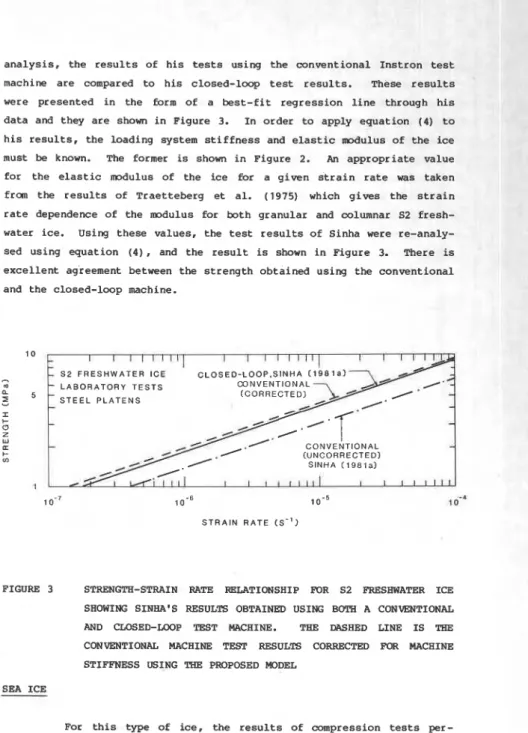
a n a l y s i s , t h e r e s u l t s o f h i s t e s t s u s i n g t h e c o n v e n t i o n a l I n s t r o n t e s t machine a r e compared t o h i s c l o s e d - l o o p t e s t r e s u l t s . These r e s u l t s were p r e s e n t e d i n t h e form o f a b e s t - f i t r e g r e s s i o n l i n e t h r o u g h h i s d a t a and t h e y a r e shown i n F i g u r e 3. I n o r d e r t o a p p l y e q u a t i o n (4) t o h i s r e s u l t s , t h e l o a d i n g system s t i f f n e s s and e l a s t i c m d u l u s o f t h e i c e must be known. The former is shown i n F i g u r e 2. An a p p r o p r i a t e v a l u e f o r t h e e l a s t i c m d u l u s o f t h e i c e f o r a g i v e n s t r a i n r a t e was t a k e n from t h e r e s u l t s of T r a e t t e b e r g e t a l . (1975) which g i v e s t h e s t r a i n r a t e dependence o f t h e m d u l u s f o r both g r a n u l a r and columnar S2 f r e s h - water i c e . Using t h e s e v a l u e s , t h e t e s t r e s u l t s o f S i n h a were re-analy- s e d u s i n g e q u a t i o n ( 4 ) , and t h e r e s u l t is shown i n F i g u r e 3. T h e r e is e x c e l l e n t agreement between t h e s t r e n g t h o b t a i n e d u s i n g t h e c o n v e n t i o n a l and t h e c l o s e d - l o o p machine. L A B O R A T O R Y T E S T S S T E E L P L A T E N S 1 o - ~ 10." l o - = S T R A I N R A T E ( s - ' )
FIGURE 3 STRENGTH-STRAIN RATE RELATIONSHIP FOR S2 FRESHWATER ICE SHOWING SINJiA'S RESULTS OBTAINED USING BOTH A CONVENTIONAL AND CLOSED-LOOP TEST MACHINE. THE DASHED LINE I S TBE CONVENTIONAL MACHINE TEST RESULTS CORRECTED FOR MACHINE STIFFNESS USING TBE PROPOSED MODEL
SEA ICE
For t h i s t y p e o f i c e , t h e r e s u l t s o f c o m p r e s s i o n t e s t s p e r - formed by t h e a u t h o r s i n t h e f i e l d on g r a n u l a r s e a i c e u s i n g two d i f f e r - e n t t e s t machines ( S o i l t e s t CT-405; T r i - T e s t 50) w i t h b o t h c o m p l i a n t and
s t e e l
p l a t e n s ( F r e d e r k i n g a n d Timco, 1 9 8 3 ; 1 9 8 4 ) viere c o m p a r e d to t h e r e s u l t s o f tests made by Wang ( 1 9 7 9 ) o n t h e same t y p e o f s e a ' i c e u n d e r l a b o r a t o r y c o n d i t i o n s u s i n g a c l o s e d - l o o pt e s t
m a c h i n e . I n a l l cases, t h e test t e m p e r a t u r e was a p p r o x i m a t e l y -lOeC, a n d t h e ice was o f com- p a r a t i v e s a l i n i t y . T h e r e s u l t s f o r t h e s e tests a r e p r e s e n t e d i n F i g u r e 4 a . S i m i l a r t o t h e r e s u l t s f o r t h e f r e s h w a t e r ice t e s t s , t h e a s m e a s u r - e d s t r e n g t h o f t h e ice is less t h a n t h o s e f o r c o m p a r a b l e s t r a i n r a t e s o b t a i n e d w i t h t h e c l o s e d - l o o p m a c h i n e . S i n c e t h e elastic m o d u l u s o f t h e ice was n o t m e a s u r e d i n t h e s e tests, a n e s t i m a t e o f it was made by u s i n g t h e r e l a t i o n s h i p b e t w e e n t h e e l a s t i c m o d u l u s (E) a n d t h e b r i n e w l u m e G R A N U L A R S E A I C E T = - 1 0 ' C 0 F R E D E R K I N G A N D T l M C O ( I 9 8 3 a ) - C O M P L I A N T P L A T E N S - S O I L T E S T P R E S S - -0 F R E D E R K I N G A N D T l M C O ( 1 9 8 3 a ) - S T E E L P L A T E N S - S O I L T E S T P R E S S --
- - - W A N G ( 1 9 7 9 ) I-C L O S E D - L O O P C O N V E N T I O N A L ( U N C O R R E C T E D ) [ a ] I I I Il 1 1
1 1
I 1 1 1 1 1 1-
- W A N G ( 1 9 7 9 ) ' C L O S E D - L O O P 0 C O N V E N T I O N A L - (CORRECTED)~ r u
I
,
,
1 1 1 1 1
I
I
1 1 1 1 1 1 1
I
I
I 1 1
1 1 1
S T R A I N R A T E ( s - ' 1FIGURE 4 STRENGTH-STRAIN RATE RELATIONSHIP FOR GEfANULAR SEA ICE
SHOWING WANG'S LABORATORY RESULTS OBTAINED USING CLOSED
LOOP MACHINE AND FREDERKING AND TIMCO'S FIELD RESULTS
OBTAINED USING CONVENTIONAL MACHINES ( a ) UNCORRECTED, ( b )
( u b ) determined f o r s e a i c e by Mudrey (1977)
,
E = 5.32-
13% m a . Using t h e s e v a l u e s and e q u a t i o n ( 4 ) , t h e r e s u l t s of t h e t e s t s k r Frederking and Timco were re-analysed and a r e p r e s e n t e d i n F i g u r e 4 The c o r r e c t e d v a l u e s compare w e l l with t h o s e of Wang.The method o u t l i n e d i n t h i s n o t e , based on a knowledge o f t h e t e s t system s t i f f n e s s and specimen modulus, a p p e a r s t o p r o v i d e a r e a s o n a b l e f i r s t approximation for c o r r e c t i n g s t r a i n r a t e s i n s t r e n g t h t e s t s . The t e c h n i q u e can be a p p l i e d t o i n t e r p r e t i n g d a t a a l r e a d y i n t h e l i t e r a t u r e i f t h e t e s t machine s t i f f n e s s is known. I t a l s o p r o v i d e s a r a t i o n a l e f o r using c o n v e n t i o n a l t e s t machines i n f i e l d t e s t i n g .
REFERENCES
F r e d e r k i n g , R.M.W. and Timco, G.W., 1983. u n i - a x i a l Compressive S t r e n g t h and Deformation of B e a u f o r t Sea Ice. Proc. POAC 83, M1. I, p. 89-98, H e l s i n k i , Finland.
F r e d e r k i n g , R.M.W. and Timco, G.W., 1984. Compressive Behaviour o f Beaufort Sea I c e Under k r t i c a l and H o r i z o n t a l Loading. Proc. 3rd I n t . Symp. on Offshore Mech. and A r c t i c Technology, M1. 111, p. 145-149, New O r l e a n s , U.S.A.
Haynes, F.D:, 1979. Temperature E f f e c t on t h e ~ n i - a x i a l S t r e n g t h of I c e . Proc. POAC 79, M1. I, p. 667-681, ~ r o n d h e i m , Norway.
S i n h a , N.K., 1981a. Comparative Study of I c e S t r e n g t h Data. Proc. IABR Symp. on I c e , M1. 11, p. 581-595, Quebec C i t y , Canada.
S i n h a , N.K., 1981b. Rate S e n s i t i v i t y of Compressive S t r e n g t h of' Columnar-Grained I c e . Exp. Mech. 21, No. 6, p. 209-218.
S i n h a , N.K., 1982. Constant S t r a i n - a n d S t r e s s - R a t e Compressive S t r e n g t h o f Columnar-Grained Ice. J. Mat. S c i . 17, p. 785-802.
S i n h a , N.K. and F r e d e r k i n g , R.M.W., 1979. E f f e c t o f Test System S t i f f - n e s s on S t r e n g t h of I c e . Proc. POX 79, M1. I, p. 708-717; Trondheim, Norway:
T r a e t t e b e r g , A., Gold, L.W. and F r e d e r k i n g , R.M.W., 1975. The S t r a i n Rate and Temperature Dependence o f Young's Modulus o f I c e . Proc. 3rd IAHR Symp. on I c e , p. 479-486, Hanover, N.H., U.S.A.
M u d r e y , K.D., 1977. Determination o f EYrchanical Sea I c e P r o p e r t i e s by
Large-Scale F i e l d Beam Experiments. Proc. POX 77, M1. I, p. 529-543, S t . John's, Canada.
Wang, Y.S., 1979. C r y s t a l l o g r a p h i c S t u d i e s and S t r e n g t h Tests o f F i e l d I c e i n t h e Alaskan Beaufort Sea. Proc. POX 79, M1. I, p. 651-665, Trondheim, Norway.
T h i s p a p e r , w h i l e being d i s t r i b u t e d i n r e p r i n t form by t h e D i v i s i o n of B u i l d i n g R e s e a r c h , remains t h e c o p y r i g h t of t h e o r i g i n a l p u b l i s h e r . It s h o u l d n o t be r e p r o d u c e d i n whole o r i n p a r t w i t h o u t t h e p e r m i s s i o n of t h e p u b l i s h e r . A l i s t of a l l p u b l i c a t i o n s a v a i l a b l e from t h e D i v i s i o n may be o b t a i n e d by w r i t i n g t o t h e P u b l i c a t i o n s S e c t i o n , D i v i s i o n of B u i l d i n g R e s e a r c h , N a t i o n a l R e s e a r c h C o u n c i l of C a n a d a , O t t a v a , O n t a r i o ,
K I A OR6.
Ce document e s t d i s t r i b u 6 sou8 forme d e t i r e - i l - p a r t par l a D i v i s i o n d e s r e c h e r c h e 8 e n b l t i m e n t . Les d r o i t s d e r e p r o d u c t i o n s o n t t o u t e f o i s l a p r o p r i € t € d e 1 1 6 d i t e u r o r i g i n a l . Ce d o c u m e n t n e p e u t 8 t r e r e p r o d u i t en t o t a l i t 6 ou en p a r t i e s a n s l e consentement d e l ' i d i t e u r . Une l i s t e d e s p u b l i c a t i o n s d e l a D i v i s i o n p e u t 8 t r e obtenue en Q c r i v a n t a l a S e c t i o n d e s p u b l i c a t i o n s . D i v i s i o n d e s r e c h e r c h e s e n b l t i m e n t , C o n s e i l n a t i o n a l d e r e c h e r c h e s Canada, O t t a v a , h t a r i o . K1A