HAL Id: cea-00944345
https://hal-cea.archives-ouvertes.fr/cea-00944345
Submitted on 24 Sep 2019
HAL is a multi-disciplinary open access
archive for the deposit and dissemination of
sci-entific research documents, whether they are
pub-lished or not. The documents may come from
teaching and research institutions in France or
abroad, or from public or private research centers.
L’archive ouverte pluridisciplinaire HAL, est
destinée au dépôt et à la diffusion de documents
scientifiques de niveau recherche, publiés ou non,
émanant des établissements d’enseignement et de
recherche français ou étrangers, des laboratoires
publics ou privés.
A phosphatase cascade by which rewarding stimuli
control nucleosomal response
Alexandre Stipanovich, Emmanuel Valjent, Miriam Matamales, Akinori Nishi,
Jung-Hyuck Ahn, Matthieu Maroteaux, Jesus Bertran-Gonzalez, Karen
Brami-Cherrier, Hervé Enslen, Anne-Gaëlle Corbillé, et al.
To cite this version:
Alexandre Stipanovich, Emmanuel Valjent, Miriam Matamales, Akinori Nishi, Jung-Hyuck Ahn, et
al.. A phosphatase cascade by which rewarding stimuli control nucleosomal response. Nature, Nature
Publishing Group, 2008, 453 (7197), pp.879. �10.1038/nature06994�. �cea-00944345�
ARTICLES
A phosphatase cascade by which rewarding
stimuli control nucleosomal response
Alexandre Stipanovich
1,2,3*, Emmanuel Valjent
1,2,3*, Miriam Matamales
1,2,3*, Akinori Nishi
4,5, Jung-Hyuck Ahn
5,
Matthieu Maroteaux
1,2,3, Jesus Bertran-Gonzalez
1,2,3, Karen Brami-Cherrier
1,2,3, Herve
´ Enslen
1,2,3,
Anne-Gae
¨lle Corbille
´
1,2,3, Odile Filhol
6, Angus C. Nairn
5,7, Paul Greengard
5, Denis Herve
´
1,2,3& Jean-Antoine Girault
1,2,3Dopamine orchestrates motor behaviour and reward-driven learning. Perturbations of dopamine signalling have been implicated in several neurological and psychiatric disorders, and in drug addiction. The actions of dopamine are mediated in part by the regulation of gene expression in the striatum, through mechanisms that are not fully understood. Here we show that drugs of abuse, as well as food reinforcement learning, promote the nuclear accumulation of 32-kDa
dopamine-regulated and cyclic-AMP-regulated phosphoprotein (DARPP-32). This accumulation is mediated through a signalling cascade involving dopamine D1 receptors, cAMP-dependent activation of protein phosphatase-2A,
dephosphorylation of DARPP-32 at Ser 97 and inhibition of its nuclear export. The nuclear accumulation of DARPP-32, a potent inhibitor of protein phosphatase-1, increases the phosphorylation of histone H3, an important component of nucleosomal response. Mutation of Ser 97 profoundly alters behavioural effects of drugs of abuse and decreases motivation for food, underlining the functional importance of this signalling cascade.
Midbrain dopamine neurons, activated after unexpected rewarding stimuli, are essential in reinforcement learning1. Drugs of abuse
mimic the physiological action of dopamine neurons by increasing their firing rate or preventing the uptake of dopamine. Thus, they enhance extracellular dopamine levels in the forebrain, especially in the nucleus accumbens (NAc), a key structure required for the rein-forcing effects of addictive drugs2–4. To understand how dopamine
mediates natural or pathological reinforcement learning, it is neces-sary to identify the intracellular events that trigger gene transcription alterations supporting long-lasting synaptic changes5–7. DARPP-32
(ref. 8) is a prominent mediator of dopamine signalling in the
stria-tum9 and is highly enriched in striatal medium-size spiny GABA
neurons10. After activation of the dopamine D1 receptor (D1R),
DARPP-32 is phosphorylated by cAMP-dependent protein kinase (PKA) at Thr 34 and converted into a potent inhibitor of the multi-functional serine/threonine protein phosphatase-1 (PP1)11.
DARPP-32-mediated inhibition of PP1 increases the phosphorylation of neurotransmitter receptors and ion channels crucial for synaptic function and plasticity9. DARPP-32 also regulates nuclear events,
as demonstrated by alterations of drug-induced gene expression in mice lacking DARPP-32 or bearing a point mutation of Thr 34 (refs 12, 13). Part of the control exerted by DARPP-32 on transcrip-tion is mediated by activatranscrip-tion of the extracellular signal-regulated kinase pathway, which is dependent on the concomitant stimulation of D1R and glutamate N-methyl-D-aspartate receptors13,14. However,
the precise mechanisms of information transfer from the cytoplasm to the nucleus of striatal neurons are still poorly understood. Drugs and incentive learning increase nuclear DARPP-32 DARPP-32 has been extensively characterized as a cytoplasmic
protein9. In contrast, electron microscopy has revealed
immunoreactivity to DARPP-32 in the nucleus of some striatal medium-size spiny neurons15, although the significance of this
obser-vation has not been explained. In mice treated withD-amphetamine,
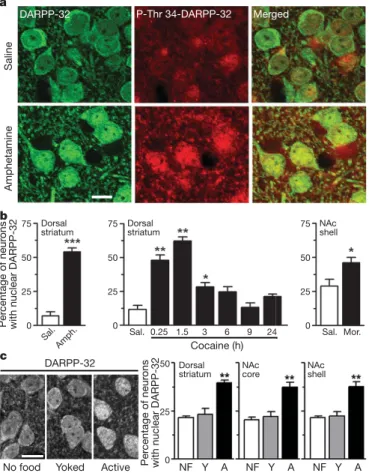
immunoreactivity to DARPP-32 phosphorylated on Thr 34 was strong in the nuclei of striatal neurons (Fig. 1a).D-Amphetamine
also increased total DARPP-32 immunoreactivity in nuclei (Fig. 1a, b). Cocaine induced a rapid accumulation of DARPP-32 in the nuc-leus that lasted several hours (Fig. 1b and Supplementary Fig. 1a).
D-Amphetamine and cocaine triggered the nuclear accumulation of
DARPP-32 in both the dorsal striatum and the NAc (data not shown). In contrast, morphine increased nuclear DARPP-32 only in the NAc shell (Fig. 1b and Supplementary Fig. 1b), where it potently increases dopamine release16. A reinforcement learning
model, in which mice nose-poked for food, also triggered the nuclear accumulation of DARPP-32 in the dorsal striatum and in the NAc shell and core (Fig. 1c). In mice receiving no food, or in yoked mice that received food when the ‘active’ animal nose-poked, no nuclear accumulation was observed (Fig. 1c).
In drd1a-EGFP mice, which specifically express enhanced green fluorescent protein (EGFP) in striatonigral neurons under the control of the D1R promoter (drd1a)17, nuclear accumulation of
DARPP-32 occurred in D1R-expressing neurons 8 min after cocaine injection (Supplementary Fig. 2a). Cocaine-induced rapid nuclear accumulation of DARPP-32 was not observed in D1R-null mice (Supplementary Fig. 2b), indicating the requirement for D1R. In striatal neurons in culture, DARPP-32 immunofluorescence was predominantly cytoplasmic; application of SKF81297, a D1R agonist, induced its nuclear accumulation, which was prevented by a D1R antagonist, SCH23390, or a cAMP antagonist, Rp-cAMPS (Supple-mentary Fig. 3a, b). Conversely, a cAMP analogue, Sp-5,6-DCl-cBIMPS, increased nuclear DARPP-32 immunoreactivity in a
*These authors contributed equally to this work. 1Inserm, UMR-S 839, 75005 Paris, France.2Universite
´ Pierre et Marie Curie (UPMC), 75005 Paris, France.3Institut du Fer a
` Moulin, 75005 Paris, France.4Department of
Pharmacology, Kurume University School of Medicine, Kurume, Fukuoka 830-0011, Japan.5Laboratory of Molecular and Cellular Neuroscience, The Rockefeller University, New York,
time-dependent manner (Supplementary Fig. 3c). Similar results were obtained with DARPP-32 fused to EGFP (D32–GFP), co-expressed with D1R in striatal neurons in culture (Supplementary Fig. 4a–c). Taken together, our results show that nuclear accumula-tion of DARPP-32 in response to physiological reward-controlled learning or to drugs of abuse was mediated by D1R and that cAMP was necessary and sufficient for this effect.
Ser 97 phosphorylation controls DARPP-32 localization
Leptomycin B (LMB), a specific inhibitor of CRM1-mediated nuc-lear export18, induced a rapid nuclear accumulation of endogenous
DARPP-32 (Fig. 2a) or transfected D32–GFP (Supplementary Fig. 5a and Supplementary Video) in virtually all neurons. At residues 103– 111 of DARPP-32 we identified a putative nuclear export signal (NES; Fig. 2b) that was homologous to sequences known to bind CRM1 (ref. 19). Mutation of Leu 103 or Leu 109 to alanine induced a marked accumulation of D32–GFP in the nucleus (Fig. 2c), con-firming the critical role of this sequence in nuclear export. Similar results were observed in Chinese hamster ovary cells (Supplementary Fig. 5b, c). We also found that the amino-terminal region of DARPP-32, which encompasses several putative nuclear localization signals, had a critical function in its nuclear import (data not shown).
These results suggested that D1R stimulation acted by reducing the export of DARPP-32 out of the nucleus. We ruled out a general inhibitory influence of D1R stimulation on CRM1-dependent nuc-lear export, by showing that SKF81297 did not alter the localization of another protein with an active NES20, namely Ca21 /calmodulin-dependent kinase-Ia (CaMKIa–GFP; Fig. 2d). Introduction of an ectopic NES sequence derived from prohibitin21 (NESproh) at the
carboxy terminus of DARPP-32 (D32–NESproh–GFP) blocked the
nuclear accumulation induced by SKF81297 (Fig. 2d).
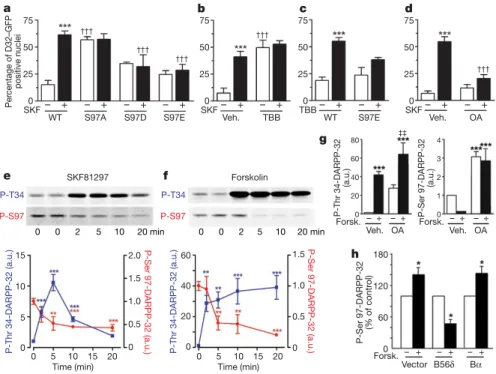
To determine how the D1R/cAMP pathway regulated DARPP-32 localization we mutated its major phosphorylation sites (Thr 34, Thr 75, Ser 97 and Ser 130; Fig. 2b) to alanine. In striatal neurons in culture, basal and D1R-induced localization of T34A-D32–GFP, T75A-D32–GFP and S130A-D32–GFP mutants was similar to that of wild-type protein (Supplementary Fig. 6a). In support of these obser-vations, in knock-in mutant mice bearing an alanine point mutation at Thr 34 or Thr 75, the basal localization of DARPP-32 and its cocaine-induced nuclear accumulation was similar to that of the wild type (Supplementary Fig. 6b, c). In contrast, when Ser 97, located close to the NES of DARPP-32, was mutated to alanine, the protein was nuclear in basal conditions and D1R stimulation did not alter this distribution (S97A-D32–GFP; Fig. 3a). Mutation of Ser 97 to the acidic residues glutamate (S97E) or aspartate (S97D), which mimics phosphorylation, induced a preferential cytoplasmic localization, which was not modified by SKF81297 (Fig. 3a and Supplementary Fig. 7a).
Ser 97 (Ser 102 in rat) is highly phosphorylated in basal
conditions by casein kinase 2 (CK2)22. An inhibitor of CK2,
4,5,6,7-tetrabromobenzotriazole (TBB)23, markedly increased
nuc-lear D32–GFP and prevented the effects of treatment with D1R ago-nist (Fig. 3b and Supplementary Fig. 7b). The effects of TBB resulted from the prevention of Ser 97 phosphorylation, because they were
75
Per
centage of neur
ons
with nuclear DARPP-32
Per
centage of neur
ons
with nuclear DARPP-32
50 25 0 75 50 25 0 50 25 0 75 50 25 0
No food Yoked Active NF Y A NF Y A NF Y A DARPP-32 Dorsal striatum Dorsal striatum Sal. Amph. Dorsal striatum 0.25 1.5 3 Cocaine (h) 6 9 24
Sal. Sal. Mor.
NAc shell NAc core NAc shell c b Merged P-Thr 34-DARPP-32 DARPP-32 Amphetamine Saline a
Figure 1|Drugs of abuse and food self-administration induce nuclear
accumulation of DARPP-32 in striatal neurons. a, DARPP-32 (green) and phospho-Thr 34-DARPP-32 (red) immunofluorescence in dorsal striatum
of mice injected with saline orD-amphetamine (10 mg kg21intraperitoneally
for 15 min).b, Effects ofD-amphetamine (amph.), cocaine (20 mg kg21, time
course) and morphine (mor., 5 mg kg21subcutaneously). Sal, saline.
c, Effects of 1 h of reinforcement learning: mice in self-administration chamber without food (NF), learning to nose-poke for food pellets (active; A) or receiving pellets when the active animal nose-poked (yoked; Y). Error bars represent s.e.m., n 5 4–8, t-test (amphetamine, morphine) or one-way analysis of variance (Supplementary Table 1) and Bonferroni test. Asterisk, P , 0.05; two asterisks, P , 0.01; three asterisks, P , 0.001. Single confocal sections. Scale bars, 10 mm.
100
Per
centage of neur
ons
with nuclear DARPP-32
D32–GFP positive nuclei (%) GFP-positive nuclei (%) 75 50 25 0 100 75 – + – + – + 50 25 0 100 CaMKIα –GFP D32–GFP D32–NESproh –GFP ††† 75 50 25 0 SKF 0 25 LMB 50 Time (min) 75 100 WT
L103A L106A L109A Y111A
T34 NH2 COOH L103GEL106REL109GY111 T75 S97 S130 d c b a
Figure 2|DARPP-32 undergoes continuous cyto-nuclear shuttling.
a, Leptomycin B (LMB; 10 ng ml21) induces nuclear accumulation of
DARPP-32 in striatal neurons in culture.b, Putative NES in DARPP-32 and
major phosphorylation sites.c, Mutagenesis of hydrophobic residues in NES
increases nuclear localization of D32–GFP in transfected neurons. Three
asterisks, P , 0.001 compared with wild type (WT).d, Stimulation of D1R
(10 mM SKF81297 for 15 min) has no effect on the localization of an unrelated protein with a NES (CaMKIa–GFP) or when DARPP-32 contains
an additional NES (D32–NESproh–GFP). Three asterisks, P , 0.001 for SKF
compared with vehicle; three daggers, P , 0.001 for mutant compared with WT. Error bars represent s.e.m., n 5 3–6, one-way analysis of variance (Supplementary Table 1), Bonferroni test.
not observed with S97E-D32–GFP (Fig. 3c and Supplementary Fig. 7c). These results support the hypothesis that DARPP-32 is mainly nuclear when Ser 97 is dephosphorylated, whereas it is preferentially cytoplasmic when phosphorylated by CK2.
Protein phosphatase-2A dephosphorylates Ser 97
Because our results predicted that dephosphorylation of Ser 97 would enhance nuclear DARPP-32, we tested the role of protein phosphatase-2A (PP2A), which dephosphorylates Ser 97 in vitro22.
Pretreatment of striatal neurons with okadaic acid, a potent inhibitor of PP2A, did not alter the basal cytoplasmic localization of D32–GFP, whereas it blocked its D1R-induced nuclear translocation (Fig. 3d and Supplementary Fig. 7d). We next examined the regulation of Ser 97 phosphorylation in striatal slices24. SKF81297 induced a
marked increase in Thr 34 phosphorylation, as expected, and a dephosphorylation of Ser 97 (Fig. 3e). The precise time course of the two responses was different, with dephosphorylation of Ser 97 being slower and more persistent than Thr 34 phosphorylation. Forskolin, a potent activator of adenylyl cyclase, induced a pro-nounced and sustained increase in Thr 34 phosphorylation and a slightly delayed, but persistent, decrease in Ser 97 phosphorylation (Fig. 3f and Supplementary Fig. 8). Forskolin-stimulated dephos-phorylation of Ser 97 was prevented by okadaic acid (Fig. 3g), at a concentration that blocks PP2A activity fully, and PP1 activity only partly, in striatal slices25.
PP2A activity is controlled by various regulatory subunits, among which the B56d subunit is highly expressed in the striatum (Sup-plementary Fig. 9a) and is activated by cAMP-dependent
phosphor-ylation26,27. When B56d was co-expressed with DARPP-32 in
HEK293 cells, it promoted dephosphorylation of Ser 97 in response to forskolin (Fig. 3h and Supplementary Fig. 9b). In contrast, in cells transfected with the vector alone or with another isoform of the B subunit (Ba), forskolin slightly increased Ser 97 phosphorylation (Fig. 3h and Supplementary Fig. 9b). Thus, D1R stimulation and increased cAMP levels induce the dephosphorylation of Ser 97 selec-tively through stimulation of PP2A containing the B56d subunit. Altered behaviour in S97A-DARPP-32 mice
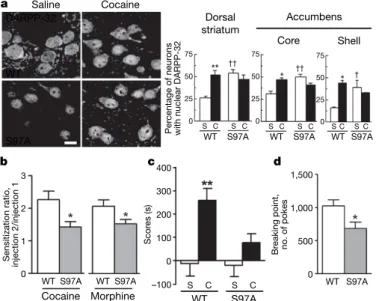
To examine the role of Ser 97 in vivo, we used a knock-in mouse line bearing a point mutation of this residue to alanine (S97A). DARPP-32 was nuclear in about half of medium-size spiny neurons in the various striatal regions of the mutant mice (Fig. 4a). Cocaine injection did not alter the nuclear localization of S97A-DARPP-32 (Fig. 4a). The spontaneous activity, habituation and acute locomotor response to cocaine were similar in S97A-DARPP-32 mice and wild-type mice (Supplementary Fig. 10a–c), whereas the acute locomotor
response to morphine (5 mg kg21) was decreased in the mutant
(Supplementary Fig. 10d). In wild-type mice a second injection of cocaine or morphine, seven days after the first injection, had a much stronger effect on locomotion than the first, showing a robust sensitization (Supplementary Fig. 10e, f) as reported previously13.
In S97A-DARPP-32 mice, locomotor sensitization to cocaine and morphine, although still present, was less pronounced than in wild-type mice (Fig. 4b and Supplementary Fig. 10e, f). Moreover, the rewarding effects of cocaine, evaluated by conditioned place preference, were not observed in S97A-DARPP-32 mice (Fig. 4c).
We next examined whether mutation of Ser 97 interfered with responses to physiological rewarding stimuli by using a model in
75
– +
WT
P-T34
P-Thr 34-DARPP-32 (a.u.) P-Thr 34-DARPP-32 (a.u.)
P-S97
P-T34
P-S97
P-Ser 97-DARPP-32 (a.u.)
P-Ser 97-DARPP-32 (a.u.)
SKF SKF TBB SKF
Forsk.
Forsk.
S97A S97D S97E Veh. Veh. OA
Veh. Vector B56δ Bα OA TBB WT S97E P-Thr 34-DARPP-32 (a.u.) P-Ser 97-DARPP-32 (% of contr ol) P-Ser 97-DARPP-32 (a.u.) – + – + – + – + – + – + – + – + – + – + – + – + – + Forsk. Veh. OA – + – + – + 50 Per
centage of D32–GFP positive nuclei 25 0 15 60 180 120 60 0 40 20 0 2.0 SKF81297 Forskolin 1.5 1.0 0.5 0 10 5 0 1.5 1.0 0.5 0 0 5 10 Time (min) 15 20 0 5 10 Time (min) 15 20 75 50 25 0 75 50 25 0 75 80 60 40 20 0 4 3 2 1 0 50 25 0 h g 0 0 2 5 10 20 min min f e 0 0 2 5 10 20 d c b a ††† ††† ††† ††† ‡‡ †††
Figure 3|Phosphorylation at Ser 97 controls intracellular localization of
DARPP-32. a, Striatal neurons transfected with D1R and wild-type (WT), S97A-D32–GFP, S97D-D32–GFP or S97E-D32–GFP, treated with vehicle (Veh., 2) or 10 mM SKF81297 (SKF, 1, 15 min). Three asterisks, P , 0.001 for SKF compared with vehicle; two daggers, P , 0.01; three daggers,
P , 0.001 for mutant compared with WT.b, CK2 inhibition (TBB, 50 mM,
45 min before SKF) increases nuclear DARPP-32. Three asterisks, P , 0.001 for SKF compared with vehicle; three daggers, P , 0.001 for TBB compared
with vehicle.c, S97E mutation prevents TBB effects. Three asterisks,
P , 0.001 for TBB compared with vehicle.d, Okadaic acid (OA; 500 nM,
45 min before SKF) prevents D1R-induced DARPP-32 nuclear
accumulation. Three asterisks, P , 0.001 for SKF compared with vehicle;
three daggers, P , 0.001 for OA compared with vehicle.e, SKF81297
(10 mM) induces Thr 34 phosphorylation (blue) and Ser 97 dephosphorylation (red) in mouse striatal slices (immunoblotting;
n 5 5–7). Two asterisks, P , 0.01; three asterisks, P , 0.001.f, Forskolin
(10 mM) also induces Thr 34 phosphorylation (blue) and Ser 97
dephosphorylation (red) (n 5 5–7). Two asterisks, P , 0.01; three asterisks,
P , 0.001.g, Okadaic acid (1 mM) prevents this forskolin-induced Ser 97
dephosphorylation. Three asterisks, P , 0.001 compared with control; two
double daggers, P , 0.01 compared with OA.h, B56d allows Ser 97
dephosphorylation by forskolin (Forsk., 10 mM, 10 min): HEK293 cells transfected with DARPP-32 and vector, B56d-PP2A or Ba-PP2A subunit (immunoblotting, n 5 3, t-test). Error bars represent s.e.m., one-way ANOVA (Supplementary Table 1) and Bonferroni test (unless otherwise indicated). Asterisk, P , 0.05.
which mildly food-deprived mice learned to obtain food pellets by nose-poking. Wild-type and mutant mice learned equally well, even when the number of nose-pokes necessary to obtain a pellet was increased to a fixed ratio of five or when the rewarded hole was reversed (Supplementary Fig. 10g). However, when the required number of nose-pokes was progressively increased until the mice interrupted their behaviour, the breaking point was lower in S97A mutant mice than in wild-type mice (Fig. 4d). Taken together, these results show that mutation of Ser 97 alters long-lasting responses to drugs of abuse, and decreases motivation for food reward.
In S97A-DARPP-32 mice we found a decreased phosphorylation of DARPP-32 on Thr 34 and of several proteins regulated through DARPP-32 (data not shown). We previously observed, with purified bovine DARPP-32, that phosphorylation by CK2 facilitated the phosphorylation of Thr 34 by PKA22. However, there was no deficit
in cAMP-induced Thr 34 phosphorylation of S97A mutant protein in transfected COS7 cells in which overexpressed DARPP-32 was cyto-plasmic (Supplementary Fig. 11). We therefore conclude that the observed alterations in S97A mice probably resulted from the block-ade of cyto-nuclear shuttling of DARPP-32, rather than from an intrinsic effect of Ser 97 phosphorylation on Thr 34 phosphorylation. Nuclear DARPP-32 regulates histone H3 phosphorylation Because D1R stimulation induces the accumulation of Thr 34-phospho-DARPP-32 (Fig. 1a), a potent inhibitor of PP1, we proposed that DARPP-32 translocation might regulate the phos-phorylation of nuclear proteins. We therefore investigated the phosphorylation of histone H3 on Ser 10, a substrate for several kinases28,29, which is known to be regulated by PP1 (refs 30, 31).
The phosphorylation of H3 on Ser 10 is a key step in nucleosomal
response28,32and is crucial for memory formation33. It is increased in
the striatum after cocaine administration in vivo, and this response is functionally important14,34. Cocaine induced an intense
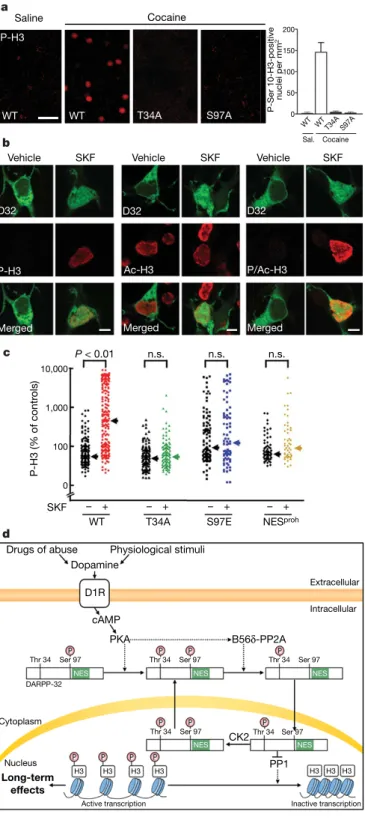
phospho-Ser 10-H3 signal in the nuclei of several striatal neurons in wild-type mice, whereas this effect was absent in both T34A-DARPP-32 and S97A-DARPP-32 mice (Fig. 5a). Similar results were observed with an antibody that detected phospho-acetyl-H3 (phospho-Ser 10-acetyl-Lys 14-H3; data not shown).
In striatal neurons transfected with D1R and D32–GFP, the D1R agonist SKF81297 markedly increased the phosphorylation of H3 on Ser 10 (Fig. 5b, c, and Supplementary Fig. 12). SKF81297 did not alter the acetylation of H3 on Lys 14, but increased the immunoreactivity of phospho-Ser 10, acetyl-Lys 14 H3 (Fig. 5b and Supplementary Fig. 12). D1R-induced phosphorylation of histone H3 was lost when neurons were transfected with T34A-D32–GFP instead of the wild type (Fig. 5c), confirming that the ability of DARPP-32 to inhibit PP1 was essential for H3 phosphorylation. We then directly evaluated the role of DARPP-32 translocation to the nucleus by using mutant forms of D32–GFP that are constitutively excluded from the nucleus:
S97E-D32–GFP (see Fig. 3a) and DARPP-32-NESproh–GFP (see
Fig. 2d). In neurons transfected with these ‘cytoplasmic’ variants of D32–GFP, the D1R agonist SKF81297 did not induce H3 phosphor-ylation (S97E and NESproh; Fig. 5c). These results showed that DARPP-32 phosphorylation on Thr 34, and thus PP1 inhibition, was essential for D1R-induced phosphorylation of Ser 10-H3 and that this effect required the ability of DARPP-32 to accumulate in the nucleus in response to stimulation of D1R.
Discussion
Our study identifies nuclear DARPP-32 as a key factor in the phos-phorylation of histone H3, a component of the nucleosomal response that is essential for gene expression28,32,33. Psychostimulant drugs (
D -amphetamine and cocaine) and morphine, which act by completely different mechanisms, share the ability to increase extracellular dopa-mine in the NAc and to trigger the nuclear accumulation of DARPP-32. A natural stimulus such as a simple food-reinforced learning model caused a similar effect. DARPP-32 undergoes a very active, continuous cyto-nuclear shuttling regulated by the phosphorylation of Ser 97, which is in the vicinity of its NES (summarized in Fig. 5d). Phosphorylation of Ser 97 by CK2 seems to be crucial for the nuclear export of DARPP-32. CK2 is present in nuclei of striatal neurons (Supplementary Fig. 13) and can phosphorylate nuclear DARPP-32 and promote its export. Stimulation of D1R triggers the rapid phosphorylation of Thr 34 responsible for cytoplasmic effects of DARPP-32, and the slower dephosphorylation of Ser 97, by acti-vating PP2A through cAMP/PKA-mediated phosphorylation of its B56d subunit26,27, thus decreasing the nuclear export of DARPP-32.
Although phosphorylation has been reported to regulate the cyto-nuclear shuttling of several proteins35, this is a rare example of
facilitation of CRM1-mediated nuclear export by phosphor-ylation36,37. cAMP-independent mechanisms also couple dopamine
D2 receptor (D2R) to a delayed activation of PP2A (ref. 38). D2R does not seem to be important in the early nuclear accumulation of DARPP-32, but it could have a regulatory role on Ser 97 phosphor-ylation and DARPP-32 localization in other circumstances.
A large body of evidence demonstrates that long-term synaptic plasticity requires the control of gene expression in the striatum as in other brain regions39. We have identified a previously
unrecog-nized mechanism by which dopamine controls chromatin through the regulated translocation of a PP1 inhibitor to the nucleus, which promotes histone H3 phosphorylation. Dopamine-controlled inhibition of nuclear PP1, a wide-spectrum protein phosphatase, is likely to have other targets, making it a general means for the control of nuclear function. This mechanism is undoubtedly important in the long-term effects of drugs of abuse, which activate gene transcrip-tion through the stimulatranscrip-tion of D1R, and in physiological reward-controlled learning. Regulation of the nuclear accumulation of
d c b Core Shell Accumbens Dorsal striatum 75 3 400 1,500 1,000 500 0 300 200 100 0 –100 2 1 0 Per c entage of neur ons
with nuclear DARPP-32
Sensitization ratio,
injection 2/injection 1
Scor
es (s)
Br
eaking point, no. of pokes
50 25 0 75 S C S C WT S97A WT S97A WT WT S97A S C S97A WT S97A S C Cocaine Morphine S C S C WT S97A S C S C WT S97A 50 25 0 75 50 25 0 S97A WT DARPP-32 Cocaine Saline a †† †† †
Figure 4|Mutation of Ser 97 alters localization of DARPP-32, behavioural
responses to drugs of abuse and motivation for food reward. a, DARPP-32 immunoreactivity (dorsal striatum) in wild-type (WT) or S97A-DARPP-32
mice injected with saline (S) or cocaine (C, 20 mg kg21, for 10 min). Single
confocal sections. Scale bar, 10 mm; n 5 3–8. Asterisk, P , 0.05; two asterisks, P , 0.01 for saline compared with cocaine; dagger, P , 0.05; two
daggers, P , 0.01 for S97A compared with WT.b, Decreased locomotor
sensitization to a second injection (day 7) of cocaine (20 mg kg21, for 1 h;
n 5 16) or morphine (5 mg kg21, for 3 h; n 5 8) in S97A mice (t-test).
Asterisk, P , 0.05.c, Conditioned place preference to cocaine was prevented
in S97A mice (scores are calculated as time in cocaine-paired compartment after conditioning minus that before conditioning; n 5 7–8). Two asterisks,
P , 0.01.d, Decreased breaking point for food reward under progressive
ratio schedule in S97A mice (t-test, n 5 7–8). Error bars represent s.e.m., two-way analysis of variance (Supplementary Table 1) and Bonferroni test (unless otherwise indicated). Asterisk, P , 0.05.
DARPP-32 may also be important to the functions or dysfunctions of dopamine that involve transcription-dependent long-term plasticity, including neuroleptic- andL-DOPA-induced dyskinesia, and other
diseases of the basal ganglia. METHODS SUMMARY
Knock-in T34A-DARPP-32, T75A-DARPP-32 and S97A-DARPP-32 (refs 40,
41), D1R-deficient42, drd1a-EGFP17and matched wild-type control mice were
habituated to saline injections for three days before experiments. Drug-treated mice were anaesthetized with pentobarbital and received an intracardiac per-fusion of 4% paraformaldehyde. Vibratome-cut brain sections were processed
for immunofluorescence13. Primary striatal neurons, from 14-day embryonic
Swiss mice, were grown in supplemented Neurobasal medium and transfected a week later with plasmids expressing D1R and DARPP-32 fused with C-terminal EGFP (D32–GFP). HEK293, CHO-K1 or COS-7 cells were transfected with DARPP-32 constructs associated or not with PP2A subunits, and studied 24– 48 h later. On the basis of confocal single sections, the subcellular localization of DARPP-32 or GFP was classified into three categories: nuclear staining stronger than, equal to or weaker than cytoplasmic. For cells in culture, the first two categories were pooled and considered as cells with nuclear staining. Phosphorylated and/or acetylated H3 immunofluorescence was quantified with Image-J-1.34s (National Institutes of Health). Striatal coronal slices (350 mm)
were incubated in oxygenated artificial cerebrospinal fluid25, and
phospho-DARPP-32 was analysed in slices or transfected cells by western blotting25.
Locomotor activity, sensitization produced by a single injection of drug, and
conditioned place preference were measured as described13,14,43. In the operant
model for food self-administration (incentive learning), mildly food-deprived mice were placed in an operant chamber with two nose-poke holes. One or five nose-pokes (fixed ratios 1 and 5) in the rewarded hole, indicated by a cue light, triggered the release of a food pellet. Controls were ‘no food’ mice (mice in the same chamber but with no pellet delivered) and ‘yoked’ mice (paired to active mice, in exactly the same conditions, but rewarded when the active mouse nose-poked). For the reversal test, the previously inactive hole became active and vice versa. For analysis of the progressive ratio, the number of successive pokes required for pellet release was progressively increased until the mouse stopped poking (breaking point).
Full Methods and any associated references are available in the online version of the paper at www.nature.com/nature.
Received 20 January; accepted 4 April 2008. Published online 21 May 2008.
1. Schultz, W. & Dickinson, A. Neuronal coding of prediction errors. Annu. Rev. Neurosci.23, 473–500 (2000).
2. Berke, J. D. & Hyman, S. E. Addiction, dopamine, and the molecular mechanisms of memory. Neuron25, 515–532 (2000).
3. Di Chiara, G. Drug addiction as dopamine-dependent associative learning disorder. Eur. J. Pharmacol.375, 13–30 (1999).
4. Everitt, B. J. & Robbins, T. W. Neural systems of reinforcement for drug addiction: from actions to habits to compulsion. Nature Neurosci.8, 1481–1489 (2005). 5. Nicola, S. M., Surmeier, J. & Malenka, R. C. Dopaminergic modulation of neuronal
excitability in the striatum and nucleus accumbens. Annu. Rev. Neurosci.23, 185–215 (2000).
6. Reynolds, J. N. & Wickens, J. R. Dopamine-dependent plasticity of corticostriatal synapses. Neural Netw.15, 507–521 (2002).
7. Hyman, S. E., Malenka, R. C. & Nestler, E. J. Neural mechanisms of addiction: the role of reward-related learning and memory. Annu. Rev. Neurosci.29, 565–598 (2006).
8. Walaas, S. I., Aswad, D. W. & Greengard, P. A dopamine- and cyclic AMP-regulated phosphoprotein enriched in dopamine-innervated brain regions. Nature 301, 69–71 (1983).
9. Svenningsson, P. et al. DARPP-32: an integrator of neurotransmission. Annu. Rev. Pharmacol. Toxicol.44, 269–296 (2004).
10. Ouimet, C. C. et al. DARPP-32, a dopamine- and adenosine
39:59-monophosphate-regulated phosphoprotein enriched in dopamine-innervated brain regions. III. Immunocytochemical localization. J. Neurosci.4, 111–124 (1984). 11. Hemmings, H. C. Jr, Greengard, P., Tung, H. Y. L. & Cohen, P. DARPP-32, a
dopamine-regulated neuronal phosphoprotein, is a potent inhibitor of protein phosphatase-1. Nature310, 503–505 (1984).
12. Fienberg, A. A. et al. DARPP-32: Regulator of the efficacy of dopaminergic neurotransmission. Science281, 838–839 (1998).
13. Valjent, E. et al. Regulation of a protein phosphatase cascade allows convergent dopamine and glutamate signals to activate ERK in the striatum. Proc. Natl Acad. Sci. USA102, 491–496 (2005).
14. Brami-Cherrier, K. et al. Parsing molecular and behavioral effects of cocaine in mitogen- and stress-activated protein kinase-1-deficient mice. J. Neurosci.25, 11444–11454 (2005). d c Merged Merged P < 0.01 – + – + – + – + P-H3 (% of contr ols) n.s. WT SKF
Drugs of abuse Physiological stimuli
Extracellular Intracellular Dopamine D1R cAMP Cytoplasm H3 H3 H3 H3 H3 H3 H3 Long-term effects Nucleus
Active transcription Inactive transcription PKA CK2 PP1 NES NES NES NES NES Thr 34 DARPP-32 Ser 97 Thr 34 Ser 97 Thr 34 Ser 97 Thr 34 Ser 97 Thr 34 Ser 97 B56δ-PP2A
T34A S97E NESproh
10,000 1,000 100 0 n.s. n.s. Merged D32 D32 D32 P/Ac-H3 Ac-H3 P-H3
Vehicle SKF Vehicle SKF Vehicle SKF
b S97A T34A WT WT P-H3 Cocaine 200 P-Ser 10-H3-positive nuclei per mm 2 150 WT WT T34A S97A 100 50 0 Sal. Cocaine Saline a
Figure 5|Role of nuclear DARPP-32 in the phosphorylation of histone H3
in striatal neurons. a, Phospho-Ser 10-H3 (P-H3) immunofluorescence
induced by cocaine (20 mg kg21, for 30 min) in wild-type (WT) dorsal
striatum is abolished in T34A or S97A DARPP-32 mutant mice. Scale bar,
40 mm.b, Stimulation of D1R (SKF81297 (SKF), 10 mM, for 15 min)
increases Ser 10-H3 phosphorylation in striatal neurons transfected with D32–GFP and D1R. Confocal section, GFP fluorescence, P-H3, acetyl-Lys 14-H3 (Ac-H3) and phospho-Ser 10-acetyl-acetyl-Lys 14-H3 (P/Ac-H3)
immunofluorescence. Scale bars, 5 mm.c, Phosphorylation of H3 requires
DARPP-32 Thr 34 phosphorylation and nuclear accumulation. Striatal neurons transfected with WT, T34A-D32–GFP, S97E-D32–GFP or
D32–NESproh–GFP, treated with SKF81297. Arrows indicate medians.
Kruskal–Wallis (P , 0.0001) and Dunn’s tests. n.s., not significant. d, Working model of regulation of nucleosomal response in striatal neurons by DARPP-32.
15. Ouimet, C. C. & Greengard, P. Distribution of DARPP-32 in the basal ganglia: An electron microscopic study. J. Neurocytol.19, 39–52 (1990).
16. Pontieri, F. E., Tanda, G. & Di Chiara, G. Intravenous cocaine, morphine, and amphetamine preferentially increase extracellular dopamine in the ‘shell’ as compared with the ‘core’ of the rat nucleus accumbens. Proc. Natl Acad. Sci. USA 92, 12304–12308 (1995).
17. Gong, S. et al. A gene expression atlas of the central nervous system based on bacterial artificial chromosomes. Nature425, 917–925 (2003).
18. Nishi, K. et al. Leptomycin B targets a regulatory cascade of crm1, a fission yeast nuclear protein, involved in control of higher order chromosome structure and gene expression. J. Biol. Chem.269, 6320–6324 (1994).
19. Henderson, B. R. & Eleftheriou, A. A comparison of the activity, sequence specificity, and CRM1-dependence of different nuclear export signals. Exp. Cell Res.256, 213–224 (2000).
20. Stedman, D. R. et al. Cytoplasmic localization of calcium/calmodulin-dependent protein kinase I-a depends on a nuclear export signal in its regulatory domain. FEBS Lett.566, 275–280 (2004).
21. Rastogi, S., Joshi, B., Fusaro, G. & Chellappan, S. Camptothecin induces nuclear export of prohibitin preferentially in transformed cells through a CRM-1-dependent mechanism. J. Biol. Chem.281, 2951–2959 (2006).
22. Girault, J. A. et al. Phosphorylation of DARPP-32, a dopamine- and cAMP-regulated phosphoprotein, by casein kinase II. J. Biol. Chem.264, 21748–21759 (1989).
23. Sarno, S. et al. Selectivity of 4,5,6,7-tetrabromobenzotriazole, an ATP site-directed inhibitor of protein kinase CK2 (‘casein kinase-2’). FEBS Lett.496, 44–48 (2001).
24. Nishi, A. et al. Amplification of dopaminergic signaling by a positive feedback loop. Proc. Natl Acad. Sci. USA97, 12840–12845 (2000).
25. Nishi, A., Snyder, G. L., Nairn, A. C. & Greengard, P. Role of calcineurin and protein phosphatase-2A in the regulation of DARPP-32 dephosphorylation in neostriatal neurons. J. Neurochem.72, 2015–2021 (1999).
26. Usui, H. et al. Activation of protein phosphatase 2A by cAMP-dependent protein kinase-catalyzed phosphorylation of the 74-kDa B0 (d) regulatory subunit in vitro and identification of the phosphorylation sites. FEBS Lett.430, 312–316 (1998). 27. Ahn, J. H. et al. Protein kinase A activates protein phosphatase 2A by
phosphorylation of the B56d subunit. Proc. Natl Acad. Sci. USA 104, 2979–2984 (2007).
28. Nowak, S. J. & Corces, V. G. Phosphorylation of histone H3: a balancing act between chromosome condensation and transcriptional activation. Trends Genet. 20, 214–220 (2004).
29. Salvador, L. M. et al. Follicle-stimulating hormone stimulates protein kinase A-mediated histone H3 phosphorylation and acetylation leading to select gene activation in ovarian granulosa cells. J. Biol. Chem.276, 40146–40155 (2001). 30. Murnion, M. E. et al. Chromatin-associated protein phosphatase 1 regulates
aurora-B and histone H3 phosphorylation. J. Biol. Chem.276, 26656–26665 (2001).
31. Hsu, J. Y. et al. Mitotic phosphorylation of histone H3 is governed by Ipl1/aurora kinase and Glc7/PP1 phosphatase in budding yeast and nematodes. Cell102, 279–291 (2000).
32. Bode, A. M. & Dong, Z. G. Inducible covalent postranslational modification of histone H3. Sci. STKE281, 1–12 (2005).
33. Levenson, J. M. & Sweatt, J. D. Epigenetic mechanisms: a common theme in vertebrate and invertebrate memory formation. Cell. Mol. Life Sci.63, 1009–1016 (2006).
34. Kumar, A. et al. Chromatin remodeling is a key mechanism underlying cocaine-induced plasticity in striatum. Neuron48, 303–314 (2005).
35. Poon, I. K. & Jans, D. A. Regulation of nuclear transport: central role in development and transformation? Traffic6, 173–186 (2005).
36. Panasyuk, G. et al. Nuclear export of S6K1 II is regulated by protein kinase CK2 phosphorylation at Ser-17. J. Biol. Chem.281, 31188–31201 (2006).
37. Alt, J. R., Cleveland, J. L., Hannink, M. & Diehl, J. A. Phosphorylation-dependent regulation of cyclin D1 nuclear export and cyclin D1-dependent cellular transformation. Genes Dev.14, 3102–3114 (2000).
38. Beaulieu, J. M. et al. An Akt/b-arrestin 2/PP2A signaling complex mediates dopaminergic neurotransmission and behavior. Cell122, 261–273 (2005). 39. Nestler, E. J. Molecular basis of long-term plasticity underlying addiction. Nature
Rev. Neurosci.2, 119–128 (2001).
40. Svenningsson, P. et al. Diverse psychotomimetics act through a common signaling pathway. Science302, 1412–1415 (2003).
41. Zhang, Y. et al. Cocaine self-administration in mice is inversely related to phosphorylation at Thr34 (protein kinase A site) and Ser130 (kinase CK1 site) of DARPP-32. J. Neurosci.26, 2645–2651 (2006).
42. Drago, J. et al. Altered striatal function in a mutant mouse lacking D1A dopamine receptors. Proc. Natl Acad. Sci. USA91, 12564–12568 (1994).
43. Vanderschuren, L. J. et al. A single exposure to amphetamine is sufficient to induce long-term behavioral, neuroendocrine, and neurochemical sensitization in rats. J. Neurosci.19, 9579–9586 (1999).
44. Valjent, E. et al. Involvement of the extracellular signal-regulated kinase cascade for cocaine-rewarding properties. J. Neurosci.20, 8701–8709 (2000).
Supplementary Information is linked to the online version of the paper at www.nature.com/nature.
Acknowledgements We thank M. Lambert for her help with time-lapse video; P. Ingrassia and P. Bernard for their help with mutant mice; and M. R. Picciotto, S. Cottecchia, J. P. Hornung, R. Luedtke, M. Takeda and Intracellular Therapies Inc. for reagents. This work was supported by Inserm, and by grants from Agence Nationale de la Recherche (05-NEUR-020-01), Fondation Bettencourt-Schueller
(Coup d’e´lan) and Association pour la Recherche contre le Cancer (ARC-3118 and
-7905) to J.A.G., from Fondation pour la Recherche Me´dicale (FRM) to D.H., a
Grant-in-Aid for Scientific Research from the Japan Society for the Promotion of Science to A.N., and grants from the National Institute on Drug Abuse (DA10044), the National Institute of Mental Health (MH74866), the US Department of Defense (W81XWH-05-1-0146), the Picower Foundation, the Michael Stern Parkinson’s Research Foundation and the US Army Medical Research Acquisition Activity (DAMD17-02-1-0705 and W81XWH-05-1-0146) to P.G. and A.C.N. A.S.
was supported by Mission Interministe´rielle de Lutte contre la Drogue et la
Toxicomanie and FRM, and J.B.G. by FRM.
Author Contributions A.S. and Mi.M. performed experiments in vivo and in transfected cultures, immunofluorescence and molecular biology. E.V. conducted in vivo, behavioural and immunohistofluorescence experiments. A.S., E.V. and Mi.M. prepared the figures. A.N. performed the slice experiments, J.H.A. the phosphatase experiments, and Ma.M. the incentive learning experiments. J.B.G. and A.G.C. contributed to in vivo and immunohistofluorescence experiments, and K.B.C. and H.E. to cell culture experiments. O.F. provided advice and reagents. A.S., A.C.N., P.G., D.H. and J.A.G. were involved in the study design and manuscript writing. J.A.G. coordinated the study. All authors analysed data they generated, discussed results and commented on the manuscript. A.S., E.V. and Mi.M. contributed equally to this work.
Author Information Reprints and permissions information is available at www.nature.com/reprints. Correspondence and requests for materials should be addressed to J-A.G. ([email protected]).
METHODS
Animals. Male eight-week-old C57BL/6J mice from Elevage Janvier or Japan-SLC were used for in vivo and slice experiments, respectively. Production of
knock-in T34A-DARPP-32, T75A-DARPP-32 and S97A-DARPP-32 mutant40,41,
D1R-deficient42and drd1a-EGFP17mice were described previously. Mutant and
wild-type mice used in experiments, or their parents, were littermates. Mice were
kept for at least one week in a local animal house in stable conditions (22uC,
12 h/12 h light/dark cycle, free access to food and water). During the three days preceding the experiments, mice were habituated to behavioural apparatus, when applicable, and to injections by daily intraperitoneal saline administration. Animal care was in accordance with ethical guidelines (Declaration of Helsinki and NIH, publication no. 85-23, revised 1985, European Community Guidelines, and French Agriculture and Forestry Ministry guidelines for hand-ling animals, decree 87849, license A 75-05-22) and approved by the local ethical committees.
Drugs. (1)-D-Methylphenethylamine (D-amphetamine) sulphate salt,
cocaine-HCl, SKF81297, SCH23390 (both in 0.1% v/v dimethylsulphoxide) and okadaic acid potassium salt were from Sigma-Aldrich or Tocris; morphine sulphate
salt was from Francopia; 5,6-dichloro-1-b-D
-ribofuranosylbenzimidazole-39,59-cyclic-monophosphoro-thioate, Sp-isomer (Sp-5,6-DCl-cBIMPS) and adenosine-39,59-cyclic-mono-phosphorothioate, Rp-isomer (Rp-cAMPS) were from Biolog; leptomycin-B was from Amersham; 4,5,6,7-tetrabromobenzotriazole (50 mM in 0.1% dimethylsulphoxide) was from Calbiochem. For in vivo experiments, drugs were dissolved in 0.9% NaCl and injected intraperitoneally (i.p.) except morphine, which was injected subcutaneously (s.c.).
Plasmid constructs and DARPP-32 mutants. Rattus norvegicus DARPP-32 cDNA (mouse residue numbering is used throughout) was amplified by PCR with Pfu (Stratagene) and cloned in the XhoI/EcoRI sites of EGFP-N2 (Clontech), and subjected to site-directed mutagenesis (Quick-Change;
Stratagene). DARPP-32-NESprohwas constructed by EcoRI/SalI digestion and
ligation of a sequence encoding AAEDIAYQLSRSRNITYLPAGQSVLLQLPQ (NES of prohibitin; ref. 21) to the C terminus of DARPP-32. Constructs were verified by DNA sequencing. CaMKIa–GFP and pRK5-D1R were gifts. Cell culture and transfection. Striatal neurons (180,000 per well) from 14-day
embryonic Swiss mice (Janvier) were transfected after seven days in culture14
with D32–GFP (1 mg) and pRK5-D1R (1 mg) DNA, using Lipofectamine 2000 in OptiMEM serum-free medium. Treatments were done 24 h later, in fresh Neurobasal medium. CHO-K1 cells (American Type Culture Collection) (25,000 cells per 14-mm diameter coverslip) were cultured in Ham’s F-12 medium with 10% foetal bovine serum (FBS). COS-7 and HEK293 cells were
cultured in six-well plates (106per well) in DMEM medium with 10% FBS.
Culture media were from Invitrogen. CHO-K1 and COS-7 cells were transfected as neurons with D32–GFP DNA (1 mg). HEK293 cells were co-transfected with Myc-tagged DARPP-32 (0.5 mg) and Flag-tagged B-subunits of PP2A vector, Ba or B56d (0.5 mg) DNA, using Fugene-6 (Roche). After 48 h, cells were treated with forskolin and lysed in 150 ml of 50 mM Tris-HCl pH 7.4, 150 mM NaCl, 1% Triton X-100, 0.1% SDS, protease inhibitor cocktail (Roche) and phosphatase inhibitor cocktail I and II (Calbiochem), sonicated for 5 s, and centrifuged for 10 min at 16,000g.
Immunostaining of striatal neurons in culture. Cells were fixed with PBS containing 2% paraformaldehyde (40 min, 20–23uC) and incubated with
methanol/acetone (1:1, 10 min, 4uC). After three rinses in PBS, cells were treated with blocking buffer (3% BSA in PBS except for H3 immunofluorescence: 1% BSA and 1% FBS) for 45 min (2 h for P-Ser 10-H3) at room temperature.
Coverslips were incubated overnight at 4uC in PBS with 1% BSA and
DARPP-32 (1:4,000 dilution) and D1R (1:500 dilution) monoclonal antibodies. P-Ser 10-H3, acetyl-Lys 14-H3 and P-Ser 10-acetyl-Lys 14-H3 antibodies
(1:1,000 dilution; Upstate) were added overnight at 4uC in PBS containing
1% BSA and 0.05% Tween 20. Anti-mouse Alexa488-conjugated antibody or anti-mouse Cy3-conjugated antibody (1:400 dilution; Molecular Probes) were added for 1 h at room temperature. Nuclei were counterstained with SYTOX (1:2,000 dilution; Molecular Probes). Cells rinsed three times were mounted under coverslips with Vectashield (Vector Laboratories).
Immunohistofluorescence of brain sections and subcellular distribution of DARPP-32. Brains from paraformaldehyde-perfused mice were postfixed
and 30-mm sections were cut with a vibratome (Leica)13,44. Free-floating sections
were incubated overnight with antibodies at 4uC, and after rinses in TBS, for 2 h
at room temperature with secondary antibody (1:400 dilution; Cy3-coupled anti-rabbit IgG or Alexa488-conjugated anti-mouse antibodies; Molecular Probes). Nuclei were counterstained with 1 mM TO-PRO-3 iodide (Molecular Probes). Sections were rinsed three times in TBS and mounted in Vectashield. Image acquisition and statistical analysis. Image acquisition with sequential laser scanning confocal microscopy (SP2; Leica) was performed at the Institut du Fer a` Moulin Imaging Facility. For brain immunofluorescence, two sections were analysed bilaterally and cells were counted in one field for dorsal striatum, NAc shell and core (data points for an animal correspond to four acquisitions per structure). For cultures, data points correspond to a minimum of 15 transfected cells (minimum of two different experiments with three independent transfec-tions). Data were analysed with Prism (GraphPad) software, using parametric or non-parametric statistics as indicated, depending on the normality of the dis-tribution of variables.
Behavioural analysis. Locomotor activity was measured in a circular corridor
(Imetronic)13. Mice were placed in the corridor 30 min before injection for the
acute experiments. Locomotor sensitization was induced by a single injection of
cocaine or morphine13,43. Food self-administration experiments were conducted
in operant chambers (Imetronic) with two holes, one being the active hole, indicated by a cue light. Nose-poking in the active hole resulted in delivery of a food pellet (Phymep). The light was switched off for 10 s after the consumption of the food pellet, during which no reward was provided. Mice were food-deprived (3.5 g/d, water ad libitum) starting five days before the experiment, to reach 85% of initial weight. Self-administration sessions (1 h per day) were conducted five days per week. Mice were trained under a fixed ratio 1 (FR1, 1 pellet per nose poke) schedule. The session was terminated after 100 pellets or 1 h. Acquisition criteria were: stable response with less than 20% deviation from the mean of the total number of reinforcers earned in three consecutive sessions (80% stability). Criteria were then changed to a fixed ratio 5 (FR5, 1 pellet per 5 nose pokes) schedule. When the 80% stability criterion had been reached, a reversal procedure was started (rFR5). During reversal the previously active hole became inactive, and vice versa. When the same criteria as above had been met, mice were subjected to a single 2-h progressive ratio (PR) session in which the requirement to earn a pellet escalated according to the following series: 1, 2, 3, 5, 12, 18, 27, 40, 60, 90, 135, 200, 300, 450, 675, 1,000, 1,500.