Control of Internal Profiles via LHCD on Alcator C-Mod
The MIT Faculty has made this article openly available.
Please share
how this access benefits you. Your story matters.
Citation
Wilson, J. R. et al. “Control of Internal Profiles via LHCD on Alcator
C-Mod.” in Radio frequency power in plasmas, edited by V. Bobkov
and J.-M. Noterdaeme. (AIP Conf. Proc. v.1187, issue 1, 2009, p.
327-330). ©2009 American Institute of Physics.
As Published
http://dx.doi.org/10.1063/1.3273759
Publisher
American Institute of Physics
Version
Final published version
Citable link
http://hdl.handle.net/1721.1/66710
Terms of Use
Article is made available in accordance with the publisher's
policy and may be subject to US copyright law. Please refer to the
publisher's site for terms of use.
Control of Internal Profiles via LHCD on
Alcator C-Mod
J.R. Wilson", R.R. Parker^ P.T. Bonoli^ A.E. Hubbard^ J.W. Hughes^ A. Ince-Cushman , C. Kessef, J.S. Ko , O. Meneghini , M. Porkolab ,
M. Reinke , J.E. Rice , A.E. Schmidt , S. Shiraiwa , S. Scott'', G.M. Wallace^ J.C. Wright''
"Princeton Plasma Physics Laboratory, Princeton University, Princeton, NJ 08543, USA MIT Plasma Science and Fusion Center, Cambridge, MA 02139, USA
Abstract. LHCD on Alcator C-Mod is being used in plasmas with parameters similar to those
expected on ITER for the purpose of tailoring the plasma current profile. LHCD experiments have also produced intriguing results related to momentum transport and edge pedestal physics that affect the toroidal rotation profile and the temperature and density profiles. Quantitative comparisons between local measurements and theory/simulation have been performed, confirming the off-axis localization of the current drive, as well as its magnitude and location dependence on the launched ny spectrum and electron temperature. Applying LHCD during the current ramp saves volt-seconds and delays the peaking of the current profile. Counter current toroidal rotation during LHCD has been observed in both L and H-mode plasmas. In H-mode plasmas the edge pedestal coUisionality is reduced while the overall pressure in the pedestal increases slightly.
Keywords: Lower Hybrid Current Drive, rotation in toroidal plasmas PACS: 52.35.Hr, 52.55.Wq
I. INTRODUCTION
A high power rf system for Lower Hybrid Current Drive (LHCD) has been installed on the Alcator C-Mod tokamak with the dual purpose of providing a tool to access plasma scenarios suitable for advanced tokamak (AT) operation and to explore detailed aspects of the physics and technology of LHCD that could be applied to ITER. In this paper we will concentrate on the effects on the plasma, particularly profile modifications due to the LHCD.
LHCD on Alcator C-Mod utilizes a system comprised of twelve 250 kW klystrons operating at 4.6 GHz feeding an rf launcher containing 4 four rows of 24 wave-guides. The rf directly excites 22 of the 24 waveguides with the outer columns in each row left un-fed. [1,2] The spectrum of the launcher can be electronically varied between ny =
1.5 and ny = 4 by electronically varying the phase between klystrons. Plasma parameters investigated include: 0.3 x 10^" m"^ < ne < 2 x 10^" m"^ 0.3 MA < Ip < 1 MA, 4 T < BT < 6 T.
CPl 187, Radio Frequency Power in Plasmas edited by V. Bobkov and J.-M. Noterdaeme
Modification of the current profile via LHCD has been verified by a combination of Motional Stark Effect (MSE) measurements in conjunction with magnetics and Electron Cyclotron Emission (ECE). [3] A hard x-ray emission array is used to localize the fast electrons driven by the rf waves. Changes in the plasma rotation profile induced by LHCD have been measured with an x-ray crystal spectrometer. [4] Modification of the H-mode edge pedestal parameters in the presence of LHCD has been observed indicating a change in particle transport resulting in a reduction in edge collisionality.
II. TAILORING OF THE CURRENT P R O F IL E
Achieving maximum fusion performance in the tokamak configuration requires precise control of the current profile. Plasma stability at high plasma pressure is best achieved with a current profile that is significantly broadened from that typically obtained. In steady state AT operation the pressure driven bootstrap current will dominate. Typically, however, a small, -10-20%, fraction of the current will need to be supplied by external needs. In addition, this current is usually required far off-axis. LHCD provides an efficient means of obtaining this current provided that control of its location can be achieved.
On Alcator C-Mod hard x-ray emission is used to obtain information on the localization of the fast electrons driven by the rf and responsible for carrying the rf driven current. In addition, the MSE diagnostic, constrained by magnetic measurements and ECE measurement of the sawtooth inversion radius is used to measure the change in the current profile due to LHCD. The x-ray emission peaks off-axis and the location of the peak in the emission can be varied either by changing the launched ny or by changing the target temperature of the plasma by pre-heating with ICRF. [5] Secondary peaks in emission can occur for operation where multi-pass damping can be expected to occur. The MSE diagnostic indicates significant broadening of the current profile yielding a shrinking or complete disappearance of the q=l surface, confirmed by ECE, and significantly reduced internal inductance k, confirmed by magnetics. C-Mod plasmas are always operated in a constant Ip mode
that complicates the interpretation of the driven current due to induced inductive currents.
Experiments where the LHCD power is applied in the current ramp-up phase of the discharge have resulted in a delay in the time of onset of sawtooth oscillations of as much as 0.5 s (Fig. 1). For an Ip = 0.45 MA ohmic
sawtooth onset time
450
300
H i 50
0.4 time, s
FIGURE 1. Central ECE emission showing delay of sawtooth onset time from 0.16 s (ohmic) to 0.45 s (LH ^ MW ICRF), 0.62 s (LH + 1 MW ICRF) and 0.7 s (LH)
discharge sawteeth commence at 0.16 s. The addition of 0.5 MW of LHCD delays the onset time to 0.7s, well into the flattop. Adding additional ICRF power raises the density and reduces the driven current, shortening the sawtooth free period. [6]
III. PLASMA ROTATION DRIVEN BY LHCD
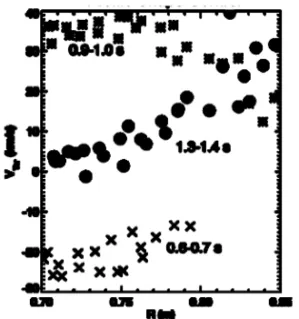
Changes in the plasma toroidal rotation profile have been observed during LHCD experiments. [4] LHCD is observed to drive a counter current rotation. The magnitude of the rotation velocity change is proportional to the inferred driven rf current. The time rate of change of the rotation velocity is consistent with the momentum source being the rf wave momentum and can be ascribed to an inward pinch of the fast electrons as they drag on the bulk plasma. [7] The location where the torque appears in the plasma radial dimension is associated with the expected location of the driven current as inferred from x-ray emission. ICRF heating is observed to drive rotation in the co-current direction. The combination of LHCD and ICRF can therefore be used to create a sheared velocity profile (Fig. 2). This profile tailoring may be useful in controlling energy transport in the plasma. The plasma rotation changes from all counter during the L-mode phase to all co during the ICRF H-mode phase. The application of LHCD drives the central rotation to near zero while leaving the outer part of the plasma unaffected.
I
-m t
" « « I !• (M-lJOs w « . - • < . \ » iJMA» XX OMiraFigure 2. Toroidal plasma rotation velocity for three different segments of the discharge: 0.6-0.7 s L-mode, 0.9-1.0 s 1.6 MW ICRF H-mode and 1.3 - 1.4 s ICRF + 0.8 MW LHCD.
immediate drop in the Lyman H-alpha emission away from the pedestal occur more slowly.
IV. AFFECT ON THE
H-MODE PEDESTAL
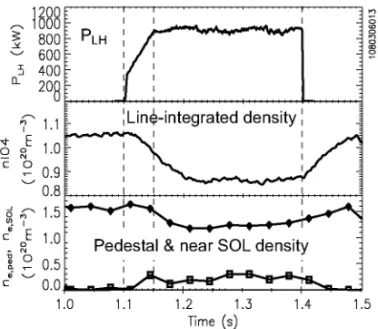
The application of LHCD into H-mode discharges is also seen to have an effect on the pedestal region. [6] The density inside the pedestal is seen to drop while the density in the scrape off layer (SOL) plasma increases substantially. This is very advantageous for good LH coupling to H-Mode plasmas and may preclude the need for gas puffing in front of the launcher. The electron temperature increases in the pedestal and the total pressure increases proportional to the net power. The density changes are signaled by an almost just inside the pedestal, while changes Increases in density fluctuations are
observed on a number of phase contrast imaging (PCI) channels, including in the quasi-coherent mode which drives particle transport in the pedestal. ^-^ ^ I LL ro E o •J ^-~s ' 7 • E (N i u 1 T— 1 v_^ ?nn 000 800 600 400
2og
1 1 1 0 o.y 0.8 1.5 1.0 0.5 0.0 4^Pedestal & near SOL density
1.0 1.1 1.4 1.5
. V. SUMMARY
[Lin^-integrated density [
LHCD experiments on Alcator C-Mod have revealed the ability to affect the plasma current profile, the toroidal plasma rotation and the structure of the H-mode pedestal. LHCD drives current well off axis in C-Mod lowering the plasma internal inductance and delaying onset of sawtooth activity. Scaling of the LHCD from the present 1 MW power level to the ultimate 2.5 MW level indicates that the desired AT current profiles should be attainable. Changes in toroidal plasma rotation are observed consistent with the LHCD providing a torque on the plasma due to the rf wave momentum. LHCD is seen to affect the H-mode pedestal by increasing particle transport locally but not at the expense of energy confinement.
1.2 1.3 Time (s)
Figure 3. Effect of LHCD on the pedestal. Top panel -LHCD power. Second panel - line integrated density showing slow response. Bottom panel- density in the pedestal and SOL plasma
VI. ACKNOWLEDGEMENTS
The authors wish to acknowledge the support of the Alcator C-Mod team and the LH engineering group. This work is supported by USDOE Contract No. DE-AC02-09CH11466 and DE-FC02-99ER54512.
VII. REFERENCES
1. 2. 3. 4. 5. 6. 7.S. Bemabei et al.. Fusion Science and Technology 43, 145 (2003) P. Bonoli et al.. Fusion Science and Technology 51, 401 (2007) J. Ko, PhD Thesis, Mass. Inst. Of Tech., unpubhshed (2009) J.E. Rice, et al. Nuclear Fusion 49, 025004 (2009)
A.E. Schmidt et al., this conference J. R. Wilson et al.. Proceedings of the 22° R. R. Parker et al., this conference
IAEA Conf paper EX/P6-21