Academic and Research Staff
Prof. P. R. Grayt Dr. A. Borbelytt Dr. N. Y. S. KiangJ Prof. P. G. Katona Dr. A. W. B. Cunningham
5
Dr. R. G. Mark$S$ Prof. W. T. Peake$ N. I. Durlach Dr. M. Nomoto**** Prof. W. M. Siebert Dr. H. FischlerS$ Dr. R. Rojas-Corona Prof. W. A. Rosenblith Dr. O. Franzen*** Dr. G. F. Songster Prof. T. F. Weiss$ Dr. R. D. Hall R. M. Browns Dr. J. S. Barlow** Dr. G. Hellekantttt A. H. CristjDr. G. O. Barnett
5
D. P. LangbeinjGraduate Students
J. A. Anderson J. E. Evans D. C. Milne
J. Berliner J. A. Freeman E. C. Moxon
G. von Bismarck J. J. Guinan, Jr. M. Nahvi
L. D. Braida R. Hershkowitz S. Portny
S. K. Burns H. Hsiao D. J-M. Poussart
A. N. Chandra E. G. Merrill I. H. Thomae
H. S. Colburn P. J. Metz M. L. Wiederhold
RESEARCH OBJECTIVES AND SUMMARY OF RESEARCH
The principal activities of the Communications Biophysics Group tend to combine electrophysiological and behavioral experiments with machine data processing and ana-lytical methods. Our major objective is to obtain a better understanding of sensory
This work was supported principally by the National Institutes of Health (Grant 2 P01 MH-04737-06), the Joint Services Electronics Programs (U. S. Army, U. S. Navy, and U. S. Air Force) under Contract DA 36-039-AMC-03200(E), the National Science Founda-tion (Grant GK-835), the NaFounda-tional Aeronautics and Space AdministraFounda-tion (Grant NsG-496), and in part by the National Institutes of Health (Grant 5 ROI NB-05462-03).
Leave of absence, at General Atronics Corporation, Philadelphia, Pennsylvania. $Also at Eaton-Peabody Laboratory, Massachusetts Eye and Ear Infirmary, Boston, Massachusetts.
Research Affiliate in Communication Sciences from the Neurophysiological Labo-ratory of the Neurology Service of the Massachusetts General Hospital, Boston, Massa-chusetts.
ttPostdoctoral Fellow from the Brain Research Institute, University of Zurich, Zurich, Switzerland.
UFrom the Department of Electronics, Weizmann Institute of Science, Rehovoth, Israel.
Postdoctoral Fellow from the Speech Transmission Laboratory, The Royal Institute of Technology, Stockholm, Sweden.
tttPostdoctoral Fellow from the Department of Physiology, Kungl. Veterinarskolan, Stockholm, Sweden.
't t Assistant Resident, Harvard Medical Service, Boston City Hospital, Boston, Massachusetts.
Public Health Service International Postdoctoral Research Fellow, from the Department of Physiology, Tokyo Medical and Dental University, Tokyo, Japan.
5Associate in Medicine, Department of Medicine, Harvard Medical School, and Direc-tor, Laboratory of Computor Science, Massachusetts General Hospital.
(XXXI. COMMUNICATIONS BIOPHYSICS)
communication - in particular, of hearing. But in addition to our major research inter-ests, we have found it profitable to apply our tools and methods selectively to other
orga-nisms and other systems as suggested below.
The group continues close cooperation with the Eaton-Peabody Laboratory of Auditory Physiology at the Massachusetts Eye and Ear Infirmary. This laboratory is operated cooperatively by M. I. T. and the Eye and Ear Infirmary. The cooperative arrangements include joint appointments of scientific staff. Some of the projects described below (Sec. A) will actually be carried out at the Eaton-Peabody Laboratory by staff members and students of the Communications Biophysics Group.
The research program of the Communications Biophysics Group can be divided into five or six major areas. The programs for each area are discussed individually in the following subsections.
A. Research on the Peripheral Auditory System
Our studies of the auditory system in the recent past have ranged from the acoustic properties of the external ear to the electrical activity recorded at the cortex. The principal projects of current interest are the following.
1. Our experimental studies of the signal transmission properties of the middle ear in cat during the past few years have provided a fairly accurate transfer function. Further work on the middle ear will be aimed at achieving (a) a detailed verification of the lumped-element model that we have developed, and (b) making measurements of transfer characteristics in a wider range of conditions.
2. Studies of the dependence of intracochlear potentials on position in the cochlea, as well as on stimulus parameters, could be exceedingly important for the understanding of the mechanical-to-neural transduction process. Techniques have been developed for introducing micropipettes into the basal turn of the cochlea, recording DC, as well as AC, potentials, and for determining histologically the position of the electrode. A series of experiments has been planned to extend systematically our preliminary observations.
3. Recent microelectrode studies of the discharge patterns of single fibers in the auditory nerve have provided a remarkably orderly outline of the relationship between this activity and the acoustic stimulus. Future studies will concentrate on certain aspects of responses to stimuli that are slightly more complex than the clicks and tone bursts that have dominated our earlier work. Our objectives continue to be both to achieve a better understanding of the processes of excitation in the cochlea and to furnish a description of the discharge patterns in terms of a random-process model. 4. Single-unit response patterns in the cochlear nucleus of cats have been studied in some detail in our laboratories. Also, anatomical investigations of the outputs of the cochlear nucleus have begun to describe the connections of the cochlear nucleus to other brain-stem nuclei. In parallel with these anatom-ical studies, we are starting electrophysiological mapping of the superior olivary region.
5. Electrical stimulation of the olivocochlear bundle has been shown by several workers to have a significant gross effect on the auditory nerve responses to acoustic stimuli. Techniques for studying such efferent influences on single auditory nerve fibers have been developed; the effects on thresholds, tuning curves, and so forth, will be sys-tematically explored.
6. The probabilistic behavior of certain isolated, peripheral nerve fibers in response to electrical stimulation has been observed by various workers for 30 years. We have recently developed the necessary techniques and have repeated some of these observa-tions in isolated, sciatic nerve fibers of the frog. The problem will be further pursued
in the frog and in the large unmyelinated fibers of other species. The problem is of interest for two reasons: (i) an understanding of the probabilistic mechanisms in single
fibers has bearing on understanding the coding of messages in fibers of sensory sys-tems, and (ii) understanding the probabilistic generator might lead to some insights
into the mechanisms governing the behavior of nerve membrane in general.
7. During the last several years, an attempt has been made to explore the implica-tions for auditory behavior - particularly discrimination - of the observed stochastic nature of the coding of acoustic stimuli in the auditory nerve. The results of these the-oretical efforts have suggested, among other things, a plausible mechanism that might underlie the Weber-Fechner law and have yielded new insights into the "place" versus "volley" pitch controversy. Future studies are planned which may be helpful in under-standing a variety of other auditory phenomena including various kinds of masking, crit-ical bands, and certain binaural interactions.
N. Y. S. Kiang, W. T. Peake, W. M. Siebert, T. F. Weiss
B. Neuroelectrical Correlates of Conditioning
During the past five years, we have been studying sensory evoked activity during conditioning as a particular example of the study of the brain's electrical activity during the acquisition of learned behavior. In the coming years we plan to extend these studies and also venture into several relatively unexplored problem areas as described below.
1. In the search for neuroelectric correlates of conditioning several lines of evi-dence suggest that it would be advantageous to examine the activity of central structures that have direct influence on motoneuron pools. Specifically, activity in such structures as the subthalamic nucleus, red nucleus, portions of the mesencephalic and bulbar retic-ular formations, as well as the motor cortex, would seem to be of interest. In some preliminary studies of activity in motor pathways, we have developed a conditioning situation for the rat that appears to be quite adequate for such work. The principal remaining problems concern the proper choice of recording electrodes and the appro-priate types of data analysis.
2. A principal conclusion of our past investigations is that alterations in evoked responses observed in primary sensory pathways during aversive conditioning are not intimately related to the neural substrate of conditioning, but instead are indicative of an emotional response to noxious stimulation. Changes in evoked activity cannot be found in primary sensory systems as the discriminative behavior is acquired if the appetitive instrumental conditioning paradigm is employed. It seems advisable, how-ever, to extend this research to nonspecific, polysensory systems (e. g., medial tha-lamic nuclei). An experimental situation has been developed (it is essentially an analog for the rate of a human reaction time experiment) that appears to meet the logical requirements, but it will have to be refined in order to reduce the training time and to insure adequate control of stimulus and movement-related variables.
3. The finding that evoked potentials are significantly altered during a fear response raises questions with their own intrinsic interest. The fear response is a very general-ized reaction that can readily be brought under stimulus control. The alterations in evoked responses should therefore be quite amenable to experimental analysis. Com-bined lesion and electrophysiological techniques should carry this analysis quite far.
4. Over the long range, we hope to initiate some electrophysiological condi-tioning studies on invertebrate species. It is not at all clear that it is possible to develop an invertebrate preparation in which conditioned control of behavior can be readily achieved under conditions suitable for the recording of single-unit poten-tials, but the promises of such a preparation are sufficiently great to warrant a serious attempt.
(XXXI. COMMUNICATIONS BIOPHYSICS)
C. Psychophysics
Our research in psychophysics during the last few years has been concerned
prima-rily with binaural hearing. During the coming year we intend to continue research in
this area and to initiate research in a number of other areas. Our current interests are
outlined as follows.
1. Binaural Hearing
Our previous work on binaural hearing has consisted of constructing a black-box
model, the equalization and cancellation (EC) model, and performing a variety of
exper-iments to test it. The projects of current interest in binaural hearing concern (a) the
effects of interaural phase shifts and bandwidth on binaural unmasking; (b) the effect on
binaural unmasking of introducing interaural relations in the noise that are unlike those
encountered in a natural environment; (c) the ability of the EC model to predict
just-noticeable differences (jnd's) in interaural time delay, amplitude ratio, and
decorrela-tion; (d) the extent to which an interaural amplitude difference can be discriminated
from an interaural time difference; and (e) the development of a new quantitative model
of binaural hearing based on physiological data.
2. Effect of Duration on Pitch Discrimination for "Place Pitch" versus
"Periodicity Pitch"
It is well known that the sensation of pitch can arise from characteristics of the
energy spectrum of the signal (place pitch) or from periodicity characteristics
(period-icity pitch). Recent computations based on auditory-nerve data and ideal-observer
the-ory indicate that the effect of duration on pitch discrimination may be different in the
two cases. Plans are now being made to explore this question empirically.
3. Short-Term Memory for Sounds
Although much work has been done on short-term memory, relatively little is known
about this topic for the situations usually considered in psychoacoustic experiments.
Moreover, the knowledge that exists is seldom incorporated into the models constructed
for interpreting psychoacoustic data. An effort is now under way to construct a
quanti-tative model of short-term memory for sounds that can be used for interpreting these
data, and to perform experiments that will guide the development of this model.
4. Sequential Effects
Past research has shown that a subject's response to a given stimulus is determined
not only by that stimulus, but also by previous stimuli, previous responses, and
previ-ous feedback in the experimental series. Since the sequence of previprevi-ous events varies
from trial to trial, a portion of the subject's response variability can be ascribed to
these variations. Research is now being initiated to study sequential effects in detail,
and to separate these effects from other sources of response variability (such as
inter-nal noise). In addition to performing specific experiments on this topic, we intend to
store the complete history of practically all of our future experiments and to analyze
sequential effects as a routine matter, independently of the primary purpose of the
experiment.
5. Subjective Estimates of Uncertainty
In most psychophysical experiments, the experiment is structured in such a way
that the only means by which the experimenter can obtain information on the subject's
uncertainty about his choice of response is by repeating the same stimulus a number of times and examining the response variability. This method has the advantage of objec-tivity, but tends to confuse the "instantaneous uncertainty" experienced by the subject on a single trial with variations in the state of the subject from trial to trial. In certain cases, substantial benefits can be obtained by requiring that the subject describe his uncertainty directly on each trial. Experiments are now being planned to study the relation of these subjective estimates of uncertainty to the estimate obtained by exam-ining the variability obtained in repeated trials.
6. Relation of Magnitude Estimation to Absolute Identification
One model for interpreting a subject's behavior in an absolute identification task (in which the stimuli to be identified are selected from a unidimensional, prothetic, contin-uum) is to assume that the subject estimates the magnitudes of the stimuli, recodes the names of the stimuli chosen by the experimenter into these estimates, and bases his identification choice on a given trial according to his magnitude estimate on that trial. Preliminary research has indicated that this model is capable of precise formulation and that it may be an accurate one. Experiments are now being initiated to test this model. A related effort concerns the search for a precise and useful definition of "unidimensional." Also, experiments are planned to determine the dependence of abso-lute identification performance on the means available to the subject for storing and recalling his previous sensations.
7. Relation of Magnitude Estimation to Discrimination and Detection (Microscaling) At present, there is a large schism in psychophysics between discrimination and detection on the one hand, and magnitude estimation and cross-modality matching on the other hand. By studying magnitude estimation and cross-modality matching over very small stimulus ranges (microscaling) and considering intrasubject variability in the estimates, as well as the central tendency, we hope to bridge the gap between these two areas of activity.
N. I. Durlach, W. M. Siebert, W. A. Rosenblith
D. Other Neurophysiological Research
In addition to the programmatic research in specific problem areas described above, our group has always supported a few studies in central nervous system function - par-ticularly those that seem likely to profit from our general interest in analytical and com-puter techniques. It is impossible to foresee in detail what specific research of this kind will be undertaken during the coming year, since the prospects stem from the par-ticular interests of predoctoral and postdoctoral students and mutual interests (although perhaps not primary interests) of various staff members. Current projects in this more general category (many of which will be continued) include the following.
1. The response pattern of cells in the cerebellum is being studied with specific emphasis upon excitatory and inhibitory states of cells following a sensory stimulus such as a click. The results are used in the formulation of a possible structural model with stochastic properties.
2. A study is also in progress on the behavior of respiratory neurons in the medulla, particularly in the nucleus of the solitary tract.
3. Two studies are under way of single-unit activity evoked in the optic nerve of cat by a variety of photic stimuli. Emphasis in both cases is placed on the quantitative anal-ysis of the unit potentials.
(XXXI. COMMUNICATIONS BIOPHYSICS)
4. Intracellular potentials from units in the cerebral ganglion of Aplysia
californi-cus that respond to tactile stimulation are under investigation. This work also aims at
giving a detailed description of the pathways serving touch in this species.
5. Another study of the cerebellum involves exploration of a possible source-sink
analysis of cerebellar potentials suggested by the relatively simple laminar morphology
of this structure.
W. A. Rosenblith
E.
EEG
Studies
Several useful techniques have been developed for analyzing the characteristically
nonstationary electroencephalographic data obtained from recording from the scalp of
a human subject. One method involves observing the cumulative behavior of amplitudes
from a sequence of evoked responses. Another useful display is a sequence of
fre-quency spectra in which each individual spectrum is based on a few seconds of data, but
the sequence itself covers samples lasting many minutes or even hours.
These
dis-plays have a third dimension
-
that of time, and they emphasize changes in the data
concomitant with changes in the subject's "state."
Apparatus is being designed and
constructed which will conveniently implement these displays.
We continue to study the relationships between the
EEG
alpha rhythm,
psychophys-ical variables, and biochempsychophys-ical phenomena by using facilities and subjects at the M.I.T.
Clinical Research Center. So that confidence levels can be established for averaged
evoked responses, we plan to develop a method of estimating variance of the evoked
response from an examination of the displayed average evoked response.
We also plan
to examine the possibility of using a matched filter based on the averaged evoked
response to enhance individual responses in slow-wave data. We have been involved
with and hope to continue a program of evaluation and development of medical
instru-mentation that is potentially useful clinically.
S. K. Burns, W. A. Rosenblith
F. Cardiovascular System Studies
The aim of our research is the quantitative understanding of the cardiovascular
control mechanism. In particular, we are investigating, at present,
that part of the
carotid-sinus reflex which causes sudden heart-rate changes as a result of the
intro-duction of sudden disturbances in the arterial blood pressure.
Three major projects are being carried out.
1.
The quantitative description of the relationship between blood pressure and the
firing pattern of pressure receptor nerves.
2. The statistical characterization of the firing pattern of the cardiac vagal
effer-ent nerve fibers.
3.
The determination of the relationsip between vagal efferent firing frequency and
heart rate.
P. G. Katona
SELECTED PUBLICATIONS
J. S. Barlow, "A Simple Time Division Multiplexing System for Low-Frequency
Bio-electric Signals," IEEE Trans., Vol. BME-13, pp. 195-199, 1966.
J. S. Barlow, "Electronic Simulation as an Aid in Evaluating Computer-Analyzed
EEG
Data," Electroencephal.
clin.
Neurophysiol. (in press).
S. K. Burns and R. Melzack, "A Method for Analyzing Variations in Evoked Responses,"
A. W. B. Cunningham, P. O'Lague, R. Rojas-Corona and J. A. Freeman, "Microelec-trode Studies of Spontaneous Potentials from Chick Embryo Telencephalon in vitro," Experientia 22, 439-446 (1966).
N. I. Durlach, "On the Application of the EC Model to Interaural Jnd's," J. Acoust. Soc. Am. (in press).
H. Fischler, N. Peled, and S. Yerushalmi, "FM/FM Multiplex Radio-Telemetry Sys-tem for Handling Biological Data," IEEE Trans. on Bio-Medical Engineering (in press). D. B. Geselowitz, "Comment on Core Conductor Model," Biophys. J. 6, 691-692 (1966). P. R. Gray, "A Statistical Analysis of Electrophysiological Data from Auditory Nerve Fibers in Cat," Technical Report 451, Research Laboratory of Electronics, Massachu-setts Institute of Technology, Cambridge, Mass., June 21, 1966.
R. D. Hall, R. J. Clayton, and R. Mark, "A Device for the Partial Restraint of Rats in Operant Conditioning Studies," J. Exptl. Anal. Behav. 9, 143-145 (1966).
R. D. Hall and R. G. Mark, "Acoustically Evoked Potentials in the Rat during Condi-tioning," Technical Report 455, Research Laboratory of Electronics, Massachusetts Institute of Technology, Cambridge, Mass., November 30, 1966.
N. Y. S. Kiang, with T. Watanabe, E. C. Thomas, and Louise F. Clark, Discharge Patterns of Single Fibers in the Cat's Auditory Nerve (The M.I.T. Press, Cambridge, Mass., 1966).
N. Y. S. Kiang, J. W. Shipley, and M. B. Sachs, "Sensitivity of Single Auditory-Nerve Fibers to Acoustic Stimuli," J. Acoust. Soc. Am. 39, 1253 (A) (1966).
K. Koerber, R. R. Pfeiffer, W. B. Warr and N. Y. S. Kiang, "Spontaneous Spike Dis-charges from Single Units in the Chochlear Nucleus after Destruction of the Cochlea," Exptl. Neurol. 16, 119-130 (1966).
B. J. Murawski and S. K. Burns, "Day-to-Day Correlation of Urinary Adrenal Steroids and Alpha Frequencies in the EEG," J. Appl. Physiol. 21, 549-553 (1966).
W. T. Peake and J. J. Guinan, Jr., "Circuit Model for Transfer Characteristics of the Cat's Middle Ear," J. Acoust. Soc. Am. 39, 1253 (A) (1966).
R. R. Pfeiffer, "Classification of Response Patterns of Spike Discharges for Units in the Cochlear Nucleus: Tone-Burst Stimulation," Exptl. Brain Res. 1, 220-235 (1966). R. R. Pfeiffer, "Anteroventral Cochlear Nucleus: Waveforms of Extracellularly Recorded Spike Potentials," Science 154, 667-668 (1966).
L. R. Rabiner, C. L. Lawrence and N. I. Durlach, "Further Results on Binaural Unmasking and the EC Model, J. Acoust. Soc. Am 40, 62-70 (1966).
W. A. Rosenblith, "Physics and Biology-Where do They Meet?," Physics Today, Vol. 19, No. 1, pp. 23-34, January 1966.
W. A. Rosenblith, "On Cybernetics and the Human Brain," The American Scholar 35, 243-248 (1966).
W. A. Rosenblith, "From a Biophysicist Who Came to Supper," R. L. E.: 1946 + 20, Research Laboratory of Electronics, Massachusetts Institute of Technology, Cambridge, Mass., May 1966, pp. 42-44.
M. B. Sachs and N. Y. S. Kiang, "Iso-Rate Contours for Single Auditory-Nerve Fibers," J. Acoust. Soc. Am. 39, 1252 (A) (1966).
R. Suzuki, "Simulation Study of a Hand Controlled by Myoelectric Signals," Confer-ence on Data Acquisition and Processing in Biology and Medicine, Rochester, New York, July 27, 1966 (A).
T. F. Weiss, "A Model of the Peripheral Auditory System," Kybernetik (in press).
(XXXI. COMMUNICATION BIOPHYSICS)
M. L. Wiederhold and W. T. Peake, "Effectiveness of Crossed Olivocochlear Bundle Stimulation. Dependence on Acoustic Stimulus Parameters," J. Acoust. Soc. Am. (in press).
F. M. Wiener, R. R. Pfeiffer, and A. S. N. Backus, "On the Sound Pressure Transfor-mation by the Head and Auditory Meatus of the Cat," Acta Oto-Laryngol. 61, 256-269
(1966).
THESES
1. David Assael, "The Effect of Intensity on Pitch in Human Hearing," S. B. Thesis, Department of Electrical Engineering, M.I.T.
2. James E. Brown III, "Research on the 'Vector Model' of Binaural Unmasking," S.B. Thesis, Department of Electrical Engineering, M.I.T.
3. Charles Cain, "Spontaneous Potentials from Chick Embryo Cerebellum in Tissue Culture," S.M. Thesis, Department of Electrical Engineering, M.I.T.
4. Richard E. Doherty, "A Behaviorally Sorted Recording and Averaging System for Electroencephalography," S. B. Thesis, Department of Electrical Engineering, M.I.T.
5. Thomas W. Eggers, "A Magnetic Tape Operating System for a PDP-4 Computer," S.B. Thesis, Department of Electrical Engineering, M.I.T.
6. Robert E. Greenwood, "Computer-Aided Electronic Simulation of the Cochlea," S.M. Thesis, Department of Electrical Engineering, M.I.T.
7. Juergen M. Hahn, "High-Speed Projection System for Visual Neurophysiology," S.B. Thesis, Department of Electrical Engineering, M.I.T.
8. Steven J. Hayashi, "Computer Simulation of Sequence of Activation in Fibrillating Heart," S. B. Thesis, Department of Electrical Engineering, M.I.T.
9. Adrian Houtsma, "Auditory Discrimination of Frequency Ratios," S. M. Thesis, Department of Electrical Engineering, M.I.T.
Q10. David M. Kettner, "A Statistical Analysis of Four Nonlinear Correlators," S. M. Thesis, Department of Electrical Engineering, M.I.T.
S11. John L. Lehr, "Iron Lung Control by Muscle Potentials," S.B. Thesis, Department of Electrical Engineering, M.I.T.
-12. Jane Win-Shih Liu, "Probabilistic Models of Neural Networks," S.M. Thesis, Depart-ment of Electrical Engineering, M.I.T.
,13. Robert Macdonald, "Cochlear Potentials in the Presence of Surgically Produced Endolymphatic Hydrops," S. B. Thesis, Department of Electrical Engineering, M.I.T.
14. Roger Greenwood Mark, "Auditory Evoked Potentials during Conditioning in the Rat," Ph.D. Thesis, Department of Electrical Engineering, M.I.T.
15. David Milne, "Temporal Aspects of Single-Unit Activity in the Optic Tract," S.M. Thesis, Department of Electrical Engineering, M.I.T.
16. Charles E. Molnar, "Model for the Convergence of Inputs upon Neurons in the Cochlear Nucleus," Ph.D. Thesis, Department of Electrical Engineering, M.I.T. j 17. Paul H. O'Lague, "Spontaneous Activity in 14-day Chick Embryo
Telence-phalic Tissue Cultures," S. M. Thesis, Department of Electrical Engineering, M.I.T.
18. William A. Plice, "Temperature Effects on Electrical Activity of Brain Tissue in vitro," S.B. Thesis, Department of Electrical Engineering, M.I.T.
19. Murray B. Sachs,
"Auditory Nerve Fiber Responses to Two-Tone Stimuli,"
Ph.D. Thesis, Department of Electrical Engineering, M.I.T.
20. Martin M. Scholl,
"A Study of the Phase of the Alpha Rhythm with Respect to
Visual Evoked Response and Visual Reaction time," S.M. Thesis, Department of
Electrical Engineering, M.I.T.
21. Alan E. Schutz, "An Electronic Model for the Eye of Limulus," S.M.Thesis,
Depart-ment of Electrical Engineering, M.I.T.
22. Joshua J. Singer, "Response to Photic Stimulation of the Sixth Abdominal Ganglion
of Crayfish," S. M. Thesis, Department of Electrical Engineering, M.I.T.
23. David G. Tweed, "High-Speed Analog-Digital Converter Input and Comparator
Cir-cuit Design," S.B. Thesis, Department of Electrical Engineering, M.I.T.
24. Michael Weidner,
"Electrical Properties of 3M-kcl Filled Microelectrodes,"
S.B. Thesis, Department of Electrical Engineering, M.I.T.
25. Francis K. Williams, "A Comparison of the Neuroelectric Characteristics of the
Squid and Lobster Axons," S.B. Thesis, Department of Electrical Engineering,
M. I. T.
26. J. F. Young, "A Model for Single Baroreceptors," S.M. Thesis, Department of
Elec-trical Engineering, M.I.T.
27. A. N. Kramer, "Irregularities in the Normal Heart Beat: A Statistical Analysis,"
S.B. Thesis, Department of Electrical Engineering, M.I.T.
28. M. C. Raezer, "Nerve Firing Patterns of Cardio-Inhibitory Vagus Nerve Fibers,"
S. B. Thesis, Department of Electrical Engineering, M.I.T.
(XXXI. COMMUNICATIONS BIOPHYSICS)
A. CIRCUIT MODEL FOR THE CAT'S MIDDLE EAR
We have derived an analog for the mechanical system of the middle ear based on our recent measurements on anesthetized cats.1 The general form of our circuit analog (Fig. XXXI-la) is similar to the form proposed by Zwislocki2; whereas the element con-figurations (Fig. XXXI-1b) that we have found sufficient for "fitting" all of our data are
2-4
generally simpler than those of other authors. In this report we shall (a) describe how we choose the element values to match our data, and (b) show that a model with these element values predicts other results.
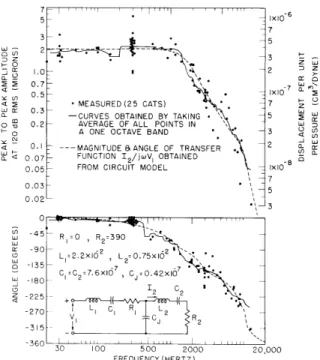
Our measurements of the displacement of the incus and stapes relative to the malleus (Fig. XXXI-2) indicate that the two boxes on the right in Fig. XXXI-la can be approxi-mated by a second-order system with an undamped natural frequency of 2 =
-1
2Tr 9000 sec , and a damping factor of 2 0. 46. R2, C2, L2, and C must therefore satisfy two constraints:
1 -1 2 = 2Tr 9000 sec 1 2 R
c2
L2 = 0. 46, where C+ C2 C'C
Measurements of the stapes displacement (Fig. XXXI-3) with the cavities open (i. e., with the "cavities" box of Fig. XXXI-la shorted) suggest that the circuit model should have a heavily damped resonance near 1000 Hz. If we assume that the capacitance Cj is approximately an open circuit in this frequency range, this resonance involves only a simple series circuit. To fit the shape of the amplitude and phase curves, we place two more constraints on the element values:
S=
C
= 2Tr 1500 sec- 1RT
CT
T
= 0. 7, 1 2whereR
RR +RZLT= L +L,
C
1 2
One more constraint is obtained
by making the low-frequency transfer ratio of the circuit equal to the measured value
V
C
V 1J
1
1Fig. XXXI-1. (a) General form of the circuit analog of the middle ear. The input voltage, V1 , is analogous to the sound pressure
out-side the drum membrane; the current, 12, is analogous to the velocity of the stapes. The voltage, V1, is analogous to the pressure across the drum membrane. When the
cav-ities are open, V = V1.
(b) Circuit configuration for the model. The elements might be thought of as analogs of mechanical parameters as follows:
R2 ~the net resistance of the incus, stapes, and cochlea.
C2 ~ the net compliance of the ligaments of the incus and stapes and the cochlea.
L2 ~ the net inertia associated with the incus, stapes, and cochlea.
C ~ the compliance of the incudo-malleolar
joint.
C1, R L1 ~ the compliance, resistance and inertia, respectively, of the drum membrane and malleus.
C ~ the compliance of the air in the middle-ear cavity.
Cb ~ the compliance of the air in the bulla cavity. Lh , Rh ~ the acoustic mass and resistance,
respec-tively, of the hole connecting the middle-ear cavity to the bulla cavity.
(XXXI. COMMUNICATIONS BIOPHYSICS)
12 ( -0) C1C 2 -7
= = 3. 8 X 10- 7
farads.
jV1
C1C
Hence we have a total of 5 constraints on the 7 element values indicated in the circuit of Fig. XXXI-3. Since the capacitance CJ is virtually an open circuit for w near 01, the
0.1 0 -45 -90 -135 -180 30 100 300 3000 FREQUENCY (HERTZ) 20,000
Fig. XXXI-2. Displacement of the incus and stapes relative to the malleus displacement. The combined data from 4 cats have been fitted with curves from the equation shown, with the
param-eter values w2 = 2w 9000 sec- , and 2 = 0. 46.
transfer characteristic of the model is not sensitive to the particular way in which the total resistance is divided between the resistances R1 and R2, or the way in which the net capacitance is separated into C1 and C
2, as long as wl,' 2' 1 2 are fixed. We have arbitrarily made Cl = C2 and R1 = 0. Some of
Mller's measurements of input impedance before and after interruption of the incudo-stapedial joint indicate that a major portion of the resistance should be on the cochlear side of the joint, and that the compliances are roughly of the same magnitude.
The two coupled cavities of the cat's middle ear are represented by the circuit labeled Z in Fig. XXXI-4. The values of these 4 parameters were
c
chosen so that the model would fit measurements of the change in middle-ear transmission when the cavities are opened. The four constraints that were used
0.5 12 0.5
2
2-0.7 0.5
* MEASURED(25 CATS)
0.3 -- CURVES OBTAINED BY TAKING "
0.2- AVERAGE OF ALL POINTS IN
A ONE OCTAVE BAND
01 --- MAGNITUDE ANGLE OF TRANSFER 0.07 - FUNCTION I1/jwVI OBTAINED
0.05- FROM CIRCUIT MODEL
0.03 0.02 -3 2 xlO -7 7 5 3 2 IxlO0 7 5 0 C20 -2 I-2 5 R=0 R2 =390 90 L-=2.2x12 L =0.75xl -135-C=C 2 7.6xIO C =0.42xI * -180 .42x 2 2 C 225 + V G R -315 _ - 2 -360 30 100 i L500 ,, 2000 I 20,000 FREQUENCY (HERTZ)
Fig. XXXI-3.
Transfer characteristic based on data from 25 cats.The vertical coordinates in the upper figure are stapes displacement (left) and stapes displacement divided by sound pressure at the drum membrane (right). Solid curves represent the "average" transfer function de-rived from the experimental measurements. Dashed curves were obtained from the circuit model shown.
-5L Rh=22 , R2 390
-Lh= 1.4 XIO- 2 , LI= 2.2 XIO-2 L2 = 0.75X I0- 2
30 Cb = 3.OX 10- 7 , Cm= 1.9 X 10⁷ , CI = C2 7.6 X 10 7 C = 0.42 X I0"7 30 30 - Lh Rh Cb 1 CI L2 C2 -60 L1 C1 L2 2
t
-90 -__n" R _7i I z IC 1000 FREQUENCY (HERTZ) 10,000Fig. XXXI-4.
Change in transmission through the middle ear resulting
from opening both of the middle-ear activities. Solid curve
represents a "typical" experimental result; dashed curves
were obtained from the circuit model given in the figure.
z LIL co z# I n LOL 0n
(XXXI. COMMUNICATIONS BIOPHYSICS)
are (i) the frequency of the maximum effect (cavity resonance)
C
+C
m b -1
=
Cm
= 27r
4000 sec
c LC C
hmb
(ii) the quality factor of the cavity resonance
c h
1 6Q Q c Rh = 16,
(iii) the magnitude of the effect at low frequencies,
Z +Z
Z ( w
1) = 1. 8,
z1
and (iv) the magnitude of the effect at the resonant frequency
Z1
cThe resulting elements values and the measured and computed effects of opening both cavities are shown in Fig. XXXI-4.
The transfer characteristic of the total model and the measured transfer character-istic are shown in Fig. XXXI-5. Since both curves in Fig. XXXI-5 are obtained from curves of Figs. XXXI-3 and XXXI-4, this figure does not contain any new information. We can, however, use the model to predict the change in the transfer function resulting
cr-at 0 3 ! -1 -....--- D -Uw 2 -MEASURED I7 ar
i
U
x -9 ----M
O
DEL (I l/ j V )
7
z
L L = .4xlO2 LI=2.2xI2 L2=O.75xI 2 c
h3 2 <CO C=2= 7.6x l 7 , C J=0.42 lO7 ixO 8 45 --90 -S - Lh Rh b C I2 -o -135 -00 1 2 -180
+
D 225 -V Cm C R2 S-270 30 100 500 5000 20,000 FREQUENCY (HERTZ)Fig. XXXI-5. Transfer characteristic of cat's middle ear with the bulla and septum intact.
from opening the septum when the bulla is already open. This operation is analogous to setting 1/Cm = 0, when 1/Cb = 0. With no new choice of element values we can test the prediction against the measured data. The results (Fig. XXXI- 6) indicate that in general the model comes as close to the measured data as do measurements made on other cats.
I I I I I I I I [ I I 1 1 1 ! 1
15 -- MEASURED (FROM CAT 73) A
ZI+Zc /,' 1
10 ---- MODEL ZI
5- AAA MEASURED FROM OTHER CATS
O -5 Rh= 22 , R2= 390 Lh= 1.4 XO-2 L = 2.2 X10- 2 ~L2 0.75 X10 2 SU) ' SCm = 1.9 X 10⁻⁷ CI C2 -7.6 X 10 , C 0.42 X 10 -7 r 30 S -30 Lh Rh L c n -60 -, LI CI L2 C2 Uw -90
K
Z R2 100 1000 10,000 FREQUENCY (HERTZ)Fig. XXXI-6. Change in transmission through the middle ear resulting from open-ing the septum in an ear with the bulla previously opened. The small "peaks" measured from "other cats" represent only the parts of the measured curves near the maximum. Then are included to indicate the range of frequencies and amplitudes found.
The circuit-element values have been chosen to give numerical values for the current 12 in amperes which are equal to the stapes velocity in cm/sec; the value of the voltage
2
in volts is equal to the sound pressure in dynes/cm . In order to equate the electric-circuit-element values to the mechanical parameters of the middle ear, we have to take into account: (a) the fact that the motion of the malleus and incus is mainly rotational, (b) the lever ratio from malleus displacement to stapes displacement, (c) the nature of the drum membrane motion, and (d) the coupling of the drum membrane to the manu-brium of the malleus. Also, some of the element values that we have used are not unique (i. e. , other values could fit the data equally well), so that we cannot really expect these values to equal the mechanical parameters. Although the validity of this model at the level of the individual elements cannot now be demonstrated, the circuit of Fig. XXXI-5 does provide a fairly accurate and concise description of a relatively large amount of experimental data.
We have received considerable assistance from Thomas Goblick, of Lincoln Labora-tory, in computing the characteristics of the model.
(XXXI. COMMUNICATIONS BIOPHYSICS)
References
1. J. J. Guinan, Jr., and W. T. Peake,"Middle-Ear Characteristics of Anesthetized
Cats" (to appear in J. Acoust. Soc. Am.).
2.
J. Zwislocki, "Analysis of the Middle-Ear, Part I: Input Impedance," J. Acoust.
Soc. Am. 34, 1514-1523 (1962).
3.
Y. Onchi, "Mechanism of the Middle Ear," J. Acoust. Soc. Am. 33, 794-805 (1961).
4.
A. R. Moller, "Network Model of the Middle Ear," J. Acoust. Soc. Am. 33, 168-176
(1961).
5. A. R. Moller, "An Experimental Study of the Acoustic Impedance of the Middle Ear
and Its Transmission Properties," Acta Oto-Laryngol. 60, 129-149 (1965).
B. MULTICHANNEL TIME-DOMAIN FILTERING EMPLOYING TIME-DIVISION MULTIPLEXING AND A MAGNETIC DELAY DRUM
If a signal consists of a message together with a disturbance that is of a single fre-quency appreciably higher than that of the message, then one way of eliminating the dis-turbance is to summate the signal with itself delayed by one-half the period of the frequency of the disturbance. A magnetic delay druml ' 2 provides a very convenient method of obtaining the necessary delay; the delay can be adjusted over a very wide
range, to match the half-period of the interference. On the other hand, if the magnetic delay drum is limited to providing only a single channel of a signal and its delayed duplicate, then only a single channel of signal could be filtered in this way.
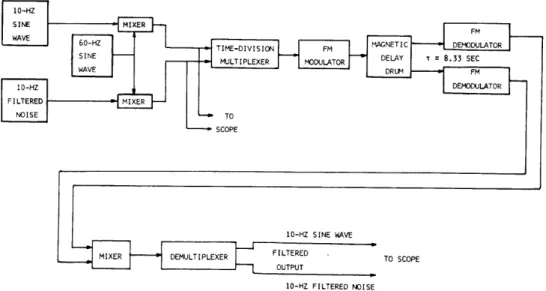
In the present report, a system of time-division multiplexing is employed together with a magnetic drum, in order to provide filtering of two signals in which the disturbance is of the same frequency in both. Although the results from the system described here were carried out with a 10-Hz sine wave and a 10-Hz random noise as the two messages, and a 60-Hz sine wave for the interference, the system is readily adjustable for filtering of other lower or higher frequencies, within the limits of the frequency response in the over-all system.
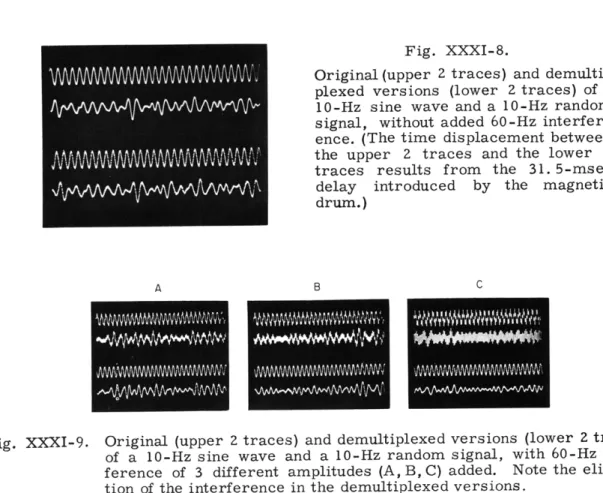
A block diagram of the system is shown in Fig. XXXI-7. The 10-Hz sine wave is derived from an oscillator; the 10-Hz filtered noise was derived from an Elgenco Model 312A noise generator (DC-120 Hz) and a Spencer-Kennedy Laboratories Variable Elec-tronic Filter (Model 308A), the two channels of which were set at 10-Hz highpass and lowpass, respectively. Samples of these waveforms are shown in the two upper traces of Fig. XXXI-8. The 60-Hz interference was obtained from another sine-wave oscillator
10-HZ
SINE MIXER
Z 60-HZ MAGNETIC DEMODULATOR
SIE MULTIPLEXER . . MODULATOR -M
IO-HZ DEMODi .ATOR
FILTERED MIXER
NOISE TO
SCOPE
10-HZ SINE WAVE
MIXER DEMULTIPLEXER FILTERED TO SCOPE
OUTPUT
10-HZ FILTERED NOISE
(XXXI. COMMUNICATIONS BIOPHYSICS)
and mixed, respectively, with the two above-mentioned waveforms; illustrative
examples
for 3 different amplitudes of the interference are shown in the two upper
traces in
Fig. XXXI-9.
Fig. XXXI-8.
Original (upper 2 traces) and
demulti-plexed versions (lower 2 traces) of a
10-Hz sine wave and a 10-Hz random
signal, without added 60-Hz
interfer-ence. (The time displacement between
the upper 2 traces and the lower 2
traces results from the 31. 5-msec
delay
introduced
by the magnetic
drum.)
A B C
Fig. XXXI-9.
Original (upper 2 traces) and demultiplexed versions (lower 2 traces)
of a 10-Hz sine wave and a 10-Hz random signal, with 60-Hz
inter-ference of 3 different amplitudes (A, B, C) added. Note the
elimina-tion of the interference in the demultiplexed versions.
The system for time-division multiplexing which was employed has been described
elsewhere.
3Briefly, 2 traces of a Tektronics Type 3A74 plug-in unit were employed
for the multiplexing, the third trace providing the keying pulse that is necessary
for
demultiplexing; sequentially triggered sample-and-hold circuits
3'
4were employed for
the demultiplexing.
The output of the multiplexer was fed, in turn, to an FM modulator
(Wavetek Voltage-Controlled Generator Model 105), the center frequency of which was
set at 13. 5 kHz.
The magnetic delay drum system employed was that of the Analog
Cor-relator System for Brain Potentials. 2 The delay on the magnetic drum was set
at
8. 33 msec, half of the period of the 60-Hz interference frequency.
Following FM demodulation (circuits designed by R. M. Brown, Jr.), the two signals
delayed relatively to one another were mixed, to eliminate the 60-Hz interference
fre-quency.
For this purpose, a vernier adjustment of the multiplexing rate was made so
that the relative delay for the pair of multiplexed signals recovered from the magnetic
frequency, that is, so that the phases (with respect to the keying pulses) of the pair of
multiplexed waveforms were coincident,
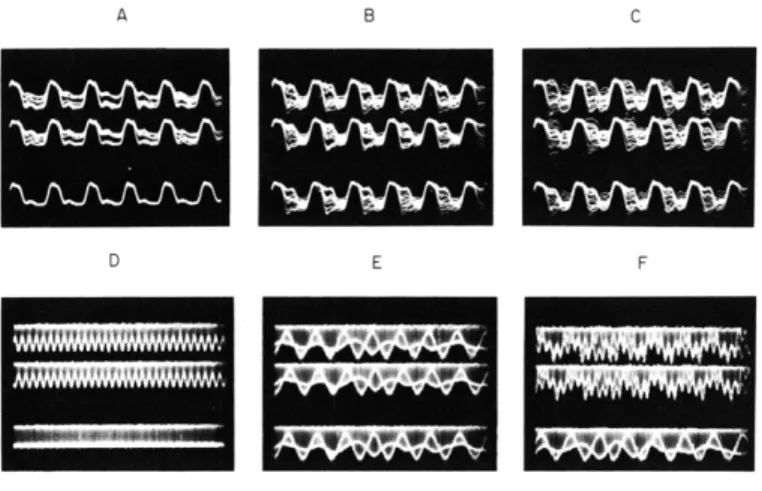
as is shown in the two upper traces of
Fig. XXXI-10.
The summed signals are thus freed of the disturbance frequency, as is
A B C
D E F
-A
Fig. XXXI-10.
Summation of multiplexed signal with itself delayed by 8. 33 msec,
(upper 2 traces), showing the elimination of the 60-Hz interference
before demultiplexing (lowest traces).
(The constant-amplitude
component is the keying pulse for demultiplexing.) A: 60-Hz
inter-ference only; B: information signals only; C: 60-Hz interinter-ference
base.
evident from the lowest traces of Fig. XXXI-10(A-C) and Fig. XXXI-10(D-F).
Corre-spondingly, the disturbance frequency is also eliminated from the resulting
demulti-plexed waveforms, as is shown in the lower two traces in Fig. XXXI-9. Comparison of
the upper and lower traces in Fig. XXXI-9 with the corresponding traces in Fig. XXXI-8
indicates the efficacy of this method for eliminating the unwanted 60-Hz disturbance.
In the present case, the dwell-time
3for each channel of the multiplexer was
0. 45 msec, so that each channel was sampled at 0. 45 msec
X
3 or 1. 35 msec intervals;
the corresponding sampling frequency was thus 740 Hz.
Although only two independent channels of filtering were employed in the results
described here, a third channel could easily have been added, were the latter desired
[the multiplexing system, in fact, permits the use, under certain circumstances, of
3 channels of continuous information (e. g., EEG's) plus an additional channel of pulse
information (e. g.
,
a stimulus pulse), the latter appearing as occasional keying pulses
of increased amplitude.]
As mentioned, the system permits a very wide choice of selection of parameters;
in particular, it could be arranged for filtering of relatively low-frequency interference
(XXXI. COMMUNICATIONS BIOPHYSICS)
channels, although not necessarily of the same amplitude or phase.) In particular, the
system would permit the elimination of fixed-frequency interference (i. e.
,
a 60-Hz
arte-fact) in physiological records played back at a lower or a higher speed than the original
recordings, from magnetic tape recordings, or from electrically transcribed inked
recordings played back at a lower speed than for the original recording, that is,
in a
multichannel system for reconversion of
EEG
inked-traces to their electrical form,
5by
6
employing the principle of phase-modulated analog sampling.
This work was supported at the Massachusetts General Hospital by a U. S. Public
Health Service Career Program Award (Number 5-K3-NB-9201), and by a Public Health
Service Research Grant (Number NB-03752), from the National Institute of Neurological
Diseases and Blindness.
J. S. Barlow
References
1. K. W. Goff, "The Development of a Variable Time Delay," Proc. IRE 41, 1578-15
(1953).
2.
J. S. Barlow and R. M. Brown, "An Analog Correlator System for Brain Potentials,"
Technical Report 300, Research Laboratory of Electronics, M. I. T.
,
July 14, 1955.
3.
J. S. Barlow, "A Simple Time-Division Multiplexing System for Low-Frequency
Bioelectric Signals," IEEE Trans. Vol. BME-13, No. 4, pp. 195-199, October 1966.
4.
J. S. Barlow, "A Small Electronic Analog Averager and Variance Computer for
Evoked Potentials of the Brain," Quarterly Progress Report No. 55, Research
Labo-ratory of Electronics, M. I. T., October 15, 1959, pp. 158-165.
5.
J. S. Barlow and. R. A. DiPerna, "Analog Inked-Trace Reader for Automatic,
Con-tinuous, High-Speed Multichannel Operation," Electroenceph.
clin.
Neurophysiol.
(in press).
6.
J. S. Barlow, "Automatic Curve Reading by Phase-Modulated Analog Sampling"
C. DETERMINISTIC NATURE OF ARTERIAL PRESSURE RECEPTORS
There are some excellent accounts dealing with the qualitative input-output
char-acteristics of arterial pressure receptors.1 More recently, there have been reports
attempting to describe these characteristics quantitatively, in terms of mathematical
models.
It appears that regardless of whether single fibers or multiple fibers are
examined, the output of the pressure receptors is customarily characterized by a
con-tinuous function that gives an indication of the "instantaneous frequency" of nerve firing.
Although this type of characterization may be suitable for describing multiple-fiber
preparations, it is not adequate for giving an accurate description of the input-output
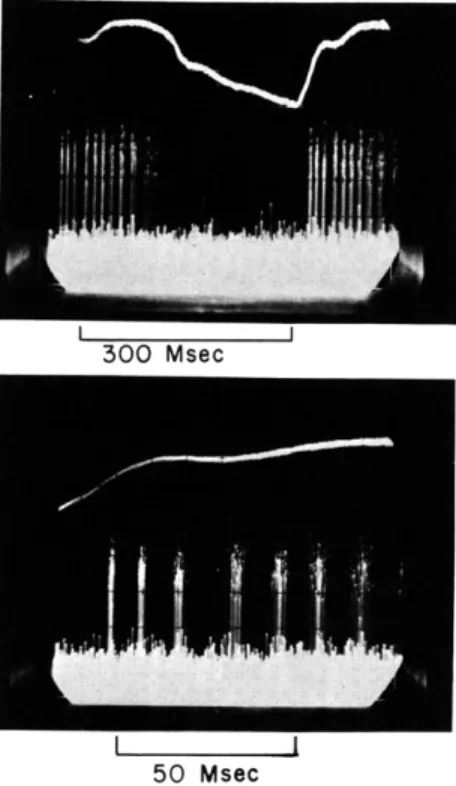
characteristics of single pressure receptor fibers. Our results show that the firing
pattern of single pressure receptor nerves is reproducible when the pressure
wave-form is periodic, and nerve firings tend to occur at well-determined instances of time.
Figure XXXI-11 shows the pressure waveform and associated firing pattern on a
single common-carotid pressure receptor nerve of an anaesthetized cat in a particular
Fig. XXXI-11.
Arterial blood pressure and pressure-receptor nerve
firing. In both records: top trace is blood pressure;
00 Mse
bottom trace is nerve firing.
Pressure minimum:
140 mm Hg; maximum 200 mm Hg. Nerve spikes
are approximately 20iZvolt.
Top record:
approxi-mately 25 cycles superimposed, 50 msec/cm.
Bot-tom record: approximately 50 cycles superimposed,
10 msec/cm. (B
31, T116 905-901).
I I
50 Msec