Data-driven Risk Assessment for Truckload Service Providers by
Sriram Kishore Chittella
B.A. Sc. Systems Design Engineering, University of Waterloo, 2011 and
ARCHNES
MASSACHUSETTP INSTITUTE OF TECHNOLOLGYJUL 16 2015
LIBRARIES
Marcos Machado Teixeira
B.S. Economics, FAE Franciscan University Center of Parana, 2005 B.A. Law, Federal University of Parana, 2004
Submitted to the Engineering Systems Division in Partial Fulfillment of the Requirements for the Degree of
Master of Engineering in Logistics at the
Massachusetts Institute of Technology June 2015
2015 Kishore Chittella and Marcos Machado Teixeira. All rights reserved.
The authors hereby grant to MIT permission to reproduce and to distribute publicly paper and electronic copies of this document in whole or in part in any medium now known or hereafter
created. % A Signature of Author Signature of Author Certified by... Accepted by....
Signature redacted
Master of Engineering in Logistics Program, Engineering Systems Division ..May 8, 2015
Signature redacted
-... ..
...----Master of Engineering in Logistics Progrim, Engineering Systems Division May 8. 2015
Signature redacted
Dr. Daniel W. Steeneck Postdoctoral Associate, Cen er for Transportation & Logistics
- / Thesis Supervisor
tignature
redacted
1'
Director, Center for Transportation and LogisticsV Dr. Yossi Sheffi Elisha Gray II Professor of Engineering Systems Professor, Civil and Environmental EngineeringData-driven Risk Assessment for Truckload Service Providers
by
Sriram Kishore Chittella and
Marcos Machado Teixeira
Submitted to the Engineering Systems Division on May 8, 2015 in Partial Fulfillment of the Requirements for
the Degree of Master of Engineering in Logistics
ABSTRACT
Non-asset backed third-party logistics companies provide shippers access to a flexible source of capacity through transportation carrier spot market. The increased volatility in the trucking spot market rates is turning the 3PL businesses more risky and complex. To maximize profitability, a better understanding of the risk and the volatility patterns across the different geographies, time periods and other factors are investigated based on three years of real spot market data from a major 3PL company in US. Throughout this research we investigate the nature of trucking spot market volatility to allow truckload service providers to reduce their risk when setting long-term contracts. Using three different measures of volatility we are able to assess the company's risk profile and arise with insights to improve truckload service providers' business.
Thesis Supervisor: Dr. Daniel Steeneck
ACKNOWLEDGEMENTS
We would like to thank Dr. Daniel Steeneck, our thesis advisor, and Dr. Chris Caplice, our thesis co-advisor, for their brilliant insights throughout the project. Their guidance and encouragement gave us the necessary fuel to go further and enrich our learning experience through this research.
We would like to thank our thesis sponsor company who provided us with this exciting topic, especially those who worked very close to us contributing to the success of this project.
We would like to thank all of the SCM Class of 2015 for the most memorable experience in our lives, making this year unique and unforgettable.
Kishore Chittella & Marcos Machado Teixeira
I would personally like to thank my family for always encouraging me in my
ongoing adventures and specially my wife for her love and constant support.
Marcos Machado Teixeira
I thank my family for their love and encouragement. I thank my friends for their
ongoing support and my colleagues (academic and industry) for professional development opportunities.
Table of Contents
ABSTRACT ... 2
ACKNOW LEDGEM ENTS ... 3
1. INTRODUCTION... 8 2. BACKGROUND ... 11 2.1. Trucking Industry... 11 2.2. Shippers ... 12 2.3. Carriers... 13 2.4. 3PLs and Brokers... 15
2.5. Methods of Procurement of Truckload Transportation ... 17
2.6. Trucking Spot M arket... 18
3. LITERATURE REVIEW ... 21
3.1. Introduction: Opportunity for Improved Profitability... 21
3.2. Price Volatility in Spot M arket... 22
3.3. Factors Contributing to Price Volatility in Spot Market ... 23
3.4. Volatility Patterns ... 25
3.5. M athematical Analysis ... 26
3.6. Conclusion: Cross Industry Insights... 27
4. M ETHODOLOGY AND DATASET ... 28
4.1. The Dataset... 28
4.3. M easures of Volatility... 32
4.4. Lane Characterization... 35
4.5. Factors Related to Volatility ... 36
4.6. Linear Regression ... 36
4.7. Chapter sum m ary ... 38
5. RESULTS ... 39
5.1. Data Exploration... 39
5.2. Distribution of Linehaul Cost per M ile... 43
5.3. V olatility and Correlation ... 45
5.4. Lane Characterization... 53
5.5. Factors Related to Volatility ... 54
5.6. Regression Analysis ... 66
6. INSIGHTS AND CONCLUSION ... 68
6.1. K ey Findings... 68
6.2. M anagem ent Im plem entation... 71
6.3. Recom m endations and Conclusion ... 75
6.4. Future Research ... 76
REFERENCES ... 78
List of Tables
T able 1: D ata attributes... 29
T able 2: D ata cleaning ... 30
Table 3: Beta value interpretation... 34
Table 4: Regional and national average and coefficient of variation ... 42
Table 5: Regional probability density functions... 44
Table 6: Regional beta values (in comparison with national index)... 46
Table 7: Average month over month percentage changes ... 48
Table 8: Correlation of national and regional indices (all data) ... 48
Table 9: Correlation of national and regional indices (2012)... 49
Table 10: Correlation of national and regional indices (2013)... 50
Table 11: CASS beta values in comparison with national and regional indices ... 51
Table 12: Correlation of national and regional indices with CASS index (all data) ... 51
Table 13: Region p-values - beta vs. distance... 55
Table 14: Region p-values - coefficient of variation vs. distance... 56
Table 15: Region p-values - beta vs. volume... 57
Table 16: Region p-values - coefficient of variation vs. volume ... 59
Table 17: Regression analysis summary... 66
Table 18: Top risky lanes for ABC company ... 70
Table 19: Top 10 risky long-haul lanes 2012 and 2013 (beta) ... 80
Table 20: Top 10 risky long-haul lanes 2012 and 2013 (coefficient of variation)... 80
Table 21: Top 10 risky long-haul lanes 2012 and 2013 (average monthly percentage ch an g e)... 8 1 Table 22: Top 10 risky short-haul lanes 2012 and 2013 (beta) ... 81
Table 23: Top 10 risky short-haul lanes 2012 and 2013 (coefficient of variation) ... 82
Table 24: Top 10 risky short-haul lanes 2012 and 2013 (average monthly percentage ch an g e)... 82
Table 25: Top 10 less risky long-haul lanes 2012 and 2013 (beta)... 83
Table 26: Top 10 less risky long-haul lanes 2012 and 2013 (coefficient of variation) .... 83
Table 27: Top 10 less risky long-haul lanes 2012 and 2013 (average monthly percentage ch an g e)... 84
Table 28: Top 10 less risky short-haul lanes 2012 and 2013 (beta) ... 84
Table 29: Top 10 less risky short-haul lanes 2012 and 2013 (coefficient of variation) ... 85
Table 30: Top 10 less risky long-haul lanes 2012 and 2013 (average monthly percentage ch an g e)... 8 5
List of Figures
Figure 1: Third party logistics and broker business... 8
Figure 2: Petroleum administration for defense districts map ... 32
Figure 3: Commodity activity by region map (provided by ABC company)... 37
Figure 4: Average cost per mile including fuel costs ... 39
Figure 5: N ational index ... 40
Figure 6: Regional indices and national index... 41
Figure 7: Regional line haul probability distributions ... 45
Figure 8: Volatility by beta of regional indices (in comparison with national index)... 47
Figure 9: Lane characterization framework ... 53
Figure 10: B eta vs. distance... 54
Figure 11: Coefficient of variation vs. distance... 55
Figure 12: B eta vs. volum e ... 57
Figure 23: Coefficient of variation vs. volume... 58
Figure 14: National risk profile (2012 and 2013 beta) ... 60
Figure 15: Regional risk profile (2012 and 2013 beta)... 60
Figure 16: National risk profile (2012 and 2013 coefficient of variation) ... 62
Figure 17: Regional risk profile (2012 and 2013 coefficient of variation)... 63
Figure 18: National risk profile (2012 and 2013 average M/M % change)... 64
Figure 19: Regional risk profile (2012 and 2013 average M/M % change)... 65
Figure 20: Monthly cost per mile - Laredo x Houston (lane 780 - 770) ... 72
Figure 21: Weekly cost per mile - Laredo x Houston (lane 780 - 770)... 73
Figure 22: Daily cost per mile - Laredo x Houston (lane 780 - 770)... 73
1. INTRODUCTION
The trucking spot market is a marketplace where loads are negotiated on a non-contract basis. The motivation for this thesis originates from limitations for truckload service providers in understanding volatility in the trucking spot market. When referring to truckload service providers, in this research, we mean freight brokers and 3PL (third party logistics) companies. 3PL is an outsourced provider of activities related to logistics and distribution, while a freight broker is fundamentally an entity that connects shippers and carriers. Specifically, we consider them to act as intermediaries between shippers and carriers, as shown in Figure 1.
Shipper
3PL
&Broker
Carrier
Contract
Spot
Figure 1: Third party logistics and broker business
Freight brokers match shippers with carriers for individual loads as well as contracts. Various factors such as changes in economy, weather, carrier capacity, and seasons, can introduce variability in spot market prices. Within this scenario, brokers and
3PL companies need to develop a better understanding of the risk and the volatility patterns of the spot market rates in order to mitigate market uncertainty.
Non-asset based logistics providers or brokers serve shippers that wish to
outsource some or all of their transportation needs, by negotiating rates with carriers and manages day-to-day operations for their clients, effectively matching loads with carrier availability and capacity. The difference between the cost of procuring carrier capacity and the rate paid by the customer for the shipment is the margin that these firms earn on the load.
To reduce risk, it is important for brokers and 3PLs to develop an understanding of how the risk and the volatility patterns of the spot market rates are affected by
geography, season, and load distance, among others. In this thesis we develop and apply methods for (i) assessing line-haul spot market risk, (ii) identifying factors impacting this risk and (iii) pricing contracts for providing line-haul service on specific lanes. Measures of volatility are defined and applied to key lanes to establish a risk profile. This risk profile is then studied to determine the sources of volatility. Finally, we find the
distributions for the spot market prices of various lanes and show how these can used to price the contracts. To initiate the research process, we first considered some important questions:
1) What is volatility?
2) How does volatility impact non-asset does backed 3PL companies?
4) How can non-asset backed 3PL company take advantage of, or mitigate impacts of volatility?
5) How can be volatility and risk be measured and characterized?
The remainder of this thesis is organized as follows. Section 2 provides a
background of the trucking industry. Section 3 reviews the literature related to this topic. Section 4 describes the tools, sources of information, and methods we used to collect, treat and analyze the data, as well as describes the scenario presented in the dataset. Section 5 shows the analysis performed through this research and the results obtained. Finally, section 6 summarizes the insights and conclusion from this project, describing the key findings and recommendations.
2. BACKGROUND
2.1.
Trucking Industry
In the US, the major transportation mode is trucking. The industry transports about nine billion tons and employed more than 1.3 million people in 2012. With a market valued at $ 681.7 billion in 2013, the trucking business claimed about 81.2% of the US commercial freight transportation market. S&P Capital IQ estimates that
aggregate revenues for the US commercial freight transportation market-including the trucking, rail, air, water, and pipeline sectors-reached about $795.6 billion in 2012. As comparison to these numbers, the US air freight was $ 78.8 billion industry in 2012, rail freight $ 39.8 billion industry, water transportation $ 14.4 billion industry, while trucking was $ 642.1 billion in the same year (S&P, 2014). In 2013 the overall transportation sector was responsible for 9.3% of US GDP (US Department of Transportation - Bureau of Transportation Statistics, 2014).
However, despite the sector's size, the trucking industry is a business with low returns on capital, manpower and resources. This requires trucking companies to be more and more efficient if they want to stay in business. In 2013, the seven leading truckload carriers in US average 8.35% in operating margin, ranging from 2.9% to 13.6% (S&P, 2014). Within the trucking industry, freight transportation capacity has been facing pressure from various sources in recent years in US. Many factors have been causing capacity constraints and have been driving rates up. Some of those factors can be predicted, but some cannot.
The trucking industry, involves a wide range of participants, including shippers, carriers, brokers, and 3PLs. Of course there are more actors with different roles involved in this huge industry (e.g. trucking associations, unions, etc.), but for the purpose of our research we consider only the first four entities.
Another important distinction to be made in this market is between private fleets and for-hire trucking segment. The first category relates to companies (shippers) that use their own fleet to move their products, usually when the transportation plays a critical role in achieving the company's goals. A good example of this case is retail stores, which normally operate private fleets to facilitate efficient delivery of products to their stores. In contrast, the for-hire trucking segment is the case when companies outsource their
transportation needs, contracting truckload providers to service them with transport. This is the biggest segment of the trucking market, which involves either large motor carriers and own operators, and the one we are going to focus in this research.
2.2.
Shippers
Shippers are the central players in the trucking industry. They own the freight and are the decision makers of who is going to move their loads. Shippers are the beneficial owners of freight, and include manufacturers, distributors, and retailers (Sheffi, 2004). They are entities (individual or companies) that have goods to be transported.
As mentioned before, shippers in the US can access truck capacity from either their private fleets or for-hire trucking firms. Although little financial information is available on private carriage, the ATA estimates that companies running their own
45.5% of the trucking market, while the for-hire category generated revenues of $350.1 billion in the same year, or about 54.5% of the motor carrier business (S&P, 2014). For example, one of the biggest private fleets in US is owned by Walmart, and they are also a large buyer of hire TL services. In today's global economy, when dealing with for-hire trucking, shippers may contract directly with the carriers, may for-hire third party
logistics providers or brokers to procure and manage their freight shipments, or use a mix of both. Even when a company has their own fleet, in most cases, it will still need to outsource a portion (inbound or outbound) of their operation to for-hire carriers or to
3PLs. It is uncommon to find shippers using only private fleets to run the entire business. Walmart, for instance, uses its private fleet in parallel with for-hire trucking firms.
A shipper needs to balance the risks associated from transport of their goods. By
making the right decisions and choices, the shipper can dramatically improve the
competitiveness of the supply chain and the profitability of the company. The goal of any shipper is to ensure the delivery of the freight to their customer in the right condition, at the right time, at the right price, and in the most efficient way that optimizes the supply
chain as a whole.
2.3.
Carriers
Freight transportation carriers provide the physical connection between shippers and their customers (Sheffi, 2004). Carriers can be viewed as asset based companies, which own most of the equipment (tractors and trailers) they use to provide transportation
services. They usually own or lease the trucks and directly employ the drivers. Sometimes carriers are also called second party logistics (2PLs) from a shipper
standpoint. However, large motor carriers can also serve as brokers, as they use owner operators or smaller carriers to move the loads under their responsibility. According to the US Department of Transportation, in 2011, the US total number of interstate motor carriers was 742,762.
We can divide TL carriers in four basic categories: international, national, regional, and independent or owner operators. Independent operators are self-employed commercial truck drivers that own and operate their own trucking business. They may lease to a carrier or they may operate under their own authority.
Regarding the types of equipment, in the US trucking market, carriers can offer a wide variety of trucks, which are differentiated by the type of trailers. The most common types are: Dry Van, Refrigerated, Flatbeds, Liquid Tankers, Containers, Ragtops, and others. There are also some specialized carriers that use specialized trailers as auto carriers, bulk commodity, heavy haulers, cement mixer, dump truck, etc. In other countries the types of trucks can vary from these, depending on culture, infrastructure, regulations, and particular needs that may exist.
However, possibly the most important division of the for-hire trucking industry is the truckload (TL), the less-than-truckload (LTL), and small package delivery (Parcel) segments. Among the largest publicly traded companies in the TL business are
companies such as J.B. Hunt Transport Services Inc., Swift Transportation Co., Landstar Systems Inc., and Werner Enterprises Inc. Representing the largest carriers in the LTL business are Con-way Transport, and YRC Worldwide. UPS Freight and FedEx Freight are the largest companies representing Parcel business, even though they do LTL and TL in their operations (S&P, 2014).
As noted by Caplice (2007), truckload transportation firms (carriers) generally handle shipments that are picked up at a location and driven directly to a single
destination with no intermediate stops. This is contrasted with less-than-truckload (LTL) or parcel shipments where the individual shipment might be picked up and transported to
an initial sorting hub on one vehicle and reloaded onto a separate vehicle for movement to another terminal before finally being loaded onto another vehicle for final delivery
(Caplice, 2007).
Truckload (TL) carriers specialize in hauling large shipments for long distances. In this segment, a truck will pick up a load from a shipper and carry it directly to the destination, without transferring the freight from one equipment to another. The TL market is highly fragmented without a single leading actor, mostly due to very low barriers to new entrees. Less than truckload (LTL) carriers usually collect several shipments of smaller sizes from different shippers in one truck that are going to similar locations. The consolidation of freight requires a network of freight terminals. When the shipment arrives at its destination terminal, the load is moved to a pickup-and-delivery truck, and then transported to the final destination. Lastly, parcel carriers usually handle small packages and freight that can be broken down into units less than 150 pounds. For this research, we are analyzing data only from the TL market, limiting it to Dry Van equipment into US territory.
2.4. 3PLs and Brokers
The terms "3PL" and "broker" are often used as interchangeable concepts in the trucking industry. However, in reality, there are some differences between these two terms. Although both entities act as intermediaries between shippers and carriers, their roles can diverge a lot. A broker usually focuses on the execution of an individual shipment, while a third-party logistics provider, in general, works more strategically.
Conceptually, brokers should refer to more basic services and 3PLs to more complex operations.
Another common way to distinguish brokers and 3PLs is from an asset
standpoint. At large, brokers are non-asset-based providers, while modem 3PLs might have at least some assets to back their operations. Nevertheless, most of the time, the terms "3PL" and "broker" will overlap, as we can see 3PL companies acting as brokers
and vice versa.
We consider only freight brokers in this research. The first freight brokers started in business selling the unused capacity of carriers in a particular region. As the
transportation industry developed, brokers began to help shippers to find carriers when they needed transportation, and now it is not uncommon to have freight brokers entering into long-term contracts with shippers to provide transportation on all of a shipper's lanes. After agreed in a contract with the client, the broker then goes to the spot market obtain truck capacity on an on-demand basis to supply transportation for the shipper.
The difference between the price the shipper pays to transport its goods and the price the carrier charge to move the load is the profit the broker makes in this transaction.
Since the spot market rates are very volatile and the rates paid by shippers are agreed in advance, the brokers' margin can vary widely, sometimes resulting even in a loss. With that said, we can easily conclude that 3PLs and Brokers profitability derives from their
ability to forecast future spot market rates.
The broker's role can be defined as one of a matchmaker between carriers and shippers, helping shippers that need to ship cargo find a trucking company that can
deliver the shipment on time and in good condition. The value of a broker is to facilitate a business by bridging an operational or information gap. Brokers and 3PLs provide more
trucks are scarce, allowing them to access the trucking spot market without directly participating of it. Brokers maintain relationships with thousands of carriers, and keep
track of their performance. Freight Brokers can normally deliver available capacity for the right price.
2.5.
Methods of Procurement of Truckload Transportation
Generally procurement is defined as the act of buying, purchasing or obtaining goods or services from a supplier. In terms of truckload procurement, shippers procure transportation using many different approaches. Some of them use a manual approach, usually smaller shippers, while larger shippers are more likely to use systems to manage procurement activities. Most large shippers buy transportation services using requests for proposals (RFPs), leading to contract prices that are typically in effect for one to two years (Sheffi, 2004).
Currently, a wide variety of different electronic market formats can be used for procurement in the truckload industry, including combinatorial auctions, private and public exchanges, and electronic catalogs (Caplice, 2007). The next step after the implementation of one of these tools is to establish the rates for each lane that will be serviced by the carrier for a certain period of time. These rates will be used on the execution stage on a daily basis every time the carrier moves a load for the shipper.
However, besides formal contracts between shipper and carriers, there is also an alternative for shippers to procure truckload transportation, which is accessing the freight spot market. A spot transaction happens usually for a single load and the price is
section we are going to emphasize specifically the trucking spot market, since its understanding is crucial for the comprehension of our research.
2.6.
Trucking Spot Market
The trucking spot market is composed of two main players, regular carriers (small and large) and owner operators. Owner operators usually haul as free-lancers, going to the load that fits better their needs. However, in the carrier's case, their role in the spot market is a little bit different. After completion of a load, they need to relocate their equipment to be ready to serve another customer they made commitments to. This makes many carriers willing to sell their extra capacity below market price to return to their original base. Sometimes carriers can lower their service rates down to the marginal cost of service for trips that have to be performed whether or not they carry a load (Garrido,
2007).
The spot market is a common term for single transactions where the price is determined near (or at) the time when the shipper needs extra capacity to move its goods (Bignell, 2013). Due to this logic, the spot market prices can be substantially lower or higher than average market prices, since this market reflects exactly the current transportation capacity and demand.
One method that shippers use is to contract 3PL or freight broker companies in order to access a large number of carriers and to have more flexible capacity. A spot market transaction begins with a negotiation between the shipper and the broker to agree on a rate for a particular lane, followed by the negotiation between the broker and the
with a carrier (or owner operator), the transaction is closed and the load can be moved. The difference between the rate agreed with the shipper and the rate negotiated with the
carrier is the margin the broker makes in that particular transaction. Companies such as
C.H. Robinson, Total Quality logistics, XPO Logistics, and Coyote Logistics are among
the largest brokerage firms in US and North America.
These days, it is very common to have 3PL and broker companies entering the auction process competing with regular carriers, In this case, brokers provide long-term rates for some lanes in order to get annual contracts with the shipper. This is the case of our sponsor (ABC Company), which has many contracts set with shippers, but, as a non-asset based logistics provider, needs to rely in the truck spot market to physically provide the service. Brokerage business logic relies on believing that the aggregate amount that they pay to carriers over the course of the contract will be less than the aggregate revenue received from the shipper. Their success depends on the capability to guess future spot market rates.
For the reasons stated above and many other factors that constrain trucking capacity, the trucking spot market rates are far more volatile than contract rates. According to the DAT Truckload Report (2014), spot market rates exceeded contract rates on 45% of hauls from mid-April to mid-May in 2014. In previous years, between 20% and 25% of spot market rates were higher than contract rates (Thornton, 2014). As we mentioned, this scenario can be influenced by many factors. Regions of origin and destination, types of loads, likelihood of backhaul, total distance and deadhead distance, load and unload time, load weight, and others are always a concern for carriers and owner operators when choosing which load to accept. Likewise, the type of trailer required and specific requirements for the load are also constraints.
There are also hidden factors that play a role in rates' volatility, which will be identified later when analyzing the data on this paper. The most common are: geographic factors, such as seasonality (Christmas, agricultural harvest, etc.); different types of equipment; general economic indicators (e.g. in growing economies GDP puts a pressure on truck availability); government policy (e.g. truck driver hours-or-service regulation changes); load and unload time; week day; manpower capacity; and others.
3. LITERATURE REVIEW
3.1.
Introduction: Opportunity for Improved Profitability
Although no substantial research has been done on this specific topic, some previous work has addressed related topics involving the spot market of the transportation
industry. Third-party-logistics (3PL) providers connect shippers with carriers by matching loads with truck capacity. The difference between the cost of procuring truck
capacity and the price paid by the shipper for the shipment is the margin the 3PL company earns on a load. The price charged to the shipper is generally agreed upon in advance via an annual contract. In contrast the truck capacity is obtained from the spot market within a week of the scheduled load pickup time.
Bignell (2013) explores the importance of utilizing trucking spot market rate information and knowledge to improve contract formulation and negotiation. Because rates with shippers are established prior to negotiations with carriers, the margin achieved
by a broker on any particular transaction can vary widely and may even be negative,
depending on general economic conditions, market trends, and seasonal variations. In addition, Bignell (2013) also establishes that spot market behavior varies geographically and with respect to time. This thesis explores a better understanding of the spot market volatility patterns across the various markets. Very limited research has been conducted thus far in the scientific community to gain an in-depth knowledge of volatility in truckload spot market prices. Such research has been performed for spot electricity market, airline tickets and commodities such as silver and fuel.
By acknowledging this gap in literature, our final objective is to identify and
quantify individual patterns of volatility in the spot market, and based on that, to produce a data-driven model that allows freight brokers and 3PL companies to assess and reduce their risk. This knowledge can be utilized to enhance existing contracting models with carriers to reduce risk. Since there is very limited research specific to a truckload spot market on this topic, other types of spot markets are also within scope as the findings from those markets may be closely applicable to the truckload spot market. The literature review focuses on the following topics: price volatility in spot market; factors
contributing to price volatility in spot market; volatility patterns with respect to time and location; and mathematical analysis.
3.2.
Price Volatility in Spot Market
Price volatility in spot market transactions is a popular topic of study among researchers in the commodities and financial markets. Over the years, researchers have studied the price volatility of a variety of items including financial instruments such as stocks and commodities such as silver, electricity and fuel. In the research conducted by Simonsen on volatility of power markets, volatility is defined as a characteristic to measure the fluctuations or risk associated with purchasing (Simonsen, 2005).
In a separate study conducted by Gillen and Mantin on price volatility in the airline markets, volatility is defined as the level of uncertainty associated with the erratic change of the value of an item over time (Gillen & Mantin, 2009). Simply put, this measure is utilized to answer how well and the degree of certainty with which one can predict the change in the price of an item. Standard deviation of the price is the
descriptive statistic that is proposed to be utilized to measure the volatility in that case. Further, it is suggested by Gillen & Martin that volatility indicates the overall instability and deviation of the demand relative to the general expectation for a good or service.
Therefore, volatility of the prices may in reality indicate that the demand itself is volatile. The instability and volatility in prices is seen as a significant factor in customer's future expectations of prices and relevant decisions. In the financial industry, volatility is a measure that is utilized to quantify the risk associated with a financial instrument. A
common volatility measure in the financial sector includes the Chicago Board of Options Exchange (CBOE) Volatility Index (VIX) which measures the volatility of the S&P 500
and is known to measure the volatility of the index. Other applications of volatility models suggested by Simonsen include the foreign exchange market as well as the volatility associated with the inflation of an economy (Simonsen, 2005). Exponential
smoothing approach is also investigated due to its simplicity. In the case of the electricity model, volatility is seen as an important and useful input into models that forecast the prices in electricity markets. Conceptually the same approach can be applied to the carrier transaction data to improve the contract and the pricing strategy between the shipper and the carrier.
3.3.
Factors Contributing to Price Volatility in Spot Market
According to Cassidy, the spot market for truckloads is quite close to the market equilibrium (Cassidy, 2010). Carrier executives believe that the volatility, uncertainty and imbalance is caused as a result of various factors such as shortage of truck drivers, rising and fluctuating fuel costs and increasingly constrained regulatory environment. In the
same line of reasoning, Thornton emphasizes that the responsible for higher rates in the trucking market are factors that constrain capacity, including more stringent regulations, extreme weather, increasing operating costs, and a chronic shortage of experienced drivers (Thornton, 2014). As mentioned previously, the freight transportation market has been facing many ups and downs in the last two or three years, causing freight brokerage business to become more risky as this volatility is poorly understood by the main players.
Particularly, the rising fuel prices negatively impact smaller carriers with older trucks who do not have much leverage in negotiating spot market prices and recovering fuel surcharges. On the other hand larger carriers have greater power in price negotiations and are equipped with newer and more fuel efficient trucks. In the case of fuel prices, large and erratic fluctuations may occur due to several different reasons ranging from geopolitical unrest in oil producing nations to refinery capacity constraints and weather disruptions. Furthermore, the government has made efforts to improve the drivers'
conditions by proposing to introduce more mandatory breaks, reduce the driving time per day and equip trucks with monitoring and safety devices. As per industry experts these changes can directly increase the cost to the carrier thereby increasing the overall volatility and baseline for the trucking spot market prices. In the case of the research conducted on the airlines industry by Gillen and Mantin, market share i.e. the number of planes is seen as a factor that influences the volatility (Gillen & Mantin, 2009). A dummy variable is introduced in the regression model to indicate whether or not the market share for a single carrier is more than 90%. In addition, other factors that were identified by Gillen and Mantin include the presence of a low cost carrier in the route being taken by the company, the total distance of the lane and whether or not the journey is non-stop.
3.4.
Volatility Patterns
Simonsen observes the phenomenon of volatility clustering in spot markets whereby the volatility of prices is intermittent with periods of high volatility followed by less volatile periods. Simonsen further investigates the relationship between volatility and time by examining the temporal volatility-volatility correction function to quantify the concept. In addition, he observes that prices are particularly more volatile in the summer months than rest of the year, thus illustrating the time-dependent nature of volatility (Simonsen, 2005).
Volatility also varies with respect to price levels. At low price levels of spot prices, there is a stronger relationship between volatility and price levels i.e. volatility increases with an increase in price. On the other hand, at high price levels, there is a weak relationship between volatility and price levels. While our research focuses on the spot market price volatility of truckloads, the volatility patterns observed in other markets such as commodities and financial instruments will offer fresh insights and creativity. Similarly, Gillen and Mantin investigate how volatility changes with respect to time in the airlines market. It was done by plotting and studying the change in volatility with respect to time across the different geographies (Gillen & Mantin, 2009). Volatility drastically increases during the last 2 weeks of the month though the average price level may not necessarily increase or decrease, thereby confirming the time dependent nature of volatility.
3.5.
Mathematical Analysis
A mathematical technique commonly used in the volatility analysis of the prices
in the various spot markets is regression analysis. For example, in the spot market for airline tickets, Gillen and Mantin performed regression analysis to identify the underlying determinants of price volatility (Gillen & Mantin, 2009). In order to do this, market
structure variables were formulated to represent the market concentration (Hirschman-Herfindahl Index), market domination and whether or not an airline was low cost. In addition, a distance variable was included to represent the route characteristics. By simulating the regression models with the various explanatory variables and examining the R 2 values generated, Gillen and Martin were able to determine whether or not each of
the factors had any influence on the volatility of the prices (Gillen & Mantin, 2009). In the specific example, it was determined that the presence of a low cost carrier on a
specific route does not impact the price volatility.
When modeling the volatility of railway freight in China, Dai, Sriboonchitta and Li (2012) used symmetric and asymmetric conditional volatility models (GARCH, GJR-GARCH and EGJR-GARCH) in order to estimate the volatility in monthly railway freight volume. According to their results, it indicated that the volatility has an asymmetric effect on risk from positive and negative shocks of equal magnitude.
In addition to the transportation field, we also considered options in different fields with similar behaviors. One option that makes sense for us is the finance market. In finance, the risk of stocks and options is calculated by using the stock prices' volatility.
By testing the significance of beta, stock riskiness is predicted (Bahhouth, Maysami and
for hedging, risk management, asset pricing and performance measurement (Branger and Schlag, 2007). This approach is in some way analogous to the 3PL companies acting in the trucking spot market, in which they have to "bet in" a rate while setting contracts with shippers and later they have to buy transportation capacity in the spot market.
3.6.
Conclusion: Cross Industry Insights
The trucking industry in US provides an essential service to the US economy by transporting large quantities of raw materials, works in process, and finished goods over the country. In the past three years, 3PL enterprises were struggling to predict future trucking spot rates. In our research, we will try to fill this gap when understanding the volatility that exist in this specific market, making it easier to be explored. We will focus on understanding the spot trucking market behavior to posteriorly create a feasible model able to enhance the spot rates forecasting process. 3PL providers will benefit from a better understanding of rate volatility and able to increase their business' profitability.
It is evident through the literary review that there is very limited knowledge regarding the spot market price volatility in the freight transportation and truckload industry. It is recommended to adopt some techniques and methodologies utilized in other industries and apply them specifically to the truckload spot market price volatility scenario to develop an in-depth understanding of truckload spot market price volatility.
4. METHODOLOGY AND DATASET
In this section, we describe the tools, sources of information, and methods we used to collect, treat and analyze the data. We also will describe the scenario presented in the dataset.
4.1.
The Dataset
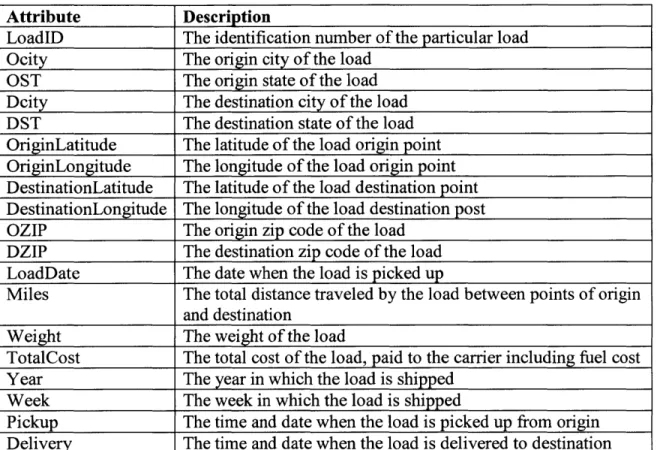
The original data were provided by our sponsor company's strategic team, which were extracted from the company's system. The dataset includes shipment records of dry van equipment, nationwide (US) over the past three years (From October 2011 through September 2014). The data are composed of 1,609,594 rows of load shipments during this three years period. Each row of data indicates a load shipment by a carrier to a shipper and consists of the attributes shown in table 1.
Table 1: Data attributes
Attribute Description
LoadID The identification number of the particular load Ocity The origin city of the load
OST The origin state of the load Dcity The destination city of the load
DST The destination state of the load OriginLatitude The latitude of the load origin point OriginLongitude The longitude of the load origin point DestinationLatitude The latitude of the load destination point DestinationLongitude The longitude of the load destination post
OZIP The origin zip code of the load DZIP The destination zip code of the load LoadDate The date when the load is picked up
Miles The total distance traveled by the load between points of origin and destination
Weight The weight of the load
TotalCost The total cost of the load, paid to the carrier including fuel cost Year The year in which the load is shipped
Week The week in which the load is shipped
Pickup The time and date when the load is picked up from origin Delivery The time and date when the load is delivered to destination
The origin and destination are described by providing City, State, Latitude and Longitude, and the total cost provided in the raw data includes the cost of the fuel.
4.2.
Data Preparation
In this section, we will review how we cleaned, normalized, and grouped the dataset provided to better fit our research needs.
4.2.1. Data Cleaning
We decided to filter out some outlier shipments using the criteria in Table 2.
Table 2: Data cleaning
Data cleaning operation Rows removed
Remove records that consist of distances which are 0 or less 5448
Remove records that consist of cost per load (total cost - fuel cost) 8954
which is 0 or less
Remove records where OZIP is "NULL" Or Is Null 1322
Remove records where DZIP is "NULL" Or Is Null 3777
Thus the data set condensed from 1,609,594 transactions to after data cleaning, or 98.79% of the original data.
1,590,093 transactions
4.2.2. Data Normalization
To be able to compare lanes with different distances, we normalized the shipment costs by transforming the total cost per shipment into a per mile basis.
The fuel cost was isolated from the linehaul cost to avoid any fuel related cost fluctuations. We estimated the fuel cost using the Department of Energy On-Highway Diesel Fuel Price Index. We converted the $/gallon to $/miles based on average fuel consumption, which was currently (as of the most recent published number) $0.46 per mile for the US average, using the index published by PADD. With this information, we were able to derive the historical weekly prices using published data.
4.2.3. Data Aggregation and Selection
We aggregated and selected the data for analysis purposes. On top of the
segmentation we decided to aggregate the data in terms of lanes origin and lanes
destination. The data was aggregated in lanes by 3 digit origin and destination zip codes to improve significance and relevance. This resulted in an aggregated data set consisting
of 1,164,953 spot transactions.
Each transaction consists of Load Date, Origin and Destination State and 3-digit
ZIP, Cost per load without fuel (Average, Minimum and Maximum), Distance (Average,
Minimum and Maximum), Cost per mile and Load Count. Load count indicated the number of loads in a particular 3-digit to 3-digit lane. The average, minimum and
maximum costs and distances are calculated using the information for a 3-digit to 3-digit lane for a particular day.
The data set was then further transformed to categorize the loads by region based on the state of origin. This was done by grouping each of the states into 5 categories: West Coast, Rocky Mountain, Midwest, East Coast and Gulf Coast. East Coast is divided into New England, Central Atlantic and Lower Atlantic Regions. District of Columbia is grouped under the Central Atlantic region. This is based on the Department of Energy Petroleum Administration for Defense Districts map as shown in Figure 2.
Petroleum Administration for Defense Districts
OR PADD 2:
PADD 6: Midwest
West Coast,
'A-AK, HI . 1 * C T" AZ PAOOIA PADD 1: East Coast
Figure 2: Petroleum administration for defense districts map
4.3.
Measures of Volatility
Three measures of volatility were utilized to quantify the volatility and to characterize the risk: Coefficient of variation (CV), beta (p) and average month/month percentage change (AMoM).
4.3.1. Coefficient of variation
The coefficient of variation (CV) is a standardized measure of dispersion of a frequency distribution. It is defined as the ratio of the standard deviation to the mean. The coefficient of variation is useful because the standard deviation of data must always be understood in the context of the mean of the data. In contrast, the actual value of the CV
is independent of the unit in which the measurement has been taken, so it is a dimensionless number. CV is calculated as:
CV=
Here a is the standard deviation of the linehaul cost per mile and i is the average of the linehaul cost per mile. The CV is calculated based on the monthly values of -and p during 2012 and 2013.
4.3.2. Beta
The Beta value is utilized to indicate the relative risk of a lane in comparison to an index such as the national index or the CASS index. Beta is calculated as:
Cov(x, y) (2)
Var(y)
Here x is the cost per mile values of a lane and y is the cost per mile values of an index within a time period. To calculate a 8 value for a time period, the average monthly values are utilized within the time period. The values for the beta for a given region or lane can be interpreted as described in the Table 3 below. The time intervals used for the beta calculations can be quarter to quarter or yearly.
Table 3: Beta value interpretation
Beta Value Interpretation
P<0
Regional index moves in the opposite direction as compared to thenational index
p=0
Regional index is uncorrelated to the national index0<P<1 Regional index moves in the same direction as the national index but is less volatile
=1 Regional index moves in the same direction as the national index and
by the same amount
>1 Regional index moves in the same direction as the national index and is more volatile
The reliability of the beta values is calculated using Pearson's product-moment correlation coefficient (R-Squared value). This measures the linear correlation
(dependence) between two variables giving a value between +1 and -1. 1 indicates total positive correlation, 0 indicates no correlation and -1 indicates total negative correlation.
4.3.3. Average month/month percentage change
As the third measure, volatility is calculated by examining the average month over month percentage change in the cost per mile rates based on the average monthly rates for each region. This indicates the extent to which the cost per mile rate varies on a monthly basis. It is calculated as:
E[Mn) * 100%]
Avg= n
n
(3)
Here Mn indicates the average monthly cost per mile rate for month n and Mn_ 1 indicates the average monthly cost per mile rate for month n - 1.
4.4.
Lane Characterization
A subset of data of 3digit-3digit zip code, which have at least 1 load per month
every month for 2012 and 2013 are utilized to more closely analyze and understand the characteristics of individual lanes. In total when aggregating the data by month, there are 90,275 unique 3digit origin to 3digit destination zip code lanes. Once this data is filtered out to include only lanes which have at least 1 load per month every month for 2012 and
2013, the number of lanes is reduced to 674. If the zip code 3 digit zip code lanes are
filtered out to include only lanes which have at least 1 load per week every week for 2012 and 2013, the number of lanes is reduced to 30. On average, the national linehaul cost per mile changes by 0.41% week over week during 2012 and 2013 and 1.51% month over month. The coefficient of variation are 0.08 and 0.09 monthly and weekly respectively.
Hence monthly values were utilized to ensure a sufficiently large data set across the various regions. However, weekly analysis is conducted on the Laredo to Houston
(780-770) lane in the Management Implementation section of the thesis. The lanes are then
characterized by volatility and risk based on the Beta value for 2012 and 2013 against the national index as well as the coefficient of variation and average monthly percentage change for 2012 and 2013.
4.5.
Factors Related to Volatility
The relationships between volatility, distance and volume are investigated. Volatility is examined using both beta and the coefficient of variation. First, the
relationship between coefficient of variation and beta is examined to ensure that both the measures are relevant.
4.6.
Linear Regression
Using the monthly average cost per mile in years 2012 and 2013 for each region (Central Atlantic, Lower Atlantic, New England, Gulf Coast, West Coast, Mid-West, and Rocky Mountain) as the dependent variable, and interchanging some independent
variables, such as GDP Index, date (month and year), number of trucks at origin, and commodities seasons (agricultural activity), several regression analysis were performed to test which factors influence or do not influence the spot market rates in a given region.
Figure 3 shows the commodity map used to account for the crops' seasons by regions, which was provided and developed by our thesis sponsor (ABC Company), based on their empirical analysis over the years.
U. . without).~t e, pJef s 1k lo JWm lot A* -1 A "WOO, lot A A
Figure 3: Commodiy activity by region map (provided by ABC company)
Some regions have no agricultural activities, so for these regions this variable was not considered. For the regions with agricultural activity, this variable was considered as a binary variable (1 for the months with agricultural activity and 0 for the months
without).
Regarding the number of trucks at origin, as we used monthly average cost per mile, we opted for using the truck capacity (number of trucks) from a region stand point,
which means, the sum of trucks available per month at all states that compose that region. The number of trucks available was also provided by ABC Company, and does not capture the whole market. As the destinations are multiple for each region, we were not able to include the truck capacity at destination.
The p-value for each term tests the null hypothesis that the coefficient is equal to zero (no effect). A low p-value (< 0.05) indicates that the null hypothesis can be rejected.
In other words, a predictor that has a low p-value is likely to be a meaningful addition to your model because changes in the predictor's value are related to changes in the response variable. Conversely, a larger (insignificant) p-value suggests that changes in the
predictor are not associated with changes in the response.
4.7.
Chapter summary
In this section we outlined the steps taken before analyzing the data and the tools we utilized to perform the analysis. We started with 1,609,594 rows of load shipments and ended up with 1,164,953 rows of data, which were later grouped in 7 different regions. The next chapter will discuss in more details the analyses performed on the resulted data and the results obtained through this process.
5. RESULTS
5.1.
Data Exploration
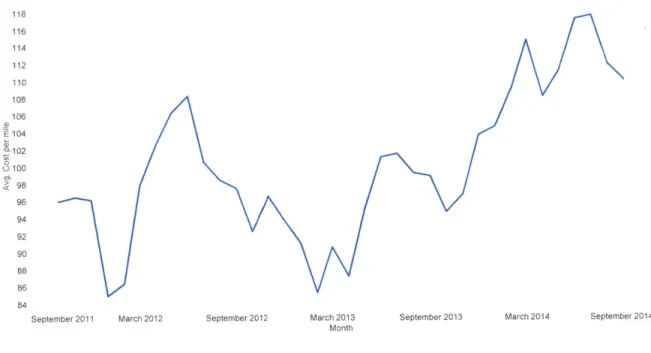
The average rate per mile across ABC's network including fuel cost is not static. It changes with seasonality (weekly, monthly, quarterly, yearly) and has a general trend. This view is shown in Figure 4. The rates are normalized by dividing by the average cost per mile value.
118 116 114 112 110 108 106 104 a 102 0 100 < 98 96 94 92 90 88 86 84
September 2011 March 2012 September 2012 March 2013 September 2013 March 2014 September 2014 Month
Figure 4: Average cost per mile including fuel costs
Typically, the peaks in the cost rates are occurring in the summer months and the dips are occurring in the winter months. However in the case of 2014, the dip is not
prominent in the winter months likely due to harsh nation-wide weather conditions which put a pressure on the trucking industry, causing the rates to increase.
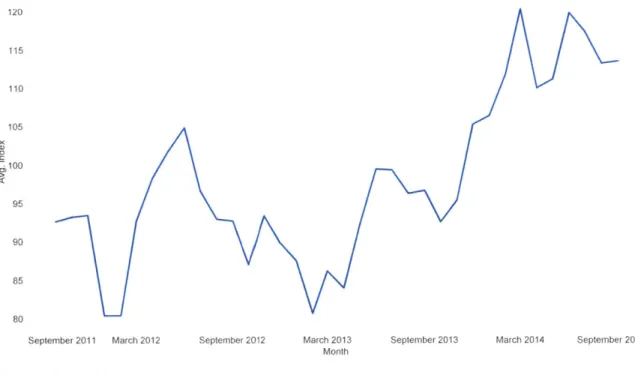
The cost per load is composed of the fuel cost and the linehaul cost. We are interested in the nature of the linehaul cost, and so the fuel cost must be removed. Figure
5 presents the monthly linehaul cost per mile across ABC's network after removing the fuel cost and normalizing with the average. We call this the national index and this forms the basis of the core analysis for spot market rates volatility.
120 115 110 105 100 95 90 85 80
September 2011 March 2012 September 2012 March 2013 September 2013 March 2014 September 2014 Month
Figure 5: National index
Similar to the previous average cost per mile visualization (with fuel prices), the national index in Figure 6 exhibits peaks during the summer months and dips during the winter months.
Once the data is separated by regions, using the Department of Energy Petroleum Administration for Defense Districts map (see Section 4), the regional indices are also
generated. Figure 6 shows the monthly regional indices. The national index is plotted in black and bold in this graph for comparison.
Region
150 150 Central Atlantic
: Gulf Coast
140 1 140 14 0 Mid WestLower Atlantic
New England 130 130 N Rocky Mountain U West Coast 120 120 110 110 -o 100 100 <90 90 < 80 80 70 70 60 60 50 50 40 40
March 2012 September 2012 March 2013 September2013 March 2014 September 2014 Month
Figure 6: Regional indices and national index
As seen, on average, the Central Atlantic, Mid West and West Coast regions have a higher line haul cost than the national index. In addition, the New England and the Rocky Mountain regions appear to be more volatile than rest of the regions and the national index. These insights are supported by the average and coefficient of variation values calculated for each of the regions based on the monthly index as summarized in Table 4.
Table 4: Regional and national average and coefficient of variation Region Ft CV National 100 21.4% Central Atlantic 113 26.6% Gulf Coast 87 31.3% Lower Atlantic 90 24.7% Mid West 107 21.0% New England 73 49.0% Rocky Mountain 68 72.0% West Coast 114 30.5%
5.2.
Distribution of Linehaul Cost per Mile
The historical cost per mile values of the national index are examined to determine an appropriate distribution fit. The probability distribution function is then utilized to determine the contract price that ABC should charge the shipper given that
ABC would like to earn a margin of m dollars with a probability of p. If C is the cost per
mile on a given lane and m is the desired margin with a probability of p, the contract price x can be determined as (i.e. x - c >= m) by solving the below equation:
P(C <= x - m) = p (4)
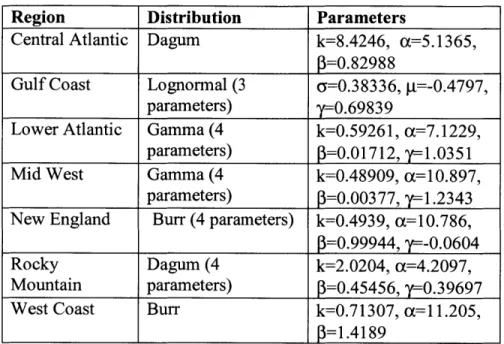
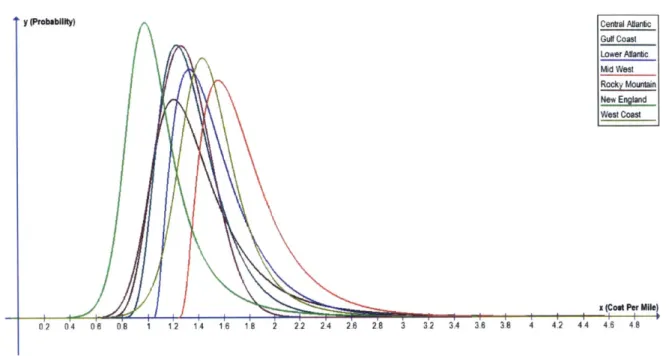
The distributions for the different regions are outlined in Table 5 and are visualized in Figure 8.
Table 5: Regional probability density functions
Region Distribution Parameters
Central Atlantic Dagum k=8.4246, cx=5.1365,
=0.82988
Gulf Coast Lognormal (3 cy=0.38336, p=-0.4797,
parameters) y=0.69839
Lower Atlantic Gamma (4 k=0.59261, cx=7.1229,
parameters)
p=0.01712,
-1.0351Mid West Gamma (4 k=0.48909, x=10.897,
parameters)
pl=0.00377,
y=.2343
New England Burr (4 parameters) k=0.4939, a=10.786, =0.99944, y=-0.0604
Rocky Dagum (4 k=2.0204, a=4.2097,
Mountain parameters)
P=0.45456,
7-0.39697West Coast Burr k=0.71307, o=1l1.205,
=1.4189
Figure 7 shows that the line haul probability distributions differ for the various regions. Certain regions can be best fit by the Gamma distribution while others are best fit to the Log Normal, Burr and Dagum distributions. Importantly, it can be seen that none of the regions can be best fit to the normal distribution.
y (Probability) Central Atantic Gulf Coast Lower Atlantic Mid West Rocky Mountain New England West Coast
x (Cost Per Mile)
0'2 04 06 0.8 1 12 14 1,6 18 2 2.2 2.4 2.6 2.8 3 3.2 3.4 3.6 3.8 4 42 4.4 4.6 4.8
Figure 7: Regional line haul probability distributions
5.3.
Volatility and Correlation
To quantify the volatility in the lanes, we calculate coefficient of variation, beta values and average month/month percentage change. The coefficient of variation for each of the regions is shown previously in Table 4.
The volatility of each of the regional indices is determined in comparison to the company national index. Table 6 below shows the regional betas in comparison with
ABC company national index. Darker shades indicate high volatility. Green indicates that
the price moves in the direction of the national index and orange indicates that price moves in the opposite direction of the index.
Table 6: Regional beta values (in comparison with national index)
Central Gulf Lower Mid New Rocky West
Q Atlantic Coast Atlantic iest En land Mountain Coast
2011Q4 2012QI 2teiMn 2012Q3 2012Q4_, 2013QI 2013Q2 2013Q3 2013Q4_ Overal
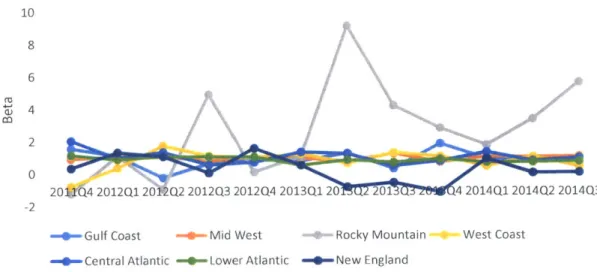
Figure 8 visualizes the volatility of regional indices in comparison with the
national index as a function of time to better identify the trends in the volatility. It
illustrates that the Rocky Mountain region is more volatile than the rest of the markets that ABC operates in. More specifically, Rocky Mountain peaks in Q3 2012 and
Q2
2013. The peaks indicate that the rates are highly volatile in comparison to the nationalindex, moving in the same direction as the national index. The New England region exhibits a high degree of volatility in Q2, Q3 and Q4 of 2013 however moving in the opposite direction of the national index. On the other hand, the Mid West and Lower Atlantic regions are flat and the beta values consistently hovering around 1 showing that both these regions behave identical to the national index of ABC and are stable in
10 8 6 t4 2 0 20VIQ4 2012Q1 20 Q2 2012Q3 2012Q4 2013Q1 20 201 4 2014Q1 2014Q2 2014Q3 -2
--- Gulf Coast - Mid West Rocky Mountain West Coast
-*-Central Atlantic p Lower Atlantic -@--New England Figure 8: Volatility by beta of regional indices (in comparison with national index)
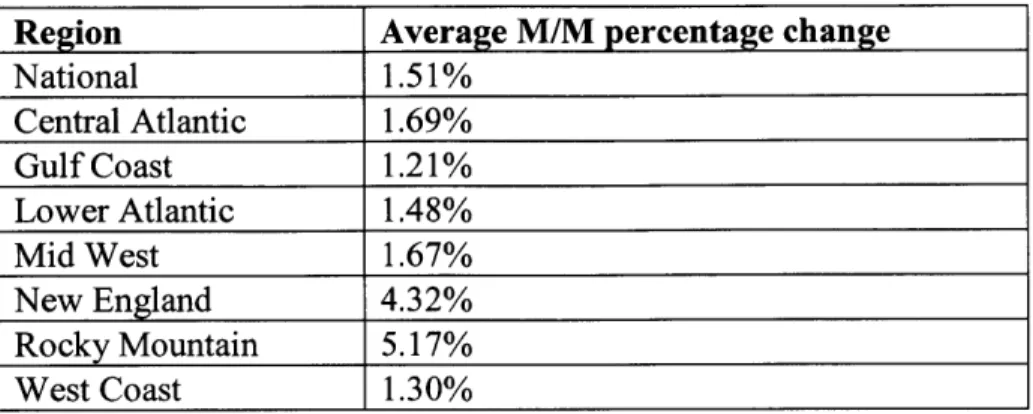
Next, as shown in Table 7, volatility is calculated by examining the average month over month percentage change in the monthly line haul rates. The New England
and Rocky Mountain regions have a high average month over month percentage change than the other regions. This indicates that there are abrupt drops or peaks in the monthly line haul rates within these regions.
Table 7: Average month over month percentage changes
Region Average M/M percentage change
National 1.51% Central Atlantic 1.69% Gulf Coast 1.21% Lower Atlantic 1.48% Mid West 1.67% New England 4.32% Rocky Mountain 5.17% West Coast 1.30%
To further investigate the behavior of the line haul rates, the correlations are calculated between the national and regional indices. Table 8 shows the correlation between the national and regional indices for the entire timeframe of analysis.
Table 8: Correlation of national and regional indices (all data)
National 1.00 Central Atlantic 0.84 1.00 Gulf Coast 0.82 0.61 1.00 Lower Atlantic 0.84 0.59 0.83 1.00 Mid West 0.87 0.65 0.59 0.63 1.00 New England 0.35 0.41 0.22 0.20 0.27 1.00 Rocky Mountain 0.18 0.09 0.16 0.04 0.03 0.05 1.00 West Coast 0.71 0.60 0.61 0.63 0.44 0.14 0.12 1.00
The correlations demonstrates that the Mid West region most closely resembles the national index when considering the entire duration of analysis. However when
examining individual years for instance 2012 as shown in Table 8, the Central Atlantic, Gulf Coast and Lower Atlantic regions also quite closely resemble the national index.
Table 9: Correlation of national and regional indices (2012)
National 1.00 Central Atlantic 0.86 1.00 Gulf Coast 0.88 0.67 1.00 Lower Atlantic 0.86 0.64 0.82 1.00 Mid West 0.78 0.62 0.60 0.59 1.00 New England 0.54 0.34 0.44 0.61 0.47 1.00 Rocky Mountain 0.12 -0.03 0.17 -0.05 -0.13 -0.18 1.00 West Coast 0.72 0.70 0.65 0.66 0.23 0.32 0.10 1.00
After considering the correlation in 2013 as well as shown in Table 10, it can be inferred that the Rocky Mountain followed by New England behave differently from the national index and all the other regions that ABC operates in. One plausible explanation is the low volume of truck loads in these regions. In addition, within the East Coast Region, the sub-regions Central Atlantic, Lower Atlantic and New England behave differently when compared to each other.