ecoinvent: Materials and Agriculture
Developments in Wood and Packaging Materials Life Cycle Inventories
in ecoinvent
Roland Hischier1*, Hans-Jörg Althaus2 and Frank Werner3
1 EMPA, Swiss Federal Laboratories for Materials Testing and Research, LCA unit, Lerchenfeldstrasse 5, CH-9014 St. Gallen 2 EMPA, Swiss Federal Laboratories for Materials Testing and Research, LCA unit, Ueberlandstrasse 129, CH-8600 Duebendorf 3 Dr. F. Werner, Environment & Development, Martastrasse 116, CH-8003 Zurich
* Corresponding author ([email protected])
Outlook. Since wood is only limited and representative data for Europe is therefore not included, an update in the near future would be reasonable. Possible further extensions in the future could include various, final wooden products. For the data on paper/board, different levels of quality are observed, requiring a selective up-date of these data. Future extensions could in-clude datasets for the import of pulp from overseas – especially from South America and Canada.
Keywords: Board; ecoinvent; life-cycle inventories; packaging materials; paper; revenue-based allocation; Switzerland; wood
DOI: http://dx.doi.org/10.1065/lca2004.11.181.6 Abstract
Goal, Scope and Background. This paper gives an overview on how the wood and packaging material production is inventoried in ecoinvent. Packaging materials have been a very important topic in the area of Life Cycle Assessment for more than twenty years. Wood is the most important renewable material and regenerative fuel used worldwide, and an important raw material for paper / board. Several methodological problems arising when inventory-ing wood for material and energetic uses in a generic database are discussed in more detail. Within the ecoinvent project, the Swiss data base for life cycle inventory data, two reports are dedicated to these two important topics – report No. 9 for wood and report No. 11 for packaging materials.
Methods. The whole wood chain has been modeled in a consist-ent way. This allows one to use this data for LCAs of building materials, bioenergy or paper production. The data represent average technologies used in Central Europe in the year 2000. A revenue-based co-product allocation approach is used for the different outputs. Correction factors are introduced for the con-sistent modeling of mass-based, material inherent wood proper-ties such as solar energy, carbon uptake and land use. For pack-aging materials, the datasets represent European average data for the most often used materials as well as specific datasets for the production of actual packaging boxes and containers. Results and Discussion. For wood, revenue-based allocation and the use of the correction factors for mass-related wood proper-ties are shown and explained. For packaging materials, the im-portance of the raw material wood to the total load is shown. Furthermore trends in the data inventories for board packaging materials over the last two decades are discussed: mainly due to the increased comprehensiveness of the data, higher cumulative emissions can be observed.
Conclusion. For wood, the database ecoinvent provides con-sistent datasets for the entire chain from forestry to intermedi-ate products such as timber, different types of wood-based boards, chips, pellets, etc. For packaging materials, the number of datasets of basic materials has been extended. A modular concept for actual packaging container datasets allows the user an easy modeling of various types of packaging containers/boxes. In the area of paper and board, a comprehensive database for the production of various types of pulp, paper and board is vided, which is representative for the average European pro-duction situation.
Introduction
The packaging area has been growing enormously since the 1960s. Due to the fact that packaging material has already fulfilled its function at the beginning of the use phase of the respective product turning into waste, the environmental relevance of packaging materials got very important. Thus, packaging materials were one of the main focus in the early years of LCA (BUS 1984) and inventory data in this area already have a long tradition in Switzerland, cumulating in its present version as part of the ecoinvent database. One of the raw materials often used for packaging – and at the same time the most important raw material for the production of paper and board – is wood. In fact, it is the world's most important renewable material and regenerative fuel (Bowyer 1995, Eldag 1980, Schulz 1993, Sutton 1993). Wood is widely used as construction material, and as raw material for derived timber products (e.g. plywood, particle board, etc.). In the following two sections of this paper, the areas of packaging materials and wood and their respective integra-tion into ecoinvent are described. A detailed overview of the database ecoinvent is given in Frischknecht et al. (2004a). The overall structure of the wood part of the ecoinvent v1.1 database and how the most crucial wood-related methodo-logical issues were solved are presented in Section 1. The special properties of wood as a naturally grown material, which is not a priori suited for industrial production and in most cases is partly used as material and partly for energy conversion, require specific methodological consideration for establishing life cycle inventories of the wood chain.
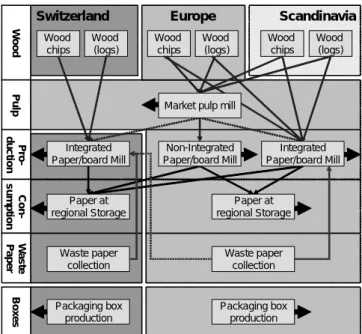
Section 2 then deals with the packaging area in ecoinvent, emphasising on the paper/board sector. In this sector, ecoinvent distinguishes several types of products, e.g. mar-ket pulps, graphical papers, packaging papers (kraft, corru-gated) and several types of cardboard. A more detailed over-view of the structure of the paper/board sector within the database ecoinvent is shown in Fig. 3. Further, a comparison of this most up-to-date data with older data from Habersatter et al. (1998), one standard packaging inventory in the era be-fore ecoinvent, as well as the influence of the wood chain to the total load of paper, are shown and discussed.
1 Wood
A broad variety of wood products – materials and fuels – and production processes are integrated in ecoinvent. Data v1.1 from direct forestry products such as roundwood and indus-trial wood to different types of wood-based boards, chips, pellets and further co-products such as bark, sawdust, etc. (Table 1). This poses specific methodological problems with regard to a consistent modelling of the whole wood chain.
1.1 Goal and scope
It is the goal of the datasets on wood in ecoinvent to provide consistent generic life cycle inventory data for LCAs of wood in its applications as a building material, fuel and starting material for other industrial products such as paper and card-board. Data represent the most common technologies in central Europe around the year 2000.
1.2 Functional unit and reference flow
The choice of the functional unit and the reference flow of wood products in a generic LCI database is influenced by the units commonly used for the products, but also by the important properties of the products. Since all possible uses
of wood from massive beams and boards to chips and pel-lets for incineration are included, the description of the prod-uct needs to provide sufficient information for all of them. Neither mass nor volume is by itself a suitable reference for the definition of reference flow of wood products. Density and heating value depend very much on the water content of wood, which varies in the range of >180% for (indus-trial) wood in the forest to 10% (w/w, relative to dry wood mass) for technically dried wood along the production chain. Thus, information on volume, dry matter content and heat-ing value is needed to model applications of wood as con-struction material and fuel: volume is how concon-struction wood is sold and bought, dry matter content is important to model the emissions of burning wood and the heating value is needed for the energy output of incineration processes. Since transportation is modelled in ton-km, it is also necessary to know the apparent mass. Thus, besides volume or mass, the water content of wood needs to be indicated for every wood fraction represented in a database.
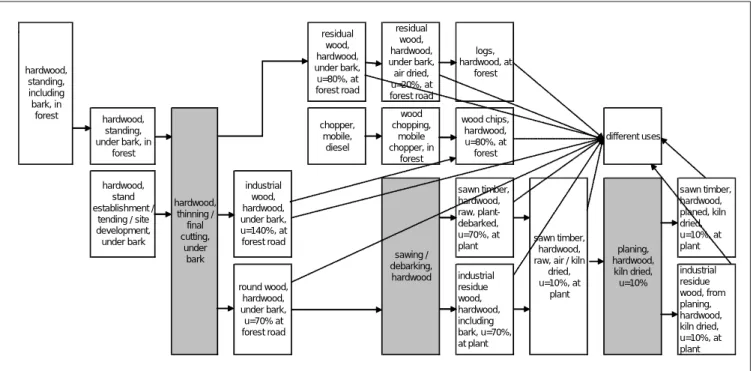
In ecoinvent Data v1.1, these special properties of wood are taken into account by choosing volume as a reference for the definition of the reference flows while indicating the water content of every fraction in the name of the product or proc-ess. Fig. 1 shows the first steps in the wood chain as it is modelled in ecoinvent, and how the products and processes are named.
Volume is chosen as a reference flow instead of dry matter content, because it is the relevant unit for wood on the mar-ket for many products. Unlike apparent mass, volume is in-dependent of the moisture content (above 30%) and thus relates linearly to the dry matter content of wood. Below 30% moisture content, species-specific volume changes of wood are associated with the drying process. A shrinkage ratio of 9% (v/v) for spruce and 12% (v/v) for beech are assumed in ecoinvent for the technical drying processes (Werner et al. 2003, according to Frühwald et al. 1996).
Class Examples of products Short description of data Main sources
Direct forest products
Round wood, fuel wood Data on beech and spruce used for generic hard- and softwood, respectively. Sustainable forest management assumed.
BfS/BUWAL 2000, Frischknecht et al. 1996, Frühwald et al. 1996,
Schweinle 2000, 2001, Werner 2002 Sawn timber Massive boards, air/kiln
dried, raw/planed
Old, but comprehensive data regarding energy consumption. No information on direct emissions (where dust might be an issue).
Frühwald et al. 1996, Hurst 1996, Ressel 1986 Boards from round
wood
Plywood, laminated timber element, wood wool board
Old, but comprehensive data regarding material and energy consumption. Some information on direct VOC emissions. Frühwald et al. 1996, Hess 1996, Ressel 1986, Schniewind 1989 Boards from industrial residue wood
Particleboard, OSB, fibre boards, cement bonded particleboard
Recent and comprehensive data for average material and energy input. Specific products might differ considerably. Some information on VOC and dust emissions
Frühwald et al. 2000, Wegener et al. 1994 Fuel Chips, pellets, charcoal Data of unknown quality on energy consumption and no
data on direct emissions from the processes.
Anonymous 1996, Bergmair 1996, BfS/BUWAL 2000, Frischknecht et al. 1996 Chemical wood
protection
Confidential data for specific products of three classes. Other products might differ considerably.
Hillier 1997,
Künniger & Richter 2000 Infrastructure Production plants,
chainsaws, choppers
Chainsaw based on measurements, other data partly based on expert's guesses. Only to be used to model infrastructure as a background process.
Bergmair 1996, Frischknecht et al. 1996, expert guesses
The volume of wood products can be defined in different ways; ecoinvent uses the most common definition that is used for the commercialisation of a specific product − an information which is given in the ecoinvent meta-informa-tion on the processes. For most products, the volume of wood refers to 'wood under bark', i.e. to the wood volume without the bark. This means, that 1 m3 of 'round wood at forest road'
actually corresponds to more than 1 m3 because the bark is
not included in the functional unit. On the other hand, wood chips are usually measured in bulked volume. Thus, 1 m3 of
wood chips from industry refers to less than 1 m3 wood under
bark, whereas all wood-based boards are inventoried refer-ring to their final volume in m3.
1.3 Co-product allocation
Wood as a naturally grown material, irregular in shape and structure, is not a priori suited for industrial processing or use in technical applications. As a consequence, the manage-ment and processing of wood generates a variety of co-prod-ucts throughout the wood processing chain from its cultiva-tion in managed forests, its extraccultiva-tion, sawing, processing to intermediate and finished products, on to its recycling, incin-eration or final disposal. Co-products generated are, e.g. resi-dues from thinning, bark, sawdust, shavings, chips and fibres, side-cuts, wood waste and waste of intermediate products from wood and wood-based industries (Jungmeier et al. 2002a, Jungmeier et al. 2002b, Werner 2002). In many cases, the eco-nomic value of these co-products is considerably lower than the economic value of the main product or can even be nega-tive, i.e. they are considered as waste that has either to be disposed of or recycled. As revenues (value) are in fact the driving force behind any economic process (Huppes 1992),
multi-output processes are allocated based on revenues of the different co-products. Revenue-based allocation also takes into account the fact that an established industrial demand exists for almost all co-products of the wood chain. It has been argued against economic allocation factors that prices are subject to large fluctuations due to market influ-ence, which would make the LCI results rather short living or even arbitrary. Although true for prices as such, price ratios of different co-products – which are used for revenue-based co-product allocation – are much more stable over time than the individual prices. In addition to that, LCI-data has to be updated within a few years to depict the in-dustrial development, which is of course also true for rev-enue-based allocation factors.
Revenues are of course only one option among several pos-sible allocation factors such as volume (u=0), volume (undried), volume (technically dried u=12%) or mass (u=0), mass (undried), mass (technically dried u=12%). Results can differ considerably for the different allocation factors in de-pendency of the species to be considered (Werner 2002). For the socio-economic reasons outlined above, revenues are chosen as the default allocation factor for the wood chain.
1.4 Consequences of the revenue-based, co-product allocation for resource use, carbon flows and energy content
Revenue-based allocation poses a specific problem for the material inherent characteristics of the biomass, carbon and energy content, three parameters associated with the (oven dry) mass of wood (de Feyter 1995). As a consequence of the revenue-based allocation and given the large price dif-ferences for co-products, carbon bound in wood and its
en-Fig. 1: Overview of hardwood production as modelled in ecoinvent Data v1.1. Grey fields represent multi-output processes. Process and product names contain information on the moisture content and on the reference function. 'Under bark' indicates that the volume relates to the wood without bark, while 'including bark' obviously indicates that the volume includes wood and bark
residual wood, hardwood, under bark, u=80%, at forest road residual wood, hardwood, under bark, air dried, u=20%, at forest road logs, hardwood, at forest hardwood, standing, under bark, in forest chopper, mobile, diesel wood chopping, mobile chopper, in forest wood chips, hardwood, u=80%, at forest different uses sawn timber, hardwood, raw, plant-debarked, u=70%, at plant sawn timber, hardwood, planed, kiln dried, u=10%, at plant round wood, hardwood, under bark, u=70% at forest road industrial residue wood, hardwood, including bark, u=70%, at plant industrial residue wood, from planing, hardwood, kiln dried, u=10%, at plant sawn timber, hardwood, raw, air / kiln
dried, u=10%, at plant planing, hardwood, kiln dried, u=10% industrial wood, hardwood, under bark, u=140%, at forest road hardwood, thinning / final cutting, under bark sawing / debarking, hardwood hardwood, stand establishment / tending / site development, under bark hardwood, standing, including bark, in forest
ergy content would be attributed to the main product in a much higher proportion than what would correspond to its mass. Thus, the main product would 'profit' from a propor-tionally much more negative GWP (i.e. storing of carbon) and mathematically produce much more thermal energy when incinerated than it actually does. On the other hand, the co-product with a much lower price would appear to carry neither the benefit of bound carbon nor to have any energy content. It is obvious that such an allocation would not lead to a consistent model of the wood chain.
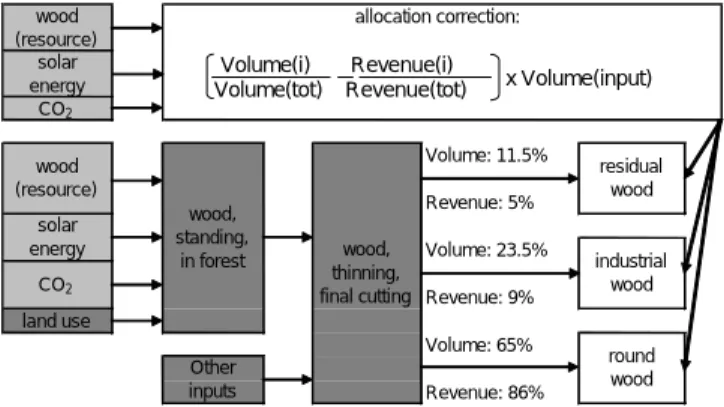
In ecoinvent, this issue is solved by allocating wood as a resource from the ecosphere and the carbon and energy con-tent of wood based on volume (under bark). In a system of subsequent unit processes, this can only be done by using allocation correction factors. Fig. 2 shows the definition, calculation and use of these factors. The calculation proce-dure of the allocation correction factors (formula see Fig. 2) implies that their sum in one process is always zero (with the exception of the drying processes where an allocation correction process is inventoried to correct the effect of the shrinkage of the wood). Table 2 gives a numerical example of the use and effect of the allocation correction factors. The roundwood input inventoried in the sawing process in ecoinvent is 1.71 m³. The outputs are 1m³ sawn timber and 0.71 m³ industrial residue wood. Allocation by revenue
al-locates 96% to sawn timber. Thus, the modelled CO2 uptake of 1 m³ sawn timber would be 1338 kg instead of the 815 kg which is really bound in the wood. The allocation correction factors are now calculated to compensate this mismatch.
1.5 Industrial residual wood as input
Some production processes use industrial residual wood such as sidings, chips or sawdust as input material, for example particleboard production. In many LCA studies, industrial residual wood as input is modelled by applying the cut-off procedure, i.e. industrial residual wood as an input does not carry any environmental burdens from former production processes. Given the fact that co-products with a positive market price are attributed environmental burdens through-out the wood chain in ecoinvent, such a procedure would result in an inconsistent application of the co-product allo-cation rule (Werner 2002), which is not in conformity with the 100% rule stated in ISO 14,041, clause 6.5.3.
In ecoinvent, this issue is solved with the definition of two industrial residual wood processes as an input for both hard-wood and softhard-wood (m3). In these processes, the different
industrial residual wood fractions that are generated through-out the wood chain in ecoinvent are summarised, weighted by the actual production volumes of the main products. Moisture content of these industrial residual woods is cal-culated as the weighted average of the moisture content of the input fractions.
1.6 Thermal energy surplus from internal production processes
Many large wood processing companies are connected to a district heating network providing their thermal energy sur-plus to neighbouring companies or residential buildings. As a consequence, wood input and emissions from the wood incineration process have to be allocated to the thermal en-ergy requirements of the wood processing company and to the energy surplus that is used by third parties.
The wood part of ecoinvent where this issue is relevant – board production – relies on secondary literature. Primary data collection was made only for a few processes, for which no secondary literature was available or where secondary literature had to be complemented. As a consequence, the allocation procedures applied in the secondary literature were
Allocation by revenue
Sawing, softwood, forest-debarked Inventoried
volume [m3] CO2 uptake [kg] Allocation factor CO2 uncorrected [kg] CO2 corrected [kg] Input
Round wood, softwood, debarked, u=70% at forest road 1.71 1394 Softwood, allocation correction, 1 (allocated to sawn timber) –0.64 –523 Softwood, allocation correction, 2 (allocated to residue wood) 0.64 523 Output
Sawn timber, softwood, raw, forest-debarked, u=70%, at plant 1 815 0.96 1338 815 Industrial residue wood, softwood, forest-debarked, u=70%, at plant 0.71 579 0.04 55.75 579
Fig. 2: Allocation and allocation correction in ecoinvent. Because only part of the inputs to the first unit process in the wood chain need to be allocated by volume (light grey), while the others are allocated by eco-nomic revenue (dark grey), the introduction of allocation correction proc-esses is necessary
Table 2: Example for use and calculation of allocation correction factors
wood (resource) solar energy CO2 Volume: 11.5% Revenue: 5% Volume: 23.5% Revenue: 9% land use Volume: 65% Revenue: 86% allocation correction: residual wood industrial wood round wood Other inputs wood, thinning, final cutting wood, standing, in forest wood (resource) CO2 solar energy Volume(i) Revenue(i)
adopted. Generally, the wood fraction and emissions corre-sponding to the surplus energy were subtracted from the plant data to only account for the thermal energy required for the production processes.
1.7 Modelling of land use
Land use is inventoried in ecoinvent according to a method-ology developed based on results of the 14th discussion fo-rum at ETHZ in 2001. Basically, the land occupation (in m2a) is inventoried independently to the transformation (in
m2) from one occupation form to the other. More
informa-tion is provided in Althaus et al. (2004b) and Frischknecht et al. (2004b). Since land use inventories in ecoinvent need to be appropriate, not only for forest but for all kinds of land use, the recommendations developed by the working group 'land use' of COST E9 (is in accordance with Doka et al. 2001) could not be fully implemented. Land use of the forest is inventoried as occupation of intensively used forest and transformation from extensively to intensively used for-est. Because it is not possible to determine when this trans-formation took place (many forests in Europe were inten-sively used 2000 years ago during the Roman Empire), the time span to normalise the transformation to the product output was chosen one rotation cycle. Thus, the transfor-mation value is calculated assuming that the land is trans-formed to harvest just once. This worst case estimation is in accordance with Doka et al. (2001). If the land transforma-tion is interpreted as a major environmental issue in an LCA study, this assumption has to be questioned.
2 Packaging Materials
Life Cycle Inventories of packaging materials have a long tradition in Switzerland – starting with the first report of the Swiss EPA already twenty years ago (BUS (1984)). This report has been updated and extended several times (Habersatter 1991, Habersatter et al. (1998), cumulating in its present version which is part of the database ecoinvent. In all these Swiss packaging reports, a variety of different packaging base materials is covered – e.g. plastics, glass, board/paper, aluminium and steel.
2.1 Goal and scope
It is the goal of the datasets on packaging materials in ecoinvent to provide consistent generic life cycle inventory data for basic packaging materials, containers and boxes representing average European and/or Swiss technology. Across all the various stages of databases, the amount of basic materials grew constantly – achieving around 40 dif-ferent materials in the latest database – whereas the amount of treatment processes got smaller in ecoinvent compared with all the precedent reports.
In this paper here, only the board/paper sector, as one of the most important packaging material sectors – economically and within ecoinvent – is treated. More details about the remaining packaging materials can be found in Hischier (2004) (glass, plastics) and in Althaus et al. (2004a) (alu-minium, steel).
2.2 Structure of the paper/board sector within ecoinvent
A clear structure along the life-cycle of the paper produc-tion has been established within the framework of ecoinvent (see part III in Hischier 2004) – i.e. starting with datasets for forestry processes, passing various market pulp and pa-per/board production datasets, the consumption phase and ending up with waste paper collection datasets. The actual packaging box production is in separate datasets. An over-view of the structure and the relation between the different datasets is given in Fig. 3.
According to Fig. 3, ecoinvent distinguishes datasets for Swiss and European conditions in most of the examined steps. This offers the choice of a large variety of datasets to meet the aim of the user's study. The broadest choice exists for the paper/ board production. The paper/board consumption mix (proc-esses with the extension 'at regional storage') is modelled based on statistical information from the Confederation of Euro-pean Paper Industries (CEPI 2001) using only the inventories of graphical paper in ecoinvent Data v1.1 and an additional transport from the production to the consumption area (i.e. to Switzerland). Similar datasets for other regions and further types of paper/board can be created by following the method-ology used and documented in Hischier (2004).
All datasets of the paper / board sector are established ac-cording to the general ecoinvent methodology (Frischknecht et al. 2004c). According to this methodology, no credits are given for recycled materials. DIP (deinked pulp) for exam-ple only accounts for the environmental load of the produc-tion of DIP out of waste paper; waste paper as input materi-als does not carry any environmental burden from its former paper/board life. There is a methodological difference between the European and the Scandinavian wood data, as latter datasets are not modelled as multi-output processes and do
Wood chips Wood (logs) Switzerland Wood chips Wood (logs) Waste paper collection Waste paper collection Europe Wood chips Wood (logs) Scandinavia Integrated Paper/board Mill Non-Integrated Paper/board Mill Paper at regional Storage Market pulp mill
W ood Pu lp Pro -duc ti on Co n -su m p tio n Wa st e Pa p e r Bo x e s Packaging box production Packaging box production Paper at regional Storage Integrated Paper/board Mill
Fig. 3: Overview of the structure of the paper and board sector within the database ecoinvent. The bold arrows indicate the datasets for most com-mon use of the users of the database ecoinvent
not contain the correction factors explained in Section 1. Scandinavian wood is reported as a single output process which is derived based on an unspecified allocation procedure. This is mainly due to the fact that these datasets are based on only one source providing no more information.
Specific datasets for the production of packaging containers and boxes are included as well. These datasets contain only the additional inputs and outputs, whereas the amount of raw material (e.g. corrugated board, aluminium, HDPE) is not in-cluded. This type of inventories allows a broader and much more flexible application of these packaging box datasets.
2.3 Comparison with former paper/board inventories
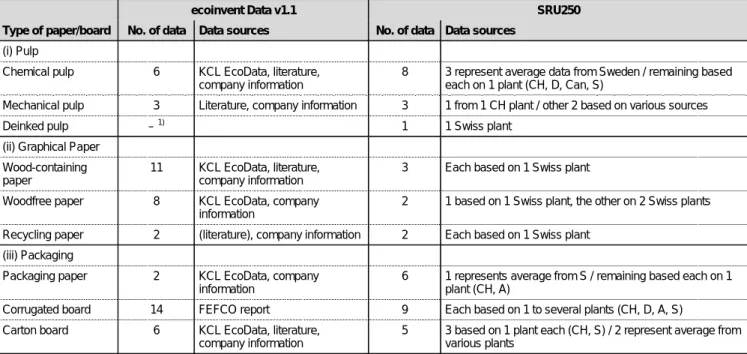
The precursor database for LCI data of paper and board in Switzerland is Habersatter et al. (1998), also called SRU250. Table 3 gives an overview of the amount of datasets in SRU 250 and ecoinvent Data v1.1.
The main advantage of the new ecoinvent data compared to the data published in SRU250 across all types of paper/board is, that the respective dataset is based on a broader base of information in ecoinvent – literature sources, company in-formation either by personal inin-formation from specific mills or from their Corporate Environmental Reports (CER) as well as other LCI inventory databases (FEFCO et al. 2000, KCL 2002). As far as possible, datasets based on the infor-mation of just one producer / paper mill was avoided. The most important changes can be observed for graphical paper. The old inventories were all based on information of one single Swiss company; ecoinvent contains average Eu-ropean datasets for the various types of graphical paper. In addition to that, ecoinvent contains much more different datasets for graphical paper. This is due to two different
facts: (i) specific datasets in function of the available infor-mation are established, and (ii) different datasets for the production and the consumption situation are established. All in all, ecoinvent Data v1.1 contains a much more adequate set of data with regard to the coverage of the European paper/ board market compared to all former Swiss inventories.
2.4 Case study packaging paper
As an example in the packaging area, the dataset 'kraft pa-per, unbleached, at plant (RER)' of ecoinvent Data v1.1 is shown here. First, this dataset is compared with the respec-tive dataset in SRU 250, the dataset 'kraftpaper unbleached'. In a second step, the importance of the precoursory wood chain (explained in details in Section 1) to the kraft paper dataset is shown.
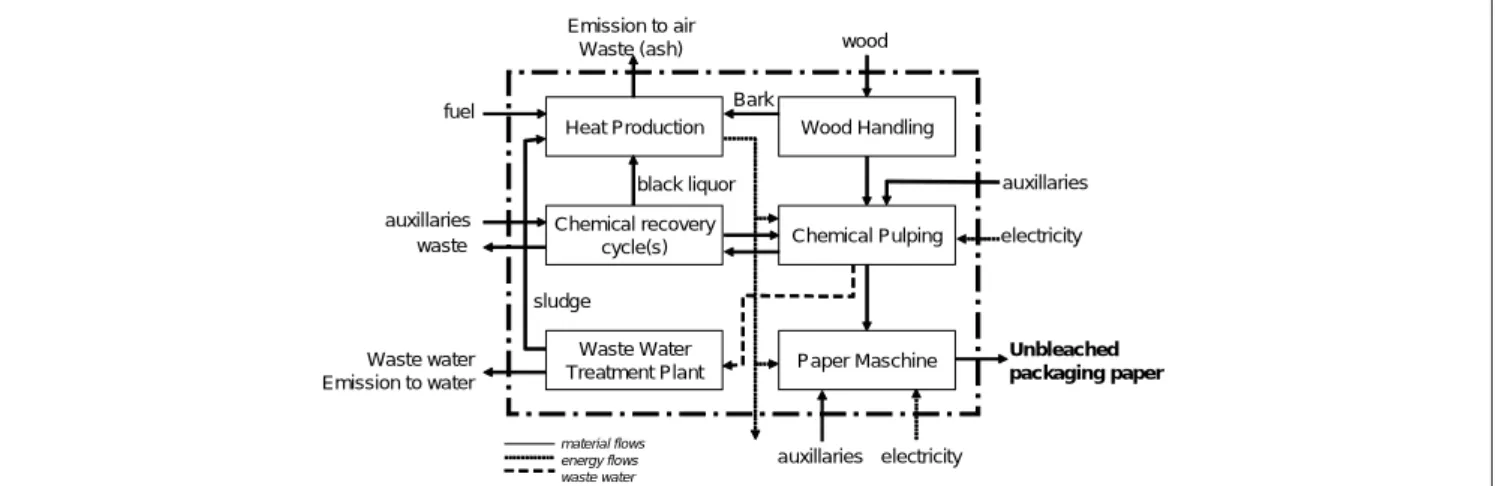
Established as a European average dataset, the packaging paper dataset in ecoinvent contains the following produc-tion steps: wood handling process, chemical pulping, paper production on the paper machine, on-site energy produc-tion as well as the respective chemical recovery cycles and the internal waste water treatment plant. In Fig. 4, these different parts together with the most important material and energy flows are summarized. As can be seen there, the production of any kind of auxiliary materials is not included in the corrugated base paper production.
SRU 250 contains a dataset 'kraftpaper unbleached' based on the information from just 1 Swiss company. As this com-pany is a non-integrated paper mill, the dataset contains the following production steps: paper production, on-site en-ergy production as well as the respective chemical recovery cycles and the internal waste water treatment plant – but no production process of the used chemical pulp.
ecoinvent Data v1.1 SRU250
Type of paper/board No. of data Data sources No. of data Data sources
(i) Pulp
Chemical pulp 6 KCL EcoData, literature, company information
8 3 represent average data from Sweden / remaining based each on 1 plant (CH, D, Can, S)
Mechanical pulp 3 Literature, company information 3 1 from 1 CH plant / other 2 based on various sources Deinked pulp – 1) 1 1 Swiss plant
(ii) Graphical Paper Wood-containing
paper
11 KCL EcoData, literature, company information
3 Each based on 1 Swiss plant Woodfree paper 8 KCL EcoData, company
information
2 1 based on 1 Swiss plant, the other on 2 Swiss plants
Recycling paper 2 (literature), company information 2 Each based on 1 Swiss plant
(iii) Packaging
Packaging paper 2 KCL EcoData, company information
6 1 represents average from S / remaining based each on 1 plant (CH, A)
Corrugated board 14 FEFCO report 9 Each based on 1 to several plants (CH, D, A, S) Carton board 6 KCL EcoData, literature,
company information
5 3 based on 1 plant each (CH, S) / 2 represent average from various plants
1) according to European statistics, there is no market for deinked pulp, thus no such dataset in ecoinvent
Table 3: Overview of the coverage of the paper/board sector within ecoinvent and the former Swiss packaging inventories (ecoinvent from Hischier (2004), SRU250 from Habersatter et al. (1998))
In Table 4, a selection of cumulative LCI results and the LCIA parameter 'cumulative energy demand (CED)'of the two examined datasets (unbleached kraft paper according to Hischier (2004), unbleached kraftpaper according to SRU 250) are shown. The cumulative energy demand (CED) is used there for the representation of the LCI input values of the various energy carriers.
As shown in Table 4, the dataset in ecoinvent Data v1.1 reports lower values for CED factors of fossil, nuclear and water compared with the old data, but a much higher value for the CED of biomass. This high amount is due to the fact that in ecoinvent, the amount of internally burned wooden waste is part of the material input (wood), whereas in SRU
250 waste as fuel often was not taken into account as an input. The wood input is responsible for 99% of this biomass CED value. Most emissions to air and water show higher values compared to the data in SRU 250. This is mainly due to the fact that the various materials used for the produc-tion of kraft paper are based on more detailed inventories within ecoinvent, resulting in higher overall values. One exception is the fossil carbon dioxide emissions into air, as these CO2 emissions are mainly caused by use of fossil fuels within the kraft paper chain.
In Table 5, the amount of the precoursory wood chain to the total load of the dataset 'kraft paper' is shown for the same selection of cumulative LCI results and the LCIA pa-rameter 'cumulative energy demand (CED)' as in Table 4.
Heat Production Emission to air Waste (ash) electricity Waste water Emission to water fuel auxillaries wood Waste Water Treatment Plant material flows energy flows waste water electricity Chemical Pulping Wood Handling Bark Paper Maschine sludge black liquor Chemical recovery cycle(s) auxillaries waste Unbleached packaging paper auxillaries
Fig. 4: Schematic overview of an unbleached kraft paper mill and its main material and energy flows
ecoinvent
data v1.1 SRU 250 Cumulative Energy Demand (in MJ-Eq)
non-renewables, fossil 1.12E+1 1.90E+1 –40.9% non-renewables, nuclear 4.22E+0 1.22E+1 –65.4% renewables, water 1.77E+0 3.56E+0 –50.2% renewables, wind, solar,
geothermal 1.56E-1 0 – renewables, biomass 4.34E+1 3.00E-1 + 14’400%
Air emissions (in kg)
carbon monoxide, fossil 2.28E-3 9.80E-4 +132.2% carbon dioxide, fossil 7.60E-1 1.06E+0 –28.3%
NMVOC 1.13E-3 1.22E-3 –7.0% nitrogen oxides 5.09E-3 5.11E-3 –0.4%
sulphur dioxide 3.35E-3 2.62E-3 +27.8% particulates, > 10 um 6.99E-4
particulates, < 10 and > 2.5 um 4.13E-4 particulates, < 2.5 um 8.09E-4
1.78E-3 +76.6%
Water emissions (in kg)
BOD 2.35E-3 7.67E-4 +206.5%
COD 4.47E-3 1.11E-2 –59.7%
chloride 7.01E-3 3.22E-3 +117.7%
Table 4: Cumulative energy demand (CED) and selected LCI results from the two unbleached kraft paper datasets (ecoinvent from Hischier (2004), SRU250 from Habersatter et al. (1998)). The values represent the cumu-lative result over the whole chain per kg of paper and the recumu-lative changes from SRU 250 to ecoinvent
ecoinvent data v1.1
Thereof from wood Cumulative Energy Demand (in MJ-Eq)
non-renewables, fossil 1.12E+1 8.3% non-renewables, nuclear 4.22E+0 2.8% renewables, water 1.77E+0 2.5% renewables, wind, solar, geothermal 1.56E-1 0.8% renewables, biomass 4.34E+1 99.0%
Air emissions (in kg)
carbon monoxide, fossil 2.28E-3 52.7% carbon dioxide, fossil 7.60E-1 7.5%
NMVOC 1.13E-3 43.7%
nitrogen oxides 5.09E-3 24.1% sulphur dioxide 3.35E-3 3.5% particulates, > 10 um 6.99E-4 6.2% particulates, < 10 and > 2.5 um 4.13E-4 6.7% particulates, < 2.5 um 8.09E-4 16.0%
Water emissions (in kg)
BOD 2.35E-3 11.0%
COD 4.47E-3 6.3%
chloride 7.01E-3 10.0%
Table 5: Cumulative energy demand (CED) and selected LCI results from the unbleached kraft paper dataset in ecoinvent (Hischier (2004)) and their amount of the precoursory wood chain (expressed in% of the re-spective total per kg of paper)
As shown in Table 5, the precoursory wood chain contrib-utes in a very broad range to the total load of the paper production – achieving 99% for CED of biomass. This value confirms that almost all burned biomass is internally pro-duced waste, originating from the wood input. For all re-maining CED values, the wood chain has only a minor in-fluence. Most emissions to air and water show values from the wood chain of 10% and less, i.e. are not due to the input of wood, but from the energy consumption and/or the vari-ous auxilliaries used in the paper production process. There are three exceptions, where wood is relevant by being re-sponsible for a quarter and more of the respective load: fos-sil carbon monoxide, NMVOC and nitrogen oxides. The first two are to a large extent due to the cutting activities (datasets 'power sawing' and 'diesel, burned in building machine') of the wood in the forest, while the latter one originates from the burned fuels for cutting (dataset 'diesel, burned in building machine') and for transporting the wood out of the forest (dataset 'transport, lorry 16t').
3 Conclusion and Outlook
The ecoinvent v1.1 database provides consistent datasets of wood-based products over the entire wood chain. The methodology used for modelling multi-output processes allows the use of these datasets in LCA studies with focus on material and energetic use including different end of life options. The LCI data represents a broad spectrum of wooden basic products. Unfortunately, the inventory data for many wood products is based on data of a limited number of companies and cannot be considered to be rep-resentative for Europe. Furthermore, some data needs ac-tualization. In addition to that, various wooden final prod-ucts like window frames, doors, floors, poles, railway sleepers, palisades, etc. could be included in a future ver-sion of ecoinvent (Künniger & Richter 1997, Künniger & Richter 1998, Künniger & Richter 2000, Richter et al. 1996, Werner & Richter 1997, Werner et al. 1997).
For packaging materials, further processes and materials could be included compared to the former packaging inven-tories in Switzerland, whereas for the production of specific packaging containers / boxes a new modular concept allows the user to easily model various types of packaging contain-ers/boxes. With regard to paper/board, ecoinvent v1.1 con-tains a comprehensive set of production datasets for the vari-ous types of market pulp, paper and board representing the average European production situation. Different levels of data quality are observed between the paper/board datasets. An update of those datasets with a lower data quality is desirable. A future version of ecoinvent could also contain datasets of the imports of pulp from overseas, especially from South America and Canada.
References
Althaus H-J, Blaser S, Classen M and Jungbluth N (2004a): Life Cycle Inventories of Metals. Final report ecoinvent 2000 No. 10. EMPA Dübendorf, Swiss Centre for Life Cycle Inventories, Dübendorf, CH, Online-Version <http://www.ecoinvent.ch>
Althaus H-J, Kellenberger D, Doka G and Künniger T (2004b): Manufacturing and Disposal of Building Materials and Inven-torying Infrastructure in ecoinvent. Int J LCA 10 (1) 35–42 <DOI: http://dx.doi.org/10.1065/lca2004.11.181.4>
Anonymous (1996): DGfH-Merkblatt: Energetische Verwertung von Altholz [Energy Recovery of old wood]. Deutsche Gesell-schaft für Holzforschung (DGfH), München
Bergmair J (1996): Gesamtenergieaufwand bei der Herstellung von Hackgut bzw. Pellets; Vergleich von industriellem und bäuerli-chem Hackgut und Pellets [Total energy effort for production of wood chips rsp. pellets; comparison of industrial and agri-cultural wood chips and pellets]. Eine Studie des Forschungsin-stitutes für Alternative Energienutzung und Biomasseverwertung im Auftrag der Regionalenergie Steiermark, Graz
BfS/BUWAL (2000): Wald und Holz in der Schweiz; Jahrbuch 2000 [Forest and wood in Switzerland; yearbook 2000]. Statistik der Schweiz, Bundesamt für Umwelt, Wald und Landschaft (BUWAL), Bundesamt für Statistik (BFS), Neuenburg
Bowyer J (1995): Wood and Other Raw Materials for the 21st Century. Forest Products Journal 45 (2) 17–24
BUS (1984): Ökobilanz von Packstoffen [Ecobalance of packaging materials]. Bundesamt für Umweltschutz (BUS) (publisher), Bern (Switzerland)
Doka G, Hillier W, Kaila S, Köllner T, Kreissig J, Muys B, Quijano J G, Salpakivi-Salomaa P, Schweinle J, Swan G and Wessman H (2001): The Assessment of Environmental Impacts Caused by Land use in the Life Cycle Assessment of Forestry and For-est Products; Guidelines, Hints and Recommendations; Final Report of Working Group 2 'Land use' of COST Action E9. Hamburg
CEPI (2001): Annual Statistics 2000. Confederation of European Paper Industries (CEPI), Brussels
de Feyter S (1995): Handling of the Carbon Balance of Forests in LCA. In: Life-Cycle Analysis – A Challenge for Forestry and Forest Industry (ed Solberg B). pp 33–39. EFI Proceedings No 8, European Forest Institute, Hamburg
Eldag H (1980): Wood and Wood Products. In: Materials in World Perspective; Assessment of Resources, Technologies and Trends for Key Materials Industries (ed Altenpohl DG). pp 105–117. Springer-Verlag, Berlin, Heidelberg, New York
FEFCO, Groupment Ondulé and Kraft Institute (2000): European Database for Corrugated Board Life Cycle Studies, Paris Frischknecht R, Suter P, Bollens U, Bosshart S, Ciot M, Ciseri L,
Doka G, Hischier R, Martin A, Dones R, Gantner U (1996): Ökoinventare von Energiesystemen, Grundlagen für den öko-logischen Vergleich von Energiesystemen und den Einbezug von Energiesystemen in Ökobilanzen für die Schweiz [Ecoinventories of energy systems]. Bundesamt für Energiewirtschaft (BEW/ PSEL), Ed. 3. Aufl., Bern
Frischknecht R, Jungbluth N, Althaus H-J, Doka G, Dones R, Heck, T, Hellweg S, Hischier R, Nemecek T, Rebitzer G, Spielmann M (2004a): The ecoinvent Database: Overview and Methodologi-cal Framework. Int J LCA 10 (1) 3–9 <DOI: http://dx.doi.org/ 10.1065/lca2004.10.181.1>
Frischknecht R, Jungbluth N, Althaus H-J, Doka G, Dones R, Hischier R, Hellweg S, Nemecek T, Rebitzer G, Spielmann M (2004b): Code of Practice. Final report ecoinvent 2000 No. 2. Swiss Centre for Life Cycle Inventories, Dübendorf, CH, Online-Version <http://www.ecoinvent.ch>
Frischknecht R, Jungbluth N, Althaus H-J, Doka G, Dones R, Hischier R, Hellweg S, Nemecek T, Rebitzer G, Spielmann M (2004c): Overview and Methodology. Final report ecoinvent
2000 No. 1. Swiss Centre for Life Cycle Inventories, Dübendorf, CH, Online-Version <http://www.ecoinvent.ch>
Frühwald A, Wegener G, Scharai-Rad M, Zimmer B, Hasch J (1996): Grundlagen für Ökoprofile und Ökobilanzen in der Forst- und Holzwirtschaft [Basis for ecoprofiles and ecobalances in the forest and wood sector]. Ordinariat für Holztechnologie der Universität Hamburg, Institut für Holzforschung der Univer-sität München, in Zusammenarbeit mit Bundesforschungsanstalt für Forst- und Holzwirtschaft, Hamburg
Frühwald A, Scharai-Rad M, Hasch J (2000): Ökologische Be-wertung von Holzwerkstoffen [Ecological assessment of wooden materials]; Schlussbericht, ergänzt in den Bereichen Spanplat-tenrecycling und OSB-Bilanzen. Universität Hamburg, Hamburg Habersatter K (1991): Oekobilanz von Packstoffen Stand 1990 [Ecobalances of packaging materials, status 1990]. BUWAL Schriftenreihe Umwelt Nr. 132. BUWAL, Bern
Habersatter K, Fecker I, Dall'Acqua S, Fawer M, Fallscheer F, Förster R, Maillefer C, Ménard M, Reusser L, Som C, Stahel U, Zimmermann P (1998): Ökoinventare für Verpackungen [Ecoin-ventories of packaging materials]. BUWAL Schriftenreihe Um-welt Nr. 250. BUWAL, Bern
Hess (1996): Personal communication. Hess & Co. AG, Döttingen Hillier W (1997): The Risk of Life Cycle Assessment for Preserva-tive Treated Timber Products. Lectures and Presentations at WEI Congress, WEI, Oslo
Hischier R (2004): Life Cycle Inventories of Packaging and Graphi-cal Paper. Final report ecoinvent 2000 No. 11. EMPA St. Gallen, Swiss Centre for Life Cycle Inventories, Dübendorf, CH, Online-Version <http://www.ecoinvent.ch>
Huppes G (1992): Allocating Impacts of Multiple Economic Proc-esses in LCA. In proceedings from: Life Cycle Assessment, In-ventory, Classification, Valuation, Data Bases, Brussels Hurst A (1996): Holztransporte 1993 in der Schweiz [Wood
trans-ports 1993 in Switzerland]. Umwelt-Materialien Nr. 61, Bun-desamt für Umwelt Wald und Landschaft (BUWAL), Bern Jungmeier G, Werner F, Jarnehammer A, Hohenthal C, Richter K
(2002a): Allocation in LCA of Wood-based Products. Experi-ences of Cost Action E9. Part I, Methodology. Int J LCA 7 (5) 290–294
Jungmeier G, Werner F, Jarnehammer A, Hohenthal C, Richter K (2002b): Allocation in LCA of Wood-based Products; Experi-ences of Cost Action E9. Part II, Examples. Int J LCA 7 (6) 369–375
KCL (2002): KCL EcoData – Life cycle inventory database. The Finn-ish Pulp and Paper Research Institute (KCL), Espoo (Finland) Künniger T, Richter K (1997): Ökologischer Vergleich von
Freilei-tungsmasten aus imprägniertem Holz, armiertem Beton und korrosionsgeschütztem Stahl [Environmental comparison of elec-tricity mains made from impregnated wood, reinforced concrete and corrosion-protected steel]. Eidg. Materialprüfungs- und For-schungsanstalt (EMPA), Dübendorf
Künniger T, Richter K (1998): Ökologischer Vergleich von Eisen-bahnschwellen in der Schweiz; Streckenschwellen aus vorge-spanntem Beton, Profilstahl und teerölimprägniertem Buchen-holz [Environmental assessment of railway sleepers in Switzer-land; sleepers made of prestressed concrete, profiled steel and creosote-treated beech wood]. Forschungs- und Arbeitsbericht 115/38, Eidg. Materialprüfungs- und Forschungsanstalt (EMPA), Dübendorf
Künniger T, Richter K (2000): Ökobilanzen von Konstruktionen im Garten- und Landschaftsbau [Environmental assessment of
constructions of garden and landscape architecture]. Eidg. Mate-rialprüfungs- und Forschungsanstalt (EMPA), Dübendorf Ressel J (1986): Energieanalyse der Holzindustrie der
Bundesre-publik Deutschland [Energy analysis of the German Wood In-dustry]. Bundesministerium für Forschung und Technologie (BMFT), Hamburg
Richter K, Künniger T, Brunner K (1996): Ökologische Bewertung von Fensterkonstruktionen verschiedener Rahmenmaterialien (ohne Verglasung) [Environmental assessment of window con-structions of different frame materials (without glazing)]. EMPA-SZFF-Forschungsbericht, Schweizerische Zentralstelle für Fens-ter- und Fassadenbau (SZFF), Dietikon
Schniewind AP (1989): Concise Encyclopedia of Wood and Wood-based Materials. Pergamon PressOxford, New York, Beijing, Kronberg, Sao Paulo, Potts Point, Tokyo, Toronto
Schweinle J (2000): Analyse und Bewertung der forstlichen Pro-duktion als Grundlage für weiterführende forst- und holzwirt-schaftliche Produktlinien-Analysen [Analysis and assessment of forest production as basis for a further forest and wood product line analysis]. Mitteilungen der Bundesforschungsanstalt für Forst- und Holzwirtschaft Hamburg, Komissionsverl. Max Wiedebusch, Ed. 2nd ed., Hamburg
Schweinle J (2001): Personal communication. Bundesforschungs-anstalt für Forst- und Holzwirtschaft (BFH), Hamburg Schulz H (1993): Entwicklung der Holzverwendung im 19., 20.
und 21. Jahrhundert [Development of the use of wood in the 19th, 20th and 21st century]. Holz als Roh- und Werkstoff 51, 78–82
Sutton WRJ (1993): The World's Need for Wood. In: The Globali-sation of Wood: Supply, Processes, Products, and Markets. For-est Products Society, Madison/WI
Wegener G, Beudert M, Frühwald A, Dreiner K, Scharai-Rad M (1994): (DGfH) DGfH, Bewertung von Holz im Vergleich mit anderen Werkstoffen unter dem Aspekt der CO2-Bilanz. Holz-absatzfonds, Bonn
Werner F (2002): Modelling of Wooden Products in Life Cycle Assessment with Special Emphasis on Recycling and End-of-life; Model Requirements, Allocation Procedures and Recom-mendations Derived from LCAs of Railway Sleepers and Parti-cle Board. Research and Work Report 115/48. Eidg. Material-prüfungs- und Forschungsanstalt (EMPA), Duebendorf Werner F, Althaus H-J, Künniger T, Richter K (2003): Life Cycle
Inventories of Wood as Fuel and Construction Material. Final report ecoinvent 2000 No. 9. EMPA Dübendorf, Swiss Centre for Life Cycle Inventories, Dübendorf, CH, Online-Version <http://www.ecoinvent.ch>
Werner F, Richter K (1997): Ökologische Untersuchung von Par-kettfussböden, Betrachtung von Mosaik-Klebeparkett, Fertig-parkett, 2-schichtig und Fertigparkett 3-schichtig [Environmental assessment of parquet floorings; consideration of mosaic quet, 2-layered prefabricated and 3-layered prefabricated par-quets]. EMPA/ISP-Forschungsbericht, Dübendorf, Heimberg Werner F, Richter K, Bosshart S, Frischknecht R (1997):
Ökologi-scher Vergleich von Innenbauteilen am Bsp. von Zargen aus Mas-sivholz, Holzwerkstoff und Stahl [Environmental assessment of interior works using the example of door frames made of solid wood, particle board and steel]. EMPA/ETH-Forschungsbericht, Dübendorf, Zürich
Received: July 2nd, 2004 Accepted: November 9th, 2004 OnlineFirst: November 10th, 2004