HAL Id: cea-02907166
https://hal-cea.archives-ouvertes.fr/cea-02907166
Submitted on 27 Jul 2020HAL is a multi-disciplinary open access archive for the deposit and dissemination of sci-entific research documents, whether they are pub-lished or not. The documents may come from teaching and research institutions in France or abroad, or from public or private research centers.
L’archive ouverte pluridisciplinaire HAL, est destinée au dépôt et à la diffusion de documents scientifiques de niveau recherche, publiés ou non, émanant des établissements d’enseignement et de recherche français ou étrangers, des laboratoires publics ou privés.
the ERANOS and JNC code systems
Kenji Yokoyama, Jean Tommasi, G. Rimpault
To cite this version:
Kenji Yokoyama, Jean Tommasi, G. Rimpault. Analyses of experiments in the JOYO fast reactor using the ERANOS and JNC code systems. PHYSOR 2002 - International Conference on the New Frontiers of Nuclear Technology: Reactor Physics, Safety and High-Performance, Oct 2002, Seoul, South Korea. �cea-02907166�
ANALYSES OF EXPERIMENTS IN THE JOYO FAST REACTOR
USING THE ERANOS AND JNC CODE SYSTEMS
Kenji Yokoyama O-arai Engineering Center
Japan Nuclear Cycle Development Institute (JNC)
4002, Narita-cho, O-arai-machi, Higashi-Ibaraki-gun, Ibaraki, 311-1393, Japan [email protected]
Jean Tommasi and Gérald Rimpault Centre d’Etudes Nucléaires de Cadarache Commissariat a l’Energie Atomique (CEA) 13108 Saint-Paul-lez-Durance CEDEX, France
[email protected], [email protected]
ABSTRACT
JOYO is an experimental fast reactor in Japan. JNC has analyzed some of the JOYO MK-I experiments using its own latest code system. On the other hand, the European analysis system ERANOS is under validation and was applied to an analysis of the JOYO experiments. The first step in this comparison was the common analysis of the JUPITER experiments, and had been reported in the PHYSOR2000 conference. This paper describes the analyses performed using the two code systems and subsequent intercomparisons of the results. One-region homogeneous core with blanket, JOYO MK-I (the first phase core of JOYO), has been considered. The calculated parameters are criticality (critical mass) and burnup reactivity coefficient. Further, sensitivity analyses for differences among nuclear data libraries have been performed in order to clarify the effect of library and to determine the effect of analytical method.
The use of ERALIB1 adjusted library in ERANOS improves not only the results of the JUPITER core but also those of the burnup reactivity coefficient of JOYO MK-I core. However, it worsens the result of the criticality of JOYO MK-I core. There is a room for improvement concerning the criticality of small uranium-enriched cores like JOYO MK-I. On the burnup reactivity coefficient, the use of U-235 capture cross-section in JEF-2.2 and βeff obtained by ERANOS improves the results in the JNC
system.
1. INTRODUCTION
JNC (formerly PNC) has analyzed data from past critical experiments and power reactor operation using its neutronics code system, and the results of these analyses have been utilized for FBR nuclear design study in Japan1. The data and analytical results include the ones for the experimental fast
reactor JOYO and the JUPITER experiments. JUPITER2 was a joint research program between US
DOE and PNC using ZPPR (Zero Power Physics Reactor) facility at ANL-Idaho from 1978 to 1988. On the other hand, JOYO is an experimental fast reactor, which has been constructed and operated within the Fast Breeder Reactor Development Program in Japan. JOYO attained first criticality in 1977. After a period of operation at 50MWth, the nominal reactor power was raised to 75MWth. This
first phase of operation at 50MWth and 75MWth is called Mark-I core (MK-I), which ended in 1981. Some of the characteristics of JOYO MK-I have been analyzed with the latest JNC neutronic code system3. Criticality of the minimum core (critical mass)4 and burnup reactivity coefficient 5 of JOYO MK-I core are considered.
On the other hand, the European fast reactor analysis code system ERANOS6 has gone intensive
numerical and experimental validation and applied successfully to the PHENIX and SUPER-PHENIX core designs. Both JNC and CEA recognized that comparisons between the two code systems need to be investigated to better assess the validity of their predictions.
The first step in this comparison was the common analysis of the JUPITER experiments. In a previous paper7, the two-region homogeneous core ZPPR-9 (the reference of JUPITER cores) and the radially-
heterogeneous core ZPPR-13A have been considered. The calculated parameters are criticality (critical mass), reaction rate distribution (reaction rate traverse), reaction rate ratio (spectrum index), sample Doppler reactivity, sodium (Na) void reactivity and control rod worth.
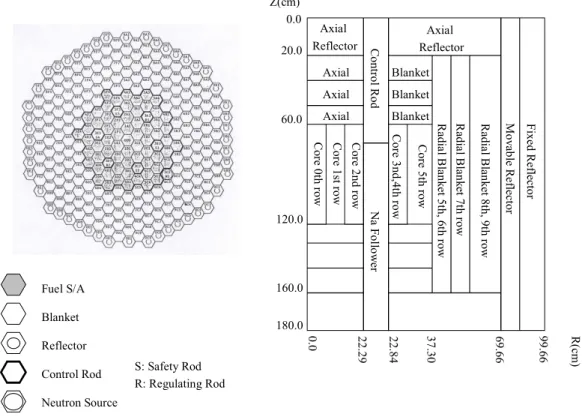
In this paper, the study has been applied to the analysis of the JOYO MK-I core. Since it is a power reactor, measurements performed such as the burnup-characteristics complement those of critical facilities and are worth investigating. The criticality of the minimum core and burnup reactivity coefficient of JOYO MK-I have been analyzed by ERANOS, and the results have been compared with those evaluated by the JNC code system. Figure 1 shows the configuration of the JOYO MK-I minimum core. The JOYO MK-I core consisted of mixed plutonium and enriched uranium fuel with the volume of 240 liters. Its core is much smaller than those of JUPITER, which were considered in the previous step of this study.
Fuel S/A Blanket Reflector Control Rod Neutron Source Axial Reflector Axial Blanket C or e 0t h r ow Cor e 1s t r ow Cor e 2nd row Core 3nd,4t h ro w Core 5t h row R adi al B lan ke t 5t h, 6t h ro w Radi al B lan ke t 7t h r ow R adi al B lan ke t 8t h, 9t h ro w Mov ab le R efl ector Fi xed Refl ect or Axial Reflector Axial Blanket Axial Blanket Co ntr ol R od Na F oll ow er 0.0 60.0 20.0 120.0 160.0 180.0 0.0 22.2 9 22.8 4 37 .30 69.6 6 99.66 Z(cm) R( cm ) S: Safety Rod R: Regulating Rod
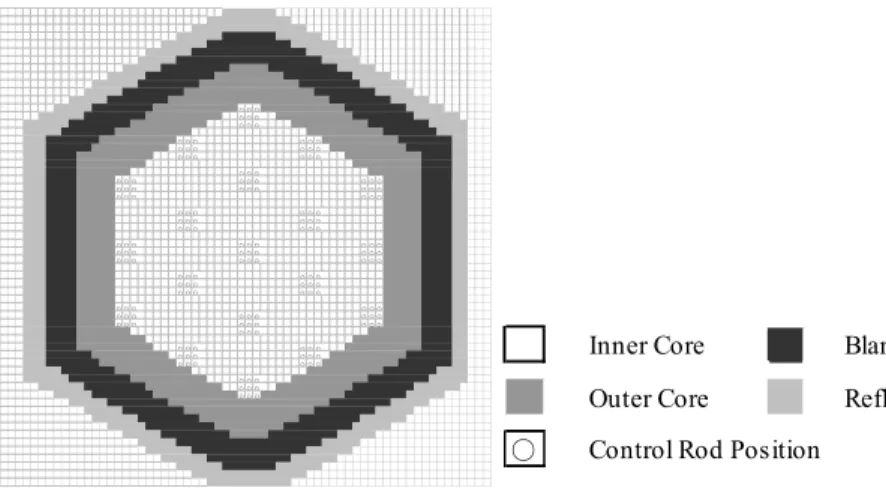
Further, criticality values of ZPPR-10A and ZPPR-10B cores of the JUPITER experiments have been considered in this study. These cores are middle-size two-region homogeneous cores in JUPITER-I phase (650MWe mock-up). Figure 2 shows the ZPPR-10A configuration. ZPPR-10A is a mock-up core of the end of cycle (EOC) and has control rod follower regions. ZPPR-10B has the same configuration as ZPPR-10A but is a mock-up core of the beginning of cycle (BOC) and has control rod regions. ○ ○ ○ ○ ○ ○ ○ ○ ○ ○ ○ ○ ○ ○ ○ ○ ○ ○ ○ ○ ○ ○ ○ ○ ○ ○ ○ ○ ○ ○ ○ ○ ○ ○ ○ ○ ○ ○ ○ ○ ○ ○ ○ ○ ○ ○ ○ ○ ○ ○ ○ ○ ○ ○ ○ ○ ○ ○ ○ ○ ○ ○ ○ ○ ○ ○ ○ ○ ○ ○ ○ ○ ○ ○ ○ ○ ○ ○ ○ ○ ○ ○ ○ ○ ○ ○ ○ ○ ○ ○ ○ ○ ○ ○ ○ ○ ○ ○ ○ ○ ○ ○ ○ ○ ○ ○ ○ ○ ○ ○ ○ ○ ○ ○ ○ ○ ○ ○ ○ ○ ○ ○ ○ ○ ○ ○ ○ ○ ○ ○ ○ ○ ○ ○ ○ ○ ○ ○ ○ ○ ○ ○ ○ ○ ○ ○ ○ ○ ○ ○ ○ ○ ○ ○ ○ ○ ○ ○ ○ ○ ○ ○ ○ ○ ○ ○ ○ ○ ○ ○ ○
Inner Core Blanket Outer Core Reflector ○ Control Rod Position
Figure 2. The core configuration of ZPPR-10A
2. METHOD OF ANALYSIS
Table I summarizes the main features of the JNC and CEA calculation schemes used for JOYO MK-I in this study. On the ZPPR-10A and -10B, the calculation schemes used for ZPPR-9 and -13A7 were
applied.
Table I. Comparison of the analytical methods for JOYO MK-I relating to this study
ERANOS JNC Nuclear data library JEF-2.2, ERALIB1 JENDL-3.2
Energy groups of the library 1968 and 33 70
Treatment of self-shielding Subgroup method
Background cross-section by Tone’s method + Interpolation of self-shielding factor
Treatment of spatial mesh (and Finite difference in Variational nodal
diffusion theory) Finite difference
Treatment of angular mesh P3 S8
Treatment of anisotropic
scattering P1 (Extended P0) P1 (Extended P0) Geometrical model of cell
calculation 2D exact model 1D ring model Geometrical model of core
calculation 3D Hex-Z 3D Tri-Z and 3D XYZ Homogenization method of
control rod
Reactivity preservation method
2.1 THE ERANOS CALCULATION SCHEME
In the analysis using ERANOS, two nuclear data sets were used: the European Joint Evaluated Library JEF-2.28 and the adjusted cross-section library ERALIB19. Fundamental calculations were
performed using the heterogeneous cell model with the coarse group (33-group) library. The group collapsing correction from the coarse groups to the fine groups (1968-groups) were evaluated by using the macrocell calculation option, which models whole core in one-dimensional (1D) geometry and takes into account the resonance and spectrum interaction between core and blanket regions. The corrected results by the group collapsing correction, which correspond to those obtained by using the effective cross-section produced by the fine groups library, is specified by the simple notation "ERANOS" in Chapter 3. The notation "ERANOS(33G)" represents the results without group collapsing correction.
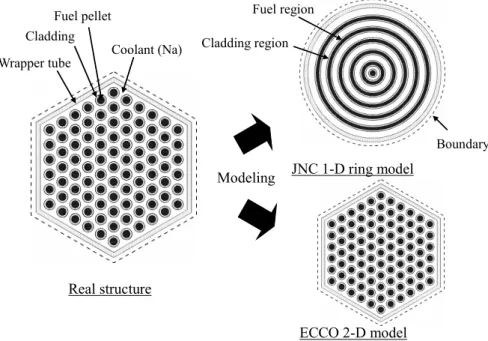
ERANOS treats the self-shielding of cross-sections with the subgroup method with the ECCO10 cell
code. In the cell calculation, a 2D cell model representation as shown in Figure 3 was applied. For the homogeneous cross-section of the control rod, an ERANOS scheme based on reactivity preservation method11 was used.
For core calculations, variational nodal transport theory12, which does not require the spatial mesh
correction, was applied for analyses of both criticality and burnup reactivity coefficient. In order to analyze the burnup coefficients, the PROJERIX scheme11 in ERANOS was applied to treat reloading
the fuel subassemblies exactly.
Fuel pellet Cladding Wrapper tube Cladding region Fuel region Coolant (Na) Boundary
Modeling JNC 1-D ring model
Real structure
ECCO 2-D model
Figure 3. Calculation model for the JOYO MK-I fuel sub-assembly 2.2 THE JNC CALCULATION SCHEME
In the JNC's analysis, 70-group fast reactor constant set based on the Japanese Evaluated Nuclear Data Library JENDL-3.213 (JFS-3-J3.2R14) was used for all core parameters. JFS-3-J3.2R was recently revised
Cell calculations were performed with 1D model for both fuel and blanket subassemblies15 and self-shielding was treated by the factor table interpolation method. In order to calculate the homogeneous cross-section of the control rod, reaction rate ratio preservation method16 was used.
All the parameters obtained by core calculations were corrected to results based on the transport theory with zero mesh-size in space and angle.
2.3 SENSITIVITY ANALYSIS
In order to investigate the effects due to the use of different libraries, a sensitivity analysis was also performed. The sensitivity coefficient of a core parameter, R, to cross-section, σ, is defined as follows: , , , , , , d d m x g m x g m x g R R S
σ
σ
= (1)where the subscripts m, x and g represent nuclide, reaction type and energy group number, respectively. Contribution of each cross-section to a core parameter change is evaluated as follows:
, , , , , , , , , m x g m x g m x g m x g m x g
R
R
S
R
σ
σ
σ
′
−
′ −
=
⋅
∑∑
(2)Sensitivity coefficients were calculated in order to investigate the results. They were calculated by SAGEP17 and SAGEP-BURN18 codes in the JNC system, which are based on the generalized
perturbation theory, including burnup characteristics19.
3. RESULTS AND DISCUSSION
This chapter describes the accuracy of ERANOS and subsequent comparison with the JNC system. Experimental and analytical uncertainties are worth being considered when analyzing the discrepancy in calculation over experiment (C/E) values from unity. The analytical uncertainties are based on an evaluation in the cross-section adjustment study of JNC1. Further, uncertainties induced from
cross-section must be considered, and they are evaluated by using the latest covariance data file for JENDL-3.220 , which are processed to group-wise data by ERRORJ code21. Those uncertainties are
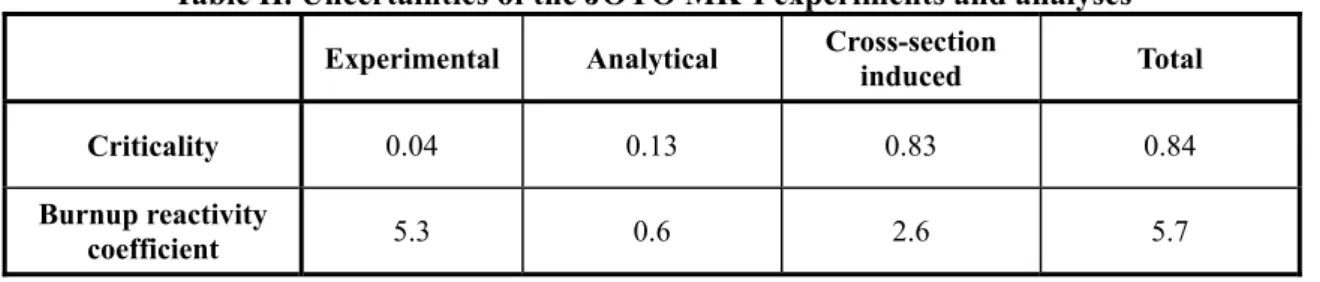
summarized in Table II. This table shows that the cross-section induced uncertainties are large in both parameters. Figure 4 and 5 show the contributions to the cross-section induced uncertainty to criticality and burnup reactivity coefficient, respectively.
Table II. Uncertainties of the JOYO MK-I experiments and analyses Experimental Analytical Cross-section induced Total
Criticality 0.04 0.13 0.83 0.84
Burnup reactivity
coefficient 5.3 0.6 2.6 5.7
0 0.2 0.4 0.6 0.8 1 1.2 U-235 χ Pu-239 χ Na Elastic Fe(Nat.) Elastic Fe(Nat.) Inelastic U-235 Fission U-238 Capture U-238 Inelastic Pu-239 Capture Pu-239 Fission Others Total
Nuclide and Reaction
Uncertainty (%) JOYO MK-I ZPPR-9 0.0 0.5 1.0 1.5 2.0 2.5 3.0 U-235 χ Pu-239 χ Fe(Nat.) Inelastic U-235 Capture U-235 Fission U-238 Capture U-238 Inelastic Pu-239 Capture Pu-239 Fission U-235 β U-238 β Pu-239 β Others Total
Nuclide and Reaction
Uncertainty (%)
JOYO MK-I
Figure 4. Nuclide-wise cross section induced
uncertainties for criticality Figure 5. Nuclide-wise cross section induced uncertainties for burnup coefficient
On the uncertainty of the criticality, JOYO MK-I has different trend from ZPPR-9. The uncertainty induced from Fe elastic scattering cross-section becomes dominant to JOYO MK-I, though Pu-239 fission cross-section is the main contribution to ZPPR-9.
On burnup coefficient, it is necessary to calculate an effective delayed neutron fraction (βeff) because
the experimental value was obtained in dollar unit. Therefore, the uncertainty of the burnup coefficient has contributions of the delayed neutron fraction (β). The uncertainties induced from the delayed neutron fractions of U-235 and U-238 are dominant to JOYO MK-I burnup coefficient. 3.1 CRITICALITY
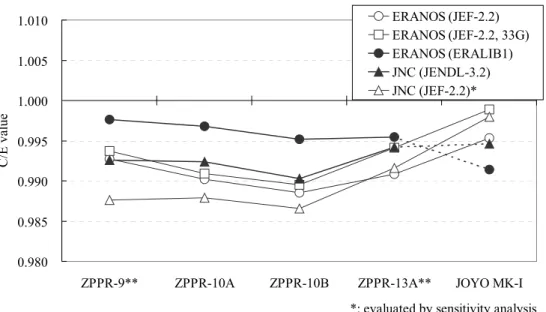
Figure 6 shows the summary of results on criticality. The effect of difference between 2D as-built cell model and 1D ring cell model was evaluated by ECCO and it is confirmed that the effect is very small for criticality (~0.02%∆k/kk') and negligible. This figure includes the results of JUPITER cores. The results of ZPPR-10A and ZPPR-10B have the same tendency as the other JUPITER cores (ZPPR-9 and ZPPR-13A).
For the minimum core criticality of JOYO MK-I, the result evaluated by ERANOS with JEF-2.2 is in agreement with that evaluated by the JNC system with JENDL-3.2. However, these two results include some effects by difference of methods and libraries. They are discussed in the followings. (1) Group collapsing effect:
It is found by comparing ERANOS(JEF-2.2) and ERANOS(JEF-2.2, 33G) that the group collapsing effect for JOYO MK-I core is ~0.4%dk/kk' and is as large as that for ZPPR-13A. Due to the small core of JOYO MK-I, the interaction between core and blanket region is becoming important.
0.980 0.985 0.990 0.995 1.000 1.005 1.010
ZPPR-9** ZPPR-10A ZPPR-10B ZPPR-13A** JOYO MK-I
C/E value ERANOS (JEF-2.2) ERANOS (JEF-2.2, 33G) ERANOS (ERALIB1) JNC (JENDL-3.2) JNC (JEF-2.2)*
*: evaluated by sensitivity analysis
Figure 6. Summary of results on the criticality (2) Library effect (JEF-2.2 and JENDL-3.2):
For JUPITER cores, it is predicted by sensitivity analysis that the use of JEF-2.2 decreases C/E value compared to JENDL-3.2. Figure 7 shows the break-down of the reactivity change when replacing the JENDL-3.2 library by the JEF-2.2 one. It is caused by a lot of nuclide and reaction contributions (mainly Pu-239 ν and fission). For JOYO MK-I core, the use of JEF-2.2 increases C/E value due to Fe elastic scattering cross-section and U-235 ν. The JOYO MK-I core is sensitive to the elastic scattering cross-section that affect the length of neutron mean free path because it is very small core and has large neutron leakage from the core. Further, the JOYO MK-I core is not sensitive to the Pu-239 due to the uranium-enriched fuel, compared with JUPITER cores that consisted of Pu fuel. (3) ERALIB1 effect:
ERANOS with JEF-2.2 systematically underestimates the criticality of the JUPITER cores and the use of ERALIB1 improves it well. However, the use of the ERALIB1 worsens the C/E value for JOYO MK-I core. Figure 8 shows the break-down of the reactivity change when replacing the JEF-2.2 library by the ERALIB1 one. In this figure, it is seen that the reactivity change has various nuclide and reaction contributions. The main contributions of the improvement for JUPITER core are Pu-239 fission cross-section and ν value. On the other hand, the main difference on JOYO core criticality is the Na elastic scattering cross-section.
-0.80 -0.60 -0.40 -0.20 0.00 0.20 0.40 Fe(Nat.) Capture Fe(Nat.) Elastic U-235 Fission U-235 ν U-238 Capture U-238 Fission
Nuclide and Reaction
Change (%) JOYO MK-I ZPPR-9 -0.60 -0.40 -0.20 0.00 0.20 0.40 0.60 0.80 Na Elastic Na Inelastic U-235 Capture U-235 Fission U-235 ν U-238 Fission U-238 Elastic N uc lid e a nd R eac Change (%) JOYO MK-I ZPPR-9 Pu-239 Capture Pu-239 Fission Pu-239 ν Others Total tio n U-238 Inelastic Pu-239 Fission Pu-239 ν Others Total
Figure 7. Nuclide-wise contribution to criticality
(Difference between JEF-2.2 and JENDL-3.2) Figure 8. Nuclide-wise contribution to criticality (Difference between ERALIB1 and JEF-2.2) 3.2 BURNUP REACTIVITY COEFFICIENT
Figure 9 shows the summary of the results of the burnup reactivity coefficient. For the burnup reactivity coefficient, the JNC system systematically overestimates the measurements. On the other hand, ERANOS with JEF-2.2 yields better results. The use of ERALIB1 further improves the C/E's, resulting in analytical results in agreement with the experimental ones within the uncertainties.
0.85 0.90 0.95 1.00 1.05 1.10 1.15
50MW Power-up test 50MW 1st cycle 50MW 2nd cycle
C/ E v alu e ERANOS (JEF-2.2) ERANOS (JEF-2.2, 33G) ERANOS (ERALIB1) JNC (JENDL-3.2) JNC (JEF-2.2)*
*: evaluated by sensitivity analysis and used βeff obtained by ERANOS
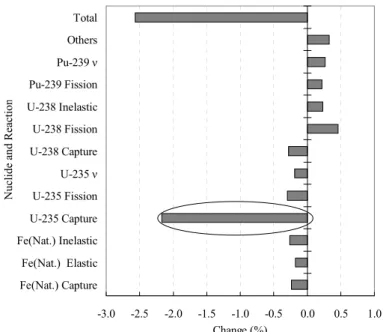
It is seen that the group collapsing effect for JOYO MK-I is very small (0.3%) and can be considered as negligible. The main reason of difference between JNC(JENDL-3.2) and ERANOS (JEF-2.2) is βeff, whose difference is 2.6%. Further, the change of nuclear data library (JEF-2.2 and JENDL-3.2)
causes a significant difference. Figure 10 shows the nuclide-wise contribution to the library effects. It is found that if U-235 capture cross-section of JEF-2.2 is used the burnup reactivity coefficient decreases by 2%. The use of U-235 capture cross-section in JEF-2.2 and βeff obtained by ERANOS
improves the results in the JNC system.
On the other hand, the control rod worth for ZPPR-9, which described in reference 7, has a discrepancy between ERANOS(JEF-2.2) and JNC(JENDL-3.2) because of βeff. In this case, the use of
βeff obtained by ERANOS worsens the results. Further discussion about βeff will be necessary.
-3.0 -2.5 -2.0 -1.5 -1.0 -0.5 0.0 0.5 1.0 U-238 Capture U-238 Fission Pu-239 Fission Pu-239 ν Others Total e an d n U-238 Inelastic Reactio Fe(Nat.) Capture Fe(Nat.) Elastic Fe(Nat.) Inelastic U-235 Capture U-235 Fission U-235 ν N uclid Change (%)
Figure 10. Nuclide-wise contribution to burnup coeffiecient (difference between JEF-2.2 and JENDL-3.2)
CONCLUSIONS
An analysis of the JOYO MK-I experiments using the ERANOS system has been performed, and the results of this analysis were compared with those obtained by the JNC system. In summary, ERANOS has a good performance for evaluating the characteristics of the small uranium-enriched fast reactor, including the burnup reactivity coefficients. The use of ERALIB1 adjusted library improves not only the results of the JUPITER core but also those of the burnup reactivity coefficient of JOYO MK-I core. However, it worsens the result of the criticality of JOYO MK-I core. There is a room for improvement concerning the criticality of small uranium-enriched cores like JOYO MK-I.
Concerning the JNC system, the incorporation of much finer groups constant set would be effective for the improvement of accuracy for JOYO MK-I core. In addition further investigation is required in the effective delayed neutron fraction (βeff). In future work, the other core parameters of JOYO will be
REFERENCES
1 M.Ishikawa, K.Sugino, W.Sato and K.Numata, "Development of a Unified Cross-section Set ADJ2000 Based on Adjustment Technique for Fast Reactor Analysis," Int. Conf. on Nuclear Data for Science and Technology, Tsukuba, Japan, 9C4(494) (2001).
2 M.J.Lineberry, et al., "Experimental Studies of Large Conventional LMFBR Cores at ZPPR," Proc. of Fast Reactor Physics 1979, Aix-en-Provence, IAEA-SM-244/86, Vol.1, pp.187 (1979). 3 M. Ishikawa, "Consistency Evaluation of JUPITER Experiments and Analysis for Large FBR
Cores," Proc. of Int. Conf. on the Physics of Reactors (PHYSOR96), Mito, Japan, Vol.2, P.E-36 (1996).
4 H.Yamamoto, et al., "JOYO Start Up Test Report -- Measurement of the Critical Core and Full Core Loading Test," PNC TN941 80-58, (Apr. 1980)
5 M.Ishikawa, et al., "Experimental Fast Reactor 'JOYO' Power-Up Test Report -- Burn-Up Coefficient (NT-35)," PNC TN941 80-33 (Feb. 1980)
6 J.Y.Doriath et al., "ERANOS1: The Advanced European System of Codes for Reactor Physics Calculation," Int. Conf. on Mathematical Methods and Super Computing in Nuclear Applications, Karlsruhe, Germany (1993).
7 K.Sugino and G.Rimpault, "Analyses of the JUPITER Fast Reactor Experiments Using the ERANOS and JNC Code System," Proc. of Int. Conf. on the Physics of Reactor (PHYSOR2000), Pittsburgh, PA, USA,
8 J.L.Rowlands and N. Tubbs, "The Joint Evaluated File: A New Nuclear Data Library for Reactor Calculation," Santa Fe Symposium (1985).
E.Fort, W.Assal, G.Rimpault, et al., "Realisation and Performance of the Adjusted Nuclear Data Library ERALIB1," Proc. of Int. C f Reactors (PHYSOR96), Mito, Japan, Vol.3, P.F-21 (1996).
al Method Implemented in the ERANOS System," Proc. of Top. Mtg. on Advances in Reactor Physics,
a, et al., "Development of the fast reactor group constant set JFS-3-J3.2R based on the JENDL-3.2," TN9400 2001-124 (Feb. 2002) [Written in Japanese].
. Iwai, "Advances in Methods of Commercial FBR Core Characteristics Analyses -- Investigations of a Treatment of the Double-heterogeneity and a Method to Calculate
16 nization Method for Fast
17 18
haracteristics (II)," PNC TJ9124 94-007, Vol.1 (Mar. 1994). [Written in Japanese] turbation Theory," Nucl. Sci. Eng., 91, pp.1 Session X.E (2000).
9
onf. on the Physics o
10 M.J.Grimstone, G.Rimpault, et al., "The Geometrical Treatment in the New European Cell Code ECCO," Top. Mtg. on Advances in Nuclear Engineering Computation and Radiation Shielding, Santa Fe, New Mexico (1989).
11 S.Czernecki, "Advancées dans le calcul neutronique des réacteur a neutrons rapides -- Démonstration sur le réacteur Super-Phénix," Thèse docteur de l'Université de Provence Mention Sciences Physiques (Nov. 1998). [Written in French]
12 J.Y.Doriath, J.M.Ruggieri, G.Buzzi et al., "Reactor Analysis Using a Variational Nod Knoxville, Tennessee (1994).
13 T.Nakagawa, et al., Japanese Evaluated Nuclear Data Library Version 3 Revision-2: JENDL-3.2," J. Nucl. Sci. Technol, 32, pp.1259 (1995).
14 G. Chib
15 K.Sugino and T
Homogenized Control Rod Cross Sections --," PNC TN9410 98-067 (July, 1998). [Written in Japanese]
T.Kitada, S.Kosaka and T.Takeda, "New Control Rod Homoge Reactors," J. Nucl. Sci. Technol., 31 [7], pp.647 (July 1994).
A.Hara, T.Takeda and Y.Kikuchi, "SAGEP: Two-Dimensional Sensitivity Analysis Code Based on Generalized Perturbation Theory," JAERI-M 84-027 (Feb. 1984). [Written in Japanese] H. Hanaki, et al., "Preparation of Computer Codes for Analyzing Sensitivity Coefficients of Burnup C
19 T.Takeda and T.Umano, "Burnup Sensitivity Analysis in a Fast Breeder Reactor -- Part I: Sensitivity Calculation Method with Generalized Per
20 Nuclear Data Covariance Workshop, BNL 21
II)," JNC TJ9440 99-003 (1999) [Written in Japanese] K. Shibata et al., "JENDL-3.2 Covariance File," Proc.
1999, pp.111, ORNL/TM-2000/19 (2000).
K. Kosako and N. Yamamo, "Preparation of Covariance Processing System for the Evaluated Nuclear Data File, JENDL, (I