HAL Id: halshs-00677393
https://halshs.archives-ouvertes.fr/halshs-00677393
Preprint submitted on 8 Mar 2012
HAL is a multi-disciplinary open access
archive for the deposit and dissemination of
sci-entific research documents, whether they are
pub-lished or not. The documents may come from
teaching and research institutions in France or
L’archive ouverte pluridisciplinaire HAL, est
destinée au dépôt et à la diffusion de documents
scientifiques de niveau recherche, publiés ou non,
émanant des établissements d’enseignement et de
recherche français ou étrangers, des laboratoires
Prevention against equality?
Marc Fleurbaey, Grégory Ponthière
To cite this version:
WORKING PAPER N° 2012 – 12
Prevention against equality?
Marc Fleurbaey
Grégory Ponthière
JEL Codes: D63, D71, I12, J18
Keywords: Compensation, Equality, Longevity, Mortality, Prevention
P
ARIS
-
JOURDAN
S
CIENCES
E
CONOMIQUES
48, BD JOURDAN – E.N.S. – 75014 PARISTÉL. : 33(0) 1 43 13 63 00 – FAX : 33 (0) 1 43 13 63 10
Prevention Against Equality?
Marc FLEURBAEY
Gregory PONTHIERE
yMarch 7, 2012
Abstract
Common sense supports prevention policies aimed at improving sur-vival prospects among the population. It is also widely acknowledged that an early death is a serious disadvantage, and that attention should be paid to the compensation of short-lived individuals. This paper re-examines the compatibility of those two concerns: prevention against early death and compensation for early death. We show that, under mild conditions, no social ordering on allocations can satisfy a concern for prevention and a concern for compensation. The reason is that if it is socially desirable to raise the number of survivors through prevention, it must also be, un-der costly prevention, desirable to deteriorate the living standards of the short-lived. We then explore two approaches to the prevention / compen-sation dilemma, and study the associated optimal allocation of resources. Keywords: compensation, equality, longevity, mortality, prevention. JEL codes: D63, D71, I12, J18.
Princeton University.
yEcole Normale Superieure, Paris - Paris School of Economics. [corresponding author] Address: Ecole Normale Supérieure, 48 boulevard Jourdan, building B, 2nd ‡oor, O¢ ce B, 75014 Paris, France. E-mail: [email protected] Telephone: 0033143136204.
1
Introduction
Death is the unique certain event of every human life. That unique sure thing gives rise, at the individual level, to three major types of reactions. A …rst reaction is to try to forget death. A second reaction is to try to postpone death as much as possible. A third reaction consists of trying to make death as benign as possible, by reducing the disadvantage associated to it.
At the social level, the …rst reaction seems hardly reasonable: one would certainly not like a society that treats its citizens as if these were invulnerable. On the contrary, one may expect from a fair or a good society to do as much as possible to postpone the death of its citizens, and to make their death as benign as possible. Those two requirements invite public policies of various kinds.
On the one hand, the desire to postpone death invites massive prevention programs against premature death. Although longevity inequalities are largely due to factors on which individuals have little control (e.g. genes, pollution, early childhood), it remains true that longevity is partly endogenous: a per-son can, to some extent, in‡uence his life expectancy by adopting more or less healthy lifestyles.1 Hence there is a strong support for prevention policies dif-fusing the healthy ways of life. In the light of the signi…cant impact of lifestyles on mortality, such policies could have a large impact. For instance, Balia and Jones (2008), in their study on premature mortality in Great Britain, correcting for biases due to endogeneity and unobserved heterogeneity, …nd that lifestyles predict about 25 percent of the overall inequality in mortality, with strong con-tributions of smoking and sleep patterns.2
On the other hand, there also exists a strong support for making death as benign as possible. A premature death is a serious disadvantage, which gives rise to large inequalities in well-being across individuals. From the point of view of social justice, such inequalities are unacceptable, and there is a strong appeal for compensating the short-lived, by reducing the disadvantage due to death as much as possible. Compensating the short-lived seems, at …rst glance, infeasible, since short-lived persons can be neither identi…ed ex ante nor a¤ected ex post (after their longevity is revealed). However, as shown by Fleurbaey et al (2011), such a compensation can be carried out under general conditions, by concentrating the consumption of resources on the early ages of life.3 Replacing smoothed or increasing consumption pro…les by decreasing consumption pro…les reduces the disadvantage due to early death.
Those two concerns - i.e. postponing death and making it benign - are both intuitive, and their corollaries in terms of policies are in conformity with common sense. A massive prevention against early death and the compensation of the short-lived seem to be equally desirable. From the perspective of social justice,
1On the impact of genes on longevity inequalities, see Christensen et al (2006).
2Other studies on the same topic include: Auster et al (1969), Mullahy and Portney (1990), Mullahy and Sindelar (1996), and Contoyannis and Jones (2004).
3The compensation proposed by Fleurbaey et al (2011) follows the lines of the egalitarian-equivalent approach to social justice (discussed below). Note that such a policy requires the knowledge, by the government, of the statistical distribution of the age at death.
those two concerns both favour equality, but on di¤erent grounds. Massive prevention favours the equality of longevities within the population, while the compensation of the short-lived favours the equality of standards of living among agents with unequal longevities. Egalitarians should thus want them both.
However, the main …nding of this paper is that there is tension between the goal to postpone death as much as possible for everyone, and the goal to make death as benign as possible for everyone. The reason for this tension is that prevention may impose costs on all individuals and ultimately harm those who die early in spite of sharing in the cost. We therefore explore the compatibility between prevention against early death and compensation for early death.
To study this issue, we consider a pure exchange economy with a …nite population of …nitely-lived individuals. In this economy there is a risk on the length of life, and individuals can raise their life expectancy through health-improving e¤orts (e.g. jogging). In this framework, we examine the possibility to construct a social ordering on the set of all possible allocations (i.e. lifetime consumption and prevention e¤orts pro…les for all agents), on the basis of several axioms capturing our concerns for prevention and compensation.
Note that such a framework, although simple, captures two important fea-tures of real life. First, the model emphasizes that the possibility to in‡uence one’s life expectancy does not coincide with a perfect control on actual longevity. This is in conformity with empirical studies showing that lifestyles a¤ect survival prospects on average, but that adopting a particular lifestyle does not guaran-tee a certain longevity, since longevity remains inherently risky. Second, our framework allows for the heterogeneity of individual preferences on (un)healthy lifestyles. This heterogeneity in attitudes toward lifestyles is also in conformity with real life. It is, for instance, a matter of fact that some persons like having physical activities, whereas other persons hate this kind of activity. But given that those heterogeneous preferences generate inequalities in life expectancies and, possibly, in actual longevities, they can hardly be ignored.
In this framework, the concern for prevention takes the form of a simple condition, the Survivors Numbers Count axiom, which states that, as soon as it delivers a strictly longer life to some individuals (other things equal), a small enough rise in the prevention e¤ort made by all individuals is socially desirable. The concern for compensation, on the other hand, take the form of an axiom called Pigou-Dalton for Equal Preferences, E¤orts and Lifetimes (PDEPEL). This axiom says that if we consider two agents who have the same longevity and the same preferences, then a transfer from the richer agent to the poorer agent constitutes a social improvement (everything else being unchanged).
Anticipating on our results, we show that, under mild conditions, such as the Weak Pareto axiom and the Hansson Independence axiom, there exists no social ordering on allocations satisfying both the Survivors Numbers Count axiom and PDEPEL. In other words, it is impossible to satisfy both our concern for prevention against early death and our concern for compensation for early death. The reason is that if it is socially desirable to raise the number of survivors through prevention (as implied by Survivors Numbers Count), it must also be socially desirable, if prevention is costly, to deteriorate the living standards of
the unlucky short-lived, which goes against compensation and equality concerns (and thus against our Pigou-Dalton axiom). Hence attempts to postpone death as much as possible con‡icts with attempts to make early death as benign as possible.
Therefore some choice has to be made between those two natural reactions in front of death. This paper explores two approaches to such dilemma.
A …rst approach consists of giving the priority to compensation, by letting the Survivors Numbers Count axiom aside. It can then be shown that, provided we add another version of the Pigou-Dalton Principle (i.e., the Pigou-Dalton Principle for Constant Consumption and Reference E¤ort and Lifetime — PD-CCREL), the social ordering on allocations must satisfy the maximin property on a particular index of well-being that we call the Constant Consumption Pro…le Equivalent for Reference Lifetime and E¤ort (CCPERLE). That is, the approach evaluates a particular social state by looking at the smallest consump-tion the agents would accept in the replacement of their current situaconsump-tion, if they could bene…t from longevity and e¤orts of reference.
A second approach consists of giving the priority to prevention, by letting PDEPEL aside. Actually, the set of social ordering functions satisfying Weak Pareto, Hansson Independence, Survivors Numbers Count and PDCCREL is not empty, and within the class of social ordering functions satisfying those axioms, there is a salient family of social ordering functions, which consists in the social ordering functions involving a continuous and quasi-concave social welfare function applied to CCPERLE levels.
Having derived these two alternative approaches to the dilemma between prevention and compensation, we will then explore the precise form of the social optimum in a simple 2-period economy where longevities are unequal, and where agents, who di¤er in time preferences and in preferences towards e¤ort, can a¤ect their life expectancy through dedication to prevention e¤ort. For this purpose, we start considering a …rst-best setting, in which individual preferences can be observed by the social planner, but not individual longevities — only the statistical distribution of deaths for all e¤ort levels is known ex ante. Then, we also consider a second-best setting, in which individual preferences cannot be observed.
The rest of this paper is organized as follows. Section 2 presents the frame-work. Section 3 presents plausible ethical axioms accounting for the prevention and the compensation concerns, and shows that no social objective can satisfy those axioms. Section 4 studies two approaches to the dilemma: priority to compensation or priority to prevention. Section 5 examines the corresponding social optima under a full observability of agents’preferences. Section 6 consid-ers some extensions, including the second-best problem. Section 7 concludes.
2
The framework
The model describes the situation of a given …nite population of agents with or-dinal preferences over lifetime consumption and dedication pro…les. We consider
a pure exchange economy.
The set of natural integers (resp., real numbers) is denoted N (resp., R). Let N be the set of individuals, with cardinality jNj. The maximum possible lifespan for any individual, i.e., the maximum number of periods that can ever be lived, is denoted by T , with T 2 N and T > 1.
Each individual will have a particular lifetime consumption pro…le. Under the assumption of non-negative consumptions, a lifetime consumption pro…le for an individual i 2 N is a vector of dimension T or less.
Each individual also has a particular lifetime preventive e¤ ort pro…le. Under the assumption of non-negative e¤ort, a lifetime e¤ort pro…le for an individual i 2 N is a vector of dimension T or less.4
For the simplicity of presentation, let us call the pair (ci; ei) the life of individual i, and denote this life by xi = (ci; ei). Following this notation, the set of all possible (individual) lives can be denoted by X =ST`=1 R`+ R`+ .
The longevity of an individual i with life xi is de…ned by a function : X ! N, such that (xi) is the dimension of the lifetime consumption and e¤ort pro…les, that is, the length of existence of individual i.
An allocation de…nes a consumption pro…le ci and a health e¤ort pro…le ei for each individual in N . An allocation for N can also be written as a list of lives for all members of N , that is, a vector xN := (xi)i2N 2 XjNj. We denote by xij`the beginning of life of sublength ` of individual i with longevity (xi) > `. That part of life includes a consumption subpro…le, denoted by cij`, and an e¤ort subpro…le, denoted by eij`.
Each individual i 2 N has well-de…ned preferences over the set of all pos-sible lives X. His preferences are described by an ordering Ri (i.e. a re‡exive, transitive and complete binary relation). For all xi2 X, the indi¤erence set at xi for Ri is de…ned as I(xi; Ri) := fx0i2 X j x0iIixig. For any lives xi and x0i of equal length, preference orderings on xi and x0i are assumed to be continuous, convex and weakly monotonic in consumption (i.e. if we consider (ci; ei) and (c0i; e0i), ci ci0 and ei = e0i imply xiRix0i, and ci c0i and ei= e0iimply xiPix0i). Note that we do not assume here monotonicity of preferences with respect to health-improving e¤ort, that is, we leave open the possibility to have some in-dividuals who like making health-improving e¤orts, whereas other inin-dividuals dislike this kind of practice. However, we assume that for all lives xi 2 X; there exists a life x with full length and with constant consumption (c; :::; c) 2 RT
+ and e¤ort (e; :::; e) 2 RT
+ such that xiIix, which means that no life is worse or better than all lives with full longevity. This excludes lexicographic preferences for which longevity is an absolute good or bad. Let < be the set of all preference orderings on X satisfying these properties. A preference pro…le for N is a list of preference orderings of the members of N , denoted RN := (Ri)i2N2 <jNj.
Finally, it should be stressed here that the preferences of the agent, as de-scribed by the ordering Ri on X, are assumed to be respectable preferences,
4Note that using such an e¤ort variable is a simpli…cation. One could, instead, have a monetary e¤ort (entering the budget constraint) or a temporal e¤ort (entering the time constraint). We use a purely physical e¤ort on the grounds of analytical simplicity.
in the sense that these are the preferences to be taken into account when as-sessing the goodness and the fairness of allocations. Clearly, in the context of health-a¤ecting choices, the occurrence of regrets is widespread, and such re-grets reveal the existence of a tension between, on the one hand, the preferences that governed the choices of agents (i.e. the ex ante preferences), and, on the other hand, the preferences that agents use when evaluating their lives (i.e. the ex post preferences).5 The existence of such a dual self raises the question of the preferences to be taken into account in social valuations. Usually, there is a ten-dency to consider that the most respectable preferences are the ones observed towards the end of life, life being regarded as a period of learning about oneself. Our approach will follow that standard view and take the ex post preferences of agents into account, and not the ex ante preferences.
3
The social objective
The goal of this section is to examine the possibility to derive a social objective that does justice to the prevention against an early death and to the compensa-tion for an early death. For that purpose, we will, in a …rst stage, present some basic ethical axioms that social preferences ought to satisfy. Then, in a second stage, we will propose two axioms that account for the ideas of preventing early death within the population and compensating short-lived persons.
Social preferences will be formalized by a social ordering function% which associates every admissible preference pro…le RN of the population with an ordering %RN de…ned on the set of all possible allocations for N , that is, an
ordering de…ned on XjNj. For all xN, x0
N 2 XjNj, xN &RN x0N means that the allocation xN is, under the preference pro…le RN, at least as good as the allocation x0N. The symbols RN and RN will denote strict preference and
indi¤erence, respectively.
A …rst, standard axiom imposed on social preferences consists of the Weak Pareto axiom, which states that if all individuals prefer one allocation to an-other, then this should also be regarded as socially preferable to that alternative. Axiom 1 (Weak Pareto) For all preference pro…les RN 2 <jNj, all alloca-tions xN; x0N 2 XjNj, if xiPix0i for all i 2 N, then xN RN x0N.
This axiom can be justi…ed as a guarantee against the choice of ine¢ cient allocations, or, alternatively, as a way to insure the respect for individual pref-erences. In the context of health-a¤ecting choices, the reliance on the Pareto axiom is quite liberal, since individual preferences may go against behaviors maximizing individual health.
5For instance, Slovic (2001) found, on the basis of a telephone survey of a representative sample of U.S. respondents, that 85 % of adult smokers stated that they would not start smoking if they had to do it over again. That result is robust to various countries. In the U.K., Jarvis et al (2002) showed that about 83 % of smokers "would not start smoking if they had their time again". Finally, Fong et al (2004) showed, on the basis of a telephone survey in Canada, the U.S., the U.K. and Australia, that about 90 % of smokers agree with the statement "if you had to do it over again, you would not have started smoking"
In the social choice literature, it is also common, in order to avoid Arrow-type impossibility results, to impose the Hansson Independence axiom. That condition, which was …rst introduced by Hansson (1973) and Pazner (1979), re-quires that social preferences over two allocations depend only on the individual indi¤erence curves at these allocations.
Axiom 2 (Hansson Independence) For all preferences pro…les RN; R0N 2 <jNjand for all allocations xN; x0
N 2 XjNj, if for all i 2 N, I(xi; Ri) = I (xi; Ri0) and I(x0
i; Ri) = I (x0i; R0i), then xN %RN x0N if and only if xN %R0 N x
0
N.
In comparison to Arrow’s Independence of Irrelevant Alternatives, Hansson Independence is much weaker, since the indi¤erence curves at the allocations un-der consiun-deration contain more information than individual pairwise preferences over these two allocations. This is what preserves us from Arrow’s impossibility. Let us now formulate, in the context of our economy, a concern for postpon-ing death as much as possible. Such concern for prevention can take the form of the Survivors Numbers Count axiom. This axiom states that, as soon as it guarantees a strictly longer life to one person (and the same longevities for all others), a general increase in preventive e¤ort is socially desirable.
Axiom 3 (Survivors Numbers Count) For all RN 2 <jNj, all xN, x0N 2 XjNj, all i 2 N, if (xi) < (x0
i), if xi= x0ij (xi), xj= x
0
j for all j 6= i, and if x0
iPixi, then there exists a vector of e¤ ort e00N e0N such that: (c0i; e00i)i2N %RN (xi)i2N
The Survivors Numbers Count axiom states that the certainty of lengthening the life of one person justi…es, from a social perspective, a rise in the levels of individual health e¤orts. This condition is quite intuitive, since the increase in preventive e¤ort is not based here on the expectation of saving one life (as in policy decisions), but, rather, on the absolute certainty to save one life.6
Regarding the concern for compensation, one way to capture this is by means of the following version of the Pigou-Dalton compensation principle, which we call here Pigou-Dalton for Equal Preferences, E¤orts and Lifetimes (PDEPEL). This axiom states that, for agents who are identical in terms of everything (i.e. preferences, e¤ort, longevity) except their consumption, a transfer from the agent with the higher consumption to the agent with the lower consumption is a social improvement.
Axiom 4 (Pigou-Dalton for Equal Preferences, E¤orts and Lifetimes) For all RN 2 <jNj, all xN, x0N 2 XjNj, and all i, j 2 N, if Ri = Rj, if ei = e0i = ej = e0j, (xi) = (x0i) = (xj) = x0j = `, and there exists
2 R`
++ such that
c0i ci= c0i cj= c0j+ c0j
6At the stage of de…ning the social ob jective, it is important to posit basic principles like "saving one life is worth some e¤ort" that bear on the evaluation of …nal consequences. At the stage of policy decisions, studied in later sections, one deals with statistical lives.
and xk = x0k for all k 6= i; j, then
xN %RN x0N:
Although quite intuitive, the Pigou-Dalton principle is limited to individuals with identical preferences and this is a very strong limitation. Social orderings that give full priority to individuals having certain kinds of preferences, even when they are extremely better o¤ than others, can satisfy this axiom.
In order to introduce some inequality aversion across individuals with dif-ferent preferences, a natural candidate consists of the following axiom, which is another version of the Dalton principle. This axiom, called the Pigou-Dalton Principle for Constant Consumption, and Reference E¤ort and Lifetime, states that, if two agents have a longevity that is equal to a level of reference ` , as well as an e¤ort pro…le that is equal to a reference pro…le e , then a transfer that lowers the constant consumption pro…le of the rich and raises the constant consumption pro…le of the poor constitutes a social improvement, whatever their preferences.
Axiom 5 (Pigou-Dalton for Constant Consumption, Reference E¤ort and Lifetime) For all RN 2 <jNj, all xN, xN0 2 XjNj, and all i, j 2 N, such that ei = e0i =
ej = e0j = e , and such that (xi) = (xi0) = (xj) = x0j = ` , and xi and xj are constant consumption pro…les, if there exists 2 R`++ such that
c0i ci= c0i cj= c0j+ c0j and xk = x0k for all k 6= i; j, then
xN %RN x0N:
The restriction to speci…c situations (constant consumption, reference e¤ort and longevity) is necessary for this axiom to remain compatible with Weak Pareto, as is well known in social choice theory. It is intuitive that if one wants to respect individual preferences, it is impossible to make interpersonal comparisons in physical terms in all cases. This is the reason for this restriction, which is not needed, by contrast, when the transfer is made between individuals with identical preferences, and this explains the di¤erence between the two Pigou-Dalton axioms introduced here.
The reference pro…le of health-improving e¤orts e and the reference longevity ` can be interpreted as follows. The reference e¤ort pro…le e and reference longevity ` are such that an external observer could, when comparing the lives of two persons with the e¤ort pro…le e and the length ` , say who is better o¤ than the other by just looking at the constant consumption pro…les of those agents, without knowing anything about their preferences. Thus the reference levels of longevity and e¤orts allow the comparison of agents’ well-being di-rectly from their consumption, without caring for their preferences. Naturally, the reference e¤orts pro…le e and reference longevity ` are ethical parame-ters, whose selection can, in combination with the Weak Pareto axiom, have important redistributive consequences.
The …ve axioms de…ned above seem quite appealing, and one would like social preferences to satisfy all of them. However, as stated in the following proposition, the …rst four axioms are logically incompatible.
Theorem 1 There exists no social ordering function % de…ned on <jNj satis-fying Weak Pareto, Hansson Independence, PDEPEL, and Survivors Numbers Count.
The proof of this result is simple and we only provide a sketch of the argu-ment. By a direct adaptation of arguments developed in Fleurbaey et al. (2011), one shows that Weak Pareto, Hansson Independence, and PDEPEL imply an absolute priority for the worse-o¤ individuals. That is, if two persons i and j have the same preferences, but i lies on a higher indi¤erence curve than j, push-ing i on a lower indi¤erence curve and j on a higher one is socially desirable, whatever the relative size of the shift for the two agents.
However, absolute priority for the worse-o¤ con‡icts with the Survivors Numbers Count axiom under general assumptions on individual preferences. To see this, let us …rst remind that this latter axiom states that, as soon as this guarantees the rise in the longevity of one person (and no change in others’ longevities), a generalized rise in the preventive e¤ort levels in the population is socially desirable. Note, however, that such a generalized rise in prevention can be damageable to the worse-o¤ individuals. Take the case where the worse-o¤ individuals are short-lived persons who do not like health e¤orts. If some addi-tional preventive e¤ort is imposed to them — without increasing their longevity — those persons are made worse o¤ than before, and so rising the overall pre-vention level in the name of the rise in one person’s longevity contradicts the priority given to the worse-o¤s. Hence some choice is to be made between the Pigou-Dalton axiom and the Survivors Numbers Count axiom.
Before drawing the corollaries from that result, it should be noticed that if some restrictions were imposed on individual preferences, the above impossibil-ity would no longer prevail. If, for instance, individual preferences are monotonic not only in consumption, but also in preventive e¤ort, then imposing a general rise in preventive e¤ort will not worsen the situation of the worse-o¤ individuals, and, thus, will not contradict our absolute priority to the worse-o¤s.
Having stressed this, it remains that there is no obvious reason why one should impose the monotonicity of individual preferences with respect to e¤ort. Hence, the above impossibility highlights a true dilemma: social preferences cannot exhibit both a concern for the number of survivors and a priority to the worse o¤. One cannot care both about the prevention against an early death, and about the compensation for an early death. A choice must be made between those two concerns, which appear equally reasonable. The rest of the paper explores two distinct approaches to that dilemma.
4
Two approaches
On the one hand, a …rst approach consists of giving up the concern for prevention against a premature death, while keeping the concern for compen-sating the short-lived. This can been done by relaxing the Survivors Numbers Count axiom, and by characterizing the social preferences in a context where the compensation of the short-lived matters.
On the other hand, one can keep the concern for a wide prevention against an early death, while giving less priority to the concern for compensating the short-lived. This can be done by keeping the Survivors Numbers Count axiom, while adopting a modi…ed version of the Pigou-Dalton principle.
The rest of this section will explore these two solutions.
4.1
Priority to compensation
Let us now explore the …rst approach, which does not require social preferences to satisfy the Survivors Numbers Count axiom. The question is whether this implies completely giving up any concern for prevention.
The combination of the remaining four axioms su¢ ces to provide a partial but relatively precise characterization of social preferences. In order to investi-gate what kind of social preferences satisfy those conditions, let us …rst de…ne the Constant Consumption Pro…le Equivalent for Reference Lifetime and E¤ort (CCPERLE).
De…nition 1 (CCPERLE) For any i 2 N, any Ri 2 < and any xi 2 X, the Constant Consumption Pro…le Equivalent for Reference Lifetime and E¤ ort (CCPERLE) of xiis the constant consumption pro…le ^cisuch that (^ci; e ) = ` and
xiIi(^ci; e )
where e is the reference e¤ ort pro…le and ` is the reference longevity level. The CCPERLE can be interpreted as the constant consumption path that would, if combined with a reference e¤ort pro…le e and a reference longevity ` , make the agent indi¤erent with his current life. As such, the CCPERLE can be regarded as a way to homogenize consumptions across individuals, by converting consumptions under di¤erent e¤orts and longevities into some com-parable consumptions. The intuition goes as follows. In the present context, where agents may have unequal e¤orts and unequal longevities, looking at con-sumption pro…les does not su¢ ce to have an idea of individual well-being. A given consumption per period does not yield the same well-being if it is associ-ated with a high or a low health e¤ort, or if it is enjoyed during a more or less long life. However, the CCPERLE allows us to have a precise view of agent’s well-being, since it has, by construction, taken e¤ort and longevity di¤erentials into account.7
7Note that the CCPERLE of x
ialways exists if ` = T , by our assumptions made on <, but the existence of the CCPERLE is not guaranteed if ` < T: It may happen that xi with high longevity is strictly preferred to all lifetime consumption pro…les with lower longevity ` : When this happens, we adopt the convention that the CCPERLE is in…nite. This problem
It is straightforward to see that, if ci is a constant consumption pro…le with (ci; e ) = ` , the CCPERLE is equal to the consumption pro…le, i.e. ^ci = ci. However, if ci is a constant consumption pro…le with an e¤ort pro…le equal to the reference pro…le (i.e. ei = e ) but with a longevity ` lower than the reference longevity ` , then we have ^ci? ci, depending on whether ci lies above or below the critical level making a longer life with that consumption worth being lived. Moreover, if ci is a constant consumption pro…le with ` = ` but with an e¤ort pro…le lower than the reference pro…le (i.e. ei e ), then we have ^ci 7 ci, depending on whether the agent likes or dislikes making health-improving e¤orts. If the agent regards e¤ort as desirable, imposing the higher reference e¤ort pro…le to him would require, to bring indi¤erence with his initial situation, a lower consumption pro…le, yielding ^ci < ci. On the contrary, if the agent dislikes making e¤ort, imposing a higher e¤ort level e ei will require to raise his consumption pro…le, in such a way as to maintain indi¤erence with the situation with a lower e¤ort. Then, in that case, we will have ^ci > ci. Therefore, when the reference e¤ort pro…le is higher than the actual e¤ort level, our equivalent is lower for the agents with a taste for e¤ort, and higher for agents who dislike e¤orts, ceteris paribus.
Having de…ned the CCPERLE, we can now present the following theorem, which characterizes the social preferences, or, more precisely, states that the Maximin on CCPERLE is a necessary condition for social optimality.
Theorem 2 Assume that the social ordering function% satis…es axioms Weak Pareto, Hansson Independence, PDEPEL and PDCCREL on <jNj. Then% is such that for all RN 2 <jNj, all xN, x0N 2 XjNj,
min
i2N(^ci) > mini2N(^c 0
i) =) xN RN x0N:
This theorem is an immediate extension of Th. 1 in Fleurbaey et al. (2010). As explained in the previous section, the combination of Weak Pareto, Hansson Independence and PDEPEL implies absolute priority for the worse-o¤ among agents having the same preferences. Adding PDCCREL to the list forces inter-personal comparisons to be made in terms of CCPERLE.
It should be noted that this theorem does not give a full characterization of social preferences because it does not say how to compare allocations for which min (^ci) = min (^c0i).8 All the theorem states is that if one allocation exhibits a higher minimum CCPERLE than another, then it must also be socially more desirable. In other words, the theorem implies that maximizing min (^ci) is a necessary operation, as the best social allocation is necessarily included in the set of allocations that maximize min (^ci). Note, however, that in most concrete problems, it is likely that the Maximin on CCPERLE has, as a solution, a
of non-existence is not very important as the social preferences highlighted here focus on the worst-o¤ individuals.
8Clearly, given the postulated axioms, the equality of the min (^c
i)for two allocations does not necessarily imply social indi¤erence between these allocations: an allocation could still be regarded as better than the other (on the grounds of other aspects of the distribution), and the theorem has nothing to say about that.
unique allocation, in which case that allocation must also be the most socially desirable allocation. When a unique solution is not obtained, it is natural to re…ne the Maximin into the Leximin, which extends the lexicographic priority of the worse-o¤ to higher ranks in the distribution.
4.2
Priority to prevention
The alternative approach consists in dropping the …rst Pigou-Dalton axiom and reintroducing Survivors Numbers Count. There are many social ordering functions that satisfy the list of axioms made of Weak Pareto, Hansson Inde-pendence, Survivors Numbers Count and PDCCREL. Some of them violate the principle of anonymity, or give di¤erent degrees of priority to various individuals as a function of properties of their indi¤erence sets.
However, there is a salient family in the class of social ordering functions satisfying these axioms. Consider two additional and standard axioms.
Axiom 6 (Continuity) For all RN 2 <jNj, all xN 2 XjNj, the sets n x0N 2 XjNjj xN %RN x0N o and nx0N 2 XjNjj x0N %RN xN o are closed.
Axiom 7 (Separability) For all RN 2 <jNj, all xN, x0N 2 XjNj, all M N , xM; xNnM %RN x0M; xNnM , xM; x0NnM %RN x0M; x0NnM : One then obtains the following result, characterizing what we will call the Sum of Transformed CCPERLE.
Theorem 3 Assume that the social ordering function% satis…es Weak Pareto, Hansson Independence, Continuity, Separability, and PDCCREL on <jNj. Then Survivors Numbers Count is also satis…ed, and there is an increasing concave function ' : R+ ! R such that for all RN 2 <jNj, all xN, x0N 2 XjNj,
xN %RN x0N , X i2N ' (^ci) X i2N ' (^c0i) : Proof. See the Appendix.
Note that this second approach retains a concern for prevention without completely dropping the ideal of compensation. Seeking equality in terms of CCPERLE implies giving some priority to the worse-o¤. It may happen that for individuals who are far from the reference longevity and e¤ort, and for particular preferences, the social ordering fails to give priority to the distribution of consumption c to the worse-o¤ as measured by CCPERLE. But the ordering never fails to give priority to the worse-o¤ who are at the reference levels, and the more inequality averse the function W; the more this priority extends to situation away from the reference levels.
5
First-best optimum
The previous section explored two approaches to the dilemma between preven-tion against early death and compensapreven-tion for early death. We showed that, if priority is given to compensation, basic axioms on social preferences imply that the optimal allocation must maximize the minimum CCPERLE in the popula-tion. On the contrary, if the survivors number matters, then, provided we add another version of the Pigou-Dalton principle, a wide class of social objective can satisfy our ethical requirements, including social welfare functions that are continuous and quasi-concave in individual CCPERLE levels, and allows for various arbitrages between compensation and prevention concerns.
This section characterizes, under these two alternative social objectives, the social optimum in a resource allocation problem where individuals, who face risky lifetime, di¤er in time preferences and in (dis)utility from prevention.
5.1
Environment
Consider an economy where agents live either one or two periods. The length of life of each agent is only known ex post. Ex ante, the social planner knows indi-vidual preferences, as well as the statistical distribution of indiindi-vidual longevities for each level of e¤ort.9 The social planner, who can monitor individual e¤ort, looks for the optimum allocation of an endowment W of resources.
Heterogeneity concerns two aspects of preferences: time preferences i and attitude towards e¤ort vj. Some agents assign a high weight to the future (old age), whereas others are less patient, and assign a low weight to the future. Some agents like prevention e¤ort (e.g. jogging), whereas others dislike it.
For simplicity, individual lifetime welfare takes a standard time-additive form, which is separable in the utility or disutility of e¤ort:
Uij1 = u(cij) + vj(eij) ;
Uij2 = u(cij) + vj(eij) + iu(dij);
where cij, dij and eij denote …rst- and second-period consumptions and e¤ort of an agent with a time preference factor i and an utility from e¤ort vj, while U1
ij and Uij2 denote his actual lifetime utility if he lives respectively one or two periods. Temporal utility u( ) takes the same form for everyone, unlike the utility from e¤ort, which is type-speci…c, under the form of vj( ).10 We assume that there exists some consumption c such that u(c) = 0.11
Ex ante, agents are standard expected-utility maximizers: EUij = u(cij) + vj(eij) + (eij) iu(dij);
where EUij denotes the expected utility of an agent with time preference i and attitude towards e¤ort vj(eij). The expression (eij) denotes the survival
9The latter piece of information amounts, in the present context, to know how the indi-vidual e¤ort level a¤ects the life expectancy of agents.
1 0As usual, we assume: u0(cij) > 0and u00(cij) < 0:
function for an agent making an e¤ort eij. As usual, we assume (0) = ~ > 0, 0( ) > 0, 00( ) < 0 and that there exists a maximum e¤ort level e, so that (e) = < 1.
Heterogeneity takes the following form. Ex ante, agents di¤er in their time preferences, i, and in their attitude towards e¤ort, vj, with two types for each. For time preferences, type-1j agents are less patient than type-2j agents:
0 < 1 < 2 < 1
Regarding e¤ort, we assume that i1 agents dislike e¤orts, whereas type-i2 agents like e¤ort. For simplicity, we assume that vj( ) = jv ( ) with v(0) = 0; v( ) 0, v0( ) > 0 and v00( ) > 0, with:
1< 0 < 2
Hence, there exist 4 types of agents ex ante, who are di¤erentiated by their i and j. Ex post, there are 8 types of agents, as each ex ante type includes short-lived and long-lived agents.12
We assume that the social planner can allocate resources as …rst-period or second-period consumptions without any cost, but that agents cannot transfer resources across periods freely, so that the bundles (received from the planner) have to be consumed in the same periods as they are received.13 Within that framework, the problem of the social planner consists in o¤ering four consump-tion and e¤ort bundles (cij; dij; eij) to agents with time preference parameter i and attitude towards e¤orts j, for i = 1; 2 and j = 1; 2. Note that these bundles do not depend on whether agents live one or two periods, as the actual length of life is not known ex ante by the planner.
The two social objectives considered here are the Maximin CCPERLE and the Sum of Transformed CCPERLE. Note that, at …rst glance, one might want to consider simpler social objective functions, de…ned not in terms of CCPERLE levels, but, rather, in terms of individual lifetime welfare levels. The problem is that such an approach would presuppose a full comparability of individual life-time welfare levels, which is problematic, since preference parameters i and j then become, under that approach, scaling factors a¤ecting the social optimum in an arbitrary way.14 Social objectives de…ned in terms of CCPERLE levels are immunized against those comparability / aggregation problems.
5.2
Maximin CCPERLE
In the following, we solve the problem faced by a planner trying to maximize the minimum CCPERLE, assuming that the planner can observe characteristics i and j. For that purpose, we take the maximum length ` = 2 as a reference level ` , and the maximum e¤ort level e as the reference level of e¤ort e .
1 2We assume that there is a mass 1 of individuals in each of the ex ante groups.
1 3This amounts to assume that the social planner can fully tax the savings of individuals. 1 4There is, for instance, no obvious reason why, under zero e¤ort, lover and e¤ort-averse individuals should be equally well-o¤. Moreover, there is no obvious reason why impa-tient agents should have a lower lifetime welfare than paimpa-tient agents ceteris paribus.
By de…nition, the CCPERLE for an agent of type i; j with an actual length of life ` = 1; 2 is the constant consumption pro…le (^cij`; ^cij`) such that:
u (^cij2) + jv(e) + iu (^cij2) = u (cij) + jv(eij) + iu (dij) u (^cij1) + jv(e) + iu (^cij1) = u (cij) + jv(eij)
On the …rst line, ^cij2de…nes the consumption equivalent of an agent with time preference i and attitude towards e¤ort j who e¤ectively lived two periods, while the second line de…nes a consumption equivalent ^cij1 for a i; j -type agent living only one period. Note that since we take ex-post utilities on the right-hand side of these expressions, the CCPERLE of an agent does not de-pend on his survival probability. However, the ex post lifetime welfare does depend on individual health-a¤ecting e¤ort, through its impact on …rst-period welfare. Thus, if individual e¤ort depends on the survival function, this will a¤ect indirectly the level of the consumption equivalent for a given longevity.
Let us …rst de…ne the consumption equivalent (^cij`; ^cij`) for each of the 8 groups of individuals that emerge ex post.
` def. CCPERLE ^cij`
1 1 1 u (^c111) (1 + 1) + 1v(e) = u (c11) + 1v(e11) 1 2 1 u (^c121) (1 + 1) + 2v(e) = u (c12) + 2v(e12) 2 1 1 u (^c211) (1 + 2) + 1v(e) = u (c21) + 1v(e21) 2 2 1 u (^c221) (1 + 2) + 2v(e) = u (c22) + 2v(e22) 1 1 2 u (^c112) (1 + 1) + 1v(e) = u (c11) + 1v(e11) + 1u (d11) 1 2 2 u (^c122) (1 + 1) + 2v(e) = u (c12) + 2v(e12) + 1u (d12) 2 1 2 u (^c212) (1 + 2) + 1v(e) = u (c21) + 1v(e21) + 2u (d21) 2 2 2 u (^c222) (1 + 2) + 2v(e) = u (c22) + 2v(e22) + 2u (d22) The problem of the social planner can thus be written as follows:
max
cij;dij;eij
min(^c111;c^121;^c211;^c221;c^112;^c122;^c212;c^222)
s.to c11+ (e11)d11+ c21+ (e21)d21+ c12+ (e12)d12+ c22+ (e22)d22 W where the CCPERLE ^cij` are de…ned in the above table.
The solution to that social planning problem is represented below.
Proposition 1 Under perfect information about ex-ante types i; j , and (4 + 2~ + 2 ) c W , the Maximin CCPERLE optimum involves:
c < c11< c12; c21< c22 d11 = d12= d21= d22= c e11 = e21= 0 < e12= e22= e
That consumption, e¤ ort pro…le leads to an equalization of CCPERLE among ex ante groups, but may not prevent inequalities within ex ante groups:
^
c121 = c^122 c^111= ^c112 and ^c221= ^c222 ^c211= ^c212 ^
Proof. See the Appendix.
The Maximin CCPERLE optimum exhibits three major features.
First, it provides a consumption c to all agents at the old age. Indeed, if dij exceeds c, long-lived agents are better o¤ than short-lived agents. Hence, redistributing dij c towards the young increases the welfare of the short-lived. Inversely, if dij < c, the worst-o¤ agents are the long-lived, so that redistributing towards them until dij = c would raise the welfare of the worst-o¤s. Hence we must have dij = c.15
Second, the Maximin CCPERLE imposes zero prevention e¤ort on agents who dislike prevention. The reason is that, since some e¤ort-averse agents will turn out to be short-lived despite prevention, the welfare of those short-lived agents is de…nitely increased by allowing them to avoid prevention e¤ort. The same is not true for e¤ort-loving agents, for whom it is always optimal to allow them to do the maximum e¤ort, whatever they survive to the old age or not.
Third, the Maximin CCPERLE discriminates, at the young age, between agents with di¤erent ex ante characteristics. The priority given to patient agents (for a given attitude towards prevention) is not surprising, since patient agents are more a¤ected by a short life than impatient agents. Regarding the priority given to those who like prevention, the intuition goes as follows. Agents who dislike e¤ort tend to choose an e¤ort level that is inferior to the reference e¤ort, and this su¢ ces to make these appear "better o¤" than the agents who like e¤orts and practice the reference e¤ort. Hence, when one measures the well-being of agents by using the maximum e¤ort level as a reference, the CCPERLE of the patient who likes e¤ort is necessarily lower, for an equal …rst-period consumption, than the CCPERLE of the patient who dislikes e¤ort. Hence the Maximin CCPERLE leads to higher …rst-period consumption for agents who like prevention (under given time preferences).
All in all, the Maximin CCPERLE achieves a full compensation with respect to the length of life: for given i and j, there is, at the social optimum, an equality of lifetime welfare, whatever individuals live long or not. However, there may remain some welfare inequalities across agents with an equal longevity, but these inequalities result from agents’preferences (di¤erent i or j), for which they can be held responsible, unlike for a premature death.16
Regarding the prevention, imposing zero e¤ort levels to all agents who do not life e¤ort may be shocking. Indeed, given that the proportion of survivors in a group depends on the amount of e¤ort, imposing such a low e¤ort level amounts to nothing less than reducing the number of survivors with respect to what would have prevailed under, for instance, a generalized high e¤ort. But the Maximin solution does not depend on the number of agents who are in each situation (e.g. short-lived or long-lived), but only on how bad the situation of the worse-o¤ is. This explains why it is optimal to impose e¤ort levels that are minimal for agents who do not like e¤ort. Allowing large e¤orts for those agents
1 5That rationale is close to the one used in Fleurbaey et al (2011).
1 6On the distinction between "circonstances" characteristics and "responsibility" character-istics, see Fleurbaey (2008).
would make the short-lived members even worse-o¤ than without such e¤ort.17 That particular corollary of the Maximin CCPERLE is counterintuitive, since there is a strong intuitive support for large preventive campaigns favouring large levels of health-improving e¤orts, and leading, in …ne, to a large number of survivors. Obviously the Maximin CCPERLE, which does not care about the number of survivors, but only about the situation of the short-lived, does not legitimate such practices. The reason is that the Maximin CCPERLE gives absolute priority to compensation concerns over prevention concerns.
5.3
Sum of Transformed CCPERLE
Let us now explore what the social optimum becomes under an alternative approach to the compensation / prevention dilemma, which does not give up a concern for massive prevention. As stated in Theorem 3, adding the Survivors Numbers Count axiom to the Weak Pareto and Hansson Independence axiom, while replacing the Pigou-Dalton Principle for Equal Preferences, E¤ort and Lifetime (PDEPEL) by the Pigou-Dalton Principle for Constant Consumption and Reference E¤ort and Lifetime (PDCCREL), implies, under Continuity and Separability, that social preferences can be represented by a sum of transformed CCPERLE ' (^cij`), with '0( ) > 0 and '00( ) < 0.
For the purpose of this analytical application, we will take, as a social objec-tive, Atkinson’s isoelastic social welfare function, de…ned in terms of individual CCPERLE (instead of individual utilities as usually done):18
W (^cN) = X i;j;` nij` (^cij`)1 1 1
where re‡ects the sensitivity of social preferences to inequalities in CCPERLE among the population, while nij` is proportion of individuals of type ij with a length of life `.19 That social objective includes the case where = 0, in which what is to be maximized is the sum of individuals’CCPERLE. On the contrary, when tends to +1, the social objective is the Maximin on CCPERLE, which gives absolute priority to the compensation of the dead.
Except in that special case, the isoelastic social objective function W (^cN) does some justice to massive prevention. Indeed, instead of focusing only on the worse-o¤ individuals, it ranks allocations by comparing aggregate outcomes on the population as a whole. But despite that di¤erence, the informational basis relevant for the ranking of allocations still remains individuals’CCPERLE,
1 7The same conclusion remains true when the long-lived are the worst-o¤s. Note also that, in that case, it is still optimal to allow e¤ort-lovers to do as much e¤ort as possible, since e¤ort-lovers enjoy the e¤ort whatever they will survive or not to the old age. Thus there is no argument for preventing them from making such e¤orts.
1 8See Atkinson and Stiglitz (1980, p. 340). 1 9By assumption, we have n
ij= 1for all i; j, so that nij1= (1 j)nij= 1 j, while nij2= jnij= j.
which, under reference levels ` = 2 and e = e, is: ^ cij`= f U` ij jv(e) 1 + i !
where f (x) u 1(x). As u0(x) > 0 and u00(x) < 0, we have f0(x) > 0 and f00(x) > 0: the CCPERLE is an increasing convex function. Using the notations g (^cij`) (^cij`)
1 1
1 , the transformed CCPERLE can be rewritten as:
g (^cij`) = g f U` ij jv(e) 1 + i ! h U ` ij jv(e) 1 + i !
where h(x) g f (x). Moreover, if one denotes f U
1 ij jv(e) 1+ i fij1(cij; eij) and f U 2 ij jv(e)
1+ i fij2(cij; dij; eij), we can de…ne hij1(cij; eij) g fij1(cij; eij)
and hij2(cij; dij;eij) g fij2(cij; dij; eij). Hence we have: @hij1(cij; eij) @cij > 0 and @hij1(cij; eij) @eij < 0 for j = 1 > 0 for j = 2 @hij2(cij; dij; eij) @cij > 0;@hij2(cij; dij; eij) @dij > 0 @hij2(cij; dij; eij) @eij < 0 for j = 1 > 0 for j = 2
It is not obvious to see whether the composed functions hij1(x) and hij2(x) are concave or convex in their arguments. In order to guarantee the concavity of the objective function to be maximized, we assume that the transformed CCPERLEs are concave in their arguments (consumptions and prevention).20 This assumption is most likely to hold when inequality aversion is large.21
The social planner’s problem can be rewritten as: max cij;dij;eij X i;j nij1hij1(cij; eij) + X i;j nij2hij2(cij; dij; eij) s.to c11+ (e11)d11+ c21+ (e21)d21+ c12+ (e12)d12+ c22+ (e22)d22 W
2 0This assumption can be written as: @2h ij1(cij; eij) @c2 ij < 0;@ 2h ij1(cij; eij) @e2 ij < 0 @2h ij2(cij; dij; eij) @c2 ij < 0;@ 2h ij2(cij; dij; eij) @d2 ij < 0;@ 2h ij2(cij; dij; eij) @e2 ij < 0
2 1However, it is shown in the Appendix, by means of a simple analytical example, that this assumption is actually quite weak, since it is, in general, satis…ed even when the degree of inequality aversion is zero (i.e. = 0).
Proposition 2 Under perfect information about ex-ante types i; j , and (4 + 4 ) c W , the Sum of Transformed CCPERLE optimum involves:
ci1 < ci2 8i ( c1j < c2j when low ( ) c1j > c2j when high ( ) cij > dij 8i; j d22> d12; d21> d11> c e12 = e22= e > e21> e11> 0 Proof. See the Appendix.
Thus our alternative social optimum involves higher …rst-period consumption for agents who like e¤ort than for those who dislike e¤ort, since their CCPERLE exhibits a higher marginal rise when …rst-period consumption increases. More-over, whether patient agents receive more or less consumption in the …rst period that impatient agents depends on the level of survival probabilities. If survival chances are low (whatever the e¤ort is), the most relevant group consists of short-lived individuals. Hence, given that the more reactive CCPERLE among the short-lived are those of patient agents, these should receive higher …rst-period consumption. On the contrary, if survival chances are high (whatever the e¤ort is), the most relevant group consists of survivors. Then, the most re-active CCPERLE is the one of impatient agents, who should then receive higher consumption at the young age.
The social optimum also involves declining consumption pro…les. Regarding the levels of second-period consumption, these all exceed c, and the largest old-age consumption concerns patient old-agents who like e¤orts, whereas the lowest old-age consumption is for impatient agents who dislike e¤ort.
Finally, the social optimum involves a positive prevention e¤ort for all indi-viduals, even though agents who like e¤orts should still, at the social optimum, make more e¤orts than e¤ort-averse agents.
We are now in position to compare the social optimum under the Sum of Transformed CCPERLE with the one under the Maximin CCPERLE.
Corollary 1 Comparing the social optima under Maximin CCPERLE ( ) and under the Sum of Transformed CCPERLE ( ), we have:
c1j < c2j but ( c1j < c2j when low ( ) c1j > c2j when high ( ) ci1 < ci2 and ci1 < ci2 d11 = d12= d21= d22< d11< d12; d21< d22 e11 = e21= 0 < e11= e21 e12 = e22= e = e12 = e22
There are three major di¤erences between those alternative social optima. First, in terms of prevention, whereas the Maximin CCPERLE recommends no preventive e¤ort for agents who dislike these, on the grounds of the welfare of those who turn out to be short-lived despite e¤orts, the Sum of Transformed CCPERLE legitimates prevention e¤orts for all, but with, nonetheless, lower e¤orts for those who dislike e¤orts. That major di¤erence is due to the fact that the latter social objective, takes - unlike the former - the number of survivors into account, and not only the welfare of the short-lived.
Second, whereas the Maximin CCPERLE assigns a low consumption c to all surviving old individuals, the Sum of Transformed CCPERLE provides higher old-age consumption to all survivors, while favouring the patient over the im-patient, and e¤ort-lover over e¤ort-averse agents. This major departure with respect to the Maximin CCPERLE optimum comes from the aggregated nature of the Sum of Transformed CCPERLE objective, which cares also about the welfare of the old individuals, even though these are not the worst-o¤s.
Third, there is also some major di¤erence regarding the treatment of het-erogeneity at the young age. The Maximin CCPERLE favours patient agents (for whom the welfare loss due to premature death is the largest). On the con-trary, the Sum of Transformed CCPERLE favours, for su¢ ciently large survival chances, impatient agents over patient agents, since, in case of widespread sur-vival to the old age, the CCPERLE of impatient agents is more reactive to cij than the one of patient agents. Finally, both the Maximin CCPERLE and the Sum of Transformed CCPERLE favour agents who like e¤ort (since e¤ort-averse are supposed to bene…t from a lower e¤ort than the reference level, which makes their CCPERLE less reactive to a marginal rise in cij).
The Sum of Transformed CCPERLE, by leading to a higher prevention and to a higher level of consumption at the old age, seems less radical than the Maximin CCPERLE. Nonetheless, that social objective faces a major inconve-nient: more prevention and more old-age consumption both go against the ideal of compensating short-lived individuals. Thus that alternative social objective does not overcome the dilemma between compensation and prevention. It only provides one approach, which gives up the priority to compensation. Obviously, giving up that priority is not costless.
6
Extensions
6.1
Unobserved
ex ante heterogeneity
Let us now relax the perfect observability assumption on preference parameters iand j, and characterize the second-best social optimum, under the Maximin CCPERLE and the Sum of Transformed CCPERLE.
Focusing on the former social objective, the problem of the social plan-ner is, under that alternative information environment, to propose 4 bundles (cij; dij; eij), one for each ex ante type, in such a way as to maximize the mini-mum CCPERLE, still subject to the budget constraint, to which we add
incen-tive compatibility constraints. Given that, at the …rst-best, impatient agents may be tempted to pretend to be patient, to receive higher …rst-period con-sumption, and that e¤ort-averse agents may also be tempted to pretend to be e¤ort-lover, the incentive compatibility constraints are:
u(c1j) + jv (e1j) + (e1j) 1u(d1j) u(c2j) + jv (e2j) + (e2j) 1u(d2j) 8j = 1; 2 u(ci1) + 1v (ei1) + (ei1) iu(di1) u(ci2) + 1v (ei2) + (ei2) iu(di2) 8i = 1; 2
The solution to that social planning problem is represented below.
Proposition 3 Under imperfect information about ex-ante types i; j , and (4 + 2~ + 2 ) c W , the Maximin CCPERLE optimum involves:
c < c11= c21< c12= c22 d11 = d12= d21= d22= c e11 = e21= 0 < e12= e22= e Proof. See the Appendix.
The only di¤erence with respect to the …rst-best is that patient and impatient agents are here treated equally at the young age, unlike at the …rst-best, where patient agents received higher …rst-period consumptions. Note, however, that it remains still true that e¤ort-loving agents receive more …rst-period consumption than e¤ort-averse agents, exactly as in the …rst-best. The reason is that, when the social planner o¤ers a bundle with maximum prevention, all e¤ort-averse agents are forced to reveal their true type, to avoid large welfare losses. Thus the …rst-best inequalities between e¤ort-averse and e¤ort-lover consumption at the young age are, at least qualitatively, conserved at the second-best.
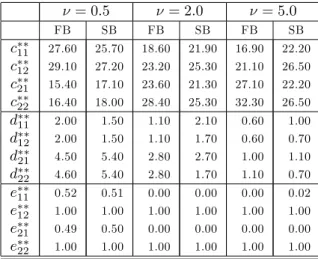
Turning now to the Sum of Transformed CCPERLE, the addition, to the social planner’s problem, of incentive compatibility constraints tends to compli-cate the analysis. However, the extent to which the second-best optimum di¤ers from the …rst-best optimum can be illustrated numerically. For that purpose, the following table compares the …rst-best and second-best optima under three degrees of inequality aversion: = 0:5, = 2 and = 5.22
First-best …gures perfectly illustrate the results in Proposition 2. E¤ort-averse agents always receive, ceteris paribus, lower consumption than e¤ort-loving agents (both at the young and the old age). Moreover, patient agents have higher old-age consumption than impatient agents. However, at the young age, impatient agents receive higher consumption than patient agents when optimal prevention is high, i.e. under = 0:50, whereas the opposite holds under lower prevention, as under = 2 and = 5. Regarding prevention, it is optimal for e¤ort-loving agents to carry out maximum prevention e, while
2 2Here we assume u(c
ij) = p2cij, v(eij) = e 2 ij
2 , and (eij) = a+7e
b+7e as well as the following values for our parameters:
1 2 1 2 e a b W ` e
e¤ort-averse agents only do prevention when inequality aversion is su¢ ciently low. = 0:5 = 2:0 = 5:0 FB SB FB SB FB SB c11 27.60 25.70 18.60 21.90 16.90 22.20 c12 29.10 27.20 23.20 25.30 21.10 26.50 c21 15.40 17.10 23.60 21.30 27.10 22.20 c22 16.40 18.00 28.40 25.30 32.30 26.50 d11 2.00 1.50 1.10 2.10 0.60 1.00 d12 2.00 1.50 1.10 1.70 0.60 0.70 d21 4.50 5.40 2.80 2.70 1.00 1.10 d22 4.60 5.40 2.80 1.70 1.10 0.70 e11 0.52 0.51 0.00 0.00 0.00 0.02 e12 1.00 1.00 1.00 1.00 1.00 1.00 e21 0.49 0.50 0.00 0.00 0.00 0.00 e22 1.00 1.00 1.00 1.00 1.00 1.00
Turning now to the second-best, the added incentive constraints have the following e¤ects. In order to prevent impatient agents from pretending to be patient, a simple solution consists of proposing consumption bundles with higher second-period consumption for agents who pretend to be patient, in comparison with the …rst-best. That upward distortion in old-age consumption is observed under low inequality aversion (i.e. = 0:5). However, for higher degrees of inequality aversion, the separation of types is no longer achieved through larger old-age consumption gap between patient and impatient agents, but, rather, through proposing higher …rst-period consumptions for the impatient, as well as lower …rst-period consumption for the patient, in comparison to the …rst-best.
0 2 4 6 8 10 12 14 16 18 CCP E RL E 111 121 211 221 112 122 212 222 ex post types
First Best Second Best
Figure 1: CCPERLE at FB and SB ( = 0:5). 0 2 4 6 8 10 12 14 16 18 CCP E RL E 111 121 211 221 112 122 212 222 ex post types
First Best Second Best
Figure 2: CCPERLE at FB and SB ( = 5:00).
As far as welfare inequalities are concerned, the comparison of CCPERLE levels shown on Figures 1 and 2 con…rms that welfare inequalities between
short-lived and long-short-lived agents are signi…cantly reduced when the inequality aversion rises from = 0:5 (Figure 1) to = 5 (Figure 2), in the …rst-best as well as the second-best optimum. Under low inequality aversion (Figure 1), impatient agents are, at the …rst-best, better o¤ than patient agents, and e¤ort-averse individuals are better o¤ than e¤ort-loving agents ceteris paribus. These in-equalities are preserved at the second-best optimum. The only di¤erence is that impatient agents are net "losers" at the second-best (in comparison with the …rst-best), whereas patient agents are net "winners". In contrast, under high inequality aversion (Figure 2), the …rst-best involves lower inequalities across ex ante types, for short-lived as well as long-lived agents. Nonetheless, at the second-best, the "winners" — in comparison to the …rst-best — are now the impatient individuals, and the "losers" are the patient ones. This is an inver-sion of what is observed under low inequality averinver-sion. Hence, the impact of incentive compatibility constraints in terms of welfare inequalities is sensitive to the degree of inequality aversion.
6.2
Reference longevity and e¤ort
Let us now assess the robustness of our results to the reference levels for longevity ` and prevention e. For that purpose, we …rst take the minimum longevity ` = 1 as the reference longevity ` , while still assuming reference e¤ort e = e. The following table shows the CCPERLE for the 8 types of agents ex post.
` def. CCPERLE ^cij`
1 1 1 u (^c111) + 1v(e) = u (c11) + 1v(e11) 1 2 1 u (^c121) + 2v(e) = u (c12) + 2v(e12) 2 1 1 u (^c211) + 1v(e) = u (c21) + 1v(e21) 2 2 1 u (^c221) + 2v(e) = u (c22) + 2v(e22) 1 1 2 u (^c112) + 1v(e) = u (c11) + 1v(e11) + 1u (d11) 1 2 2 u (^c122) + 2v(e) = u (c12) + 2v(e12) + 1u (d12) 2 1 2 u (^c212) + 1v(e) = u (c21) + 1v(e21) + 2u (d21) 2 2 2 u (^c222) + 2v(e) = u (c22) + 2v(e22) + 2u (d22) The problem of the social planner can thus be written as follows:
max
cij;dij;eij
min(^c111;^c121;^c211;c^221;c^112;^c122;c^212;^c222) s.t. BC where the CCPERLE ^cij` are de…ned in the above table.
Proposition 4 Under perfect information about ex-ante types i; j , and (4 + 2~ + 2 ) c W , the Maximin CCPERLE optimum involves, under ` = 1:
c < c11= c21< c22= c12 d11 = d12= d21= d22= c e11 = e21= 0 < e12= e22= e
Proof. See the Appendix.
The only di¤erence with respect to the Maximin CCPERLE under ` =
2 concerns the treatment of patient and impatient agents at the young age. Whereas, under ` = 2, patient agents receive higher consumption at young age, this is no longer true under ` = 1, where they are treated equally, because the short-lived’s CCPERLE is independent from time preferences under ` = 1. Note also that the second-best Maximin CCPERLE, at which patient and impatient agents have the same …rst-period consumption, is fully robust to the selection of the reference longevity level (unlike the …rst-best optimum).
Take now the case where the reference e¤ort level is the minimum e¤ort level: e = 0. The list of CCPERLE becomes, under ` = 2:
` def. CCPERLE ^cij`
1 1 1 u (^c111) (1 + 1) = u (c11) + 1v(e11) 1 2 1 u (^c121) (1 + 1) = u (c12) + 2v(e12) 2 1 1 u (^c211) (1 + 2) = u (c21) + 1v(e21) 2 2 1 u (^c221) (1 + 2) = u (c22) + 2v(e22) 1 1 2 u (^c112) (1 + 1) = u (c11) + 1v(e11) + 1u (d11) 1 2 2 u (^c122) (1 + 1) = u (c12) + 2v(e12) + 1u (d12) 2 1 2 u (^c212) (1 + 2) = u (c21) + 1v(e21) + 2u (d21) 2 2 2 u (^c222) (1 + 2) = u (c22) + 2v(e22) + 2u (d22) The problem of the social planner can thus be written as follows:
max
cij;dij;eij
min(^c111;^c121;^c211;c^221;c^112;^c122;c^212;^c222) s.t. BC where the CCPERLE ^cij` are de…ned in the above table.
Proposition 5 Under perfect information about ex-ante types i; j , and (4 + 2~ + 2 ) c W , the Maximin CCPERLE optimum involves, under e = 0:
c < c12< c11; c22< c21 d11 = d12= d21= d22= c e11 = e21= 0 < e12= e22= e Proof. See the Appendix.
There is a unique di¤erence with respect to the baseline case where e = e: here e¤ort-averse agents receive, at the young age, a higher consumption than e¤ort-loving agents, instead of a lower consumption. The same di¤erence holds with respect to the second-best Maximin CCPERLE, at which e¤ort-loving agents have, under e = e, a higher …rst-period consumption than e¤ort-averse agents.
Turning now to the Sum of Transformed CCPERLE, the social planner’s problem can still be rewritten, when we consider that ` = 1 and e = e, as:
max cij;dij;eij X i;j nij1hij1(cij; eij) + X i;j nij2hij2(cij; dij; eij) s.t. BC
where hij1(cij; eij) g fij1(cij; eij) and hij2(cij; dij;eij) g fij2(cij; dij; eij), with fij1(cij; eij) f Uij1 jv(e) and fij2(cij; dij; eij) f Uij2 jv(e) . Proposition 6 Under perfect information about ex-ante types i; j , and
(4 + 4 ) c W , the Sum of Transformed CCPERLE optimum involves,
un-der ` = 1: ci1 < ci2 8i ( c1j < c2j when low ( ) c1j > c2j when high ( ) cij > dij 8i; j d22> d12; d21> d11> c e12 = e22= e > e21> e11> 0 Proof. See the Appendix.
Thus the Sum of Transformed CCPERLE social optimum looks, from a qualitative perspective, quite robust to the selected reference longevity.
Turning now to the alternative case where ` = 2 and e = 0, the social planner problem becomes:
max cij;dij;eij X i;j nij1hij1(cij; eij) + X i;j nij2hij2(cij; dij; eij) s.t. BC
where hij1(cij; eij) g fij1(cij; eij) and hij2(cij; dij;eij) g fij2(cij; dij; eij), with fij1(cij; eij) f U1 ij 1+ i and fij2(cij; dij; eij) f U2 ij 1+ i .
Proposition 7 Under perfect information about ex-ante types i; j , and
(4 + 4 ) c W , the Sum of Transformed CCPERLE optimum involves,
un-der e = 0: ci1 > ci2 8i ( c1j < c2j when low ( ) c1j > c2j when high ( ) cij > dij 8i; j d22> d12; d21> d11> c e12 = e22= e > e21> e11> 0 Proof. See the Appendix.
The Sum of Transformed CCPERLE optimum involves here higher …rst-period consumptions for the averse agents in comparison to the e¤ort-loving agents, contrary to what prevails when the reference e¤ort is the max-imum e¤ort. The reason is that the change in the reference e¤ort makes the marginal change in CCPERLE of short-lived e¤ort-averse agents larger, ceteris paribus, than the one of short-lived e¤ort-loving agents.