3rd International Conference on Bio-Based Building Materials June 26th - 28th 2019
Belfast, UK
ID_ MM137
ASSESSING THE VARIABILITY OF HEMP CONCRETE PROPERTIES DURING
EXPERIMENTAL TESTS: A FOCUS TO SPECIMENS’ NUMBER
C. Niyigena1*, S. Amziane1, A. Chateauneuf1
1 Université Clermont Auvergne, Institut Pascal, Polytech Clermont-Ferrand, 63174 Aubière Cédex France
*Corresponding author; e-mail: [email protected]
Abstract
Several parameters influence the mechanical properties of hemp concrete. Some are due to the nature of its constituents such as the aggregate size, the type of binders, and other parameters are due to manufacturing method, such as the compaction energy and the molding method as well as the methods used for its properties characterizations. This paper is interested in the study of the variability of hemp concrete properties taking into account the number of specimens used during experimental investigations. The hemp concrete properties considered are: the maximum compressive stress and apparent modulus. A methodology with the goal to evidence how the increase in number of specimens may improve the accuracy for obtained results has been used. The mean, minimum and maximum values, with also standard deviation and the confidence interval have been analysed. Beyond, a comparative analysis between the theoretical distribution and the observed experimental distribution in each set by Q-Q plots allowed a better appreciation of the accuracy in obtained results. With this study, it has been highlighted that at least a set of six specimens is necessary and recommended for accurate results during experimental investigations.
Keywords:
Hemp concrete; variability; specimens’ number; compressive stress; modulus
1 INTRODUCTION
The selection of construction materials is a crucial step as the final quality and reliability of buildings are depending significantly to them. Hence it is important to have a good mastery of the properties of the constituent materials. However, the sources of uncertainty associated are numerous, some are intrinsic to materials [1], [2] while others are extrinsic to them. In general way, the randomness character for a given parameter can have two origins: the variability which is an intrinsic consequence of the phenomenon studied, and the uncertainty, result of insufficient information with respect to this parameter.
In the case of hemp concrete material, it has been highlighted its sensitivity with respect to various parameters. A literature review analysis is proposed in order to highlight the variability and uncertainty of hemp concrete with respect to various parameters. This analysis is focusing on the compressive strength and the modulus. The parameters considered are numerous such as nature of constituents [2], curing conditions [3], methods used [4], etc. And the herein literature analysis highlight the gap about the influence of the number of specimens used during experimental test.
Nguyen [5] has highlighted the parameters affecting the compressive strength of hemp concrete. According to him, this material has a very ductile mechanical behavior in compression and traction because of the low rigidity of hemp aggregates. He obtained a compressive
strength at 28 days varying from 0.2 MPa to 3.6 MPa, those values were considered for a deformation level of 7.5%. This dispersion is attributed to the type of hemp aggregates used, the composition and the compaction energy. Thanks to this compaction energy [6], it is possible to improve the mechanical performance of hemp concrete. The Mahn [7] obtained values in the same range of 2 MPa by changing the binder content. In the same case with different binder contents, Cérezo [8] obtained compressive strength values with dispersion between 0.25 and 1.15 MPa. For low binder content ratio, the compressive strength was of the order of 0.25 MPa. For intermediate ratio values were between 0.48 and 0.8 MPa while in case of high binder content ratio, values of 1.15 MPa were observed. Low values of the order of 0.2 MPa were obtained by Elford et al. [9] as well as Gourlay [10] mainly because of molding method and curing conditions. In conclusion hemp concrete mechanical are weak with elastoplastic behavior and much dispersed therefore they must be used with a supporting structure to meet structural requirements [8].
The sources of these dispersion are very numerous, and they show to what extend the values of the compressive strength can vary according to the parameters taken into account during experimental investigations.
The literature on modulus values also show great dispersion due to many parameters like for example the methods used for its calculation which are quite different
[4]. Cérezo [8], defines the Young’s modulus as the slope at the origin of the stress-strain curve by considering the hypothesis of small deformations. For various binder contents and within a period of 12 months and beyond the modulus values were characterized by high dispersion [8]. For low binder content, the overall stiffness modulus increases from 1 to 3 MPa. For intermediate dosage obtained values are ranging from 32 to 95 MPa, while in case of high binder content values from 100 to 160 MPa are observed. For various formulations Nguyen [5] obtained at 90 days, the module values which vary between 25 MPa and 176 MPa. In his study, the Young’s modulus is calculated according to the greatest increase in the stress/strain ratio recorded in the beginning of loading stage. The essential parameters considered are the binder dosage and also water to binder (E/L) and binder to hemp aggregates ratios. According to different studies [12]– [15] the Young’s modulus of hemp concrete increases with compression strength in a dispersed way. This is in line with logic since different authors didn’t carry out their investigations with the same parameters. In the same way as for compressive strength, the Young’s modulus values show also to what extent hemp concrete properties are very sensitive to different parameters.
With this literature analysis it is demonstrated at one hand, the sensitivity of hemp concrete properties with different parameters. But it is to not that at the other
hand, the number of hemp specimens used is not considered. However, the number of specimens is an essential parameter to consider in order to get reliable and representative results during experimental investigations. As for example, in a study conducted by Almeida F.M et al. [21] on the variability of self-placing concrete, it had been highlighted the importance of the number of samples for significant result. Actually, and to the best of our knowledge, the impact of number of specimens is not yet investigated in the case of hemp concrete material. Currently, three samples are considered sufficiently significant enough for the test on conventional materials such as ordinary concrete for example. This same number is also used for hemp concrete despite the lack of knowledge about its accuracy. The main scope of the herein study is to assess the real impact of specimens’ number on hemp concrete properties dispersion during experimental investigation. Which number of specimens is suitable for a reliable and representative result?
2 MATERIALS AND METHODS
2.1 Types of shiv
The materials used consist of four hemp concrete which are differentiated on the basis of the hemp particles used, Tab. 16 [22]. It is to note that one kind of binder has been used.
Tab. 16 : Nomenclature and overview of results of characterizations of types of used hemp shiv [22]
N om e nclat ure B D : B ul k D e nsity [k g/ m 3] IW C : In it ia l W a te r C onte nt 2 [ % ] FWC : Fi na l W a te r C onte nt 3[% ] MP S : Mea n P a rt ic le S urf a c e 4 [m m 2] MP : Mas s of P a rt ic le [ m g] L: Lengt h [ m m ] W : W idt h [ m m ] E l: E longat ion FD : Fer e t D ia m e te r [m m ] H1 89.7 194.2 379.2 4.89 0.84 3.40 1.04 3.47 1.79 H2 118.3 233.8 358.3 1.94 0.35 1.45 0.44 2.60 0.76 H3 125.7 154.0 351.3 8.10 1.77 5.88 1.40 4.97 2.78 H4 103.9 162.9 338.7 1.18 0.18 1.02 0.28 2.77 0.50
2.2 Composition of hemp concrete specimens The used formulation is walling hemp concrete, with 250kg/m3; to make up 100 litres, 25kg of binder are needed with 12kg of hemp shiv and 30kg of water. The used cylindrical moulds are 11x22cm. For each hemp shiv types nine specimens are considered at 30 days. 2.3 Mixing and testing of hemp concrete
specimens
To make the test specimens, a methodology in [22] has been used. For a given type of shiv, the moulds were filled freely by hand, up to around four layers. The upper surface of each layer was scratched to help the next layer to adhere properly. In these conditions, a reference mould was filled and then weighed, the other specimens are calibrated to give the same weight of this reference specimen. This strategy enables us, indirectly, to control the compacting energy within the same type of shiv. The same operator filled the reference moulds, in order to help control the
2 Quantity of water absorbed by a 20 g sample of shiv after 1 minute of immersion. 3 Quantity of water absorbed by a 20 g sample of shiv after 48 hours of immersion.
4Obtained by dividing the specific surface of a 3 g sample by the number of particles in that sample.
compacting energy between the different types of shiv. When filled and weighted, the specimens were left in their moulds for 72 h. After removal, two different types of drying were used: open-air drying and kiln drying. Open-air drying took place in a test room. As the climate conditions in that room are not precisely controlled, the pieces were exposed to variations of temperature and relative humidity, respectively between 14 and 30 °C and between 31 and 66% RH. Average conditions were 21 °C and 48% RH.
As it is not possible, with open-air drying, to eliminate all of the water contained in the specimen, it is necessary to further dry the pieces in a kiln. They were kiln dried at 60 °C for 48 h, which corresponds to a variation in mass of less than 0.1% when weighed twice at an interval of 24 h.
2.4 Methods of characterisation and analysis One can distinguish the methods used to characterize the hemp concrete properties and those used to analyze
the results properties. The properties of hemp concrete to be determined are the compression stress and apparent modulus. The protocols and methods used to measure them are the same as those used in a previous study [23]. Beyond these methods, statistical methods are used to analyze the results.
For statistical analysis, nine specimens may allow to form many sets of 3; 4; 5 specimens, etc. To form these sets, one can use either a simple random sampling with replacement or without replacement. In the current study it is proposed a simple methodology that corresponds to what can be done in practice. First a set of three specimens is considered, then a specimen is
added for the new second set and so on until all nine specimens are considered. The purpose of this approach is to highlight the improvement of accuracy in obtained results when the number of specimens is increased. With this approach, 7 different sets numbered 1 to 7 are formed for each hemp concrete. For a better identification of these sets, a complete additional numbering of sets is proposed in Tab. 17. It simply consists in putting the number of hemp concrete (H1 to H4) followed by the number of the set (1 to 7). For example, H4-6 stands for set number 6 (with 8 specimens) of hemp concrete H4.
Tab. 17 : identification of different sets analyzed with i= 1 to 4
N° lot Hi-1 Hi-2 Hi-3 Hi-4 Hi-5 Hi-6 Hi-7 Nomber of specimens
d’échantillons
3 4 5 6 7 8 9
The statistical parameters analyzed in this work include the mean, standard deviation (SD), minimum and maximum values with also the confidence interval. They allow to assess the accuracy and quality of obtained results in each set. Moreover, a comparative analysis between the theoretical distribution and the observed experimental distribution in each set by quantile-quantile or Q-Q plots allows a better appreciation of the accuracy in obtained results. All statistical analyses were performed using Excel and XLSTAT software [25].
3 RESULTS AND DISCUSSION
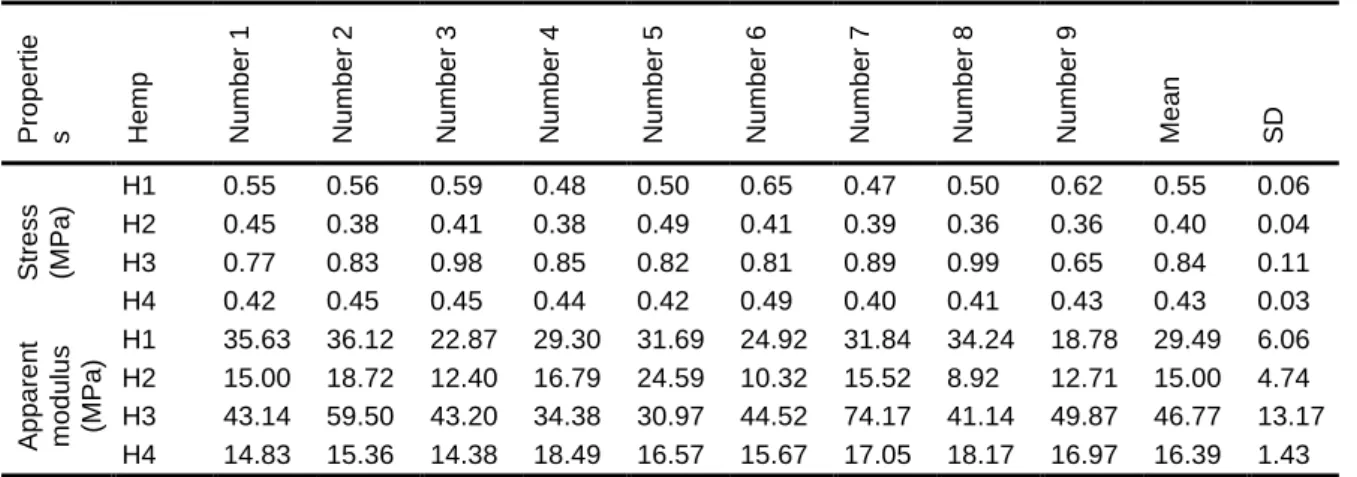
The raw results obtained are presented in Tab. 18 below. They are characterized by dispersions as it will be seen in the following.
Tab. 18 : hemp concrete properties for each specimen at 30 days
Pro p e rti e s Hem p Num b e r 1 Num b e r 2 Num b e r 3 Num b e r 4 Num b e r 5 Num b e r 6 Num b e r 7 Num b e r 8 Num b e r 9 M e a n SD Stre s s (M Pa ) H1 0.55 0.56 0.59 0.48 0.50 0.65 0.47 0.50 0.62 0.55 0.06 H2 0.45 0.38 0.41 0.38 0.49 0.41 0.39 0.36 0.36 0.40 0.04 H3 0.77 0.83 0.98 0.85 0.82 0.81 0.89 0.99 0.65 0.84 0.11 H4 0.42 0.45 0.45 0.44 0.42 0.49 0.40 0.41 0.43 0.43 0.03 Ap p a re n t m o d u lu s (M Pa ) H1 35.63 36.12 22.87 29.30 31.69 24.92 31.84 34.24 18.78 29.49 6.06 H2 15.00 18.72 12.40 16.79 24.59 10.32 15.52 8.92 12.71 15.00 4.74 H3 43.14 59.50 43.20 34.38 30.97 44.52 74.17 41.14 49.87 46.77 13.17 H4 14.83 15.36 14.38 18.49 16.57 15.67 17.05 18.17 16.97 16.39 1.43 The compressive strength result reveal non-negligible
dispersions at two different levels. At one hand, one can observe the variability with respect to the type of hemp concrete with a factor between 2 and 3 for the minimum and maximum values observed, case of hemp concretes H2 and H3, Fig. 32. This is in line with what had been observed in a previous study [22] in which a factor equal to 10 have been observed on different nine hemp concretes showing to what extend hemp shiv type may significantly impact hemp concrete properties. At the other hand, one can observe significant dispersion for one given type of hemp concrete. By way of
example, for hemp concrete H3, there are values ranging from 0.65 MPa to 0.99 MPa for specimens numbered 9 and 8, respectively, with a standard deviation equal to 0.11 MPa. This intrinsic variability of hemp concrete material shows to what extend it is necessary to take into account the number of specimens needed for an accurate result. For the moment, only obtained results are presented, their analysis on the necessary number of specimens for a statistically significant result is proposed later.
a b
Fig. 32 : results for differents hemp concrete, stress (a) and apparent modulus (b)
The observed dispersion for stress are also confirmed in the case of modulus. However, the results for apparent modulus show that for some hemp concretes, results are less dispersed compared to others. It is the case of for example hemp concrete H4 which is characterized by low dispersions compared to others (Fig. 32). Moreover, this low dispersed character for H4, even if it is less marked, remains of course observable for the stress with values around 0.45 MPa (Tab. 16). These results highlight to what extent modulus property may be sensitive not only to hemp concrete type but also to its measurement method. This issue associated with the modulus calculation method had been analyzed in a previous study [4].
After this presentation of raw results, in the following an analysis of the number of specimens needed for a statistically significant result is proposed.
3.1 Analysis
Before presenting the results, it should be noted that as the study is being carried out on 4 types of hemp concretes (H1, H2, H3 and H4) by taking into account 2 properties with 7 sets each time, it is not suitable to present all results obtained. Thus, the presentation of results will be limited to one property per hemp concrete as follow: compressive strength for H2 and apparent modulus for H3, respectively. For a complete analysis, if necessary, results for all sets and hemp concretes given in Appendix A are also used.
3.1.1 Compressive strength
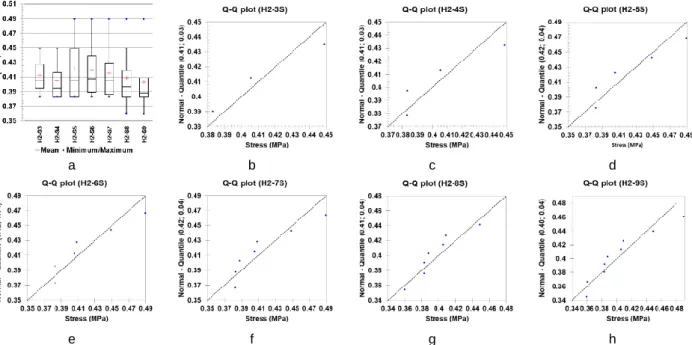
During experimental investigation of the compression stress test, the increase in the number of specimens causes a random variation of mean values from one set to another. Despite of significant magnitude observed between minimum and maximum values (varying up to 0.35 MPa in some cases, as for example hemp H2, Fig. 33 a), it is interesting to note that the mean value is stable around 0.41 MPa from the first set with 3 specimens.
a b c d
e f g h
Fig. 33: Significant number of specimens, from 3 to 9 specimens (b) to (h) for stress at 30 days: H2
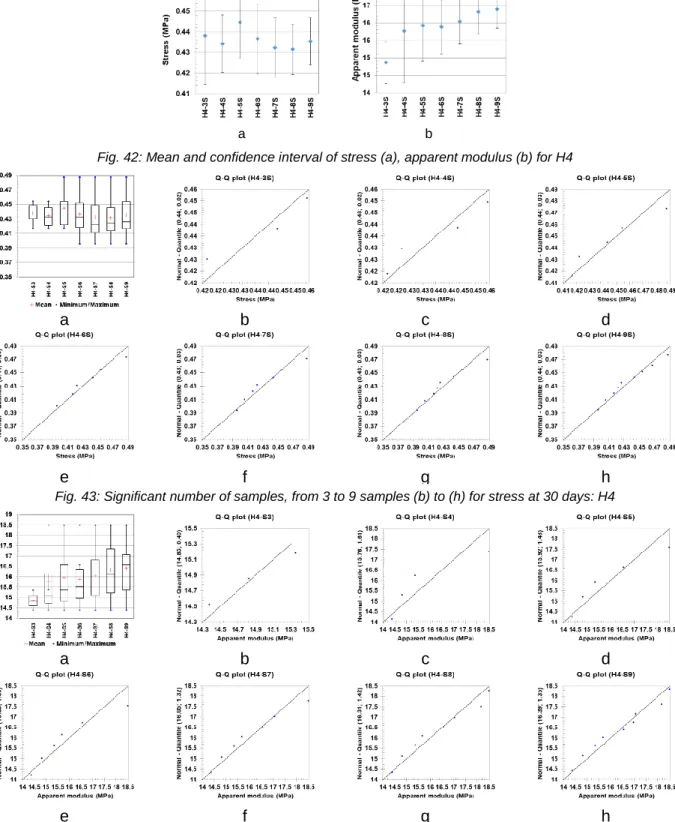
The high magnitude observed on mean values within different sets does not exceed 0.02 MPa, this is the case of H2 and H4 in Fig. 33 a and Fig. 43 a, respectively. In general, with 6 specimens, the set already contains the minimum and maximum values with some exception
cases such as hemp H3, (Fig. 41 a), for which a set of 9 specimens is necessarily required.
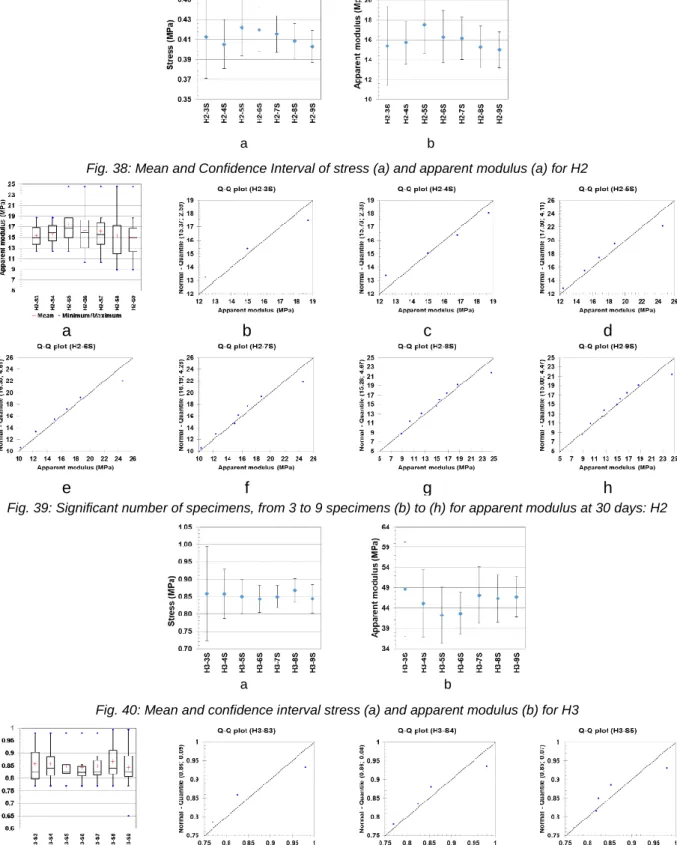
With at least a set of 4 specimens, one can observe an improvement of accuracy in result characterised by the decrease of confidence interval which varies from 0.08 to 0.03 MPa (Fig. 38 a) or from 0.27 MPa to 0.08 MPa
(Fig. 40 a). Moreover, results of the Q-Q diagrams show however that a good correlation between the theoretical normal distribution and the experimental observations is obtained with a set of at least 6 specimens, like for example H4 in Fig. 43 e.
Both the small magnitude observed between the mean values regardless of the set with a clear improvement of the accuracy characterized by a decrease of confidence interval (for example Fig. 40 b) highlight the interest to increase the number of specimens.
4.1.2 Apparent modulus
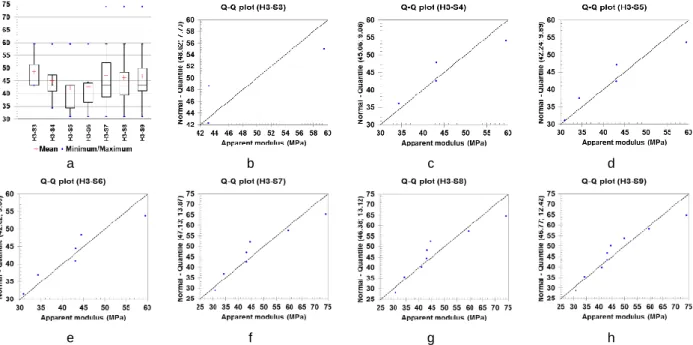
The analysis of apparent modulus results in Tab. 18 reveals a considerable variability characterized by high standard deviation, varying from 1.43 MPa to 13.17 MPa for both H4 and H3, respectively. When it comes to the analysis of number of specimens, the extent of amplitude observed between minimum and maximum
values also testifies that considerable variability; it is for example 45 MPa in the case of H3 (Fig. 34 a).
The mean values observed on different sets are varying also, the maximum amplitude in that case is equal to 8 MPa always for H3. The variation of this average according to the number of specimens is also random but is stable in some cases, H1 (Fig. 37 a) for example. On the other hand, it is increasing then decreasing, or vice versa H2 (Fig. 39 a) and H3 (Fig. 34 a), or strictly increasing, H4 (Fig. 44 a). After 5 specimens, one can observe a good correlation between the theoretical distribution and the experimental observations. The accuracy of the results is optimal with respect to confidence interval after 6 specimens. It decreases by half when moving from a set of 3 specimens to 9 specimens set for the H2, H3 and H4 (Fig. 38 b; Fig. 40 b; Fig. 42 b), and decreases dramatically from 18.67 MPa to 4.66 MPa for H1 (Fig. 35 b).
a b c d
e f g h
Fig. 34: Significant number of samples, from 3 to 9 samples (b) to (h) for apparent modulus at 30 days: H3
In conclusion, considering the variability obtained on the modules and also the dispersed and random nature of the mean values within different sets, and the small decrease of the confidence interval before 6 specimens, it is clear that the consideration of a set with 3 specimens is not suitable. At least 6 specimens are necessary and recommended.
4 CONCLUSION
The main purpose of this study was to understand the impact of the number of specimens during experimental investigations for hemp concrete material. And also to demonstrate which number to be considered for accurate results. Two properties: compressive strength and apparent modulus, have been analysed. With four different type hemp concrete, nine specimens have been used per each. A methodology that corresponds to what can be done in practice have been used to form different seven sets. Its goal was to evidence how the increase in number of specimens may improve the accuracy for obtained results. Statistical parameters analysed include the mean value, standard deviation, minimum and maximum values with also the confidence interval. Also, a comparative analysis between the
theoretical distribution and the observed experimental distribution in each set by Q-Q plots allows a better appreciation of the accuracy in obtained results. According to above basis, it has been highlighted the possibility of using 3 specimens in the case of, compressive strength. However, for the apparent modulus, the results show that the use of 3 specimens is not suitable because of the poor accuracy observed on mean values when the number of specimens increases and also the small decrease in the confidence interval before a set of 6 specimens. Therefore, with this study, it is clear that at least a set of 6 specimens is necessary and recommended for accurate results during experimental investigations.
For the future works the same methodology used in this study may be extended to other hemp concrete properties like thermal conductivity, acoustical, durability, etc. It can also be used in other bio-based materials with similar behaviour as hemp concrete such as sunflower concrete, straw concrete, etc.
5 ACKNOWLEDGEMENTS
The authors would like to express their sincere thanks to the regional authority of Auvergne-Rhône-Alpes for funding this research.
6 REFERENCES
[1] J. Xiao, K. Zhang, and A. Akbarnezhad, “Variability of stress-strain relationship for recycled aggregate concrete under uniaxial compression loading,” J. Clean. Prod., vol. 181, pp. 753–771, Apr. 2018.
[2] Y. Diquélou, E. Gourlay, L. Arnaud, and B. Kurek, “Influence of binder characteristics on the setting and hardening of hemp lightweight concrete,” Constr. Build. Mater., vol. 112, pp. 506–517, 2016.
[3] L. Arnaud and E. Gourlay, “Experimental study of parameters influencing mechanical properties of hemp concretes,” Constr. Build. Mater., vol. 28, no. 1, pp. 50– 56, 2012.
[4] C. Niyigena, S. Amziane, and A. Chateauneuf, “Assessing the impact of calculation methods on the variability of Young’s modulus for hemp concrete material,” Constr. Build. Mater., vol. 198, pp. 332–344, 2019.
[5] T. T. Nguyen, “Contribution à l’étude de la formulation et du procédé de fabrication d’éléments de construction en béton de chanvre.” Université de Bretagne Sud, 2010.
[6] T.-T. Nguyen, V. Picandet, S. Amziane, and C. Baley, “Influence of compactness and hemp hurd characteristics on the mechanical properties of lime and hemp concrete,” Eur. J. Environ. Civ. Eng., vol. 13, no. 9, pp. 1039–1050, 2009.
[7] T. M. Dinh, “Contribution Au Développement de Béton de Chanvre Préfabriqué Utilisant Un Liant Pouzzolanique Innovant.” 2014.
[8] V. Cérézo, “Propriétés mécaniques, thermiques et acoustiques d’un matériau à base de particules végétales: approche expérimentale et modélisation théorique.” Ecole Nationale des Travaux Publics de l’Etat, 2005.
[9] S. Elfordy, F. Lucas, F. Tancret, Y. Scudeller, and L. Goudet, “Mechanical and thermal properties of lime and hemp concrete (‘hempcrete’) manufactured by a projection process,” Constr. Build. Mater., vol. 22, no. 10, pp. 2116–2123, 2008.
[10] E. GOURLAY, “Caractérisation expérimentale des propriétés mécaniques et hygrothermiques du béton de chanvre. Détermination de l’impact des matières premières et de la méthode de mise en oeuvre,” ENTPE, 2014.
[11] C. Gross and P. Walker, “Racking performance of timber studwork and hemp-lime walling,” Constr. Build. Mater, 2014.
[12] H. Wadi, S. Amziane, E. Toussaint, and M. Taazount, “Lateral load-carrying capacity of hemp concrete as a natural infill material in timber frame walls,” Eng. Struct., 2019.
[13] C. Niyigena et al., “RRT3: Statistical analysis of hemp concrete mechanical properties variability,” in First International Conference on Bio-based Building Materials, ICBBM 2015, 2015.
[14] T. M. DINH, “Développement et caractérisation d’éco-matériaux pour la construction,” Toulouse, 2014.
[15] E. Gourlay, “Caractérisation expérimentale des propriétés mécaniques et hygrothermiques du béton de chanvre. Détermination de l’impact des matières premières et de la méthode de mise en oeuvre,” Lyon, 2014.
[16] J. Chamoin, “Optimisation des propriétés (physiques, mécaniques et hydriques) de bétons de chanvre par la maîtrisede la formulation.” INSA de Rennes, 2013.
[17] V. Nozahic, “Vers une nouvelle démarche de conception des bétons de végétaux lignocellulosiques basée sur la compréhension et l’amélioration de l’interface liant/végétal: application à des granulats de chenevotte et de tige de tournesol associés à un liant ponce/chaux.” Université Blaise Pascal-Clermont-Ferrand II, 2012.
[18] C. Magniont, “Contribution à la formulation et à la caractérisation d’un écomatériau de construction à base d’agroressources.” Toulouse 3, 2010.
[19] R. Walker, S. Pavia, and R. Mitchell, “Mechanical properties and durability of hemp-lime concretes,” Constr. Build. Mater., vol. 61, pp. 340–348, 2014. [20] P. B. de Bruijn, K.-H. Jeppsson, K. Sandin, and C. Nilsson, “Mechanical properties of lime–hemp concrete containing shives and fibres,” Biosyst. Eng., vol. 103, no. 4, pp. 474–479, 2009.
[21] F. M. Almeida Filho, B. E. Barragán, J. R. Casas, and A. L. H. C. El Debs, “Hardened properties of self-compacting concrete—a statistical approach,” Constr. Build. Mater., vol. 24, no. 9, pp. 1608–1615, 2010. [22] C. Niyigena, S. Amziane, and A. Chateauneuf, “Multicriteria analysis demonstrating the impact of shiv on the properties of hemp concrete,” Constr. Build. Mater., vol. 160, pp. 211–222, Jan. 2018.
[23] C. Niyigena et al., “Variability of the mechanical properties of hemp concrete,” Mater. Today Commun., vol. 7, pp. 122–133, Mar. 2016.
[24] L. Arnaud, Bio-aggregate-based Building Materials: Applications to Hemp Concretes. John Wiley & Sons, 2013.
[25] S. Adinsoft, “XLSTAT-software, version 10,” Addinsoft, Paris, Fr., 2010.
7 APPENDIX
a b
Fig. 35: Mean and confidence interval of stress (a) and apparent modulus (b) for H1
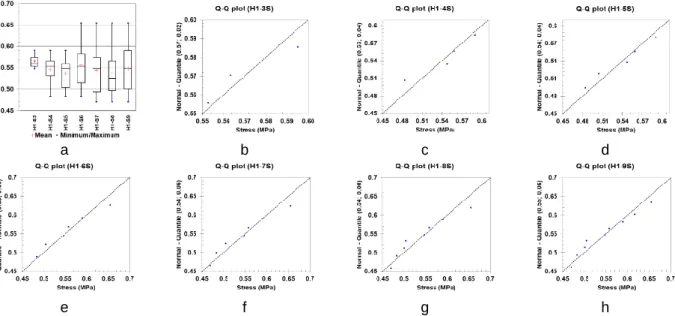
a b c d
e f g h
Fig. 36: Significant number of specimens, from 3 to 9 specimens (b) to (h) for stress at 30 days: H1
a b c d
e f g h
a b
Fig. 38: Mean and Confidence Interval of stress (a) and apparent modulus (a) for H2
a
b
c
d
e
f
g
h
Fig. 39: Significant number of specimens, from 3 to 9 specimens (b) to (h) for apparent modulus at 30 days: H2
a b
Fig. 40: Mean and confidence interval stress (a) and apparent modulus (b) for H3
a
b
c
d
e
f
g
h
a b
Fig. 42: Mean and confidence interval of stress (a), apparent modulus (b) for H4
a
b
c
d
e
f
g
h
Fig. 43: Significant number of samples, from 3 to 9 samples (b) to (h) for stress at 30 days: H4
![Tab. 16 : Nomenclature and overview of results of characterizations of types of used hemp shiv [22]](https://thumb-eu.123doks.com/thumbv2/123doknet/14750775.580043/2.892.112.793.567.751/tab-nomenclature-overview-results-characterizations-types-used-hemp.webp)