Disease transmission via drops and bubbles
The MIT Faculty has made this article openly available.
Please share
how this access benefits you. Your story matters.
Citation
Poulain, Stephane and Lydia Bourouiba."Disease transmission via
drops and bubbles." Physics Today 72, 5 (May 2019): 70 © 2019
American Institute of Physics
As Published
http://dx.doi.org/10.1063/pt.3.4211
Publisher
AIP Publishing
Version
Final published version
Citable link
https://hdl.handle.net/1721.1/125275
Terms of Use
Article is made available in accordance with the publisher's
policy and may be subject to US copyright law. Please refer to the
publisher's site for terms of use.
Disease transmission via drops and bubbles
Stephane Poulain
, and
Lydia Bourouiba
Citation:
Physics Today
72, 5, 70 (2019); doi: 10.1063/PT.3.4211
View online:
https://doi.org/10.1063/PT.3.4211
View Table of Contents:
https://physicstoday.scitation.org/toc/pto/72/5
Published by the
American Institute of Physics
ARTICLES YOU MAY BE INTERESTED IN
Tracking the journey of a uranium cube
Physics Today 72, 36 (2019);
https://doi.org/10.1063/PT.3.4202
Microswimmers with no moving parts
Physics Today 72, 44 (2019);
https://doi.org/10.1063/PT.3.4203
Commentary: Basic research in a time of crisis
Physics Today 72, 10 (2019);
https://doi.org/10.1063/PT.3.4194
Australia sees big opportunity in hydrogen energy
Physics Today 72, 28 (2019);
https://doi.org/10.1063/PT.3.4200
Craters on Pluto and Charon show that Kuiper belt collisions are rare
Physics Today 72, 14 (2019);
https://doi.org/10.1063/PT.3.4196
Albert Einstein, celebrity physicist
70 PHYSICS TODAY|MAY 2019
S
easonal influenza was responsible for nearly a million hospitalizations in the US in 2018, and tuberculosis killed more than a million people around the world. Those and other infectious diseases are spread by pathogens, such as bacteria and viruses. An important part of the pathogens’ life cycle occurs in liquids, whose fluid dynamics influences transmission from one in-fected host or environmental reservoir to another.A cough or sneeze, for instance, produces a turbulent cloud of hot, moist air and droplets, as shown in figure 1. That cloud and its droplet payload can span a room up to 8 m long in a few seconds. Droplets can also be spread from bursting bub-bles or splashed from a wet, contaminated surface.
To predict and model disease transmission at both popula-tion and individual scales, and to develop efficient mitigapopula-tion innovations and strategies against the spread of infectious dis-eases, understanding the role of the underlying fluid dynamics is critical. Yet little is known about the factors affecting the source, transport, and persistence of pathogen-bearing droplets. This Quick Study focuses on the example of bursting air bubbles to illustrate the rich physics and close coupling of biology and fluid dynamics in the context of disease transmission.
Bursting bubbles and droplets
Watery air bubbles are ubiquitous: They populate the surfaces of pools, rain puddles, and wastewater treatment plants, and an estimated 1019bubbles are created every second in Earth’s
oceans and seas. As they burst under various conditions, each bubble can emit hundreds of water droplets. Those droplets are efficient vehicles for transporting what the water contains, in-cluding microorganisms, toxins, and even crude oil. Bursting bubbles from a flushing toilet can send droplets more than a meter into the air. They are also easily carried aloft by winds, over both short and long distances.
A surface bubble consists of a thin cap of water a few mi-crons thick that entraps air. The curvature of the cap creates an overpressure relative to the bulk water below it. To first order, the pressure difference induces a flow resisted by viscosity at the base of the bubble. The cap drains into the pool of water it is connected to, and its thickness continuously decreases until the bubble eventually ruptures and ejects droplets.
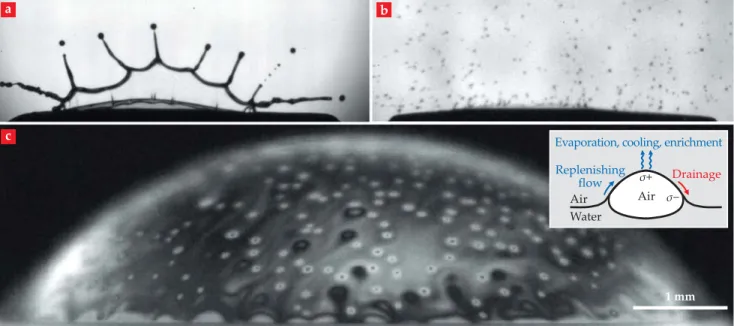
Figure 2 illustrates an important factor governing the properties of those droplets: the thickness of the cap when it bursts. Thinner bubbles emit more, smaller, and faster-moving
droplets than do thicker bubbles. It follows that older bubbles generate droplets that are particularly efficient at spreading contaminants because they are smaller and more easily trans-ported longer distances.
During our experiments at MIT, we noticed that the bubbles on the surface of clean, distilled, bottled, or tap water burst quickly, typically within a couple of seconds; fewer than 5% sur-vive up to 10 seconds. But even during that short lifetime, their interaction with the ambient air can control their thickness in a surprising and counterintuitive way. In addition to draining, the water in a bubble also evaporates. By cooling the bubble’s cap, evaporation increases its surface tension compared with that of the bubble’s base, which remains at ambient temperature. The imbalance in surface tension drives water from the base (low surface tension σ−) toward the cap (high surface tension
σ+), a phenomenon known as Marangoni flow. The upward flow counteracts the drainage and produces thicker bubbles of
QUICK STUDY
Disease transmission via drops and bubbles
Stephane Poulain and Lydia Bourouiba
Watery air bubbles covered with bacteria or viruses can live far longer than uncontaminated ones.
And on bursting, they spawn orders of magnitude more droplets, each one a microbial grenade.
FIGURE 1. VIOLENT EXHALATIONS SUCH AS A SNEEZE release
a turbulent cloud of hot, moist air and suspended droplets (red) that can travel the length of most rooms (up to 8 m). The cloud and its payload of saliva and mucus droplets can also linger in the air for as long as 10 minutes. The largest of such drops (green) shoot from the mouth and fall quickly. The gas-phase dynamics enhances the range of suspended droplets by delaying their exit from the cloud. (Image courtesy of Lydia Bourouiba, MIT, from HHMI’s Image of the Week: The Anatomy of a Sneeze.)
Stephane Poulain is a graduate
student and Lydia Bourouiba is
an associate professor and director of the Fluid Dynamics of Disease Transmission Laboratory; both are at MIT in Cambridge, Massachusetts.
MAY 2019|PHYSICS TODAY 71
a given age. The thickening effect is, in fact, general. According to our recent research, any mechanism that produces a surface-tension gradient leaving the base with relatively lower surface tension can dramatically increase the thickness and lifetime of bubbles.
This replenishing effect of evaporation on watery bubbles is, in fact, ubiquitous. It is exacerbated by volatile compounds, such as alcohol (see the article by Roberto Zenit and Javier Rodríguez-Rodríguez, PHYSICSTODAY, November 2018, page 44). The addition of salt also leads to a dramatic illustration of the effect, with important implications for the ocean– atmosphere coupling. In that case, the evaporation enriches the local salt concentration at the apex of each bubble, which further in-creases σ. The result is bubbles that can stop thinning altogether!
Brimming with bacteria
Freshwater bubbles contaminated with bacteria live much longer than do clean-water bubbles. Indeed, some of them sur-vive for minutes. In our experiments we discovered that bac-terial secretions can stabilize those bubbles, which makes them resistant to perturbations that would otherwise pop clean bub-bles at much shorter lifetimes. The effect is akin to adding sur-factant molecules that stabilize liquid films and give soap bub-bles their long lifetimes.
Altough replenishing via upward Marangoni flows is per-vasive in clean bubbles, they still continuously thin. However, coated with secretions, bacteria-laden bubbles can reach life-times and thicknesses beyond those accessible to clean bubbles. And if such biologically contaminated bubbles survive beyond a critical lifetime, their thinning changes dramatically.
The direct removal of water by evaporation becomes more dominant than the replenishing of water by upward Marangoni flow. That is, in the short term, bubbles become thicker than ex-pected. But beyond a certain age, evaporation thins them out faster than expected. Indeed, drainage-induced thinning is thickness dependent, whereas evaporation-induced thinning is not. Below a critical thickness, the rate of thinning by
drainage-dominated dynamics becomes smaller than the rate induced by evaporation.
That subtle competition has important implications. Be-cause they increasingly thin as they age, old and contaminated bubbles produce 10 times as many droplets as clean ones of the same age—potentially hundreds of them from a single bubble. And those droplets are themselves 1/10 as large—down to, on average, 10 μm in radius—and are emitted into the air 10 times as fast (up to 15 m/s) as those of clean bubbles.
Bacterial secretions are known to protect the microorganisms by forming a biofilm—a thick matrix of cells that stick together. But the secretion’s effect on bubbles arises even in the absence of a biofilm, and even for common species such as Escherichia
coli. Despite their tiny size, pathogens cannot be assumed to be passively transported in bubbles and droplets. Indeed, whether they evolved for this purpose or not, when the mi-croorganisms reside on bubbles, they can, in effect, manipu-late the underlying interfacial physics to optimize their own dispersal.
Additional resources
‣ L. Bourouiba, “Fluid dynamics of disease transmission and health,” in Research Trends in Biological Fluid Dynamics, S. Jung et al., eds., US National Committee on Theoretical and Applied Mechanics (2016), p. 11.
‣ L. Bourouiba, J. W. M. Bush, “Drops and bubbles in the en-vironment,” in Handbook of Environmental Fluid Dynamics:
Overview and Fundamentals, H. J. S. Fernando, ed., CRC Press/Taylor & Francis (2013), chap. 32.
‣ H. Lhuissier, E. Villermaux, “Bursting bubble aerosols,”
J. Fluid Mech.696, 5 (2012).
‣ S. Poulain, E. Villermaux, L. Bourouiba, “Ageing and burst of surface bubbles,” J. Fluid Mech.851, 636 (2018).
‣ S. Poulain, L. Bourouiba, “Biosurfactants change the thin-ning of contaminated bubbles at bacteria-laden water inter-faces,” Phys. Rev. Lett.121, 204502 (2018). PT a
c
b
1 mm Evaporation, cooling, enrichment Replenishing flow Air Water Air Drainage σ− σ+
FIGURE 2. TWO BUBBLES BURST ON A WATERY SURFACE, one (a) after 3 seconds and the other (b) after 55 seconds. The longer-lived
bubble, being thinner, spawns some 250 drops when it bursts, whereas the younger one emits less than a dozen. (c) An air bubble is
shown laden with bacteria. The inset shows that when the surface tension σ of a bubble’s apex is higher than that of its base, a replenishing Marangoni flow is established that counters evaporation. (Adapted from S. Poulain, L. Bourouiba, Phys. Rev. Lett. 121, 204502, 2018.)