HAL Id: pastel-00843578
https://pastel.archives-ouvertes.fr/pastel-00843578
Submitted on 11 Jul 2013HAL is a multi-disciplinary open access archive for the deposit and dissemination of sci-entific research documents, whether they are pub-lished or not. The documents may come from teaching and research institutions in France or abroad, or from public or private research centers.
L’archive ouverte pluridisciplinaire HAL, est destinée au dépôt et à la diffusion de documents scientifiques de niveau recherche, publiés ou non, émanant des établissements d’enseignement et de recherche français ou étrangers, des laboratoires publics ou privés.
renforcement mécanique d’hydrogels hybrides
Séverine Rose
To cite this version:
Séverine Rose. Interactions polymère/silice : de la structure locale au renforcement mécanique d’hydrogels hybrides. Matériaux. Université Pierre et Marie Curie - Paris VI, 2013. Français. �pastel-00843578�
THESE DE DOCTORAT DE
L’UNIVERSITE PIERRE ET MARIE CURIE
SpécialitéChimie et Physico-Chimie des Polymères (ED 397, Physique et Chimie des Matériaux)
Présentée par
Mlle Séverine ROSE
Pour obtenir le grade de
DOCTEUR DE L’UNIVERSITE PIERRE ET MARIE CURIE
Sujet de la thèse :
Interactions polymère/silice :
de la structure locale au renforcement
mécanique d’hydrogels hybrides
Soutenue le 14 juin 2013 devant le jury composé de :
M. Guy Schlatter Rapporteur
M. Loïc Vanel Rapporteur
M. Thibaud Coradin Examinateur
M. Bruno Grassl Examinateur
M. Jean-François Tassin Président du jury
Je souhaite tout d’abord remercier Christian Frétigny, directeur du Laboratoire PPMD-SIMM de l’ESPCI ParisTech, de m’avoir accueillie et fourni tous les éléments nécessaires pour effectuer ma thèse.
Je tiens à remercier sincèrement mes trois encadrants de thèse, Dominique, Alba et Tetsu. Merci pour la confiance, la pédagogie et la disponibilité dont vous avez fait preuve lors de nos discussions scientifiques. Cette expérience m’a permis de beaucoup apprendre de vos différences et de votre complémentarité. Grâce à vous, mon séjour au PPMD a été ponctué par de nombreuses conférences aussi bien en France, à Cargèse, Lorient, Lyon, Strasbourg, qu’à l’étranger : Goslar en Allemagne, Katmandou au Népal et Grenade en Espagne. Je suis très reconnaissante de la confiance que vous m’avez témoignée en me laissant participer à ces multiples conférences, parfois couronnées de distinctions.
Je remercie chaleureusement les membres de mon jury pour l’intérêt qu’ils ont témoigné à l’égard de mon travail. Merci en particulier à Guy Schlatter et Loïc Vanel d’avoir accepté de rapporter ce manuscrit et merci à Jean-François Tassin qui a présidé ce jury. Je remercie également Thibaud Coradin et Bruno Grassl d’avoir enrichi la discussion en apportant de nouveaux points de vue. Enfin je remercie sincèrement Ludwik Leibler de m’avoir fait l’honneur de participer à mon jury ainsi que pour sa grande participation à la compréhension de notre système, suite à nos passionnantes discussions face à l’Himalaya. Merci pour votre confiance, vos encouragements et vos gentils mots qui m’ont énormément rassurée à quelques minutes de ma soutenance.
Ce travail de thèse a été effectué au sein d’un laboratoire extrêmement dynamique, composé de personnes ayant contribué aux résultats présentés et que je souhaite remercier : Guylaine pour son expertise en rhéologie, Ludovic et David pour les montages expérimentaux sur mesure, Mohamed pour la DSC et l’ATG. Je tiens à remercier également Freddy pour ses
Mangeant et Sarah Mosbah pour leur étude du taux de gonflement dans différents solvants, Alexandre Dizeux pour les belles images des gels et la rhéologie et Lauriane Alison pour son aide en mécanique des gels. Merci également à Annie, Gilles, Flore et Pierre pour leur aide au quotidien, sans qui le laboratoire ne tournerait pas rond, ainsi qu’à tous les permanents qui contribuent à cette ambiance très chaleureuse dont on se sépare difficilement.
Je tiens à remercier sincèrement Fabrice Cousin, François Boué et Arnaud Hélary du Laboratoire Léon Brillouin (CEA, Saclay) pour leur accueil chaleureux lors de mes nombreuses sessions sur Orphée pour la diffusion de neutrons aux petits angles. Merci à la bonne humeur de Fabrice qui a réussi à transformer nos week-ends, soirées et jours fériés à Saclay en d’agréables moments qui resteront gravés dans nos mémoires.
J’aimerais remercier chaleureusement Cédric Lorthioir de l’Institut de Chimie et des Matériaux Paris-Est pour les expériences de RMN du solide qui ont ouvert une nouvelle voie de compréhension de notre système.
Au cours de ma thèse, j’ai eu l’opportunité d’enseigner, dans le cadre d’une mission doctorale, au sein de l’UPMC. Je tiens à remercier les acteurs de cette formidable aventure d’enseignement. Merci en particulier à Benjamin Isare, François Stoffelbach et Damien Brégiroux pour la confiance qu’ils m’ont toujours accordée.
Je tiens à remercier également Christel Laberty-Robert pour la confiance qu’elle m’a accordée à la fin de ma thèse et pour l’opportunité que j’ai de travailler avec elle actuellement.
Merci à tous les étudiants dont j’ai croisé la route et qui contribuent à l’ambiance si agréable du PPMD, avec une pensée toute particulière pour ceux qui ont partagé le bureau H2.07 avec moi : Elodie pour son accueil chaleureux, Guillaume pour nos longues discussions, ses conseils et son accueil à San Francisco, Clémence pour sa bonne humeur, nos pauses thé et ce soutien mutuel en période de rédaction, Jennifer pour son enthousiasme et pour avoir brillamment complété la « gel girl team » ! Je remercie sincèrement ceux qui ont partagé mon
Natacha, Nisita, Peiluo, Toan, Xavier et Yannick, pour les pauses déjeuners si animées et agréables. Même s’il faut traverser de nombreux couloirs pour parvenir à l’escalier C, la bonne humeur qui y règne a beaucoup compté pendant ma thèse. Merci donc à Céline, Eloïse, Lucie, Sandie, Sandrine, et Solenn ainsi qu’à Eric, Gabriel, Julien, Rémi, Wei, et tous ceux avec qui j’ai partagé de très bons moments durant ces années.
Je remercie mes amis et les personnes qui ont marqué ces années de thèse. Merci notamment à Jessalyn et Mathieu pour les agréables soirées en Corse, les après-midis sportives et les discussions philosophiques. J’adresse une pensée toute particulière et de profonds remerciements à Clémentine, ma binôme exceptionnelle durant mes trois années d’école et dont le soutien quotidien pendant ma thèse a été si important... Maintenant, sa maîtrise des hydrogels hybrides contenant de la silice est au moins aussi importante que ma connaissance de la déshydratation des smectites dans les bassins sédimentaires !
J’adresse enfin mes plus sincères remerciements à mes parents et à ma petite sœur pour leur soutien sans faille et leurs encouragements tout au long de mes études. Une des plus grandes découvertes de ma thèse a été celle d’Alexandre, merci pour ton soutien au quotidien, pour ta patience pendant ma rédaction, pour ta relecture attentive, pour tout.
AAm Acrylamide
CV-SANS Contrast Variation Small Angle Neutron Scattering
DLS Dynamic Light Scattering
DMA N,N-dimethylacrylamide
GPC Gel Permeation Chromatography
KPS Potassium Persulfate
LCST Lower Critical Solution Temperature
MBA N,N’-methylene-bis-acrylamide
PAAm Poly(acrylamide)
PAMPS Poly(2-acrylamido-2-methylpropanesulfonic acid)
PDMA Poly(N,N-dimethylacrylamide)
PEG Poly(ethylene glycol)
PNIPAm Poly(N-isopropylacrilamide)
SANS Small Angle Neutron Scattering
SAXS Small Angle X-ray Scattering
SLS Single Light Scattering
TEMED N,N,N’,N’-tetramethyl-ethylenediamine
TEOS Tetrahydroxysilane
E Elastic modulus
f Functionality
F Force
G Shear modulus
I(q) Scattering intensity
kB Boltzmann constant
M Molar mass
Q Swelling
R Ideal gas constant
Rh Hydrodynamic radius
S(q) Structure factor
Sspe Specific surface
t Time T Temperature vspe Specific volume V Volume ε Strain σN Nominal stress σ Stress φ Volume fraction λ Wavelength
Ξ Correlation length of static heterogeneities
ξ Correlation length of thermodynamic heterogeneities
Introduction générale
……….….1General introduction
………7Chapter 1: Hybrid hydrogels, a general survey
……….…11Contents ... 12
Introduction ... 14
1. Polymer hydrogels ... 15
1.1. Definitions, main characteristics and applications ... 15
1.1.1. Definitions and characteristics ... 15
1.1.2. Applications ... 16
1.2. Synthesis methods ... 18
1.3. Inhomogeneities in hydrogels ... 19
1.3.1. Types of inhomogeneities ... 20
1.3.2. Characterisation and consequences of inhomogeneities ... 21
2. Reinforcement of organic hydrogels ... 24
2.1. Topological networks ... 24
2.1.1. Structure of topological networks ... 24
2.1.2. Properties of topological networks ... 25
2.2. Double networks ... 27
2.2.1. Synthesis and structure of double networks ... 27
2.2.2. Properties and applications of double networks ... 28
2.3. Tetra-PEG gels ... 31
3.1.1. Synthesis and structure of hybrid hydrogels with clay platelets ... 34
3.1.2. Mechanical properties of hybrid hydrogels with clay platelets ... 36
3.2. Hybrid hydrogels with silica nanoparticles ... 39
3.2.1. General aspects on silica ... 39
3.2.2. Covalent bonding between silica and polymers ... 42
3.2.3. Physical interactions between silica and polymers ... 43
4. Objectives of the thesis ... 46
References ... 48
Chapter 2: Covalent networks: synthesis and structure of PDMA
hydrogels
……….………...……….…55Contents ... 56
Introduction ... 57
1. Material and methods ... 58
1.1. Chemicals... 58
1.2. Synthesis of hydrogels ... 59
1.3. Titration of extractible... 60
1.4. Mechanics: tensile test ... 60
1.5. Swelling behaviour ... 63
1.6. Small Angle Neutron Scattering ... 66
2. Results and discussion ... 68
2.1. Titration of extractible... 68
2.2. Mechanical properties... 69
2.3. Swelling properties ... 73
2.3.1. Swelling kinetics ... 73
2.3.2. Swelling equilibrium ... 76
Chapter 3: Hybrid hydrogels: synthesis and structural investigation of
hydrogels containing silica nanoparticles
..……….…89Contents ... 90
Introduction ... 91
1. Synthesis and characterization methods ... 92
1.1. Inorganic material ... 92
1.1.1. Scanning electron microscopy ... 92
1.1.2. Dynamic light scattering ... 93
1.1.3. Small angle neutron scattering ... 94
1.2. Synthesis of hybrid hydrogels ... 95
1.3. Titration of extractibles ... 96
1.4. Mechanics: tensile test ... 97
1.5. Swelling behaviour ... 97
1.6. Structural investigations by small angle neutron scattering ... 98
2. Characterization of hybrid PDMA hydrogels ... 100
2.1. Titration of extractible chains and silica nanoparticles ... 100
2.2. Structural analysis by Small Angle Neutron Scattering ... 102
2.2.1. Characterization of silica dispersion ... 102
2.2.2. Characterization of silica dispersion in hybrid hydrogels ... 108
2.2.3. Looking for the corona ... 114
2.3. Mechanical properties: initial elastic modulus ... 117
2.4. Swelling behaviour ... 120
dependence
of
mechanical
reinforcement,
dissipation
and
recovery
………..……….………...……….…127Contents ... 128
Introduction and general strategy ... 130
1. Material and methods ... 133
1.1. Synthesis of hybrid hydrogels ... 133
1.2. Rheology ... 133
1.3. Large strain experiments in tensile mode – rubber elasticity ... 134
1.3.1. Tensile tests ... 136
1.3.2. Cycling ... 136
1.3.3. Stress relaxation ... 137
1.3.4. Fracture ... 137
1.4. Small angle neutron scattering under deformation ... 138
2. Stiffening effect of nanoparticles and time-dependence ... 141
2.1. Rheology: small strain linear viscoelasticity ... 141
2.2. Tensile behaviour ... 144
3. Dissipation processes ... 147
3.1. Dissipation by stress relaxation ... 147
3.1.1. Stress relaxation behaviour related to the silica content ... 148
3.1.2. Toward a characteristic time-identification ... 150
3.2. Dissipation upon loading-unloading cycles ... 151
3.3. Recovery processes... 155
3.3.1. Strain recovery and effect on successive moduli ... 155
3.3.2. Cycling at large strains ... 159
4. Damage and fracture ... 161
4.1. Failure properties: effects of silica content and strain rate ... 161
5.2. Reversibility ... 177
6. Conclusions on the mechanical reinforcement of hybrid hydrogels: picture and simple model ... 180
References ... 187
Chapter 5: Tunability of the system
……...……….191Contents ... 192
Introduction ... 193
1. Tuning the PDMA matrix ... 194
1.1. Changing the cross-linking density ... 194
1.1.1. Synthesis of hybrid hydrogels ... 194
1.1.2. Swelling measurements ... 195
1.1.3. Mechanical properties... 197
1.2. Changing the swelling state ... 204
1.2.1. Mechanical properties at swelling equilibrium ... 205
1.2.2. SANS under deformation ... 208
2. Changing the dispersion state of silica particles ... 211
2.1. Synthesis of hybrid hydrogels ... 211
2.2. Swelling measurements ... 213
2.3. Mechanical properties... 214
3. Playing with the magnitude of interactions ... 217
3.1. Changing the monomer ... 217
3.1.1. Synthesis of hybrid hydrogels ... 218
3.2.1. Swelling behaviour in urea ... 223
3.2.1. Synthesis of hybrid hydrogels with urea ... 224
3.2.2. Mechanical properties... 224
4. Conclusion ... 227
References ... 229
Chapter 6: Diluted approach: study of hybrid hydrogels by Dynamic
Light Scattering
……….………...………..….…231Contents ... 232
Introduction ... 234
1. Light scattering ... 235
1.1. Presentation and principle ... 235
1.1.1. Static Light Scattering ... 235
1.1.2. Dynamic Light Scattering and Laser Light Scattering ... 236
1.2. Single Light Scattering in gels ... 240
1.3. Gelation process ... 243
1.3.1. Gelation of polymeric hydrogels ... 243
1.3.2. Gelation of hybrid hydrogels ... 245
1.4. Dynamics of particles ... 245
2. Dynamics of PAAm hybrid hydrogels studied by DLS ... 248
2.1. Abstract and introduction ... 248
2.2. Synthesis and characterization methods ... 251
2.2.1. Synthesis of PAAm hybrid hydrogels ... 251
2.2.2. Dynamic light scattering measurements ... 252
2.2.3. Microrheology by diffusing-wave spectroscopy ... 252
2.3. Effect of chemical cross-linking ... 253
3.1. Abstract and introduction ... 269
3.2. Synthesis and characterization methods ... 272
3.2.1. Synthesis of P(AAm-co-DMA) hybrid hydrogels ... 272
3.2.2. Dynamic light scattering measurements ... 272
3.2.3. Hydrogels synthesis for mechanical measurements ... 273
3.2.4. Mechanical measurements ... 273
3.3. Effect of DMA/silica interactions on the dynamics ... 273
3.4. Conclusions ... 287
4. Conclusion on the DLS studies... 289
References ... 291
General conclusion
……….………...………...…295Résumé substantiel en français
………….………...………..….…299Les hydrogels font l’objet d’applications de plus en plus nombreuses et variées dans les domaines des biotechnologies tels que l’agriculture, l’industrie agroalimentaire, la biologie et le secteur biomédical. Au quotidien, nous les retrouvons dans les lentilles de contact, les superabsorbants, la libération contrôlée de médicaments… Les hydrogels constituent des matériaux prometteurs pour de nombreuses applications biocompatibles grâce à leur haute teneur en eau, leur déformabilité et leurs propriétés facilement adaptables au milieu extérieur. En effet, de nombreux hydrogels sont composés de polymères stimulables, leurs propriétés peuvent alors être contrôlées par différents paramètres extérieurs tels que la température, le pH, les champs magnétiques et électriques. Cependant, la forte teneur en eau des hydrogels (jusqu’à plus de 90% en masse) est souvent à l’origine de leur faible résistance mécanique, en termes de module élastique et de taux de déformation. La fragilité des hydrogels limite donc le nombre d’applications envisageables.
Dans la nature, les hydrogels constituent de nombreux tissus, tant dans le monde animal que dans le monde végétal. En effet, les algues, les méduses et les concombres de mer sont trois exemples d’espèces vivantes d’hydrogels, principalement constitués d’eau. Ils présentent de bonnes propriétés élastiques ainsi qu’une grande robustesse leur permettant de survivre dans des milieux hostiles. La nature peut donc nous procurer de nombreux enseignements dont il est utile de s’inspirer pour l’élaboration de nouveaux matériaux aux propriétés nouvelles. L’étude structurale des matériaux est alors une étape cruciale pour cette compréhension. Le développement de techniques de caractérisation spécialement destinées à l’étude des hydrogels a permis de nombreuses avancées. Parmi ces techniques, nous pouvons citer les techniques de diffusion : diffusion de la lumière, diffusion des rayons-X, diffusion de neutrons… L’essor de ces techniques a donné accès à une nouvelle échelle de caractérisation : l’échelle nanoscopique. La connaissance et la compréhension des organisations nanoscopiques des tissus naturellement robustes formés d’hydrogels nous permettent désormais d’élaborer des matériaux synthétiques aux propriétés renforcées.
rendue possible par une chimie sophistiquée et maîtrisée, combinant des matériaux organiques et inorganiques ainsi que des interactions chimiques et physiques. En effet, l’introduction de nanoparticules au sein de matrices polymères est connue pour améliorer les propriétés mécaniques des matériaux. De nombreuses propriétés peuvent ainsi être améliorées grâce à ce concept d’hybridation : des propriétés de conduction électrique aux propriétés antimicrobiennes en passant bien entendu par les propriétés mécaniques. L’un des exemples les plus connus est celui des élastomères chargés. Les élastomères, présentant une grande élasticité, voient leurs propriétés mécaniques fortement améliorées par la présence de particules microscopiques ou nanoscopiques telles que le noir de carbone ou la silice. Les interactions existant entre la matrice polymère et les charges solides sont le paramètre clé du renforcement mécanique. En effet, des interactions spécifiques entre ces deux composants permettent un bon état de dispersion des charges, nécessaire à l’efficacité du renforcement (qu’il soit mécanique, électrique, thermique…).
Dans le domaine des hydrogels, des stratégies d’hybridation ont aussi été développées en introduisant des particules inorganiques au sein de ces réseaux de polymères gonflés. On citera en particulier les travaux pionniers du groupe de Haraguchi au Japon qui ont développé au début des années 2000 le concept de gel nanocomposite en introduisant des nanoparticules d’argile au sein d’un réseau de poly(N-alkylacrylamide). Les propriétés remarquables de ces gels nanocomposites, associées aux travaux non moins spectaculaires obtenus par les groupes de Gong (réseaux organiques interpénétrés) et d’Okumura et Ito (réseaux organiques à nœuds coulissants), ont vraiment été à l’origine de la très forte activité observée aujourd’hui dans ce domaine. A la même époque, les travaux réalisés au laboratoire
Science et Ingénierie de la Matière Molle par Laurence Petit avaient démontré la possibilité d’utiliser les propriétés d’adsorption de polymères tels que le poly(N,N-diméthylacrylamide) (PDMA) avec des nanoparticules de silice pour générer la formation d’assemblages hybrides réversibles. Plus récemment, l’introduction de ces mêmes interactions au sein d’une matrice de PDMA réticulé a permis de valider l’utilisation des nanoparticules de silice dans le cadre du renforcement des propriétés mécaniques des hydrogels. Ce sont ces travaux précurseurs publiés en 2010 au sein de notre équipe Soft Polymer Network qui ont conduit vers une étude
plus systématique des propriétés viscoélastiques des gels hybrides PDMA/silice ; étude qui fait l’objet de ce travail de thèse.
Ce manuscrit de thèse se divise en six chapitres. Le premier sera consacré à une étude bibliographique concernant le domaine des hydrogels. Il présente leurs principales caractéristiques, leurs applications actuelles ainsi que leurs limitations. A partir d’une description des inhomogénéités structurales à l’origine des propriétés limitées des hydrogels, les différentes stratégies de renforcement récemment développées seront présentées.
Le deuxième chapitre s’intéressera à la synthèse et à la caractérisation d’hydrogels organiques, du point de vue de leurs propriétés thermodynamiques, structurales et mécaniques. A partir de cette étude détaillée, nous étudierons, au Chapitre 3, l’impact de l’introduction de nanoparticules de silice sur les propriétés de ces réseaux, grâce à des techniques expérimentales parfaitement adaptées aux hydrogels.
En se concentrant sur les interactions polymère/silice, les propriétés mécaniques des hydrogels hybrides seront largement étudiées dans le Chapitre 4. Nous porterons un intérêt particulier à la caractérisation de ces réseaux sur une large gamme d’échelle de temps. Enfin, cette étude nous permettra de proposer une modélisation simple dans le but de rendre compte du caractère viscoélastique de notre système.
Le Chapitre 5 sera consacré à l’étude de l’adaptabilité de notre système hybride par la modification des paramètres clés de l’architecture du réseau. Pour cela la matrice polymère, le réseau inorganique et leurs interactions seront modifiés.
Pour finir, le Chapitre 6 sera l’occasion d’exposer une étude parallèle concernant les hydrogels hybrides en s’intéressant plus particulièrement à leur structure locale. Les méthodes de diffusion de la lumière sont particulièrement adaptées à la caractérisation précise des interactions existant entre la matrice polymère et les nanoparticules de silice.
polymère ne présentant pas d’interaction avec la silice : le polyacrylamide. Enfin, nous étudierons l’impact de l’introduction progressive d’un monomère ayant des interactions avec la silice, le N,N-diméthylacrylamide, sur la dynamique du système.
Enfin, les apports de cette étude seront repris en conclusion et des perspectives seront proposées.
Dans un souci de diffusion scientifique et par le caractère international des participants à ce projet, nous avons choisi de rédiger la majeure partie de ce manuscrit en anglais. Cependant, cette introduction générale, la conclusion générale ainsi qu’un résumé substantiel sont rédigés en français.
Hydrogels are being increasingly used in many bio-applications such as agriculture and food science, biology and biomedicine. In our everyday life, we can find them in contact lenses, superabsorbants, targeted drug delivery systems… Hydrogels are promising materials for biocompatible applications, thanks to their high water contents, their soft mechanical properties and their adaptability to external environment. As a matter of fact, many hydrogels are made of responsive polymers: their properties can be tuned with several parameters such as temperature, pH, magnetic and electric fields. However, the high water content of hydrogels (up to 90 wt%) is often at the origin of poor mechanical properties in terms of elastic modulus and deformability. Their fragility limits the potential applications of hydrogels.
In nature, hydrogels are widely present in tissues, in both animal and vegetal worlds. For instance, algae, jellyfish and sea cucumbers are three kinds of “living hydrogels” mainly composed of water. They have good elastic properties and a high toughness allowing them to survive in hostile media. Learning from nature is a promising way for understanding and designing new reinforced materials. For that reason, structural investigations are essential steps; they became possible thanks to the development of experimental techniques dedicated to hydrogels study. Among these techniques, one can mention the scattering ones: light scattering, X-ray scattering, neutron scattering… The development of these techniques opened a new scale of the structural investigation: the nano-scale. From the knowledge of the nano-organization of naturally tough hydrogel tissues, synthetic materials can be designed with enhanced and responsive properties.
In the case of natural hydrogels, jellyfish present a singular layered porous structure but other elaborated morphologies have been developed. Nowadays, the elaboration of well-defined macromolecular architectures is possible thanks to a sophisticated chemistry, combining organic and inorganic materials, chemical and physical interactions. For instance, hybridation of nanoparticles with a polymer network is known to improve the mechanical properties of materials. A wide range of properties can be enhanced by this hybridation
Elastomers are well known for their high elasticity but their mechanical properties are significantly enhanced by the presence of solid micro or nanoparticles, such as carbon black or silica. However, the interactions existing between the organic matrix and the fillers are a key parameter for the mechanical reinforcement. As a matter of fact, specific interactions enable the good dispersion of fillers, necessary to reach the full extent of reinforcement (mechanical, electrical, thermal…).
In the case of hydrogels, similar hybridation strategies have been developed with the introduction of inorganic particles in swollen polymeric network. We can mention the pioneering work of Haraguchi in Japan who developed in 2002 the concept of nanocomposite gel by introducing clay nanoparticles into a poly(N-alkylacrylamide) network. The outstanding properties of nanocomposite gels, together with the smart works on organic gels developed by Gong (double networks) and Okumura and Ito (slide-ring gels), have really triggered a high research activity in this domain. In the meantime, the PhD work performed by Laurence Petit in the Soft Matter Science and Engineering laboratory has clearly shown the possibility to take advantage of the adsorption properties of polymers like poly(N,N-dimethylacrylamide) (PDMA) with silica nanoparticles to build reversible hybrid assemblies. More recently, the introduction of such nanoparticles inside a covalently cross-linked PDMA network demonstrates the efficiency of silica nanoparticles to reinforce the mechanical properties of hydrogels. These preliminary works, published in 2010 within our « Soft Polymer Network » group have naturally led towards a more systematic study relative to viscoelastic properties of hybrid hydrogels PDMA/silica; study that forms the core of this PhD work.
This manuscript is divided into six chapters. The first one is devoted to an overview of the hydrogel science. The main characteristics of hydrogels are discussed along with their main limitations. After a description of structural inhomogeneities at the origin of the weak properties of hydrogels, the reinforcement strategies that emerged during the last ten years will be introduced.
The second chapter deals with the synthesis and the study of chemical hydrogels, in terms of thermodynamics, structure and mechanical properties. From this characterization, the elaboration of hybrid hydrogels will be described in Chapter 3. The impact of silica nanoparticles onto the general characteristics of hydrogels will be investigated following a similar approach.
In Chapter 4, the mechanical properties of hybrid hydrogels will be addressed with a special focus on PDMA/silica interactions. After a detailed investigation of the properties at different strains and probing more deeply the time-scale effects, this study will lead to a brief modelling of our structure, taking into account the viscoelastic nature of the system.
In Chapter 5, the adaptability of the system will be considered, changing the main attributes of hybrid hydrogels: the polymer matrix, the inorganic network and their interactions. The macroscopic response of such tuning will be discussed.
Chapter 6 will be dedicated to a parallel study of hybrid hydrogels in terms of local structure. Light scattering methods are perfectly adapted for that purpose, aiming at characterizing the polymer/nanoparticles interactions. After an introduction to light scattering techniques, two aspects will be developed. First, the dynamics of hybrid hydrogels prepared with a non-adsorbing polymer (polyacrylamide) will be investigated. Then, we will study how the dynamics of the system changes when interacting monomer units (N,N-dimethylacrylamide) are progressively introduced into the polymer network.
Finally, the main contributions of this work will be recalled and summarized in a concluding part, along with the prospects.
Chapter 1
Contents
Contents ... 12 Introduction ... 14 1. Polymer hydrogels ... 15 1.1. Definitions, main characteristics and applications ... 15 1.1.1. Definitions and characteristics ... 15 1.1.2. Applications ... 16 1.2. Synthesis methods ... 18 1.3. Inhomogeneities in hydrogels ... 19 1.3.1. Types of inhomogeneities ... 20 1.3.2. Characterisation and consequences of inhomogeneities ... 21 2. Reinforcement of organic hydrogels ... 24 2.1. Topological networks ... 24 2.1.1. Structure of topological networks ... 24 2.1.2. Properties of topological networks ... 25 2.2. Double networks ... 27 2.2.1. Synthesis and structure of double networks ... 27 2.2.2. Properties and applications of double networks ... 28 2.3. Tetra-PEG gels ... 31 2.3.1. Synthesis and structure of tetra-PEG gels ... 31 2.3.2. Mechanical properties of tetra-PEG gels ... 32 3. Hybrid hydrogels ... 34 3.1. Hybrid hydrogels with clay platelets ... 34 3.1.1. Synthesis and structure of hybrid hydrogels with clay platelets ... 34 3.1.2. Mechanical properties of hybrid hydrogels with clay platelets ... 36 3.2. Hybrid hydrogels with silica nanoparticles ... 39
3.2.3. Physical interactions between silica and polymers ... 43 4. Objectives of the thesis ... 46
Introduction
The main purpose of this work is the elaboration of a hybrid material swollen by water based on the combination of a polymeric hydrogel and inorganic nanoparticles and the study of the structure-properties relationships. Nowadays an abundant literature is available on gels topic, from natural gels to synthetic ones. The first part of this chapter will be dedicated to a literature survey about hydrogels.
As hydrogels are polymeric materials highly swollen by water, their mechanical properties are quite poor, compared to other polymeric systems. Many investigations can be reported on the reinforcement of the mechanical properties of hydrogels with the elaboration of various architectures. The second part of this chapter will describe the main reinforcement strategies, always staying in the organic world.
Several teams did not limit their research activities to the solutions proposed by organic chemistry but widened it to the inorganic field. In the past decade, hybrid hydrogels have widely drawn attention and the third part of this chapter will summarize the different strategies developed for the improvement of hydrogels’ properties.
As a conclusion, the objectives of the thesis and the general approach which has been followed will be described.
1.
Polymer hydrogels
1.1.
Definitions, main characteristics and applications
1.1.1. Definitions and characteristics
A gel is a macromolecular three-dimensional network highly swollen by a solvent. Generally, the weight concentration of solvent is up to 90 wt%. For a structural point of view, a gel is constituted of polymer chains or colloids interconnected to each other at the macroscopic scale [1]. Thanks to the percolation, gels are soft materials behaving as soft solids, with the ability of swelling and deswelling. According to the nature of the solvent, gels are classified in three groups: hydrogels (for water), organogels (for organic solvents) and aerogels (for air) [2]. In this study, we will focus on hydrogels based on covalently cross-linked polymer chains, as schematically represented on Figure 1.
Figure 1: Schematic representation of a polymer hydrogel.
Thanks to specific interactions between the polymer chains and the solvent and thanks to many possible structures of the network, polymer hydrogels are complex materials. These two key parameters can be infinitely modified in order to obtain specific materials with defined properties. One of the most remarkable properties of hydrogels is the very low
Water
Polymer chain
Cross-linking point
polymer content. The linking points, which can be either chemical (for covalently cross-linked gels) or physical (for self-assembled gels), are at the origin of the cohesive nature of hydrogels. In the case of covalent bonds between the different polymer chains, the cross-linking points are irreversible, if no chemical degradation is undergone. These hydrogels behave as elastic solids, with the conservation of the permanent shape under self-weight (no flowing phenomenon) and no physical modification. In the case of physically cross-linked gels, the interactions at the origin of the cross-linking points are reversible, such as Van der Waals interactions or derivates [3]: hydrogen bonding [4], ionic [5, 6] or hydrophobic interactions [7, 8]… The different possibilities in nature of the physical interactions leading to gel formation is at the origin of a wide time-scale of the gel life-time. Other physical interactions are stiffer than the previously cited ones and the resulting hydrogels remain stable along higher time-scales. For instance, it is well known that gelatine can make gels upon cooling by the formation of triple helixes in water [9, 10]. Another example of strong physical interactions on gels is the one of polyvinyl alcohol hydrogels: while polyvinyl alcohol is atactic in nature, this material is able to form crystalline domains in water, that has been widely studied [11].
1.1.2. Applications
As hydrogels are networks of hydrophilic polymers highly swollen by water, diffusion processes can occur inside the structure: water can diffuse through hydrogels. This characteristic is at the origin of many applications as hydrogels are able to absorb, store and release large amounts of water and also of aqueous solutions containing active substances. Thus, since the eighties, many applications of hydrogels have been developed in the life science area, among which can be cited contact lenses (thanks to the transparency of hydrogels) [12, 13] and superabsorbants (thanks to the high ability to swell) [14]. In the case of research on contact lenses, several solutions are proposed to enhance the comfort of users and to prevent drying out of eyes. For that purpose, gradient of cross-linking densities in the lenses cross-section has been investigated, leading to a gradient of mechanical properties
Figure 2: Representation of Alcon© technology for contact lenses with water gradient.
Recently, some new materials have been developed, based on stimuli-responsive polymer hydrogels. As a matter of fact, the high amount of water contained in hydrogels is a key parameter in responsiveness properties: modifying experimental parameters such as temperature, ionic strength and pH results in changes of the swelling properties of hydrogels and thus of mechanical properties [15]. For that reason, new applications of hydrogels appeared in the bio-area such as bio-sensors for encapsulation and drug delivery systems, where the hydrogels are used thanks to their adaptability to the environment [16-18]. An example of the use of thermosensitive polymers in drug delivery is given in Figure 3. From surface-specific modification of a hydrogel, a reduced-permeability layer is created at the hydrogel surface. A change in temperature produces an opening of the layer, enabling the previously loaded drug to diffuse out of the hydrogel. In this example, poly(N-isopropylacrylamide) (PNIPAm) can be used, for its temperature responsibility by Lower Critical Solution Temperature (LCST) mechanism [19].
Figure 3: Schematic representation of a new hydrogel system based on a thermosensitive switch for on-off drug delivery, from [19].
Hydrogels are also used in scaffolds for tissue engineering, controlling the distribution of cells or molecular species [20-22]. In agriculture, hydrogels can also hold moisture in arid areas [23]. The number of scientific publications and applications concerning hydrogels has been increasing drastically during the last thirty years. However one main limitation remains: the poor mechanical properties of hydrogels and their durability under stimuli.
As a conclusion to this first part, hydrogels are swollen structure with a wide range of properties. The mechanical and swelling properties of gels will be influenced by the life-time of the cross-links (infinite for chemical gels and more or less temporary for physical gels) and also by structural parameters of the polymer network (such as the mesh size, the presence and type of inhomogeneities…).
1.2.
Synthesis methods
The differentiation of gels depending on the medium (water, oil or air) is very common but other classifications exist. Gels can also be classified in three types, depending on their preparation methods, as illustrated in Figure 4 [2].
From the copolymerization of monomers and cross-linkers in a solvent, a first type of three-dimensional swollen network can be obtained, using either chemical or physical cross-linkers. This first type of gel is composed of a large variety of monomers and cross-linkers, using all the classical polymerization reactions. In this first type of gel synthesis, the polymer chains and the cross-linked network are formed simultaneously. This method generally leads to heterogeneous structures, with a broad size distribution of elastic chains [24]. Co-monomers can also be polymerized, leading to numerous possibilities of architectures.
A second type of gels can be made from the cross-linking of pre-formed polymer chains in solution with cross-linker (chemical or physical). In this case, the gel formation can occur by the linkage of reactive moieties present at the chains’ end or along the chains. This method is used for example in the case of gelatine gels, for which the proteins and peptide chains can
Then a last type of gels is obtained by the gelation of low molecular weight compounds in organic solvent [25]. Those oil gelators can be fatty acid derivatives, steroid derivatives, anthryl derivatives (radicals derived from anthracene), amino-acids, organometallic compounds… One advantage of this type of gel is the low concentration needed to reach the gelation (typically 2 wt% or less).
Figure 4: Shibayama’s classification of gels according to the preparation method. Type 1, chemical gels: gels made by polymerization and cross-linking a mixture of monomers (open circles) and cross-linkers (solid circles). Type 2, physical gels: gels made by cross-linking polymer chains in solution (the cross-linking points are represented in grey circles). Type 3, physical gels of oil gelators: physical gels made by self aggregation of low molecular weight compounds. [2]
1.3.
Inhomogeneities in hydrogels
The macroscopic behaviour of hydrogels directly depends on the architecture of the polymeric network. The presence of defects strongly influences the mechanical properties of hydrogels by weakening it. For that reason, a precise experimental characterization of the local structure of hydrogels is needed and has been deeply investigated during the last forty years. The presence of large amounts of water in hydrogels can be a serious drawback for the
characterization but new investigations techniques have been developed for that purpose. The main source of inhomogeneities in hydrogels comes from the synthesis of the networks. As a matter of fact, when the synthesis of hydrogels is conducted from monomers or polymer chains in solution in presence of cross-linkers (it corresponds to the first two cases explained in the previous part dedicated to the synthesis of hydrogels), there is no control of the incorporation of the cross-linking units: the organization of the cross-linking points is statistic along the network.
1.3.1. Types of inhomogeneities
First, in the case of gel synthesis from the copolymerization of monomers and cross-linker, the obtained networks contain inhomogeneities with concentration fluctuations [26-28].
Second, when the cross-linkers cannot be distributed all along the polymer chains but only at their ends (in the case of gel synthesis from the cross-linking of pre-formed polymer chains), the final structures are less heterogeneous than in the previous case but still remain inhomogeneous [27].
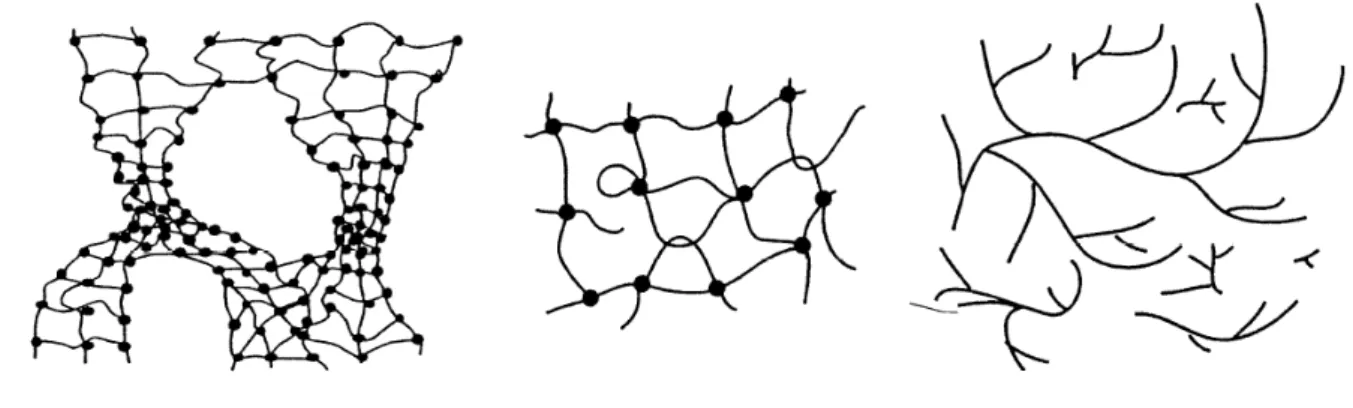
Shibayama recently proposed a new classification, schematically represented on Figure 5, of the three possible defects in gel structures [29]:
• A first type of defects is the one of spatial inhomogeneities, which corresponds to the non-uniform spatial distribution of cross-links along the polymeric network. Some zones are densely cross-linked while others are loosely cross-linked. When chemical cross-linkers are used, these inhomogeneities remain static, while in the case of reversible cross-linkers, these inhomogeneities can be dynamic and thus can disappear.
• A second type of defects is the one of topologic inhomogeneities, which represents the state of topology of the network such as loops, trapped entanglements and dangling chains. These defects, which appeared during the gel synthesis, are static inhomogeneities.
• A last type of defects is the one of connectivity inhomogeneities, coming from the size distribution and the spatial distribution of branched polymer clusters. This last type of inhomogeneities is dynamic.
Figure 5: Shibayama’s classification of inhomogeneities in gels. Left: spatial inhomogeneities. Middle: topological inhomogeneities. Right: connectivity inhomogeneities. [29]
The contrast between hydrogel heterogeneities (densely and weakly cross-linked domains) remains weak at the preparation state but can be enhanced by swelling the hydrogel: the differences of polymer concentrations within these different domains are revealed [30].
1.3.2. Characterisation and consequences of inhomogeneities
Classical ways of synthesis previously described lead to the formation of hydrogels containing inhomogeneities. Experimentally, these inhomogeneities can be expressed by abnormal behaviour under solicitation compared to developed models and can be identified according to several methods.
Microscopic scale: diffusion properties of hydrogels
Spatial inhomogeneities are characteristic of chemically cross-linked hydrogels, resulting from the irregular incorporation of cross-linking units through the network formation. At the preparation state, physically cross-linked hydrogels can present spatial inhomogeneities which can be suppressed under certain conditions. Scattering techniques, such as Small Angle Neutron Scattering (SANS) and Light Scattering (LS), are used to evidenced these concentration fluctuation zones in hydrogels, at a scale from the dozen to the hundred of
nanometres. Indeed, a gel can be thought as a semi-dilute solution in which the polymer segments are cross-linked by chemical or physical bounds. Several theoretical models have been developed based on Lorentzian functions, such as the one of Panyukov and Rabin [2, 31] which describes a semi-dilute solution with partially inhomogeneous spatial distribution of polymer segments containing cross-links which prevents the polymer segments from free movements. These two components are represented by two correlation lengths: ξ for the polymer-polymer correlation and Ξ for the correlation length characteristic of solid-like inhomogeneities, as represented in Figure 6.
Figure 6: Schematic representation of a randomly cross-linked gel: regions of higher cross-linking density are marked in black, with a characteristic size Ξ. Chains are not shown, except in the magnified inset, from [30]. In both domains, the polymer-polymer correlation distance ξ, corresponding to the thermal blob, is unchanged.
A comparison between the theoretical and the experimental parameters can give information about the presence of inhomogeneities. The use of theoretical models such as the one mentioned here can quantify characteristic lengths, as represented in Figure 6.
In some cases, spatial inhomogeneities can even be detected visually by the presence of poorly transparent zones in hydrogels samples [32].
Macroscopic scale: elastic and swelling properties of hydrogels
two models are based on the principles of rubber elasticity, comparing the entropy of the network in the initial unconstrained state to the one in the stresses state [35].
When immerged in a good solvent and under certain preparation conditions, a gel is able to swell up to a maximal state. The swelling properties of hydrogels have been described by Flory-Rehner’s thermodynamic theory [33, 36, 37], taking into account several parameters such as the affinity of the polymer for the surrounding solvent, the initial concentrations of monomers, cross-linkers, the cross-linker functionality… These mechanical and thermodynamic models will be discussed in the next Chapters by comparison with the experimental results.
Influence of synthesis parameters on inhomogeneities
Thanks to the characterization techniques exposed here, the effect of experimental parameters on inhomogeneities of hydrogels can be evidenced. In the literature of acrylic gels, the main influencing parameters are the following (all the other parameters being constant):
• the monomer concentration: an equilibrium can be found between a diluted state, where the percolation can be unreached, and a more concentrated state where the effective cross-linking density can decrease due to steric effects, as studied by Gundogan et al. [38];
• the nature of monomers: the behaviour of electrolyte polymer gels is related to their environmental medium and particularly to the presence of ionic charges, as described by Miquelard-Garnier et al. [39];
• the cross-linker concentration: generally, a high cross-linker concentration in the reactive medium leads to strongly inhomogeneous structures (in terms of spatial inhomogeneities), as previously represented and widely studied by Shibayama [24, 29, 40];
• the initiation system: in the case of free-radical polymerization, Okay et al. have shown that different morphologies can be obtained according to the nature of the initiation reaction: redox or thermal initiation [41].
2.
Reinforcement of organic hydrogels
As described in the previous part, hydrogels are non ideal materials as their structures contain many types of defects. Several strategies have been developed in order to suppress or at least minimize these inhomogeneities with the aim of a reinforcement of the mechanical properties of gels. Moreover, the numerous defects of hydrogels are at the origin of poor mechanical properties. Recent studies have also been conducted in order to delay gel fracture. In this part, we will focus on three strategies recently developed on purely organic hydrogels: topological networks, double networks, and tetra-PEG gels.
2.1.
Topological networks
2.1.1. Structure of topological networks
In the beginning of the twenty first century, Ito et al. developed a new kind of hydrogels which are designated as topological networks [42]. They are based on the concept of movable cross-links, theoretically described by Edwards twenty five years ago [43] and more recently by Rubinstein and Panyukov [44]. The main idea of this system is to introduce movable cross-links, which is totally impossible in conventional chemical hydrogels. This structure allows free movements of the cross-linking points along the polymer chains in order to equalize the tension of the polymer chains, like pulleys. This novel gel architecture is obtained from the chemical cross-linking of polyrotaxane molecules in solution, comprising poly(ethylene glycol) and α-cyclodextrin. The cross-linking of the polyrotaxane chains results from the coupling of the α-cyclodextrin rings, leading to polymer chains topologically interlocked by figure-of-eight cross-links. One particularity of these gels is the presence of bulky end groups on the polymer chains. These topological gels are also called “slide-ring gels” and their original structure is schematically represented in Figure 7.
Figure 7: Left up: the polyrotaxane consisting of α-cyclodextrin and poly(ethylene glycol) and left down: the figure of eight cross-link: covalently cross-linked cyclodextrins, from [42]. Right: schematic representation of the structure of topological hydrogels, from [46].
The sliding motion of α-cyclodextrin on polyrotaxane chains has been evidenced by DLS by the appearance of a new mode in the decay-rate distribution function, between the fast one (related to cooperative diffusion) and the slow one (related to self-diffusion) [47].
By the SANS technique, an increase of the scattering intensity I(q) is observed for classical gels when the cross-linking density is increased. This increase is due to frozen inhomogeneities introduced by cross-linking. However, the slide-ring gels revealed lower scattering intensity with the increase of cross-linking density [46]. This decrease has been attributed to the reduction of spatial inhomogeneities thanks to the free movement of the cross-links along the polymer chains which accommodate the imposed macroscopic strain.
2.1.2. Properties of topological networks
The original structure of slide-ring gels provides unique properties which answer the main limitations of organic hydrogels and that are summarized below.
Swelling properties of slide-ring gels
The slide-ring gels developed by Ito et al. behave as superabsorbent polymers as they can absorb water up to 400 times their dry weight and 1600 times the weight of the PEG contained. Interestingly, this volume changes are totally reversible, without any damage [42].
Mechanical properties of slide-ring gels
When a loading-unloading tensile cycle is applied, physical hydrogels show large hysteresis in stress-strain curves, with a J shape, like in living tissues, because of recombination of physical cross-links during deformation. On the other hand, conventional organic hydrogels do not show any hysteresis and S shape as no recombination is possible with permanent cross-links. For slide-ring gels, a different mechanical behaviour is observed: J-shaped curves (different from chemical hydrogels) with no hysteresis (different from physical hydrogels) [48]. Moreover, they can reach strains of 2000% thanks to the pulley effect represented in Figure 8 [42].
Figure 8: Left: schematic comparison of deformation in covalently cross-linked network and slide-ring gel, from [42].
Right: typical J-shaped stress-strain curves of slide-ring gels with different concentrations of cross-linker, from [49].
Recently, the mechanical behaviour of slide-ring gels has been investigated in terms of cross-linking variation and an abnormal behaviour has been pointed out, compared to conventional rubber elasticity [50]. As a matter a fact, when the cross-linking density of slide-ring gels is increased, first a normal increase of elastic modulus is observed but it is then followed by a decrease of elastic modulus. A theory of alignment entropy of cyclic molecules in addition to the conformational entropy of polymer chains has been proposed to explain
The viscoelastic properties of slide-ring gels have also been studied by Hadziioannou et al., revealing two relaxation modes [51]. Indeed, the two evidenced viscoelastic regimes have been attributed to the molecular mechanism of the change of the mean mass distribution between the cross-linking points, thanks to the sliding motion of the α-cyclodextrin rings on the PEG chains.
Bi-dimensional small angle neutron scattering of slide-ring gels
Small angle neutron scattering experiments can be realized under deformation in order to correlate the macroscopic behaviour to the structure properties. With this technique, slide-ring gels are again different from conventional chemical hydrogels. As a matter of fact, organic hydrogels present a so-called “abnormal butterfly pattern” under deformation, due to an amplification of inhomogeneities in the stretching direction. In the case of topological gels, a “normal butterfly pattern” is observed indicating that the pulley effect suppresses the amplification of inhomogeneities thanks to the presence of movable cross-links [46].
2.2.
Double networks
2.2.1. Synthesis and structure of double networks
Ten years ago, Gong et al. developed the concept of tough gels with double network hydrogels consisting of two interpenetrating polymer networks swollen by water [52]. The first network is made of highly cross-linked rigid polymers while the second one is a loosely, or even not, cross-linked flexible polymer network, as schematically represented in Figure 9. In this representation, the first neutral network of poly(acrylamide) (PAAm) is interpenetrated with a second polyelectrolyte network of poly(2-acrylamido-2-methylpropanesulfonic acid) (PAMPS) [53]. The main idea is to find an optimal combination of the first rigid and brittle polyelectrolyte network and the second flexible and ductile neutral network.
Figure 9: Schematic representation of the structure of double network hydrogels, from [53]. Note that the molar concentration of the second PAAm network is 20-30 times the one of the first PAMPS network.
Double network hydrogels are generally synthesized via a two-step sequential free-radical polymerization, starting from the synthesis of the highly cross-linked polyelectrolyte network (PAMPS), followed by the swelling of this first network by the second neutral monomer (AAm) and finishing by its polymerization with a small amount of chemical cross-linker. The double network gel is then immersed in water to reach swelling equilibrium [52].
SANS and Ultra Small Angle Neutron Scattering (U-SANS) have been used to characterized double network hydrogels. Molecular association has been evidenced, as the structures of PAMPS and PAAm networks are more homogeneous when synthesized in presence of the co-monomer than in pure water [54].
2.2.2. Properties and applications of double networks
Here we mention the main properties of double networks leading to useful applications, mainly in biomedical area.
Mechanical properties of double network hydrogels
The mechanical properties of double networks – in terms of stiffness (elastic modulus), strength and toughness - are much better than that of the individual components but optimal concentration ratios have to be found for enhancing their mechanical properties [55-58]. When the second network is loosely cross-linked (or even without chemical cross-linker), double network hydrogels exhibit high mechanical strength. As a matter of fact, when the cross-linking density of the second PAAm network is changed from 0 to 1 mol%, keeping constant the structure of the first PAMPS network, similar elastic modulus (300 kPa) are obtained but the highest fracture parameters are obtained for the uncross-linked materials [56]. Moreover, DLS analyses revealed the presence of a slow mode at low cross-linking densities of the second network, with a perfect correlation with mechanical properties at different cross-linking densities [56].
During uniaxial tensile tests, Gong’s double networks show a necking phenomenon: narrowed zones appear along the samples and then grow up with elongation, as represented in Figure 10 left. In the corresponding stress-strain curves, yielding occurs, followed by a plateau region during the neck zone propagation, [55]. This phenomenon corresponds to a break of the first PAMPS network into small clusters, because of its intrinsic fragility. These formed clusters play the role of physical cross-linking points for the long flexible PAAm chains, behaving as sliding cross-linker. This mechanism has been verified by SANS experiments under deformation [54].
In our laboratory, cyclic experiments of loading-unloading on double network hydrogels have revealed very large hysteresis. Their analysis have been used to characterize the degree of heterogeneity of different double networks: more than 80% of the network strands being very short and resulting in bond fracture at any deformation beyond 20% [59].
c d
Figure 10: Left: tensile behaviour of double networks at a rate of 0.13 s-1, from [55]; a: loading curves of PAMPS/PAAm double network with images demonstrating a necking process, the insert capital letters represent the correspondence between the images and the date points in the loading curves and b: illustration of the network structure before and after necking.
Right: pictures comparing mechanical behaviour of simple and double networks, from [52]; c: cross-linked PAMPS simple network and d: PAMPS/PAAm double network.
Applications of double network hydrogels
The use of soft viscoelastic polymer network to reinforce the mechanical properties of a brittle polyelectrolyte network is the success story of Gong’s group. From the strong mechanical reinforcement observed, other hydrogel systems have been developed inspired by Gong’s concept, leading to applications in biomaterials. Among the biocompatible hydrogels based on double networks, we can mention:
The biological applications of double networks that have been well developed concern:
• substitute solution for cartilage replacement thanks to the resistance against water, the absence of detrimental effects on cartilage interface in vivo and the spontaneous cartilage regeneration observed for PAMPS/PDMA double network hydrogels [63-67],
• cornea reparation thanks to the transparency, the good glucose diffusion coefficient and the good tolerance of PEG/PAAc hydrogels [68].
2.3.
Tetra-PEG gels
2.3.1. Synthesis and structure of tetra-PEG gels
From the previous examples of reinforced hydrogels, it is obvious that all the strategies are based on a minimisation of inhomogeneities as they are at the origin of reduced mechanical properties. We present here another strategy based on the research of ideally homogeneous network. The strategy of Sakai et al. aims at forming a homogeneous structure by combining two well-defined symmetrical tetrahedron-like macromonomers of the same size [69]. The particularity of these two macromonomers is that each of them has four end-linking groups reacting with each other, avoiding self-reaction as they must be connected alternately, as schematically represented in Figure 11. The two constitutive units are: a tetra-NHS-glutarate-terminated PEG (TNPEG) and a tetraamine-tetra-NHS-glutarate-terminated PEG (TAPEG). A controlled anionic polymerization is used to obtain monodisperse macromolecules, with an important restriction of mobility of the four arms by steric repulsion. Then a simple mixing of two aqueous solutions of TNPEG and TAPEG leads to a gel formation based on the alternation of elastic blobs without any entanglements [70, 71].
SANS experiments has been conducted on tetra-PEG hydrogels, varying the length of the arms and an unusual result has been observed. As a matter of fact, polymer gels usually exhibit an upturn in scattering intensity curves in the low-q region because of inhomogeneities. Contrary to other polymer networks, tetra-PEG hydrogels do not show any upturn, confirming their “ideality” [40]. This absence of Inhomogeneity remains also at the deformed state.
Figure 11: Up: molecular structures of TAPEG (left) and TNPEG (right), from [69]. Down: schematic illustration of the two constitutive units of tetra-PEG gels, left: two units and right: network structure, from [40].
2.3.2. Mechanical properties of tetra-PEG gels
Tensile behaviour of tetra-PEG hydrogels has been studied varying the molecular weight of the macromonomers. A threshold has been evidenced for the molecular weight of the macromonomers: below 10 kg/mol, tetra-PEG hydrogels are brittle and poorly stretchable but above this critical value, they reach high deformability and resist to high stress compared to acrylamide hydrogels having the same network concentration, as presented in Figure 12, [69].
Figure 12: Left: comparison of tensile curves of agarose gel, acrylamide gel and tetra-PEG gel, at the same network concentration and in the same experimental conditions, from [69]. Right: tensile curves of tetra-PEG gels with two different molecular weight of macromonomers: 20 kg/mol (in red) and 40 kg/mol (in blue), from [72].
From the mechanical behaviour of tetra-PEG hydrogels, Sakai et al. evidenced a very high deformability of such “ideal” network [72]. Moreover, SANS measurements under deformation also demonstrated the absence of structural inhomogeneity which is at the origin of such mechanical behaviour (or in some cases the presence of avery low fraction of inhomogeneities) [40]. Another proof of the controlled architecture is the fracture experiments which confirmed that no entanglement was formed in such system [73].
3.
Hybrid hydrogels
As discussed in the first part of this chapter, classical organic hydrogels present poor mechanical properties because of inhomogeneities and low dissipation, inducing limited applications. Research on hydrogels science has not been limited to the organic part of chemistry. As a matter of fact, the incorporation of inorganic components has been studied since the beginning of the twenty first century for the mechanical reinforcement of hydrogels. Often designated as “nanocomposite gels”, “hybrid hydrogels”, “nanohybrid hydrogels”, this novel class of materials has been introduced by Haraguchi et al. in Japan and is now studied in different research teams. We present here Haraguchi’s system and the other materials that ensued from it.
3.1.
Hybrid hydrogels with clay platelets
3.1.1. Synthesis and structure of hybrid hydrogels with clay platelets PNIPAm hydrogels had attracted a lot of interest because of their sensitivity to external stimuli such as temperature, solvent, pH, light… During the last decade, Haraguchi et al. developed a new kind of PNIPAm hydrogels with singular mechanical properties, thanks to the introduction of exfoliated clay platelets into the polymer network [74]. These gels are based on the exfoliation of clay into dispersed platelets (Laponite, 20-30 nm in diameter, 1 nm in thickness) in an aqueous solution of NIPAm followed by the polymerization of NIPAm using a redox initiation of potassium persulfate (KPS)/N,N,N,N’-tetramethylethylenediamine (TEMED). In the absence of chemical cross-linker, these gels are expected to be physical gels with neighbouring clay sheets connected by polymer chains: clay sheets acting as multifunctional cross-linker for the PNIPAm chains, as schematically represented in Figure 13.
Figure 13: Schematic representation of the structure of Haraguchi ‘s hybrid hydrogels, from [75].
The gelation mechanism of PNIPAm/clay hybrid hydrogels and their obtained structure have been studied in details by DLS and contrast variation SANS [76]. Concerning the first technique, the formation of the hybrid network has been characterized by:
• the formation of growing clusters of nanocomposite microgels (corresponding to a depression in optical transmittance),
• followed by the gelation threshold (corresponding to an abrupt increase in the light scattering intensity).
The second technique of contrast variation SANS is based on the different scattering length densities of the three-component systems (here: PNIPAm, clay and water) and the possibility to “screen” one of the three components by suitable D2O/H2O ratios; this technique will be
presented in details in the experimental part of Chapter 3. From this technique, Miyazaki et
al. concluded that:
• a polymer layer surrounding the clay platelets exists, with a thickness of 1 nm,
• this fraction of polymer layer is almost constant, whatever the clay platelets concentration.
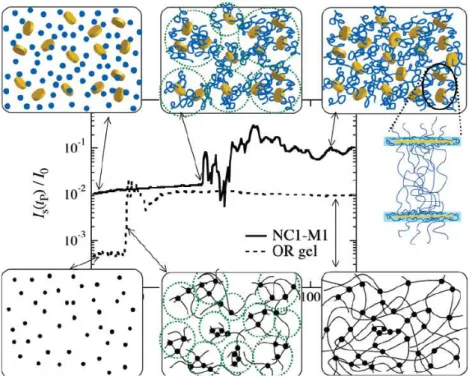
From these results, the following gelation mechanism has been proposed: the polymerization is initiated at the clay surfaces, as initiators are often concentrated near the surface of clay platelets [77]. After initiation, the free radical polymerization starts by the growing of polymer chains in the neighbourhood of clay platelets, progressively forming microgel clusters. The exfoliated clay platelets are covered by an adsorbed polymer layer. Those clusters percolate and the gel is formed (if the NIPAm initial concentration is high enough). Miyazaki’s results are summarized in the schematic representation given in Figure 14.
![Figure 3: Schematic representation of a new hydrogel system based on a thermosensitive switch for on-off drug delivery, from [19]](https://thumb-eu.123doks.com/thumbv2/123doknet/2894136.74031/35.892.124.766.861.1057/figure-schematic-representation-hydrogel-based-thermosensitive-switch-delivery.webp)
![Figure 7: Left up: the polyrotaxane consisting of α-cyclodextrin and poly(ethylene glycol) and left down: the figure of eight cross-link: covalently cross-linked cyclodextrins, from [42]](https://thumb-eu.123doks.com/thumbv2/123doknet/2894136.74031/43.892.131.736.142.386/figure-polyrotaxane-consisting-cyclodextrin-ethylene-covalently-linked-cyclodextrins.webp)
![Figure 15: Left: Stress-strain curves of nanocomposite PNIPAm/clay hydrogels, varying the clay content (NC1 to NC9), compared to a corresponding organic hydrogel (OR3), from [74]](https://thumb-eu.123doks.com/thumbv2/123doknet/2894136.74031/55.892.113.790.199.497/figure-stress-nanocomposite-pnipam-hydrogels-compared-corresponding-hydrogel.webp)
![Figure 16: Left: Comparison of stress-strain curves of tetra-PEG gels without clay (up) and with clay platelets (down), at different compositions, from [85]](https://thumb-eu.123doks.com/thumbv2/123doknet/2894136.74031/56.892.114.786.372.842/figure-comparison-stress-strain-curves-platelets-different-compositions.webp)