Devising a Framework for the Development of the Medium Scale Coal Sector in Colombia
by
Juan David Rodriguez Montes Bachelor of Civil Engineering, 2004
Pontificia Universidad Javeriana
Submitted to the Department of Urban Studies and Planning in Partial Fulfillment of the Requirements for the Degree of Master of Science in the Special Program for
Urban and Regional Studies and Planning at the
MASSACHUSETTSIN
Massachusetts Institute of Technology Of TECHNOLO February, 2009
FEB 1
8
20
@2009 Juan David RodriguezAll Rights Reserved
LIBRARIE
The author hereby grants to MIT permissi o repro uce and to paper and electronic copies of this th s i ole o in part.
distribute publicly
Author
Department of Urban Studies and Planning
January 16, 2009
Certified by
Accepted b
Karen R. Polrinske Professor of Regional Political Economy and Planning Thesis Supervisor v .
ARCHIVES
GY09
ES
7/ Bish SanyalFord International Professor of Urban Development and Planning Spurs Director
].
Devising a Framework for the Development of the Medium Scale Coal Sector in Colombia
by
Juan David Rodriguez Montes
Submitted to the Department of Urban Studies and Planning on January 16, 2009 in Partial Fulfillment of the Requirements for the Degree of Master of Science in the
Special Program for Urban and Regional Studies and Planning
ABSTRACT
The purpose of my study is to devise a framework that encompasses the strategies put forth by the Colombian government as to advancing the productivity and
competitiveness of the country, with an emphasis on finding development alternatives for the medium-scale coal sector, tackling its shortcomings, and improving the sector's situation. The framework integrates three dimensions of analysis including the Colombian national policies for productivity and
competitiveness, coal sector development, and environmental conservation. I lay out several coal-development alternatives and evaluate their economic and
environmental performances using input-output analysis, and multi-criteria decision analysis for alternative selection. I also model different scenarios prioritizing each of the dimensions of analysis.
The results from the scenario analysis show that coal gasification suits best the three dimensions of analysis, providing the highest economic benefits with the least environmental impacts of the proposed development alternatives.
In addition, I use Geographic Information Systems to conduct location-suitability analysis for the coal fields in the interior of Colombia. Results of the suitability analysis portray coal fields in the C6rdoba and Cundinamarca Provinces as the most suitable regions for coal-gasification development.
Supervisor: Karen R. Polenske Reader: Michael Flaxman
Dedicated to my Caring Father, Mother, Brother and Sisters and to my Beloved Wife and my Daughter. Their Love and Support made this Accomplishment possible.
CONTENTS ABSTRACT ii ACKNOWLEDGEMENTS vi FIGURES vii TABLES viii CHAPTER 1: INTRODUCTION 11
CHAPTER 2 : FRAMEWORK FOR THE DEVELOPMENT OF THE 17
MEDIUM-SCALE COLOMBIAN COAL INDUSTRY
2.1 Framework Overview 18
2.1.1 Dimensions of Analysis 18
2.2 Framework Methodology 20
CHAPTER 3: COMPETITIVENESS AND PRODUCTIVITY AGENDA IN 25
COLOMBIA
3.1 The Colombian Government's Role in the Coal-Mining Sector 26
3.2 Competitiveness Agenda for the Mining Sector 26
3.3 Mining Sector's Competitiveness Policies 27
3.4 Mining Districts as a Path for Increasing Competitiveness in Mining 28 3.5 Framework Combined with the Coal-Mining Competitiveness 31
Agenda
3.6 Summary 31
CHAPTER 4: COLOMBIA'S ENERGY SITUATION 32
4.1 Colombia's Energy Outlook 33
4.1.1 Liquid Fuels 33
4.1.2. Natural Gas 37
4.1.3 Electric Power 39
4.2 Summary 41
CHAPTER 5: COAL MINING IN COLOMBIA 42
5.1 Coal Resources of Colombia 43
5.2 Classification of Colombian Coal Operations 46
5.3 The Medium-Scale Coal Sector 48
5.4 Coal Uses in Colombia 50
5.5 Production Forecast 51
5.6 Exports Forecast 52
5.7 Coal Qualities 52
5.8 Transportation Cost 54
CHAPTER 6: MEDIUM-SCALE COAL DEVELOPMENT ALTERNATIVES 57 IN COLOMBIA
6.1 Acronyms and Abbreviations 59
6.2 Steam Coal Development Alternatives 60
6.2.1 Intensification of Coal-Based Power Generation 62
6.2.2 Coal Liquefaction 65
6.2.3 Coal Gasification 70
6.3 Economic Evaluation of Steam Coal Development Alternatives 74
6.3.1 Model Overview 74
6.3.2 Input-output Analysis Results 82
6.4 Criteria for Project Selection 82
6.4.1 Grid Analysis of the Steam Coal Development Alternatives 84
6.4.2 Scenario Modeling 88
6.4.3 Results by Scenario 90
6.5 Geographic Information Systems Applied to the Strategy Making 94 6.5.1. Suitability Analysis for Project Location 94
6.6 Coking Coal Development Alternatives 106
6.5.1 Analysis Overview 106
6.5.2 Coking Coal Development Analysis Conclusions 110
6.7. Summary 112
CHAPTER 7: CONCLUSIONS 113
REFERENCES 117
APPENDICES 121
Appendix A: Appendix to Chapter 5 121
ACKNOWLEDGEMENTS
I would like to thank my Thesis Supervisor, Professor Karen R. Polenske, for inspiring my interest in studying regional economy and planning, and also for her continuous encouragement and academic excellence.
I also want to express my gratitude to my Thesis Reader, Professor Michael Flaxman, for his critical thinking, insightful comments and delightful discussions about the many considerations involved in planning projects and economic development.
In addition, I want to thank the Information and Mining Divisions Staff of the Colombian Mining and Energy Planning Unit - UPME, especially, Engineer Jorge Londoho, for providing valuable information and data for the analyses conducted in this study.
FIGURES Figure 2.1: Figure 2.2: Figure 3.1: Figure 4.1: Figure Figure Figure Figure Figure 4.2: 4.3: 4.4: 4.5: 4.6: Figure 5.1: Figure 5.2: Figure 5.3: Figure 5.4: Figure 6.1: Figure 6.2: Figure 6.3: Figure Figure Figure Figure Figure Figure Figure Figure Figure 6.4: 6.5: 6.6: 6.7: 6.8: 6.9: B.1: B.2: B.3:
Block-Flow Diagram: Framework for Development of the Colombian Medium-Scale Coal Sector
Block-Flow Diagram: Framework for Development of the Colombian Medium-Scale Coal Sector (Continued) Coal Mining Districts in Colombia
GDP Growth Forecast by the Colombian National Department of Statistics - DANE
Diesel Fuel Demand Forecast in Colombia Colombia's Gasoline Demand Forecast to 2025 Colombian Natural Gas Demand Forecast Gas Reserves and Production Forecast to 2020
Required Power-Generation Capacity vs. Secured Capacity. 2007 to 2012
Coal Mining Provinces and Comparative Productions for Years 2005 and 2006
High-yield, Open-Pit Mine in the Cesar Province Underground Medium-Scale (low yield) Coal Mine
Location and Ownership of Coal Ports in Northern Colombia Coal Fields with High Reserve-Potential
and Protected Areas in Colombia
Nearest Roads, Rivers and Gas Pipelines to High Potential Coal Fields
Location Attractiveness Based on Distance from Coal Fields and Near Roads
Location Attractiveness Based on Distance from Rivers
Location Attractiveness Based on Distance from Gas Pipelines Location Suitability Overlay for Coal Gasification
Suitability Overlay for the San Jorge Coal Field
Suitability Overlay for the Suesca and Lenguazaque Coal Fields Suitability Overlay for the Paipa and Sogamoso Coal Fields Supercritical Unit with CO2 Capture Process Flow Diagram
Coal to Liquid Process Block Flow Diagram
Major Systems Comprising the Syngas Production Reference Plant 23 24 29 33 34 36 37 39 41 45 46 48 55 96 97 99 100 101 102 103 104 105 126 131 134
TABLES Table 4.1 Table Table Table Table Table Table Table Table Table Table Table Table Table Table 4.2: 4.3: 4.4: 4.5: 4.6: 5.1: 5.2 5.3: 5.4: 5.5: 5.6: 5.8: 6.1: 6.2: Table 6.3: Table 6.4: Table 6.5: Table 6.6: Table 6.7: Table 6.8: Table 6.9: Table 6.10: Table 6.11: Table 6.12: Table Table Table Table 6.13: 6.14: 6.15: 6.16:
Colombia's Diesel Supply and Demand Forecast Balance, 2015 and 2025
Colombia's Gasoline Supply and Demand Forecast to 2025 Colombia Natural Gas Demand Forecast by Sector
Gas Demand Share per Sector Forecast to 2025
Installed Capacity Demand Forecast by GDP Growth Scenario Total Power Output Demand Forecast to 2014 by GDP Growth Scenario
Measured and Potential Reserves of Coal in Colombia Percentage Distribution of Coal Types in Colombia Coal Consumption by Sector
Colombian Coal Production Forecast 2009 to 2025 Colombian Coal Exports Forecast. 2009-2025 Medium-Scale Coal Qualities
Coal Trucking Cost for Exports
Design Illinois #6 Coal Characteristics
Cost and Performance Parameters of the U.S. DOE Pulverized Coal Reference Power Plant
Cost and Performance Parameters of the Case Study Pulverized Coal Power Plant
Coal to Liquids Reference Plant Capital Cost Summary Case-study Coal to Liquids Plant Capital and Performance Summary
Coal-Gasification Reference Plant Cost and Performance Summary
Case-study Coal-Gasification Plant Cost and Performance Summary
Fuels Sector Original Technical Coefficients Relative to the "Coal" and "Crude Oil and Natural Gas" Sectors
Procedure for the Modification of the Fuels Sector Technical Coefficients
Fuels Sector Modified Technical Coefficients
Gas Supply Sector Original Technical Coefficients Relative to the Coal and Crude Oil and Natural Gas Sectors
Procedure for the Modification of the Gas Supply Sector Technical Coefficients
Gas Supply Sector Modified Technical Coefficients
Technical Coefficients for the Fuels, Gas Supply, and Power Generation Sectors used for the Case-study
Coal Development Alternative Investments Summary Sectoral and Total Output due to Investments in Coal-Development Alternatives 35 36 38 38 40 40 43 44 50 51 52 53 54 61 64 65 68 69 72 73 76 77 77 78 78 78 80 81 83
Table Table Table Table Table Table Table Table 6.17: 6.18: 6.19: 6.20: 6.21: 6.22: 6.23: 6.24: Table 6.25: Table 6.26: Table Table 6.27: 6.28: Table 6.29: Table A.1: Table A.2: Table Table Table Table Table Table Table Table Table Table Table Table Table Table A.3: A.4: B.1: B.2: B.3: B.4: B.5: B.6: B.7: B.8: B.9: B.10: B.11: B.12:
Coal-Development Alternatives Overall Performance Performance Index Meaning Explanation
Percentile Distribution of the Results of Overall Performance for Development Alternatives
Scores According to Performance Percentiles
Coal Development Alternatives' Performance Indexes Weights and Their Connotation
Weights for Each Factor of Decision by Scenario Coal-Development Alternatives' Scores for the Economic Priority Scenario
Coal-Development Alternatives' Scores for the Coal Development Priority Scenario
Coal-Development Alternatives' Scores for the Environmental Conservation Priority Scenario
Coal Sector and Basic Metallurgic Sector Technical Coefficients Exogenous Demands for Coking-Coal Exports and Coking-Coal Local Consumption from Steel Making
Exogenous Demands for Coking-Coal Exports and Coking-Coal Local Consumption from Steel Making
Coal Production Series per Province and Mining Company until June 30/2008
Coal Production Series per Province and Mining Company until June 30/2008 (Continued)
Qualities of Coal in Colombia per Province and Areas
Qualities of Coal in Colombia per Province and Areas (Continued) Balance of Supercritical Coal-Fired Plant
Coal-Fired Reference Power Plant Performance Summary
Reference Coal-Fired Power Plant Green House Gases Emissions Reference Coal-Fired Power Plant Water Balance
Reference Coal-Fired Power Plant Total Cost Summary Coal to Liquids Reference Plant Performance Summary Balance of Coal to Liquids Reference Plant
Coal to Liquids Reference Plant Capital Cost Summary Syngas Reference Plant Estimated Performance Summary
Syngas Reference Plant Capital Cost Summary Simplified Input-Output Colombian Matrix
Leontief Matrix from the Simplified Input-Output Colombian Matrix 84 85 87 87 88 89 89 91 92 93 108 109 110 121 122 123 124 127 128 129 129 130 132 132 133 135 136 137 138
CHAPTER 1
INTRODUCTION
The capacity of a country to build a strong national productive apparatus and to satisfy the energy requirements that emerge in that process, are fundamental elements to attain development. Further, implementing processes by which the
country advances its competitiveness will improve the economic atmosphere and the social conditions of people. These concepts also entail fostering social and
economic prosperity, reducing any adverse impacts of development on the environment.
For this study, I focus on Colombia, which has taken steps towards improving its productivity and competitiveness by laying out policies that engage the productive sectors of the country in an integrated sustainable-development-driven program, called the National Agenda for Competitiveness. According to this program, governmental institutions are required to design strategies for the development of Colombia's economic sectors with principles of productivity and sustainability. For the coal sector, the focus of this study, the Colombian government has
implemented some policies intended to promote sustainable mining in the country and to improve the productivity and competitiveness in regions where this sector is underdeveloped. The core of these policies is the model of mining districts,
territorial divisions for the stewardship of the mineral resources with the purpose of creating strategies for the advancement of the coal sector. This model presents a
unique opportunity for the implementation of development alternatives that take into account the regions' socioeconomic and environmental context.
In Colombia, the coal sector is composed of two main categories: The large-scale
coal sector is characterized by being very well developed, having economies of
scale, and suitability for exports because of their geographical location, enormous production volumes, excellent quality, and low production and transportation costs. The coal is mainly steam coal used for electric-power generation.
The medium-scale coal sector has medium to low production levels, lacks
continuous local demand, and is inappropriate for exports because the mines are located in the interior of the country; therefore, the huge transportation and
production costs do not create economies of scale. Nonetheless the quality and variety of these deposits are remarkable, and the reserves are vast. In this study, I focus on the medium-scale coal-sector.
The purpose of my study is to devise a framework that encompasses the strategies put forth by the Colombian government as to advancing the productivity and
competitiveness of the country, with an emphasis on finding development alternatives for the medium-scale coal sector, tackling its shortcomings, and
improving the sector's situation. Also, in the process of creating coal-development alternatives, I take into account aspects of environmental sustainability and
maximization of benefits for the coal sector and for the economy as a whole, enhancing the contribution of the medium-scale coal sector to the country's socioeconomic growth.
Moreover, the framework sheds light on alternatives for the use of coal that are strategic for Colombia's development and competitiveness, such as projects that ensure the supply of medium and long-term energy requirements. The framework
takes advantage of coal's flexibility to be converted into other forms of energy and fuels, like electric power or liquid fuels and gas, whose scarcity is being faced by the country.
I create development alternatives based upon experiences from the United States, where coal conversion into various forms of energy has been performed for several decades (Freudenthal 1974). In addition, I incorporate planning tools for evaluating the economic and environmental performances of outlined alternatives, and
selecting the most appropriate coal development alternative from the economic and environmental perspectives.
I use three methodologies: (1) input-output analysis to determine the potential economic impact of each development alternative, (2) spatial analysis using geographic information systems (GIS), and (3) multi-criteria decision analysis to account for several perspectives and factors of decision, like economic and environmental effects, in parallel.
Spatial analysis is included in the framework's analytical section, as GIS may provide a set of valuable information for each development alternative, related to transportation cost and efficiency, and further environmental impacts, which can be included in the multi-criteria decision analysis. However, I did not conduct
transportation and environmental GIS analyses in the case-study (Chapter 6), due to the lack of detailed and specialized data required for that purpose.
In this framework, GIS is also intended to plan the implementation of a selected coal development alternative. I illustrate the use of GIS in Chapter 6, by conducting
the location of inputs, available infrastructure for the supply of inputs and distribution of transformed products.
An essential premise for this framework, is that the medium-scale coal sector, which is located in the interior of Colombia, requires local and constant, long-term demand in order to develop. This allows mining projects to be large enough to achieve economies of scale, countering location and transportation disadvantages for exports and diminishing the impacts of foreign-market volatility. Therefore, I emphasize in the framework the activities that ensure the demand for coal
assuming that coal-mining activities will thrive insofar as the demand for coal is in place.
With this framework, I intend to provide the Colombian governmental agencies that make decisions about the coal sector, with a tool for planning and budgeting
purposes and to envision the kind of projects that should be fostered by the
government. However, the scope of this study and the limited detail of the data that I could acquire in the study's preparation time, do not support major investment decisions. Careful analysis of the recommended coal-development alternatives should be conducted to ensure their viability in the Colombian context and to justify major investments and policy actions.
In Chapter 2 "Framework for the Development of the Medium-Scale Colombian Coal Industry," I provide an overview of the proposed framework for the
advancement of the coal sector in line with the strategies for the country's productivity and competitiveness improvement. I describe the assumptions, components, methodologies and outcomes of the framework.
In Chapter 3 "Competitiveness and Productivity Agenda in Colombia," I describe the strategies that the Colombian government has implemented to enhance the productivity and competitiveness of the country. I also discuss the set of policies that governmental agencies managing the mineral resources of the country have put forth to engage the coal-mining sector in the process of competitiveness improvement. In addition, I indicate the coupling of the proposed framework with those strategies.
In Chapter 4 "Colombia's Energy Situation," I present Colombia's energy outlook and analyze the energy situation of the country in the medium and long term, identifying the country's requirements and energy-supply challenges for its future development.
In Chapter 5 "Coal Mining in Colombia," I describe the situation and potential of the coal sector in the country, emphasizing its evolution, the country's vast coal
endowment, the constraints for development of the medium-scale coal sector, and also, the remarkable possibilities for its advancement.
In Chapter 6 "Medium-Scale Coal Development Alternatives in Colombia," I illustrate the application of the framework by envisioning and evaluating several coal-development alternatives that could contribute to the sustainable economic development of the coal sector and the country. I evaluate the alternatives using input-output analysis and multi-criteria decision analysis to account for various factors of decision in parallel. After selecting a development alternative, I conduct a prototype spatial analysis using Geographic Information Systems (GIS) for project location suitability in coal regions.
In Chapter 7 "Conclusions," I present a summary of the thesis, the proposed framework, its outcomes, and its usefulness for assisting the governmental
institutions in the planning of development strategies for the coal sector. I also comment on further work that can be done from this study.
I hope this framework becomes a practical tool for planning in the coal sector, helping effectively the sector's and the country's development.
CHAPTER 2
FRAMEWORK FOR THE DEVELOPMENT OF THE MEDIUM-SCALE COLOMBIAN COAL INDUSTRY
The motivation of this thesis is to create a framework for the Colombian medium-scale coal sector to assist the country's decision-makers in finding development alternatives for that sector. I conceived this framework to integrate the current policies of the Colombian National Government for the advancement of the productivity and competitiveness of the country, environmental conservation, and smart use of the country's coal resources.
In the development of this framework, I emphasize finding development
alternatives that improve the medium-scale coal sector's situation. Also, in the process of envisioning coal-development alternatives, I take into account aspects that are environmentally sustainable and that benefit the coal sector and the economy as a whole, as a means to increase the contribution of the medium-scale coal sector to the country's sustainable socioeconomic growth. The analyses comprise several policy decision factors and different scenarios reflecting prioritization cases, in order to find the most appropriate alternative for the
development of the coal sector, the country's economic growth, and environmental conservation, altogether.
2.1 Framework Overview
The framework accounts for three analysis dimensions, namely (1) the Colombian national policies for productivity and competitiveness, (2) the coal sector
development, and (3) sustainability or environmental conservation. For the coal-development alternatives, I take into account what is important for each dimension.
2.1.1 Dimensions of Analysis
In this section, I provide an explanation of the dimensions of analysis. These dimensions are categories of factors that I consider for the study and the basis of the framework.
1. Colombian National Policies for Productivity and Competitiveness Dimension
For this dimension, I consider the effort that the Colombian government is undertaking to make the country competitive and to improve the socioeconomic conditions for people. I urge Governmental institutions to create strategies for the sustainable and effective development of the country's productive sectors they manage. Further, strategies should be coordinated among sectors to aim at the same objective.
For the coal sector, the Colombian government, through the Mining and Energy Ministry, has created policies attempting to promote the mining activities and to improve the productivity and competitiveness of the medium-scale coal sector in an environmentally sustainable way. Coal-development alternatives must be attuned to the government's efforts and must ensure an increasing contribution of the coal
sector to the national development. In addition, coal-development alternatives can supply products that are strategic for the country's competitiveness and
advancement, like energy in the form of power or fuels.
In this framework, I consider a scenario in which the priority is the economic benefit stemming from the coal alternative developments.
2. Coal-Sector Development
The coal sector in Colombia presents deep disparities: while the country is the fourth largest global steam coal exporter (WCI 2008), most of the coal mining in the interior of the country is poorly developed, despite having a great potential for expansion and for advancing the socioeconomic conditions of regions. Coal-development alternatives must ensure a continuous demand for coal in a way that medium-scale coal-mining projects achieve economies of scale to overcome
development constraints and improve its productivity and output and environmental performance. I provide a further description of the medium-scale coal sector in Chapter 5.
In this framework, I evaluate the activities that ensure the demand for coal rather than analyzing coal-mining development, assuming that coal-mining activities will thrive insofar as there is a continuous, long-term demand for coal. In sum, this is a demand-driven analysis for the medium-scale coal-sector development.
Moreover, in the analysis of coal-development alternatives, I consider a scenario in which the coal-sector development is prioritized.
3. Environmental Conservation
Reduction of the adverse impacts of development, and environmental protection, are fundamental for sustainable development. Currently, to implement and to oversee pollution controls in medium- to low-yield coal mines is a challenging process. A large coal mining development, as the proposed in this study, would allow the government to design and implement environmental controls in an early stage of development.
The implementation of coal-development alternatives implies the introduction of pollution controls intended to improve the present environmental performance of coal mining and processing activities in the country. Therefore, environmental performance of the proposed coal-development alternatives must be taken into consideration in order to balance the environmental footprint of the medium-scale coal sector's development. I do this in the framework by accounting for emissions of carbon dioxide (CO2) and water consumption of each alternative. I also consider a scenario that prioritizes environmental conservation, giving a high importance to environmental performance.
2.2 Framework Methodology
I provide a brief description of the framework's process and methodologies below.
In Chapter 6, I present a case study to show how the framework works.
I started the analysis by finding possible coal-development alternatives that comply with the dimensions of analysis described in the previous section, from
development alternatives analyzed in Wyoming State of the United States 20
(Freudenthal 1974), including intensification of coal-based power generation, coal liquefaction, and coal gasification.
Then, I researched the economic and environmental performance of each alternative from comprehensive studies conducted by the U.S. Department of Energy (U.S. DOE). Investment and environmental data for each reference plant of the alternatives from the U.S. DOE had different scales of production and coal consumption. For analysis and comparison purposes, I assumed constant returns to scale to adjust the plants' levels of investment, coal consumption, production, and environmental impacts, for a consumption target of 4 million tonnes a year, which is the scale I assume for the coal-mining development associated with any of these projects.
After I normalized the development alternatives to the target coal consumption, I used input-output analysis to evaluate the direct, indirect, and induced effects of each development alternative investment on the coal-sector output, the country's total output, and income. Further, I converted the economic and environmental performance values of the development alternatives into performance indexes for easier interpretation and analysis. Furthermore, I used a multi-criteria decision methodology and scenario modeling to identify the level of benefits that
development alternatives would generate in different priority scenarios for development.
With this set of information, decision-makers can chose an alternative development according to a given priority, i.e., economy, development of the coal sector or the
environment. In the case study of Chapter 6, I selected the coal-development alternative with the best overall performance.
Spatial Analysis
I include GIS in the analysis, as it may provide a set of valuable information for each development alternative, related to transportation cost and efficiency, and further environmental impacts, which can be included in the multi-criteria decision analysis. However, I did not conduct transportation and environmental GIS
analyses in the case study, as I was missing detailed and specialized data required for that purpose.
After I selected a coal-development alternative, I used Geographic Information Systems (GIS) to conduct the spatial analysis. This kind of analysis is useful for planning the development alternative selected, and the identification of optimal locations, required supporting infrastructure, inputs sourcing, and output allocation.
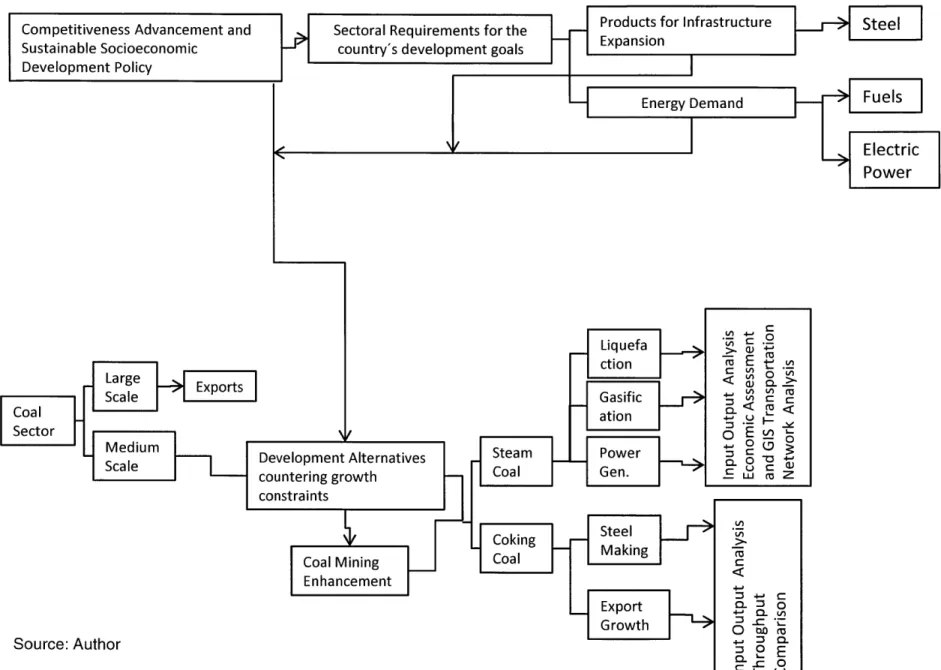
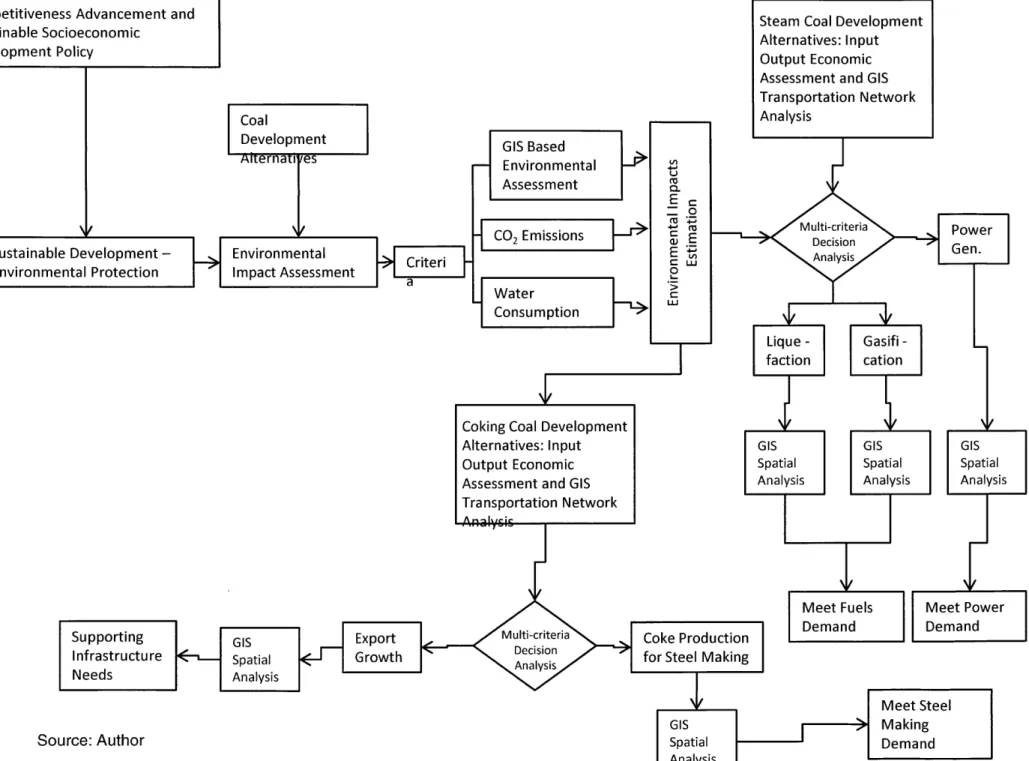
I present a block-flow model in Figures 2.1 and 2.2 to summarize and illustrate the framework's functioning. The flow model starts from the three dimensions of analysis described, and considers the fundamental elements for each dimension. Further, the flow model describes the factors of decision and the analysis
methodologies used for evaluation of alternatives. Finally, the multi-criteria decision analysis provides an understanding about the kind of development that should be fostered in the country, and GIS analysis is used to plan the development strategy.
Competitiveness Advancement and Sustainable Socioeconomic
Development Policy
H_
Sectoral Requirements for the country's development goalsDevelopment Alternatives countering growth constraints
Source: Author
Competitiveness Advancement and Sustainable Socioeconomic Development Policy Sustainable Development -Environmental Protection Source: Author
Figure 2.1: Block-Flow Diagram: Framework for Development of the Colombian Medium-Scale Coal Sector 24
Steam Coal Development Alternatives: Input Output Economic Assessment and GIS Transportation Network Analysis
Coking Coal Development Alternatives: Input Output Economic Assessment and GIS Transportation Network
CHAPTER 3
COMPETITIVENESS AND PRODUCTIVITY AGENDA IN COLOMBIA
In 2004, the Colombian National Commission for Economic and Social Policy (CONPES) put forth the National Competitiveness and Productivity Policy: Communitarian State - Development for Everyone. This Policy established
priorities, strategies, institutions in charge, and timelines from regional and sectoral perspectives for the coordinated and integral achievement of the country's
competitiveness through higher productivity and more efficient use of resources with principles of social and environmental responsibility (Conpes 2008).
This Policy is materializing with the design and application of the National Agenda for Competitiveness, which is currently under construction and whose main basis is the consensus among the government, the private sector, the academia, the
territorial authorities, the institutions, and the Colombian Society in general, to undertake the reforms, programs, and strategic projects critical for improving the productivity and competitiveness in Colombia (Confecdmaras 2005).
The National Agenda is intended to be a bottom-up process of experience-gathering and coordinated construction of strategies by different sectors of the Nation to attain sustained economic growth, technological advancement, poverty alleviation, and social development. This inclusive scope entails the
implementation of productivity and competitiveness policies and strategies by the governmental institutions in charge of the Nation's sectors, incorporating the
interaction among them for the accomplishment of the National Agenda's objectives.
3.1 The Colombian Government's Role in the Coal-Mining Sector
In 2001, a new National Mining Code was implemented in Colombia. The conception of the Government's role shifted from being the main investor,
manager, and developer of the mining business to being a promoter, facilitator, and comptroller of the use of mineral resources. Therefore the investment and
development of mineral mining and transformation projects were left for the national and international private sectors (UPME 2006).
3.2 Competitiveness Agenda for the Mining Sector
For the Mining Sector, the preparation, execution, and observation of such policies, are under the jurisdiction of the Mining and Energy Ministry. They should be
consistent with the Government's role in the Colombian Mining Industry (Promoter, Facilitator, and Comptroller), and the principles of the National Agenda, which for the mining sector translates into achievement of sustainable advancement of mining activities and expansion of the mining sector's share of the national output.
Policies made by the Ministry in this context include: Promotion of Mining, Management of Mining Resources, and Improvement of the Productivity, and Competitiveness of the Mining Sector.
3.3 Mining Sector's Competitiveness Policies
The Promotion of Mining policy is intended to consolidate the mining industry in Colombia and attract national and foreign investment to develop mining projects of national interest across the country. As explained in Minminas (2005), these new projects, undertaken in a sustainable manner and in harmony with the cultural and social contexts of regions, will generate growth and wellbeing due to the smart and transparent distribution of royalties and the demand for products and services provided by local suppliers
The Management of Mining Resources policy is meant to optimize the
performance of institutions that assign and oversee the Mining Concessions and manage the Nation's mineral resources. This translates into a more effective, efficient, and transparent concession-bidding process and contract oversight.
The policy on Improvement of Productivity and Competitiveness of the
Colombian Mining Sector is intended to specialize and strengthen the economies
of scale of the mining activities in order to increase the sustainable use of mineral resources by regions. In this approach, regions are able to structure plans of social and economic development integrated to the proper use of their mineral resources.
The main component of this strategy is the Model of Mining Districts, which allows the local agents of each district to reinforce their action capacity on the regions, engaging territorial institutions to design and implement programs and projects based on smart use of mineral resources, bolstering regional development and
enhancing the living conditions of communities without compromising the environment (Minminas 2007).
In order to understand the context of the strategy's development, I present a further explanation of the Mining Districts rationale in section 3.4.
3.4 Mining Districts as a Path for Increasing Competitiveness in Mining
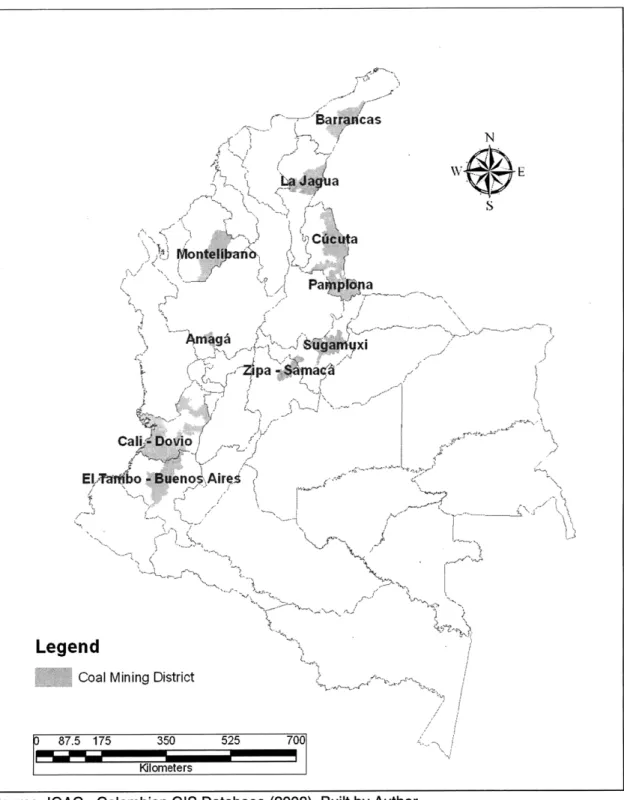
Mining Districts are defined by Minminas (2007) as strategic zones with geographic and geological continuity in which the mining industry is an economic activity of interest and high social impact. I show the coal-mining districts in Colombia in Figure 3.1.
Within these zones, planning and execution of strategies and programs for the sustainable enhancement of the productivity and competitiveness of mining
activities are undertaken by public entities, private companies, social organizations, and technical and academic institutions.
Benefits of such territorial division of the stewardship of mineral resources include:
* Construction of high-quality geographic, geological, economic and demographic data bases that allow comprehensive socioeconomic and spatial planning, better management of resources and more effective environmental protection.
Source: IGAC - Colombian GIS Database (2008). Built by Author.
Figure 3.1: Coal-Mining Districts in Colombia.
29
* Facilitation of the relationship between the State and the community, encouraging bottom-up processes for the formulation of action plans and project oversight.
* Improved resource allocation from the country's budget for project development, technology implementation, social programs, and infrastructure expansion
* Effective integration of mining and processing (value-added) projects to the territorial master development plans of municipalities included in each district. In addition, this structure fosters the linkage of the mining industry's value chain with other economic activities in the district.
In sum, Mining Districts are territorial divisions for the management of the country's mineral resources intended to optimize planning practices and strategy-making through participatory processes, in order to enhance the mining industry's productivity and competitiveness and to integrate it to the socioeconomic development plans of municipalities that compose each district.
3.5 Framework Combined with the Coal-Mining Competitiveness Agenda
The essential premise of this work is the alignment of conceived alternatives for the development of the coal sector with the strategies designed by the Mining and
Energy Ministry, particularly those concerned with the promotion of mining in a sustainable way and the enhancement of the productiveness and competitiveness of the coal industry.
The Mining Districts' structure presents an invaluable opportunity to propose a variety of alternative developments for the coal sector not as isolated processes, independent of the context around them, but as programs that depend on the interaction of the many components of the districts, and that will, by the same token, contribute to the socioeconomic growth of the district. In this spirit, I
propose several alternatives for the development of the medium-scale coal industry in coal-mining districts.
3.6 Summary
In this chapter, I presented the Colombian national policies for competitiveness and productivity. In addition, I described how these policies apply for the coal-mining sector and how the Mining Districts model has the potential to advance the
competitiveness of the medium-scale coal sector. Further, I indicated the coupling of the framework proposed in this study with the coal-mining competitiveness agenda.
CHAPTER 4
COLOMBIA'S ENERGY SITUATION
For this study, I consider Colombia's energy situation and trends regarding production and consumption of electric power, liquid fuels and natural gas. It is crucial to understand the country's current and long-term energy panorama to see how the proposed coal development alternatives can contribute to satisfy
Colombia's growing energy demand.
The Colombian Department of National Statistics (DANE) forecast the annual gross domestic product (GDP) growth of Colombia to 2025. GDP growth estimates
by DANE, include a base case, low- and high-growth scenarios as shown in Figure 4.1 (DANE Website: www.dane. qov.co accessed September 2008).
The total annual energy consumption increase in Colombia (i.e., electric power, liquid fuels, and natural gas) indicated in this chapter, was estimated by the
Colombian Mining and Energy Planning Unit (UPME) as a function of annual GDP growth.
In addition, the supply of liquid fuels, natural gas, and electric power, included in this chapter, was estimated by the UPME, based on this agency's records of available reserves of oil and gas and the installed capacity of power generation plants until 2025 (Union Temporal CTL 2007 and UPME 2007).
5 .2 S . 4 4 ;j5 B ase Low Cas- Gfowth
Source: DANE Website: www.dane.qov.co (2008).
Figure 4.1: GDP Growth Forecast by the Colombian National Department of Statistics - DANE.
4.1 Colombia's Energy Outlook
I indicate the energy supply and demand in Colombia, and the balance of energy in
order to identify possible shortages of liquid fuels, natural gas, and electric power. 4.1.1 Liquid Fuels
Presently, Colombia's domestic production of diesel fuel and gasoline does not meet the country's entire demand for liquid fuels. Therefore, the country needs to make up for the shortage by importing these products, putting pressures on the country's balance of payments, especially when the international prices of these
I
High 1Gzov~~ 61hE 19* -- -k ---~FS,
-- ---"I-111.1111-1--commodities surge. I present diesel fuel and gasoline supply and demand data below.
Diesel Fuel
As indicated in Figure 4.2, the forecasted demand for diesel fuel increases steadily from 2009 to 2025, due to the estimated expansion of economic activity. As of 2006, the country had a domestic supply of about 75,000 barrels a day (bbl/day) of diesel and a 21,000 bbl/day deficit, which is being compensated with diesel
imports. As I show in Table 4.1, by year 2015, Biodiesel plants in the country will supply about 6,300 bbl/day and domestic diesel-fuel production will increase to
roughly 100,000 bbl/day. Yet, there will be a 26,000 bbl/day deficit. The sharp
growing demand exacerbates the deficit, which by 2025 will be 61,000 bbl/day. 178.000 168.000 -158.000 M* 148.000 2 138.000 128.000 118.000 108.000 vv o t" r,4 m q Li w. r- ou r ) o -N m c r Lfl o 0 C 0 Q Q 0 C ) D CD
Source: Union Temporal CTL (2007). Built by author.
Note: bbl/day = Barrels per day
Table 4.1 Colombia's Diesel Supply and Demand Forecast Balance, 2015 and 2025
Units: bbl/day
Source: Union Temporal CTL (2007). Calculation: Author
Gasoline
As I show in Figure 4.3, the estimated demand for gasoline decreases, as the existing transportation fleet in the country that used to run on gasoline, is being retrofitted to use diesel fuel. By year 2018, the increase in automobile ownership and use will increase gasoline demand (Union Temporal CTL 2007).
As of 2006 the country had a 15,000 bbl/day deficit of gasoline and, in spite of the decreasing demand, by 2015 the deficit is expected to be about 13,000 bbl/day.
The domestic production of gasoline and ethanol is estimated to rise in the 2015
-2025 period. However, as I indicate in Table 4.2, the gasoline and ethanol
production will not suffice to meet the 2025 demand, resulting roughly a 13,000 bbl/day gasoline deficit.
Diesel 2006 - 101 2025 National Supply 74,852 100,981 102,464 Biodiesel - 6,303 8,203 Total Nat'l Supply 74,852 107,284 110,667 Consumption 95,987 133,746 171,753 Deficit 21,135 26,462 61,086
I
90000 85000 80000 75000 70000 ---65000
Source: Union Temporal CTL (2007). Built by Author.
Figure 4.3: Colombia's Gasoline Demand Forecast to 2025
Table 4.2: Colombia's Gasoline Supply and Demand Forecast to 2025
National Supply Ethanol Total National Supply Consumption Deficit 80,151 53,701 63,376 4,982 6,246 7,347 85,133 59,947 70,723 99,866 72,857 83,861 14,733 12,910 13,138
4.1.2 Natural Gas
Natural gas is a widely used commodity in Colombia. As I show in Figure 4.4, its demand is rising rapidly, due to economic growth and the increasing use of gas in automobiles and power generation. I show the forecasted natural gas demand in Colombia to 2025 by sectors in Table 4.3, and the expected gas demand share per sector in Table 4.4.
As I indicate in Figure 4.5, the country's reserves of natural gas are shrinking: By 2020, Colombia will only have enough reserves for six more years. This is a critical situation given the country's present and future reliance of the country on gas.
Units: Million cubic feet per day (Mcfd) 2,000 1,800 1,600 1,400 1,200 0 1,000 800 600" 400 200 0 N- (M) c i , t () 11 r0 t o 0) M -It to 0 0 0 0 0 0 0 0 0 0 0 R 0 0 0 0 0 0
t Residential [Commercial 0 Industrial 0 Power Generation M Transportation M Exports Source: UPME (2007)
Figure 4.4: Colombian Natural Gas Demand Forecast.
Table 4.3: Colombia Natural Gas Demand Forecast by Sector Residential 100.4 111.7 124.9 139.4 156.4 Commercial 20.2 23.4 27.1 31.1 35.4 Industrial 366.2 449.8 506.1 547.1 594.7 Power Generation 162.6 174.7 242.9 241.3 363.6 Transportation 36.4 48.6 57.2 65.4 76.8 Total Consumption 685.7 808.3 958.2 1024.3 1226.9 Source: UPME (2007)
Table 4.4: Gas Demand Share per Sector Forecast to 2025
Residential 14.6% 13.8% 13.0% 13.6% 12.7% Commercial 2.9% 2.9% 2.8% 3.0% 2.9% Industrial 53.4% 55.7% 52.8% 53.4% 48.5% Power Generation 23.7% 21.6% 25.3% 23.6% 29.6% Transportation 5.4% 6.0% 6.0% 6.4% 6.3% Source: UPME (2007)
8,000 39 7,000
Reserves/Production
33 6,000 27 24 4.000 2,000 1,000 2004 200 200 2010 2012 2014 2016 2018 2020 SReserves (Gcf) -o RIP Source: UPME (2007)Gcf = Giga cubic feet
Figure 4.5: Gas Reserves and Production Forecast to 2020
4.1.3 Electric Power
Colombia needs to guarantee the supply of electric power to ensure its
competitiveness and economic advancement. The country is endowed with vast
hydrological resources and most of the energy generated presently is hydropower (UPME 2008b). However, the demand for electric power is growing rapidly and the
current installed generation capacity will not suffice. Therefore, new power generation facilities should be implemented to enhance the country's installed
capacity and to provide the required energy for development.
39
In Table 4.5, I1 show the electric power demand forecast by UPME to 2014, under different scenarios of economic growth including low, high and base cases.
Table 4.5: Installed Capacity Demand Forecast to 2014 by GDP Growth Scenario
Units: MW _ _ _ ~ _ I w_ ; _a n m q U ~ 0A~ YEAR 2006 8.786 42 8.692 3.1 899 2.0 2006 9.095 35 871 3.2 8.835 2.7 2007 9,396 3.3 9.248 3.1 9,08 29 200 9.738 3.6 9,50 3.3 9,35 310 2009 10,098 3.7 9487 33 9,633 2.9 201 10455 3.5 10,178 3.2 9,885 2.6 2011 10826 3.5 10.500 3.2 10.144 2.6 202 11,22 3.7 10,47 3.3 10,424 2.8 2013 11,80 3.8 11,213 3.4 10,718 2.8 2014 ... 1 085 3.7 1 #8? 3.3 11 015 2.8 Source: UPME (2008b)
% = Annual growth percentage
In Table 4.6, I include the power output demand forecast by UPME for the same
scenarios of economic growth.
Table 4.6: Total Power Output Demand Forecast to 2014 by GDP Growth Scenario Units: GWh/yr
YEAR HIGH % BASE % LOW %
2005 48733 3.6 48215 25 47697 1A 2006 5054 3.8 49874 3.4 49117 3.0 S53.6 5159 3A 5084 3.2 200 54457 4.0 53410 03.6 52337 3.3 2009 5287 3.4 550010 1 2.389 200 58276 3.5 56734 32 55100 2 201 60343 3.5 8528 3.2 8543 2 2012 2731 4.0 60618 3. 58265 3.0 2013 64937 3.5 82503 3.1 59742 2.5 2014 8736 3,7 64586 3.3 61396 2.8 Source: UPME (2008b)
% = Annual growth percentage
In Figure 4.6, I describe the projected increase in installed capacity required. The
red line represents the power generation capacity that the country has secured by
BASE
=
current developments and project procurement. As indicated, the required capacity outstrips the secured capacity.
Source: UPME (2008b).
Figure 4.6: Required Power-Generation Capacity vs. Secured Capacity.2007 to 2012
4.2 Summary
In this chapter, I reviewed the supply and demand energy balance of Colombia in the medium and long term. The country faces pressing shortages of liquid fuels, natural gas, and power-generating capacity. The government needs to implement projects that secure these strategic supplies for competitiveness, and this can be done by implementing projects that transform coal into liquid fuels, gas and electric power, included in the coal development alternatives laid out in this study.
12000 -11000 - 10000-9000 8000 7000 2007 2008 2009 2010 2011 2012
* HIGH [3 BASE
*
LOW eSECURED CAPACITYMW
--
--
----
--
---
--
- ---
--- -
----
~
t
CHAPTER 5
COAL MINING IN COLOMBIA
Several regions in Colombia present large and high-quality reserves of various types of coal including steam coal for power generation, metallurgic or coking coal for coke production, and anthracite for the steel and water-treatment industries.
Currently, most of the coal production of the country is dedicated to exports: As of 2007, the country is the fourth largest coal exporter in the world, totaling 67 million tonnes of coal exported to markets in Europe and the Americas, most of it being
steam coal in raw form (WCI 2008). Although the country has experienced in the last decade a remarkable surge in the production and exports of steam coal from deposits in the northern region of the country, fields of different types of coal like coking coal and anthracite, products from their transformation like coke, and even steam coal deposits located in the center of the country, have not been developed at a nearly comparable pace, despite having a great potential for expansion and to contribute to the country's socioeconomic growth.
At the same time, medium to low yield coal mines insufficient reductions of environmental adverse impacts due to ineffective environmental controls and oversight, and safety hazards, have raised environmental and health concerns in the country
5.1 Coal Resources of Colombia
I summarize In Table 5.1 the country's measured and potential coal reserves. The
difference between them is the drilling-grid: While measured reserves are obtained by drillings made every 500 meters, potential reserves are inferred by drillings made every 4,500 meters. Both types of resources are expressed in million tonnes.
Table 5.1: Measured and Potential Reserves of Coal in Colombia
La Guajira Steam 3,933 4,537
Cesar Steam 2,035 6,556
C6rdoba- Norte Steam 381 722
de Antioquia
Total Northern Region (Atlantic Coast) 6,349 11,815
Steam
Norte de Antracite 120 795 Santander Coking Steam Santander Antracite 56 464 Coking Steam Boyacd Antracite 170 1,720 Coking Steam Cundinamarca Antracite 236 1,482 Coking Antioquia - Steam 90 475 Antiguo Caldas Valle Cauca -Steam 41 242 CaucaTotal Central Region (Interior) 713 5,178
Total Country 7,062 16,993
Figure 5.1, shows the coal-producing provinces in Colombia (beige shade), and a
production comparison for 2005 and 2006. Guajira, Cesar, and Cordoba Provinces
in the north of the country produce steam coal for exports through the ports on the Caribbean.
Table 5.2 shows the distribution percentages by type of coal across the country.
These data are crucial for the selection of the mining project and plant location.
Table 5.2 Percentage Distribution of Coal Types in Colombia
GUAJIRA CESAR a6RDOBA - NORTE DE ANTIOQUIA NORTE DE SANTANDER SANTANDER BOYACA CUNDINAMARCA ANTIOQUIA - CALDAS
VALLE DEL CAUCA - CAUCA
... ... .... ... ... 1.26 18.92 ... I ... ... ... ... ... ... -rl ~ ~L~l~ ~ ~ U i 100.00 100.00 100.00 54.54 50.00 54.57 55.04 100.00 100.00
Source: Uni6n Temporal CTL (2007) citing Ingeominas (2004)
44.20 31.08 45.43 44.96 r.,,**,.°,.o,.rrr..., -° o,° . .. °, -l fW*~*II1 lUl In~
900000 1100000 13000000
Carbon=Coal. Aio=Year. Source: UPME (2008a)
Figure 5.1: Coal Mining Provinces and Comparative Productions for Years 2005 and 2006
5.2 Classification of Colombian Coal Operations
Essentially, the coal sector in Colombia can be classified into two main categories:
1. Large-scale, high-yield steam-coal projects that are operated by world-class companies, located in Colombia's northern region. The excellent location (proximity to ports), quality, reserves, and suitability for open pit, high-yield mining allowed these operations to increase production rapidly. They have low operation and transportation costs, thorough planning practices, and high levels of mechanization and technology. This category accounts for about 96% of all coal exports from Colombia (UPME 2007). A typical open pit mine is portrayed in Figure 5.2.
Source: Ingeominas (2004)
Figure 5.2: High-yield, Open-Pit Mine in the Cesar Province
i i -i-iru;i ;i l ,~ ;, a: d.~-~i'w --a-,. --,:-iv I* Ire i~~ ~-$I~w~ :."_, "'~,~~u~""
2. Medium-scale, medium-to-low output coal projects that are operated by
national and some foreign companies and local entrepreneurs, located in the Central and Mid-eastern regions of the country (interior). They produce coking coal, anthracite, and transformed products, namely coke; some steam-coal small mining operations supply local markets of the cement industry and coal-fired power generation plants. Because these projects do not have the same competitive advantages and economies of scale as the large-scale operations, transportation and production costs, and lack of continuous and reliable
demand, have constrained their development. This sector is the target of my study: When the coal sector is mentioned, it refers to the medium-scale operations unless otherwise specified.
Even though a specific production threshold to determine the scale of a coal mining project was not found, for this case study, I assume that a production up to 400,000 metric tons per year is medium-scale. This corresponds to the
lowest production of a single mining project in the northern region of the country from year 2004 to 2008 (Table A. 1).
Source: Ingeominas (2004)
Figure 5.3: Underground Medium-Scale (low yield) Coal Mine
5.3 The Medium-Scale Coal Sector
Some factors affect medium-scale coal operations, such as low technological levels and high cost of transportation, partially due to poor infrastructure. In addition, the mining authorities have not made effective a strategy to implement
new activities for the domestic use of coal that enhances the country's productivity and competitiveness.
The results are haphazard development, low efficiency and sustainability, adverse environmental impacts, and low social investment.
However, the medium-scale operations have contributed significantly to the regional and national economy. In the regions where these operations are based, thousands of jobs have been created; royalties and tax revenues have allowed some level of investment in infrastructure and social programs, and the demand for products and services from other industries has had a positive effect on regional output (UPME 2007).
These operations are undoubtedly important for the regional and national economy, as indicated by the National Plan for Mining Development 2007-2010 (UPME 2007). The Colombian Government has stated the need for improving the conditions for their growth, competitiveness, and sustainability, by attempting to overcome location and technological disadvantages and to increase their
relevance in the national economy.
Although the government has made clear the objective of fostering sustainable development for the coal sector at the medium-scale, the completed studies are very aspirational and have not helped to develop a profound and detailed
understanding of the net (i.e., positive and negative) socioeconomic impacts of these activities. As a result, the Government lacks supportive information to
conduct comprehensive planning, leading to shortcomings in achieving this objective.
I propose the planning framework described in Chapter 2, specifying a few key socioeconomic planning tools of analysis for the development of the medium-scale operations including the implementation of value-added activities for coal, that enhance the intermediate demand of products and services, employment and
income distribution. This framework complies with the Colombian national agenda for productivity and competitiveness and may help to transform aspirations of coal sector development into strategies for advancement of the sector.
5.4 Coal Uses in Colombia
As mentioned previously, there is an internal market for Steam and Metallurgic coal, whose consumption is described in Table 5.3. Nonetheless, this market is not large enough to justify a greater mining development. Currently, exports are driving medium-scale coal mining developments in the country, particularly of coking coal deposits. This however, does not apply for steam coal.
Table 5.3: Coal Consumption by Sector
Units: Thousand Tonnes
Power* 1,386 1,446 1,296 1,274 745 970 1,139
Steel Makingt 472 493 442 608 417 422 422
Industry 2,092 2,181 1,956 1,752 2,319 2,460 2,466
Residential 109 114 102 101 100 98 98
Total 4,059 4,234 3,796 3,735 2,581 3,950 4,125
*Includes cogeneration. Tlncludes Coking Facilities and Blast Furnaces.
Source: Uni6n Temporal CTL (2007)
At current levels, the country has a local consumption of roughly 4 million tonnes. In the next section, I include forecasts for Colombian coal production and exports.
5.5 Production Forecast
I present in Table 5.4 a production forecast, disaggregated by provinces, conducted for the period 2009 to 2025, by the Colombian National Institute of Geology and Mining (Ingeominas).
Table 5.4: Colombian Coal Production Forecast. 2009 to 2025
Units: Million Tonnes
La Guajira 45 474 47.9 48 48.8 49 49.8 9 49. 49. 4.8 49 4 4.8 49.8 49. Cesar 48.0 505 66.5 665 66 5 66 5 665 66.5 66.5 6.5 66.5 66.5 66.5 66.5 C6rdoba 02 0 21 A 0 4 04 04 4 0 0.4 0.4 0.4 04 0.4 0.4 0-4 0.4 Cundinamarca 15 17 1t 1,7 17 1. 1.8 8 18 1.8 1.8 1.8 1.8 18 1.8 1.8 1.8 Boyacit 1.8 20 2,0 2.0 20 2.0 20 2211 2.1 21 2.1 2.1 21 2-1 2.1 2.1 2.1 NortedeSantander 2.8 30 103. 3. 3. 3. 3. 3.0 3. 3.0 3. 3. 3 3 3.0 3.0 Antioquia 1.2 2 121 2 1 2 1.2 12 12 1,2 2 1 2 2 ,12 1.2 1,2 12
Valle del Cauca 0 1 01 0.1 0 1 0 0 0.1 00.1 0.1 0 0 0 0.1 01 0 0 1 0.1 0.1 0.1
Santander 10 1 5 20 2,8 3,7 50 67 9.1 9t1 9.1 91 9.1 91 91 9.1 91 9.1
TOTAL 101.5 10?.7 124.9 126.1 127.6 129. 4 131.6 14.0 1340 434.0 134.0 134.0 134. 10 134.0
Source: Uni6n Temporal CTL (2007) citing Ingeominas (2004)
5.6 Exports Forecast
In Table 5.5, I show exports forecast, disaggregated by provinces, for the period 2009 to 2025.
Table 5.5: Colombian Coal Exports Forecast. 2009-2025
Units: Million Tonnes
l'.tungomaRaa U.* U0 U . U.0I U 0 UA 0 U. U. U U' U t U, , u U. U i
Boyac 1.3
_
1 .5 1 Z 1 15 1 1 .6 1 ., 1.5 1.51-
1 .t 1 5 1. 1Norte de Santander 2. 2 2. 2 2.0 2.0 2.0 2. 2. 0 2. 2.0 21 27 2. 2. 2.0
Antioqusa 0 0 .ol 0.0 0.0 0,0 0.0 0.0 00 0 0 0 0 0 00 00 0-0 0. 0 0.0 0'0
del Cauca 0 0 0 .0 0.0 O 0 O 0 0 .0 0 .0 00 00 00 0 .0 00 00 0.0 0 0.0 O
C6rdoba Montelibano 00 00 0 0.0 0. 0 0 .0 .0 0 &0 .0 0.0 0.0 00 0 0 00 0.0 0.0 0.0 0.0
TOTAL s.7 E 02.0 113. 1i9.ol s19.4 119.1 10 1204 1204 120A 1204 120. 120.4 120.4 120A I ,4 12 120.4120
Source: Uni6n Temporal CTL (2007) citing Ingeominas (2004)
As compared in the production and exports charts, La Guajira and Cesar are entirely oriented to exports.
Based on the measured and potential reserves, the types of coal and the
production forecast, the most suitable provinces to develop large-scale coal mining
and transformation projects in the interior of the country are Santander, Boyaca,
Cundinamarca, Norte de Santander, and the region composed by Cordoba
Province and the North of the Antioquia Province. In the next section, I describe
the coal qualities for these regions.
5.7 Coal Qualities
In Table 5.6, I include the results of proximate analyses and characterizations obtained for the regions suitable for high-yield coal-mining development
The qualities observed in Table 5.6, show high-quality coal in areas like Norte de
Santander, C6rdoba and Norte de Antioquia, Boyaca, and Cundinamarca. In
design coal type, Illinois #6, shown in Table 6.1, making it suitable for the coal development alternatives discussed in Chapter 6.
Quality details are provided for coal resources across the country in Tables A.1 and A.2.
Table 5.6: Medium-Scale Coal Qualities
.oraona - onre
de Antiouuia Alto San Jorge BCA 14.49 37.56 38.73 9,280
Salazar ROM 3.76 9.4 9.4 3681 381 4.96 0.62 12,762 .T.M.
Tasajero ROM 2.84 10.17 34.82 52.18 0.85 13,326 T.M
Norte deNtede Zulia ROM
3.36 11.90 35.29 49.45 1,27 12967 M
Santander
Catatumbo BCA 4.31 8.64 39.17 47.88 0.95 12,316 T
San Luis
- Thrmicos BAC 1.18 18.72 30.48 49.62 2.01 12.284 T
Santander - Metalirgicos BAC 1 1.18 10.09 29.05 59.67 2.15 13,893 M
PAramro del Almorzadero BCA 5.18 4.71 14.23 75.88 0.75 12,889 A.T.
Checua ROM 3.56 10.00 26.19 61.25 0.80 13,439 T.M.
Boyac Albarracin ROM 4.69 12.18 33.71 49.42 1.07 12,420 T
Sogarnoso -Jeric6 ROM 4.29 9.57 30.19 55.96 1.23 13,099 T.M.
Cundinamarca Lenguazaque ROM 4.67 10.62 33.85 50.86 1.06 12.718 T.M.
Suesca ROM 3.92 10.431 33.53 52.12 0.69 12.7381 T
Source: Union Temporal CTL (2007) - Modified: Author
Notes: 1 Indicates source of sample: ROM= Run of Mine; BCA = Different from the mine.
T=Thermal (Steam). M=Metallurgic (Coking). A=Anthracite. VM=Volatile Matter. FC=Fixed Carbon. S=Sulphur. CV=Calorific Value.