HAL Id: hal-00297468
https://hal.archives-ouvertes.fr/hal-00297468
Submitted on 11 Jun 2008
HAL is a multi-disciplinary open access
archive for the deposit and dissemination of
sci-entific research documents, whether they are
pub-lished or not. The documents may come from
teaching and research institutions in France or
abroad, or from public or private research centers.
L’archive ouverte pluridisciplinaire HAL, est
destinée au dépôt et à la diffusion de documents
scientifiques de niveau recherche, publiés ou non,
émanant des établissements d’enseignement et de
recherche français ou étrangers, des laboratoires
publics ou privés.
Sensitivity analysis of surface ozone to modified initial
and boundary conditions in both rural and industrial
zones
N. Castell, A. F. Stein, R. Salvador, E. Mantilla, M. Millán
To cite this version:
N. Castell, A. F. Stein, R. Salvador, E. Mantilla, M. Millán. Sensitivity analysis of surface ozone to
modified initial and boundary conditions in both rural and industrial zones. Advances in Science and
Research, Copernicus Publications, 2008, 2, pp.113-118. �hal-00297468�
Adv. Sci. Res., 2, 113–118, 2008 www.adv-sci-res.net/2/113/2008/
©Author(s) 2008. This work is distributed under the Creative Commons Attribution 3.0 License.
Advances in
Science and
Research
EMS
Annual
Meeting
and
8th
Eur
opean
Confer
ence
on
Applications
of
Meteor
olo
gy
2007
Sensitivity analysis of surface ozone to modified initial
and boundary conditions in both rural and industrial
zones
N. Castell1, A. F. Stein2, R. Salvador1, E. Mantilla1, and M. Mill´an1
1Fundaci´on Centro de Estudios Ambientales del Mediterraneo, CEAM, Paterna, Valencia, Spain 2Earth Resources and Technology on assignment to NOAA/Air Resources Lab., Silver Spring, Maryland, USA
Received: 20 December 2007 – Revised: 20 April 2008 – Accepted: 22 April 2008 – Published: 11 June 2008 Abstract. A three-dimensional air quality model based on a set of chemical species mass conservation equa-tions describes the time evolution of chemical species in the atmosphere. In order to solve this set of equaequa-tions, proper choices of initial and boundary conditions are needed.
Ideally, initial and boundary conditions should be determined on the basis of observations. However, since such high-resolution observations are generally not available, it becomes necessary to use other information sources to specify the initial and boundary values. The fact that both the initial and the boundary conditions are specified with some degree of presumption makes it important to evaluate their influence in the model results. In this paper we present a study of the impact of initial and boundary concentrations on the modelled surface ozone concentration over two environments: Huelva and Badajoz, an industrial and a rural zone, respectively. The impacts are analysed for the same meteorological period (10–15 August 2003).
1 Introduction
Eulerian photochemical airshed models have been developed to study the formation and dispersion of ozone, based on a mathematical description of chemistry, physics, meteorol-ogy, and emissions (Seinfeld and Pandis, 1998). To run air quality models initial and boundary conditions have to be specified. Model studies of photochemical pollutants will be affected by the assumed initial and boundary conditions.
Berge el al. (2001) have indicated that the influence of ini-tial conditions could be minimized through spin-up or start-up prior to formal simulations. The influences of initial ditions basically depend on the species lifetime. Initial con-ditions are of some importance, but their effect can be mini-mized by running the model for a period of time before using the results. However, the effects of uncertainties in boundary conditions are not as easy to minimize. Seinfeld and Pandis (1998) have suggested a few rules to reduce the influences of boundary conditions. First, include all the sources that may have potential effects on the given region in the simulation domain. Second, include the sources implicitly in boundary
Correspondence to: N. Castell
conditions; and third, apply the simulation results of a larger model domain to the boundary condition of smaller simula-tion domains within.
In the Iberian Peninsula there are three important air mass drainages: the Ebro Valley in the northeastern; the Pyre-nees and the Central Massif, introducing northwestern flows into the Mediterranean through the Gulf of Lyon; and the Guadalquivir Valley, in the southwestern Iberian Peninsula, towards the Gulf of Cadiz (Gangoiti et al., 2001; Millan et al., 1992).The air pollution from outside of the Iberian model domain penetrates through orographic canalizations.
The 10–15 August 2003 period is representative of high occurrence meteorological and air quality situations in the South-West of the Iberian Peninsula (Millan et al., 1997). During this period stagnant high-pressure and meso-scale re-circulation patterns were registered. These atmospheric con-ditions, together with a cloudless sky and elevated tempera-tures, favoured photochemical ozone formation.
During 11–14 August 2003, at 10:00 UTC the diurnal regime is established, and the breeze has a component E in the Gulf of Cadiz and S-SW in the Guadalquivir Valley. From 21:00 UTC, flows weaken and the nocturnal regimen characterized by the development of mountain and katabatic winds in the main orographic systems and the formation of
114 N. Castell et al.: Sensitivity analysis of surface ozone to modified IC/BC
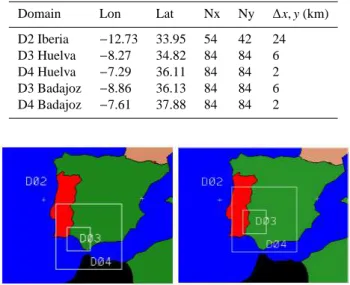
Table 1. Domain description. Longitude and latitude of the lower left corner, number of X and Y cells, and horizontal resolution of X, Y cells.
Domain Lon Lat Nx Ny ∆x,y (km)
D2 Iberia −12.73 33.95 54 42 24
D3 Huelva −8.27 34.82 84 84 6
D4 Huelva −7.29 36.11 84 84 2
D3 Badajoz −8.86 36.13 84 84 6
D4 Badajoz −7.61 37.88 84 84 2
Figure 1.Nested domains used in the photochemical modelling of Huelva (left) and Badajoz (right).
land breezes in coastal areas dominates de dynamics of air pollutants. Drainages are developed in main valleys and peninsular orographic systems. The last day of the period the atmospheric stability was broken. A detailed description of the meteorological conditions can be found in Salvador et al. (2006).
2 Methodology
2.1 Meteorological and photochemical modelling
Numerical simulations have been carried out using the MM5 meteorological model (Grell et al., 1994) and the CAMx photochemical model (Environ, 2006), independently. Both models make use of the nested grid capabilities to include interactions between the different scales involved. The pho-tochemical simulations domains are described in Table 1 and Fig. 1. For the selection of the domain configuration, the Seinfeld and Pandis (1998) rules to reduce the influences of boundary conditions were taken into account.
The coarse domain includes the Iberian Peninsula, the west and east boundaries extend to the Mediterranean and Atlantic sea, respectively. The nested domains include the areas of Badajoz and Huelva, with a horizontal grid resolu-tion of 2 km.
The anthropogenic emissions for the Iberian Peninsula are estimated from the EMEP emissions inventory (EEA, 2006). Simultaneously, a high-resolution emission inventory was developed specifically for the Huelva and Badajoz domains, including the estimation of biogenic, road-traffic and main
industrial emissions. The non methane volatile organic com-pounds (NMVOCs) emission model from vegetation (iso-prene, monoterpenes and other NMVOCs) uses the algorithm by Guenther et al. (1993), suited and adapted for describ-ing the particular emitter behavior of some Spanish species (Castell et al., 2006).
The boundary conditions for the base case were selected as average background concentrations for the area, with an ozone concentration of 35 ppb. For the other species no mea-sures were available and conditions of clean air were as-sumed (see Table 2). Ideally, initial and boundary conditions should be determined based on observations. However, these observations are generally not available.
In order to assess the influence of initial and boundary con-ditions (IC and BC) in tropospheric ozone levels, seven dif-ferent simulations were performed by modifying the IC and BC from the base case (described in Table 2), namely:
a. Increase of 50% in IC and BC for ozone and its precur-sors.
b. Increase of 50% only in IC for ozone and its precursors. c. Increase of 50% only in BC for ozone and its precursors. d. Increase of 50% in ozone IC.
e. Increase of 50% in ozone precursors’ IC. f. Increase of 50% in ozone BC.
g. Increase of 50% in ozone precursors’ BC.
Initial and boundary conditions were only modified in the coarse domain (Iberian Peninsula). The emissions, meteo-rology as well as the rest of photochemical model input vari-ables were the same in the base case and the different scenar-ios for all domains.
2.2 Model vs measurement data
In order to evaluate the performance of MM5-CAMx to calculate ground-level ozone, the data provided by the air quality network of Andalucia and Extremadura Government (Spain) were used. Performance of the models was statis-tically evaluated by comparing the first-layer simulation re-sults and the ozone values measured in 20 air quality stations located in the southwestern Spain.
The objective set in the Directive 2002/3/EC (deviation of 50% for the 1-h averages during daytime) is achieved for all of the stations for the whole period (10–15 August 2003), with a mean normalized gross error of −29% and −33%, for Huelva and Badajoz domains, respectively.
Addiotionally, to insure the performance in the Iberian Peninsula the ozone simulations have been statistically eval-uated using 8 remote air quality stations belonging to the EMEP network and homogenously distributed over Spain. The objective set in the Directive 2002/3/EC is achieved too (Castell et al., 2007).
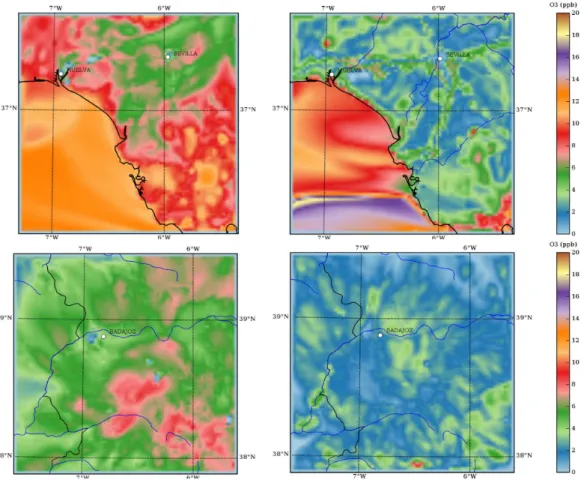
Figure 2. Impacts of an increase of 50% in initial and boundary conditions (run a –base case) at 00:00 UTC (left) and 12:00 UTC (right) hours for 13 August, for the Huelva (up) and Badajoz (down) domains.
3 Results and discussion
3.1 Impact of an increase in IC and BC
The results of the simulation with increases of 50% in IC and BC for ozone and its precursors, shows impacts along the whole simulation (10–15 August 2003) for both Huelva and Badajoz. Figure 2 shows the difference in ozone concentra-tions between simulation a and the base case for 13 August at 12:00 and 00:00 UTC. In both study domains, Huelva (indus-trial) and Badajoz (rural) the impacts exceed 10 ppb in some areas. Generally, the impacts are greater during the night. Nevertheless, in the Huelva and Badajoz domains there are grid cells where the impact is lower than 3 ppb. These grid cells coincide with the industrial areas where the emissions have been distributed with a constant daily profile.
3.2 Impact of an increase in IC
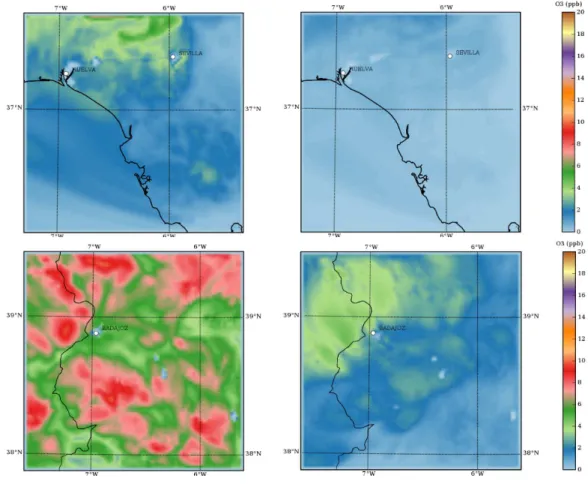
Figure 3 represents the ozone impact as consequence of an increase of 50% in IC (run b – base case) at 48 and 72 h from the start of the simulation. In the Badajoz domain the effect of increasing the initial conditions still continues to be
im-Table 2.Initial and boundary conditions for the base case. Specie Concentration (ppb) NO 4.90 E-05 NO2 8.56 E-02 O3 3.46 E+01 PAR 3.08 E+00 TOL 6.04 E-03 HCHO 1.07 E+00 ALD2 1.05 E-01 ETH 5.32 E-03 PAN 3.83 E-02 CO 9.95 E+01 HNO2 7.28 E-04 H2O2 2.26 E+00 HNO3 1.53 E+00 NXOY 6.33 E-03
portant after 48 h, with impacts as high as 10 ppb in several grid cells. In contrast, in the Huelva domain the impact is slightly relevant after 48 h. In the Bajadoz domain the impact
116 N. Castell et al.: Sensitivity analysis of surface ozone to modified IC/BC
Figure 3. Impact of initial conditions (run b – base case) at 48 h (left) and 72 h (right) after the simulation started for the Huelva (up) and Badajoz (down) domains.
becomes negligible after 72 h from the beginning of the sim-ulation. The spin-up time needed to minimize the impact of initial conditions strongly depends on the domain character-istics.
The sensibility of ozone is higher to an increase in the ozone ICs than to an increase in ozone precursors, for both rural and industrial areas. An increase of 50% in ozone IC (run d – base case) leads to an impact of up to 15 ppb, whereas an increase in the IC of its precursors (run e – base case) produces an impact of 5 ppb or less (not shown).
Furthermore, the analysis of the temporal evolution of the IC impact shows that it can be minimized or even eliminated with a reasonable spin-up time. These simulations indicate that the initial conditions were unimportant for ozone after 48–72 h.
3.3 Impact of an increase in BC
During the first 24 h the impact due to the boundary con-ditions is negligible. However, the impact over the Huelva domain during the second day and over the Badajoz domain during the third day can reach up to 10 ppb. These increases
are observed over the rest of the simulation, with variations among the different days that can be attributed to the meteo-rological situation (mainly wind speed and direction).
Figure 4 shows the maximum impact for every cell in the domain for August 14th (120 hours from beginning of the simulation) due to a 50% increase in ozone BC (run f – base case) and in ozone precursors’ BC (run g – base case). Both Badajoz and Huelva show greater impacts when ozone BC are increased than when the ozone precursors are modi-fied. In the first case (run f ), the impacts can exceed 10 ppb whereas in the second one (run g) the impacts are below 2 ppb. Similar results were described for the northeastern Iberian Peninsula by Jimenez et al. (2007).
The impact of BC shows daily oscillations, with a smaller impact during the central daylight hours (12 to 18 h). This smaller impact coincides with the hours when the solar ra-diation as well as biogenic and traffic emissions reach their maxima. The diurnal oscillation of the BC impact is not so clear in zones where emissions are temporally constant, like industrial ones.
Liu et al. (2001) quantified the influences of boundary conditions, showing that it decreases during the downwind
Figure 4.Hourly maximum impact in ozone levels due to a 50% increase in ozone boundary conditions (run f – base case, left) and in ozone precursors’ boundary conditions (run g – base case, right) for the Huelva (up) and Badajoz (down) domains for 14 August 2003.
transport, and is significant to a selected site when the arrival time of BC is short and the species lifetime is long. When the arrival time is 15 h, an average of 64% of initial ozone boundary conditions will contribute to the calculated ozone concentrations. For arrival times of 23, 20, and 7 h, the ra-tios are 26%, 34%, and 79%, respectively. It indicates that with a proper selection of the mother domain the impact of boundary conditions can be reduced.
4 Conclusions
This work shows that the impact of the initial conditions di-minishes as the simulation progresses. However, it is impor-tant to note that the influence of the initial conditions lasts longer in the rural area (Badajoz) than in the industrial area (Huelva). Therefore, in order to reduce the influence from the initial conditions there is a need to estimate the spin-up times required for each particular domain.
Both the emissions characteristics and the meteorological conditions have a noticiable influence over the duration and intensity of the impact over the ground-level-ozone.
Once the influence of the initial conditions is minimized through a proper spin-up time, the influence of the boundary
conditions increases with the simulation time, and with dis-tances of 300–500 km between the inner nested domain and the coarse grid boundary cells, the impact of the boundary conditions may account for as much as 15 ppb of the ground-level ozone at some points in the domain.
The use of larger master domains could reduce the BC im-pact in the nested domains. However, they would have the disadvantage of great computer times and the need to have the input model data (emissions, land-use, etc.) for larger areas. These requirements cannot be always assumed.
Therefore, it is necessary to carefully consider the choice of both boundary conditions (especially for ozone) and spin-up times when applying air quality models in different geo-graphical areas.
The election of the boundary conditions, especially for ozone, could be critical in the modelling of future scenar-ios where the BC supplied to the model could be affected by emission controls in adjacent areas. The estimation of ozone concentrations in these future scenarios will depend on the estimate on the future inflow of boundary conditions (Win-ner et al., 1995).
118 N. Castell et al.: Sensitivity analysis of surface ozone to modified IC/BC
Acknowledgements. The Fundacion CEAM is financed by the Generalitat Valenciana and BANCAIXA. This work is a contribu-tion to CONSOLIDER-INGENIO 2010 programme (GRACCIE research project) and ACCENT. Thanks also to CESCA for its computer support.
Edited by: A. Baklanov
Reviewed by: two anonymous referees
References
Berge, E., Huang, H.-C., Chang, J., and Liu, T.-H.: A study of the importance of initial conditions for photochemical oxidant modeling, J. Geophys. Res., 106(D1), 1347–1363, 2001. Castell, N., Mantilla, E., Salvador, R., Stein, A., Hernandez, L., and
Millan, M.: Emission Inventory for a Photochemical Modelling Exercise over the South-west of Spain, 6th Annual Meeting of the EMS/6th ECAC, abstract no. EMS2006A00315, 2006. Castell, N., Salvador, R., Mantilla, E., and Millan, M.: A
strat-egy for impact assessment using air quality models: an applica-tion in the Iberian Peninsula, 7th EMS Annual Meeting and 8th European Conference on Applications of Meteorology, abstract no. EMS2007A00341, 2007.
EEA: EMEP/CORINAIR Emission Inventory Guidebook, Tecnical report No. 11/2006, European Environmental Agency, Copen-hagen, Denmark, 2006.
Environ.: CAMx User’s Guide, Comprehensive Air Quality Model with Extension, Environ International Corporation, 2006. Gangoiti, G., Millan, M., Salvador, R., and Mantilla, E.:
Long-range transport and recirculation of pollutants in the western Mediterranean during the project regional cycles of air pollu-tion in the west-central Mediterranean area, Atmos. Environ., 35, 6267–6276, 2001.
Grell, G. A, Dudhia, J., and Stauffer, D. R.: A description of the fifth- generation Penn State/NCAR Mesoscale Model (MM5), NCAR Tech. Note NCAR/TN-398+STR, 1994.
Guenther, A., Zimmerman, P. R., and Harley, P. C.: Isoprene and monoterpenes Emission Rate Variability: Model Evaluations and Sensitivity analysis, J. Geophys. Res., 98(D7), 12 609–12 617, 1993.
Jimenez, P., Parra, R., and Baldasano, J. M.: Influence of initial and boundary conditions for ozone modeling in very complex terrains: A case study in the northeastern Iberian Peninsula, En-viron. Modell. Softw., 22, 9, 1294–1306, 2007.
Liu, T.-H., Jeng, F.-T., Huang, H.-C., Berge, E., and Chang, J. S.: Influences of initial conditions and boundary conditions on re-gional and urban scale Eulerian air quality transport model sim-ulations, Chemosphere – Global Change Science, 3, 2, 175–183, 2001.
Millan, M., Salvador, R., and Mantilla, E.: Photooxidant dynamics in the Mediterranean Basin in summer: results from European Research Projects, J. Geophys. Res., 102(D7), 8811–8823, 1997. Millan, M., Artinano, B., Alonso, L., Castro, M., Fernandez-Patier, R., and Goberna, J.: Mesometeorological cycles of air pollution in the Iberian Peninsula, Air Pollution Research Report 44, Com-mission of the European Communities, Brussels, Belgium, 1992. Salvador, R., Mantilla, E., Castell, N., Stein, A., Hernandez, L., and Millan, M.: Analysis of Meteorological Conditions dur-ing Photochemical Episodes over South-West of the Iberian Peninsula, 6th Annual Meeting of the EMS/6th ECAC, abstract no. EMS2006A00314, 2006.
Seinfeld, J. H. and Pandis, S. N.: Atmospheric chemistry and physics: from air pollution to climate change, John Wiley and Sons Inc., 1998.
Winner, D. A., Cass, G. R., and Harley, R. A.: Effect of alternative boundary conditions on predicted ozone control strategy perfor-mance: a case study in the Los Angeles area, Atmos. Environ., 29, 23, 3451–3464, 1995.