Algorithms Incorporating Concurrency and Caching
by
Jeremy T. Fineman
Submitted to the Department of Electrical Engineering and Computer Science
in partial fulfillment of the requirements for the degree of
Doctor of Philosophy
at the
MASSACHUSETTS INSTITUTE OF TECHNOLOGY
September 2009
©
Massachusetts Institute of Technology 2009. All rights reserved.
Author ...
Department of ElectricalEngineding and Computer Science
September 4, 2009
Certified by ... ... . ... ..
Charles E. Leiserson
Professor
Thesis Supervisor
Accepted by ...
Professor Terry P. Orlando
Chairman, Department Committee on Graduate Students
Electrical Engineering and Computer Science
ARCHWEO
MASSACHUSETTS INSTfWiJEOF TECHNOLOGY
SEP 3 0 2009
Algorithms Incorporating Concurrency and Caching
byJeremy T. Fineman
Submitted to the Department of Electrical Engineering and Computer Science on September 4, 2009, in partial fulfillment of the
requirements for the degree of Doctor of Philosophy
Abstract
This thesis describes provably good algorithms for modern large-scale computer systems, including today's multicores. Designing efficient algorithms for these systems involves overcoming many challenges, including concurrency (dealing with parallel accesses to the same data) and caching (achieving good memory performance.)
This thesis includes two parallel algorithms that focus on testing for atomicity violations in a parallel fork-join program. These algorithms augment a parallel program with a data structure that answers queries about the program's structure, on the fly. Specifically, one data structure, called SP-ordered-bags, maintains the series-parallel relationships among threads, which is vital for uncovering race conditions (bugs) in the program. Another data structure, called XConflict, aids in detecting conflicts in a transactional-memory system with nested parallel transactions. For a program with work T and span To, maintaining either data structure adds an overhead of PT, to the running time of the parallel program when executed on P processors using an efficient scheduler, yielding a total runtime of O(T1/P + PTo). For each of these data structures, queries can be
answered in 0(1) time.
This thesis also introduces the compressed sparse rows (CSB) storage format for sparse matri-ces, which allows both Ax and ATx to be computed efficiently in parallel, where A is an n x n sparse matrix with nnz > n nonzeros and x is a dense n-vector. The parallel multiplication al-gorithm uses
e(nnz)
work and O(V/-/ log n) span, yielding a parallelism ofe(nnz
/ Vlog n),which is amply high for virtually any large matrix.
Also addressing concurrency, this thesis considers two scheduling problems. The first schedul-ing problem, motivated by transactional memory, considers randomized backoff when jobs have different lengths. I give an analysis showing that binary exponential backoff achieves makespan
V2e(v61-i ) with high probability, where V is the total length of all n contending jobs. This
bound is significantly larger than when jobs are all the same size. A variant of exponential backoff, however, achieves makespan of O(V log V) with high probability. I also present the size-hashed
backoff protocol, specifically designed for jobs having different lengths, that achieves makespan O(V log3 log V) with high probability.
The second scheduling problem considers scheduling n unit-length jobs on m unrelated ma-chines, where each job may fail probabilistically. Specifically, an input consists of a set of n jobs, a directed acyclic graph G describing the precedence constraints among jobs, and a failure proba-bility qij for each job j and machine i. The goal is to find a schedule that minimizes the expected makespan. I give an O(log log(min {m, n}))-approximation for the case of independent jobs (when there are no precedence constraints) and an O(log(n + m) log log(min {m, n}))-approximation al-gorithm when precedence constraints form disjoint chains. This chain alal-gorithm can be extended into one that supports precedence constraints that are trees, which worsens the approximation by another log(n) factor.
To address caching, this thesis includes several new variants of cache-oblivious dynamic dic-tionaries. A cache-oblivious dictionary fills the same niche as a classic B-tree, but it does so with-out tuning for particular memory parameters. Thus, cache-oblivious dictionaries optimize for all levels of a multilevel hierarchy and are more portable than traditional B-trees. I describe how to add concurrency to several previously existing cache-oblivious dictionaries. I also describe two new data structures that achieve significantly cheaper insertions with a small overhead on searches. The cache-oblivious lookahead array (COLA) supports insertions/deletions and searches in O((1/B) log N) and O(log N) memory transfers, respectively, where B is the block size, M is the memory size, and N is the number of elements in the data structure. The xDict supports these operations in O((1/1B E) logB(N/M)) and O((1/)0logB(N/M)) memory transfers, re-
1-spectively, where 0 < E < 1 is a tunable parameter.
Also on caching, this thesis answers the question: what is the worst possible page-replacement strategy? The goal of this whimsical chapter is to devise an online strategy that achieves the highest possible fraction of page faults / cache misses as compared to the worst offline strategy. I show that there is no deterministic strategy that is competitive with the worst offline. I also give a randomized strategy based on the most recently used heuristic and show that it is the worst possible page-replacement policy. On a more serious note, I also show that direct mapping is, in some sense, a worst possible page-replacement policy.
Finally, this thesis includes a new algorithm, following a new approach, for the problem of maintaining a topological ordering of a dag as edges are dynamically inserted. The main result included here is an O(n2 log n) algorithm for maintaining a topological ordering in the presence of up to m < n(n - 1)/2 edge insertions. In contrast, the previously best algorithm has a total running time of O(min
{
m3/ 2, n5/2}).
Although these algorithms are not parallel and do not exhibit particularly good locality, some of the data structural techniques employed in my solution are similar to others in this thesis.Thesis Supervisor: Charles E. Leiserson Title: Professor
Acknowledgments
I would first like to thank Charles E. Leiserson, my advisor. When Charles announced to my entire group that I would be graduating this year, that was the first I had heard of it. At that point, I thought he had tired of having me around. Now that we're nearing the end, however, and Charles is requesting changes to this document, I realize that he must still want me around. In all seriousness, though, I would like to thank Charles for putting up with me for all these years and for providing guidance in both research and my career. And for putting his signature on the cover sheet.
I would like to thank all of my collaborators, including Kunal Agrawal, Michael A. Bender, Gerth Stolting Brodal, Aydin Buluq, Martin Farach-Colton, Christopher Y. Crutchfield, Erik D. Demaine, Zoran Dzunic, Yonatan Fogel, Matteo Frigo, John R. Gilbert, Seth Gilbert, John Iacono, David R. Karger, Bradley C. Kuszmaul, Stefan Langerman, Charles E. Leiserson, J. Ian Munro, Jelani Nelson, Jacob H. Scott, Jim Sukha, and Robert E. Tarjan. They were invaluable in developing the solutions described later in this thesis.
Michael deserves particular attention and gratitude. He worked with me on a large fraction of the research that went into this thesis, and he has been a good friend and mentor throughout.
I would also like to thank all the other members of the SuperTech group not already mentioned, including Angelina Lee and Edya Ladan Mozes, as well as the members of the theory group. I would also like to thank all my friends for contributing to many dinner parties, dessert parties, game nights, and other activities that kept me sane.
I extend particular gratitude to the delicious pig who became the pulled pork that got cooked in the pot that burned me. Were it not for you, pig, I would not have had those wonderful blisters on my fingers for a few weeks of peak thesis-typing time.
Last but not least, I would like to thank Artessa for doing her best to curtail my thesis efforts. Without her, perhaps I would have finished months earlier.
This work was supported in part by NSF Grants ACI-0324974, CCF-0541209, CCF-0621511, CNS-0305606, CNS-0540248, CNS-0615215, CSR-AES 0615215, OCI-0324974, the Singapore MIT Alliance, Google Inc., and the Intel Corporation. Any opinions, findings, conclusions or rec-ommendations expressed in this thesis are those of the author and do not necessarily reflect the views of these funding organizations.
Contents
1 Introduction 1
2 Series-Parallel Maintenance 9
2.1 The SP-order algorithm ... . ... 13
2.2 The SP-fast-bags algorithm ... ... 18
2.3 A model of parallel programs ... ... .. 23
2.4 The SP-ordered-bags algorithm ... 25
2.5 The global tier of SP-ordered-bags ... ... 29
2.6 The local tier of SP-ordered-bags ... ... 30
2.7 Correctness of SP-ordered-bags ... ... 33
2.8 Performance analysis ... 38
2.9 Related work on SP-maintenance ... ... 41
2.10 Concluding remarks ... ... 42
3 Nested Parallelism in Transactional Memory 43 3.1 CWSTM framework ... ... ... .. 46 3.2 CW STM semantics ... ... . 47 3.3 AnaiveTM ... ... 50 3.4 CW STM overview ... ... . 51 3.5 CWSTM conflict detection ... ... ... .. 53 3.6 Trace maintenance ... ... 60
3.7 Highest active transaction ... 61
3.8 Supertraces ... .. 62
3.9 Ancestor queries ... . ... 63
3.10 Performance claims ... 65
3.11 Concluding remarks ... ... ... 66
4 Scheduling Under Uncertainty 69 4.1 Preliminaries ... 71
4.2 Independentjobs ... 74
4.3 Jobs with chain-like precedence constraints ... .. 80
4.4 Jobs with tree-like precedence constraints ... ... 85
4.5 Stochastic scheduling ... ... ... 85
5 Contention Resolution with Heterogeneous Job Sizes 89
5.1 Traditional backoff with variable-sized jobs . ... .. 91
5.2 Size-hashed backoff ... .... . 94
5.3 Concluding remarks ... ... 101
6 Parallel Sparse Matrix-Vector and Matrix-Transpose-Vector Multiplication Using Com-pressed Sparse Blocks 103 6.1 Conventional storage formats ... 105
6.2 The CSB storage format ... 107
6.3 Matrix-vector multiplication using CSB ... .... 109
6.4 Analysis . ... . .... ... . . 113
6.5 Experimental design ... 115
6.6 Experimental results ... .. 119
6.7 CSB Discussion ... ... . . 122
7 Introduction to Cache-Oblivious Dictionaries 127 7.1 Previous cache-oblivious dictionaries ... ... 129
8 Concurrent Cache-Oblivious B-Trees 131 8.1 The concurrent-cache model ... 132
8.2 Exponential CO B-tree ... 133
8.3 Packed-memory CO B-tree ... 137
8.4 Lock-free CO B-tree ... 143
8.5 Concurrent CO B-tree discussion ... ... 146
9 The Lookahead Array: A Cache-Oblivious Dictionary With Faster Insertions 147 9.1 Cache-oblivious lookahead array (COLA) . ... ... 148
9.2 COLA: experimental results ... 153
10 The xDict: A CO B-Tree With Optimal Update/Query Tradeoff 157 10.1 Introducing the x-box ... 157
10.2 Sizing an x-box ... .. ... 160
10.3 Operating an x-box ... 160
10.4 Building a dictionary out of x-boxes ... 165
10.5 Final notes .. ... ... ... .... . . 166
11 The Worst Page-Replacement Policy 167 11.1 Lowerbounds ... 169
11.2 M ost-recently used ... ... 170
11.3 Direct mapping ... 173
11.4 Concluding remarks ... ... 174
12 Incremental Topological Ordering 175 12.1 Basic strategy ... 177
12.2 Algorithm for dense graphs ... ... 178
12.3 A nalysis . . . 182
12.4 Concluding remarks ... 184
13 Conclusions 187
viii
List of Figures
1-1 The machine model...
1-2 A chart showing the locality and parallelism exhibited by algorithms in each chapter of this thesis . ... . ...
2-1 A dag representing a multithreaded computation . ... 2-2 The parse tree for the computation dag. ...
2-3 Comparison of serial, SP-maintenance algorithms ...
2-4 An English and Hebrew ordering. ...
2-5 The SP-order algorithm written in serial pseudocode. . ... 2-6 An illustration of how SP-order operates at an S-node . ...
2-7 An illustration of how SP-order operates at a P-node. ... 2-8 A canonical Cilk parse tree. ... ... ...
2-9 The SP-bags algorithm described in terms of procedures. ...
2-10 The SP-bags algorithm written in serial pseudocode.. ...
2-11 The SP-ordered-bags algorithm written in parallel pseudocode. ... . .
2-12 The SP-Precedes procedure for the SP-ordered-bags algorithm. ...
2-13 The split of a trace around a P-node in terms of a canonical Cilk parse tree. ...
2-14 An ordering of the new traces resulting from a steal. ...
2-15 The local-tier SP-fast-bags algorithm written in parallel pseudocode. ...
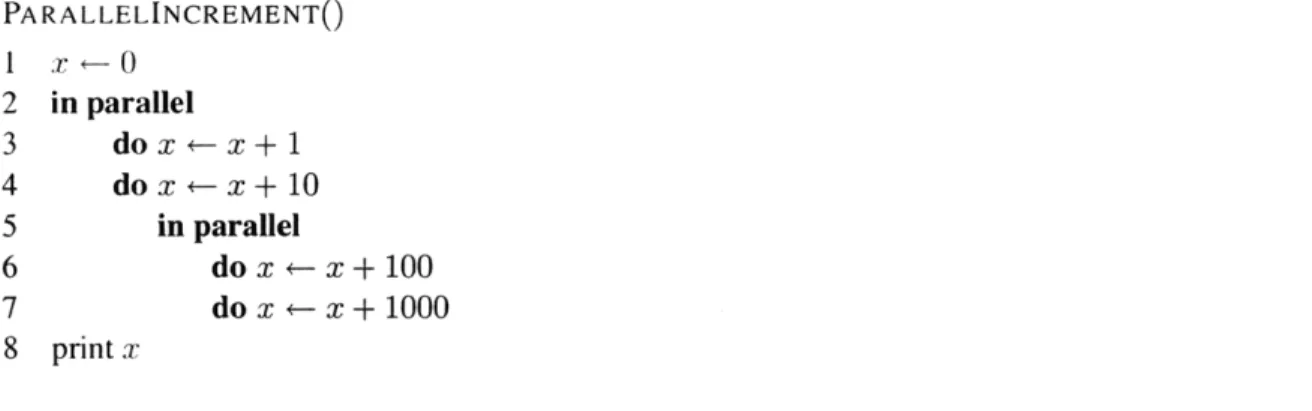
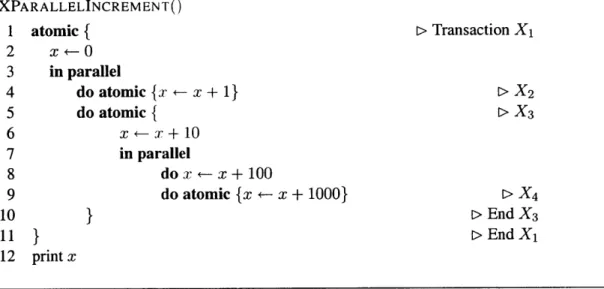
3-1 3-2 3-3 3-4 3-5 3-6 3-7 3-8 3-9 3-10 3-11
A simple fork-join program that does several parallel increments . . . . The series-parallel dag for the sample program . . . . ...
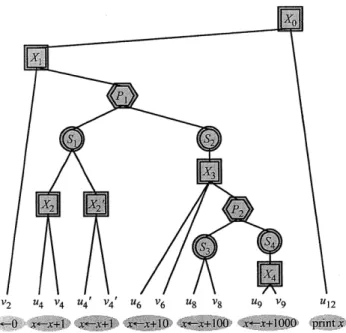
The same program with the addition of transactions. . . . . A legend for computation-tree figures . . . . . . . . .. A computation tree for the program given by Figure 3-1 . . . . .
Pseudocode for a conflict-detection query . . . . .
Pseudocode instrumenting a memory access. .... . . . ..
Code for cleanup up an aborted transaction . . . . .
Traces of a computation tree (a) before and (b) after a steal action. . . . . Pseudocode for the XConflict algorithm. . . . . The definition of arrows used to represent paths in Figures 3-12, 3-13 and 3-14. . . 3-12 The three possible scenarios in which X is the nearest transactional ancestor of B
that belongs to an active trace...
3-13 The possible scenarios in which the highest active transaction Y in Ux is an ancestor of X . . . . . . ...
3-14 The scenario in which the highest active transaction Y in Ux is not an ancestor of X. 4-1 Approximation ratios for SUU. . ...
44 44 45 47 48 52 54 55 56 57 58 58 59 59
5-1 Pseudocode for size-hashed backoff. ... ...
6-1 Average performance of Ax and ATx operations on our benchmark suite. ... 104
6-2 Parallel matrix-vector multiplication using CSR. . ... 105
6-3 Serial matrix-transpose-vector multiplication for CSR. . ... 106
6-4 Pseudocode for CSB matrix-vector multiplication. . ... 110
6-5 Pseudocode for subblockrow-vector multiplication used for CSB... .111
6-6 Pseudocode for the subblock-vector product used for CSB ... . 112
6-7 The effect of CSB block size on SpMv performance. . ... . 117
6-8 Structural information on the sparse matrices used in our experiments. ... 118
6-9 CSB_SPMV performance on Opteron (smaller matrices). . ... 120
6-10 CSB_SPMV_T performance on Opteron (smaller matrices). . ... 121
6-11 CSB_SPMV performance on Opteron (larger matrices). . ... 122
6-12 CSB_SPMV_T performance on Opteron (larger matrices). . ... . 123
6-13 Average speedup of CSB on smaller test matrices. . ... 123
6-14 Parallelism test for CSB_SPMV ... 124
6-15 CSB_SPMV performance on Harpertown... .. 124
6-16 CSB_SPMV performance on Nehalem. ... 125
6-17 Serial performance comparison of SpMV for CSB and CSR. . ... 125
6-18 Serial performance comparison of SpMV_T for CSB and CSR. . ... 126
6-19 Performance comparison of parallel CSB_SPMV with Star-P. . ... 126
7-1 Summary of known cache-oblivious dictionaries. . ... . . 129
7-2 The van Emde Boas layout... ... 129
8-1 An exponential CO B-tree. ... ... 133
8-2 An example of an insert into an exponential CO B-tree. . ... 134
8-3 The modified van Emde Boas layout of a node in the exponential CO B-tree... 134
8-4 A packed-memory CO B-tree. ... 138
8-5 An insertion into the packed-memory array. . ... .. 140
9-1 Comparison of the COLA and B-tree for random insertions. . ... 154
9-2 Comparison of the COLA and B-tree for sorted insertions. . ... 154
9-3 Comparison of the COLA and B-tree for random searches. . ... 155
9-4 Comparison of various insertion patterns into the COLA ... 155
10-1 The recursive structure of an x-box. ... 158
10-2 Buffer sizes for an x-box. ... ... 158
12-1 An example of a clique, for which the simple algorithm performs 0(k2) work. . : 178 12-2 Pseudocode for updating labels. . ... ... 180
Chapter 1
Introduction
This thesis explores algorithms and data structures motivated by and designed for modem large-scale computer systems, such as multicore computers. Achieving good performance on these ma-chines entails designing algorithms that achieve good parallelism, thereby utilizing multiple pro-cessors effectively, and that have good locality, exploiting the cache to attain good memory per-formance. The goal of this thesis is to study various techniques for parallel and cache-efficient (specifically, so-called cache-oblivious) algorithms. Many of the solutions described in this thesis are data structural in nature, and many of the solutions exploit amortization in the analysis. Much of this thesis is really a study of amortized data structures in the context of practical problems motivated by modem computers.
Recently, most hardware vendors have abandoned their singlecore chips in favor of multicore designs. Intel, for example, announced in 2005 that their focus would be on multicore chips. Al-though most common machines today have between 2 and 8 cores, a general belief is that the num-ber of cores will double every silicon generation (see, for example, [28]). Hence, highly parallel algorithms are necessary to exploit the full power of these machines.
Network
Figure 1-1: The machine model used for most of the algorithms in this thesis. Each processor is connected to a private fast memory, called the cache. Processors communicate through the shared main memory.
Throughout most of this thesis, I consider algorithms designed for a shared-memory machine, such as the one shown in Figure 1-1 (see also [117, Chapter 4]). As shown, each identical processor is connected to a private fast memory, called the cache. Processors are connected to main memory
Locality
Figure 1-2: A chart showing how much locality and parallelism are expressed by each of the chapters in this thesis. The points here are subjective and should be taken as a guideline only. The x-axis here plots locality, with points towards the right exploiting the cache more effectively. The y-axis indicates concurrency or parallelism with higher points representing algorithms with more parallelism.
through some network, which is abstracted away throughout this thesis. Accessing the cache is much cheaper than accessing the shared memory, and thus good algorithms should exhibit locality to exploit the cache. In general, my algorithms are designed for a symmetric multiprocessor (SMP), in which all memory locations (not currently residing in a cache) have the same access cost by each processor. My performance analyses depend on the uniform access cost, but algorithmic correctness does not. These algorithms thus apply to nonuniform access machines (NUMA), and the presence of locality in the algorithms suggests good performance there as well. Moreover, although Figure
1-1 shows only a single level of cache and a slow memory, many of the algorithms presented in this
thesis generalize effectively to multilevel memory or cache hierarchies. In fact, one of the reasons I consider cache-oblivious algorithms is that cache-oblivious algorithms automatically generalize to multilevel memory hierarchies.
Figure 1-1 is consistent with common multicore processors today, such as all present Intel and AMD chips. Other types of multicores exist, such as the Sony-Toshiba-IBM Cell Broadband Engine with heterogeneous processors, or the Cray MTA with no caches. Although the algorithms in this thesis are not specifically designed for those types of machines, many of the techniques presented here may still be applicable.
Figure 1-2 shows a subjective chart of the locality and parallelism expressed by the algorithms within this thesis. The goal is to achieve algorithms in the upper-right, like those in Chapters 6 and 8, achieving both good locality and parallelism. As a step in this direction, I also consider algorithms that achieve either parallelism or locality. Chapters 2-6 and Chapter 8 address concur-rency, whereas Chapters 7-11 address caching and locality. Chapters 2-5 are more infrastructural in nature, whereas Chapters 6 and 12 address algorithms at the library or application level.
Contributions
One of the key difficulties in designing parallel algorithms is coping with concurrent accesses to shared data. In some cases (e.g., the algorithm in Chapter 6), parallel tasks may be scheduled such that no two contending tasks execute at the same time. In this case, however, the parallel algorithm
-:--must be structured to facilitate this scheduling, which is not a trivial task.
Much of this thesis focuses on more complex interactions among processors. When two parallel tasks operate on the same data, some mechanism for handling critical sections is required, in the form of semaphores [831 (or locks), or, more recently, transactional memory [119]. Dealing with critical sections adds more difficulty to the implementation of parallel codes. If the critical sections are too large, then parallelism decreases. If the critical sections are smaller, then the program be-comes more complex. Complex parallel codes are prone to bugs like race conditions and deadlock. Moreover, it is not generally well-understood how to design algorithms that achieve provably good performance bounds while using locks or transactions.
This thesis makes two major contributions with respect to concurrency control. First, I pro-vide algorithms that help the programmer to write correct parallel codes using locks or transactions, either by uncovering race bugs in programs with locks (Chapter 2) or by supporting conflict detec-tion in a highly parallel transacdetec-tional-memory system (Chapter 3). Second, these are themselves examples of parallel algorithms that achieve provably good performance despite their use of locks internally. Moreover, the solutions here include a novel approach for amortizing the cost of locking against the span of the computation.
Another goal of this thesis is to construct algorithms with good locality, thereby efficiently using memory caches on the machine. For large data sets, the cost of memory accesses may dominate the total runtime of an algorithm. Fortunately, memory is transferred in large chunks, and so by orga-nizing data cleverly (to introduce locality), we can exploit the cache and drive down the total cost of the memory accesses. Most notably, my work on caching focuses on cache-oblivious dictionaries in Chapters 7-10. Many of the parallel algorithms included in this thesis, moreover, are structured to achieve some level of locality (notably, the algorithm in Chapter 6, but also to a lesser degree those algorithms in Chapters 2 and 3).
As a whole, this thesis aims to study many techniques for designing provably good parallel algorithms, also including some that use locks, and cache-oblivious algorithms.
Chapters 2 and 3 addresses mutual exclusion for fork-join programst, providing tools that make it easier to guarantee program correctness. Both of these chapters describe solutions that are in-tended to be integrated into a parallel runtime system, essentially augmenting a parallel program with additional data structures to answer questions about the program as it is running. These algo-rithms essentially operate on input fork-join programs and augment them to address certain prob-lems. Both of the parallel algorithms described in these chapters maintain a shared data structure that is accessed concurrently using locks for mutual exclusion. The analysis includes a novel technique for amortizing the cost of locking against the "span" of the underlying program. For a program with
work (serial running time) T1 and span (also called critical-path length or depth) T,, maintaining the centralized data structures in either of these chapters adds an overhead of O(PTo) to the run-ning time of the parallel program when executed on P processors using an efficient scheduler. In contrast, the program without augmentation can be executed in O(T1/P + T) time. For both of
these data structures, relevant queries can be answered in 0(1) time without acquiring any locks. Chapter 2 address the problem of series-parallel maintenance, determining whether the struc-ture of the program allows for two particular tasks to execute in parallel. Specifically, are tasks u and v logically serial or parallel? Answering this question is a key component of race detectors tools for uncovering race bugs in the program. Chapter 2 describes three algorithms, the serial SP-order and SP-fast bags algorithms, and the parallel SP-SP-ordered-bags algorithm. Consider a parallel program with T1 work and To span. When augmented with SP-order or SP-fast-bags, the program
'Fork-join programs are a restricted class of parallel programs with well-structured parallelism. Languages such as Cilk [54], NESL [53], and libraries such as TBB [174] all provide fork-join parallelism.
can be executed in O(TI) time on a single processor while supporting queries in 0(1) time. Both of these algorithms can be combined to form the SP-ordered-bags algorithm. When that program is augmented with SP-ordered-bags, it can be executed in O(T1/P + PToO) worst-case time on P
processors. Here, queries can be answered in 0(1) time, in parallel, without acquiring any locks. Chapter 2 represents joint work with Michael A. Bender, Seth Gilbert, and Charles E. Leiserson.
Chapter 3 considers conflict detection in a transactional-memory system that contains nested parallel transactions. Previous work on transactional memory (e.g., [119]) focuses on transactions that represent serial computation. In contrast, Chapter 3 considers adding transactions that contain parallel code blocks (that in turn contain nested parallel transactions) to fork-join programs. Allow-ing nestAllow-ing within transactions exacerbates the problem of discoverAllow-ing conflicts among transactions and determining when one transaction must abort. Chapter 3 presents an algorithm for conflict de-tection in this complex setting. The key data structure, called XConflict, supports these queries and achieves the same performance bounds as SP-ordered-bags. That is, a program with Ti work and
Tc span can be executed in O(T1/P + PToo) worst-case time on P processors while augmented to maintain the XConflict data structure. Moreover, queries about conflicts among transactions can be answered in 0(1) time without acquiring any locks. Chapter 3 represents joint work with Kunal Agrawal and Jim Sukha.
Chapters 4 and 5 consider scheduling problems. Specifically, Chapter.4 deals with a distributed scheduling problem, whereas Chapter 5 studies various backoff protocols in the presence of tasks that have different sizes.
Chapter 4 addresses scheduling under uncertainty, first introduced in [146], where each job has a stochastic failure rate. Specifically, an input consists of n unit-length jobs and m machines, where each job-machine pair has an independent failure probability when executing the job for unit time. This failure probability models machines crashing or taking too long to complete. There may be precedence constraints among jobs modeled by a directed acyclic graph (dag). The problem is to as-sign jobs to machines so as to minimize the expected makespan, which is the completion time of the last job to complete. A single job may be executed on multiple machines at the same time, thereby decreasing its aggregate failure probability. This thesis includes an O(log log /t)-approximation when all jobs are independent (no precedence constraints), O(log(n + m) log log IL)-approximation when precedence constraints form chains, and O(log(n +m) log(n) log log /)-approximation when constraints form trees, where t = min {m, n). These results beat the previously best approxima-tion ratios by at least an O((log n)/ log log M) factor. The soluapproxima-tions I present use many classic tools like LP rounding and competitive analysis. Chapter 4 represents joint work with Christopher Y. Crutchfield, Zoran Dzunic, David R. Karger, and Jacob H. Scott.
Chapter 5 considers randomized backoff, where processes/jobs make competing attempts to access a shared resource, but only one can gain control of the resource at a time. Here, I consider jobs that have nonuniform size. If an access attempt fails due to contention, then that process waits for a random amount of time (determined by the backoff protocol) before trying again. In the context of this thesis, backoff with jobs having different sizes is primarily motivated by transactional memory, where the "jobs" correspond to transactions in a program, all of which access the same memory location. This thesis presents the first theoretical analysis of randomized backoff when jobs have different sizes. I consider the case here when all jobs enter the system at the same time. Chapter 5 includes several contributions. First, the analyses show that binary exponential backoff achieves a makespan of V2e (v/i'- ) with high probability for n jobs with total length V. This
bound for jobs having different sizes is significantly worse than the
E(n
log n) bound achieved when all jobs have unit size [43]. This bound also suggests that binary exponential backoff is not a good choice for some transactional-memory systems. I also show that exponential backoff with a slower rate of backoff achieves O(V log V) makespan. Finally, I improve the bounds furtherby providing the size-hashed backoff scheme that is designed to work with a particular class of functions. I show constructively a class of functions allowing size-hashed backoff to complete with makespan O(Vi-og V(log log V)2) and prove the existence of functions that would allow
size-hashed backoff to complete with makespan O(V(log log V)3). Chapter 5 represents joint work with Michael A. Bender and Seth Gilbert.
Chapter 6 returns to a fork-join parallel algorithm, but now at the application level instead of the runtime-system level. This chapter introduces a storage format for sparse matrices, called
compressed sparse blocks (CSB), which allows both Ax and ATx to be computed efficiently in
parallel, where A is an n x n sparse matrix with nnz > n nonzeros and x is a dense n-vector. The parallel multiplication algorithms use E(nnz) work and O(vn lg n) span, yielding a parallelism of O(nnz /V/ Ig n), which is amply high for virtually an large matrix. The storage requirement for CSB is essentially the same as that for the more-standard compresses-sparse-rows (CSR) [175] format, for which computing Ax in parallel is easy but ATx is difficult. Benchmark results indicate that on one processor, the CSB algorithm for Ax and ATx run just as fast as the CSR algorithm for
Ax, but the CSB algorithm also scales up linearly with processors until limited by offchip memory
bandwidth. Chapter 6 represents joint work with Aydin Bulug, Matteo Frigo, John R. Gilbert, and Charles E. Leiserson
One interesting aspect CSB is that it uses a recursive layout. Typically recursive layouts are used to exploit locality, but here the recursive layout allows for parallelism. Moreover, the multiplica-tion algorithm introduces parallelism by duplicating shared-memory locamultiplica-tions, thereby reducing the need for concurrency control on these locations. The analyses amortizes the cost of creating these extra memory locations against the cost of the actual multiplication, yielding a low overhead. Al-though I do not analyze the cache efficiency of CSB, the experimental study as well as the recursive
layout suggest that CSB does achieve good spatial locality.
Chapters 8-11 address cache performance, including various cache-oblivious dynamic dictio-naries in Chapters 8-10. A dynamic dictionary is a data structure that supports insertions, deletions, and predecessor queries on keyed data. Dynamic dictionaries that achieve good memory perfor-mance are the key data structures for filesystems and databases. The most famous memory-efficient dynamic dictionary is the B-tree [30, 70], which supports all three operations with O(logB N) memory transfers, where B is the block size, or number of records moved in each memory trans-fer. A cache-oblivious dynamic dictionary is a dictionary that achieves good performance with-out using the parameter B in the data structure. Several cache-oblivious dynamic dictionaries (e.g., [34, 35, 37, 41]), also called oblivious B-trees, already exist. These previous cache-oblivious dictionaries, however, are all serial in nature. Chapter 7 provides a more detailed intro-duction to cache-oblivious dictionaries as well related work.
Chapter 8 provides cache-oblivious B-trees that support concurrent operations. These data struc-tures build on previous versions of cache-oblivious B-tree and obtain similar performance bounds to the original data structures when operating serially. This chapter uses two main types of tools to facilitate concurrent operations. First, introducing randomization into the underlying data struc-tures reduces the likelihood of overlapping expensive update operations. Second, the concurrent data structures make use of monotonic data movement. That is to say, the typical cache-oblivious B-trees move data in memory on update operations. The concurrent versions described in Chapter 8 aim to restrict this movement so that the address of a particular record can only increase over time, thereby facilitating concurrent operations. Chapter 8 represents joint work with Michael A. Bender, Seth Gilbert, and Bradley C. Kuszmaul.
Although the concurrent cache-oblivious B-trees are not the only parallel cache-oblivious algo-rithms in the literature, to my knowledge, these are the only ones that directly cope with multiple processors concurrently accessing the same data. Blelloch, Gibbons, and Simhadri [52], for
exam-pie, provide general theorems stating that if an algorithm has low span and achieves good serial cache performance, then it achieves good parallel cache performance. Their results, however, as-sume that caches are noninterfering. There are also many examples of parallel cache-oblivious algorithms [51, 52, 67, 68, 100], but these typically also deal with computations where the data can be partitioned across processors, and there is little contention on shared locations.
Chapters 9 and 10 include dynamic cache-oblivious dictionaries that support a better insertion bound at a small cost to searches. The cache-oblivious lookahead array, described in Chapter 9, achieves inserts in O((log N)/B) amortized memory accesses while still supporting searches in O(log N) worst-case memory transfers. That is, insertions are improved by an O(B/ log B) factor whereas searches are worsened by only a O(log B) factor. The xDict, described in Chapter 10, achieves the optimal tradeoff bound (proved in [59]), namely inserts in O((1/EB1 -) logB(N/M))
and searches in O((1/e) logB(N/M)) memory transfers. These data structures are the first to incor-porate the technique of fractional cascading [64] into oblivious data structures. The
cache-oblivious lookahead array represents joint work with Michael A. Bender, Martin Farach-Colton, Yonatan R. Fogel, Bradley C. Kuszmaul, and Jelani Nelson, and the xDict represents joint work
with Gerth Stolting Brodal, Erik D. Demaine, John Iacono, Stefan Langerman, and J. Ian Munro. Chapter 11 also addresses caching, but with a paradoxical goal. In particular, this chapter aims to devise an online page-replacement strategy that achieves the highest possible fraction of page faults (or cache misses) as compared to the (worst) offline strategy. The goal here is not entirely serious, but the analyses may still be interesting in their own right. Since the aim is to reduce locality, and this chapter does not address parallelism, Figure 1-2 shows this chapter in the lower-left of the chart.
I show that randomization is required to have a strategy that is competitive with the worst offline
strategy. I also give a randomized strategy based on the most recently used heuristic and prove that it is the worst possible replacement policy. I also show that direct mapping is, in some sense, the worst page-replacement policy. This last result suggests that caches should use at least some degree of associativity. Chapter 11 represents joint work with Kunal Agrawal and Michael A. Bender.
Finally, Chapter 12 addresses dynamically maintaining a topological ordering in a dag. In par-ticular, let G = (V, E) be a dag, and let n = IVI and m = IEl. We say that a total ordering on
vertices is a topological ordering if for every edge (u, v) E E, we have u appearing before v in the total ordering. This chapter considers the problem of maintaining a topological ordering dynami-cally as the underlying graph changes. Specifidynami-cally, I address the incremental problem, in which we begin with an empty n-node graph G = (V, 0) and edges are added one at a time. Throughout this
process, a data structure maintains a topological ordering of the graph G, allowing for queries about relationships among vertices. Chapter 12 presents a new algorithm that has total cost O(n2 log n)
for maintaining the ordering across m edge insertions. At the heart of the algorithm is a new ap-proach for maintaining the ordering. Rather than attempting to place nodes in an ordered list (as in previous approaches), we assign each node a label that induces the ordering and can be updated efficiently. When the graph is dense, this algorithm is more efficient than existing algorithms. By way of contrast, the best prior algorithms achieve only O(min {m 1"5, n2.5
})
cost. These algorithms are all serial, and there is likely little locality. Chapter 12 represents joint work with Michael A. Bender and Seth Gilbert.With the exception of the scheduling algorithms in Chapters 4 and 5 and the page-replacement problem in Chapter 11, all of the algorithms in this thesis incorporate data structures and amortiza-tion. These data structures have many similar themes that unify the topic areas. Some of the cache-oblivious data structures, particular the concurrent B-trees (Chapter 8) and the xDict (Chapter 10) use recursive layouts. A recursive layout also occurs in the parallel CSB algorithm in Chapter 6, but the goal in CSB is to provide parallelism, not locality.
Another theme is maintaining a total order. SP-ordered-bags (Chapter 2) as well as XConflict
---(Chapter 3) have components that maintain total orders of nodes in the underlying dag. Similarly, a topological order (Chapter 12) is a total ordering. In fact, SP-order maintains two topological orderings of the underlying computation dag. The cache-oblivious dictionaries also maintain total orders by keeping data in sorted order in components of the concurrent CO B-trees (Chapter 8) and the COLA (Chapter 9) and xDict (Chapter 10). Moreover, the underlying order-maintenance data structure [79, 81] used in SP-ordered-bags and XConflict is reminiscent of the packed-memory array [41, 123] employed by many cache-oblivious dictionaries including those in Chapter 8. Both data structures aim to order data, and analysis of each uses a similar amortization argument (al-though the latter is more complicated). Also common to these orderings is labels. The order-maintenance data structure dynamically labels objects to permit efficient queries. In the same vein, the incremental topological ordering algorithm (Chapter 12) labels nodes in the dag to infer the topological ordering.
Chapter 2
Series-Parallel Maintenance
This chapter shows how to maintain the series-parallel (SP) relationships between logical strands in a multithreaded program "on the fly." That is, given two logical strands, I show how to answer the question of whether the strands may run in parallel, and I show how to answer this question while the multithreaded program is running (rather than by after-the-fact or static analysis). This problem arises as the principal data-structuring issue in dynamic race detectors [65, 84, 91, 153, 163], as a race can only occur when two strands may access the same memory in parallel. In this chapter, I show that for fork-join programming models, such as MIT's Cilk system [54, 99, 185], this data-structuring problem can be solved asymptotically optimally. I also give the first provably efficient parallel algorithm for the problem. This chapter represents joint work with Michael A. Bender, Seth
Gilbert, and Charles E. Leiserson, previously appearing in [48].
Both this chapter and the next discuss algorithms that are intended to be integrated into a par-allel runtime system, essentially augmenting a parpar-allel program with additional data structures to answer questions about the program as it is running. The goal of these algorithms is to improve the parallel-programming platform, thereby moving some complexities away from the programmer. Specifically, these chapters discusses algorithms that help the programmer to deal with atomicity, coping with concurrent accesses to shared data. These algorithms are designed to take input parallel programs and augment them to address certain problems. The "series-parallel maintenance" prob-lem addressed in this chapter is relevant to race-detection tools for verifying program correctness under concurrent accesses to data. The "conflict-detection" problem in Chapter 3 is a component for guaranteeing atomicity in a transactional-memory system.
This chapter considers programs written in dynamic multithreaded languages such as Cilk [54] or NESL [53] or multithreaded libraries like Hood [56]. In such languages, a programmer specifies dynamic parallelism using linguistic constructs such as "fork" and "join," "spawn" and "sync," or "parallel" blocks. Dynamic multithreaded languages allow the programmer to specify a program's parallel structure abstractly, that is, permitting (but not requiring) parallel in specific locations of the program. We restrict our attention further to programs that have only properly nested parallelism, i.e., one that can be represented by a series-parallel dag or parse tree, to be described shortly.
Following [91] we model the execution of a multithreaded program as a directed acyclic graph, or computation dag, where nodes are eitherforks or joins and edges are strands. Such a dag is illustrated in Figure 2-1. A fork node has a single incoming edge and multiple outgoing edges. A join node has multiple incoming edges and (at most) a single outgoing edge. Strands (edges) represent blocks of serial execution. We model the performance of our parallel algorithms in terms of work and span [72, Ch. 27]:
Figure 2-1: A dag representing a multithreaded computation. The edges represent strands, labeled
u1, U2, .. .us. The diamonds represent forks, and the squares indicate joins.
P1
S, S3
U1 2 U5 S4
P2 u4 P3 U8
u2 U3 U6 U7
Figure 2-2: The parse tree for the computation dag shown in Figure 2-1. The leaves are the strands in the dag. The S-nodes indicate series relationships, and the P-nodes indicate parallel relationships.
strands, or equivalently, the running time on 1 processor.
* The span' of a computation, denoted by Too, is the length of the longest chain of depen-dencies, or equivalently, its running time on an infinite number of processors assuming no scheduling overhead.
The parallelism of a computation is the ratio T/T,.
For fork-join programming models, where every fork has a corresponding join that unites the forked strands, the computation dag has a structure that can be represented efficiently by a
series-parallel (SP) parse tree [91]. In the parse tree each internal node is either an S-node or a P-node and
each leaf is a strand of the dag.2 Figure 2-2 shows the parse tree corresponding to the computation dag from Figure 2-1. If two subtrees are children of the same S-node, then the parse tree indicates that (the subcomputation represented by) the left subtree must execute before (that of) the right subtree, and we say that strands in the left subtree logically precede strands in the right subtree. If two subtrees are children of the same P-node, then the parse tree indicates that the two subtrees may execute in parallel, and we say that the strands in the left subtree operate logically in parallel with those in the right subtree.
An SP parse tree can be viewed as an a posteriori execution of the corresponding computation dag, but our algorithms must operate while the dag, and hence the parse tree, is unfolding dynami-cally. The way that the parse tree unfolds depends on a scheduler, which determines which strands execute where and when on a finite number of processors. A partial execution corresponds to a subtree of the parse tree that obeys the series-parallel relationships, namely, that a right subtree of an S-node cannot be present unless the corresponding left subtree has been fully elaborated, or unfolded with all leaf strands executed. Both subtrees of a P-node, however, can be partially
elabo-'The literature also uses the terms depth [50] and critical-path length [54].
2We assume without loss of generality that all SP parse trees are full binary trees, that is, each internal node has
exactly two children.
-rated. In a language like Cilk, a serial execution unfolds the parse tree in the manner of a left-to-right walk. For example, in Figure 2-2 a serial execution executes the strands in the order of their indices.
A typical serial on-the-fly determinacy-race detector simulates the execution of the program as a left-to-right walk of the parse tree while maintaining various data structures for determining the existence of races. The type of race detector we are discussing considers a single a posteriori SP parse tree (as generated from the simulated execution) and reports a race whenever there exists a valid scheduling of this parse tree that contains a race condition.
The core data structure of the race detector maintains the series-parallel relationships between the currently executing strand and previously executed strands. Specifically, the race detector must determine whether the current strand is operating logically in series or in parallel with certain pre-viously executed strands. We call a dynamic data structure that maintains the series-parallel rela-tionship between strands an SP-maintenance data structure. The data structure supports insertion, deletion, and SP queries: queries as to whether two nodes are logically in series or in parallel.
The Nondeterminator [65, 91] race detectors use a variant of Tarjan's [187] least-common-ancestor algorithm, called the SP-bags algorithm, as the basis of their SP-maintenance data struc-ture. To determine whether a strand ui logically precedes a strand uj, denoted ui -< uj, the SP-bags algorithm can be viewed intuitively as inspecting their least common ancestor lca(ui, uj) in the parse tree to see whether it is an S-node with ui in its left subtree. Similarly, to determine whether a strand ui operates logically in parallel with a strand uj, denoted ui II uj, the SP-bags algorithm checks whether lca(ui, uj) is a P-node. Observe that an SP relationship exists between any two nodes in the parse tree, not just between strands (leaves). For example, in Figure 2-2 we have ul -< U4, because S1 = lca(ul, u4) is an S-node and ul appears in Sl's left subtree. We
also have ul 1I u6, because P1 = lca(ui, u6) is a P-node. The (serially executing)
Nondetermi-nator race detectors perform SP-maintenance operations whenever the program being tested forks, joins, or accesses a shared-memory location. The amortized cost for each of these operations is
O(a(v, v)), where ca is Tarjan's functional inverse of Ackermann's function and v is the number
of shared-memory locations used by the program. As a consequence, the asymptotic running time of performing determinacy-race detection is O(Ti a(v, v)), where T is the work of the original computation.
The SP-bags algorithm has two shortcomings. The first is that it slows the asymptotic running time by a factor of cz(v, v). This factor is nonconstant in theory but is nevertheless close enough to constant in practice that this deficiency is minor. The second, more important, shortcoming is that the SP-bags algorithm relies heavily on the serial nature of its execution, and hence it appears difficult to parallelize.
Some early SP-maintenance algorithms use labeling schemes without centralized data struc-tures. These labeling schemes are easy to parallelize but unfortunately are much less efficient than the SP-bags algorithm. Examples of such labeling schemes include the English-Hebrew scheme [163] and the offset-span scheme [153]. These algorithms generate labels for each strand on the fly, but once generated, the labels remain static. By comparing labels, these SP-maintenance algorithms can determine whether two strands operate logically in series or in parallel. One of the reasons for the inefficiency of these algorithms is that label lengths increase linearly with the number of forks (English-Hebrew) or with the depth of fork nesting (offset-span).
Contributions
This chapter presents two serial SP-maintenance algorithm that improve on the original SP-bags algorithm. The SP-order algorithm, which is inspired by the English-Hebrew scheme, removes the inverse Ackermann's a(v, v) factor from the amortized running time of SP-bags operations,
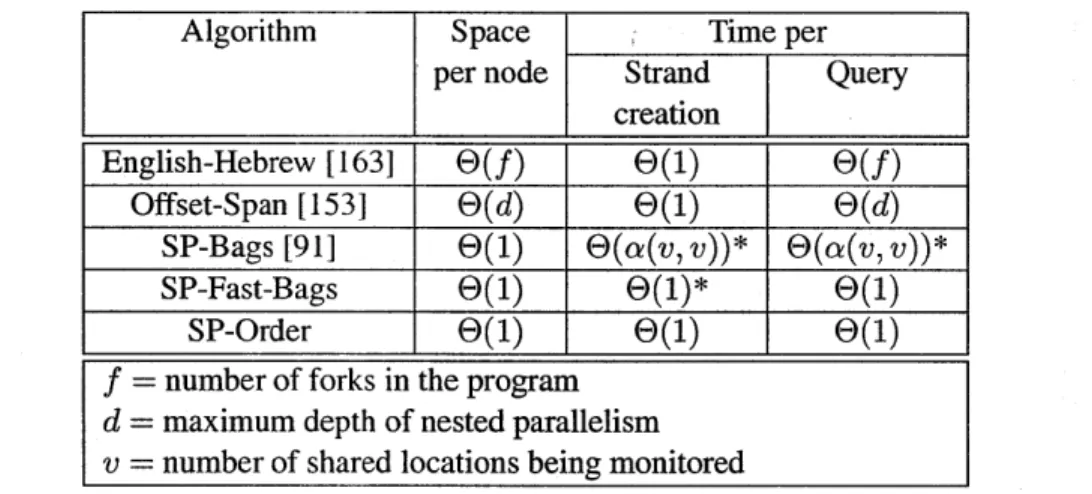
Algorithm Space Time per per node Strand Query
creation
English-Hebrew [163] O(f) 0(1) o(f) Offset-Span [153] O(d) 0(1) O(d)
SP-Bags [91] 0(1) O(a(v,v))* O(a(v,v))*
SP-Fast-Bags 8(1) 0(1)* 0(1) SP-Order 0(1) 0(1) 0(1)
f = number of forks in the program
d = maximum depth of nested parallelism
v = number of shared locations being monitored
Figure 2-3: Comparison of serial, SP-maintenance algorithms. An asterisk (*) indicates an amortized bound. The function a is Tarjan's functional inverse of Ackermann's function.
making all operations 0(1) time in the worst case. Rather than using static labels, SP-order main-tains labels with an order-maintenance data structure [33,79, 81, 192]. The SP-fast-bags algorithm also achieves 0(1) time for SP-maintenance operations, but the bound is amortized. SP-fast-bags directly improves the SP-bags algorithm using data-structuring techniques from Gabow and Tar-jan [101]. Figure 2-3 compares the serial space and running times of SP-order and the SP-fast-bags with the other algorithms. Although SP-fast-bags only achieves an amortized bound, and hence is qualitatively dominated by SP-order, its data structure allows its bags to be "split" (which turns out to be useful in the context of our parallel algorithm).
Our parallel SP-maintenance algorithm SP-ordered-bags, which is designed to run with a Cilk-like work-stealing scheduler [55, 99], is the first of its kind which is provably efficient. SP-ordered-bags consists of two tiers: a global tier based on parallelizing SP-order, and a local tier based on SP-fast-bags. Suppose that a fork-join program has T work and To span. Whereas an efficient Cilk-like scheduler executes this computation in asymptotically optimal Tp = O(T1/P + Too)
expected time on P processors, SP-ordered-bags executes the computation in O(T1/P + PToo)
worst-case time on P processors while maintaining SP relationships. Thus, whereas the underly-ing computation achieves linear speedup when P = O(T1/T) - the parallelism dominates the
number of processors - SP-ordered-bags achieves linear speedup when P = O(/T 1/T,) - the
square root of the parallelism dominates the number of processors.
These results represent joint work with Michael A. Bender, Seth Gilbert, and Charles E. Leiser-son, some of which appeared earlier in a conference paper [48]. The conference paper described the SP-order and a less-efficient variant of the parallel SP-ordered-bags algorithm, called SP-hybrid. This thesis describes the new SP-fast-bags algorithm, as well as the improved parallel algorithm SP-ordered-bags. In particular, for a program with T1 work, span Too, and n strands, the SP-hybrid
algorithm runs in O((TI/P + PToo) lg n) time in expectation, whereas SP-ordered-bags trims the lg n factor and makes the bound worst case. These improved results are also given in my Master's thesis [93].
Chapter outline
The remainder of this chapter is organized as follows. I present the SP-order algorithm in Sec-tion 2.1 and the SP-fast-bags algorithm in SecSec-tion 2.2. SecSec-tion 2.3 describes the performance model
in the presence of locks and features of the scheduler necessary to achieve good performance for SP-ordered-bags. Section 2.4 presents an overview of the parallel SP-ordered-bags algorithm. Sec-tion 2.5 describes the organization of the global tier of SP-ordered-bags in more detail, and Sec-tion 2.6 describes the local tier. SecSec-tion 2.7 provides a proof of correctness, and SecSec-tion 2.8 analyzes the performance of SP-ordered-bags. Finally, Section 2.9 reviews related work.
2.1
The SP-order algorithm
This section presents the serial SP-order algorithm. I begin by discussing how an SP parse tree, provided as input to SP-order, is created. I then review the concept of an English-Hebrew ordering [163], showing that two linear orders are sufficient to capture SP relationships. I show how to maintain these linear orders on the fly using order-maintenance data structures [33, 79, 81, 192]. Finally, I give the SP-order algorithm itself and show that each SP-maintenance operation takes 0(1) time in the worst case. I conclude that any fork-join program running in T1 time on a single processor can be checked on the fly for determinacy races in O(TI) time.
The input to SP-order
SP-order takes as input a fork-join multithreaded program expressed as an SP parse tree. In a real implementation, such as a race detector, the parse tree unfolds dynamically and implicitly as the multithreaded program executes, and the particular unfolding depends on how the program is scheduled on the multiprocessor computer. For ease of presentation, however, we assume that the program's SP parse tree unfolds according to a left-to-right tree walk. During this tree walk, SP-order maintains SP relationships "on the fly" in the sense that it can immediately respond to SP queries between any two executed strands. At the end of the section, we relax the assumption of left-to-right unfolding and argue that no matter how the parse tree unfolds, SP-order can maintain SP relationships on the fly.
English and Hebrew orderings
SP-order uses two total orders to determine whether strands are logically parallel, an English order and a Hebrew order. In the English order, the nodes in the left subtree of a P-node precede those in the right subtree of the P-node. In the Hebrew order, the order is reversed: the nodes in the right subtree of a P-node precede those in the left. In both orders, the nodes in the left subtree of an S-node precede those in the right subtree of the S-node.
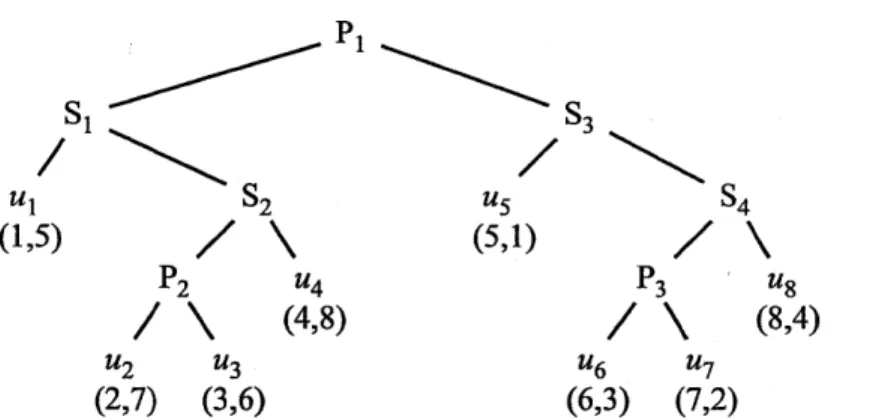
Figure 4 shows English and Hebrew orderings for the strands in the parse tree from Figure 2-2. Notice that if ui belongs to the left subtree of an S-node and uj belongs to the right subtree of the same S-node, then we have E[ui] < E[uj] and H[ui] < H[uj]. In contrast, if ui belongs to the left subtree of a P-node and uj belongs to the right subtree of the same P-node, then E[ui] < E[uj] and H[ui] > H[uj].
The English and Hebrew orderings capture the SP relationships in the parse tree. Specifically, if one strand ui precedes another strand uj in both orders, then we have ui -. uj in the parse tree
(or multithreaded dag). If ui precedes uj in one order but ui follows uj in the other, then we have
ui
II
j. For example, in Figure 2-4, we have ul -4 u4, because 1 = E[ul] < E[u4] = 4 and 5 = H[ul] < H[u4] = 8. Similarly, we can deduce that ul 1I
u6, because 1 = E[ul] < E[u6] = 6 and5 = H[ul] > H[u6] = 3. The following lemma, originally proved by Nudler and Rudolph [163],
P
1 S, S3 U1 U 5 S4(1,5)
\
(5,1)
/
\
P2 U4 P3 U8/
\
(4,8)/
\ (8,4) u2 U3 u6 U7 (2,7) (3,6) (6,3) (7,2)Figure 2-4: An English ordering E and a Hebrew ordering H for the strands in the parse tree from Figure 2-2. Under each strand u is an ordered pair (E[u], H[u]) giving its index in each of the two orders.
Lemma 2.1 Let E be an English ordering of the strands of an SP-parse tree, and let H be a Hebrew
ordering. Then, for any two strands ui and uj in the parse tree, we have ui -, uj in the parse tree if and only if E[ui] < E[uj] and H[ui] < H[ujl.
Proof (=>) Suppose that ui -< uj, and let X = Ica(ui, uj). Then, X is an S-node in the parse
tree, the strand ui resides in X's left subtree, and uj resides in X's right subtree. In both orders, the strands in the X's left subtree precede those in X's right subtree, and hence, we have E[ui] < E[uj] and H[ui] < H[uj].
(=) Suppose that E[ui] < E[uj] and H[ui] < H[uj], and let X = Ica(ui, uj). Since we have E[ui] < E[uj], strand ui must appear in X's left subtree, and uj must appear in X's right subtree.
By definition of a Hebrew ordering, X must be an S-node, and hence we have ui -< uj. O We can restate Lemma 2.1 as follows.
Corollary 2.2 Let E be an English ordering of the strands of an SP-parse tree, and let H be a Hebrew ordering. Then, for any two strands ui and uj in the parse tree with E[ui] < E[uj], we
have ui II uj if and only if H[ui] > H[uj]. Ol
Labeling a static SP parse tree with an English-Hebrew ordering is easy enough. To compute the English ordering, perform a depth-first traversal visiting left children of both P-nodes and S-nodes before visiting right children (an English walk). Assign label i to the ith strand visited. To compute the Hebrew ordering, perform a depth-first traversal visiting right children of P-nodes before visiting left children but left children of S-nodes before visiting right children (a Hebrew
walk). Assign labels to strands as before.
In race-detection applications, however, one must generate "on-the-fly" orderings as the parse tree unfolds. If the parse tree unfolds according to an English walk, then computing an English ordering is easy. Unfortunately, computing a Hebrew ordering on the fly during an English walk is problematic. In the Hebrew ordering the label of a strand in the left subtree of a P-node depends on the number of strands in the right subtree. In an English walk, however, this number is unknown until the right subtree has unfolded.
Nudler and Rudolph [163], who introduced English-Hebrew labeling for race detection, ad-dressed this problem by using large strand labels. Unfortunately, the number of bits in a label in their scheme can grow linearly in the number of P-nodes in the SP parse tree. Although they give a heuristic for reducing the size of labels, manipulating large labels is the performance bottleneck in their algorithm.
The SP-order data structure
Rather than using static labels, one can employ order-maintenance data structures [33,79,81,192] to maintain the English and Hebrew orders . In order-maintenance data structures, the labels inducing the order change during the execution of the program. An order-maintenance data structure is an abstract data type that supports the following operations:
* OM-PRECEDES(L, X, Y): Return TRUE if X precedes Y in the ordering L. Both X and Y must already exist in the ordering L.
* OM-INSERT(L, X, Y1, Y2,..., Yk): In the ordering L, insert new elements Y, Y2,..., Y, in
that order, immediately after the existing element X.
The OM-PRECEDES operation can be supported in 0(1) worst-case time. The OM-INSERT oper-ation can be supported in O(k) worst-case time, where k is the number of elements being inserted.
The SP-order data structure consists of two order-maintenance data structures to maintain En-glish and Hebrew orderings.3 With the order data structure, the implementation of an SP-maintenance algorithm is remarkably simple.
Pseudocode for SP-order
Figure 2-5 gives serial pseudocode for SP-order. The code performs a left-to-right tree walk of the input SP parse tree, executing strands on the fly as the parse tree unfolds. In lines 1-3, the code handles a leaf in the SP parse tree. In a race-detection application, queries of the two order-maintenance data structures are performed in the EXECUTESTRAND function, which represents the computation of the program under test. Typically, a determinacy-race detector [91] performs 0(1) queries for each memory access of the program under test.
As the tree walk encounters each internal node of the SP parse tree, it performs OM-INSERT operations into the English and Hebrew orderings. In line 4, we update the English ordering for the children of the node X and insert X's (left and right) children after X with X's left child appearing first. Similarly, we update the Hebrew ordering in lines 5-7. For the Hebrew ordering, we insert X's children in different orders depending on whether X is an S-node or a P-node. If X is an S-node, handled in line 6, we insert X's left child and then X's right child after X in the Hebrew order. Figure 2-6 illustrates the insertions at an S-node. If X is a P-node, on the other hand, X's left child follows X's right child. Figure 2-7 illustrates these insertions. In lines 8-9, the code continues to perform the left-to-right tree walk. We determine whether X precedes Y, shown in lines 10-11, by querying the two order-maintenance structures using the order-maintenance query OM-PRECEDES.
Correctness of SP-order
The following lemma demonstrates that SP-ORDER produces English and Hebrew orderings cor-rectly.
Lemma 2.3 At any point during the execution of SP-ORDER on an SP parse tree, the order-maintenance data structures Eng and Heb maintain English and Hebrew, respectively, orderings of the nodes of the parse tree that have been visited thus far.
Proof Consider an internal node Y in the SP parse tree. We focus first on the Heb data structure. Assume that Y is an S-node. We must prove that all the nodes in Y's left subtree precede all the
3In fact, the English ordering can be maintained implicitly during a left-to-right tree walk. For conceptual simplicity, however, we use explicit order-maintenance data structures for both orderings.