Automatic Reaction Mechanism Generation:
High Fidelity Predictive Modeling of Combustion Processes
by
Connie
W.
Gao
MASSACHUSETTS INSTITUTEOF TECHNOLOGY M. S. Chemical Engineering Practice
Massachusetts Institute of Technology, 2013 06201
B. S. Chemical Engineering
LIBRARIES
California Institute of Technology, 2010
ARCHIVES
Submitted to the Department of Chemical Engineeringin partial fulfillment of the requirements for the degree of DOCTOR OF PHILOSOPHY IN CHEMICAL ENGINEERING
at the
MASSACHUSETTS INSTITUTE OF TECHNOLOGY June 2016
Copyright
@
2016 Massachusetts Institute of Technology. All rights reserved.Author ...
Signature redacted...
Department of Chemical Engineering May 9, 2016
Certified by...Signature
redacted
...
V
William H. GreenHo tC Hottel Professor of Chemical Engineering Thesis Supervisor
Accepted by...Signature
redacted...
Richard D. Braatz Edward R. Gilliland Professor of Chemical Engineering Chairman, Committee for Graduate Students
Automatic Reaction Mechanism Generation:
High Fidelity Predictive Modeling of Combustion Processes
by
Connie W. Gao
Submitted to the Department of Chemical Engineering on May 9, 2016 in partial fulfillment
of the requirements for the degree of Doctor of Philosophy in Chemical Engineering
Abstract
Growing awareness of climate change and the risks associated with our society's de-pendence on fossil fuels has motivated global initiatives to develop economically vi-able, renewable energy sources. However, the transportation sector remains a major hurdle. Although electric vehicles are becoming more mainstream, the transportation sector is expected to continue relying heavily on combustion engines, particularly in the freight and airline industries. Therefore, research efforts to develop cleaner com-bustion must continue. This includes the development of more efficient comcom-bustion engines, identification of compatible alternative fuels, and the streamlining of existing petroleum resources. These dynamic systems have complex chemistry and are often difficult and expensive to probe experimentally, making detailed chemical kinetic modeling an attractive option for simulating and predicting macroscopic observables such as ignition delay or CO2 concentrations.
This thesis presents several methods and applications towards high fidelity predic-tive modeling using Reaction Mechanism Generator (RMG), an open source software package which automatically constructs kinetic mechanisms. Several sources con-tribute to model error during automatic mechanism generation, including incomplete or incorrect handling of chemistry, poor estimation of thermodynamic and kinetics pa-rameters, and uncertainty propagation. First, an overview of RMG is presented along with algorithmic changes for handling incomplete or incorrect chemistry. Complete-ness of chemistry is often limited by CPU speed and memory in the combinational problem of generating reactions for large molecules. A method for filtering reactions is presented for efficiently and accurately building models for larger systems. An ex-tensible species representation was also implemented based on chemical graph theory, allowing chemistry to be extended to lone pairs, charges, and variable valencies.
Several chemistries are explored in this thesis through modeling three combustion related processes. Ketone and cyclic ether chemistry are explored in the study of diisoproyl ketone and cineole, biofuel candidates produced by fungi in the decom-position of cellulosic biomass. Detailed kinetic modeling in conjunction with engine experiments and metabolic engineering form a collaborative feedback loop that ef-ficiently screens biofuel candidates for use in novel engine technologies. Next, the challenge of modeling constrained cyclic geometries is tackled in generating a com-bustion model of JP-10, a synthetic jet fuel used in propulsion technologies. The model is validated against experimental and literature data and succeeds in captur-ing key product distributions, includcaptur-ing aromatic compounds, which are precursors to polyaromatic hydrocarbons (PAHs) and soot. Finally, oil-to-gas cracking processes under geological conditions are studied through modeling the low temperature pyrol-ysis of the heavy oil analog phenyldodecane in the presence of diethyldisulfide. This system is used to gather mechanistic insight on the observation that sulfur-rich kero-gens have accelerated oil-to-gas decomposition, a topic relevant to petroleum reservoir modeling. The model shows that free radical timescales matter in low temperature systems where alkylaromatics are relatively stable.
Local and global uncertainty propagation methods are used to analyze error in automatically generated kinetic models. A framework for local uncertainty analysis was implemented using Cantera as a backend. Global uncertainty analysis was imple-mented using adaptive Smolyak pseudospectral approximations to efficiently compute and construct polynomial chaos expansions (PCE) to approximate the dependence of outputs on a subset of uncertain inputs. Both local and global methods provide similar qualitative insights towards identifying the most influential input parameters in a model. The analysis shows that correlated uncertainties based on kinetics rate rules and group additivity estimates of thermochemistry drastically reduce a model's degrees of freedom and can have a large impact on model outputs. These results highlight the necessity of uncertainty analysis in the mechanism generation workflow. This thesis demonstrates that predictive chemical kinetics can aid in the mech- · anistic understanding of complex chemical processes and contributes new methods for refining and building high fidelity models in the automatic mechanism generation workflow. These contributions are available to the kinetics community through the RM G software package.
Thesis Supervisor: William H. Green
DEDICATION
I dedicate this thesis to my parents, Xiaoming Gao and Ruilian Wu, who dreamed of me completing a PhD at MIT.
ACKNOWLEDGMENTS
My PhD has been a long journey filled with many challenges and successes. It would not have been possible without the support and mentorship from many people in my academic and personal life.
First, I'd like to express my gratitude towards my advisor, Professor William Green. Throughout my PhD, he has provided the feedback and encouragement I needed to grow professionally. His positive outlook and ability to bring people to-gether also taught me the importance of interpersonal skills in academics and the work place. I thank Bill for his email six years ago recruiting me into the Green Group. I am now positive that I made the best choice.
I am also extremely grateful to my collaborator and unofficial second mentor, Professor Richard West. I first met Richard when he was a postdoc in the Green Group. Since then, he has been an invaluable source of ideas for RMG and a provider of hands on advice and code review. In particular, I thank Richard for the idea to use Anaconda to package RMG, which allowed us to release the first binary for the Python version of RMG.
I also thank my thesis committee, Professors Paul Barton, George Stephanopou-los, and Youssef Marzouk. Their knowledge of numerical analysis and uncertainty propagation was extremely helpful in guiding my research.
Now, I'd like to thank several Green Group members who I have collaborated with during my PhD. First, I'd like to thank my predecessor and the previous lead developer of RMG, Josh Allen. Josh is a brilliant chemical engineer and computer scientist who ported over much of the RMG-Java code to Python. He also worked on the fungi biofuels project with me.
I also thank Shamel Merchant and Adron Vandeputte for their mentorship and friendship both in and out of lab. Shamel helped guide and support me through the toughest moments of my PhD. He was always able to make me see the bigger picture and helped me prioritize my research. Aaron is a quantum chemist and dedicated researcher who was invaluable on the JP-10 and cineole projects. I will remember our group's times together very fondly- running along the river, watching videos together, and playing Magic in the lab.
I thank Nathan Yee, who has been a fellow RMG developer, deskmate, and friend. I also thank Nick Vandewiele and Kehang Han for their commitment as RMG de-velopers and peers. Nathan and Nick both helped work on the JP-10 project, and Kehang has been a collaborator on the phenyldodecane project. I will miss our coffee breaks and RMG chats. I also thank the older members of the group who I have had the pleasure of working with: Michael Harper, Greg Magoon, Amrit Jalan, Caleb
Class, Beat Buesser, Jorge Aguilera-Iparraguirre and Enoch Dames.
I would also like to thank my scientific collaborators outside of the Green Group. I thank Prof. Subith Vasu, Dr. Adam Scheer, and Dr. Craig Taatjes from Sandia National Laboratory, who I worked with on the fungi biofuels project. I had the pleasure of living in Livermore, CA and working at the Combustion Research Facility for 3 months in 2013 under their mentorship. I also thank Robin Bonomi, Greg Magoon, and Professor Kevin Van Geem for collaborating with me on the JP-10 project. I gratefully acknowledge the work of Eoghan Reeves, who has done the experimental work on the phenyldodecane project. I also appreciate the guidance offered by Professor Shuhei Ono on this project. I thank Professor Youssef Marzouk for helping provide advice for my uncertainty work, as well as his students Andrew Davis, Dr. Matthew Parno, and Dr. Daniele Bigoni, who helped introduce me to the MIT Uncertainty Quantification (MUQ) library. I also thank Dr. Ray Speth for his help working with Cantera.
Our daily tasks and meetings would not have been possible without the logistical support provided by the administrative staff in the Green Group. I'd like to give a special thank you to Gwen Wilcox and Barbara Balkwill for their tireless efforts.
Finally, I'd like to thank all the people in my personal life who have supported me during my PhD. I am thankful for all the friendships I made during Practice School and will cherish the fond memories I've had exploring Europe and working on food science with Kristen Whaley, Zachary Waxman, Sayalee Mahajan, Vishnu Sresht, Qing Xu, Li Tan, and Yuran Wang. I'm especially grateful to Yuran for putting up with me as a roommate in Minnesota and for all of our homecooked Chinese dinners. I am thankful for my other roommates while at MIT: Mariah Mandt, who is now a rockstar at Shell working in the Iraqi oil fields, and Ted Steiner, who is a close friend, rocket scientist, and hiking buddy. I also thank Nathan Yee, Winston Chern, Sakul Ratanalert, Alex Bourque, and Dariusz Murakowski for all the hot pot and board game nights we've had together. I also had the pleasure of meeting Shireen Goh, who was truly a big sister to me before she returned to Singapore. I am grateful for my friendship with Sivaraman Ramaswamy and our times philosophizing at Starbucks,
and Poyen Chen for our times working together in the first year. I'm grateful for the McKinsey Insight Program for bringing Jouha Min, Lulu Li, and Alex Guo into my life. I thank Yuqing Cui for our book club discussions and outdoor escapes. I am also grateful for the 6 years of friendship with Noemie Dorval and our longstanding traditions of hosting parties and celebrating Halloween together. I thank my college friends- Heejae, Jon, Lil Jon, Jennifer, and Michelle for supporting me from both near and far. I also want to thank my boyfriend Ben Renner for his companionship over the last three years. I will always treasure our memories of biking riding around Cambridge and exploring the MIT libraries and tunnels together. Finally, I thank my family: my parents who pushed me to complete my PhD, Baodi, DD, and MM. I have made it this far because of their love.
CONTENTS
1 Introduction
1.1 Automatic mechanism generation . . . . 1.2 High fidelity predictive kinetic modeling . . . . 1.3 Thesis overview . . . . 1.4 . R eferences . . . . 2 Reaction Mechanism Generator: an open source software package
for automatic mechanism generation
2.1 B ackground . . . . 2.2 O verview . . . . 2.2.1 Species and functional group representation . . . . 2.2.2 Thermodynamic parameter estimation . . . . 2.2.3 Kinetic parameter estimation . . . . 2.2.4 Rate-based algorithm . . . . 2.3 Features . .. . . . 2.3.1 Estimation of pressure-dependent rate coefficients . . . . 2.3.2 Liquid phase solvation and diffusion . . . . 2.3.3 Transport property estimation . . . . 2.3.4 Sensitivity analysis . . . . 2.3.5 CanTherm . . . . 2.3.6 Cantera support . . . . 2.3.7 Web front-end . . . . 2.4 Example: n-heptane pyrolysis . . . . 2.5 Design principles . . . . 2.6 Binary packaging using the Anaconda Python distribution . . . . 2.7 C onclusion . . . . 2.8 R eferences . . . . 3 Screening fungi-derived biofuel candidates:
idation model for cineole
3.1 Methodology . . . . 3.1.1 Chlorine-initiated oxidation . . . . 3.1.2 Quantum chemical calculations . . 3.1.3 Mechanism generation . . . . 3.2 Results and discussion . . . . 3.3 Conclusion . . . . 3.4 References . . . .
a low temperature
ox-17 18 19 19 21 23 23 24 24 28 30 35 38 38 39 41 42 42 42 43 43 46 46 47 47 51 53 54 56 59 61 67 68
4 An experimental and theoretical study of the pyrolysis and oxida-tion of JP-10
4.1 Background .... . . .. . ... ... .... ..
4.2 M ethodology . . . . 4.2.1 Shock tube experiments . . . . 4.2.2 Detailed chemical kinetic modeling . . . . 4.3 Results and discussion . . . . 4.3.1 The reaction network . . . . 4.3.2 Pyrolysis and oxidation shock tube speciation 4.3.3 Pyrolysis flow tube speciation . . . . 4.3.4 Ignition delay . . . . 4.4 Conclusion . . . . 4.5 R eferences . . . .. . . . . 73 73 75 76 78 80 80 83 90 91 95 97 5 Understanding geological oil to gas cracking processes using
phenyl-dodecane as a heavy oil analog
5.1 Background ... ... ... .... .... 5.1.1 Effects of sulfur on the thermal stability of petroleum systems 5.1.2 Effects of water on the thermal stability of petroleum systems 5.2 Experimental and analytical methods . . . .
5.2.1 Model compounds . . . . 5.2.2 Confined pyrolysis . . . . 5.2.3 Gas analysis . . . . 5.3 Chemical kinetic modeling . . . . 5.3.1 Mechanism generation . . . .
5.4 R esults . . . . 5.4.1 Neat PDD pyrolysis . . . . 5.4.2 PDD pyrolysis in the presence of DEDS . . 5.5 D iscussion . . . .. . . . 5.6 Conclusion . . . . 5.7 References . . . . 6 Uncertainty propagation in automatic mechanism
6.1 Background .... .... ... ...
6.2 O verview . . . . 6.3 Assigning uncertainties to RMG's databases . . . . 6.3.1 Kinetics uncertainty . . . . 6.3.2 Thermochemistry uncertainty . . . . 6.4 Sensitivity analysis . . . .
6.4.1 Mathematical description . . . ... 6.4.2 Running sensitivity analysis within RMG 6.5 Local uncertainty propagation . . . .
6.5.1 Correlated uncertainty analysis . . . . 6.6 Global uncertainty propagation . . . . 6.6.1 Implementation . . . . 101 102 103 103 104 104 104 105 106 107 . . . 107 . . . 110 . . . . 112 . . . . 114 . . . . 122 . . . . 123 generation 129 .. .. . .. . .. 129 . . . . 133 . . . . 133 . . . . 134 . . . . 137 . . . . 138 . . . . 138 . . . . 140 . . . . 141 . . . . 141 . . . . 142 . . . . 144
6.7 Case study using a toy model . . . . 6.7.1 Sensitivity analysis . . . . 6.7.2 Local uncertainty analysis . . . . 6.7.3 Correlated local uncertainty analysis 6.7.4 Global uncertainty analysis . . . . . 6.8 Conclusion . . . . 6.9 References . . . . 7 Recommendations for future work
7.1 Improving the RMG database . . . . 7.1.1 Infrastructure for an open access database . . . . 7.1.2 An automated workflow for adding data from quantum chem-istry calculations . . . .. . . . 7.2 Aromatic chemistry and recognition of PAH pathways . . . . 7.3 Lumped kinetic models . . . . 7.4 Robust model generation under uncertainty . . . . 7.5 R eferences . . . . . . . . . . . . . . . . . . . . . . . . . . . . . . . . 146 146 146 148 150 151 152 155 155 155 156 156 157 157 158
LIST OF FIGURES
1.1 United States primary energy consumption by source and sector in 2013. Total usage was 97.5 quadrillion Btu. Figure taken from the Energy In-formation Administration. . . . . 18 1.2 The three major sources of model error in automatic reaction mechanism
generation. . . . . 19 2.1 Overview of the RMG workflow. . . . . 24 2.2 Adjacency list (left) and graph (right) of a methyl radical. . . . . 25 2.3 Adjacency list for a functional group (top) and its possible molecular
struc-tures (bottom ). . . . . 27 2.4 Old style molecular adjacency list for singlet carbene. . . . . 27 2.5 Three new species representation capabilities of the new style adjacency
list: spin multiplicity as a species attribute (left, i.e. singlet vs. triplet carbene), variable valency (middle, i.e. sulfur hexafluoride), and partial
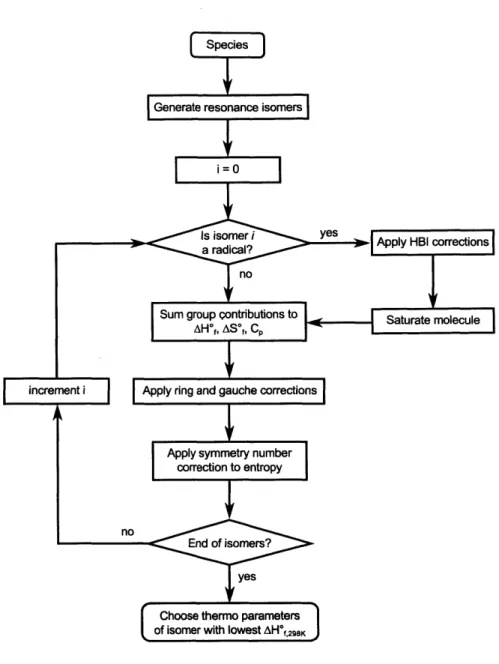
charges (right, i.e. nitrogen dioxide). . . . . 28 2.6 Flowchart of the group additivity-based thermodynamic parameter
esti-mation algorithm as implemented in RMG . . . . 29 2.7 Schematic depicting the QMTP interface for calculating thermodynamic
parameters on-the-fly using quantum mechanics in RMG. Adapted from M agoon et al. [4] . . . . 30 2.8 Reaction template and recipe for the H_Abstraction family. . . . . 30 2.9 Hierarchical trees for the reactants in the HAbstraction family. Top:
Partial tree of the X-H reactant. Bottom: Partial tree of the Y reactant. 32 2.10 Simple hierarchical trees for a bimolecular reaction family containing
re-actants A and B. . . . . 32 2.11 Flowchart of the rate-based algorithm as implemented in RMG. The
gen-erated mechanism contains the final set of species and reactions in the core. ... ... 36 2.12 Schematic depicting expansion of the model core as RMG proceeds. . . . 37 2.13 A typical unimolecular system. An activated species C* can be formed
either from chemical activation (as the product of an association reaction) or thermal activation (via collisional excitation). Once activated, multi-ple isomerization and dissociation reactions may become competitive with one another and with collisional stabilization; these combine to form a network of unimolecular reactions described by a set of phenomenological rate coefficients k(T, P) that connect each pair of configurations, not just those directly adjacent. . . . . 39
2.14 N-heptane flow tube experiments at P = 400 Pa for an initial mixture of 2% n-heptane and 98% argon. Simulated mole fraction profiles by the
RMG-generated model (lines) and LLNL v3.1 model (dotted lines.) . . . 46
3.1 The collaborative lignocellulosic biofuel research effort framework for in-tegrating combustion chemistry and engine performance feedback into the metabolic engineering of fungi-generated biofuels. From Allen et al. [9] . 52 3.2 DIPK (C7H14O); diisopropyl ketone; 114 amu . . . . 52
3.3 Cineole (C10H100); 1,3,3-trimethyl-2-oxabicyclo[2,2,2]octane; 154 amu . . 53
3.4 Absolute partial photoinization spectrum of cineole (m/z =154). The ionization onset is observed near 8.5 eV followed by a steady rise before leveling off at approximately 10.4 eV. . . . . 55
3.5 Integrated ion signal (8.5 - 11.0 eV) for cineole and its fragment ions. Calibration standards run simultaneously are also shown. . . . . 56
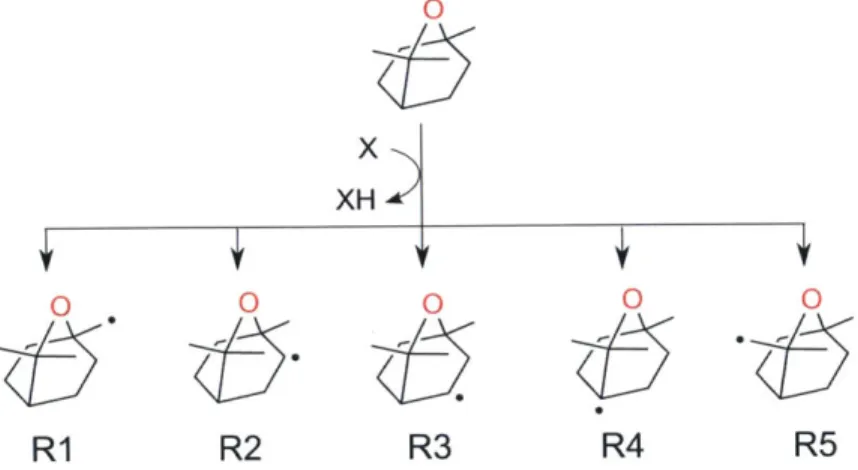
3.6 Hydrogen abstractions from cineole lead to five possible alkyl radicals. . 57 3.7 Major Reaction Pathways for RI Alkyl Radical. . . . . 58
3.8 Major Reaction Pathways for R2 Alkyl Radical. . . . . 59
3.9 Major Reaction Pathways for R3 Alkyl Radical. . . . . 59
3.10 Major Reaction Pathways for R4 Alkyl Radical. . . . . 60
3.11 Major Reaction Pathways for R5 Alkyl Radical. . . . . 60
3.12 Schematic of low temperature oxidation pathways for cineole. Expected masses of species involved in cineole (m/z=154) oxidation are indicated in red . . . . . 6 3 3.13 An example of the 3-dimensional data collection scheme employed in this study wiUh lin-,Ui '-2, cUhUine, aud (AIIU[ine radical reacting at 550 K. Top: Photoionization spectra for m/z = 152, 153, and 168 signals. Mid-dle: Product time profiles for m/z = 152, 153, and 168 signals. Bot-tom: Mass spectrum showing the coproducts of the chain-propagating and chain-terminating channels associated with the oxidation of cineole radicals. The three sets of data are acquired simultaneously. . . . . 64
3.14 A comparison of experimental (left) vs. simulated (right) product mass spectra for the Cl-initiated oxidation of cineole at 550 K (bottom) and 650 K (top). The experimental difference mass spectra is normalized to photocurrent resulting from integrating the ion signal for 40 ms imme-diately following photolysis over ionizing photon energies 7.9 - 10.6 eV, then subtracting the averaged pre-photolysis signal. The simulated mass spectra gives the product mole fractions integrated over the first 40 ms of reaction, omitting. cineole and chlorine-containing compounds for clarity. Common mass peaks found in both experiment and simulation are labeled in red. ... ... 65
3.15 Comparison of the relative photoionization signal for the product peak found at m/z = 70 against the individual photoionization spectra of methacrolein and methyl vinyl ketone. The black solid line shows the fitted weighted sum of the two species' photionization spectra. . . . . 66
3.16 Product time profiles (left) and corresponding photoionization spectra (middle) and deduced species (right) for mass peaks m/z = 43, 58, 70, 82, 94, and 95 at 550 K . . . . 67 3.17 Product time profiles (left) and corresponding photoionization spectra
(middle) and deduced species (right) for mass peaks m/z = 110, 124, 135, 152, 153, and 168 at 550 K . . . . 68 3.18 Reaction fluxes relative to the total consumption of cineole at 40 ms, T =
650 K, P = 4 Torr. Key reaction species found in experiment are boxed and highlighted. . . . . 69 4.1 Main constituents of JP-10: (from left to right) exo-tetrahydrodicyclopentadiene, endo-tetrahydrodicyclopentadiene and adamantane. . . . . 74 4.2 Schematic of the shock tube used for the experimental study. . . . . 76 4.3 The three step mechanism of JP-10 thermal decomposition: radical chain
initiation reactions (top), radical chain reactions (middle), and finally aromatization (bottom). . . . . 80 4.4 Predicted major decomposition pathways of JP-10 pyrolysis (9.34 mol%
JP-10 in N2) and stoichiometric combustion (0.62 mol% JP-10 and 8.72
mol% 02 in N2) in an isothermal batch reactor operated at 1000 K and
1.7 atm. Rates are expressed relative to the total JP-10 consumption rate and are reported at a conversion of 10%. The values for the pyrolysis are written in normal font while those for the stoichiometric combustion are indicated in italic and bold. . . . . 82 4.5 Experimentally measured (data points) and simulated concentration
pro-files (lines) of JP-10 as a function of temperature. Pyrolysis and oxidation experiments were conducted in a shock tube with an initial JP-10 loading of 0.2 mol% diluted in Ar, P = 7 atm, and r = 500 ps. Experimental error is shown on a single data point to illustrate uncertainties in concentration
( 30%) and in temperature ( 50 K). . . . . 84 4.6 Experimentally measured (data points) and simulated concentration
pro-files (lines) of JP-10's main decomposition products as a function of tem-perature. Pyrolysis and oxidation experiments were conducted in a shock tube with an initial JP-10 loading of 0.2 mol% diluted in Ar, P = 7 atm, and T= 500 ps. Experimental error is shown on a single data point to illustrate uncertainties in concentration
(t
30%) and in temperature(
50 K ). . . . . 85 4.7 Experimentally measured (data points) and simulated concentration
pro-files (lines) of aromatics and related species from JP-10's decomposition as a function of temperature. Pyrolysis and oxidation experiments were conducted in a shock tube with an initial JP-10 loading of 0.2 mol%
di-luted in Ar, P = 7 atm, and T = 500 ps. Experimental error is shown on a single data point to illustrate uncertainties in concentration ( 30%) and in temperature (t 50 K). . . . . 86
4.8 Experimentally measured (data points) and simulated concentration pro-files (lines) of C3 and C4 species from JP-10's decomposition as a function of temperature. Pyrolysis and oxidation experiments were conducted in a shock tube with an initial JP-10 loading of 0.2 mol% diluted in Ar, P = 7 atm, and T= 500 ps. Experimental error is shown on a single data point to illustrate uncertainties in concentration
(
30%) and in temperature( 50 K ). . . . . 87 4.9 Experimentally measured (data points) and simulated concentration
pro-files (lines) of other cyclic species from JP-10's decomposition as a function of temperature. Pyrolysis and oxidation experiments were conducted in a shock tube with an initial JP-10 loading of 0.2 mol% diluted in Ar, P = 7 atm, and T= 500 ps. Experimental error is shown on a single data point to illustrate uncertainties in concentration
(1
30%) and in temperature (t 50 K). ..*. . . .. . .. .. . . .. . .. . .. . . . .. . 88 4.10 Experimentally measured (data points) and simulated concentrationpro-files (lines) of C2 and C5 species from JP-10's decomposition as a function of temperature. Pyrolysis and oxidation experiments were conducted in a shock tube with an initial JP-10 loading of 0.2 mol% diluted in Ar, P = 7 atm, and T= 500 ps. Experimental error is shown on a single data point to illustrate uncertainties in concentration (1 30%) and in temperature (t 50 K ). . . . . 89 4.11 Experimentally measured (data points) and simulated concentration
pro-files (lines) as a function of temperature for the pyrolysis of JP-10 as reported by Vandewiele et al. Experimental conditions: 7 mol% JP-10 diluted in N2, P = 0.14 MPa, mass flow rate of JP-10 = 2.33 x 10⁻² g/s.
Mole percentages are normalized excluding N2 . . . . . 92
4.12 Experimentally measured (data points) and simulated concentration pro-files (lines) as a function of temperature for the pyrolysis of JP-10 as reported by Vandewiele et al. Experimental conditions: 10 mol% JP-10 diluted in N2, P = 0.14 MPa, mass flow rate of JP-10 = 2.33 x 10⁻² g/s.
Mole percentages are normalized excluding N2 . . . . . . . . . 93
4.13 Pressure corrected (7 atm) experimental ignition delays for Colket (0.15 mol% JP-10 feed, circles), Davidson (0.20 mol% JP-10 feed, squares), Wang (0.24 mol% JP-10 feed, diamonds), and Mikolaitis (1.48 mol% JP-10 feed, triangles) at stoichiometric conditions, along with simulated ignition delays (lines) at 4D = 1.0 and P = 7 atm. . . . . 94 4.14 Parity plot comparing simulated and measured ignition time delays for
JP-10 for existing experimental datasets: Colket (circles); Davidson (squares); Mikolaitis (triangles); and Wang (diamonds) . . . . 95 4.15 Most sensitive reaction kinetics found in normalized OH sensitivity
analy-sis (dln[OH]/dln k) conducted at 1500 K, 7 atm, 1D = 1.0, 0.20 mol% JP-10 diluted in Ar in an adiabatic batch reactor. Reactions grouped together have nearly equal importance. . . . . 96 5.1 DEDS (C4HOS2); diethyldisulfide; 122 amu . . . . 101
5.2 PDD (C1 8H3 0); phenyldodecane; 246 amu . . . . 101
5.3 PDD isomers identified in experiment. . . . . 108
5.4 PDD conversion in neat pyrolysis and in the presence of DEDS with re-spect to temperature. The RMG model is simulated at P = 35 MPa and
at different temperatures with an shaded error bar of 20%. The model is plotted against against various experimental data by Lewan [21], Behar [22], Savage [19], and the new data by Reeves presented in this chapter. . 110
5.5 Simulated PDD neat pyrolysis molar yields of major species compared against Savage and Klein experiments conducted at 400 . . . .111 5.6 Simulated PDD neat pyrolysis molar yields of aromatic species compared
against Savage and Klein experiments conducted at 400C. . . . .111
5.7 Simulated PDD neat pyrolysis molar yields of alkane species compared against Savage and Klein experiments conducted at 4000 . . . . 112 5.8 GC-FID traces of PDD-DEDS (top), and PDD (bottom) pyrolysis at 350
'C after 72 hours. Key differences between the product distributions are
highlighted. . . . . 113
5.9 Simulated and experimental Reeves data of major species molar selectiv-ities (moles produced / moles PDD reacted) at 350 C after 72 hours of reaction time for PDD neat pyrolysis (blue) and decomposition in the
presence of DEDS (red). . . . . 113 5.10 Simulated and experimental Reeves data of hydrogen and light alkane
molar selectivities (moles produced
/
moles PDD reacted) at 350 C after72 hours of reaction time for PDD neat pyrolysis (blue) and decomposition
in the presence of DEDS (red). . . . . 114
5.11 Simulated and experimental Reeves data of PDD isomer molar selectivities
(moles produced
/
moles PDD reacted) at 350 C after 72 hours of reaction time for PDD neat pyrolysis (blue) and decomposition in the presence of D E D S (red) . . . . 115 5.12 Fluxes of PDD decomposition at 350 C and 10 hours. . . . . 1165.13 The Retro-ene molecular elimination reaction from alkylaromatic to toluene
and alkene via a 4-membered transition state (top) and a 6-membered transition state(bottom). The 6-membered transition state is computed
to be m ore favorable. . . . ... . . . . 117
5.14 Ipso-isomerization reaction of PDD radical leading to the formation of a
PD D isom er. . . . . 119 5.15 Recombination products in neat PDD pyrolysis. . . . . 119 5.16 RMG model simulation of the decomposition of neat DEDS (x = 0.0875)
in Argon as a function of temperature. . . . . 120 5.17 DEDS decomposition pathway at a temperature of 350 'C and at a
re-action time of 60 seconds. Percentages are presented relative to total decomposition rate of DEDS at this time. Products in dashed boxes are predicted to be consumed later in the reaction timescale, while ethane and hydrogen sulfide are predicted to be stable products. Reproduced from
6.1 Checking model validity against experimental data: two cases. Case 1: model predictions and data overlap, though there is systematic deviation between the nominal experimental values and the model. Case 2: model predictions and data do not overlap. . . . . 130 6.2 Schematic of the global uncertainty analysis workflow involving three key
packages: MUQ, Cantera, and RMG. . . . . 145 6.3 Top 5 most sensitive reaction kinetics affecting the concentration of
un-decene at 72 hours of reaction time. . . . . 147 6.4 Top 5 most sensitive species thermochemistry affecting the concentration
of undecene at 72 hours of reaction time. . . . . 147 6.5 Top 5 reaction kinetics contributing to local uncertainty in the undecene
concentration at 72 hours of reaction time. . . . . 148 6.6 Top 5 species thermochemistry contributing to local uncertainty in the
undecene concentration at 72 hours of reaction time. . . . . 148 6.7 Top 5 rate rules contributing to uncertainty in the concentration of
un-decene at 72 hours of reaction time. . . . . 149 6.8 Top 5 thermo groups or library values contributing to uncertainty in the
LIST OF TABLES
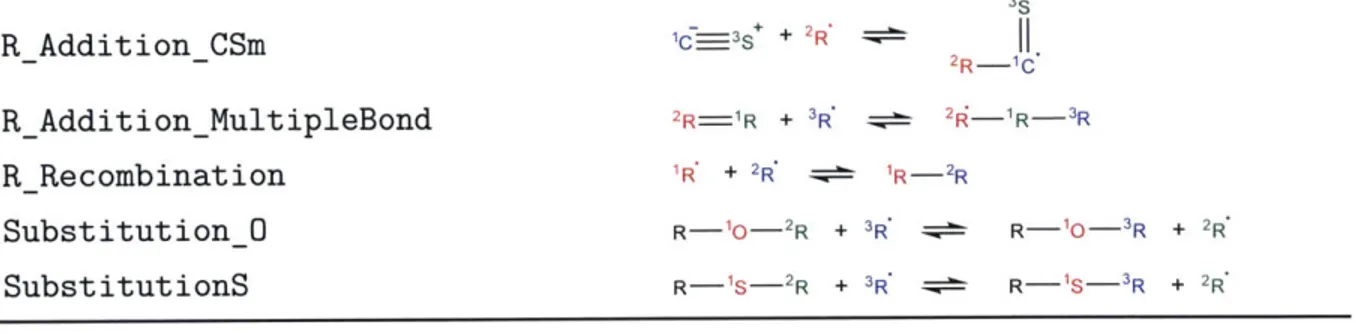
2.1 Atom types used in RMG group definitions ... 26 2.2 RMG Reaction Families ... ... 32 2.3 Comparison of model generation times for n-heptane pyrolysis with
reac-tion filtering turned off and on in the rate-based enlarging algorithm. . . 38 3.1 Initial concentrations (molecules/cm3) in the cineole Cl-initiated oxidation
experiments. Helium was added to reach a total pressure of 4 Torr in all experim ents. . . . . 55 3.2 CBS-QB3 Arrhenius parameters and rate coefficients at 600K for hydrogen
abstraction reactions by chlorine and methyl radical from cineole. The resulting radicals RI to R5 are shown in Figure 3.6. A two-transition state approach was used to obtain data for reactions involving Cl radicals. For hydrogen abstraction from cineole leading to R5 no inner transition state could be found. ... . .. . . . .. . . . . 58 3.3 Important reactions for major alkyl radicals of cineole. High-pressure limit
Arrhenius parameters and rate coefficients at 600 K for the /3-scission reac-tions were calculated using the CBS-QB3 method. Values in parentheses were calculated using BMK/6-311G(2d,d,p). . . . . 61 3.4 Thermochemistry of important radicals in cineole oxidation chemistry.
AH in units of kcal/mol, and AS, C, in units of cal/(mol - K) . . . . 62 4.1 RMG model generation conditions for the four subnetworks in the JP-10
m echanism . . . . 79 4.2 Species that have been experimentally observed but are missing in the
model. The peak concentrations listed are from the shock tube pyrolysis experiments. The initial JP-10 feed was 0.2 mol%. Structures are deduced from experiment based on mass spectrum and retention time in GC/MS. 90 4.3 Summary of experimental conditions for JP-10 ignition delay datasets
available in literature. . . . . 94 5.1 PDD conversion in Lewan and Reeves experiments. Experiments with
DEDS contain an initial mole fraction of DEDS~ 0.085. . . . . 108 5.2 Experimental molar yield of product species after PDD neat pyrolysis and
decomposition in the presence of DEDS at 350 'C after 72 hours of reaction tim e. . . . . 109
5.3 The -scission and ipso-isomerization reactions of the PDD initial radicals leading to products detected in experiment. PDDradl has a radical closest to the phenyl group, while PDDrad12 has a radical furthest away from the phenylgroup. . . . . 118 6.1 Uncertainty factors for RMG kinetic parameters . . . . 137 6.2 Global vs. local output uncertainty for phenyldodecane and undecene in
-toy m odel . . . . 150 6.3 Global reaction sensitivity indices for toy model: phenyldodecane and
undecene... ... 151 6.4 Global thermochemistry sensitivity indices for toy model: phenyldodecane
1
INTRODUCTION
Growing awareness of climate change and the risks associated with our society's dependence expansion on a resource-limited planet has motivated global initiatives to develop technologies that decrease our dependency on fossil fuels. Particularly imminent is the need to curb greenhouse gas emissions. A limit of 2 'C warming as measured from preindustrial times has been set in the 2009 Copenhagen Accord; any further warming would lead to "dangerous" implications on the global climate system. Rising global temperatures could lead to the break up of the West Antarctic ice sheet, which may lead to devastating ripple effects such as the rise of sea levels by as much as 12 feet, flooding most coastal cities. A 2013 report by a United Nations panel on climate change [1] claimed a rise of up to a meter in global mean sea level by 2100 if current greenhouse gas emissions rates continue. More ominous is the recent 2016 climate change model [2] which doubles that projection. Although the 2015 Paris Climate Deal signed by both the United States and China has resolved to curb emissions, a full throttle global effort is necessary to develop economically viable renewable energy for replacing carbon-intensive energy sources.
In 2015, renewable energy represented the majority of new electricity generation capacity added around the world, due to strong investments in developing countries such as China, India, and Brazil. [3] However, a major hurdle remains in transporta-tion fuels. Although fuel cell technology and electric vehicles are becoming more prominent, the transportation sector is expected to rely heavily on combustion en-gines in the near future, particularly in the freight and airline industries. Shown in Figure 1.1, the transportation sector contributes to more than 28% of total energy consumption in the United States. Despite the introduction of ethanol and biodiesel, renewables contributed to only 5% of the overall US transportation sector energy usage in 2013. [4] The steep rise of oil prices in 2008 spawned not only renewable energy research but also the increased refining of heavier crudes, extraction of oil from
tar sands, and fracking of shale oil and gas. The refiming of these inconveiitional oil
solirces have actually led to an increase in emilissiois associated with extract ion and refining of oil bv nearly 33%, over the last decade. [5] Consequently. the crilde oil price drop of 2014 has done little to curb fossil fuel demand. Therefore. it is ill) to policy-makers to implement new measures to combat climate cliaige al(l for researchers to develop affordable, clealler co(liblistiOnl.
Percent of Sources Percent of Sectors
Total 97.5 Transportation 26.9 (28%) Industrial 21 5 (22%) Source ector
Figre 1.1: United States primary energy consumuptioi by source and sector in 2013. Total nisage was 97.5 quadrillion Btu. Fignre taken from the Energy Information Administration.
A multi-pronged approach is requiired to tackle the clean energy problem: (1)
management of existing petroleimi resources, (2) developmeiit of alternative green fuels, (3) improvement of emissions controls inl existiig engine designs. and (4) de-velopment of more efficient and cleaner novel engine technologies. New teclnmologies such as the homogeneous charge compressiol ignition (HCCI) emgnme can operate at uil) to 15% improved fue, efficiency over the spark igiition elgline while maintainiig
cleaner emissiomis. [6] In addition. the HCCI engine is compatible with a wide variety
*of alternative fuels unlike coimveiitiomal diesel al(l spark igilitioni eligilies. p)rovi(ling new avenues in the search for rencwable fuels. Ignitioi in HCCI engines occnrs via auto-ignitiol after the mechaiical compressioln of a homnogeneons gas mixture. The challenge associated with auto-ignition iin HCCI engines amid similar novel emigille
teclologies is that their ignition timing is fuel dependelt. Extensive knowledge of
suc-cessfully, and engine characteristics must be adjusted to the fuel used. Although the combustion kinetics of conventional fuels such as gasoline is well known, detailed investigation of new fuel candidates is required.
One approach that ameliorates the expense of expensive engine tests and ex-perimental data collection is predictive detailed kinetic modeling. Detailed kinetic models consist of reaction networks with rate coefficients and equilibrium constants that describe the system at a set of reaction conditions. These models can be used to simulate macroscopic behaviors such as ignition timing or the formation of soot. Being able to predict the behavior of fuels within engines provides a means to quickly screen fuel candidates.
1.1
Automatic mechanism generation
Detailed combustion models become very tedious to construct manually as the num-ber of reaction species and intermediates increase. These processes involve complex free-radical reactions between hundreds of reaction intermediates, coupled with ther-modynamic and heat and mass transfer effects. In the past, models were often greatly simplified due to lack of computing power as well as lack of understanding of under-lying chemistry. Today, numerical solvers and computational chemistry has advanced to the point where detailed kinetic models can now be constructed and applied to complex systems. Some detailed kinetic models are constructed by hand through carefully keeping track of all species and reactions and incorporating relevant chem-istry. This process is often tedious and error-prone and additionally requires expert and up-to-date understanding of chemistry. These challenges can be avoided by using automatic reaction mechanism generation, which comprehensively constructs kinetic models using a set of reaction templates and kinetics rules, relying on a database that is continually updated. Automatic reaction mechanism generation can be used as a high throughout method for screening potential fuel targets for advanced engines, as well as for developing kinetic models for regimes where it is expensive or unwieldy to perform experiments.
1.2
High fidelity predictive kinetic modeling
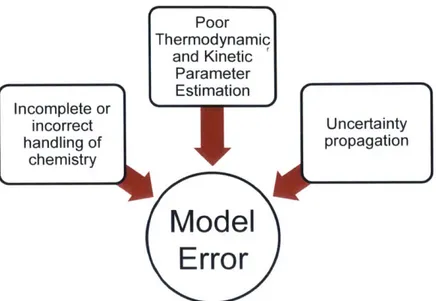
Several sources can contribute to model error during automatic mechanism genera-tion, including (1) incomplete or incorrect handling of chemistry, (2) poor thermo-dynamic and kinetics parameter estimation, and (3) uncertainty propagation (Figure 1.2).
I Poor Thermodynamic and Kinetic Parameter Estimation Incomplete or incorrect Uncertainty handling of propagation chemistry
Model
Error
Figure 1.2: The three major sources of model error ill autoumatic reactioll mechanism genieration.
Uncertaiuty analysis cani hell) idelitify the largest coiitributing sources of output error from the miodel inputs. Theriodynaic aiid kinet-ics paraieter estimat ion can
be imllproved through algoritluniic ul)(lates to chelilistry treatment adi(I cot mined
ad-ditions to the cheinstry database. Identifyinig iiicorrect or iincomlplet e chemistry is the iiiost difficult. as there are n(o svsteiatic mlethods for ildeutifying unknown chem-istrv without exteisive iiiodel develo)iiellt and ex)erimleital validatioll. However, through nmlodeling of iew molecules alid physica l systems. coiii)uter ul(lerstauldiig of chemistry will gradually improve. Addressing all three sources of error is necessary for the generation of high fidelity predictive kinetic iodels.
1.3 Thesis overview
i\ v thesis has imiade several contributions toward (evelo)ing iethodologies for high fidelity predictive mlodehilig within EMG. To I)ut these mlethodologies into practice,
my thesis also highlights three combustion related process iodeled by RMG.
iiclud-ing uniderstain(ig ketone aii( cyclic ether cemistry through the study of 1)iofliel can(lidates dliiso)ro)yl ketone and cineole, combustion mnodeling of the fused tricychic jet fuel JP-10, alld iodeliig the geological oil to gas cracking process via the heavy
oil analog I)hellyldodecalle.
Chapter 2 discusses the fraiework for automatic mechanism generation. focusing on the software )ackage Reaction Mechanism Generator (RNIG) developed at MIT
and used throughout this thesis. The features of the Python version of RMG are summarized in this chapter, including several new features that differentiate it from the former Java version: a new species representation that is capable of describing lone pairs and formal charges on molecules, a modification to the rate-based model enlarging algorithm which filters reaction to speed up model generation, and a web interface that allows users to draw molecules and generate adjacency lists, search RMG's databases, and visualize RMG-generated models online. RMG is capable of generating reaction mechanisms for C, H, 0, N, S, and Si chemistry and modeling both gas and liquid-phase kinetics, thermochemistry, and transport.
Chapter 3 presents the role of automatic mechanism generation in a biofuel collab-oration that uses mutual feedback between biologists, combustion experimentalists and theorists to screen fungi-derived biofuel candidates for use in HCCI engines. RMG is used to generated detailed low temperature oxidation models for diisopropyl ketone and cineole. Quantum chemical calculations are used to derive the initial hydrogen abstraction reaction rate coefficients and used as a base reaction network for which the final reaction mechanism is generated. The model is evaluated against chlorine-initiated oxidation experiments and is qualitatively able to identify a vari-ety of species intermediates, demonstrating the capability of automatic mechanism generation to model new chemistries in practice.
Chapter 4 presents a comprehensive combustion model of JP-10, a tricyclic syn-thetic aviation fuel prized for its high volumetric energy density and low freezing point. Significant ongoing research is focused on the development of ramjet, scramjet and pulse detonation engines that burn JP-10 fuel. However, the testing of these engines is very expensive and time-consuming and have been prone to ignition prob-lems, prompting the development of kinetic models to better understand the fuel's chemical behavior. A comprehensive detailed model was generated using RMG and extensively validated against a new set of shock tube experimental data and flow tube pyrolysis and ignition delay data from literature. Since JP-10 is a fused tricyclic compound, this presented additional challenges for estimating thermochemistry and kinetics accurately during automatic mechanism generation.The final model succeeds in capturing key trends in product distributions. We are also able to predict specia-tion of aromatic compounds, which are the precursors to polyaromatic hydrocarbons (PAH's) and soot, both potent atmospheric pollutants. Finally, we use our model to predict ignition delays over multiple experimental datasets, with general agreement within a factor of 4.
decomposition of kerogen and oil at geological conditions, a topic of great interest for petroleum reservoir modeling and prospecting. Organic sulfur is thought to be an accelerant in kerogen decomposition due to the facile nature of mercapto radical generation; however, the mechanism by which this occurs is relatively unknown. In this study, we investigate the influence of organic sulfur (diethyl disulfide, DEDS) on the decomposition of a heavy oil analog (phenyldodecane, PDD) through a combi-nation of confined anhydrous pyrolysis experiments in gold capsules and automatic mechanism generation. RMG was used to automatically construct a full decomposi-tion mechanism of PDD neat pyrolysis and decomposidecomposi-tion in the presence of DEDS. We show that DEDS does not substantially accelerate PDD decomposition at 350'C
(after 72h), in contrast to previous investigations in fixed volume reactors, but does exhibit statistically significant acceleration effects on decomposition at 250 C (after
1001h), hinting that free radical timescales may affect oil decomposition.
Chapter 6 presents methods for uncertainty analysis within RMG. Uncertainties within a kinetic model can become exaggerated for some input parameters while becoming irrelevant for others, due to the nonlinearity of chemical kinetic systems. Uncertainty analysis is the most efficient way to improve a model because it seeks to identify the greatest sources of model output error. This is especially significant in automatically generated mechanisms, where uncertainties are correlated because kinetics rate rules and thermodynamic group values can be used to estimate values in multiple input parameters. Local first order uncertainty propagation was imple-mented in RMG with respect to kinetic parameters and species thermochemistry. A cythonized wrapper PyDAS [7] was written for the DASPK3.1 [8] fortran code, a solver with native sensitivity analysis, to compute sensitivities in RMG. Global un-certainty propagation was also implemented using adaptive Smolyak pseudospectral approximations [9] to generate global sensitivity indices for the input parameters. A toy model was used to evaluate results from the two uncertainty propagation meth-ods. Local uncertainty analysis was also used to investigate the effect of correlated uncertainties.
Finally, Chapter 7 discusses several recommendations for future work in predictive chemical kinetics.
1.4
References
[1] J. Church, P. Clark, A. Cazenave, J. Gregory, S. Jevrejeva, A. Levermann, M. Mer-rifield, G. Milne, R. Nerem, P. Nunn, A. Payne, W. Pfeffer, D. Stammer, and A.
Contribution of Working Group I to the Fifth Assessment Report of the Intergov-ernmental Panel on Climate Change. Cambridge University Press, 2013, pp.
1137-1216.
[2] R. M. Deconto and D. Pollard. "Contribution of Antarctica to past and future sea-level rise." Nature 531, 2016, pp. 591-597. DOI: 10.1038/nature17145.
[3] F. S. F.-U. C. C. for Climate & Sustainable Energy Finance. Global Trends in
Re-newable Energy Investment. 2016, pp. 1-84.
[4] U.S. Energy Information Administration. Annual Energy Outlook, 2013.
[5] D. Gordon, A. Brandt, J. Bergerson, and J. Koomey. "Know Your Oil: Creating a
Global Oil-Climate Index", 2015.
[6] D. Flowers, N. Killingsworth, and R. Dibble. "In Pursuit of New Engine Dynamics."
Mech. Eng. 129, 2007.
[7] J. W. Allen and C. W. Gao. PyDAS: A Python wrapper for the DASSL, DASPK,
and DASKR differential algebraic system solvers. 2016. URL: https: //github. com/
ReactionMechanismGenerator/PyDAS.
[8] L. Petzold and S. Li. DASPK3.1. URL: http://www.cs.ucsb.edu/-cse/software.
html.
[9] P. R. Conrad and Y. M. Marzouk. "Adaptive Smolyak Pseudospectral Approxima-tions." SIAM J. Sci. Comp. 35 (6), 2013, A2643-A2670. DOI: 10.1137/120890715.
2
REACTION MECHANISM GENERATOR: AN OPEN SOURCE SOFTWARE PACKAGE FOR AUTOMATIC MECHANISM
GENERATION
This chapter introduces the primary software used in this thesis for modeling the chemistry of combustion processes: Reaction Mechanism Generator. RMG is an au-tomatic reaction mechanism generator which uses known chemistry knowledge stored
in a database along with parameter estimation methods to generate detailed chemical kinetic mechanisms which can then be used as input to third party reactor software
(e.g. CHEMKIN, Cantera, ANSYS Fluent) to simulate predictions for macrovariables
of interest such as product composition, ignition behavior, or flame speed.
The four principal capabilities required for any automatic reaction mechanism generation code are [1]: a way to uniquely and unambiguously represent chemical species, a method to determine what reactions can occur between species, a means to estimate the kinetic and thermodynamic parameters, and a metric by which to include or exclude species and reactions in the model.
RMG uses a functional group based methodology to work with species and reac-tions. In this approach, reaction families are defined by templates that manipulate matching functional groups to convert molecules from reactants to products. Chem-ical graph theory is used to represent molecules and functional group substructures, with vertices representing atoms and edges representing bonds. This allows for graph isomorphism comparisons: for identifying functional groups when estimating param-eters, and for comparing species against one another. Thermodynamic parameters are estimated for chemical structures using the Benson group contribution method [2, 3] or on-the-fly quantum chemistry calculations [4]. The species and reactions included in the final model are chosen by expanding the model using the rate-based algorithm of Susnow et al. [5]
2.1
Background
Several automatic reaction mechanism generation codes have been developed in the past, some proprietary and some open-source, including MAMOX, NetGen, REAC-TION, and EXGAS. Broadbelt and Pfaendtner [6] provide an introduction to the general concepts and terminology of kinetic model generation, and several recent re-views describe the commonalities, differences, and histories of these software projects [7-10].
The open-source software package RMG was developed in the Green Group at MIT to to help researchers model physical processes through automatic mecha-nism generation. All 60,000 lines of Python code are open-source and hosted on Github (https: //github. com/ReactionMechanismGenerator/RMG-Py). RMG was originally developed in Java by Jing Song [11] in 2004, following approaches pio-neered by NetGen and the ExxonMobil Mechanism Generator (XMG) in the 1990s [12, 13]. An object-oriented programming style was used prioritizing flexibility and extensibility of chemical rules and code re-usability. Over the years, several de-tailed kinetic models generated by RMG have been published in literature, including models for butanol [14], ketone biofuels [15], JP-10 jet fuel [16], and neopentane
[17]. The source code for the Java version of RMG can be found both on Github (https: //github. com/React ionMechanismGenerator/RMG- Java) and Sourceforge
(http: //rmg. sourcef orge .net/), with over 7000 downloads from Sourceforge alone
over the last two years. In 2008, Joshua Allen and Richard West began writing a Python version of RMG, known as RMG-Py [18]. This was motivated by improved code readability, better error handling, and broader access to a variety of existing chem-informatics libraries. This chapter presents the features and usage of the new Python version of RMG.
2.2
Overview
An overview of the RMG workflow is presented in Figure 2.1. First, ab initio cal-culations or experimental data is inputted into the RMG databases. RMG uses a combination of chemistry knowledge, functional group-based assumptions, and the flux-based algorithm to build detailed kinetic models for use in simulating macrobe-haviors of interest.
G
Chemistry knowledge Functional group assumption 1. Thermodynamic and kinetic estimation2. Build reaction network
H
A QD E B E
C G
Flux-based algorithm ... ...
Figure 2.1: Overview of the RIG workflow.
2.2.1 Species and functional group representation
Clheinical grapl theory is uise(l in for species and functional group representation., With
gra)lh vertices re)resentilig atoms and edges repnreselnting boids. Graph isomJonrpIlisll checks between reacting molecules and grollu) deffiitiolns cani quickly identify func-ti onal group-specific rea(func-tion sites. wich allows for funcfunc-tional-group i ased tlhermlno estimation and kinetics. Currently, the VF2 algorithm [19] for graph aid sllbgraplh isoiorphisms is iiplemented.
2.2.1.1 Molccilc adjacercy lists
Molecules are described using "adjacency lists," a graph representationi of the atoms
an( bonds that connuect them. A set of molecule objects which are resoiance isomers form a single sl)ecies. This species contains its owin thermocheical (i.e. enthalpy. entrol)y, and heat capacities) and statistical nmechanical (i.e. frequencies almd energies) iniforiation. The adj acencv list for a methyl radi al CH3 is depicted iII Figure 2.2.
Tme first colunn indicates the atom iindex. tie secoi( colunmim ilndicates the atomic elememit, the 3rd colummn in(licates the number of unpaired electrons associated each atom and is )rece(led by the lovercase letter u representing "nlIaire(i", the 4th
col-Ab initio rate
calculations H T=ET
3. Simulate predictions
Oil-to-gas cracking rates, product distributions
Detailed kinetic mechanism 0
multiplicity 2 2H 1 C ul p0 cO {2,S} {3,S} {4,S} 2 H uO pO cO {l,S} j 11 3 H uO 0 cO {l,S} "H-C-4 H uO p0 cO {1, S} atom index Hi element unpaired electrons pairs of electrons---
charge-bonded atom index
bond order
Figure 2.2: Adjacency list (left) and graph (right) of a methyl radical.
umn1 indicates the number of lone pairs associated with each atom and is preceded by
the lowercase letter p representing '-pairs". and the 5th coluin indicates the fornal charge on the atom preceded by the lowercase letter c representing "-charge". The values in brackets indicate the presence of a bond. with the first value in brackets indicating the atom in(lex of the atom to which the current atom is bonded. and the
second value indicating whether the bond is single S. double D, triple T., or benzene
B. Finally, the molecule has an overall spin multiplicity defined above the adjacency list. In the above adjacency list, the carbon atom has a single inpaired electron and
3 single bonds to hydrogen atoms, forming a methyl radical.
2.2.1.2 Grwup adlaccncy lists
Similar to molecule adjacency lists, functional groups can also be described by
ad-jacency lists. but group atom types are used in the adjacency list instead of atomic elements. These atom types can describe more a more general set of elements and can sometimes provide additional local )ond structure requirements. The use of atom types accelerates graph isomorphismn. or equivalency. checks and helps define both broad and general functional groups. The list of atom types used in 13MG are
defined in Table 2.1. Shown in Figure 2.3 is an example of a group adjacency list. utilizing the R! H. Cd, and Od atonmtypes described in Table 2.1.
Note that ini a group adjacency list. multiplicity. bonds. atom types. and even unpaired electrons can be a set of values. In order to distinguish from the notatioll used for bonds. square brackets are used for a grouping of values. In a group. only the miumiber of lllnpaired electrons and bond information are required. Values that are unspecified. such as the number of lone pairs and charges on each atom in the
adjacency list above. are assumed to be wildcards. The notation x can also be lsed in place of a wildCard.
Table 2.1: Atom types used in RMG group definitions
Atom type Description
R any atom with any local bond structure
R! H any non-hydrogen atom with any local bond structure H hydrogen atom with any local bond structure
C1 chlorine atom with any local bond structure He helium atom with any local bond structure Ne neon atom with any local bond structure Ar argon atom with any local bond structure
Carbon atom types
C carbon atom with any local bond structure
Cs carbon atom with only single bonds
Cd carbon atom with one double bond
CO carbon atom with one double bond (to oxygen)
CS carbon atom with one double bond (to sulfur)
Cdd carbon atom with two double bonds Ct carbon atom with one triple bond
Cb carbon atom with two benzene bonds
Cbf carbon atom with three benzene bonds Silicon atom types Si silicon atom with any local bond structure
Sis silicon atom with only single bonds Sid silicon atom with one double bond
SiO silicon atom with one double bond (to oxygen) Sidd silicon atom with two double bonds
Sit silicon atom with one triple bond Sib silicon atom with two benzene bonds Sif silicon atom with three benzene bonds
Nitrogen atom types
N nitrogen atom with any local bond structure
Nid nitrogen atom with one double bond and two lone pairs N3s nitrogen atom with up to three single bonds
N3d nitrogen atom with one double bond and up to one single bond N3t nitrogen atom with one triple bond
N3b nitrogen atom with two benzene bonds N5s nitrogen atom with four single bonds
N5d nitrogen atom with one double bond two single bonds
N5dd nitrogen atom with two double bonds
N5t nitrogen atom with one triple bond and one single bond
N5b nitrogen atom with two benzene bonds and one single bond Oxygen atom types
0 oxygen atom with any local bond structure
Os oxygen atom with only single bonds
Od oxygen atom with one double bond Ot oxygen atom with one triple bond Da oxygen atom with no bonds
Sulfur atom types
S sulfur atom with any local bond structure
Ss sulfur atom with only single bonds
Sd sulfur atom with one double bond Sa sulfur atom with no bonds